Article

Comparative Analysis of Satellite DNA in Dasypyrum Species: Identification of Chromosomal Markers for V and Vb Subgenomes


by
Anna I. Yurkina
1,†,
Viktoria M. Sokolova
1,†,
Ekaterina D. Badaeva
1,2,
Daniil S. Ulyanov
1,
Gennady I. Karlov
1,
Mikhail G. Divashuk
1 and
Pavel Yu. Kroupin
1,*
1
All-Russia Research Institute of Agricultural Biotechnology, Timiryazevskaya St. 42, 127434 Moscow, Russia
2
N.I. Vavilov Institute of General Genetics, Russian Academy of Sciences, Gubkin St. 3, 119991 Moscow, Russia
*
Author to whom correspondence should be addressed.
These authors contributed equally to this work.
Plants 2025, 14(24), 3819; https://doi.org/10.3390/plants14243819
Submission received: 19 November 2025 / Revised: 7 December 2025 / Accepted: 11 December 2025 / Published: 15 December 2025
(This article belongs to the Section Plant Molecular Biology)

Abstract

The genus Dasypyrum represents a valuable source of beneficial traits for wheat improvement, yet the cytogenetic organization of its genomes, particularly of the satellite repeats, remains poorly understood. This study aimed through comparative analysis of satellite DNA in diploid D. villosum (W6 21717, V genome) and tetraploid D. breviaristatum (PI 516547, VVb genomes) to reveal the evolutionary dynamics of their subgenomes and to identify species-specific chromosomal markers. We performed whole-genome sequencing, bioinformatic analysis, and fluorescence in situ hybridization (FISH). Bioinformatic screening identified 14 satellite repeats in the D. breviaristatum genome (CL9, CL95, CL100, CL110, CL127, CL133, CL134, CL135, CL147, CL153, CL165, CL169, CL173, and CL197), which were classified by copy number: one as high-copy (CL9, ≥0.6%) and the rest as low-copy (<0.29%). Their monomer sizes ranged broadly from 118 to 1118 base pairs. Most repeats showed varying degrees of homology with known sequences from the Triticeae family, and one repeat, CL165, had no detectable homologs in existing databases. FISH analysis subdivided repeats into three groups: predominantly terminal (CL100, CL110, CL134, CL135, CL147, CL165, CL169, CL173, and CL197), pericentromeric (CL127 and CL133), and mixed localization (CL9). Significant species-specific differences were revealed, including emergence of tetraploid-specific repeats (CL110, CL134, CL135, CL147, CL165, and CL173) and the reorganization of conserved sequence distribution. Notably, the repeat CL135 was identified as a specific marker for the V subgenome within the allopolyploid D. breviaristatum. The obtained data support the allopolyploid origin of D. breviaristatum and demonstrate that these two species are genetically distinct but evolutionarily closely related. Chromosomal markers developed based on newly discovered satellite repeats open new avenues for investigating genomic architecture and evolutionary relationships within the genus Dasypyrum, as well as for identifying its chromatin in distant hybrids.

1. Introduction

The genus Dasypyrum (syn. Haynaldia), being a wild relative of wheat, includes two species: the annual Dasypyrum villosum (2n = 2x = 14) and the perennial D. breviaristatum (2n = 2x = 14 and 2n = 4x = 28) [1,2,3,4]. Due to significant genomic diversification, the genomes of D. villosum and diploid D. breviaristatum were designated with the symbols V and Vb, respectively [5]. For a long time, the genomic structure of tetraploid D. breviaristatum remained incompletely understood; in particular, it was not clear whether it was an auto- or allopolyploid [1,6,7,8]. However, subsequent studies on the genomic organization of Dasypyrum showed that tetraploid D. breviaristatum has an allopolyploid structure—VVb [9]. This conclusion was supported by phylogenetic analysis, which revealed significant divergence between D. villosum and D. breviaristatum despite their close relationship [5].
Interest in this genus is driven by the fact that cultivated wheat (Triticum aestivum L.), being one of the world’s most important cereal crops, faces threats from the spread of diseases and climate change [10]. Long-term selective breeding has led to a narrowing of its genetic diversity. Because of this, wild relatives of particular Dasypyrum species are of particular value as sources of new beneficial genes for expanding the wheat gene pool [11,12]. Dasypyrum species possess valuable agronomic traits such as disease resistance, high protein content, and drought tolerance, which can significantly enrich the genetic diversity of the wheat gene pool for breeding purposes [13,14].
A classic example of successful introgression of resistance genes from D. villosum into wheat is the development of the translocational line T6VS·6AL, which carries the Pm21 gene [15,16]. This gene provides a high level of resistance to powdery mildew caused by the pathogen Blumeria graminis f. sp. tritici (Bgt) and has been widely used in Chinese wheat breeding programs [17,18]. The T4DL·4V#6S and T7DL·7DS-4V#6L translocation lines with the Pm4VL gene are also known [19]. In addition, the genetic potential of D. villosum is not limited to chromosome 6V, as the chromosome 5V also contains valuable resistance genes such as Pm55 and Pm5V [20].
Stem rust, caused by Puccinia graminis f. sp. tritici, is one of the most destructive wheat diseases. The emergence of the Ug99 (TTKSK) race and its derivatives has led to the loss of effectiveness of many resistance genes, such as Sr24, Sr31, and Sr38 [21,22,23]. However, D. villosum exhibits resistance to Ug99, conferred by the Sr52 gene located on the long arm of chromosome 6V [24,25] and the SrTA10276-2V gene on chromosome 2V [26].
Stripe rust resistance genes have been identified on D. villosum chromosomes 1V, 3V (YrCD-3), 5V (Yr5V), and 7V (Yr7VS) [27,28,29,30]. The common wheat–D. breviaristatum 2Vb(2D) substitution line D11-5 was reported to exhibit high resistance to this disease and good agronomical traits [31]. In addition, Dasypyrum species showed resistance to wheat spindle streak mosaic virus (Wss1) [32], eyespot (Pch3 = PchDV) [33], cereal cyst nematodes (CreV) [34], Fusarium head blight [35], and leaf rust [36]. They also exhibit tolerance to salt, drought, and heat stressors [37,38,39,40], confirming their value as a source of traits for wheat breeding.
FISH (fluorescence in situ hybridization) techniques, utilizing both universal and species-specific probes, are widely used for the precise identification of chromosomes and the analysis of their structural rearrangements [41,42,43,44,45,46]. Detailed karyotyping of Dasypyrum species provides a foundation for subsequent comparative and evolutionary studies within the genus and with other members of the tribe Triticeae.
Analyses of repetitive DNA sequences, particularly satellite repeats, are an important direction in cytogenetic research of Dasypyrum, because they are used as markers for chromosome identification and serve as indicators of evolutionary changes and chromosomal rearrangements. Repeats constitute a significant portion of plant genomes and reflect both the degree of relatedness between species and internal organization of their chromosomes [47,48,49,50,51]. FISH techniques enable the visualization of these repeats, allowing comparison of their distribution in closely related species. The similarity or difference of chromosomal arrangement of the same satellite sequences on chromosomes of related species provides valuable insights into the degree of relatedness of their subgenomes and the evolutionary processes that have shaped their genetic architecture [52,53,54]. Therefore, analysis of repeat distribution using FISH could be a key tool for understanding phylogenetic relationships and genome divergence within the genus Dasypyrum.
The aim of this study is to conduct a comparative cytogenetic analysis of satellite repeats in diploid D. villosum and tetraploid D. breviaristatum to reveal the evolutionary dynamics of their subgenomes and develop species-specific chromosomal markers. To achieve these goals, it is necessary to: (1) identify and characterize a set of satellite repeats in the D. breviaristatum genome using whole-genome sequencing and bioinformatic analysis; (2) perform detailed cytomolecular karyotyping by mapping the chromosomal distribution of these repeats in both species using in situ fluorescent hybridization (FISH); (3) to conduct a comparative analysis of the FISH structure in order to identify conservative and species-specific organizational features.

2. Results

2.1. Satellite Repeats Characterization

Based on the whole-genome sequencing data, we identified fourteen repeats in D. breviaristatum: ten high-probability satellite repeats (CL9, CL95, CL110, CL127, CL134, CL135, CL147, CL165, CL169, and CL197) and four low-probability satellite repeats (CL100, CL133, CL153, and CL173). Characteristics of the identified repeats are provided in Table S1, including repeat monomer consensus sequences, TAREAN graphs, repeat copy numbers in the genome, homology with published sequences in the NCBI database, and sequences from other studies.
Based on bioinformatics analysis, all repeats were classified as low-copy (<0.29%), medium-copy (0.3–0.59%), and high-copy (≥0.6%). CL9 was identified as the only high-copy repeat, while all other repeats were low-copy.
Additionally, the monomer sizes of all satellite repeats were determined (Table S1). High-confidence satellite repeats are represented by sequences ranging from 178 to 863 base pairs (bps): CL9 (337 bps), CL95 (358 bps), CL110 (570 bps), CL127 (863 bps), CL134 (568 bps), CL135 (380 bps), CL147 (376 bps), CL165 (842 bps), CL169 (178 bps), and CL197 (566 bps). Low-confidence repeats have the following sizes: CL100 (118 bps), CL133 (504 bps), CL153 (1118 bps), and CL173 (118 bps). Thus, the overall range of monomer sizes for all identified satellites varies from 118 to 1118 bps.
Comparison of the nucleotide sequences of the newly discovered repeats with those previously published in the NCBI database revealed that only CL165 showed no homologs. For the remaining repeats, the percentage identity with known similar sequences ranged from 65% to 98%, indicating that they diverged from previously reported sequences.
Assessments of the homologies of the repeats we identified in D. breviaristatum revealed that most sequences shared significant similarity with known repetitive elements in cereal crops. These satellite repeats have been found in a wide range of species, including Thinopyrum bessarabicum (CL97, CL157, CL192), Agropyron cristatum (ACRI_TR_CL20, ACRI_TR_CL85), Aegilops crassa (CL244, CL261), and Elymus (StLIB96, StLIB117). Three of the repeats we identified (CL95, CL135, and CL147) showed homology to the satellite repeat ACRI_TR_CL20 from A. cristatum (68–90%). Repeats CL9, CL134, and CL100 demonstrated homology with the following FISH-positive sequences from wheat, pTa-173, pTa-1, pTa-505, and pTa-835, respectively (86–96%). Three repeats shared similarity with spelt-like sequences: CL135 and CL147 with Spelt52.2 from Ae. speltoides (68% and 93%) and CL169 with Tri-MS-6 from T. aestivum (75%). Repeats CL9, CL95, and CL100 exhibited similarity with retrotransposons from barley and rye (88–93%). Furthermore, repeats CL135 and CL147 showed similarity with the rye tandem repeat pSc200 (70–75%), while repeat CL110 showed similarity with pSc250 (78%).
In addition, we assessed similarity between the repeats we identified and oligoprobe sequences reported in various studies (Table S1). This analysis revealed that repeat CL9 showed similarity to the sequences of pAs1, a member of AFA-family (85–95%), as well as to oligo-pTa535 (86%). Repeats CL133 and CL169 were similar to sequences from Th. elongatum: CL133 with oligo-7E-430 (98%) and CL169 with oligo-7E-744 (97%). Repeat CL173 shared a 91% similarity with oligo-6H-2-100 from Th. intermedium. A number of repeats were similar with oligos developed for T. aestivum (Chinese Spring), specifically CL133 with oligo-5D151 (98%), CL135 with oligo-Td25 (85%), and CL147 with oligo-Td25 and DP4J27982 (98% and 100%).

2.2. Mapping of Satellite Repeats on D. villosum and D. breviaristatum Chromosomes

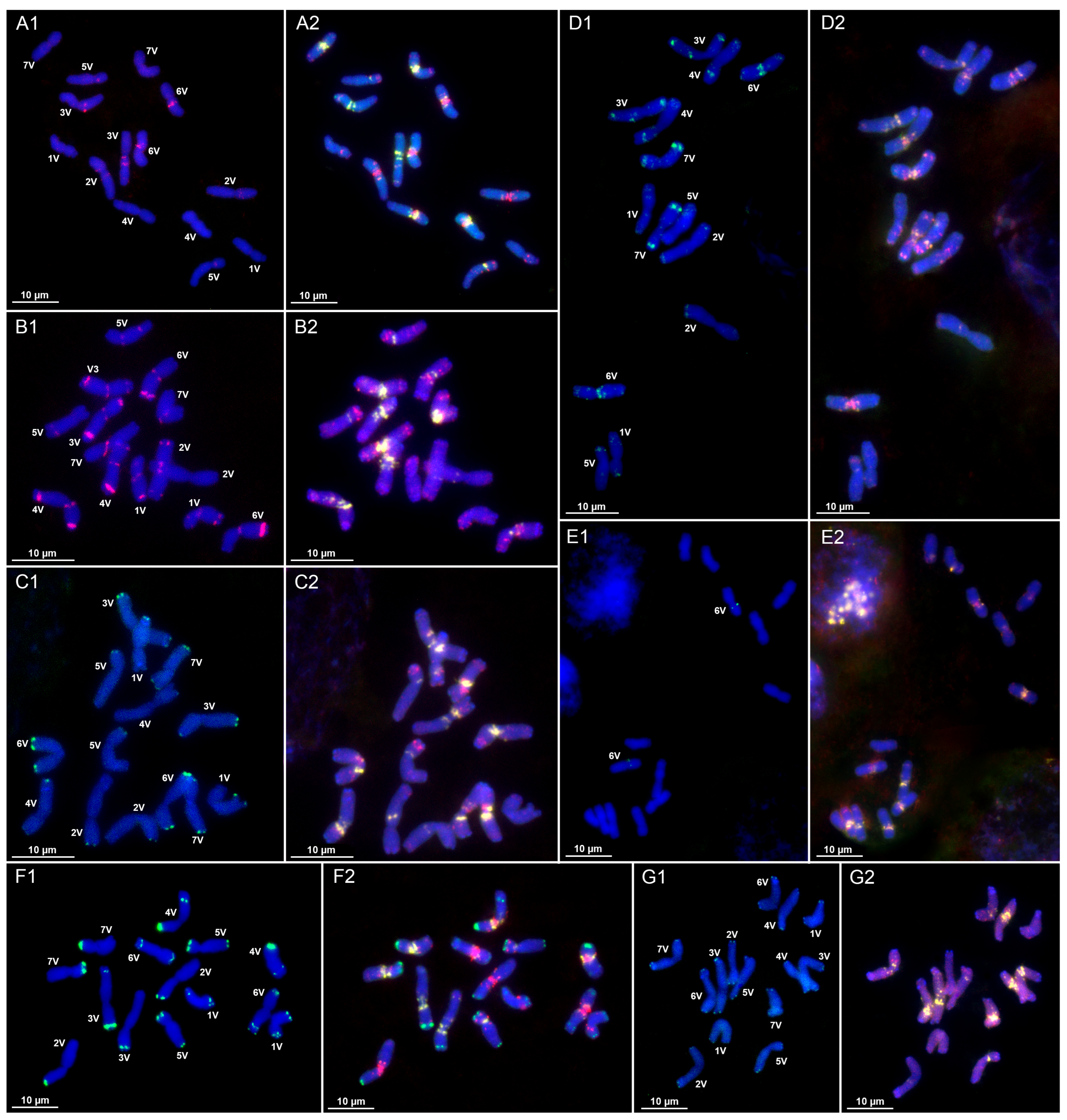
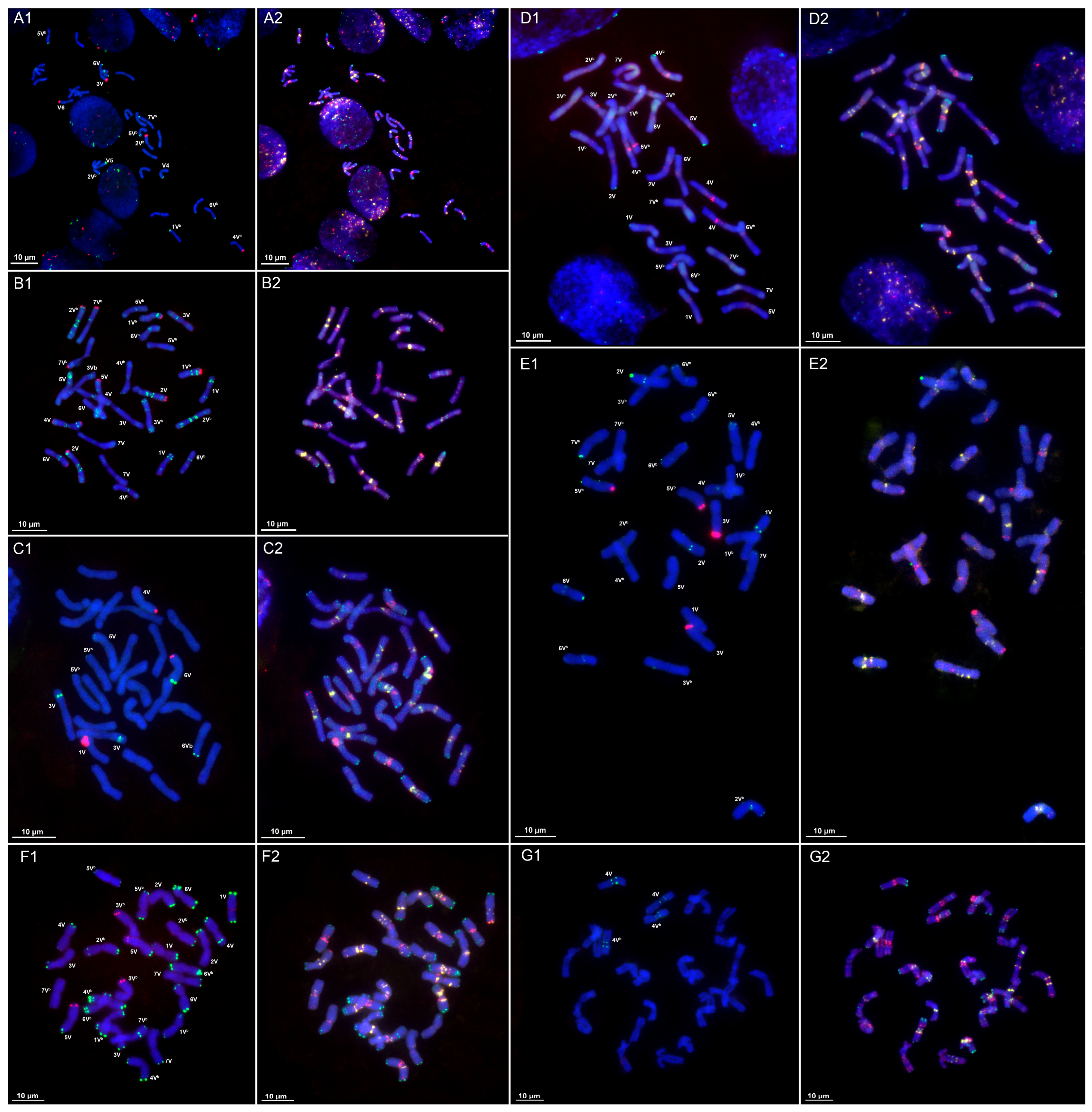
CL9: The satellite repeat CL9 occurs on all chromosome pairs of D. villosum (Figure 1D1,D2 and Figure S1). It forms terminal signals on the short arm chromosome 1V, where minor signals are also observed; chromosome 2V shows subterminal signals on both arms; chromosome 3V possesses subterminal signals on both arms with an additional interstitial signal on the long arm; chromosome 4V displays distal CL9 signals on the short arm and weak subterminal signals on the long arm; chromosome 5V shows minor signals; chromosome 6V exhibits intense pericentromeric signals along with minor signals on both arms; and chromosome 7V demonstrates the most intense subterminal signals on both long and short arms. In D. breviaristatum, CL9 is found on all chromosomes of both V and Vb subgenomes (Figure 2B1,B2 and Figure S2) and displays multiple signals with predominantly proximal and distal localization.
CL95: In D. villosum, CL95 is localized pericentromerically and subterminally on both arms of chromosomes 1V, 3V, and 4V; pericentromerically on 7V; distally on 5VL; and pericentromerically and subterminally on the long arm of 6VL. Chromosome 2V shows that the heteromorphic pattern CL95 is localized subterminally on the long arm of one homolog, while in the second we see a subterminal signal on the short arm and a weak subterminal signal on the long arm (Figure 1B1,B2 and Figure S1). In D. breviaristatum, CL95 exhibits terminal localization—on both arms of chromosome 3V, and on 6VL, 2VbL, and 4VbL (Figure 2A1,A2 and Figure S2).
CL100 forms subterminal and terminal clusters on D. villosum chromosomes (Figure 1F1,F2 and Figure S1). Terminal signals are present on 2VS, 3VS, and 7VS arms; chromosomes 1V and 6V display terminal signals on both arms, with an additional subterminal signal in the long arm; CL100 localizes terminally on both arms of chromosome 5V; and one homolog of 4V has a signal at the end of short arm, while another homolog exhibits intense distal signals on the long arm. In D. breviaristatum, CL100 demonstrates a predominantly terminal location either on both arms (1V, 3V, 4V, 6V, 1Vb, 4Vb, 5Vb, and 6Vb), on the short arm only (5V, 7V, and 7Vb), or on the long arm only (2V and 2Vb) (Figure 2F1,F2 and Figure S2). No signal was detected on 3Vb. It should also be noted that several chromosomes are heteromorphic in signal distribution: one homolog of 3V lacks a terminal signal on the short arm; chromosome 4V displays a distal signal on the short arm with the least intense terminal signal; chromosome 2Vb has a distal signal on the short arm; chromosome 4Vb shows a subterminal signal for CL100; and no CL100 signals were detected on one homolog of chromosome 7Vb.
CL110 is not detected by FISH in D. villosum (Figure 1D1,D2). In D. breviaristatum, it is located predominantly in terminal chromosome regions (Figure 2B1,B2 and Figure S2)—on both homologs of 2VS, 1VbS, and 7VbS, and on only one homolog of each of 4V, 5VS, 6VL, and 2VbS.
CL127 is distributed proximally on 6VS in D. villosum (Figure 1E1,E2 and Figure S1) and on both arms of 4V and 4Vb in D. breviaristatum (Figure 2G1,G2 and Figure S2).
CL133 produces proximal signals on chromosomes 2VS, 3VL, 5VS, and 6VL of D. villosum, with one homolog of 3V showing an additional pericentromeric signal (Figure 1A1,A2 and Figure S1). In D. breviaristatum, CL133 also exhibits proximal localization on all chromosomes, with the most intense signals on 4V, 4Vb, and 5Vb (Figure 2D1,D2 and Figure S2).
CL134: No hybridization signals for CL134 are detected on D. villosum chromosomes (Figure 1A1,A2 and Figure S1). In D. breviaristatum, CL134 localizes on 1VL, 2VL, 5VS, 6VL, 1VbL, 4VbS, and 6VbS; however, in all these chromosome pairs the signal is present on one homolog only (Figure 2D1,D2 and Figure S2).
CL135: Diploid D. villosum lacks this repeat (Figure 1C1,C2), while one homolog of each of the D. breviaristatum chromosomes pairs 1VS, 4VS, and 6VL carries terminal CL135 signals, with the most intense signal being on 1VS (Figure 2C1,C2 and Figure S2).
CL147: FISH was unable to detect this repeat on D. villosum chromosomes (Figure 1B1,B2). CL147 signals distribution on D. breviaristatum chromosomes proves to be heterozygous. Distal signals are observed on one 3VS homolog and terminal signals on one homolog of 4VS, 5VS, 1VbS, 2VbS, 6VbS, and 7VbS. A single 6V chromosome displays terminal CL147 signals on both short and long arms, and two homologs differ in signal distribution: terminally on the long or subterminally on the short arm 5Vb (Figure 2A1,A2 and Figure S2).
CL153: FISH was unable to detect CL153 in Dasypyrum species (Figure 1E1,E2 and Figure 2G1,G2).
CL165 is not found in D. villosum (Figure 1F1,F2), while in D. breviaristatum it produces subterminal signals on two chromosome pairs—5VL and 3VbL (Figure 2F1,F2 and Figure S2).
CL169 forms terminal signals on all chromosomes of D. villosum (Figure 1G1,G2 and Figure S1), while in D. breviaristatum it exhibits terminal and/or proximal location on 1V, 2V, 4V, 5V, 6V, 7V, 2Vb, 6Vb, and 7Vb (Figure 2E1,E2 and Figure S2). Chromosomes 1V, 7V, 2Vb, 6Vb, and 7Vb are heterozygous in CL169’s signal distribution.
CL173 is not detected in D. villosum using FISH (Figure 1G1,G2), while intense terminal signals appear on 3VL and 5VbL of D. breviaristatum, along with weak minor signals at 1VL, and on single homologs of each 7VL and 7VbS (Figure 2E1,E2 and Figure S2).
CL197 localizes terminally on both arms of 3V, 6V, and 7V, on the long arm of 1V and 4V, and on the short arm of 2V and 5V of D. villosum (Figure 1C1,C2 and Figure S1), with chromosome 4V being heterozygous. In D. breviaristatum, subterminal CL197 clusters appears on chromosome 2VS, and terminal clusters on both 5VbS homologs and on one homolog of each of 4VS, 5VS, and 6VbL (Figure 2C1,C2 and Figure S2). It should also be noted, however, that CL197’s signal size varies in D. breviaristatum, with the most intense signals observed on chromosomes 3V, 6V, and 6Vb.
Based on distribution pattern, all satellite repeats identified in the studied Dasypyrum species can be divided into three main groups:
Group 1—repeats with predominantly terminal and distal localization. This category includes repeats CL100, CL110, CL134, CL135, CL147, CL165, CL169, CL173, and CL197.
Group 2—repeats with pericentromeric and proximal localization—CL127 and CL133.
Group 3—repeats with complex hybridization patterns. This group includes CL9, characterized by the presence of various signal types: terminal, subterminal, distal, and pericentromeric.

3. Discussion

Satellite repeats are the most variable and rapidly evolving components. They are tandemly organized or dispersed DNA sequences that are widely distributed in plant genomes, particularly in cereals [49,55]. These repeats play a crucial role in chromosome organization, being involved in the formation and stabilization of centromeric and telomeric regions, as well as in maintaining genome integrity [56,57,58]. Due to their high variability and species-specificity, satellite repeats serve as valuable markers for studying evolution, phylogenetic analysis, and chromosome identification.
Employment of satellite repeats as chromosomal markers enables detailed analysis of plant genomes. One of the key methods for their physical mapping is fluorescence in situ hybridization (FISH), which provides high visualization accuracy and allows for studying the distribution of these sequences on chromosomes [59,60,61,62].
Our current results have provided detailed information on the genomic and chromosomal organization of Dasypyrum species. FISH analysis using satellite repeats enabled the development of new specific molecular cytogenetic markers for the V and Vb genome chromosomes of Dasypyrum. Comparative FISH analysis revealed both shared features and species-specific differences in satellite DNA organization between diploid D. villosum and tetraploid D. breviaristatum.
Of the fourteen analyzed repeats, thirteen (CL9, CL95, CL100, CL110, CL127, CL133, CL134, CL135, CL147, CL165, CL169, CL173, and CL197) showed discrete hybridization patterns on chromosomes of at least one species. The repeats CL110, CL134, CL135, CL147, CL153, CL165, and CL173 were not detected in the D. villosum genome, indicating that they are either absent or represented by an extremely low copy number in this species. In contrast, the same repeats (with the exception of CL153) displayed clear FISH patterns in the D. breviaristatum chromosome genome, often in a heterozygous state, suggesting their divergence or recent emergence in the allopolyploid’s evolution. It is also noteworthy that such a localization pattern on an odd number of chromosomes is characteristic of cross-pollinating species with heterozygous genomes [63].
The localization of group 1 repeats in telomeric regions aligns with the general trend of satellite DNA accumulation in heterochromatic areas at chromosome ends, which is characteristic of many cereal species. Comparison of sequences of the repeats assigned to this group revealed that nearly all of them share similarity with tandem repeats pSc119.2, pSc200, and pSc250 of S. cereale and FISH-positive pTa-like sequences of T. aestivum, which are widespread in the tribe Triticeae, including genera Triticum, Aegilops, Agropyron, Dasypyrum, Thinopyrum, Pseudoroegneria, and Avena, and are detected in both subtelomeric and interstitial chromosomal regions [64,65,66,67,68,69].
Repeats CL110, CL134, CL135, and CL147 also show similarity to StY repeats, with predominantly terminal localization on St-subgenome chromosomes and distal localization on Y-subgenome chromosomes of Roegneria grandis [70].
Similar repeats with terminal locations have also been found in other Triticeae species: BSCL and DP4J27982 in Th. bessarabicum Jb-genome [71,72]; STlib_96, and CL69 in P. libanotica St genome [73,74]; oligo-D1D in T. aestivum D-subgenome [75] and in D. breviaristatum V and Vb subgenomes [76]; oligo-Td25 in D. breviaristatum Vb subgenome [76]; Spelt-1 and Spelt52, Ae. speltoides S genome [77]; CL244 in Ae. crassa Xcr subgenome (also in Th. bessarabicum Jb-genome and common wheat B subgenome) [62]; and oligo-7E-744 and oligo-6H-2-100 in Th. elongatum (localized on Vb subgenome chromosomes of D. breviaristatum) [76].
It is noteworthy that no similar sequences were found for CL165, suggesting its unique origin or significant divergence from other repeats.
Given the broad spectrum of genomes containing terminal repeats, we can hypothesize ancient origin from a common ancestor for the repeats CL100, CL110, CL134, CL135, CL147, CL169, CL173, and CL197 identified in the current study. We can also hypothesize their potential role in stabilizing chromosome ends and maintaining structural integrity of genomes.
Considering group 2, the CL133 shares homology with the FAT-repeat of T. aestivum, which primarily hybridizes to proximal and pericentromeric regions of the D chromosomes, as well as to chromosomes of the C, D, N, M, S, Xcr, and U genomes of various Aegilops species, the H genome of H. chilense, the XX1 genome of H. geniculatum, and the R genome of S. cereale, and also exhibits intense dispersed signals in proximal regions of St genome chromosomes of P. spicata [78,79]. Furthermore, CL133 demonstrates similarity with the microsatellite P631 with pericentromeric distribution on chromosomes of the Jr, Jv, and St subgenomes of Th. intermedium, the Jb genome of Th. bessarabicum, the St genome of P. spicata, and on T. aestivum chromosomes (subgenome affiliation was not determined) [80]. It is also similar to the FISH-positive repetitive sequence pTa-451 of T. aestivum; oligo-7E-430 from Th. elongatum (pericentromeric localization on chromosome 6Vb of D. breviaristatum); and oligo-5D151 from T. aestivum, which localizes on chromosomes 5V, 6V, 7V, 5Vb, and 6Vb of D. breviaristatum [76]. These differences in hybridization patterns may be explained by accumulation of these sequences in the pericentromeric region of a common ancestor of Triticum, Aegilops, Thinopyrum, Secale, and Pseudoroegneria. The number and distribution of these elements changed during subsequent divergence, leading to different hybridization patterns. Although the listed repeats are homologous to each other, some are dispersed from the pericentromeric region to proximal areas.
Only one homolog of repeat CL127 was identified—it was a satellite sequence ACRI_TR_CL85 from A. cristatum. As far as its localization has not been characterized, it can be considered that we have discovered a new proximal repeat.
Furthermore, there is CL9 from group 3, characterized by the occurrence of various signal types (terminal, subterminal, distal, and pericentromeric). The corresponding hybridization pattern is supported by CL9’s homology to the Afa family repeats, pAs1 from Ae. tauschii and pTa535 from T. aestivum [81], which primarily localize in subtelomeric and interstitial chromosomal regions. These sequences are discovered in a broad range of cereal taxa, including Triticum, Hordeum, Secale, and even certain species of Leymus and Psathyrostachys, indicating their ancient origin predating the divergence of the Triticeae tribe [82,83]. Interestingly, despite the structural conservation of the flanking regions of these repeats, their central part is highly polymorphic, enabling the use of pAs1-like sequences in cytogenetics for identifying individual chromosomes and genomes [84]. Nevertheless, the localization pattern of CL9 differs from the Afa family, which may indicate divergence of the repeat we discovered from the ancestral form shared by the Afa family.
The repeat CL95 is of particular interest as it did not fit into any of the established groups due to its specific patterns in D. villosum and D. breviaristatum—exhibiting pericentromeric, distal, and subterminal localization in the diploid species, but exclusively terminal localization in the tetraploid. CL95 showed similarity with the terminal and/or subterminal BSCL5 repeat of Th. bessarabicum [72]. Different patterns of CL95 in diploid D. villosum and tetraploid D. breviaristatum can likely be explained by the reduction or redistribution of repetitive sequences, particularly from pericentromeric and interstitial regions, which often occurs during polyploidization and is accompanied by their subsequent accumulation in terminal heterochromatic blocks [85]. The similarity of CL95 with the terminal repeat BSCL5 of Th. bessarabicum suggests possible conservation of its telomere-associated function, yet the species-specific dynamics of its distribution highlight the role of polyploidization as a powerful driver of satellite sequence reorganization. In the case of D. villosum, the detection of pericentromeric sequences in telomeric regions might be attributed to their importance in fundamental cellular processes such as homologous chromosome recognition, ensuring their proper segregation in meiosis and mitosis, and maintaining chromosomal structural integrity [86].
Thus, comparative cytogenetic study of satellite repeats allows us to conclude that the diploid species D. villosum and tetraploid D. breviaristatum represent genetically distinct but evolutionarily closely related species, each characterized by the unique patterns of satellite DNA chromosomal organization. The obtained cytogenetic data support allopolyploid origin of D. breviaristatum, resulting from the hybridization of D. villosum with another, possibly yet unknown or currently extinct, diploid species. This conclusion is consistent with previously published molecular genetic and phylogenetic studies, where species of the genus Dasypyrum form a common cluster while demonstrating clear species differentiation [5,9].
The chromosomal markers developed in this study, based on satellite repeats, open new avenues for investigating genomic architecture and evolutionary relationships within the genus Dasypyrum, as well as for identifying its chromatin in distant hybrids.
Despite the robustness of the obtained chromosomal patterns and the clear differentiation between D. villosum and D. breviaristatum, several limitations of the present study should be acknowledged. First, the analysis was conducted on single accessions per species, which does not fully capture the intraspecific variability of satellite DNA and may limit the generalization of our conclusions. Second, although FISH provides high-resolution visualization of repeat distribution, the relatively low sequencing coverage used for repeat identification may have resulted in incomplete detection of low-copy or highly diverged satellite families. These constraints highlight the need for expanded population-level sampling, deeper sequencing, and integrative quantitative cytogenomic approaches in future research.

4. Materials and Methods

4.1. Plant Materials

The following plant material was used in the study: the annual species D. villosum W6 21,717 (2n = 14, genome V), originating from Ukraine, and the perennial species D. breviaristatum PI 516,547 (2n = 28, genome VVb), originating from Morocco. All accessions were kindly provided by the USDA-ARS Germplasm Resources Information Network (GRIN).

4.2. Sequencing and Bioinformatics Analysis

Genomic DNA of D. breviaristatum was extracted from young leaves using the CTAB method [87]. The concentration of the extracted DNA was assessed using Qubit 4 (“Thermo Fisher Scientific”, Waltham, MA, USA), and quality assessment was performed by electrophoresis in a 1.5% agarose gel. Whole-genome sequencing was carried out on the Illumina NextSeq platform (“Illumina, Inc.”, San Diego, CA, USA) using a NextSeq 500/550 Mid Output Kit v2.5 (“Illumina, Inc.”, San Diego, CA, USA) as described in Illumina protocols for pair-end reads. Methodological details for the bioinformatics analysis pipeline used in this study are described in detail in Supplementary Materials File S1.
The primer sequences for the identified satellite repeat monomers are provided in Table 1.
Additionally, two satellite repeats were used as oligoprobes: CL169 TAMRA (5′-AAGCCTCCCTGACGCCCTCGAGCCAAAGACCGCA-3′) and CL173 FAM (5′-AATTTTGGG TCCCGGGGCGATCC-3′).

4.3. Fluorescence In Situ Hybridization (FISH)

Root tips from the studied Dasypyrum accessions were fixed and cytological preparations from root meristems were made according to the method described in [88]. The localization of satellite repeats on chromosomes of D. villosum and D. breviaristatum was performed using the fluorescence in situ hybridization (FISH) method according to the protocol from [89]. For detection, streptavidin-Cy3 ("Vector Laboratories", Peterborough, UK) and anti-digoxigenin-FITC (“Roche”, Mannheim, Germany) were used. After hybridization, chromosomes were counterstained with DAPI in Vectashield mounting medium (“Vector Laboratories”, Peterborough, UK). Subsequent re-hybridization with "standard" DNA probes (pSc119.2, pAs1, pTa-535, and (GAA)10) was performed for precise chromosome identification according to other studies [68,76,90,91,92]. For D. villosum, a combination of pSc119.2, pAs1, and (GAA)10 was used, while for D. breviaristatum, pSc119.2, pTa535, and (GAA)10 probes were applied. Signals were captured using a DFC 9000 GTC fluorescence microscope (“Leica”, Wetzlar, Germany) and processed in Adobe Photoshop 2017.1.1 (“Adobe Inc.”, San Jose, CA, USA).

5. Conclusions

This study presents an analysis of satellite repeats in D. villosum and D. breviaristatum, identified through whole-genome sequencing. Bioinformatics analysis revealed 14 satellite repeats in the D. breviaristatum genome, most showing homology with known repetitive sequences from the Triticeae tribe. FISH analysis established unique chromosomal localization patterns, classifying the repeats into three groups: predominantly terminal (CL100, CL110, CL134, CL135, CL147, CL165, CL169, CL173, and CL197), pericentromeric (CL127 and CL133), and mixed localization (CL9). Significant species-specific differences were revealed between diploid D. villosum and tetraploid D. breviaristatum, including tetraploid-specific repeats (CL110, CL134, CL135, CL147, CL165, and CL173) and reorganization of conserved sequence distribution (CL95). These results support the allopolyploid origin of D. breviaristatum. The identified satellite repeats can serve as molecular genetic markers for evolutionary, phylogenetic, and population studies in cereals, and for assessing chromosomal structure in cultivated cereal hybrids involving Dasypyrum species. We acknowledge the limitations of using single accessions and moderate sequencing coverage, which may not capture the full intraspecific variability and complexity of the repetitive genome. Future research should focus on expanded population-level sampling, deeper sequencing, and integrative cytogenomic approaches to fully elucidate the evolutionary dynamics of these repeats. The identified markers hold significant biotechnological potential for the efficient development and characterization of wheat–Dasypyrum introgression lines, facilitating the transfer of valuable agronomic traits.

Supplementary Materials

The following supporting information can be downloaded at: https://www.mdpi.com/article/10.3390/plants14243819/s1, Table S1: Repeatome annotation table for D. breviaristatum single RepeatExplorer2 assembly; File S1: Bioinformatic methods for comparative analysis of satellite DNA in Dasypyrum species; Figure S1: The karyotype of 14 D. villosum chromosomes with the studied satellite repeats is shown. The combinations of satellite repeats and oligo probes are shown on the left; the color of the probes corresponds to the color of the signal; Figure S2: The karyotype of 28 D. breviaristatum chromosomes with the studied satellite repeats is shown. The combinations of satellite repeats and oligo probes are shown on the left; the color of the probes corresponds to the color of the signal. References [93,94] are cited in the Supplementary Materials.

Author Contributions

Conceptualization, M.G.D. and P.Y.K.; methodology, V.M.S., A.I.Y. and D.S.U.; validation, P.Y.K., E.D.B., V.M.S., A.I.Y. and D.S.U.; formal analysis, E.D.B., V.M.S. and A.I.Y.; investigation, V.M.S., A.I.Y. and D.S.U.; resources, M.G.D. and G.I.K.; data curation, M.G.D. and P.Y.K.; writing—original draft preparation, A.I.Y., V.M.S. and P.Y.K.; writing—review and editing, A.I.Y., E.D.B., P.Y.K. and G.I.K.; visualization, V.M.S. and E.D.B.; supervision, M.G.D. and P.Y.K.; project administration, G.I.K., M.G.D. and P.Y.K.; funding acquisition, P.Y.K. All authors have read and agreed to the published version of the manuscript.

Funding

This research was funded by the Russian Science Foundation, grant No. 24-16-00286.

Data Availability Statement

The original contributions presented in this study are included in the article/Supplementary Material. Further inquiries can be directed to the corresponding author.

Conflicts of Interest

The authors declare no conflicts of interest.

References

  1. Löve, Á. Conspectus of the Triticeae. Feddes Repert. 1984, 95, 425–521. [Google Scholar] [CrossRef]
  2. Frederiksen, S. Taxonomic Studies in Dasypyrum (Poaceae). Nord. J. Bot. 1991, 11, 135–142. [Google Scholar] [CrossRef]
  3. Ohta, S.; Morishita, M. Genome Relationships in the Genus Dasypyrum (Gramineae). Hereditas 2001, 135, 101–110. [Google Scholar] [CrossRef]
  4. Grądzielewska, A. The Genus Dasypyrum—Part 1. The Taxonomy and Relationships within Dasypyrum and with Triticeae Species. Euphytica 2006, 152, 429–440. [Google Scholar] [CrossRef]
  5. Liu, C.; Li, G.-R.; Sehgal, S.K.; Jia, J.-Q.; Yang, Z.-J.; Friebe, B.; Gill, B. Genome Relationships in the Genus Dasypyrum: Evidence from Molecular Phylogenetic Analysis and in Situ Hybridization. Plant Syst. Evol. 2010, 288, 149–156. [Google Scholar] [CrossRef]
  6. Linde-Laursen, I.; Frederiksen, S. Comparison of the Giemsa C-Banded Karyotypes of Dasypyrum villosum (2x) and D. breviaristatum (4x) from Greece. Hereditas 1991, 114, 237–244. [Google Scholar] [CrossRef]
  7. Blanco, A.; Simeone, R.; Resta, P.; Pace, C.D.; Delre, V.; Caccia, R.; Mugnozza, G.S.; Frediani, M.; Cremonini, R.; Cionini, P. Genomic Relationships between Dasypyrum villosum (L.) Candargy and D. hordeaceum (Cosson et Durieu) Candargy. Genome 1996, 39, 83–92. [Google Scholar] [CrossRef]
  8. Galasso, I.; Blanco, A.; Katsiotis, A.; Pignone, D.; Heslop-Harrison, J. Genomic Organization and Phylogenetic Relationships in the Genus Dasypyrum Analysed by Southern and in Situ Hybridization of Total Genomic and Cloned DNA Probes. Chromosoma 1997, 106, 53–61. [Google Scholar] [CrossRef]
  9. Baum, B.; Edwards, T.; Johnson, D. What Does the nr5S DNA Multigene Family Tell Us about the Genomic Relationship between Dasypyrum breviaristatum and D. villosum (Triticeae: Poaceae)? Mol. Genet. Genom. 2014, 289, 553–565. [Google Scholar] [CrossRef] [PubMed]
  10. King, J.; Dreisigacker, S.; Reynolds, M.; Bandyopadhyay, A.; Braun, H.-J.; Crespo-Herrera, L.; Crossa, J.; Govindan, V.; Huerta, J.; Ibba, M.I.; et al. Wheat Genetic Resources Have Avoided Disease Pandemics, Improved Food Security, and Reduced Environmental Footprints: A Review of Historical Impacts and Future Opportunities. Glob. Change Biol. 2024, 30, e17440. [Google Scholar] [CrossRef] [PubMed]
  11. Kroupin, P.Y.; Divashuk, M.G.; Karlov, G.I. Gene resources of perennial wild cereals involved in breeding to improve wheat crop. Sel’skohozyajstvennaya Biol. 2019, 54, 409–425. (In Russian) [Google Scholar] [CrossRef]
  12. Zhang, J.; Chen, Q.; Yang, F.; Wang, Y.; Xiao, J.; Ding, H.; Ma, Q.; Deng, Q.; Jiang, Y. Utilization of the Dasypyrum Genus for Genetic Improvement of Wheat. Mol. Breed. 2024, 44, 82. [Google Scholar] [CrossRef] [PubMed]
  13. De Pace, C.; Vaccino, P.; Cionini, P.G.; Pasquini, M.; Bizzarri, M.; Qualset, C.O. Dasypyrum. In Wild Crop Relatives: Genomic and Breeding Resources: Cereals; Springer: Berlin/Heidelberg, Germany, 2011; pp. 185–292. [Google Scholar]
  14. Liu, Y.; Liu, Q.; Yi, C.; Liu, C.; Shi, Q.; Wang, M.; Han, F. Past Innovations and Future Possibilities in Plant Chromosome Engineering. Plant Biotechnol. J. 2025, 23, 695–708. [Google Scholar] [CrossRef]
  15. Chen, P.D.; Qi, L.L.; Zhou, B.; Zhang, S.; Liu, D. Development and Molecular Cytogenetic Analysis of Wheat-Haynaldia Villosa 6VS/6AL Translocation Lines Specifying Resistance to Powdery Mildew. Theor. Appl. Genet. 1995, 91, 1125–1128. [Google Scholar] [CrossRef]
  16. Xing, L.; Yuan, L.; Lv, Z.; Wang, Q.; Yin, C.; Huang, Z.; Liu, J.; Cao, S.; Zhang, R.; Chen, P.; et al. Long-Range Assembly of Sequences Helps to Unravel the Genome Structure and Small Variation of the Wheat–Haynaldia villosa Translocated Chromosome 6VS. 6AL. Plant Biotechnol. J. 2021, 19, 1567–1578. [Google Scholar] [CrossRef]
  17. Xing, L.; Hu, P.; Liu, J.; Witek, K.; Zhou, S.; Xu, J.; Zhou, W.; Gao, L.; Huang, Z.; Zhang, R.; et al. Pm21 from Haynaldia villosa Encodes a CC-NBS-LRR Protein Conferring Powdery Mildew Resistance in Wheat. Mol. Plant 2018, 11, 874–878. [Google Scholar] [CrossRef]
  18. Wu, X.; Bian, Q.; Gao, Y.; Ni, X.; Sun, Y.; Xuan, Y.; Cao, Y.; Li, T. Evaluation of Resistance to Powdery Mildew and Identification of Resistance Genes in Wheat Cultivars. PeerJ 2021, 9, e10425. [Google Scholar] [CrossRef]
  19. Wei, Y.; Zhang, T.; Jin, Y.; Li, W.; Kong, L.; Liu, X.; Xing, L.; Cao, A.; Zhang, R. Introgression of an Adult-Plant Powdery Mildew Resistance Gene Pm4VL from Dasypyrum villosum Chromosome 4V into Bread Wheat. Front. Plant Sci. 2024, 15, 1401525. [Google Scholar] [CrossRef] [PubMed]
  20. Lu, C.; Du, J.; Chen, H.; Gong, S.; Jin, Y.; Meng, X.; Zhang, T.; Fu, B.; Molnár, I.; Holušová, K.; et al. Wheat Pm55 Alleles Exhibit Distinct Interactions with an Inhibitor to Cause Different Powdery Mildew Resistance. Nat. Commun. 2024, 15, 503. [Google Scholar] [CrossRef] [PubMed]
  21. Jin, Y.; Szabo, L.; Pretorius, Z.; Singh, R.; Ward, R.A.; Fetch, T., Jr. Detection of Virulence to Resistance Gene Sr24 within Race TTKS of Puccinia graminis f. Sp. tritici. Plant Dis. 2008, 92, 923–926. [Google Scholar] [CrossRef]
  22. Jin, Y.; Szabo, L.; Rouse, M.; Fetch, T., Jr.; Pretorius, Z.; Wanyera, R.; Njau, P. Detection of Virulence to Resistance Gene Sr36 within the TTKS Race Lineage of Puccinia graminis f. Sp. tritici. Plant Dis. 2009, 93, 367–370. [Google Scholar] [CrossRef]
  23. Chen, S.; Guo, Y.; Briggs, J.; Dubach, F.; Chao, S.; Zhang, W.; Rouse, M.N.; Dubcovsky, J. Mapping and Characterization of Wheat Stem Rust Resistance Genes SrTm5 and Sr60 from Triticum monococcum. Theor. Appl. Genet. 2018, 131, 625–635. [Google Scholar] [CrossRef]
  24. Qi, L.; Pumphrey, M.; Friebe, B.; Zhang, P.; Qian, C.; Bowden, R.; Rouse, M.; Jin, Y.; Gill, B. A Novel Robertsonian Translocation Event Leads to Transfer of a Stem Rust Resistance Gene (Sr52) Effective against Race Ug99 from Dasypyrum villosum into Bread Wheat. Theor. Appl. Genet. 2011, 123, 159–167. [Google Scholar] [CrossRef] [PubMed]
  25. Li, H.; Dong, Z.; Ma, C.; Tian, X.; Qi, Z.; Wu, N.; Friebe, B.; Xiang, Z.; Xia, Q.; Liu, W.; et al. Physical Mapping of Stem Rust Resistance Gene Sr52 from Dasypyrum villosum Based on Ph1b-Induced Homoeologous Recombination. Int. J. Mol. Sci. 2019, 20, 4887. [Google Scholar] [CrossRef] [PubMed]
  26. Ando, K.; Krishnan, V.; Rynearson, S.; Rouse, M.N.; Danilova, T.; Friebe, B.; See, D.; Pumphrey, M.O. Introgression of a Novel Ug99-Effective Stem Rust Resistance Gene into Wheat and Development of Dasypyrum villosum Chromosome-Specific Markers via Genotyping-by-Sequencing (GBS). Plant Dis. 2019, 103, 1068–1074. [Google Scholar] [CrossRef] [PubMed]
  27. Zhao, W.; Gao, X.; Dong, J.; Zhao, Z.; Chen, Q.; Chen, L.; Shi, Y.; Li, X. Stripe Rust Resistance and Dough Quality of New Wheat-Dasypyrum villosum Translocation Lines T1DL •1V# 3S and T1DS• 1V# 3L and the Location of HMW-GS Genes. Genet. Mol. Res. 2015, 14, 8077–8083. [Google Scholar]
  28. Zhang, J.; Tang, S.; Lang, T.; Wang, Y.; Long, H.; Deng, G.; Chen, Q.; Guo, Y.; Xuan, P.; Xiao, J.; et al. Molecular Cytogenetic Identification of the Wheat–Dasypyrum villosum T3DL· 3V# 3S Translocation Line with Resistance against Stripe Rust. Plants 2022, 11, 1329. [Google Scholar] [CrossRef]
  29. Zhang, R.; Lu, C.; Meng, X.; Fan, Y.; Du, J.; Liu, R.; Feng, Y.; Xing, L.; Cápal, P.; Holušová, K.; et al. Fine Mapping of Powdery Mildew and Stripe Rust Resistance Genes Pm5V/Yr5V Transferred from Dasypyrum villosum into Wheat without Yield Penalty. Theor. Appl. Genet. 2022, 135, 3629–3642. [Google Scholar] [CrossRef] [PubMed]
  30. Hou, F.; Jin, Y.; Hu, J.; Kong, L.; Liu, X.; Xing, L.; Cao, A.; Zhang, R. Transferring an Adult-Plant Stripe-Rust Resistance Gene Yr7VS from Chromosome 7V of Dasypyrum villosum (L.) to Bread Wheat. Plants 2024, 13, 1875. [Google Scholar] [CrossRef]
  31. Li, G.-R.; Zhao, J.-M.; Li, D.-H.; Yang, E.-N.; Huang, Y.-F.; Liu, C.; Yang, Z.-J. A Novel Wheat—Dasypyrum breviaristatum Substitution Line with Stripe Rust Resistance. Cytogenet. Genome Res. 2014, 143, 280–287. [Google Scholar] [CrossRef]
  32. Chen, Q.C.; Wang, G.F.; Chen, H.F.; Chen, P.D. Development and Characterization of Triticum aestivum-Haynaldia villosa Translocation Line T4VS. 4VL-4AL. Acta Agron. Sin. 2007, 33, 871–877. [Google Scholar]
  33. Yildirim, A.; Jones, S.S.; Murray, T.D. Mapping a Gene Conferring Resistance to Pseudocercosporella herpotrichoides on Chromosome 4V of Dasypyrum villosum in a Wheat Background. Genome 1998, 41, 1–6. [Google Scholar] [CrossRef]
  34. Zhang, R.; Feng, Y.; Li, H.; Yuan, H.; Dai, J.; Cao, A.; Xing, L.; Li, H. Cereal Cyst Nematode Resistance Gene CreV Effective against Heterodera filipjevi Transferred from Chromosome 6VL of Dasypyrum villosum to Bread Wheat. Mol. Breed. 2016, 36, 122. [Google Scholar] [CrossRef]
  35. Cai, X.; Xu, S.; Oliver, R.; Zhang, Q.; Stack, R.; Zhong, S.; Friesen, T.; Halley, S.; Elias, E. Alien Introgression for FHB Resistance in Wheat—Challenges and Strategies. In Proceedings of the 11th International Wheat Genetics Symposium, Brisbane, Australia, 24–29 August 2008; Sydney University Press: Sydney, Austraila, 2008; Volume 3, pp. 716–718. [Google Scholar]
  36. De Pace, C.; Bizzarri, M.; Pasquini, M.; Nocente, F.; Ceccarelli, M.; Vittori, D.; Vida, G. Additional Genetic Factors of Resistance to Stem Rust, Leaf Rust and Powdery Mildew from Dasypyrum villosum. In Proceedings of the International Symposium on Genetics & Breeding of Durum Wheat; CIHEAM: Bari, Italy, 2014; pp. 447–491. [Google Scholar]
  37. Zhong, G.-Y.; Dvořák, J. Evidence for Common Genetic Mechanisms Controlling the Tolerance of Sudden Salt Stress in the Tribe triticeae. Plant Breed. 1995, 114, 297–302. [Google Scholar] [CrossRef]
  38. Fu, J.; Bowden, R.L.; Jagadish, S.K.; Gill, B.S. Genetic Variation for Tolerance to Terminal Heat Stress in Dasypyrum villosum. Crop Sci. 2017, 57, 2626–2632. [Google Scholar] [CrossRef]
  39. Djanaguiraman, M.; Prasad, P.; Kumari, J.; Sehgal, S.; Friebe, B.; Djalovic, I.; Chen, Y.; Siddique, K.H.; Gill, B. Alien Chromosome Segment from Aegilops speltoides and Dasypyrum villosum Increases Drought Tolerance in Wheat via Profuse and Deep Root System. BMC Plant Biol. 2019, 19, 242. [Google Scholar] [CrossRef] [PubMed]
  40. Zhang, Y.; Zhang, C.; Chen, B.; Jiang, J.; Zheng, Z.; Guo, Y.; Liu, K.; Xu, H. Identification of High Ammonium and Salt Tolerance of Tongmai 6 at Seedling Stage and Analysis of Expression Patterns of Tags Genes. J. Triticeae Crops 2023, 43, 809–818. [Google Scholar] [CrossRef]
  41. Xiao, Z.; Tang, S.; Qiu, L.; Tang, Z.; Fu, S. Oligonucleotides and ND-FISH Displaying Different Arrangements of Tandem Repeats and Identification of Dasypyrum villosum Chromosomes in Wheat Backgrounds. Molecules 2017, 22, 973. [Google Scholar] [CrossRef]
  42. Sun, H.; Song, J.; Lei, J.; Song, X.; Dai, K.; Xiao, J.; Yuan, C.; An, S.; Wang, H.; Wang, X. Construction and Application of Oligo-Based FISH Karyotype of Haynaldia villosa. J. Genet. Genom. (Yi Chuan Xue Bao) 2018, 45, 463–466. [Google Scholar] [CrossRef]
  43. Lei, J.; Zhou, J.; Sun, H.; Wan, W.; Xiao, J.; Yuan, C.; Karafiátová, M.; Doležel, J.; Wang, H.; Wang, X. Development of Oligonucleotide Probes for FISH Karyotyping in Haynaldia villosa, a Wild Relative of Common Wheat. Crop J. 2020, 8, 676–681. [Google Scholar] [CrossRef]
  44. Wu, N.; He, Z.; Fang, J.; Liu, X.; Shen, X.; Zhang, J.; Lei, Y.; Xia, Y.; He, H.; Liu, W.; et al. Chromosome Diversity in Dasypyrum villosum, an Important Genetic and Trait Resource for Hexaploid Wheat Engineering. Ann. Bot. 2023, 131, 185–198. [Google Scholar] [CrossRef] [PubMed]
  45. Li, Z.; Sun, Z.; Ren, T. Frequent Variations and Phylogenetic Relationships within the Genus Secale Identified by ND-FISH According to the Genome-Wide Universal Oligonucleotides Chromosome Probes. Front. Plant Sci. 2024, 15, 1501642. [Google Scholar] [CrossRef]
  46. Meng, Z.; Zheng, Q.; Wang, W.; Zhu, Y.; Li, Y.; Dong, F.; Luo, W.; Zhang, Z.; Wang, F.; Shen, H.; et al. Oligo-FISH Barcode Chromosome Identification System Provides Novel Insights into the Natural Chromosome Aberrations Propensity in the Autotetraploid Cultivated Alfalfa. Hortic. Res. 2025, 12, uhae266. [Google Scholar] [CrossRef]
  47. Plohl, M. Those Mysterious Sequences of Satellite DNAs. Period. Biol. 2010, 112, 403–410. [Google Scholar]
  48. Evtushenko, E.; Elisafenko, E.; Vershinin, A. Organization and Evolution of the Subtelomeric Regions of the Rye Chromosomes. Tsitologiia 2013, 55, 230–233. [Google Scholar]
  49. Mehrotra, S.; Goyal, V. Repetitive Sequences in Plant Nuclear DNA: Types, Distribution, Evolution and Function. Genom. Proteom. Bioinform. 2014, 12, 164–171. [Google Scholar] [CrossRef] [PubMed]
  50. Saxena, R.K.; Edwards, D.; Varshney, R.K. Structural Variations in Plant Genomes. Brief. Funct. Genom. 2014, 13, 296–307. [Google Scholar] [CrossRef] [PubMed]
  51. Qi, F.; Liang, S.; Xing, P.; Bao, Y.; Wang, R.R.-C.; Li, X. Genome Analysis of Thinopyrum intermedium and Its Potential Progenitor Species Using Oligo-FISH. Plants 2023, 12, 3705. [Google Scholar] [CrossRef]
  52. Kroupin, P.Y.; Ulyanov, D.S.; Karlov, G.I.; Divashuk, M.G. The Launch of Satellite: DNA Repeats as a Cytogenetic Tool in Discovering the Chromosomal Universe of Wild Triticeae. Chromosoma 2023, 132, 65–88. [Google Scholar] [CrossRef]
  53. Liu, J.; Lin, X.; Wang, X.; Feng, L.; Zhu, S.; Tian, R.; Fang, J.; Tao, A.; Fang, P.; Qi, J.; et al. Genomic and Cytogenetic Analyses Reveal Satellite Repeat Signature in Allotetraploid Okra (Abelmoschus esculentus). BMC Plant Biol. 2024, 24, 71. [Google Scholar] [CrossRef]
  54. Badaeva, E.D.; Razumova, O.V.; González Franco, M.J.; Sokolova, V.M.; Yurkina, A.I.; Belousova, M.K.; Chikida, N.N.; Dragovich, A.Y.; Fisenko, A.V.; Amosova, A.V.; et al. Dynamics of Repetitive DNA Sequences over the Course of Evolution and Intraspecific Divergence of Tetraploid Goat-Grass Species Aegilops biuncialis Vis. BMC Plant Biol. 2025. [Google Scholar] [CrossRef]
  55. Garrido-Ramos, M.A. Satellite DNA: An Evolving Topic. Genes 2017, 8, 230. [Google Scholar] [CrossRef]
  56. Charlesworth, B.; Sniegowski, P.; Stephan, W. The Evolutionary Dynamics of Repetitive DNA in Eukaryotes. Nature 1994, 371, 215–220. [Google Scholar] [CrossRef]
  57. Biscotti, M.A.; Olmo, E.; Heslop-Harrison, J. Repetitive DNA in Eukaryotic Genomes. Chromosome Res. 2015, 23, 415–420. [Google Scholar] [CrossRef]
  58. Hartley, G.; O’Neill, R.J. Centromere Repeats: Hidden Gems of the Genome. Genes 2019, 10, 223. [Google Scholar] [CrossRef] [PubMed]
  59. Koo, D.-H.; Tiwari, V.K.; Hřibová, E.; Doležel, J.; Friebe, B.; Gill, B.S. Molecular Cytogenetic Mapping of Satellite DNA Sequences in Aegilops geniculata and Wheat. Cytogenet. Genome Res. 2016, 148, 314–321. [Google Scholar] [CrossRef] [PubMed]
  60. Su, H.; Liu, Y.; Liu, C.; Shi, Q.; Huang, Y.; Han, F. Centromere Satellite Repeats Have Undergone Rapid Changes in Polyploid Wheat Subgenomes. Plant Cell 2019, 31, 2035–2051. [Google Scholar] [CrossRef] [PubMed]
  61. Divashuk, M.G.; Nikitina, E.A.; Sokolova, V.M.; Yurkina, A.I.; Kocheshkova, A.A.; Razumova, O.V.; Karlov, G.I.; Kroupin, P.Y. qPCR as a Selective Tool for Cytogenetics. Plants 2022, 12, 80. [Google Scholar] [CrossRef]
  62. Kroupin, P.Y.; Badaeva, E.D.; Sokolova, V.M.; Chikida, N.N.; Belousova, M.K.; Surzhikov, S.A.; Nikitina, E.A.; Kocheshkova, A.A.; Ulyanov, D.S.; Ermolaev, A.S.; et al. Aegilops crassa Boiss. Repeatome Characterized Using Low-Coverage NGS as a Source of New FISH Markers: Application in Phylogenetic Studies of the Triticeae. Front. Plant Sci. 2022, 13, 980764. [Google Scholar] [CrossRef]
  63. Song, S.; Liu, H.; Miao, L.; He, L.; Xie, W.; Lan, H.; Yu, C.; Yan, W.; Wu, Y.; Wen, X.; et al. Molecular Cytogenetic Map Visualizes the Heterozygotic Genome and Identifies Translocation Chromosomes in Citrus Sinensis. J. Genet. Genom. 2023, 50, 410–421. [Google Scholar] [CrossRef]
  64. Lapitan, N.; Gill, B.; Sears, R. Genomic and Phylogenetic Relationships among Rye and Perennial Species in the Triticeae 1. Crop. Sci. 1987, 27, 682–687. [Google Scholar] [CrossRef]
  65. Katsiotis, A.; Hagidimitriou, M.; Heslop-Harrison, J. The Close Relationship Between the A and B Genomes in Avena L. (Poaceae) Determined by Molecular Cytogenetic Analysis of Total Genomic, Tandemly and Dispersed Repetitive DNA Sequences. Ann. Bot. 1997, 79, 103–109. [Google Scholar] [CrossRef]
  66. Badaeva, E.; Amosova, A.; Samatadze, T.; Zoshchuk, S.; Shostak, N.; Chikida, N.; Zelenin, A.; Raupp, W.; Friebe, B.; Gill, B. Genome Differentiation in Aegilops. 4. Evolution of the U-Genome Cluster. Plant Syst. Evol. 2004, 246, 45–76. [Google Scholar] [CrossRef]
  67. Komuro, S.; Endo, R.; Shikata, K.; Kato, A. Genomic and Chromosomal Distribution Patterns of Various Repeated DNA Sequences in Wheat Revealed by a Fluorescence in Situ Hybridization Procedure. Genome 2013, 56, 131–137. [Google Scholar] [CrossRef]
  68. Zhang, W.; Zhang, R.; Feng, Y.; Bie, T.; Chen, P. Distribution of Highly Repeated DNA Sequences in Haynaldia villosa and Its Application in the Identification of Alien Chromatin. Chin. Sci. Bull. 2013, 58, 890–897. [Google Scholar] [CrossRef]
  69. Zhao, Y.; Xie, J.; Dou, Q.; Wang, J.; Zhang, Z. Diversification of the P Genome among Agropyron gaertn. (Poaceae) Species Detected by FISH. Comp. Cytogenet. 2017, 11, 495. [Google Scholar] [CrossRef]
  70. Wu, D.; Zhu, X.; Tan, L.; Zhang, H.; Sha, L.; Fan, X.; Wang, Y.; Kang, H.; Lu, J.; Zhou, Y. Characterization of Each St and Y Genome Chromosome of Roegneria grandis Based on Newly Developed FISH Markers. Cytogenet. Genome Res. 2021, 161, 213–222. [Google Scholar] [CrossRef]
  71. Du, P.; Zhuang, L.; Wang, Y.; Yuan, L.; Wang, Q.; Wang, D.; Dawadondup, X.; Tan, L.; Shen, J.; Xu, H.; et al. Development of Oligonucleotides and Multiplex Probes for Quick and Accurate Identification of Wheat and Thinopyrum bessarabicum Chromosomes. Genome 2017, 60, 93–103. [Google Scholar] [CrossRef]
  72. Chen, J.; Tang, Y.; Yao, L.; Wu, H.; Tu, X.; Zhuang, L.; Qi, Z. Cytological and Molecular Characterization of Thinopyrum bessarabicum Chromosomes and Structural Rearrangements Introgressed in Wheat. Mol. Breed. 2019, 39, 146. [Google Scholar] [CrossRef]
  73. Wu, D.; Yang, N.; Xiang, Q.; Zhu, M.; Fang, Z.; Zheng, W.; Lu, J.; Sha, L.; Fan, X.; Cheng, Y.; et al. Pseudorogneria libanotica Intraspecific Genetic Polymorphism Revealed by Fluorescence in Situ Hybridization with Newly Identified Tandem Repeats and Wheat Single-Copy Gene Probes. Int. J. Mol. Sci. 2022, 23, 14818. [Google Scholar] [CrossRef] [PubMed]
  74. Kroupin, P.Y.; Yurkina, A.I.; Ulyanov, D.S.; Karlov, G.I.; Divashuk, M.G. Comparative Characterization of Pseudoroegneria libanotica and Pseudoroegneria tauri Based on Their Repeatome Peculiarities. Plants 2023, 12, 4169. [Google Scholar] [CrossRef] [PubMed]
  75. Lang, T.; Li, G.; Wang, H.; Yu, Z.; Chen, Q.; Yang, E.; Fu, S.; Tang, Z.; Yang, Z. Physical Location of Tandem Repeats in the Wheat Genome and Application for Chromosome Identification. Planta 2019, 249, 663–675. [Google Scholar] [CrossRef] [PubMed]
  76. Yu, Z.; Wang, H.; Jiang, W.; Jiang, C.; Yuan, W.; Li, G.; Yang, Z. Karyotyping Dasypyrum breviaristatum Chromosomes with Multiple Oligonucleotide Probes Reveals the Genomic Divergence in Dasypyrum. Genome 2021, 64, 789–800. [Google Scholar] [CrossRef] [PubMed]
  77. Salina, E.; Adonina, I.; Vatolina, T.Y.; Kurata, N. A Comparative Analysis of the Composition and Organization of Two Subtelomeric Repeat Families in Aegilops Speltoides Tausch. and Related Species. Genetica 2004, 122, 227–237. [Google Scholar] [CrossRef]
  78. Linc, G.; Gaál, E.; Molnár, I.; Icsó, D.; Badaeva, E.; Molnár-Láng, M. Molecular Cytogenetic (FISH) and Genome Analysis of Diploid Wheatgrasses and Their Phylogenetic Relationship. PLoS ONE 2017, 12, e0173623. [Google Scholar] [CrossRef]
  79. Badaeva, E.D.; Zoshchuk, S.A.; Paux, E.; Gay, G.; Zoshchuk, N.V.; Roger, D.; Zelenin, A.V.; Bernard, M.; Feuillet, C. Fat Element—A New Marker for Chromosome and Genome Analysis in the Triticeae. Chromosome Res. 2010, 18, 697–709. [Google Scholar] [CrossRef]
  80. Khuat, T.M.L. Analysis of the Organization of Repeated DNA Sequences in the Genomes of Wild Wheat Relatives. Abstract of the Dissertation of the Candidate of Biological Sciences. Ph.D. Thesis, Russian State Agrarian University—Moscow Timiryazev Agricultural Academy, Moscow, Russia, 2015. (In Russian). [Google Scholar]
  81. Tang, Z.; Yang, Z.; Fu, S. Oligonucleotides Replacing the Roles of Repetitive Sequences pAs1, pSc119. 2, pTa-535, pTa71, CCS1, and pAWRC. 1 for FISH Analysis. J. Appl. Genet. 2014, 55, 313–318. [Google Scholar] [CrossRef]
  82. Rayburn, A.L.; Gill, B. Molecular Identification of the D-Genome Chromosomes of Wheat. J. Hered. 1986, 77, 253–255. [Google Scholar] [CrossRef]
  83. Sharma, S.; Raina, S. Organization and Evolution of Highly Repeated Satellite DNA Sequences in Plant Chromosomes. Cytogenet. Genome Res. 2005, 109, 15–26. [Google Scholar] [CrossRef]
  84. Busch, W.; Herrmann, R.G.; Hohmann, U. Repeated DNA Sequences Isolated by Microdissection. II. Comparative Analysis in Hordeum Vulgare and Triticum Aestivum. Theor. Appl. Genet. 1996, 93, 164–171. [Google Scholar] [CrossRef]
  85. Kuo, Y.-T.; Ishii, T.; Fuchs, J.; Hsieh, W.-H.; Houben, A.; Lin, Y.-R. The Evolutionary Dynamics of Repetitive DNA and Its Impact on the Genome Diversification in the Genus Sorghum. Front. Plant Sci. 2021, 12, 729734. [Google Scholar] [CrossRef] [PubMed]
  86. Villasante, A.; Abad, J.P.; Méndez-Lago, M. Centromeres Were Derived from Telomeres during the Evolution of the Eukaryotic Chromosome. Proc. Natl. Acad. Sci. USA 2007, 104, 10542–10547. [Google Scholar] [CrossRef] [PubMed]
  87. Rogers, S.O.; Bendich, A.J. Extraction of DNA from Milligram Amounts of Fresh, Herbarium and Mummified Plant Tissues. Plant Mol. Biol. 1985, 5, 69–76. [Google Scholar] [CrossRef]
  88. Kroupin, P.Y.; Divashuk, M.; Belov, V.; Glukhova, L.; Aleksandrov, O.; Karlov, G. Comparative Molecular Cytogenetic Characterization of Partial Wheat-Wheatgrass Hybrids. Russ. J. Genet. 2011, 47, 432–437. [Google Scholar] [CrossRef]
  89. Kuznetsova, V.; Razumova, O.; Karlov, G.; Dang, T.; Kroupin, P.Y.; Divashuk, M. Some Peculiarities in Application of Denaturating and Non-Denaturating in Situ Hybridization on Chromosomes of Cereals. Mosc. Univ. Biol. Sci. Bull. 2019, 74, 75–80. [Google Scholar] [CrossRef]
  90. Zhang, H.; Li, G.; Li, D.; Gao, D.; Zhang, J.; Yang, E.; Yang, Z. Molecular and Cytogenetic Characterization of New Wheat—Dasypyrum breviaristatum Derivatives with Post-Harvest Re-Growth Habit. Genes 2015, 6, 1242–1255. [Google Scholar] [CrossRef]
  91. Li, G.; Gao, D.; Zhang, H.; Li, J.; Wang, H.; La, S.; Ma, J.; Yang, Z. Molecular Cytogenetic Characterization of Dasypyrum breviaristatum Chromosomes in Wheat Background Revealing the Genomic Divergence between Dasypyrum Species. Mol. Cytogenet. 2016, 9, 6. [Google Scholar] [CrossRef]
  92. Li, G.; Zhang, T.; Yu, Z.; Wang, H.; Yang, E.; Yang, Z. An Efficient Oligo-FISH Painting System for Revealing Chromosome Rearrangements and Polyploidization in Triticeae. Plant J. 2021, 105, 978–993. [Google Scholar] [CrossRef]
  93. Novák, P.; Neumann, P.; Macas, J. Global Analysis of Repetitive DNA from Unassembled Sequence Reads Using RepeatExplorer2. Nat. Protoc. 2020, 15, 3745–3776. [Google Scholar] [CrossRef]
  94. Novák, P.; Ávila Robledillo, L.; Koblížková, A.; Vrbová, I.; Neumann, P.; Macas, J. TAREAN: A Computational Tool for Identification and Characterization of Satellite DNA from Unassembled Short Reads. Nucleic Acids Res. 2017, 45, e111. [Google Scholar] [CrossRef]
Figure 1. Chromosomal localization of satellite repeats on metaphase cells of D. villosum (A1G1): (A1)—CL133 (red) + CL134 (green), (B1)—CL95 (red) + CL147 (green), (C1)—CL135 (red) + CL197 (green), (D1)—CL110 (red) + CL9 (green), (E1)—CL153 (red) + CL127 (green), (F1)—CL165 (red) + CL100 (green), and (G1)—CL173 (red) + CL169 (green); (A2G2)–pSc119 FAM (green) + pAs1 TAMRA (red) + (GAA)10 (yellow). The bar indicates 10 µm.
Plants 14 03819 g001
Figure 2. Chromosomal localization of satellite repeats on metaphase cells of D. breviaristatum (A1G1): (A1)—CL95 (red) + CL147 (green), (B1)—CL110 (red) + CL9 (green), (C1)—CL135 (red) + CL197 (green), (D1)—CL133 (red) + CL134 (green), (E1)—CL173 (red) + CL169 (green), (F1)—CL165 (red) + CL100 (green), and (G1)—CL153 (red) + CL127 (green); (A2G2)—pSc119 FAM (green) + pTa-535 TAMRA (red) + (GAA)10 (yellow). The bar indicates 10 µm.
Plants 14 03819 g002
Table 1. Primer sequences for the satellite repeats.
RepeatPrimers
CL9F: 5′-TTCGGACGAAAACCCGTCTG-3′
R: 5′-GACGTGGCTTTGAATGGTGC-3′
CL95F: 5′-GCGTTGGAAAGCTATTGGGG-3′
R: 5′-GCCGGCTCATCGAAATTTGA-3′
CL100F: 5′-GCCCGTTTCGTGGACTATTAC-3′
R: 5′-AAACTGCGAGTGTTGATGACC-3′
CL110F: 5′-AGAGCCTCCTCCTTCTATGC-3′
R: 5′-CGGCTTCGGTAACATTTTGG-3′
CL127F: 5′-ATGAGTAGACGCGTAGTGCG-3′
R: 5′-CGGGGTGGTGTCGAAAATTG-3′
CL133F: 5′-GGACACACACCCCTCACAAA-3′
R: 5′-TGAAGGCCGTAAGAGGAAGC-3′
CL134F: 5′-TCCGGGAAATCCCATTTGGC-3′
R: 5′-ATGCCCTTTGGTTCATGGCT-3′
CL135F: 5′-CCAACGAATCCTAAACCGCC-3′
R: 5′-ACATGGATGGACACAATAGGGT-3′
CL147F: 5′-CGACTGGAGCGGTTTAGGAA-3′
R: 5′-CTTTCTCGGGGTTTGTGTGC-3′
CL153F: 5′-ATGCTTGGCAAACAACCTTTAGC-3′
R: 5′-CCTAGACTTGGTCTGTCATCT-3′
CL165F: 5′-TACCCTTCGTCCCCTGTTGA-3′
R: 5′-AATTGACACGTCGCTGGACT-3′
CL197F: 5′-CATGAGTTGACCGCGAAGC-3′
R: 5′-ATGATTTCCGTACAGCGGCG-3′
Disclaimer/Publisher’s Note: The statements, opinions and data contained in all publications are solely those of the individual author(s) and contributor(s) and not of MDPI and/or the editor(s). MDPI and/or the editor(s) disclaim responsibility for any injury to people or property resulting from any ideas, methods, instructions or products referred to in the content.