


Range Dynamics of the Moss Pohlia cruda in Italy Under Different Climate Change Scenarios




Abstract
1. Introduction
2. Results
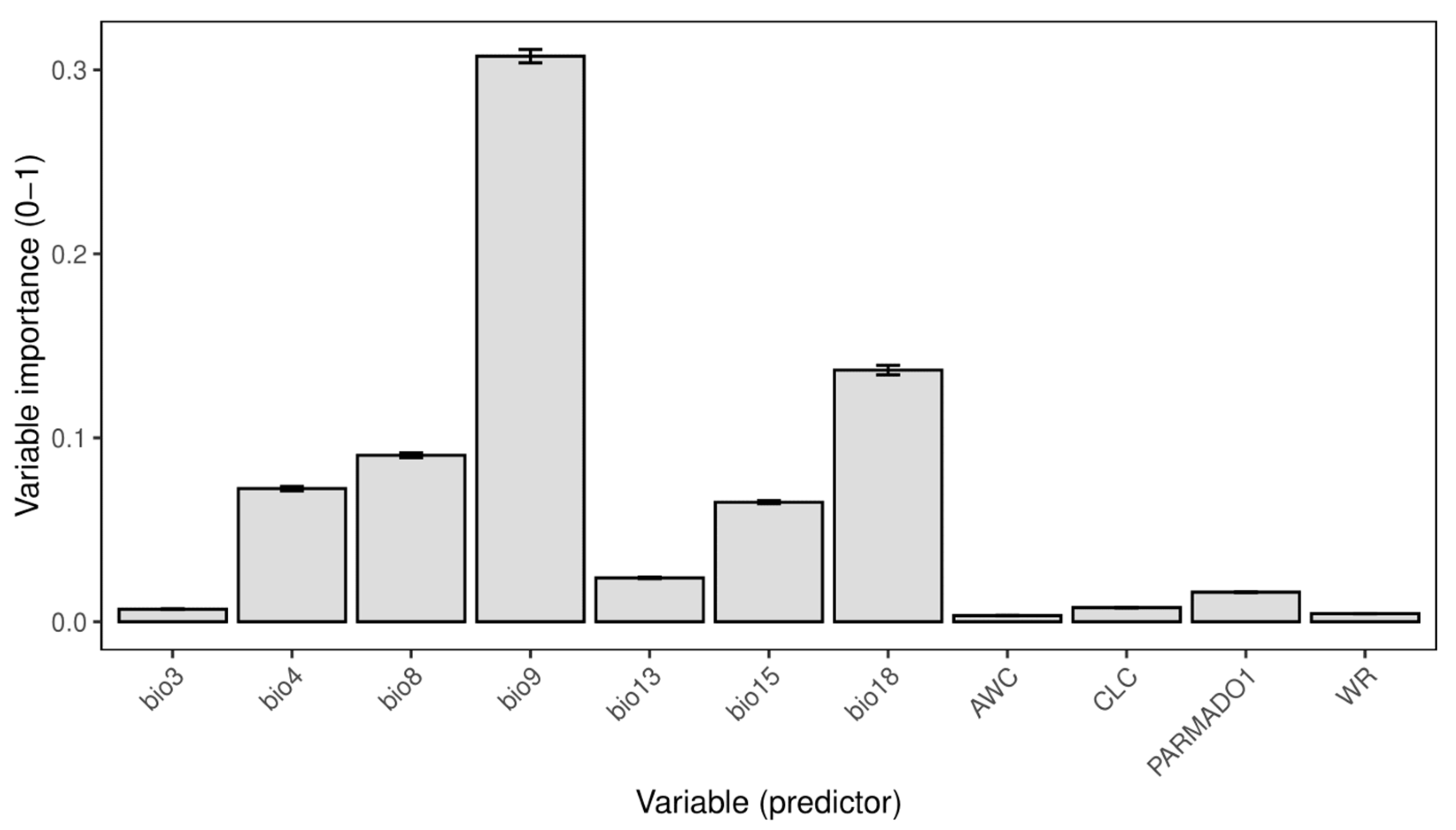
2.1. Ensemble Model Metrics and Variable Importance
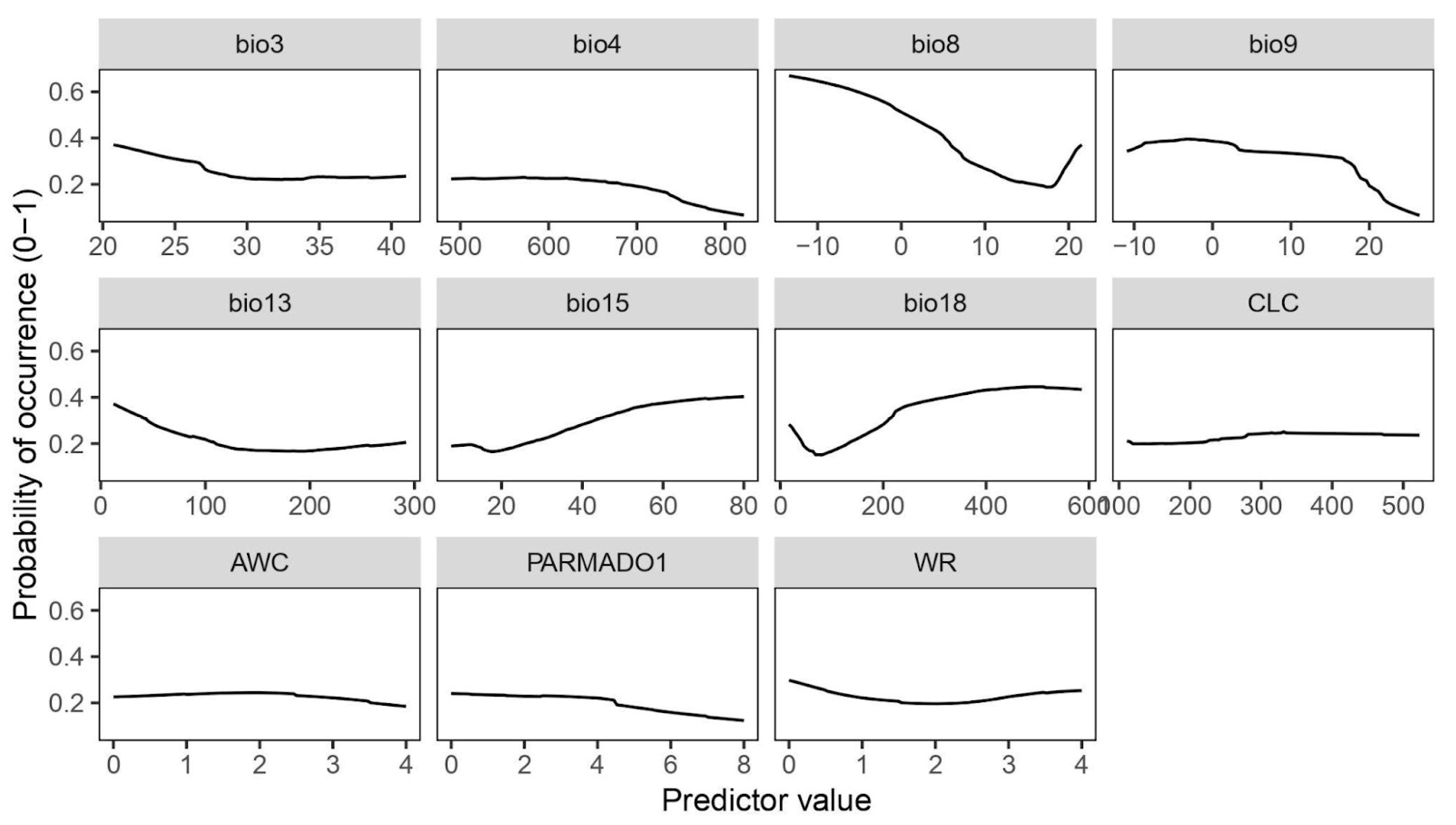
2.2. Species Response Curves and Ecological Preferences
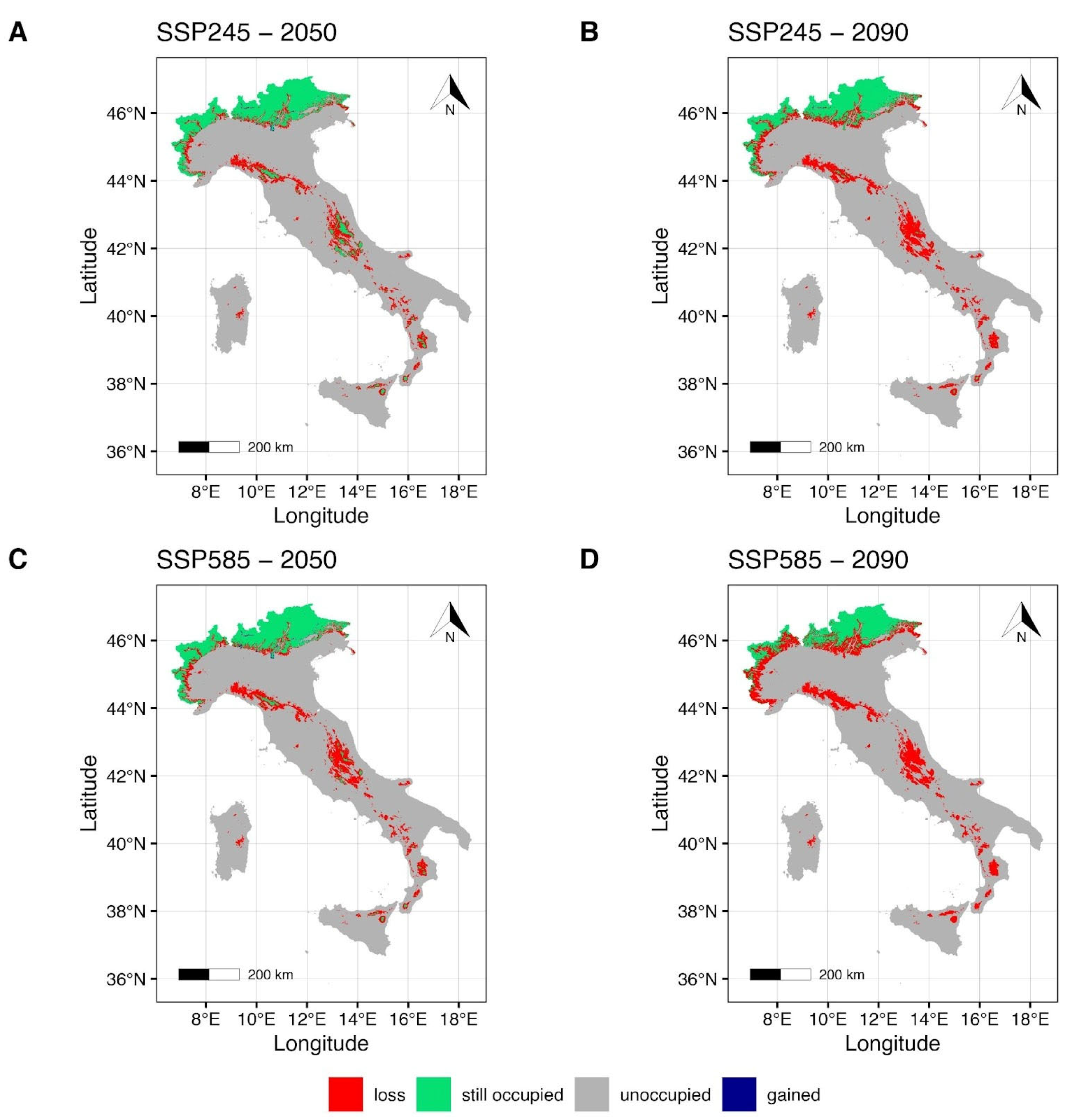
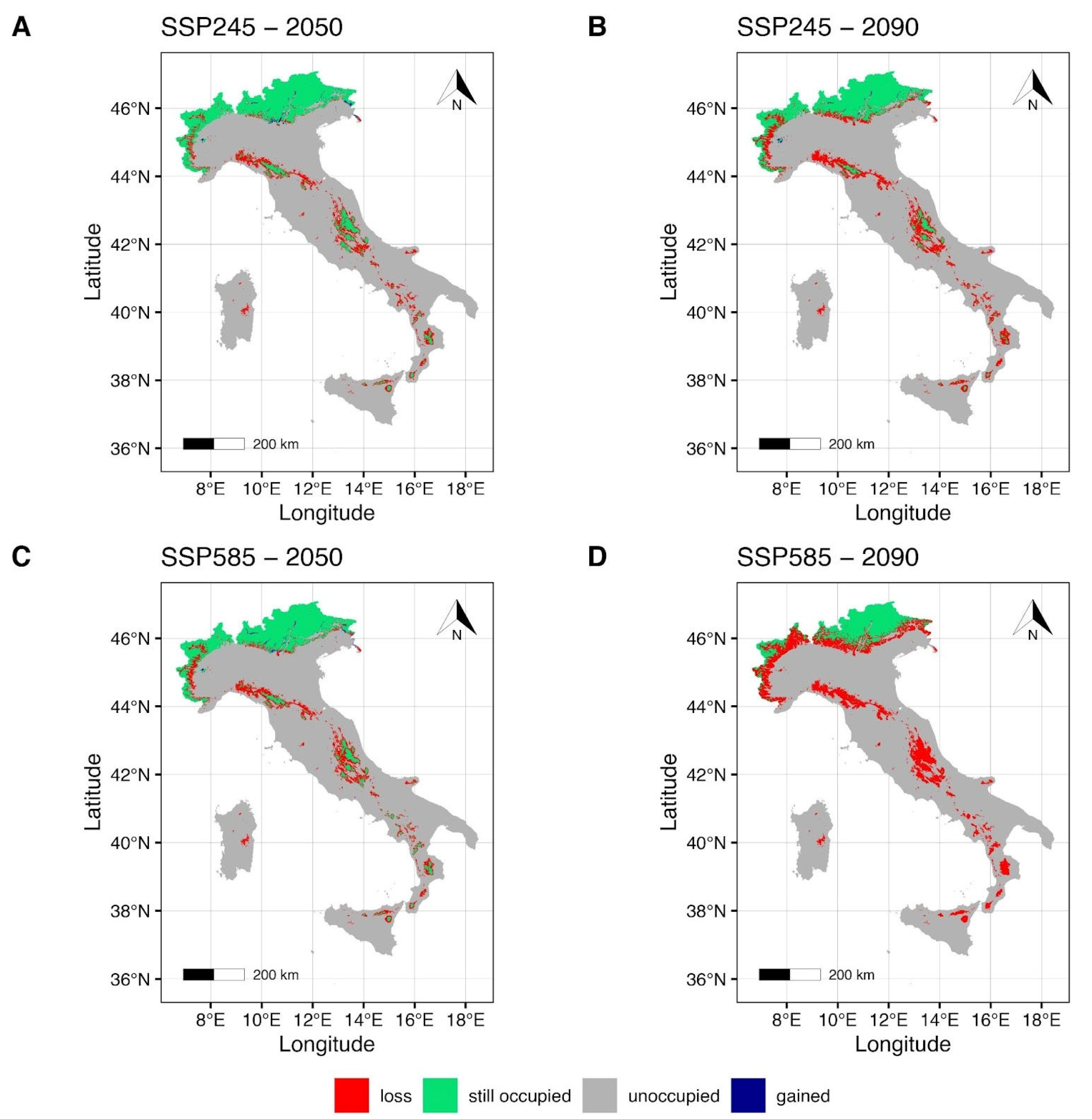
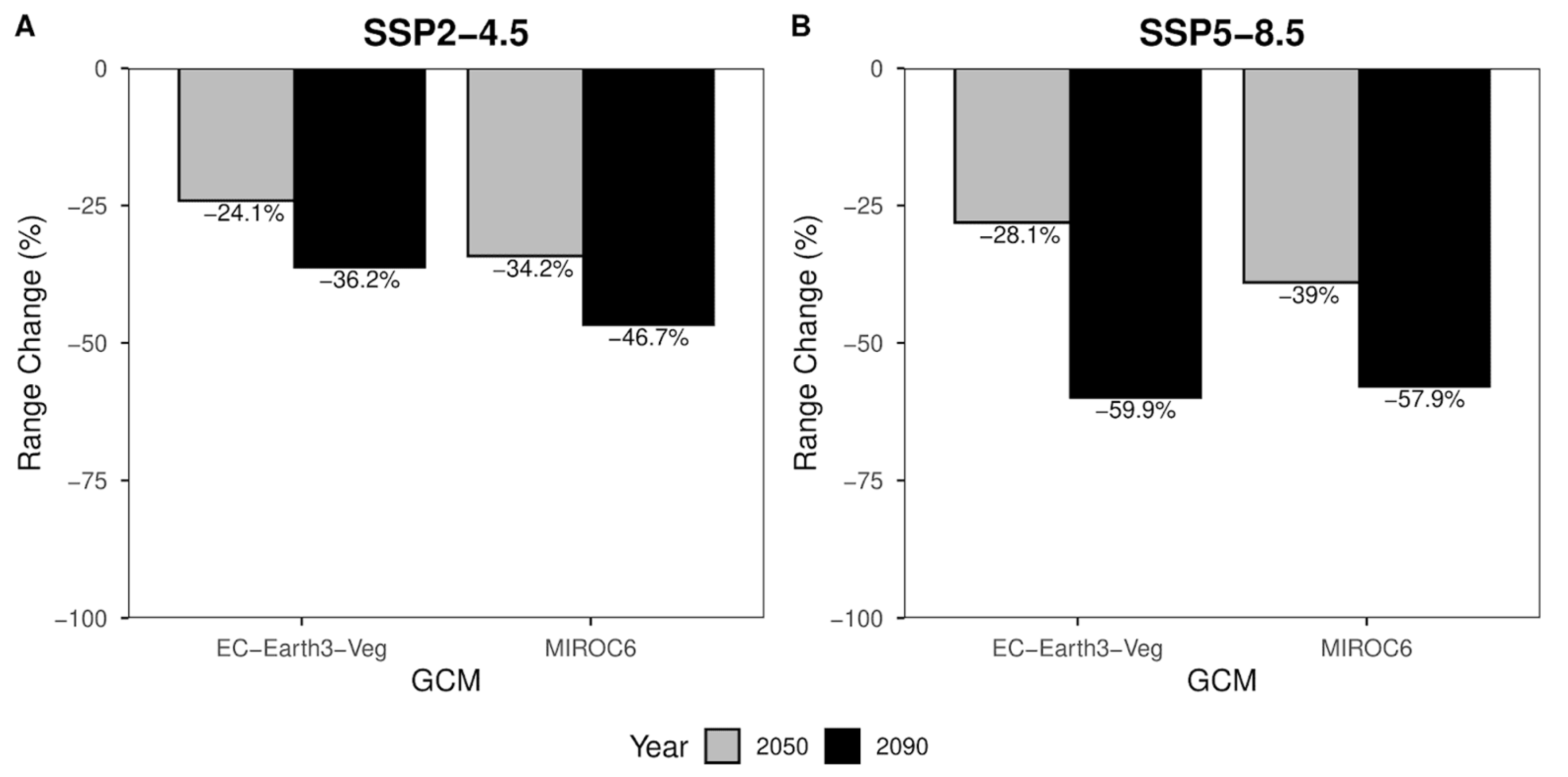
2.3. Species’ Distribution Maps and Range Change
3. Discussion
4. Materials and Methods
4.1. Study Area and Species-Occurrence Data
4.2. Climate Data and Environmental Predictors
4.3. Species Distribution Modeling
5. Conclusions
Supplementary Materials
Author Contributions
Funding
Data Availability Statement
Acknowledgments
Conflicts of Interest
References
- Patiño, J.; Vanderpoorten, A. Bryophyte biogeography. Crit. Rev. Plant Sci. 2018, 37, 175–209. [Google Scholar] [CrossRef]
- Wang, Z.M.; Ye, W.; Xing, F.W. Bryophyte diversity on a tropical continental island (Hainan, China): Potential vulnerable species and environmental indicators. J. Bryol. 2019, 41, 350–360. [Google Scholar] [CrossRef]
- Hodgetts, N.; Cálix, M.; Englefield, E.; Fettes, N.; García Criado, M.; Patin, L.; Nieto, A.; Bergamini, A.; Bisang, I.; Baisheva, E.; et al. A Miniature World in Decline: European Red List of Mosses, Liverworts and Hornworts; International Union for Conservation of Nature: Brussels, Belgium, 2019. [Google Scholar]
- Eldridge, D.J.; Guirado, E.; Reich, P.B.; Ochoa-Hueso, R.; Berdugo, M.; Sáez-Sandino, T.; Blanco-Pastor, J.L.; Tedersoo, L.; Plaza, C.; Ding, J.; et al. The global contribution of soil mosses to ecosystem services. Nat. Geosci. 2023, 16, 430–438. [Google Scholar] [CrossRef]
- Mayo de la Iglesia, R.; Miserere, L.; Vust, M.; Theurillat, J.-P.; Randin, C.; Vittoz, P. Divergent responses of alpine bryophytes and lichens to climate change in the Swiss Alps. J. Veg. Sci. 2024, 35, e13292. [Google Scholar] [CrossRef]
- Vitasse, Y.; Ursenbacher, S.; Klein, G.; Bohnenstengel, T.; Chittaro, Y.; Delestrade, A.; Monnerat, C.; Rebetez, M.; Rixen, C.; Strebel, N.; et al. Phenological and elevational shifts of plants, animals and fungi under climate change in the European Alps. Biol. Rev. 2021, 96, 1816–1835. [Google Scholar] [CrossRef]
- Bergamini, A.; Ungricht, S.; Hofmann, H. An elevational shift of cryophilous bryophytes in the last century—An effect of climate warming? Divers. Distrib. 2009, 15, 871–879. [Google Scholar] [CrossRef]
- Janssen, J.A.M.; Rodwell, J.S.; García Criado, M.; Gubbay, S.; Haynes, T.; Nieto, A.; Sanders, N.; Landucci, F.; Loidi, J.; Ssymank, A.; et al. European Red List of Habitats Part 2. Terrestrial and Freshwater Habitats; European Union: Brussel, Belgium, 2016; pp. 1–44. [Google Scholar]
- Nicolosi, G.; Piano, E.; De Beni, E.; Isaia, M. Double dare: Climate change and volcanic activity threaten local populations of Meta menardi (Araneae, Tetragnathidae) in Sicily. Glob. Ecol. Conserv. 2023, 48, e02699. [Google Scholar] [CrossRef]
- Lloret, F.; González-Mancebo, J.M. Altitudinal distribution patterns of bryophytes in the Canary Islands and vulnerability to climate change. Flora 2011, 206, 769–781. [Google Scholar] [CrossRef]
- Sabovljevic, M. Pohlia cruda (Europe Assessment). The IUCN Red List of Threatened Species: E.T84534890A87782028. 2019. Available online: https://www.iucnredlist.org/species/84534890/87782028 (accessed on 15 October 2025).
- Smith, A.J.E. The Moss Flora of Britain and Ireland, 2nd ed.; Cambridge University Press: Cambridge, UK, 2004. [Google Scholar]
- Hodgetts, N.; Lockhart, N. Checklist and country status of European bryophytes—Update 2020. In Irish Wildlife Manuals; National Parks and Wildlife Service, Department of Culture, Heritage and the Gaeltacht: Dublin, Ireland, 2020; Number 123. [Google Scholar]
- Hodgetts, N.G.; Söderström, L.; Blockeel, T.L.; Caspari, S.; Ignatov, M.S.; Konstantinova, N.A.; Lockart, N.; Papp, B.; Schröck, C.; Sim-Sim, M.; et al. An annotated checklist of bryophytes of Europe, Macaronesia and Cyprus. J. Bryol. 2020, 42, 1–116. [Google Scholar] [CrossRef]
- Smith, A.J.E.; Preston, C.D.; Hill, M.O. (Eds.) Atlas of the Bryophytes of Britain and Ireland: Volume 3. Mosses (Diplolepideae); Brill: Leiden, The Netherlands, 1994. [Google Scholar]
- Puglisi, M.; Campisi, P.; Aleffi, M.; Bacilliere, G.; Bonini, I.; Cogoni, A.; Dia, M.G.; Miserere, L.; Privitera, M.; Tiburtini, M.; et al. Red-list of Italian bryophytes. 2. Mosses. Plant Biosyst. 2024, 158, 1031–1056. [Google Scholar] [CrossRef]
- Puglisi, M.; Bacilliere, G.; Miraglia, G.; Teri, D.; Sciandrello, S. The High-Altitude Volcanic Caves of Mount Etna (Eastern Sicily): A Relevant Refuge for Some Ptero-Bryophyte Communities. Land 2024, 13, 967. [Google Scholar] [CrossRef]
- Valle, B.; Ligi, O.; Invernizzi, A.; Fiaschi, T.; Gobbi, M.; Caccianiga, M. Moss flora of two Alpine glacial and periglacial sites on crystalline and carbonatic bedrock. Nat. Hist. Sci. 2025, 12, 1–13. [Google Scholar] [CrossRef]
- Council Directive 92/43/EEC of 21 May 1992 on the conservation of natural habitats and of wild fauna and flora. Available online: https://eur-lex.europa.eu/search.html?scope=EURLEX&text=Council+Directive+92%2F43%2FEEC+of+21+May+1992&lang=en&type=quick&qid=1764179912841 (accessed on 1 November 2025).
- Williams, J.; Seo, C.; Thorne, J.; Nelson, J.; Erwin, S.; O’Brien, J.; Schwartz, M. Using species distribution models to predict new occurrences for rare plants. Divers. Distr. 2009, 15, 565–576. [Google Scholar] [CrossRef]
- Abubakar, I.; Pantović, J.P.; Šinžar-Sekulić, J.B.; Sabovljević, M.S. Modeling the Distribution of the Rare and Red-Listed Halophytic Moss Species Entosthodon hungaricus Under Various Climate Change Scenarios in Serbia. Plants 2024, 13, 3347. [Google Scholar] [CrossRef] [PubMed]
- Sérgio, C.; Figueira, R.; Draper, D.; Menezes, R.; Sousa, A.J. Modelling bryophyte distribution based on ecological information for extent of occurrence assessment. Biol. Cons. 2007, 135, 341–351. [Google Scholar] [CrossRef]
- Pantović, J.P.; Božović, D.P.; Sabovljević, M.S. Possible Effects of Climate Change on the Occurrence and Distribution of the Rare Moss Buxbaumia viridis in Serbia (SE Europe). Plants 2023, 12, 557. [Google Scholar] [CrossRef]
- Ștefănuț, S.; Ion, C.M.; Sahlean, T.; Tamas, G.; Nicoară, G.R.; Vladimirescu, M.; Moroșanu, A.-M.; Helepciuc, F.E.; Ștefănuț, M.M.; Bîrsan, C.C. Population and Conservation Status of Buxbaumia viridis (DC.) Moug. & Nestl. in Romania. Plants 2023, 12, 473. [Google Scholar] [CrossRef]
- Abay, G.; Gül, S. Modeling the distribution of the endemic Turkish moss species Cinclidotus bistratosus Kürschner & Lüb. Nestle (Pottiaceae) under various climate change scenarios. Front. Plant Sci. 2025, 16, 1659115. [Google Scholar] [CrossRef]
- Elith, J.; Leathwick, J.R. Species Distribution Models: Ecological Explanation and Prediction Across Space and Time. Annu. Rev. Ecol. Evol. Syst. 2009, 40, 677–697. [Google Scholar] [CrossRef]
- Elith, J.; Kaerney, M.; Phillips, S. The art of modelling range-shifting species. Met. Ecol. Evol. 2010, 1, 330–342. [Google Scholar] [CrossRef]
- van Zuijlen, K.; Bisang, I.; Nobis, M.P.; Bergamini, A. Extinction risk of European bryophytes predicted by bioclimate and traits. Biol. Conserv. 2024, 293, 110584. [Google Scholar] [CrossRef]
- Proctor, M.C.; Tuba, Z. Poikilohydry and homoihydry: Antithesis or spectrum of possibilities? New Phytol. 2002, 156, 327–349. [Google Scholar] [CrossRef]
- Slate, M.L.; Antoninka, A.; Bailey, L.; Berdugo, M.B.; Callaghan, D.A.; Cardenas, M.; Chmielewski, M.W.; Fenton, J.N.; Holland-Moritz, H.; Hopkins, S.; et al. Impact of changing climate on bryophyte contributions to terrestrial water, carbon, and nitrogen cycles. New Phytol. 2024, 242, 2411–2429. [Google Scholar] [CrossRef]
- Abay, G.; Gül, S. Predicting the distribution of Sphagna (Bryophyta) in Türkiye: A perspective of present and future climate scenarios. Front. Plant Sci. 2025, 16, 1540845. [Google Scholar] [CrossRef] [PubMed]
- Dilks, T.J.K.; Proctor, M.C.F. Comparative experiments on temperature responses of bryophytes; assimilation, respiration and freezing damage. J. Bryol. 1975, 8, 317–336. [Google Scholar] [CrossRef]
- Dierssen, K. Distribution, Ecological Amplitude and Phytosociological Characterisation of European Bryophytes; J. Cramer: Stuttgart, Germany, 2001. [Google Scholar]
- Mägdefrau, K. Life-forms of bryophytes. In Bryophyte Ecology; Springer: Dordrecht, The Netherlands, 1982; pp. 45–58. [Google Scholar]
- Kürschner, H.; Frey, W. Life strategies in bryophytes—A prime example for the evolution of functional types. Nova Hedwig. 2012, 96, 83–116. [Google Scholar] [CrossRef]
- During, H. Ecological classification of bryophytes and lichens. In Bryophytes and Lichens in a Changing Environment; Bates, J.W., Farmer, A.M., Eds.; Oxford University Press: Oxford, UK, 1992; pp. 1–31. [Google Scholar]
- Zanatta, F.; Engler, R.; Collart, F.; Broennimann, O.; Mateo, R.G.; Papp, B.; Muñoz, J.; Baurain, D.; Guisan, A.; Vanderpoorten, A. Bryophytes are predicted to lag future climate change despite their high dispersal capacities. Nat. Commun. 2020, 11, 5601. [Google Scholar] [CrossRef]
- Zanatta, F.; Patiño, J.; Lebeau, F.; Massinon, M.; Hylander, K.; de Haan, M.; Ballings, P.; Degreef, J.; Vanderpoorten, A. Measuring spore settling velocity for an improved assessment of dispersal rates in mosses. Ann. Bot. 2016, 118, 197–206. [Google Scholar] [CrossRef]
- Wierzcholskaa, S.; Dyderskib, M.K.; Jagodzińskib, A.M. Potential distribution of an epiphytic bryophyte depends on climate and forest continuity. Glob. Planet. Change 2020, 93, 103270. [Google Scholar] [CrossRef]
- Istituto Nazionale di Statistica. Annuario Statistico Italiano 2024; Istituto Nazionale di Statistica: Rome, Italy, 2024; pp. 9–11. [Google Scholar]
- Hill, M.O.; Preston, C.D.; Bosanquet, S.D.S.; Roy, D.B. BRYOATT: Attributes of British and Irish Mosses, Liverworts and Hornworts; Centre for Ecology and Hydrology: Lancaster, UK, 2007; pp. 1–88. [Google Scholar]
- Cutini, M.; Marzialetti, F.; Barbato, G.; Rianna, G.; Theurillat, J.P. Bioclimatic pattern in a Mediterranean mountain area: Assessment from a classification approach on a regional scale. Int. J. Biometeorol. 2021, 65, 1085–1097. [Google Scholar] [CrossRef]
- Biondi, E.; Baldoni, M. The climate and vegetation of peninsular Italy. Colloq. Phytosoc. 1994, 23, 675–721. [Google Scholar]
- Dawson, N.; Fischer, J.; Kuhn, M.; Pasotti, A.; Mhugent; Rouzaud, D.; Bruy, A.; Sutton, T.; Dobias, M.; Pellerin, M.; et al. qgis/QGIS: 3.44.4, Final-3_44_4; Zenodo: Genève, Switzerland, 2025. [Google Scholar] [CrossRef]
- Fick, S.E.; Hijmans, R.J. WorldClim 2: New 1km spatial resolution climate surfaces for global land areas. Int. J. Climat. 2017, 37, 4302–4315. [Google Scholar] [CrossRef]
- European Commission, Joint Research Centre (JRC). European Soil Database v2.0 (Vector and Attribute Data). European Commission, Joint Research Centre (JRC) [Dataset]. 2001. Available online: http://data.europa.eu/89h/jrc-esdac-1 (accessed on 20 February 2023).
- CORINE Land Cover 2018 (Vector/Raster 100 m), Europe, 6-Yearly. European Union’s Copernicus Land Monitoring Service Information. Available online: https://land.copernicus.eu/en/products/corine-land-cover/clc2018#download (accessed on 20 September 2025).
- Döscher, R.; Acosta, M.; Alessandri, A.; Anthoni, P.; Arsouze, T.; Bergman, T.; Bernardello, R.; Boussetta, S.; Caron, L.P.; Carver, G.; et al. The EC-Earth3 Earth system model for the Coupled Model Intercomparison Project 6. Geosci. Model Dev. 2020, 15, 2973–3020. [Google Scholar] [CrossRef]
- Shiogama, H.; Manabu, A.; Hiroaki, T. MIROC MIROC6 Model Output Prepared for CMIP6 ScenarioMIP, Version 20250915[1]; Earth System Grid Federation: Greenbelt, MD, USA, 2019. [Google Scholar] [CrossRef]
- Pörtner, H.O.; Roberts, D.C.; Tignor, M.; Poloczanska, E.S.; Mintenbeck, K.; Alegría, A.; Craig, M.; Langsdorf, S.; Löschke, S.; Möller, V.; et al. Climate Change 2022: Impacts, Adaptation and Vulnerability. Contribution of Working Group II to the Sixth Assessment Report of the Intergovernmental Panel on Climate Change; Cambridge University Press: Cambridge, UK; New York, NY, USA, 2022; p. 3056. [Google Scholar] [CrossRef]
- Naimi, B.; Hamm, N.A.S.; Groen, T.A.; Skidmore, A.K.; Toxopeus, A.G. Where is positional uncertainty a problem for species distribution modelling? Ecography 2014, 37, 191–203. [Google Scholar] [CrossRef]
- Araujo, M.; New, M. Ensemble forecasting of species distributions. Trends Ecol. Evol. 2007, 22, 42–47. [Google Scholar] [CrossRef]
- Guéguen, M.; Blancheteau, H.; Thuiller, W. Biomod2: Ensemble Platform for Species Distribution Modeling. R Package Version 4.3-4. 2025. Available online: https://biomodhub.github.io/biomod2/ (accessed on 20 September 2025).
- Ripley, B.D. Pattern Recognition and Neural Networks; Cambridge University Press: Cambridge, UK, 2007. [Google Scholar]
- Breiman, L. Classification and Regression Trees; Wadsworth International Group: Belmont, CA, USA, 1984. [Google Scholar]
- Hastie, T.; Tibshirani, R.; Buja, A. Flexible Discriminant Analysis by Optimal Scoring. J. Am. Stat. Assoc. 1994, 89, 1255–1270. [Google Scholar] [CrossRef]
- Hastie, T.; Tibshirani, R. Generalized Additive Models. In Encyclopedia of Statistical Sciences; John Wiley and Sons Inc.: Chichester, UK, 2004. [Google Scholar][Green Version]
- Freund, Y.; Schapire, R.E. A decision-theoretic generalization of on-line learning and an application to boosting. J. Comp. Syst. Sci. 1997, 55, 119–139. [Google Scholar] [CrossRef]
- McCullagh, P. Generalized linear models. Eur. J. Oper. Res. 1984, 16, 285–292. [Google Scholar] [CrossRef]
- Friedman, J.H. Multivariate Adaptive Regression Splines. Ann. Stat. 1991, 19, 1–67. [Google Scholar] [CrossRef]
- Phillips, S.J.; Anderson, R.P.; Schapire, R.E. Maximum entropy modeling of species geographic distributions. Ecol. Model. 2006, 190, 231–259. [Google Scholar] [CrossRef]
- Phillips, S. Maxnet: Fitting ‘Maxent’ Species Distribution Models with ‘glmnet’. R Package Version 0.1.4. 2022. Available online: https://github.com/mrmaxent/maxnet (accessed on 3 October 2025).
- Breiman, L. Random Forests. Mach. Learn. 2001, 45, 5–32. [Google Scholar] [CrossRef]
- Busby, J.R. BIOCLIM—A bioclimate analysis and prediction system. Plant Prot. Quart. 1991, 6, 8–9. [Google Scholar]
- Chen, T.; Guestrin, C. XGBoost: A Scalable Tree Boosting System. In Proceedings of the 22nd SIGKDD Conference on Knowledge Discovery and Data Mining, San Francisco, CA, USA, 13–17 August 2016; Available online: https://arxiv.org/abs/1603.02754 (accessed on 14 October 2025).
- Barbet-Massin, M.; Jiguet, F.; Albert, C.H.; Wilfried, T. Selecting Pseudo-Absences for Species Distribution Models: How, Where and How Many? Methods Ecol. Evol. 2012, 3, 327–338. [Google Scholar] [CrossRef]

| Code | Variable | Unit | Data Source |
|---|---|---|---|
| BIO1 | Annual Mean Temperature | °C | WorldClim |
| BIO2 | Mean Diurnal Range | °C | WorldClim |
| BIO3 * | Isothermality (BIO2/BIO7) (×100) | °C | WorldClim |
| BIO4 * | Temperature Seasonality | SD | WorldClim |
| BIO5 | Max Temp of Warmest Month | °C | WorldClim |
| BIO6 | Min Temperature of Coldest Month | °C | WorldClim |
| BIO7 | Temp Annual Range (BIO5-BIO6) | °C | WorldClim |
| BIO8 * | Mean Temperature of Wettest Quarter | °C | WorldClim |
| BIO9 * | Mean Temperature of Driest Quarter | °C | WorldClim |
| BIO10 | Mean Temperature of Warmest Quarter | °C | WorldClim |
| BIO11 | Mean Temperature of Coldest Quarter | °C | WorldClim |
| BIO12 | Annual Precipitation | mm | WorldClim |
| BIO13 * | Precipitation of Wettest Month | mm | WorldClim |
| BIO14 | Precipitation of Driest Month | mm | WorldClim |
| BIO15 * | Precipitation Seasonality | CV | WorldClim |
| BIO16 | Precipitation of Wettest Quarter | mm | WorldClim |
| BIO17 | Precipitation of Driest Quarter | mm | WorldClim |
| BIO18 * | Precipitation of Warmest Quarter | mm | WorldClim |
| BIO19 | Precipitation of Coldest Quarter | mm | WorldClim |
| Elevation | Elevation Data | m | WorldClim |
| PARMADO1 * | Parent Material (PAR-MAT-DOM1) | Categorical | ESDAC |
| AWC * | Available Water Capacity (AWC_TOP) | Categorical | ESDAC |
| WR * | Water Regime | Categorical | ESDAC |
| CLC * | Corine Land Cover | Categorical | CLMS |
Disclaimer/Publisher’s Note: The statements, opinions and data contained in all publications are solely those of the individual author(s) and contributor(s) and not of MDPI and/or the editor(s). MDPI and/or the editor(s) disclaim responsibility for any injury to people or property resulting from any ideas, methods, instructions or products referred to in the content. |
© 2025 by the authors. Licensee MDPI, Basel, Switzerland. This article is an open access article distributed under the terms and conditions of the Creative Commons Attribution (CC BY) license (https://creativecommons.org/licenses/by/4.0/).
Share and Cite
Bacilliere, G.; Božović, D.P.; Sabovljević, M.S.; Puglisi, M. Range Dynamics of the Moss Pohlia cruda in Italy Under Different Climate Change Scenarios. Plants 2025, 14, 3640. https://doi.org/10.3390/plants14233640
Bacilliere G, Božović DP, Sabovljević MS, Puglisi M. Range Dynamics of the Moss Pohlia cruda in Italy Under Different Climate Change Scenarios. Plants. 2025; 14(23):3640. https://doi.org/10.3390/plants14233640
Chicago/Turabian StyleBacilliere, Giulia, Djordje P. Božović, Marko S. Sabovljević, and Marta Puglisi. 2025. "Range Dynamics of the Moss Pohlia cruda in Italy Under Different Climate Change Scenarios" Plants 14, no. 23: 3640. https://doi.org/10.3390/plants14233640
APA StyleBacilliere, G., Božović, D. P., Sabovljević, M. S., & Puglisi, M. (2025). Range Dynamics of the Moss Pohlia cruda in Italy Under Different Climate Change Scenarios. Plants, 14(23), 3640. https://doi.org/10.3390/plants14233640

