Article

Community-Level Incentive Mechanisms for the Conservation of Crop Wild Relatives: A Malawi Case Study

1
Bioversity International, Via di San Domenico 1, 00153 Rome, Italy
2
Malawi Plant Genetic Resources Centre (MPGRC), Chitedze Research Station, Lilongwe P.O. Box 158, Malawi
3
School of Biosciences, University of Birmingham, Birmingham B15 2TT, UK
*
Author to whom correspondence should be addressed.
Plants 2023, 12(5), 1030; https://doi.org/10.3390/plants12051030

Submission received: 20 January 2023 / Revised: 10 February 2023 / Accepted: 15 February 2023 / Published: 24 February 2023
(This article belongs to the Section Plant Genetic Resources)

Abstract

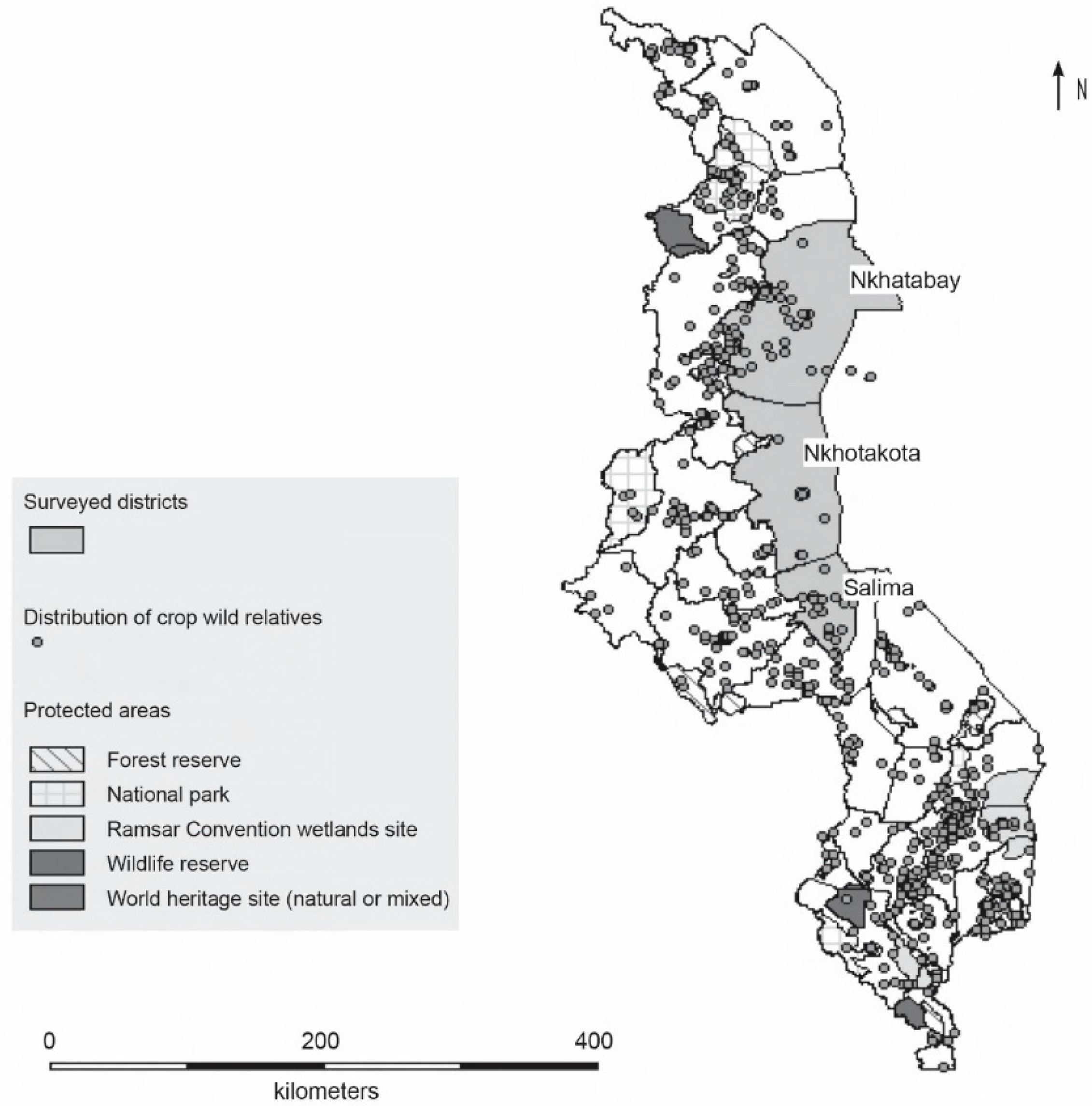
Despite being an increasingly important source of genes for crop breeding aimed at improving food security and climate change adaptation, crop wild relatives (CWRs) are globally threatened. A root cause of CWR conservation challenges is a lack of institutions and payment mechanisms by which the beneficiaries of CWR conservation services (such as breeders) could compensate those who can supply them. Given that CWR conservation generates important public good values, for the significant proportion of CWRs found outside of protected areas, there is a strong justification for the design of incentive mechanisms to support landowners whose management practices positively contribute to CWR conservation. This paper contributes to facilitating an improved understanding of the costs of in situ CWR conservation incentive mechanisms, based on a case study application of payments for agrobiodiversity conservation services across 13 community groups in three districts in Malawi. Results demonstrate a high willingness to participate in conservation activities, with average conservation tender bids per community group being a modest MWK 20,000 (USD 25) p.a. and covering 22 species of CWRs across 17 related crops. As such, there appears to be significant potential for community engagement in CWR conservation activities that is complementary to that required in protected areas and can be achieved at modest cost where appropriate incentive mechanisms can be implemented.
Keywords: crop wild relatives; ecosystem services; community engagement; conservation incentives; payments for agrobiodiversity conservation services crop wild relatives; ecosystem services; community engagement; conservation incentives; payments for agrobiodiversity conservation services