Modeling Phenological Phases across Olive Cultivars in the Mediterranean

 , , , , ,
  , and
, and
Abstract
1. Introduction
2. Materials and Methods
2.1. Data Collection
2.2. Phenological Models
- yc—Chilling requirement: critical value of y, which defines the end of chill accumulation.
- zc—Heating requirement: critical value of z, which defines the end of heat accumulation.
- s1—Slope parameter that determines the transition from the chill accumulation to the heat accumulation period in PhenoFlex.
- Tu—Optimal temperature of the growing degree hours (GDH) model.
- E0—Time-independent activation energy of forming the precursor to the dormancy-breaking factor (PDBF).
- E1—Time-independent activation energy of destroying the precursor to the dormancy-breaking factor (PDBF).
- A0—Amplitude of the (hypothetical) process involved in forming the precursor to the dormancy-breaking factor in the dynamic model.
- A1—Amplitude of the (hypothetical) process involved in destroying the precursor to the dormancy-breaking factor (PDBF) in the dynamic model.
- Tf—Transition temperature parameter of the sigmoidal function in the dynamic model, also involved in converting the PDBF to chill portions.
- Tc—Upper threshold in the GDH model.
- Tb—Base temperature of the GDH model.
- slope—Slope parameter of the sigmoidal function in the dynamic model, which determines what fraction of the PDBF is converted to chill portions.
2.3. Data Preparation
2.4. Calibration and Validation of Phenological Models
3. Results
4. Discussion
5. Conclusions
Author Contributions
Funding
Data Availability Statement
Acknowledgments
Conflicts of Interest
Appendix A
Appendix B
References
- Deiana, P.; Santona, M.; Dettori, S.; Molinu, M.G.; Dore, A.; Culeddu, N.; Azara, E.; Naziri, N.; Tsimidou, M.Z. Can All the Sardinian Cultivars Support the PDO “Sardegna” Virgin Olive Oil? Eur. J. Lipid Sci. Technol. 2019, 121, 1800135. [Google Scholar] [CrossRef] [Scilit]
- Connor, D.J. Adaptation of olive (Olea europaea L.) to water-limited environments. Aust. J. Agric. Res. 2005, 56, 1181–1189. [Google Scholar] [CrossRef] [Scilit]
- Therios, I.N. Olives; CABI: Wallingford, UK, 2009; Available online: https://www.worldcat.org/title/olives/oclc/436920449 (accessed on 1 February 2023).
- Koubouris, G.C.; Metzidakis, I.T.; Vasilakakis, M.D. Impact of temperature on olive (Olea Eur. L.) pollen performance in relation to relative humidity and genotype. Environ. Exp. Bot. 2009, 67, 209–214. [Google Scholar] [CrossRef] [Scilit]
- Fraga, H.; Pinto, J.G.; Santos, J.A. Climate change projections for chilling and heat forcing conditions in European vineyards and olive orchards: A multi-model assessment. Clim. Change 2019, 152, 179–193. [Google Scholar] [CrossRef] [Scilit]
- López-Bernal, Á.; García-Tejera, O.; Testi, L.; Orgaz, F.; Villalobos, F.J. Agricultural and Forest Meteorology Studying and modelling winter dormancy in olive trees. Agric. For. Meteorol. 2020, 280, 107776. [Google Scholar] [CrossRef] [Scilit]
- Rojo, J.; Orlandi, F.; Ben Dhiab, A.; Lara, B.; Picornell, A.; Oteros, J.; Msallem, M.; Fornaciari, M.; Pérez-Badia, R. Estimation of Chilling and Heat Accumulation Periods Based on the Timing of Olive Pollination. Forests 2020, 11, 835. [Google Scholar] [CrossRef] [Scilit]
- De Melo-Abreu, J.P.; Barranco, D.; Cordeiro, A.M.; Tous, J.; Rogado, B.M.; Villalobos, J.F. Modelling olive flowering date using chilling for dormancy release and thermal time. Agric. For. Meteorol. 2004, 125, 117–127. [Google Scholar] [CrossRef] [Scilit]
- Osborne, C.P.; Chuine, I.; Viner, D.; Woodward, F.I. Olive phenology as a sensitive indicator of future climatic warming in the Mediterranean. Plant Cell Environ. 2000, 23, 701–710. [Google Scholar] [CrossRef] [Scilit]
- Galan, C.; Garcia-Mozo, H.; Vazquez, L.; Ruiz, L.; Diaz de la Guardia, C.; Trigo, M.M. Heat requirement for the onset of the Olea europaea L. pollen season in several sites in Andalusia and the effect of the expected future climate change. Int. J. Biometeorol. 2005, 49, 184–188. [Google Scholar] [CrossRef] [Scilit]
- Bonofiglio, T.; Orlandi, F.; Sgromo, C.; Romano, B.; Fornaciari, M. Influence of temperature and rainfall on timing of olive (Olea europaea) flowering in southern Italy. N. Z. J. Crop Hortic. Sci. 2010, 36, 59–69. [Google Scholar] [CrossRef] [Scilit]
- Navas-Lopez, J.F.; Leon, L.; Rapoport, H.F.; Moreno-Alias, I.; Lorite, I.J.; De la Rosa, R. Genotype, environment and their interaction effects on olive tree flowering phenology and flower quality. Euphytica 2019, 215, 184. [Google Scholar] [CrossRef] [Scilit]
- Aguilera, F.; Fornaciari, M.; Ruiz-Valenzuela, L.; Galán, C.; Msallem, M.; Ben Dhiab, A.; Díaz-de la Guardia, C.; Trigo, M.; Bonofiglio, T.; Orlandi, F. Phenological models to predict the main flowering phases of olive (Olea europaea L.) along a latitudinal and longitudinal gradient across the Mediterranean region. Int. J. Biometeorol. 2014, 59, 629–641. [Google Scholar] [CrossRef] [Scilit] [PubMed]
- Orlandi, F.; Sgromo, C.; Bonofiglio, T.; Ruga, L.; Romano, B.; Fornaciari, M. A comparison among olive flowering trends in different Mediterranean areas (south-central Italy) in relation to meteorological variations. Theor. Appl. Clim. 2009, 97, 339. [Google Scholar] [CrossRef] [Scilit]
- Rojo, J.; Pérez-Badia, R. Effects of topography and crown-exposure on olive tree phenology. Trees 2014, 28, 449–459. [Google Scholar] [CrossRef] [Scilit]
- Barranco, D.; Fernández-Escobar, R.; Rallo, L. El Cultivo del Olivo, 6th ed.; Ediciones Mundi-Prensa: Madrid, Spain, 2008. [Google Scholar]
- Nieddu, G.; Sirca, C.; Chessa, I. Evaluation of the phenological behavior of two olive tree cultivars. Adv. Hort. Sci. 2002, 138–143. Available online: https://www.jstor.org/stable/42883317 (accessed on 28 August 2023).
- Cesaraccio, C.; Spano, D.; Snyder, R.L.; Duce, P. Chilling and forcing model to predict bud-burst of crop and forest species. Agric. For. Meteorol. 2004, 126, 1–13. [Google Scholar] [CrossRef] [Scilit]
- Ruml, M.; Vuković, A.; Milatović, D. Evaluation of different methods for determining growing degree-day thresholds in apricot cultivars. Int. J. Biometeorol. 2010, 54, 411–422. [Google Scholar] [CrossRef] [Scilit]
- Zouari, I.; Mezghani, A.; Labidi, F. Flowering and heat requirements of four olive cultivars grown in the south of Tunisia. ActaHortic. 2017, 1160, 231–236. [Google Scholar] [CrossRef] [Scilit]
- Moriondo, M.; Ferrise, R.; Trombi, G.; Brilli, L.; Dibari, C.; Bindi, M. Modelling olive trees and grapevines in a changing climate. Environ. Model. Softw. 2015, 72, 387–401. [Google Scholar] [CrossRef] [Scilit]
- Moriondo, M.; Leolini, L.; Brilli, L.; Dibari, C.; Tognetti, R.; Giovannelli, A.; Rapi, B.; Battista, P.; Caruso, G.; Gucci, R.; et al. A simple model simulating development and growth of an olive grove. Eur. J. Agron. 2019, 105, 129–145. [Google Scholar] [CrossRef] [Scilit]
- McMaster, G.S.; Wilhelm, W.W. Growing degree-days: One equation, two interpretations. Agric. For. Meteorol. 1997, 87, 291–300. [Google Scholar] [CrossRef] [Scilit]
- Luedeling, E.; Schiffers, K.; Fohrmann, T.; Urbach, C. PhenoFlex—an integrated model to predict spring phenology in temperate fruit trees. Agric. For. Meteorol. 2021, 307, 108491. [Google Scholar] [CrossRef] [Scilit]
- Ghersa, C.M.; Holt, J.S. Using phenology prediction in weed management: A review. Weed Res. 1995, 35, 461–470. [Google Scholar] [CrossRef] [Scilit]
- Orlandi, F.; Garcia-Mozo, H.; Galán, C.; Romano, B.; Diaz de la Guardia, C.; Ruiz, L.; Trigo, M.M.; Dominguez-Vilches, E.; Fornaciari, M. Olive flowering trends in a large Mediterranean area (Italy and Spain). Int. J. Biometeorol. 2010, 54, 151–163. [Google Scholar] [CrossRef] [Scilit]
- Di Paola, A.; Chiriacò, V.M.; di Paola, F.; Nieddu, G. A Phenological Model for Olive (Olea europaea L. var europaea) Growing in Italy. Plants 2021, 10, 1115. [Google Scholar] [CrossRef] [Scilit] [PubMed]
- Medda, S.; Fadda, A.; Mulas, M. Influence of Climate Change on Metabolism and Biological Characteristics in Perennial Woody Fruit Crops in the Mediterranean Environment. Horticulturae 2022, 8, 273. [Google Scholar] [CrossRef] [Scilit]
- Botarelli, L.; Brunetti, A.; Pasquini, A.; Zinoni, F. Progetto Finalizzato PHENAGRI. In spetti Generali Delle Osservazioni Agrofenologiche; Ministero delle Politiche Agricole e Forestali, Collana di Agrofenologia: Roma, Italy, 1999; Volume 1. [Google Scholar]
- Pesaresi, S.; Biondi, E.; Casavecchia, S. Bioclimates of Italy. J. Maps 2017, 13, 955–960. [Google Scholar] [CrossRef] [Scilit]
- Copernicus Climate Change Service (C3S): ERA5-Land Hourly Data from 1950 to Present. Copernicus Climate Change Service (C3S) Climate Data Store (CDS). 2022. Available online: https://cds.climate.copernicus.eu/cdsapp#!/dataset/reanalysis-era5-land?tab=overview (accessed on 31 February 2022).
- Oses, N.; Azpiroz, I.; Marchi, S.; Guidotti, D.; Quartulli, M.; Olaizola, I. Analysis of Copernicus’ ERA5 Climate Reanalysis Data as a Replacement for Weather Station Temperature Measurements in Machine Learning Models for Olive Phenology Phase Prediction. Sensors 2020, 20, 6381. [Google Scholar] [CrossRef] [Scilit]
- Lang, G.A. Dormancy: A new universal terminology. Hortscience 1987, 22, 817–820. [Google Scholar] [CrossRef] [Scilit]
- Scrucca, L. Genetic Algorithms. Version 3.2.3. CRAN. 2022. Available online: https://luca-scr.github.io/GA/ (accessed on 1 April 2022).
- Luedeling, E. chillR: Statistical Methods for Phenology Analysis in Temperate Fruit Trees, R Package Version 0.72. 2020. Available online: https://cran.r-project.org/web/packages/chillR/index.html (accessed on 15 April 2022).
- Nowosad, J. Analysis of Aerobiological Data. Pollen Package. CRAN 2021. Available online: https://nowosad.github.io/pollen/ (accessed on 15 May 2022).
- Linvill, D.E. Calculating Chilling Hours and Chill Units from Daily Maximum and Minimum Temperature Observations. HortScience 1990, 25, 14–16. [Google Scholar] [CrossRef] [Scilit]
- Stone, M. Cross-Validatory Choice and Assessment of Statistical Predictions. J. R. Stat. Soc. Ser. B 1974, 36, 111–147. [Google Scholar] [CrossRef] [Scilit]
- Fishman, S.; Erez, A.; Couvillon, G.A. The temperature dependence of dormancy breaking in plants: Mathematical analysis of a two-step model involving a cooperative transition. Theor. Biol. 1987, 124, 473–483. [Google Scholar] [CrossRef] [Scilit]
- Richardson, E. Pheno-climatography of spring peach bud development. HortScience 1975, 10, 236–237. [Google Scholar] [CrossRef] [Scilit]
- Anderson, J.L.; Kesner, C.D.; Richardson, E.A. Validation of chill unit and flower bud phenology models for ’Montmorency’ sour cherry. Acta Hortic. 1986, 184, 71–78. [Google Scholar] [CrossRef] [Scilit]
- Besnard, G.; Baradat, P.; Bervillé, A. Genetic relationships in the olive (Olea europaea L.) reflect multi-local selection of cultivars. Theor. Appl. Genet. 2001, 102, 251–258. [Google Scholar] [CrossRef] [Scilit]
- Deiana, P.; Filigheddu, M.R.; Dettori, S.; Culeddu, N.; Dore, A.; Molinu, M.G.; Santona, M. Olives and Olive Oil in Health and Disease Prevention, 2nd ed.; Chapter 4—The chemical composition of Italian virgin olive oils; Academic Press: San Diego, CA, USA, 2021; pp. 51–62. [Google Scholar] [CrossRef] [Scilit]
- Aybar, V.E.; Paulo de Melo-Abreu, J.; Searles, P.S.; Matias, A.C.; Del Río, C.; Caballero, J.M.; Cecilia Rousseaux, M. Evaluation of olive flowering at low latitude sites in Argentina using a chilling requirement model. Span. J. Agric. Res. 2015, 13, e0901. [Google Scholar] [CrossRef] [Scilit]
- Orlandi, F.; Lanari, D.; Romano, B.; Fornaciari, M. New model to predict the timing of olive (Olea europaea) flowering: A case study in central Italy. N. Z. J. Crop Hortic. Sci. 2006, 34, 93–99. [Google Scholar] [CrossRef] [Scilit]
- Oses, N.; Azpiroz, I.; Quartulli, M.; Olaizola, I.; Marchi, S.; Guidotti, D. Machine Learning for olive phenology prediction and base temperature optimization. In Proceedings of the Global Internet of Things Summit (GIoTS), Dublin, Ireland, 3 June 2021. [Google Scholar] [CrossRef] [Scilit]
- Efe, R.; Soykan, A.; Sönmez, S.; Cürebal, I. The effect of temperature conditions on olive (Olea europaea L. subsp. europaea) growing and phenological, pomological characteristics in Turkey. J. Ekoloji 2009, 18, 17–26. Available online: https://agris.fao.org/agris-search/search.do?recordID=TR2010000198 (accessed on 15 March 2023). [CrossRef] [Scilit]
- Rapoport, H.F.; Perez-Lopez, D.; Hammami, S.B.M.; Aguera, J.; Moriana, A. Fruit pit hardening: Physical measurement during olive fruit growth. Ann. Appl. Biol. 2013, 163, 200–208. [Google Scholar] [CrossRef] [Scilit]
- López-Bernal, Á.; Fernandes-Silva, A.A.; Vega, V.A.; Hidalgo, J.C.; León, L.; Testi, L.; Villalobos, F.J. A fruit growth approach estimate oil content olives. Eur. J. Agron. 2021, 123, 126206. [Google Scholar] [CrossRef] [Scilit]
- Corell, M.; Perez-Lopez, D.; Andreu, L.; Recena, R.; Centeno, A.; Galindo, A.; Moriana, A.; Martín-Palomo, M.J. Yield response of a mature hedgerow oil olive orchard to different levels of water stress during pit hardening. Agric. Water Manag. 2022, 261, 107374. [Google Scholar] [CrossRef] [Scilit]
- Brito, C.; Dinis, L.; Luzio, A.; Silva, E.; Gonçalves, A.; Meijón, M.; Escandón, M.; Arrobas, M.; Rodrigues, M.A.; Moutinho-Pereira, J.; et al. Kaolin and salicylic acid alleviate summer stress in rainfed olive orchards by modulation of distinct physiological and biochemical responses. Sci. Hortic. 2019, 246, 201–211. [Google Scholar] [CrossRef] [Scilit]
- Benlloch-González, M.; Sánchez-Lucas, R.; Benlloch, M.; Ricardo, F.E. An approach to global warming effects on flowering and fruit set of olive trees growing under field conditions. Sci. Hortic. 2018, 240, 405–410. [Google Scholar] [CrossRef] [Scilit]



| Phenological Phase Cultivar | Sprouting | Blooming | Pit Hardening |
|---|---|---|---|
| Carolea/early | 96 (6 April) | 138 (18 May) | 186 (5 July) |
| Picholine/early | 97 (7 April) | 140 (20 May) | 187 (6 July) |
| Frantoio/mid–late | 124 (4 May) | 148 (28 May) | 214 (2 August) |
| Moraiolo/mid–late | 134 (14 May) | 151 (31 May) | 215 (3 August) |
| Location/Site | Latitude (Decimal Degrees) | Longitude (Decimal Degrees) | Tm | Cultivar | Years of Data Availability | Length (Years) |
|---|---|---|---|---|---|---|
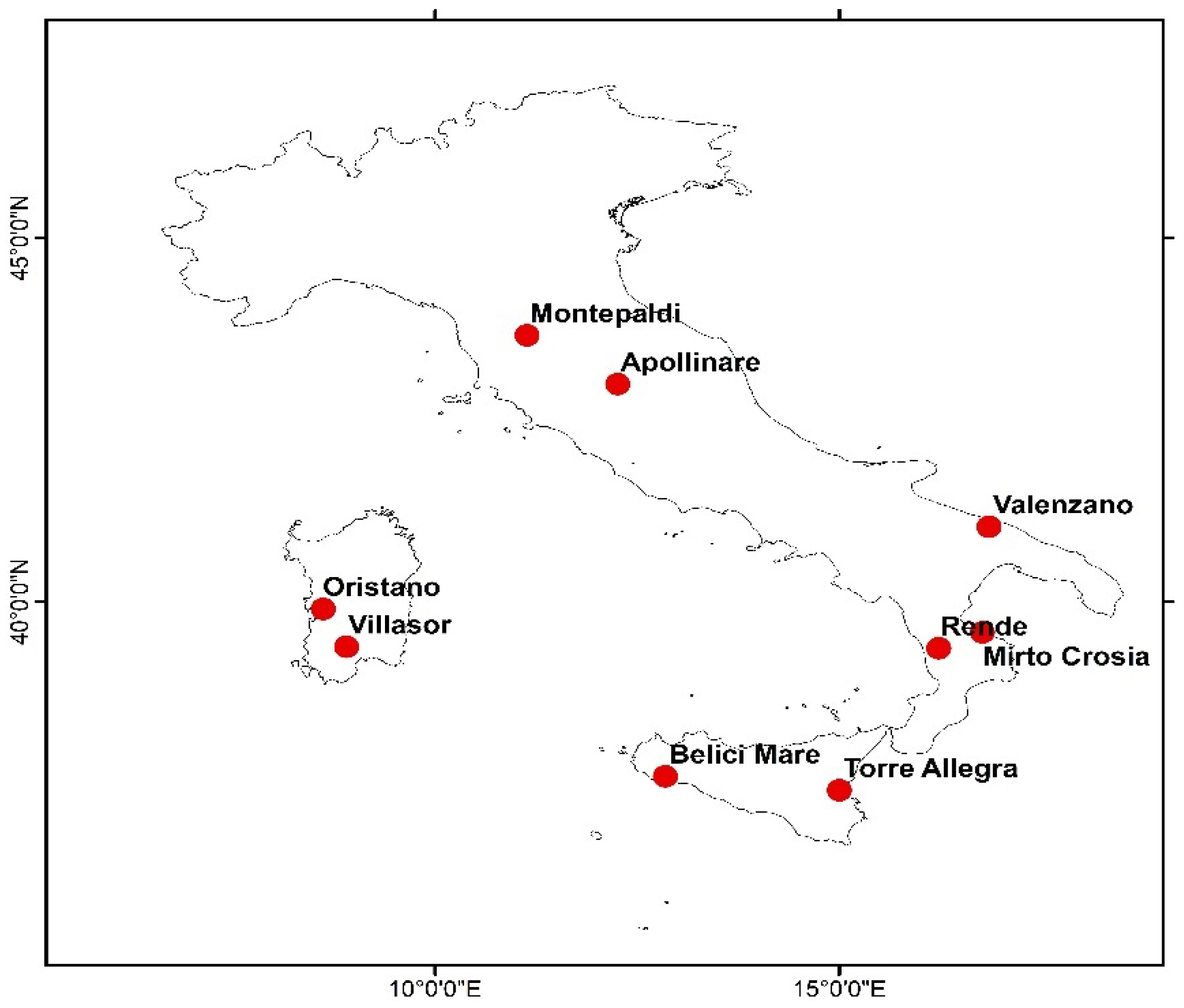
| Montepaldi (Tuscany, FI) | 43.66° | 11.14° | 15.8 °C | Carolea | 1997–1999 | 3 |
| Picholine | 1997–1999 | 3 | ||||
| Frantoio | 1997–1999 | 3 | ||||
| Moraiolo | 1997–1999 | 3 | ||||
| Villasor (Sardinia, CA) | 39.38° | 8.91° | 16.9 °C | Carolea | 1997–1999 | 3 |
| Picholine | 1997–1998 | 2 | ||||
| Oristano (Sardinia, OR) | 39.9° | 8.62° | 17 °C | Carolea | 2014–2019 | 6 |
| Frantoio | 2014–2020 | 7 | ||||
| Valenzano (Apulia, BA) | 41.03° | 16.85° | 16.5 °C | Carolea | 1997–2000 | 4 |
| Picholine | 1997–2000 | 4 | ||||
| Torre Allegra (Sicily, CT) | 37.41° | 15.00° | 16.6 °C | Carolea | 1997 and 1999 | 2 |
| Picholine | 1997 and 1999 | 2 | ||||
| Belice Mare (Sicily, TP) | 37.60° | 12.85° | 18.84 °C | Carolea | 1997–1998 | 2 |
| Picholine | 1997–1998 | 2 | ||||
| Rende (Calabria, CS) | 39.36° | 16.23° | 16.3 °C | Carolea | 1999 | 1 |
| Picholine | 1997 and 1999 | 2 | ||||
| Saint Apollinare (Perugia, PG) | 43.04° | 12.25° | 14 °C | Carolea | 1997–1999 | 3 |
| Picholine | 1997–1999 | 3 | ||||
| Frantoio | 1997–1999 | 3 | ||||
| Moraiolo | 1997–1999 | 3 | ||||
| Mirto Crosia (Cosenza, CS) | 39.72° | 16.75° | 18.14 °C | Carolea | 2001–2003, 2015, 2018, 2019, and 2021 | 8 |
| Moraiolo | 2001, 2002, 2003, 2019, and 2021 | 5 | ||||
| Frantoio | 2001, 2002, 2003, and 2019 | 4 |
| Case | Temperature Conditions | Chill Days | Anti-Chill Days |
|---|---|---|---|
| 1 | 0 ≤ Tc ≤ Tn ≤ Tx | Cd = 0 | Ca = Tm − Tc |
| 2 | 0 ≤ Tn ≤ Tc < Tx | Cd = − ((Tm − Tn) − ([Tx − Tc]2/2[Tx − Tn])) | Ca = ((Tx − Tc)2/2(Tx − Tn)) |
| 3 | 0 ≤ Tn ≤ Tx ≤ Tc | Cd = − (Tm − Tn) | Ca = 0 |
| 4 | Tn < 0 ≤ Tx ≤ Tc | Cd = − (Tx2/2(Tx − Tn)) | Ca = 0 |
| 5 | Tn < 0 < Tc < Tx | Cd = − (Tx2/2(Tx − Tn)) − ((Tx − Tc)2/2(Tx − Tn)) | Ca = ((Tx − Tc)2/2(Tx − Tn)) |
| 6 | Tn < Tx < 0 < Tc | Cd = 0 | Ca = 0 |
| Phase Olive Cultivar | Sprouting | Blooming | Pit Hardening | |||
|---|---|---|---|---|---|---|
| PhenoFlex | CAC | PhenoFlex | CAC_GDD | PhenoFlex | CAC_GDD | |
| Carolea | 22 | 20 | 14 | 9 | 40 | 10 |
| Picholine | 24 | 24 | 14 | 12 | 42 | 13 |
| Frantoio | 9.5 | 9 | 18 | 4 | 13 | 5 |
| Moraiolo | 5 | 6 | 16 | 4 | 23 | 6 |
| Phenological Phase | Cultivar | CAC | CAC_GDD | |||
|---|---|---|---|---|---|---|
| Tc | Cr | Tb | Tx | Hr | ||
| Sprouting | Carolea | 9.5 | −115 | - | - | - |
| Picholine | 8.2 | −122 | - | - | - | |
| Moraiolo | 11.2 | −133 | - | - | - | |
| Frantoio | 9.7 | −137 | - | - | - | |
| Blooming | Carolea | - | - | 5.9 | 31.5 | 437 |
| Picholine | - | - | 7 | 28.3 | 568 | |
| Moraiolo | - | - | 4.5 | 29.5 | 370 | |
| Frantoio | - | - | 5.3 | 26.3 | 388 | |
| Pit hardening | Carolea | - | - | 5.9 | 31.5 | 1074 |
| Picholine | - | - | 7 | 28.3 | 1003 | |
| Moraiolo | - | - | 4.5 | 29.5 | 1315 | |
| Frantoio | - | - | 5.3 | 26.3 | 1275 | |
| Phase Olive Cultivar | Sprouting | Blooming | Pit Hardening | ||||
|---|---|---|---|---|---|---|---|
| PhenoFlex | CAC | PhenoFlex | CAC_GDD | PhenoFlex | CAC_GDD | ||
| Carolea | Mean | 22.4 | 20.43 | 29.9 | 8.82 | >40 | 9.8 |
| Stdv. | 1.5 | 0.87 | 0.5 | 0.61 | 3 | 1 | |
| Sample Number | 22 | 21 | 13 | ||||
| Picholine | Mean | 26.8 | 24.94 | 36.4 | 12.23 | >40 | 14 |
| Stdv. | 1.1 | 1.3 | 4.2 | 0.83 | 1.9 | 0.97 | |
| Sample Number | 16 | 16 | 14 | ||||
| Frantoio | Mean | 12.48 | 11 | 31 | 6 | >40 | 4.5 |
| Stdv. | 1.4 | 1.5 | 2.2 | 0.4 | 3.35 | 0.5 | |
| Sample Number | 12 | 12 | 6 | ||||
| Moraiolo | Mean | 5.65 | 5.74 | 34 | 3.47 | >40 | 5.6 |
| Stdv. | 1.3 | 1.16 | 4.5 | 1 | 3.27 | 0.72 | |
| Sample Number | 6 | 6 | 6 | ||||
Disclaimer/Publisher’s Note: The statements, opinions and data contained in all publications are solely those of the individual author(s) and contributor(s) and not of MDPI and/or the editor(s). MDPI and/or the editor(s) disclaim responsibility for any injury to people or property resulting from any ideas, methods, instructions or products referred to in the content. |
© 2023 by the authors. Licensee MDPI, Basel, Switzerland. This article is an open access article distributed under the terms and conditions of the Creative Commons Attribution (CC BY) license (https://creativecommons.org/licenses/by/4.0/).
Share and Cite
Didevarasl, A.; Costa Saura, J.M.; Spano, D.; Deiana, P.; Snyder, R.L.; Mulas, M.; Nieddu, G.; Zelasco, S.; Santona, M.; Trabucco, A. Modeling Phenological Phases across Olive Cultivars in the Mediterranean. Plants 2023, 12, 3181. https://doi.org/10.3390/plants12183181
Didevarasl A, Costa Saura JM, Spano D, Deiana P, Snyder RL, Mulas M, Nieddu G, Zelasco S, Santona M, Trabucco A. Modeling Phenological Phases across Olive Cultivars in the Mediterranean. Plants. 2023; 12(18):3181. https://doi.org/10.3390/plants12183181
Chicago/Turabian StyleDidevarasl, Ali, Jose M. Costa Saura, Donatella Spano, Pierfrancesco Deiana, Richard L. Snyder, Maurizio Mulas, Giovanni Nieddu, Samanta Zelasco, Mario Santona, and Antonio Trabucco. 2023. "Modeling Phenological Phases across Olive Cultivars in the Mediterranean" Plants 12, no. 18: 3181. https://doi.org/10.3390/plants12183181
APA StyleDidevarasl, A., Costa Saura, J. M., Spano, D., Deiana, P., Snyder, R. L., Mulas, M., Nieddu, G., Zelasco, S., Santona, M., & Trabucco, A. (2023). Modeling Phenological Phases across Olive Cultivars in the Mediterranean. Plants, 12(18), 3181. https://doi.org/10.3390/plants12183181