


The Appeal of Ethnobotanical Folklore Records: Medicinal Plant Use in Setomaa, Räpina and Vastseliina Parishes, Estonia (1888–1996)



Abstract
1. Introduction
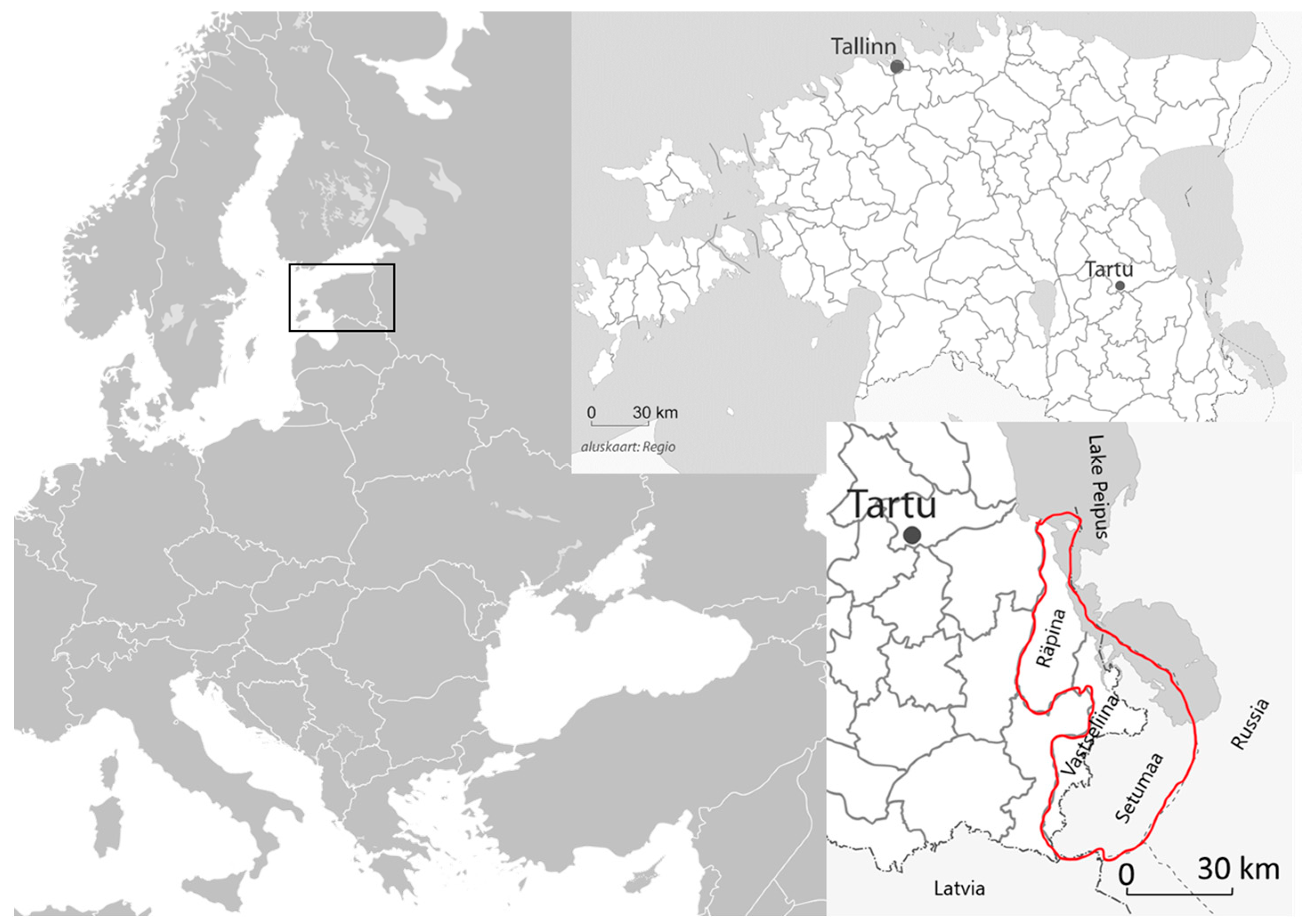
1.1. Seto (Setomaa), Räpina and Vastseliina Parishes
The Organization of Medicinal Support in the Region
1.2. The Aim of the Work
- (1)
- to analyze the historical material and compare the two regions; and
- (2)
- to provide an example of how to treat archival data in ethnobotanical research, in such a way that it is fully useable in modern scientific research and comparable with currently obtained data.
- (a)
- reviewed folklore ethnobotanical texts from the HERBA database [8], and identified the various plants and diseases whenever possible; and
- (b)
- limited our research to the whole of Setomaa and only the two parishes of Võru (Räpina and Vastseliina) in order to have a relatively comparable number of texts.
2. Results
2.1. Cleaning the Data
- the text clearly referred to a pharmacy drug or a processed product purchased from a travelling merchant;
- no clear reference to the plant was given (e.g., make the broom from nine leafy trees);
- students supplying the records clearly misinterpreted the information and/or clearly confused the plants;
- there was no reference to the plant’s application (stating that it was just medicine);
- poisonous aspects of a plant were highlighted with no medicinal application; and
- when students used both the Latin name and local name of the plant deriving from literary sources and a clear literature influence could be detected.
2.2. The Identification of Plants
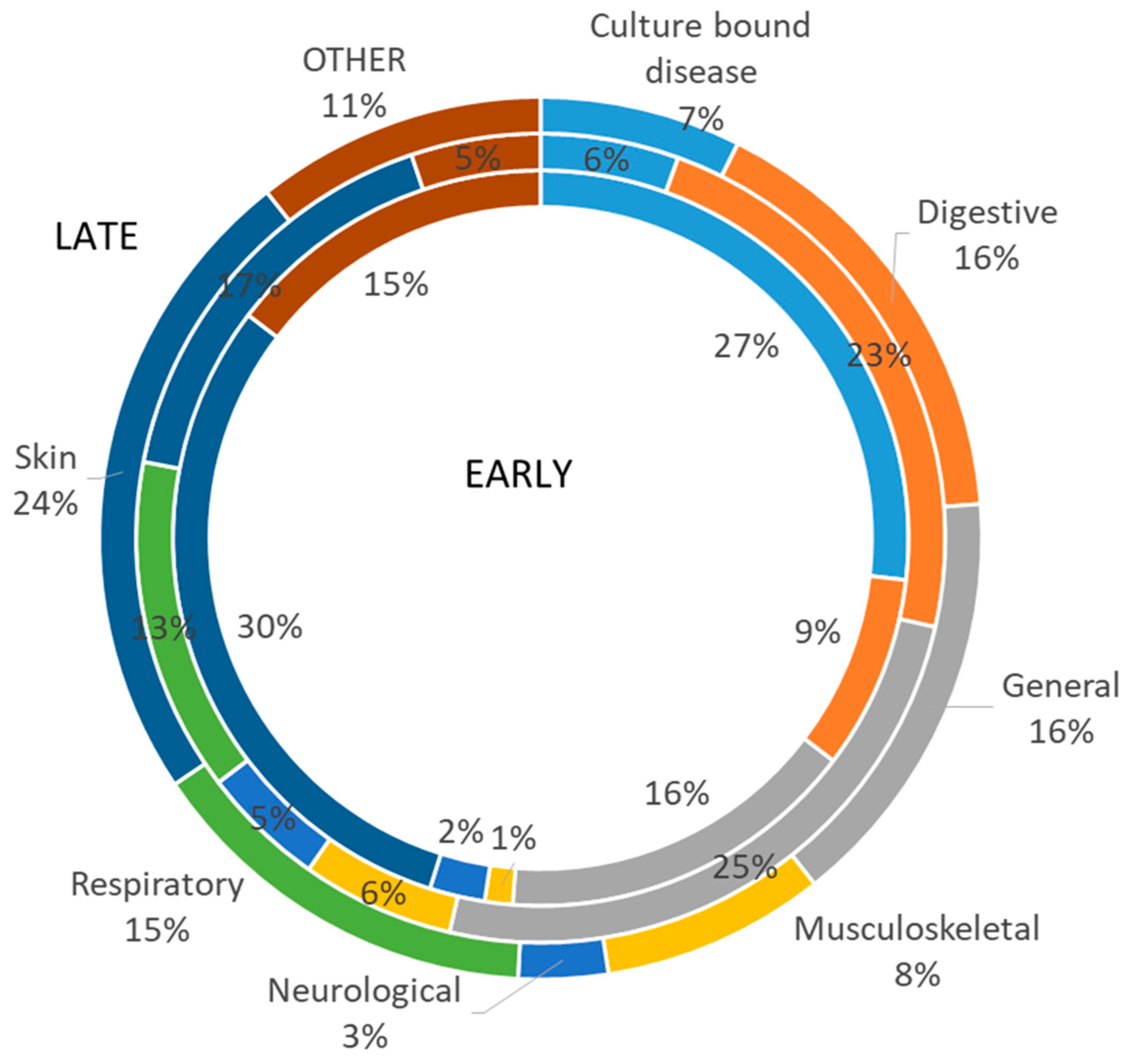
2.3. The Identification of Etic Disease Categories
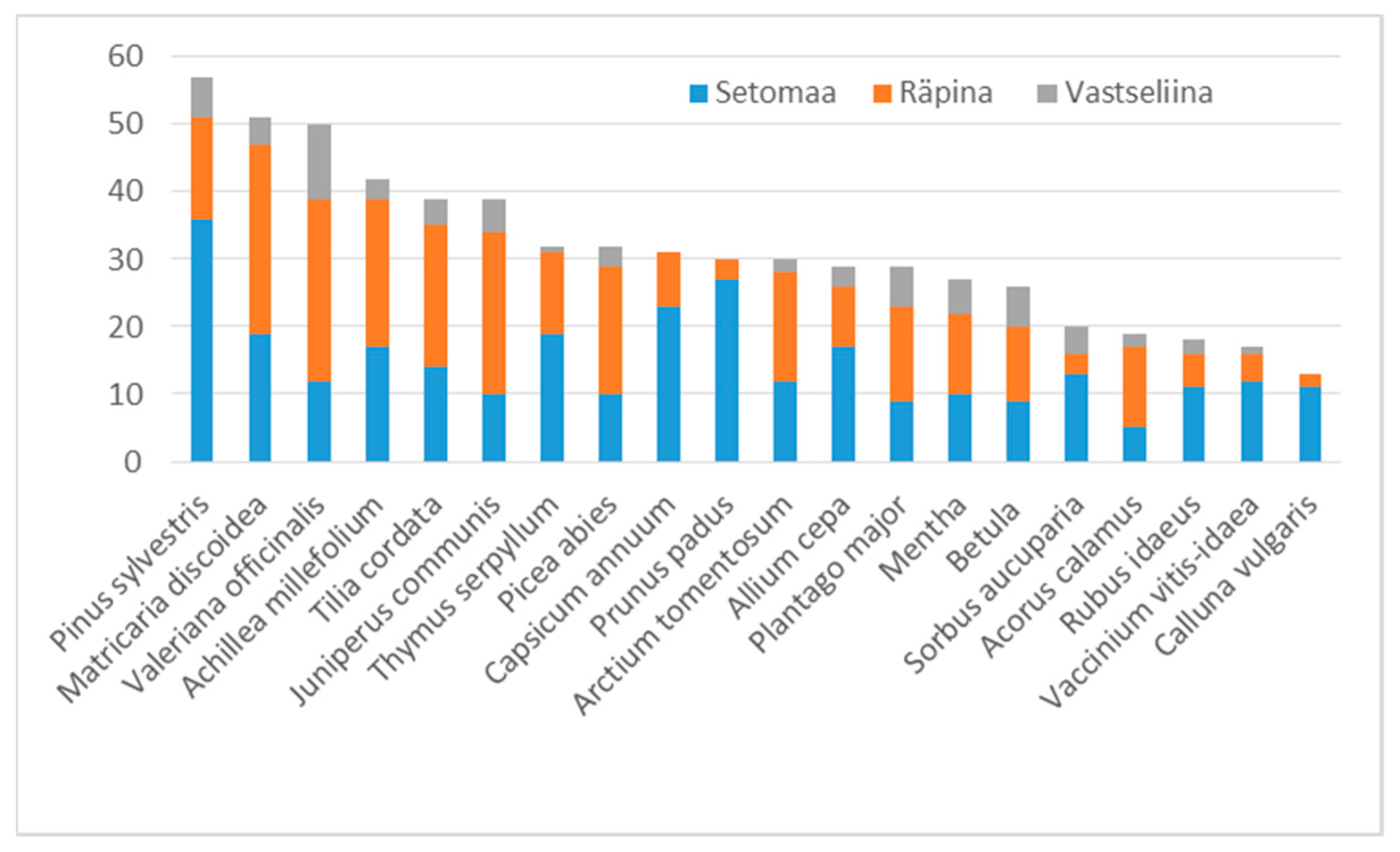
2.4. A General Overview of Plant Uses
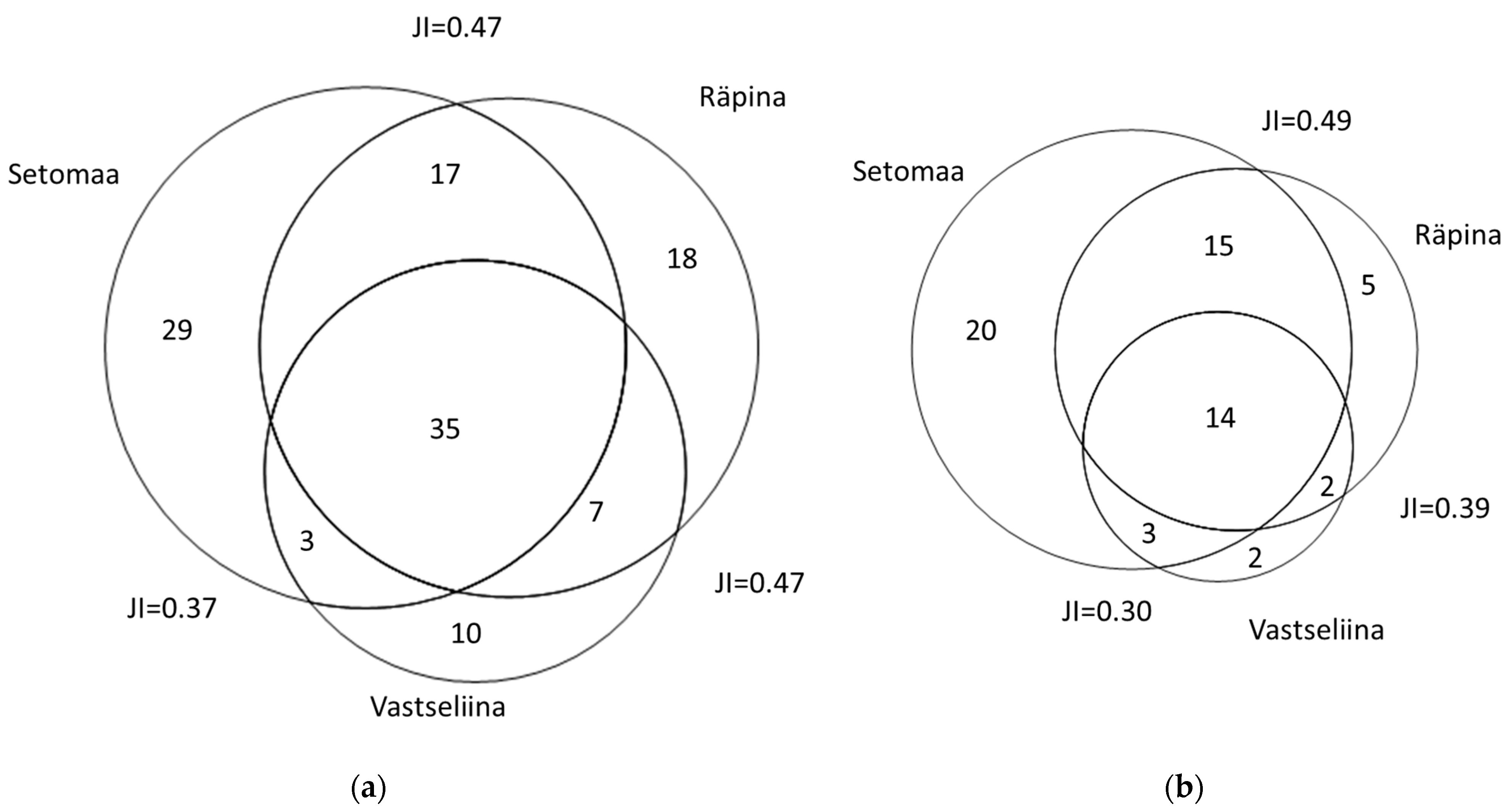
2.5. A Cross-Cultural and Diachronic Comparison
3. Discussion
- (1)
- Not all pre-systematized data may be suitable for the research purpose, and therefore some of the data may need to be removed due to not having sufficient information (as we did with missing information on a specific identified use).
- (2)
- One needs to be critical of the data, especially if the collection has some competitive undertones and there is a possibility of group work or risk that the actual data was beautified.
- (3)
- It is better to under-identify the data than over-identify it; working with historical data, especially folklore material, it is inevitable that some taxa remain unidentified.
- (4)
- It is important to involve specialists in the local flora also having a background in historical biogeography.
- (5)
- Working with such a dataset also requires knowledge of the purchasable material in the region.
- (6)
- The historical epidemiology of the region also needs to be studied prior to disease identification.
4. Materials and Methods
- Early: 1888–1904 (80 UR);
- Middle: 1928–1942 (871 UR); and
- Late: 1949–1996 (121 UR).
Data Comparison
5. Conclusions
Supplementary Materials
Author Contributions
Funding
Institutional Review Board Statement
Informed Consent Statement
Data Availability Statement
Conflicts of Interest
References
- Quave, C.L.; Pieroni, A. A reservoir of ethnobotanical knowledge informs resilient food security and health strategies in the Balkans. Nat. Plants 2015, 1, 14021. [Google Scholar] [CrossRef] [PubMed]
- Silva, T.C.D.; Medeiros, P.M.; Balcázar, A.L.; Sousa, T.A.D.A.; Pirondo, A.; Medeiros, M.F.T. Historical ethnobotany: An overview of selected studies. Ethnobio. Conserv. 2014, 3, 1–12. [Google Scholar] [CrossRef]
- Łuczaj, Ł. Dziko rosnące rośliny jadalne w ankiecie Józefa Rostafińskiego z roku 1883. Wiad. Bot. 2008, 52, 39–50. [Google Scholar]
- Łuczaj, Ł. Changes in the utilization of wild green vegetables in Poland since the 19th century: A comparison of four ethnobotanical surveys. J. Ethnopharmacol. 2010, 128, 395–404. [Google Scholar] [CrossRef]
- Kalle, R.; Pieroni, A.; Svanberg, I.; Sõukand, R. Early Citizen Science Action in Ethnobotany: The Case of the Folk Medicine Collection of Dr. Mihkel Ostrov in the Territory of Present-Day Estonia, 1891–1893. Plants 2022, 11, 274. [Google Scholar] [CrossRef]
- Kalle, R.; Sõukand, R. The name to remember: Flexibility and contextuality of preliterate folk plant categorization from the 1830s, in Pernau, Livonia, historical region on the eastern coast of the Baltic Sea. J. Ethnopharmacol. 2021, 264, 113254. [Google Scholar] [CrossRef]
- Ningthoujam, S.S.; Talukdar, A.D.; Potsangbam, K.S.; Choudhury, M.D. Challenges in developing medicinal plant databases for sharing ethnopharmacological knowledge. J. Ethnopharmacol. 2012, 141, 9–32. [Google Scholar] [CrossRef]
- Sõukand, R.; Kalle, R. (Eds.) HERBA: Historistlik Eesti Rahvameditsiini Botaaniline Andmebaas; EKM Teaduskirjastus: Tartu, Estonia, 2008; Available online: http://herba.folklore.ee (accessed on 20 August 2022).
- Koay, A.; Shannon, F.; Sasse, A.; Heinrich, M.; Sheridan, H. Exploring the Irish National Folklore Ethnography Database (Dúchas) for Open Data Research on Traditional Medicine Use in Post-Famine Ireland: An Early Example of Citizen Science. Front. Pharmacol. 2020, 11, 584595. [Google Scholar] [CrossRef]
- Shannon, F.; Sasse, A.; Sheridan, H.; Heinrich, M. Are identities oral? Understanding ethnobotanical knowledge after Irish independence (1937–1939). J. Ethnobiol. Ethnomed. 2017, 13, 65. [Google Scholar] [CrossRef]
- Sõukand, R.; Kalle, R. Personal and shared: The reach of different herbal landscapes. Est. J. Ecolog. 2012, 61, 20–36. [Google Scholar] [CrossRef]
- Pranskuniene, Z.; Bernatoniene, J.; Simaitiene, Z.; Pranskunas, A.; Mekas, T. Ethnomedicinal uses of honeybee products in lithuania: The first analysis of archival sources. Evid.-based Complement. Altern. Med. 2016, 9272635, 1–7. [Google Scholar] [CrossRef] [PubMed]
- Sak, K.; Jürisoo, K.; Raal, A. Estonian folk traditional experiences on natural anticancer remedies: From past to the future. Pharma. Biol. 2014, 52, 855–866. [Google Scholar] [CrossRef] [PubMed]
- Sile, I.; Romane, E.; Reinsone, S.; Maurina, B.; Tirzite, D.; Dambrova, M. Medicinal plants and their uses recorded in the Archives of Latvian Folklore from the 19th century. J. Ethnopharmacol. 2020, 249, 112378. [Google Scholar] [CrossRef] [PubMed]
- Sile, I.; Romane, E.; Reinsone, S.; Maurina, B.; Tirzite, D.; Dambrova, M. Data on medicinal plants in the records of Latvian folk medicine from the 19th century. Data Brief 2020, 28, 105024. [Google Scholar] [CrossRef]
- Assmuth, L. Intertwining identities: The politics of language and nationality in the Estonian-Russian borderlands. In Crossings and Crosses: Borders, Educations, and Religions in Northern Europe; Berglund, J., Lundén, T., Strandbrink, P., Eds.; De Gruyter: Berlin, Germany, 2015; pp. 29–46. [Google Scholar]
- Assmuth, L. Asymmetries of gender and generation in a post-Soviet borderland. In Border Encounters. Asymmetry and Proximity at Europe’s Frontiers; Bacas, J.L., Kavanagh, W., Eds.; Berghahn Books: New York, NY, USA, 2013; pp. 139–164. [Google Scholar]
- Sõukand, R.; Pieroni, A. The importance of a border: Medical, veterinary, and wild food ethnobotany of the Hutsuls living on the Romanian and Ukrainian sides of Bukovina. J. Ethnopharmacol. 2016, 185, 17–40. [Google Scholar] [CrossRef]
- Sõukand, R.; Kalle, R.; Pieroni, A. Homogenisation of Biocultural Diversity: Plant Ethnomedicine and Its Diachronic Change in Setomaa and Võromaa, Estonia, in the Last Century. Biology 2022, 11, 192. [Google Scholar] [CrossRef]
- Kalle, R.; Sõukand, R.; Pieroni, A. Devil Is in the Details: Use of Wild Food Plants in Historical Võromaa and Setomaa, Present-Day Estonia. Foods 2020, 9, 570. [Google Scholar] [CrossRef]
- Lüüs, A. Rahvahaigused ja rahva ravimisviisid Võrumaal 19. sajandi viimasel veerandil. II. Mana 1960, 1, 34–35. [Google Scholar]
- Lüüs, A. Rahvahaigused ja rahva ravimisviisid Võrumaal 19. sajandi viimasel veerandil. I. Mana 1959, 3, 184–187. [Google Scholar]
- Gustavson, H.; Pilk, F.R. Kreutzwaldi arstitegevusse. Keel Kirjand. 1982, 8, 409–416. [Google Scholar]
- Gustavson, H. Eesti Apteekide Ajaloost; Eesti Apteekrite Liit: Tallinn, Estonia, 2020; 232p. [Google Scholar]
- Anonymous. Maarohtudega haiguse vastu; Taim murrab tõve; Üks tunnike rohukauplejatega Tallinna turul. Uudisleht 1936, 140, 7. Available online: https://dea.digar.ee/page/uudisleht/1936/09/08/7 (accessed on 5 October 2022).
- Sõukand, R.; Raal, A. How the name Arnica was borrowed into Estonian. Trames 2008, 12, 29–39. [Google Scholar] [CrossRef]
- International Classification of Primary Care, 2nd Edition (ICPC-2). Updated March 2003 in Family Practice, OUP. Available online: https://www.who.int/standards/classifications/other-classifications/international-classification-of-primary-care (accessed on 20 August 2022).
- Sõukand, R. “Jooksvarohud” Eesti rahvameditsiinis. Akadeemia 2004, 11, 2475–2493. [Google Scholar]
- Sõukand, R.; Hrynevich, Y.; Prakofjewa, J.; Valodzina, T.; Vasilyeva, I.; Paciupa, J.; Shrubok, A.; Hlushko, A.; Knureva, Y.; Litvinava, Y.; et al. Use of cultivated plants and non-plant remedies for human and animal home-medication in Liubań district, Belarus. J. Ethnobio. Ethnomed. 2017, 13, 54. [Google Scholar] [CrossRef]
- Belichenko, O.; Kolosova, V.; Kalle, R.; Sõukand, R. Green pharmacy at the tips of your toes: Medicinal plants used by Setos and Russians of Pechorsky District, Pskov Oblast (NW Russia). J. Ethnobiol. Ethnomed. 2022, 18, 1–38. [Google Scholar] [CrossRef]
- Hurt, J. Paar palwid Eesti ärksamaile poegadele ja tütardele. Olevik 1888, 12, 1. [Google Scholar]
- Prūse, B.; Kalle, R.; Buffa, G.; Simanova, A.; Mežaka, I.; Sõukand, R. We need to appreciate common synanthropic plants before they become rare: Case study in Latgale (Latvia). Ethnobiol. Conserv. 2021, 10, 1–26. [Google Scholar] [CrossRef]
- Vilbaste, G. Eesti Taimenimetused; Emakeele Selts: Tallinn, Estonia, 1993; pp. 1–706. [Google Scholar]
- Plants of the World Online. Facilitated by the Royal Botanic Gardens, Kew, UK. Available online: https://powo.science.kew.org/ (accessed on 20 August 2022).
- Tutin, T.G.; Burges, N.A.; Chater, A.O.; Edmondson, J.R.; Heywood, V.H.; Moore, D.M.; Valentine, D.H.; Walters, S.M.; Webb, D.A. (Eds.) Flora Europaea; University Press: Cambridge, UK, 1964–1980; Volumes 1–5, Available online: http://ww2.bgbm.org/EuroPlusMed/query.asp (accessed on 20 August 2022).
- Stevens, P.F. Angiosperm Phylogeny Website. 2001 Onwards. Version 14 July 2017. Available online: http://www.mobot.org/MOBOT/research/APweb/ (accessed on 20 August 2022).
- González-Tejero, M.; Casares-Porcel, M.; Sánchez-Rojas, C.P.; Ramiro-Gutiérrez, J.M.; Molero-Mesa, J.; Pieroni, A.; Giusti, M.E.; Censorii, C.; de Pasquale, C.; Della, D.; et al. Medicinal plants in the Mediterranean area: Synthesis of the results of the project Rubia. J. Ethnopharmacol. 2008, 116, 341–357. [Google Scholar] [CrossRef] [PubMed]
- Mauri, M.; Elli, T.; Caviglia, G.; Uboldi, G.; Azzi, M. RAWGraphs: A Visualisation Platform to Create Open Outputs. In Proceedings of the 12th Biannual Conference on Italian SIGCHI Chapter; Association for Computing Machinery, Cagliari, Italy, 18 September 2017; pp. 1–5. [Google Scholar]

| Blood: 8 | Urological: 20 | Respiratory: 134 |
|---|---|---|
| blood cleaning: 5 | blood peeing: 3 | cough: 129 |
| blood pressure: 1 | kidney and bladder disease: 10 | difficulties in breathing: 1 |
| poor blood: 2 | kidney disease: 5 | nose bleeding: 2 |
| oedema: 1 | sore throat: 2 | |
| urinary retention: 1 | ||
| Pregnancy, etc.: 3 | Female genital: 11 | Cardiovascular: 15 |
| giving birth: 3 | problems with menstruation: 4 | heart diseases: 15 |
| women diseases: 7 | ||
| Culture-bound disease: 79 | Musculoskeletal: 64 | Neurological: 49 |
| kaetus (evil eye): 3 | backache: 4 | calming: 6 |
| halltõbi: 4 | bone pain: 3 | epilepsy: 1 |
| internal disease: 38 | foot diseases: 4 | headache: 13 |
| kidi (tendovaginitis or bursitis in the wrist): 11 | joint disease: 1 | nerve disease: 8 |
| vaivaja, vaivajatõbi (nightmare or hernia): 3 | joint dislocation: 4 | paralysis: 2 |
| pistja (stixis, pleuritis, etc.): 6 | jooksva/rheumatic: 48 | seizures: 12 |
| riis (umbilical hernia in children): 2 | sleep disorder: 7 | |
| tiir (itchy soles): 1 | ||
| tsirgutõbi (a disease in young children): 1 | ||
| ussiviga (chorea in young children): 4 | ||
| Skin: 200 | Digestive: 227 | General: 250 |
| abscess: 9 | appendicitis: 1 | against several diseases: 15 |
| bee stings: 1 | bile disease: 1 | cold: 57 |
| bleeding: 19 | constipation: 5 | cholera: 3 |
| boil: 26 | diarrhea: 12 | disinfection: 6 |
| burned wound: 13 | digestion problems: 10 | fever: 10 |
| skin cancer: 1 | gastric disease: 13 | for sweating: 5 |
| cracked lips: 4 | gastric ulcers: 2 | freezing: 6 |
| cut wound: 2 | hemorrhoids: 1 | good for health: 4 |
| dandruff: 4 | heartburn: 2 | inflammation: 2 |
| eruption: 4 | indigestion: 3 | loss of appetite: 9 |
| erysipelas: 22 | jaundice: 8 | lung disease: 34 |
| for beauty: 4 | liver disease: 6 | pain: 3 |
| fresh wound: 3 | mouth diseases: 1 | prophylactics: 4 |
| hair loss: 1 | nausea: 2 | rabies: 1 |
| inflammation: 7 | stomach disease: 53 | stroke: 2 |
| itching: 1 | stomach worms: 14 | throat disease: 21 |
| local pain: 2 | stomachache: 64 | tiredness: 1 |
| lump on skin: 6 | tapeworm: 4 | tuberculosis: 62 |
| pimples: 6 | tooth diseases: 7 | typhus: 2 |
| roos (erysipelas): 2 | toothache: 18 | whooping cough: 2 |
| rotten wound: 10 | vomiting: 1 | |
| scabies: 3 | ||
| scabs: 3 | ||
| skin disinfection: 2 | ||
| skin diseases: 1 | ||
| snake bite: 5 | ||
| splinter: 1 | ||
| sunburn: 1 | ||
| warts: 8 | ||
| wound: 28 | ||
| Ear diseases: 2 | Eye diseases: 10 |
| Collection/Parish | Räpina | Setomaa | Vastseliina | Sum |
|---|---|---|---|---|
| E | 5 | 1 | 2 | 8 |
| ERA | 27 | 45 | 1 | 73 |
| ERM | 3 | 3 | ||
| H | 22 | 25 | 28 | 75 |
| KKI | 6 | 6 | ||
| RKM | 37 | 43 | 11 | 91 |
| Vilbaste | 343 | 383 | 90 | 816 |
| SUM | 434 | 503 | 135 | 1072 |
| Family | Taxa | Local Name | Etic Disease Category | UR |
|---|---|---|---|---|
| Acoraceae | Acorus calamus L. L | Jõekalmus S, lesnagud S, kalmus, tatersäla V, kalmusejuur | Cardiovascular | 1 |
| Culture-bound disease | 1 | |||
| Digestive | 7 | |||
| General | 7 | |||
| Musculoskeletal | 3 | |||
| Skin | 1 | |||
| Urological | 1 | |||
| Amaranthaceae | Beta vulgaris L. C | peet S, verevä nakri S | Eye | 1 |
| Skin | 4 | |||
| Amaryllidaceae | Allium cepa L. C | sibul, sippul S, sipul V | Cardiovascular | 2 |
| Digestive | 7 | |||
| Ear | 1 | |||
| General | 5 | |||
| Respiratory | 5 | |||
| Skin | 8 | |||
| Urological | 1 | |||
| Allium sativum L. C | kurslaga S, kurslakk S, küüslauk S | Digestive | 1 | |
| General | 1 | |||
| Respiratory | 1 | |||
| Skin | 1 | |||
| Apiaceae | Angelica sylvestris L. L | heinputk V, pütsk V | Digestive | 2 |
| Carum carvi L. L | köömned V, küümned | Cardiovascular | 1 | |
| Digestive | 5 | |||
| General | 6 | |||
| Respiratory | 2 | |||
| Asparagaceae | Convallaria majalis L. L | maikelluke S | General | 1 |
| Asphodelaceae | Aloe arborescens Mill. C | aalo, aaloe, aalus S, aleo S, pakso lill S | Culture-bound disease | 1 |
| General | 6 | |||
| Respiratory | 1 | |||
| Skin | 7 | |||
| Asteraceae | Achillea millefolium L. L | raudrohi, verihein, verihain, valgõ lill S | Culture-bound disease | 2 |
| Digestive | 11 | |||
| Female genital | 2 | |||
| General | 5 | |||
| Musculoskeletal | 1 | |||
| Neurological | 1 | |||
| Respiratory | 6 | |||
| Skin | 10 | |||
| Antennaria dioica (L.) Gaertn. L | kassikäpad S | Female genital | 1 | |
| Arctium tomentosum Mill. L | takjas, takk S | Blood | 2 | |
| Culture-bound disease | 3 | |||
| Digestive | 3 | |||
| General | 3 | |||
| Respiratory | 7 | |||
| Skin | 11 | |||
| Urological | 1 | |||
| Artemisia absinthium L. L | koirohi, pänül S, pälüm | Culture-bound disease | 2 | |
| Digestive | 5 | |||
| General | 3 | |||
| Musculoskeletal | 1 | |||
| Skin | 4 | |||
| Carduus crispus L. or Cirsium vulgare (Savi) Ten. L | karuohtja V | Urological | 1 | |
| Gnaphalium uliginosum L. L | sammaspoolehain, sammaspoolehein, sammaspoolhain S, sammaspoolikuhain S, sammaspoolikuhein V, sammaspoolõhain S, soo-kassiurb V | Skin | 10 | |
| Matricaria chamomilla L. C | kamel V, teekummel | General | 6 | |
| Neurological | 4 | |||
| Respiratory | 2 | |||
| Matricaria discoidea DC. L | kaamel V, kammel V, kumelitee V, kaamelihain V, kummel, kummulid S, lõhnav kummel, ubinhain, ubinhein, unõhain S, upinhain, uppinhain S | Culture-bound disease | 2 | |
| Digestive | 9 | |||
| Ear | 1 | |||
| Eye | 3 | |||
| General | 15 | |||
| Musculoskeletal | 1 | |||
| Neurological | 2 | |||
| Pregnancy, childbearing, etc. | 1 | |||
| Respiratory | 11 | |||
| Skin | 6 | |||
| Scorzoneroides autumnalis (L.) MoenchL, Solidago virgaurea L. L or with lower probability, many other taxa | arnikas, ärnika S | Culture-bound disease | 6 | |
| Digestive | 3 | |||
| General | 2 | |||
| Neurological | 1 | |||
| Respiratory | 2 | |||
| Solidago virgaurea L. L | ärnetsa V | Musculoskeletal | 1 | |
| Tanacetum vulgare L. L | kolladsõ lill S, kollane lill S, solknaheinad S, solknarohi V | Digestive | 4 | |
| Taraxacum officinale F.H. Wigg. L | võilill | Digestive | 1 | |
| Skin | 1 | |||
| Tragopogon pratensis L. L | piimjuur V | Digestive | 1 | |
| Tripleurospermum inodorum (L.) Sch.Bip. L | kammel S | Digestive | 1 | |
| Respiratory | 1 | |||
| Tussilago farfara L. L | ämmaleht V | Skin | 1 | |
| Betulaceae | Alnus spp. L (incl. Alnus glutinosa (L.) Gaertn. and Alnus incana (L.) Moench) | lepp, soolepp S imälepp S imälepp S valge lepp V | Culture-bound disease | 2 |
| Skin | 4 | |||
| Digestive | 1 | |||
| Betula spp. L | kask, kõiv, kõo S | Culture-bound disease | 2 | |
| Digestive | 2 | |||
| General | 5 | |||
| Musculoskeletal | 7 | |||
| Respiratory | 2 | |||
| Skin | 8 | |||
| Brassicaceae | Armoracia rusticana G. Gaertn., B. Mey. & Scherb. C | maarjaritska V, mädarõigas V | Culture-bound disease | 1 |
| Digestive | 2 | |||
| Brassica oleracea var. capitata f. AlbaC | kapsas S | Eye | 1 | |
| Neurological | 2 | |||
| Skin | 1 | |||
| Brassica rapa L. C | naar V | General | 1 | |
| Capsella bursa-pastoris (L.) Medik. L | hiirekõrv V | Musculoskeletal | 1 | |
| Sinapis alba L. C | sinep V | Eye | 1 | |
| Cannabaceae | Cannabis sativa L. C | kanebi, kanep V | Culture-bound disease | 3 |
| General | 1 | |||
| Caprifoliaceae | Valeriana officinalis L. L | balderjan V, palderjaan V, palderjan, paltõjan S | Cardiovascular | 3 |
| Culture-bound disease | 7 | |||
| Digestive | 17 | |||
| Female genital | 1 | |||
| General | 2 | |||
| Neurological | 20 | |||
| Crassulaceae | Hylotelephium maximum (L.) Holub L | kidsihain, kidsihein V, maapähkme V | Culture-bound disease | 7 |
| General | 1 | |||
| Sempervivum globiferum L. N | maasibul V | Neurological | 1 | |
| Cupressaceae | Juniperus communis L. L | kadajas, kadakas, kadak V, kattai | Blood | 1 |
| Culture-bound disease | 4 | |||
| Digestive | 3 | |||
| General | 19 | |||
| Musculoskeletal | 1 | |||
| Neurological | 2 | |||
| Respiratory | 1 | |||
| Urological | 8 | |||
| Linum usitatissimum L. C | lina | General | 3 | |
| Skin | 6 | |||
| Cyperaceae | Eriophorum vaginatum L. L | pikki hain V | Skin | 1 |
| Droseraceae | Drosera rotundifolia L. L | huulehain S, huulhain S, huulhein S | Skin | 5 |
| Equisetaceae | Equisetum arvense L. L | põldosi V, tilkhain V | Skin | 1 |
| Equisetum spp. L | osjad V | Urological | 1 | |
| Ericaceae | Andromeda polifolia L. L | tsihknaõied S | Respiratory | 1 |
| Arctostaphylos uva-ursi (L.) Spreng. L | leesikad, tsiamarja S, lehike S, tsiapalohka S, tsiapalokka S | Culture-bound disease | 1 | |
| General | 1 | |||
| Respiratory | 1 | |||
| Urological | 2 | |||
| Calluna vulgaris (L.) Hull L | kanarik S, kanarpik S, palokanarik S | Digestive | 1 | |
| General | 4 | |||
| Musculoskeletal | 2 | |||
| Skin | 3 | |||
| Chimaphila umbellata (L.) W.P.C.Barton L | obijoinihain S, obijoinilill S, obijoon S, opijon S, obijoon S, oobium, oopiumiheinad V, opijann S | Cardiovascular | 2 | |
| Culture-bound disease | 3 | |||
| Digestive | 4 | |||
| General | 1 | |||
| Neurological | 2 | |||
| Respiratory | 4 | |||
| Rhododendron tomentosum Harmaja L | sookael V, sookanarbik S, sookanarik S, suukanarik S sootsähknad V, soovitsked V, tsihk S, tsihkna S | Digestive | 2 | |
| Respiratory | 1 | |||
| General | 4 | |||
| Musculoskeletal | 2 | |||
| Skin | 1 | |||
| Vaccinium myrtillus L. L | mustikas, mustkas S, mustigõ S | Digestive | 13 | |
| Vaccinium oxycoccos L. L | jõhvikad V, kuremari S, kuremarjad | Digestive | 1 | |
| General | 2 | |||
| Neurological | 1 | |||
| Skin | 1 | |||
| Vaccinium vitis-idaea L. L | palõhk S, palohkna S, palovka S, palukas, pohl, pohlak V | Culture-bound disease | 1 | |
| General | 5 | |||
| Musculoskeletal | 2 | |||
| Neurological | 1 | |||
| Respiratory | 5 | |||
| Urological | 2 | |||
| Fagaceae | Quercus robur L. L | tamm, tammõ S | Blood | 1 |
| Culture-bound disease | 2 | |||
| Digestive | 4 | |||
| General | 3 | |||
| Skin | 5 | |||
| Gentianaceae | Gentiana cruciata L. E | vaivajarohi V | Musculoskeletal | 1 |
| Gentiana spp. E | süäme alodsõ hain S, südamealuse heinad S | Cardiovascular | 3 | |
| Grossulariaceae | Ribes nigrum L. C | mustad hõrakad V | General | 1 |
| Hypericaceae | Hypericum spp. L | naistepuna V | Digestive | 1 |
| Female genital | 1 | |||
| Lamiaceae | Mentha spicata L. C | rohemünt V | Digestive | 1 |
| Mentha aquatica L. L | vesimünt S | Neurological | 1 | |
| Mentha spp. C | piparmünt, münt V, aia-vehverments V, pibarment S, vehverloints S, vehvermänts V, vehverments | Neurological | 4 | |
| Culture-bound disease | 1 | |||
| Digestive | 7 | |||
| Female genital | 1 | |||
| General | 7 | |||
| Respiratory | 5 | |||
| Thymus serpyllum L. L | jaanihaina S, jaanihein, kadedushein V, kaetiserohi V, üheksahaiguserohi V, kolmekordne rohi V, liivatee, üheksatõverohi S, maarjahein, pühamaarjahaina S | Digestive | 2 | |
| Eye | 2 | |||
| General | 12 | |||
| Musculoskeletal | 3 | |||
| Neurological | 1 | |||
| Pregnancy, childbearing, etc. | 1 | |||
| Respiratory | 11 | |||
| Trifolium pratense L. L | ristikhein | General | 1 | |
| Musculoskeletal | 2 | |||
| Respiratory | 1 | |||
| Skin | 1 | |||
| Trifolium repens L. L | valge ristikhein | Female genital | 1 | |
| General | 1 | |||
| Trifolium sp. L | maarjaristikhein | General | 1 | |
| Lauraceae | Laurus nobilis L P | loorber V | Blood | 1 |
| Lycopodiaceae | Huperzia selago (L.) Bernh. ex Schrank & Mart. N | nõiakõld S, nõiakollad V | Cardiovascular | 1 |
| Eye | 1 | |||
| Lycopodium clavatum L. N | karukollad V, nõiakollad V | Skin | 1 | |
| Melanthiaceae | Paris quadrifolia L. L | – | Digestive | 1 |
| Menyanthaceae | Menyanthes trifoliata L. L | ubalehe V, ubaleht V | Digestive | 1 |
| General | 2 | |||
| Oleaceae | Fraxinus excelsior L. L | saar V | Musculoskeletal | 1 |
| Orchidaceae | Dactylorhiza maculata (L.) Soó N | jumalakäpp V, juudakäpp V | Digestive | 1 |
| Papaveraceae | Chelidonium majus L. L | vererohi V | Urological | 1 |
| Corydalis solida (L.) Clairv L. | vaivaja haina S | Culture-bound disease | 2 | |
| Fumaria officinalis L. L | juuksehain V | Skin | 1 | |
| Papaver somniferum L. C | magun S, makunna S | Digestive | 1 | |
| Neurological | 1 | |||
| Pinaceae | Picea abies (L.) H.Karst. L | kuus, kuusk | Digestive | 1 |
| General | 10 | |||
| Musculoskeletal | 4 | |||
| Respiratory | 2 | |||
| Skin | 15 | |||
| Pinus sylvestris L. L | mänd, pettai V,petäi S, pedäjäs S | Digestive | 2 | |
| General | 27 | |||
| Musculoskeletal | 8 | |||
| Respiratory | 11 | |||
| Skin | 9 | |||
| Piperaceae | Piper nigrum L. P | pipar | Digestive | 2 |
| Respiratory | 1 | |||
| Plantaginaceae | Plantago major L. L | paiselehe, paiseleht, umbleht V, ummelehe S, teeleht V | Culture-bound disease | 1 |
| Eye | 1 | |||
| General | 2 | |||
| Musculoskeletal | 1 | |||
| Skin | 24 | |||
| Poaceae | Avena sativa L. C | kaar, kaer | Culture-bound disease | 4 |
| Digestive | 4 | |||
| General | 5 | |||
| Hordeum vulgare L. C | kesvad V, oder V | Skin | 3 | |
| Secale cereale L. C | rüä S, rüga V, rukis | Digestive | 2 | |
| Musculoskeletal | 1 | |||
| Skin | 5 | |||
| Polygonaceae | Persicaria amphibia (L.) Delarbre or Glyceria maxima (Hartm.) Holmb. L | läsnäk S, lesnak S, lesnäk S | General | 3 |
| Respiratory | 2 | |||
| Polygala amarella Crantz L | vahulill S | Skin | 1 | |
| Polygonum arenastrum Boreau L | morohain S, niseldushain V, niseldushein V, nisõldushaina V | Musculoskeletal | 3 | |
| Skin | 1 | |||
| Polygonum aviculare L. L | – | Musculoskeletal | 1 | |
| Rumex crispus L. L | kärnhain S hobuhain S | Skin | 2 | |
| Respiratory | 1 | |||
| Rumex hydrolapathum Huds. L | kärnahain S | Skin | 2 | |
| Polypodiaceae | Dryopteris filix-mas (L.) Schott L or Pteridium aquilinum (L.) Kuhn L; (Dennstaedtiaceae) | maarjasõnajalg V, sõnajalg V | Culture-bound disease | 2 |
| Digestive | 7 | |||
| Musculoskeletal | 2 | |||
| Neurological | 1 | |||
| Ranunculaceae | Anemone nemorosa L. L | haragheinad S, haraklilled S | Digestive | 2 |
| Rhamnaceae | Frangula alnus Mill. L | kisõpuu S, kitsepuu S, kitsetoome V, kitseuibo, vohopaadsa, soemära S, paakspuu | Digestive | 8 |
| Rosaceae | Alchemilla vulgaris L. L | kortsleht V | Digestive | 1 |
| Potentilla argentea L. L | verehain S | Skin | 1 | |
| Filipendula ulmaria (L.) Maxim. L | angervaks V | Pregnancy, childbearing, etc. | 1 | |
| Skin | 1 | |||
| Fragaria vesca L. L | maasikas | General | 3 | |
| Respiratory | 4 | |||
| Malus domestica (Suckow) Borkh. C | õunapuu S, uibu S, uip S, uipoh S | Culture-bound disease | 1 | |
| General | 3 | |||
| Respiratory | 2 | |||
| Potentilla erecta (L.) Raeusch. L | kalkanajuured S, kalgan V, maramaar S, maran, nabahain V, tedremadar V, tedremaran, tedremarja juured S | Blood | 1 | |
| Culture-bound disease | 6 | |||
| Digestive | 14 | |||
| General | 1 | |||
| Prunus cerasus L. C | kirss, vislapuu S | Digestive | 1 | |
| Respiratory | 2 | |||
| Prunus padus L. L | toome, toomingas | Cardiovascular | 1 | |
| Digestive | 14 | |||
| General | 7 | |||
| Neurological | 3 | |||
| Respiratory | 2 | |||
| Skin | 3 | |||
| Pyrus communis L. C | pruusa S | Culture-bound disease | 1 | |
| Rubus chamaemorus L. L | murakad S | Musculoskeletal | 2 | |
| Rubus idaeus L. L | vabarna | Digestive | 1 | |
| General | 10 | |||
| Respiratory | 7 | |||
| Rubus polonicus Weston L | mustad vabarnad | General | 1 | |
| Sorbus aucuparia L. L | pihlakas, pihl S, pihlapuu S | Culture-bound disease | 4 | |
| Digestive | 4 | |||
| General | 7 | |||
| Respiratory | 3 | |||
| Skin | 2 | |||
| Rubiaceae | Coffea sp. P | kohv V | Culture-bound disease | 1 |
| Respiratory | 1 | |||
| Galium boreale L. L | niseldushain, nikastushein | Musculoskeletal | 1 | |
| Salicaceae | Populus tremula L. L | haab | General | 2 |
| Salix spp. L | pai S, paju | Digestive | 1 | |
| General | 1 | |||
| Respiratory | 2 | |||
| Skin | 8 | |||
| Sapindaceae | Acer platanoides L.L | vaher V | General | 1 |
| Solanaceae | Capsicum annuum L. (Longum Group) C | kõdrapipar S, pipar söögipipõr S, türgi pipar V, verevä pipar S verikõder, veripipõr S | Digestive | 22 |
| General | 1 | |||
| Musculoskeletal | 2 | |||
| Respiratory | 6 | |||
| Hyoscyamus niger L. N | hambahain S | Digestive | 2 | |
| Nicotiana rustica L. C | tubaguhain S, tubak S, tubakas, tubakulehe V | Culture-bound disease | 4 | |
| Digestive | 2 | |||
| Respiratory | 1 | |||
| Skin | 2 | |||
| Solanum dulcamara L. L | maavitsad V, päris maavits | Musculoskeletal | 6 | |
| Skin | 6 | |||
| Solanum tuberosum L. C | kartohvel S, kartokas S, kartul | Culture-bound disease | 1 | |
| Digestive | 2 | |||
| Musculoskeletal | 1 | |||
| Skin | 2 | |||
| Thymelaeaceae | Daphne mezereum L. L | küüvits V | Digestive | 3 |
| Tiliaceae | Tilia cordata Mill. L | lõhmus, pahka V, pähn V, pärn, pähnäpuu V, pärnapuu V | Blood | 2 |
| Digestive | 2 | |||
| General | 20 | |||
| Respiratory | 10 | |||
| Skin | 4 | |||
| Urological | 1 | |||
| Urticaceae | Urtica dioica L. L | nõges | General | 2 |
| Musculoskeletal | 4 | |||
| Respiratory | 2 | |||
| Skin | 2 | |||
| Urtica urens L. N | raudnõges S | General | 2 | |
| Skin | 2 | |||
| Viburnaceae | Viburnum opulus L. L | lodjapuu | Digestive | 3 |
| General | 1 | |||
| Neurological | 1 | |||
| Respiratory | 2 | |||
| Adoxa moschatellina L. L | mättahain S, mättalill S | Respiratory | 1 | |
| Cardiovascular | 1 | |||
| Unidentified taxon | härjapää V, verihein V | Respiratory | 1 | |
| kandrohi S | Digestive | 2 | ||
| Female genital | 1 | |||
| karamarjad S | Urological | 1 | ||
| kärnõ rohi S | Skin | 1 | ||
| lepakukud S | General | 1 | ||
| luuvaluheinad V | Musculoskeletal | 1 | ||
| nätselmehein V | General | 2 | ||
| Musculoskeletal | 1 | |||
| palohain S | Culture-bound disease | 1 | ||
| pinipussuhain S | General | 1 | ||
| punatse lill V | Female genital | 1 | ||
| tõrvaleht V | General | 1 | ||
| tõrvaõied S | Digestive | 1 | ||
| valge kassikäpp V | Female genital | 1 | ||
| valge lill V | Female genital | 1 | ||
| valge lill | Respiratory | 2 | ||
| valgõ lill | digestive | 2 | ||
| no name S | Skin | 1 | ||
| Abbreviation | Full Name of the Collection | Years of Collection | No. of Pages of Full Collection | No. of Texts in Setomaa | No. of Texts in Räpina | No. of Texts in Vastseliina |
|---|---|---|---|---|---|---|
| H | Folklore collection of J. Hurt | 1860–1906 | 114,696 | 40 | 17 | 27 |
| E | Folklore collection of M. J. Eisen | 1880–1934 | 90,100 | 1 | 5 | 2 |
| ERM | Folklore collection of Estonian National Museum | 1915–1925 | 9398 | 4 | ||
| ERA | Folklore collection of Estonian Folklore Archives | 1927–1944 | 265,098 | 39 | 28 | 1 |
| Vilbaste | Folklore collection of G. Vilbaste | 1907–1966 | 20,327 | 520 | 309 | 196 |
| KKI | Institute of Language and Literature folklore collection | 1941–1984 | 35,679 | 6 | ||
| RKM | Folklore collection of Folklore Department of Estonian Literary Museum | 1945–1996 | 447,231 | 35 | 37 | 7 |
| SUM of records | 982,529 | 631 | 400 | 237 |
Publisher’s Note: MDPI stays neutral with regard to jurisdictional claims in published maps and institutional affiliations. |
© 2022 by the authors. Licensee MDPI, Basel, Switzerland. This article is an open access article distributed under the terms and conditions of the Creative Commons Attribution (CC BY) license (https://creativecommons.org/licenses/by/4.0/).
Share and Cite
Sõukand, R.; Kalle, R. The Appeal of Ethnobotanical Folklore Records: Medicinal Plant Use in Setomaa, Räpina and Vastseliina Parishes, Estonia (1888–1996). Plants 2022, 11, 2698. https://doi.org/10.3390/plants11202698
Sõukand R, Kalle R. The Appeal of Ethnobotanical Folklore Records: Medicinal Plant Use in Setomaa, Räpina and Vastseliina Parishes, Estonia (1888–1996). Plants. 2022; 11(20):2698. https://doi.org/10.3390/plants11202698
Chicago/Turabian StyleSõukand, Renata, and Raivo Kalle. 2022. "The Appeal of Ethnobotanical Folklore Records: Medicinal Plant Use in Setomaa, Räpina and Vastseliina Parishes, Estonia (1888–1996)" Plants 11, no. 20: 2698. https://doi.org/10.3390/plants11202698
APA StyleSõukand, R., & Kalle, R. (2022). The Appeal of Ethnobotanical Folklore Records: Medicinal Plant Use in Setomaa, Räpina and Vastseliina Parishes, Estonia (1888–1996). Plants, 11(20), 2698. https://doi.org/10.3390/plants11202698

