

Analysis of Using Machine Learning Application Possibilities for the Detection and Classification of Topographic Objects



Abstract
1. Introduction
2. Literature Review
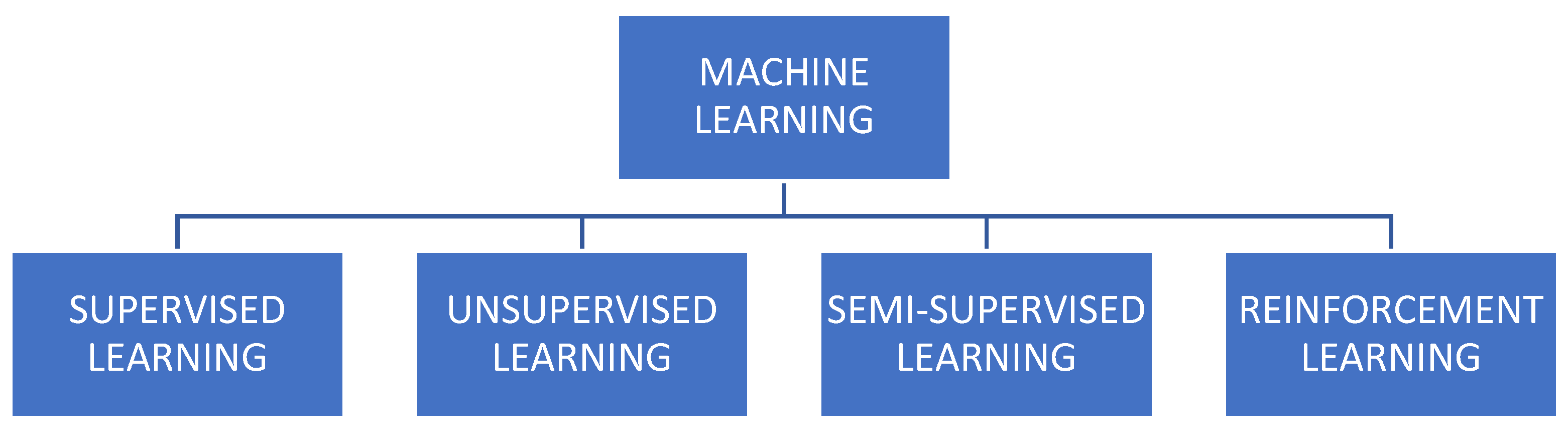
- Supervised learning is based on data sets containing both input values (features) and corresponding output values (labels). The model then learns to predict labels based on the features provided.
- Unsupervised learning uses unlabeled data and aims to detect hidden structures or patterns in the data set.
- Semi-supervised learning combines both approaches, using both labeled and unlabeled data.
- Reinforcement learning is based on a mechanism of rewards and punishments, thanks to which the model gradually learns optimal decisions in each environment [5].

- Identification (detection) means locating an object in spatial data
- Classification involves assigning a semantic label describing the object type. Segmentation refers to the delineation of the spatial extent of an object by assigning pixels or points to a given class.


- Appropriate selection of input data size and format.
- Intelligent and effective collection and annotation of samples, especially in hard-to-reach areas.
- Careful selection and extraction of features characteristic of the objects under analysis.
- Attention to these aspects translates into higher accuracy and efficiency of machine learning models in the analysis of topographic objects.

| Methods | Advantages | Disadvantages |
|---|---|---|
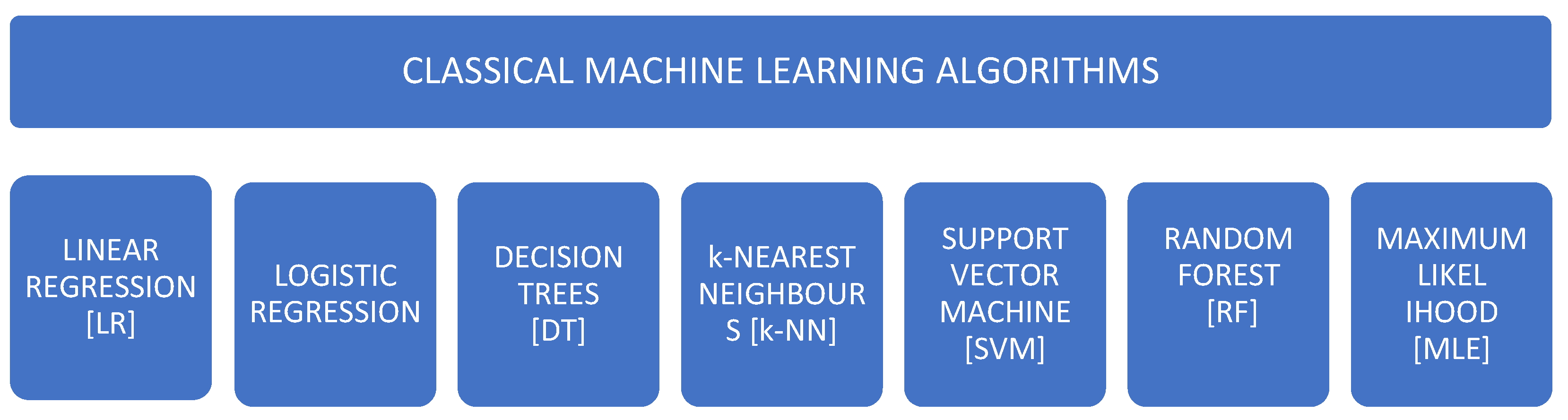
| Classical Machine Learning Algorithms | Easy implementation and deployment Provides insight into the validity of analyzed features (RF) Short computation time on smaller data sets Effective classification task solving even on a small training sample (SVM) | Limited scalability and adaptability Time-consuming and inaccurate with large data sets |
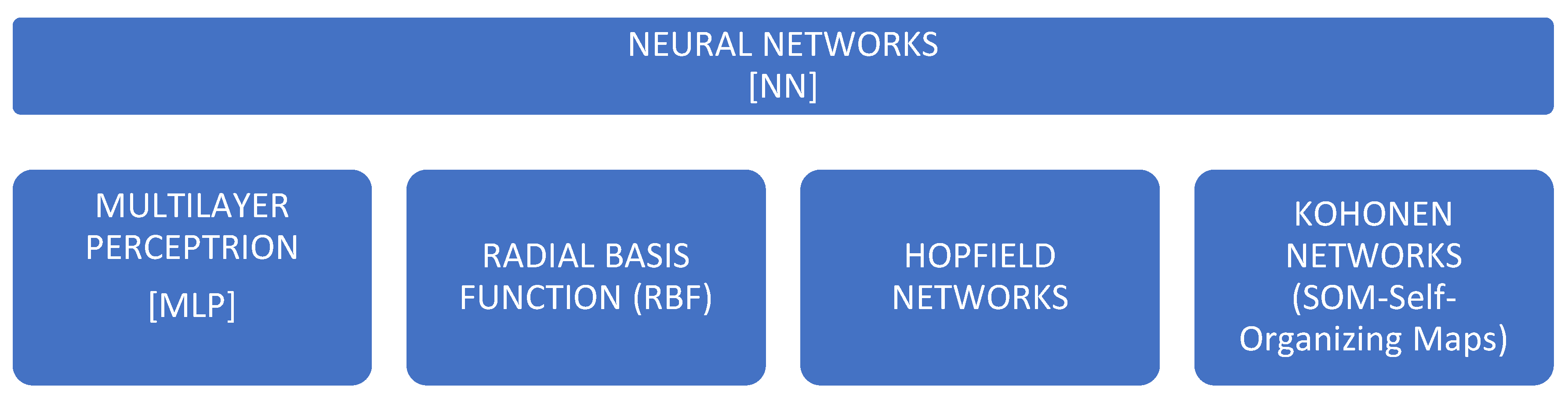
| Neural Networks | Weakly or partially supervised learning methods Developed model compression techniques Hybrid solutions: combining neural networks with graph algorithms or rules (post-process) Data augmentation techniques, transfer learning, or the use of pre-trained networks | Requirement for large, representative training datasets with correct labels Hardware requirements Dependence on training data Prone to overfitting on small training samples |
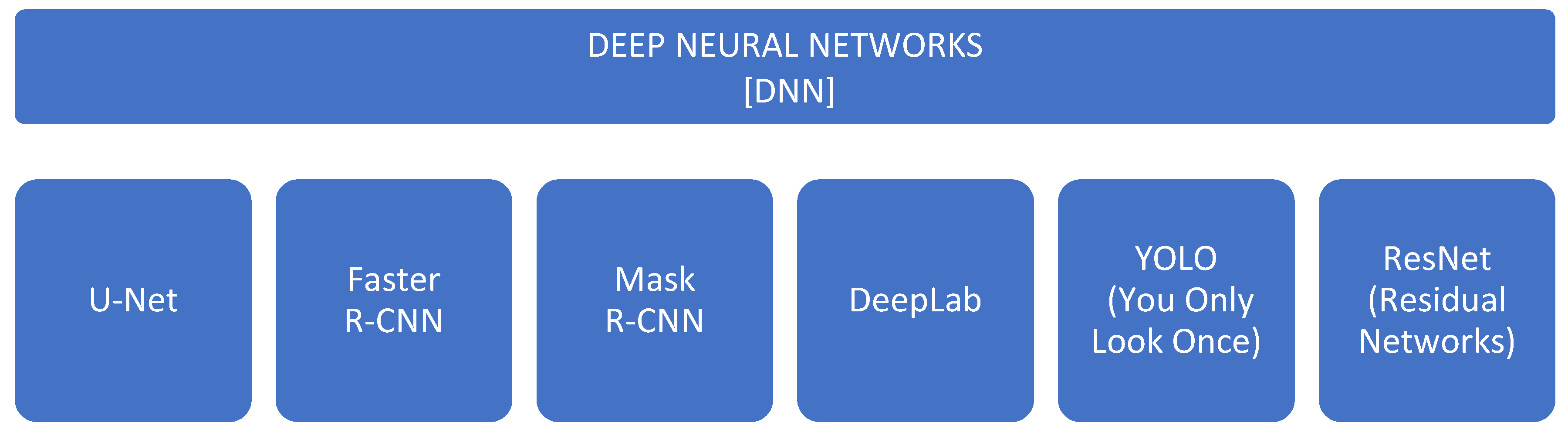
| Deep Neural Networks | Possibility of retraining existing models Ability to capture details and dependencies that humans might not notice when designing features manually Automation—the system learns on its own based on data, which shortens the path to creating a solution | Preparing samples in a topographic context can be costly (manual mapping of thousands of objects by experts) Sample preparation is prone to errors Ambiguous interpretability—deep models act like a black box—it is difficult to explain why a given area has been classified in a particular way With automation, the system learns on its own, extending the training time |
3. Comparative Analysis of Methods for Topographic Object Detection and Classification
3.1. Applications of Supervised Learning Algorithms in Satellite and Aerial Images
3.2. Applications of Supervised Learning Algorithms in Lidar Data (Point Clouds)
4. Discussion
4.1. Accuracy of Detecting Sample Objects Using Neural Networks
4.1.1. Buildings
4.1.2. Roads
4.1.3. Unusual Objects That Are Difficult to Identify
4.2. Speed of Operation and Computational Efficiency of Selected Algorithms
| Object Class | Data Modality | Method Family | Metric | Reported Range | Representative Studies |
|---|---|---|---|---|---|
| Buildings | VHR RGB | CNN (U-Net, FCN) | IoU | 0.75–0.90 | [53,54] |
| Buildings | LiDAR | Point-based DL | F1-score | 0.88–0.95 | [55,56,57] |
| Roads | RGB | CNN | F1-score | 0.70–0.88 | [29,58,59,60,61,62] |
| Roads | LiDAR | RF/SVM | Precision | 0.75–0.85 | [63,64] |
| Forest roads | Multimodal | DL fusion | IoU | 0.65–0.82 | [42,44] |
5. Future Research Directions and Emerging DL Architectures
5.1. Specialized Architectures for Decision-Making Challenges in Operational Mapping
5.2. Fundamental Models and Self-Supervised Learning
5.3. Multimodal Data Fusion
6. Conclusions
Author Contributions
Funding
Data Availability Statement
Acknowledgments
Conflicts of Interest
Abbreviations
| AI | Artificial Intelligence |
| ML | Machine Learning |
| DL | Deep Learning |
| GIS | Geographic Information System |
| BDOT10k | Topographic Object Database |
| LR | Linear Regression Algorithm |
| DT | Decision Trees Algorithm |
| k-NN | k-nearest Neighbours Algorithm |
| SVM | Support Vector Machine Algorithm |
| RF | Random Forest Algorithm |
| MLE | Maximum Likelihood Algorithm |
| NN | Neural Networks |
| MLP | Multilayer Perception Networks |
| RBF | Radial Basis Function Networks |
| SOM | Kohonen Networks (Self-Organizing Maps |
| DNN | Deep Neural Networks |
| YOLO | You Only Look Once Networks |
| ResNet | Residual Networks |
References
- Iorkaa, A.A.; Barma, M.; Muazu, H.G. Machine Learning Techniques, Methods and Algorithms, Conceptual and Practical Insights. Int. J. Eng. Res. Appl. 2021, 11, 55–64. [Google Scholar]
- Bjola, C. AI for Development: Implications for Theory and Practice. Oxf. Dev. Stud. 2022, 50, 78–90. [Google Scholar] [CrossRef]
- Unuriode, A.O.; Durojaiye, O.M.; Yusuf, B.Y.; Okunadea, L.O. The Integration of Artificial Intelligence into Database Systems (AI-DB Integration Review). Int. J. Cybern. Inform. (IJCI) 2023, 12, 161–172. [Google Scholar] [CrossRef]
- Rashid, A.B.; Kausik, M.D. AI Revolutionizing Industries Worldwide: A Comprehensive Overview of Its Diverse Applications. Hybrid Adv. 2024, 7, 100277. [Google Scholar] [CrossRef]
- Podział Modeli Uczenia Maszynowego Wraz z Przykładami Zastosowania—Centralny Ośrodek Informatyki—POPC Wsparcie—Portal Gov.pl. Available online: https://www.gov.pl/web/popcwsparcie/podzial-modeli-uczenia-maszynowego-wraz-z-przykladami-zastosowania (accessed on 25 October 2025).
- Pluto-Kossakowska, J.; Kamiński, M. Analiza możliwości automatycznej detekcji obiektów topograficznych na zdjęciach lotniczych i satelitarnych VHR. Teledetekcja Sr. 2022, 62, 5–15. Available online: https://yadda.icm.edu.pl/baztech/element/bwmeta1.element.baztech-68ac9a70-7466-4b5a-858a-ed64a3400396/c/pluto-kossakowska_analiza_62_2022.pdf (accessed on 25 October 2025).
- Wu, C.; Shen, H.; Shen, A.; Deng, J.; Gan, M.; Zhu, J.; Xu, H.; Wang, K. Comparison of machine-learning methods for above-ground biomass estimation based on Landsat imagery. J. Appl. Remote Sens. 2016, 10, 035010. [Google Scholar] [CrossRef]
- European Parliament; Council of the European Union. Directive 2007/2/EC of the European Parliament and of the Council establishing an Infrastructure for Spatial Information in the European Community (INSPIRE). Off. J. Eur. Union 2007, L108, 1–14. [Google Scholar]
- Annoni, A.; Craglia, M.; Ehlers, M.; Georgiadou, Y. Towards a European Spatial Data Infrastructure. Int. J. Geogr. Inf. Sci. 2005, 19, 1–11. [Google Scholar]
- INSPIRE Thematic Working Group. INSPIRE Data Specification on Transport Networks—Technical Guidelines; European Commission Joint Research Centre: Ispra, Italy, 2010. [Google Scholar]
- INSPIRE Maintenance and Implementation Group (MIG). INSPIRE Data Specification on Land Cover—Technical Guidelines (Version 3.0); European Commission: Brussels, Belgium, 2024. [Google Scholar]
- ISO 19110:2005; Geographic Information—Methodology for Feature Cataloguing. International Organization for Standardization: Geneva, Switzerland, 2005.
- Główny Urząd Geodezji i Kartografii (GUGiK). Baza Danych Obiektów Topograficznych BDOT10k—Specyfikacja Techniczna; GUGiK: Warszawa, Poland, 2021. [Google Scholar]
- Koc-San, D. Evaluation of different classification techniques for the detection of glass and plastic greenhouses from WorldView-2 satellite imagery. J. Appl. Remote Sens. 2013, 7, 073553. [Google Scholar] [CrossRef]
- Natekin, A.; Knoll, A. Gradient boosting machines, a tutorial. Front. Neurorootics 2013, 7, 21. [Google Scholar] [CrossRef]
- Gharineiat, Z.; Kurdi, F.T.; Campbell, G. Review of Automatic Processing of Topography and Surface Feature Identification LIDAR Data Using Machine Learning Techniques. Remote Sens. 2022, 14, 4685. [Google Scholar] [CrossRef]
- Li, H.; Hu, B.; Li, Q.; Jing, L. CNN-Based Individual Tree Species Classification Using High-Resolution Satellite Imagery and Airborne LIDAR Data. Forests 2021, 12, 1697. [Google Scholar] [CrossRef]
- Kwaśnicka, H.; Markowska-Kaczmar, U. Sieci Neuronowe w Zastosowaniach; Oficyna Wydawnicza Politechniki Wrocławskiej: Wrocław, Poland, 2005. [Google Scholar]
- Tadeusiewicz, R. Odkrywanie Właściwości Sieci Neuronowych Przy Użyciu Programów w Języku C#; Polska Akademia Umiejętnosci: Kraków, Poland, 2007. [Google Scholar]
- Suzuki, K. Artificial Neural Networks—Architectures and Applications; InTech: London, UK, 2013; Available online: https://www.intechopen.com/books/3110#:~:text=DOI-,10.5772/3409,-ISBN (accessed on 25 October 2025).
- Pokonieczny, K. Wykorzystanie perecptronu wielowarstwowoego do wyszczególniania obiektów o znaczeniu orientacyjnym na mapach topograficznych. Rocz. Geomatyki 2016, XIV, 397–405. [Google Scholar]
- Janaszek-Mańkowska, M.A.; Mańkowski, D.; Kozdrój, J. Sieci nweuronowe typu MLP w prognozowaniu plonu jęczmienia jarego. Biul. Inst. Hod. I Aklim. Roślin 2011, 259, 93–112. [Google Scholar]
- Zborowicz, M.; Boniecki, P. MLP neural network as a tool for images computer analysis. J. Res. Appl. Agric. Eng. 2010, 55, 124–127. [Google Scholar]
- Boniecki, P. The neural networks of the type MLP and RBF as classifying tools in picture analysis. J. Res. Appl. Agric. Eng. 2006, 51, 34–39. [Google Scholar]
- Gil, J.; Mrówczyńska, M.; Gibowski, S. Model ciągły sieci neuronowej typu Hopfielda w zastosowaniu do oszacowania stabilności punktów sieci geodezyjnej pionowej pomiarowo-kontrolnej. Acta Sci. Pol. Geod. Descr. Terrarum 2007, 6, 39–50. [Google Scholar]
- Mandl, T.; Eibl, M. Topographic Maps Based on Kohonen Self Orgaznizing Map san Empirical Approach. In Proceedings of the European Symposium on Intelligent Technologies, Hybrid Systems and Their Implementation on Smart Adaptive Systems (EUNITE), Puerto de Cruz, Teneriffa, Spain, 19–14 December 2001; pp. 467–471. [Google Scholar]
- Astudillo, C.A.; Oommen, B.J. Topology-oriented self-organizing maps: A survey. Pattern Anal. Appl. 2014, 17, 223–248. [Google Scholar] [CrossRef]
- Cottrell, M.; Olteanu, M.; Rossi, F.; Vialaneix, N. Theoretical and applied aspects of the self-organizing maps. In Proceedings of the 11th International Workshop WSOM 2016, Houston, TX, USA, 6–8 January 2016; pp. 3–26. [Google Scholar]
- Wu, T.; Luo, J.; Gao, L.; Sun, Y.; Dong, W.; Zhou, Y.; Liu, W.; Hu, X.; Xi, J.; Wang, C.; et al. Geo-Object-Based Vegetation Mapping via Machine Learning Methods with an Intelligent Sample Collection Scheme: A Case Study of Taibai Mountain, China. Remote Sens. 2021, 13, 249. [Google Scholar] [CrossRef]
- Di, K.; Li, W.; Yue, Z.; Sun, Y.; Liu, Y. A machine learning approach to crater detection from topographic data. Adv. Space Res. 2014, 54, 2419–2429. [Google Scholar] [CrossRef]
- Jalalipour, S.; Ayyalasomayjula, S.; Damrah, H.; Lin, J.; Rekabdar, B.; Li, R. Deep Learning-Based Spatial Detection of Drainage Structures using Advanced Object Detection Methods. In Proceedings of the 2023 Fifth International Conference on Transdisciplinary AI (TransAI), Laguna Hills, CA, USA, 25–27 September 2023. [Google Scholar]
- Tiede, D.; Schwendemann, G.; Alobaidi, A.; Wendt, L.; Lang, S. Mask R-CNN-based building extraction from VHR satellite data in operational humanitarian action: An example related to Covid-19 response in Khartoum, Sudan. Trans. GIS 2021, 25, 1213–1227. [Google Scholar] [CrossRef]
- Boston, T.; Van Dijk, A.; Larraondo, P.R.; Thackway, R. Comparing CNNs and Random Forests for Landsat Image Segmentation Trained on a Large Proxy Land Cover Dataset. Remote Sens. 2022, 14, 3396. [Google Scholar] [CrossRef]
- Liu, T.; Amr, A.E.; Morton, J.; Wilhelm, V.L. Comparing Fully Convolutional Networks, Random Forest, Support Vector Machine, and Patch-based Deep Convolutional Neural Networks for Object-based Wetland Mapping using Images from small Unmanned Aircraft System. GIScience Remote Sens. 2017, 55, 243–264. [Google Scholar] [CrossRef]
- Schlosser, A.; Gergely, S.Z.; László, B.; Zsolt, V. Building Extraction Using Orthophotos and Dense Point Cloud Derived from Visual Band Aerial Imagery Based on Machine Learning and Segmentation. Remote Sens. 2020, 12, 2397. [Google Scholar] [CrossRef]
- Abbas, S.; Almadhor, A.; Sampedro, G.A.; Alsubai, S.; Al, H.A.; Strážovská, Ľ.; Zaidi, M.M. Efficient geospatial mapping of buildings, woodlands, water and roads from aerial imagery using deep learning. PeerJ Comput. Sci. 2024, 10, 2039. [Google Scholar] [CrossRef] [PubMed]
- Adamiak, M. Wykorzystanie Technik Uczenia Maszynowego i Teledetekcji do Wspomagania Interpretacji Przestrzeni Geograficznej. Ph.D. Thesis, Uniwersytet Łódzki, Łódź, Poland, 2022. Available online: https://www.researchgate.net/publication/364164811_Wykorzystanie_technik_uczenia_maszynowego_i_teledetekcji_do_wspomagania_interpretacji_przestrzeni_geograficznej (accessed on 25 October 2025).
- Krawiec, K.; Wyczałek, I. Nadzorowana detekcja tras komunikacyjnych z wykorzystaniem metod uczenia maszynowego. Arch. Fotogram. Kartogr. Teledetekcji 2006, 16, 361–371. [Google Scholar]
- Coulter, L.; Hall, T.; Guzman, L.; Kasahara, I. Satellite Image Building Detection using U-Net Convolutional Neural Network. Image Process. Appl. 2021, EE556, 1–9. Available online: https://www.luisjguzman.com/media/EE5561/building_detection.pdf (accessed on 25 October 2025).
- Clode, S.; Rottensteiner, F.; Kootsookos, F.; Zelniker, E. Detection and Vectorization of Roads from LIDAR Data. Photogramm. Eng. Remote Sens. 2007, 73, 517–535. [Google Scholar] [CrossRef]
- Awrangjeb, M.; Ravanbakhsh, M.; Fraser, C.S. Automatic detection of residential buildings using LIDAR data and multispectral imagery. ISPRS J. Photogramm. Remote Sens. 2010, 65, 457–467. [Google Scholar] [CrossRef]
- García, A.; Martínez, B.; Moroyoqui, Z.; Picos, K.; Orozco-Rosas, U. LIDARbased classification of objects and terrain. In Optics and Photonics for Information Processing XVIII, Proceedings of the Optical Engineering + Applications, San Diego, CA, USA, 18–23 August September 2024; Conference Poster; SPIE: Bellingham, WA, USA, 2024. [Google Scholar] [CrossRef]
- Lingli, Z.; Hattula, E.; Raninen, J. Enhancing Building Extraction with LIDAR and Aerial Image Data: Examining Data Combinations for Improved Accuracy in Rural and Urban Environments; GIM International: Lemmer, The Netherlands, 28 November 2024. [Google Scholar]
- Buján, S.; Guerra-Hernández, J.; González-Ferreiro, E.; Miranda, D. Forest Road Detection Using LIDAR Data and Hybrid Classification. Remote Sens. 2021, 13, 393. [Google Scholar] [CrossRef]
- Nahhas, F.H.; Shafri, H.Z.M.; Sameen, M.I.; Pradhan, B.; Mansor, S. Deep learning approach for building detection using LIDAR–orthophoto fusion. J. Sens. 2018, 2018, 1–12. [Google Scholar] [CrossRef]
- Morsy, S.; Shaker, A.; El-Rabbany, A. Multispectral LIDAR Data for Land Cover Classification of Urban Areas. Sensors 2017, 17, 958. [Google Scholar] [CrossRef] [PubMed]
- Candan, A.T.; Kalkan, H. U-Net-based RGB and LIDAR image fusion for road segmentation. Signal Image Video Process. 2023, 17, 2837–2843. [Google Scholar] [CrossRef]
- Mahphood, A.; Arefi, H. Density-Based Method for Building Detection from LIDAR Point Cloud. In Proceedings of the ISPRS Annals of the Photogrammetry, Remote Sensing and Spatial Information Sciences X-4/W1-2022, GeoSpatial Conference 2022—Joint 6th SMPR and 4th GIResearch Conferences, Tehran, Iran, 19–22 February 2023. [Google Scholar]
- Desnos, K.; Pertuz, S. Design and Architecture for Signal and Image Processing. In Proceedings of the 15th International Workshop, DASIP 2022, Budapest, Hungary, 20–22 June 2022; Available online: https://link.springer.com/book/10.1007/978-3-031-12748-9 (accessed on 25 October 2025).
- Bhatti, M.A.; Syam, M.; Chen, H.; Hu, Y.; Keung, L.W.; Zeeshan, Z.; Ali, Y.A.; Sarhan, N. Utilizing convolutional neural networks (CNN) and U-Net architecture for precise crop and weed segmentation in agricultural imagery: A deep learning approach. Big Data Res. 2024, 36, 100465. [Google Scholar] [CrossRef]
- Huang, W.; Sun, Q.; Yu, A.; Guo, W.; Xu, Q.; Wen, B.; Xu, L. Leveraging Deep Convolutional Neural Network for Point Symbol Recognition in Scanned Topographic Maps. ISPRS Int. J. Geo-Inf. 2023, 12, 128. [Google Scholar] [CrossRef]
- Hashmi, H.; Dwivedi, R.; Kumar, A. YOLO-RS: An Efficient YOLO-Based Approach for Remote Sensing Object Detection. In Proceedings of the 2023 12th International Conference on System Modeling & Advancement in Research Trends (SMART), Moradabad, India, 22–23 December 2023; pp. 50–56. [Google Scholar] [CrossRef]
- Zhang, X.; Li, Y.; Wang, X.; Liu, F.; Wu, Z.; Cheng, X.; Jiao, L. Multisource interactive stair attention for remote sensing image captioning. Remote Sens. 2023, 15, 579. [Google Scholar] [CrossRef]
- He, Z.; He, H.; Li, J.; Chapman, M.A.; Ding, H. A short-cut connections-based neural network for building extraction from high resolution orthoimagery. Int. Arch. Photogramm. Remote Sens. Spat. Inf. Sci. 2022, XLIII-B1-2022, 39–44. [Google Scholar] [CrossRef]
- Smith, M.J.; Fleming, L.; Geach, J.E. Earthpt: A time series foundation model for earth observation. arXiv 2023, arXiv:2309.07207. [Google Scholar]
- Diab, A.; Kashef, R.; Shaker, A. Deep Learning for LiDAR Point Cloud Classification in Remote Sensing. Sensors 2022, 22, 7868. [Google Scholar] [CrossRef]
- Zhang, Y.; Wang, T.; Lin, X.; Zhao, Z.; Wang, X. Building Extraction from LiDAR Point Clouds Based on Revised RandLA-Net. ISPRS-Int. Arch. Photogramm. Remote Sens. Spat. Inf. Sci. 2024, XLVIII-1-2024, 943–948. [Google Scholar] [CrossRef]
- Zhou, G.; Qian, L.; Gamba, P. Advances on Multimodal Remote Sensing Foundation Models. Remote Sens. 2025, 17, 3532. [Google Scholar] [CrossRef]
- Zhu, X.; Zhu, J.; Li, H.; Wu, X.; Li, H.; Wang, X.; Dai, J. Uniperceiver: Pre-training unified architecture for generic perception for zero-shot and few-shot tasks. In Proceedings of the IEEE/CVF Conference on Computer Vision and Pattern Recognition, New Orleans, LA, USA, 19–24 June 2022; pp. 16804–16815. [Google Scholar]
- Guo, Z.; Hu, X.; Wang, J.; Miao, X.Y.; Sun, M.T.; Wang, H.W.; Ma, X.Y. A duplex transform heterogeneous feature fusion network for road segmentation. Sci. Rep. 2024, 14, 17438. [Google Scholar] [CrossRef]
- Lu, X.; Weng, Q. Deep learning-based road extraction from remote sensing imagery: Progress, problems, and perspectives. ISPRS J. Photogramm. Remote Sens. 2025, 228, 122–140. [Google Scholar] [CrossRef]
- Luo, Z.; Gao, L.; Xiang, H.; Li, J. Road object detection for HD map: Full-element survey, analysis and perspectives. ISPRS J. Photogramm. Remote Sens. 2023, 197, 122–144. [Google Scholar] [CrossRef]
- Wu, L.; Zhu, X.; Lawes, R.; Dunkerley, D.; Zhang, H. Comparison of machine learning algorithms for classification of LiDAR points for characterization of canola canopy structure. Int. J. Remote Sens. 2019, 40, 5973–5991. [Google Scholar] [CrossRef]
- Mohamed, M.; Morsy, S.; El-Shazly, A. Machine learning for mobile lidar data classification of 3d road environment. ISPRS-Int. Arch. Photogramm. Remote Sens. Spat. Inf. Sci. 2021, XLIV-M-3-2021, 113–117. [Google Scholar] [CrossRef]
- Wu, H.; Xie, J.; Deng, W.; Lin, A.; Shariff, A.R.M.; Akmalov, S.; Wu, W.; Li, Z.; Yu, Q.; Wang, Q.; et al. CT-HiffNet: A contour-texture hierarchical feature fusion network for cropland field parcel extraction from high-resolution remote sensing images. Comput. Electron. Agric. 2025, 239, 111010. [Google Scholar] [CrossRef]
- Chen, N.; Yang, R.; Zhao, Y.; Dai, Q.; Wang, L. Remote Sensing Image Segmentation Network That Integrates Global–Local Multi-Scale Information with Deep and Shallow Features. Remote Sens. 2025, 17, 1880. [Google Scholar] [CrossRef]
- Huang, W.; Deng, F.; Liu, H.; Ding, M.; Yao, Q. Multiscale semantic segmentation of remote sensing images based on edge optimization (MSEONet). IEEE Trans. Geosci. Remote Sens. 2025, 63, 5616813. [Google Scholar] [CrossRef]
- Gao, T.; Xia, S.; Liu, M.; Zhang, J.; Chen, T.; Li, Z. MSNet: Multi-Scale Network for Object Detection in Remote Sensing Images. Pattern Recognit. 2025, 158, 110983. [Google Scholar] [CrossRef]
- Tao, C.; Meng, Y.; Li, J.; Yang, B.; Hu, F.; Li, Y.; Cui, C.; Zhang, W. MSNet: Multispectral semantic segmentation network for remote sensing images. GIScience Remote Sens. 2022, 59, 1177–1198. [Google Scholar] [CrossRef]
- Guo, Y.; Zhank, Z.; Shang, Y.; Zhao, T.; Deng, S.; Yang, Y.; Yin, J. SRMF: A Data Augmentation and Multimodal Fusion Approach for Long-Tail UHR Satellite Image Segmentation. arXiv 2025. [Google Scholar] [CrossRef]
- Qu, Y.; Zhang, Z.; Xu, C.; Wan, Q.; Xie, M.; Chen, Y.; Liu, Z.; Zhong, Y. UniRSCD: A Unified Novel Architectural Paradigm for Remote Sensing Change Detection. arXiv 2025. [Google Scholar] [CrossRef]
- Wang, R.; Ma, L.; He, G.; Johnson, B.A.; Yan, Z.; Chang, M.; Liang, Y. Transformers for Remote Sensing: A Systematic Review and Analysis. Sensors 2024, 24, 3495. [Google Scholar] [CrossRef]
- Huang, Z.; Yan, H.; Zhan, Q.; Yang, S.; Zhang, M.; Zhang, C.; Lei, Y.; Liu, Z.; Liu, Q.; Wang, Y. A Survey on Remote Sensing Foundation Models: From Vision to Multimodality. arXiv 2025. [Google Scholar] [CrossRef]
- Caron, M.; Touvron, H.; Misra, I.; Jégou, H.; Mairal, J.; Bojanowski, P.; Joulin, A. Emerging Properties in Self-Supervised Vision Transformers (DINO). arXiv 2021. [Google Scholar] [CrossRef]
- Liang, D.; Peng, F.; Wu, B.; Cui, X.; Zhuang, H.; Zhang, G. FFSNet: Adaptive features fusion of foundation models and self-supervised models for remote sensing image segmentation. Digit. Signal Process. 2026, 168, 105634. [Google Scholar] [CrossRef]
| Data Modality | Object Class | Method Family | Typical Input | Typical Metrics | Performance Range Examples | Annotation Effort | Computational Cost | Generalization Ability |
|---|---|---|---|---|---|---|---|---|
| RGB/VHR imagery | Buildings | CNN (U-Net, FCN) | 2D images | IoU, F1 | 0.80–0.90 | High | Medium | Low–Medium |
| RGB + DSM | Buildings | CNN + height fusion | 2D + height | IoU, F1 | 0.85–0.93 | High | High | Medium |
| LiDAR point cloud | Buildings | PointNet/PointCNN | 3D points | F1, completeness | 0.88–0.95 | Medium | High | High |
| RGB | Roads | CNN | 2D images | F1, IoU | 0.75–0.90 | High | Medium | Medium |
| LiDAR | Roads | ML (RF, SVM) | Point features | Precision, recall | 0.70–0.85 | Medium | Low | Medium |
| Multimodal | Forest roads | DL fusion models | 2D + 3D | F1, IoU | 0.70–0.85 | High | High | High |
| Data & Project Conditions | Recommended Method Family | Rationale | Risks/Limitations |
|---|---|---|---|
| Only RGB images, small training set | Classical ML (RF, SVM) | Lower data demand, interpretable | Lower ceiling of accuracy |
| Only RGB images, large labeled dataset | CNN (U-Net, DeepLab) | Strong performance on 2D patterns | Sensitive to domain shift |
| RGB + DSM available | CNN + height fusion | Height helps separate objects | DSM errors propagate |
| LiDAR point cloud available | Point-based DL (PointNet++, KPConv) | Best for 3D geometry | High computational cost |
| Strong domain variability (urban + rural) | Transformers/foundation models | Better generalization | Requires large pretraining |
| Lack of labeled data | Self-supervised/pretrained models | Reduces annotation effort | Transfer learning needed |
| Need for fast operational mapping | Classical ML or lightweight CNN | Lower computational cost | Lower accuracy |
Disclaimer/Publisher’s Note: The statements, opinions and data contained in all publications are solely those of the individual author(s) and contributor(s) and not of MDPI and/or the editor(s). MDPI and/or the editor(s) disclaim responsibility for any injury to people or property resulting from any ideas, methods, instructions or products referred to in the content. |
© 2026 by the authors. Published by MDPI on behalf of the International Society for Photogrammetry and Remote Sensing. Licensee MDPI, Basel, Switzerland. This article is an open access article distributed under the terms and conditions of the Creative Commons Attribution (CC BY) license.
Share and Cite
Kryzia, K.; Radziejowska, A.; Adamczyk, J.; Kryzia, D. Analysis of Using Machine Learning Application Possibilities for the Detection and Classification of Topographic Objects. ISPRS Int. J. Geo-Inf. 2026, 15, 59. https://doi.org/10.3390/ijgi15020059
Kryzia K, Radziejowska A, Adamczyk J, Kryzia D. Analysis of Using Machine Learning Application Possibilities for the Detection and Classification of Topographic Objects. ISPRS International Journal of Geo-Information. 2026; 15(2):59. https://doi.org/10.3390/ijgi15020059
Chicago/Turabian StyleKryzia, Katarzyna, Aleksandra Radziejowska, Justyna Adamczyk, and Dominik Kryzia. 2026. "Analysis of Using Machine Learning Application Possibilities for the Detection and Classification of Topographic Objects" ISPRS International Journal of Geo-Information 15, no. 2: 59. https://doi.org/10.3390/ijgi15020059
APA StyleKryzia, K., Radziejowska, A., Adamczyk, J., & Kryzia, D. (2026). Analysis of Using Machine Learning Application Possibilities for the Detection and Classification of Topographic Objects. ISPRS International Journal of Geo-Information, 15(2), 59. https://doi.org/10.3390/ijgi15020059