
Article

Spatiotemporal Imbalances in Dockless Bike-Sharing Usage: Evidence from Shanghai

1
College of Architecture and Urban Planning, Tongji University, 1239 Siping Road, Shanghai 200092, China
2
Key Laboratory of Spatial Intelligent Planning Technology, Ministry of Natural Resources of China, Shanghai 200092, China
*
Author to whom correspondence should be addressed.
ISPRS Int. J. Geo-Inf. 2026, 15(1), 41; https://doi.org/10.3390/ijgi15010041
Submission received: 28 November 2025 / Revised: 10 January 2026 / Accepted: 12 January 2026 / Published: 14 January 2026

Abstract

Rebalancing shared bikes poses a significant challenge for dockless bike-sharing (DLBS) operators, as inevitable spatiotemporal mismatches between demand and supply lead to high redistribution costs. Despite its operational significance, empirical research on the spatiotemporal imbalance of DLBS usage and its underlying drivers remain limited. Utilizing one month’s extensive trajectories of shared bikes in Shanghai, China, this study quantifies DLBS net flows at fine-grained grid level by hour to capture demand–supply imbalances across both spatial and temporal dimensions. To uncover dominant patterns in DLBS imbalance, we employ non-negative matrix factorization, a matrix decomposition technique, to extract latent structure of DLBS net flows. Four distinct patterns are identified: self-sustained balance, morning peak outflow, morning peak inflow, and metro-driven imbalance. We further apply multinomial logit models (MNL) to examine how these patterns are associated with different built environment characteristics. The results show that higher population density, greater diversity of points of interest, and proximity to city centers promote more balanced DLBS flows, whereas high road network density and concentrations of subway stations, residential communities, and firms intensify imbalances. These findings provide valuable insights for enhancing the operational efficiency of DLBS systems and supporting informed transportation management and urban planning practices.

1. Introduction

With rapid urbanization and the increasing number of private vehicles, many cities worldwide are facing severe traffic congestion and air pollution [1]. Dockless bike-sharing (DLBS), as an emerging type of shared mobility, offers an effective solution to these challenges [2,3]. In recent years, supported by mobile payment and digital technology, DLBS has expanded rapidly worldwide and has gained widespread popularity [4]. Compared to private cars, DLBS is more flexible, environmentally friendly, and cost-effective, making it particularly suitable for short-distance trips of 3–5 km [5,6]. Additionally, DLBS can integrate seamlessly with public transit, providing a convenient first- and last-mile solution for longer travel [7,8]. This not only enhances urban transportation efficiency but also encourages the widespread adoption of green travel.
Despite the continuous expansion of DLBS, challenges related to their operation and management have become increasingly profound. Existing studies show that the dynamics of human activities and mobility generate inevitable spatial and temporal imbalances in shared bike demand and supply, leading to systematic bike shortages in some areas and excessive accumulation in others [9,10]. If left unaddressed, these issues can reduce the reliability of DLBS, discouraging users, and prompting a shift toward private cars or other less sustainable modes of transport [11,12,13]. This outcome not only undermines the system’s intended benefits, such as mitigating traffic congestion and reducing carbon emissions, but also risks exacerbating urban mobility and environmental challenges. Moreover, rebalancing imposes substantial operational burdens; for instance, in Arlington, Virginia (USA), rebalancing accounted for approximately 80% of the total operating costs in a dock-based bikeshare system (Source: https://gppreview.com/2014/04/07/beyond-urban-planning-the-economics-of-capital-bikeshare/ (accessed on 30 October 2025)). Although this evidence comes from a dock-based system, the comparison remains relevant for DLBS because both systems rely on labor- and vehicle-intensive rebalancing to address spatial demand–supply mismatches. In fact, due to the absence of fixed stations in DLBS, rebalancing may be even more complex and costly, requiring frequent dispatch of bikes across urban areas. Understanding the spatiotemporal patterns of shared bike imbalances is thus crucial for enhancing the operation efficiency of bike-sharing systems and promoting sustainable urban mobility.
There has been growing research interest in delineating the spatiotemporal patterns of DLBS usage. Temporally, researchers commonly visualize the evolution of DLBS departures or arrivals over time, identifying peak usage periods and daily fluctuations through time-series analysis and visualization techniques [14,15,16,17]. For instance, studies indicate that DLBS departure trips tends to spike during morning and evening peak hours, aligning with typical commuting patterns, while nighttime usage drops significantly [15,18]. Spatially, data visualization and data mining techniques, such as hotspot detection and clustering algorithms, have been widely used to identify areas with high concentrations for DLBS origins, destinations, or both, revealing spatial clustering patterns [19,20,21]. Findings indicate that bike-sharing trips are often concentrated in central business districts, public transportation station areas, and university campuses, whereas suburban areas typically exhibit lower demand [4,22]. However, these studies primarily focused on the volumes of shared bike trips at origins or destinations, which limits their ability to fully capture the dynamics of bike-sharing imbalances and may lead to suboptimal or misguided rebalancing strategies. For instance, a suburban area with low overall trip counts might experience repeated morning shortages and evening surpluses, which would not be apparent from aggregate data. Ignoring such spatiotemporal dynamics may result in suboptimal rebalancing strategies that fail to match supply with actual demand.
Emerging research addresses this limitation by jointly examining both departure and arrival volumes of shared bike trips. Some scholars have identified a self-balancing phenomenon within DLBS systems, where minor fluctuations in bike availability within localized areas can naturally alleviate demand–supply imbalances [10,23,24]. This operates through two mechanisms: shared bikes primarily circulate in local loops for short-distance trips, sustaining basic supply stability within districts, while cross-regional rides, both inflows and outflows, serve as a natural adjustment valve, redistributing bikes between areas to address local surpluses or deficits. Studies have observed that while certain areas may experience temporary bike shortages, spontaneous return flows from nearby locations help restore availability over time [10,23,25]. However, the finer-scale dynamics of this self-balancing behavior and the underlying factors that influence it remain underexplored.
To address the research gaps, this study introduces a net flow-based approach and utilizes a large-scale DLBS trajectory dataset from Shanghai, China to better understand DLBS mobility patterns and their spatiotemporal imbalances. Through non-negative matrix factorization (NMF), we identify latent spatiotemporal structures in DLBS net flow dynamics. Furthermore, multinomial logit (MNL) models are applied to analyze the relationship between these net flow patterns and built environment (BE) characteristics. Our findings provide valuable insights into the nature of imbalanced DLBS usage and provide empirical evidence to support more effective urban planning and transportation management strategies.
The rest of this paper is structured as follows: Section 2 reviews the related literature on the travel behavior of DLBS users and the impact of the BE on such behavior. Section 3 details the study area, datasets, and methodology for identifying DLBS imbalances and analyzing their spatiotemporal patterns. Section 4 presents the empirical findings with interpretive analysis. Finally, Section 5 summarizes the key research findings and discusses their policy implications.

2. Related Works

This section reviews two strands of literature relevant to this study: mobility patterns of shared bike users and the role of BE factors in shaping these behaviors.

2.1. Mobility Patterns of Bike-Sharing Users

Previous studies have utilized the shared bike trajectory data to delineate the spatiotemporal patterns of DLBS usage. Temporally, researchers commonly visualize the evolution of DLBS departures or arrivals over time using hourly or daily ridership curves or bar charts [14,17]. Moreover, bike-sharing usage exhibits distinct morning and evening peaks on weekdays, while no clear peaks are observed on weekends, likely due to the widespread use of shared bikes for commuting [14,15,16,18]. In addition, many studies have applied clustering or dimensionality reduction approaches to analyze typical patterns of shared bike usage. For example, Jiménez et al. used clustering to classify stations in the Dublin bike-sharing system into generator, attractor, and balanced stations [26]. Cazabet et al. applied NMF methods and discovered six distinct temporal patterns in arrival trips across bike-sharing stations in Lyon, France [27]. Zhu and Diao used the fuzzy c-means clustering algorithm to categorize bike-sharing stations into five groups based on daily usage distributions, each corresponding to a different rental and return demand pattern [11]. Xu et al. employed an eigen decomposition approach to uncover the temporal rhythms of DLBS usage and their variations across different urban areas [4].
Spatially, previous studies have often employed data visualization and data mining techniques to identify hotspots, revealing the spatial clustering patterns of DLBS trips. For example, spatial aggregation and dispersion characteristics of bike-sharing arrivals and departures have been visualized through grid-based trip counts [17] and OD flow patterns across various time periods [28]. Morton et al. applied Local Indicators of Spatial Association to detect hotspot areas. These studies consistently find that bike-sharing trips are primarily clustered in city centers and gradually decline as one moves away from the urban core [22]. Further, Xing et al. integrated Points of Interest (POI) data and applied k-means clustering to analyze travel patterns based on trip purposes [21]. Li et al. used NMF and found that bike-sharing services mainly cater to specific areas rather than covering an entire city [19]. Some researchers have also examined the mobility characteristics of bike-sharing through complex network analysis. Zhang et al. employed network community detection methods to explore the spatial clustering structure of DLBS trips in Singapore [17].
However, most existing studies focus primarily on either departure trips or arrival trips when analyzing mobility patterns of DLBS. This single-dimension approach fails to capture the critical mismatch between origin and destination flows, a key factor determining DLBS efficiency. To address this limitation, many scholars have investigated the issue of imbalanced bike distribution. Nair et al. analyzed a large-scale bike-sharing system in Paris and found that the distribution of bikes could become increasingly unbalanced over time [29]. Xie and Wang identified significant imbalance in the Washington, D.C. bike-sharing system, driven largely by large-scale commuting behavior, with imbalances often concentrated in certain areas. Such demand–supply mismatches critically undermine system efficiency, triggering both unmet ride demand and user trip abandonment [9]. He et al. introduced the renting-returning ratio as a metric to analyze station-level demand–supply imbalances in Nanjing’s bike-sharing system, revealing that imbalanced stations were less frequent during peak commuting periods [23]. Meng et al. used network analysis to compare the spatiotemporal patterns of bike-sharing systems across ten cities in China, revealing that demand distribution becomes especially unbalanced during peak hours, with a pronounced tidal pattern in city center areas [30]. Xin et al. proposed and operationalized the concept of a bike mobility chain, demonstrating that DLBS exhibits distinct localized flow patterns and station clustering differences across time periods on weekdays and holidays [31].
Some studies have also introduced the concept of self-balancing in bike-sharing systems, where the system naturally maintains balance across stations or regions without manual scheduling or external interventions [9,10]. This self-balancing is driven by users’ natural travel behavior, incentive mechanisms, or intelligent optimization strategies, which help mitigate demand–supply imbalances. Hua et al. suggested that a balanced state in a bike-sharing system should involve slight fluctuations in bike counts in a specific area over a certain period. Through k-means clustering, they found that 72% of DLBS virtual stations and 81% of docked bike stations can achieve self-balancing [10]. Similarly, Song et al., based on DLBS data from Shanghai and employing a multiple-censored Tobit model, reported that approximately 76% of bikes form self-loops within two weeks, with campus areas exhibiting the highest self-loop rates [32].
While user-driven self-balancing behaviors are recognized as a critical mechanism in bike-sharing systems, their spatiotemporal dynamics remain underexplored, particularly at fine-grained spatial and temporal scales. Existing studies predominantly rely on aggregate metrics at the rush-hour or daily level [10,23], which may obscure the underlying imbalances in DLBS mobility. For instance, an area deemed balanced over an entire day could still experience repeated demand–supply mismatches during peak commuting hours, resulting in lower user satisfaction and higher redistribution costs for operators. In contrast, net-flow-based approaches explicitly capture the difference between departures and arrivals within a spatial unit over time, providing a more nuanced measure of dynamic demand–supply mismatches. Moreover, the absence of fixed stations in DLBS further complicates the task of accurately measuring imbalance. Virtual station-based approaches often result in uneven spatial coverage, with overly dense networks in central districts and overly large catchment areas in suburban zones [10], which undermines effective system monitoring and management. These challenges highlight the need for grid-based analyses at finer temporal resolutions to better capture self-balancing patterns and their relationship with the BE. Such insights can inform more effective rebalancing interventions when self-balancing proves insufficient.

2.2. Effects of the BE on Bike-Sharing Usage

Extensive studies have explored the impacts of the BE on bike-sharing usage [5,33,34,35,36]. BE factors are commonly measured along the Density, Diversity, Design, Distance to transit, and Destination accessibility (5Ds) dimensions [37,38,39]. Numerous studies have confirmed that factors such as population density, land-use mix, road network design, and accessibility to transportation infrastructure significantly influence bike-sharing usage [40,41,42]. For instance, higher population and employment density contribute to increased bike-sharing usage due to a larger potential user base and higher demand for short-distance travel [41]. Moreover, mixed land use encourages bike-sharing usage by reducing commuting distances [38]. Additionally, proximity to parks, restaurants, shopping centers, sports venues, and public transit stations is associated with higher bike-sharing usage [43,44,45]. More recently, Chahine et al., using a difference-in-differences approach, found that the installation of protected bike lanes significantly increases bike-sharing ridership [46]. Zhang et al. further revealed that daytime cycling demand is primarily shaped by trip purposes and urban morphology, whereas nighttime cycling is more strongly influenced by urban greening [47]. Similarly, Ji et al. demonstrated that street configuration and land use exert nonlinear effects on bike-sharing usage [48].
Moreover, some studies have further explored the impact of the BE on the spatiotemporal patterns of DLBS. Liu and Lin employed hierarchical clustering to identify four distinct spatiotemporal patterns of public bike usage in Taipei and revealed that these patterns were closely associated with location, land use, and availability of facilities [49]. According to Xu et al., residential and commercial density, as well as the number of road intersections showed strong correlations with the spatiotemporal usage patterns of bike-sharing, whereas land-use mix and cycling path length had relatively weaker effects [4]. More recently, Dong et al. applied K-modes clustering to classify individual single-trip and daily bike-sharing travel patterns and utilized MNL models to demonstrate that different spatiotemporal patterns are influenced by varying land-use characteristics [50]. These findings suggest that bike-sharing system operators and urban planners can strategically determine station locations and allocate bicycles based on the surrounding travel patterns and infrastructure conditions. Aligning bicycle distribution with land-use characteristics and individual mobility habits can enhance system efficiency and better integrate bike-sharing into urban transportation networks.
However, few studies have examined how the BE influences the spatiotemporal imbalances of DLBS usage. Gaining deeper insights into these dynamics would offer valuable guidance for both urban planners and system operators of DLBS.
To address this research gap, this study investigates the spatiotemporal patterns of imbalanced usage in DLBS and their relationships with the BE. Using a large-scale dataset of DLBS orders from Shanghai, China, we measure the imbalance based on net flows of shared bikes and apply NMF to extract typical spatiotemporal patterns. We then use MNL models to examine how these patterns are associated with BE factors. Additionally, we validate the identified imbalance patterns by analyzing the departures and arrival flows of shared bikes. The findings advance understanding of spatiotemporal imbalance in bike-sharing usage and provide empirical support for urban and transport planning.

3. Study Area, Data, and Methodology

3.1. Study Area

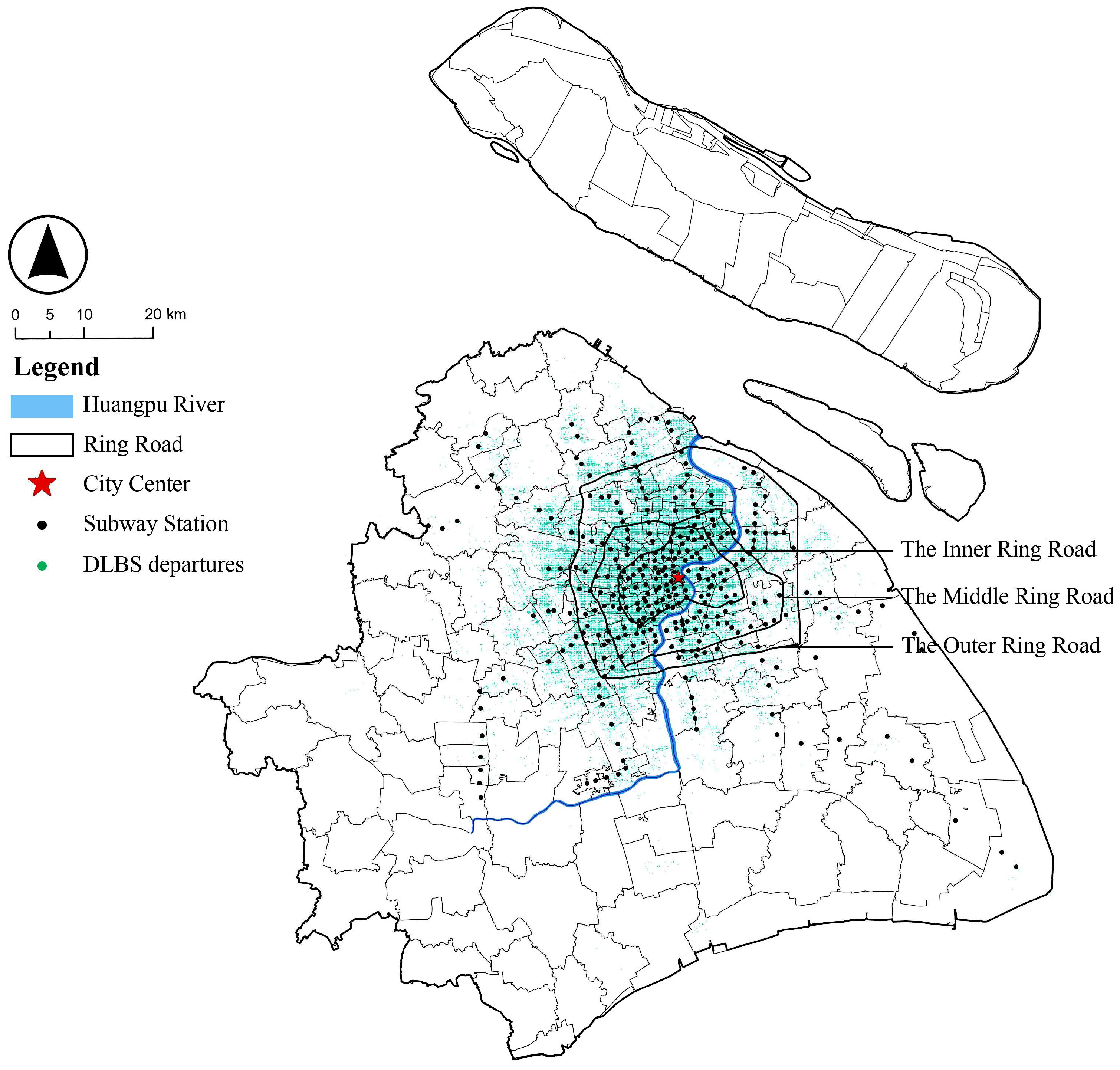
This study focuses on Shanghai, China, which has a land area of 6341 km2 and a population over 24 million. The city’s spatial structure is delineated by three concentric ring roads, which are explicitly illustrated in Figure 1. The area within the inner ring road constitutes the urban core, with the major financial, commercial, and business districts. The area within the outer ring road forms the central urban zone, while areas beyond the outer ring road correspond to the suburban regions. As a pioneer in DLBS, Shanghai has hosted major operators like Mobike since 2016, emerging as a global leader in this transportation innovation [21,51]. By March 2017, the city had a fleet of 450,000 shared bikes and more than 4 million registered DLBS users [13,21]. Figure 1 shows that DLBS activity is mainly concentrated in the area within the outer ring road, which serves as the primary focus of our analysis. These figures highlight the importance of bike-sharing in Shanghai’s transportation system and provide context for analyzing its development and impacts.
We adopt a 1 km × 1 km grid as the basic spatial analysis unit, aligning with the scale of urban blocks. Smaller grids risk data sparsity, while larger grids may misrepresent users’ perceived accessibility to DLBS services. The chosen grid size achieves a balance between analytical precision, operational feasibility, and theoretical relevance, making it suitable for studying demand–supply imbalance in DLBS systems.

3.2. Data Collection and Processing

The primary dataset consists of DLBS trips recorded by Mobike in Shanghai, between 1 and 31 August 2016. It contains detailed information on individual trips, including order ID, user ID, bike ID, start and end time, trip origin and destination, travel time, and travel distance. Following previous studies and typical DLBS travel behavior, we include trips with travel time between 1 and 120 min, travel distance ranging from 100 m to 10 km, and occurring in non-rainy weather conditions in the analysis [35,36,52]. These thresholds are chosen to exclude extremely short trips that may reflect data errors or casual movements, as well as unusually long trips that are atypical for regular bike-sharing users, ensuring that the final sample reflects representative daily usage patterns. The final sample covers 25 days (18 weekdays and 7 weekend days), totaling 835,029 trips by 17,636 users and 275,464 bikes, providing a robust foundation for analyzing DLBS usage patterns.
We use various open-source geospatial data to quantify the BE. Population data are obtained from LandScan, road network data are acquired from Open Street Map, and POI data are collected from Amap. Eight BE indicators are calculated at the 1 km grid cell level following the 5Ds framework. Table 1 reports descriptive statistics for all variables in the analysis.

3.3. Identification of Bike-Sharing Usage Patterns

In this study, we quantify the demand–supply balance of DLBS across different areas by calculating net flow, defined as the difference between the numbers of departure and arrival trips within each grid. Positive net flow values indicate that more bikes are leaving the area than arriving, reflecting a net outflow, with larger values corresponding to stronger outflow. Conversely, negative net flow values indicate that more bikes are arriving than departing, reflecting a net inflow, with larger absolute values corresponding to stronger inflow. Values close to zero suggest a balanced area, where departures and arrivals are roughly equal.
We employ NMF, a matrix decomposition technique, to uncover spatiotemporal patterns of DLBS net flow. NMF is an unsupervised machine learning algorithm for dimensionality reduction in multivariate data through the decomposition of its nonnegative parts [53]. NMF has been widely applied to analyze human mobility patterns, including taxi trips [54] and bike-sharing usage [19,27], further demonstrating its effectiveness in revealing both temporal and spatial patterns. In this study, we apply NMF to analyze DLBS-related matrices, aiming to identify the typical spatiotemporal patterns in bike-sharing imbalance. NMF can be mathematically formulated as follows:
V ( L × T ) W ( L × K ) × H ( T × K )
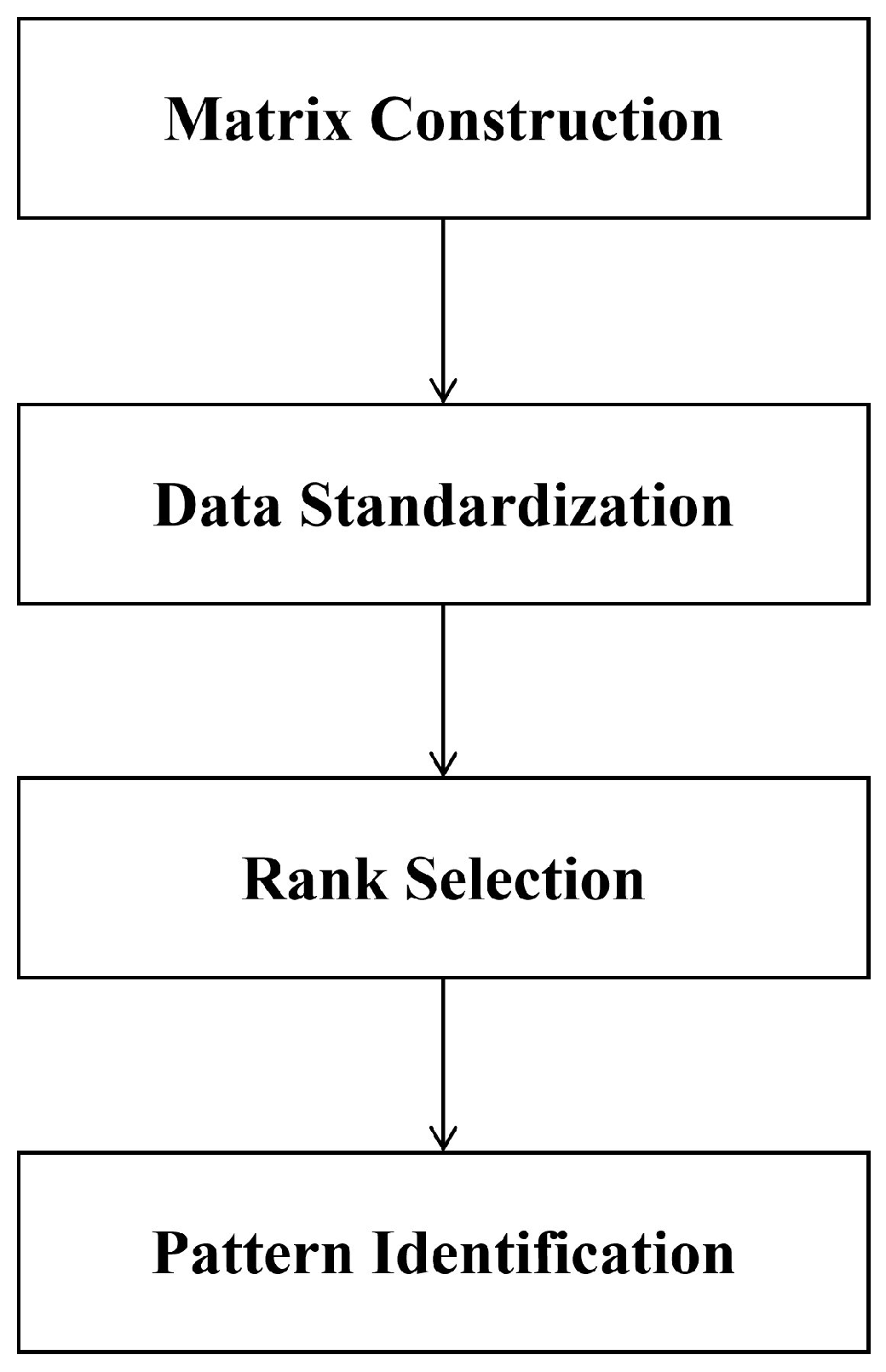
Given non-negative matrix V and a predefined rank K, NMF decomposes V into two lower-dimensional non-negative matrices, W and H, by minimizing the difference between V and its factorized approximation, thereby capturing key embedded patterns in a compressed form. Specifically, V represents the DLBS net flow matrix, where L and T denote the spatial (grid) and temporal (hour) dimensions, respectively. The matrix W captures the spatial patterns of DLBS net flow, while H reflects the temporal patterns. We apply a four-step procedure for NMF: constructing DLBS matrices, standardizing the data, determining the optimal rank K, and analyzing the results (Figure 2).
First, we construct a matrix for shared bike net flows by grid and hour. Shanghai is divided into 9809 grids (1 km × 1 km) and the study period is segmented into hourly intervals. The choice of a 1 km grid is based on the following considerations: 500 m is a typical walking distance for locating a shared bike, which corresponds to a 500 m radius when one is at the grid center. In addition, the mean DLBS trip distance is 1.7 km and the median distance is 1.3 km, both exceeding the diagonal length of a 1 km × 1 km grid, indicating that this spatial resolution is well suited to capturing cross-grid travel behavior. Moreover, when aggregating at the 500 m scale, the bike volume decreases substantially, leading to highly sparse results with no clear clustering patterns. In contrast, the 1 km grid strikes a balance by preserving spatial resolution while alleviating data sparsity, thereby producing more stable statistics. We aggregate departure and arrival trips by grid and hour and compute hourly net flows (departure minus arrival) for each grid, distinguishing between weekdays and weekends. Focusing on weekdays, we exclude grids without DLBS activity and retain only the top 40% of grids with the highest trip volumes. This screening yields 794 grids, which together account for more than 95% of total trips in weekdays. Grids with extremely low or zero activity were removed during preprocessing to minimize noise and small-sample artifacts in the net flow calculation. The spatial distribution of these grids, mainly concentrated in the central urban area. Based on these grids, we construct a weekday net flow matrix (794 × 24), where each row represents a grid, each column represents an hour, and each element represents the net flow of shared bikes within the grid during that hour.
Next, to standardize the net flow matrix, we first subtract the minimum observed value (a negative value) from all entries, ensuring that the matrix contains only non-negative values. We then divide the adjusted values by the absolute value of the minimum, which rescales the data while preserving their relative differences. There are two main reasons for this standardized treatment; (1) DLBS net flow varies significantly across different grids and time periods, and direct comparisons may be affected by extreme values. Standardization scales the results to a relatively consistent range, facilitating comparative analysis across different scenarios. (2) Traditional standardization methods, such as Z-score or Min-Max normalization, while effective for scaling data, often fail to naturally reflect the demand–supply balance. For instance, after Z-score standardization, a value of zero corresponds to the mean, but the magnitude of positive or negative values is not intuitive for interpreting supply and demand, and negative values cannot be handled by NMF methods. Min-Max normalization scales values to the [0, 1] range, but it does not clearly distinguish between supply and demand either. In contrast, the proposed method defines a value of 1 as the balanced point: values greater than 1 denote a net outflow of shared bikes, while values below 1 corresponds to net inflow. Notably, a value of 0 does not correspond to no DLBS activity, but to the strongest relative net inflow in the rescaled matrix. This approach enhances interpretability and ease of understanding. It should be noted, however, that this transformation shifts the balance point and reduces the original magnitude of imbalance, so the values cannot be directly interpreted in physical terms. Nonetheless, since our focus is on relative spatiotemporal patterns, the extracted features still effectively capture the distribution and dynamics of flows, while preserving comparability across grids and time periods.
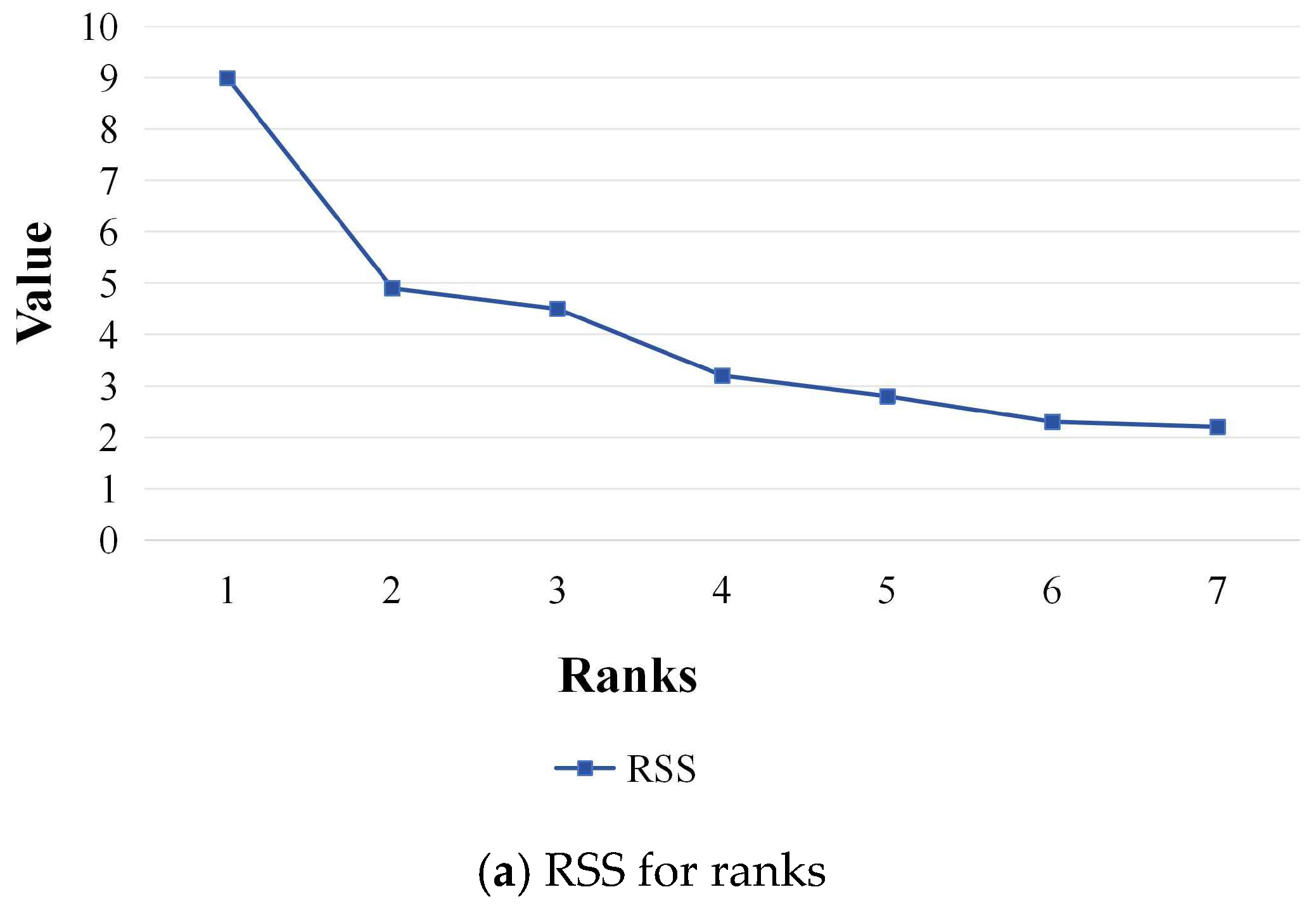
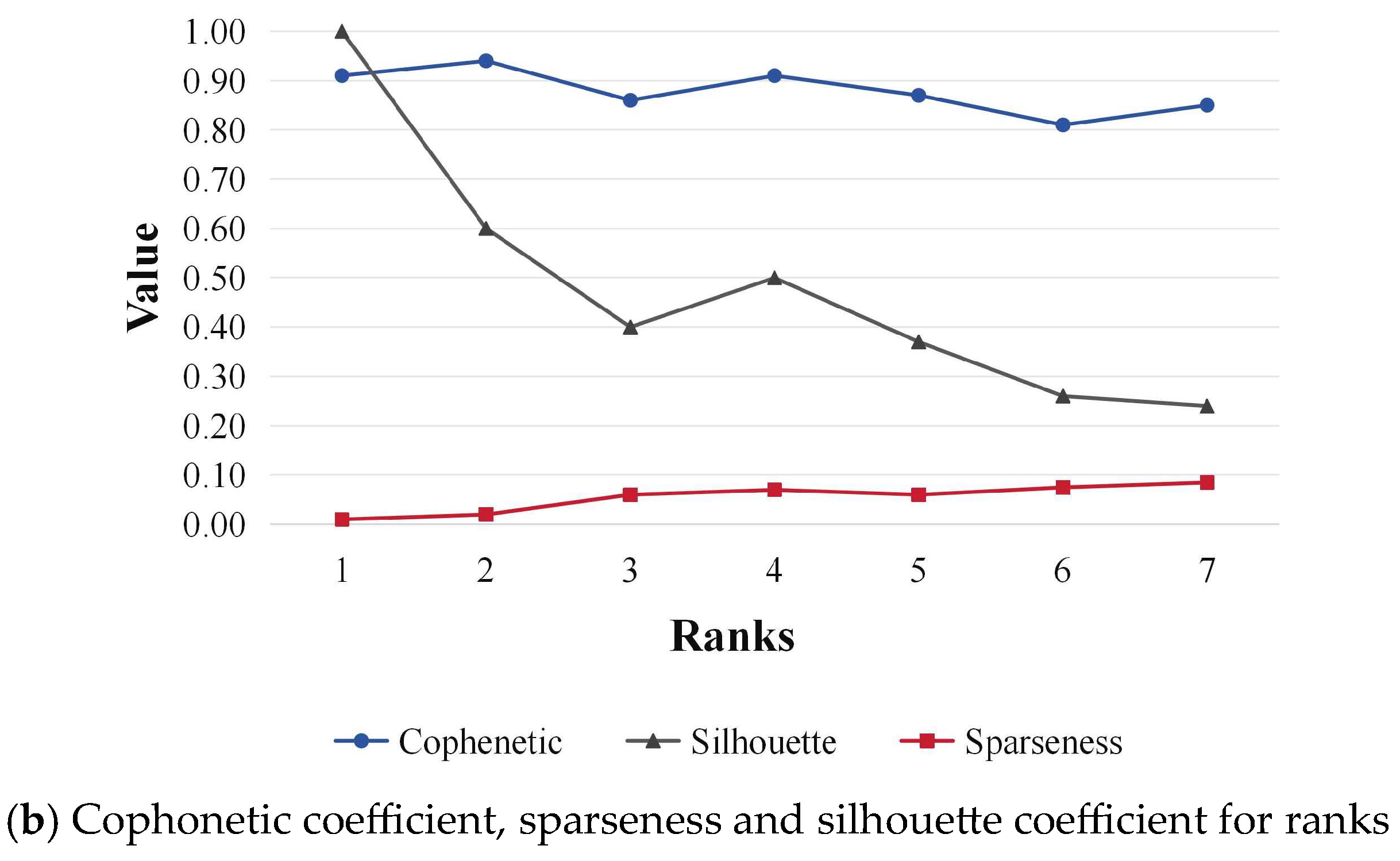
Then, we determine the optimal rank K (i.e., number of identified patterns) for NMF to ensure proper pattern extraction. An appropriate K prevents feature blending and improves interpretability. To identify the optimal rank, we apply the Residual Sum of Squares (RSS) method, which measures the difference between the original and factorized matrices (Figure 3a). The RSS curve is plotted against different values of K, and the elbow point, where the RSS drops significantly before leveling off, is selected as the optimal K. This approach ensures a balance between model complexity and interpretability, preventing underfitting or overfitting. Our experiments show that smaller K values tend to merge highly similar temporal patterns, while larger values may fragment them. Considering the interpretability of the extracted patterns, we choose K = 4 for weekday matrix. In addition, following the approach of exsiting studies [55,56], we further calculate the cophenetic coefficient, sparseness, and silhouette coefficient across different ranks to comprehensively assess the stability and interpretability of the model (Figure 3b). At K = 4, the model achieved good stability (cophenetic coefficient = 0.86), strong explanatory power (sparseness = 0.40), and an acceptable balance of consistency (silhouette coefficient = 0.06).
Finally, we apply NMF to decompose the net flow (grid-time) matrix (794 × 24) into two simpler ones, a grid-pattern matrix (794 × 4) and a pattern-time matrix (4 × 24), to reveal the internal structure of DLBS imbalance. The pattern-time matrix describes temporal dynamics, showing the hourly variation in DLBS net flow during the day for each identified pattern. The grid-pattern matrix captures spatial variations, with the coefficients of a grid representing its weights for each identified pattern; the pattern with highest weight is considered dominant in the grid. Together, these matrices uncover distinct spatiotemporal mobility patterns, providing insights into how DLBS imbalance varies across locations and times.

3.4. Determinants of DLBS Usage Patterns

To further examine the factors shaping the spatiotemporal patterns of DLBS imbalance identified by NMF, we develop a series of MNL models linking the dominant net flow pattern in a grid to BE factors. The MNL model accommodates multi-category dependent variables and is well-suited for analyzing the choice probability of selecting one pattern over a reference category. It has been widely applied in bike-sharing research [23,49,50]. In this study, the MNL model for each matrix-based scenario is specified as follows:
ln P I n P A n = m = 1 M β I m X m n
where PIn is the probability that grid n has a dominant pattern I, and PAn is the probability of the reference pattern A. Xmn represents a set of BE variables for grid n (Table 1), including FAR, population density, POI diversity, road density, distance to the nearest metro station, distance to the CBD, density of residential communities, and density of firms. βm denotes the estimated coefficient for the m-th BE variable.
To facilitate interpretation, we report average marginal effects (AMEs), which are more intuitive than raw log-odds coefficients. The marginal effect of variable Xm on the probability of selecting pattern i is computed as:
P I n X m n = P I n β I m j = 1 J P J n β J m
where βIm is the estimated coefficient of variable Xm for pattern I, PJn and βJm represent the probabilities and coefficients of all possible patterns j = 1, …, J; and the summation term captures the probability-weighted average effect of across all patterns. The AMEs, averaged across all grids, indicate how a one-unit increase in a BE variable affects the probability of each pattern, holding other variables constant.

4. Results

This section first characterizes the temporal and spatial distribution of DLBS net flow and then presents the results of the NMF-based spatiotemporal pattern extraction and the MNL analysis linking these patterns to BE factors.

4.1. Distributional Characteristics of DLBS Net Flow

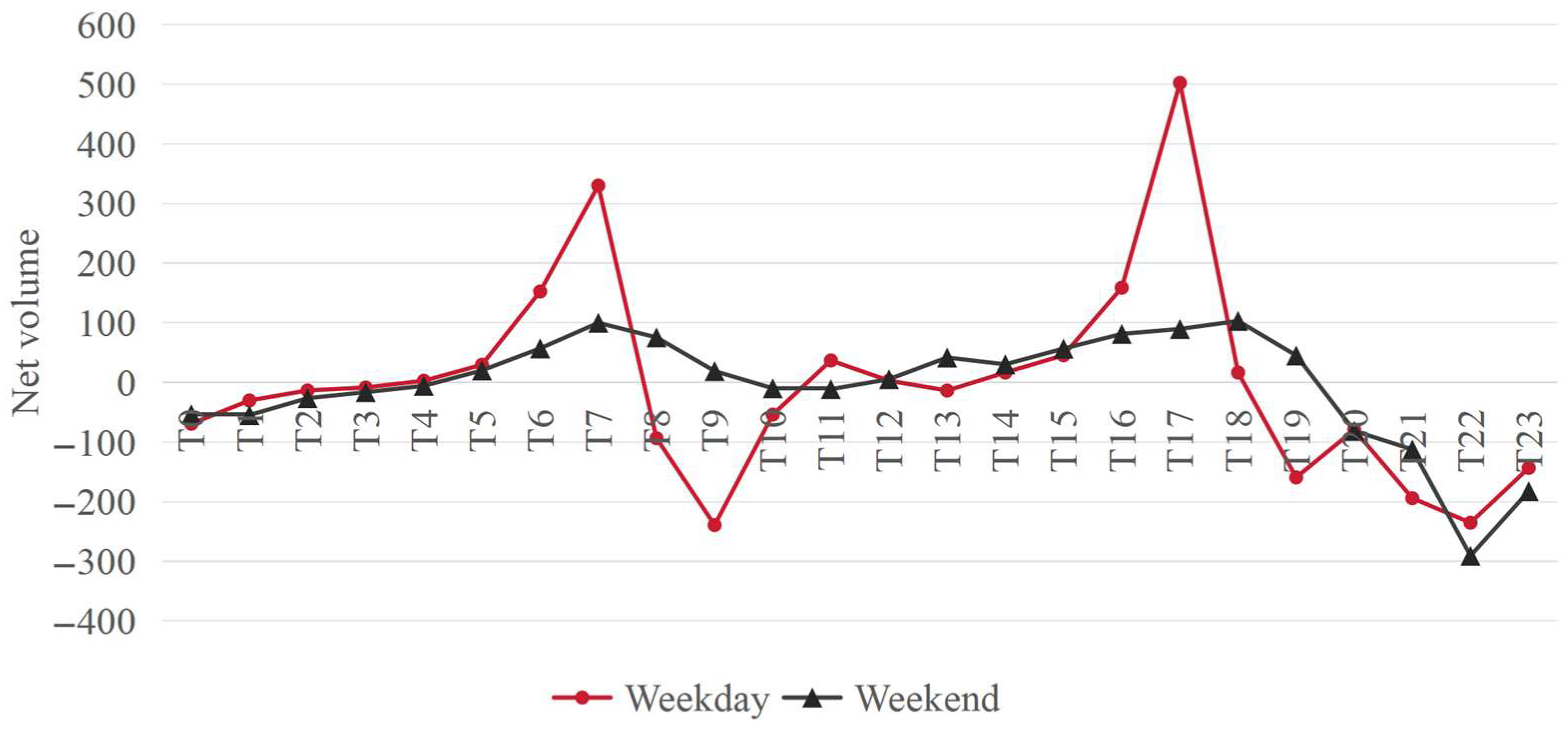
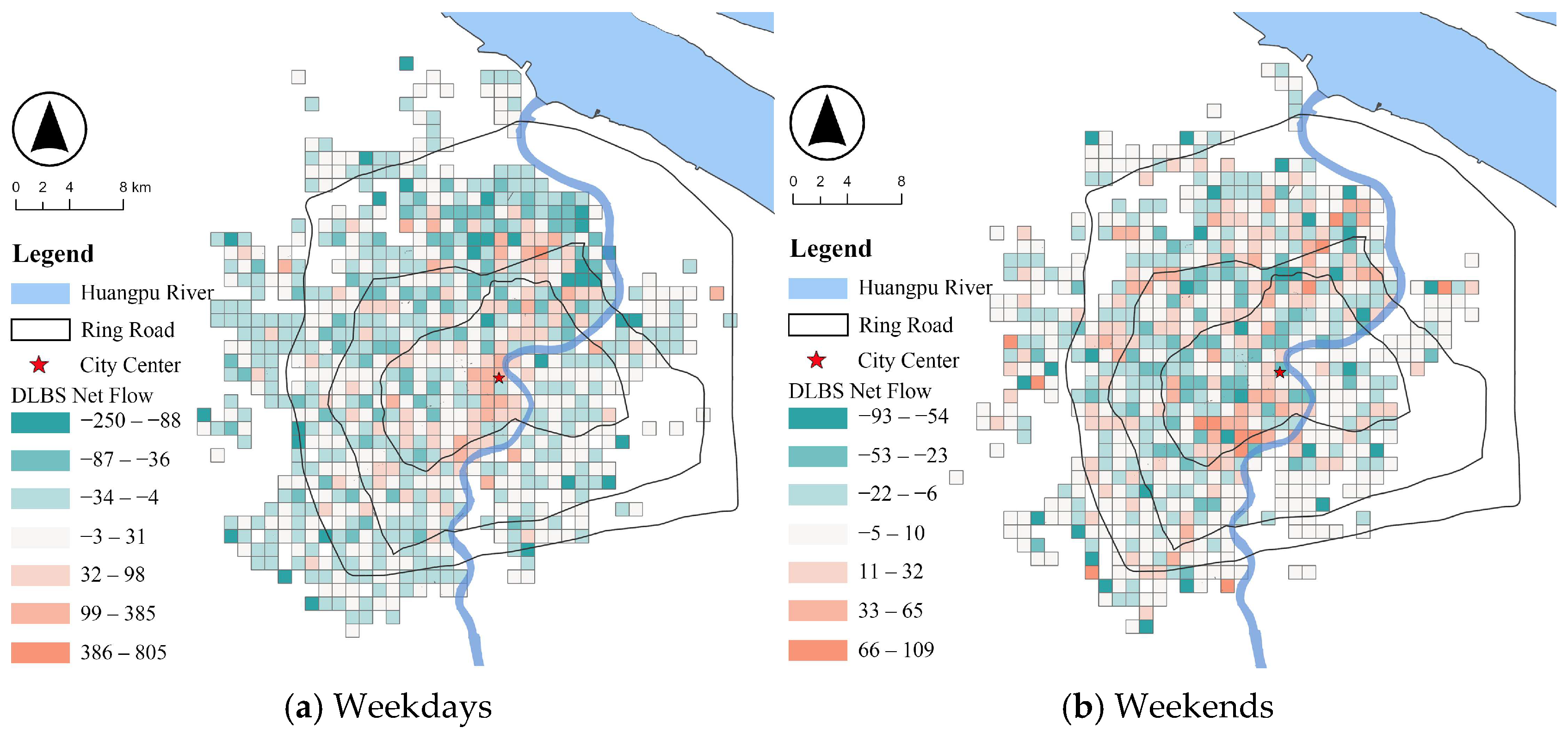
Figure 4 and Figure 5 illustrate the hourly distribution of DLBS net flows across the city and the spatial variation in daily net flow by grid cell, respectively. Temporally, weekdays exhibit pronounced fluctuations during two distinct peak periods, morning (06:00–09:00) and evening (17:00–19:00) peak hours, which closely mirror urban commuting rhythms and lead to significant systematic imbalances. For comparison, we also plot the temporal variations for weekends, which differ substantially from those for weekdays: net flow fluctuations remain within a much narrower range and lack clear peak periods. This comparison highlights that while DLBS operations on weekdays face significant imbalance during commuting hours, weekend usage exhibits considerably lower temporal imbalances [9,30].
The imbalance of daily DLBS trips also show significant spatially disparity. On weekdays, DLBS net flow shows a clustered pattern (Moran’s I = 0.132, p < 0.001), indicating moderate but statistically significant spatial autocorrelation, in sharp contrast to the random distribution observed on weekends (Moran’s I = −0.007, p > 0.1). Moreover, DLBS departures are even more strongly clustered (Moran’s I = 0.841, p < 0.001), further demonstrating that net flow and single-sided demand can exhibit completely different spatial distribution patterns. Specifically, on weekdays, net outflows concentrate in urban cores including the Bund, Nanjing East Road, and Wujiaochang sub-center, while net inflows cluster in peripheral areas such as Jiangwan and Yanjixincun. This spatial discrepancy likely stems from commuter-dominated DLBS usage during weekday rush hours, where substantial cross-regional unidirectional flows generate pronounced imbalance and fixed hotspot zones. By contrast, weekends exhibit more evenly distributed intra-regional flows, shaped by diversified travel purposes and destinations that reduce unidirectional movement and large-scale redistribution needs.
In summary, weekdays exhibit substantial spatiotemporal variations in DLBS net flows, while weekend imbalances are much smaller in magnitude on average and more evenly distributed, posing lower operational pressures. Therefore, our subsequent analysis focuses on weekdays.

4.2. NMF-Based Identification of DLBS Net Flow Patterns

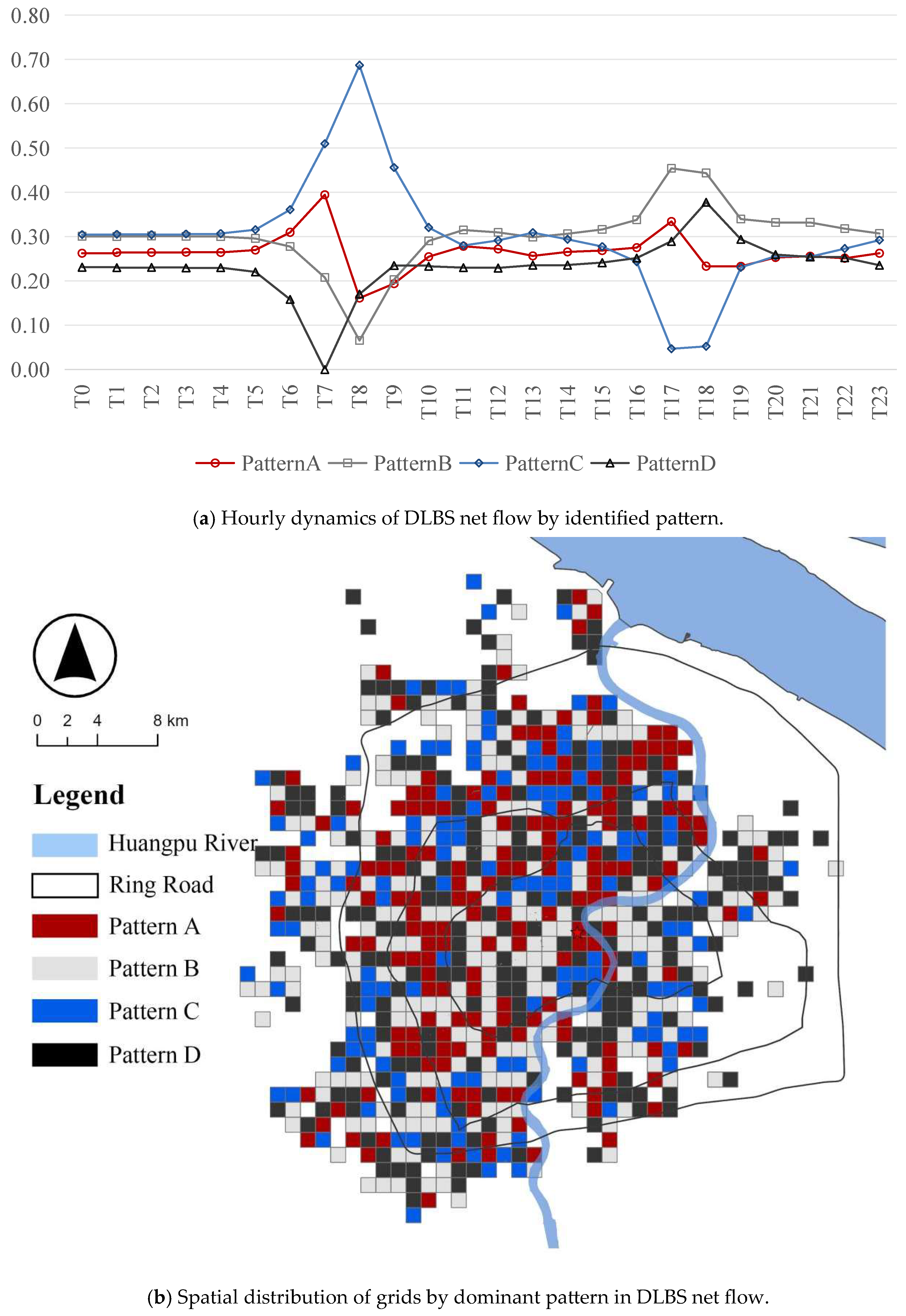
Section 4.1 examines the spatiotemporal distribution of DLBS net flows; however, the latent structure and the heterogeneity among grids with distinct daily rhythm patterns remain unexplored. To address this, we employ NMF to dissect a grid-time matrix of net flow on weekdays into a grid-pattern matrix and a pattern-time matrix. It is important to note that the coefficients in both matrices represent relative intensities after rescaling. The pattern-time matrix captures the hourly dynamics of net flow for individual patterns (Figure 6a). Coefficients in this matrix above the mean (0.275) indicates DLBS outflow, whereas lower values represent inflow. The grid-pattern matrix reveals the associations between individual grids and identified patterns. Each grid can be expressed as a weighted combination of the four DLBS net flow patterns and the pattern with the largest coefficient represents its dominant pattern. Figure 6b presents the spatial distribution of grid cells classified by their dominant pattern.
Based on NMF, four distinct DLBS net flow patterns (A–D) are identified. Pattern A shows relatively stable intra-day variations, indicating a self-balanced usage structure. Patterns B and D exhibit net inflows in the morning and net outflows in the evening, with Pattern D being more spatially concentrated around metro stations. In contrast, Pattern C displays net outflows in the morning and net inflows in the evening, and is mainly concentrated in residential areas. Overall, these patterns reveal pronounced heterogeneity in the temporal rhythms and spatial distribution of DLBS net flows across the city.

4.3. MNL-Based Associations Between DLBS Net Flow Patterns and BE Factors

We employ MNL model to investigate the relationship between spatiotemporal patterns of DLBS net flow and the BE, using Pattern A (self-sustained balance) as the reference category. In this model, each grid cell is characterized by the dominant net flow pattern. The estimated average marginal effects are reported in Table 2, representing the change in the probability of each pattern associated with a one-unit increase in a given BE variable. The results are summarized below with a focus on the 5D BE metrics.
Density: Population density exhibits statistically significant and pattern-specific effects. Higher population density is associated with a lower likelihood of Pattern B, while significantly increasing the probabilities of Pattern A (both p < 0.01). By contrast, FAR does not show statistically significant associations with any net flow pattern.
Diversity: POI mix is significantly and negatively related only to Pattern D (p < 0.01), whereas its effects on the other patterns remain insignificant.
Design: Road network density emerges as a consistently significant factor across all patterns. It is positively associated with the likelihood of Patterns B and D, but negatively associated with Patterns A and C, with all effects reaching at least the 5% significance level.
Distance to transit: Metro station density shows a strong and differentiated association with DLBS net flow patterns. Specifically, it is significantly positively associated with Pattern D, while being significantly negatively associated with Pattern A (both p < 0.01). No statistically significant effects are observed for Patterns B and C.
Destination accessibility: Distance to the CBD is positively associated with the probability of Pattern D, but negatively associated with Pattern A, with both effects statistically significant. Residential community density is significantly negatively related to Pattern B, while showing a significant positive association with Pattern C. In addition, firm density displays statistically significant effects for Patterns A–C, being positively associated with Patterns A and B and negatively associated with Pattern C.
Overall, the MNL results reveal clear heterogeneity in how DLBS net flow patterns are associated with different dimensions of the BE, underscoring the role of urban form in shaping spatial variations in DLBS usage dynamics.

5. Discussions

This section expands on the results by interpreting the potential significance of each pattern based on imbalance metrics, exploring how the BE may shape these patterns, and discussing potential policy implications.

5.1. Imbalanced Spatiotemporal Patterns of DLBS Net Flow

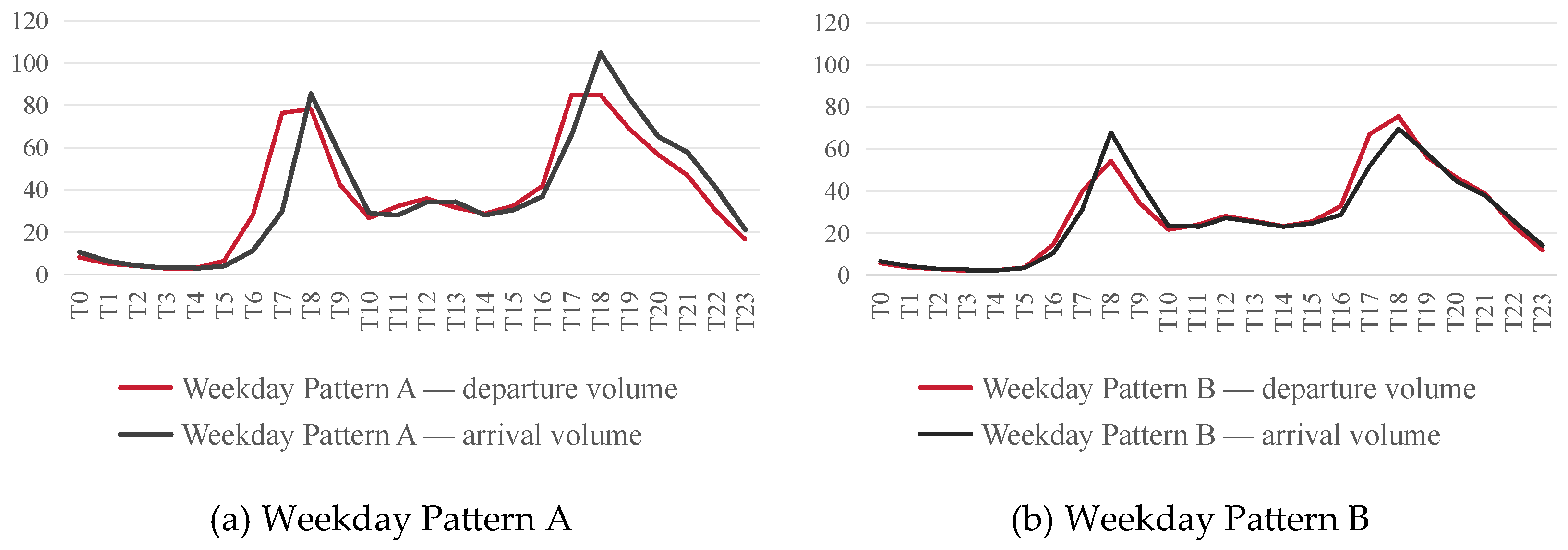
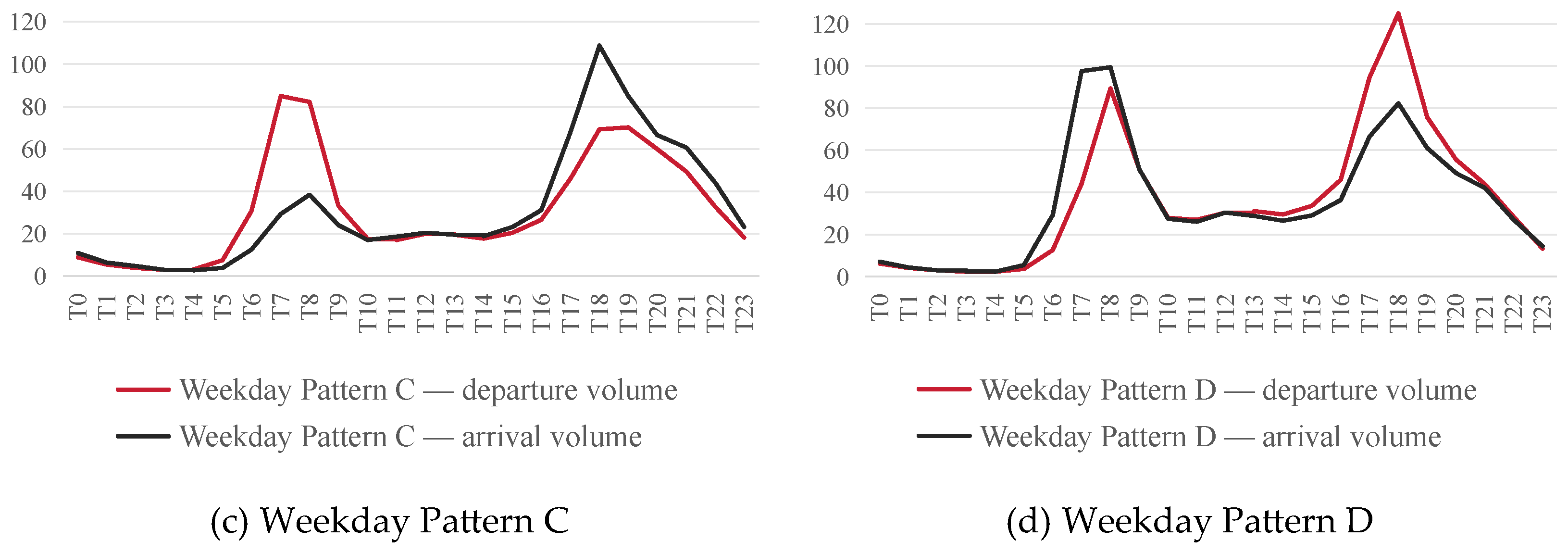
Section 4.1 and Section 4.2 provide an initial exploration of the spatiotemporal distribution and patterns of DLBS net flows. However, the identified spatiotemporal patterns through NMF remain relatively abstract. To address this issue, we visualize the departure and arrival volumes associated with each pattern (Figure 7) and report a set of descriptive statistics (Table 3) to facilitate a more concrete understanding of the imbalance characteristics embodied in each pattern. Figure 7 further depicts the average arrival and departure DLBS trips across grids grouped by their dominant pattern, providing insights into the underlying source of imbalance. Overall, the temporal and spatial patterns of departure and arrival trips differ markedly from those of net flow, suggesting that analyses focusing solely on departures or arrivals, as is common in existing studies, are unable to capture the demand–supply mismatch in DLBS systems. Consequently, such one-sided approaches provide limited guidance for developing effective rebalancing strategies.
In addition, for each identified pattern, we calculate a set of imbalance metrics (Table 3) using coefficients from the pattern-time matrix. These metrics are computed based on the absolute deviations of the coefficients from the mean value of all coefficients in the matrix. They include: (1) total imbalance, defined as the sum of absolute deviations over time, reflecting the overall daily extent of supply–demand mismatch, (2) maximum hourly imbalance, representing the peak level of supply–demand mismatch, and (3) standard deviation of hourly imbalance, capturing the temporal fluctuations of imbalance within a day. These indicators quantitatively characterize the spatiotemporal patterns extracted through matrix decomposition.
When examined through specific indicators, the four distinct weekday patterns (A–D) reflect differentiated self-balancing usage characteristics of DLBS users. Notably, Pattern A is characterized by the lowest total imbalance and hourly fluctuation throughout the day among the four patterns. There are two mild morning peaks, one outflow at 7 am and one inflow at 8 am, possibly resulting from local short-distance commuting trips. Overall, this pattern indicates a stable, self-sustained balance maintained by DLBS users.
Both Weekday Patterns B and C follow a bimodal trend, but differ markedly in peak timing and directions of net flows. Pattern B exhibits a big dip (strong net inflow) at 08:00, followed by a gradual increase leading to a net outflow peak at 17:00 (Figure 7b). This reflects a typical commuting-driven pattern, characterized by morning inflows to job centers and evening outflows toward residential zones. Spatially, grids associated with this pattern are primarily concentrated in the city center. Pattern B can thus be classified as a moderate-imbalance type. It shows medium total imbalance (1.32) and moderate hourly fluctuation, with a standard deviation hourly imbalance of 0.05. In contrast, Weekday Pattern C shows the opposite commuting-related trend, with strong morning outflows and evening inflows, as can be observed in Figure 7c. Spatially, the grids corresponding to this pattern are mostly located in residential areas. Pattern C represents a high-imbalance type, featuring the highest total imbalance (1.78) and the largest standard deviation (0.10). Overall, the temporal dynamics of Weekday Patterns B and C underscore the dominant role of commuting activity in shaping daily fluctuations in DLBS net flow.
Weekday Pattern D can be described as a moderate-balance type. Compared with the other patterns, it exhibits a medium-level total imbalance (1.28) and moderate hourly fluctuation (0.05). Moreover, its outflow peaks at 18:00, while the inflow peak occurs at 7:00, which is shifted by about one hour relative to the peaks of Patterns B and C (8:00 and 17:00). This temporal shift likely reflects that Pattern D represents a metro-driven DLBS usage type, requiring earlier bike usage in the morning and later usage in the evening for access to metro stations. Spatially, grids with dominant Pattern D are concentrated near metro stations, further supporting this interpretation.
Compared with Hua et al. who reported daily self-rebalancing in 72% of DLBS services in Nanjing using K-means clustering with indicator-based feature extraction [10], our hourly-level analysis reveals that only approximately 23.1% (corresponding to Weekday Pattern A) of urban areas maintain relatively good balance. This discrepancy highlights the value of our finer temporal granularity, which captures system dynamics potentially obscured by daily aggregation. By analyzing DLBS net flows at the hourly level, we provide a more nuanced understanding of imbalances patterns, offering new insights for improving operational strategies and bike redistribution planning. Moreover, the heterogeneous spatial distribution of these patterns suggest that the BE might play a role in shaping the imbalance of DLBS usage.

5.2. BE Influences on Spatiotemporal Patterns of DLBS Net Flows

Building on the identified imbalance patterns, this subsection further interprets the results of the MNL model to elucidate how BE factors, framed by the 5D framework, are associated with different spatiotemporal imbalance patterns of DLBS net flows.
Density: In the MNL model, population density positively influences the most balanced Weekday Pattern A of DLBS net flow, while it has a negative effect on the high-imbalance Weekday Pattern B. This indicates that higher population density helps sustain DLBS self-balance, which is consistent with the findings of He et al. [23]. On the one hand, compact urban environment, characterized by high density and integrated residential, commercial, and recreational spaces, facilitates self-contained cycling trips within localized zones. This spatial efficiency naturally equilibrates departure-arrival flows by minimizing travel distances. On the other hand, higher population density is typically associated with greater demand for shared bikes. This diverse demand results in more frequent and widespread trips across various times and locations, minimizing the likelihood of bikes accumulating excessively in certain areas or during peak hours. As a result, this dynamic promotes a self-balancing DLBS system between bike departures and arrivals.
Diversity: Higher POI diversity is associated with a mitigation the temporal concentration of bike demand during morning and evening peak hours. In the MNL model, areas with greater POI mix show a significantly lower probability of observing moderate-imbalance Pattern D, which represents moderate hourly fluctuation with higher bike arrivals during the morning peak and higher departures during the evening peak. This relationship may be explained by the fact that, in areas with high POI diversity, the variety of travel purposes distributes demand across different times of the day and directions of the bike flow, thereby alleviating the pressure caused by concentrated demand during a single peak period [57]. Specifically, a 1-unit increase is associated with a 28.4% decreases in the probability of Pattern D on weekdays, indicating that greater POI diversity promotes a more balanced temporal distribution of bike flows.
Design: Road network density exhibits differential effects on the four patterns. It slightly reduces the probability of self-sustained balanced Pattern A and unbalanced Pattern C with morning peak outflow, while it increases the likelihood of unbalanced Patterns B and D with morning peak inflow. This can be explained by the interplay between road network accessibility and travel behavior. High-density road networks are generally located in commercial or office cores, where high accessibility concentrates bike trips toward these grids. Consequently, these areas experience pronounced early morning inflows, whereas residential areas with lower road density are more likely to generate morning outflows. Such commuting-dominated directional flows in high-density road networks reduce the likelihood of self-sustained balanced DLBS flows.
Distance to transit: The distance to the nearest subway stations plays a significant role in shaping urban dynamics [58], thereby influencing DLBS imbalances. In MNL model, higher density of subway station is negatively correlated with the most balanced Pattern A of DLBS net flow. This may be because, on weekdays, shared bikes often serve as a first- and last-mile connection for subway trips [7]. This functional role naturally generates unidirectional tidal flows during morning and evening peaks, resulting in imbalances in bike inflows and outflows in areas near subway stations. Additionally, MNL results show a positive correlation between proximity to subway stations and the occurrence of metro-linked Pattern D, further supporting this conclusion. An increase of one metro station per km2 decreases the probability of Weekday Pattern A by 12.9%. These findings highlight the important role that subway stations play in shaping the unbalanced mobility patterns of DLBS.
Destination accessibility: In MNL, distance to the city center is negatively associated with Pattern A and positively with Pattern D on weekdays in DLBS net flow. This suggests that more balanced DLBS flow trends (Pattern A) are more likely to occur in city centers, while unbalanced trends (Pattern D) are more likely to emerge in suburban areas. This balance can be attributed to the fact that city centers typically host a greater variety of travel activities, with destinations located closer together, making DLBS a convenient option for short trips. Consequently, DLBS trips and arrivals tend to be more evenly distributed over a shorter time span. Moreover, the diverse purposes of travel in city centers attract sustained bike usage throughout the day. The metro-linked Pattern D is more likely to occur in suburban areas, as the combined metro-DLBS mode is preferred by residents living farther from the city center [8]. In summary, these associations highlight that the mixed land use and high levels of activity in city centers make these areas more likely to exhibit balanced DLBS usage trends.
Additionally, the model results for Weekday Patterns B and C illustrate how residential density and employment density shape unbalanced DLBS flow trends, which has also been suggested by Shaheen et al. [33] and He et al. [23]. Weekday Pattern C is positively correlated with residential density but negatively correlated with employment density. This means that in areas with high residential density, more shared bike trips occur in the morning as residents commute, with higher bike arrivals in the evening as they return. Conversely, Weekday Pattern B shows the opposite trend, with higher probabilities in areas of high firm density and lower residential density.

5.3. Policy Implications

Based on these findings, several policy implications emerge for enhancing the operational efficiency of DLBS systems:
Targeted interventions for imbalanced areas: In some areas, natural self-balancing may occur, while targeted interventions are required in others with persistent imbalances. To address this, user incentive schemes, such as offering discounts or credits for returning bikes to low-availability zones, can be introduced. Such demand-responsive strategies can optimize the utilization of underused bikes and promote a more balanced spatial distribution across the system.
Coordinated management across complementary areas: For example, during weekday evening peaks, grids classified as Pattern C exhibit low outflows and concentrated inflows, whereas neighboring Pattern B areas show the opposite trend, with high outflows and low inflows. By integrating such areas into unified management unit, operators can coordinate redistribution and fleet balancing more effectively, reallocating bikes from Pattern B to Pattern C areas as needed. This approach allows resource deployment to follow actual mobility dynamics rather than rigid administrative boundaries, thereby improving operational efficiency
BE improvement to support self-balancing: Encouraging mixed-land use development, especially in suburban and residential areas, can reduce the spatial mismatch between housing and employment, thereby mitigating extreme commuting-driving imbalance. Moreover, given the persistent DLBS imbalances observed around metro stations, establishing designated bike-parking zones near transit hubs can enhance first- and last-mile connectivity and support a more sustainable integration of cycling and public transport.

6. Conclusions

DLBS is widely recognized as an innovative solution to alleviate traffic congestion and reduce carbon emissions. However, it faces persistent challenges of supply–demand imbalance. The substantial rebalancing efforts required to address this issue not only undermine operational efficiency but also offset the environmental benefits of DLBS programs. Despite its importance, limited research has systematically examined the spatial and temporal dynamics of DLBS imbalance. To address this gap, we calculate the net flow of DLBS trips at grid cell level and apply the NMF to uncover the spatiotemporal patterns of DLBS net flow using a one-month GPS dataset from a major bike-sharing operator in Shanghai, China. Furthermore, we employ MNL models to explore the relationship between the BE and DLBS net flow patterns. Our findings provide valuable insights into the spatiotemporal mismatch between DLBS demand and supply and offer empirical evidence to inform more effective urban planning and transportation management strategies.
The key findings reveal distinct spatiotemporal patterns in DLBS unbalanced dynamics. On weekdays, DLBS net flow fluctuates significantly in downtown and sub-centers during peak hours, whereas weekend net flow demonstrates relatively stable and spatially dispersed patterns. Specifically, the imbalanced DLBS mobility on weekdays can be categorized into four patterns. Pattern A exhibits lower imbalance, reflecting the DLBS system’s self-balancing capacity. In contrast, unbalanced Patterns B, C and D are strongly influenced by commuting, showing pronounced bimodal peaks: Pattern B features a pronounced morning inflow and evening outflow; Pattern C, characterized by strong morning outflow and evening inflow, represents the most imbalanced pattern; and Pattern D, with its peaks shifted by one hour relative to Patterns B and C, reflects a metro-driven imbalance.
Notably, the MNL models further demonstrate that BE factors exert differential impacts on DLBS net flow. Higher population density, a more diverse land use mix and proximity to the city center contribute to a more balanced DLBS mobility pattern. Conversely, higher road network density and concentrations of subway stations, residential and business areas further exacerbate these imbalances, likely due to the spatial mismatch between jobs and housing as well as the uneven provision of rail transport services. These findings highlight the complex interplay between urban infrastructure planning and sustainable micromobility system operations.
Future research can be extended in several directions. First, this study is constrained by the lack of operator-side data on fleet deployment and rebalancing logistics. Incorporating such information could enable a more comprehensive understanding of DLBS operational dynamics and user behavior. Second, exploring the social equity implications of DLBS imbalance and developing equity-oriented rebalancing strategies could help ensure fair access to DLBS services across different social groups. Third, as this study focuses on Shanghai, its findings may not be directly generalized to cities with different urban structures, transportation systems, or cultural contexts. Comparative studies across multiple cities could provide a broader assessment of the generalizability of the observed patterns. Fourth, the primary bike-sharing dataset used in this study is from 2016, which may not fully reflect recent changes in travel behavior or shared mobility operations. Future research should incorporate more recent and longer-term datasets to examine the temporal stability and evolution of the identified patterns. Fifth, the explanatory power of the MNL model is limited, likely due to unobserved heterogeneity or omitted variables. Future research could adopt more flexible discrete choice models or machine learning approaches to better capture complex behavioral patterns and improve model fit. Sixth, the NMF approach used in this study requires non-negative input data, so after normalization the input matrix reflects relative intensity rather than absolute net flows, which should be taken into account when interpreting the spatiotemporal patterns. Finally, external factors such as holidays or special events, which can substantially affect DLBS demand and spatial distribution, are not considered. Future studies could incorporate these temporal disruptions to better capture irregularities in bike-sharing usage.

Author Contributions

Conceptualization, K.S.; methodology, K.L.; software, K.L.; validation, K.L.; formal analysis, K.S.; resources, M.D.; data curation, K.S.; writing—original draft preparation, K.S.; writing—review and editing, M.D.; visualization, K.S.; supervision, M.D.; project administration, M.D.; funding acquisition, M.D. All authors have read and agreed to the published version of the manuscript.

Funding

This work is funded by National Key R&D Program of China (2024YFC3807900), the Shanghai Municipal Natural Science Foundation (Grant number: 23ZR1465100), and the Fundamental Research Funds for the Central Universities of China.

Data Availability Statement

The datasets used in this study are available from the authors upon reasonable request.

Acknowledgments

The authors would like to thank Xueli Liu for her valuable assistance and suggestions during this study.

Conflicts of Interest

The authors declare no conflict of interest.

References

  1. Diao, M.; Su, H. Electric vehicle ownership and the built environment: Evidence from China. Transp. Res. Part D Transp. Environ. 2025, 146, 104854. [Google Scholar] [CrossRef]
  2. Saltykova, K.; Ma, X.; Yao, L.; Kong, H. Environmental impact assessment of bike-sharing considering the modal shift from public transit. Transp. Res. Part D Transp. Environ. 2022, 105, 103238. [Google Scholar] [CrossRef]
  3. Zhu, Y. Can bicycle sharing mitigate vehicle emission in Chinese large cities? Estimation based on mode shift analysis. Transportation 2022, 49, 1627–1648. [Google Scholar] [CrossRef]
  4. Xu, Y.; Chen, D.; Zhang, X.; Tu, W.; Chen, Y.; Shen, Y.; Ratti, C. Unravel the landscape and pulses of cycling activities from a dockless bike-sharing system. Comput. Environ. Urban Syst. 2019, 75, 184–203. [Google Scholar] [CrossRef]
  5. Fishman, E.; Washington, S.; Haworth, N.; Mazzei, A. Barriers to bikesharing: An analysis from Melbourne and Brisbane. J. Transp. Geogr. 2014, 41, 325–337. [Google Scholar] [CrossRef]
  6. Zhang, Y.; Mi, Z. Environmental benefits of bike sharing: A big data-based analysis. Appl. Energy 2018, 220, 296–301. [Google Scholar] [CrossRef]
  7. Kong, H.; Jin, S.T.; Sui, D.Z. Deciphering the relationship between bikesharing and public transit: Modal substitution, integration, and complementation. Transp. Res. Part D Transp. Environ. 2020, 85, 102392. [Google Scholar] [CrossRef]
  8. Diao, M.; Song, K.; Shi, S.; Zhu, Y.; Liu, B. The environmental benefits of dockless bike sharing systems for commuting trips. Transp. Res. Part D Transp. Environ. 2023, 124, 103959. [Google Scholar] [CrossRef]
  9. Xie, X.-F.; Wang, Z.J. Examining travel patterns and characteristics in a bikesharing network and implications for data-driven decision supports: Case study in the Washington DC area. J. Transp. Geogr. 2018, 71, 84–102. [Google Scholar] [CrossRef]
  10. Hua, M.; Yu, X.; Chen, X.; Chen, J.; Cheng, L. Can bike sharing achieve self-balancing distribution? Evidence from dockless and station-based cases. Travel Behav. Soc. 2025, 38, 100879. [Google Scholar] [CrossRef]
  11. Zhu, Y.; Diao, M. Understanding the spatiotemporal patterns of public bicycle usage: A case study of Hangzhou, China. Int. J. Sustain. Transp. 2020, 14, 163–176. [Google Scholar] [CrossRef]
  12. Diao, M.; Kong, H.; Zhao, J. Impacts of transportation network companies on urban mobility. Nat. Sustain. 2021, 4, 494–500. [Google Scholar] [CrossRef]
  13. Diao, M. Towards sustainable urban transport in Singapore: Policy instruments and mobility trends. Transp. Policy 2019, 81, 320–330. [Google Scholar] [CrossRef]
  14. Shen, Y.; Zhang, X.; Zhao, J. Understanding the usage of dockless bike sharing in Singapore. Int. J. Sustain. Transp. 2018, 12, 686–700. [Google Scholar] [CrossRef]
  15. Du, Y.; Deng, F.; Liao, F. A model framework for discovering the spatio-temporal usage patterns of public free-floating bike-sharing system. Transp. Res. Part C Emerg. Technol. 2019, 103, 39–55. [Google Scholar] [CrossRef]
  16. O’Brien, O.; Cheshire, J.; Batty, M. Mining bicycle sharing data for generating insights into sustainable transport systems. J. Transp. Geogr. 2014, 34, 262–273. [Google Scholar] [CrossRef]
  17. Zhang, X.; Shen, Y.; Zhao, J. The mobility pattern of dockless bike sharing: A four-month study in Singapore. Transp. Res. Part D Transp. Environ. 2021, 98, 102961. [Google Scholar] [CrossRef]
  18. Chen, Z.; van Lierop, D.; Ettema, D. Dockless bike-sharing systems: What are the implications? Transp. Rev. 2020, 40, 333–353. [Google Scholar] [CrossRef]
  19. Li, A.; Zhao, P.; Huang, Y.; Gao, K.; Axhausen, K.W. An empirical analysis of dockless bike-sharing utilization and its explanatory factors: Case study from Shanghai, China. J. Transp. Geogr. 2020, 88, 102828. [Google Scholar] [CrossRef]
  20. Zheng, L.; Meng, F.; Ding, T.; Yang, Q.; Xie, Z.; Jiang, Z. The effect of traffic status on dockless bicycle-sharing: Evidence from Shanghai, China. J. Clean. Prod. 2022, 381, 135207. [Google Scholar] [CrossRef]
  21. Xing, Y.; Wang, K.; Lu, J.J. Exploring travel patterns and trip purposes of dockless bike-sharing by analyzing massive bike-sharing data in Shanghai, China. J. Transp. Geogr. 2020, 87, 102787. [Google Scholar] [CrossRef]
  22. Morton, C.; Kelley, S.; Monsuur, F.; Hui, T. A spatial analysis of demand patterns on a bicycle sharing scheme: Evidence from London. J. Transp. Geogr. 2021, 94, 103125. [Google Scholar] [CrossRef]
  23. He, M.; Ma, X.; Wang, J.; Zhu, M. Geographically weighted multinomial logit models for modelling the spatial heterogeneity in the bike-sharing renting-returning imbalance: A case study on Nanjing, China. Sustain. Cities Soc. 2022, 83, 103967. [Google Scholar] [CrossRef]
  24. Lu, K.F.; Liu, Y.; Peng, Z.R. Unraveling urban bike-sharing dynamics: Spatiotemporal imbalances in bike rentals and returns in Washington DC. Cities 2025, 162, 105967. [Google Scholar] [CrossRef]
  25. Faghih-Imani, A.; Hampshire, R.; Marla, L.; Eluru, N. An empirical analysis of bike sharing usage and rebalancing: Evidence from Barcelona and Seville. Transp. Res. Part A Policy Pract. 2017, 97, 177–191. [Google Scholar] [CrossRef]
  26. Jiménez, P.; Nogal, M.; Caulfield, B.; Pilla, F. Perceptually important points of mobility patterns to characterise bike sharing systems: The Dublin case. J. Transp. Geogr. 2016, 54, 228–239. [Google Scholar] [CrossRef]
  27. Cazabet, R.; Jensen, P.; Borgnat, P. Tracking the evolution of temporal patterns of usage in bicycle-Sharing systems using nonnegative matrix factorization on multiple sliding windows. Int. J. Urban Sci. 2018, 22, 147–161. [Google Scholar] [CrossRef]
  28. Yang, Y.; Heppenstall, A.; Turner, A.; Comber, A. A spatiotemporal and graph-based analysis of dockless bike sharing patterns to understand urban flows over the last mile. Comput. Environ. Urban Syst. 2019, 77, 101361. [Google Scholar] [CrossRef]
  29. Nair, R.; Miller-Hooks, E.; Hampshire, R.C.; Bušić, A. Large-scale vehicle sharing systems: Analysis of Vélib’. Int. J. Sustain. Transp. 2013, 7, 85–106. [Google Scholar] [CrossRef]
  30. Meng, F.; Zheng, L.; Ding, T.; Wang, Z.; Zhang, Y.; Li, W. Understanding dockless bike-sharing spatiotemporal travel patterns: Evidence from ten cities in China. Comput. Environ. Urban Syst. 2023, 104, 102006. [Google Scholar] [CrossRef]
  31. Xin, R.; Yang, J.; Ai, B.; Ding, L.; Li, T.; Zhu, R. Spatiotemporal analysis of bike mobility chain: A new perspective on mobility pattern discovery in urban bike-sharing system. J. Transp. Geogr. 2023, 109, 103606. [Google Scholar] [CrossRef]
  32. Song, Y.; Zhang, L.; Luo, K.; Wang, C.; Yu, C.; Shen, Y.; Yu, Q. Self-loop analysis based on dockless bike-sharing system via bike mobility chain: Empirical evidence from Shanghai. Transportation 2024, 1–25. [Google Scholar] [CrossRef]
  33. Shaheen, S.A.; Zhang, H.; Martin, E.; Guzman, S. China’s Hangzhou public bicycle: Understanding early adoption and behavioral response to bikesharing. Transp. Res. Rec. 2011, 2247, 33–41. [Google Scholar] [CrossRef]
  34. Fishman, E.; Washington, S.; Haworth, N.; Watson, A. Factors influencing bike share membership: An analysis of Melbourne and Brisbane. Transp. Res. Part A Policy Pract. 2015, 71, 17–30. [Google Scholar] [CrossRef]
  35. El-Assi, W.; Mahmoud, M.S.; Habib, K.N. Effects of built environment and weather on bike sharing demand: A station level analysis of commercial bike sharing in Toronto. Transportation 2017, 44, 589–613. [Google Scholar] [CrossRef]
  36. Song, K.; Diao, M. Nonlinear and Spatially-Varying effects of the built environment on dockless Bike-Sharing usage. Transp. Res. Part D Transp. Environ. 2025, 145, 104807. [Google Scholar] [CrossRef]
  37. Cervero, R.; Kockelman, K. Travel demand and the 3Ds: Density, diversity, and design. Transp. Res. Part D Transp. Environ. 1997, 2, 199–219. [Google Scholar] [CrossRef]
  38. Ewing, R.; Cervero, R. Travel and the built environment: A synthesis. Transp. Res. Rec. 2001, 1780, 87–114. [Google Scholar] [CrossRef]
  39. Ewing, R.; Cervero, R. Travel and the built environment: A meta-analysis. J. Am. Plan. Assoc. 2010, 76, 265–294. [Google Scholar] [CrossRef]
  40. Bi, H.; Li, A.; Hua, M.; Zhu, H.; Ye, Z. Examining the varying influences of built environment on bike-sharing commuting: Empirical evidence from Shanghai. Transp. Policy 2022, 129, 51–65. [Google Scholar] [CrossRef]
  41. Faghih-Imani, A.; Eluru, N. Incorporating the impact of spatio-temporal interactions on bicycle sharing system demand: A case study of New York CitiBike system. J. Transp. Geogr. 2016, 54, 218–227. [Google Scholar] [CrossRef]
  42. Zhao, J.; Deng, W.; Song, Y. Ridership and effectiveness of bikesharing: The effects of urban features and system characteristics on daily use and turnover rate of public bikes in China. Transp. Policy 2014, 35, 253–264. [Google Scholar] [CrossRef]
  43. Kabak, M.; Erbaş, M.; Cetinkaya, C.; Özceylan, E. A GIS-based MCDM approach for the evaluation of bike-share stations. J. Clean. Prod. 2018, 201, 49–60. [Google Scholar] [CrossRef]
  44. Mateo-Babiano, I.; Bean, R.; Corcoran, J.; Pojani, D. How does our natural and built environment affect the use of bicycle sharing? Transp. Res. Part A Policy Pract. 2016, 94, 295–307. [Google Scholar] [CrossRef]
  45. Wang, K.; Akar, G.; Chen, Y.J. Bike sharing differences among millennials, Gen Xers, and baby boomers: Lessons learnt from New York City’s bike share. Transp. Res. Part A Policy Pract. 2018, 116, 1–14. [Google Scholar] [CrossRef]
  46. Chahine, R.; Duarte, J.; Gkritza, K. Effect of protected bike lanes on bike-sharing ridership: A New York City case study. J. Transp. Geogr. 2025, 123, 104147. [Google Scholar] [CrossRef]
  47. Zhang, T.; Tang, F.; Hu, Y.; Zhang, L.; Guo, Y. Shaping greener mobility: Impact of urban greening structure on time-dependent bike-sharing usage. Transp. Res. Part D Transp. Environ. 2025, 141, 104657. [Google Scholar] [CrossRef]
  48. Ji, S.; Heinen, E.; Wang, Y. Non-linear effects of street patterns and land use on the bike-share usage. Transp. Res. Part D Transp. Environ. 2023, 116, 103630. [Google Scholar] [CrossRef]
  49. Liu, H.-C.; Lin, J.-J. Associations of built environments with spatiotemporal patterns of public bicycle use. J. Transp. Geogr. 2019, 74, 299–312. [Google Scholar] [CrossRef]
  50. Dong, X.; Zhang, B.; Wang, Z. Impact of land use on bike-sharing travel patterns: Evidence from large scale data analysis in China. Land Use Policy 2023, 133, 106852. [Google Scholar] [CrossRef]
  51. van Waes, A.; Farla, J.; Raven, R. Why do companies’ institutional strategies differ across cities? A cross-case analysis of bike sharing in Shanghai & Amsterdam. Environ. Innov. Soc. Transit. 2020, 36, 151–163. [Google Scholar]
  52. Zhou, M.; Wang, D.; Li, Q.; Yue, Y.; Tu, W.; Cao, R. Impacts of weather on public transport ridership: Results from mining data from different sources. Transp. Res. Part C Emerg. Technol. 2017, 75, 17–29. [Google Scholar] [CrossRef]
  53. Lee, D.; Seung, H.S. Algorithms for non-negative matrix factorization. Adv. Neural Inf. Process. Syst. 2000, 13, 535–541. [Google Scholar]
  54. Kang, C.; Qin, K. Understanding operation behaviors of taxicabs in cities by matrix factorization. Comput. Environ. Urban Syst. 2016, 60, 79–88. [Google Scholar] [CrossRef]
  55. Urria, I.; Petrovic, A.; van Ham, M.; Manley, D. The spatio-temporal evolution of social inequalities in cities: A multidimensional, multiscalar and longitudinal approach for neighbourhood classification. Cities 2025, 165, 106089. [Google Scholar] [CrossRef]
  56. Stier, J.; Navarro, P.; Valle, M.A. A novel methodological approach for analyzing the multifaceted phenomenon of residential segregation: The case of Berlin. Cities 2023, 141, 104465. [Google Scholar] [CrossRef]
  57. Tu, W.; Cao, R.; Yue, Y.; Zhou, B.; Li, Q.; Li, Q. Spatial variations in urban public ridership derived from GPS trajectories and smart card data. J. Transp. Geogr. 2018, 69, 45–57. [Google Scholar] [CrossRef]
  58. Diao, M.; Leonard, D.; Sing, T.F. Spatial-difference-in-differences models for impact of new mass rapid transit line on private housing values. Reg. Sci. Urban Econ. 2017, 67, 64–77. [Google Scholar] [CrossRef]
Figure 1. Spatial distribution of DLBS trips at origins in Shanghai.
Ijgi 15 00041 g001
Figure 2. Flowchart of NMF decomposition.
Ijgi 15 00041 g002
Figure 3. Statistics for the choice of optimal NMF rank.
Ijgi 15 00041 g003aIjgi 15 00041 g003b
Figure 4. Average net flow of DLBS by hour in Shanghai.
Ijgi 15 00041 g004
Figure 5. Spatial distribution of average daily net flow of DLBS Classification method: natural break.
Ijgi 15 00041 g005
Figure 6. Spatiotemporal patterns of DLBS net flow on weekdays.
Ijgi 15 00041 g006
Figure 7. Volumes of departure and arrival trips across grids grouped by dominant net flow pattern.
Ijgi 15 00041 g007aIjgi 15 00041 g007b
Table 1. Descriptive statistics for BE variables.
DescriptionMeanStd. Dev.MinMax
Density
      Floor area ratio (FAR)Total building area/grid area1.50.670.078.53
      Population density
      (1000 persons/km2)
Total population/grid area12.9411.800.4278.05
Diversity
      POI mix (entropy index) aDiversity of land uses0.680.050.090.78
Design
      Road density (km/km2)Total length of roads/grid area10.834.640.0728.29
Distance to transit
      Density of metro stations (number/km2)Number of metro stations/grid area0.270.4702
Destination accessibility
      Distance to CBD b (km)Distance from the centroid of grid to CBD11.995.270.2726.74
      Density of residential communities (number/km2)Number of residential communities/grid area16.2113.49067
      Density of firms (number/km2)Number of firms/grid area113.28138.330894
Note. a  P O I m i x = i = 1 n P i log P i , where Pi denotes the proportion of the ith type of POI; and n represents total number of POI types. In this study, six types of POIs are considered: commercial, firms, food and beverages, institutions, leisure, and services. b Distance to CBD is calculated as the straight-line distance to the Bund.
Table 2. Results of the MNL models for DLBS net flow.
VariablesMNL
(Patterns of Net Flow on Weekdays)
Pattern A (Self-Sustain)Pattern B
(AM Peak Inflow)
Pattern C
(AM Peak Outflow)
Pattern D
(Metro-Driven Usage)
AMEStd.
Err
AMEStd.
Err.
AMEStd.
Err.
AMEStd.
Err.
Density
     FAR−0.0070.0320.0470.031−0.0060.032−0.0350.031
     Population density0.0040.001
***
−0.0050.002
***
0.0020.001−0.0010.002
Diversity
     POI mix0.1650.123−0.0460.1270.1640.111−0.2840.121
***
Design
     Density of road networks−0.0070.004
**
0.0090.004
**
−0.0130.004
***
0.0110.004
***
Distance to transit
     Density of metro stations−0.1290.036
***
−0.0210.037−0.0210.0330.1710.032
***
Destination accessibility
     Distance to CBD−0.0070.004
**
0.0010.004−0.0040.0030.0090.004
***
     Density of residential communities−0.0020.001−0.0030.002
**
0.0050.001
***
0.0010.002
     Density of firms0.0010.001
***
0.0010.001
***
−0.0010.001
***
−0.0010.001
No. of Observations794
Log-Likelihood−1025.8
Pseudo R-square0.053
Significance code: ** p < 0.05; *** p < 0.01.
Table 3. Imbalance metrics for different DLBS net flow patterns.
PatternTotal ImbalancePeak Hourly Imbalance (Dominant Direction, Time)Std. Dev. of Hourly ImbalanceCharacteristics
Pattern A:
Self-sustained balance
0.680.12 (outflow, 7:00)/
0.11 (inflow, 8:00)
0.03Low total imbalance, two mild morning peaks occurring one hour apart, low hourly fluctuation
Pattern B:
Morning peak inflow
1.320.21 (inflow, 8:00)/
0.18 (outflow, 17:00)
0.05Medium total imbalance, pronounced inflow peak at 8:00 and outflow peak at 17:00, moderate hourly fluctuation
Pattern C:
Morning peak outflow
1.780.41 (outflow, 8:00)/
0.23 (inflow, 17:00)
0.10High total imbalance, strong outflow peak at 8:00 and inflow at 17:00, high hourly fluctuation
Pattern D:
Metro-driven imbalance
1.280.28 (inflow, 7:00)/
0.10 (outflow, 18:00)
0.05Medium total imbalance, significant inflow peak at 7:00, peak time shifted by one hour from Patterns B and C, moderate hourly fluctuation
Disclaimer/Publisher’s Note: The statements, opinions and data contained in all publications are solely those of the individual author(s) and contributor(s) and not of MDPI and/or the editor(s). MDPI and/or the editor(s) disclaim responsibility for any injury to people or property resulting from any ideas, methods, instructions or products referred to in the content.