
Ray-Casting-Based Trajectory Generation for Industrial Robots in Manufacturing Operations


Abstract
1. Introduction
1.1. Robot Trajectory Generation
1.2. Ray-Casting
2. Materials and Methods
2.1. Offline Programming Environment
2.2. R-Method Development Logic
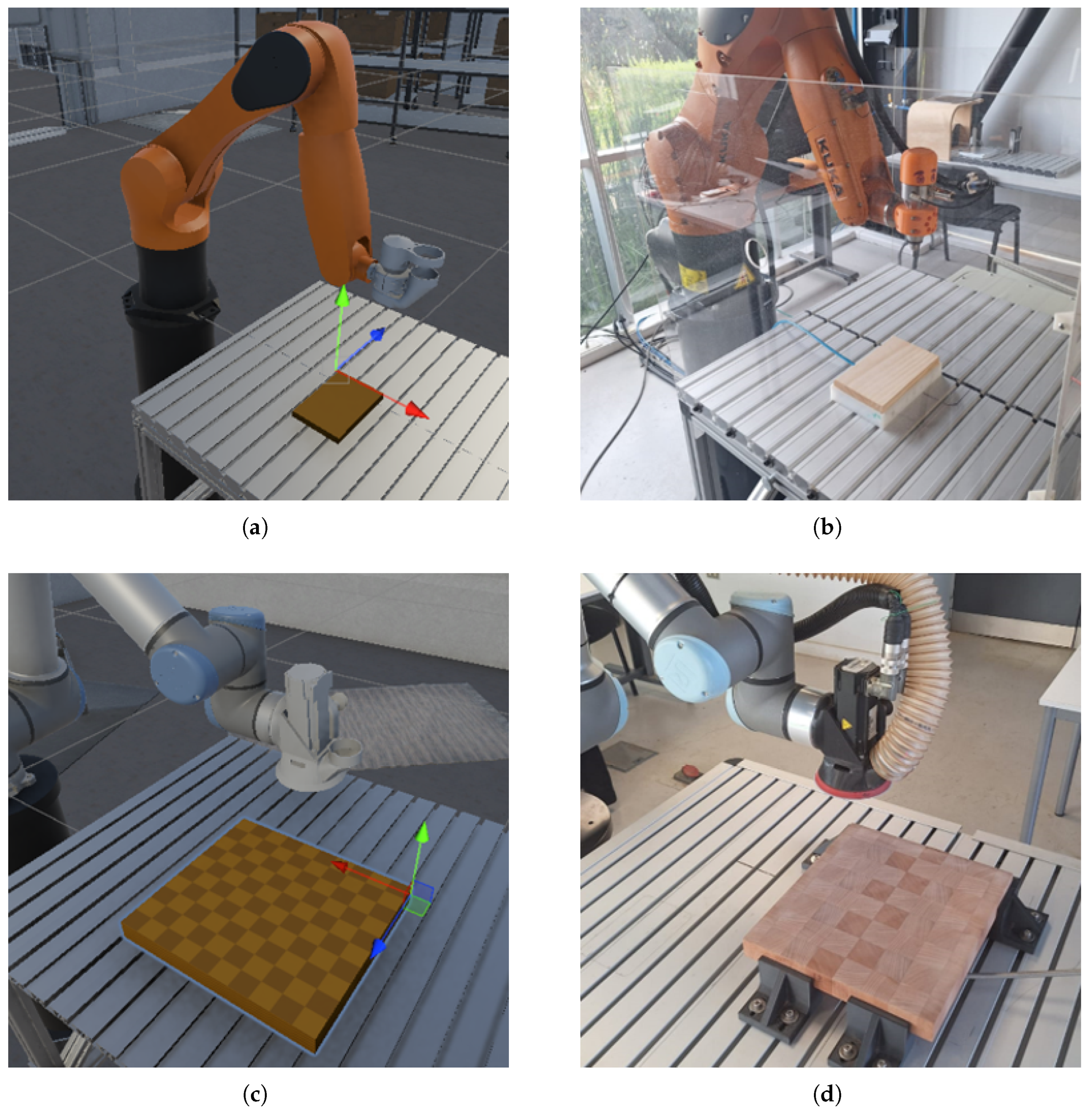
2.3. Experimental Setup
3. Results
3.1. Trajectory Programming Workflow
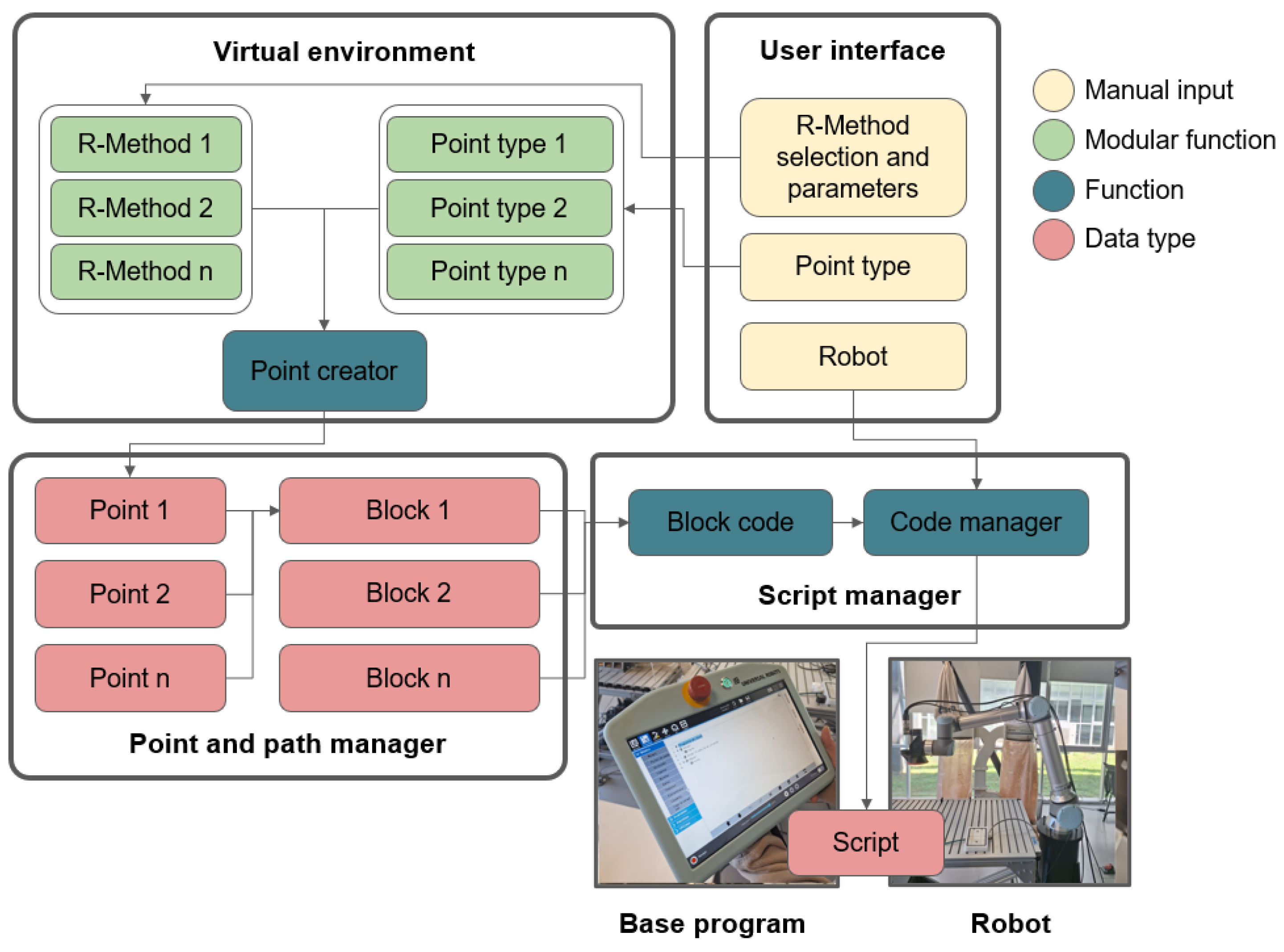
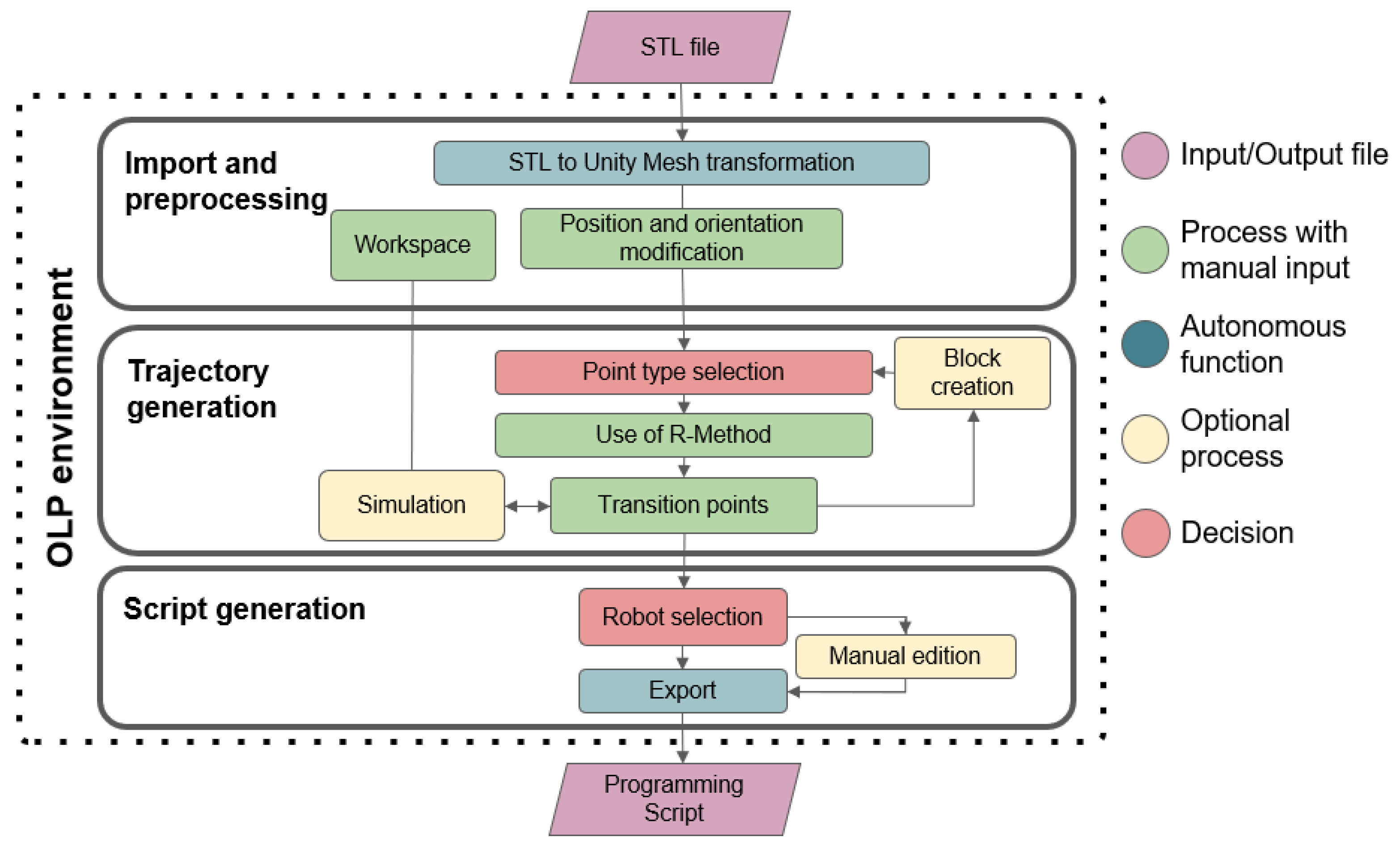
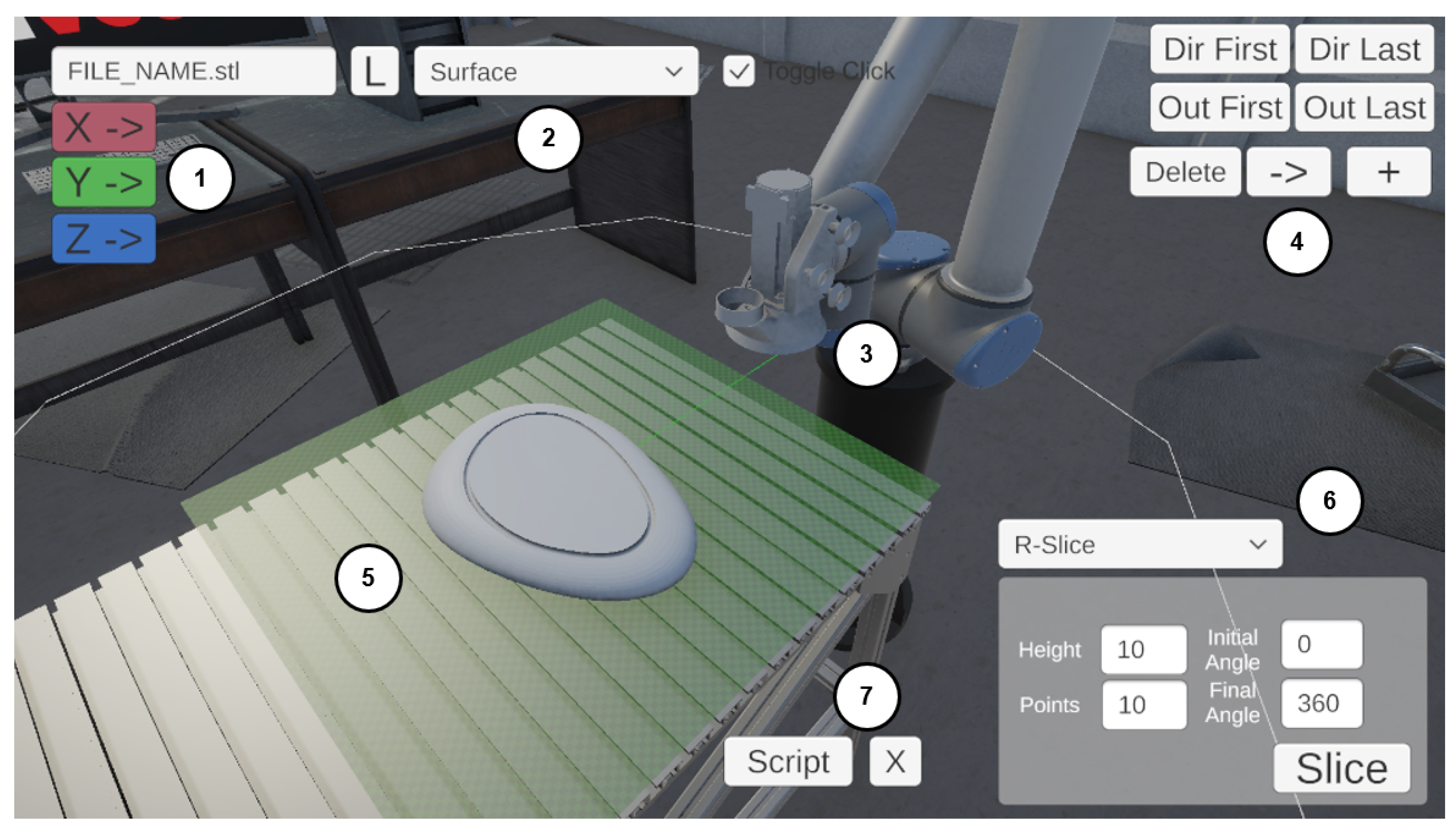
- Import and pre-processing: In this stage, an STL model can be loaded and visualized within the user interface, and its position and orientation can be modified according to the actual work environment. Parameters of the physical setup where the robot and workpiece are located must be considered, including kinematics, potential collisions and workspace volume, to ensure that the generated trajectories can be executed by the robot. The environment creates points and trajectories relative to a base frame or origin that must coincide with the real-world workspace and workpiece location.
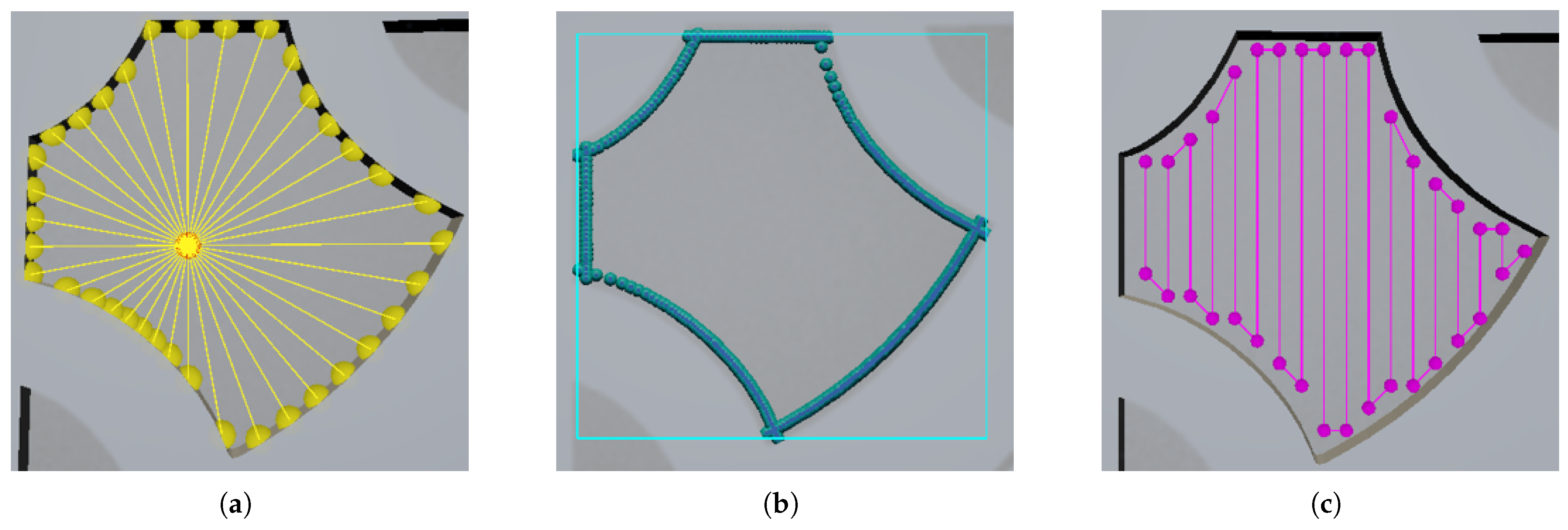
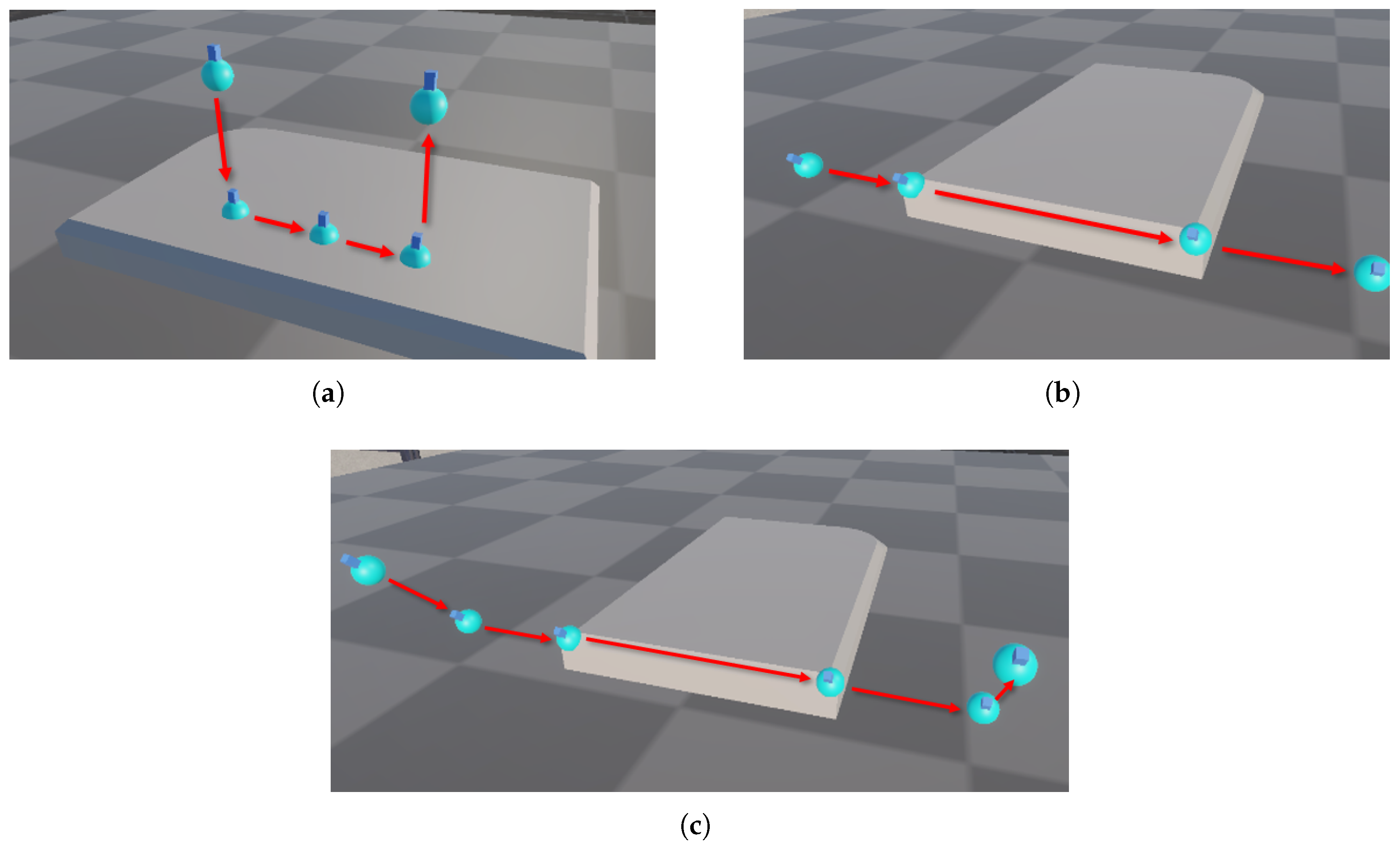
- Trajectory generation: This stage allows for the configuration of point types and other parameters that determine the characteristics of the trajectories generated by the four developed R-Methods: “R-Click”, “R-Slice”, “R-Rain”, and “R-Box”. To organize point sequences for robot paths and the specific manufacturing operation, auxiliary or transition points can be generated, and different sequences can be partitioned into blocks, which can be configured independently in later stages. Additionally, an optional kinematic simulation of the robot executing the trajectory can be performed to ensure that no erroneous points have been generated and that the intended movements are followed.
- Script generation: In this stage, a programming script for the UR10e and KUKA KR6 R900 robots can be generated from an integrated base template, defining the points and motion functions in the appropriate syntax for each robot. This script can be edited in the OLP environment before export if a user needs to make manual changes. Finally, the generated script can be integrated into the base program of the aforementioned robots.
- Input and output files: The system utilizes an STL file corresponding to the production workpiece and generates an industrial robot programming script as a result.
- Processes requiring manual inputs: These are associated with functions that demand parameter entry by the user, such as the R-Methods and Transition Points.
- Autonomous functions: These execute tasks automatically without requiring manual intervention.
- Optional processes: These are intended for improved management and organization of the trajectories.
- Decision stages: These correspond to the selection of variables that determine how other processes operate, such as the robot type selection for script generation.
3.2. R-Methods
3.3. Script Generation
3.4. Application
4. Discussion
5. Conclusions
Author Contributions
Funding
Data Availability Statement
Acknowledgments
Conflicts of Interest
References
- International Federation of Robotics (IFR). The Impact of Robots on Productivity, Employment and Jobs; IFR: Frankfurt am Main, Germany, 2017; Available online: https://ifr.org/img/office/IFR_The_Impact_of_Robots_on_Employment.pdf (accessed on 4 June 2025).
- Pan, Z.; Polden, J.; Larkin, N.; Van Duin, S.; Norrish, J. Recent progress on programming methods for industrial robots. Robot. Comput.-Integr. Manuf. 2012, 28, 87–94. [Google Scholar] [CrossRef]
- Dijkstra, E.W. A note on two problems in connexion with graphs. Numer. Math. 1959, 1, 269–271. [Google Scholar] [CrossRef]
- Hart, P.E.; Nilsson, N.J.; Raphael, B. A Formal Basis for the Heuristic Determination of Minimum Cost Paths. IEEE Trans. Syst. Sci. Cybern. 1968, 4, 100–107. [Google Scholar] [CrossRef]
- LaValle, S.M. Rapidly-Exploring Random Trees: A New Tool for Path Planning; Technical Report 98-11; Department of Computer Science, Iowa State University: Ames, IA, USA, 1998. [Google Scholar]
- Pang, M.; Liu, Z.; Cai, S.; Ren, Z.; Zhu, Y. Variable structure GA based motion planning of a three-limbed robot. In Proceedings of the 2009 International Conference on Measuring Technology and Mechatronics Automation, Zhangjiajie, China, 11–12 April 2009; Volume 2, pp. 519–522. [Google Scholar]
- Ichnowski, J.; Avigal, Y.; Satish, V.; Goldberg, K. Deep learning can accelerate grasp-optimized motion planning. Sci. Robot. 2020, 5, eabd7710. [Google Scholar] [CrossRef] [PubMed]
- Feng, T.; Li, J.; Jiang, H.; Yang, S.X.; Wang, P.; Teng, Y.; Chen, S.; Fu, Q.; Luo, B. The optimal global path planning of mobile robot based on improved hybrid adaptive genetic algorithm in different tasks and complex road environments. IEEE Access 2024, 12, 18400–18415. [Google Scholar] [CrossRef]
- Li, Z.; Wang, W. Path planning for industrial robots in free-form surface polishing. In Proceedings of the 2019 5th International Conference on Control, Automation and Robotics (ICCAR), Beijing, China, 19–22 April 2019; pp. 183–187. [Google Scholar]
- Tsai, F.Y.; Song, K.T. Path planning and control of a 6-dof manipulator for freeform surface polishing based on a point cloud model. In Proceedings of the International Conference on Advanced Robotics and Intelligent Systems (ARIS), Taipei, Taiwan, 22–24 August 2024; Institute of Electrical and Electronics Engineers Inc.: New York, NY, USA, 2024. [Google Scholar]
- Wu, H.; Wang, Y.; Wei, X.; Zhu, D. Spatial path planning for robotic milling of automotive casting components based on optimal machining posture. Metals 2022, 12, 1271. [Google Scholar] [CrossRef]
- Chen, W.; Li, X.; Ge, H.; Wang, L.; Zhang, Y. Trajectory planning for spray painting robot based on point cloud slicing technique. Electronics 2020, 9, 908. [Google Scholar] [CrossRef]
- Schneyer, S.; Sachtler, A.; Eiband, T.; Notestineer, K. Segmentation and coverage planning of freeform geometries for robotic surface finishing. IEEE Robot. Autom. Lett. 2023, 8, 5267–5274. [Google Scholar] [CrossRef]
- Leth, N.W.; Petersen, H.G. Robot path generation for curve manufacturing processes from unstructured CAD data: An off-line programming method. In Proceedings of the ISR 2020; 52th International Symposium on Robotics, Online, 9–10 December 2020; pp. 1–8. [Google Scholar]
- Shen, S.; Ren, K.; Fu, M.; Yang, M.; Chen, Y. Automatic trajectory generation for metal surface droplet coloring. Int. J. Adv. Manuf. Technol. 2023, 127, 5073–5082. [Google Scholar] [CrossRef]
- Bedaka, A.K.; Lin, C.-Y. CAD-based offline programming platform for welding applications using 6-DOF and 2-DOF robots. In Proceedings of the 2020 International Conference on Advanced Robotics and Intelligent Systems (ARIS), Taipei, Taiwan, 19–21 August 2020; pp. 1–4. [Google Scholar] [CrossRef]
- Nieto Bastida, S.; Lin, C.-Y. Autonomous trajectory planning for spray painting on complex surfaces based on a point cloud model. Sensors 2023, 23, 9634. [Google Scholar] [CrossRef] [PubMed]
- Hughes, J.; van Dam, A.; McGuire, M.; Sklar, D.; Foley, J.; Feiner, S.; Akeley, K. Computer Graphics: Principles and Practice, 2nd ed.; Addison-Wesley: Hoboken, NJ, USA, 1996. [Google Scholar]
- Shirley, P.; Ashikhmin, M.; Marschner, S. Fundamentals of Computer Graphics, 3rd ed.; A K Peters: Natick, MA, USA, 2009. [Google Scholar]
- Renz, H.; Krämer, M.; Hoffmann, F.; Bertram, T. Next-best-trajectory planning of robot manipulators for effective observation and exploration. arXiv 2025, arXiv:2503.22588. [Google Scholar] [CrossRef]
- Charrow, B.; Kahn, G.; Patil, S.; Liu, S.; Goldberg, K.; Abbeel, P.; Kumar, V. Information-theoretic planning with trajectory optimization for dense 3D mapping. Robot. Sci. Syst. 2015, 11, 3–12. [Google Scholar]
- Pantic, M.; Meijer, I.; Girod, R.; Alatur, N.; Andersson, O.; Cadena, C.; Siegwart, R.; Ott, L. Obstacle avoidance using raycasting and Riemannian motion policies at kHz rates for MAVs. In Proceedings of the 2023 IEEE International Conference on Robotics and Automation (ICRA), London, UK, 29 May–2 June 2023; pp. 1666–1672. [Google Scholar] [CrossRef]
- Ali, M.A.; Maqsood, A.; Athar, U.; Khanzada, H.R. Comparative evaluation of reinforcement learning algorithms for multi-agent unmanned aerial vehicle path planning in 2D and 3D environments. Drones 2025, 9, 438. [Google Scholar] [CrossRef]
- Santos, J.; Oliveira, M.; Arrais, R.; Veiga, G. Autonomous scene exploration for robotics: A conditional random view-sampling and evaluation using a voxel-sorting mechanism for efficient ray casting. Sensors 2020, 20, 4331. [Google Scholar] [CrossRef] [PubMed]
- Bircher, A.; Kamel, M.; Alexis, K.; Oleynikova, H.; Siegwart, R. Receding horizon “next-best-view” planner for 3D exploration. In Proceedings of the 2016 IEEE International Conference on Robotics and Automation (ICRA), Stockholm, Sweden, 16–21 May 2016; pp. 1462–1468. [Google Scholar] [CrossRef]
- Kim, I.S.; Lee, W.K.; Hong, Y.D. Simple global path planning algorithm using a ray-casting and tracking method. J. Intell. Robot. Syst. 2018, 90, 101–111. [Google Scholar] [CrossRef]
- Unity Technologies. Unity for Industry. Available online: https://unity.com/es/industry (accessed on 25 December 2025).
- Möller, T.; Trumbore, B. Fast, minimum storage ray-triangle intersection. J. Graph. Tools 1997, 2, 21–28. [Google Scholar] [CrossRef]





| Metric | R-Click | R-Rain | R-Slice | R-Box |
|---|---|---|---|---|
| Generation latency test [ms] | ||||
| Point generation [points/ms] | 5.8 | 10.8 | 10.2 | 4.6 |
| Latency per point [ms/points] | 0.17 | 0.092 | 0.097 | 0.21 |
| Performance Characteristic | Geometry Intersection-Based Methods [9,11,12,16] | NURBS-Based Methods [10,13,15,17] | Graph-Based Methods [14] | R-Methods |
|---|---|---|---|---|
| Computational Requirements | Require intensive geometric processing to solve intersection equations between triangulations or neighboring points. | Require real-time tool posture optimization, surface projection over meshes, and adaptive control matrices for force or impedance regulation. | Mainly concentrated in the preprocessing stage through matrix formulation for graph nodes and edges. | STL loading, ray-casting, and path generation are performed with low computational cost. |
| Manufacturing Applications | Sanding, polishing, deburring, painting, and welding. | High-precision polishing, abrasive sanding, convex surface processing, painting, and spray coating. | Machining, repair operations with edge treatments, and contouring of complex geometries. | Tested on flat and curved surface sanding. Milling operations include raster, profile, and contour machining, with potential applications in painting, welding, and adhesive dispensing. |
| Versatility | Dependent on surface characteristics, without explicitly resolving collision or singularity conditions. | Algorithms automatically adapt tool orientation and spacing according to physical surface properties such as curvature. | Capable of processing corrupted or unstructured CAD files. | Allows point generation on any surface while considering transitions and process-specific constraints, with user-configurable parameters. |
| Human Intervention | Low. Mainly limited to CAD model loading and process parameter configuration. | Low. Mainly limited to CAD model loading and process parameter configuration. | Low. Mainly limited to CAD model loading and process parameter configuration. | Low. Includes CAD loading, strategy selection, and semi-automatic transition configuration. |
Disclaimer/Publisher’s Note: The statements, opinions and data contained in all publications are solely those of the individual author(s) and contributor(s) and not of MDPI and/or the editor(s). MDPI and/or the editor(s) disclaim responsibility for any injury to people or property resulting from any ideas, methods, instructions or products referred to in the content. |
© 2026 by the authors. Licensee MDPI, Basel, Switzerland. This article is an open access article distributed under the terms and conditions of the Creative Commons Attribution (CC BY) license.
Share and Cite
Fuentes-Fierro, E.; Leal-Muñoz, E.; Diez, E. Ray-Casting-Based Trajectory Generation for Industrial Robots in Manufacturing Operations. Robotics 2026, 15, 132. https://doi.org/10.3390/robotics15070132
Fuentes-Fierro E, Leal-Muñoz E, Diez E. Ray-Casting-Based Trajectory Generation for Industrial Robots in Manufacturing Operations. Robotics. 2026; 15(7):132. https://doi.org/10.3390/robotics15070132
Chicago/Turabian StyleFuentes-Fierro, Eduardo, Erardo Leal-Muñoz, and Eduardo Diez. 2026. "Ray-Casting-Based Trajectory Generation for Industrial Robots in Manufacturing Operations" Robotics 15, no. 7: 132. https://doi.org/10.3390/robotics15070132
APA StyleFuentes-Fierro, E., Leal-Muñoz, E., & Diez, E. (2026). Ray-Casting-Based Trajectory Generation for Industrial Robots in Manufacturing Operations. Robotics, 15(7), 132. https://doi.org/10.3390/robotics15070132