Article

Mathematical Modeling of Passive and Active Tensions in Biological Muscles for Soft Robotic Actuators

by
Amirreza Fahim Golestaneh
Department of Civil and Mechanical Engineering, Purdue University Fort Wayne, Fort Wayne, IN 46805, USA
Robotics 2026, 15(2), 43; https://doi.org/10.3390/robotics15020043
Submission received: 27 November 2025 / Revised: 1 February 2026 / Accepted: 9 February 2026 / Published: 14 February 2026
(This article belongs to the Special Issue Dynamic Modeling and Model-Based Control of Soft Robots)

Abstract

Biological muscles generate tension from the combined contribution of the passive elastic recoil and the actively controlled contractile mechanisms. Understanding and replicating these passive and active tensions is necessary and beneficial for designing soft robotic actuators that emulate muscle-like behavior. In the current work, the aim is to develop a mathematical framework for modeling both the passive and active tensions in a biological muscle as functions of muscle length and contraction velocity. We will describe the passive tension by a nonlinear monotonically increasing function of length with threshold behavior in order to capture the experimentally observed stiffening occurring in stretched biological muscles. We will model the active tension using the superposition of Gaussian functions that relate bell-shaped tension-length with a flat plateau over the optimal length of the sarcomere. The parameters of this Gaussian representation of the active tension-length relation are determined from formulating a least-squares optimization problem, such that a Characteristic (indicator) function is approximated globally over the optimal length range of the sarcomere by summation of some Gaussian functions. The closed-form formulations for the required integrals are derived using the integral of the product of two Gaussian functions over R n as well as the error function which enables efficient parameter identification. We will also propose a symmetric tension–velocity relation that distinguishes three phases of concentric, eccentric and isometric contractions, and is parametrized directly by measurable quantities of isometric tension and maximum shortening velocity. The passive and active tensions are finally combined into a unified comprehensive tension model in which the exponentially modeled passive tension is added up to the active contribution, formulated as the product of the activation level, a normalized length-dependent factor and a normalized velocity-dependent factor. The resulting model reproduces canonical tension-length and tension-velocity relations and provides an analytically tractable comprehensive tension model that can be embedded in the dynamics of soft and continuum robot actuators inspired by biological muscles.

1. Introduction

Soft robotic actuators inspired by biological muscles have attracted significant attention over the last two decades due to their inherent compliance, safety in human–machine interactions, and ability to generate complex deformations that are difficult to achieve with traditional rigid mechanisms [1,2,3,4,5]. Biological muscles provide a rich paradigm for actuation: they realize large strains, exhibit tunable stiffness, and can generate smooth, continuous motions under distributed loading. These attributes have motivated a broad class of bio-inspired soft robotic systems, ranging from continuum manipulators and wearable devices to assistive and rehabilitative technologies [6,7,8,9].
From a physiological viewpoint, skeletal muscle tension generation is governed by well-characterized relationships between tension, length, and contraction velocity. Classical experiments demonstrated that the isometric tension produced by a muscle fiber depends strongly on sarcomere length, yielding the well-known length–tension curve with a plateau region associated with optimal overlap between actin and myosin filaments [10]. Similarly, the tension generated during dynamic contractions depends on the velocity of shortening or lengthening, as captured by the force–velocity (here, tension–velocity) relation introduced by Hill [11]. These two relations have been extensively used in biomechanics and neuromuscular modeling to describe muscle behavior under a wide range of physiological conditions [12,13,14]. Throughout this work, we use the term tension to denote the axial mechanical quantity that is often referred to as muscle force in the biomechanics literature.
A wide variety of phenomenological muscle models have been developed to reproduce the observed tension–length and tension–velocity relations. Hill-type muscle–tendon models, and their subsequent extensions, decompose muscle behavior into contractile, series-elastic, and parallel-elastic components whose parameters are identified from experimental data [12,13]. These models have been successfully integrated into musculoskeletal simulation environments and multibody dynamics tools to study human movement, posture control, and motor coordination [13,14]. However, most formulations are tailored to specific muscles or experimental protocols, and the underlying functional forms are often selected for convenience rather than to systematically encode known structural features of the tension–length and tension–velocity curves.
In parallel, the soft robotics community has developed a diverse range of muscle-inspired artificial actuators—such as pneumatic artificial muscles, fiber-reinforced elastomer actuators, and tendon- or cable-driven continuum structures—that mimic selected aspects of muscle behavior at the actuator level [1,2,3,4,9]. Many of these designs qualitatively reproduce muscle-like characteristics such as large stroke, compliance, or approximately linear stiffness in useful operating ranges. Among these bio-inspired soft actuators, twisted and coiled artificial muscles (TCAMs) have attracted significant interest due to their large stroke, high power density, and fiber-reinforced architecture, which make them promising candidates for compact soft robotic systems [15,16,17]. Recent physics-based models of TCAMs, including Cosserat-rod and control-oriented formulations [15,16,17,18], highlight the need for accurate descriptions of the underlying muscle-like tension generation, which motivates the present work on the mathematical modeling of active and passive tensions in biological muscles for application in soft robotic actuators. Nevertheless, the mathematical characterization of these artificial actuators is often device-specific, with tension models derived either from simplified continuum mechanics assumptions, empirical curve fitting, or black-box identification. As a result, there is still a gap between detailed physiological muscle models and compact, reusable mathematical descriptions of tension generation that can be systematically transferred to soft robotic actuators.
Muscle-inspired force generation is central to many soft robotic actuation technologies in which the generated tension/force is the primary control-relevant output. Representative examples include: (i) McKibben pneumatic artificial muscles (PAMs), where output force is strongly dependent on contraction/extension and is commonly modeled for control and calibration; (ii) twisted-and-coiled polymer actuators (TCPA/TCAM-type), which are frequently operated under external loads and require force–length and rate-dependent characteristics to predict contraction and load response; (iii) shape-memory-alloy (SMA) wire or spring actuators, which are often treated as muscle-like tensile elements for compact soft robotic designs; (iv) dielectric elastomer actuators (DEA) and pneumatic/hydraulic elastomeric actuators when incorporated through an equivalent axial force/tension along a backbone, tendon, or transmission; (v) tendon- or cable-driven soft continuum manipulators and bio-inspired arms, where distributed cable tensions are direct inputs to continuum models and controllers; and (vi) tendon/series-elastic actuation in soft grippers and soft hands, where internal tensions determine grasp forces and compliance.
In these systems, a closed-form and identification-ready mapping from actuator length and velocity to generated tension supports actuator calibration from limited measurements and provides a practical component for embedding actuation physics into dynamic models used for control. In particular, an explicitly decomposed tension formulation facilitates systematic parameter tuning to match measured force–length and force–velocity behaviors, and supports common robotics objectives such as trajectory tracking, force regulation, and impedance-like behaviors in interaction with the environment. This manuscript therefore positions the proposed tension model as a modular building block for muscle-inspired soft robotic actuator modeling and subsequent model-based control design.
Recent soft actuator modeling research has emphasized actuator-level multimodal modeling and validation, hybrid control-oriented formulations, and reduced-order continuum representations. For example, multimodal soft actuator models have been developed and validated to capture multiple deformation modes within unified actuator-level descriptions, and hybrid control strategies have been proposed to combine model-based structure with data-driven elements for practical deployment [19,20]. In parallel, lumped-mass and other reduced-order continuum formulations have been widely used to model large-deformation soft continuum structures under external loads while maintaining computational tractability [21]. The present work is complementary to these efforts: rather than proposing a device-specific pressure-to-shape model, we develop a closed-form, identification-ready tension generation map that can be embedded as a constitutive/actuation module within multimodal, lumped-mass, hybrid, or continuum actuator models when a muscle-like tension output is the control-relevant quantity.
Variable stiffness modulation is another key capability in muscle-inspired and soft robotic systems. Biological muscles modulate effective stiffness through the interplay of passive elasticity and activation-dependent active tension, and related mechanisms have been explored in variable-stiffness and muscle-inspired soft robots [22,23,24]. The explicit decomposition adopted here (passive and active components, together with a velocity-dependent term) provides a modeling structure that can be leveraged in future actuator-level studies to represent stiffness modulation through parameterized changes in the active component and its interaction with passive elasticity.
In this paper, the proposed tension formulation was intended as a muscle-inspired tension-generation module for tensile soft actuators and tendon/cable transmissions in which the control-relevant output is an axial force (tension) that varies with actuator length and contraction rate. Representative platforms include pneumatic artificial muscles (including McKibben-type and related pneumatic muscles), twisted/coiled polymer artificial muscles, and dielectric-elastomer artificial muscles integrated as muscle-like tensile elements in soft robotic systems. These actuator families are commonly characterized through force–contraction (force–length) measurements under fixed actuation conditions (e.g., pressure/voltage), reporting nontrivial force profiles over contraction and peak-force behavior [24]. Within this muscle-inspired setting, the bell-shaped active length–tension component was used to capture the canonical length-dependent force-generation objective, while actuator-specific transduction (e.g., pressure/temperature/voltage to ( l , l ˙ ) ) can be incorporated externally when embedding the model in a particular soft actuator.
This work addresses that gap by developing a mathematical framework for modeling both passive and active tensions in biological muscles and by formulating these models in a way that is directly applicable to bio-inspired soft actuators. On the passive side, muscles exhibit an exponential-like increase in tension when stretched beyond a threshold length corresponding to collagen and connective-tissue engagement [12,25,26]. On the active side, the tension generated by cross-bridge cycling in sarcomeres exhibits a bell-shaped dependence on length, with a relatively flat plateau over the optimal range and a rapid decay outside this region [10]. Inspired by these characteristics, we construct a passive tension model based on an exponential function of muscle (or actuator) length, and an active tension model obtained from a sum of Gaussian functions carefully designed to reproduce the plateau and decay regions of the physiological active tension–length curve.
The proposed active tension model is derived using tools from probability and approximation theory. Following the Gaussian framework in [27], we use a finite sum of one-dimensional Gaussian functions whose centers and widths are chosen to approximate, in a least-squares sense, a characteristic function that represents the optimal length interval of the sarcomere. The idea of representing non-smooth or piecewise-defined functions as sums of Gaussians has been explored in various approximation contexts [28], and we adapt it here to encode the flat peak and smooth transitions of the active tension–length relation. This formulation yields closed-form expressions for integrals of products of Gaussian terms, which we exploit to derive analytic expressions for the least-squares cost functional and its dependence on the Gaussian parameters. The resulting model provides a compact, differentiable description of the active tension curve, suitable for both analysis and numerical simulation.
In addition to length dependence, our formulation includes an explicit tension–velocity relation to capture concentric, eccentric, and isometric contractions within a unified expression. Building on the qualitative shape of the classical Hill curve, we adopt a symmetric power-law relationship around the isometric contraction point, parametrized by an isometric tension level, a maximum shortening velocity, and an exponent controlling the curvature of the relation. This simple yet flexible structure allows the model to reproduce the key features of physiological tension–velocity behavior while remaining tractable for parameter identification and integration into dynamic models of soft robotic systems.
From the perspective of soft robotics, the proposed tension models can be viewed as generic input–output maps that encode how a muscle-inspired actuator generates tension as a function of its elongation and contraction velocity, independent of the specific physical realization (e.g., fluidic elastomer, twisted polymer, or cable-driven continuum segment) [1,2,4]. By anchoring these maps in well-established physiological relations and by deriving them from analytically tractable Gaussian constructions, the framework offers a principled way to transfer biological muscle behavior into the design and control of soft actuators. Moreover, the parameters of the model can be tuned either to match experimental measurements from biological muscles [12,25,26] or to capture the measured tension–length and tension–velocity curves of artificial actuators in a consistent manner.

Related Work, Gap, and Contributions

Existing muscle and muscle-inspired actuator models used in biomechanics and robotics often rely on (i) Hill-type phenomenological force–velocity relations coupled with simplified active force–length curves, or (ii) lumped-parameter models calibrated to a particular dataset or actuator configuration. While these approaches are effective for simulation and control, they can obscure the explicit role of each tension component (passive, active length-dependent, and velocity-dependent) and may require re-tuning when experimental conditions, material parameters, or actuation regimes change.
The present manuscript contributes a unified, explicitly decomposed tension model that separates passive tension, active tension–length, and tension–velocity effects into analytically defined components suitable for parameter identification from limited experimental measurements. The key contributions are:
  • Unified decomposition and closed-form construction: We present a total muscle-tension model built from three physically interpretable components (passive, active length-dependent, and velocity-dependent), with a consistent notation and composition that enables direct integration into soft robotic actuator modeling and control.
  • Generalizable active tension–length representation: We model the active tension–length curve using a Gaussian-mixture structure, which provides a flexible yet structured representation capable of approximating a broad range of experimentally observed active tension–length profiles while maintaining an interpretable parameterization.
  • Parameter identification pathway with minimal assumptions: We provide an explicit least-squares-based formulation for identifying parameters of the active component, which supports calibration even when measurements are limited to typical experimental inputs/outputs available in robotics and biomechanics settings.
  • Robotics-oriented modeling emphasis: We consolidate the model into a form that is directly usable for muscle-inspired soft robotic actuators (where the actuator tension is the key output), enabling subsequent dynamic modeling and model-based control design.
This positioning clarifies that our contribution is not introducing a new physiological hypothesis, but rather providing a robotics-ready, analytically structured, and identifiable tension model that bridges common biomechanics formulations and the practical needs of soft robotic actuation.
The remainder of the paper is organized as follows. Section 2 reviews the physiological background of passive tension in muscles and introduces the proposed exponential tension–length model. Section 3 presents the physiological background of active tension and develops the Gaussian-based formulation for the active tension–length relation, including the least-squares approximation over the optimal length interval and the resulting closed-form expressions for the cost functional. Section 4 introduces the tension–velocity model for concentric, eccentric, and isometric contractions. Section 5 combines the passive and active components into a unified total tension model as a function of length, velocity, and activation. Finally, Section 6 summarizes the main contributions and outlines directions for future work, including experimental identification of model parameters for specific biological muscles and soft robotic devices.

2. Passive Tension in Biological Muscles

2.1. Physiological Background of Passive Tension

In addition to actively generated tension, biological muscles exhibit passive tension when they are stretched beyond their slack configuration. Passive tension arises without any neural stimulation; it is generated by the elastic recoil of the muscle–tendon unit and the engagement of connective tissues, such as collagen and extracellular matrix structures. A useful analogy is a rubber band: when the band is pulled and elongated, it develops a restoring tension that tends to bring it back to its original length once the external load is removed. Similarly, when one pushes the fingers down to forcibly straighten them, the muscles and tendons in the fingers are stretched and develop tension that can bring the fingers back up even in the absence of active muscular stimulation. In both cases, the tension is stored elastically rather than produced by active contraction.
From a functional standpoint, passive tension in a muscle depends primarily on its length. Below a certain threshold (or slack) length, the muscle is sufficiently compliant that the passive tension is essentially zero. Once the muscle is stretched beyond this threshold, the passive tension increases monotonically with length. More compliant muscles exhibit smaller passive tension for a given elongation, whereas stiffer muscles or tendons produce larger passive tension at the same length. Experimental studies have quantified the passive tension–length relation in skeletal muscles by gradually stretching the muscle and measuring the resulting passive tension. Milligan et al. fitted a linear function to the nonzero portion of the passive tension data over a restricted range of lengths [25], whereas Yu et al. showed that an exponential function provides a better fit over a wider range of elongations [26]. These observations support the view that passive tension grows slowly near the threshold length and then rises more steeply as the muscle is stretched further, consistent with the progressive engagement and stiffening of connective tissues.
It is also important to note that the length at which passive tension first becomes nonzero (the threshold length) can be greater than the relaxed (rest) length of the muscle. In other words, a muscle can be elongated beyond its resting length while still generating negligible passive tension until sufficient structural elements are stretched and begin to resist further elongation. This distinction between relaxed and threshold lengths is essential for constructing realistic passive tension models for both biological muscles and muscle-inspired actuators.

2.2. Exponential Model for Passive Tension

Motivated by the experimental evidence for a monotonically increasing, nonlinear passive tension–length relation [25,26], we adopt an exponential model for passive tension. Throughout this work, we use the term tension to denote the axial mechanical quantity often referred to as muscle force in biomechanics; to avoid confusion, we use only the word “tension” in the rest of the paper. Let x R + denote the current muscle (or actuator) length and let x 0 R + be a threshold (slack) length beyond which passive tension becomes nonzero. We define the passive tension T p ( x ) as
T p ( x ) = 0 , x x 0 , k p e α ( x x 0 ) 1 , x > x 0 ,
where k p R + is a scaling coefficient with the dimension of tension, and α R + controls the rate at which passive tension rises with length. The subtraction of 1 in the exponential branch ensures continuity at the threshold, since T p ( x 0 ) = 0 and T p ( x 0 + ) = k p e α ( x 0 x 0 ) 1 = 0 , so T p ( x ) is continuous at x = x 0 .
For x > x 0 , the first derivative of the passive tension with respect to length is strictly positive because both k p and α are positive and the exponential factor is always positive. Consequently, T p ( x ) is strictly increasing for x > x 0 , consistent with the monotonic rise of passive tension observed in experiments. The second derivative is also strictly positive, which implies that the passive tension–length curve is convex (bends upward): the tension increases slowly just above the threshold and then more steeply as the muscle (or actuator) is further elongated. This convex exponential behavior matches the typical shape of measured passive curves in skeletal muscle and bio-inspired actuators, where small deformations around the slack length produce negligible tension, but larger stretches rapidly engage stiffer connective-tissue components and yield a sharp increase in tension.
The parameters k p , α , and x 0 can be identified from experimental passive tension–length data. One common procedure is to measure passive tension at a set of muscle lengths, determine the length below which the measured tension is effectively zero (yielding an estimate of x 0 ), and then fit k p and α to the nonzero portion of the data using nonlinear regression. More compliant muscles or actuators correspond to smaller values of k p and/or α , whereas stiffer tissues are represented by larger parameter values. In practice, this calibration can be performed either on biological muscle preparations or directly on muscle-inspired soft actuators, enabling the same mathematical structure (1) to serve as a unified passive tension model across both domains.
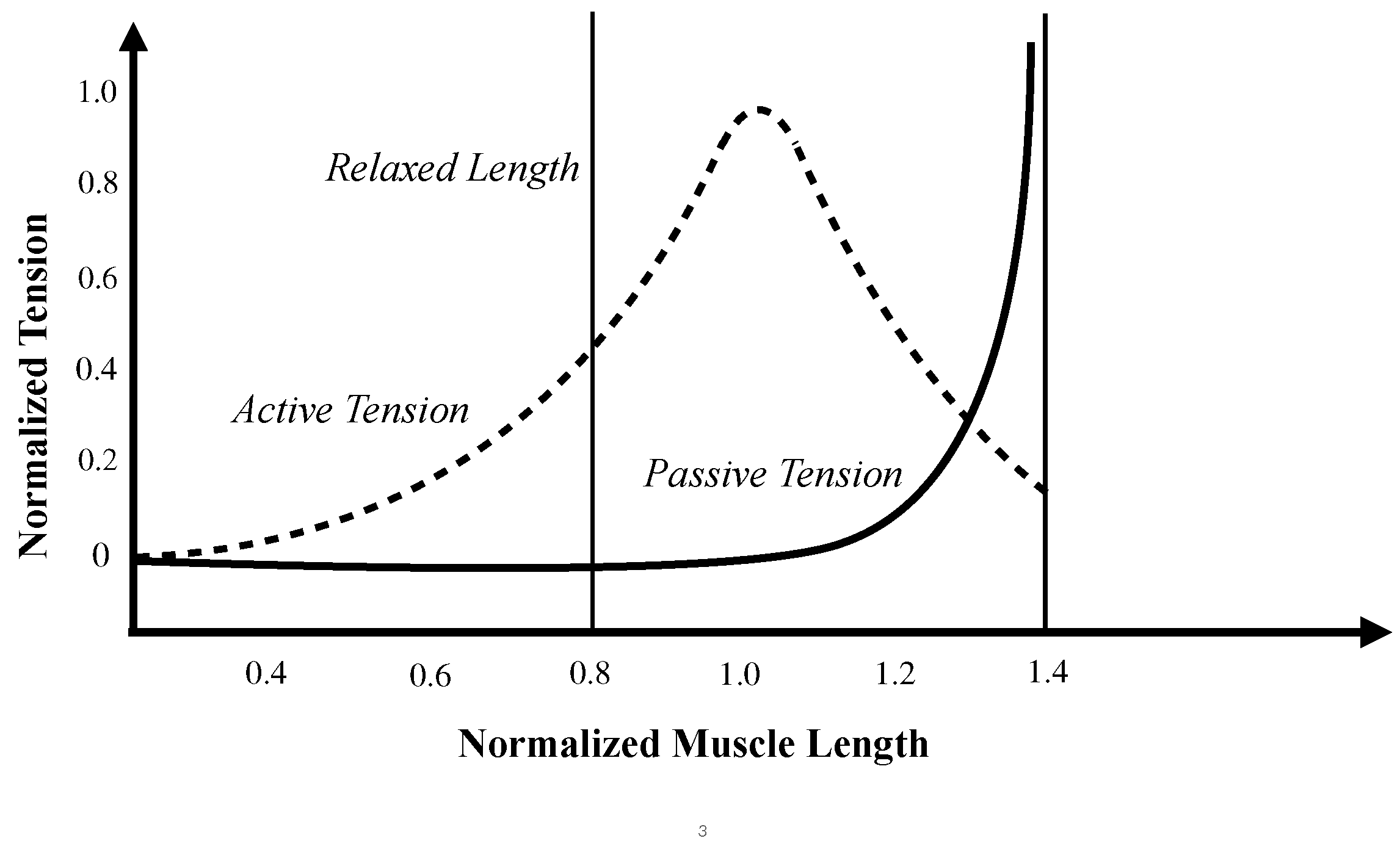
For completeness, Figure 1 illustrates a typical passive tension curve alongside the active tension and total tension of a muscle, adapted from [6]. The passive branch remains close to zero up to a threshold length and then rises nonlinearly, consistent with the exponential structure of (1). The exponential model is sufficiently simple to be embedded in dynamic models of muscle-inspired soft actuators, while still capturing the essential qualitative features of passive tension: zero response below a threshold, monotonic increase above that threshold, and convex growth as elongation increases. In later sections, the passive tension model is combined with an active tension model to describe the total tension generated by a muscle or bio-inspired actuator as a function of length and contraction velocity.

3. Active Tension in Biological Muscles

3.1. Physiological Background of Active Tension

Active tension generation in skeletal muscle is rooted in the microscopic architecture of muscle fibers. Each muscle fiber is composed of repeating contractile units called sarcomeres, which are arranged in series along the myofibrils. A sarcomere contains two primary types of protein filaments: thin filaments composed mainly of actin and thick filaments composed of myosin. The myosin filaments carry multiple myosin heads clustered near both ends and away from the central bare zone. Each myosin head can attach to a nearby actin filament to form an actin–myosin cross-bridge, and the cyclic formation and detachment of these cross-bridges underlie the active shortening and tension generation of the sarcomere.
Unlike passive tension, which is purely elastic and does not require neural input, active tension arises only when the muscle is stimulated. Upon activation (e.g., via an action potential and subsequent calcium release), myosin heads bind to actin and, through ATP-driven conformational changes, generate relative sliding of actin and myosin filaments. The total active tension produced by a sarcomere at a given instant depends on the number of attached cross-bridges that are capable of producing force. Consequently, for a given level of activation, the active tension generated by a sarcomere depends strongly on its length at the moment of stimulation, often referred to as the starting or resting sarcomere length.
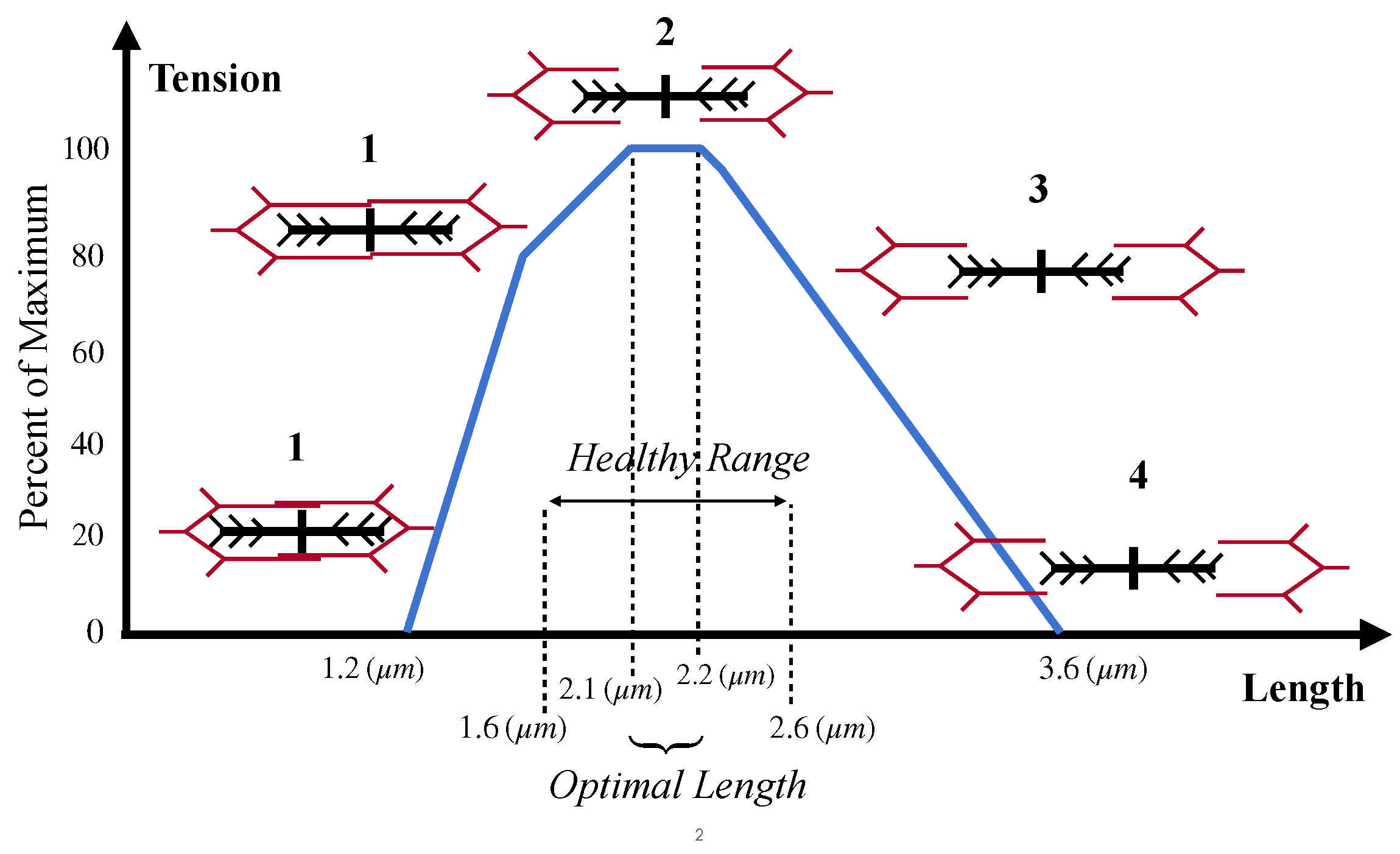
There exists an optimal sarcomere length at which the spatial overlap between actin and myosin filaments is such that the maximum possible number of myosin heads can bind to actin and form tension-generating cross-bridges. If a sarcomere is stimulated at this optimal length, it produces the maximal active tension during subsequent contraction. When the sarcomere is stretched beyond this optimal length, the overlap between actin and myosin decreases: fewer myosin heads lie opposite actin binding sites, fewer cross-bridges can form, and the active tension decreases. If the sarcomere is stretched too far, the actin filaments move out of reach of the myosin heads; cross-bridge formation becomes negligible and the active tension drops to a very low level. This situation corresponds to the far-right region of the classic active tension–length curve (often labeled as “region 3” or “region 4”, in Figure 2), where active tension is small because of insufficient filament overlap.
A similar reduction of active tension occurs when the sarcomere is too short. If a sarcomere is significantly shorter than its optimal length, portions of the actin filaments may overlap with the central bare zone of the myosin filament, where no myosin heads are present to form cross-bridges. In addition, actin filaments from opposite sides of the sarcomere may interfere with each other, sterically blocking some myosin heads from binding to their actin targets. In the extreme case of very short sarcomere lengths, actin–actin overlap and geometric constraints prevent meaningful cross-bridge formation, leaving essentially no room for further filament sliding. As a result, the active tension again becomes very small. These effects correspond to the left-hand side of the active tension–length curve (often labeled as “region 1” in Figure 2), where excessive shortening leads to reduced active tension.
Overall, these filament-level mechanisms produce the well-known bell-shaped active tension–length relation: active tension is small at very short lengths, increases with length, reaches a plateau over an optimal range of sarcomere lengths, and then decreases again as the sarcomere is stretched further [10]. The plateau region corresponds to a range of lengths over which the overlap between actin and myosin remains nearly ideal, such that the number of available cross-bridges—and hence the active tension—remains approximately constant.
In skeletal muscle, healthy sarcomere lengths are typically constrained to a physiological operating range in which the muscle functions normally. A commonly cited healthy range is approximately 70 % to 130 % of the optimal length, corresponding to about 1.6 μ m to 2.6 μ m for many skeletal muscles, with the optimal length interval itself being roughly 2.1 μ m to 2.2 μ m , and the full extreme range from maximally shortened to maximally stretched spanning approximately 1.2 μ m to 3.6 μ m [10,29]. As a practical example, when a person fully straightens the elbow and then attempts a biceps curl, the initial phase of the movement often feels more difficult because the sarcomeres of the biceps are elongated beyond their optimal length, and the muscle cannot generate its maximal active tension at that configuration. The optimal-length plateau, where active tension is maximal, corresponds to the most common operating range for everyday muscle activities.
Figure 2 schematically illustrates the dependence of active tension on sarcomere (or muscle) length, highlighting the optimal region, healthy (normal) region, and the reduction of active tension at both excessively short and excessively long lengths.

3.2. Gaussian-Based Model for Active Tension

We now develop a mathematical model for the active tension–length relation based on sums of Gaussian functions. The starting point is the standard n-dimensional Gaussian distribution [27], defined as
ψ ( x ; Σ , δ ) 1 2 π n / 2 det ( Σ ) 1 / 2 exp 1 2 ( x δ ) Σ 1 ( x δ ) ,
where x R n , the vector δ R n denotes the location of the peak, and the symmetric positive definite matrix Σ S + ( n ) encodes the shape and orientation of the ellipsoidal level sets of ψ . The spectral decomposition Σ = Q Λ Q , with rotation matrix Q SO ( n ) and diagonal matrix Λ , makes explicit that these level sets are ellipsoids whose principal axes are oriented by Q and whose semi-axis lengths are given by the entries of Λ . The Gaussian function is bell-shaped, infinitely differentiable, and decays rapidly to zero as x . When it is normalized so that R n ψ ( x ) d x = 1 and ψ ( x ) 0 , it can be interpreted as a probability density function on R n .
Motivated by the bell-shaped dependence of active tension on sarcomere length—with a nearly flat plateau over the optimal length interval and smooth decay at both shorter and longer lengths—we adopt a construction inspired by [28] and approximate the active tension curve with a finite sum of one-dimensional Gaussians. As mentioned above in the passive tension model, x R + denotes the current muscle (or actuator) length, and we define
f ( x ; σ , δ k , a k , b k ) = k = 1 m ψ k ( x ; σ , δ k , a k , b k ) ,
where each term ψ k : R R is a one-dimensional Gaussian of the form
ψ k ( x ; σ , δ k , a k , b k ) = a k 2 π | σ | 1 / 2 exp b k 2 σ ( x δ k ) 2 .
Here a k R controls the height (amplitude) of the Gaussian, b k R + controls its width, and σ R + plays the role of the one-dimensional analogue of the matrix Σ in (2). Because of the extra scaling parameters a k and b k , the functions ψ k in (4) are not, in general, normalized probability densities: they can take negative values if a k < 0 , and their integral over R is not constrained to be 1. In the present context, they are purely analytic building blocks used to approximate the active tension–length relation.
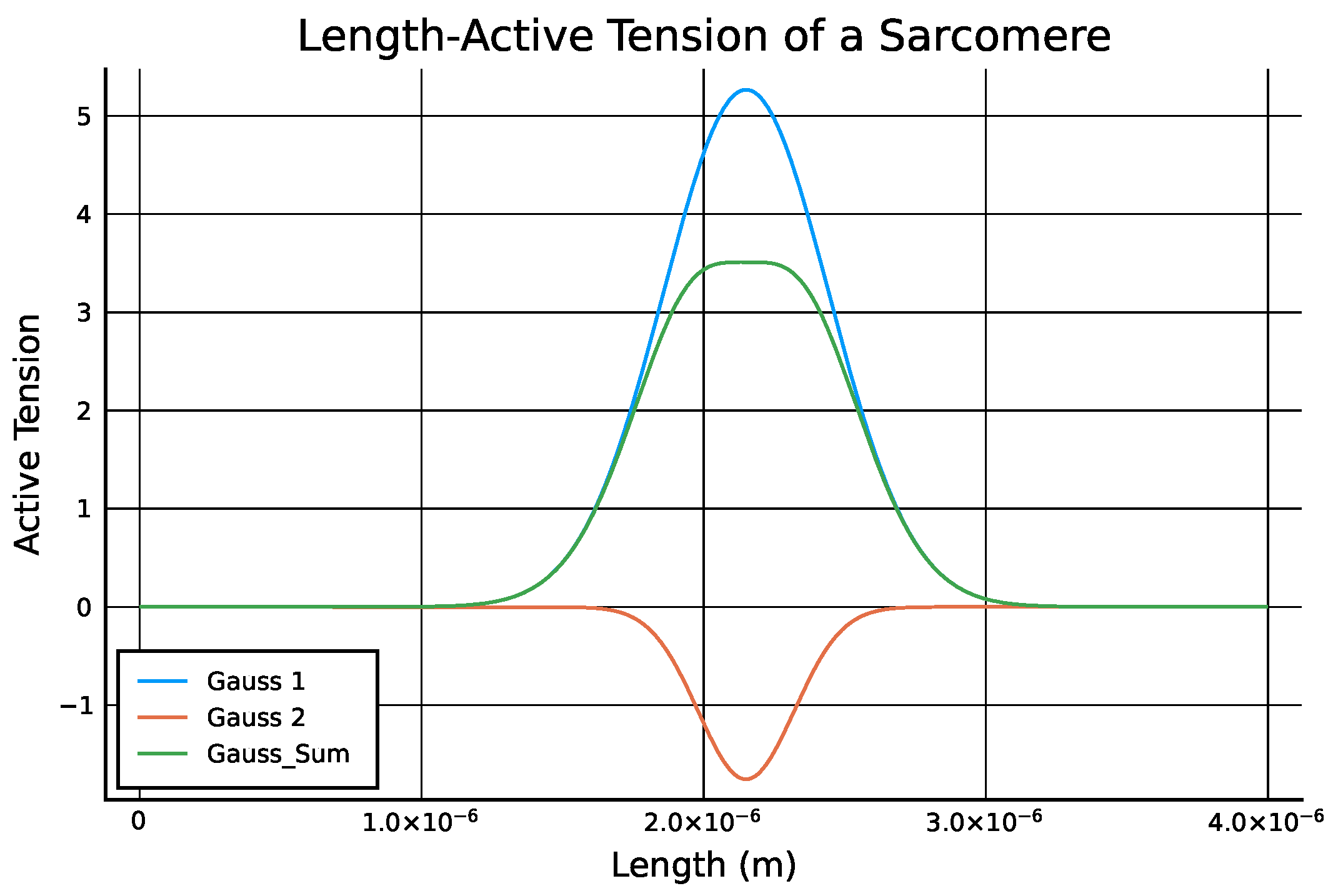
Figure 3 illustrates how the sum of two Gaussians of the form (4) can produce a new bell-shaped function f in (3) with a relatively flat peak. The individual Gaussians are chosen over a length range comparable to that of a physiological sarcomere (see Figure 2), and the resulting sum exhibits a plateau-like region over an interval similar to the optimal length range (≈2.1– 2.2 μ m ), while decaying toward zero near the shorter and longer extreme lengths (≈1.2 μ m and 3.6 μ m ). This qualitative similarity suggests that a sum of Gaussians can capture the essential features of the active tension–length curve.
From a modeling point of view, the optimal sarcomere (or muscle) length range is the most important domain on which the active tension model should match the true physiological behavior. Let L opt = [ 1 , 2 ] R + denote the interval of optimal lengths; as discussed in Section 3.1, this is the range over which active tension is maximal and approximately constant. The broader healthy operating range for the sarcomere, spanning roughly 70 % to 130 % of the optimal length, is also of interest, since the muscle commonly operates within this interval during normal daily activities. To formalize the idea that the active tension should ideally be “maximal and flat” over L opt and negligible outside it, we introduce the characteristic (indicator) function C : R { 0 , 1 } over L opt ,
C ( x ) = 1 , x L opt , 0 , x R L opt ,
and seek a sum of Gaussians of the form (3) that approximates C in a global (i.e., L 2 ) sense. We emphasized that the Gaussian-based active length–tension formulation was adopted as a flexible phenomenological approximation of the experimentally observed bell-shaped relationship (including the plateau region), primarily to provide a smooth, tunable representation that is convenient for parameter identification. This choice was not intended to imply a specific underlying physiological mechanism. The rectangular indicator function was used as a compact mathematical target to encode the optimal-length interval in the least-squares construction and was not intended to represent the physiological active length–tension curve itself. The resulting Gaussian approximation remained smooth and can represent gradual, non-rectangular transitions through appropriate choices of Gaussian widths and weights. When experimental force–length measurements (or a physiologically motivated polygonal curve) are available, the same least-squares formulation can be applied by replacing the target function with the corresponding dataset/curve. More precisely, we use a least-squares approximation in the Hilbert space L 2 ( R ) and determine the parameters ( a k , b k ) by minimizing the squared L 2 -norm of the difference between f and C:
min ( a k , b k ) R × R + k = 1 m ψ k ( x ; σ , δ k , a k , b k ) C ( x ) L 2 ( R ) 2 .
For fixed Gaussian centers and widths, the active tension–length representation was linear in the mixture weights, so the weights were directly estimated via least-squares. In practice, constrained/regularized least-squares can be used to improve robustness to measurement noise while enforcing physically meaningful bounds (e.g., nonnegativity) on the estimated weights. Define the cost functional
N ( a k , b k ) k = 1 m ψ k ( x ; σ , δ k , a k , b k ) C ( x ) L 2 ( R ) 2 = R k = 1 m ψ k ( x ; σ , δ k , a k , b k ) C ( x ) 2 d x .
Although the primary region of interest for C is the optimal interval L opt , we emphasize that the minimization (6) is global: the approximation is carried out over the entire real line, and the resulting f ( x ) is a smooth bell-shaped curve with a flat plateau near L opt and smooth decay outside it. This construction therefore yields a function that resembles the physiological active tension–length curve over the full healthy length range (approximately 70 % 130 % of optimal length), rather than only on the plateau.
For computational purposes, it is convenient to express N ( a k , b k ) in terms of integrals that can be evaluated in closed form. Because the integrand in (7) is a finite sum of Gaussian terms and the characteristic function C ( x ) vanishes outside L opt , and because the sets L opt and R L opt form a partition of R , one can expand the square in (7) and simplify to obtain, for the case m = 2 :
N ( a k , b k ) = R ψ 1 2 ( x ) d x + 2 R ψ 1 ( x ) ψ 2 ( x ) d x + R ψ 2 2 ( x ) d x 2 L opt ψ 1 ( x ) d x 2 L opt ψ 2 ( x ) d x + μ ( L opt ) ,
where μ ( L opt ) denotes the Lebesgue measure of the interval L opt , which reduces to its length μ ( L opt ) = 2 1 . Equation (8) expresses the least-squares cost functional entirely in terms of integrals of Gaussians over R and over the finite interval L opt .
The first three terms in (8) involve integrals of Gaussian products over R . These can be computed using the closed-form relation for the integral of the product of two Gaussians over R n (derived in Appendix A) specialized to n = 1 , yielding, for k { 1 , 2 } and with ψ 1 , ψ 2 of the form (4) [28]:
R ψ 1 ( x ; σ , δ 1 , a 1 , b 1 ) ψ 2 ( x ; σ , δ 2 , a 2 , b 2 ) d x = a 1 a 2 2 π | σ ( b 1 + b 2 ) | 1 / 2 × exp ( δ 1 b 1 + δ 2 b 2 ) 2 2 σ ( b 1 + b 2 ) δ 1 2 b 1 + δ 2 2 b 2 2 σ ,
and
R ψ k 2 ( x ; σ , δ k , a k , b k ) d x = a k 2 2 π | b k σ | 1 / 2 exp ( δ k b k ) 2 b k σ δ k 2 b k σ , k { 1 , 2 } .
Since σ , b 1 , b 2 R + in our application, these expressions can be further simplified algebraically, although we keep them in the above form for clarity and consistency with the general n-dimensional derivation. Detailed derivations of (9) and (10) from the general formula in Appendix A are provided in Appendix A.1 and Appendix A.2, respectively.
The remaining two integrals in (8) involve the Gaussians restricted to the optimal length interval L opt = [ 1 , 2 ] . These integrals can be expressed in terms of the error function, leading to (see Appendix A.3 for details)
L opt ψ k ( x ; σ , δ k , a k , b k ) d x = a k 2 b k erf b k 2 σ ( 2 δ k ) erf b k 2 σ ( 1 δ k ) ,
for k { 1 , 2 } . The error function erf ( x ) is a classical sigmoid-shaped function with a bell-shaped derivative and admits a convergent power-series representation on R . For example, its Maclaurin expansion is
erf ( x ) = 2 π n = 0 ( 1 ) n x 2 n + 1 n ! ( 2 n + 1 ) .
Combining (9), (10), and (11), the cost functional (8) can be evaluated exactly for any given set of Gaussian parameters, enabling the use of standard nonlinear optimization algorithms to identify ( a k , b k , δ k ) that best approximate the ideal characteristic function C ( x ) .
It is instructive to compare this Gaussian-based construction with classical interpolation approaches used to model the active tension–length relation from experimental data. In the literature, Yu et al. [26] interpolated experimental active tension data with a third-order polynomial, whereas Milligan et al. [25] employed a fourth-order polynomial. In principle, one can fit a single high-degree polynomial to the entire dataset, but such polynomial interpolation is prone to oscillations near the ends of the interpolation interval (Runge-type phenomena), and the quality of the fit can degrade significantly outside the range of measured data. An alternative is spline interpolation, in which low-degree polynomials are fit piecewise on subintervals of the data. Spline interpolation offers several advantages: it is constructed to be continuous, its first and second derivatives are typically continuous across subinterval boundaries, and it can provide accurate local approximations to the data with smaller interpolation error than a single high-degree polynomial. The smoothness and piecewise structure of splines suggest that they can also reproduce a flat plateau near the optimal length range of the muscle.
However, spline-based models are inherently data-driven and their accuracy depends strongly on the number, spacing, and quality of experimental data points. Experimental measurements of muscle tension inevitably contain various sources of error, and these errors propagate through the interpolation procedure, potentially compounding as more data points are added. In contrast, the Gaussian-based model proposed here is less reliant on dense experimental sampling: it primarily requires estimates of the optimal length interval and the maximum active tension, and then uses a small set of parameters ( a k , b k , δ k ) to encode the shape of the active tension curve. The closed-form structure of the cost functional (8) and its component integrals (9)–(11) further facilitates efficient parameter tuning via nonlinear optimization. As a result, the Gaussian-based approach offers a compact, analytically tractable representation of the active tension–length relation that is well suited for integration into dynamic models of biological muscles and bio-inspired soft actuators. We noted that the active tension–length component in this manuscript was formulated as a static relation and did not model activation dynamics or history-dependent effects. The scope of this work focused on a closed-form, identification-ready component within an explicitly decomposed total-tension framework for muscle-inspired soft robotic actuators. Incorporating activation dynamics and history-dependent effects will be addressed in future work.
Remark 1
(sum of Gaussians vs. cubic splines). A commonly used alternative for representing the active length–tension relation is a cubic-spline fit. In comparison, the sum-of-Gaussians representation used here provides a closed-form expression with closed-form derivatives, which is convenient for gradient-based identification and control-oriented use. For fixed centers and widths, the sum-of-Gaussians calibration reduces to estimating mixture weights via least-squares, whereas spline fitting typically involves selecting knots (and boundary conditions) and evaluating a piecewise polynomial representation. A quantitative benchmarking of accuracy (e.g., RMSE) and evaluation cost against cubic splines when fitting to specific datasets is targeted as a next step.

4. Tension–Velocity Relation in Muscles

4.1. Physiological Background of the Tension–Velocity Relation

In addition to its dependence on sarcomere (or muscle) length, active tension also depends strongly on the velocity of change of sarcomere (or muscle) length. This dependence differs between the three classical modes of muscle contraction: concentric, eccentric, and isometric. In a concentric contraction, the muscle shortens while producing active tension—for example, lifting a weight in a bench press, curling the biceps during an arm flexion, or standing up from a squat. In an eccentric contraction, the muscle lengthens while still generating active tension, as occurs when lowering a weight under control in a bench press, uncurling the biceps while resisting gravity, or lowering oneself from a pull-up. In an isometric contraction, the muscle generates active tension without a change in length; a typical example is attempting to hold or move a load that is too heavy to produce any visible motion, such as pushing against an immovable object or trying to curl a weight that cannot be lifted.
In concentric contractions, when the muscle shortens as it produces active tension, the shortening velocity decreases as the load (and thus the active tension) increases. In other words, under heavier loads, the muscle can still shorten, but it does so more slowly. This is consistent with everyday experience: in a bench press, a heavier barbell is lifted more slowly than a lighter one; similarly, standing up from a squat with a heavy load takes longer than standing up with a light load. At the extreme, for sufficiently large loads, the shortening velocity drops to zero and the contraction becomes isometric, with the muscle generating tension but not changing its length.
In eccentric contractions, where the muscle lengthens while producing active tension, the relationship between tension and velocity has the opposite trend: the lengthening velocity tends to increase with load. When lowering a weight in a bench press or descending from a pull-up, a heavier load is more difficult to control, and the muscle tends to lengthen more rapidly unless the nervous system compensates with increased activation. Moreover, for a given level of activation, muscles can generally produce a larger active tension during eccentric contractions than during concentric ones. This explains why a person can often lower a heavier weight under control than they can lift concentrically: the muscle is capable of resisting greater loads while it is being stretched than it can generate while shortening.
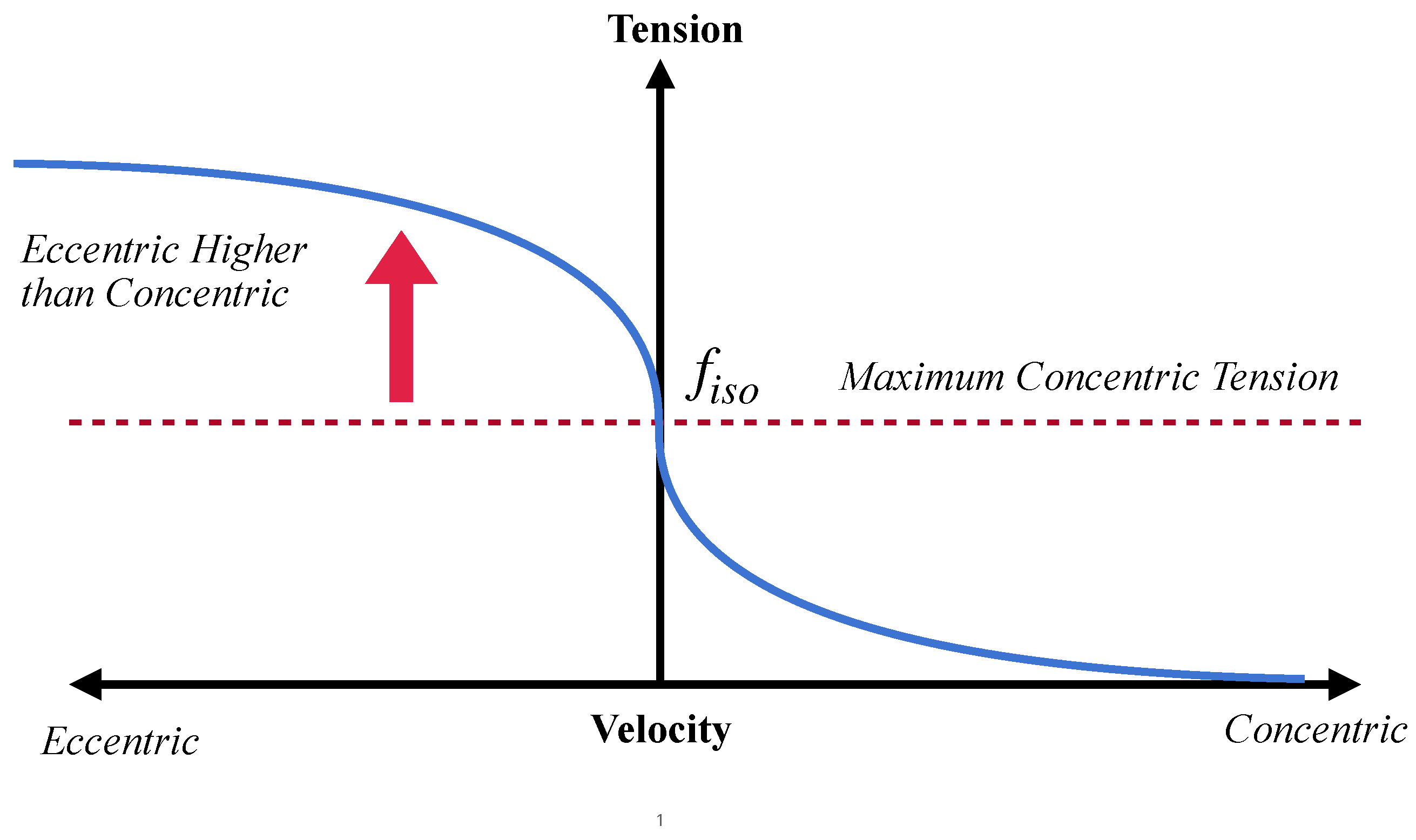
These relationships between active tension and contraction velocity give rise to the classic tension–velocity curve of muscle (see Figure 4). On the concentric side (positive shortening velocities), the curve shows a monotonic decrease of active tension with increasing velocity: high tension corresponds to slow shortening, and as velocity increases, the tension that can be produced drops toward zero. On the eccentric side (negative velocities corresponding to lengthening), the curve continues beyond the isometric point with active tension rising above the isometric level for moderate lengthening velocities, and then tending toward a plateau at higher lengthening velocities. The isometric contraction corresponds to the intersection of the tension–velocity curve with the vertical axis at zero velocity, where the muscle produces a nonzero active tension without changing its length.
As a more global illustration, runners and sprinters typically operate their muscles at relatively high contraction velocities with lower force per contraction, corresponding to the high-velocity, low-tension region of the concentric branch. In contrast, strength or power athletes performing heavy lifting exercises operate at low contraction velocities but generate large active tensions, corresponding to the low-velocity, high-tension region near the isometric point and transitioning toward the eccentric branch. Experimentally measured tension–velocity curves are often approximately symmetric, in a qualitative sense, around the isometric point on the vertical axis: the concentric and eccentric branches form a smooth, continuous curve passing through this point, with opposite trends of tension versus velocity on each side.
Figure 4 schematically summarizes these features, showing the active tension as a function of contraction velocity for concentric, eccentric, and isometric contractions. This physiological background motivates the mathematical tension–velocity relation introduced in the next subsection, which aims to capture the essential qualitative behavior of the curve with a simple analytic expression suitable for use in muscle and soft-actuator models.

4.2. Mathematical Model for the Tension–Velocity Relation

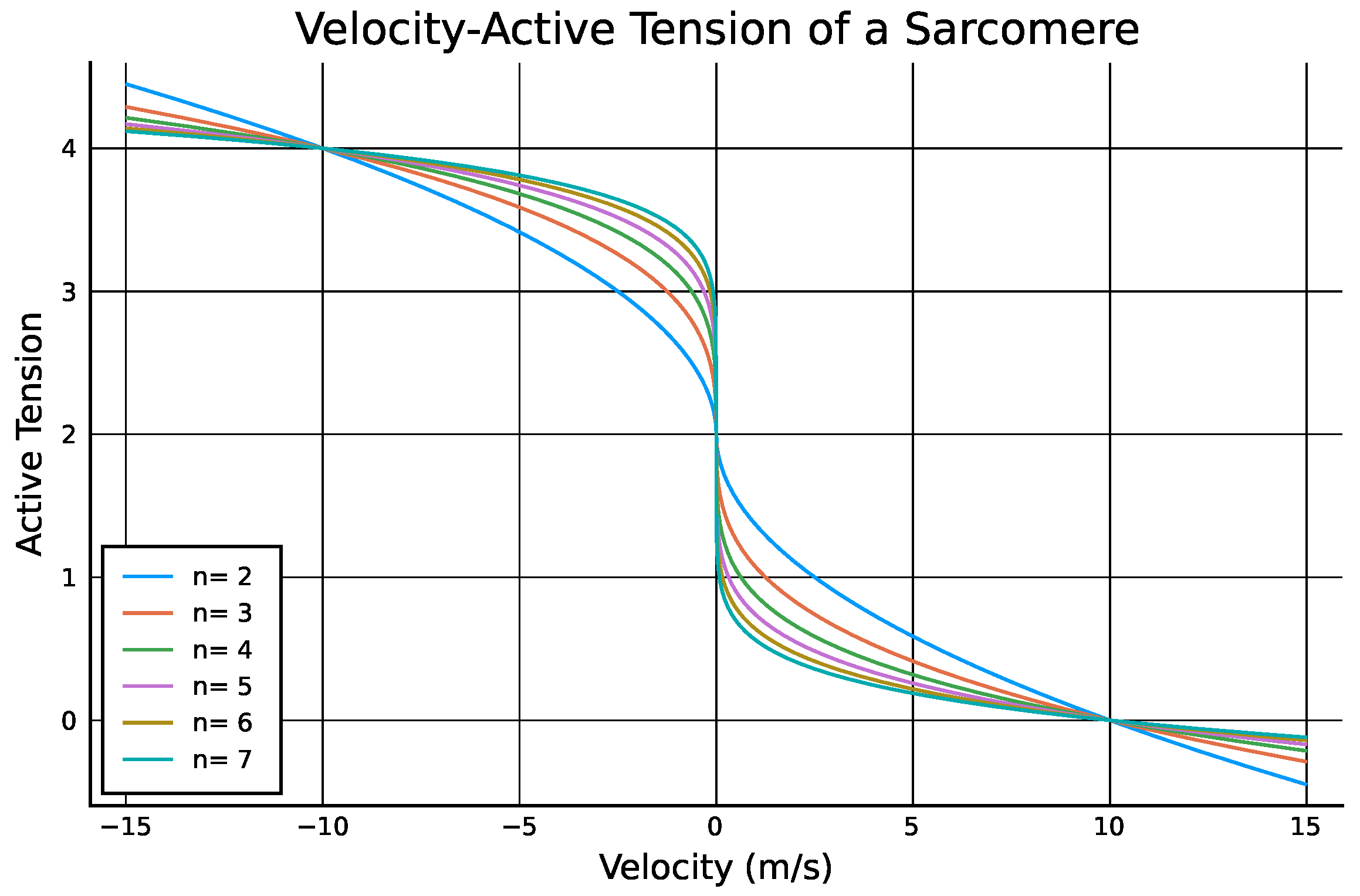
Motivated by the qualitative symmetry of the tension–velocity curve around the isometric point (zero velocity), we introduce a simple analytic expression that captures the essential behavior of active tension for concentric, eccentric, and isometric contractions. Let v R denote the velocity of change of muscle (or actuator) length, with the convention that v > 0 corresponds to concentric (shortening) contraction, v < 0 corresponds to eccentric (lengthening) contraction, and v = 0 corresponds to isometric contraction. We denote by f v ( v ) the active tension as a function of the contraction velocity and define
f v ( v ) = f iso C v 1 / n , v 0 , f iso + C ( v ) 1 / n , v < 0 ,
where f iso R + is the active tension produced during an isometric contraction (the intersection of the curve with the vertical axis), C R + is a scaling coefficient, and n Z + controls the shape (curvature) of the relation. The exponent 1 / n ensures that f v ( v ) is continuous at v = 0 , with
f v ( 0 ) = f iso ,
and produces a nonlinear, concave-like dependence of tension on velocity on both the concentric and eccentric sides. In (12), the velocity satisfies v R and the shape parameter satisfies n Z + . The expression is real-valued because v 1 / n is only evaluated for v 0 , and for v < 0 , the fractional power is applied to ( v ) > 0 , i.e., ( v ) 1 / n . We noted that physiological muscle behavior is generally asymmetric between concentric (shortening) and eccentric (lengthening) contractions. The symmetric form was used here as a first-order approximation to keep the model compact and identification-friendly for muscle-inspired soft robotic actuators. Extending the velocity term to use distinct concentric/eccentric parameterizations is a straightforward refinement and was left for future work.
Regularity at the isometric point. To avoid a non-finite slope at the isometric point v = 0 that can arise in piecewise power-law terms, we used a smooth regularization in a small neighborhood of v = 0 by replacing sgn ( v ) | v | α with
ϕ ε ( v ) = v v 2 + ε 2 α 1 2 ,
where ε > 0 is small. This choice satisfied ϕ ε ( v ) sgn ( v ) | v | α for | v | ε while ensuring ϕ ε C 1 at v = 0 and a finite derivative ϕ ε ( 0 ) = ε α 1 .
On the concentric side ( v 0 ), (12) prescribes a monotonic decrease of active tension from the isometric value f iso toward lower values as the shortening velocity v increases. This reflects the physiological observation that a muscle can shorten quickly only against relatively small loads: as the load (and thus required tension) increases, the shortening velocity decreases, and in the limit of very large loads, the muscle approaches an isometric contraction with v 0 . On the eccentric side ( v < 0 ), (12) yields an increase of active tension above f iso as the magnitude of the lengthening velocity | v | grows, in agreement with experimental evidence that muscles can resist larger loads while being stretched than they can generate while shortening. Thus, the same functional form, with opposite signs for v and v , captures both branches in a symmetric way around the isometric point.
A practical advantage of the model (12) is that its parameters can be directly related to measurable quantities. Suppose that from experiment we know the isometric active tension f iso and the maximum concentric shortening velocity v max R + , defined as the velocity at which the active tension drops to zero. On the concentric branch, the condition f v ( v max ) = 0 yields
f v ( v max ) = f iso C v max 1 / n = 0 ,
from which we solve for the scaling coefficient C as
C = f iso v max 1 / n R + .
Thus, once f iso , v max , and the shape parameter n are specified or estimated from data, the coefficient C is uniquely determined, and the full tension–velocity curve (12) is fixed.
The resulting relation is illustrated in Figure 5. On the right-hand side ( v 0 ), the concentric branch decreases from f iso at v = 0 to zero at v = v max . On the left-hand side ( v < 0 ), the eccentric branch rises above f iso as | v | increases, reflecting the higher tensions that can be sustained during controlled lengthening contractions. The point ( 0 ,   f iso ) corresponds to the isometric contraction, and the overall curve is qualitatively symmetric about this point, consistent with the schematic physiological tension–velocity relation discussed in Section 4.1.

5. Total Tension Model

The previous sections introduced separate models for the passive tension–length relation (1), the active tension–length relation based on sums of Gaussians (3), and the tension–velocity relation (12). In classical muscle mechanics, the total muscle tension is modeled as the sum of a passive component, arising from elastic elements in parallel with the contractile machinery, and an active component, generated by actin–myosin cross-bridges when the muscle is stimulated. We adopt this viewpoint and combine the three ingredients into a single expression for the total tension as a function of muscle length, contraction velocity, and activation.
As in the passive and active tension models, let x R + denote the current muscle (or actuator) length and v R denote the velocity of change of that length, with v > 0 corresponding to concentric (shortening) contraction, v < 0 to eccentric (lengthening) contraction, and v = 0 to isometric contraction. Let u [ 0 , 1 ] be a dimensionless activation level, where u = 0 represents a fully relaxed muscle and u = 1 a fully activated muscle. The passive tension T p ( x ) is given by the exponential model (1), whereas the Gaussian-based function f ( x ; σ , δ k , a k , b k ) in (3) describes the bell-shaped dependence of active tension on length, and the function f v ( v ) in (12) encodes the dependence of active tension on contraction velocity. For convenience, we introduce normalized length- and velocity-dependent factors. First, we define a dimensionless length factor
f L ( x ) f ( x ; σ , δ k , a k , b k ) max ξ L opt f ( ξ ; σ , δ k , a k , b k ) ,
so that f L ( x ) 1 on the optimal length interval L opt and decays smoothly toward zero at very short and very long lengths. In other words, f L ( x ) is the normalized active tension–length shape, with f L ( x opt ) = 1 at the optimal length x opt , and f ( x ; σ , δ k , a k , b k ) can be interpreted as the active tension at zero velocity as a function of length (under full activation). Second, we normalize the tension–velocity relation by the isometric active tension f iso and define
g ( v ) f v ( v ) f iso ,
for f v given by (12). Here f v ( v ) represents the active tension at optimal length as a function of velocity (again under full activation), while g ( v ) is the corresponding dimensionless tension–velocity factor. By construction, g ( 0 ) = 1 , g ( v ) < 1 for concentric contractions with v > 0 , and g ( v ) > 1 for eccentric contractions with v < 0 , reflecting the reduced concentric and enhanced eccentric tensions relative to the isometric case. The scalar f iso R + is the same quantity used in (12): it denotes the active tension produced during an isometric contraction at optimal length and full activation ( x = x opt , v = 0 , u = 1 ). Thus, f iso is a constant reference force that provides a common scale for both the length-dependent factor f L ( x ) and the velocity-dependent factor g ( v ) .
The active component of muscle tension is then modeled as
T a ( x , v , u ) = u f iso f L ( x ) g ( v ) .
At optimal length x L opt and zero velocity v = 0 , we have f L ( x ) 1 and g ( 0 ) = 1 , so (16) reduces to T a u f iso , as expected for an isometric contraction with activation level u. This multiplicative structure reflects the fact that sarcomere length and contraction velocity modulate the same underlying cross-bridge mechanism. The activation level u specifies how “on” the muscle is, f L ( x ) describes how the current length helps or impairs force generation relative to the optimal length, and g ( v ) describes how the current velocity scales tension relative to the isometric condition. Modeling these effects as multiplicative factors acting on a single reference tension scale f iso is suggested here, whereas an additive combination of separate “length” and “velocity” tension terms would incorrectly suggest independent tension contributions from length and velocity, which is not supported by cross-bridge physiology.
Finally, the total muscle tension is expressed as the sum of passive and active contributions,
T tot ( x , v , u ) = T p ( x ) + T a ( x , v , u ) ,
where T p ( x ) is given by (1) and T a ( x , v , u ) by (16). Equation (17) provides a compact, analytically tractable representation of the full muscle tension that can be directly embedded in dynamic models of biological muscles or muscle-inspired soft actuators, with passive tension capturing elastic resistance to stretch and active tension capturing the combined effects of activation, sarcomere length, and contraction velocity. We can embed the proposed formulation in a muscle-inspired soft actuator by using the total tension T tot ( l , l ˙ ) as the actuation force in an actuator/load dynamics, e.g.,
m l ¨ + c l ˙ + k ( l l 0 ) = T tot ( l , l ˙ ) F ext ,
where l denotes the actuator length (or contraction coordinate), and F ext represents an external load. This template applies directly to muscle-inspired tensile actuation architectures in which a calibrated mapping from ( l , l ˙ ) to generated tension is required for actuator-level modeling and control.

6. Conclusions

In this work, we developed an analytically tractable framework for modeling the tensions generated by biological muscles and muscle-inspired soft actuators. The formulation separates the total tension into passive and active components and incorporates the dependence of active tension on both muscle length and contraction velocity, with the aim of providing models that are physiologically meaningful yet simple enough for use in robotic actuation.
For the passive component, we adopted an exponential tension–length relation with a threshold (slack) length. This model reproduces the experimentally observed behavior of passive tension: it is negligible below the slack length, then increases monotonically and convexly as the muscle or actuator is stretched, with parameters that can be tuned to represent tissues or materials of different stiffness.
For the active component, we proposed a Gaussian-based length–tension model constructed as a least-squares approximation of an ideal characteristic function over the optimal length interval. The resulting sum of Gaussians yields a smooth bell-shaped curve with a flat plateau over the optimal length range and smooth decay at very short and very long lengths. Closed-form expressions for the relevant integrals enable efficient parameter identification and make the model more robust to sparse or noisy experimental data than high-degree polynomial fits, while remaining compact and analytic. The dependence of active tension on contraction velocity was captured by a simple piecewise analytic relation that is symmetric around the isometric point. With a small number of interpretable parameters (isometric tension, maximum concentric velocity, a shape exponent, and a derived scaling factor), this model reproduces the key qualitative features of the classical concentric and eccentric branches of the tension–velocity curve.
These ingredients were then combined into a unified total tension model in which the active component is expressed as a product of activation level, a normalized length-dependent factor, and a normalized velocity-dependent factor, all scaled by a single reference isometric tension. This multiplicative structure reflects the way sarcomere length and contraction velocity modulate the same underlying cross-bridge mechanism, while the total tension is obtained as the sum of this active contribution and the passive exponential response. The resulting expression provides a compact, smooth, and physiologically interpretable description of the full muscle tension as a function of length, velocity, and activation.
Taken together, the exponential passive model, the Gaussian-based active length–tension model, the analytic tension–velocity relation, and the combined total tension formulation provide a cohesive and flexible framework for representing muscle-like actuators. These smooth, low-dimensional models in closed form are well suited for integration into dynamic models of musculoskeletal systems and soft robotic devices. A comprehensive quantitative validation and benchmarking against experimental datasets and established muscle models was beyond the scope of the present manuscript and was left for future work. Future work will focus on systematic parameter identification from experimental datasets, incorporation of activation dynamics and history effects, and coupling with continuum-mechanics-based models for control and motion-planning applications in soft robotics.


Funding

This research received no external funding.

Institutional Review Board Statement

Not applicable.

Informed Consent Statement

Not applicable.

Data Availability Statement

The original contributions presented in this study are included in the article. Further inquiries can be directed to the corresponding author.

Acknowledgments

The author confirms that all scientific ideas, mathematical formulations, derivations, figures, and interpretations presented in this manuscript are original and were developed by the author. An AI language model (ChatGPT, OpenAI 5.2) was used solely to improve the clarity and readability of the English text, including rephrasing sentences and editing grammar and style. No scientific content, data, analyses, or conclusions were generated by the AI system, and the author takes full responsibility for all aspects of the manuscript.

Conflicts of Interest

The author declares no conflicts of interest.

Abbreviations

The following abbreviations are used in this manuscript:
TCAMTwisted and Coiled Artificial Muscle
FEMFinite Element Method
FSIFluid–Structure Interaction

Appendix A. Closed-Form Relation for the Integral of the Product of Two Gaussians over R n

Here, the details of the derivation of the closed-form relation for the integral of the product of two Gaussians over R n ,
R n ψ 1 ( x ; Σ 1 , δ 1 ) ψ 2 ( x ; Σ 2 , δ 2 ) d x ,
in [28], are worked out comprehensively, in order to compute the first three terms in (8) for n = 1 .
R n ψ 1 ( x ; δ 1 , Σ 1 ) ψ 2 ( x ; δ 2 , Σ 2 ) d x = 1 ( 2 π ) n det ( Σ 1 ) det ( Σ 2 ) 1 / 2 R n exp 1 2 ( x δ 1 ) Σ 1 1 ( x δ 1 ) × exp 1 2 ( x δ 2 ) Σ 2 1 ( x δ 2 ) d x .
Now focus on the integration term:
R n exp 1 2 ( x δ 1 ) Σ 1 1 ( x δ 1 ) + ( x δ 2 ) Σ 2 1 ( x δ 2 ) d x = R n exp { 1 2 [ x Σ 1 1 x x Σ 1 1 δ 1 δ 1 Σ 1 1 x + δ 1 Σ 1 1 δ 1 + x Σ 2 1 x x Σ 2 1 δ 2 δ 2 Σ 2 1 x + δ 2 Σ 2 1 δ 2 ] } d x .
Because x ( Σ i 1 δ i ) is a scalar, we have x ( Σ i 1 δ i ) = ( Σ i 1 δ i ) x . Collecting terms and using the symmetry of Σ i 1 , we obtain
R n exp 1 2 x M x + m x C d x ,
where
M Σ 1 1 + Σ 2 1 , m Σ 1 1 δ 1 + Σ 2 1 δ 2 ,
and
C 1 2 δ 1 Σ 1 1 δ 1 + δ 2 Σ 2 1 δ 2 .
Using (2.32) in [27],
R n exp 1 2 x M x + m x C d x = ( 2 π ) n / 2 det ( M ) 1 / 2 exp 1 2 m M 1 m C .
Thus
R n ψ 1 ( x ; δ 1 , Σ 1 ) ψ 2 ( x ; δ 2 , Σ 2 ) d x = ( 2 π ) n / 2 det ( Σ 1 1 + Σ 2 1 ) 1 / 2 ( 2 π ) n det ( Σ 1 ) det ( Σ 2 ) 1 / 2 × exp [ 1 2 δ 1 Σ 1 1 + δ 2 Σ 2 1 ( Σ 1 1 + Σ 2 1 ) 1 ( Σ 1 1 δ 1 + Σ 2 1 δ 2 ) 1 2 δ 1 Σ 1 1 δ 1 + δ 2 Σ 2 1 δ 2 ] .
Finally,
R n ψ 1 ( x ; δ 1 , Σ 1 ) ψ 2 ( x ; δ 2 , Σ 2 ) d x = 1 ( 2 π ) n / 2 det ( Σ 1 ) det ( Σ 2 ) det ( Σ 1 1 + Σ 2 1 ) 1 / 2 × exp [ 1 2 δ 1 Σ 1 1 + δ 2 Σ 2 1 ( Σ 1 1 + Σ 2 1 ) 1 ( Σ 1 1 δ 1 + Σ 2 1 δ 2 ) 1 2 δ 1 Σ 1 1 δ 1 + δ 2 Σ 2 1 δ 2 ] .

Appendix A.1. Computation of (9)

To use (A5) to compute (9) (and (10)), we first rewrite the Gaussian function (4) in standard one-dimensional form:
ψ k ( x ; σ , δ k , a k , b k ) = a k ( 2 π | σ | ) 1 / 2 exp b k 2 σ ( x δ k ) 2 = a k | b k | 1 / 2 1 2 π | σ b k | 1 / 2 exp 1 2 σ b k 1 ( x δ k ) 2 ,
where a k R , b k R + , and σ b k 1 b k σ 1 R + .
Now (A6) is in the standard Gaussian form, so we can use (A5) with n = 1 :
R ψ 1 ( x ; σ , δ 1 , a 1 , b 1 ) ψ 2 ( x ; σ , δ 2 , a 2 , b 2 ) d x = a 1 a 2 | b 1 b 2 | 1 / 2 1 ( 2 π ) 1 / 2 ( b 1 1 σ ) ( b 2 1 σ ) ( b 1 / σ + b 2 / σ ) 1 / 2 = × exp [ 1 2 ( δ 1 b 1 σ 1 + δ 2 b 2 σ 1 ) ( b 1 σ 1 + b 2 σ 1 ) 1 ( b 1 σ 1 δ 1 + b 2 σ 1 δ 2 ) 1 2 ( δ 1 2 b 1 σ 1 + δ 2 2 b 2 σ 1 ) ] .
This simplifies to
R ψ 1 ( x ; σ , δ 1 , a 1 , b 1 ) ψ 2 ( x ; σ , δ 2 , a 2 , b 2 ) d x = a 1 a 2 ( 2 π | σ ( b 1 + b 2 ) | ) 1 / 2 exp ( δ 1 b 1 + δ 2 b 2 ) 2 2 σ ( b 1 + b 2 ) δ 1 2 b 1 + δ 2 2 b 2 2 σ ,
where a k R and b k R + . Since σ , b 1 , b 2 R + , (A8) can be simplified further, but we leave it in this form.

Appendix A.2. Computation of (10)

Setting ψ 1 = ψ 2 in (A8) yields (10):
R ψ k 2 ( x ; σ , δ k , a k , b k ) d x = a k 2 ( 2 π | 2 b k σ | ) 1 / 2 exp ( 2 δ k b k ) 2 2 σ ( 2 b k ) 2 δ k 2 b k 2 σ = a k 2 2 ( π | b k σ | ) 1 / 2 exp ( δ k b k ) 2 σ b k δ k 2 b k σ .
Therefore,
R ψ k 2 ( x ; σ , δ k , a k , b k ) d x = a k 2 2 ( π | b k σ | ) 1 / 2 exp ( δ k b k ) 2 σ b k δ k 2 b k σ ,
for k { 1 , 2 } . Again, since σ , b 1 , b 2 R + , one can simplify (A10) further, but we keep this form.

Appendix A.3. Computation of (11)

Here, (11) is worked out in detail. Using (4),
L opt ψ k ( x ; σ , δ k , a k , b k ) d x = 1 2 a k ( 2 π | σ | ) 1 / 2 exp b k 2 σ ( x δ k ) 2 d x .
Let
y b k 2 σ 1 / 2 ( x δ k ) , d y = b k 2 σ 1 / 2 d x , d x = 2 σ b k 1 / 2 d y .
Then
x = 1 y = b k 2 σ 1 / 2 ( 1 δ k ) , x = 2 y = b k 2 σ 1 / 2 ( 2 δ k ) .
Thus, (A11) becomes
= a k ( 2 π | σ | ) 1 / 2 y = b k 2 σ 1 / 2 ( 1 δ k ) y = b k 2 σ 1 / 2 ( 2 δ k ) exp ( y 2 ) 2 σ b k 1 / 2 d y = a k ( 2 π | σ | ) 1 / 2 2 σ b k 1 / 2 0 b k 2 σ 1 / 2 ( 2 δ k ) exp ( y 2 ) d y 0 b k 2 σ 1 / 2 ( 1 δ k ) exp ( y 2 ) d y .
Since σ R + , we have | σ | = σ . Using the standard relation
0 b f ( x ) d x = 0 a f ( x ) d x + a b f ( x ) d x a b f ( x ) d x = 0 b f ( x ) d x 0 a f ( x ) d x ,
and the definition of the error function
erf ( x ) = 2 π 0 x e t 2 d t ,
we can rewrite (A13) as
= a k π b k π 2 erf b k 2 σ 1 / 2 ( 2 δ k ) π 2 erf b k 2 σ 1 / 2 ( 1 δ k ) .
Therefore,
L opt ψ k ( x ; σ , δ k , a k , b k ) d x = a k 2 b k erf b k 2 σ 1 / 2 ( 2 δ k ) erf b k 2 σ 1 / 2 ( 1 δ k ) ,
where k { 1 , 2 } and L opt = [ 1 , 2 ] R .

References

  1. Trivedi, D.; Rahn, C.; Kier, W.; Walker, I. Soft robotics: Biological inspiration, state of the art, and future research. Appl. Bionics Biomech. 2008, 5, 99–117. [Google Scholar] [CrossRef]
  2. Rus, D.; Tolley, M.T. Design, fabrication and control of soft robots. Nature 2015, 521, 467–475. [Google Scholar] [CrossRef]
  3. Laschi, C.; Mazzolai, B.; Cianchetti, M. Soft robotics: Technologies and systems pushing the boundaries of robot abilities. Sci. Robot. 2016, 1, eaah3690. [Google Scholar] [CrossRef]
  4. Coyle, S.; Majidi, C.; Leduc, P.R.; Hsia, K.J. Bio-inspired soft robotics: Material selection, actuation, and design. Extrem. Mech. Lett. 2018, 22, 51–59. [Google Scholar] [CrossRef]
  5. Yaşa, Ö.; Toshimitsu, Y.; Michelis, M.Y.; Jones, L.; Filippi, M.; Buchner, T.; Katzschmann, R. An Overview of Soft Robotics. Annu. Rev. Control. Robot. Auton. Syst. 2022, 6, 1–29. [Google Scholar] [CrossRef]
  6. Yekutieli, Y.; Sagiv-Zohar, R.; Aharonov, R.; Engel, Y.; Hochner, B.; Flash, T. Dynamic Model of the Octopus Arm. I. Biomechanics of the Octopus Reaching Movement. J. Neurophysiol. 2005, 94, 1443–1458. [Google Scholar] [CrossRef] [PubMed]
  7. Kier, W.M.; Smith, K.K. Tongues, tentacles and trunks: The biomechanics of movement in muscular-hydrostats. Zool. J. Linn. Soc. 2008, 83, 307–324. [Google Scholar] [CrossRef]
  8. William, M.K. Hydrostatic skeletons and muscular hydrostats. In Biomechanics (Structures and Systems): A Practical Approach; IRL Press at Oxford University Press: Oxford, UK, 1992; pp. 205–231. [Google Scholar]
  9. Polygerinos, P.; Wang, Z.; Galloway, K.C.; Wood, R.J.; Walsh, C. Soft Robotic Glove for Combined Assistance and at-Home Rehabilitation. Robot. Auton. Syst. 2015, 73, 135–143. [Google Scholar] [CrossRef]
  10. Gordon, A.M.; Huxley, A.F.; Julian, F.J. The variation in isometric tension with sarcomere length in vertebrate muscle fibres. J. Physiol. 1966, 184, 170–192. [Google Scholar] [CrossRef] [PubMed]
  11. Hill, A.V. The heat of shortening and the dynamic constants of muscle. Proc. R. Soc. London. Ser. B Biol. Sci. 1938, 126, 136–195. [Google Scholar] [CrossRef]
  12. Zajac, F.E. Muscle and tendon: Properties, models, scaling, and application to biomechanics and motor control. Crit. Rev. Biomed. Eng. 1989, 17, 359–411. [Google Scholar] [PubMed]
  13. Millard, M.; Uchida, T.; Seth, A.; Delp, S.L. Flexing computational muscle: Modeling and simulation of musculotendon dynamics. J. Biomech. Eng. 2013, 135, 021005. [Google Scholar] [CrossRef]
  14. Alcazar, J.; Csapo, R.; Ara, I.; Alegre, L.M. On the Shape of the Force-Velocity Relationship in Skeletal Muscles: The Linear, the Hyperbolic, and the Double-Hyperbolic. Front. Physiol. 2019, 10, 769. [Google Scholar] [CrossRef] [PubMed]
  15. Lamuta, C.; Messelot, S.; Tawfick, S. Theory of the tensile actuation of fiber reinforced coiled muscles. Smart Mater. Struct. 2018, 27, 055018. [Google Scholar] [CrossRef]
  16. Sun, J.; Zhao, J. Physics-Based Modeling of Twisted-and-Coiled Actuators Using Cosserat Rod Theory. IEEE Trans. Robot. 2022, 38, 779–796. [Google Scholar] [CrossRef]
  17. Weerakkody, T.H.; Hammond, M.; Neilan, J.H.; Cichella, V.; Lamuta, C. Modeling and control of twisted and coiled artificial muscles for soft robotics. Meccanica 2023, 58, 643–658. [Google Scholar] [CrossRef]
  18. Fahim Golestaneh, A.; Cichella, V.; Lamuta, C. Physics-based modeling of twisted and coiled artificial muscles (TCAMs) for soft robotics using extended Cosserat theory of rods. Smart Mater. Struct. 2025, 34, 045015. [Google Scholar] [CrossRef]
  19. Mallikarachchi, S.; Gunawardane, P.D.S.H.; Le, X.T.; Chiao, M.; Godage, I. Multimodal Soft Robotic Actuator Modeling and Validation. In Proceedings of the 2024 IEEE 7th International Conference on Soft Robotics (RoboSoft), San Diego, CA, USA, 14–17 April 2024; pp. 359–365. [Google Scholar]
  20. Le, X.T.; Gunawardane, P.D.S.H.; Mallikarachchi, S.; Chiao, M.; Godage, I. Hybrid Control of 3D-Printed Multimodal Soft Pneumatic Actuators. In Proceedings of the 2024 IEEE International Conference on Mechatronics and Automation (ICMA), Tianjin, China, 4–7 August 2024; pp. 1753–1758. [Google Scholar]
  21. Habibi, H.; Yang, C.; Kang, R.; Walker, I.D.; Godage, I.S.; Dong, X.; Branson, D.T. Modelling an Actuated Large Deformation Soft Continuum Robot Surface Undergoing External Forces Using a Lumped-Mass Approacb* Research supported by UK Engineering and Physical Sciences Research Council (EPSRC). In Proceedings of the 2018 IEEE/RSJ International Conference on Intelligent Robots and Systems (IROS), Madrid, Spain, 1–5 October 2018; pp. 5958–5963. [Google Scholar] [CrossRef]
  22. Must, I.; Sinibaldi, E.; Mazzolai, B. A variable-stiffness tendril-like soft robot based on reversible osmotic actuation. Nat. Commun. 2019, 10, 344. [Google Scholar] [CrossRef]
  23. Gunawardane, P.D.S.H.; Lee, D.; Cheung, P.; Zhou, H.; Alici, G.; Chiao, M. Configuration identification of on-demand variable stiffness strain-limiting layers in zig-zag soft pneumatic actuators using deep learning methods. Int. J. Robot. Res. 2025, 1–17. [Google Scholar] [CrossRef]
  24. Yang, Y.; Li, D.; Sun, Y.; Wu, M.; Su, J.; Li, Y.; Yu, X.; Li, L.; Yu, J. Muscle-inspired soft robots based on bilateral dielectric elastomer actuators. Microsyst. Nanoeng. 2023, 9, 124. [Google Scholar] [CrossRef]
  25. Milligan, B.; Curtin, N.; Bone, Q. Contractile properties of obliquely striated muscle from the mantle of squid (Alloteuthis subulata) and cuttlefish (Sepia officinalis). J. Exp. Biol. 1997, 200, 2425–2436. [Google Scholar] [CrossRef] [PubMed]
  26. Yu, S.N.; Crago, P.E.; Chiel, H.J. Biomechanical properties and a kinetic simulation model of the smooth muscle I2 in the buccal mass of Aplysia. Biol. Cybern. 1999, 81, 505–513. [Google Scholar] [CrossRef] [PubMed]
  27. Chirikjian, G. Stochastic Models, Information Theory, and Lie Groups; Springer: Berlin/Heidelberg, Germany, 2009; Volume 1. [Google Scholar]
  28. Yan, Y.; Chirikjian, G.S. A Gaussian Packing Model For Phasing in Macromolecular Crystallography. In Proceedings of the International Conference on Bioinformatics & Computational Biology (BIOCOMP), New Orleans, LA, USA, 23–25 March 2011. [Google Scholar]
  29. Lieber, R.L.; Fridén, J. Functional and clinical significance of skeletal muscle architecture. Muscle Nerve 2000, 23, 1647–1666. [Google Scholar] [CrossRef] [PubMed]
Figure 1. Schematic representation of passive, active, and total tensions in a muscle as a function of length, adapted from [6].
Robotics 15 00043 g001
Figure 2. Schematic active tension–length relation of a sarcomere, illustrating the optimal length region (plateau), the healthy (normal) operating length range, and the reduction in active tension at both excessively short and excessively long lengths.
Robotics 15 00043 g002
Figure 3. Illustration of the sum of two Gaussian functions (4). The resulting function f ( x ) in (3) exhibits a flat peak over an optimal length interval and decays smoothly toward zero at short and long lengths, similar to the physiological active tension–length relation.
Robotics 15 00043 g003
Figure 4. Schematic active tension–velocity relation. The horizontal axis is contraction velocity v and the vertical axis is active tension f v ( v ) . The isometric contraction occurs at v = 0 with f v ( 0 ) = f iso . Concentric (shortening) contractions correspond to v 0 and exhibit a decrease of active tension as v increases, while eccentric (lengthening) contractions correspond to v < 0 and exhibit an increase of active tension above f iso as | v | increases. This figure is illustrative and is included to indicate the sign convention and qualitative trends modeled in Section 4.
Robotics 15 00043 g004
Figure 5. Analytic tension–velocity relation given by (12). The curve passes through the isometric point at ( v ,   f v ) = ( 0 ,   f iso ) , decreases toward zero tension with increasing concentric (shortening) velocity v > 0 , and increases above f iso with increasing eccentric (lengthening) velocity v < 0 .
Robotics 15 00043 g005
Disclaimer/Publisher’s Note: The statements, opinions and data contained in all publications are solely those of the individual author(s) and contributor(s) and not of MDPI and/or the editor(s). MDPI and/or the editor(s) disclaim responsibility for any injury to people or property resulting from any ideas, methods, instructions or products referred to in the content.