
Development of an Autonomous Robot for Precision Floor Marking


Abstract
1. Introduction
1.1. Context and Gap
1.2. Contributions and Novelty
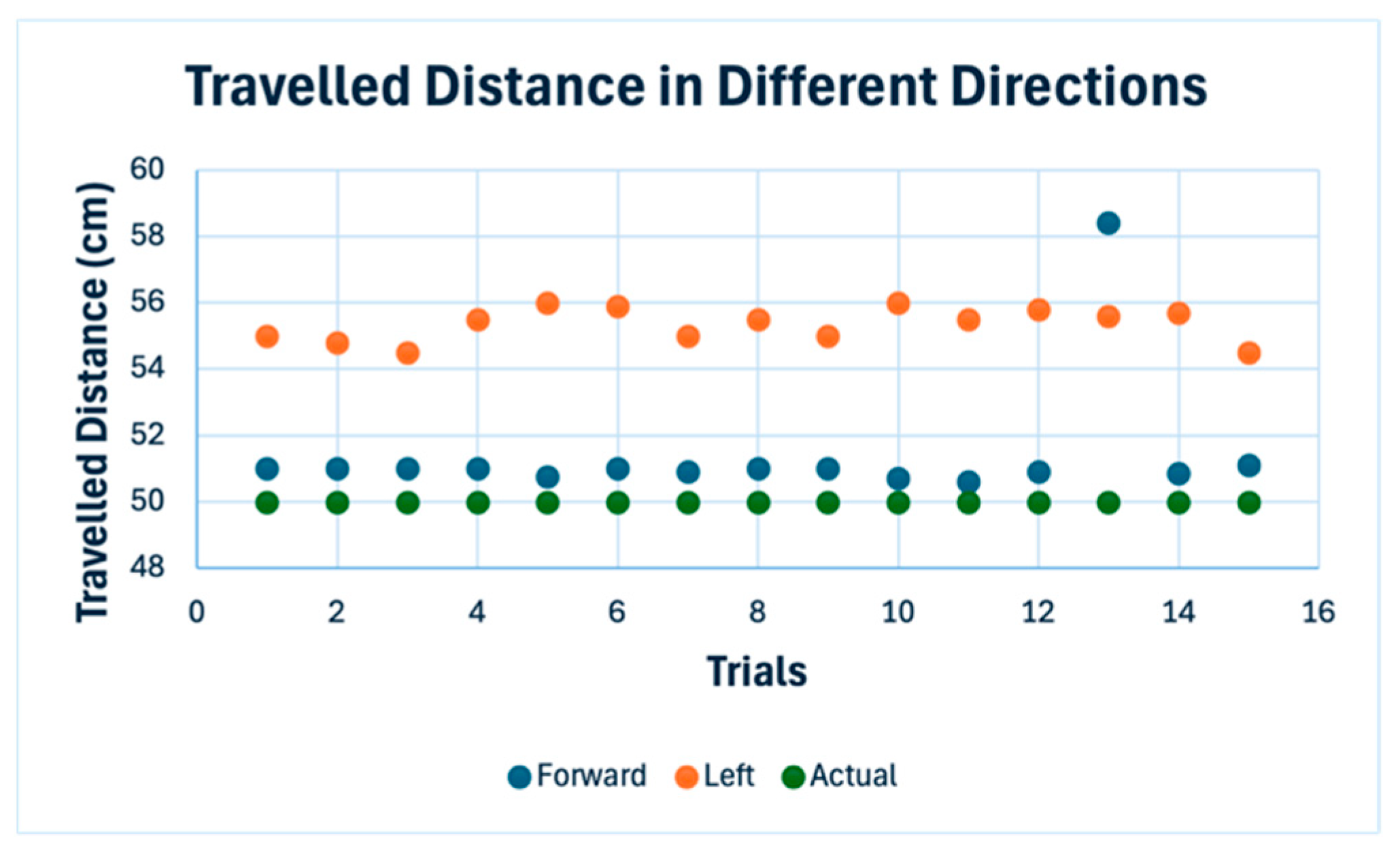
- Infrastructure-Independent Autonomous Localization: Unlike commercial systems such as HP SitePrint or Dusty Robotics, which require external total stations or beacons for positional correction, this work introduces a “zero-infrastructure” navigation framework. By utilizing solely onboard encoders and ultrasonic sensors, the robot achieves a localized precision of σ = 1.6 mm for forward motion and σ = 3 mm for lateral motion, which is sufficient for its intended application scope without expensive external hardware.
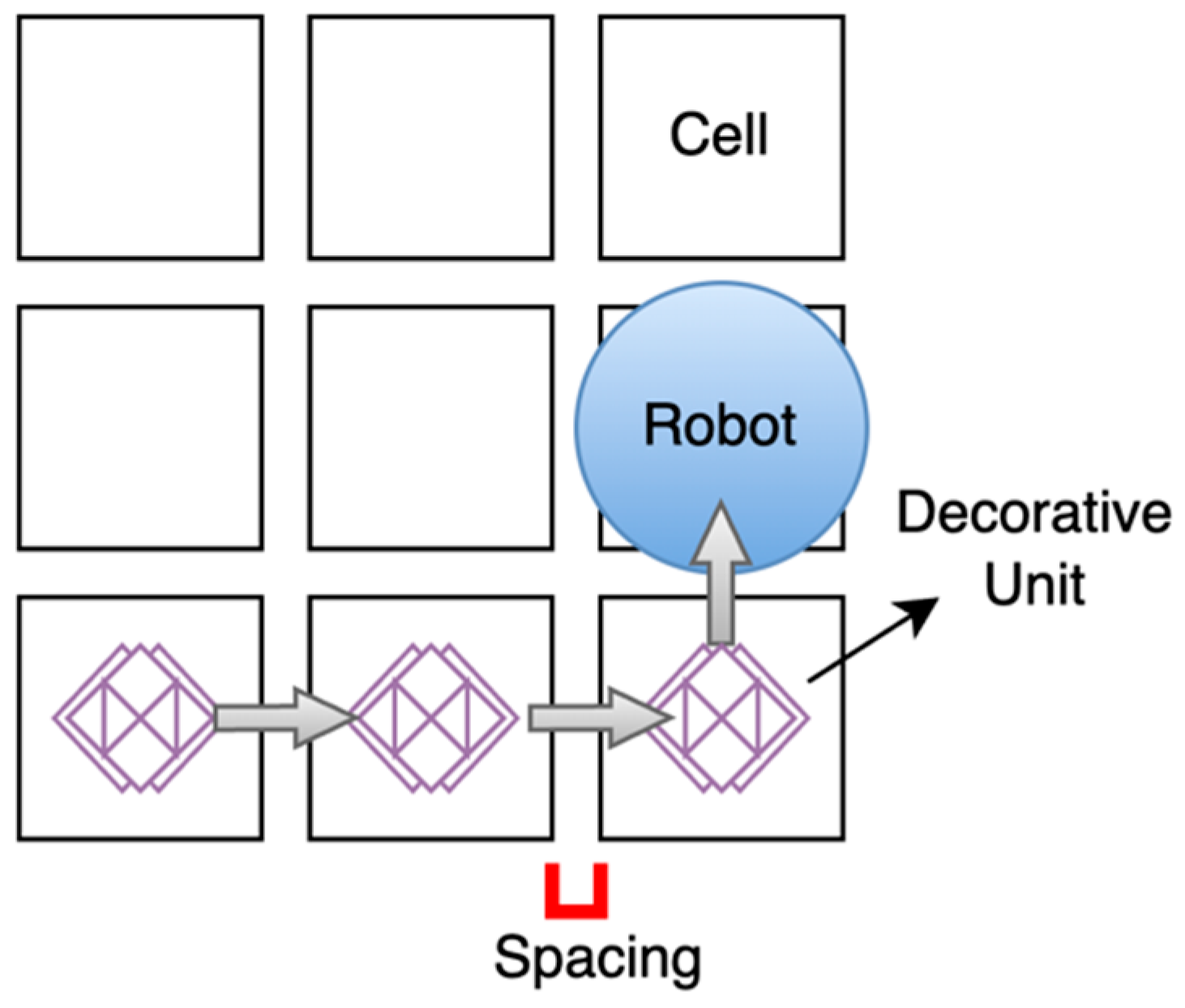
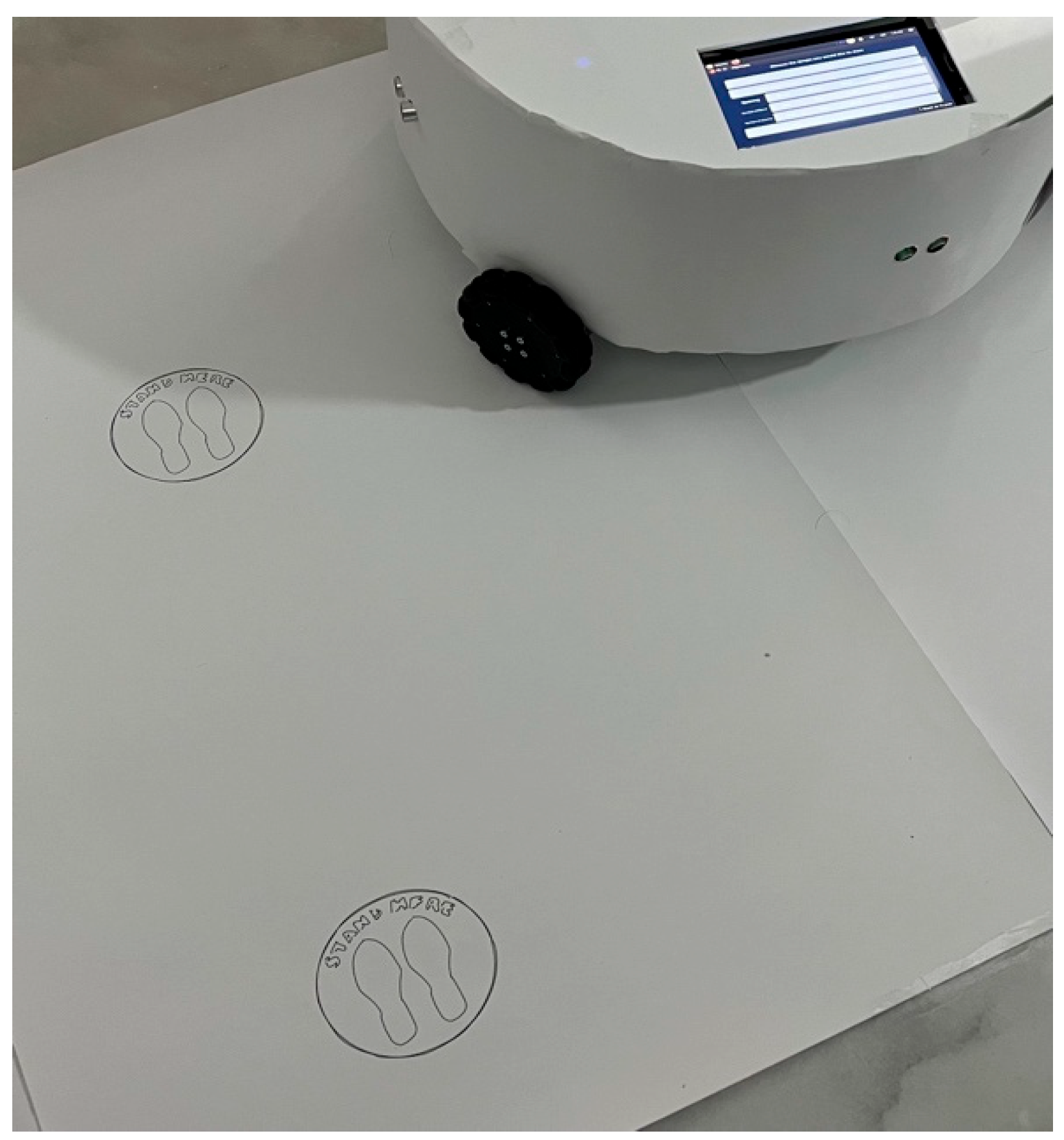
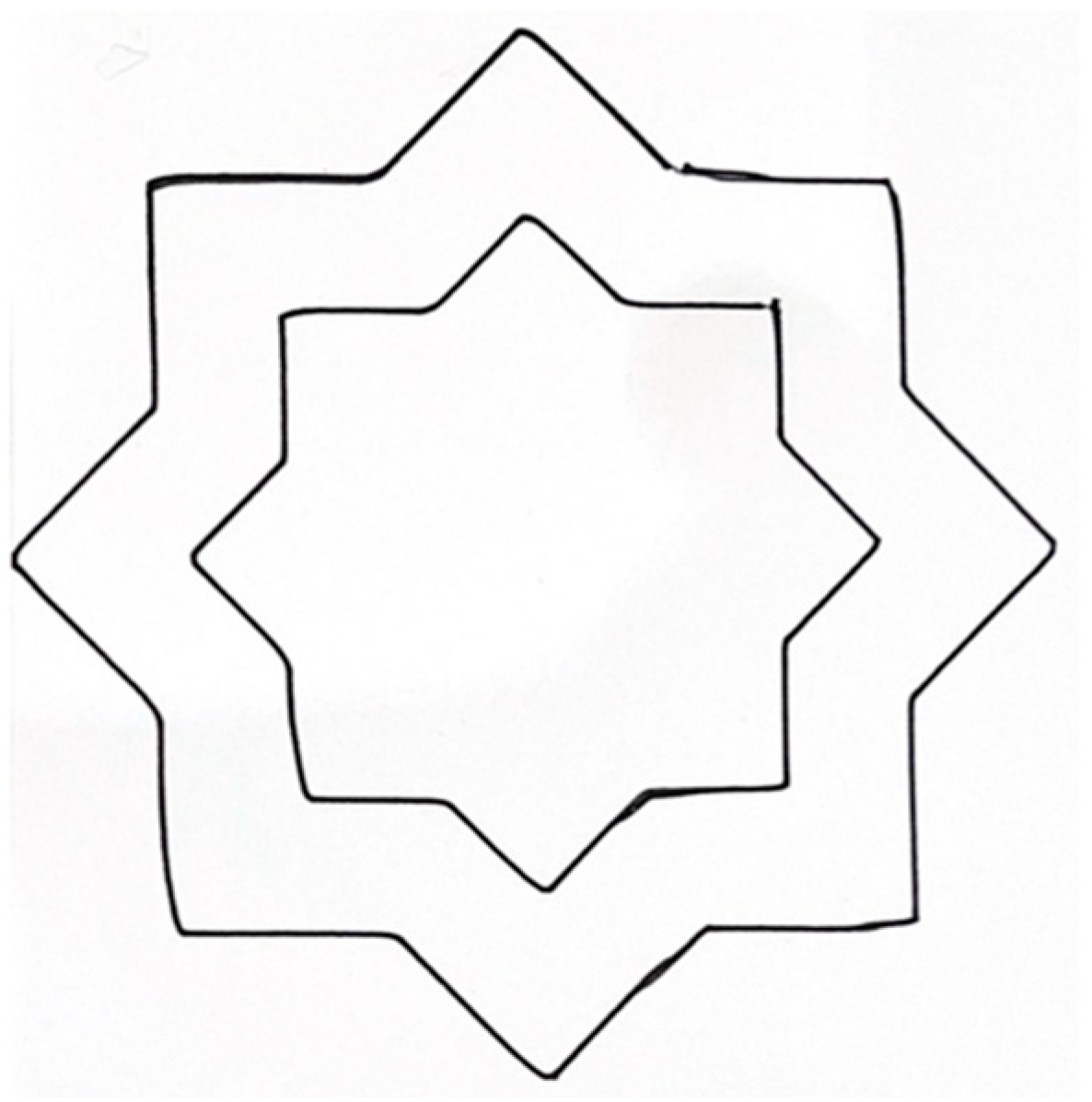
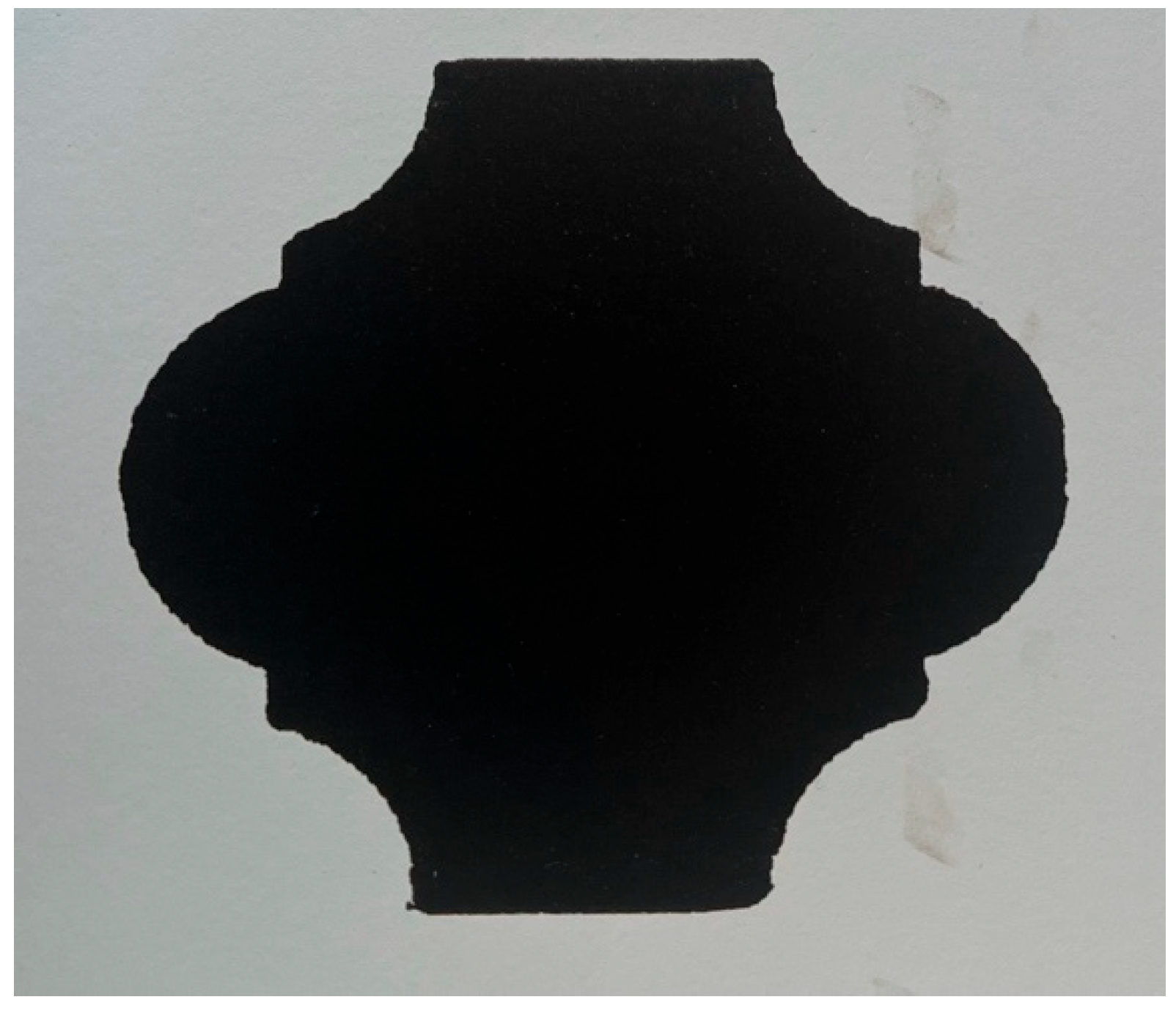
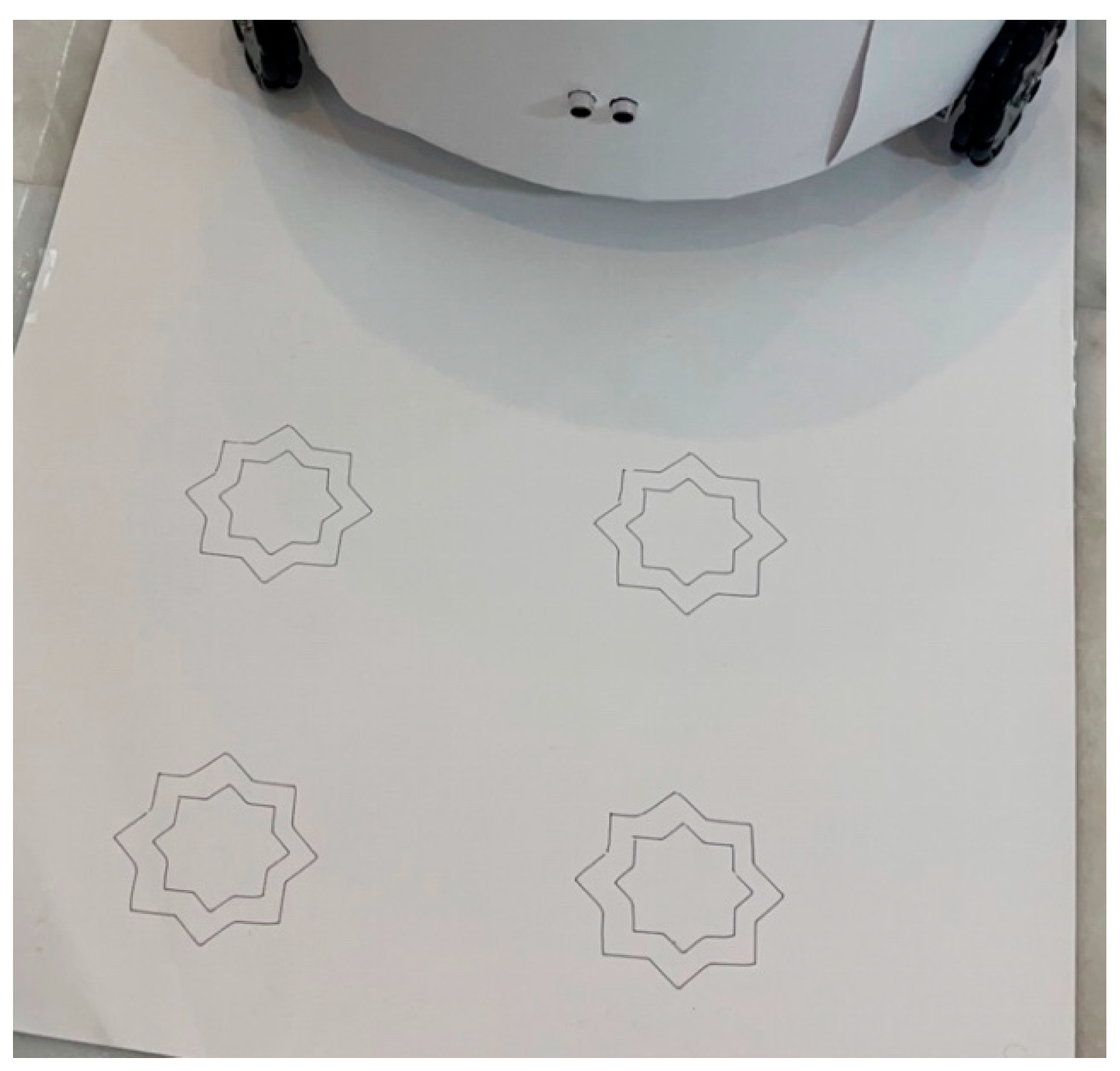
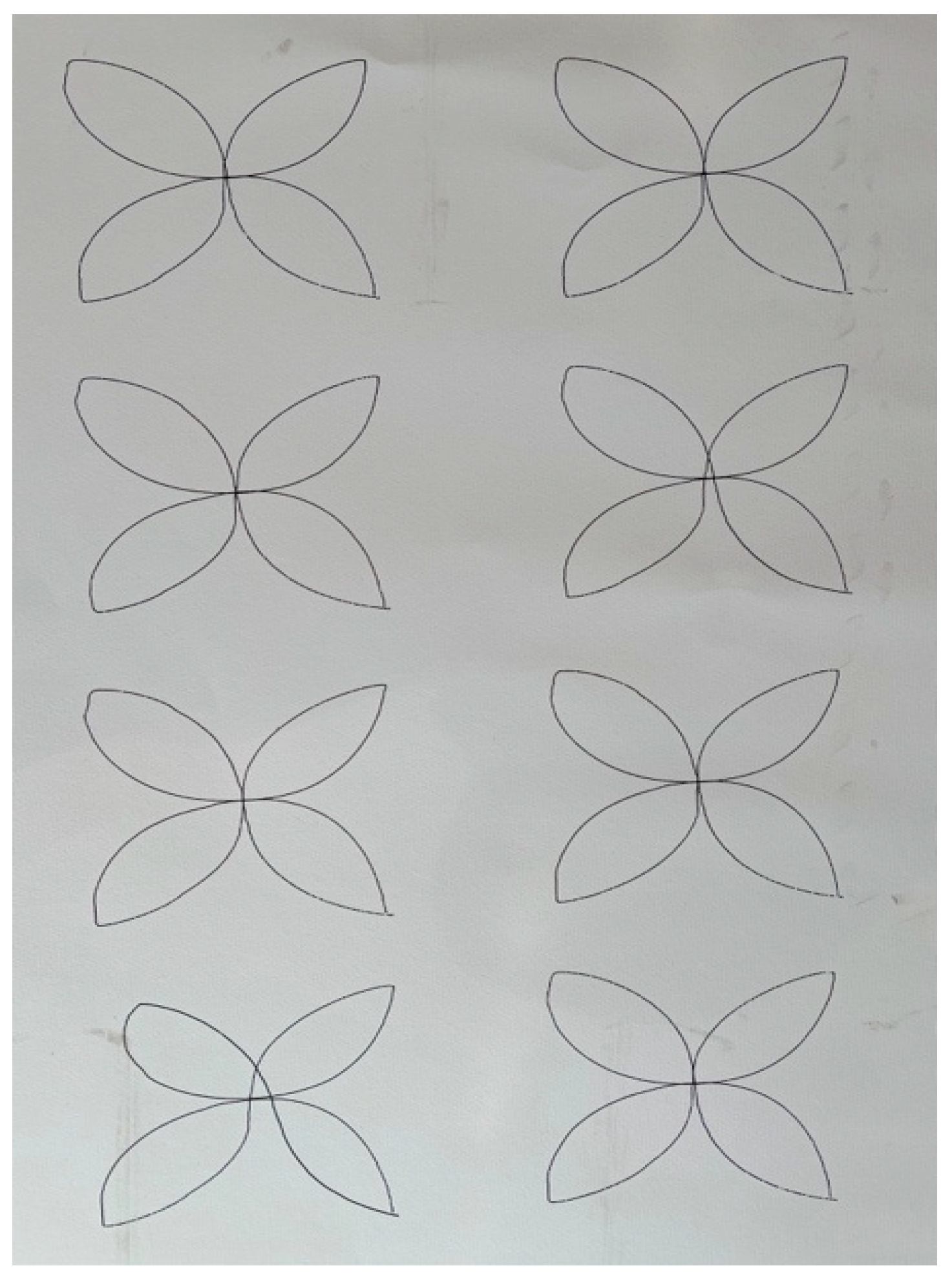
- Scalable Grid-Based Pattern Synthesis: Addressing the mechanical constraints of compact mobile plotters, this work implements a grid-based drawing strategy. By segmenting large designs into manageable cells, the platform can synthesize complex, large-format patterns while maintaining pattern continuity (as shown in Figure 1).
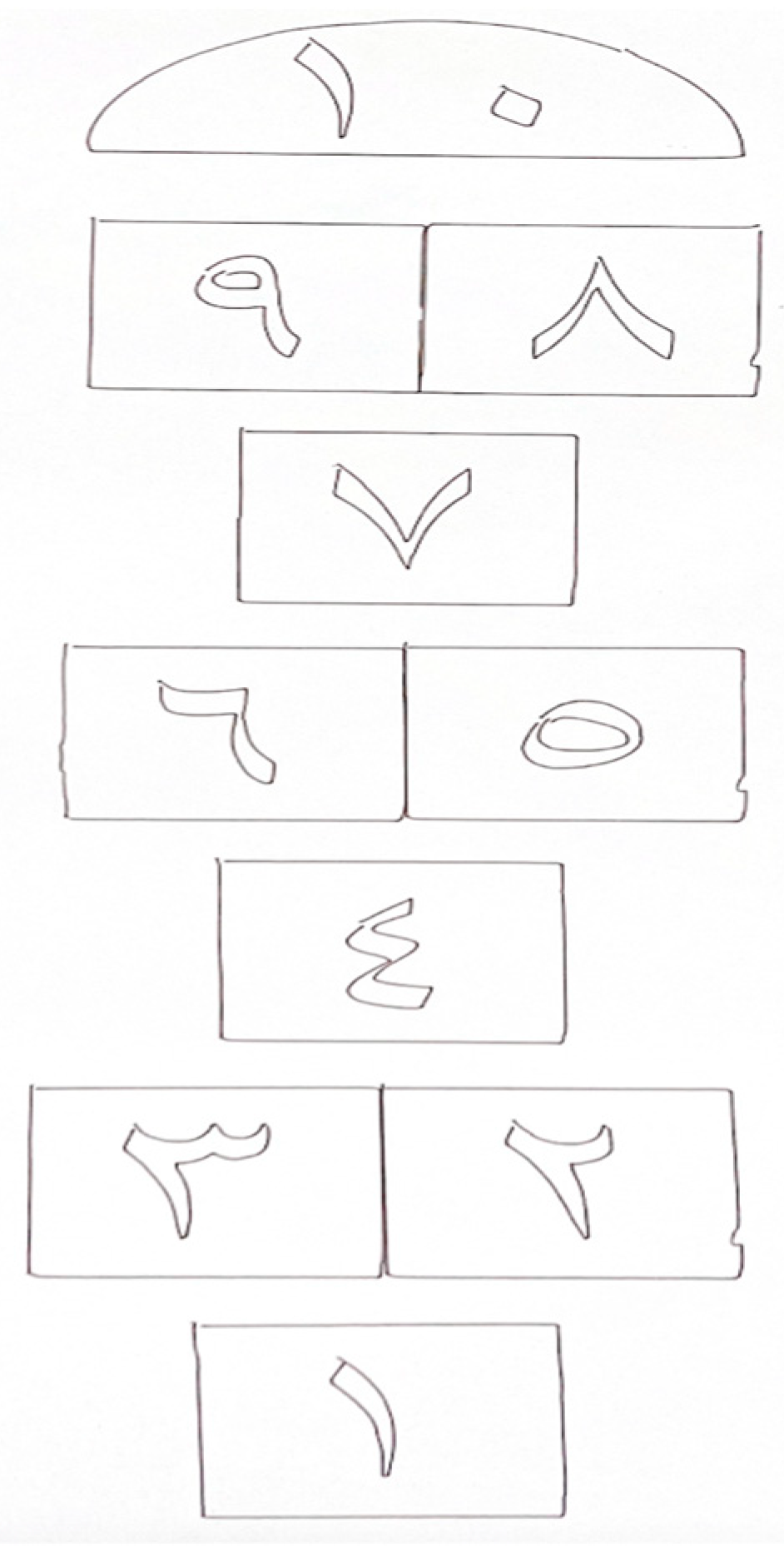
- CAD-Independent Marking Workflow for Non-Experts: While existing industrial robots rely on pre-loaded CAD files for operation, this system features an intuitive user interface that eliminates technical barriers. This facilitates rapid, on-site creation of intricate designs, such as educational floor games and themed signage, ideal for dynamic environments like schools and offices.
- Targeted Accuracy within a Cost-Effective Framework: The robot is constructed entirely from commercially available, low-cost components. We demonstrate that for the specific application of decorative and functional floor marking, the achieved precision provides a viable, affordable alternative to high-cost industrial-grade systems.
2. Materials and Methods
2.1. Mechanical and Electrical Architecture
2.1.1. Mobile Platform and Plotter
2.1.2. Actuation and Sensing
2.1.3. Power System
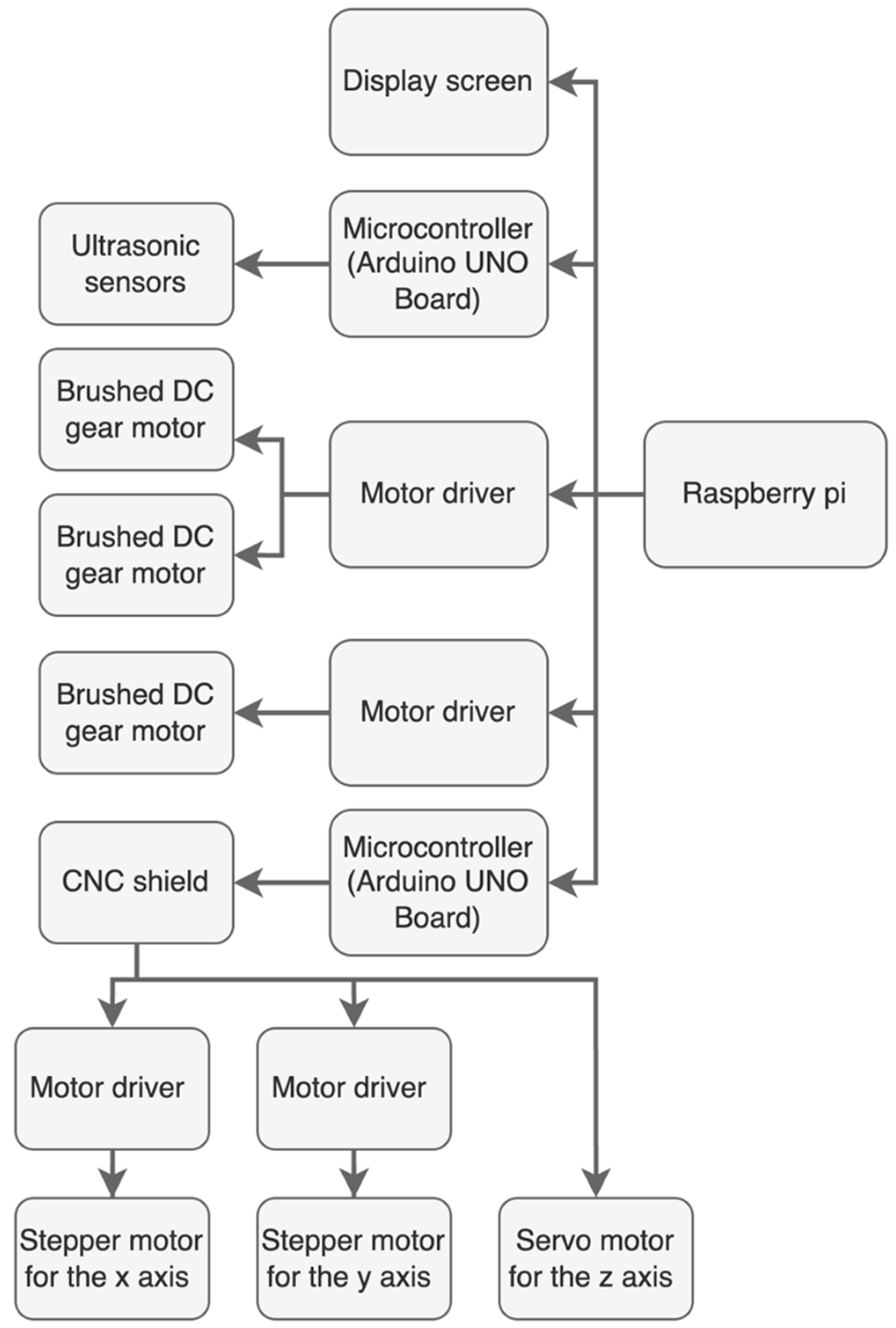
2.1.4. System Layout
2.2. Control and Navigation Framework
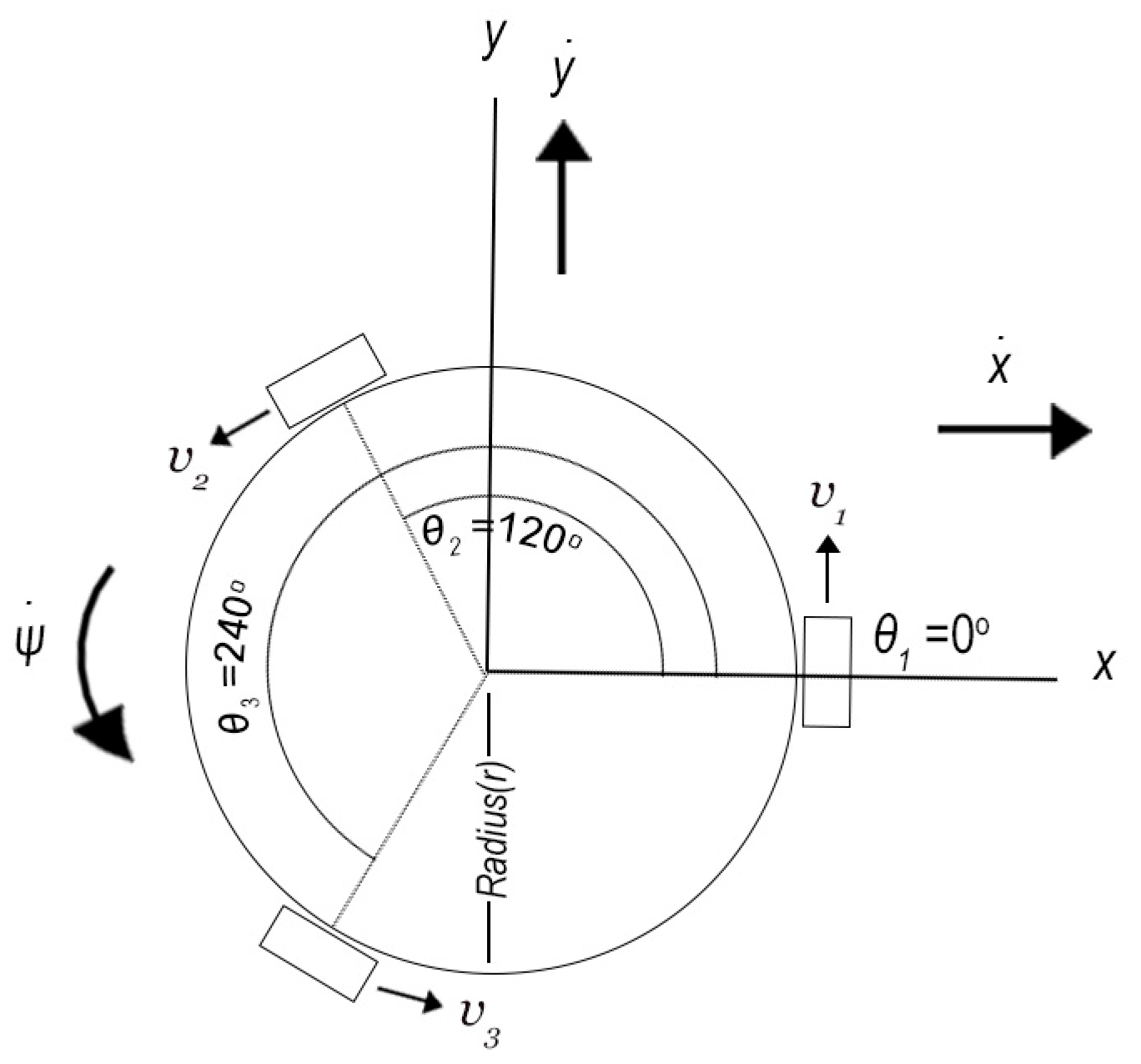
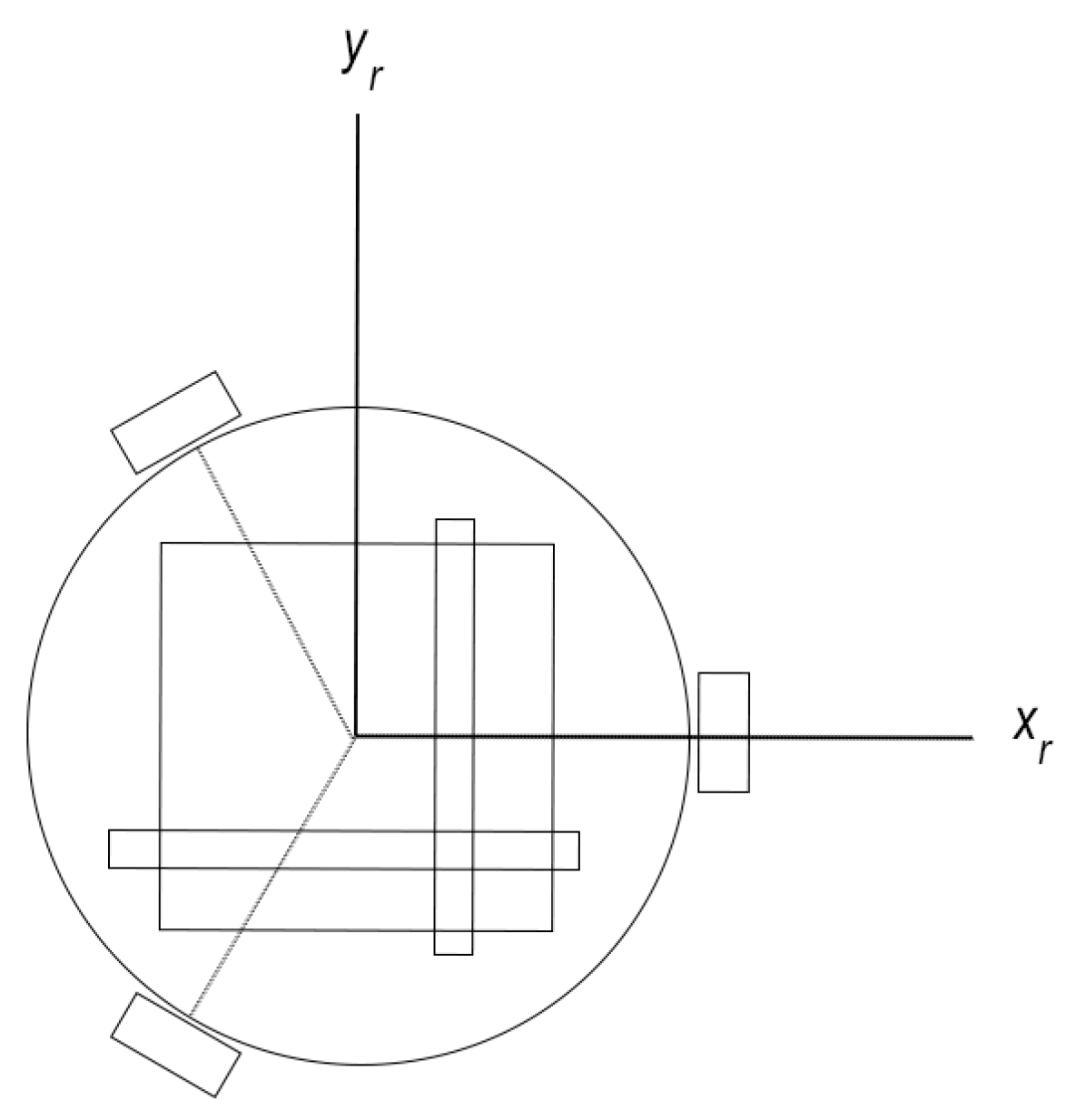
2.2.1. Omnidirectional Kinematic Model
2.2.2. Grid-Based Drawing Strategy
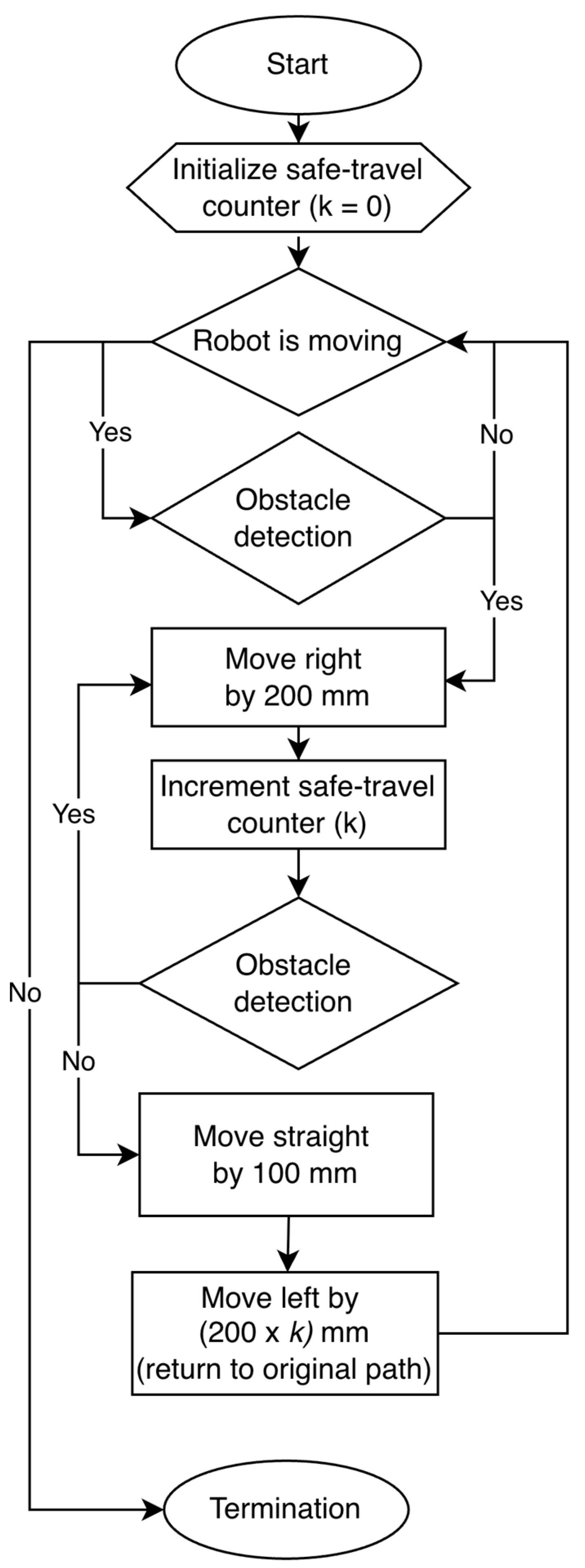
2.2.3. Autonomous Navigation and Obstacle Avoidance
2.3. Software Pipeline
2.3.1. Pattern Processing and Execution
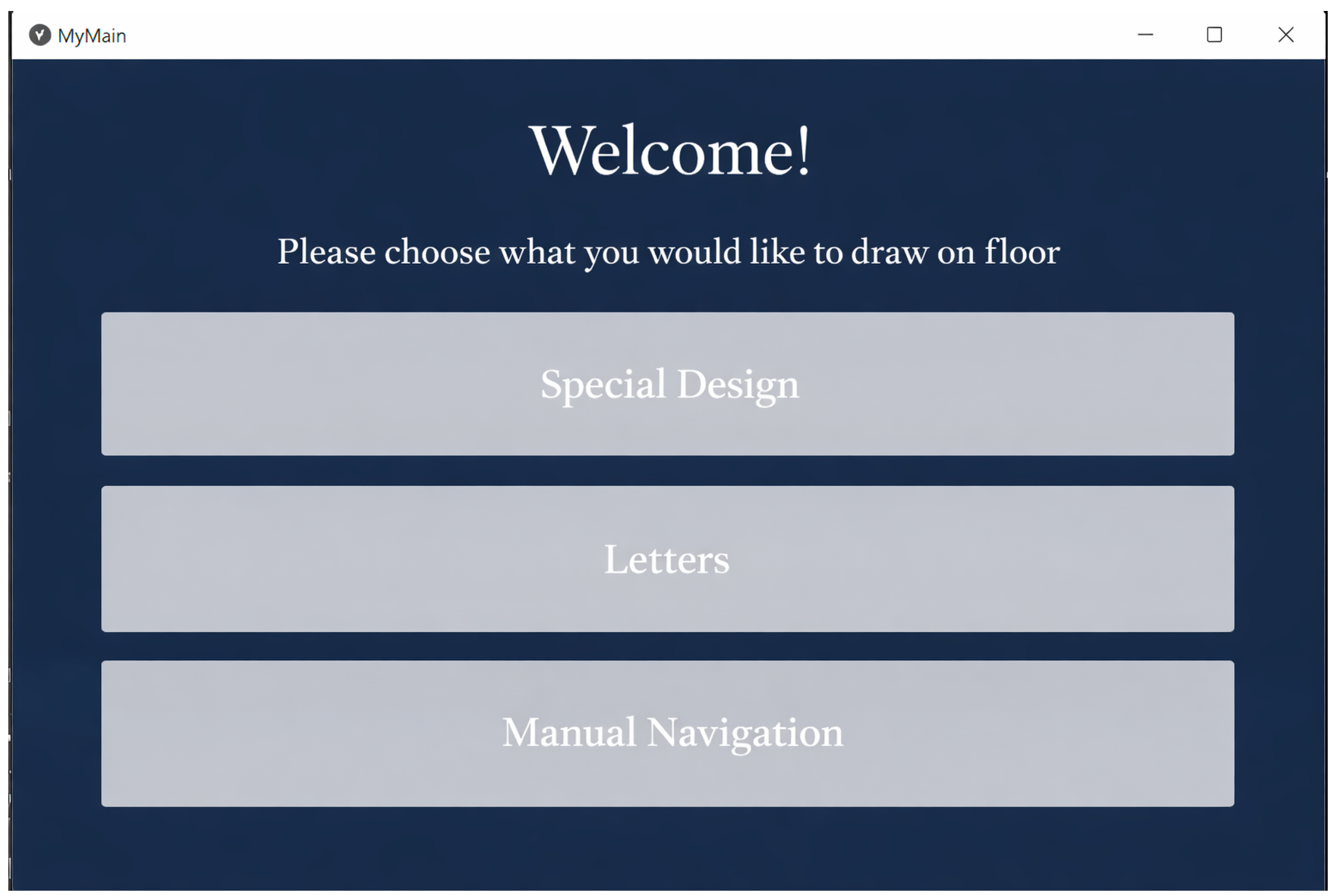
2.3.2. User Interface
3. Results and Discussion
3.1. Plotter Performance
3.2. Navigation Performance
3.3. Complete Scenario Performance
4. Conclusions
Author Contributions
Funding
Data Availability Statement
Acknowledgments
Conflicts of Interest
Abbreviations
| CAD | computer-aided design |
| CNC | computer numerical control |
| GPS | global positioning system |
| IMU | inertial measurement unit |
| LLM | large language model |
| PI | proportional–integral |
| RPI | Raspberry Pi |
References
- National Institute for Occupational Safety and Health (NIOSH); Occupational Safety and Health Administration (OSHA); U.S. Coast Guard (USCG); Environmental Protection Agency (EPA). Occupational Safety and Health Guidance Manual for Hazardous Waste Site Activities. Training 1985, 4, 1. [Google Scholar]
- O’Neill, M.J. Effects of signage and floor plan configuration on wayfinding accuracy. Environ. Behav. 1991, 23, 553–574. [Google Scholar] [CrossRef]
- Jensfelt, P.; Forell, E.; Ljunggren, P. Field and service applications—Automating the marking process for exhibitions and fairs—The Making of Harry Platter. IEEE Robot. Autom. Mag. 2007, 14, 35–42. [Google Scholar] [CrossRef]
- Kitahara, T.; Satou, K.; Onodera, J. Marking Robot in Cooperation with Three-Dimensional Measuring Instruments. In Proceedings of the 35th International Symposium on Automation and Robotics in Construction (ISARC), Taipei, Taiwan, 28 June–1 July 2018; pp. 292–299. Available online: https://www.iaarc.org/publications/2018_proceedings_of_the_35th_isarc/marking_robot_in_cooperation_with_three_dimensional_measuring_instruments.html (accessed on 24 December 2025).
- Tsuruta, T.; Miura, K.; Miyaguchi, M. Mobile robot for marking free access floors at construction sites. Autom. Constr. 2019, 107, 102912. [Google Scholar] [CrossRef]
- Tanaka, K.; Kajitani, M.; Kanamori, C.; Itoh, H.; Abe, Y.; Tanaka, Y. Development of Marking Robot Working at Building Sites. In Proceedings of the 12th International Symposium on Automation and Robotics in Construction (ISARC), Warsaw, Poland, 30 May–1 June 1995; pp. 235–242. [Google Scholar] [CrossRef]
- Robotics, D. BIM-Driven Layout for Construction. Available online: https://www.dustyrobotics.com/ (accessed on 9 April 2025).
- HP SitePrint. Available online: https://www.hp.com/us-en/printers/site-print/layout-robot.html (accessed on 24 December 2025).
- Ali, M.; Mailah, M.; Moiduddin, K.; Ameen, W. Development of an autonomous robotics platform for road marks painting using laser simulator and sensor fusion technique. Robotica 2021, 39, 535–556. [Google Scholar] [CrossRef]
- Wahyuni, S.; Budiarto, H.; Jamilah, N. Mobile robot painted dashed lines as road markings. IOP Conf. Ser. Mater. Sci. Eng. 2021, 1125, 012080. [Google Scholar] [CrossRef]
- Robotic Line Marker for All Sports Pitches. Turf Tank. Available online: https://turftank.com/us/ (accessed on 24 December 2025).
- TinyMobileRobots. TinyMobileRobot Pro-X. Available online: https://tinymobilerobots.com/tinymobilerobot-pro-x/ (accessed on 24 December 2025).
- TinyMobileRobots. TinySurveyor Road-Marking Robot. Available online: https://tinymobilerobots.com/road-marking-robot/tinysurveyor/ (accessed on 24 December 2025).
- Floor Marking Robot. intmach.com. Available online: https://www.intmach.com/floor-marking-robot (accessed on 22 June 2025).
- Lionel. August Robotics. Available online: https://augustrobotics.com/lionel (accessed on 24 December 2025).
- Scalera, L.; Gasparetto, A.; Seriani, S.; Gallina, P. History of drawing robots. In Explorations in the History and Heritage of Machines and Mechanisms; Ceccarelli, M., Aslan Seyhan, I., Eds.; Springer Nature: Cham, Switzerland, 2024; pp. 3–17. [Google Scholar]
- Karimov, A.; Kopets, E.; Leonov, S.; Scalera, L.; Butusov, D. A robot for artistic painting in authentic colors. J. Intell. Robot. Syst. 2023, 107, 34. [Google Scholar] [CrossRef]
- Moura, L. Robot art: An interview with Leonel Moura. Arts 2018, 7, 28. [Google Scholar] [CrossRef]
- Santos, M.; Notomista, G.; Mayya, S.; Egerstedt, M. Interactive multi-robot painting through colored motion trails. Front. Robot. AI 2020, 7, 580415. [Google Scholar] [CrossRef] [PubMed]
- Song, D.; Park, J.; Kim, Y.J. SSK: Robotic Pen-Art System for Large, Nonplanar Canvas. IEEE Trans. Robot. 2023, 39, 3106–3119. [Google Scholar] [CrossRef]
- Liu, Y.; Alias, A.H.; Haron, N.A.; Bakar, N.A.; Wang, H. Robotics in the construction sector: Trends, advances, and challenges. J. Intell. Robot. Syst. 2024, 110, 72. [Google Scholar] [CrossRef]
- Mazzetto, S.; Hosamo, H.H.; Al-Atroush, M.E. How Programmable Construction Can Shape the Future of Sustainable Building in Italy. Sustainability 2025, 17, 1839. [Google Scholar] [CrossRef]
- Rafindadi, A.D.; Kado, B.; Gora, A.M.; Dalha, I.B.; Haruna, S.I.; Ibrahim, Y.E.; Shabbir, O.A. Caught-in/between accidents in the construction industry: A systematic review. Safety 2025, 11, 12. [Google Scholar] [CrossRef]
- Xu, X.; de Soto, B.G. On-site autonomous construction robots: A review of research areas, technologies, and suggestions for advancement. In Proceedings of the 37th International Symposium on Automation and Robotics in Construction (ISARC), Kitakyushu, Japan, 27–28 October 2020; pp. 385–392. [Google Scholar] [CrossRef]
- Zeng, L.; Guo, S.; Wu, J.; Markert, B. Autonomous mobile construction robots in built environment: A comprehensive review. Develop. Built Environ. 2024, 19, 100484. [Google Scholar] [CrossRef]
- Org, K. Kivy: Cross-platform Python Framework for NUI. 2010. Available online: https://kivy.org/#home (accessed on 20 August 2022).
- Roboclaw_Python_Library: The Official RoboClaw Python Library. Basicmicro. Available online: https://github.com/basicmicro/roboclaw_python_library (accessed on 20 August 2022).
- Prezzi, C. Grbl-Servo: Special Grbl Version for Use with Servo Instead of Spindle or Laser. GitHub, 22 February 2018. Available online: https://github.com/cprezzi/grbl-servo (accessed on 4 June 2022).
- Cluts. 2D Pen Plotter—Arduino Writing Machine. 28 December 2021. Available online: https://cults3d.com/en/3d-model/tool/2d-pen-plotter-arduino-writing-machine (accessed on 19 March 2022).
- Das, U.C.; Shaik, N.B.; Suanpang, P.; Nath, R.C.; Mantrala, K.M.; Benjapolakul, W.; Gupta, M.; Somthawinpongsai, C.; Nanthaamorn-phong, A. Development of automatic CNC machine with versatile applications in art, design, and engineering. Array 2024, 24, 100369. [Google Scholar] [CrossRef]
- Klančar, G.; Zdešar, A.; Blažič, S.; Škrjanc, I. Motion modeling for mobile robots. In Wheeled Mobile Robotics: From Fundamentals Towards Autonomous Systems; Butterworth-Heinemann: Oxford, UK, 2017; pp. 13–59. [Google Scholar]
- Karimov, A.; Strelnikov, M.; Mazin, S.; Goryunov, D.; Leonov, S.; Butusov, D. Physically Motivated Model of a Painting Brush for Robotic Painting and Calligraphy. Robotics 2024, 13, 94. [Google Scholar] [CrossRef]
- Zingrebe, D.S.; Gülzow, J.M.; Deussen, O. Robotic Writing of Arbitrary Unicode Characters Using Paintbrushes. Robotics 2023, 12, 72. [Google Scholar] [CrossRef]
- Caputo, C.; Ammar, A.; Johnson, A. Assessment of Traditional and Robotic Approaches to Interior Construction Layout: A Framework and Comparative Study. In ISARC, Proceedings of the International Symposium on Automation and Robotics in Construction, Lille, France, 3–5 June 2024; IAARC Publications: Oulu, Finland, 2024; Volume 41, pp. 113–120. [Google Scholar]
- Koubaa, A.; Ammar, A.; Boulila, W. Next-generation human-robot interaction with ChatGPT and robot operating system. Softw. Pract. Exp. 2025, 55, 355–382. [Google Scholar] [CrossRef]



| Performance Aspect | Metric | Iterations |
|---|---|---|
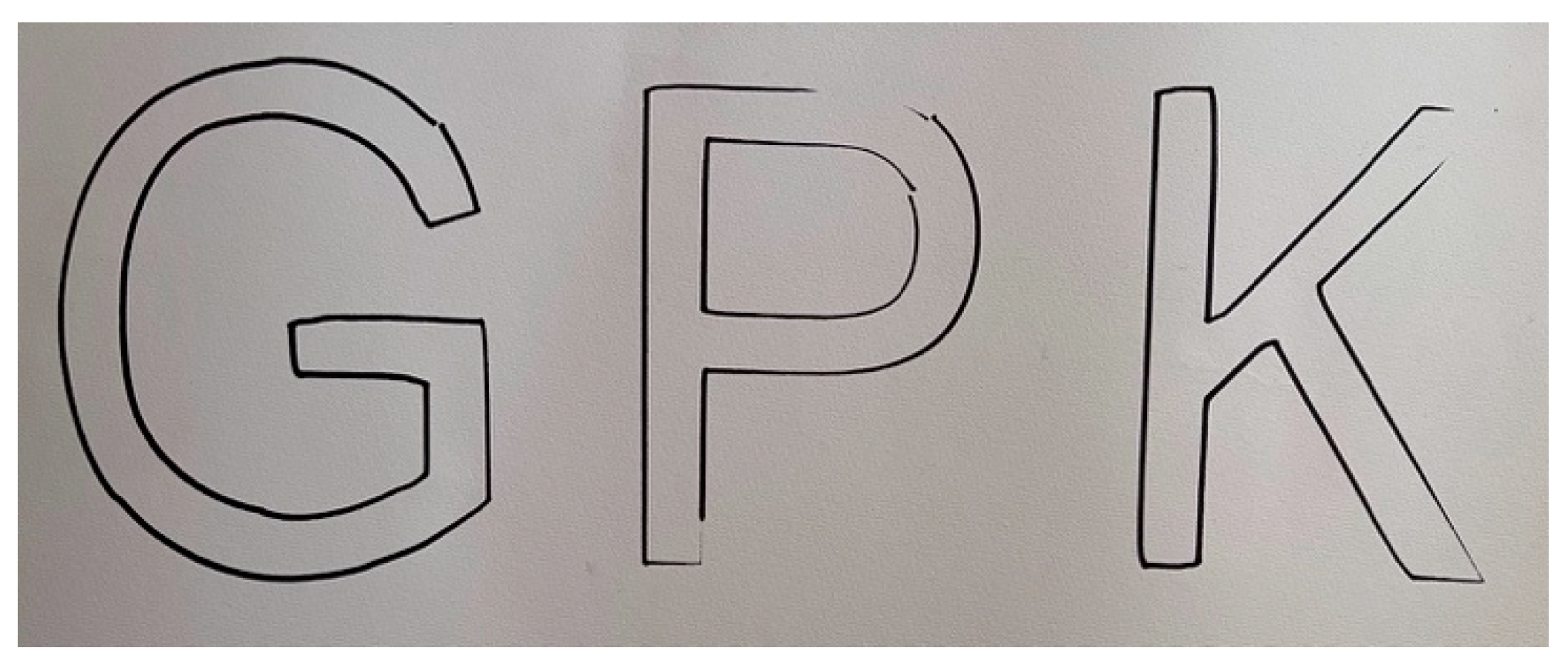
| Plotting Repeatability | Minor variations | 5 |
| Navigation (Forward/backward) | Average overshoot: 14.1 mm | 15 |
| Navigation (Lateral) | Average overshoot: 53.5 mm | 15 |
| Complete Scenario | Average overshoot: +27.1 mm (forward/backward) Average overshoot: +67.3 mm (lateral) | 6 |
Disclaimer/Publisher’s Note: The statements, opinions and data contained in all publications are solely those of the individual author(s) and contributor(s) and not of MDPI and/or the editor(s). MDPI and/or the editor(s) disclaim responsibility for any injury to people or property resulting from any ideas, methods, instructions or products referred to in the content. |
© 2025 by the authors. Licensee MDPI, Basel, Switzerland. This article is an open access article distributed under the terms and conditions of the Creative Commons Attribution (CC BY) license.
Share and Cite
Alahmed, F.; Hawwa, M.; Baroudi, U. Development of an Autonomous Robot for Precision Floor Marking. Robotics 2026, 15, 7. https://doi.org/10.3390/robotics15010007
Alahmed F, Hawwa M, Baroudi U. Development of an Autonomous Robot for Precision Floor Marking. Robotics. 2026; 15(1):7. https://doi.org/10.3390/robotics15010007
Chicago/Turabian StyleAlahmed, Fatimah, Muhammad Hawwa, and Uthman Baroudi. 2026. "Development of an Autonomous Robot for Precision Floor Marking" Robotics 15, no. 1: 7. https://doi.org/10.3390/robotics15010007
APA StyleAlahmed, F., Hawwa, M., & Baroudi, U. (2026). Development of an Autonomous Robot for Precision Floor Marking. Robotics, 15(1), 7. https://doi.org/10.3390/robotics15010007