
Article

Virulence Reduction in Yersinia pestis by Combining Delayed Attenuation with Plasmid Curing

by
Svetlana V. Dentovskaya
,
Rima Z. Shaikhutdinova
,
Mikhail E. Platonov
,
Nadezhda A. Lipatnikova
,
Elizaveta M. Mazurina
,
Tat’yana V. Gapel’chenkova
,
Pavel Kh. Kopylov
,
Sergei A. Ivanov
,
Alexandra S. Trunyakova
,
Anastasia S. Vagaiskaya
and
Andrey P. Anisimov
*
Laboratory for Plague Microbiology, Especially Dangerous Infections Department, State Research Center for Applied Microbiology and Biotechnology, 142279 Obolensk, Russia
*
Author to whom correspondence should be addressed.
Biomolecules 2026, 16(1), 40; https://doi.org/10.3390/biom16010040
Submission received: 20 November 2025 / Revised: 18 December 2025 / Accepted: 23 December 2025 / Published: 25 December 2025
(This article belongs to the Section Molecular Biology)

Abstract

Yersinia pestis caused the three plague pandemics that claimed more than two hundred million human lives. There is still no vaccine that meets all WHO requirements, and many researchers continue to develop plague vaccines using various technological platforms. For example, researchers led by Roy Curtiss 3rd have developed a new approach to achieve controlled, delayed attenuation of bacterial pathogens. Mutants generated using this method were superior in protecting Y. pestis-infected mice immunized with strains generated using traditional gene knockout. However, further studies are needed to determine the safety and efficacy of these delayed-attenuated strains in other mammalian species in order to extrapolate on humans the data obtained in accordance with the FDA Animal Rule. Three Y. pestis strains, a Δcrp mutant, a mutant with arabinose-dependent regulated crp expression (araC PBAD crp) or an araC PBAD crp mutant cured of plasmid pPst were derived from virulent wild-type strain 231. To evaluate the safety, outbred mice or guinea pigs were immunized subcutaneously with serial tenfold dilutions of mutated strains. For vaccine studies, immunized animals were subcutaneously challenged with 200 LD100 (lethal dose in all exposed subjects) of the wild-type Y. pestis strain. The challenge caused the death of 100% of naïve animals in controls. The Y. pestis strain 231Δcrp was nonlethal in mice at a dose of 107 CFs. The LD50 of the 231Δcrp strain in guinea pigs increased by at least 107-fold compared to that of the wild-type strain. The LD50s of the 231PBAD-crp mutant in mice and guinea pigs were approximately 104-fold and 107-fold higher than those of Y. pestis 231, respectively. The 231PBAD-crp(pPst¯) strain did not cause death in mice (LD50 > 107 CFU) and guinea pigs (LD50 > 109 CFU) when administered subcutaneously and was capable of inducing intense protective immunity in both species of laboratory animals. Our research has shown once again the necessity of balance between safety and effectiveness demonstrating the feasibility of further investigation of crp mutants as promising candidate plague vaccines.

1. Introduction

Plague is a disease of wild rodents, which only accidentally crosses over to humans [1]. However, these accidents were the cause of at least three known pandemics and cost humanity more than 200 million lives [2,3]. The World Health Organization (WHO), a key player in pandemic preparedness and response [4], has released a list of prioritized pathogens posing the greatest emerging epidemic threats. WHO draws the attention of the global community to the need to accelerate research in the development and clinical trials of vaccines against these priority pathogens [5,6]. This list contains five bacterial pathogens, including Yersinia pestis, the causative agent of the plague. Although the success in the fight against the third plague pandemic was largely due to the application of the first generation of plague vaccines (e.g., a killed plague vaccine developed in 1897 by Waldemar Mordecai Haffkine (1860–1930)) [7,8] there is still no generally accepted plague vaccine that meets all WHO requirements [9]. A number of researchers continue to develop plague vaccines using various technological platforms [10,11]. Advances in molecular bacteriology have made it possible to develop a wide range of plague vaccine candidates that appear to be superior to the first-generation vaccines in vitro and in animal comparative studies [12]. Recently, Roy Curtiss 3rd’s team proposed an original methodology for controlled delayed attenuation of bacterial pathogens [13,14,15]. This technology has been applied to Y. pestis strain KIM5+ (subsp. pestis bv. Medievalis) in a mouse model and has shown superiority over traditional knockout mutagenesis [16]. However, the safety and efficacy of the strains with delayed attenuation in humans is not yet known.
Currently, ethical considerations prohibit the use of standard research methodologies like randomized controlled trials or cohort studies for evaluating plague vaccines. This is because failure to vaccinate the control group would expose its members to unacceptable risk. Therefore, the authorization of plague vaccines for use in humans should be conducted utilizing the FDA’s Animal Rule [17]. This rule facilitates the licensing of products for which traditional potency testing methodologies are deemed unethical. Specifically, the Animal Rule is applied in situations where an infective agent exhibits extremely high pathogenicity and the rarity of the infection it causes precludes the feasibility of conducting field studies (21 CFR 601.91 Subpart H, “Approval of Biological Products When Human Efficacy Studies Are Not Ethical or Feasible”) [18]. One of the four essential requirements for the application of the FDA Animal Rule is that the vaccine’s effects (survival or prevention of serious disease) must be observed in more than one animal species, which is expected to be more likely to reflect human responses.
The aim of this study was to verify the vaccine properties of the PBAD-crp mutant generated on the basis of a phylogenetically different parent strain and to evaluate its properties not only in mice but also in guinea pigs.

2. Materials and Methods

2.1. Bacterial Strains, Plasmids, and Culture Conditions

All bacterial strains and plasmids used in this study are listed in Table 1. Escherichia coli DH5α was used for plasmid propagation. Y. pestis cells were grown routinely at 28 °C in BHI, HiMedia, Mumbai, India) or on BHI agar at pH 7.2. E. coli cells were grown routinely at 37 °C in Luria–Bertani (LB) broth (HiMedia, Mumbai, India) or on agar plates at pH 7.2. Ampicillin (100 µg/mL, Amp) (neoFroxx, Einhausen, Germany), chloramphenicol (20 µg/mL, Cm) (neoFroxx, Einhausen, Germany), polymyxin B (50 μg/mL, Pol) (neoFroxx, Einhausen, Germany), L-arabinose (200 µg/mL, Ara) (HiMedia, Dahej, India) were supplemented as appropriate. BHI agar containing 10% sucrose was used for sacB-based counterselection in the allelic exchange experiments. MacConkey agar (HiMedia, Mumbai, India) with 0.5% maltose (HiMedia, Dahej, India) was used to indicate sugar fermentation and crp expression.

2.2. Animals

Six-week-old outbred mice (Lab of Biomodels breeding unit, SCRAMB, Moscow, Russia) and four-week-old guinea pigs («Andreevka» branch of the Scientific Center of Biomedical Technologies of the Federal Medical and Biological Agency (Andreevka, Moscow, Russia) both male and female were used in all studies. All animal experiments were approved by the State Research Center for Applied Microbiology and Biotechnology (Obolensk, Moscow, Russia) Bioethics Committee (Permit No: VP-2025/1 on 30 April 2025) and were performed in compliance with the NIH Animal Welfare Insurance #A5476-01 issued on 2 July 2007, and the European Union guidelines and regulations on handling, care and protection of Laboratory Animals (https://environment.ec.europa.eu/topics/chemicals/animals-science_en (accessed on 18 November 2025).

2.3. Construction of the Plasmids

The primers used in this work are listed in Table 2.
A primer set of Crp-NdeI/Crp-XhoI was used for amplifying the gene sequence of crp. The resulting PCR product was digested with NdeI and XhoI and ligated with plasmid pET-24b(+) digested with the same restriction enzymes to construct plasmid pET24-crp. E. coli BL21(DE3) was transformed with the plasmid pET24-crp.
Primer sets of Crp-HindIII/Crp-SphI and Crp-XbaI/Crp-SalI were used for amplifying URcrp (upstream region gene sequence of crp, from −664 to −110 bp) and the gene sequence of crp with the Shine-Dalgarno sequence, from −36 to +633 bp, respectively. A primer set of Pbad-SphI/Pbad-XbaI was used for amplifying the araC PBAD promoter from strain E. coli DH5α. The resulting PCR products were digested with appropriate restriction enzymes and ligated with pUC57 digested with HindIII and SalI to construct the plasmid pUC57-URcrp-araC Pbad-crp.
A primer set of Lt0-SphIF/Lt0-SphIR was used for amplifying the transcription terminator t0 from bacteriophage λ (Lt0TT). The resulting PCR product was digested with SphI and ligated with the plasmid pUC57-URcrp-araC Pbad-crp digested with the same restriction enzyme to construct the plasmid pUC57-URcrp-Lt0TT-araC Pbad-crp. The plasmid pUC57-URcrp-Lt0TT-araC Pbad-crp was digested with SmaI and ligated with the suicide vector pCVD442 digested with the same restriction enzyme to construct the plasmid pCVD442-URcrp-Lt0TT-araC Pbad-crp.
All the plasmid constructions were verified through sequencing.

2.4. Mutagenesis

The crp deletion was constructed in the Y. pestis EV strain by λRed-mediated mutagenesis [21] and confirmed by PCR (Table 2). The Y. pestis EVΔcrp::cat DNA fragment containing the respective deletion was then subcloned into the pCVD442 plasmid [22]. The pCVD442-Δcrp::cat plasmid was transferred from an E. coli S17-1 λpir donor strain into a recipient wild type Y. pestis strain 231 by conjugation. Elimination of the suicide vector and selection of Y. pestis clones were performed in the presence of 5% sucrose and chloramphenicol [22]. The resistance cassette was eliminated to produce FRT scar mutants by introducing pCP20 [21].
The procedure for constructing the Y. pestis 231PBAD-crp mutant was performed using the standard method [22]. In brief, the suicide plasmid pCVD442-URcrp-Lt0TT- araC PBAD-crp was conjugationally transferred from E. coli S17-1 λpir to Y. pestis 231. A single-crossover insertion strain was isolated on BHI agar plates containing ampicillin. Loss of the suicide vector after the second recombination between the homologous regions was selected using the sacB-based sucrose sensitivity counter-selection system. The colonies were screened for AmpS and verified by PCR using the primers Crp-KF/Crp-KR.
The isogenic pPst-plasmid-cured strain of Y. pestis 231PBAD-crp(pPst¯) was generated as described earlier. It was cloned from the 231PBAD-crp strain after 10 serial passages caused in BHI broth media at +5 °C [24]. Clones lacking the 9.5-kb pPst plasmid were detected by PCR and confirmed by a fibrinolysis assay [25].
The presence of all Y. pestis resident plasmids [26,27,28,29] was confirmed via PCR amplification.

2.5. Preparation of Crp Antiserum

Full-length His-tagged Crp was expressed from E. coli BL21(DE3)/pET24-crp. Briefly, recombinant E. coli culture was grown to log phase in LB broth at 37 °C with agitation. Cells were then induced with 1 mM IPTG (isopropyl-β-d-thiogalactopyranoside) for 4 h. After sonication and centrifugation, protein was solubilized in the binding buffer containing 6 M urea and was purified in an affinity chromatography using Ni2+-Sepharose chromatography under denaturing conditions.
Mouse anti-CRP serum was collected after two subcutaneous immunizations with 20 μg per animal after being mixed with the Imject Alum (1:1).

2.6. Western Blotting

The whole-cell lysates were separated by sodium dodecyl sulfate-polyacrylamide (10%) gel electrophoresis and then electrophoretically transferred to a nitrocellulose membrane using equipment and protocols from Bio-Rad Laboratories (Hercules, CA, USA). The membrane was blocked overnight at 4 °C with 5% (w/v) nonfat dry milk in phosphate-buffered saline containing 0.2% Tween 20 (PBS-T), washed three times for 10 min with PBS-T, probed at room temperature for 1.5 h with a mice polyclonal against His-tagged Crp from E. coli BL21(DE3)/pET24-crp diluted in PBS-T, and then washed three times with PBS. Immunoreactive proteins were detected using a horseradish peroxidase-conjugated anti-mouse IgG-HRP (1:5000, Sigma, Saint-Louis, MO, USA). Proteins were visualized with DAB substrate kit (Abcam, Cambridge, UK) and photographed using an Amersham ImageQuant 800 (Cytiva, Wilmington, NC, USA) gel imaging system.

2.7. Animal Challenges

Y. pestis strains were grown at 28 °C for 48 h on BHI plus L-arabinose (200 µg/mL), diluted to an appropriate concentration in PBS. The challenge doses were determined by serial dilutions in PBS and plating on BHI agar.
To demonstrate the loss of virulence, mice (n = 6/per dose) and guinea pigs (n = 6/per group) were challenged subcutaneously (s.c.) with the 231Δcrp, 231PBAD-crp or 231PBAD-crp(pPst¯) strains. Each strain was inoculated at different 10-fold doses at 0.2 mL aliquots (102 CFU–107 CFU per mouse, 102–109 CFU per guinea pig). At the same time, 4 additional groups of 6 mice or guinea pigs were used to control the virulence of the wild type Y. pestis 231. Then the animals were monitored for 28 days to assess the survival rate.
For vaccine studies, groups of 6 outbred mice or 6 guinea pigs were vaccinated via the subcutaneous (s.c. route with serial dilutions of the Y. pestis 231 strain PBAD-crp(pPst¯) or only with PBS buffer as a placebo. Blood was collected on day 28 postimmunization for antibody measurement. On day 30, animals were injected s.c. with 200 LD100 (400 CFU for mice, 6 × 10³ CFU for guinea pigs) of the wild-type Y. pestis strain 231. All animals were observed over a 30-day period.

2.8. ELISA

ELISA was used to assay serum IgG antibodies against recombinant LcrV [30] and F1 [31] proteins and Y. pestis 231 whole-cell lysate (YPL) [32]. Polystyrene 96-well flat-bottom microtiter plates (Dynatech Laboratories Inc., Chantilly, VA, USA) were coated with 1 μg/well recombinant protein or 0.5 μg/well YPL in 0.3 N sodium carbonate buffer [pH 9.6]. Mouse and guinea pig sera samples were serially diluted from 1:250 to 1:512,000. The endpoint dilution titer was calculated as the serum dilution resulting in an absorbance reading of 0.2 units above background. Goat anti-mouse IgG-HRP (1:5000, Sigma, Saint-Louis, MO, USA) and goat anti-guinea pig IgG-HRP (1:5000, Sigma, Saint-Louis, MO, USA) were used as the detection antibodies. The reactions were developed with TMB (3,3′,5,5′-Tetramethylbenzidine) and stopped with 2 M H2SO4. The absorbance at 450 nm was measured. Background values were obtained from serum samples collected from the animals injected with the PBS alone.

2.9. In Vivo Cytokine Analysis

Outbred mice (n = 3) and guinea pigs (n = 3) were inoculated s.c. with 104 CFU of Y. pestis 231(PBAD-crp)/pPst¯. A group of uninfected mice served as the negative control (0 day). Samples were taken from mice inoculated s.c. on days 2, 4, and 6 post-inoculation. The sera were filtered through 0.22-μm syringe filters (PTFE-0.22-13, JINTENG, Tianjin, China) and cultured on BHI plates to confirm their sterility. The levels of cytokines were measured using an ELISA with Guinea pig Interferon-γ ELISA Kit (#EGP0017), Guinea pig TNF-α ELISA Kit (#EGP0049), Mouse IFN-γ ELISA Kit (#EM0093), and Mouse TNF-α ELISA Kit (#EM0183), all according to the manufacturer’s instructions (Fine Biotech Co., Ltd., Wuhan, China).

2.10. Statistics

The LD50 and 95% confidence intervals of the isogenic Y. pestis strains for mice and guinea pigs were calculated using the Kärber method [22]. t-test of unpaired samples, ANOVA and Log-rank (Mantel–Cox) test were used. A p-value below 0.05 was considered significant.

3. Results

3.1. Construction of the Deletion-Insertion Mutation to Achieve Regulated Delayed Attenuation

The Δcrp mutant of Y. pestis strain 231 was generated by replacing the crp with the chloramphenicol resistance gene cat and curing the resistance cassette to produce a FRT scar (Figure 1A). The PBAD crp mutant of Y. pestis strain 231 was constructed by replacing 74 nucleotides containing the crp promoter region from −110 to −37 bp with the transcription terminator t0 from bacteriophage λ (Lt0TT) and the araC PBAD promoter from E. coli strain DH5α (Figure 1B). The deletion of the crp from wild type 231 and the promoter replacement with PBAD-crp were confirmed by PCR analysis using specific primers (Table 2) as well as by DNA sequencing of the flanking regions of the crp on the chromosome. The above-mentioned genetic manipulations resulted in creation of the isogenic Δcrp and PBAD-crp mutants of Y. pestis strain 231.
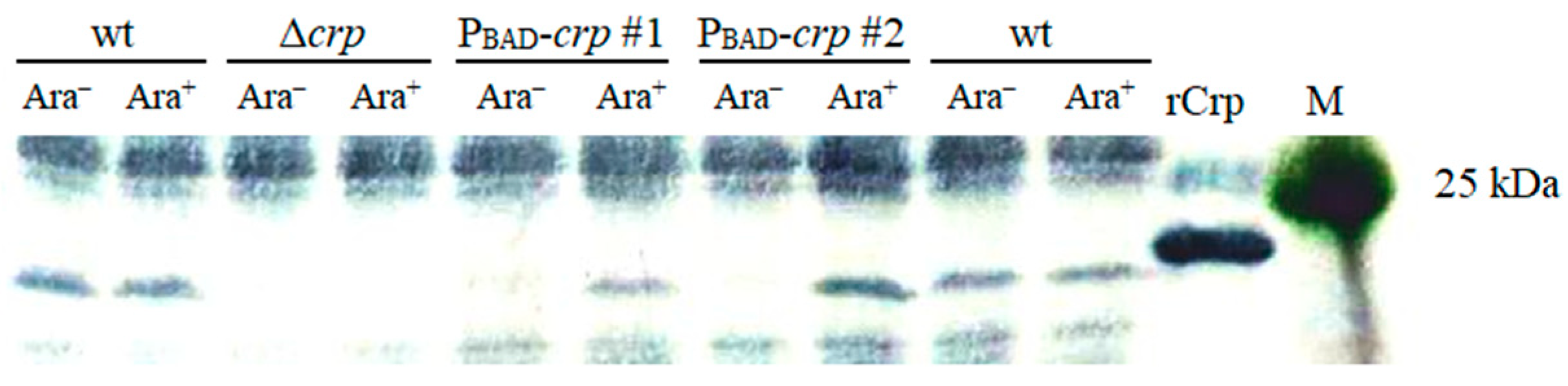
The growth of the PBAD-crp mutant strain in the presence of arabinose leads to transcription of the crp, but gene expression stopped in the absence of arabinose. The presence of the Crp protein in Y. pestis mutant strains was tested by Western blot using mouse antibodies raised against the His-tagged recombinant protein. Crp was not detected in the either 231Δcrp or 231 PBAD-crp mutants grown in the absence of arabinose (Figure 2). After arabinose addition, the PBAD-crp strain synthesized approximately the same amount of Crp as the parent wild-type Y. pestis strain 231.
The Δcrp and the PBAD-crp strains without arabinose grew more slowly than the parent Y. pestis strain 231 in BHI medium.When 0.2% arabinose was added to the nutrient medium, PBAD-crp grew at the same rate as the wild type strain.
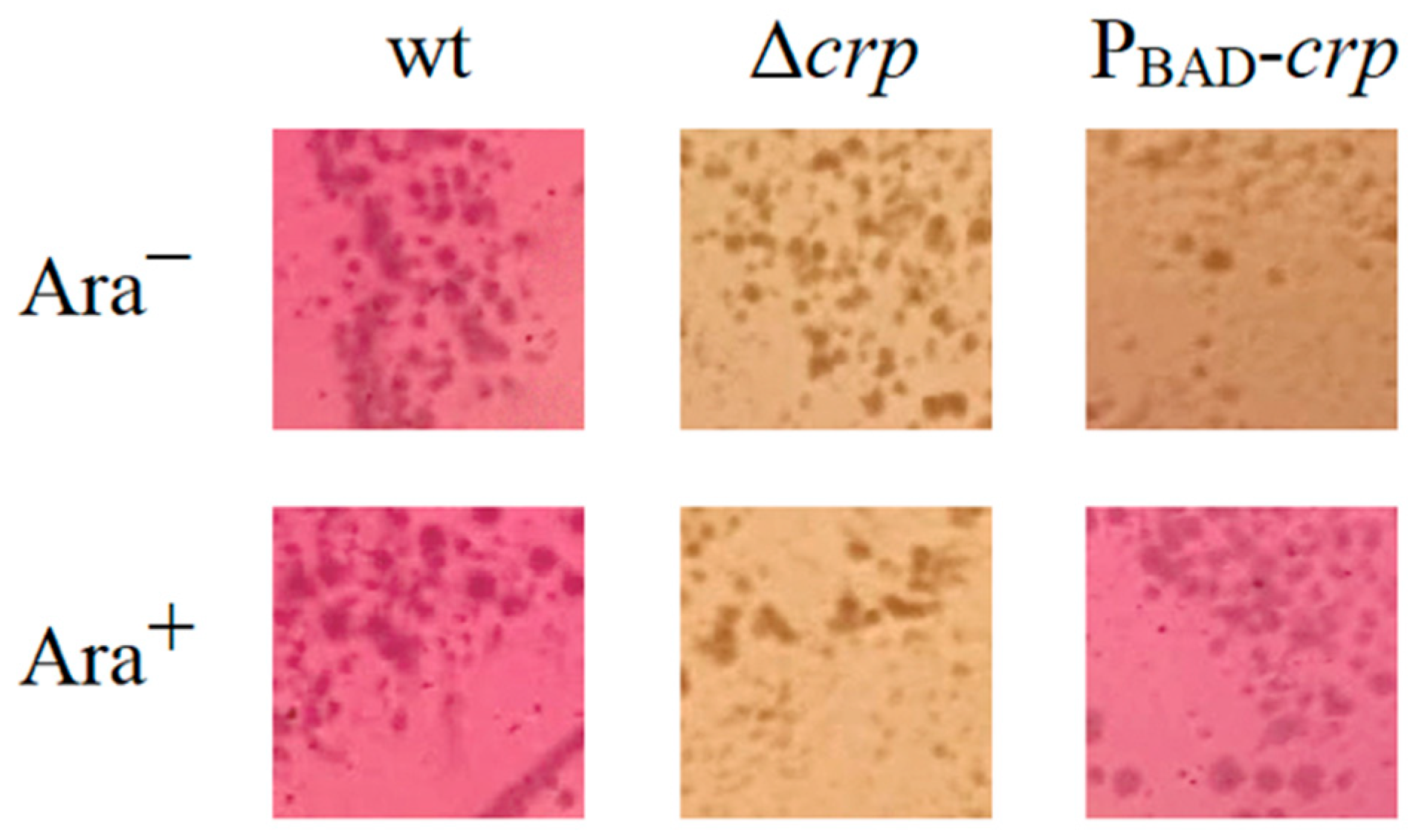
Crp increased expression of malT, the transcriptional activator of maltose metabolism [33]. The test of maltose fermentation can readily display the Crp activity. We analyzed the growth of wild-type 231, 231Δcrp, PBAD-crp on MacConkey maltose agar without and with 0.2% arabinose (Figure 3). The parent wild-type strain of Y. pestis was able to ferment maltose to acid, which was accompanied by a decrease in pH, and as a result, the colonies changed color on MacConkey medium containing a red indicator with a neutral pH. The Y. pestis 231Δcrp mutant did not grow with maltose as the sole carbon source. The Y. pestis 231PBAD-crp strain could ferment maltose only when grown in the presence of arabinose, but not in the absence of it.

3.2. Attenuation of Mutant Strains in s.c. Challenged Mice and Guinea Pigs

To investigate the contribution of Crp to Y. pestis 231 strain virulence, we infected outbred mice and guinea pigs s.c. with Y. pestis 231, 231Δcrp, or 231PBAD-crp. Y. pestis 231PBAD-crp strain was grown with arabinose prior to inoculation. The strain 231Δcrp was nonlethal at doses of ≤107 CFU in mice. The LD50 of 231Δcrp strain in guinea pigs increased at least by 107-fold (LD50 = 2.1 × 10⁸ CFU) compared with that of the wild-type strain (LD50 = 3 CFU) (Table 3). The LD50s of the 231PBAD-crp mutant in mice and guinea pigs were approximately 104-fold and 107-fold higher than those of Y. pestis 231, respectively.
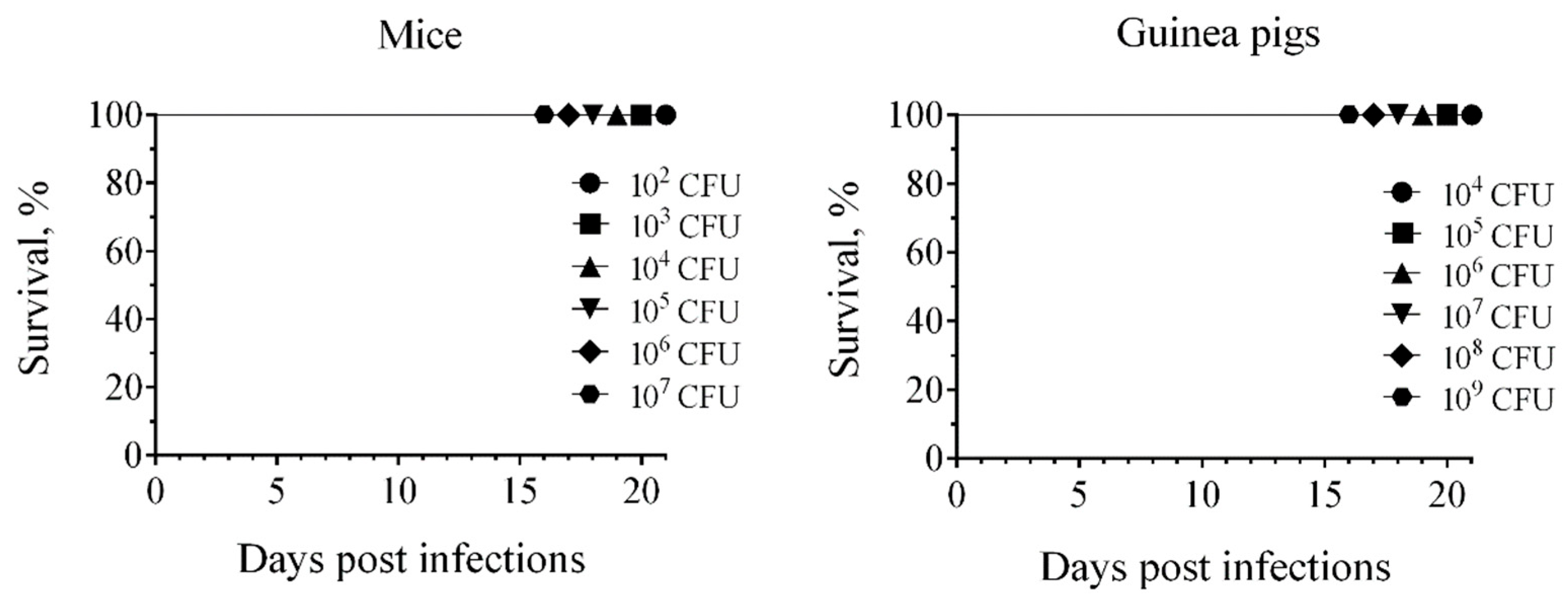
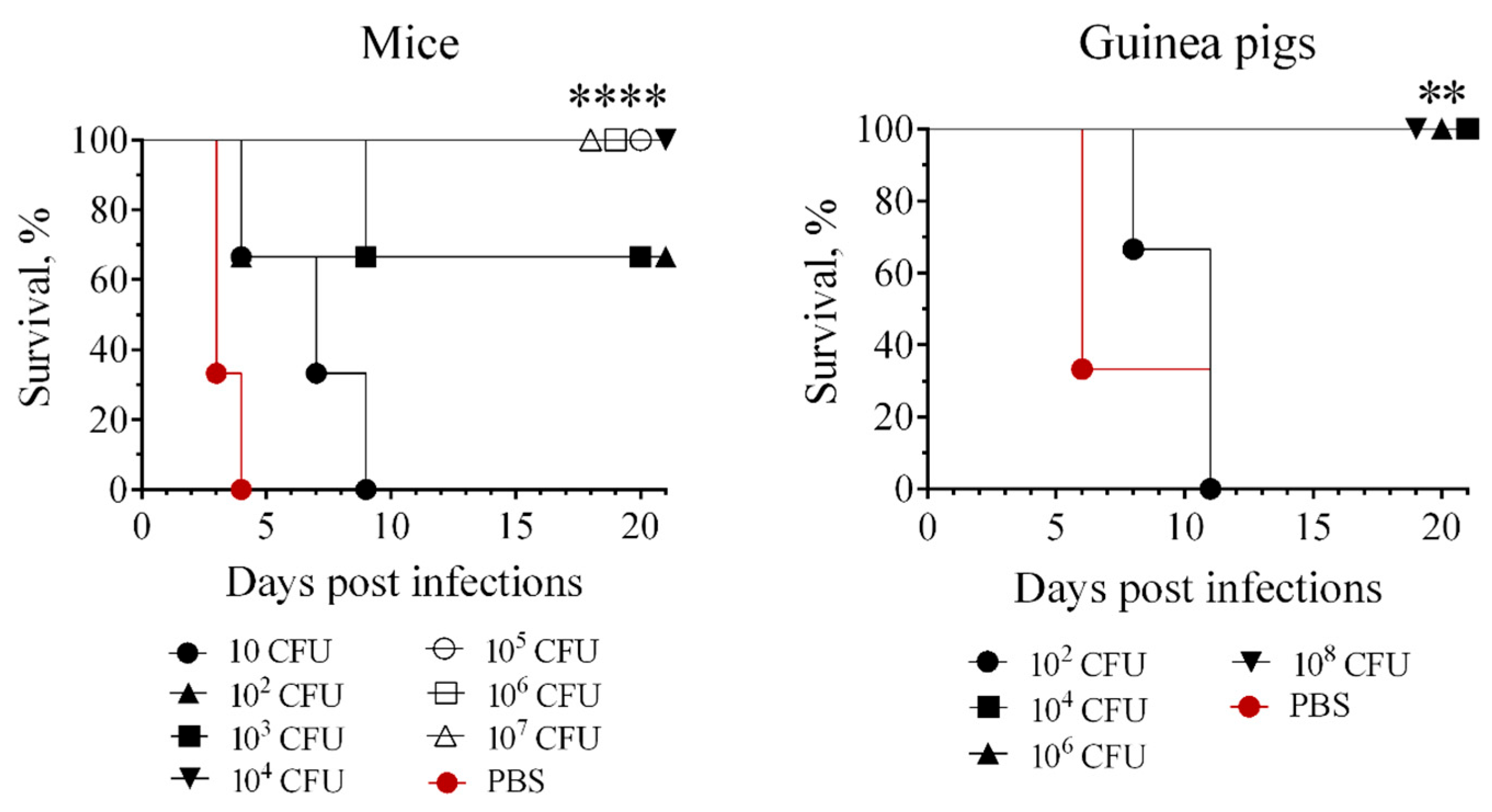
The degree of attenuation of the 231(PBAD-crp) mutant strain was increased by eliminating the pPst plasmid. We tested the ability of the plasmid-cured strain to infect outbred mice and guinea pigs. The 231PBAD-crp(pPst¯) strain was nonlethal at doses of approximately ≤107 CFU in mice and ≤109 CFU in guinea pigs (Figure 4).

3.3. Humoral Immune Responses

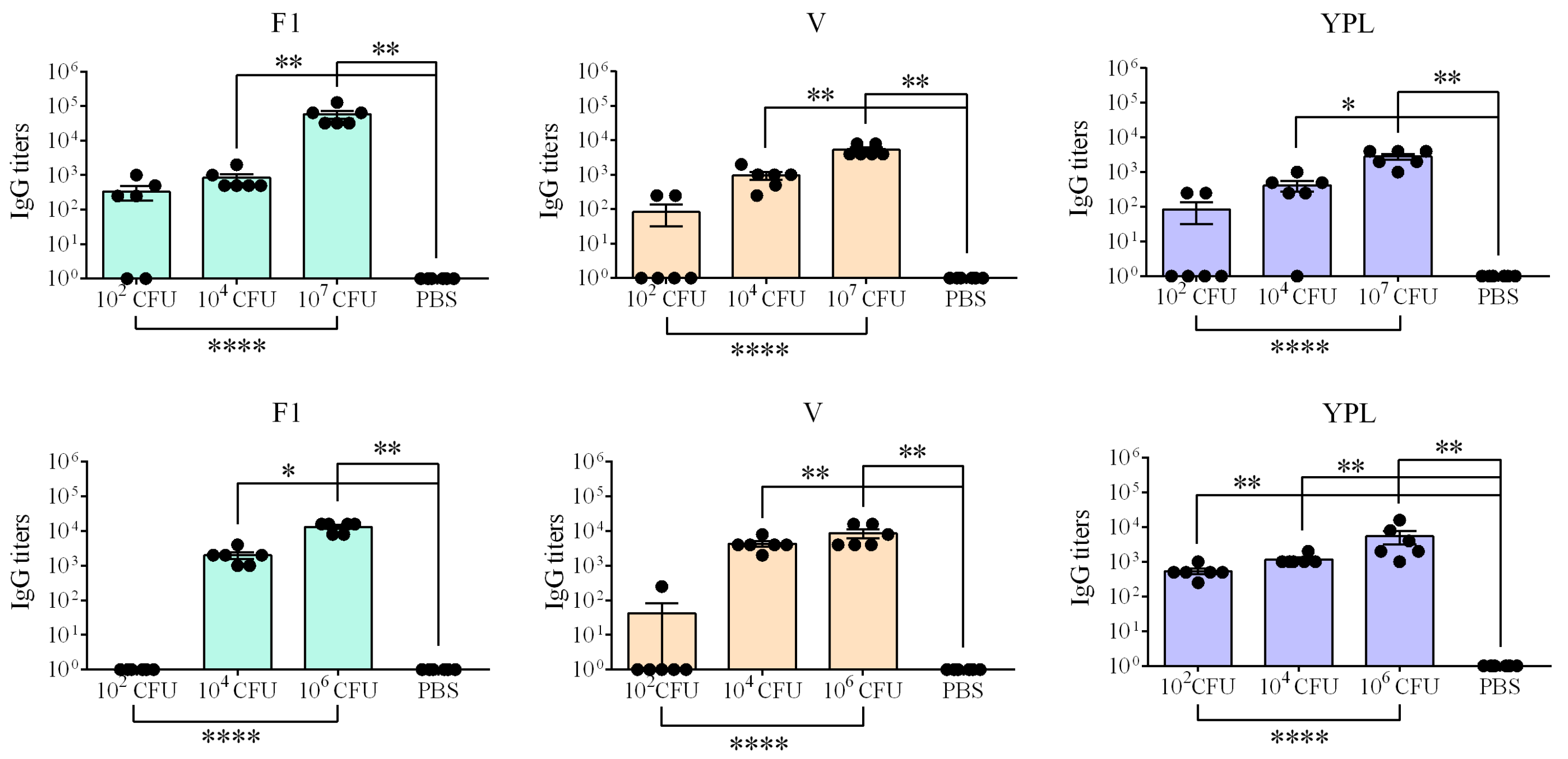
Sera were collected from vaccinated mice and guinea pigs 28 days after immunization. The levels of serum IgG titers against two main immunodominant Y. pestis protective antigens (F1 and LcrV) and Y. pestis whole-cell lysate (YPL) were determined via ELISA (Figure 5). Anti-F1 (p < 0.0001), anti-LcrV (p < 0.0001), and anti-YPL (p < 0.0001) IgG titers in mice and guinea pigs increased in a dose-dependent manner when the levels of IgG induced by different immunized doses were compared. The differences in the levels of IgG to Y. pestis antigens in the sera of mice and guinea pigs immunized with 102 CFU were insignificant (p > 0.05).

3.4. Cell-Mediated Immune Response

Then we measured the levels of the cytokines TNF-α and IFN-γ in sera of mice and guinea pigs at various times after immunization with Y. pestis strain 231PBAD-crp(pPst¯) (Figure 6). In s.c.-immunized mice and guinea pigs, induction of pro-inflammatory cytokines IFN-γ and TNF-α followed similar kinetics. The levels of cytokines increased significantly by 48 h. Then the level of IFN-γ in the serum of mice and guinea pigs and TNF-α in guinea pigs decreased. In the serum of mice, the level of TNF-α remained almost at the same level from the second to the sixth day after the immunization with Y. pestis strain 231PBAD-crp(pPst¯).

3.5. Ability of s.c. Administered Strain with araC PBAD-Regulated crp to Induce Protective Immunity to s.c. Challenge with Wild-Type Y. pestis Strain 231

Groups of mice and guinea pigs were subcutaneously immunized with 10-fold or 100-fold (respectively) dilution doses of Y. pestis strain 231PBAD-crp(pPst¯) and challenged subcutaneously 30 days later with 200 LD100 (400 CFU for mice, 6 × 10³ CFU for guinea pigs) of the wild-type strain 231.
Mice immunized with 10 CFU of the Y. pestis 231PBAD-crp(pPst¯) mutant succumbed to plague after being challenged with 200 LD100 of the WT Y. pestis strain 231, but the post-infection lifespan of animals in this group was significantly increased compared with that of the naïve mice. 66.6% of the mice immunized subcutaneously with 102 or 103 CFU survived after challenge with 200 LD100 of the WT Y. pestis. 102 CFU, the lowest immunizing dose of the strain 231PBAD-crp(pPst¯), did not protect guinea pigs against infection with 200 LD100 of the wild type Y. pestis strain 231. The immunizing doses of ≥104 CFU were sufficient to ensure 100% survival of both animal species. (Figure 7).

4. Discussion

Developing live bacterial vaccines presents a significant challenge: ensuring safety without compromising the ability to protect vaccinated individuals [34]. However, traditional attenuation methods often result in bacteria becoming overly susceptible to the host’s innate immunity, which prevents the development of a strong immune response. To overcome these limitations, researchers have engineered bacterial strains that initially exhibit the behavior of virulent wild-type bacteria, allowing them to effectively colonize the host’s tissues. Subsequently, these strains undergo a precisely controlled and delayed attenuation process within the host. This strategy prevents the disease while still triggering a powerful immune response. This regulated delayed attenuation can be accomplished through various genetic modifications [14].
One approach involves substituting promoters of essential for virulence genes (fur, crp, phoPQ, rpoS) with an arabinose-dependent araC PBAD cassette [13]. This ensures that expression of these genes relies on the presence of available arabinose during growth. Upon colonization of host tissues, arabinose deprivation halts the synthesis of these genes’ products, leading to gradual attenuation and preventing disease manifestations.
Initially, the araC PBAD mutant was generated by the developers of the delayed attenuation method. Its LD50 for mice was 105 CFU [16], which indicated significant residual virulence and was not good for a vaccine strain. To further reduce virulence, the lpxL gene from E. coli was introduced into the genome of the araC PBAD mutant. This gene is coding a late acyltransferase responsible for the addition of the sixth fatty acid residue to the lipid A. The resulting hexaacyl variant of lipid A is successfully recognized by the host immune system, which prevents the development of a lethal infection [35]. The double mutant further reduced its virulence. For mice its LD50 was >107 CFU [36]. Deletion of the introduced gene is not so unlikely. From a biosafety point of view, it is undesirable to use such strains as vaccines, since it is impossible to exclude reverse or compensatory mutations fraught with reversion of virulence. However, a drawback of this vaccine strain variant is the potential loss of the lpxL gene integrated into the Y. pestis genome and restoration of virulence.
To achieve the same goals—further reducing virulence—we used an alternative approach: elimination of the pPst plasmid from the genome, believing that the probability of de novo emergence of the plasminogen activator gene is incomparably lower than the probability of loss of the lpxL gene. This plasmid encodes the well-known pathogenicity factor, plasminogen activator Pla. In the majority of studies, knockout of this gene resulted in an increase in LD50 values up to 106 or more CFU [37], but in some experiments LD50 values did not increase, while the survival time of mice after infection with a Pla-negative strains slightly increased [38].
Relative evaluation of the Y. pestis Δcrp knockout mutant with its isogenic araC PBAD crp variant with arabinose-dependent regulated expression of the crp gene showed that, compared with the parental KIM5+ strain (bv. Medievalis), both strains were significantly attenuated upon s.c. infection of Swiss Webster mice [16]. LD50 of the Δcrp (3 × 10⁷ CFU) and araC PBAD crp (4.3 × 10⁵ CFU) mutants were approximately 106 and 104 times higher than those of the parent Y. pestis strain KIM5+ (<10 CFU), respectively. In our experiments conducted on derivatives of the Y. pestis strain 231 from another phylogenetic group (bv. Antiqua), we obtained similar results. Compared with the parent strain (LD50 = 3 CFU for both animals), the LD50 of the Δcrp knockout mutant increased for outbred mice and guinea pigs by approximately six and seven orders of magnitude, while the virulence of the delayed-attenuation 231PBAD-crp variant decreased by approximately 1.9 × 10⁴ and 1.5 × 10⁷ times.
However, according to the Russian national guidelines [39], Y. pestis candidate vaccine strains should not cause death in mice infected subcutaneously with 107 CFU and guinea pigs infected subcutaneously with 2 × 10⁹ CFU and even 1.5 × 10¹⁰ CFU. The Δcrp mutant and the less attenuated isogenic PBAD-crp mutant did not meet these criteria.
At the same time, it is known that means for achieving regulated delayed attenuation can be combined with other mutations, which together may yield safe efficacious recombinant attenuated bacterial vaccines [36]. The combination of different mutagenesis methods allows uniting diverse strategies for the rational approach to design of attenuated strains of pathogenic bacteria, candidates for vaccine strains [40]. In our study, we took advantage of the fact that in some cases, the loss of the ability to produce plasminogen activator is accompanied by significant attenuation, and the plasmid encoding Pla does not contain genes for protective antigens [38]. After low-temperature cultivation, we were able to select a pPst¯ clone of PBAD-crp mutant that reduced its virulence compared to the wild-type strain by at least 7 orders of magnitude in mice and at least 9 orders of magnitude in guinea pigs.
Is the path we have chosen to develop candidate vaccine strains not too complex? Perhaps we could have stopped at one of the intermediate stages? Or, on the contrary, should we have continued editing the genome to remove or modify genes encoding proteins that are undesirable from a vaccinological perspective? Do our mutants combine safety with effective protection for immunized individuals belonging to different species or phylogenetic groups? Below we will try to answer some of these questions.
It is known that different animals react differently to Y. pestis antigens [41]. A mixed vaccine including the strains with special efficacy in rats and in guinea pigs protects both animal species better than the monocomponent ones. A multivalent vaccine, containing strains proven effective against both rats and guinea pigs, offers superior protection for these two animal species compared to vaccines targeting only a single strain. The efficacy of plague vaccines has been demonstrably enhanced through various combinatorial approaches. Studies have shown that administering live attenuated vaccines (#46-S, M #74, or MP-40) in conjunction with the existing EV vaccine significantly amplifies their protective effect [42].
The generation of antibodies specific to Y. pestis is crucial in fighting off infection [39,43,44,45,46,47]. However, a strong and effective immune response against this pathogen also requires the activation of cellular immune mechanisms [48,49,50,51]. Immunization of mice and guinea pigs with 231PBAD-crp(pPst¯) elicits anti-F1, anti-LcrV, and anti-YPL serum IgG in a dose-dependent manner. The induction of cellular immunity against Y. pestis by 231PBAD-crp(pPst¯) is confirmed by the observed increase in TNF-α and IFN-γ production levels in mice and guinea pigs immunized subcutaneously. Thus, Y. pestis 231PBAD-crp(pPst¯) seems to stimulate both humoral and cellular immunity. Mice and guinea pigs immunized subcutaneously with a single dose (104 CFU) of the 231PBAD-crp(pPst¯) mutant were completely protected against a subcutaneous challenge with 200 LD100 of the wild type Y. pestis strain.
The strain 231PBAD-crp(pPst¯) is of interest as a vaccine candidate. It is possible that its predecessor with the pPst plasmid has a greater ability to protect animals due to greater residual virulence, but its ability to cause death in some infected individuals at doses of no more than 107 CFU excludes it from potential vaccine candidates.

5. Conclusions

Our results confirm that arabinose-dependent regulated expression of crp in combination with elimination of the pPst plasmid is an effective strategy for attenuating Y. pestis while maintaining high immunogenicity, providing protection in murine and guinea pig models against bubonic plague.

Supplementary Materials

The following supporting information can be downloaded at: https://www.mdpi.com/article/10.3390/biom16010040/s1.

Author Contributions

Conceptualization: A.P.A.; data curation: A.P.A. and S.V.D.; formal analysis: A.S.T., A.S.V., E.M.M., T.V.G., N.A.L., R.Z.S., S.A.I. and P.K.K.; funding acquisition: A.P.A. and S.V.D.; investigation: A.S.V., M.E.P., A.S.T., T.V.G., E.M.M., N.A.L., R.Z.S., S.A.I. and P.K.K.; methodology: S.V.D., P.K.K. and M.E.P.; project administration: A.P.A. and S.V.D.; resources: A.P.A., S.V.D. and P.K.K.; software: A.S.V., A.S.T., E.M.M. and M.E.P.; supervision: S.V.D., A.S.V. and A.S.T.; validation: S.V.D., A.S.V., A.S.T., T.V.G., M.E.P., E.M.M., N.A.L., R.Z.S. and S.A.I.; visualization: A.S.V., A.S.T., T.V.G., N.A.L., R.Z.S. and S.A.I.; writing—original draft preparation: A.P.A., S.V.D., A.S.V., A.S.T. and N.A.L.; writing—review and editing: A.P.A. and S.V.D. All authors have read and agreed to the published version of the manuscript.

Funding

This work was supported by the Russian Science Foundation (grant number 23-15-00132).

Institutional Review Board Statement

The animal study protocol was approved by the Bioethics Committee of the State Research Center for Applied Microbiology and Biotechnology (Permit No: VP-2025/1 on 30 April 2025).

Informed Consent Statement

Not applicable.

Data Availability Statement

The original contributions presented in this study are included in the article/Supplementary Material. Further inquiries can be directed to the corresponding author.

Conflicts of Interest

All authors declare that they have no conflicts of interest.

References

  1. Zeppelini, C.G.; De Almeida, A.M.P.; Cordeiro-Estrela, P. Zoonoses as Ecological Entities: A Case Review of Plague. PLoS Negl. Trop. Dis. 2016, 10, e0004949. [Google Scholar] [CrossRef]
  2. Gage, K.L.; Kosoy, M.Y. Natural History of Plague: Perspectives from More than a Century of Research. Annu. Rev. Entomol. 2005, 50, 505–528. [Google Scholar] [CrossRef] [PubMed]
  3. Barbieri, R.; Signoli, M.; Chevé, D.; Costedoat, C.; Tzortzis, S.; Aboudharam, G.; Raoult, D.; Drancourt, M. Yersinia pestis: The Natural History of Plague. Clin. Microbiol. Rev. 2020, 34, e00044-19. [Google Scholar] [CrossRef] [PubMed]
  4. Williams, B.A.; Jones, C.H.; Welch, V.; True, J.M. Outlook of Pandemic Preparedness in a Post-COVID-19 World. npj Vaccines 2023, 8, 178. [Google Scholar] [CrossRef]
  5. Ukoaka, B.M.; Okesanya, O.J.; Daniel, F.M.; Ahmed, M.M.; Udam, N.G.; Wagwula, P.M.; Adigun, O.A.; Udoh, R.A.; Peter, I.G.; Lawal, H. Updated WHO List of Emerging Pathogens for a Potential Future Pandemic: Implications for Public Health and Global Preparedness. Infez. Med. 2024, 4, 463–477. [Google Scholar] [CrossRef]
  6. Pathogens Prioritization [Digest]. Available online: https://cdn.who.int/media/docs/default-source/consultation-rdb/prioritization-pathogens-v6final.pdf?sfvrsn=c98effa7_9&download=true (accessed on 9 December 2025).
  7. Butler, T. Plague History: Yersin’s Discovery of the Causative Bacterium in 1894 Enabled, in the Subsequent Century, Scientific Progress in Understanding the Disease and the Development of Treatments and Vaccines. Clin. Microbiol. Infect. 2014, 20, 202–209. [Google Scholar] [CrossRef]
  8. D’Amelio, E.; Salemi, S.; D’Amelio, R. Anti-Infectious Human Vaccination in Historical Perspective. Int. Rev. Immunol. 2016, 35, 260–290. [Google Scholar] [CrossRef]
  9. Workshop WHO. Efficacy Trials of Plague Vaccines: Endpoints, Trial Design, Site Selection. 2018. Available online: https://cdn.who.int/media/docs/default-source/blue-print/plaguevxeval-finalmeetingreport.pdf?sfvrsn=c251bd35_2 (accessed on 22 December 2025).
  10. Adamovicz, J.J.; Andrews, G.P. Plague Vaccines. In Biological Weapons Defense; Lindler, L.E., Lebeda, F.J., Korch, G.W., Eds.; Humana Press: Totowa, NJ, USA, 2005; pp. 121–153. ISBN 978-1-58829-184-4. [Google Scholar]
  11. Sun, W. Plague Vaccines: Status and Future. In Yersinia pestis: Retrospective and Perspective; Advances in Experimental Medicine and Biology; Yang, R., Anisimov, A., Eds.; Springer: Dordrecht, The Netherlands, 2016; Volume 918, pp. 313–360. ISBN 978-94-024-0888-1. [Google Scholar]
  12. Rosenzweig, J.A.; Hendrix, E.K.; Chopra, A.K. Plague Vaccines: New Developments in an Ongoing Search. Appl. Microbiol. Biotechnol. 2021, 105, 4931–4941. [Google Scholar] [CrossRef]
  13. Curtiss, R.; Wanda, S.-Y.; Gunn, B.M.; Zhang, X.; Tinge, S.A.; Ananthnarayan, V.; Mo, H.; Wang, S.; Kong, W. Salmonella enterica Serovar Typhimurium Strains with Regulated Delayed Attenuation In Vivo. Infect. Immun. 2009, 77, 1071–1082. [Google Scholar] [CrossRef]
  14. Curtiss Iii, R.; Xin, W.; Li, Y.; Kong, W.; Wanda, S.-Y.; Gunn, B.; Wang, S. New Technologies in Using Recombinant Attenuated Salmonella Vaccine Vectors. Crit. Rev. Immunol. 2010, 30, 255–270. [Google Scholar] [CrossRef] [PubMed]
  15. Juárez-Rodríguez, M.D.; Yang, J.; Kader, R.; Alamuri, P.; Curtiss, R.; Clark-Curtiss, J.E. Live Attenuated Salmonella Vaccines Displaying Regulated Delayed Lysis and Delayed Antigen Synthesis to Confer Protection against Mycobacterium Tuberculosis. Infect. Immun. 2012, 80, 815–831. [Google Scholar] [CrossRef]
  16. Sun, W.; Roland, K.L.; Kuang, X.; Branger, C.G.; Curtiss, R. Yersinia pestis with Regulated Delayed Attenuation as a Vaccine Candidate to Induce Protective Immunity against Plague. Infect. Immun. 2010, 78, 1304–1313. [Google Scholar] [CrossRef]
  17. Allio, T. The FDA Animal Rule and Its Role in Protecting Human Safety. Expert Opin. Drug Saf. 2018, 17, 971–973. [Google Scholar] [CrossRef]
  18. Hart, M.K.; Saviolakis, G.A.; Welkos, S.L.; House, R.V. Advanced Development of the rF1V and rBV A/B Vaccines: Progress and Challenges. Adv. Prev. Med. 2012, 2012, 14. [Google Scholar] [CrossRef]
  19. Kislichkina, A.A.; Krasil’nikova, E.A.; Platonov, M.E.; Skryabin, Y.P.; Sizova, A.A.; Solomentsev, V.I.; Gapel’chenkova, T.V.; Dentovskaya, S.V.; Bogun, A.G.; Anisimov, A.P. Whole-Genome Assembly of Yersinia pestis 231, the Russian Reference Strain for Testing Plague Vaccine Protection. Microbiol. Resour. Announc. 2021, 10, e01373-20. [Google Scholar] [CrossRef]
  20. Datsenko, K.A.; Wanner, B.L. One-Step Inactivation of Chromosomal Genes in Escherichia coli K-12 Using PCR Products. Proc. Natl. Acad. Sci. USA 2000, 97, 6640–6645. [Google Scholar] [CrossRef] [PubMed]
  21. Cherepanov, P.P.; Wackernagel, W. Gene Disruption in Escherichia coli: TcR and KmR Cassettes with the Option of Flp-Catalyzed Excision of the Antibiotic-Resistance Determinant. Gene 1995, 158, 9–14. [Google Scholar] [CrossRef] [PubMed]
  22. Donnenberg, M.S.; Kaper, J.B. Construction of an Eae Deletion Mutant of Enteropathogenic Escherichia coli by Using a Positive-Selection Suicide Vector. Infect. Immun. 1991, 59, 4310–4317. [Google Scholar] [CrossRef] [PubMed]
  23. Leal-Balbino, T.C.; Leal, N.C.; Nascimento, M.G.M.D.; Oliveira, M.B.M.D.; Balbino, V.D.Q.; Almeida, A.M.P.D. The pgm locus and pigmentation phenotype in Yersinia pestis. Genet. Mol. Biol. 2006, 29, 126–131. [Google Scholar] [CrossRef]
  24. Lawton, W.D.; Stull, H.B. Gene Transfer in Pasteurella pestis Harboring the F′ Cm Plasmid of Escherichia coli. J. Bacteriol. 1972, 110, 926–929. [Google Scholar] [CrossRef]
  25. Bahmanyar, M.; Cavanaugh, D.C. Plague Manual; World Health Organization (WHO): Geneva, Switzerland, 1976. [Google Scholar]
  26. Ferber, D.M.; Brubaker, R.R. Plasmids in Yersinia pestis. Infect. Immun. 1981, 31, 839–841. [Google Scholar] [CrossRef]
  27. Ben-Gurion, R.; Shafferman, A. Essential Virulence Determinants of Different Yersinia Species Are Carried on a Common Plasmid. Plasmid 1981, 5, 183–187. [Google Scholar] [CrossRef] [PubMed]
  28. Portnoy, D.A.; Falkow, S. Virulence-Associated Plasmids from Yersinia enterocolitica and Yersinia pestis. J. Bacteriol. 1981, 148, 877–883. [Google Scholar] [CrossRef] [PubMed]
  29. Protsenko, O.A.; Anisimov, P.I.; Mozharov, O.T.; Konnov, N.P.; Popov, I.A. Detection and characterization of Yersinia pestis plasmids determining pesticin I, fraction I antigen, and “mouse” toxin synthesis. Genetika 1983, 19, 1081–1090. [Google Scholar] [PubMed]
  30. Kopylov, P.K.; Svetoch, T.E.; Ivanov, S.A.; Kombarova, T.I.; Perovskaya, O.N.; Titareva, G.M.; Anisimov, A.P. Characteristics of the Chromatographic Cleaning and Protectiveness of the LcrV Isoform of Yersinia pestis. Appl. Biochem. Microbiol. 2019, 55, 524–533. [Google Scholar] [CrossRef]
  31. Trunyakova, A.S.; Platonov, M.E.; Ivanov, S.A.; Kopylov, P.K.; Dentovskaya, S.V.; Anisimov, A.P. A Recombinant Low-Endotoxic Yersinia pseudotuberculosis Strain—Over-Producer of Yersinia pestis F1 Antigen. Genet. Microbiol. Virol. 2024, 42, 10. [Google Scholar] [CrossRef]
  32. Okan, N.A.; Mena, P.; Benach, J.L.; Bliska, J.B.; Karzai, A.W. The smpB-ssrA Mutant of Yersinia pestis Functions as a Live Attenuated Vaccine to Protect Mice against Pulmonary Plague Infection. Infect. Immun. 2010, 78, 1284–1293. [Google Scholar] [CrossRef]
  33. Steinsiek, S.; Bettenbrock, K. Glucose Transport in Escherichia coli Mutant Strains with Defects in Sugar Transport Systems. J. Bacteriol. 2012, 194, 5897–5908. [Google Scholar] [CrossRef]
  34. Roth, J.A.; Henderson, L.M. New Technology for Improved Vaccine Safety and Efficacy. Vet. Clin. N. Am. Food Anim. Pract. 2001, 17, 585–597. [Google Scholar] [CrossRef]
  35. Montminy, S.W.; Khan, N.; McGrath, S.; Walkowicz, M.J.; Sharp, F.; Conlon, J.E.; Fukase, K.; Kusumoto, S.; Sweet, C.; Miyake, K.; et al. Virulence factors of Yersinia pestis are overcome by a strong lipopolysaccharide response. Nat. Immunol. 2006, 7, 1066–1073. [Google Scholar] [CrossRef]
  36. Sun, W.; Six, D.; Kuang, X.; Roland, K.L.; Raetz, C.R.H.; Curtiss, R. A Live Attenuated Strain of Yersinia pestis KIM as a Vaccine against Plague. Vaccine 2011, 29, 2986–2998. [Google Scholar] [CrossRef]
  37. Sodeinde, O.A.; Subrahmanyam, Y.V.; Stark, K.; Quan, T.; Bao, Y.; Goguen, J.D. A surface protease and the invasive character of plague. Science 1992, 258, 1004–1007. [Google Scholar] [CrossRef]
  38. Sebbane, F.; Uversky, V.N.; Anisimov, A.P. Yersinia pestis Plasminogen Activator. Biomolecules 2020, 10, 1554. [Google Scholar] [CrossRef]
  39. Anisimova, T.I.; Sayapina, L.V.; Sergeeva, G.M.; Isupov, I.V.; Beloborodov, R.A.; Samoilova, L.V.; Anisimov, A.P.; Ledvanov, M.Y.; Shvedun, G.P.; Zadumina, S.Y.; et al. Main Requirements for Vaccine Strains of the Plague Pathogen: Methodological Guidelines MU 3.3.1.1113-02; Federal Centre of State Epidemic Surveillance of Ministry of Health of Russian Federation: Moscow, Russia, 2002. [Google Scholar]
  40. Mba, I.E.; Sharndama, H.C.; Anyaegbunam, Z.K.G.; Anekpo, C.C.; Amadi, B.C.; Morumda, D.; Doowuese, Y.; Ihezuo, U.J.; Chukwukelu, J.U.; Okeke, O.P. Vaccine Development for Bacterial Pathogens: Advances, Challenges and Prospects. Trop. Med. Int. Health 2023, 28, 275–299. [Google Scholar] [CrossRef] [PubMed]
  41. Anisimov, A.P.; Vagaiskaya, A.S.; Trunyakova, A.S.; Dentovskaya, S.V. Live Plague Vaccine Development: Past, Present, and Future. Vaccines 2025, 13, 66. [Google Scholar] [CrossRef]
  42. Korobkova, E.I. Live Antiplague Vaccine; Medgiz: Moscow, Russia, 1956. [Google Scholar]
  43. Hill, J.; Copse, C.; Leary, S.; Stagg, A.J.; Williamson, E.D.; Titball, R.W. Synergistic Protection of Mice against Plague with Monoclonal antibodies Specific for the F1 and V Antigens of Yersinia pestis. Infect. Immun. 2003, 71, 2234–2238. [Google Scholar] [CrossRef] [PubMed]
  44. Green, M.; Rogers, D.; Russell, P.; Stagg, A.J.; Bell, D.L.; Eley, S.M.; Titball, R.W.; Williamson, E.D. The SCID/Beige Mouse as a Model to Investigate Protection against Yersinia pestis. FEMS Immunol. Med. Microbiol. 1999, 23, 107–113. [Google Scholar] [CrossRef]
  45. Williamson, E.D.; Flick-Smith, H.C.; Waters, E.; Miller, J.; Hodgson, I.; Le Butt, C.S.; Hill, J. Immunogenicity of the rF1+rV Vaccine for Plague with Identification of Potential Immune Correlates. Microb. Pathog. 2007, 42, 11–21. [Google Scholar] [CrossRef]
  46. Moore, B.D.; Macleod, C.; Henning, L.; Krile, R.; Chou, Y.-L.; Laws, T.R.; Butcher, W.A.; Moore, K.M.; Walker, N.J.; Williamson, E.D.; et al. Predictors of Survival after Vaccination in a Pneumonic Plague Model. Vaccines 2022, 10, 145. [Google Scholar] [CrossRef]
  47. Zhang, L.; Zheng, B.; Lu, J.; Wu, H.; Wu, H.; Zhang, Q.; Jiao, L.; Pan, H.; Zhou, J. Evaluation of Human Antibodies from Vaccinated Volunteers for Protection against Yersinia pestis Infection. Microbiol. Spectr. 2024, 12, e01054-24. [Google Scholar] [CrossRef] [PubMed]
  48. Smiley, S.T. Immune Defense against Pneumonic Plague. Immunol. Rev. 2008, 225, 256–271. [Google Scholar] [CrossRef]
  49. Parent, M.A.; Wilhelm, L.B.; Kummer, L.W.; Szaba, F.M.; Mullarky, I.K.; Smiley, S.T. Gamma Interferon, Tumor Necrosis Factor Alpha, and Nitric Oxide Synthase 2, Key Elements of Cellular Immunity, Perform Critical Protective Functions during Humoral Defense against Lethal Pulmonary Yersinia pestis Infection. Infect. Immun. 2006, 74, 3381–3386. [Google Scholar] [CrossRef] [PubMed]
  50. Levy, Y.; Flashner, Y.; Tidhar, A.; Zauberman, A.; Aftalion, M.; Lazar, S.; Gur, D.; Shafferman, A.; Mamroud, E. T Cells Play an Essential Role in Anti-F1 Mediated Rapid Protection against Bubonic Plague. Vaccine 2011, 29, 6866–6873. [Google Scholar] [CrossRef] [PubMed]
  51. Williamson, E.D.; Kilgore, P.B.; Hendrix, E.K.; Neil, B.H.; Sha, J.; Chopra, A.K. Progress on the Research and Development of Plague Vaccines with a Call to Action. npj Vaccines 2024, 9, 162. [Google Scholar] [CrossRef] [PubMed]
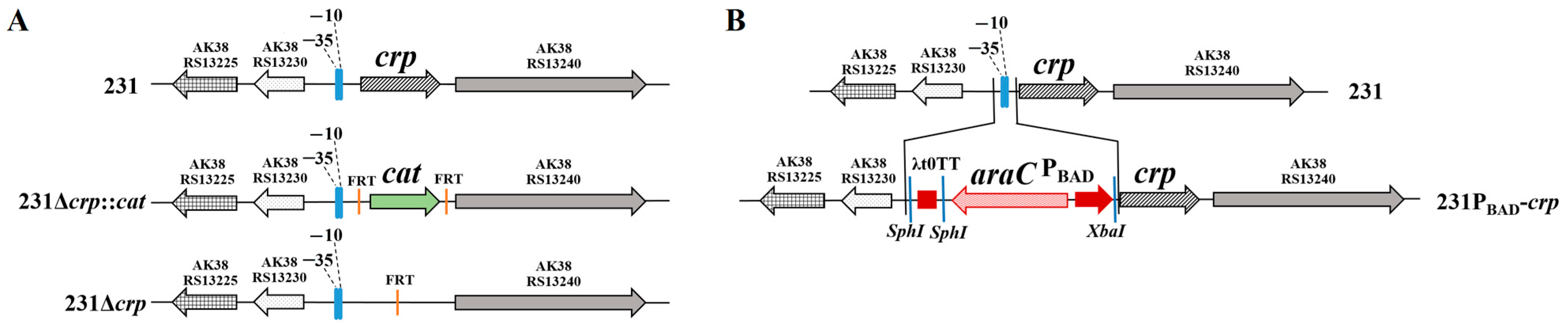
Figure 1. Schematic diagram depicting the chromosomal structure of the crp deletion mutation (A) and deletion-insertion mutations resulting in the arabinose-regulated crp gene (B).
Biomolecules 16 00040 g001
Figure 2. Crp synthesis in Y. pestis crp mutants. Strains were grown in BHI without (Ara) and with 0.2% arabinose (Ara+) at 37 °C overnight, and Crp synthesis was detected by Western blotting using anti-Crp sera. M, protein marker; rCrp—recombinant Crp; wt, wild type. Original WB are in Supplementary Materials.
Biomolecules 16 00040 g002
Figure 3. Phenotypes of Y. pestis strains with crp deletion-insertion mutations streaked on MacConkey maltose agar without (Ara) and with 0.2% arabinose (Ara+).
Biomolecules 16 00040 g003
Figure 4. Virulence of Y. pestis strain 231PBAD-crp(pPst¯) for subcutaneously infected outbred mice (n = 6) and guinea pigs (n = 6).
Biomolecules 16 00040 g004
Figure 5. Antibody responses in sera of mice and guinea pigs immunized s.c. with 231PBAD-crp(pPst¯) at day 28 post immunization. Y. pestis whole-cell lysate (YPL) and recombinant F1 and LcrV were used as the coating antigens. t-test of unpaired samples and ANOVA were used. Antibody titers are shown as individual values with a mean (Mean) with Standard Error of Measurement (SEM). *—p < 0.05; **—p < 0.005; ****—p < 0.0001.
Biomolecules 16 00040 g005
Figure 6. Cytokine levels in the sera of mice (A,B) and guinea pigs (C,D) immunized s.c. with 104 CFU of Y. pestis strain 231PBAD-crp(pPst¯). Serum samples were collected from 3 mice and 3 guinea pigs on days 2, 4, and 6 p.i. Values were calculated as picograms of cytokine per ml of blood. All experiments were performed twice with similar results. ANOVA was used. Cytokines levels were shown as the mean (Mean) with Standard Error of Measurement (SEM). #—p > 0.05; *—p < 0.05; ***—p < 0.005.
Biomolecules 16 00040 g006
Figure 7. Survival of outbred mice (n = 6) and guinea pigs (n = 6) subcutaneously challenged with 200 LD100 of the WT Y. pestis strain 231 30 days after subcutaneous immunization with Y. pestis PBAD-crp(pPst¯) grown in the presence of arabinose. Log-rank (Mantel–Cox) test was used. **—p < 0.05, ****—p < 0.0001.
Biomolecules 16 00040 g007
Table 1. Bacterial strains and plasmids used in this study.
Strain, PlasmidRelevant AttributesSource
Y. pestis
2310.ANT3 phylogroup, wild-type strain, universally virulent (LD50 for mice ≤ 10 CFU, for guinea pigs ≤ 10 CFU); Pgm+, pMT1+, pPst+, pCD+, parental strainSCPM-O ** [19]
EV1.ORI3 phylogroup, vaccine strain, Δpgm *, pMT1+, pPst+, pCD+SCPM-O
EVΔcrp::catΔcrp derivative of EV, CmR
231ΔcrpΔcrp derivative of 231, CmSThis study
231PBAD-crpΔPcrp::araC PBAD crp derivative of Y. pestis 231This study
231PBAD-crp(pPst¯)ΔPcrp::araC PBAD crp pPst¯ derivative of Y. pestis 231PBAD-crpThis study
E. coli
DH5αF, gyrA96(Nalr), recA1, relA1, endA1, thi-1, hsdR17(rk, mk+), glnV44, deoR, Δ(lacZYA-argF)U169, [φ80dΔ(lacZ)M15], supE44SCPM-O
S17-1 λpirthi pro hsdRhsdM+ recA RP4 2-Tc::Mu-Km::Tn7(TpRSmRPmS)SCPM-O
BL21(DE3)FompT hsdSB (rB mB) gal dcm (DE3)SCPM-O
Plasmid
pKD46bla araC PBADgam bet exo pSC101 oriTS[20]
pKD3bla FRT cat FRT PS1 PS2 oriR6K[20]
pCP20bla cat cI857 λPRflp pSC101 oriTS[21]
pET-24b (+)kan pBR322 ori PT7Novagene (Madison, WI, USA; now Millipore Sigma)
pET24-crpkan pBR322 ori PT7 crpThis study
pUC57bla pUC oriThermo Fisher Scientific (Vilnius, Lithunia)
pUC57-URcrp-araC Pbad-crpbla pUC ori araC PBAD crpThis study
pUC57-URcrp-Lt0TT-araC PBAD-crpbla pUC ori bacteriophage Lambda t0 transcriptional terminator PBAD crpThis study
pCVD442ori R6K mob RP4 bla sacB[22]
pCVD442-Δcrp::catbla R6K ori RP4 mob sacB Δcrp::catThis study
pCVD442-URcrp-Lt0TT- araC PBAD-crpbla R6K ori RP4 mob sacB bacteriophage Lambda t0 transcriptional terminator PBAD crpThis study
* The pigmentation locus (pgm) is a large, unstable fragment of the Y. pestis chromosome containing an iron uptake region. Loss of this locus results in a dramatic reduction in virulence [23]. ** The State Collection of Pathogenic Microbes and Cell Cultures on the base of the State Research Center for Applied Microbiology and Biotechnology (“SCPM-Obolensk”).
Table 2. Primers used in this study.
crp Primers for Mutant Construction and Screening
Crp1FATGGTTCTCGGTAAGCCACAAACAGACCCGACTCTCGAATGGTTCCTGTCTCATTATGGGAATTAGCCATGGTCC
Crp1RTTAACGGGTGCCGTAAACGACGATCGTTTTACCGTGTGCGGAGATCAAGTTTTGAGTGTAGGCTGGAGCTGCTTC
Crp2FTAACAACAAAGATACAGCCC
Crp2RAGTAACAAAATTGTGCCACC
Crp-KFGACTTCGCGTACCTCAAAGC
Crp-KRTACATAACCGGAACCACAAC
Primers for pCVD442-URcrp-Lt0TT-PBAD-crp Construction
Pbad-SphIGCGGCATGCATAATGTGCCTGTCAAATGG
Pbad-XbaIGCGTCTAGAGAGAAACAGTAGAGAGTTGC
Lt0-SphIFAGCGCATGCTGACTCCTGTTGATAGATCC
Lt0-SphIRTTTGCATGCGACAAGTTGCTGCGATTCTC
Crp-HindCCTAAGCTTCCCGGGTCGGCTGATAGATCAACTGC
Crp-SphIGAAGCATGCGCCGAAAGGTATAGCCAAGG
Crp-XbaIGCGTCTAGAAAGTTAGGCAGCGATAACAAC
Crp-SalICTTGTCGACTTAACGGGTGCCGTAAAC
Primers for pET24-crp Construction
Crp-NdeITAGTATCATATGGTTCTCGGTAAGCCACA
Crp-XhoITACTCGAGACGGGTGCCGTAAACGACGAT
Screening for pCD1
yscFPlusACACCATATGAGTAACTTCTCTGGATTTACG
yscFMinusATTCTCGAGTGGGAACTTCTGTAGGATG
Screening for pMT
caf1PlusAGTTCCGTTATCGCCATTGC
caf1MinusGGTTAGATACGGTTACGGTTAC
Screening for pPst
PstFCAATCATATGTCAGATACAATGGTAGTG
PstRCTCCTCGAGTTTTAACAATCCACTATC
Table 3. Virulence of Y. pestis strains in subcutaneously infected outbred mice and guinea pigs.
Y. pestis StrainsLD50, CFU
MiceGuinea Pigs
23133
231Δcrp>1072.1 × 108
231PBAD-crp5.6 × 1044.6 × 107
231PBAD-crp(pPst¯)>107>109
Disclaimer/Publisher’s Note: The statements, opinions and data contained in all publications are solely those of the individual author(s) and contributor(s) and not of MDPI and/or the editor(s). MDPI and/or the editor(s) disclaim responsibility for any injury to people or property resulting from any ideas, methods, instructions or products referred to in the content.