

Hypomorphic Protein Expression of DNA Polymerase Beta in PolβL301R-V303R/L301R-V303R Knock-In Transgenic Mice Does Not Impact Global DNA Methylation Levels in the Midbrain
 , , , , ,
  , ,
, ,
Abstract
1. Introduction
2. Materials and Methods
2.1. Reagents and Chemicals
2.2. Cells and Cell Culture
2.3. Polβ Stability Assay and Cell Protein Extract Preparation
2.4. PolβL301R-V303R/L301R-V303R Mouse Generation and Genotyping
2.5. Mouse Brain and Liver Isolation
2.6. Whole Mouse Phenotyping: Histopathologic and Complete Blood Count
2.7. Mouse Brain Microdissection, Fixation, and Cryopreservation
2.8. DNA, RNA, and Protein Isolation
2.9. Immunoblots
2.10. Quantitative RT-PCR Analysis
2.11. Genome Skimming and Analysis
2.12. Statistical Analysis
3. Results
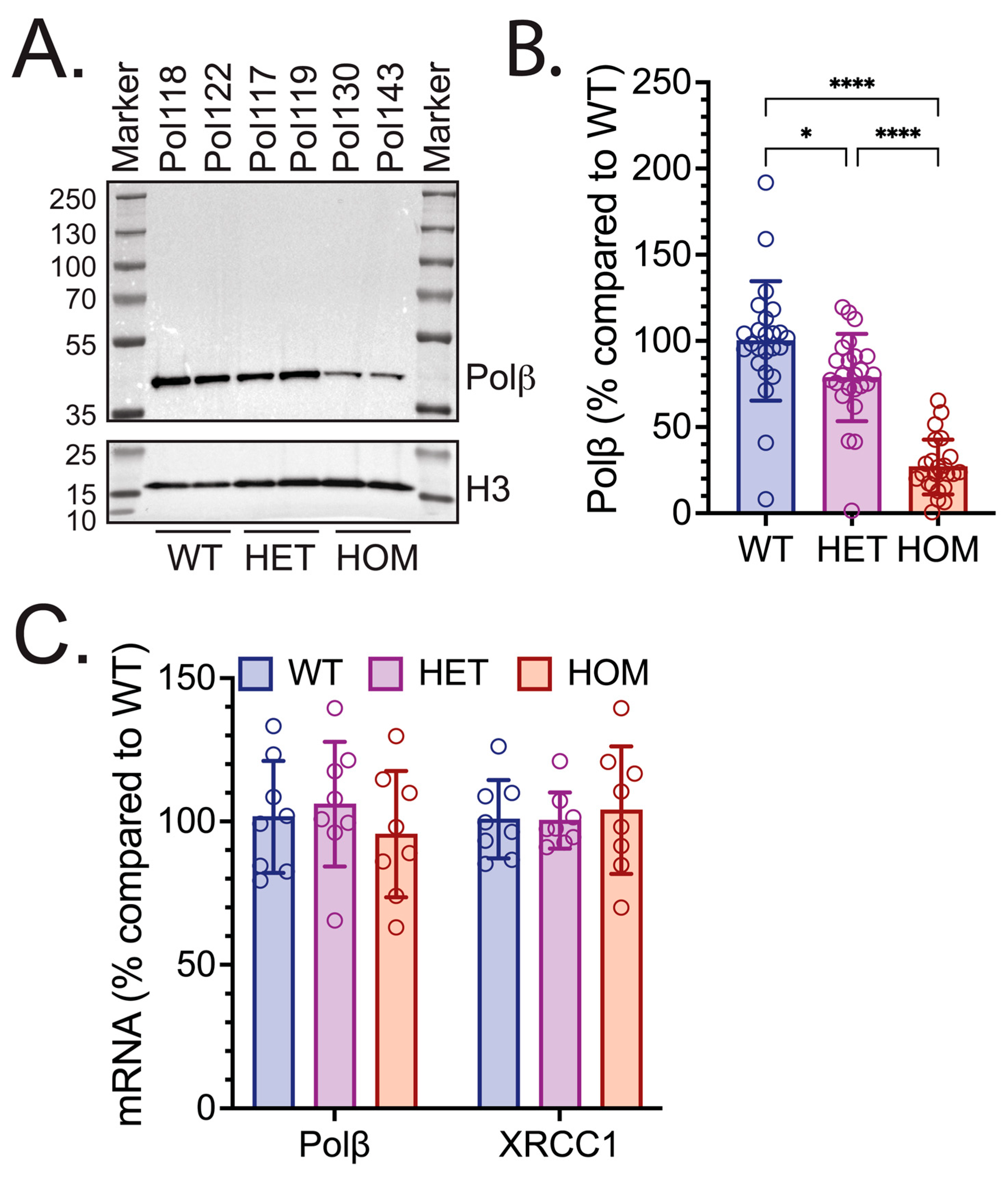
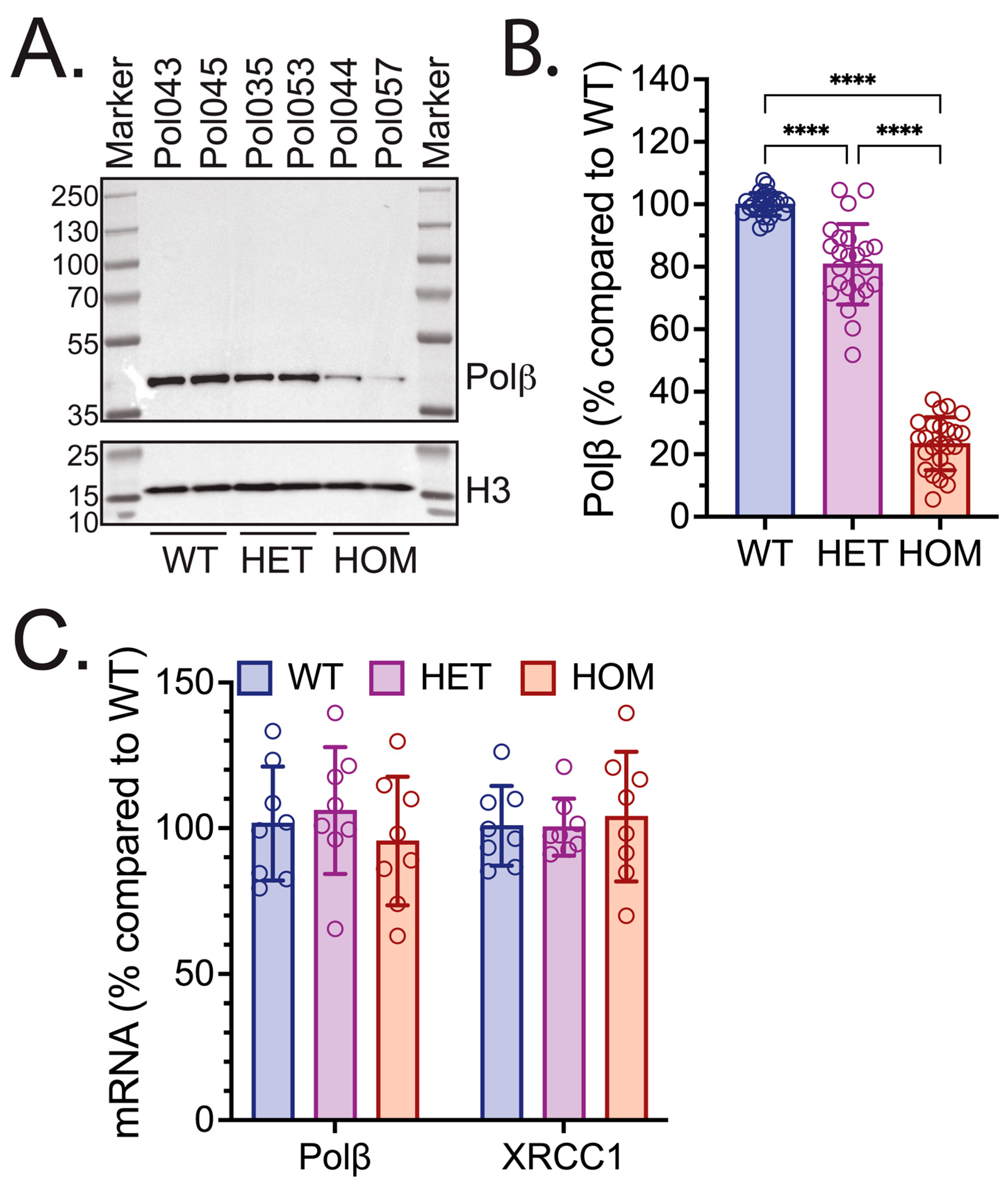
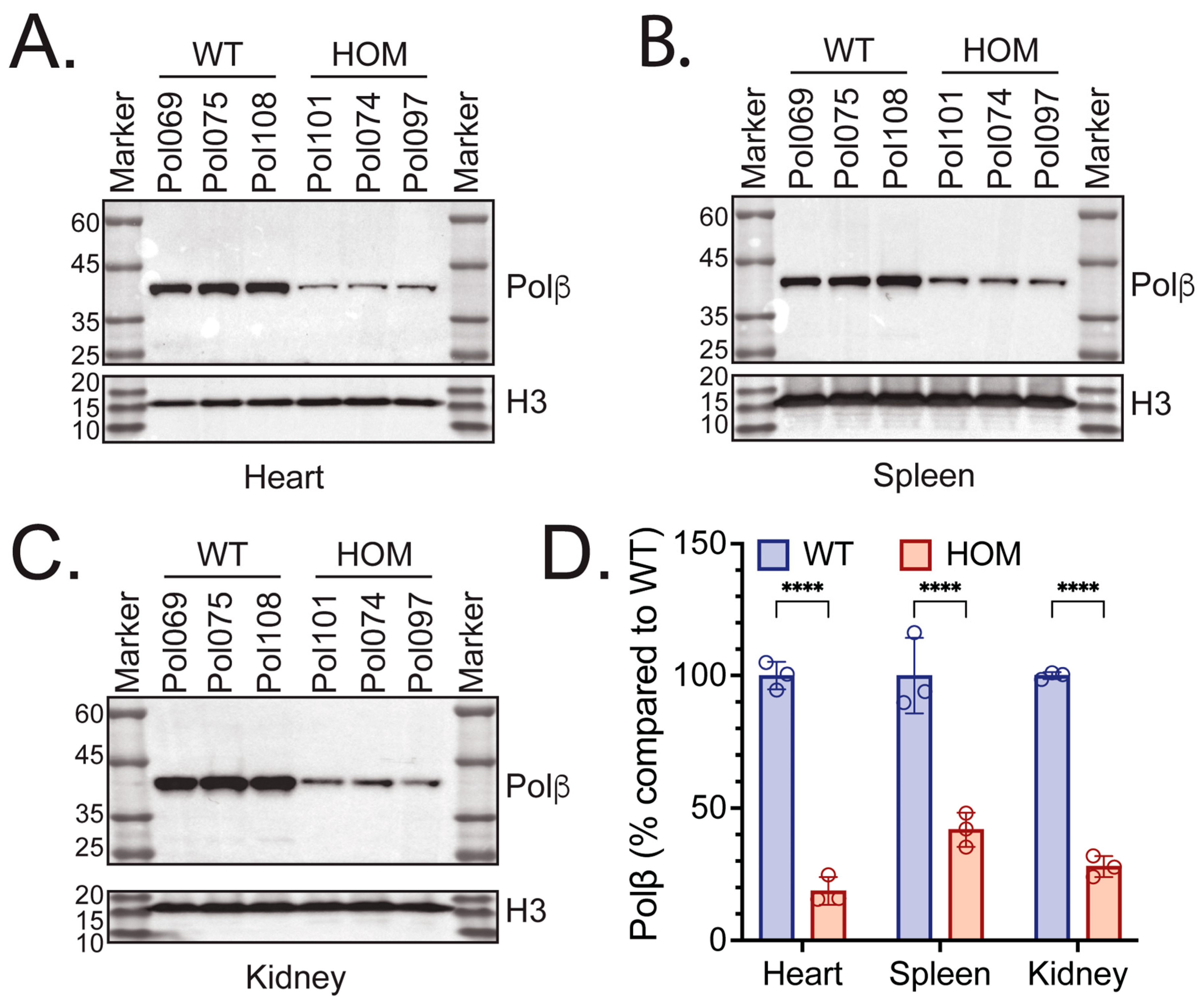
3.1. Polβ Protein Levels Were Diminished in Various PolβL301R-V303R/L301R-V303R Mouse Tissues
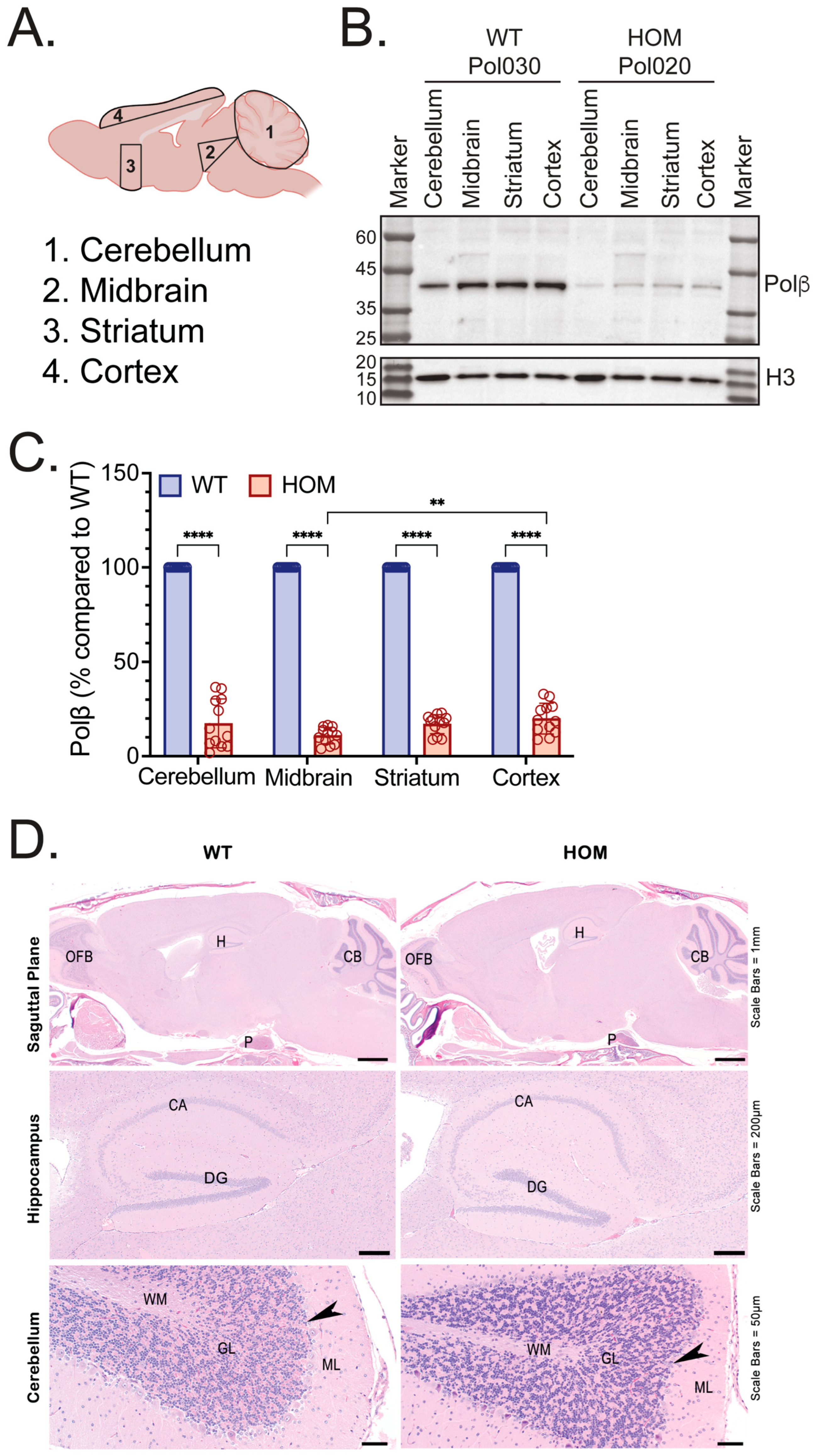
3.2. Polβ Protein Levels Across Brain Sections
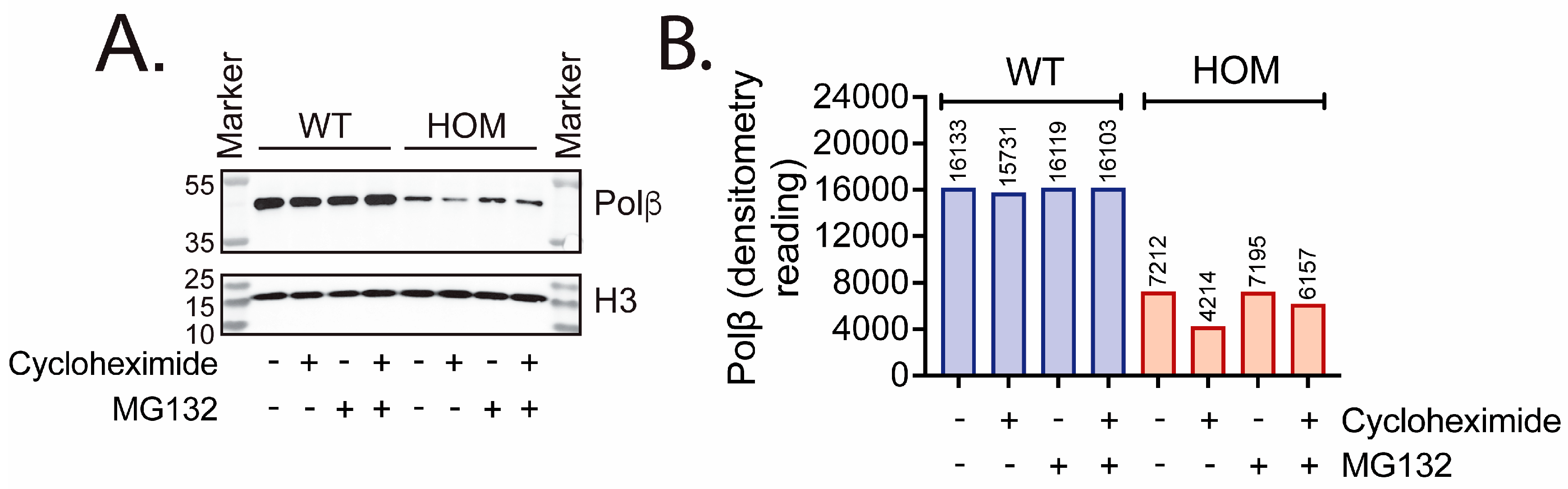
3.3. Polβ Stability in L301R/V303R HOM Mouse Ear Fibroblasts
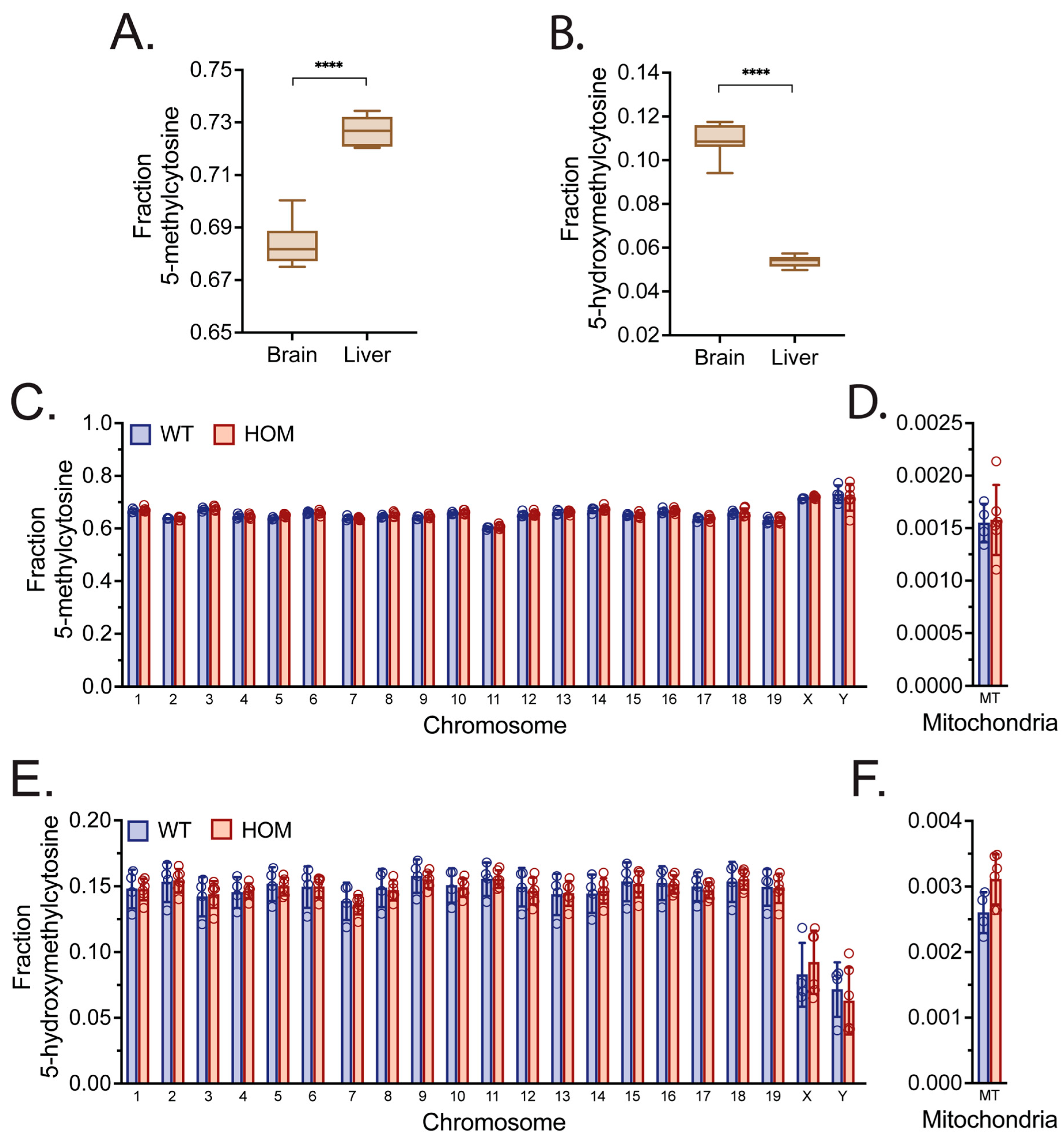
3.4. Genome Skimming of WT, HET, and HOM Polβ KI Mice Reveals Tissue-Specific Methylation Levels
4. Discussion
5. Conclusions
Supplementary Materials
Author Contributions
Funding
Institutional Review Board Statement
Informed Consent Statement
Data Availability Statement
Acknowledgments
Conflicts of Interest
References
- Leguisamo, N.M.; Gloria, H.C.; Kalil, A.N.; Martins, T.V.; Azambuja, D.B.; Meira, L.B.; Saffi, J. Base excision repair imbalance in colorectal cancer has prognostic value and modulates response to chemotherapy. Oncotarget 2017, 8, 54199–54214. [Google Scholar] [CrossRef]
- Yang, J.; Parsons, J.; Nicolay, N.H.; Caporali, S.; Harrington, C.F.; Singh, R.; Finch, D.; D’Atri, S.; Farmer, P.B.; Johnston, P.G.; et al. Cells deficient in the base excision repair protein, DNA polymerase beta, are hypersensitive to oxaliplatin chemotherapy. Oncogene 2010, 29, 463–468. [Google Scholar] [CrossRef]
- Grundy, G.J.; Parsons, J.L. Base excision repair and its implications to cancer therapy. Essays Biochem. 2020, 64, 831–843. [Google Scholar] [CrossRef]
- Montaldo, N.P.; Nilsen, H.L.; Bordin, D.L. Targeting base excision repair in precision oncology. DNA Repair 2025, 149, 103844. [Google Scholar] [CrossRef]
- Zhou, W.; Jing, X.; Hang, R.; Liu, Z.; Cao, L.; Li, M. Base excision repair in human cancer: Emerging diagnostic and therapeutic target. DNA Repair 2025, 152, 103879. [Google Scholar] [CrossRef] [PubMed]
- Dong, J.; Wang, X.; Yu, Y.; Yan, X.; Cui, J.W. Association of Base Excision Repair Gene Polymorphisms with the Response to Chemotherapy in Advanced Non-Small Cell Lung Cancer. Chin. Med. J. 2018, 131, 1904–1908. [Google Scholar] [CrossRef] [PubMed]
- Kim, J.; Kang, S.J.; Jo, N.; Kim, S.J.; Jang, S. Cancer prognosis using base excision repair genes. Mol. Cells 2025, 48, 100186. [Google Scholar] [CrossRef]
- Wallace, S.S.; Murphy, D.L.; Sweasy, J.B. Base excision repair and cancer. Cancer Lett. 2012, 327, 73–89. [Google Scholar] [CrossRef] [PubMed]
- SenGupta, T.; Palikaras, K.; Esbensen, Y.Q.; Konstantinidis, G.; Galindo, F.J.N.; Achanta, K.; Kassahun, H.; Stavgiannoudaki, I.; Bohr, V.A.; Akbari, M.; et al. Base excision repair causes age-dependent accumulation of single-stranded DNA breaks that contribute to Parkinson disease pathology. Cell Rep. 2021, 36, 109668. [Google Scholar] [CrossRef]
- Sykora, P.; Wilson, D.M., 3rd; Bohr, V.A. Base excision repair in the mammalian brain: Implication for age related neurodegeneration. Mech. Ageing Dev. 2013, 134, 440–448. [Google Scholar] [CrossRef]
- Pittman, M.N.; Nelsen, M.B.; Thompson, M.K.; Prakash, A. Mitochondrial DNA Instability and Neuroinflammation: Connecting the Dots Between Base Excision Repair and Neurodegenerative Disease. Genes 2026, 17, 82. [Google Scholar] [CrossRef]
- Leandro, G.S.; Sykora, P.; Bohr, V.A. The impact of base excision DNA repair in age-related neurodegenerative diseases. Mutat. Res. 2015, 776, 31–39. [Google Scholar] [CrossRef] [PubMed]
- Almeida, K.H.; Sobol, R.W. A unified view of base excision repair: Lesion-dependent protein complexes regulated by post-translational modification. DNA Repair 2007, 6, 695–711. [Google Scholar] [CrossRef] [PubMed]
- Xu, G.; Herzig, M.; Rotrekl, V.; Walter, C.A. Base excision repair, aging and health span. Mech. Ageing Dev. 2008, 129, 366–382. [Google Scholar] [CrossRef]
- Wilson, D.M., 3rd; Bohr, V.A. The mechanics of base excision repair, and its relationship to aging and disease. DNA Repair 2007, 6, 544–559. [Google Scholar] [CrossRef]
- Hua, K.; Wang, L.; Sun, J.; Zhou, N.; Zhang, Y.; Ji, F.; Jing, L.; Yang, Y.; Xia, W.; Hu, Z.; et al. Impairment of Pol beta-related DNA base-excision repair leads to ovarian aging in mice. Aging 2020, 12, 25207–25228. [Google Scholar] [CrossRef] [PubMed]
- Maynard, S.; Schurman, S.H.; Harboe, C.; de Souza-Pinto, N.C.; Bohr, V.A. Base excision repair of oxidative DNA damage and association with cancer and aging. Carcinogenesis 2009, 30, 2–10. [Google Scholar] [CrossRef]
- Svilar, D.; Goellner, E.M.; Almeida, K.H.; Sobol, R.W. Base excision repair and lesion-dependent subpathways for repair of oxidative DNA damage. Antioxid. Redox Signal 2011, 14, 2491–2507. [Google Scholar] [CrossRef]
- David, S.S.; O’Shea, V.L.; Kundu, S. Base-excision repair of oxidative DNA damage. Nature 2007, 447, 941–950. [Google Scholar] [CrossRef]
- Lindahl, T. Instability and decay of the primary structure of DNA. Nature 1993, 362, 709–715. [Google Scholar] [CrossRef]
- Lindahl, T.; Wood, R.D. Quality control by DNA repair. Science 1999, 286, 1897–1905. [Google Scholar] [CrossRef]
- Sung, J.S.; Demple, B. Roles of base excision repair subpathways in correcting oxidized abasic sites in DNA. FEBS J. 2006, 273, 1620–1629. [Google Scholar] [CrossRef]
- Sattler, U.; Frit, P.; Salles, B.; Calsou, P. Long-patch DNA repair synthesis during base excision repair in mammalian cells. EMBO Rep. 2003, 4, 363–367. [Google Scholar] [CrossRef] [PubMed]
- Krokan, H.E.; Nilsen, H.; Skorpen, F.; Otterlei, M.; Slupphaug, G. Base excision repair of DNA in mammalian cells. FEBS Lett. 2000, 476, 73–77. [Google Scholar] [CrossRef] [PubMed]
- Whitaker, A.M.; Schaich, M.A.; Smith, M.R.; Flynn, T.S.; Freudenthal, B.D. Base excision repair of oxidative DNA damage: From mechanism to disease. Front. Biosci. 2017, 22, 1493–1522. [Google Scholar] [CrossRef] [PubMed]
- Krokan, H.E.; Bjoras, M. Base excision repair. Cold Spring Harb. Perspect. Biol. 2013, 5, a012583. [Google Scholar] [CrossRef]
- Fromme, J.C.; Verdine, G.L. Base excision repair. Adv. Protein Chem. 2004, 69, 1–41. [Google Scholar] [CrossRef]
- Krokan, H.E.; Standal, R.; Slupphaug, G. DNA glycosylases in the base excision repair of DNA. Biochem. J. 1997, 325, 1–16. [Google Scholar] [CrossRef]
- Dizdaroglu, M. Base-excision repair of oxidative DNA damage by DNA glycosylases. Mutat. Res. 2005, 591, 45–59. [Google Scholar] [CrossRef]
- Demple, B.; Sung, J.S. Molecular and biological roles of Ape1 protein in mammalian base excision repair. DNA Repair 2005, 4, 1442–1449. [Google Scholar] [CrossRef]
- Whitaker, A.M.; Freudenthal, B.D. APE1: A skilled nucleic acid surgeon. DNA Repair 2018, 71, 93–100. [Google Scholar] [CrossRef]
- Lavrik, O.I. PARPs’ impact on base excision DNA repair. DNA Repair 2020, 93, 102911. [Google Scholar] [CrossRef]
- Herrmann, G.K.; Yin, Y.W. The Role of Poly(ADP-ribose) Polymerase 1 in Nuclear and Mitochondrial Base Excision Repair. Biomolecules 2023, 13, 1195. [Google Scholar] [CrossRef] [PubMed]
- Plo, I.; Liao, Z.Y.; Barcelo, J.M.; Kohlhagen, G.; Caldecott, K.W.; Weinfeld, M.; Pommier, Y. Association of XRCC1 and tyrosyl DNA phosphodiesterase (Tdp1) for the repair of topoisomerase I-mediated DNA lesions. DNA Repair 2003, 2, 1087–1100. [Google Scholar] [CrossRef]
- Rashid, I.; Hammel, M.; Sverzhinsky, A.; Tsai, M.S.; Pascal, J.M.; Tainer, J.A.; Tomkinson, A.E. Direct interaction of DNA repair protein tyrosyl DNA phosphodiesterase 1 and the DNA ligase III catalytic domain is regulated by phosphorylation of its flexible N-terminus. J. Biol. Chem. 2021, 297, 100921. [Google Scholar] [CrossRef]
- Kubota, Y.; Nash, R.A.; Klungland, A.; Schar, P.; Barnes, D.E.; Lindahl, T. Reconstitution of DNA base excision-repair with purified human proteins: Interaction between DNA polymerase beta and the XRCC1 protein. EMBO J. 1996, 15, 6662–6670. [Google Scholar] [CrossRef]
- Lan, L.; Nakajima, S.; Oohata, Y.; Takao, M.; Okano, S.; Masutani, M.; Wilson, S.H.; Yasui, A. In situ analysis of repair processes for oxidative DNA damage in mammalian cells. Proc. Natl. Acad. Sci. USA 2004, 101, 13738–13743. [Google Scholar] [CrossRef] [PubMed]
- Ziegler, M.; Oei, S.L. A cellular survival switch: Poly(ADP-ribosyl)ation stimulates DNA repair and silences transcription. Bioessays 2001, 23, 543–548. [Google Scholar] [CrossRef] [PubMed]
- Campalans, A.; Kortulewski, T.; Amouroux, R.; Menoni, H.; Vermeulen, W.; Radicella, J.P. Distinct spatiotemporal patterns and PARP dependence of XRCC1 recruitment to single-strand break and base excision repair. Nucleic Acids Res. 2013, 41, 3115–3129. [Google Scholar] [CrossRef]
- Wilson, S.H.; Sobol, R.W.; Beard, W.A.; Horton, J.K.; Prasad, R.; Vande Berg, B.J. DNA Polymerase ß and Mammalian Base Excision Repair. Cold Spring Harb. Symp. Quant. Biol. 2001, 65, 143–155. [Google Scholar]
- Sobol, R.W.; Wilson, S.H. Mammalian DNA beta-polymerase in base excision repair of alkylation damage. Prog. Nucleic Acid. Res. Mol. Biol. 2001, 68, 57–74. [Google Scholar] [CrossRef] [PubMed]
- Sobol, R.W.; Prasad, R.; Evenski, A.; Baker, A.; Yang, X.P.; Horton, J.K.; Wilson, S.H. The lyase activity of the DNA repair protein beta-polymerase protects from DNA-damage-induced cytotoxicity. Nature 2000, 405, 807–810. [Google Scholar] [CrossRef]
- Sobol, R.W.; Horton, J.K.; Kuhn, R.; Gu, H.; Singhal, R.K.; Prasad, R.; Rajewsky, K.; Wilson, S.H. Requirement of mammalian DNA polymerase-beta in base-excision repair. Nature 1996, 379, 183–186. [Google Scholar] [CrossRef] [PubMed]
- Sugo, N.; Uchimura, A.; Matsumoto, R.; Nakayama, H.; Fujimoto, S.; Mizuno, S.; Higuchi, M.; Toshishige, M.; Satoh, Y.; Wakayama, S.; et al. DNA polymerase beta suppresses somatic indels at CpG dinucleotides in developing cortical neurons. Proc. Natl. Acad. Sci. USA 2025, 122, e2506846122. [Google Scholar] [CrossRef]
- Chen, S.; Zhang, W.; Li, X.; Cao, Z.; Liu, C. DNA polymerase beta connects tumorigenicity with the circadian clock in liver cancer through the epigenetic demethylation of Per1. Cell Death Dis. 2024, 15, 78. [Google Scholar] [CrossRef] [PubMed]
- Uyeda, A.; Onishi, K.; Hirayama, T.; Hattori, S.; Miyakawa, T.; Yagi, T.; Yamamoto, N.; Sugo, N. Suppression of DNA Double-Strand Break Formation by DNA Polymerase beta in Active DNA Demethylation Is Required for Development of Hippocampal Pyramidal Neurons. J. Neurosci. 2020, 40, 9012–9027. [Google Scholar] [CrossRef]
- Onishi, K.; Uyeda, A.; Shida, M.; Hirayama, T.; Yagi, T.; Yamamoto, N.; Sugo, N. Genome Stability by DNA Polymerase beta in Neural Progenitors Contributes to Neuronal Differentiation in Cortical Development. J. Neurosci. 2017, 37, 8444–8458. [Google Scholar] [CrossRef]
- Beard, W.A.; Wilson, S.H. Structure and mechanism of DNA polymerase beta. Biochemistry 2014, 53, 2768–2780. [Google Scholar] [CrossRef]
- Beard, W.A.; Wilson, S.H. Structure and mechanism of DNA polymerase Beta. Chem. Rev. 2006, 106, 361–382. [Google Scholar] [CrossRef]
- Prasad, R.; Batra, V.K.; Yang, X.P.; Krahn, J.M.; Pedersen, L.C.; Beard, W.A.; Wilson, S.H. Structural insight into the DNA polymerase beta deoxyribose phosphate lyase mechanism. DNA Repair 2005, 4, 1347–1357. [Google Scholar] [CrossRef]
- Chatterjee, N.; Walker, G.C. Mechanisms of DNA damage, repair, and mutagenesis. Environ. Mol. Mutagen. 2017, 58, 235–263. [Google Scholar] [CrossRef]
- Lee, D.; Lee, G. Single-molecule studies of repair proteins in base excision repair. BMB Rep. 2025, 58, 17–23. [Google Scholar] [CrossRef] [PubMed]
- Asagoshi, K.; Liu, Y.; Masaoka, A.; Lan, L.; Prasad, R.; Horton, J.K.; Brown, A.R.; Wang, X.H.; Bdour, H.M.; Sobol, R.W.; et al. DNA polymerase beta-dependent long patch base excision repair in living cells. DNA Repair 2010, 9, 109–119. [Google Scholar] [CrossRef] [PubMed]
- Balakrishnan, L.; Brandt, P.D.; Lindsey-Boltz, L.A.; Sancar, A.; Bambara, R.A. Long patch base excision repair proceeds via coordinated stimulation of the multienzyme DNA repair complex. J. Biol. Chem. 2009, 284, 15158–15172. [Google Scholar] [CrossRef] [PubMed]
- Wei, W.; Englander, E.W. DNA polymerase beta-catalyzed-PCNA independent long patch base excision repair synthesis: A mechanism for repair of oxidatively damaged DNA ends in post-mitotic brain. J. Neurochem. 2008, 107, 734–744. [Google Scholar] [CrossRef]
- Fortini, P.; Pascucci, B.; Parlanti, E.; Sobol, R.W.; Wilson, S.H.; Dogliotti, E. Different DNA polymerases are involved in the short- and long-patch base excision repair in mammalian cells. Biochemistry 1998, 37, 3575–3580. [Google Scholar] [CrossRef]
- Trasvina-Arenas, C.H.; Baruch-Torres, N.; Cordoba-Andrade, F.J.; Ayala-Garcia, V.M.; Garcia-Medel, P.L.; Diaz-Quezada, C.; Peralta-Castro, A.; Ordaz-Ortiz, J.J.; Brieba, L.G. Identification of a unique insertion in plant organellar DNA polymerases responsible for 5′-dRP lyase and strand-displacement activities: Implications for Base Excision Repair. DNA Repair 2018, 65, 1–10. [Google Scholar] [CrossRef]
- Wilson, S.H.; Kunkel, T.A. Passing the baton in base excision repair. Nat. Struct. Biol. 2000, 7, 176–178. [Google Scholar] [CrossRef]
- Endutkin, A.V.; Yudkina, A.V.; Sidorenko, V.S.; Zharkov, D.O. Transient protein-protein complexes in base excision repair. J. Biomol. Struct. Dyn. 2019, 37, 4407–4418. [Google Scholar] [CrossRef]
- Beard, W.A.; Horton, J.K.; Prasad, R.; Wilson, S.H. Eukaryotic Base Excision Repair: New Approaches Shine Light on Mechanism. Annu. Rev. Biochem. 2019, 88, 137–162. [Google Scholar] [CrossRef]
- Rathnaiah, G.; Sweasy, J.B. Protein-Protein Interactions in Base Excision Repair. Biomolecules 2025, 15, 890. [Google Scholar] [CrossRef] [PubMed]
- Vickridge, E.; Faraco, C.C.F.; Nepveu, A. Base excision repair accessory factors in senescence avoidance and resistance to treatments. Cancer Drug Resist. 2022, 5, 703–720. [Google Scholar] [CrossRef]
- Saville, K.M.; Clark, J.; Wilk, A.; Rogers, G.D.; Andrews, J.F.; Koczor, C.A.; Sobol, R.W. NAD(+)-mediated regulation of mammalian base excision repair. DNA Repair 2020, 93, 102930. [Google Scholar] [CrossRef]
- Sobol, R.W.; Kartalou, M.; Almeida, K.H.; Joyce, D.F.; Engelward, B.P.; Horton, J.K.; Prasad, R.; Samson, L.D.; Wilson, S.H. Base excision repair intermediates induce p53-independent cytotoxic and genotoxic responses. J. Biol. Chem. 2003, 278, 39951–39959. [Google Scholar] [CrossRef] [PubMed]
- Fu, D.; Calvo, J.A.; Samson, L.D. Balancing repair and tolerance of DNA damage caused by alkylating agents. Nat. Rev. Cancer 2012, 12, 104–120. [Google Scholar] [CrossRef] [PubMed]
- Marintchev, A.; Robertson, A.; Dimitriadis, E.K.; Prasad, R.; Wilson, S.H.; Mullen, G.P. Domain specific interaction in the XRCC1-DNA polymerase beta complex. Nucleic Acids Res. 2000, 28, 2049–2059. [Google Scholar] [CrossRef]
- Cuneo, M.J.; London, R.E. Oxidation state of the XRCC1 N-terminal domain regulates DNA polymerase beta binding affinity. Proc. Natl. Acad. Sci. USA 2010, 107, 6805–6810. [Google Scholar] [CrossRef]
- Kratz, A.; Kim, M.; Kelly, M.R.; Zheng, F.; Koczor, C.A.; Li, J.; Ono, K.; Qin, Y.; Churas, C.; Chen, J.; et al. A multi-scale map of protein assemblies in the DNA damage response. Cell Syst. 2023, 14, 447–463.e8. [Google Scholar] [CrossRef]
- Koczor, C.A.; Saville, K.M.; Andrews, J.F.; Clark, J.; Fang, Q.; Li, J.; Al-Rahahleh, R.Q.; Ibrahim, M.; McClellan, S.; Makarov, M.V.; et al. Temporal dynamics of base excision/single-strand break repair protein complex assembly/disassembly are modulated by the PARP/NAD(+)/SIRT6 axis. Cell Rep. 2021, 37, 109917. [Google Scholar] [CrossRef]
- Gryk, M.R.; Marintchev, A.; Maciejewski, M.W.; Robertson, A.; Wilson, S.H.; Mullen, G.P. Mapping of the interaction interface of DNA polymerase beta with XRCC1. Structure 2002, 10, 1709–1720. [Google Scholar] [CrossRef]
- Marintchev, A.; Mullen, M.A.; Maciejewski, M.W.; Pan, B.; Gryk, M.R.; Mullen, G.P. Solution structure of the single-strand break repair protein XRCC1 N-terminal domain. Nat. Struct. Biol. 1999, 6, 884–893. [Google Scholar] [CrossRef] [PubMed]
- Koczor, C.A.; Thompson, M.K.; Sharma, N.; Prakash, A.; Sobol, R.W. Polbeta/XRCC1 heterodimerization dictates DNA damage recognition and basal Polbeta protein levels without interfering with mouse viability or fertility. DNA Repair 2023, 123, 103452. [Google Scholar] [CrossRef]
- Sobol, R.W. Mouse models to explore the biological and organismic role of DNA polymerase beta. Environ. Mol. Mutagen. 2024, 65, 57–71. [Google Scholar] [CrossRef]
- Fang, Q.; Inanc, B.; Schamus, S.; Wang, X.H.; Wei, L.; Brown, A.R.; Svilar, D.; Sugrue, K.F.; Goellner, E.M.; Zeng, X.; et al. HSP90 regulates DNA repair via the interaction between XRCC1 and DNA polymerase beta. Nat. Commun. 2014, 5, 5513. [Google Scholar] [CrossRef]
- Inanc, B.; Fang, Q.; Roos, W.P.; Andrews, J.F.; Zeng, X.; Clark, J.; Li, J.; Dey, N.B.; Ibrahim, M.; Sykora, P.; et al. TRIP12’s role in the governance of DNA polymerase beta involvement in DNA damage response and repair. Nucleic Acids Res. 2025, 53, gkaf574. [Google Scholar] [CrossRef]
- Gu, H.; Marth, J.D.; Orban, P.C.; Mossmann, H.; Rajewsky, K. Deletion of a DNA polymerase beta gene segment in T cells using cell type-specific gene targeting. Science 1994, 265, 103–106. [Google Scholar] [CrossRef]
- Esposito, G.; Texido, G.; Betz, U.A.; Gu, H.; Muller, W.; Klein, U.; Rajewsky, K. Mice reconstituted with DNA polymerase beta-deficient fetal liver cells are able to mount a T cell-dependent immune response and mutate their Ig genes normally. Proc. Natl. Acad. Sci. USA 2000, 97, 1166–1171. [Google Scholar] [CrossRef]
- Sugo, N.; Aratani, Y.; Nagashima, Y.; Kubota, Y.; Koyama, H. Neonatal lethality with abnormal neurogenesis in mice deficient in DNA polymerase beta. EMBO J. 2000, 19, 1397–1404. [Google Scholar] [CrossRef]
- Wu, W.; Kargbo-Hill, S.E.; Nathan, W.J.; Paiano, J.; Callen, E.; Wang, D.; Shinoda, K.; van Wietmarschen, N.; Colon-Mercado, J.M.; Zong, D.; et al. Neuronal enhancers are hotspots for DNA single-strand break repair. Nature 2021, 593, 440–444. [Google Scholar] [CrossRef] [PubMed]
- Miner, K.M.; Jamenis, A.S.; Bhatia, T.N.; Clark, R.N.; Rajasundaram, D.; Sauvaigo, S.; Mason, D.M.; Posimo, J.M.; Abraham, N.; DeMarco, B.A.; et al. alpha-synucleinopathy exerts sex-dimorphic effects on the multipurpose DNA repair/redox protein APE1 in mice and humans. Prog. Neurobiol. 2022, 216, 102307. [Google Scholar] [CrossRef] [PubMed]
- Sanders, L.H.; Paul, K.C.; Howlett, E.H.; Lawal, H.; Boppana, S.; Bronstein, J.M.; Ritz, B.; Greenamyre, J.T. Editor’s Highlight: Base Excision Repair Variants and Pesticide Exposure Increase Parkinson’s Disease Risk. Toxicol. Sci. 2017, 158, 188–198. [Google Scholar] [CrossRef]
- Wu, X.; Zhang, Y. TET-mediated active DNA demethylation: Mechanism, function and beyond. Nat. Rev. Genet. 2017, 18, 517–534. [Google Scholar] [CrossRef]
- He, Y.F.; Li, B.Z.; Li, Z.; Liu, P.; Wang, Y.; Tang, Q.; Ding, J.; Jia, Y.; Chen, Z.; Li, L.; et al. Tet-mediated formation of 5-carboxylcytosine and its excision by TDG in mammalian DNA. Science 2011, 333, 1303–1307. [Google Scholar] [CrossRef]
- Cortellino, S.; Xu, J.; Sannai, M.; Moore, R.; Caretti, E.; Cigliano, A.; Le Coz, M.; Devarajan, K.; Wessels, A.; Soprano, D.; et al. Thymine DNA glycosylase is essential for active DNA demethylation by linked deamination-base excision repair. Cell 2011, 146, 67–79. [Google Scholar] [CrossRef] [PubMed]
- Weber, A.R.; Krawczyk, C.; Robertson, A.B.; Kusnierczyk, A.; Vagbo, C.B.; Schuermann, D.; Klungland, A.; Schar, P. Biochemical reconstitution of TET1-TDG-BER-dependent active DNA demethylation reveals a highly coordinated mechanism. Nat. Commun. 2016, 7, 10806. [Google Scholar] [CrossRef] [PubMed]
- Hu, L.; Lu, J.; Cheng, J.; Rao, Q.; Li, Z.; Hou, H.; Lou, Z.; Zhang, L.; Li, W.; Gong, W.; et al. Structural insight into substrate preference for TET-mediated oxidation. Nature 2015, 527, 118–122. [Google Scholar] [CrossRef]
- Dalton, S.R.; Bellacosa, A. DNA demethylation by TDG. Epigenomics 2012, 4, 459–467. [Google Scholar] [CrossRef]
- Akbari, M.; Morevati, M.; Croteau, D.; Bohr, V.A. The role of DNA base excision repair in brain homeostasis and disease. DNA Repair 2015, 32, 172–179. [Google Scholar] [CrossRef] [PubMed]
- Caglayan, M. Pol beta gap filling, DNA ligation and substrate-product channeling during base excision repair opposite oxidized 5-methylcytosine modifications. DNA Repair 2020, 95, 102945. [Google Scholar] [CrossRef]
- Hajkova, P.; Jeffries, S.J.; Lee, C.; Miller, N.; Jackson, S.P.; Surani, M.A. Genome-wide reprogramming in the mouse germ line entails the base excision repair pathway. Science 2010, 329, 78–82. [Google Scholar] [CrossRef]
- Drohat, A.C.; Coey, C.T. Role of Base Excision “Repair” Enzymes in Erasing Epigenetic Marks from DNA. Chem. Rev. 2016, 116, 12711–12729. [Google Scholar] [CrossRef]
- Schwarz, S.D.; Xu, J.; Gunasekera, K.; Schurmann, D.; Vagbo, C.B.; Ferrari, E.; Slupphaug, G.; Hottiger, M.O.; Schar, P.; Steinacher, R. Covalent PARylation of DNA base excision repair proteins regulates DNA demethylation. Nat. Commun. 2024, 15, 184. [Google Scholar] [CrossRef] [PubMed]
- Steinacher, R.; Barekati, Z.; Botev, P.; Kusnierczyk, A.; Slupphaug, G.; Schar, P. SUMOylation coordinates BERosome assembly in active DNA demethylation during cell differentiation. EMBO J. 2019, 38, e99242. [Google Scholar] [CrossRef] [PubMed]
- Tolic, A.; Ravichandran, M.; Rajic, J.; Dordevic, M.; Dordevic, M.; Dinic, S.; Grdovic, N.; Jovanovic, J.A.; Mihailovic, M.; Nestorovic, N.; et al. TET-mediated DNA hydroxymethylation is negatively influenced by the PARP-dependent PARylation. Epigenetics Chromatin 2022, 15, 11. [Google Scholar] [CrossRef]
- Caldecott, K.W.; Ward, M.E.; Nussenzweig, A. The threat of programmed DNA damage to neuronal genome integrity and plasticity. Nat. Genet. 2022, 54, 115–120. [Google Scholar] [CrossRef]
- Barzilai, A.; Biton, S.; Shiloh, Y. The role of the DNA damage response in neuronal development, organization and maintenance. DNA Repair 2008, 7, 1010–1027. [Google Scholar] [CrossRef] [PubMed]
- Rao, K.S.; Annapurna, V.V.; Raji, N.S.; Harikrishna, T. Loss of base excision repair in aging rat neurons and its restoration by DNA polymerase beta. Brain Res. Mol. Brain Res. 2000, 85, 251–259. [Google Scholar] [CrossRef]
- Wilson, D.M., 3rd; McNeill, D.R. Base excision repair and the central nervous system. Neuroscience 2007, 145, 1187–1200. [Google Scholar] [CrossRef]
- Rolseth, V.; Runden-Pran, E.; Neurauter, C.G.; Yndestad, A.; Luna, L.; Aukrust, P.; Ottersen, O.P.; Bjoras, M. Base excision repair activities in organotypic hippocampal slice cultures exposed to oxygen and glucose deprivation. DNA Repair 2008, 7, 869–878. [Google Scholar] [CrossRef]
- Mantha, A.K.; Sarkar, B.; Tell, G. A short review on the implications of base excision repair pathway for neurons: Relevance to neurodegenerative diseases. Mitochondrion 2014, 16, 38–49. [Google Scholar] [CrossRef]
- Oddo, S.; Caccamo, A.; Shepherd, J.D.; Murphy, M.P.; Golde, T.E.; Kayed, R.; Metherate, R.; Mattson, M.P.; Akbari, Y.; LaFerla, F.M. Triple-transgenic model of Alzheimer’s disease with plaques and tangles: Intracellular Abeta and synaptic dysfunction. Neuron 2003, 39, 409–421. [Google Scholar] [CrossRef] [PubMed]
- Sykora, P.; Misiak, M.; Wang, Y.; Ghosh, S.; Leandro, G.S.; Liu, D.; Tian, J.; Baptiste, B.A.; Cong, W.N.; Brenerman, B.M.; et al. DNA polymerase beta deficiency leads to neurodegeneration and exacerbates Alzheimer disease phenotypes. Nucleic Acids Res. 2015, 43, 943–959. [Google Scholar] [CrossRef]
- Sugo, N.; Niimi, N.; Aratani, Y.; Takiguchi-Hayashi, K.; Koyama, H. p53 Deficiency rescues neuronal apoptosis but not differentiation in DNA polymerase beta-deficient mice. Mol. Cell Biol. 2004, 24, 9470–9477. [Google Scholar] [CrossRef] [PubMed]
- Khan, M.; Gasser, S. Generating Primary Fibroblast Cultures from Mouse Ear and Tail Tissues. J. Vis. Exp. JoVE 2016, e53565. [Google Scholar] [CrossRef]
- Sanders, L.H.; McCoy, J.; Hu, X.; Mastroberardino, P.G.; Dickinson, B.C.; Chang, C.J.; Chu, C.T.; Van Houten, B.; Greenamyre, J.T. Mitochondrial DNA damage: Molecular marker of vulnerable nigral neurons in Parkinson’s disease. Neurobiol. Dis. 2014, 70, 214–223. [Google Scholar] [CrossRef]
- Kikuchi, T.; Morizane, A.; Doi, D.; Magotani, H.; Onoe, H.; Hayashi, T.; Mizuma, H.; Takara, S.; Takahashi, R.; Inoue, H.; et al. Human iPS cell-derived dopaminergic neurons function in a primate Parkinson’s disease model. Nature 2017, 548, 592–596. [Google Scholar] [CrossRef]
- Currim, F.; Tanwar, R.; Brown-Leung, J.M.; Paranjape, N.; Liu, J.; Sanders, L.H.; Doorn, J.A.; Cannon, J.R. Selective dopaminergic neurotoxicity modulated by inherent cell-type specific neurobiology. Neurotoxicology 2024, 103, 266–287. [Google Scholar] [CrossRef]
- Surmeier, D.J. Determinants of dopaminergic neuron loss in Parkinson’s disease. FEBS J. 2018, 285, 3657–3668. [Google Scholar] [CrossRef]
- Faulk, C. Genome skimming with nanopore sequencing precisely determines global and transposon DNA methylation in vertebrates. Genome Res. 2023, 33, 948–956. [Google Scholar] [CrossRef]
- Fang, Q.; Andrews, J.; Sharma, N.; Wilk, A.; Clark, J.; Slyskova, J.; Koczor, C.A.; Lans, H.; Prakash, A.; Sobol, R.W. Stability and sub-cellular localization of DNA polymerase beta is regulated by interactions with NQO1 and XRCC1 in response to oxidative stress. Nucleic Acids Res. 2019, 47, 6269–6286. [Google Scholar] [CrossRef] [PubMed]
- Lu, H.; Liu, X.; Deng, Y.; Qing, H. DNA methylation, a hand behind neurodegenerative diseases. Front. Aging Neurosci. 2013, 5, 85. [Google Scholar] [CrossRef]
- Khare, T.; Pai, S.; Koncevicius, K.; Pal, M.; Kriukiene, E.; Liutkeviciute, Z.; Irimia, M.; Jia, P.; Ptak, C.; Xia, M.; et al. 5-hmC in the brain is abundant in synaptic genes and shows differences at the exon-intron boundary. Nat. Struct. Mol. Biol. 2012, 19, 1037–1043. [Google Scholar] [CrossRef] [PubMed]
- Kidane, D.; Jonason, A.S.; Gorton, T.S.; Mihaylov, I.; Pan, J.; Keeney, S.; de Rooij, D.G.; Ashley, T.; Keh, A.; Liu, Y.; et al. DNA polymerase beta is critical for mouse meiotic synapsis. EMBO J. 2010, 29, 410–423. [Google Scholar] [CrossRef]
- Betz, U.A.; Vosshenrich, C.A.; Rajewsky, K.; Muller, W. Bypass of lethality with mosaic mice generated by Cre-loxP-mediated recombination. Curr. Biol. 1996, 6, 1307–1316. [Google Scholar] [CrossRef] [PubMed]
- He, B.; Zhang, C.; Zhang, X.; Fan, Y.; Zeng, H.; Liu, J.; Meng, H.; Bai, D.; Peng, J.; Zhang, Q.; et al. Tissue-specific 5-hydroxymethylcytosine landscape of the human genome. Nat. Commun. 2021, 12, 4249. [Google Scholar] [CrossRef] [PubMed]
- Ponnaluri, V.K.; Ehrlich, K.C.; Zhang, G.; Lacey, M.; Johnston, D.; Pradhan, S.; Ehrlich, M. Association of 5-hydroxymethylation and 5-methylation of DNA cytosine with tissue-specific gene expression. Epigenetics 2017, 12, 123–138. [Google Scholar] [CrossRef]
- Brenerman, B.M.; Illuzzi, J.L.; Wilson, D.M., 3rd. Base excision repair capacity in informing healthspan. Carcinogenesis 2014, 35, 2643–2652. [Google Scholar] [CrossRef]
- Cabelof, D.C.; Raffoul, J.J.; Yanamadala, S.; Ganir, C.; Guo, Z.; Heydari, A.R. Attenuation of DNA polymerase beta-dependent base excision repair and increased DMS-induced mutagenicity in aged mice. Mutat. Res. 2002, 500, 135–145. [Google Scholar] [CrossRef]
- Horton, J.K.; Prasad, R.; Hou, E.; Wilson, S.H. Protection against methylation-induced cytotoxicity by DNA polymerase beta-dependent long patch base excision repair. J. Biol. Chem. 2000, 275, 2211–2218. [Google Scholar] [CrossRef]
- Khan, M.M.; Roos, W.P.; Pearson, C.R.; Leonard, S.M.; Angajala, A.; Gibbs, D.Y.; Liu, J.C.; Ragin, C.; Sobol, R.W. DNA polymerase beta expression in head & neck cancer modulates the poly(ADP-ribose)-mediated replication checkpoint. DNA Repair 2025, 150, 103853. [Google Scholar] [CrossRef]
- Ibrahim, M.; Roos, W.P.; Schwartz, J.C.; Khan, M.M.; Al-Rahahleh, R.Q.; Beers, L.A.; Pearson, C.R.; Langham, K.T.; Boyang, L.; Clark, J.; et al. Replication-associated base excision repair/single-strand break repair regulates PARG inhibitor response via the PRMT1/PRMT5/ATR axis. NAR Cancer 2025, 7, zcaf057. [Google Scholar] [CrossRef]
- Saville, K.M.; Al-Rahahleh, R.Q.; Siddiqui, A.H.; Andrews, M.E.; Roos, W.P.; Koczor, C.A.; Andrews, J.F.; Hayat, F.; Migaud, M.E.; Sobol, R.W. Oncometabolite 2-hydroxyglutarate suppresses basal protein levels of DNA polymerase beta that enhances alkylating agent and PARG inhibition induced cytotoxicity. DNA Repair 2024, 140, 103700. [Google Scholar] [CrossRef]
- Sykora, P.; Kanno, S.; Akbari, M.; Kulikowicz, T.; Baptiste, B.A.; Leandro, G.S.; Lu, H.; Tian, J.; May, A.; Becker, K.A.; et al. DNA Polymerase Beta Participates in Mitochondrial DNA Repair. Mol. Cell Biol. 2017, 37, e00237-17. [Google Scholar] [CrossRef]
- Prasad, R.; Caglayan, M.; Dai, D.P.; Nadalutti, C.A.; Zhao, M.L.; Gassman, N.R.; Janoshazi, A.K.; Stefanick, D.F.; Horton, J.K.; Krasich, R.; et al. DNA polymerase beta: A missing link of the base excision repair machinery in mammalian mitochondria. DNA Repair 2017, 60, 77–88. [Google Scholar] [CrossRef]
- Mellor, C.; Larson, E.A.; Wang, M. Mechanisms of genome instability from cellular folate stress. J. Cell Biol. 2025, 224, e202502205. [Google Scholar] [CrossRef] [PubMed]
- LeBlanc, D.P.; Behan, N.A.; O’Brien, J.M.; Marchetti, F.; MacFarlane, A.J. Folate deficiency increases chromosomal damage and mutations in hematopoietic cells in the transgenic mutamouse model. Environ. Mol. Mutagen. 2018, 59, 366–374. [Google Scholar] [CrossRef] [PubMed]
- Wang, X.; Yu, J.; Wang, J. Neural Tube Defects and Folate Deficiency: Is DNA Repair Defective? Int. J. Mol. Sci. 2023, 24, 2220. [Google Scholar] [CrossRef]
- Pribyl, L.J.; Kay, J.E.; Corrigan, J.J.; Volk, L.B.; Norales, M.; Owiti, N.A.; Kowal, E.A.; Kohale, I.N.; Nazari, I.S.; Swanson, M.R.; et al. Persistent interferon signaling and clonal expansion mark early events in DNA methylation damage-induced liver cancer. bioRxiv 2025. [Google Scholar] [CrossRef] [PubMed]
- Gonzalez-Hunt, C.P.; Sanders, L.H. DNA damage and repair in Parkinson’s disease: Recent advances and new opportunities. J. Neurosci. Res. 2021, 99, 180–189. [Google Scholar] [CrossRef]
- Sanders, L.H.; Timothy Greenamyre, J. Oxidative damage to macromolecules in human Parkinson disease and the rotenone model. Free Radic. Biol. Med. 2013, 62, 111–120. [Google Scholar] [CrossRef]
- Trist, B.G.; Hare, D.J.; Double, K.L. Oxidative stress in the aging substantia nigra and the etiology of Parkinson’s disease. Aging Cell 2019, 18, e13031. [Google Scholar] [CrossRef] [PubMed]
- Puspita, L.; Chung, S.Y.; Shim, J.W. Oxidative stress and cellular pathologies in Parkinson’s disease. Mol. Brain 2017, 10, 53. [Google Scholar] [CrossRef] [PubMed]



Disclaimer/Publisher’s Note: The statements, opinions and data contained in all publications are solely those of the individual author(s) and contributor(s) and not of MDPI and/or the editor(s). MDPI and/or the editor(s) disclaim responsibility for any injury to people or property resulting from any ideas, methods, instructions or products referred to in the content. |
© 2026 by the authors. Licensee MDPI, Basel, Switzerland. This article is an open access article distributed under the terms and conditions of the Creative Commons Attribution (CC BY) license.
Share and Cite
Jacobs, B.; Ivanov, D.; Barraza, I.; Faulk, C.; Booth, C.J.; Mattos-Canedo, R.; Tian, L.; DePietro, K.; Uzun, A.; Roos, W.P.; et al. Hypomorphic Protein Expression of DNA Polymerase Beta in PolβL301R-V303R/L301R-V303R Knock-In Transgenic Mice Does Not Impact Global DNA Methylation Levels in the Midbrain. Biomolecules 2026, 16, 412. https://doi.org/10.3390/biom16030412
Jacobs B, Ivanov D, Barraza I, Faulk C, Booth CJ, Mattos-Canedo R, Tian L, DePietro K, Uzun A, Roos WP, et al. Hypomorphic Protein Expression of DNA Polymerase Beta in PolβL301R-V303R/L301R-V303R Knock-In Transgenic Mice Does Not Impact Global DNA Methylation Levels in the Midbrain. Biomolecules. 2026; 16(3):412. https://doi.org/10.3390/biom16030412
Chicago/Turabian StyleJacobs, Bryce, Dan Ivanov, Ivana Barraza, Christopher Faulk, Carmen J. Booth, Raquel Mattos-Canedo, Lucas Tian, Kaitlyn DePietro, Alper Uzun, Wynand P. Roos, and et al. 2026. "Hypomorphic Protein Expression of DNA Polymerase Beta in PolβL301R-V303R/L301R-V303R Knock-In Transgenic Mice Does Not Impact Global DNA Methylation Levels in the Midbrain" Biomolecules 16, no. 3: 412. https://doi.org/10.3390/biom16030412
APA StyleJacobs, B., Ivanov, D., Barraza, I., Faulk, C., Booth, C. J., Mattos-Canedo, R., Tian, L., DePietro, K., Uzun, A., Roos, W. P., Sanders, L. H., & Sobol, R. W. (2026). Hypomorphic Protein Expression of DNA Polymerase Beta in PolβL301R-V303R/L301R-V303R Knock-In Transgenic Mice Does Not Impact Global DNA Methylation Levels in the Midbrain. Biomolecules, 16(3), 412. https://doi.org/10.3390/biom16030412