Impaired Brain Incretin and Gut Hormone Expression in Human Alcohol-Related Brain Damage: Opportunities for Therapeutic Targeting

Abstract
1. Introduction
2. Materials and Methods
2.1. Human Subjects
2.2. Human Brain Tissue Homogenization for Protein Studies
2.3. Duplex Enzyme-Linked Immunosorbent Assays (ELISAs)
2.4. Multiplex ELISA
2.5. Data Analysis
3. Results
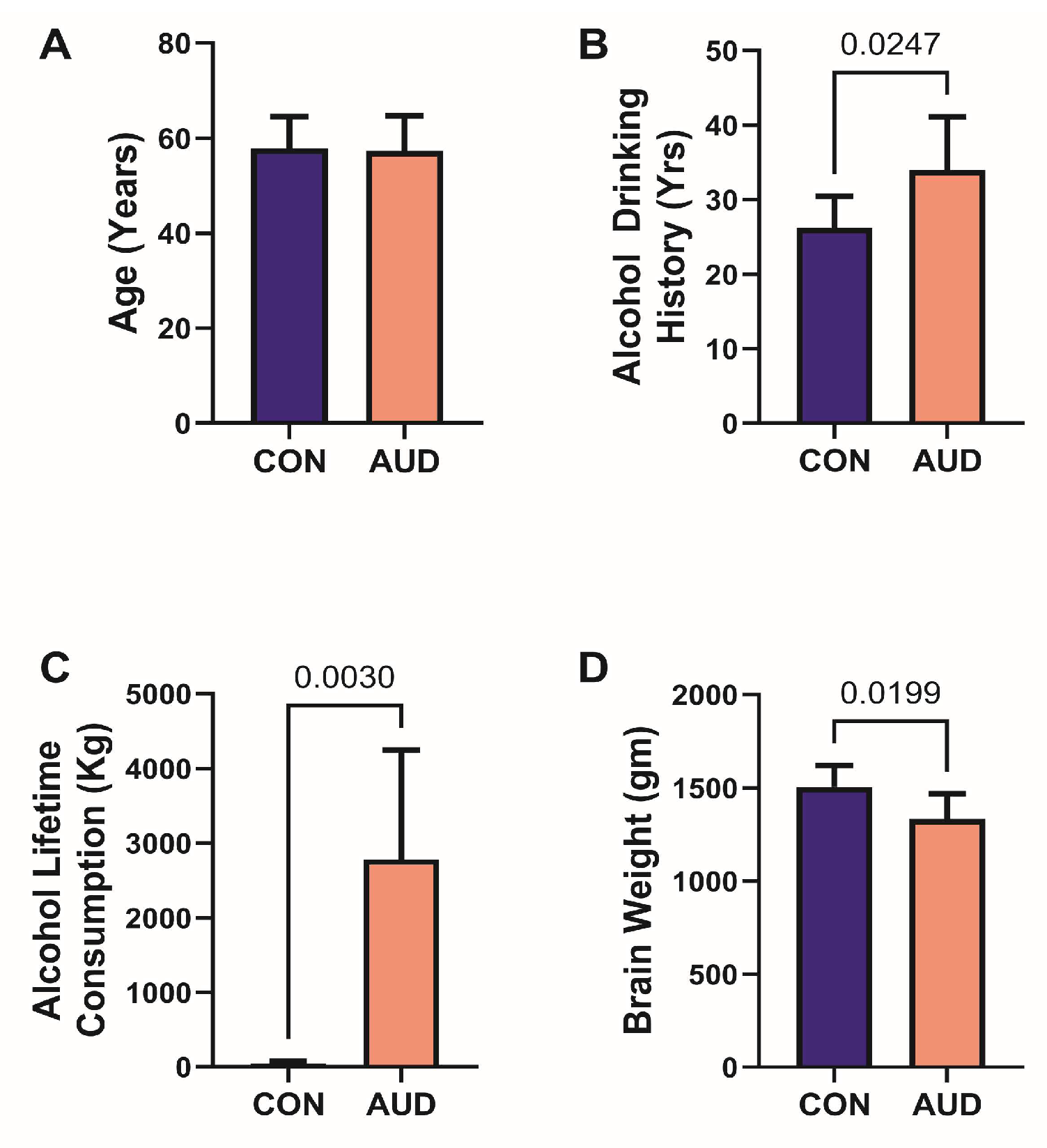
3.1. Brain Donor Characteristics
3.2. AUD Marker of Neurodegeneration
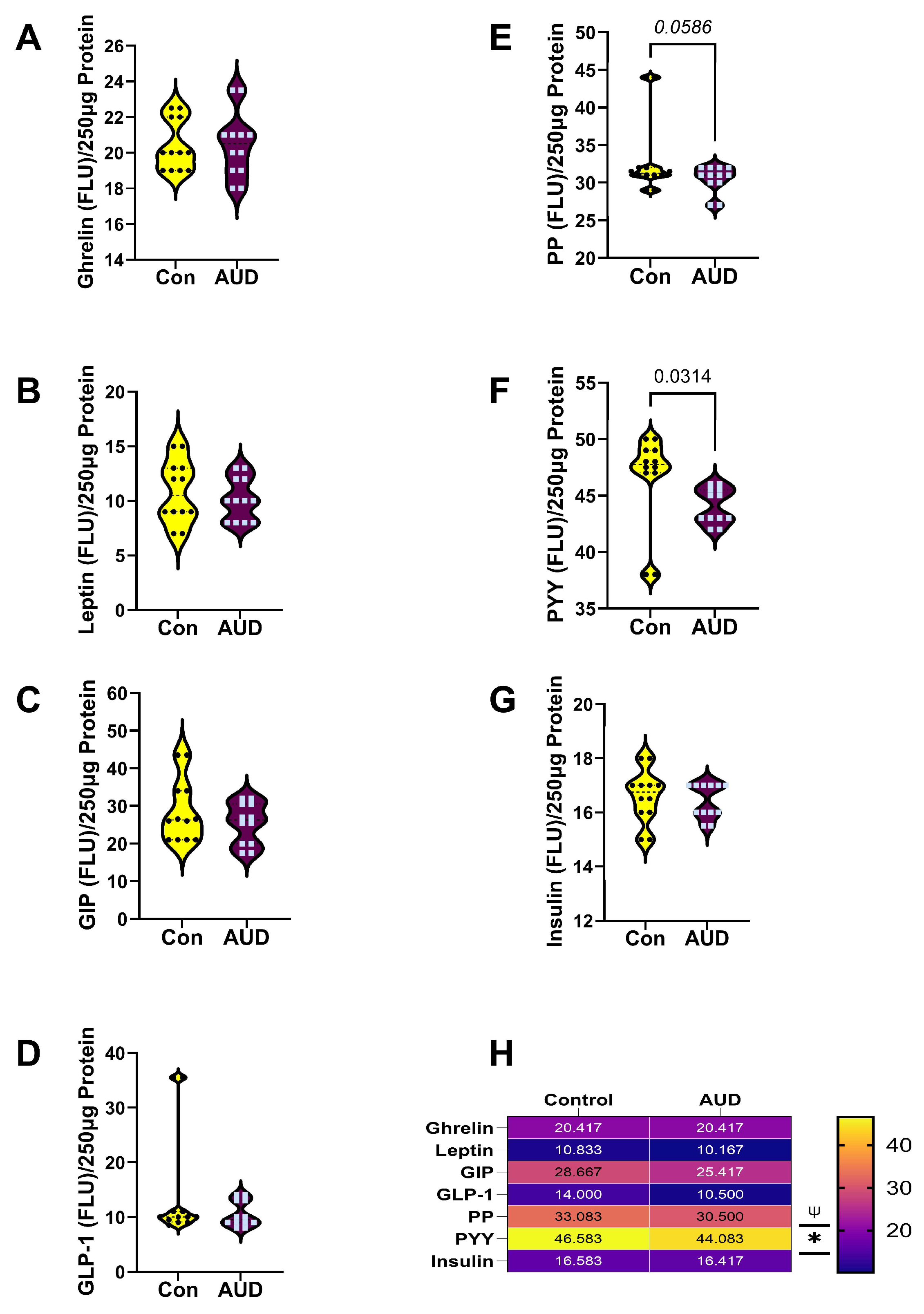
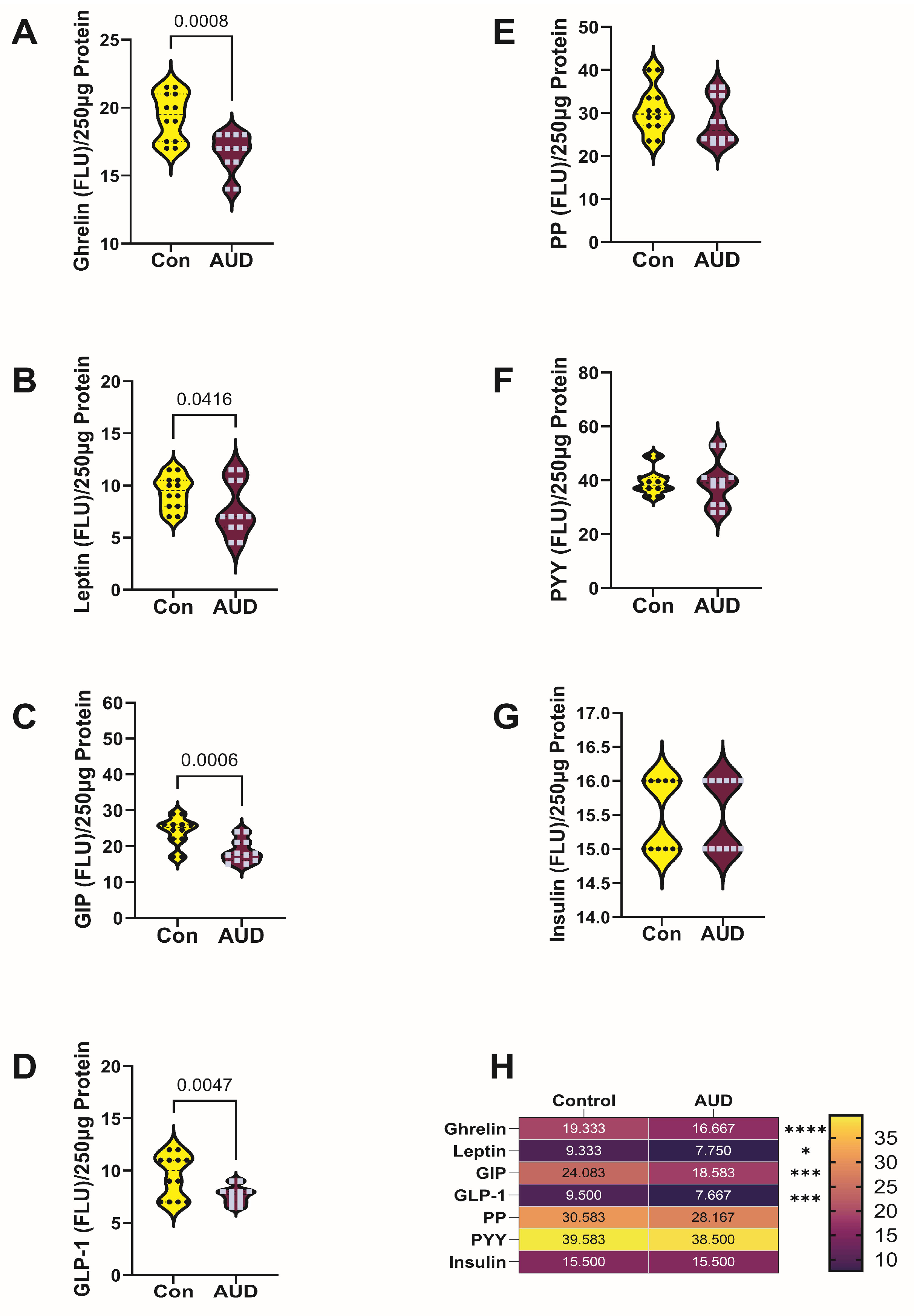
3.3. Gut Hormone 7-Plex ELISA
4. Discussion
5. Conclusions
6. Limitations of This Study
Supplementary Materials
Author Contributions
Funding
Institutional Review Board Statement
Informed Consent Statement
Data Availability Statement
Conflicts of Interest
Abbreviations
| AUD | Alcohol Use Disorder |
| ARBD | Alcohol-related brain damage |
| ELISA | Enzyme-linked immunosorbent assay |
| NfL | Neurofilament light chain |
| GIP | Glucose-dependent insulinotropic polypeptide |
| GLP-1 | Glucagon-like peptide-1 |
| IGF-1 | Insulin-like growth factor-1 |
| CNS | Central nervous system |
| RA | Receptor agonist |
| NSW | New South Wales |
| BTRC | Brain tissue resource center |
| PP | Pancreatic polypeptide |
| PYY | Peptide YY/Neuropeptide Y |
| ANOVA | Analysis of variance |
| RPLPO | Large acidic ribosomal protein |
References
- Pfefferbaum, A.; Adalsteinsson, E.; Sullivan, E.V. Dysmorphology and microstructural degradation of the corpus callosum: Interaction of age and alcoholism. Neurobiol. Aging 2006, 27, 994–1009. [Google Scholar] [CrossRef] [PubMed]
- Schulte, T.; Sullivan, E.V.; Muller-Oehring, E.M.; Adalsteinsson, E.; Pfefferbaum, A. Corpus callosal microstructural integrity influences interhemispheric processing: A diffusion tensor imaging study. Cereb. Cortex 2005, 15, 1384–1392. [Google Scholar] [CrossRef] [PubMed]
- de la Monte, S.M.; Kril, J.J. Human alcohol-related neuropathology. Acta Neuropathol. 2014, 127, 71–90. [Google Scholar] [CrossRef] [PubMed]
- Elofson, J.; Gongvatana, W.; Carey, K.B. Alcohol use and cerebral white matter compromise in adolescence. Addict. Behav. 2013, 38, 2295–2305. [Google Scholar] [CrossRef]
- Jacobus, J.; Squeglia, L.M.; Bava, S.; Tapert, S.F. White matter characterization of adolescent binge drinking with and without co-occurring marijuana use: A 3-year investigation. Psychiatry Res. 2013, 214, 374–381. [Google Scholar] [CrossRef]
- Mulholland, P.J.; Self, R.L.; Stepanyan, T.D.; Little, H.J.; Littleton, J.M.; Prendergast, M.A. Thiamine deficiency in the pathogenesis of chronic ethanol-associated cerebellar damage in vitro. Neuroscience 2005, 135, 1129–1139. [Google Scholar] [CrossRef]
- de la Monte, S.M. The Full Spectrum of Alzheimer’s Disease is Rooted in Metabolic Derangements That Drive Type 3 Diabetes. In Advances in Experimental Medicine and Biology; Springer: Berlin/Heidelberg, Germany, 2019; Volume 1128, pp. 45–83. [Google Scholar]
- Del Campo, N.; Phillips, O.; Ory-Magne, F.; Brefel-Courbon, C.; Galitzky, M.; Thalamas, C.; Narr, K.L.; Joshi, S.; Singh, M.K.; Peran, P.; et al. Broad white matter impairment in multiple system atrophy. Hum. Brain Mapp. 2021, 42, 357–366. [Google Scholar] [CrossRef]
- Zahr, N.M. Alcohol Use Disorder and Dementia: A Review. Alcohol. Res. 2024, 44, 03. [Google Scholar] [CrossRef]
- de la Monte, S.M.; Tong, M.; Cohen, A.C.; Sheedy, D.; Harper, C.; Wands, J.R. Insulin and insulin-like growth factor resistance in alcoholic neurodegeneration. Alcohol. Clin. Exp. Res. 2008, 32, 1630–1644. [Google Scholar] [CrossRef]
- Corl, A.B.; Rodan, A.R.; Heberlein, U. Insulin signaling in the nervous system regulates ethanol intoxication in Drosophila melanogaster. Nat. Neurosci. 2005, 8, 18–19. [Google Scholar] [CrossRef]
- Lindtner, C.; Scherer, T.; Zielinski, E.; Filatova, N.; Fasshauer, M.; Tonks, N.K.; Puchowicz, M.; Buettner, C. Binge drinking induces whole-body insulin resistance by impairing hypothalamic insulin action. Sci. Transl. Med. 2013, 5, 170ra114. [Google Scholar] [CrossRef] [PubMed]
- McIntyre, R.S.; Rasgon, N.; Goldberg, J.; Wong, S.; Le, G.H.; Mansur, R.B.; Rosenblat, J.D.; Teopiz, K.M.; Stahl, S.M. The effect of glucagon-like peptide-1 and glucose dependent insulinotropic polypeptide receptor agonists on neurogenesis, differentiation, and plasticity (Neuro-GDP): Potential mechanistically informed therapeutics in the treatment and prevention of mental disorders. CNS Spectr. 2025, 30, e23. [Google Scholar] [CrossRef]
- Park, J.S.; Kim, K.S.; Choi, H.J. Glucagon-Like Peptide-1 and Hypothalamic Regulation of Satiation: Cognitive and Neural Insights from Human and Animal Studies. Diabetes Metab. J. 2025, 49, 333–347. [Google Scholar] [CrossRef] [PubMed]
- Janket, S.J.; Chatanaka, M.K.; Sohaei, D.; Tamimi, F.; Meurman, J.H.; Diamandis, E.P. Does Incretin Agonism Have Sustainable Efficacy? Cells 2024, 13, 1842. [Google Scholar] [CrossRef]
- Smith, C.; Patterson-Cross, R.; Woodward, O.; Lewis, J.; Chiarugi, D.; Merkle, F.; Gribble, F.; Reimann, F.; Adriaenssens, A. A comparative transcriptomic analysis of glucagon-like peptide-1 receptor- and glucose-dependent insulinotropic polypeptide receptor-expressing cells in the hypothalamus. Appetite 2022, 174, 106022. [Google Scholar] [CrossRef]
- de la Monte, S.M. Conquering Insulin Network Dysfunctions in Alzheimer’s Disease: Where Are We Today? J. Alzheimer’s Dis. 2024, 101, S317–S343. [Google Scholar] [CrossRef]
- Fessel, J. All GLP-1 Agonists Should, Theoretically, Cure Alzheimer’s Dementia but Dulaglutide Might Be More Effective Than the Others. J. Clin. Med. 2024, 13, 3729. [Google Scholar] [CrossRef]
- de la Monte, S.M.; Tong, M.; Yang, Y. Incretin-Related Pathology and Serum Exosome Detection in Experimental Alcohol-Related Brain Damage. Biomolecules 2025, 15, 1670. [Google Scholar] [CrossRef]
- Takaku, S.; Tsukamoto, M.; Niimi, N.; Yako, H.; Sango, K. Exendin-4 Promotes Schwann Cell Survival/Migration and Myelination In Vitro. Int. J. Mol. Sci. 2021, 22, 2971. [Google Scholar] [CrossRef]
- Sango, K.; Takaku, S.; Tsukamoto, M.; Niimi, N.; Yako, H. Glucagon-Like Peptide-1 Receptor Agonists as Potential Myelination-Inducible and Anti-Demyelinating Remedies. Front. Cell Dev. Biol. 2022, 10, 950623. [Google Scholar] [CrossRef]
- Kaye, A.D.; Sala, K.R.; Abbott, B.M.; Dicke, A.N.; Johnson, L.D.; Wilson, P.A.; Amarasinghe, S.N.; Singh, N.; Ahmadzadeh, S.; Kaye, A.M.; et al. The Role of Glucagon-Like Peptide-1 Agonists in the Treatment of Multiple Sclerosis: A Narrative Review. Cureus 2024, 16, e67232. [Google Scholar] [CrossRef] [PubMed]
- Nomura, S.; Katoh, H.; Yanagisawa, S.; Noguchi, T.; Okada, K.; Watanabe, M. Administration of the GLP-1 receptor agonist exenatide in rats improves functional recovery after spinal cord injury by reducing endoplasmic reticulum stress. IBRO Neurosci. Rep. 2023, 15, 225–234. [Google Scholar] [CrossRef] [PubMed]
- Gharagozloo, M.; Galleguillos, D.; Jank, L.; Sotirchos, E.S.; Smith, M.D.; Garton, T.; Kumar, S.; Hussein, O.; Potluri, S.; Taylor, M.; et al. The Effects of NLY01, a Novel Glucagon-Like Peptide-1 Receptor Agonist, on Cuprizone-Induced Demyelination and Remyelination: Challenges and Future Perspectives. Neurotherapeutics 2023, 20, 1229–1240. [Google Scholar] [CrossRef] [PubMed]
- Jerlhag, E. Ghrelin system and GLP-1 as potential treatment targets for alcohol use disorder. Int. Rev. Neurobiol. 2024, 178, 401–432. [Google Scholar] [CrossRef]
- Jerlhag, E. GLP-1 Receptor Agonists: Promising Therapeutic Targets for Alcohol Use Disorder. Endocrinology 2025, 166, bqaf028. [Google Scholar] [CrossRef]
- Klausen, M.K.; Knudsen, G.M.; Vilsboll, T.; Fink-Jensen, A. Effects of GLP-1 Receptor Agonists in Alcohol Use Disorder. Basic Clin. Pharmacol. Toxicol. 2025, 136, e70004. [Google Scholar] [CrossRef]
- O’Keefe, J.H.; Franco, W.G.; O’Keefe, E.L. Anti-consumption agents: Tirzepatide and semaglutide for treating obesity-related diseases and addictions, and improving life expectancy. Prog. Cardiovasc. Dis. 2025, 89, 102–112. [Google Scholar] [CrossRef]
- Li, Y.; Wu, K.J.; Yu, S.J.; Tamargo, I.A.; Wang, Y.; Greig, N.H. Neurotrophic and neuroprotective effects of oxyntomodulin in neuronal cells and a rat model of stroke. Exp. Neurol. 2017, 288, 104–113. [Google Scholar] [CrossRef]
- DaDalt, A.A.; Bonham, C.A.; Lotze, G.P.; Luiso, A.A.; Vacratsis, P.O. Src-mediated phosphorylation of the ribosome biogenesis factor hYVH1 affects its localization, promoting partitioning to the 60S ribosomal subunit. J. Biol. Chem. 2022, 298, 102679. [Google Scholar] [CrossRef]
- Liu, H.T.; Zou, Y.X.; Zhu, W.J.; Sen, L.; Zhang, G.H.; Ma, R.R.; Guo, X.Y.; Gao, P. lncRNA THAP7-AS1, transcriptionally activated by SP1 and post-transcriptionally stabilized by METTL3-mediated m6A modification, exerts oncogenic properties by improving CUL4B entry into the nucleus. Cell Death Differ. 2022, 29, 627–641. [Google Scholar] [CrossRef]
- Xie, J.J.; Jiang, Y.Y.; Jiang, Y.; Li, C.Q.; Lim, M.C.; An, O.; Mayakonda, A.; Ding, L.W.; Long, L.; Sun, C.; et al. Super-Enhancer-Driven Long Non-Coding RNA LINC01503, Regulated by TP63, Is Over-Expressed and Oncogenic in Squamous Cell Carcinoma. Gastroenterology 2018, 154, 2137–2151.e1. [Google Scholar] [CrossRef]
- Nead, K.T.; Wehner, M.R.; Mitra, N. The Use of “Trend” Statements to Describe Statistically Nonsignificant Results in the Oncology Literature. JAMA Oncol. 2018, 4, 1778–1779. [Google Scholar] [CrossRef] [PubMed]
- Brureau, A.; Blanchard-Bregeon, V.; Pech, C.; Hamon, S.; Chaillou, P.; Guillemot, J.C.; Barneoud, P.; Bertrand, P.; Pradier, L.; Rooney, T.; et al. NF-L in cerebrospinal fluid and serum is a biomarker of neuronal damage in an inducible mouse model of neurodegeneration. Neurobiol. Dis. 2017, 104, 73–84. [Google Scholar] [CrossRef] [PubMed]
- Parnetti, L.; Gaetani, L.; Di Filippo, M. Serum neurofilament light chain as a preclinical marker of neurodegeneration. Lancet Neurol. 2019, 18, 1070–1071. [Google Scholar] [CrossRef] [PubMed]
- de la Monte, S.M.; Sutherland, G. Dual Stages of Alcohol-Related Cerebral White Matter Degeneration Reviewed: Early-Stage Stress/Neuroinflammation Versus Late-Stage Impaired Insulin/IGF Signaling Through Akt-mTOR-Review. ASN Neuro 2025, 17, 2573965. [Google Scholar] [CrossRef]
- Tong, M.; Homans, C.; Pelit, W.; Delikkaya, B.; de la Monte, S.M. Progressive Alcohol-Related Brain Atrophy and White Matter Pathology Are Linked to Long-Term Inhibitory Effects on mTOR Signaling. Biomolecules 2025, 15, 413. [Google Scholar] [CrossRef]
- Bava, S.; Frank, L.R.; McQueeny, T.; Schweinsburg, B.C.; Schweinsburg, A.D.; Tapert, S.F. Altered white matter microstructure in adolescent substance users. Psychiatry Res. 2009, 173, 228–237. [Google Scholar] [CrossRef]
- Tong, M.; Ziplow, J.L.; Mark, P.; de la Monte, S.M. Dietary Soy Prevents Alcohol-Mediated Neurocognitive Dysfunction and Associated Impairments in Brain Insulin Pathway Signaling in an Adolescent Rat Model. Biomolecules 2022, 12, 676. [Google Scholar] [CrossRef]
- Nauck, M.A.; Quast, D.R.; Wefers, J.; Pfeiffer, A.F.H. The evolving story of incretins (GIP and GLP-1) in metabolic and cardiovascular disease: A pathophysiological update. Diabetes Obes. Metab. 2021, 23, 5–29. [Google Scholar] [CrossRef]
- Soylu-Kucharz, R.; Sandelius, A.; Sjogren, M.; Blennow, K.; Wild, E.J.; Zetterberg, H.; Bjorkqvist, M. Neurofilament light protein in CSF and blood is associated with neurodegeneration and disease severity in Huntington’s disease R6/2 mice. Sci. Rep. 2017, 7, 14114. [Google Scholar] [CrossRef]
- O’Connell, G.C.; Alder, M.L.; Webel, A.R.; Moore, S.M. Neuro biomarker levels measured with high-sensitivity digital ELISA differ between serum and plasma. Bioanalysis 2019, 11, 2087–2094. [Google Scholar] [CrossRef] [PubMed]
- Siller, N.; Kuhle, J.; Muthuraman, M.; Barro, C.; Uphaus, T.; Groppa, S.; Kappos, L.; Zipp, F.; Bittner, S. Serum neurofilament light chain is a biomarker of acute and chronic neuronal damage in early multiple sclerosis. Mult. Scler. 2019, 25, 678–686. [Google Scholar] [CrossRef] [PubMed]
- McCorkindale, A.N.; Sizemova, A.; Sheedy, D.; Kril, J.J.; Sutherland, G.T. Re-investigating the effects of chronic smoking on the pathology of alcohol-related human brain damage. Alcohol 2018, 76, 11–14. [Google Scholar] [CrossRef] [PubMed]
- Podgorski, R.; Galiniak, S.; Mazur, A.; Domin, A.; Podgorska, D. Serum levels of leptin, ghrelin putative peptide YY-3 in patients with fetal alcohol spectrum disorders. Sci. Rep. 2024, 14, 14971. [Google Scholar] [CrossRef]
- Shanmugarajah, P.D.; Hoggard, N.; Currie, S.; Aeschlimann, D.P.; Aeschlimann, P.C.; Gleeson, D.C.; Karajeh, M.; Woodroofe, N.; Grunewald, R.A.; Hadjivassiliou, M. Alcohol-related cerebellar degeneration: Not all down to toxicity? Cerebellum Ataxias 2016, 3, 17. [Google Scholar] [CrossRef]
- Srivanitchapoom, P.; Shamim, E.A.; Diomi, P.; Hattori, T.; Pandey, S.; Vorbach, S.; Park, J.E.; Wu, T.; Auh, S.; Hallett, M. Differences in active range of motion measurements in the upper extremity of patients with writer’s cramp compared with healthy controls. J. Hand Ther. 2016, 29, 489–495. [Google Scholar] [CrossRef][Green Version]
- Yang, Z.; Han, S.; Keller, M.; Kaiser, A.; Bender, B.J.; Bosse, M.; Burkert, K.; Kogler, L.M.; Wifling, D.; Bernhardt, G.; et al. Structural basis of ligand binding modes at the neuropeptide Y Y(1) receptor. Nature 2018, 556, 520–524. [Google Scholar] [CrossRef]
- Li, Z.H.; Li, B.; Zhang, X.Y.; Zhu, J.N. Neuropeptides and Their Roles in the Cerebellum. Int. J. Mol. Sci. 2024, 25, 2332. [Google Scholar] [CrossRef]
- Yang, Y.; Tong, M.; de la Monte, S.M. Early-Stage Moderate Alcohol Feeding Dysregulates Insulin-Related Metabolic Hormone Expression in the Brain: Potential Links to Neurodegeneration Including Alzheimer’s Disease. J. Alzheimer’s Dis. Rep. 2024, 8, 1211–1228. [Google Scholar] [CrossRef]
- Robbins, J.; Busquets, O.; Tong, M.; de la Monte, S.M. Dysregulation of Insulin-Linked Metabolic Pathways in Alzheimer’s Disease: Co-Factor Role of Apolipoprotein E var epsilon4. J. Alzheimer’s Dis. Rep. 2020, 4, 479–493. [Google Scholar] [CrossRef]
- Serrenho, D.; Santos, S.D.; Carvalho, A.L. The Role of Ghrelin in Regulating Synaptic Function and Plasticity of Feeding-Associated Circuits. Front. Cell Neurosci. 2019, 13, 205. [Google Scholar] [CrossRef]
- Perea Vega, M.L.; Sanchez, M.S.; Fernandez, G.; Paglini, M.G.; Martin, M.; de Barioglio, S.R. Ghrelin treatment leads to dendritic spine remodeling in hippocampal neurons and increases the expression of specific BDNF-mRNA species. Neurobiol. Learn. Mem. 2021, 179, 107409. [Google Scholar] [CrossRef] [PubMed]
- Liu, C.; Liu, Y.; Xin, Y.; Wang, Y. Circadian secretion rhythm of GLP-1 and its influencing factors. Front. Endocrinol. 2022, 13, 991397. [Google Scholar] [CrossRef] [PubMed]
- Yuan, R.K.; Zitting, K.M. Sleep and circadian effects on the incretin system. Curr. Sleep Med. Rep. 2025, 11, 24. [Google Scholar] [CrossRef] [PubMed]
- Maiese, K. Moving to the Rhythm with Clock (Circadian) Genes, Autophagy, mTOR, and SIRT1 in Degenerative Disease and Cancer. Curr. Neurovasc. Res. 2017, 14, 299–304. [Google Scholar] [CrossRef]
- Parekh, P.K.; Ozburn, A.R.; McClung, C.A. Circadian clock genes: Effects on dopamine, reward and addiction. Alcohol. 2015, 49, 341–349. [Google Scholar] [CrossRef]
- Tice, A.L.; Laudato, J.A.; Rossetti, M.L.; Wolff, C.A.; Esser, K.A.; Lee, C.; Lang, C.H.; Vied, C.; Gordon, B.S.; Steiner, J.L. Binge alcohol disrupts skeletal muscle core molecular clock independent of glucocorticoids. Am. J. Physiol. Endocrinol. Metab. 2021, 321, E606–E620. [Google Scholar] [CrossRef]
- Rojdmark, S.; Calissendorff, J.; Brismar, K. Alcohol ingestion decreases both diurnal and nocturnal secretion of leptin in healthy individuals. Clin. Endocrinol. 2001, 55, 639–647. [Google Scholar] [CrossRef]
- Hendershot, C.S.; Bremmer, M.P.; Paladino, M.B.; Kostantinis, G.; Gilmore, T.A.; Sullivan, N.R.; Tow, A.C.; Dermody, S.S.; Prince, M.A.; Jordan, R.; et al. Once-Weekly Semaglutide in Adults with Alcohol Use Disorder: A Randomized Clinical Trial. JAMA Psychiatry 2025, 82, 395–405. [Google Scholar] [CrossRef]
- Quddos, F.; Hubshman, Z.; Tegge, A.; Sane, D.; Marti, E.; Kablinger, A.S.; Gatchalian, K.M.; Kelly, A.L.; DiFeliceantonio, A.G.; Bickel, W.K. Semaglutide and Tirzepatide reduce alcohol consumption in individuals with obesity. Sci. Rep. 2023, 13, 20998. [Google Scholar] [CrossRef]
- Thaysen-Petersen, D.; Hammerum, S.K.; Vissing, A.C.; Arnfred, B.T.; Nordahl, R.; Adjorlu, A.; Nordentoft, M.; Oestrich, I.H.; During, S.W.; Fink-Jensen, A. Virtual reality-assisted cognitive behavioural therapy for outpatients with alcohol use disorder (CRAVR): A protocol for a randomised controlled trial. BMJ Open 2023, 13, e068658. [Google Scholar] [CrossRef] [PubMed]
- Calissendorff, J.; Danielsson, O.; Brismar, K.; Rojdmark, S. Alcohol ingestion does not affect serum levels of peptide YY but decreases both total and octanoylated ghrelin levels in healthy subjects. Metabolism 2006, 55, 1625–1629. [Google Scholar] [CrossRef] [PubMed]
- Leggio, L.; Zywiak, W.H.; Fricchione, S.R.; Edwards, S.M.; de la Monte, S.M.; Swift, R.M.; Kenna, G.A. Intravenous ghrelin administration increases alcohol craving in alcohol-dependent heavy drinkers: A preliminary investigation. Biol. Psychiatry 2014, 76, 734–741. [Google Scholar] [CrossRef] [PubMed]
- Hong, S.H.; Choi, K.M. Gut hormones and appetite regulation. Curr. Opin. Endocrinol. Diabetes Obes. 2024, 31, 115–121. [Google Scholar] [CrossRef]
- Baggio, L.L.; Drucker, D.J. Biology of incretins: GLP-1 and GIP. Gastroenterology 2007, 132, 2131–2157. [Google Scholar] [CrossRef]
- Holscher, C. The incretin hormones glucagonlike peptide 1 and glucose-dependent insulinotropic polypeptide are neuroprotective in mouse models of Alzheimer’s disease. Alzheimer’s Dement. 2014, 10, S47–S54. [Google Scholar] [CrossRef]
- Khalid, M.; Alkaabi, J.; Khan, M.A.B.; Adem, A. Insulin Signal Transduction Perturbations in Insulin Resistance. Int. J. Mol. Sci. 2021, 22, 8590. [Google Scholar] [CrossRef]
- Le, T.K.C.; Dao, X.D.; Nguyen, D.V.; Luu, D.H.; Bui, T.M.H.; Le, T.H.; Nguyen, H.T.; Le, T.N.; Hosaka, T.; Nguyen, T.T.T. Insulin signaling and its application. Front. Endocrinol. 2023, 14, 1226655. [Google Scholar] [CrossRef]
- de la Monte, S.M.; Tong, M. Molecular and biochemical pathologies in human alcohol-related cerebellar white matter degeneration. Adv. Drug Alcohol Res. 2025, 5, 15342. [Google Scholar] [CrossRef]
- Karatsoreos, I.N.; Bhagat, S.; Bloss, E.B.; Morrison, J.H.; McEwen, B.S. Disruption of circadian clocks has ramifications for metabolism, brain, and behavior. Proc. Natl. Acad. Sci. USA 2011, 108, 1657–1662. [Google Scholar] [CrossRef]
- Yerraguntla, H.; Onyekachi, J.; Giacometti, L.L.; Goldberg, S.L.; Barson, J.R.; Barker, J.M.; Reyes, B.A.S. Subcellular interactions of neuropeptide Y and corticotropin-releasing factor in the central nucleus of the amygdala in the mouse. bioRxiv 2025. [Google Scholar] [CrossRef]
- Tanaka, M.; Yamada, S.; Watanabe, Y. The Role of Neuropeptide Y in the Nucleus Accumbens. Int. J. Mol. Sci. 2021, 22, 7287. [Google Scholar] [CrossRef]
- Brancato, A.; Castelli, V.; Cannizzaro, C.; Tringali, G. Adolescent binge-like alcohol exposure dysregulates NPY and CGRP in rats: Behavioural and immunochemical evidence. Prog. Neuropsychopharmacol. Biol. Psychiatry 2023, 123, 110699. [Google Scholar] [CrossRef]
- Gilpin, N.W. Neuropeptide Y (NPY) in the extended amygdala is recruited during the transition to alcohol dependence. Neuropeptides 2012, 46, 253–259. [Google Scholar] [CrossRef][Green Version]



| Characteristics | Controls | AUD | p-Value |
|---|---|---|---|
| # Cases (all Male) | 6 | 6 | |
| Age Range (Years) | 50–69 | 50–70 | |
| Smoking History (Y/N) | 3/6 | 4/6 | N.S. |
| Postmortem Interval (h) | 22.17 ± 6.43 | 32.17 ± 24.81 | N.S. |
| RNA Integrity Number | 7.50 ± 0.70 | 6.84 ± 1.35 | N.S. |
| Brain pH | 6.61 ± 0.21 | 6.66 ± 0.23 | N.S. |
| Brain Region | AUD-Factor F-Ratio | p-Value | Biomarker F-Ratio | p-Value | AUD × Biomarker F-Ratio | p-Value |
|---|---|---|---|---|---|---|
| Cerebellum | 7.035 | 0.0088 | 186.6 | <0.0001 | 0.6798 | N.S. |
| Frontal Lobe | 13.76 | 0.0003 | 208.3 | <0.0001 | 1.252 | N.S. |
Disclaimer/Publisher’s Note: The statements, opinions and data contained in all publications are solely those of the individual author(s) and contributor(s) and not of MDPI and/or the editor(s). MDPI and/or the editor(s) disclaim responsibility for any injury to people or property resulting from any ideas, methods, instructions or products referred to in the content. |
© 2026 by the authors. Licensee MDPI, Basel, Switzerland. This article is an open access article distributed under the terms and conditions of the Creative Commons Attribution (CC BY) license.
Share and Cite
de la Monte, S.M.; Tong, M.; Carlson, R.I.; Sutherland, G. Impaired Brain Incretin and Gut Hormone Expression in Human Alcohol-Related Brain Damage: Opportunities for Therapeutic Targeting. Biomolecules 2026, 16, 99. https://doi.org/10.3390/biom16010099
de la Monte SM, Tong M, Carlson RI, Sutherland G. Impaired Brain Incretin and Gut Hormone Expression in Human Alcohol-Related Brain Damage: Opportunities for Therapeutic Targeting. Biomolecules. 2026; 16(1):99. https://doi.org/10.3390/biom16010099
Chicago/Turabian Stylede la Monte, Suzanne M., Ming Tong, Rolf I. Carlson, and Greg Sutherland. 2026. "Impaired Brain Incretin and Gut Hormone Expression in Human Alcohol-Related Brain Damage: Opportunities for Therapeutic Targeting" Biomolecules 16, no. 1: 99. https://doi.org/10.3390/biom16010099
APA Stylede la Monte, S. M., Tong, M., Carlson, R. I., & Sutherland, G. (2026). Impaired Brain Incretin and Gut Hormone Expression in Human Alcohol-Related Brain Damage: Opportunities for Therapeutic Targeting. Biomolecules, 16(1), 99. https://doi.org/10.3390/biom16010099