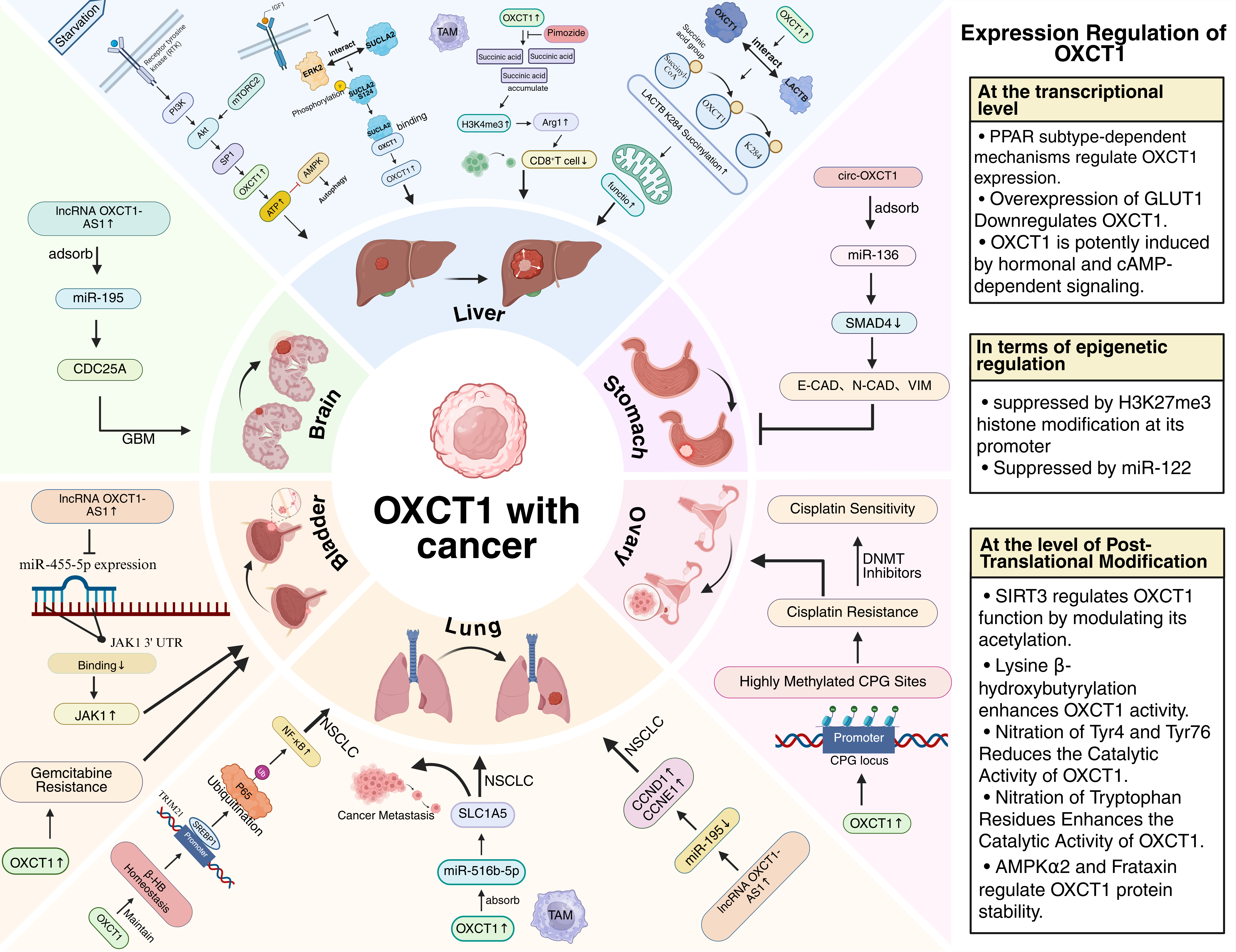
The Function and Mechanism of OXCT1 in Tumor Progression as a Critical Ketone Body Metabolic Enzyme


Abstract
1. Introduction
2. Synthesis, Structure and Biological Function of OXCT1
3. Regulation of OXCT1 Expression
4. OXCT1 in Tumor Progression: Mechanisms and Implications
4.1. Provision of Energy Support and Regulation of Metabolic Reprogramming
4.2. Suppression of Antitumor Immunity by Epigenetic Modifications
4.3. Promotion of Post-Translational Modifications
4.4. Activation of the NF-κB Signaling Pathway
4.5. Mediation of Drug Resistance Development
4.6. Regulation of Tumor Progression Through Non-Coding RNA Forms
4.6.1. CircRNAs
4.6.2. lncRNAs
5. OXCT1 Expression in Tumors and Its Clinical Significance
5.1. OXCT1 and Hepatocellular Carcinoma
5.2. OXCT1 and Colorectal Cancer
5.3. OXCT1 and Lung Cancer
5.4. OXCT1 and Glioblastoma
5.5. OXCT1 and Bladder Cancer
5.6. OXCT1 and Prostate Cancer
5.7. OXCT1 and Gastric Cancer
5.8. OXCT1 and Breast Cancer
5.9. OXCT1 and Thymoma
5.10. OXCT1 and Pancreatic Ductal Adenocarcinoma
5.11. OXCT1 and Osteosarcoma
6. OXCT1 and the Ketone Body Metabolism: Therapeutic Paradox and Prospects in Cancer
7. Discussion
8. Conclusions
Author Contributions
Funding
Institutional Review Board Statement
Informed Consent Statement
Data Availability Statement
Acknowledgments
Conflicts of Interest
Abbreviations
| Abbreviation | Definition |
| OXCT1 | 3-Ketoacid CoA-transferase 1 |
| WHO | World Health Organization |
| IARC | International Agency for Research on Cancer |
| AcAc | acetoacetate |
| β-HB | 3-hydroxybutyrate |
| Acetyl-CoA | acetyl-coenzyme A |
| TCA cycle | tricarboxylic acid cycle |
| HCC | hepatocellular carcinoma |
| CRC | colorectal cancer |
| BCa | bladder cancer |
| OS | osteosarcoma |
| PCa | prostate cancer |
| CS | chondrosarcoma |
| GC | glioma, gastric cancer |
| NPC | nasopharyngeal carcinoma |
| SCOT | succinyl-CoA:3-ketoacid CoA Transferase |
| CoA | coenzyme A |
| OXCT2 or h-Scot-t | succinyl CoA:3-oxoaci ketoacid CoA-transferase 2 |
| GLUT1 | Glucose Transporter Type 1 |
| H3K27me3 | trimethylation of lysine 27 on histone H3 |
| PTM | Post-Translational Modification |
| SIRT3 | Sirtuin 3 |
| Kbhb | lysine β-hydroxybutyrylation |
| AMPKα2 | AMP-activated protein kinase alpha 2 subunit |
| AMPK | AMP-activated protein kinase |
| IGF1 | Insulin-like growth factor 1 |
| ERK2 | extracellular signal-regulated kinase 2 |
| SUCLA2 | succinate-CoA ligase ADP-forming subunit beta |
| AHA | Acetohydroxamic acid |
| KD | ketogenic diet |
| TAM | tumor-associated macrophages |
| Arg1 | arginase 1 |
| LACTB | serine β-lactamase-like protein |
| PISD | phosphatidylserine decarboxylase |
| LPE | lysophosphatidylethanolamines |
| PE | phosphatidylethanolamines |
| SREBP1 | sterol regulatory element-binding protein 1 |
| bHLH-Zip | basic helix-loop-helix leucine zipper |
| NSCLC | non-small cell lung cancer |
| EMT | epithelial–mesenchymal transition |
| PDAC | pancreatic ductal adenocarcinoma |
| DNMT | DNA methyltransferase |
| circRNAs | circular RNAs |
| lncRNAs | long non-coding RNAs |
| circ-OXCT1 | CircRNA 3-oxoacid CoA-transferase 1 |
| ceRNA | competitive endogenous RNA |
| miRNA | microRNA |
| SLC1A5 | solute carrier family 1 member 5 |
| lncRNA OXCT1-AS1 | antisense RNA1 of lncRNA OXCT1 |
| LEF1 | Lymphoid enhancer factor 1 |
| GBM | glioblastoma |
| GEPIA | Gene Expression Profiling Interactive Analysis |
| TCGA | Cancer Genome Atlas |
| mOS | median Overall Survival |
| CRPC | castration-resistant prostate cancer |
| RFS | Recurrence-Free Survival |
| IFO | ifosfamide |
| HDACs | histone deacetylases |
| EAE | experimental autoimmune encephalomyelitis |
References
- Bray, F.; Laversanne, M.; Sung, H.; Ferlay, J.; Siegel, R.L.; Soerjomataram, I.; Jemal, A. Global cancer statistics 2022: GLOBOCAN estimates of incidence and mortality worldwide for 36 cancers in 185 countries. CA Cancer J. Clin. 2024, 74, 229–263. [Google Scholar] [CrossRef] [PubMed]
- Nelson, A.B.; Queathem, E.D.; Puchalska, P.; Crawford, P.A. Metabolic Messengers: Ketone bodies. Nat. Metab. 2023, 5, 2062–2074. [Google Scholar] [CrossRef] [PubMed]
- Woolf, E.C.; Scheck, A.C. The ketogenic diet for the treatment of malignant glioma. J. Lipid Res. 2015, 56, 5–10. [Google Scholar] [CrossRef]
- Maurer, G.D.; Brucker, D.P.; Bähr, O.; Harter, P.N.; Hattingen, E.; Walenta, S.; Mueller-Klieser, W.; Steinbach, J.P.; Rieger, J. Differential utilization of ketone bodies by neurons and glioma cell lines: A rationale for ketogenic diet as experimental glioma therapy. BMC Cancer 2011, 11, 315. [Google Scholar] [CrossRef] [PubMed]
- Zhou, W.; Mukherjee, P.; Kiebish, M.A.; Markis, W.T.; Mantis, J.G.; Seyfried, T.N. The calorically restricted ketogenic diet, an effective alternative therapy for malignant brain cancer. Nutr. Metab. 2007, 4, 5. [Google Scholar] [CrossRef]
- Seyfried, T.N.; Mukherjee, P. Targeting energy metabolism in brain cancer: Review and hypothesis. Nutr. Metab. 2005, 2, 30. [Google Scholar] [CrossRef]
- Seyfried, T.N.; Kiebish, M.A.; Marsh, J.; Shelton, L.M.; Huysentruyt, L.C.; Mukherjee, P. Metabolic management of brain cancer. Biochim. Biophys. Acta 2011, 1807, 577–594. [Google Scholar] [CrossRef]
- Puchalska, P.; Crawford, P.A. Multi-dimensional Roles of Ketone Bodies in Fuel Metabolism, Signaling, and Therapeutics. Cell Metab. 2017, 25, 262–284. [Google Scholar] [CrossRef]
- Qiu, J.Y.; Gao, S.Q.; Chen, Y.S.; Wang, X.; Zhuang, Y.S.; Miao, S.H.; Zheng, X.B.; Zhao, R.; Sun, Y.; Zhou, M.L. OXCT1 regulates hippocampal neurogenesis and alleviates cognitive impairment via the Akt/GSK-3β/β-catenin pathway after subarachnoid hemorrhage. Brain Res. 2024, 1827, 148758. [Google Scholar] [CrossRef]
- Zhuang, Y.S.; Wang, X.; Gao, S.Q.; Miao, S.H.; Li, T.; Gao, C.C.; Han, Y.L.; Qiu, J.Y.; Zhou, M.L.; Wang, H.D. Neuroprotective mechanisms of OXCT1 via the SIRT3-SOD2 pathway after traumatic brain injury. Brain Res. 2023, 1808, 148324. [Google Scholar] [CrossRef]
- Cui, H.; Hu, D.; Liu, Y.; Zhao, J. Identifying Acss1, Mtfp1 and Oxct1 as key regulators and promising biomarkers of sarcopenia in various models. Gene 2024, 896, 148053. [Google Scholar] [CrossRef]
- Jiang, K.; Kang, L.; Jiang, A.; Zhao, Q. Development and Validation of a Diagnostic Model Based on Hypoxia-Related Genes in Myocardial Infarction. Int. J. Gen. Med. 2023, 16, 2111–2123. [Google Scholar] [CrossRef]
- Zhang, Y.; Zhang, H.; Wang, H.; Wang, C.; Yang, P.; Lu, C.; Liu, Y.; Xu, Z.; Xie, Y.; Hu, J. Tandem mass tag-based quantitative proteomic analysis identification of succinylation related proteins in pathogenesis of thoracic aortic aneurysm and aortic dissection. PeerJ 2023, 11, e15258. [Google Scholar] [CrossRef] [PubMed]
- Tabatabaei Dakhili, S.A.; Greenwell, A.A.; Yang, K.; Abou Farraj, R.; Saed, C.T.; Gopal, K.; Chan, J.S.F.; Chahade, J.J.; Eaton, F.; Lee, C.; et al. The Antipsychotic Dopamine 2 Receptor Antagonist Diphenylbutylpiperidines Improve Glycemia in Experimental Obesity by Inhibiting Succinyl-CoA:3-Ketoacid CoA Transferase. Diabetes 2023, 72, 126–134. [Google Scholar] [CrossRef] [PubMed]
- Greenwell, A.A.; Tabatabaei Dakhili, S.A.; Wagg, C.S.; Saed, C.T.; Chan, J.S.F.; Yang, K.; Mangra-Bala, I.A.; Stenlund, M.J.; Eaton, F.; Gopal, K.; et al. Pharmacological Inhibition of Succinyl Coenzyme A:3-Ketoacid Coenzyme A Transferase Alleviates the Progression of Diabetic Cardiomyopathy. J. Am. Heart Assoc. 2024, 13, e032697. [Google Scholar] [CrossRef]
- Zhang, S.; Xie, C. The role of OXCT1 in the pathogenesis of cancer as a rate-limiting enzyme of ketone body metabolism. Life Sci. 2017, 183, 110–115. [Google Scholar] [CrossRef]
- Huang, D.; Li, T.; Wang, L.; Zhang, L.; Yan, R.; Li, K.; Xing, S.; Wu, G.; Hu, L.; Jia, W.; et al. Hepatocellular carcinoma redirects to ketolysis for progression under nutrition deprivation stress. Cell Res. 2016, 26, 1112–1130. [Google Scholar] [CrossRef] [PubMed]
- Martinez-Outschoorn, U.E.; Lin, Z.; Whitaker-Menezes, D.; Howell, A.; Sotgia, F.; Lisanti, M.P. Ketone body utilization drives tumor growth and metastasis. Cell Cycle 2012, 11, 3964–3971. [Google Scholar] [CrossRef]
- Israël, M.; Schwartz, L. Inhibition of the ketolytic acetyl CoA supply to tumors could be their “Achilles heel”. Int. J. Cancer 2020, 147, 1755–1757. [Google Scholar] [CrossRef]
- Fukao, T.; Mitchell, G.A.; Song, X.Q.; Nakamura, H.; Kassovska-Bratinova, S.; Orii, K.E.; Wraith, J.E.; Besley, G.; Wanders, R.J.; Niezen-Koning, K.E.; et al. Succinyl-CoA:3-ketoacid CoA transferase (SCOT): Cloning of the human SCOT gene, tertiary structural modeling of the human SCOT monomer, and characterization of three pathogenic mutations. Genomics 2000, 68, 144–151. [Google Scholar] [CrossRef]
- Orii, K.E.; Fukao, T.; Song, X.Q.; Mitchell, G.A.; Kondo, N. Liver-specific silencing of the human gene encoding succinyl-CoA: 3-ketoacid CoA transferase. Tohoku J. Exp. Med. 2008, 215, 227–236. [Google Scholar] [CrossRef]
- Fukao, T.; Sass, J.O.; Kursula, P.; Thimm, E.; Wendel, U.; Ficicioglu, C.; Monastiri, K.; Guffon, N.; Barić, I.; Zabot, M.T.; et al. Clinical and molecular characterization of five patients with succinyl-CoA:3-ketoacid CoA transferase (SCOT) deficiency. Biochim. Biophys. Acta 2011, 1812, 619–624. [Google Scholar] [CrossRef]
- Grünert, S.C.; Foster, W.; Schumann, A.; Lund, A.; Pontes, C.; Roloff, S.; Weinhold, N.; Yue, W.W.; AlAsmari, A.; Obaid, O.A.; et al. Succinyl-CoA:3-oxoacid coenzyme A transferase (SCOT) deficiency: A rare and potentially fatal metabolic disease. Biochimie 2021, 183, 55–62. [Google Scholar] [CrossRef]
- Alghamdi, M.A.; Tohary, M.; Alzaidan, H.; Imtiaz, F.; Al-Hassnan, Z.N. Clinical variability and outcome of succinyl-CoA:3-ketoacid CoA transferase deficiency caused by a single OXCT1 mutation: Report of 17 cases. JIMD Rep. 2021, 62, 91–96. [Google Scholar] [CrossRef]
- Shafqat, N.; Kavanagh, K.L.; Sass, J.O.; Christensen, E.; Fukao, T.; Lee, W.H.; Oppermann, U.; Yue, W.W. A structural mapping of mutations causing succinyl-CoA:3-ketoacid CoA transferase (SCOT) deficiency. J. Inherit. Metab. Dis. 2013, 36, 983–987. [Google Scholar] [CrossRef]
- Fukao, T.; Song, X.Q.; Mitchell, G.A.; Yamaguchi, S.; Sukegawa, K.; Orii, T.; Kondo, N. Enzymes of ketone body utilization in human tissues: Protein and messenger RNA levels of succinyl-coenzyme A (CoA):3-ketoacid CoA transferase and mitochondrial and cytosolic acetoacetyl-CoA thiolases. Pediatr. Res. 1997, 42, 498–502. [Google Scholar] [CrossRef]
- Li, J.L.; Fei, Q.; Yu, J.; Zhang, H.Y.; Wang, P.; Zhu, J.D. Correlation between methylation profile of promoter cpg islands of seven metastasis-associated genes and their expression states in six cell lines of liver origin. Ai Zheng 2004, 23, 985–991. [Google Scholar]
- Fukao, T.; Zhang, G.; Matsuo, N.; Kondo, N. CpG islands around exon 1 in the succinyl-CoA:3-ketoacid CoA transferase (SCOT) gene are hypomethylated even in human and mouse hepatic tissues where SCOT gene expression is completely suppressed. Mol. Med. Rep. 2010, 3, 355–359. [Google Scholar] [CrossRef] [PubMed]
- Tanaka, H.; Kohroki, J.; Iguchi, N.; Onishi, M.; Nishimune, Y. Cloning and characterization of a human orthologue of testis-specific succinyl CoA: 3-oxo acid CoA transferase (Scot-t) cDNA. Mol. Hum. Reprod. 2002, 8, 16–23. [Google Scholar] [CrossRef] [PubMed]
- Onishi, M.; Yasunaga, T.; Tanaka, H.; Nishimune, Y.; Nozaki, M. Gene structure and evolution of testicular haploid germ cell-specific genes, Oxct2a and Oxct2b. Genomics 2004, 83, 647–657. [Google Scholar] [CrossRef] [PubMed]
- Koga, M.; Tanaka, H.; Yomogida, K.; Nozaki, M.; Tsuchida, J.; Ohta, H.; Nakamura, Y.; Masai, K.; Yoshimura, Y.; Yamanaka, M.; et al. Isolation and characterization of a haploid germ cell-specific novel complementary deoxyribonucleic acid; testis-specific homologue of succinyl CoA:3-Oxo acid CoA transferase. Biol. Reprod. 2000, 63, 1601–1609. [Google Scholar] [CrossRef] [PubMed][Green Version]
- Hwang, C.Y.; Choe, W.; Yoon, K.S.; Ha, J.; Kim, S.S.; Yeo, E.J.; Kang, I. Molecular Mechanisms for Ketone Body Metabolism, Signaling Functions, and Therapeutic Potential in Cancer. Nutrients 2022, 14, 4932. [Google Scholar] [CrossRef]
- Guo, D.; Yu, Q.; Tong, Y.; Qian, X.; Meng, Y.; Ye, F.; Jiang, X.; Wu, L.; Yang, Q.; Li, S.; et al. OXCT1 succinylation and activation by SUCLA2 promotes ketolysis and liver tumor growth. Mol. Cell 2025, 85, 843–856.e6. [Google Scholar] [CrossRef] [PubMed]
- Zhu, C.X.; Yan, K.; Chen, L.; Huang, R.R.; Bian, Z.H.; Wei, H.R.; Gu, X.M.; Zhao, Y.Y.; Liu, M.C.; Suo, C.X.; et al. Targeting OXCT1-mediated ketone metabolism reprograms macrophages to promote antitumor immunity via CD8(+) T cells in hepatocellular carcinoma. J. Hepatol. 2024, 81, 690–703. [Google Scholar] [CrossRef]
- Ma, W.; Sun, Y.; Yan, R.; Zhang, P.; Shen, S.; Lu, H.; Zhou, Z.; Jiang, Z.; Ye, L.; Mao, Q.; et al. OXCT1 functions as a succinyltransferase, contributing to hepatocellular carcinoma via succinylating LACTB. Mol. Cell 2024, 84, 538–551.e7. [Google Scholar] [CrossRef] [PubMed]
- Liu, J.; Dai, X.; Guo, X.; Cheng, A.; Mac, S.M.; Wang, Z. Circ-OXCT1 Suppresses Gastric Cancer EMT and Metastasis by Attenuating TGF-β Pathway Through the Circ-OXCT1/miR-136/SMAD4 Axis. Onco Targets Ther. 2020, 13, 3987–3998. [Google Scholar] [CrossRef]
- Yang, S.D.; Ahn, S.H.; Kim, J.I. 3-Oxoacid CoA transferase 1 as a therapeutic target gene for cisplatin-resistant ovarian cancer. Oncol. Lett. 2018, 15, 2611–2618. [Google Scholar] [CrossRef]
- Lu, Z.; Han, T.; Wang, T.; Gan, M.; Xie, C.; Yu, B.; Wang, J.B. OXCT1 regulates NF-κB signaling pathway through β-hydroxybutyrate-mediated ketone body homeostasis in lung cancer. Genes. Dis. 2023, 10, 352–355. [Google Scholar] [CrossRef]
- Luo, H.; Peng, J.; Yuan, Y. CircRNA OXCT1 promotes the malignant progression and glutamine metabolism of non-small cell lung cancer by absorbing miR-516b-5p and upregulating SLC1A5. Cell Cycle 2023, 22, 1182–1195. [Google Scholar] [CrossRef]
- Wang, D.; Chen, Y.; Song, X.; Wu, S.; Zhang, N.; Zheng, F.; Yang, G. LncRNA OXCT1-AS1 promotes the proliferation of non-small cell lung cancer cells by targeting the miR-195/CCNE1 axis. Transl. Cancer Res. 2022, 11, 1255–1268. [Google Scholar] [CrossRef]
- Rohena-Rivera, K.; You, S.; Kim, M.; Billet, S.; Ten Hoeve, J.; Gonzales, G.; Huang, C.; Heard, A.; Chan, K.S.; Bhowmick, N.A. Targeting ketone body metabolism in mitigating gemcitabine resistance. JCI Insight 2024, 9, e177840. [Google Scholar] [CrossRef]
- Chen, J.B.; Zhu, Y.W.; Guo, X.; Yu, C.; Liu, P.H.; Li, C.; Hu, J.; Li, H.H.; Liu, L.F.; Chen, M.F.; et al. Microarray expression profiles analysis revealed lncRNA OXCT1-AS1 promoted bladder cancer cell aggressiveness via miR-455-5p/JAK1 signaling. J. Cell Physiol. 2019, 234, 13592–13601. [Google Scholar] [CrossRef] [PubMed]
- Zhong, C.; Yu, Q.; Peng, Y.; Zhou, S.; Liu, Z.; Deng, Y.; Guo, L.; Zhao, S.; Chen, G. Novel LncRNA OXCT1-AS1 indicates poor prognosis and contributes to tumorigenesis by regulating miR-195/CDC25A axis in glioblastoma. J. Exp. Clin. Cancer Res. 2021, 40, 123. [Google Scholar] [CrossRef] [PubMed]
- Wentz, A.E.; d’Avignon, D.A.; Weber, M.L.; Cotter, D.G.; Doherty, J.M.; Kerns, R.; Nagarajan, R.; Reddy, N.; Sambandam, N.; Crawford, P.A. Adaptation of myocardial substrate metabolism to a ketogenic nutrient environment. J. Biol. Chem. 2010, 285, 24447–24456. [Google Scholar] [CrossRef]
- Yan, J.; Young, M.E.; Cui, L.; Lopaschuk, G.D.; Liao, R.; Tian, R. Increased glucose uptake and oxidation in mouse hearts prevent high fatty acid oxidation but cause cardiac dysfunction in diet-induced obesity. Circulation 2009, 119, 2818–2828. [Google Scholar] [CrossRef] [PubMed]
- Poduslo, S.E. Induction of ketone body enzymes in glial cells. Arch. Biochem. Biophys. 1989, 272, 318–322. [Google Scholar] [CrossRef] [PubMed]
- Diez-Guerra, J.; Aragón, M.C.; Giménez, C.; Valdivieso, F. Effect of thyroid hormones on the 3-oxo acid CoA-transferase activity in rat brain during development. Enzyme 1980, 25, 106–110. [Google Scholar] [CrossRef]
- Thorrez, L.; Laudadio, I.; Van Deun, K.; Quintens, R.; Hendrickx, N.; Granvik, M.; Lemaire, K.; Schraenen, A.; Van Lommel, L.; Lehnert, S.; et al. Tissue-specific disallowance of housekeeping genes: The other face of cell differentiation. Genome Res. 2011, 21, 95–105. [Google Scholar] [CrossRef]
- Dittenhafer-Reed, K.E.; Richards, A.L.; Fan, J.; Smallegan, M.J.; Fotuhi Siahpirani, A.; Kemmerer, Z.A.; Prolla, T.A.; Roy, S.; Coon, J.J.; Denu, J.M. SIRT3 mediates multi-tissue coupling for metabolic fuel switching. Cell Metab. 2015, 21, 637–646. [Google Scholar] [CrossRef]
- Fang, J.; Hu, Z.; Luo, T.; Chen, S.; Li, J.; Yang, H.; Sheng, X.; Zhang, X.; Zhang, Z.; Xie, C. β-hydroxybutyrate serves as a regulator in ketone body metabolism through lysine β-hydroxybutyrylation. J. Biol. Chem. 2025, 301, 108475. [Google Scholar] [CrossRef]
- Wang, Y.; Peng, F.; Tong, W.; Sun, H.; Xu, N.; Liu, S. The nitrated proteome in heart mitochondria of the db/db mouse model: Characterization of nitrated tyrosine residues in SCOT. J. Proteome Res. 2010, 9, 4254–4263. [Google Scholar] [CrossRef]
- Turko, I.V.; Marcondes, S.; Murad, F. Diabetes-associated nitration of tyrosine and inactivation of succinyl-CoA:3-oxoacid CoA-transferase. Am. J. Physiol. Heart Circ. Physiol. 2001, 281, H2289–H2294. [Google Scholar] [CrossRef]
- Marcondes, S.; Turko, I.V.; Murad, F. Nitration of succinyl-CoA:3-oxoacid CoA-transferase in rats after endotoxin administration. Proc. Natl. Acad. Sci. USA 2001, 98, 7146–7151. [Google Scholar] [CrossRef] [PubMed]
- Brégère, C.; Rebrin, I.; Gallaher, T.K.; Sohal, R.S. Effects of age and calorie restriction on tryptophan nitration, protein content, and activity of succinyl-CoA:3-ketoacid CoA transferase in rat kidney mitochondria. Free Radic. Biol. Med. 2010, 48, 609–618. [Google Scholar] [CrossRef]
- Rebrin, I.; Brégère, C.; Kamzalov, S.; Gallaher, T.K.; Sohal, R.S. Nitration of tryptophan 372 in succinyl-CoA:3-ketoacid CoA transferase during aging in rat heart mitochondria. Biochemistry 2007, 46, 10130–10144. [Google Scholar] [CrossRef]
- Zhang, L.; Lu, Y.; An, J.; Wu, Y.; Liu, Z.; Zou, M.H. AMPKα2 regulates fasting-induced hyperketonemia by suppressing SCOT ubiquitination and degradation. Sci. Rep. 2024, 14, 1713. [Google Scholar] [CrossRef]
- Dong, Y.N.; Mesaros, C.; Xu, P.; Mercado-Ayón, E.; Halawani, S.; Ngaba, L.V.; Warren, N.; Sleiman, P.; Rodden, L.N.; Schadt, K.A.; et al. Frataxin controls ketone body metabolism through regulation of OXCT1. PNAS Nexus 2022, 1, pgac142. [Google Scholar] [CrossRef]
- Boroughs, L.K.; DeBerardinis, R.J. Metabolic pathways promoting cancer cell survival and growth. Nat. Cell Biol. 2015, 17, 351–359. [Google Scholar] [CrossRef]
- Sun, L.; Suo, C.; Li, S.T.; Zhang, H.; Gao, P. Metabolic reprogramming for cancer cells and their microenvironment: Beyond the Warburg Effect. Biochim. Biophys. Acta Rev. Cancer 2018, 1870, 51–66. [Google Scholar] [CrossRef] [PubMed]
- Tisdale, M.J.; Brennan, R.A. Loss of acetoacetate coenzyme A transferase activity in tumours of peripheral tissues. Br. J. Cancer 1983, 47, 293–297. [Google Scholar] [CrossRef]
- Mello, S.S.; Attardi, L.D. Deciphering p53 signaling in tumor suppression. Curr. Opin. Cell Biol. 2018, 51, 65–72. [Google Scholar] [CrossRef] [PubMed]
- Panatta, E.; Zampieri, C.; Melino, G.; Amelio, I. Understanding p53 tumour suppressor network. Biol. Direct 2021, 16, 14. [Google Scholar] [CrossRef]
- Tang, M.; Xu, H.; Huang, H.; Kuang, H.; Wang, C.; Li, Q.; Zhang, X.; Ge, Y.; Song, M.; Zhang, X.; et al. Metabolism-Based Molecular Subtyping Endows Effective Ketogenic Therapy in p53-Mutant Colon Cancer. Adv. Sci. 2022, 9, e2201992. [Google Scholar] [CrossRef]
- Cavalli, G.; Heard, E. Advances in epigenetics link genetics to the environment and disease. Nature 2019, 571, 489–499. [Google Scholar] [CrossRef] [PubMed]
- Wang, H.; Fan, Z.; Shliaha, P.V.; Miele, M.; Hendrickson, R.C.; Jiang, X.; Helin, K. H3K4me3 regulates RNA polymerase II promoter-proximal pause-release. Nature 2023, 615, 339–348. [Google Scholar] [CrossRef]
- Xiao, M.; Yang, H.; Xu, W.; Ma, S.; Lin, H.; Zhu, H.; Liu, L.; Liu, Y.; Yang, C.; Xu, Y.; et al. Inhibition of α-KG-dependent histone and DNA demethylases by fumarate and succinate that are accumulated in mutations of FH and SDH tumor suppressors. Genes Dev. 2012, 26, 1326–1338. [Google Scholar] [CrossRef]
- Chanmee, T.; Ontong, P.; Konno, K.; Itano, N. Tumor-associated macrophages as major players in the tumor microenvironment. Cancers 2014, 6, 1670–1690. [Google Scholar] [CrossRef]
- Noy, R.; Pollard, J.W. Tumor-associated macrophages: From mechanisms to therapy. Immunity 2014, 41, 49–61. [Google Scholar] [CrossRef]
- Zhang, M.; Zhang, L.; Guo, R.; Xiao, C.; Yin, J.; Zhang, S.; Yang, M. Structural basis for the catalytic activity of filamentous human serine beta-lactamase-like protein LACTB. Structure 2022, 30, 685–696.e5. [Google Scholar] [CrossRef] [PubMed]
- Keckesova, Z.; Donaher, J.L.; De Cock, J.; Freinkman, E.; Lingrell, S.; Bachovchin, D.A.; Bierie, B.; Tischler, V.; Noske, A.; Okondo, M.C.; et al. LACTB is a tumour suppressor that modulates lipid metabolism and cell state. Nature 2017, 543, 681–686. [Google Scholar] [CrossRef] [PubMed]
- He, Y.; Qi, S.; Chen, L.; Zhu, J.; Liang, L.; Chen, X.; Zhang, H.; Zhuo, L.; Zhao, S.; Liu, S.; et al. The roles and mechanisms of SREBP1 in cancer development and drug response. Genes. Dis. 2024, 11, 100987. [Google Scholar] [CrossRef]
- Foss, S.; Bottermann, M.; Jonsson, A.; Sandlie, I.; James, L.C.; Andersen, J.T. TRIM21-From Intracellular Immunity to Therapy. Front. Immunol. 2019, 10, 2049. [Google Scholar] [CrossRef] [PubMed]
- Rojas-Morales, P.; Tapia, E.; Pedraza-Chaverri, J. β-Hydroxybutyrate: A signaling metabolite in starvation response? Cell Signal 2016, 28, 917–923. [Google Scholar] [CrossRef]
- Lu, Y.; Yang, Y.Y.; Zhou, M.W.; Liu, N.; Xing, H.Y.; Liu, X.X.; Li, F. Ketogenic diet attenuates oxidative stress and inflammation after spinal cord injury by activating Nrf2 and suppressing the NF-κB signaling pathways. Neurosci. Lett. 2018, 683, 13–18. [Google Scholar] [CrossRef]
- Lin, C.; Wang, S.; Xie, J.; Zhu, J.; Xu, J.; Liu, K.; Chen, J.; Yu, M.; Zhong, H.; Huang, K.; et al. Ketogenic diet and β-Hydroxybutyrate alleviate ischemic brain injury in mice via an IRAKM-dependent pathway. Eur. J. Pharmacol. 2023, 955, 175933. [Google Scholar] [CrossRef]
- Huang, J.; Chai, X.; Wu, Y.; Hou, Y.; Li, C.; Xue, Y.; Pan, J.; Zhao, Y.; Su, A.; Zhu, X.; et al. β-Hydroxybutyric acid attenuates heat stress-induced neuroinflammation via inhibiting TLR4/p38 MAPK and NF-κB pathways in the hippocampus. FASEB J. 2022, 36, e22264. [Google Scholar] [CrossRef]
- Sun, W.; Wang, Q.; Zhang, R.; Zhang, N. Ketogenic diet attenuates neuroinflammation and induces conversion of M1 microglia to M2 in an EAE model of multiple sclerosis by regulating the NF-κB/NLRP3 pathway and inhibiting HDAC3 and P2X7R activation. Food Funct. 2023, 14, 7247–7269. [Google Scholar] [CrossRef]
- Pokhriyal, R.; Hariprasad, R.; Kumar, L.; Hariprasad, G. Chemotherapy Resistance in Advanced Ovarian Cancer Patients. Biomark. Cancer 2019, 11, 1179299x19860815. [Google Scholar] [CrossRef] [PubMed]
- de Sousa Cavalcante, L.; Monteiro, G. Gemcitabine: Metabolism and molecular mechanisms of action, sensitivity and chemoresistance in pancreatic cancer. Eur. J. Pharmacol. 2014, 741, 8–16. [Google Scholar] [CrossRef] [PubMed]
- Ding, J.; Li, H.; Liu, Y.; Xie, Y.; Yu, J.; Sun, H.; Xiao, D.; Zhou, Y.; Bao, L.; Wang, H.; et al. OXCT1 Enhances Gemcitabine Resistance Through NF-κB Pathway in Pancreatic Ductal Adenocarcinoma. Front. Oncol. 2021, 11, 698302. [Google Scholar] [CrossRef]
- Qin, L.; Zhan, Z.; Wei, C.; Li, X.; Zhang, T.; Li, J. Hsa-circRNA-G004213 promotes cisplatin sensitivity by regulating miR-513b-5p/PRPF39 in liver cancer. Mol. Med. Rep. 2021, 23, 421. [Google Scholar] [CrossRef]
- Feng, H.; Sun, S.Z.; Cheng, F.; Zhang, N.Q. Mediation of circ_RPPH1 on miR-146b-3p/E2F2 pathway to hinder the growth and metastasis of breast carcinoma cells. Aging 2021, 13, 20552–20568. [Google Scholar] [CrossRef]
- Zhao, B.; Li, Z.; Qin, C.; Li, T.; Wang, Y.; Cao, H.; Yang, X.; Wang, W. Mobius strip in pancreatic cancer: Biogenesis, function and clinical significance of circular RNAs. Cell Mol. Life Sci. 2021, 78, 6201–6213. [Google Scholar] [CrossRef] [PubMed]
- Soghli, N.; Qujeq, D.; Yousefi, T.; Soghli, N. The regulatory functions of circular RNAs in osteosarcoma. Genomics 2020, 112, 2845–2856. [Google Scholar] [CrossRef]
- Wen, G.; Zhou, T.; Gu, W. The potential of using blood circular RNA as liquid biopsy biomarker for human diseases. Protein Cell 2021, 12, 911–946. [Google Scholar] [CrossRef]
- Feng, J.; Xiang, Y.; Xia, S.; Liu, H.; Wang, J.; Ozguc, F.M.; Lei, L.; Kong, R.; Diao, L.; He, C.; et al. CircView: A visualization and exploration tool for circular RNAs. Brief. Bioinform. 2018, 19, 1310–1316. [Google Scholar] [CrossRef]
- Jeck, W.R.; Sorrentino, J.A.; Wang, K.; Slevin, M.K.; Burd, C.E.; Liu, J.; Marzluff, W.F.; Sharpless, N.E. Circular RNAs are abundant, conserved, and associated with ALU repeats. Rna 2013, 19, 141–157. [Google Scholar] [CrossRef]
- Geng, Y.; Jiang, J.; Wu, C. Function and clinical significance of circRNAs in solid tumors. J. Hematol. Oncol. 2018, 11, 98. [Google Scholar] [CrossRef]
- Haddad, G.; Lorenzen, J.M. Biogenesis and Function of Circular RNAs in Health and in Disease. Front. Pharmacol. 2019, 10, 428. [Google Scholar] [CrossRef] [PubMed]
- Fang, Z.; Shao, Y.; Hu, M.; Yan, J.; Ye, G. Biological roles and molecular mechanism of circular RNAs in epithelial-mesenchymal transition of gastrointestinal malignancies. Oncol. Res. 2025, 33, 549–566. [Google Scholar] [CrossRef]
- Ashrafizadeh, M.; Dai, J.; Torabian, P.; Nabavi, N.; Aref, A.R.; Aljabali, A.A.A.; Tambuwala, M.; Zhu, M. Circular RNAs in EMT-driven metastasis regulation: Modulation of cancer cell plasticity, tumorigenesis and therapy resistance. Cell Mol. Life Sci. 2024, 81, 214. [Google Scholar] [CrossRef] [PubMed]
- Statello, L.; Guo, C.J.; Chen, L.L.; Huarte, M. Gene regulation by long non-coding RNAs and its biological functions. Nat. Rev. Mol. Cell Biol. 2021, 22, 96–118. [Google Scholar] [CrossRef] [PubMed]
- He, R.Z.; Luo, D.X.; Mo, Y.Y. Emerging roles of lncRNAs in the post-transcriptional regulation in cancer. Genes. Dis. 2019, 6, 6–15. [Google Scholar] [CrossRef]
- Kung, J.T.; Colognori, D.; Lee, J.T. Long noncoding RNAs: Past, present, and future. Genetics 2013, 193, 651–669. [Google Scholar] [CrossRef]
- Bardhan, A.; Banerjee, A.; Basu, K.; Pal, D.K.; Ghosh, A. PRNCR1: A long non-coding RNA with a pivotal oncogenic role in cancer. Hum. Genet. 2022, 141, 15–29. [Google Scholar] [CrossRef]
- Paraskevopoulou, M.D.; Hatzigeorgiou, A.G. Analyzing MiRNA-LncRNA Interactions. Methods Mol. Biol. 2016, 1402, 271–286. [Google Scholar] [CrossRef]
- Wang, K.C.; Chang, H.Y. Molecular mechanisms of long noncoding RNAs. Mol. Cell 2011, 43, 904–914. [Google Scholar] [CrossRef]
- Li, B.; Zhu, L.; Li, L.; Ma, R. lncRNA OXCT1-AS1 Promotes Metastasis in Non-Small-Cell Lung Cancer by Stabilizing LEF1, In Vitro and In Vivo. Biomed. Res. Int. 2021, 2021, 4959381. [Google Scholar] [CrossRef]
- Dai, W.; Liu, H. MicroRNA-886 suppresses osteosarcoma cell proliferation and its maturation is suppressed by long non-coding RNA OXCT1-AS1. Bioengineered 2022, 13, 5769–5778. [Google Scholar] [CrossRef] [PubMed]
- Tisdale, M.J.; Brennan, R.A. Metabolic substrate utilization by a tumour cell line which induces cachexia in vivo. Br. J. Cancer 1986, 54, 601–606. [Google Scholar] [CrossRef]
- Chang, H.T.; Olson, L.K.; Schwartz, K.A. Ketolytic and glycolytic enzymatic expression profiles in malignant gliomas: Implication for ketogenic diet therapy. Nutr. Metab. 2013, 10, 47. [Google Scholar] [CrossRef] [PubMed]
- Chen, P.; Wang, H.; Zhang, Y.; Qu, S.; Zhang, Y.; Yang, Y.; Zhang, C.; He, K.; Dang, H.; Yang, Y.; et al. Construction of a Prognostic Model for Mitochondria and Macrophage Polarization Correlation in Glioma Based on Single-Cell and Transcriptome Sequencing. CNS Neurosci. Ther. 2024, 30, e70083. [Google Scholar] [CrossRef] [PubMed]
- Saraon, P.; Cretu, D.; Musrap, N.; Karagiannis, G.S.; Batruch, I.; Drabovich, A.P.; van der Kwast, T.; Mizokami, A.; Morrissey, C.; Jarvi, K.; et al. Quantitative proteomics reveals that enzymes of the ketogenic pathway are associated with prostate cancer progression. Mol. Cell Proteomics 2013, 12, 1589–1601. [Google Scholar] [CrossRef]
- Labanca, E.; Bizzotto, J.; Sanchis, P.; Anselmino, N.; Yang, J.; Shepherd, P.D.A.; Paez, A.; Antico-Arciuch, V.; Lage-Vickers, S.; Hoang, A.G.; et al. Prostate cancer castrate resistant progression usage of non-canonical androgen receptor signaling and ketone body fuel. Oncogene 2021, 40, 6284–6298. [Google Scholar] [CrossRef]
- Wang, L.; Yu, L.; Du, X.; Huo, C. Analysis of Gene Variation in Thymoma by Microarray. Zhongguo Fei Ai Za Zhi 2020, 23, 1073–1079. [Google Scholar] [CrossRef]
- Ji, L.; Wang, D.; Zhuo, G.; Chen, Z.; Wang, L.; Zhang, Q.; Wan, Y.; Liu, G.; Pan, Y. Spatial Metabolomics and Transcriptomics Reveal Metabolic Reprogramming and Cellular Interactions in Nasopharyngeal Carcinoma with High PD-1 Expression and Therapeutic Response. Theranostics 2025, 15(7), 3035–3054. [Google Scholar] [CrossRef] [PubMed] [PubMed Central]
- Bai, W.; Cheng, L.; Xiong, L.; Wang, M.; Liu, H.; Yu, K.; Wang, W. Protein succinylation associated with the progress of hepatocellular carcinoma. J. Cell Mol. Med. 2022, 26, 5702–5712. [Google Scholar] [CrossRef]
- Lee, C.L.; Huang, C.J.; Yang, S.H.; Chang, C.C.; Huang, C.C.; Chien, C.C.; Yang, R.N. Discovery of genes from feces correlated with colorectal cancer progression. Oncol. Lett. 2016, 12, 3378–3384. [Google Scholar] [CrossRef] [PubMed]
- Vallejo, F.A.; Shah, S.S.; de Cordoba, N.; Walters, W.M.; Prince, J.; Khatib, Z.; Komotar, R.J.; Vanni, S.; Graham, R.M. The contribution of ketone bodies to glycolytic inhibition for the treatment of adult and pediatric glioblastoma. J. Neuro-Oncol. 2020, 147, 317–326. [Google Scholar] [CrossRef]
- Maldonado, R.; Talana, C.A.; Song, C.; Dixon, A.; Uehara, K.; Weichhaus, M. β-hydroxybutyrate does not alter the effects of glucose deprivation on breast cancer cells. Oncol. Lett. 2021, 21, 65. [Google Scholar] [CrossRef] [PubMed]
- de Oliveira Rodrigues, M.T.; Pereira da Silva, L.; Pogue, R.E.; de Carvalho, J.L.; Motoyama, A.B.; de Alencar, E.S.T.; Brunel, H.; de Sá, M.F.G.; Vieira de Andrade, R. Induced resistance to ifosfamide in osteosarcoma cells suggests a more aggressive tumor profile. Biochem. Biophys. Rep. 2022, 32, 101357. [Google Scholar] [CrossRef]
- Dmitrieva-Posocco, O.; Wong, A.C.; Lundgren, P.; Golos, A.M.; Descamps, H.C.; Dohnalová, L.; Cramer, Z.; Tian, Y.; Yueh, B.; Eskiocak, O.; et al. β-Hydroxybutyrate suppresses colorectal cancer. Nature 2022, 605, 160–165. [Google Scholar] [CrossRef] [PubMed]
- Zhang, J.; Jia, P.P.; Liu, Q.L.; Cong, M.H.; Gao, Y.; Shi, H.P.; Yu, W.N.; Miao, M.Y. Low ketolytic enzyme levels in tumors predict ketogenic diet responses in cancer cell lines in vitro and in vivo. J. Lipid Res. 2018, 59, 625–634. [Google Scholar] [CrossRef] [PubMed]
- Kolb, H.; Kempf, K.; Röhling, M.; Lenzen-Schulte, M.; Schloot, N.C.; Martin, S. Ketone bodies: From enemy to friend and guardian angel. BMC Med. 2021, 19, 313. [Google Scholar] [CrossRef]
- Allen, B.G.; Bhatia, S.K.; Anderson, C.M.; Eichenberger-Gilmore, J.M.; Sibenaller, Z.A.; Mapuskar, K.A.; Schoenfeld, J.D.; Buatti, J.M.; Spitz, D.R.; Fath, M.A. Ketogenic diets as an adjuvant cancer therapy: History and potential mechanism. Redox Biol. 2014, 2, 963–970. [Google Scholar] [CrossRef] [PubMed]
- Shimazu, T.; Hirschey, M.D.; Newman, J.; He, W.; Shirakawa, K.; Le Moan, N.; Grueter, C.A.; Lim, H.; Saunders, L.R.; Stevens, R.D.; et al. Suppression of oxidative stress by β-hydroxybutyrate, an endogenous histone deacetylase inhibitor. Science 2013, 339, 211–214. [Google Scholar] [CrossRef]
- Xie, Z.; Zhang, D.; Chung, D.; Tang, Z.; Huang, H.; Dai, L.; Qi, S.; Li, J.; Colak, G.; Chen, Y.; et al. Metabolic Regulation of Gene Expression by Histone Lysine β-Hydroxybutyrylation. Mol. Cell 2016, 62, 194–206. [Google Scholar] [CrossRef]
- Newman, J.C.; Verdin, E. β-Hydroxybutyrate: A Signaling Metabolite. Annu. Rev. Nutr. 2017, 37, 51–76. [Google Scholar] [CrossRef]
- Ganapathy, V.; Thangaraju, M.; Gopal, E.; Martin, P.M.; Itagaki, S.; Miyauchi, S.; Prasad, P.D. Sodium-coupled monocarboxylate transporters in normal tissues and in cancer. AAPS J. 2008, 10, 193–199. [Google Scholar] [CrossRef]
- Felmlee, M.A.; Jones, R.S.; Rodriguez-Cruz, V.; Follman, K.E.; Morris, M.E. Monocarboxylate Transporters (SLC16): Function, Regulation, and Role in Health and Disease. Pharmacol. Rev. 2020, 72, 466–485. [Google Scholar] [CrossRef]
- Park, S.J.; Smith, C.P.; Wilbur, R.R.; Cain, C.P.; Kallu, S.R.; Valasapalli, S.; Sahoo, A.; Guda, M.R.; Tsung, A.J.; Velpula, K.K. An overview of MCT1 and MCT4 in GBM: Small molecule transporters with large implications. Am. J. Cancer Res. 2018, 8, 1967–1976. [Google Scholar]
- Wu, D.; Zhuo, L.; Wang, X. Metabolic reprogramming of carcinoma-associated fibroblasts and its impact on metabolic heterogeneity of tumors. Semin. Cell Dev. Biol. 2017, 64, 125–131. [Google Scholar] [CrossRef] [PubMed]
- Liang, L.; Li, W.; Li, X.; Jin, X.; Liao, Q.; Li, Y.; Zhou, Y. ‘Reverse Warburg effect’ of cancer-associated fibroblasts (Review). Int. J. Oncol. 2022, 60, 67. [Google Scholar] [CrossRef] [PubMed]
- Goudarzi, A. The recent insights into the function of ACAT1: A possible anti-cancer therapeutic target. Life Sci. 2019, 232, 116592. [Google Scholar] [CrossRef] [PubMed]
- Sun, T.; Xiao, X. Targeting ACAT1 in cancer: From threat to treatment. Front. Oncol. 2024, 14, 1395192. [Google Scholar] [CrossRef]
- Ozsvari, B.; Sotgia, F.; Simmons, K.; Trowbridge, R.; Foster, R.; Lisanti, M.P. Mitoketoscins: Novel mitochondrial inhibitors for targeting ketone metabolism in cancer stem cells (CSCs). Oncotarget 2017, 8, 78340–78350. [Google Scholar] [CrossRef]
- Gu, L.; Zhu, Y.; Lin, X.; Tan, X.; Lu, B.; Li, Y. Stabilization of FASN by ACAT1-mediated GNPAT acetylation promotes lipid metabolism and hepatocarcinogenesis. Oncogene 2020, 39, 2437–2449. [Google Scholar] [CrossRef]


| Tumor Type | OXCT1 Expression Level | Patient Prognosis | Mechanism of Action | References |
|---|---|---|---|---|
| Hepatocellular carcinoma | high | Poor | Activation of the mTORC2-AKT-SP1 signaling pathway Role of the IGF1-OXCT1 metabolic axis Suppression of anti-tumor immune mechanisms Promotion of PTM | [17,33,34,35] |
| Colorectal cancer | indefinite | Poor | Regulation of metabolic reprogramming | [63,100] |
| Non-small cell lung cancer | high | Poor | Activation of NF-κB signaling pathway The circ-OXCT1/miR-516b-5p/SLC1A5 axis regulates cell function and metabolism The lncRNA OXCT1-AS1/miR-195/CCNE1 axis promotes cell proliferation lncRNA OXCT1-AS1 Stabilizes LEF1 by blocking NARF-mediated ubiquitination to enhance metastasis | [38,39,40,98] |
| Glioblastoma | low | Poor | LncRNA OXCT1-AS1/miR-195/CDC25A axis promotes tumorigenesis | [43,101,102] |
| Bladder cancer | high | - | Reduced intranuclear availability of OVOL1 The lncRNA OXCT1-AS1/miR-455-5p/JAK1 axis promotes cell proliferation and invasion | [41,42] |
| Prostate cancer | high | - | - | [103,104] |
| Lymphoma | high | - | - | [18] |
| Gastric cancer | low | Poor | Suppression of GC EMT and metastasis by attenuating the TGF-β pathway through the circ-OXCT1/miR-136/SMAD4 axis | [36] |
| Thymoma | abnormal | - | - | [105] |
| Osteosarcoma | abnormal | - | lncRNA OXCT1-AS1 interacts with miR-886 to promote OS cell proliferation | [99] |
| Pancreatic ductal adenocarcinoma | high | Poor | Promotion of PDAC resistance to gemcitabine through the NF-κB signaling pathway | [80] |
| Ovarian cancer | abnormal | - | Modulation of cisplatin sensitivity mediates changes in drug resistance | [37] |
| Nasopharyngeal carcinoma | high | Poor | - | [106] |
Disclaimer/Publisher’s Note: The statements, opinions and data contained in all publications are solely those of the individual author(s) and contributor(s) and not of MDPI and/or the editor(s). MDPI and/or the editor(s) disclaim responsibility for any injury to people or property resulting from any ideas, methods, instructions or products referred to in the content. |
© 2025 by the authors. Licensee MDPI, Basel, Switzerland. This article is an open access article distributed under the terms and conditions of the Creative Commons Attribution (CC BY) license.
Share and Cite
Qin, W.; Hu, W.; Geng, Y. The Function and Mechanism of OXCT1 in Tumor Progression as a Critical Ketone Body Metabolic Enzyme. Biomolecules 2026, 16, 4. https://doi.org/10.3390/biom16010004
Qin W, Hu W, Geng Y. The Function and Mechanism of OXCT1 in Tumor Progression as a Critical Ketone Body Metabolic Enzyme. Biomolecules. 2026; 16(1):4. https://doi.org/10.3390/biom16010004
Chicago/Turabian StyleQin, Wen, Wenwei Hu, and Yiting Geng. 2026. "The Function and Mechanism of OXCT1 in Tumor Progression as a Critical Ketone Body Metabolic Enzyme" Biomolecules 16, no. 1: 4. https://doi.org/10.3390/biom16010004
APA StyleQin, W., Hu, W., & Geng, Y. (2026). The Function and Mechanism of OXCT1 in Tumor Progression as a Critical Ketone Body Metabolic Enzyme. Biomolecules, 16(1), 4. https://doi.org/10.3390/biom16010004