


Abstract
We report experimental measurements of the absolute photoionization cross sections for chlorine ions in different stages of ionization, over photon energy ranges corresponding to the L-shell (2s and 2p subshells) excitations. Single, double and triple photoionization channels were investigated for the ions Cl+, Cl2+, Cl3+ and Cl4+. The measurements were performed on the PLéIADES beamline at the SOLEIL radiation storage ring facility, using the Multi-Analysis Ion Apparatus (MAIA). Resonance energies and line strengths are provided for the isonuclear sequence and the evolution of the inner shell photoionization behaviour is demonstrated for the chlorine ions as the degree of ionization is increased. While dominated by photoionization from the corresponding ground state ions, the photoion yields may also contain contributions from low-lying metastable states. The results provide useful data on these ions for plasma modelling and can serve as benchmarking experimental data for future atomic theoretical calculations.
1. Introduction
Chlorine [Ne]3s23p5 is an extremely reactive element, which appears in many gaseous, liquid and solid forms of considerable scientific and industrial significance. Because of their strongly oxidizing nature, chlorine species, including ionic forms, play important roles in many terrestrial and astrophysical environments where understanding their interaction with radiation may also be important.
Chlorine is observed in the stratosphere, predominantly because of human activities such as the use of CFCs and related organic chlorine compounds such as carbon tetrachloride and methyl chloroform. Chlorine anions are, of course, ubiquitous in the form of common salt and as solvated ions in the oceans. Despite chlorine being a minor constituent of the universe (~3 × 10⁻⁷ times as abundant as hydrogen), because of its chemical activity it appears in many different forms in a wide range of astrophysical sources. For example, chlorate and perchlorate compounds have been found on Mars [1] and chlorine-bearing molecules have been utilized as absorbers at intermediate redshifts [2] where molecular ratios such as [H2Cl+]/[HCl] have been determined through line-of-sight detection. The negatively charged Cl− ion has been shown to play a role in M-spectral type stars through its bound-free absorption cross section [3]. Elemental chlorine has been studied in diffuse interstellar clouds in the form of atomic Cl and molecular HCl [4] while the Far Ultraviolet Spectroscopic Explorer has detected chlorine ions Cl+ and Cl2+ in the plasma torus of Io [5]. Astrophysical chlorine abundances have been estimated for diffuse interstellar clouds [6] and coronal solar flares [7] through satellite observations of chlorine ions.
When ions in astrophysical environments exist near short wavelength radiation sources, the nature and strength of the interaction of photons with the ions is of particular importance. Understanding and quantitative plasma modelling, including photon interactions with the relevant ions, requires detailed knowledge of the fundamental atomic cross sections [8,9,10]. X-ray observatories such as the XMM-Newton [11] and Chandra [12] have, for many years, provided detailed spectroscopic observations of a wide variety of astrophysical environments such as planetary nebulae, active galactic nuclei and diffuse interstellar and intergalactic media where the role of positively charged ions are important. Such observations need to be supported by the availability of reliable and detailed atomic data such as resonance positions and excitation and ionization cross sections. The requirement for fundamental atomic data to help interpret short wavelength satellite observations is becoming ever more critical as the recently launched XRISM “https://heasarc.gsfc.nasa.gov/docs/xrism (accessed on 25 December 2025)” and future Athena “https://sci.esa.int/web/athena (accessed on 25 December 2025)” missions will drive further demands. Much of the required data is provided by advanced theoretical calculations and special efforts have been made in terms of systematic programmes, such as the early Iron and Opacity projects [13] and more recent initiatives [10,14,15]. These calculational efforts need to be complemented by robust experimental measurements which provide absolute cross sectional data that can be directly used in plasma modelling, but may also serve as benchmarks for the various advanced calculational methods through targeted laboratory astrophysics efforts [16,17,18,19]. An overview of the impact of advances in laboratory astrophysics on our understanding of the cosmos may be obtained in reference [19].
Studies of the interaction of ionizing radiation with atomic or molecular ion states of chlorine are challenging theoretically, because calculational methods need to take account of the open shell nature of the ions and the roles of electron correlation and relativistic effects. To date, very few experimental or theoretical investigations of the interaction of ionizing photons with neutral or low charge states of chlorine have been carried out.
Photon excitation spectra have been reported for neutral gas phase HCl and Cl2 molecules near the chlorine K-edge in the 2810–2850 eV energy range [20]. For free chlorine atoms 2p excitations have been measured at the Synchrotron Radiation Center at the University of Wisconsin and calculated [21]. Shortly afterwards, further calculations were carried out using the configuration-interaction method with relativistic corrections [22]. A later study at the Advanced Light Source (ALS) at Berkeley reported high resolution measurements in the vicinity of the L2,3 thresholds together with relativistic Breit-Pauli R-matrix calculations [23].
For atomic ions the experimental challenge is increased, as it is necessary to overlap a wavelength-tunable photon beam with a sufficiently dense and well-defined beam of ions in the required stage of ionization. Pioneered at the Daresbury Laboratory [24] a number of large scale facilities incorporated dedicated photon-ion merged beam interaction systems, including The Photon Factory in Japan, Aarhus in Denmark, the ALS in the US, SuperACO and later SOLEIL in France and most recently the PIPE facility at DESY in Germany. These experimental facilities enabled a range of positively charged ions to be investigated for the first time and for absolute photoionization cross sections to be determined in some cases. See, for example, the review papers [25,26,27,28].
A number of such measurements and associated calculations have been carried out for singly charged Cl+ ions. These include an experimental investigation at the ALS facility, which provided high resolution absolute measurements of Cl+ leading to Cl2+ in the valence excitation 19.5–28.0 eV photon range [29]. A later publication [30] examined the ALS experimental data and compared the measurements with the results of large-scale Dirac-Coulomb R-matrix calculations. More recently, the Cl+ ALS experimental data have again been examined and compared with the results of new theoretical investigations [31].
The valence photoionization of Cl2+ ions into Cl3+ ions has also been studied experimentally and theoretically [32], with the experimental results obtained at the ALS and ab initio relativistic Breit-Pauli R-Matrix calculations used to interpret the results. Most of the observed resonances were identified as belonging to various specific initial levels in the primary Cl2+ beam.
In the present work, we have utilized the MAIA merged photon-ion beam apparatus [25] on the PLéIADES beamline at the SOLEIL storage ring to carry out a systematic experimental investigation of the interaction of more energetic inner-shell ionizing photons with positively charged atomic chlorine ions, for charge states ranging from singly to four times ionized. Cl5+ ions have all the outer 3p electrons removed resulting in the simpler Mg-like isoelectronic form and results, both experimental and theoretical, have been recently published for this ion [33]. For the ions Cl+, Cl2+, Cl3+ and Cl4+ with varying numbers of 3p electrons present, we report here the first experimental data for the absolute cross sections for the interaction of ionizing radiation in the energy range (~200–280 eV) corresponding to excitation of the inner-shell 2p and 2s electrons. The additional empty inner-shell adds complexity to the calculation of such excitations. Partial photoionization cross sections were measured and summed to obtain the total cross section for each ion. The behavior of the cross section is examined as a function of the ion charge, as the outer 3p electrons are sequentially removed along the isonuclear sequence. Both the 2p→nd series and 2s→3p resonances were observed and their absolute cross sections determined.
2. Experimental Details
The dedicated merged photon-ion apparatus MAIA (Multi-Analysis Ion Apparatus) situated on the ultra-high resolution soft x-ray PLÉIADES beamline at SOLEIL was used to obtain the results reported here. A detailed description of the MAIA apparatus and the experimental procedures used to determine absolute photoionization cross section results are given in [25]. We provide below an abbreviated description of the experimental protocols.
An electron cyclotron resonance (ECR) ion source seeded with HCl was used to generate the chlorine ions. The generation of the selected Cln+ ions was optimized by appropriate heating of the ECR plasma at 12.36 GHz. The ions were extracted and accelerated by an applied voltage of 4 kV and guided into the overlap region by a bending magnet, to meet the counter-propagating synchrotron radiation beam. The ion current was measured by a Faraday cup placed at the exit of the magnet and the ion beam was then focused and shaped to optimally match the dimensions of the synchrotron photon beam. The length of the overlapped interaction region was determined by a 0.57 m long tube polarized at a voltage of between −1 and −2 kV. The dimensions of the transverse overlap were determined by profilers located at the center and both ends of the pipe. These x, y measurements allowed an overlap Form Factor [25] to be determined. The primary and photoionized ions transmitted after the tube were separated and their respective currents measured. A Faraday cup was used to measure the primary ion beam while the photoionized ions, either singly or multiply ionized ions, were separated from the primary beam by a dipole magnet, selected in speed by an electrostatic analyzer, and measured with a microchannel-plate detector. Measurements with a photon chopper were used to correct for the contribution of collisionally produced ions (residual background pressure of 1.5 × 10⁻⁹ mbar). A calibrated photodiode was used to measure the photon beam flux. Knowledge of the Form Factor for the overlap of the photon and primary ion beams, the length of the interaction region, the primary ion current, the primary ion speed, the photon beam flux, and the efficiencies of the photodiode and channel-plate detectors, combined with measurements of the photoionized ion signals as functions of the photon energy, allowed absolute photoionization cross sections to be determined for the different ion channels [25]. The photon energies were calibrated with the aid of a gas cell containing argon gas, enabling the 2p3/2→4s Ar transition at 244.39 eV [34] to be measured. The experimental energy uncertainties are provided in the Tables below for individual resonances. The experimental uncertainties of the absolute cross sections are estimated to be less than about 15% [25].
The plasma heating and excitation processes within the ECR source are complex and the ECR plasma is generally not in equilibrium [35]. One of the consequences, which has been long recognised in merged beam investigations [25,26,27,28,33], is that ions in metastable states are also produced within the source and may survive into the interaction region. These metastable ions can therefore contribute to the observed photoionization results, although the results are generally dominated by ground state contributions.
3. Experimental Results and Discussion
In the following sub-sections, we sequentially provide the experimental results for the chlorine isonuclear sequence members Cl+, Cl2+, Cl3+ and Cl4+. With increasing ionization, the number of outer shell 3p valence electrons reduces, terminating in the case of the closed sub-shell configuration 3s2 for Cl5+ reported previously [33].
3.1. Cl+ Results
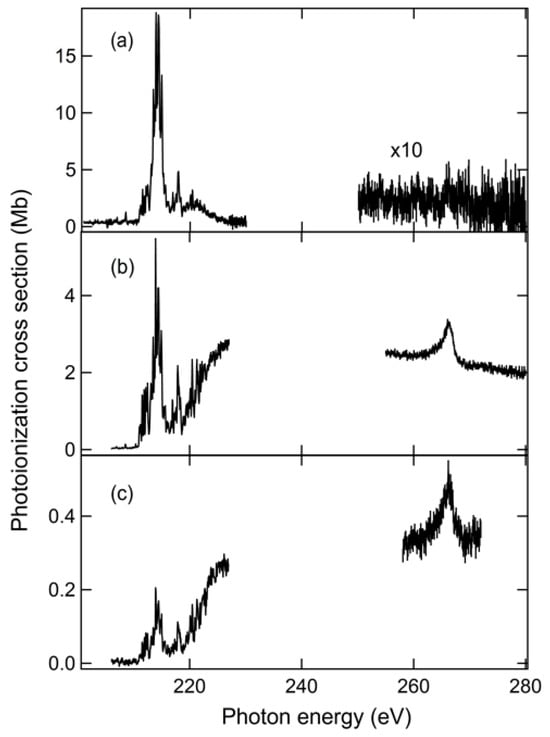
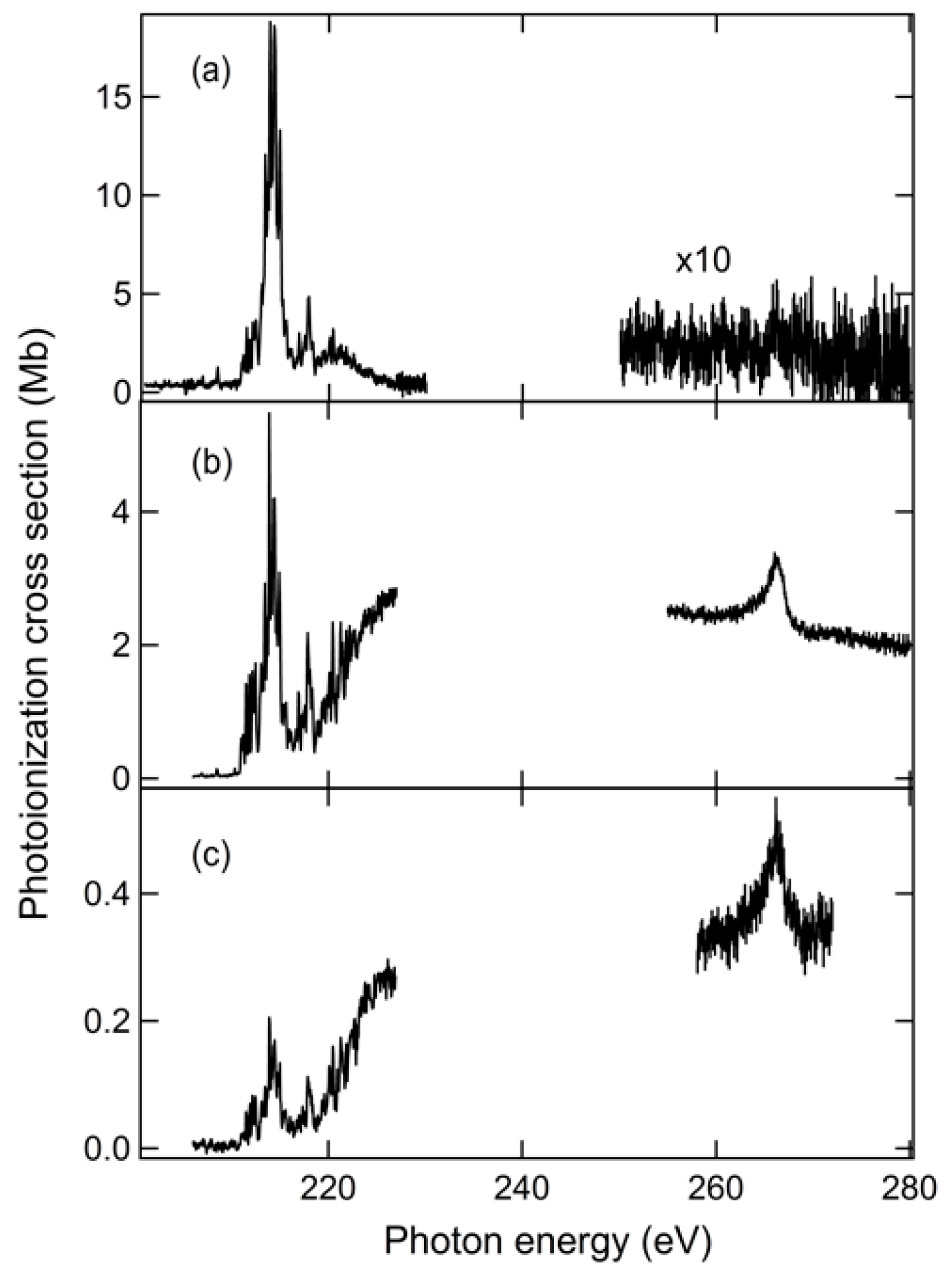
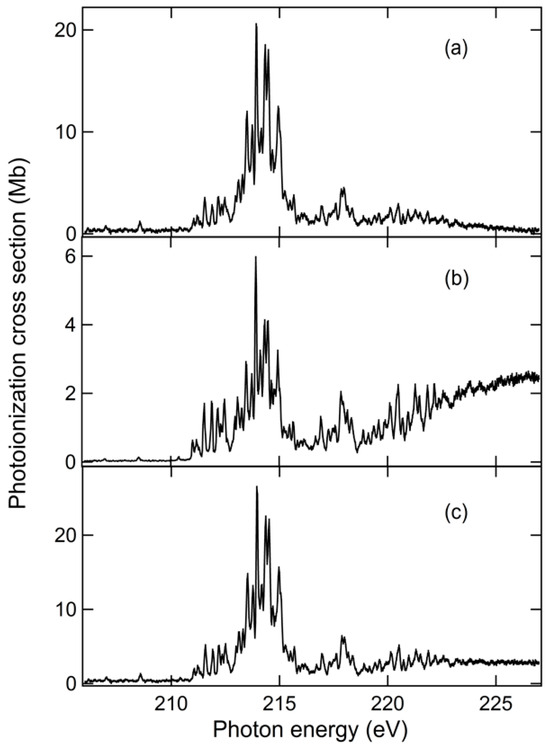
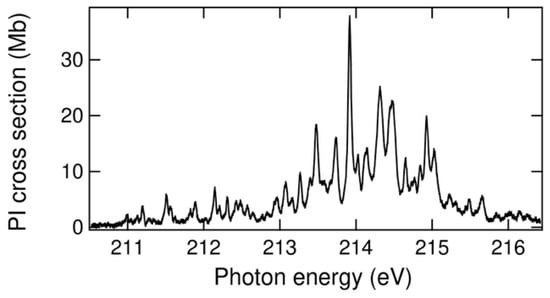
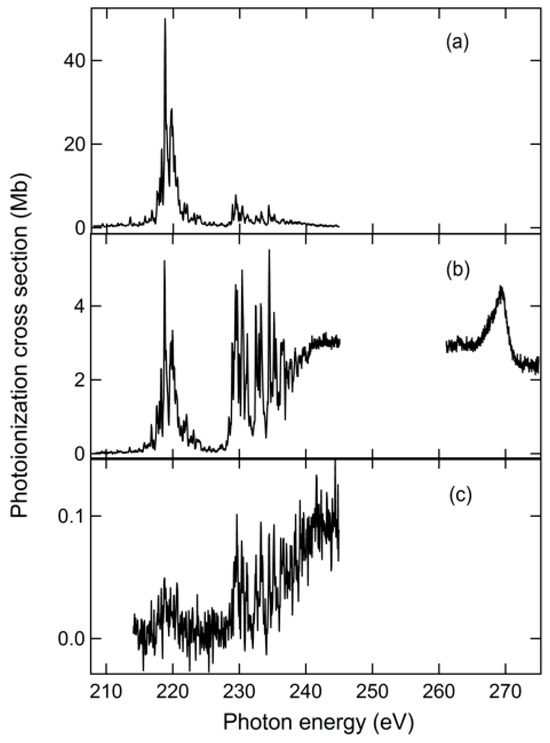
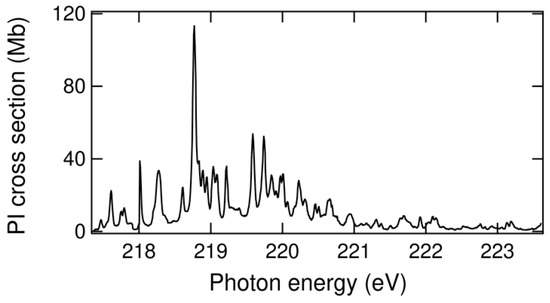
The ground state LSJ electron configuration of the sulphur-like ion Cl+ is 2p63s23p4 3P2. For 2p inner-shell excitations from the ground state we can expect Rydberg series 2p→3d, 4d, 5d, … and 2p→4s, 5s, 6s, … leading to limits of the form 2p53s23p4. The upper levels for these series involve three open shells 2p5(2P)3p4(3P)nd(2D) and 2p5(2P)3p4(3P)(n + 1)s(2D) (), thus placing severe demands on a full and complete theoretical analysis. Using LS-coupling selection rules we obtain 3p4(3P)→2p53p4nd,(n + 1)s 3S 3P 3D. There are therefore many allowed transitions, so the expectation is to find a complex structure with many resonances. This is indeed corroborated by the experimental results shown in Figure 1, Figure 3 and Figure 4. At higher photon energies, further excitations due to 2s transitions are also possible. In the following figures, we show Cl+ photoion yields for different photoionization channels recorded with three different spectral resolutions.
Figure 1.
Experimental photoionization cross section of Cl+ in single (a), double (b) and triple (c) ionization channels recorded with a spectral bandpass of 200 meV@240 eV. The most intense features near 215 eV correspond to resonances belonging to the 2p→3d excitation array. The slightly asymmetric profile near 265 eV is that of the 2s→3p resonance. The value of the 2p threshold energy is estimated to be 225 ± 2 eV. See main text of the present paper for details.
Figure 1 shows a low spectral energy resolution scan of the cross sections over the extended photon energy regime covering both inner-shell 2p and 2s excitations. This essentially overview spectrum was recorded with a fairly wide spectrometer bandpass of 200 meV. The single (SI), double (DI) and triple (TI) ionization channel cross sections are shown on Figure 1a, b and c, respectively.
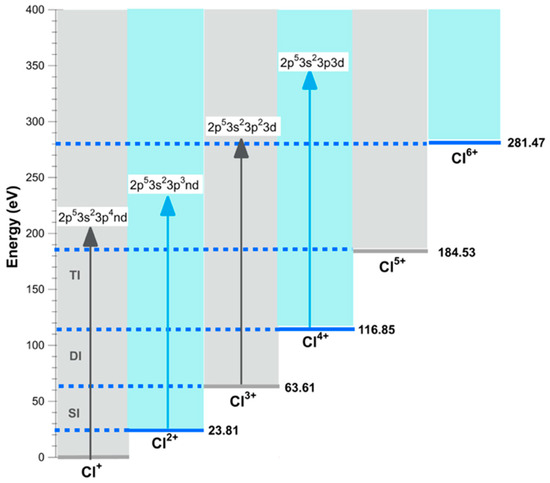
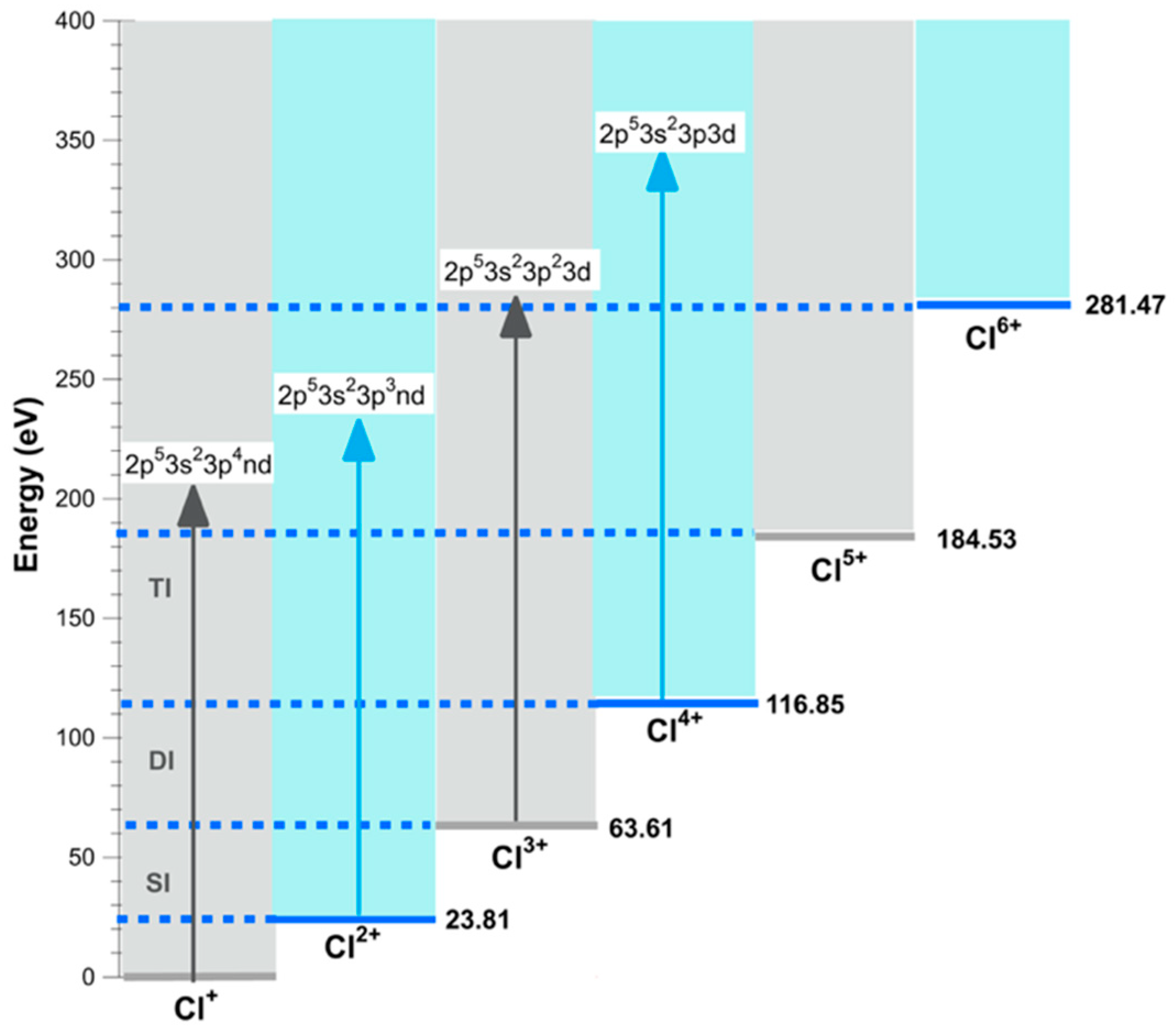
The schematic energy level diagram of Figure 2 shows these ionization routes for the Cl+ ion to Cl2+ (SI), Cl3+ (DI) and Cl4+ (TI), respectively. The vertical energy scale is referenced to the ground state of Cl+. The energy ranges of the 2p→nd and 2s→3p transitions lie above the quadruple ionization (QI) threshold (184.53 eV) of Cl+, showing that the production of Cl5+ ions is energetically possible in our Cl+ experiments. However, this was not explored experimentally due to the comparatively very small probability of QI processes giving negligible contributions to the total photoexcitation cross sections. Figure 2 can be used to determine the available ionization channels for all the ions under study in the present work. It could also be used to estimate the energy of the electrons emitted by the non-radiative decay processes that follow the initial photon absorption.
Figure 2.
Simplified energy level diagram of the Cl+ to Cl6+ isonuclear ions referenced to the 3s23p4 3P2 ground state of Cl+. The photon energies (23.81, 63.61, 116.85, 184.53 and 281.47 eV) required to produce single (SI), double (DI), triple (TI), quadruple and quintuple ionization, respectively, are indicated for Cl+. From the diagram SI, DI and TI energies can also be determined approximately for the Cl2+, Cl3+ and Cl4+ ions. The energy location of the 2p→nd resonances are also shown approximately for the Cl+, Cl2+, Cl3+ and Cl4+ ions (see Table 1 and Table 2 of the present paper). The basic ionization energy data for each ion were obtained from the NIST Atomic Spectra Database Levels Data [36].
Returning now to Figure 1, most of the oscillator strength is seen to be concentrated in the SI channel in the 210–220 eV region. The double (b) and triple (c) ionization channels, while weaker, show structures not seen in the single ionization channel. These include an increase in the cross section just above ~220 eV, attributable to the onset of normal Auger processes above the 2p threshold, and the asymmetric 2s→3p resonance just below ~270 eV. As the latter feature represents the unresolved contributions of multiple transitions, possibly even including transitions originating in excited/metastable states, no attempt was made to obtain the values of the standard ( Fano parameters, see e.g., [37], from computer best-fits of the line profile. We note, at this early stage, that this also the case for the Cl2+, Cl3+ and Cl4+ ions that are discussed in the following sections of the paper.
The data shown in Figure 3 was recorded with an intermediate spectrometer bandwidth of 85 meV@215 eV and shows the dominant SI (a) and DI (b) channels only. The total cross section is shown just below (c), essentially equal to the sum of the SI and DI channels. Figure 4 shows a recording with a narrow spectrometer bandpass of 20 meV@214 eV, over the narrow spectral region 211–216 eV which is dominated by the strongest discrete resonance structures. The complexity of the resonance structures is seen more clearly as the spectral resolution is increased from Figure 1a through Figure 3 to Figure 4.
Figure 3.
Experimental photoionization cross section of Cl+ in single (a) and double (b) ionization channels recorded with a spectral bandpass of 85 meV@215 eV. The total cross section is shown in (c) as the sum of (a,b).
Figure 4.
Experimental photoionization SI cross section of Cl+ recorded with a narrow spectral bandpass of 20 meV@214 eV.
The resonance structures between 211 and 216 eV can be associated with the 2p→3d transitions, and higher members of the nd series are observed at higher photon energies, moving towards the inner-shell ionization threshold. The peak of the 2p→4d resonance structures are observed at about 218 eV. The strongly broadened asymmetric resonance that shows up in the DI and TI channels of Figure 1, just below 270 eV, is the 2s→3p resonance. The asymmetric nature of the resonance is attributable to a strong interaction with the associated continuum.
If the cross sections in the different photoionization channels of Figure 1 are summed between the photon energies of 206–219 eV, we obtain the values of SI (38.7 ± 5.8 Mb eV), DI (10.7 ± 1.6 Mb eV) and TI (0.49 ± 0.07 Mb eV), giving ratios of DI/SI = 28 ± 6% and TI/SI = 1.3 ± 0.3%. If we use the data of Figure 3 we obtain the corresponding numbers of 32.9 ± 4.9, 9.58 ± 1.44 for the SI and DI channels and a calculated DI/SI ratio of 29.2 ± 6.2%. The differences between the two estimates are essentially due to statistical uncertainties. Figure 4 provides a summed cross section value of 30.8 ± 4.6 Mb eV between 210.5 and 216.3 eV, corresponding to the 2p→3d resonances.
We have determined the energies and strength values of resonance peaks in the 2p-3d region from Lorentzian profiles best fit values of the peak photon energy and width. This procedure was applied to the high-resolution experimental spectrum of Figure 4. The resulting individual line energies and resonance strengths (for strengths > 0.5 Mb eV) are presented in Table 1.
Table 1.
Energy (eV), absolute (Mb eV) and relative strength (the strongest resonance is given an arbitrary strength of 1) of the main 2p→3d resonances in the photoion yield cross section spectra of the Cl+ and Cl2+ ions. The energy and strength values are obtained from Lorentzian fits to the resonances of high resolution spectra (25 μm wide entrance slit on the monochromator) in the most intense decay channel only. The number in bracket is the uncertainty on the last digit of the numerical value of the physical quantity.
3.2. Cl2+ Results
The ground state electron configuration of the phosphorus-like ion Cl2+ is 2p63s23p3 4S3/2. Inner-shell excitations are observed from the ground state with Rydberg series of type 2p→3d, 4d, 5d, … and 2p→4s, 5s, 6s, … leading to limits of the form 2p53s23p3. Figure 5 shows the cross sections over the energy regimes covering both 2p and 2s inner-shell excitations, recorded with a spectrometer bandpass of 200 meV, and shows complex structures resulting from 2p excitation series, between 210 and 250 eV, and the 2s→3p asymmetric resonance at higher photon energies, with the latter observed in the double ionization channel. It is notable that in moving from Cl+ to Cl2+ that the peak of the 2p→3d structures moves to higher photon energies (~214 to ~219 eV) as might be expected due to the increased degree of ionization. The 2s→3p excitation also moves to higher energies from ~266 eV to ~269 eV. In Figure 6 we show the SI cross section in the 2p→3d region recorded with a spectrometer bandpass of 22 meV@220 eV.
Figure 5.
Experimental photoionization cross section of Cl2+ in single (a), double (b) and triple (c) ionization channels recorded with a spectral bandpass of 200 meV@240 eV. The most intense features near 220 eV correspond to resonances belonging to the 2p→3d excitation array. The slightly asymmetric profile near 270 eV is that of the 2s→3p resonance. The value of the 2p threshold energy is estimated to be 240 ± 2 eV. See main text of the present paper for details.
Figure 6.
Experimental SI photoionization cross section of Cl2+ in the 2p-3d region recorded with a narrow spectral bandpass of 22 meV@220 eV.
We can again examine the total integrated cross sections. From the data shown in Figure 5 we obtain for the spectral region of 207–234 eV the values of SI (89.2 ± 13.4 Mb eV), DI (20.6 ± 3.1 Mb eV) and TI (0.31 ± 0.04 Mb eV) giving DI/SI and TI/SI ratios of 23 ± 5% and 0.3 ± 0.1% respectively. We again note the increase in cross section in the DI and TI channels at energies corresponding to the inner-shell ionization threshold and the strongly asymmetric resonance near 270 eV identified as the 2s→3p resonance.
For the case of Cl2+ we are also able, as an example of inter-isoelectronic comparison, to compare the results with those previously measured [38] for its isoelectronic partner S+. The SI results are broadly similar for the two ions while the DI and TI channels show very different results. It is particularly noteworthy that, in the DI and TI channels, the balance between the 2p→3d resonance structures and the higher nd members changes quite significantly as the degree of ionization changes. In the DI channel for Cl2+ the 2p→3d resonances are much weaker compared to the oscillator strengths of the higher lying resonances. For the TI channel all the Cl2+ resonances are extremely weak whereas for S+ the resonance structures remain very visible and a strong continuum structure is observed for S+, indicating strong continuous decay processes.
We note that metastable states of the form 2p63s23p3 2D3/2,5/2, 2p63s23p3 2P2/2,3/2 lie only a few electron volts above the ground state and may contribute to the observed data. We report in Table 1 the energies and line strengths of the dominant Cl2+ resonances (strengths > 1 Mb eV) obtained from the data shown in Figure 6, by the profile fitting procedure described above, including the experimental bandpass of 22 meV.
3.3. Cl3+ Results
For the triply ionized chlorine ion, the ground state has two outer 3p electrons remaining in the configuration 2p63s23p2. For this case, due to beamtime limitations, we were only able to record the resonances in the 2p→3d region and the photon region corresponding to the 2s→3p asymmetric resonance. Figure 7 shows the photon yield in the SI and DI channels recorded with a spectrometer bandpass of 215 meV@250 eV, showing both the 2p→3d and 2s→3p regions, with the latter observed only in the DI channel. The lower panel shows the yield in the 2p-3d region at higher spectral resolution, with a spectrometer slit of 25 μm corresponding to a bandpass of 23 meV@226 eV. From the top panel the sum of the cross section in the SI channel between 216 and 236 eV is 125.7 ± 18.9 Mb eV while the sum in the DI channel is 4.8 ± 0.7 Mb eV, giving a DI/SI ratio of 3.8 ± 0.8%.
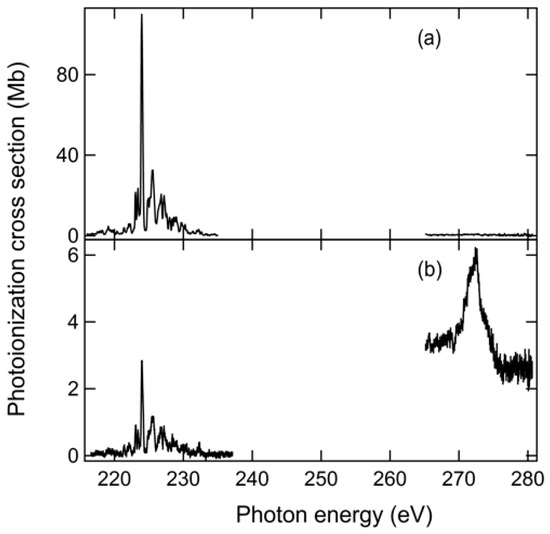
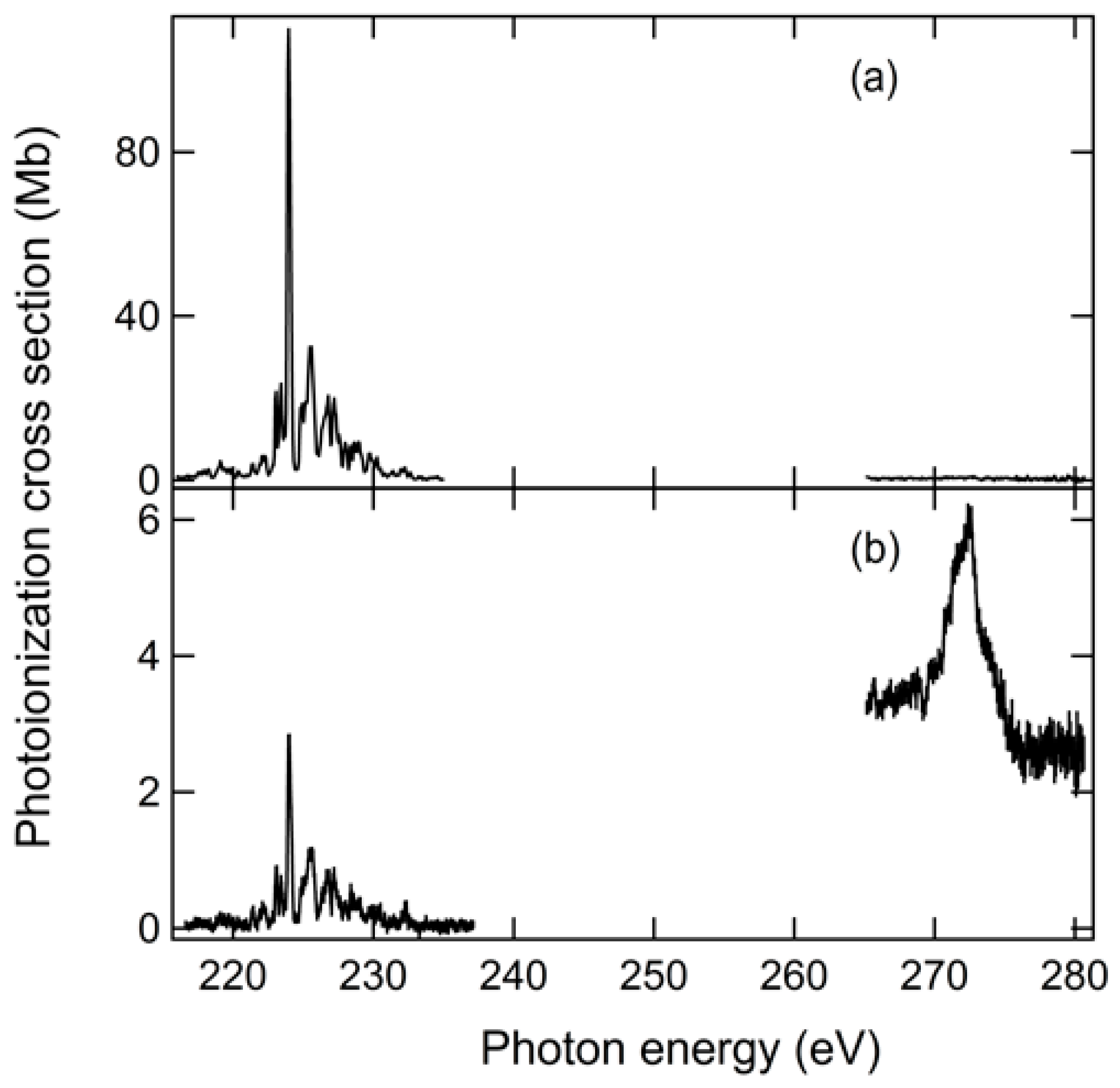
Figure 7.
Experimental photoionization cross sections of Cl3+ in the single (a) and double (b) photoionization channels recorded with a spectral bandpass of 215 meV@250 eV. The most intense features near 225 eV correspond to resonances belonging to the 2p→3d excitation array. The asymmetric profile near 275 eV is that of the 2s→3p resonance.
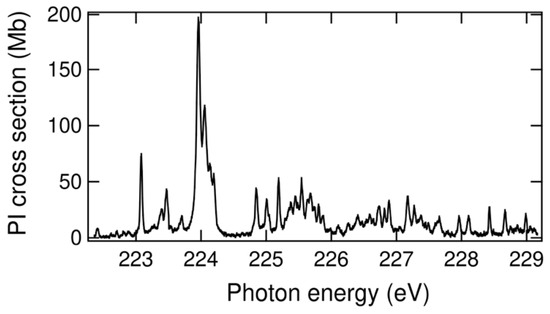
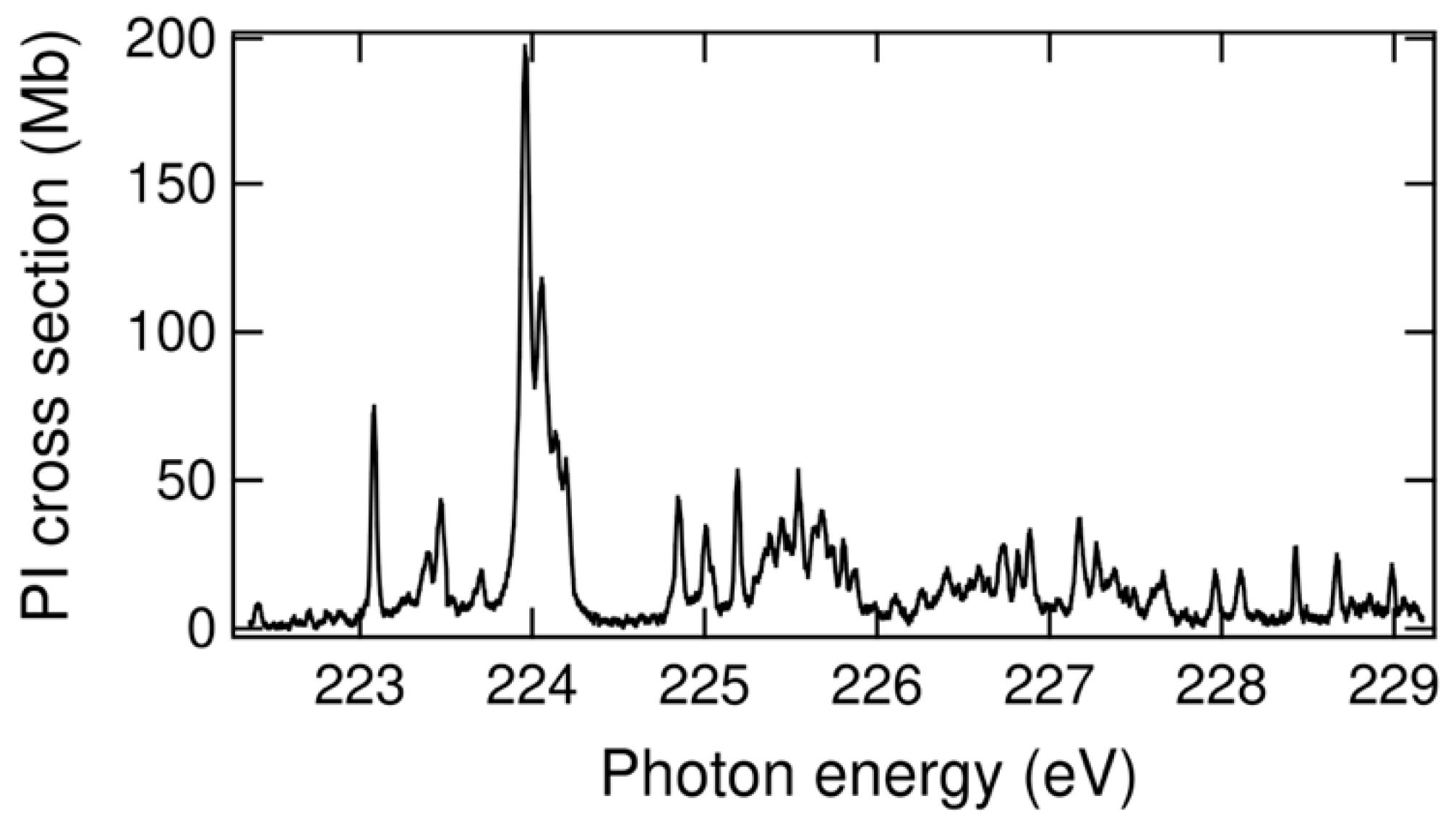
The resonance structures are more clearly evident in Figure 8 which shows the photoion yield in the 2p→3d region with a spectral resolution of 23 meV@226 eV. Table 2 reports the resonance energies and line strengths (>1 Mb eV) obtained from the data shown in Figure 7 by the profile fitting procedure described earlier.
Figure 8.
Experimental SI cross section of Cl3+ in the 2p→3d region recorded with a narrow spectral bandpass of 23 meV@226 eV.
Table 2.
Energy (eV), absolute (Mb eV) and relative strength (the strongest resonance is given an arbitrary strength of 1) of the main 2p→3d resonances in the photoion yield cross section spectra of the Cl3+ and Cl4+ ions. The energy and strength values are obtained from Lorentzian fits to the resonances of high resolution spectra (25 μm wide entrance slit on the monochromator) in the most intense decay channel only. The number in bracket is the uncertainty on the last digit of the numerical value of the physical quantity.
3.4. Cl4+ Results
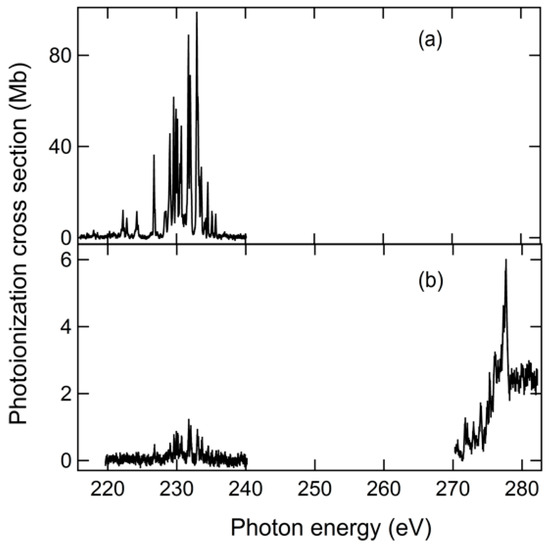
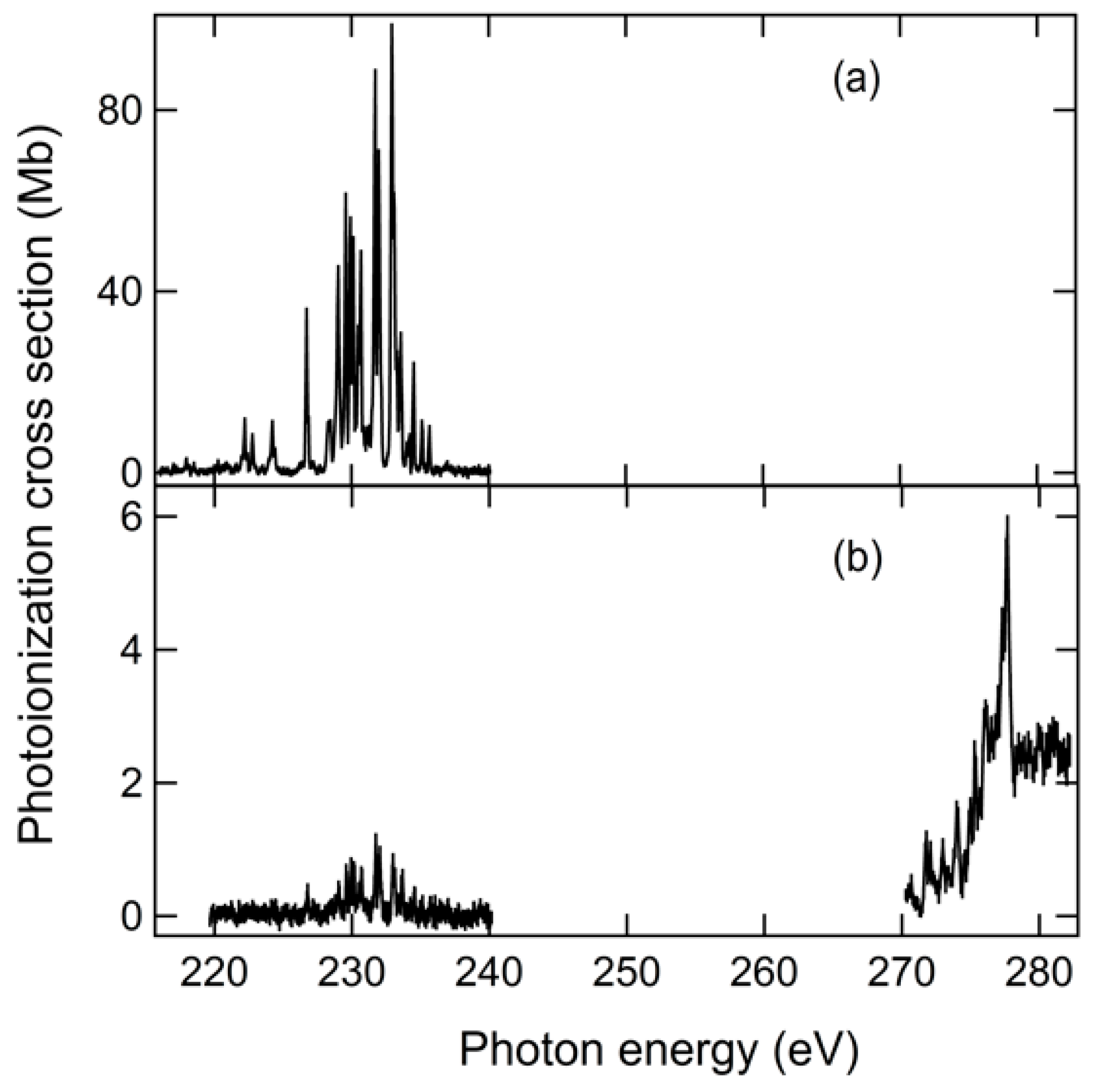
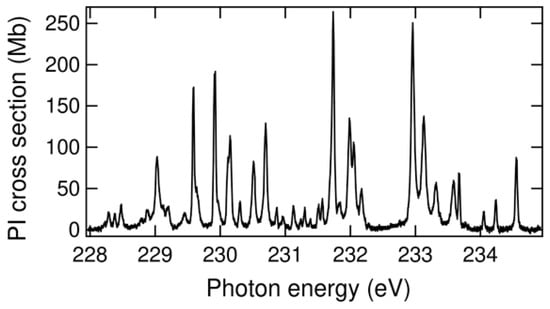
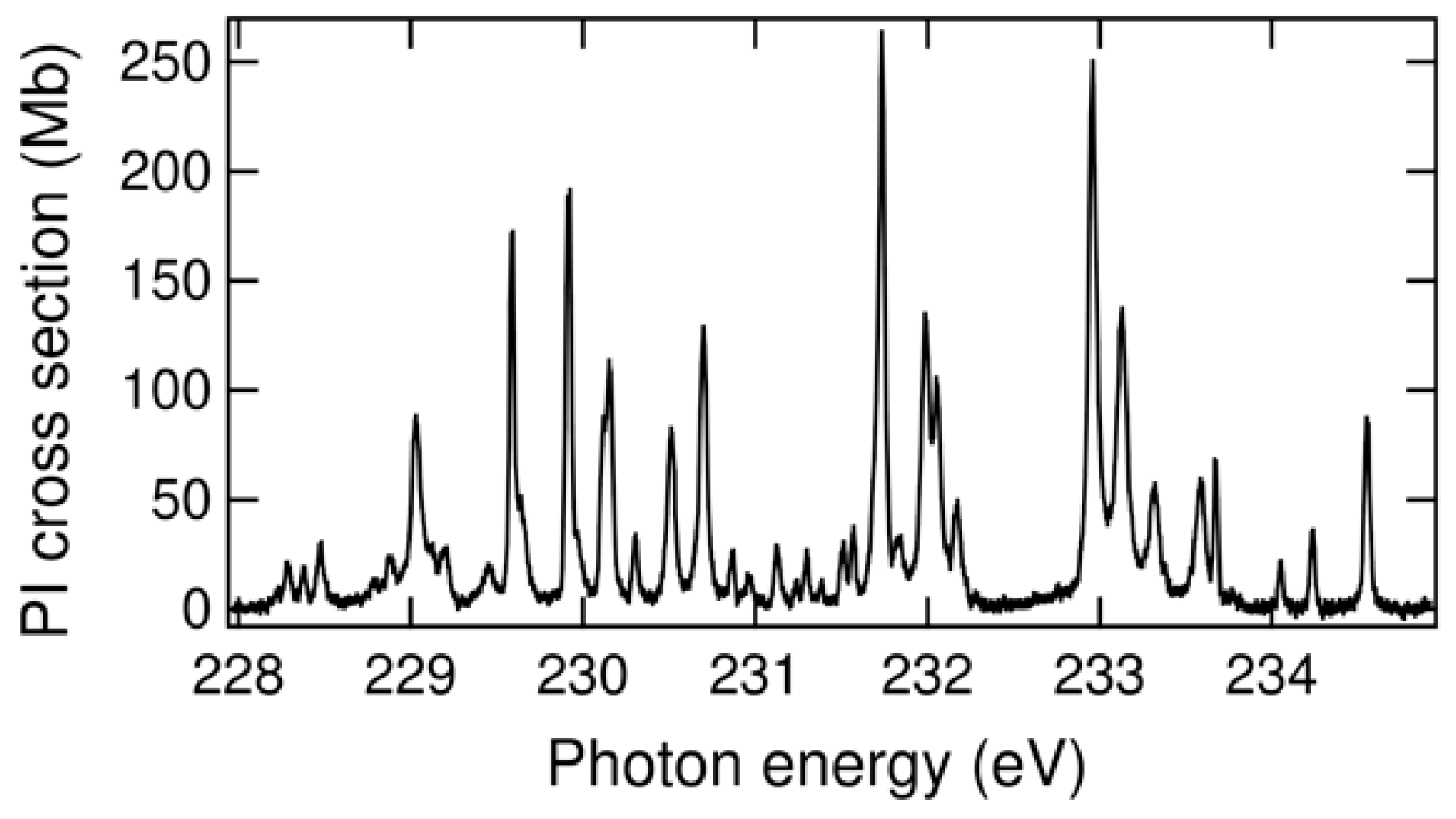
Only a single valence 3p electron remains for the quadruply ionized chlorine case. In Figure 9 we show in the top panel, the overall photoion yields in the single and double ionization channels recorded with a spectrometer slit of 215 meV@250 eV. Figure 10 shows a higher resolution scan (24 meV@231 eV) in the strong resonance region associated with the 2p→3d region. Table 2 contains the corresponding energy and line strength data. We note that the 2p→3d resonances are only weakly seen in the DI channel but the 2s→3p resonance is strongly present.
Figure 9.
Experimental photoionization cross section of Cl4+ in the single (a) and double (b) photoionization channels recorded with a spectral bandpass of 215 meV@250 eV. The most intense features near 230 eV correspond to resonances belonging to the 2p→3d excitation array. The asymmetric profile near 277 eV is that of the 2s→3p resonance, while the 2p threshold is estimated to be 275.4 ± 0.5 eV. See main text of the present paper for details.
Figure 10.
Experimental SI photoionization cross section of Cl4+ in the single ionization channel recorded with a spectral bandpass of 24 meV@231 eV, in the region of the 2p→3d resonances.
If we sum the cross sections from Figure 9, the singly ionized channel gives 162 ± 24 Mb eV between 220 and 240 eV, while the corresponding sum for the DI channel is 2.1 ± 0.3 Mb eV, giving a DI/SI ratio of 1.3 ± 0.3%.
Table 2 reports the resonance energies and line strengths (>2 Mb eV) obtained by the profile fitting procedure described above, for the data shown in Figure 10.
We note that a contributing factor to the fall off in the experimentally measured DI/SI and TI/SI ratios as we move from Cl+ through Cl2+, Cl3+ to Cl4+ may be qualitatively understood from an examination of Figure 2. A full explanation would require currently unavailable detailed information on energy levels that allow single and double Auger processes to proceed. Figure 2 shows that as the degree of ionization increases the gap between the various ionization limits grows. This implies that the photon energy range allowing multiple (double or triple) ionization decreases compared to that available for single ionization, as the initial charge state increases from Cl+ to Cl4+. For the charge states examined here, this progressive change culminates in the case of Cl4+. For Cl4+, the strongest resonances (2p→3d) appear at a photon energy value of ~230 eV (Figure 9). For these photon energies triple ionization (Cl4+→Cl7+) is not energetically possible as the ground level for Cl7+ lies at ~395 eV [36].
3.5. Isonuclear Sequence
The study of systematic trends and regularities in atomic energy levels and associated oscillator strengths along extended isonuclear and isoelectronic sequences is a mature field in atomic physics, spanning over several decades of research. Relevant data will be found in a number of extensive databases, see e.g., [39].
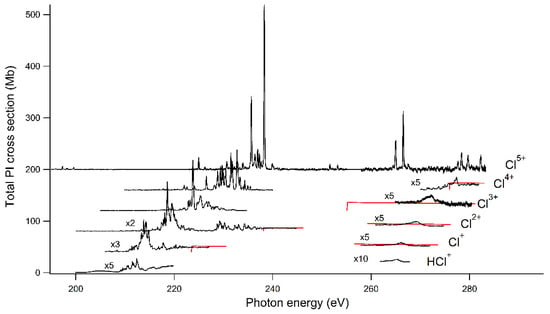
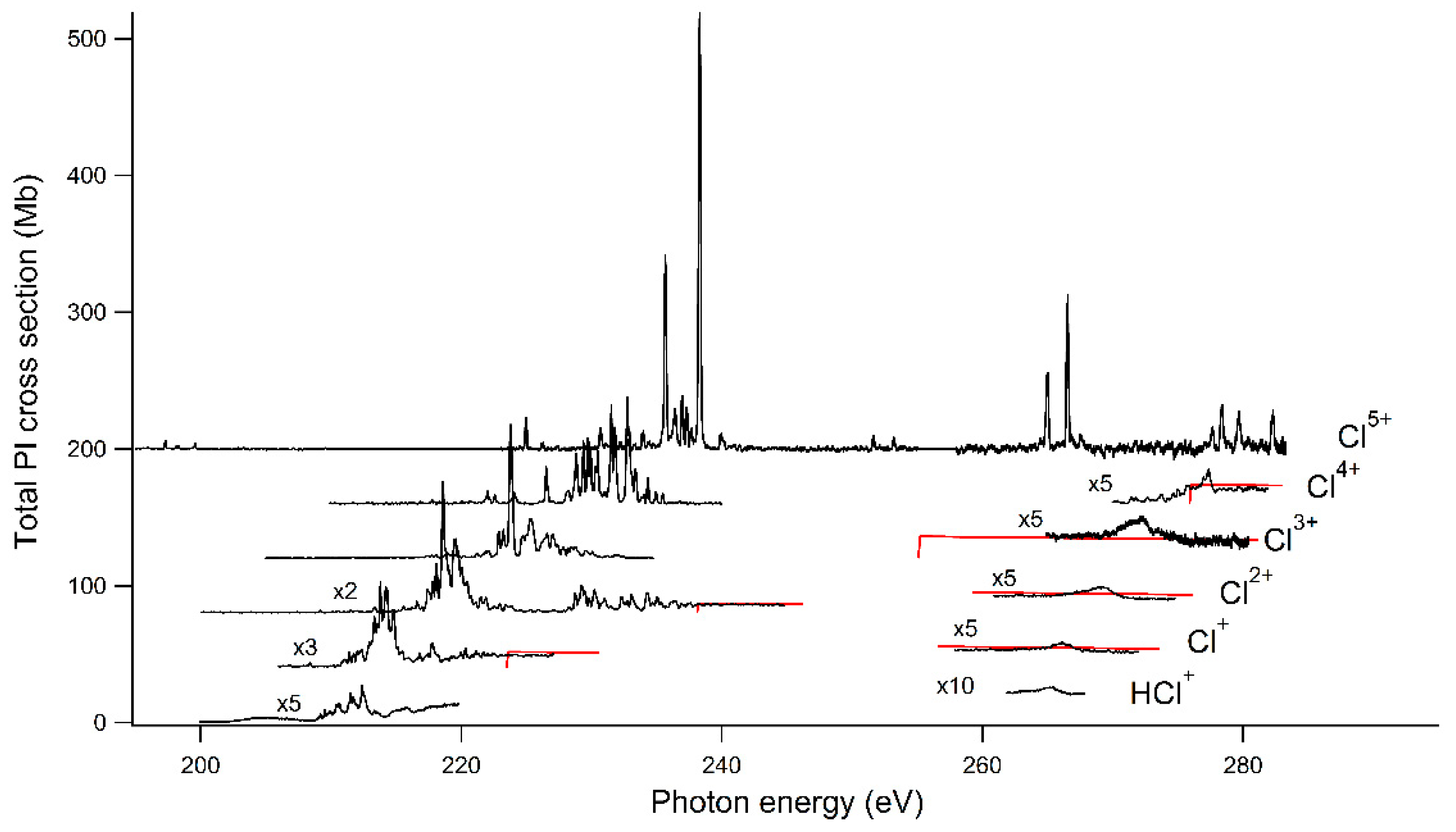
Using the present results, we can examine the evolution of the resonance structures as the degree of ionization increases along the Cl+ to Cl4+ isonuclear sequence. In Figure 11, we show on a common photon energy scale, the present ion yields together with those of Cl5+ [33] and HCl+ [40]. A shift towards higher photon energies of both the 2p and 2s excitations, as well as a systematic change with the ion charge of the integrated cross section over the 2p→3d region, are evidenced.
Figure 11.
An overview of the evolution of the total photoionization cross section along the isonuclear sequence Cl+ through Cl5+. In addition to the new results for Cl+ to Cl4+ reported here, we include the corresponding data for Cl5+ [33] and HCl+ [40]. The red curves represent the calculated direct 2p photoionization cross sections of Verner et al. [41]. To improve the readability of the plot a vertical offset of 40 Mb has been inserted between each successive trace starting at Cl+ from the reference (no offset) HCl+ trace.
From the different energy regions of these spectra, the variations of the absorption oscillator strengths f for the 2p→3d,4s, 2p→nd,(n + 1)s, n > 3 and 2p→εd,εs transitions are obtained using the formula [37]:
where σ (E) is the photoionization cross section in Mb, E is the photon energy in eV, and E1 and E2 are appropriate energy limits.
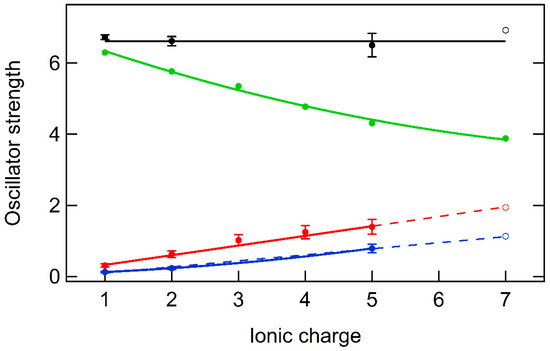
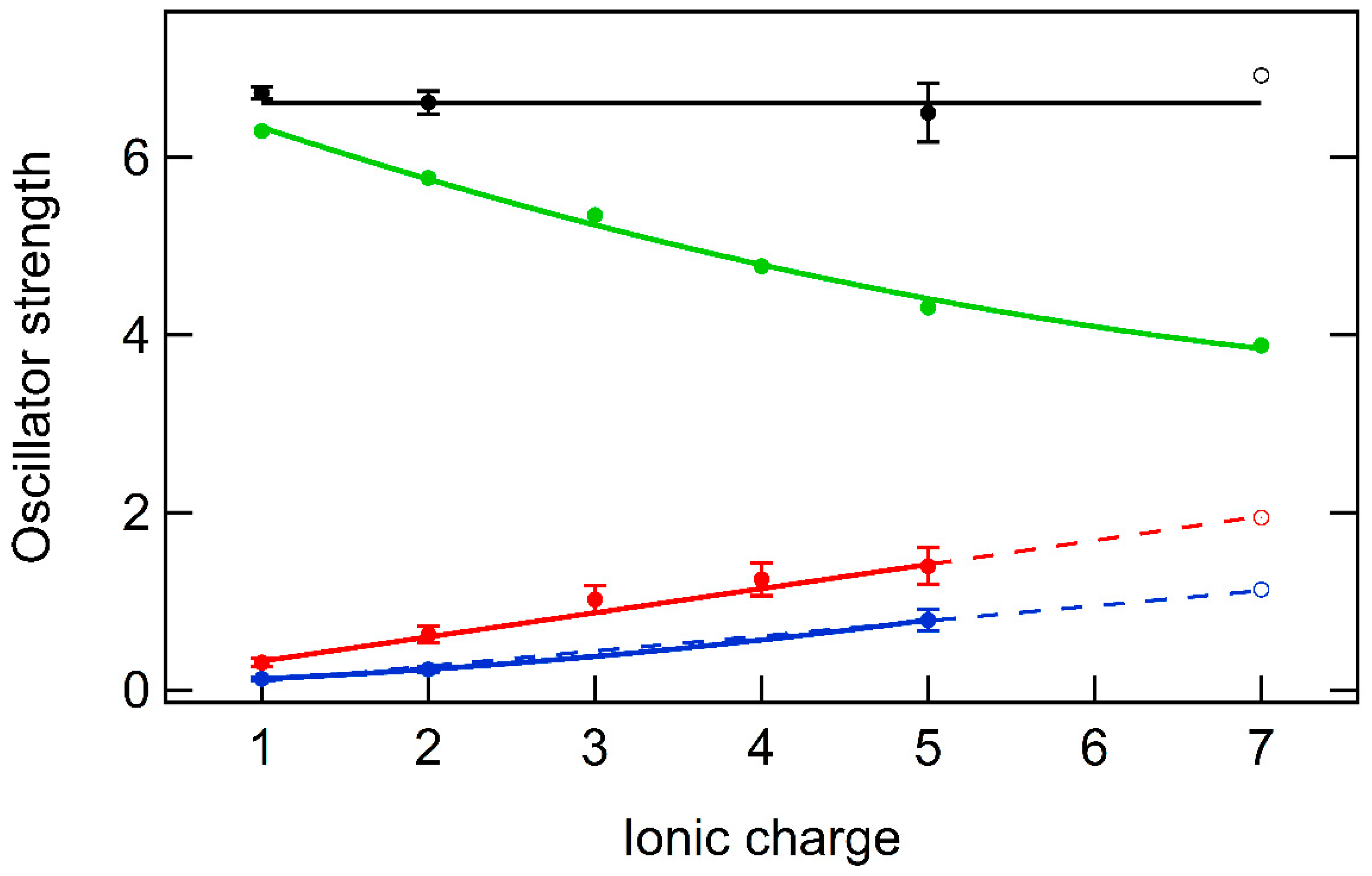
The results are shown on Figure 12. The contributions of the low-lying discrete 2p→3d,4s resonances to the overall 2p absorption oscillator strengths are shown on the red line, and the summations of the higher lying 2p→nd,(n + 1)s, n > 3 discrete resonances on the blue line. The data of Figure 11 show agreement of our experimental measurements for the direct 2p photoionization continuum cross sections with those calculated from Verner et al. [41]. We can thus calculate the contribution for each ion (points on the green line of Figure 12) of the 2p→εd,εs continuum transitions by integrating the Hartree-Dirac-Slater calculated cross sections of Verner et al. [41] from the ionization threshold up to 7 keV. Figure 12 therefore shows essentially all contributions to the 2p oscillator strengths, for the Cl isonuclear sequence. As the ion charge state increases the contributions of the discrete resonances are seen to increase relative to those of the direct photoionization continua. The sums of the various contributions to the 2p oscillator strengths for each member of the isonuclear sequence are represented by the points on the black line of Figure 12. The sum, which remains about six for the sequence, closely matches the number of 2p electrons, providing a nice example of the approximate partial sum rule [42].
Figure 12.
Variations of the oscillator strengths for the 2p→3d,4s (in red), 2p→nd,(n + 1)s, n > 3 (in blue) and 2p→εd,εs [40] (in green) transitions, as a function of the charge of the Cl ion. The blue and red dashed lines and open dots are obtained from a linear extrapolation of the blue and red solid lines, respectively. The sum of the blue (solid and dashed) and red (solid and dashed) lines is shown as the black line.
The question of the effect of the successive removal of outer shell electrons on the 2s or 2p inner shell photoionization cross sections along the Mg and Ar isonuclear sequences is of long standing interest, [43,44,45]. It seems established by now that due to relaxation effects the inner shell ionic cross sections may differ significantly from that of the neutral. Figure 12 shows that the 2p→3d integrated cross sections exhibit a smooth behaviour for the ions under study: It increases almost linearly from the singly ionized species to the more ionized Cl5+ ion, with a slope close to that reported for the sulfur isonuclear sequence [37]. From Figure 12, it is seen that f2p→3d,4s extrapolates (dashed red line in Figure 12) to a value of about 2 in Cl7+ (the most ionized species with a filled 2p subshell).
4. Conclusions
We report first experimental results on the photoionization of the early members of the chlorine isonuclear sequence ranging from Cl+ through Cl4+, in the photon energy regimes corresponding to the excitation of inner-shell 2s and 2p electrons. The observations were carried out in the single, double and triple ionization channels, enabling absolute total cross sections to be also deduced. The data were recorded at different spectral resolutions, allowing the overall spectral structures to be examined and providing tabulated resonance energies and line strengths. For Cl2+ the photoionization behaviour was compared to previously published data for its isoelectronic partner S+. The new results for the individual ions are compared with their isonuclear counterparts showing fairly smooth evolution in the integrated cross sections. We hope these experimental results will provide benchmarks for future theoretical calculations which can in turn lead to a more thorough understanding of the experimental results.
Author Contributions
D.C., J.-M.B., J.-P.M., E.T.K. and S.G. participated in the experiments and data acquisition. The table and figures were prepared by J.-M.B., J.-P.M., E.T.K. and D.C. All authors contributed to the data analyses and conclusions. E.T.K., J.-P.M. and J.-M.B. prepared the original draft. All authors received and reviewed subsequent drafts. All authors have read and agreed to the published version of the manuscript.
Funding
This research received no external funding.
Data Availability Statement
The primary data of this study are available in the published article. The manuscript is deposited in DORAS, the DCU Research Repository, at the following: https://doras.dcu.ie. Additional data are available from the corresponding author upon reasonable request.
Acknowledgments
Thanks are due to the SOLEIL and PLÉIADES beam line staff, J. Bozek, C. Nicolas, A. Milosavljevic for their support during the experimental beamtime.
Conflicts of Interest
There are no conflicts of interest.
References
- Kounaves, S.P.; Carrier, B.L.; O’Neil, G.D.; Stroble, S.T.; Claire, M.W. Evidence of Martian Perchlorate, Chlorate, and Nitrate in Mars Meteorite EETA79001: Implications for Oxidants and Organics. Icarus 2014, 229, 206–213. [Google Scholar] [CrossRef] [Scilit]
- Wallström, S.H.J.; Muller, S.; Roueff, E.; Le Gal, R.; Black, J.H.; Gérin, M. Chlorine-Bearing Molecules in Molecular Absorbers at Intermediate Redshifts. Astron. Astrophys. 2019, 629, A128. [Google Scholar] [CrossRef] [Scilit]
- Vardya, M.S. Negative Chlorine Ion and M-Spectral Type Stars. Mon. Not. R. Astron. Soc. 1966, 132, 475–478. [Google Scholar] [CrossRef] [Scilit]
- Blake, G.A.; Anicich, V.G.; Huntress, W.T., Jr. Chemistry of Chlorine in Dense Interstellar Clouds. Astrophys. J. 1986, 300, 415. [Google Scholar] [CrossRef] [Scilit]
- Feldman, P.D.; Ake, T.B.; Berman, A.F.; Moos, H.W.; Sahnow, D.J.; Strobel, D.D.; Weaver, H.H. Detection of Chlorine Ions in the Far Ultraviolet Spectroscopic Explorer Spectrum of the IO Plasma Torus. Astrophys. J. 2001, 554, L123–L126. [Google Scholar] [CrossRef] [Scilit]
- Moomey, D.; Federman, S.R.; Sheffer, Y. Revisiting the Chlorine Abundance in Diffuse Interstellar Clouds from Measurements with the Copernicus Satellite. Astrophys. J. 2012, 744, 174. [Google Scholar] [CrossRef] [Scilit]
- Sylwester, B.; Phillips, K.J.H.; Sylwester, J.; Kuznetsov, V.D. The Solar Flare Chlorine Abundance from Resik X-Ray Spectra. Astrophys. J. 2011, 738, 49. [Google Scholar] [CrossRef] [Scilit]
- Foster, A.R.; Smith, R.K.; Brickhouse, N.S.; Kallman, T.R.; Witthoeft, M.C. The Challenges of Plasma Modeling: Current Status and Future Plans. Space Sci. Rev. 2010, 157, 135–154. [Google Scholar] [CrossRef] [Scilit]
- Kallman, T.R. Modeling of Photoionized Plasmas. Space Sci. Rev. 2010, 157, 177–191. [Google Scholar] [CrossRef] [Scilit]
- Nahar, S. Database NORAD-Atomic-Data for Atomic Processes in Plasma. Atoms 2020, 8, 68. [Google Scholar] [CrossRef] [Scilit]
- Pinto, C.; Kaastra, J.S.; Costantini, E.; Verbunt, F. High-Resolution X-Ray Spectroscopy of the Interstellar Medium: XMM-Newton Observation of the LMXB GS 1826–238. Astron. Astrophys. 2010, 521, A79. [Google Scholar] [CrossRef] [Scilit]
- Swartz, D.A.; Wolk, S.J.; Fruscione, A. Chandra’s First Decade of Discovery. Publ. Natl. Acad. Sci. USA 2010, 107, 7127–7134. [Google Scholar] [CrossRef] [Scilit]
- Berrington, K. Summary of the Iron and Opacity Projects. In Astrophysical Applications of Powerful New Databases; Adelman, S.J., Wiese, W.L., Eds.; Astronomical Society of the Pacific: San Francisco, CA, USA, 1995; Volume 78, p. 19. [Google Scholar]
- Ferland, G.J.; Porter, R.L.; Lykins, M.L.; Shaw, G.; Henney, W.J.; Stancil, P.C. The 2013 Release of Cloudy. arXiv 2013, arXiv:1302.4485. [Google Scholar] [CrossRef] [Scilit]
- van Hoof, P.A.M.; VandeSteene, G.C.; Guzmán, F.; Dehghanian, M.; Chatzikos, M.; Ferland, G.J. Current and Future Development of the Photoionization Code Cloudy. Contrib. Astron. Obs. Skaln. Pleso 2020, 50, 32–43. [Google Scholar] [CrossRef] [Scilit]
- Kallman, T.R.; Palmeri, P. Atomic Data for X-Ray Astrophysics. Rev. Mod. Phys. 2007, 79, 79–133. [Google Scholar] [CrossRef] [Scilit]
- Mendoza, C.; Bautista, M.A.; Deprince, J.; García, J.A.; Gatuzz, E.; Gorczyca, T.W.; Kallman, T.R.; Palmeri, P.; Quinet, P.; Witthoeft, M.C. The XSTAR Atomic Database. Atoms 2021, 9, 12. [Google Scholar] [CrossRef] [Scilit]
- Nahar, S.N.; Hinojosa-Aguirre, G. Enhancement of the NORAD-Atomic-Data Database in Plasma. Atoms 2024, 12, 22. [Google Scholar] [CrossRef] [Scilit]
- Savin, D.W.; Brickhouse, N.S.; Cowan, J.J.; Drake, R.P.; Federman, S.R.; Ferland, G.J.; Frank, A.; Gudipati, M.S.; Haxton, W.C.; Herbst, E.; et al. The Impact of Recent Advances in Laboratory Astrophysics on Our Understanding of the Cosmos. Rep. Prog. Phys. 2012, 75, 036901. [Google Scholar] [CrossRef] [Scilit]
- Bodeur, S.; Marchal, J.L.; Reynaud, C.; Bazin, D.; Nenner, I. Chlorine K Shell Photoabsorption Spectra of Gas Phase HCI and C12 Molecules. Z Phys. AtMol. Clust. 1990, 17, 291–298. [Google Scholar] [CrossRef] [Scilit]
- Caldwell, C.D.; Krause, M.O.; Cowan, R.D.; Menzel, A.; Whitfield, S.B.; Hallman, S.; Frigo, S.P.; Severson, M.C. Inner-Shell Photoexcitation in an Open-Shell Atom: The Cl 2p→ns,md Spectrum as a Case Study. Phys. Rev. A 1999, 59, R926–R929. [Google Scholar] [CrossRef] [Scilit]
- Martins, M. Photoionization of Open-Shell Atoms: The Chlorine 2p Excitation. J. Phys. B At. Mol. Opt. Phys. 2001, 34, 1321–1335. [Google Scholar] [CrossRef] [Scilit]
- Stolte, W.C.; Felfli, Z.; Guillemin, R.; Öhrwall, G.; Yu, S.-W.; Young, J.A.; Lindle, D.W.; Gorczyca, T.W.; Deb, N.C.; Manson, S.T.; et al. Inner-Shell Photoionization of Atomic Chlorine. Phys. Rev. A 2013, 88, 053425. [Google Scholar] [CrossRef] [Scilit]
- Lyon, I.C.; Peart, B.; West, J.B.; Dolder, K. Measurements of Absolute Cross Sections for the Photoionisation of Ba+ Ions. J. Phys. B At. Mol. Phys. 1986, 19, 4137–4147. [Google Scholar] [CrossRef] [Scilit]
- Bizau, J.M.; Cubaynes, D.; Guilbaud, S.; El Eassan, N.; Al Shorman, M.M.; Bouisset, E.; Guigand, J.; Moustier, O.; Marié, A.; Nadal, E.; et al. A Merged-Beam Setup at SOLEIL Dedicated to Photoelectron–Photoion Coincidence Studies on Ionic Species. J. Electron. Spectrosc. Relat. Phenom. 2016, 210, 5–12. [Google Scholar] [CrossRef] [Scilit]
- Kjeldsen, H. Photoionization Cross Sections of Atomic Ions from Merged-Beam Experiments. J. Phys. B At. Mol. Opt. Phys. 2006, 39, R325–R377. [Google Scholar] [CrossRef] [Scilit]
- Phaneuf, R.A.; Kilcoyne, A.L.D.; Müller, A.; Schippers, S.; Aryal, N.; Baral, K.; Hellhund, J.; Aguilar, A.; Esteves-Macaluso, D.A.; Lomsadze, R. Cross-Section Measurements with Interacting Beams; AIP Publishing: Gaithersburg, MD, USA, 2013; pp. 72–78. [Google Scholar]
- Schippers, S.; Buhr, T.; Borovik, A., Jr.; Holste, K.; Perry-Sassmannshausen, A.; Mertens, K.; Reinwardt, S.; Martins, M.; Klumpp, S.; Schubert, K.; et al. The Photon-Ion Merged-Beams Experiment PIPE at PETRAIII—The First Five Years. X-Ray Spectrom. 2020, 49, 11–20. [Google Scholar] [CrossRef] [Scilit]
- Hernández, E.M.; Juárez, A.M.; Kilcoyne, A.L.D.; Aguilar, A.; Hernández, L.; Antillón, A.; Macaluso, D.; Morales-Mori, A.; González-Magaña, O.; Hanstorp, D.; et al. Absolute Measurements of Chlorine Cl+ Cation Single Photoionization Cross Section. J. Quant. Spectrosc. Radiat. Transf. 2015, 151, 217–223. [Google Scholar] [CrossRef] [Scilit]
- McLaughlin, B.M. Photoionization of Cl+ from the 3s23p4 3P2,1,0 and the 3s23p4 1D2, 1S0 States in the Energy Range 19–28 eV. Mon. Not. R. Astron. Soc. 2017, 464, 1990–1999. [Google Scholar] [CrossRef] [Scilit]
- Nahar, S.N. Photoionization Features of the Ground and Excited Levels of Cl II and Benchmarking with Experiment. New Astron. 2021, 82, 101447. [Google Scholar] [CrossRef] [Scilit]
- Nahar, S.; Hernández, E.; Kilcoyne, D.; Antillón, A.; Covington, A.; González-Magaña, O.; Hernández, L.; Davis, V.; Calabrese, D.; Morales-Mori, A.; et al. Experimental and Theoretical Study of Photoionization of Cl III. Atoms 2023, 11, 28. [Google Scholar] [CrossRef] [Scilit]
- Mosnier, J.-P.; Kennedy, E.T.; Bizau, J.-M.; Cubaynes, D.; Guilbaud, S.; Blancard, C.; Hasoğlu, M.F.; Gorczyca, T.W. L-Shell Photoionization of Magnesium-like Ions with New Results for Cl5+. Atoms 2023, 11, 66. [Google Scholar] [CrossRef] [Scilit]
- Ren, L.-M.; Wang, Y.-Y.; Li, D.-D.; Yuan, Z.-S.; Zhu, L.-F. Inner-Shell Excitations of 2p Electrons of Argon Investigated by Fast Electron Impact with High Resolution. Chin. Phys. Lett. 2011, 28, 053401. [Google Scholar] [CrossRef] [Scilit]
- Thuillier, T.; Benitez, J.; Biri, S.; Rácz, R. X-Ray Diagnostics of ECR Ion Sources—Techniques, Results, and Challenges. Rev. Sci. Instrum. 2022, 93, 021102. [Google Scholar] [CrossRef] [Scilit]
- Kramida, A.; Ralchenko, Y.; Reader, J. NIST ASD Team NIST Atomic Spectra Database (Version 5.10), 2022. Available online: https://www.nist.gov/pml/atomic-spectra-database (accessed on 25 December 2025).
- Fano, U.; Cooper, J.W. Spectral Distribution of Atomic Oscillator Strengths. Rev. Mod. Phys. 1968, 40, 441–507. [Google Scholar] [CrossRef] [Scilit]
- Mosnier, J.-P.; Kennedy, E.T.; Cubaynes, D.; Bizau, J.-M.; Guilbaud, S.; Blancard, C.; McLaughlin, B.M.; Hasoğlu, M.F.; Gorczyca, T.W. L-Shell Photoionisation Cross Sections in the S+, S2+, S3+ Isonuclear Sequence. J. Phys. B At. Mol. Opt. Phys. 2025, 58, 075002. [Google Scholar] [CrossRef] [Scilit]
- WIS Plasma Laboratory—Databases for Atomic and Plasma Physics. Available online: https://plasma-gate.weizmann.ac.il/directories/databases/ (accessed on 17 October 2025).
- Mosnier, J.-P.; Kennedy, E.T.; Cubaynes, D.; Bizau, J.-M.; Guilbaud, S.; Carniato, S. Ionic Photofragmentation Cross Sections of the HS+, H2 S+ and HCl+ Molecular Ions near the 2p Threshold. Phys. Chem. Chem. Phys. 2025, 27, 18595. [Google Scholar] [CrossRef] [Scilit]
- Verner, D.A.; Yakovlev, D.G.; Band, I.M.; Trzhaskovskaya, M.B. Subshell Photoionization Cross Sections and Ionization Energies of Atoms and Ions from He to Zn. At. Data Nucl. Data Tables 1993, 55, 233–280. [Google Scholar] [CrossRef] [Scilit]
- Kronig, R.D.L.; Kramers, H.A. Zur Theorie der Absorption und Dispersion in den Röntgenspektren. Z. Für Phys. 1928, 48, 174–179. [Google Scholar] [CrossRef] [Scilit]
- Ganesan, A.; Deshmukh, P.C.; Manson, S.T. Inner Shell Photoionization of Mg and Ca Isonuclear Sequence Using RMCTD. B. Am. Phys. Soc. 2018, 63, M01.00015. Available online: http://meetings.aps.org/link/BAPS.2018.DAMOP.M01.15 (accessed on 28 December 2025).
- Ganesan, A.; Deshmukh, S.; Jose, J.; Pradhan, G.B.; Radojevic, V.; Deshmukh, P.C.; Manson, S.T. Photoionization of the 2p Subshell in the Ar Isonuclear Sequence. J. Phys. Conf. Ser. 2015, 635, 092054. [Google Scholar] [CrossRef] [Scilit]
- Pradhan, G.B.; Jose, J.; Deshmukh, P.C.; Radojević, V.; Manson, S.T. Photoionization of Mg and Ar Isonuclear Sequences. Phys. Rev. A 2009, 80, 053416. [Google Scholar] [CrossRef] [Scilit]

Disclaimer/Publisher’s Note: The statements, opinions and data contained in all publications are solely those of the individual author(s) and contributor(s) and not of MDPI and/or the editor(s). MDPI and/or the editor(s) disclaim responsibility for any injury to people or property resulting from any ideas, methods, instructions or products referred to in the content. |
© 2026 by the authors. Licensee MDPI, Basel, Switzerland. This article is an open access article distributed under the terms and conditions of the Creative Commons Attribution (CC BY) license.