

Article

Fractatomic Physics: Atomic Stability and Rydberg States in Fractal Spaces

1
C. N. Yang Institute for Theoretical Physics, State University of New York at Stony Brook, Stony Brook, NY 11794-3840, USA
2
Department of Physics and Astronomy, State University of New York at Stony Brook, Stony Brook, NY 11794-3800, USA
3
Department of Natural Sciences, Scripps and Pitzer Colleges, Claremont Colleges Consortium, Claremont, CA 91711, USA
*
Author to whom correspondence should be addressed.
Submission received: 28 November 2025 / Revised: 25 December 2025 / Accepted: 30 December 2025 / Published: 31 December 2025

Abstract

We explore the physical quantum properties of atoms in fractal spaces, both as a theoretical generalization of normal integer-dimensional Euclidean spaces and as an experimentally realizable setting. We identify the threshold of fractality at which Ehrenfest atomic instability emerges, where the Schrödinger equation describing the wavefunction of a single electron orbiting around an atom becomes scale-free, and discuss the potential of observing this phenomena in laboratory settings. We then study the Rydberg states of stable atoms using the Wentzel–Kramers–Brillouin approximation, along with a proposed extension for the Langer modification, in general fractal dimensionalities. We show that fractal space atoms near instability explode in size even at low-number excited state, making them highly suitable to induce strong entanglements and foster long-range many-body interactions. We argue that atomic physics in fractal spaces—“fractatomic physics”—is a rich research avenue deserving of further theoretical and experimental investigations.

1. Introduction

Atomic physics lays the foundation for understanding the elementary constituents and basic interactions of matter [1]. Perhaps one of the simplest yet most thought-provoking theoretical findings about atoms is that, in terms of classical orbital stability, they cannot remain stable in Euclidean spaces above four dimensions [2,3,4], contributing to many anthropic arguments for why our universe has only three [5]. In laboratory settings, it is also possible to experimentally observe atomic instability around normal charges caused by massless (“relativistic”) quasi-electrons residing in two-dimensional lattice materials [6,7,8]. Exploring fundamentals in unconventional spaces can reveal new phenomena and offer unique insights into known physical principles [9,10,11,12,13], with vast potential for engineering applications and technologies [14,15]. An interesting class of spaces to investigate is fractal, whose geometry exhibits self-similarity across scales [16,17] and phenomena emerging within not only deviate significantly from their expected behaviors in conventional Euclidean spaces but also introduce new behaviors [18,19,20]. There have been many successes in generalizing and discovering novel physics by studying well-established models under fractality [21,22,23,24,25,26,27,28], using simple rules for vector calculus [29,30,31] founded on the assertion that mediums existing in fractal spaces can be effectively described using fractional continuous models [32,33].
In this report, we investigate the quantum aspects of Hydrogen-like atoms in fractal spaces. Each atom is a bound state of a stationary positively charged nucleus and a massive (“non-relativistic”) electron of negative charge. Here, we examine two distinct scenarios: one arises from mathematical curiosity, extending the concept of dimensionalities [29,34,35], while the other considers experimental implementation within three-dimensional Euclidean space of our universe [36]. To be more precise, in the former case (called the full fractal space), both the electrical field from the nucleus and the electron propagate within the same fractal space. In the later case (called the embedded fractal space), inspired by recent experiments for the atomic collapse on graphene [8], the electrical field spreads throughout all three dimensions, while the electron is a quasi-particle living on a fractal lattice embedded within those three dimensions. There have been studies on atomic physics in fractal spaces [37,38,39,40,41,42] and intersecting spaces without defined dimensionalities [43,44,45], but we believe we have offered a different perspective, i.e., on how atomic structure can be manipulated with fractality.
We begin by introducing a simple vector calculus formalism in fractal spaces. We briefly revisit the classical mechanics argument by Ehrenfest for why atoms should be unstable in higher-dimensional Euclidean spaces [2]. Then, under a quantum mechanical perspective, we demonstrate that the instability condition is triggered by the emergence of a scale-free Schrödinger equation describing the electron wavefunction around the nucleus [6]. This scale-free condition can be generalized for fractal spaces, allowing us to map out the boundary of fractality where the atomic transition from being stable to being unstable happens. We also find that there are macroscopic spatial structures in nature with fractional dimensions where atomic instability can occur, i.e., natural soil [21,46]. Thus, they might provide a “blueprint” for designing fractal lattices in the lab using nanoscale molecular engineering [47,48,49], through which we could search for the realization of Ehrenfest “non-relativistic” atomic instability phenomena [2,3,4]. Note that we need the ground-state of these embedded fractal space atoms to be much larger compared to the lattice spacing, which can be controlled by the effective mass of the quasi-electron orbitting around the seeded nucleus [8]. Finally, we investigate the physical properties of stable fractal space atoms by examining the behavior of their Rydberg (highly excited states [50,51]) energy levels, using the Wentzel–Kramers–Brillouin (WKB) approximation [52,53,54,55] with our proposed extension for the Langer modification [56,57]. We reveal that fractal space atoms exhibit a remarkable expansion in size as they approach the instability threshold, even at low-number excited states, as compared to that of their ground-state (which has been bounded by the lattice spacing for the fractality description to emerge). Consequently, these extremely gigantic atoms are effective at triggering robust entanglements and facilitating long-range many-body interactions [58,59]. These features might open up opportunities for advancing quantum technology [60] and proposing innovative applications, such as with quantum computing [61], quantum information [51], quantum simulation [62], and even novel materials with exotic properties [63].

2. Vector Calculus in Fractal Spaces

Fractal spaces introduce unconventional physics that require a corresponding adjustment of mathematics. To be precise, the standard vector calculus applied for Euclidean spaces has to be generalized. Let us begin with some fractal geometric characteristics. Fractal spaces can be distinguished by their unique topological attributes [64,65], in which the volume fractal dimension D v and the surface fractal dimension D s are the two most primary measures [46,66,67]. Consider a spherical ball S of radius r in this space, with surface S . The fractal dimensionalities dim S = D v and dim S = D s can be positive non-integers. In general, the volume V ( r ) and the surface area of this ball A ( r ) follow power-law dependencies, i.e., V ( r ) r D v and A ( r ) r D s , with the coefficients of proportionality depending on the particular spatial topology. For simplicity, we just assume these functions to be analytical continuations of those defined for hyperspheres [68]:
V ( r ) = π D v / 2 Γ D v + 2 2 r D v and A ( r ) = 2 π ( D s + 1 ) / 2 Γ D s + 1 2 r D s ,
in which Γ ( ) refers to the Gamma function, an extension of the factorial function to complex numbers [69]. Besides D v > D s , the constraint of embedding in the physical three-dimensional Euclidean space also bounds the fractal dimensions, i.e., D v 3 , D s 2 .
We consider a Hydrogen-like atom, consisting of an atomic nucleus with a charge of Z | q e | ( Z N ), which remains fixed in space, and an outer electron of charge | q e | and mass m e , located at a distance denoted as r, away from the nucleus. Here, we consider the electron of this Hydrogen-like atom to be in a s-orbital with spherically symmetric wavefunctions, which should be a complex scalar function Ψ ( r ) . In this fractal space, the Laplacian operator Δ acting on any radial scalar function S ( r ) gives the following [21]:
Δ S ( r ) = F D v , D s 1 r 2 D v D s 2 r 2 + D v + 2 D s + 1 r 2 D v D s 1 r S ( r ) ,
where the pre-factor is given by the following:
F D v , D s = Γ D v D s 2 Γ D v 2 π D v D s 1 / 2 Γ D s + 1 2 .
This result relies on an extension of the Green–Gauss theorem to fractal objects through fractional integrals in Euclidean spaces [22,70]. The Coulomb central interaction energy potential U ( r ) , felt by the electron due to the electrical field created by the nucleus, has the general form of a power-law:
U ( r ) = sgn ( κ ) U r κ ,
in which sgn ( ) is the sign-function (equals to + 1 when > 0 and 1 when < 0 ). We choose this expression for U ( r ) so that it can be seen easily that this is an attractive potential. As mentioned in the introduction, we look into the following two scenarios:
  • The full fractal space, in which the electrical field and the electron propagate within the same fractal space. The coefficient | U | in the expression Equation (4) for the interacting energy potential can be found to be the following:
    U ful = Γ D s + 1 2 2 κ ful π ( κ ful + 1 ) / 2 Γ D v D s 2 Z | q e | 2 and κ ful = 2 D s D v .
    We show the derivation of this using fractal vector calculus in Appendix A.
  • The embedded fractal space, where the electrical field spreads throughout the three-dimensional Euclidean space of our universe, while the electron is a quasi-particle residing on a fractal lattice embedded within those three dimensions. The coefficient | U | in the expression Equation (4) for the interacting energy potential has the familiar form:
    U emb = 1 4 π Z | q e | 2 and κ emb = 1 .
    This can also be found by setting D v , D s = 3 , 2 in Equation (5).
The former embarks on a mathematical adventure, while the latter is motivated by potential realizations within laboratory settings.
We emphasize that the assumption underlying all these mathematics— fractional continuous models for mediums on fractal spaces [32,33]—should not be viewed as definitive, but as a heuristic tool offering glimpses into the physics in fractal spaces [21]. Here, we have only adopted an effective “fractional-dimensional” continuum description (dimensionally continued Euclidean model) rather than an intrinsic analysis on a specific fractal set; a fully rigorous treatment on genuine fractals typically requires an appropriately defined fractal Laplacian/derivative operator, e.g., via Dirichlet forms or harmonic calculus. For the mathematics behind some of those representative approaches, see [71,72,73].

3. Atomic Instability

We investigate the dimensionalities of space, at which atoms become unstable, beginning with revisiting classical mechanics in Euclidean spaces, followed by expanding this argument into a quantum mechanical perspective in Euclidean spaces, and concluding with a complete and generalized model to describe atomic behaviors in fractal spaces. Note that D -dimensional Euclidean spaces are special fractal spaces with volume, and surface dimensionalities are given by D v , D s = D , D 1 , in which D is a natural number, i.e., D N .

3.1. Ehrenfest Finding in Euclidean Spaces

In classical mechanics, the planetary model depicts Hydrogen-like atoms with an electron orbiting around the nucleus in planar [74,75,76]. The electrical potential U ( r ) created around the nucleus is spherical-symmetric, therefore angular momentum L is conserved. Consider the radial motion r ( t ) of the electron (t represents time), we can define an effective potential U eff ( r ) in which the radial acceleration r ¨ = m e 1 r U eff ( r ) :
U eff ( r ) = U ( r ) + L 2 2 m e r 2
The extra energy-term L 2 / 2 m e r 2 is the kinetic energy stored inside the compact angular dimension [77]. Following from Equation (5), in D -dimensional Euclidean spaces:
κ ful = D 2 and therefore U ( r ) r D 2 ,
which means that, for D 4 , the effetive potential U eff ( r ) in Equation (7) has no minimum except at r = 0 and r = + (corresponding to atomic collapse and atomic deconfinement). There is no stable orbit for an electron around the nucleus; hence, classically, an atom cannot be stable in Euclidean spaces with dimensions D = 4 and above.

3.2. Scale-Free Schrödinger Equation in Euclidean Spaces

Going from classical to quantum mechanics [78,79,80,81], the stationary state of an atom can be described by the time-independent Schödinger equation:
H ^ Ψ ( r ) = E Ψ ( r ) , H ^ = 2 2 m e Δ + U ( r ) ,
in which Ψ ( r ) , m e , and E are the wavefunction, the mass, and the corresponding energy of the outer electron around the nucleus, respectively. H ^ is the Hamiltonian operator, is the reduced Planck constant, and Δ is the Laplacian operator. The Schödinger equation becomes scale-free when an homogeneous rescaling of r γ r leads to a rescaling of H ^ γ H ^ . When this occurs, the atomic spectrum becomes continuous. This is because if the wavefunction Ψ ( r ) is a solution of Equation (9) with energy E, then the rescaled wavefunction Ψ ( γ r ) with rescaled energy γ E is also a solution. If the bound state requires E < 0 , then the possible energy for bound states is unbounded from below (the energy can be arbitrarily negatively large, indicating no well-defined ground-state and thus atomic instability).
For the scale-free condition to be satisfied, the Laplacian Δ and the power-law energy potential U ( r ) must have the same spatial-scaling. In Euclidean spaces, Δ r 2 (as a second-derivative in space); hence, we obtain scale independence when U ( r ) r 2 . From Equation (8), we know that U ( r ) r ( D 2 ) ; hence, the scale-free critical dimension should be at D 2 = 2 , i.e., D = 4 –; in other words, for D 4 , the quantum problem enters the unstable regime. This is also the smallest dimensionality of Euclidean spaces where Ehrenfest atomic instability is expected to emerge in classical mechanics, as explained in Section 3.1.

3.3. Scale-Free Schrödinger Equation in Fractal Spaces

In a general fractal spaces, the Laplacian operator scales differently. From Equation (2), we have the scaling rule Δ r 2 D v D s . For a power-law energy potential U ( r ) as in Equation (4), the scale-free condition emerges when the range of interaction κ satisfies the following:
κ = 2 D v D s .
Let us look at this closer in two scenarios of interests:
  • The full fractal space has κ ful = 2 D s D v , as found in Equation (5). Therefore, the fractality for scale-free atoms is as follows:
    D v D s = 4 3 .
    This agrees with what we have found in Section 3.2 for Euclidean spaces.
  • The embedded fractal space has κ emb = 1 , see Equation (6). Thus, scale-free atoms can be found at fractality satisfies the following:
    D v D s = 1 2 .
    This indicates that the radial dimension should exhibits a strong fractal characteristics.
With Equation (11) or Equation (12) serving as the transition upper thresholds—below which the atom becomes unstable—in dimensionality space D v , D s , we can see that the fractality found in natural soil [46] can give us unstable atoms in both cases, e.g., D v , D s = 1.79 , 1.48 , since D v / D s 1.21 < 4 / 3 and D v D s 0.31 < 1 / 2 [21,46].

4. Rydberg States

In Section 3.3, we have found that atoms are stable in D v / D s > 4 / 3 for the full fractal space and D v D s > 1 / 2 for the embedded fractal space. We can further explore some quantum mechanical properties of these stable fractal space atoms. Let us demonstrate that by investigating the Rydberg states of Hydrogen-like atoms. To be precise, we study how their excited state energy-level E ( n ) depends on their large quantum number n 1 , n N [50,51]. Note that this model aims to understand the overall scaling of atomic energy without considering special contributions, e.g., from quantum defects [82].
We define the rescaled radius and the rescaled energy as follows:
r ˜ = r 2 F D v , D s m e U 1 κ 2 D v D s , E ˜ = E U 1 m e U 2 F D v , D s κ κ 2 D v D s ,
in which F D v , D s is given by Equation (3). We rewrite the Schrödinger equation from Equation (9), using the fractal Laplacian operator in Equation (2) and the power-law potential U ( r ) in Equation (4), as follows:
r ˜ 2 + D v + 2 D s + 1 r ˜ r ˜ + 2 r ˜ 2 D v D s 2 E ˜ + sgn ( κ ) r ˜ κ Ψ ( r ˜ ) = 0 .
Note that, since we consider only the spherical-symmetric s-orbital sector, the centrifugal term gives no contribution. We then define the rescaled wavefunction
Ψ ˜ ( r ˜ ) = r ˜ D v + 2 D s + 1 2 Ψ ( r ˜ )
to further simplify the Schrödinger equation:
r ˜ 2 + 2 r ˜ 2 D v D s 2 E ˜ + sgn ( κ ) r ˜ κ D v + 2 D s 2 1 4 r ˜ 2 Ψ ˜ ( r ˜ ) = 0 .
For analytical tractability, instead of solving Equation (16) directly, we use the WKB approximation [52,53,54,55]. The estimated radial momentum of the electron can be found by replacing r ˜ with i p ˜ r ( r ˜ ) in Equation (16):
p ˜ r ( r ˜ ) = 2 r ˜ 2 D v D s 2 E ˜ + sgn ( κ ) r ˜ κ D v + 2 D s 2 1 4 r ˜ 2 1 / 2 .
It is important to mention that the WKB approximation has long been known to be problematic in general dimensions. To address this, a trick like the generalized Langer modification is often used for more accurate estimations of eigenenergies [56,57]. Here, we follow the simple proposal made in [57], applying it for the spherical mode of the wavefunction and extending its applicability to fractal spaces. We modify the radial momentum in Equation (17) to the following:
p ˜ r ( r ˜ ) modify p ˜ r ( r ˜ ) = 2 r ˜ 2 D v D s 2 E ˜ + sgn ( κ ) r ˜ κ D v + 2 D s 2 4 r ˜ 2 1 / 2 ,
which can ensure that the estimations for the energy spectrums E ˜ ( n ) in Euclidean spaces of D N dimensions are reasonably good. This change has the benefit of being simple, yet rather far from being trivial, so we provide a detailed explanation in Appendix B. To obtain the exact correct eigenstate energies, we need to also change the Maslov index μ = 2 modify μ in a very complicated manner [57,83].
We have mentioned how the WKB approximation can be used to estimate the eigenstate energies, but we have not yet explained the method. Let us do that now. To find E ˜ ( n ) , we choose the ansatz
E ˜ = sgn ( κ ) E ˜
and impose the Wilson–Sommerfeld quantization condition [84]:
1 2 p ˜ r ( r ˜ ) d r ˜ = r ˜ min r ˜ max p ˜ r ( r ˜ ) d r ˜ = π ( n 1 ) + μ 4 in which p ˜ r ( r ˜ min ) = p ˜ r ( r ˜ max ) = 0 .
Note that n = 1 corresponds to the ground-state in this counting convention. For simplicity, we keep using the Maslov index μ = 2 , since the bound radial motion has two turning points (each contributing a phase shift of π / 2 ). We numerically investigate the solution E ˜ ( n ) and the corresponding r ˜ max of Equation (20) in Figure 1(A1,B1) for some representative fractalities.
Inside the square root of the modified radial momentum, which is given by Equation (17), there are three radial-dependent terms with exponents 2 D v D s 2 , 2 D v D s 2 κ , and 2 . Since D v > D s and the atomic stability condition in Equation (10) requires κ < 2 D v D s , the third exponent should always be the smallest. For n 1 , the atomic size becomes large, then following from Equations (18)–(20), we can use the approximation:
0 r ˜ max 2 r ˜ 2 D v D s 2 sgn ( κ ) E ˜ + r ˜ κ 1 / 2 d r ˜ π n where r ˜ max E ˜ 1 / κ .
This approximation is unaffected by how the Maslov index μ is chosen. We estimate the scaling of energy levels and sizes for fractal-space-atom Rydberg states to be the following:
E ˜ n 2 κ 2 D v D s κ , r ˜ max n 2 2 D v D s κ .
We show their derivation in Appendix C. Let us look at them closer, in each of the two scenarios of interests:
  • The full fractal space has κ ful = 2 D s D v , as previously found in Equation (5). Thus:
    E ˜ n 2 2 D s D v 3 D v 4 D s , r ˜ max n 2 3 D v 4 D s .
  • The embedded fractal space has κ emb = 1 , from Equation (6). Therefore:
    E ˜ n 2 2 D v D s 1 , r ˜ max n 2 2 D v D s 1 .
These results are also in agreement with our representative numerical findings shown in Figure 1(A1,B1). We plot them as surface functions of fractality D v , D s , for the full fractal space in Figure 1(A2,A3), and for the embedded fractal space in Figure 1(B2,B3).
In the vicinity of the scale-free threshold, i.e., κ 2 D v D s from below as found in Equation (10), the atomic size explodes after the stable fractal space atoms are excited from the ground-state size, which follows directly from Equation (22) as r ˜ max n 1 / 0 + . For comparison, the usual case of a Rydberg atom in D = three-dimensional Euclidean space has the atomic size scales as n 2 [50]. This ability to drastically bloat up even at low-excited states can help generating long-distance interactions in cold neutral atom systems. This allows atoms to interact on a macroscopic scale, facilitating long-distance quantum communication [85]. Additionally, the strength of the Rydberg–Rydberg interactions will increase greatly, which is crucial for technologies such as quantum computing [86,87,88] and quantum simulation [89,90,91]. With stronger interactions, entanglement between atoms occurs rapidly, enabling a significantly higher number of operations within a time that is negligible to the atoms’ decoherence time. In quantum simulation, the fast growth of entanglement enables us to study system dynamics on a longer timescale. This capability holds promise in gaining insight into systems exhibiting glass-like dynamics and slow thermalization (many-body localization regime [92]), which are typically challenging to observe in traditional laboratory settings due to thermalization occurring at an inaccessible time.

5. Conclusions

In this report, we give some remarks about atomic physics in fractal spaces. Beyond being merely a mathematical curiosity, we have demonstrated the potential in laboratory settings to observe the Ehrenfest atomic instability and approach the scale-free boundary of fractality to create atoms that explode after becoming excited. These exotic properties of fractal space atoms can be of relevance to the development of quantum engineering [93]. Here, we have only scratched the surface of a deep topic that requires further research attempts. On a single atom level, we have yet to fully comprehend the intricacies of angular modes beyond spherical configurations [94,95,96], scattering [97,98] and resonances [99], and we also do not consider atoms possessing many electrons [100]. On a many-atom level, it remains largely untouched, leaving a vast uncharted territory awaiting exploration [101,102,103]. We hope our work can ignite some interest in fractal space atoms, not just as a theoretical adventure, but also as an experimental quest that one can realistically pursue.

Author Contributions

Conceptualization, N.A.N. and T.V.P.; software, T.V.P.; validation, N.A.N. and T.V.P.; formal analysis, N.A.N. and T.V.P.; investigation, N.A.N. and T.V.P.; writing—original draft preparation, N.A.N. and T.V.P.; writing—review and editing, N.A.N. and T.V.P.; visualization, T.V.P.; supervision, T.V.P.; project administration, T.V.P. All authors have read and agreed to the published version of the manuscript.

Funding

Nhat A. Nghiem received a Seed Grant from Stony Brook University’s Office of the Vice President for Research and by the Center for Distributed Quantum Processing.

Data Availability Statement

No new data were created.

Acknowledgments

We would like to thank Van H. Do for many useful discussions.

Conflicts of Interest

The authors declare no conflicts of interest.

Appendix A. The Coulomb Potential in Fractal Spaces

For the full fractal space, from the Gauss flux theorem [104], we have the radial electrical field E ( r ) r ^ surrounding the nucleus to be the following:
S d σ E ( r ) = Z | q e | E ( r ) = Z | q e | A ( r ) r ^ ,
where A ( r ) is given in Equation (1), d σ = d σ r ^ is the differential area normal-vector on the spherical surface S , and r ^ is the radial unit vector. The electrical field E is the gradient of the electrical potential ϕ ( r ) , i.e., E = ϕ ( r ) ; the operator in this fractal space acting on any radial scalar function S ( r ) gives the following [21]:
S ( r ) = Γ D v D s 2 π D v D s / 2 1 r D v D s 1 r S ( r ) r ^ .
In order to solve for ϕ ( r ) , we consider the ansatz
ϕ ( r ) = Φ r κ ,
where Φ and κ are some constants to be determined. Using Equations (1), (A1) and (A2), with this ansatz we arrive at the following:
κ = 2 D s D v and Φ = Γ D s + 1 2 2 κ π ( κ + 1 ) / 2 Γ D v D s 2 Z | q e | .
Note that Φ and κ always have the same sign, thus Φ = sgn ( κ ) | Φ | . The Coulomb central interacting energy potential is given by
U ( r ) = | q e | ϕ ( r ) .

Appendix B. Generalized Langer Modification in Fractal Spaces

The generalized Langer modification in the Euclidean space of dimension D for the wavefunction of angular mode l is given by Equation (24) in [57], in which the pre-factor of the r 2 -terms inside the { } 1 / 2 of Equation (17):
D + 2 l 2 2 1 4 modify D + 2 l 2 2 4 ,
which after imposing the Wilson–Sommerfeld quantization condition [84] and changing the Maslov index μ = 2 modify μ makes the eigenstate energies correct [57,83]. For the spherical mode l = 0 and at fractality D v , D s of space to be Euclidean D , D 1 , this change in Equation (A6) is the same as follows:
D v + 2 D s 2 1 4 modify D v + 2 D s 2 4 ,
and this is what we have performed in Equation (18).

Appendix C. WKB Estimations for Rydberg Energies and Radius of Fractal Space Atoms

Define z = r ˜ / r ˜ max , we rewrite Equation (21) as follows:
r ˜ max D v D s κ / 2 0 1 2 z 2 D v D s 2 sgn ( κ ) 1 + z κ 1 / 2 d z π n and E ˜ r ˜ max κ .
The integral can be evaluated to the following:
Θ = 0 1 2 z 2 D v D s 2 sgn ( κ ) 1 + z κ 1 / 2 d z = π 2 1 / 2 Γ D v D s κ 1 2 κ Γ D v D s κ + 1 for κ > 0 , = π 2 1 / 2 Γ D v D s | κ | | κ | Γ D v D s | κ | + 3 2 for κ < 0 ,
and hence, we obtain the Rydberg sizes and energies as follows:
r ˜ max = π n Θ 2 2 D v D s κ , E ˜ = π n Θ 2 κ 2 D v D s κ .

References

  1. Kleppner, D. A short history of atomic physics in the twentieth century. Rev. Mod. Phys. 1999, 71, S78. [Google Scholar] [CrossRef]
  2. Ehrenfest, P. In what way does it become manifest in the fundamental laws of physics that space has three dimensions. Proc. Amst. Acad. 1917, 20, 200. [Google Scholar]
  3. Tangherlini, F.R. Schwarzschild field in n dimensions and the dimensionality of space problem. Il Nuovo Cimento (1955–1965) 1963, 27, 636–651. [Google Scholar] [CrossRef]
  4. Tegmark, M. On the dimensionality of spacetime. Class. Quantum Gravity 1997, 14, L69. [Google Scholar] [CrossRef]
  5. Pardo, K.; Fishbach, M.; Holz, D.E.; Spergel, D.N. Limits on the number of spacetime dimensions from GW170817. J. Cosmol. Astropart. Phys. 2018, 2018, 048. [Google Scholar] [CrossRef]
  6. Shytov, A.; Katsnelson, M.; Levitov, L. Atomic collapse and quasi–Rydberg states in graphene. Phys. Rev. Lett. 2007, 99, 246802. [Google Scholar] [CrossRef]
  7. Casolo, S.; Løvvik, O.M.; Martinazzo, R.; Tantardini, G.F. Understanding adsorption of hydrogen atoms on graphene. J. Chem. Phys. 2009, 130, 054704. [Google Scholar] [CrossRef]
  8. Wang, Y.; Wong, D.; Shytov, A.V.; Brar, V.W.; Choi, S.; Wu, Q.; Tsai, H.Z.; Regan, W.; Zettl, A.; Kawakami, R.K.; et al. Observing atomic collapse resonances in artificial nuclei on graphene. Science 2013, 340, 734–737. [Google Scholar] [CrossRef] [PubMed]
  9. Parker, L. One-electron atom in curved space-time. Phys. Rev. Lett. 1980, 44, 1559. [Google Scholar] [CrossRef]
  10. Pinto, F. Rydberg atoms in curved space-time. Phys. Rev. Lett. 1993, 70, 3839. [Google Scholar] [CrossRef] [PubMed]
  11. Nottale, L. Scale relativity and fractal space-time: Applications to quantum physics, cosmology and chaotic systems. Chaos Solitons Fractals 1996, 7, 877–938. [Google Scholar] [CrossRef]
  12. Maker, D. Quantum physics and fractal space time. Chaos Solitons Fractals 1999, 10, 31–42. [Google Scholar] [CrossRef]
  13. Kupriyanov, V. A hydrogen atom on curved noncommutative space. J. Phys. A Math. Theor. 2013, 46, 245303. [Google Scholar] [CrossRef]
  14. Allnatt, A.R.; Lidiard, A.B. Atomic Transport in Solids; Cambridge University Press: Cambridge, UK, 2003. [Google Scholar]
  15. Datta, S. Quantum Transport: Atom to Transistor; Cambridge University Press: Cambridge, UK, 2005. [Google Scholar]
  16. Mandelbrot, B.B.; Mandelbrot, B.B. The Fractal Geometry of Nature; WH Freeman: New York, NY, USA, 1982; Volume 1. [Google Scholar]
  17. Barnsley, M.F. Fractals Everywhere; Academic Press: Cambridge, MA, USA, 2014. [Google Scholar]
  18. Phan, T.V.; Morris, R.; Black, M.E.; Do, T.K.; Lin, K.C.; Nagy, K.; Sturm, J.C.; Bos, J.; Austin, R.H. Bacterial route finding and collective escape in mazes and fractals. Phys. Rev. X 2020, 10, 031017. [Google Scholar] [CrossRef]
  19. Martínez-Calvo, A.; Bhattacharjee, T.; Bay, R.K.; Luu, H.N.; Hancock, A.M.; Wingreen, N.S.; Datta, S.S. Morphological instability and roughening of growing 3D bacterial colonies. Proc. Natl. Acad. Sci. USA 2022, 119, e2208019119. [Google Scholar] [CrossRef] [PubMed]
  20. Arellano-Caicedo, C.; Ohlsson, P.; Bengtsson, M.; Beech, J.P.; Hammer, E.C. Habitat complexity affects microbial growth in fractal maze. Curr. Biol. 2023, 33, 1448–1458. [Google Scholar] [CrossRef]
  21. Phan, T.V.; Cai, T.H.; Do, V.H. Vanishing in fractal space: Thermal melting and hydrodynamic collapse. Phys. Fluids 2024, 36, 033107. [Google Scholar] [CrossRef]
  22. Tarasov, V.E. Flow of fractal fluid in pipes: Non-integer dimensional space approach. Chaos Solitons Fractals 2014, 67, 26–37. [Google Scholar] [CrossRef]
  23. Tarasov, V.E. Anisotropic fractal media by vector calculus in non-integer dimensional space. J. Math. Phys. 2014, 55, 083510. [Google Scholar] [CrossRef]
  24. Tarasov, V.E. Electromagnetic waves in non-integer dimensional spaces and fractals. Chaos Solitons Fractals 2015, 81, 38–42. [Google Scholar] [CrossRef]
  25. Tarasov, V.E. Elasticity of fractal materials using the continuum model with non-integer dimensional space. Comptes Rendus Mec. 2015, 343, 57–73. [Google Scholar] [CrossRef]
  26. Tarasov, V.E. Fractal electrodynamics via non-integer dimensional space approach. Phys. Lett. A 2015, 379, 2055–2061. [Google Scholar] [CrossRef]
  27. Tarasov, V.E. Acoustic waves in fractal media: Non-integer dimensional spaces approach. Wave Motion 2016, 63, 18–22. [Google Scholar] [CrossRef]
  28. Naqvi, Q.A.; Fiaz, M.A. Electromagnetic behavior of a planar interface of non-integer dimensional spaces. J. Electromagn. Waves Appl. 2017, 31, 1625–1637. [Google Scholar] [CrossRef]
  29. Tarasov, V.E. Fractional Dynamics: Applications of Fractional Calculus to Dynamics of Particles, Fields and Media; Springer Science & Business Media: Basel, Switzerland, 2011. [Google Scholar]
  30. Klafter, J.; Lim, S.; Metzler, R. Fractional Dynamics: Recent Advances; World Scientific: Singapore, 2012. [Google Scholar]
  31. Tarasov, V.E. General fractional dynamics. Mathematics 2021, 9, 1464. [Google Scholar] [CrossRef]
  32. Tarasov, V.E. Continuous medium model for fractal media. Phys. Lett. A 2005, 336, 167–174. [Google Scholar] [CrossRef]
  33. Tarasov, V.E. Possible experimental test of continuous medium model for fractal media. Phys. Lett. A 2005, 341, 467–472. [Google Scholar] [CrossRef]
  34. Mattila, P. Geometry of Sets and Measures in Euclidean Spaces: Fractals and Rectifiability; Cambridge University Press: Cambridge, UK, 1999; Number 44. [Google Scholar]
  35. Fernández-Martínez, M.; Sánchez-Granero, M. Fractal dimension for fractal structures. Topol. Its Appl. 2014, 163, 93–111. [Google Scholar] [CrossRef]
  36. Tarasov, V.E. Review of some promising fractional physical models. Int. J. Mod. Phys. B 2013, 27, 1330005. [Google Scholar] [CrossRef]
  37. Domany, E.; Alexander, S.; Bensimon, D.; Kadanoff, L.P. Solutions to the Schrödinger equation on some fractal lattices. Phys. Rev. B 1983, 28, 3110. [Google Scholar] [CrossRef]
  38. Dong, J.; Xu, M. Space–time fractional Schrödinger equation with time-independent potentials. J. Math. Anal. Appl. 2008, 344, 1005–1017. [Google Scholar] [CrossRef]
  39. Rodnianski, I. Fractal solutions of the Schrodinger equation. Contemp. Math. 2000, 255, 181–188. [Google Scholar]
  40. Chen, J.P.; Molchanov, S.; Teplyaev, A. Spectral dimension and Bohr’s formula for Schrödinger operators on unbounded fractal spaces. J. Phys. A Math. Theor. 2015, 48, 395203. [Google Scholar] [CrossRef]
  41. Liaqat, M.I.; Akgül, A. A novel approach for solving linear and nonlinear time-fractional Schrödinger equations. Chaos Solitons Fractals 2022, 162, 112487. [Google Scholar] [CrossRef]
  42. Nottale, L. Scale relativity and Schrödinger’s equation. Chaos Solitons Fractals 1998, 9, 1051–1061. [Google Scholar] [CrossRef]
  43. He, E.; Ganesh, R. Bound states without potentials: Localization at singularities. Phys. Rev. A 2023, 108, 022202. [Google Scholar] [CrossRef]
  44. Ji, Z.L.; Berggren, K.F. Quantum bound states in narrow ballistic channels with intersections. Phys. Rev. B 1992, 45, 6652. [Google Scholar] [CrossRef]
  45. Sols, F.; Macucci, M.; Ravaioli, U.; Hess, K. Theory for a quantum modulated transistor. J. Appl. Phys. 1989, 66, 3892–3906. [Google Scholar] [CrossRef]
  46. Giménez, D.; Allmaras, R.; Nater, E.; Huggins, D. Fractal dimensions for volume and surface of interaggregate pores—scale effects. Geoderma 1997, 77, 19–38. [Google Scholar] [CrossRef]
  47. Shang, J.; Wang, Y.; Chen, M.; Dai, J.; Zhou, X.; Kuttner, J.; Hilt, G.; Shao, X.; Gottfried, J.M.; Wu, K. Assembling molecular Sierpiński triangle fractals. Nat. Chem. 2015, 7, 389–393. [Google Scholar] [CrossRef]
  48. Kempkes, S.N.; Slot, M.R.; Freeney, S.E.; Zevenhuizen, S.J.; Vanmaekelbergh, D.; Swart, I.; Smith, C.M. Design and characterization of electrons in a fractal geometry. Nat. Phys. 2019, 15, 127–131. [Google Scholar] [CrossRef]
  49. Chen, D.Z.; Shi, C.Y.; An, Q.; Zeng, Q.; Mao, W.L.; Goddard, W.A., III; Greer, J.R. Fractal atomic-level percolation in metallic glasses. Science 2015, 349, 1306–1310. [Google Scholar] [CrossRef]
  50. Gallagher, T.F. Rydberg atoms. In Springer Handbook of Atomic, Molecular, and Optical Physics; Springer: Berlin/Heidelberg, Germany, 1994; pp. 231–240. [Google Scholar]
  51. Saffman, M.; Walker, T.G.; Mølmer, K. Quantum information with Rydberg atoms. Rev. Mod. Phys. 2010, 82, 2313. [Google Scholar] [CrossRef]
  52. Wentzel, G. Eine verallgemeinerung der quantenbedingungen für die zwecke der wellenmechanik. Z. Für Phys. 1926, 38, 518–529. [Google Scholar] [CrossRef]
  53. Kramers, H.A. Wellenmechanik und halbzahlige Quantisierung. Z. Phys. 1926, 39, 828–840. [Google Scholar] [CrossRef]
  54. Brillouin, L. La mécanique ondulatoire de Schrödinger: Une méthode générale de resolution par approximations successives, Comptes Rendus de l’Academie des Sciences 183, 24 U26 (1926) HA Kramers. Wellenmechanik Und Halbzählige Quantisierung″ Zeit. F. Phys. 1926, 39, U840. [Google Scholar]
  55. Ao, V.D.; Tran, D.V.; Pham, K.T.; Nguyen, D.M.; Tran, H.D.; Do, T.K.; Do, V.H.; Phan, T.V. A Schrödinger Equation for Evolutionary Dynamics. Quantum Rep. 2023, 5, 659–682. [Google Scholar] [CrossRef]
  56. Langer, R.E. On the connection formulas and the solutions of the wave equation. Phys. Rev. 1937, 51, 669. [Google Scholar] [CrossRef]
  57. Gu, X.Y.; Dong, S.H. The improved quantization rule and the Langer modification. Phys. Lett. A 2008, 372, 1972–1977. [Google Scholar] [CrossRef]
  58. Kleppner, D.; Littman, M.G.; Zimmerman, M.L. Highly excited atoms. Sci. Am. 1981, 244, 130–149. [Google Scholar] [CrossRef]
  59. Gallagher, T.F. Rydberg atoms. Rep. Prog. Phys. 1988, 51, 143. [Google Scholar] [CrossRef]
  60. Adams, C.S.; Pritchard, J.D.; Shaffer, J.P. Rydberg atom quantum technologies. J. Phys. B At. Mol. Opt. Phys. 2019, 53, 012002. [Google Scholar] [CrossRef]
  61. Ryabtsev, I.I.; Tretyakov, D.B.; Beterov, I.I. Applicability of Rydberg atoms to quantum computers. J. Phys. B At. Mol. Opt. Phys. 2005, 38, S421. [Google Scholar] [CrossRef]
  62. Weimer, H.; Müller, M.; Lesanovsky, I.; Zoller, P.; Büchler, H.P. A Rydberg quantum simulator. Nat. Phys. 2010, 6, 382–388. [Google Scholar] [CrossRef]
  63. Browaeys, A.; Lahaye, T. Many-body physics with individually controlled Rydberg atoms. Nat. Phys. 2020, 16, 132–142. [Google Scholar] [CrossRef]
  64. Weibel, E.R. Fractal geometry: A design principle for living organisms. Am. J. Physiol.-Lung Cell. Mol. Physiol. 1991, 261, L361–L369. [Google Scholar] [CrossRef] [PubMed]
  65. Chen, Y.; Chen, L. Fractal Geometry; Earthquake Publisher: Beijing, China, 1998; pp. 5–7. [Google Scholar]
  66. Paumgartner, D.; Losa, G.; Weibel, E.R. Resolution effect on the stereological estimation of surface and volume and its interpretation in terms of fractal dimensions. J. Microsc. 1981, 121, 51–63. [Google Scholar] [CrossRef]
  67. Friesen, W.; Mikula, R. Fractal dimensions of coal particles. J. Colloid Interface Sci. 1987, 120, 263–271. [Google Scholar] [CrossRef]
  68. Das, P.; Chatterji, B.N. Hyperspheres in digital geometry. Inf. Sci. 1990, 50, 73–91. [Google Scholar] [CrossRef]
  69. Edwards, H.M. Riemann’s Zeta Function; Courier Corporation: San Francisco, CA, USA, 2001; Volume 58. [Google Scholar]
  70. Ostoja-Starzewski, M. Continuum mechanics models of fractal porous media: Integral relations and extremum principles. J. Mech. Mater. Struct. 2009, 4, 901–912. [Google Scholar] [CrossRef]
  71. Kigami, J. Analysis on Fractals; Cambridge University Press: Cambridge, UK, 2001; Number 143. [Google Scholar]
  72. Freiberg, U.; Zähle, M. Harmonic calculus on fractals-a measure geometric approach I. Potential Anal. 2002, 16, 265–277. [Google Scholar] [CrossRef]
  73. Golmankhaneh, A.K.; Pellis, S.; Zingales, M. Fractal Schrödinger equation: Implications for fractal sets. J. Phys. A Math. Theor. 2024, 57, 185201. [Google Scholar] [CrossRef]
  74. Rutherford, E. The scattering of α and β particles by matter and the structure of the atom. Philos. Mag. 2012, 92, 379–398. [Google Scholar] [CrossRef]
  75. Bohr, N. Atomic structure. Nature 1921, 107, 104–107. [Google Scholar] [CrossRef]
  76. Lakhtakia, A. Models and Modelers of Hydrogen: Thales, Thomson, Rutherford, Bohr, Sommerfeld, Goudsmit, Heisenberg, Schr Dinger, Dirac, Sallhofer; World Scientific: Singapore, 1996. [Google Scholar]
  77. Phan, T.V.; Doan, A. A Curious Use of Extra Dimension in Classical Mechanics: Geometrization of Potential. J. Geom. Graph. 2021, 25, 265–270. [Google Scholar]
  78. Griffiths, R.B. Consistent histories and the interpretation of quantum mechanics. J. Stat. Phys. 1984, 36, 219–272. [Google Scholar] [CrossRef]
  79. Omnes, R. Consistent interpretations of quantum mechanics. Rev. Mod. Phys. 1992, 64, 339. [Google Scholar] [CrossRef]
  80. Zurek, W.H. Decoherence and the transition from quantum to classical-revisited. Los Alamos Sci. 2002, 27, 86–109. [Google Scholar]
  81. Joos, E.; Zeh, H.D.; Kiefer, C.; Giulini, D.J.; Kupsch, J.; Stamatescu, I.O. Decoherence and the Appearance of a Classical World in Quantum Theory; Springer Science & Business Media: Basel, Switzerland, 2013. [Google Scholar]
  82. Lorenzen, C.J.; Niemax, K. Quantum Defects of the n2P1/2,3/2 Levels in 39K I and 85Rb I. Phys. Scr. 1983, 27, 300. [Google Scholar] [CrossRef]
  83. Watson, J.K. Semiclassical quantization and the Langer modification. J. Chem. Phys. 1989, 90, 6443–6448. [Google Scholar] [CrossRef]
  84. Brack, M.; Bhaduri, R. Semiclassical Physics; CRC Press: Boca Raton, FL, USA, 2018. [Google Scholar]
  85. Kimble, H.J. The quantum internet. Nature 2008, 453, 1023–1030. [Google Scholar] [CrossRef]
  86. Zhang, X.L.; Gill, A.T.; Isenhower, L.; Walker, T.G.; Saffman, M. Fidelity of a Rydberg-blockade quantum gate from simulated quantum process tomography. Phys. Rev. A 2010, 85, 042310. [Google Scholar] [CrossRef]
  87. Keating, T.; Goyal, K.; Jau, Y.Y.; Biedermann, G.W.; Landahl, A.J.; Deutsch, I.H. Adiabatic quantum computation with Rydberg-dressed atoms. Phys. Rev. A 2013, 87, 052314. [Google Scholar] [CrossRef]
  88. Lukin, M.D.; Fleischhauer, M.; Cote, R.; Duan, L.M.; Jaksch, D.; Cirac, J.I.; Zoller, P. Dipole Blockade and Quantum Information Processing in Mesoscopic Atomic Ensembles. Phys. Rev. Lett. 2001, 87, 037901. [Google Scholar] [CrossRef]
  89. Turner, C.J.; Michailidis, A.A.; Abanin, D.A.; Serbyn, M.; Papić, Z. Quantum scarred eigenstates in a Rydberg atom chain: Entanglement, breakdown of thermalization, and stability to perturbations. Phys. Rev. B 2018, 98, 155134. [Google Scholar] [CrossRef]
  90. Mitra, A.; Albash, T.; Blocher, P.D.; Takahashi, J.; Miyake, A.; Biedermann, G.W.; Deutsch, I.H. Macrostates vs. Microstates in the Classical Simulation of Critical Phenomena in Quench Dynamics of 1D Ising Models. arXiv 2023, arXiv:2310.08567. [Google Scholar]
  91. Zhang, Y.; Gaddie, A.; Do, H.V.; Biederman, G.W.; Lewis-Swan, R.J. Simulating a two component Bose-Hubbard model with imbalanced hopping in a Rydberg tweezer array. arXiv 2023, arXiv:2312.14846. [Google Scholar] [CrossRef]
  92. Abanin, D.A.; Altman, E.; Bloch, I.; Serbyn, M. Colloquium: Many-body localization, thermalization, and entanglement. Rev. Mod. Phys. 2019, 91, 021001. [Google Scholar] [CrossRef]
  93. Zagoskin, A.M. Quantum Engineering: Theory and Design of Quantum Coherent Structures; Cambridge University Press: Cambridge, UK, 2011. [Google Scholar]
  94. Varshalovich, D.A.; Moskalev, A.N.; Khersonskii, V.K. Quantum Theory of Angular Momentum; World Scientific: Singapore, 1988. [Google Scholar]
  95. Edmonds, A.R. Angular Momentum in Quantum Mechanics; Princeton University Press: Princeton, NJ, USA, 1996; Volume 4. [Google Scholar]
  96. Fickler, R.; Lapkiewicz, R.; Plick, W.N.; Krenn, M.; Schaeff, C.; Ramelow, S.; Zeilinger, A. Quantum entanglement of high angular momenta. Science 2012, 338, 640–643. [Google Scholar] [CrossRef] [PubMed]
  97. Wu, T.Y.; Ohmura, T. Quantum Theory of Scattering; Courier Corporation: San Francisco, CA, USA, 2014. [Google Scholar]
  98. Chadan, K.; Sabatier, P.C. Inverse Problems in Quantum Scattering Theory; Springer Science & Business Media: Basel, Switzerland, 2012. [Google Scholar]
  99. Moiseyev, N. Quantum theory of resonances: Calculating energies, widths and cross-sections by complex scaling. Phys. Rep. 1998, 302, 212–293. [Google Scholar] [CrossRef]
  100. Sucher, J. Foundations of the relativistic theory of many-electron atoms. Phys. Rev. A 1980, 22, 348. [Google Scholar] [CrossRef]
  101. Cirac, J.; Zoller, P. Preparation of macroscopic superpositions in many-atom systems. Phys. Rev. A 1994, 50, R2799. [Google Scholar] [CrossRef] [PubMed]
  102. Heine, V.; Robertson, I.; Payne, M.C. Many-atom interactions in solids. Philos. Trans. R. Soc. London Ser. A Phys. Eng. Sci. 1991, 334, 393–405. [Google Scholar] [CrossRef]
  103. Kohn, W. Density functional theory for systems of very many atoms. Int. J. Quantum Chem. 1995, 56, 229–232. [Google Scholar] [CrossRef]
  104. Singh, C. Student understanding of symmetry and Gauss’s law of electricity. Am. J. Phys. 2006, 74, 923–936. [Google Scholar] [CrossRef]
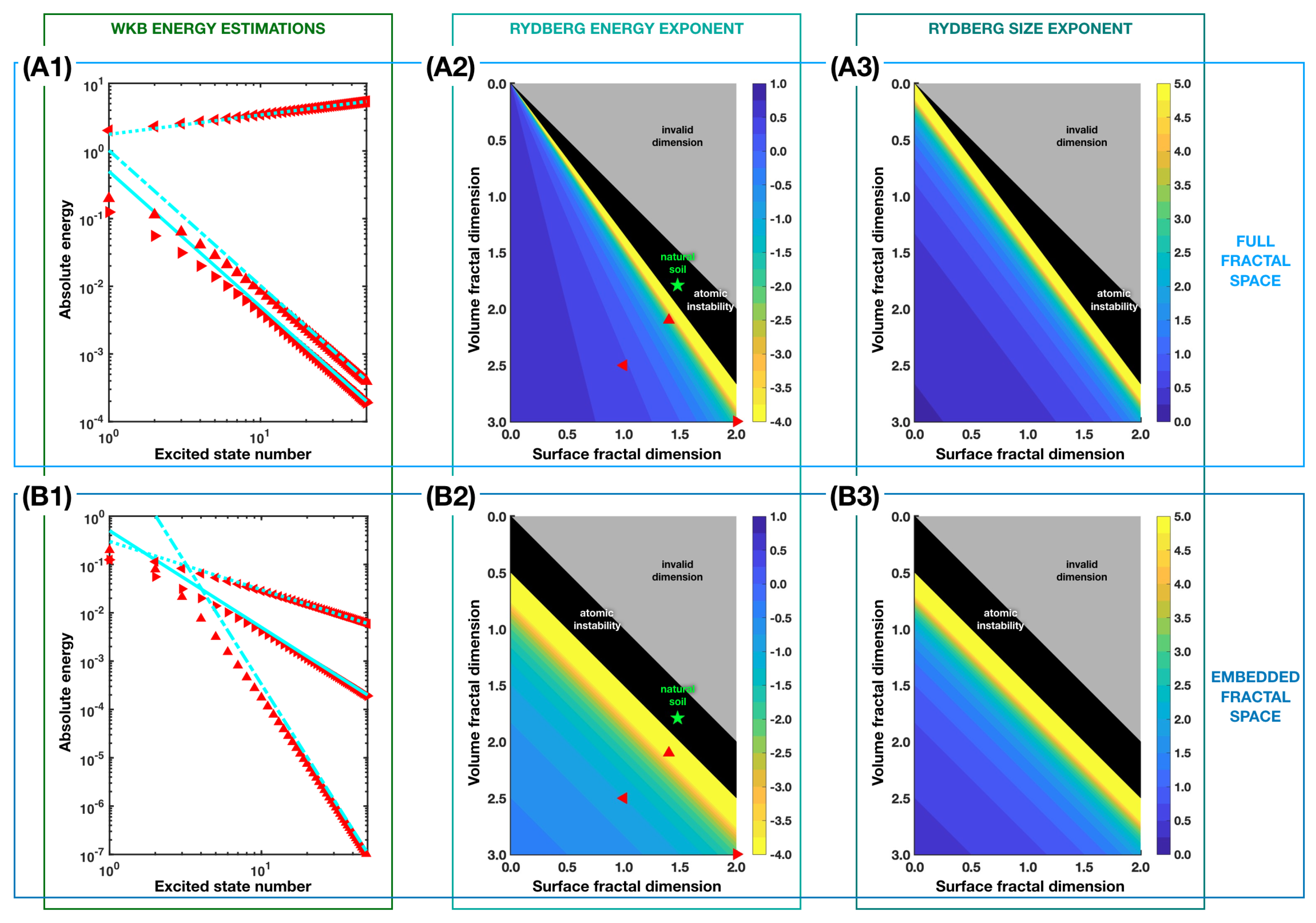
Figure 1. Numerical investigations of atomic properties at different fractalities. The rows in (A) are figures from the full fractal space scenario. (A1) The estimated energy | E ˜ | as a function of excited state number n (from ground-state n = 1 to n = 50 ) in log–log scale, following the solving of Equation (20) numerically. We then compare them with their expected asymptotic behavior, given by Equation (A10). The fractal dimensionalities D v , D s we choose to investigate are 3 , 2 , 2.5 , 1 , and 2.1 , 1.4 ; their numerical values are given by triangle markers pointing right, pointing left, and pointing up, while their theoretical asymptotic behaviors are shown with continuous, dot–dot, and dot–dash lines. (A2) The Rydberg energy exponent and (A3) Rydberg size exponent as a function of fractalities, from Equation (22). The rows in (B) are figures from the embedded fractal space scenario, in which (B1B3) are of similar descriptions with (A1A3).
Atoms 14 00002 g001
Disclaimer/Publisher’s Note: The statements, opinions and data contained in all publications are solely those of the individual author(s) and contributor(s) and not of MDPI and/or the editor(s). MDPI and/or the editor(s) disclaim responsibility for any injury to people or property resulting from any ideas, methods, instructions or products referred to in the content.


