


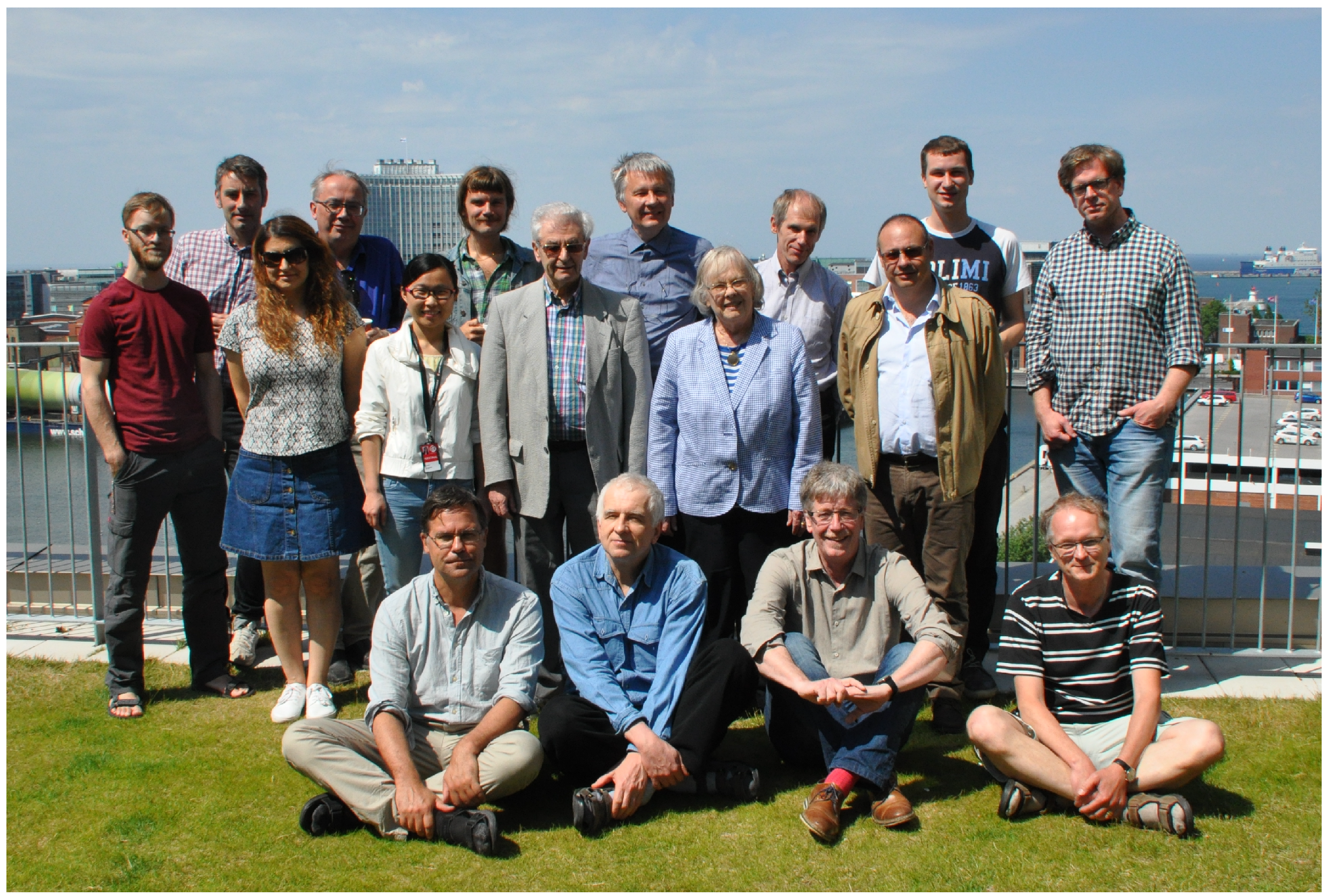
The year 2022 marked the 10th anniversary not only of the journal but also of the international collaboration on Computational Atomic Structure. To establish the latter, Tomas Brage, of Lund University, organized a retreat in July 2012, where the name CompAS was coined. Since then, a CompAS meeting has been set up every year to report on further computational and methodological developments for more efficient atomic structure calculations (see the group picture of the 2016 Malmö-Lund CompAS meeting displayed in Figure 1 as an example).
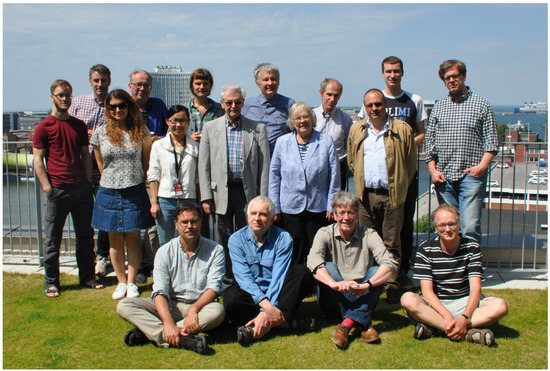
Figure 1.
CompAS members attending the 2016 meeting at Malmö University. Sitting in first row, left to right: Per Jönsson, Jacek Bieroń, Michel Godefroid, Stefan Gustafsson; standing in second row, left to right: Jakob Blomqvist, Betül Atalay, Wenxian Li, Ian P. Grant, Charlotte Froese Fischer, José Pires Marques; third row: Henrik Hartman, Tomas Brage, Jon Grumer, Gediminas Gaigalas, Alexander Kramida, Livio Filippin, Jörgen Ekman.
This Special Issue celebrates both these milestones by presenting the General Relativistic Atomic Structure Program (GRASP), its underlying theory, computational procedures, and benchmark results. A GRASP manual to assist the application of the codes to atomic physics research topics and to promote the future development of the code is included. The first GRASP manual (March 1988) consisted of a deck of cards. It described a single program for the calculation of atomic properties based on Dirac’s theory. The contributing authors were listed alphabetically as:
| A. Bar-Shalom | K. G. Dyall | I. P. Grant | C. T. Johnson |
| M. Klapisch | D. F. Mayers | B. J. McKenzie | P. H. Norrington |
| F. Parpia | E. P. Plummer | N. C. Pyper. |
K. G. Dyall was the editor, and I. P. Grant was the corresponding author for the group.
The document consisted of both a User’s Manual and a Programmer’s Guide. The former described how to prepare data cards for a calculation, whereas the latter discussed the many parameters and the important variables in the program, in effect describing the software. The program was published in [1].
At the same time, Froese Fischer concentrated on the problem of electron correlation in collaboration with Alan Hibbert, Jorgen Hansen, and Michel Godefroid. Her article in Computer Physics Reports (1986) [2] described various computational procedures. It described how the eigenvectors were determined because, in the 1980s, there were no library routines available for finding eigenvectors. Also introduced were sparse matrix methods for storing data structures for the Hamiltonian and integrals, as well as methods for solving the secular problem with sparse matrices. The underlying goal for the Atomic Structure Package (ATSP) was to be able to solve “large-scale” problems on machines with small memories.
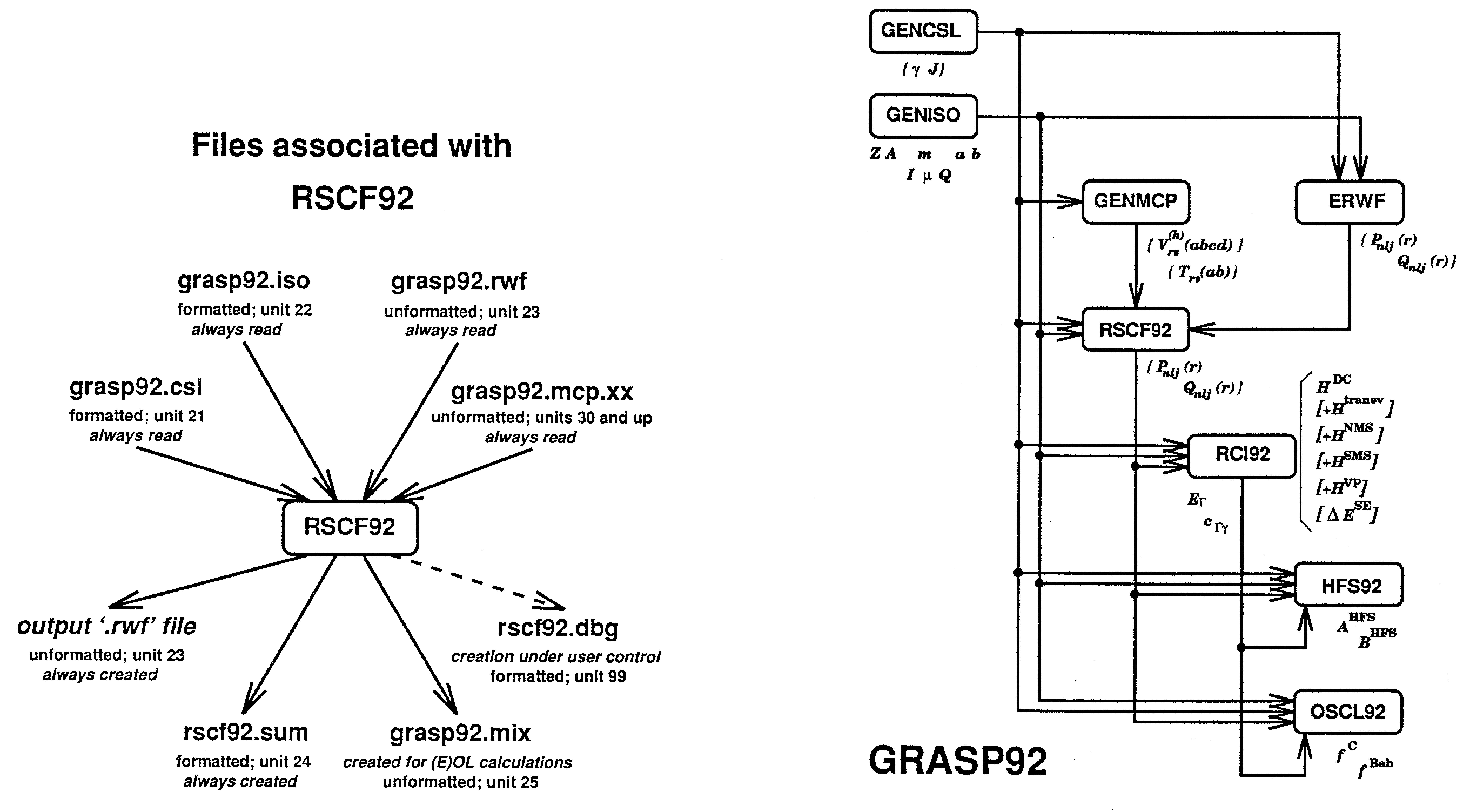
In 1992, Farid Parpia agreed to rewrite the early GRASP code, following similar procedures. Figure 2 shows a collection of programs as well as the organization of the GRASP92 package showing how information is stored in files and multiple programs for a calculation.
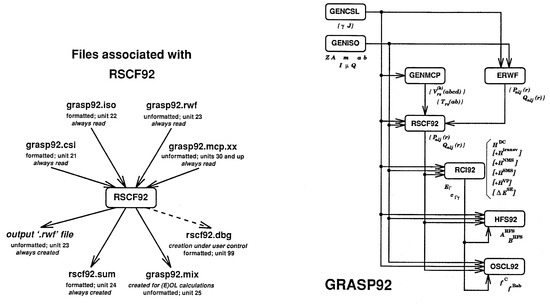
Figure 2.
Organization of the RSCF92 program that shows the files that are read and the files that are written (left graph) and the diagram of all GRASP92 programs (right graph).
The most important contribution to this Issue is the Manual [3] describing the application of the program for various atomic systems. It is supported by a paper that describes the underlying theory as it is implemented in the code, along with papers related to the application of the program to various calculations.
The collection of published articles [4,5,6,7,8,9,10,11,12] introduces the theory, related software issues, and performance of the codes. These are followed by the manual, which includes many examples for a user who may not be familiar with the software. The last few papers discuss the application of the program to recent cases of research interest.
Funding
This study received no external funding.
Conflicts of Interest
The authors declare no conflict of interest.
References
- Dyall, K.G.; Grant, I.P.; Johnson, C.T.; Parpia, F.A.; Plummer, E.P. GRASP: A general-purpose relativistic atomic structure program. Comp. Phys. Commun. 1989, 55, 424–456. [Google Scholar] [CrossRef]
- Froese Fischer, C. Self-consistent-field (SCF) and multiconfiguration (MC) Hartree-Fock (HF) methods in atomic calculations: Numerical integration approaches. Comp. Phys. Rep. 1986, 3, 264. [Google Scholar] [CrossRef]
- Jönsson, P.; Gaigalas, G.; Fischer, C.F.; Bieroń, J.; Grant, I.P.; Brage, T.; Ekman, J.; Godefroid, M.; Grumer, J.; Li, J.; et al. GRASP Manual for Users. Atoms 2023, 11, 68. [Google Scholar] [CrossRef]
- Grant, I.; Quiney, H. GRASP: The Future? Atoms 2022, 10, 108. [Google Scholar] [CrossRef]
- Jönsson, P.; Godefroid, M.; Gaigalas, G.; Ekman, J.; Grumer, J.; Li, W.; Li, J.; Brage, T.; Grant, I.P.; Bieroń, J.; et al. An Introduction to Relativistic Theory as Implemented in GRASP. Atoms 2023, 11, 7. [Google Scholar] [CrossRef]
- Gaigalas, G. A Program Library for Computing Pure Spin–Angular Coefficients for One- and Two-Particle Operators in Relativistic Atomic Theory. Atoms 2022, 10, 129. [Google Scholar] [CrossRef]
- Li, Y.; Li, J.; Song, C.; Zhang, C.; Si, R.; Wang, K.; Godefroid, M.; Gaigalas, G.; Jönsson, P.; Chen, C. Performance Tests and Improvements on the rmcdhf and rci Programs of GRASP. Atoms 2023, 11, 12. [Google Scholar] [CrossRef]
- Li, Y.; Gaigalas, G.; Li, W.; Chen, C.; Jönsson, P. Fine-Tuning of Atomic Energies in Relativistic Multiconfiguration Calculations. Atoms 2023, 11, 70. [Google Scholar] [CrossRef]
- Li, Y.; Jönsson, P.; Godefroid, M.; Gaigalas, G.; Bieroń, J.; Marques, J.P.; Indelicato, P. Independently Optimized Orbital Sets in GRASP—The Case of Hyperfine Structure in Li I. Atoms 2023, 11, 4. [Google Scholar] [CrossRef]
- Li, J.; Gaigalas, G.; Bieroń, J.; Ekman, J.; Jönsson, P.; Godefroid, M.; Fischer, C.F. Re-Evaluation of the Nuclear Magnetic Octupole Moment of 209Bi. Atoms 2022, 10, 132. [Google Scholar] [CrossRef]
- Fischer, C.F.; Godefroid, M. Variational Methods for Atoms and the Virial Theorem. Atoms 2022, 10, 110. [Google Scholar] [CrossRef]
- Fritzsche, S. Application of Symmetry-Adapted Atomic Amplitudes. Atoms 2022, 10, 127. [Google Scholar] [CrossRef]
Disclaimer/Publisher’s Note: The statements, opinions and data contained in all publications are solely those of the individual author(s) and contributor(s) and not of MDPI and/or the editor(s). MDPI and/or the editor(s) disclaim responsibility for any injury to people or property resulting from any ideas, methods, instructions or products referred to in the content. |
© 2023 by the authors. Licensee MDPI, Basel, Switzerland. This article is an open access article distributed under the terms and conditions of the Creative Commons Attribution (CC BY) license (https://creativecommons.org/licenses/by/4.0/).