Abstract
More than 30 inflationary models are confronted with the recently improved limit on the tensor-to-scalar ratio presented by the Planck team. I show that a few more models are falsified due to this sharper restriction. Additionally, I discuss possible consequences of CMB-S4 observations for these inflationary models. The results are summarized in a table.
1. Introduction
In a long article [1], predictions of observable quantities for a large number of inflationary models were deduced, and the predictions were confronted by the observational data from BICEP and Planck [2,3]. A main observational constraint was that the spectral index, , of the cosmic microwave background radiation has a value given by , and the tensor-to-scalar ratio was restricted to . In this way, it was shown that several of the inflationary models predicted values of the observable quantities in conflict with the observational data.
Recently, M. Tristram et al. [4] presented an improved limit on the tensor-to-scalar ratio from BICEP/Planck data; namely, the previous restriction is now changed to .
In this article, I shall find the consequences for several inflationary models of this sharper restriction. Further references and deductions of the formulae used below are found in [1,5].
Additionally, I discuss possible consequences of future CMB-S4 (Cosmic Microwave Background Stage 4) observations for the inflationary models. The more models that are falsified, the more we know about the inflationary era.
The CMB-S4 project is designed to give a significant improvement of our knowledge of the first moments of the history of our universe. It shall be based upon a large number of precision telescopes on the surface of the earth, and will measure r so accurately that the uncertainty of the value of r is of the order . For , it will be able to determine the value of r with 5 (five standard deviations) accuracy. If the CMB-S4 measurements fail to measure a nonvanishing value of r, it will put an upper limit to r of at the 95% confidence level.
An important quantity when analyzing observational consequences of inflationary models is the so-called number of e-folds, N, which is defined in terms of the ratio of the final value of the scale factor during the inflationary era and the initial value, , in the following way:
Note that N = 0 at the end of inflation, so N counts the number of e-folds until inflation ends and increases as we go backward in time. In order to solve the horizon problem, the number of e-folds must be at least .
Comment on notation: The reduced Planck mass is corresponding to the energy . Units are chosen so that the velocity of light in empty space and Planck’s constant h = c = 1. Einstein’s gravitational constant is .
2. Predictions for Inflationary Models
2.1. Polynomial Chaotic Inflation
The so-called chaotic inflation was proposed by A. Linde [6], and is a class of polynomial inflation models. The potential of the inflation field in this type of inflationary models has the form
where and M is the energy scale of the potential when the inflation field has Planck mass. It is assumed that p is constant and that .
For this model, the spectral index represented by , the tensor-to-scalar ratio r, and the running of the spectral index of scalar fluctuations, , are given by
Equation (3) gives the and relations
Solving the last of these expressions with respect to r gives
Inserting the measured values and leads to . However, r is per definition a positive quantity. This shows that the Planck data alone falsify the polynomial inflationary models independently of the observational restriction on r.
2.2. Hilltop Inflation
The name ‘hilltop inflation’ (Boubekeur and Lyth [7]) refers to the case where inflation occurs near a local maximum of the curve describing the potential as a function of a scalar field.
The most simple version of the hilltop inflation has a quadratic potential which represents the first two terms in a series expansion, and is thus characteristic of the region near the maximum of the potential for many models:
Here, is the absolute value of the slow-roll parameter at the maximum of the potential. Hilltop inflation occurs for .
Boubekeur and Lyth [7] note that in the case of quadratic hilltop models with the potential (6), the tensor-to-scalar ratio obeys
where is the value of the scalar field at the end of the inflationary era. They further write that neither of the factors in brackets in Equation (7) is likely to be much bigger than 1 and conclude that hilltop inflation is hardly likely to give a detectable nonvanishing value of r.
In quartic hilltop inflation, the potential is
K. Dimopoulos [8] and G. Germán [9] have shown that, in this model, r is given by
where N is the number of e-folds of the scale factor during inflation. Inserting and the typical value gives , which is permitted by the observations.
Another version of hilltop inflation, which was considered by Chiba and Khori [10], has potential
Here, represents a symmetry breaking energy scale where the potential has a minimum. This inflationary model is also called double-well inflation by Martin et al. [5], topological inflation by Chung and Lin [11], and Higgs-like by Escudero et al. [12].
With this potential, the running of the spectral index is
With and , we get , which is permitted by the Planck 2015 data, giving [10]. However, this inflationary model predicts that , or with the Planck data, . Hence, it is in conflict with the BICEP/Planck data.
2.3. Exponential Potential and Power-Law Inflation
In these inflationary universe models, the potential is an exponential function of the scalar field
Furthermore, one can deduce that the scale factor is a power function of the cosmic time. Therefore this inflationary model is also called power-law inflation.
For this model, the tensor-to-scalar ratio is given by
With the value from the Planck measurements, the model predicts that r = 0.256. Hence, it is ruled out by the BICEP/Planck data.
Geng et al. [13] generalized these types of inflationary models by including an additional free parameter p so that the potential is given the form
In the special case with , we have
Inserting and gives the requirement .
For this particular model, the running of the spectral index is
Inserting and gives , which is permitted by the Planck data. Hence, this model can so far be adjusted to be in agreement with the observational data.
2.4. Natural Inflation
The original natural inflation potential was presented by K. Freese et al. [14] and was further developed and compared with observational data by Freese and Kinney [15,16]. In the original model, there are two variants of the potential of the scalar field generating the dark energy, given by
Here, , and M is the spontaneous symmetry breaking scale. In order for inflation to occur, we must have [16]. The constant is a characteristic energy scale for the model. The potential has a minimum at and at .
I must here correct an error in [1]. Expressing the spectral index and the tensor-to-scalar ratio in terms of the N e-folds of the expansion during the inflationary era one obtains
This is the correct version of Equation (6.5.33) in [1]. It follows from these expressions that
The BICEP/Planck restrictions and lead to . On the other hand, b cannot be too large either. The condition leads to . It follows that the parameter b must obey . Equation (23) may be written.
Hence, the restrictions on b means that , so the symmetry breaking energy is larger than the Planck energy.
The original natural inflation model has a free parameter, the symmetry breaking scale, which can be adjusted to obtain agreement with observations. This is both a strength and a weakness of the theory. It saves it from falsification by the BICEP/Planck data, but makes its predictive force less. Without this parameter, that is, putting , which corresponds to symmetry breaking at the Planck scale, the BICEP–Planck data would falsify the model. The data require the symmetry breaking energy to be much larger than the Planck energy. In this energy range, we must expect quantum phenomena, which cannot be described by the classical general theory of relativity. It makes the theoretical foundation of the original natural inflation model somewhat unsecure that the symmetry appears at this scale.
2.5. Hybrid Natural Inflation
Recent investigations of hybrid natural inflation were performed by Ross and Germán [17], Carrillo-González et al. [18], Hebecker et al. [19], Vázquez et al. [20], Ross et al. [21], and G. Germán et al. [22].
In this model, the inflation field is supplied by a second field, which is responsible for terminating inflation. The model allows for a symmetry breaking scale, which is less than the Planck scale, meaning that .
For this model, the inflation potential is written as
where is a constant with a value in either the interval or . Here, represents the original natural inflation.
For this model, we have
where .
With slow-roll inflation, a natural starting point is close to where the potential is flat. This gives and , giving . It is seen from the first expression of Equation (22) that in order to obtain , the constant a must be small, of the order 10−2. Hence, the expressions for and r can be approximated by
giving
Since , it follows that . Additionally, an upper bound on the predicted value of r is obtained by putting . This leads to the prediction of r by the hybrid natural inflation model, , which is permitted by the observational data.
2.6. Higgs–Starobinsky Inflation
Higgs inflation was recently considered by Bezrukov et al. [23,24], by Gorbunov and Tokareva [25], and by Zeynizadeh and Akbarieh [26] in connection with observations of spectral properties of the cosmic microwave background radiation. The Higgs–Starobinsky potential is often written as
From this potential, one can deduce the following simple relationships in the weak field regime when one neglects numbers of order unity compared with N
Inserting gives . These are the predictions of the Higgs inflationary models, given a Planck 2015 value of . The predictions of the Higgs inflationary model are in good agreement with the most recent BICEP2/Planck observational data.
Lyth and Riotto [27] and later Drees et al. [28] and Sebastiani et al. [29] investigated several inflationary models with similar potentials as the one in Equation (25), for example,
where q is a dimensionless number of order 1. The consistency conditions
For this model, the Planck/BICEP2 data with give .
2.7. S-Dual Inflation
This is a scenario [30] inspired by string theory. We shall here consider the following class of S-dual inflation potentials:
where is a real number. The relationship for this class of inflationary universe models can be written as
where b is defined in Equation (18). Since , this requires
For and , agreement with the observational data for the S-dual inflation model requires .
2.8. Hyperbolic Inflation
Basilakos and Barrow [31] considered a class of models of inflation that is very similar to S-dual inflation. They called it hyperbolic inflation. In this model, the inflation field has the potential
where A is a constant.
The relation is
Solving this equation with respect to , we can estimate the energy scale where the inflation begins in these models from the Planck and BICEP2 data:
This requires that p obeys the condition (34), that is, . With, for example, , Equation (34) gives . Hence, in order to be compatible with the Planck/BICEP2 results, the energy scale of this model must be larger than the Planck energy.
2.9. Supergravity-Motivated Inflation
Kallosh et al. [32,33] studied inflationary models motivated from supergravity. One class of these models has the potential
where , A and p are arbitrary constants, and represents the characteristic energy per particle at the beginning of the inflationary era. As an illustration, we shall consider the model with . Then the relationship can be written as
Inserting gives . Hence, strictly speaking, this model needs a quantum gravity theory in order to have a solid foundation.
2.10. M-Flation
In this model, the potential is
where represents the energy per particle necessary to initiate inflation.
It was shown in [1] that in this inflationary model, the tensor-to-scalar ratio obeys the inequalities
Inserting leads to . This is the main prediction of the M-flation model. Hence, this model is falsified by the BICEP/Planck data. A modified model called nonminimal M-flation was recently presented by A. Ashoorion and K. Razazadeh [34]. They calculated the relationship numerically and showed that this model can be in agreement with the BICEP/Planck data.
2.11. Coleman–Weinberg Inflation
The Coleman–Weinberg (CW) potential has the form [35,36,37,38]
where . We shall assume that the value of the field is much less than the Planck mass, , that is, .
We shall now consider the small field case, that is, . Additionally, during slow roll, the quantity changes so slowly that one can approximate an integral in the calculation of N by considering as a constant. This leads to the simple relationship
The range of e-folds of the expansion during inflation is, in general, restricted to . Inserting in Equation (40) gives , which is inside the error bounds given by the Planck data as cited in the introduction.
Furthermore, the Coleman–Weinberg inflationary models predict a very small value of the tensor-to-scalar ratio.
2.12. Kähler Moduli Inflation
The Kähler moduli inflation was introduced by Conlon and Quevedo [39] and is characterized by a potential
with . This leads to
The Planck result gives . Hence, in accordance with the BICEP/Planck data. This model is similar to the Higgs–Starobinsky inflation.
2.13. Hybrid Inflation
Hybrid inflation involves two fields, the so-called waterfall field, , and the inflation field, . The potential is given by [40]
where are mass parameters, and are dimensionless constants.
H. Kodama et al. [41] showed that there exist some parameter values for hybrid inflation that lead to red-shifted values of , that is, , in agreement with the Planck data, and other values corresponding to ‘standard hybrid inflation’, which lead to blue-shifted values, , that are not allowed by these data. Additionally, they showed that hybrid inflation predicts a very small value of r, of the order 10−3 or less, that it will be difficult to determine the value of r by observations even with CMB-S4.
2.14. Brane Inflation
Several authors have considered five-dimensional universe models where the inflationary era is due to a collision between branes [42,43,44,45,46,47]. This induces an effective modified gravity theory in a four-dimensional world.
The brane version of the Friedmann Equation (2.1) takes the form
where is the tension of each brane.
Let us first consider polynomial brane inflation with the potential given in Equation (2). We shall here consider the high energy regime with . Then one finds that the tensor-to-scalar ratio can be expressed as
With , this brane inflation model predicts , which is larger than permitted by the BICEP/Planck data.
Next, we follow S. Santos da Costa and coworkers [48] and consider a brane inflation model with the so-called Starobinsky potential
where is a parameter. The model satisfies the requirements for slow roll when .
They deduced that for this model, the tensor-to-scalar ratio is given by
Choosing an allowed value for , say , and inserting , we have corresponding to . Hence, a solid foundation of the model requires a quantum gravity theory.
2.15. Fast-Roll Inflation
This is a class of inflationary universe models with a potential similar to that of hybrid inflation, but with the trigonometric functions replaced by hyperbolic functions [49],
Here, is a free parameter of this class of models that interpolate between for a flat potential and for the standard slow-roll approximation in the first order in approximation.
In this model, we have
Here, gives . Hence, this model is falsified by the BICEP/Planck data.
2.16. Running Mass Inflation
This is a supersymmetry motivated class of inflationary models. The simplest version has the potential [50,51]
Here, , and are three free parameters; M represents an energy scale; and is an extremum of .
In this inflationary model, it is necessary that
where . Inserting the Planck/BICEP2 results gives or . Hence, this models needs a valid theory of phenomena above the Planck energy.
2.17. k-Inflation
In 1999, V. F. Mukhanov and coworkers [52,53] introduced a string-theory-inspired class of inflation models where the kinetic energy of the inflation field, that is, the square of the time derivative of the scalar field, drives the accelerated expansion. It was called k-inflation.
For this model, the relationship is , and the Planck 2015 value gives , which is too large according to the Planck/BICEP2 data.
2.18. Dirac–Born–Infield (DBI) Inflation
This is a string-theory-inspired class of inflationary models. We shall here only summarize the results of Li and Liddle [54] concerning the spectral parameters of such models. They considered a class of DBI inflationary models with polynomial potential and deduced the following expression for the tensor-to-scalar ratio:
With , we have , which is too large according to the BICEP/Planck restrictions.
2.19. Fluxbrane Inflation
Taking into account radiative corrections, Martin et al. [5] argued that one can consider an inflationary model where the inflation field has the potential
In the potential (53), is a dimensional parameter that represents the strength of the radiative effects. It is usually assumed that and .
The relation is
With and , we have , which is allowed by the BICEP/Planck data.
This model furthermore leads to the relationships
With , we have , which is lower than that admitted in order to solve the horizon and flatness problems.
2.20. Mutated Hilltop Inflation
B. K. Pal et al. [55,56] introduced a new supergravity-inspired model of inflation, which they called mutated hilltop inflation. In this model, the inflation field has the potential
Here, represents the typical energy scale for hilltop inflation, , and is a dimensionless parameter that characterizes the energy at the beginning of the slow-roll era. The value of cannot be determined theoretically, so Pal et al. wrote that gives the best fit to observational data and adhered to this range in their paper.
The relationship takes the form
This is in agreement with the Planck/BICEP2 observations, and , for . The spectral parameters and r may be expressed in terms of N as follows:
With , we have , which is an acceptable number of e-folds of the expansion parameter during the inflationary era. For and , the model predicts . There is no conflict with the Planck/BICEP2 observations. This model will be tested by CMB-S4. A measured nonvanishing value of r with the accuracy obtainable by CMB-S4 will falsify the model.
2.21. Arctan Inflation
In this model, the inflation potential is [5]
where is a free parameter. It is also assumed that so that we can let be approximated by in the expressions of the slow-roll parameters. We then have the relationships
With the values and of Planck 2015 and Planck/BICEP, we have , . The number of e-folds is a little low since it is usually required that in order to solve the horizon and flatness problems, one needs . Combining the expressions for and r, we have
Inserting and gives . This model fulfills the BICEP/Planck requirements, but the prediction for the number of e-folds is not optimal. If one requires , it predicts , which is a little smaller than indicated by the Planck data.
2.22. Inflation with a Fractional Potential
Eshagli et al. [57] investigated an inflation model in which the inflation field has a fractional potential:
where is an arbitrary dimensionless constant. It is assumed that during the slow-roll era. This leads to the relationships
Inserting and gives in agreement with the BICEP/Planck data. This model will be tested by CMB-S4.
Two similar models called minimal Higgs inflation were investigated by Maity [57]. The first one has the potential
where , and is the energy scale at which the universe enters the inflationary era. We then obtain
The Planck value gives , which is too small to give a realistic inflationary scenario.
The other model considered by Maity [58] has the potential
We have
where . For this model, the Planck value gives , which may be acceptable. Therefore, this is a more promising model than the previous one. Additionally, for , this model predicts a small value of r.
2.23. Twisted Inflation
J. L. Davis et al. [59] introduced an inflationary model motivated by brane cosmology, which they called twisted inflation. They argued that the potential of the inflation field has the form
with . For this model,
Martin et al. [60] estimated that . This implies that the tensor-to-scalar ratio has a very small value according to the twisted inflation model. With , the running of the scalar spectral index is .
2.24. Quintessential Inflation
Quintessential inflation was considered by Md. W. Hossein et al. [61]. The potential of this inflationary model is
Hence, this inflationary model is mathematically similar to hyperbolic inflation with . Hossein et al. found that in the small field approximation, the slow-roll parameter is given in terms of the number of e-folds as
where is a parameter characterizing the energy of the inflation field during the slow-roll era. In the case of small field inflation, . This leads to the consistency relation
This shows that . Hence, with , this model of quintessential inflation predicts , which is ruled out by the BPK data.
We shall also consider three more recent versions of quintessential inflation, and consider first a model investigated by Bruck et al. [62]. The potential is
For this model, we have
Bruck et al. suggested that . Inserting then gives and a very small value for in agreement with the recent restrictions from the BICEP/Planck data.
Next, we consider a quintessence inflation model investigated by Dimopoulos [63], which has the potential
where and are dimensionless positive constants. In this model, we have the relationship
which requires
Inserting gives . With , we have , which are acceptable values. It may be noted that the relationship (76) does not depend upon the arbitrary parameters and .
Finally, we consider a quintessence inflation model investigated by Agarwal et al. [64], which has the potential
where and n are free parameters. However, this model requires for inflation to end. One obtains the relationship
Hence, , which is totally unrealistic.
2.25. Generalized Chaplygin Gas (GCG) Inflation
The GCG inflation model was recently described by Dinda et al. [65]. The generalized Chaplygin gas has a pressure , which is given by the energy density as
where A and m are constants. In this inflationary model, the inflation potential is
where . In this model, the tensor-to-scalar ratio is
Unless m has a value very close to , this model gives very too large value or r. Therefore, without a very accurate fine-tuning of the parameter m, a universe dominated by generalized Chaplygin gas is not a suitable model of the inflationary era.
2.26. Axion Monodromy Inflation
We shall consider an axion monodromy inflation [66] model with a potential [67]
where μ and Λ are model-dependent parameters determined by the brane compactification and the instanton action, respectively, satisfying Λ ≪ μ. This model is based on string theory. A string connects a bulk brane to the brane we live on. It modifies the background inflation field so that small oscillations of the inflation field with frequency f appear. This modification is represented by the second term in the potential (83). The model predicts [1]
where p is the ratio of the inflation field at the beginning of the inflationary era and its maximal value. For and , this model predicts that in agreement with the Planck/BICEP restrictions. This will be tested by CMB-S4.
2.27. Intermediate Inflation
In this model, the potential is given as a function of the inflation field by
where the expansion factor is given as a function of time by
Here, is the value of the scale factor at , and , where is the Planck time. In this model,
With the Planck value , we have . This value of r is larger than that permitted by the BICEP/Planck observations.
2.28. Brane–Intermediate Inflation
This is a further development of the previous inflationary model, and the scale factor is here too, given in Equation (89), but in this model, the potential is
where is the tension of each brane. The brane tension is usually assumed to be very small in Planck units, so in the strong field case, the first term inside the brackets dominates. Hence, we can approximate the potential with
In this model, we have
Inserting and gives . Furthermore,
Since the spectral index , we can use the approximation . Additionally, inserting , and the BICEP/Planck requirement into the expression for r, we find that in order for this inflationary model to be in accordance with the observational data, the brane tension must fulfill .
2.29. Constant Rate of Roll Inflation
For this class of models, the potential is
where A, B, and are constants. This model predicts , which is higher than that allowed by the BICEP/Planck observations.
A related model with the potential
comes out better. With this potential, the relationship is
The observational constraint , gives the restriction .
Another related class of inflationary models, called ‘constant slow-roll inflation’, was considered by Gao and Gong [68]. The potential is
where A and B are constants, and is a constant that is given in terms of and r as follows:
Furthermore, the number of e-folds is
Inserting gives and . This model is not in conflict with the observational data. Hence, only the last ones of the three models (104) are acceptable. This model is a generalization of the natural inflation models.
2.30. Fiber Inflation
The fiber inflation models were introduced by M. Cicoli, C. P. Burgess, and F. Quevedo [69], and later further investigated by the same authors together with S. de Alwis [70]. More recently, fiber inflation was confronted by observational data in two articles published in Physical Review D in 2020 [71,72].
In [69,70], a simple relationship between r and was deduced for the slow-roll regime of inflation, where the potential can be approximated by
namely,
Fiber inflation has , giving
Hence, with , fiber inflation predicts that , which is in agreement with the new observational constraint .
2.31. Warm Inflation
In the usual (cold) inflationary models, dissipative effects, such as decay of inflation energy into radiation energy, are neglected. However, during the evolution of the inflationary era, dissipative effects are important, and inflation field energy is transformed to radiation energy. This was first taken into account in the construction of inflationary universe models by A. Berera [73], who introduced a new class of inflationary universe models called warm inflation. In this scenario, there is no need for reheating at the end of the inflationary era. The universe heats up and becomes radiation dominated during the inflationary era, so there is a smooth transition to a radiation-dominated phase.
During the warm inflation era, both the inflation field energy with density and the electromagnetic radiation with energy density are important for the evolution of the universe. The Friedmann equation is generalized to
where H is the Hubble parameter.
In these models, the continuity equations for the inflation field and radiation take the form
respectively, where is a dissipation coefficient of a process, which causes decay of dark energy into radiation. In general, is temperature dependent. It is usual to define a dimensionless so-called dissipative ratio by
where both and H are given with the unit of energy. The situations with or are called the weak or strong dissipative regime, respectively.
In the warm inflation scenario, a thermalized radiation component is present with temperature (given with the unit of energy) . Then the tensor-to-scalar ratio is modified with respect to cold inflation so that
Hence, the tensor-to-scalar ratio is suppressed by the factor compared with the cold inflation.
2.31.1. Warm Polynomial Inflation
Visinelli [74] investigated warm inflation with a polynomial potential, which we write in the form
where since the potential and the inflation field have a dimension equal to the fourth and first power of energy, respectively. Here, M represents the energy scale of the potential when the inflation field has Planck mass.
With a constant value of the dissipation parameter , the scalar spectral index is given in terms of the number of e-folds by
for all values of p. Then gives , which is smaller than the preferred value from the Planck data, .
Panotopoulos and Videla [75] found the relation in warm inflation with , where a is a dimensionless parameter. They considered two cases.
The weak dissipative regime. In this case, and Equation (104) reduces to . They then found
With , this requires . However, they also found that in this case, , giving . This is too small to be compatible with the standard inflationary scenario since the inflationary solution to the horizon problem requires that N has a value not less than 50.
The strong dissipative regime. Then and . They then found
Then and , so this is a promising model.
2.31.2. Warm Natural Inflation
Visinelli [76] investigated warm natural inflation with the potential
Here, , and M is the spontaneous symmetry breaking scale.
Visinelli concluded that for this type of inflationary universe model, the expected value of r is extremely small, much less than what can be observed. At the present time, we only have an upper bound on r. If future measurements also give a lower bound on r, that is, if they show that r is larger than around 10−14, then this model will be falsified. At the present time, the model is in agreement with the observational data.
2.32. Tachyon Inflation
Tachyon inflation is a class of string-theory-inspired models of inflation. In these models, it has become usual to introduce the so-called tachyon field and denote it by . A rolling tachyon field can be described as a fluid, which in the homogeneous limit has energy density and pressure
where is the tachyon potential.
2.32.1. Tachyon Inflation with Constant Value of
Fei et al. [77] considered an inflationary model with a constant value of . In this model, the relationship takes the form
Inserting the Planck value and gives . Before the last restriction on r [4], this was acceptable according to the observational data. However, the model is in trouble when confronted with the new restriction that .
2.32.2. Tachyon Inflation with Constant Value of
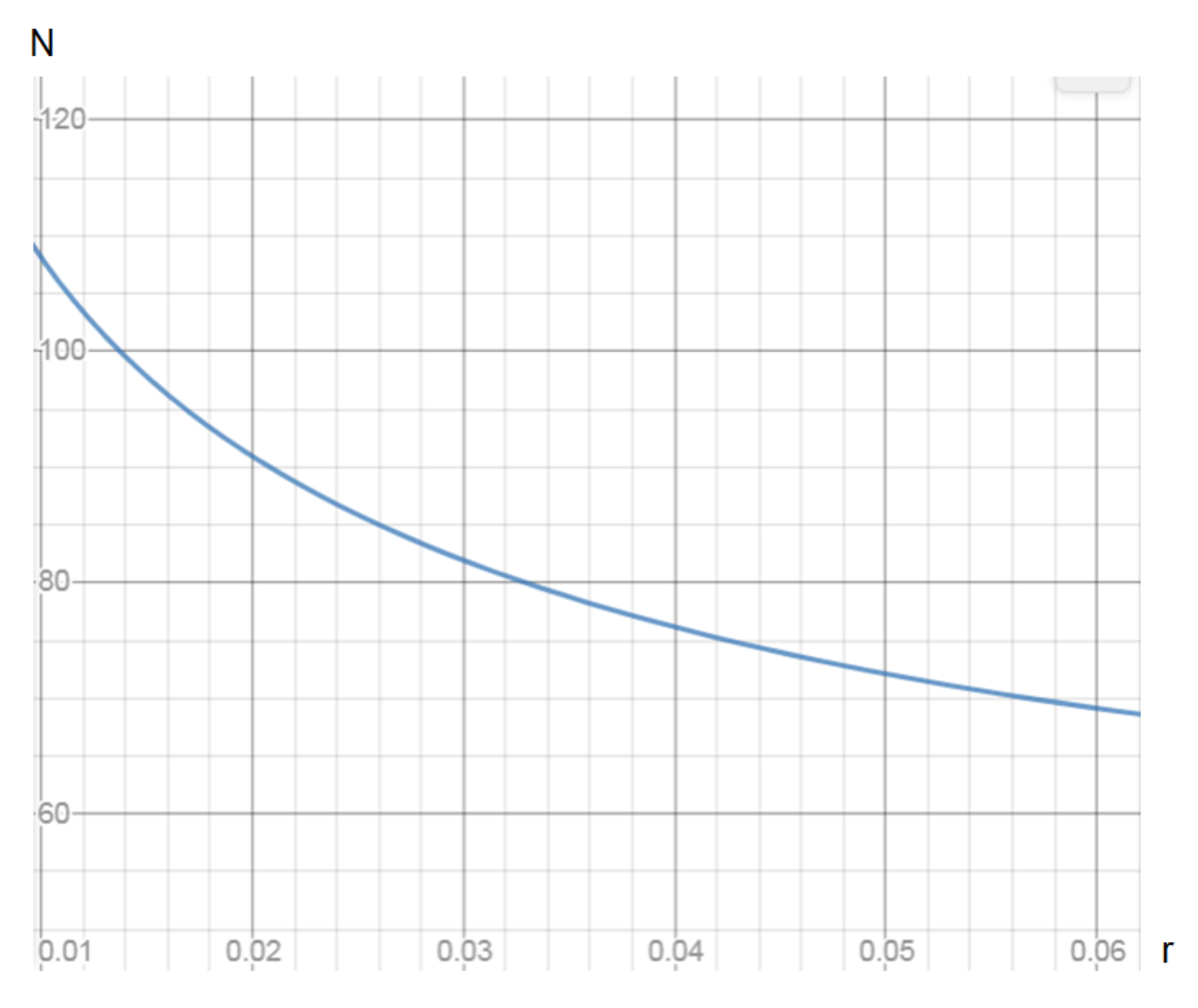
Fei et al. [77] also considered a tachyon inflation model with the constant Hubble slow-motion parameter . In this model, the relationship can be written as
This expression is plotted as a function of r for in Figure 1.
Figure 1.
The number of e-folds N as a function of r as given in Equitation (112).
We see that gives m, while the new restriction leads to .
2.32.3. Self-Dual Tachyon Inflation
In this model, the potential is written as
where and . One can deduce the relationship [1]
The spectral index parameter, , and the tensor-to-scalar ratio, r, are here given by
It follows from Equations (114) and (115) that
Inserting leads to . This is too many e-folds to be an acceptable inflationary model.
2.32.4. Exponential Tachyon Inflation
Steer and F. Vernizzi, [78] and Rezazadeh, Karami, and Hashemi [79] also considered a tachyon inflation model with exponential potential
In this model, we have
Inserting gives in good agreement with the inflationary requirements. However, the expressions (118) imply , which is too large to be compatible with the BICEP/Planck data.
2.32.5. Inverse Power-Law Tachyon Inflation
Rezazadeh, Karami, and Hashemi [79] also considered tachyon inflation with inverse power-law potential,
In this model,
With , this relationship gives , while the BPK data require , so this model is not in agreement with the observational data.
2.32.6. Tachyon-Intermediate Inflation
S. del Campo, R. Herrera, and A. Toloza [80] considered the intermediate inflation in the tachyonic framework. Then the scale factor is given in Equation (88). The relation is
It follows from this relationship that . Hence, these inflationary models are ruled out by the BICEP/Planck data.
2.32.7. Tachyon-Warm Intermediate Brane Inflation
V. Kamali, S. Basilakos, and A. Mehrabi [81] investigated tachyon-warm intermediate inflation in light of the BICEP/Planck data. They investigated two cases, (I) constant and (II) , where is the radiation temperature, and is a constant. With the number of e-folds , they found for model I and for model II . Hence, the warm-intermediate brane inflationary models are in agreement with the BICEP/Planck observational data. One may therefore wonder whether this model deserves particular emphasis and future development.
The predictions of this model are very similar to that from Starobinsky inflation, which predicts and . Thus, even CMB-S4 will not be able to differentiate between these models. In order to decide whether tachyon-warm intermediate brane inflation is a favored model, over the Starobinsky inflation, one has to judge the physical foundation of these models. The Starobinsky model comes from quantum corrections to general relativity and is generally considered to have a good theoretical basis.
Warm inflationary models are generally considered a promising class of inflationary models since these models take account of dissipative processes that presumably are important at these early stages of the universe, and that are neglected in the usual cold inflationary scenario. Tachyon inflation comes from string theory and brane physics in combination with the general theory of relativity. Tachyon-warm intermediate brane inflation belongs to this class of inflationary models. As long as we do not have testable predictions from string theory, it is rather speculative. However, it is considered a promising step in the direction of constructing a quantum gravity theory. Hence, all efforts to try to produce testable consequences of string-theory-related physics are considered important. Therefore, even if this is at the present time speculative physics, I would judge this inflationary model to be worth further development.
3. CMB-S4
CMB-S4 [82] is a large international project used to measure the temperature fluctuations and polarization of the cosmic microwave background radiation with much better accuracy than was possible with the Planck observatory.
A goal of CMB-S4 is to determine the value of r as predicted by inflationary models so far in agreement with the most accurate observations, that is, with , and for with a 5 accuracy, while failure to determine the B-mode polarization should put an upper limit of at 95% confidence.
In the concluding section, I consider the most promising inflationary models in light of the restrictions we can expect from CMB-S4.
4. Summary
The present work is concerned with observational constraints on inflationary models coming from measurements of the spectral index of the cosmic microwave radiation and the tensor-to-scalar ratio. The dominating selection criterion in this connection is that in order to be an acceptable inflationary model, the predictions of the model must not be in conflict with the observational data. However, there exist several inflationary models that are acceptable according to both the most recent observational data and future expected data from CMB-S4. Then we need additional criteria for selecting between these models. I chose a very conservative point of view, namely, that inflationary models based upon the general theory of relativity are more acceptable than those based upon modified gravity, since all observational tests favored general relativity against modified gravitational theories. Hence, I mainly gave focus to general relativistic inflationary models in this paper. There are many inflationary models based upon modified gravity [83,84], and even the Starobinsky model can be interpreted in this way.
The results of the calculations above may be summarized in the following Table 1.
Table 1.
Results of confronting predictions of the tensor-to-scalar ratio by inflationary universe models with the most recent BICEP/Planck and future CMB-S4 restrictions.
A related preprint [80] that appeared after the first version of the present paper was written, arrived at similar results as those presented here, but did not consider the implications of future data from CMB-S4.
5. Conclusions
A total of 37 inflationary models were confronted with the new Planck/BICEP constraint, . This falsifies 20 of the models, which predict either a very large value of r or an unrealistic number of e-folds of the scale factor during inflation.
I also studied the consequences of future CMB-S4 data for the remaining 17 inflationary models. If the future CMB-S4 does not detect a nonvanishing imprint of primordial gravitational waves in the form of B-mode polarization in the CMB radiation, this would mean that the value of the tensor/scalar ratio r is very small; . This would eliminate many proposed inflationary models. Those surviving the confrontation with such an observational restriction are: (A) a class of models that have a potential admitting a region of the inflation field that can be approximated as a quadratic hilltop potential, (B) hybrid natural inflation, and (C) warm inflation models.
Higgs–Starobinsky inflation and Kähler moduli inflation may be falsified by such an observational result. On the other hand, if CMB-S3 determines a value of the tensor-to-scalar ratio around or , this would be a strong support of Kähler moduli inflation or Higgs–Starobinsky inflation, respectively, and would falsify most warm inflation models.
Funding
This research received no external funding.
Conflicts of Interest
The author declares no conflict of interest.
References
- Grøn, Ø. Predictions of Spectral Parameters by Several Inflationary Universe Models in Light of the Planck Results. Universe 2018, 4, 15. [Google Scholar] [CrossRef]
- Ade, P.; Aghanim, N.; Armitage-Caplan, C.; Arnaud, M.; Ashdown, M.; Atrio-Barandela, F.; Aumont, J.; Baccigalupi, C.; Banday, A.J.; Barreiro, R.B.; et al. Planck 2013 results. XXX. Cosmic infrared background measurements and implications for star formation. Astron. Astrophys. 2014, 571, A30. [Google Scholar]
- Ade, P.; Aghanim, N.; Ahmed, Z.; Aikin, R.W.; Alexander, K.D.; Arnaud, M.; Aumont, J.; Baccigalupi, C.; Banday, A.J.; Barkats, D.; et al. Joint Analysis of BICEP2/Keck Array and Planck Data. Phys. Rev. Lett. 2015, 114, 101301. [Google Scholar] [CrossRef] [PubMed]
- Tristram, M.; Banday, A.J.; Górski, K.M.; Keskitalo, R.; Lawrence, C.R.; Andersen, K.J.; Wehus, I.K. Improved limits on the tensor-to-scalar ratio using BICEP and Planck. arXiv 2022, arXiv:2112.07961. [Google Scholar] [CrossRef]
- Martin, J.; Ringeval, C.; Vennin, V. Encyclopædia Inflationaris. Phys. Dark Univ. 2014, 5–6, 75–235. [Google Scholar] [CrossRef]
- Linde, A.D. Chaotic Inflation. Phys. Lett. 1983, 129, 177–181. [Google Scholar] [CrossRef]
- Boubekeur, L.; Lyth, D.H. Hilltop Inflation. J. Cosmol. Astropart. Phys. 2005, 2005, 010. [Google Scholar] [CrossRef]
- Dimopoulos, K. An analytic treatment of quartic hilltop inflation. Phys. Lett. 2020, 809, 135688. [Google Scholar] [CrossRef]
- Germán, G. Quartic hilltop inflation revisited. J. Cosmol. Astropart. Phys. 2021, 2021, 034. [Google Scholar] [CrossRef]
- Chiba, T.; Kohri, K. Consistency relations for large-field inflation. Prog. Theor. Exp. Phys. 2014, 2014, 93E01. [Google Scholar] [CrossRef]
- Chung, Y.; Lin, E. Topological inflation with large tensor-to-scalar-ratio. J. Cosmol. Astropart. Phys. 2014, 2014, 020. [Google Scholar] [CrossRef] [Green Version]
- Escudero, M.; Ramírez, H.; Boubekeur, L.; Giusarma, E.; Mena, O. The present and future of the most favoured inflationary models after Planck. J. Cosmol. Astropart. Phys. 2016, 2016, 020. [Google Scholar] [CrossRef]
- Geng, C.-Q.; Hossain, W.; Myrzakulov, R.; Sami, M.; Saridakis, E.N. Quintessential inflation with canonical and noncanonical scalar fields and Planck 2015 results. Phys. Rev. 2015, 92, 023522. [Google Scholar] [CrossRef]
- Freese, K.; Frieman, J.A.; Olinto, A.V. Natural inflation with pseudo Nambu-Goldstone bosons. Phys. Rev. Lett. 1990, 65, 3233. [Google Scholar] [CrossRef] [PubMed]
- Freese, K.; Kinney, W.H. On Natural Inflation. Phys. Rev. 2004, 70, 083512. [Google Scholar] [CrossRef]
- Freese, K.; Kinney, W.H. Natural Inflation: Consistency with Cosmic Microwave Background Observations of Planck and BICEP. Cosmol. Astropart. Phys. 2015, 2015, 044. [Google Scholar] [CrossRef]
- Ross, G.G.; Germán, G. Hybrid natural inflation from non-Abelian discrete symmetry. Phys. Lett. 2010, 684, 199–204. [Google Scholar] [CrossRef]
- Carrillo-González, M.; German, G.; Herrera-Aguilar, A.; Hidalgo, J.C.; Sussman, R. Testing hybrid natural inflation with BICEP. Phys. Lett. 2014, 734, 345–349. [Google Scholar] [CrossRef]
- Hebecker, A.; Kraus, S.C.; Westphal, A. Evading the Lyth bound in Hybrid Natural Inflation. Phys. Rev. 2013, 88, 123506. [Google Scholar] [CrossRef]
- Vázquez, J.A.; Carrillo-González, M.; Germán, G.; Herrera-Aguilar, A.; Hidalgo, J.C. Constraining Hybrid Natural Inflation with recent CMB data. J. Cosmol. Astropart. Phys. 2015, 2015, 039. [Google Scholar] [CrossRef]
- Ross, G.G.; Germán, G. Hybrid Natural Low Scale Inflation. Phys. Lett. 2010, 691, 117–120. [Google Scholar] [CrossRef]
- Germán, G.; Herrera-Aguilar, A.; Hidalgo, J.C.; Sussman, R.A. Canonical single field slow-roll inflation with a non-monotonic tensor-to-scalar ratio. J. Cosmol. Astropart. Phys. 2016, 2016, 025. [Google Scholar] [CrossRef]
- Bezrukov, F.; Shaposhnikov, M. The standard model Higgs boson as the Inflaton. Phys. Lett. 2008, 659, 703–706. [Google Scholar] [CrossRef]
- Bezrukov, F. The Higgs field as an inflaton. Class. Quantum Gravity 2013, 30, 214001. [Google Scholar] [CrossRef]
- Gorbunov, D.; Tokareva, A. R2-inflation with conformal SM Higgs field. J. Cosmol. Astropart. Phys. 2013, 2013, 021. [Google Scholar] [CrossRef]
- Zeynizadeh, S.; Akbarieh, A.R. Higgs inflation and general initial conditions. Eur. Phys. J. 2015, 75, 355. [Google Scholar] [CrossRef]
- Lyth, D.H.; Riotto, A. Particle Physics Models of Inflation and Cosmological Density Perturbation. Phys. Rep. 1999, 314, 1–146. [Google Scholar] [CrossRef]
- Drees, M.; Erfani, E. Running Spectral Index and Formation of Primordial Black Hole in Single Field Inflation Models. J. Cosmol. Astropart. Phys. 2012, 2012, 035. [Google Scholar] [CrossRef]
- Sebastiani, L.; Cognola, G.; Myrzakulov, R.; Odintsov, S.D.; Zerbini, S. Nearly Starobinsky inflation from modified gravity. Phys. Rev. 2014, 89, 023518. [Google Scholar] [CrossRef]
- Anchordoqui, L.A.; Barger, V.; Goldberg, H.; Huang, X.; Marfatia, D. S-dual inflation: BICEP 2 data without unlikeliness. Phys. Lett. 2014, 734, 134–136. [Google Scholar] [CrossRef]
- Basilakos, S.; Barrow, J.D. Hyperbolic inflation in the light of Planck. Phys. Rev. 2015, 91, 103517. [Google Scholar]
- Kallosh, R.; Linde, A.; Roest, D. Large Field Inflation and Double α-Attractors. J. High Energy Phys. 2014, 2014, 52. [Google Scholar] [CrossRef]
- Kallosh, R.A.; Linde, A. Planck, LHC, and a-attractors. Phys. Rev. 2015, 91, 083528. [Google Scholar]
- Ashoorioon, A.; Rezazadeh, K. Non-minimal M-flation. J. High Energy Phys. 2019, 7, 244. [Google Scholar] [CrossRef]
- Rehman, M.U.; Shafi, Q.; Wickman, J.R. GUT Inflation and Proton Decay after WMAP. Phys. Rev. 2008, 78, 123516. [Google Scholar]
- Bostan, N.; Güleryüz, Ö.; Şenoğuz, V.N. Inflationary Predictions of Double-Well, ColemanWeinberg, and Hilltop Potentials with Non-Minimal Coupling. JCAP05, 2018, 046. Available online: https://arxiv.org/abs/1802.04160 (accessed on 9 August 2022).
- Gong, J.O.; Shin, C.S. Natural Cliff Inflation. arXiv 2017, arXiv:1711.08270. [Google Scholar]
- Barenboim, G.; Chun, E.J.; Lee, H.M. Coleman-Weinberg inflation in light of Planck. Phys. Lett. 2014, 730, 81–88. [Google Scholar] [CrossRef]
- Conlon, J.P.; Quevedo, F. Kähler Moduli Inflation. J. High Energy Phys. 2006, 2006, 146. [Google Scholar] [CrossRef]
- Linde, A.D. Hybrid inflation. Phys. Rev. 1994, 49, 748–754. [Google Scholar] [CrossRef]
- Kodama, K.; Kohri, K.; Nakayama, K. On the Waterfall Behavior in Hybrid Inflation. Prog. Theor. Phys. 2011, 126, 311. [Google Scholar] [CrossRef]
- Maartens, R.; Wands, D.; Bassett, B.A.; Heard, I. Chaotic inflation on the brane. Phys. Rev. 2000, 62, 041301. [Google Scholar] [CrossRef]
- Galcagni, G. Slow roll parameters in braneworld cosmologies. Phys. Rev. 2004, 69, 103508. [Google Scholar] [CrossRef]
- Bennai, M.; Chakir, H.; Sakhi, Z. On Inflation Potentials in Randall-Sundrum Braneworld Model. Electron. J. Theor. Phys. 2006, 9, 84–93. [Google Scholar]
- Naciri, M.; Safsati, A.; Zarrouki, R.; Bennai, M. MSSM Braneworld Inflation. Adv. Stud. Theor. Phys. 2014, 8, 277–283. [Google Scholar] [CrossRef]
- Okada, N.; Okada, S. Simple brane-world inflationary models in light of BICEP2. arXiv 2014, arXiv:1407.3544. [Google Scholar]
- Maartens, R.; Koyama, K. Brane-World Gravity. Living Rev. Relativ. 2004, 13, 5. [Google Scholar] [CrossRef]
- Santos da Costa, S.; Menetti, M.; Neves, R.M.P.; Brito, F.A.; Silva, R.; Alcaniz, J. Brane inflation and the robustness of the Starobinsky inflationary model. Eur. Phys. J. Plus 2021, 136, 84. [Google Scholar] [CrossRef]
- Motohashi, H.; Starobinsky, A.A.; Yokoyama, J. Inflation with a constant rate of roll. J. Cosmol. Astropart. Phys. 2015, 2015, 018. [Google Scholar] [CrossRef]
- Covi, L.; Lyth, D.H.; Melchiorri, A. New constraints on the running-mass inflation model. Phys. Rev. 2003, 67, 043507. [Google Scholar] [CrossRef]
- Covi, L.; Lyth, D.H.; Melchiorri, A.; Odman, C.J. Running-mass inflation model and WMAP. Phys. Rev. 2004, 70, 123521. [Google Scholar] [CrossRef]
- Armendáriz-Picón, C.; Damour, T.; Mukhanov, V.F. k-inflation. Phys. Lett. 1999, 458, 209–218. [Google Scholar] [CrossRef]
- Garriga, J.; Mukhanov, V.F. Perturbations in k-inflation. Phys. Lett. 1999, 458, 219–225. [Google Scholar] [CrossRef]
- Li, S.; Liddle, A.R. Observational constraints on tachyon and DBI inflation. J. Cosmol. Astropart. Phys. 2014, 2014, 044. [Google Scholar] [CrossRef]
- Pal, B.K.; Pal, S.; Basu, B. Mutated Hilltop Inflation: A Natural Choice for the Early Universe. J. Cosmol. Astropart. Phys. 2010, 1001, 029. [Google Scholar] [CrossRef]
- Pal, B.K. Mutated hilltop inflation revisited. Eur. Phys. J. 2018, 78, 358. [Google Scholar] [CrossRef]
- Eshagli, M.; Zarei, M.; Riazi, N.; Riasatpour, A. A non-minimally coupled potential for inflation and dark energy after Planck 2015: A Comprehensive Study. J. Cosmol. Astropart. Phys. 2015, 2015, 037. [Google Scholar] [CrossRef]
- Maity, D. Minimal Higgs inflation. Nucl. Phys. 2017, 919, 560–568. [Google Scholar] [CrossRef]
- Davis, J.L.; Levi, T.S.; Van Raamsdonk, M.; Whyte, K.R.L. Twisted Inflation. J. Cosmol. Astropart. Phys. 2010, 2010, 032. [Google Scholar] [CrossRef]
- Martin, J.; Motohashi, H.; Suyama, T. Ultra Slow-Roll Inflation and the non-Gaussianity Consistency Relation. Phys. Rev. 2013, 87, 023514. [Google Scholar] [CrossRef]
- Hossain, M.W.; Myrzakulov, R.; Samu, M.; Saridakis, E.N. B mode polarization á la BICEP2 and relic gravity waves produced during quintessential inflation. Phys. Rev. 2014, 89, 123513. [Google Scholar]
- Bruck, C.; Dimopoulos, K.; Longden, C.; Owen, C. Gauss-Bonnet-coupled Quintessential Inflation. arXiv 2017, arXiv:1707.06839. [Google Scholar]
- Dimopoulos, K. Slow-roll versus ultra slow-roll inflation. Phys. Lett. 2017, 775, 262–265. [Google Scholar] [CrossRef]
- Agarwal, A.; Myrzakulov, R.; Sami, M.; Singh, N.K. Quintessential inflation in a thawing realization. Phys. Lett. 2017, 770, 200–208. [Google Scholar] [CrossRef]
- Dinda, B.R.; Kumar, S.; Sen, A.A. Inflationary generalized Chaplygin gas and dark energy in the light of the Planck and BICEP2 experiments. Phys. Rev. 2014, 90, 083515. [Google Scholar] [CrossRef]
- Kobayashi, T.; Seto, O.; Yamaguchi, Y. Axion monodromy inflation with sinusoidal corrections. Prog. Theor. Exp. Phys. 2014, 2014, 103E01. [Google Scholar] [CrossRef]
- Jin, W.; Brandenberger, R.; Heisenber, L. Axion monodromy inflation, trapping mechanisms and the swampland. Eur. Phys. J. Part. Fields 2021, 81, 162. [Google Scholar] [CrossRef]
- Gao, Q.; Gong, Y. Reconstruction of extended inflationary potentials for attractors. arXiv 2017, arXiv:1703.02220. [Google Scholar] [CrossRef]
- Cicoli, M.; Burgess, C.P.; Quevedo, F. Fibre inflation: Observable gravity waves from IIB string compactifications. J. Cosmol. Astropart. Phys. 2009, 2009, 013. [Google Scholar] [CrossRef]
- Burgess, C.; Cicoli, M.; De Alwis, S.; Quevedo, F. Robust Inflation from fibrous strings. J. Cosmol. Astropart. Phys. 2016, 2016, 032. [Google Scholar] [CrossRef]
- Cicoli, M.; Di Valentino, E. Fitting string inflation to real cosmological data: The fiber inflation case. Phys. Rev. 2020, 102, 043521-1. [Google Scholar] [CrossRef]
- Bhattacharya, S.; Dutta, K.; Gangopadhyay, M.R.; Maharana, A.; Singh, K. Fiber inflation and precision CMB data. Phys. Rev. 2020, 102, 123531-1. [Google Scholar] [CrossRef]
- Berera, A. Warm Inflation. Phys. Rev. Lett. 1995, 75, 3218–3221. [Google Scholar] [CrossRef] [PubMed]
- Visinelli, L. Observational constraints on Monomial Warm Inflation. J. Cosmol. Astropart. Phys. 2016, 2016, 054. [Google Scholar] [CrossRef]
- Panotopoulos, G.; Videla, N. Warm (l/4)/j4 inflationary universe model in light of Planck 2015 results. Eur. Phys. J. 2015, 75, 525. [Google Scholar] [CrossRef]
- Visinelli, L. Natural Warm Inflation. J. Cosmol. Astropart. Phys. 2011, 2011, 013. [Google Scholar] [CrossRef]
- Fei, Q.; Gong, Y.; Lin, J.; Yi, Z. The reconstruction of Tachyon inflationary potentials. J. Cosmol. Astropart. Phys. 2017, 2017, 018. [Google Scholar] [CrossRef]
- Steer, D.A.; Vernizzi, F. Tachyon inflation: Tests and comparison with single scalar field inflation. Phys. Rev. 2004, 70, 043527. [Google Scholar] [CrossRef]
- Rezazadeh, K.; Karami, K.; Hashemi, S. Tachyon inflation with steep potentials. Phys. Rev. 2017, 95, 103506. [Google Scholar] [CrossRef]
- Campo, S.; Herrera, R.; Toloza, A. Tachyon field in intermediate inflation. Phys. Rev. 2009, 79, 083507. [Google Scholar]
- Kamali, V.; Basilakos, S.; Mehrabi, A. Tachyon warm-intermediate inflation in the light of Planck data. Eur. Phys. J. 2016, 76, 525. [Google Scholar] [CrossRef]
- Mishra, S.S.; Sahni, V. Canonical and Non-canonical Inflation in the light of the recent BICEP/Keck results. arXiv preprint 2022, arXiv:2202.03467. Available online: https://arxiv.org/pdf/2202.03467 (accessed on 25 July 2022).
- Bamba, K.; Odintsov, S.D. Inflationary Cosmology in Modified Gravity Theories. Symmetry 2015, 7, 220–240. [Google Scholar] [CrossRef]
- Zhang, X.; Chen, C.-Y.; Reyimuaji, Y. Modified gravity models for inflation: In conformity with observations. Phys. Rev. 2022, 105, 043514. [Google Scholar] [CrossRef]
Publisher’s Note: MDPI stays neutral with regard to jurisdictional claims in published maps and institutional affiliations. |
© 2022 by the author. Licensee MDPI, Basel, Switzerland. This article is an open access article distributed under the terms and conditions of the Creative Commons Attribution (CC BY) license (https://creativecommons.org/licenses/by/4.0/).