Review

On Solar Filament Detection Techniques: From Manual to Intelligent

by
Yang Hu
1,
Yu Liu
1,2,3,*,
Hai-Tang Li
1,*,
Abouazza Elmhamdi
2,*,
Gaofei Zhu
4,
Feiyang Sha
1,
Qiang Liu
1,
Saleh Baltyuor
2,
Delin Tang
1,3,
Tengfei Song
1,5,6,
Huan Zhang
1,
Qing Zhou
1,
Xi Wang
1 and
Qiwang Luo
1
1
School of Physical Science and Technology, Southwest Jiaotong University, Chengdu 611756, China
2
Department of Physics and Astronomy, King Saud University, Riyadh 11451, Saudi Arabia
3
School of Mathematics, Physics and Statistics, Sichuan Minzu College, Kangding 626001, China
4
School of Computer and Software Engineering, Xihua University, Chengdu 610039, China
5
Yunnan Observatories, Chinese Academy of Sciences, Kunming 650011, China
6
University of Chinese Academy of Sciences, Beijing 100049, China
*
Authors to whom correspondence should be addressed.
Universe 2026, 12(6), 173; https://doi.org/10.3390/universe12060173
Submission received: 30 April 2026 / Revised: 27 May 2026 / Accepted: 3 June 2026 / Published: 11 June 2026
(This article belongs to the Section Solar and Stellar Physics)

Abstract

Solar filaments (and their limb counterparts, prominences) are critical tracers of the Sun’s magnetic topology and key precursors to coronal mass ejections (CMEs). Precise identification and continuous tracking of these features are essential for understanding solar eruptive mechanisms and improving space weather forecasting. This systematic review evaluates the evolution of automated detection methodologies, addressing the challenge of processing the exponentially growing volume of high-resolution solar observations. We identify deep learning architectures, particularly U-Net variants and Mask R-CNN, as the most promising current paradigms. Compared to traditional image processing, these data-driven models demonstrate superior robustness against noise and variable observing conditions, achieving high-precision segmentation (>90% accuracy) with sub-second inference speeds. This leap in computational efficiency and accuracy directly facilitates real-time operational monitoring and enables large-scale statistical analysis of filament evolution across solar cycles. We conclude that future breakthroughs lie in developing physics-informed AI and standardized benchmarks to bridge the gap between pixel-level segmentation and physical interpretation, ultimately creating detection systems that are both operationally reliable and scientifically meaningful.

1. Introduction

Research on the historical evolution of solar filament detection methods, including image processing techniques and machine learning applications, has emerged as a critical area of inquiry due to its significance in understanding solar activity and forecasting space weather. Early efforts in solar filament detection relied heavily on manual feature recognition, which was labor-intensive and limited by the volume of observational data [1,2]. A pivotal transition began with the systematic, long-term manual cartography of solar features in the “Synoptic Maps” by the Observatoire de Paris-Meudon, which itself embarked on a crucial digitization and semi-automated synthesis of these records from the 1990s onward [3]. This transition was crucial, as subsequent advancements in telescope technology and digital imaging dramatically increased the volume and resolution of solar observations, thereby necessitating fully automated detection methods to efficiently process the resulting vast datasets [4,5,6,7,8,9,10,11]. For example, based on multi-band H α observations from the Flare Monitoring Telescope (FMT) at Hida Observatory [12], Liu et al. [13] developed an automatic detection system for dynamic dark features such as surges, aiming to replace inefficient, time-consuming and subjective manual visual identification. Automated techniques have thus evolved from basic image enhancement and thresholding to sophisticated algorithms incorporating morphological operations and machine learning classifiers, reflecting a trajectory of increasing complexity and accuracy [14,15,16]. The practical importance of these developments is underscored by the role of solar filaments in predicting geomagnetic storms and coronal mass ejections, which have profound impacts on Earth’s technological infrastructure [17,18].
Despite significant progress, challenges remain in achieving fully automated, accurate, and real-time solar filament detection. The problem lies in the variability of filament appearance, image quality, and the need to distinguish filaments from other solar features such as sunspots [19,20,21,22]. Existing literature reveals a knowledge gap in integrating robust image processing with advanced machine learning techniques to handle diverse datasets from multiple observatories without reliance on empirical thresholds [17,23,24]. Controversies persist regarding the optimal balance between traditional image processing methods and emerging deep learning approaches, with some studies emphasizing morphological operations and others advocating neural networks for improved segmentation and classification [25,26,27]. The consequences of this gap include limitations in the timely and accurate monitoring of solar filaments, which impedes effective space weather forecasting [28].
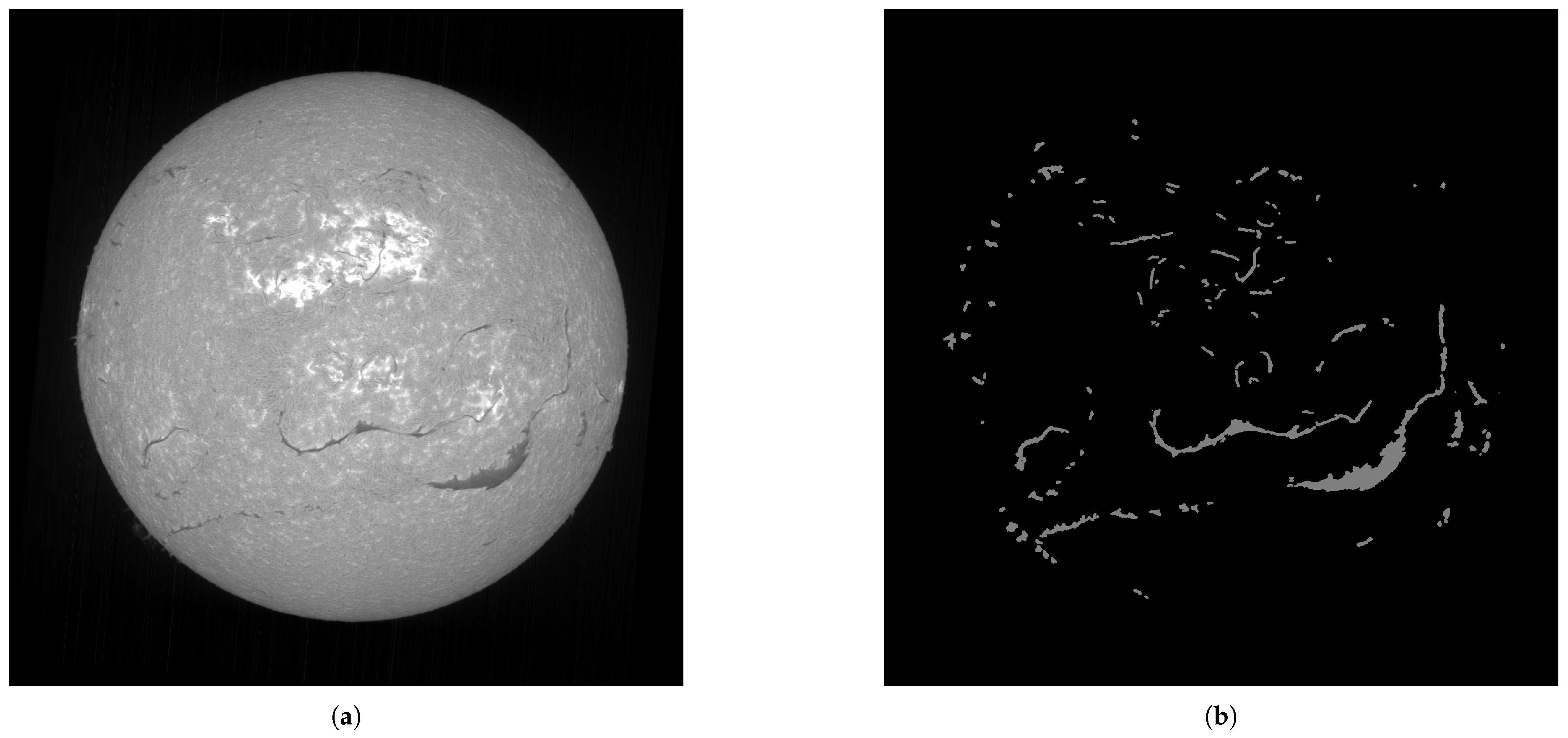
To provide a concrete illustration of modern automated filament detection, Figure 1 presents a segmentation example obtained by applying a U-Net architecture to CHASE (Chinese H α Solar Explorer) observations. This deep learning-based method effectively delineates filament structures, exemplifying the advanced techniques that have emerged alongside traditional image processing approaches.
The conceptual framework of this review is based on the interplay among solar filament characteristics, image processing methodologies, and machine learning techniques. Solar filaments are typically defined as elongated, cool plasma structures observable in H α full-disk images, and their detection relies on image segmentation and feature extraction [20,29]. Machine learning models, including support vector machines and deep neural networks, learn from labeled data to classify and track filaments, thereby improving detection accuracy and automation [4,30]. This framework supports a systematic review of the evolution of filament detection methods, aiming to identify effective strategies and remaining challenges [31].
This review critically examines the historical development of solar filament detection methods, with an emphasis on the integration of image processing and machine learning. By synthesising existing approaches, highlighting key advances, and identifying gaps, it aims to inform future research and operational applications. Addressing these gaps will help improve automated detection systems that are essential for space weather forecasting [5,18].
A comprehensive literature survey was conducted, selecting studies from early manual techniques to recent deep-learning models. The analytical framework includes comparative evaluations of algorithmic performance and methodological evolution. The findings are organised chronologically and thematically to elucidate the progression and current state of the field [2,27].
A comprehensive summary of individual studies reviewed in this work is provided in Appendix A (Table A1), which details methodologies, performance metrics, and validation approaches across the historical development of solar filament detection techniques.

2. Historical Evolution of Solar Filament Detection Techniques

The historical progression of solar filament detection methods reveals a clear technological trajectory from labor-intensive manual approaches to increasingly sophisticated automated systems. This evolution can be broadly categorized into three distinct phases, each characterized by fundamental shifts in methodology, accuracy, and computational efficiency.

2.1. Manual and Semi-Automated Methods (1990s–2002)

The earliest efforts in automated filament detection emerged from the need to process growing volumes of solar observational data. Foundational work by Mouradian [3] established long-term digital records through semi-automated digitization of hand-drawn synoptic maps from the Observatoire de Paris-Meudon, creating benchmark datasets for validation. These methods maintained human oversight to minimize false detections but represented a crucial first step toward automation.
Early fully automated approaches employed basic image processing techniques. Gao et al. [32] implemented thresholding and region-growing algorithms for filament disappearance detection, achieving processing rates of one image per minute—suitable for near-real-time alerts. These pioneering methods addressed fundamental challenges like noise and fragmentation through simple heuristics such as “4-pixel” and “40-pixel” connectivity rules, though they remained limited by sensitivity to image quality variations and background non-uniformity.

2.2. Image Processing and Early Machine Learning (2003–2010)

This period witnessed significant methodological diversification and the initial integration of machine learning. Some general introductions to pattern and feature detection in digital images can be found in the textbooks by Gonzalez and Woods [33], Jähne [34], Pao [35], Woods [36], Mallat [37] and Ripley [38]. Advanced image processing techniques emerged, with Shih and Kowalski [39] demonstrating excellent detection of large filaments (100%) using directional morphological filtering with linear structuring elements, while Fuller and Aboudarham [1] achieved very good correspondence with manual digitization through region growing with seed selection.Targeting dynamic H α dark features such as active filaments and chromospheric surge jets, Liu et al. [13] employed local median-based dynamic thresholding to identify dark points and integrated multi-wavelength information for event classification. Their method successfully identified 89% of manually recorded events and determined the start and end times of events more accurately.
The integration of machine learning classifiers marked a critical advancement. Zharkova and Schetinin [25] pioneered artificial neural networks (ANNs) for filament recognition on variable brightness backgrounds, achieving approximately 82.5% accuracy with parabolic background approximation. Subsequent work introduced support vector machines (SVMs) for filament classification and sunspot removal, with Shih et al. [4] reporting ∼95% detection rates for large filaments. Hybrid systems combining image processing with neural network verification, such as that by Qahwaji and Colak [19], reduced false acceptance rates to 4% while maintaining fast processing times (<3 s per image).
Automated tracking and characterization capabilities also advanced significantly during this period. Bernasconi et al. [15] developed automated spine extraction and chirality classification with 72% accuracy compared to manual identification, while Aboudarham et al. [40] achieved ∼90% detection accuracy through Laplacian enhancement and region growing, enabling fully automated synoptic map generation. A representative operational example of such traditional pipelines is the Automatic Solar Synoptic Analyzer (ASSA) developed by the Korean Space Weather Center, which integrates morphological directional filtering for filament detection [39] and provides real-time online products (ASSA webpage: https://spaceweather.kasa.go.kr/assa accessed on 2 June 2026).

2.3. Deep Learning Era (2011–Present)

The advent of deep learning architectures represents a paradigm shift in solar filament detection, enabling end-to-end learning with minimal hand-crafted feature engineering. Initial approaches focused on adapting existing architectures, with improved U-Net variants achieving average true positive rates of 0.9145 and Dice similarity coefficients of 0.8944 [26].
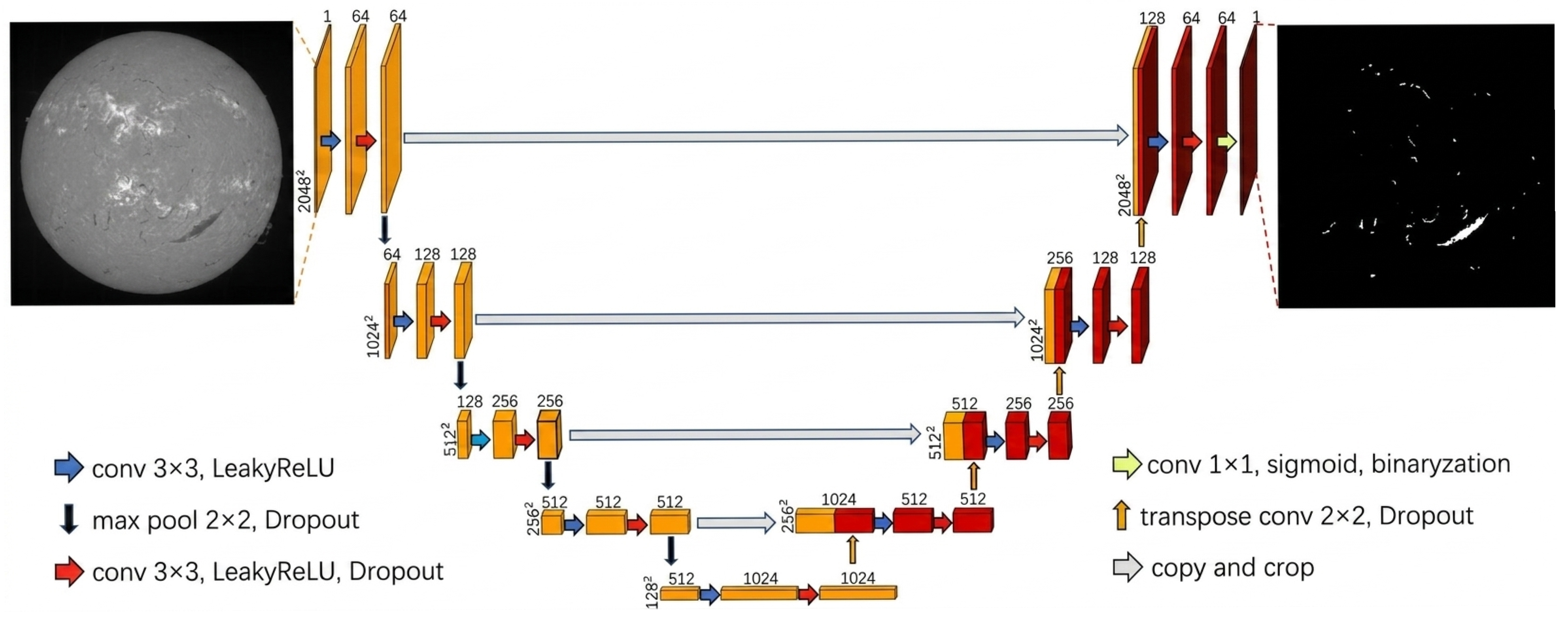
A typical U-Net architecture designed for filament segmentation is illustrated in Figure 2. As shown, the model takes H α line-center images as input and produces a binary segmentation mask of the same spatial dimensions. The encoder path captures contextual information through successive down-sampling, while the decoder path restores spatial resolution via up-sampling and skip connections. This symmetric design enables precise localization of filament boundaries, which is a key reason why U-Net and its variants have become dominant in this domain [18].
Building on this foundational design, subsequent works have introduced attention mechanisms, transformer modules, and lightweight modifications to further improve accuracy and efficiency [41,42,43].
Instance segmentation models like Mask R-CNN demonstrated remarkable performance, with Salasa and Arymurthy [44] reporting 96% precision without intensity normalization and inference times of 0.42 s per image. These approaches showed enhanced robustness to noise and background interference while eliminating the need for extensive preprocessing.
Recent advances incorporate sophisticated architectural innovations. Attention mechanisms, as implemented in Attention U2-Net by Jiang and Li [41], improve feature selection and model interpretability. Hybrid CNN-Transformer models like that of Shang et al. Shang et al. [42] achieve F1-scores of 91.19% through enhanced global feature extraction. Semi-supervised approaches combining YOLOv5 and U-Net by Diercke et al. [27] maintain high accuracy (92%) while reducing annotation costs, addressing a critical limitation in the field.
The development of lightweight architectures represents another significant trend. Models like Flat U-Net by Zhu et al. [43] demonstrate high efficiency with reduced parameters while maintaining competitive performance (precision ∼0.93), enabling deployment on embedded systems and facilitating real-time processing.
This evolutionary progression has yielded substantial improvements in detection performance. Accuracy has advanced from moderate levels (72–85%) in early methods to consistently high performance (90%+) in recent deep learning approaches. Computational efficiency has similarly improved, with processing times evolving from minutes per image in manual methods to sub-second inference in modern systems. The scope of validation has expanded from single-observatory testing to comprehensive multi-instrument evaluations, enhancing operational applicability across diverse observational platforms.
A chronological summary of these methodological developments, from semi-automated digitization to modern deep learning architectures, is presented in Table 1.

3. Performance Comparison of Key Technical Approaches

The evolution of solar filament detection has produced three dominant technical paradigms: traditional image processing, classical machine learning, and deep learning architectures. Each approach exhibits distinct performance characteristics, advantages, and limitations that make them suitable for different application scenarios and operational constraints.

3.1. Traditional Image Processing Methods

Traditional image processing techniques formed the foundation of automated filament detection, relying on carefully designed algorithms for feature extraction and segmentation. These methods typically employed sequential processing pipelines including image enhancement, thresholding, morphological operations, and region growing [1,32,48].
Performance Characteristics:
Early approaches demonstrated moderate accuracy levels, with region growing methods achieving very good correspondence with manual digitization [1] and directional morphological filtering showing excellent detection of large filaments (100%) with 90.4% detection rate for small filaments [39]. Advanced implementations incorporating robust preprocessing achieved higher performance, with polynomial luminance correction and adaptive thresholding reporting >96% accuracy for filament number detection and >99% for area measurement [20]. For dynamic features such as surges, the method achieved a recognition rate of 89% compared with manually created catalogs, while detecting over ten times more manually missed events [13].
Computational Efficiency: Processing speeds varied significantly based on algorithm complexity. Basic thresholding and region growing methods typically required 1–3 s per image [19], while more sophisticated approaches with extensive preprocessing could take up to 1 min per image [28]. Parallel implementations demonstrated substantial speed improvements, with hybrid OpenMP-MPI parallelization achieving 326×acceleration for filter-based diffusion methods [49].
Strengths and Limitations: The primary advantages of traditional methods include computational transparency, minimal training requirements, and well-understood algorithmic behavior. However, these approaches suffer from sensitivity to image quality variations, requirement for manual parameter tuning, and limited adaptability to new datasets without algorithm modification [1,50]. They particularly struggle with fragmented filaments, limb-darkening effects, and distinguishing filaments from other solar features like sunspots [2,28].

3.2. Classical Machine Learning Approaches

The integration of machine learning classifiers represented a significant advancement in filament detection capability, enabling improved feature discrimination and reduced false positive rates through learned decision boundaries.
Performance Characteristics: Artificial neural networks achieved approximately 82.5% accuracy on variable brightness backgrounds using parabolic background approximation [45]. Support vector machines demonstrated strong performance with 95% detection rates for large filaments while effectively discriminating filaments from sunspots [4]. Hybrid systems combining image processing with neural network verification reduced false acceptance rates to 4% while maintaining operational viability [19].
Computational Efficiency: Machine learning approaches showed variable computational profiles. Neural network implementations were computationally efficient during inference once trained [25], while SVM classifiers offered moderate processing speeds suitable for near real-time applications [14]. The critical limitation remained the requirement for careful feature engineering and dataset preparation prior to model training [51].
Strengths and Limitations: Machine learning methods excel at feature discrimination and classification tasks, particularly in distinguishing filaments from other solar features and handling variable background conditions [19,25]. These approaches also demonstrated effectiveness in specialized tasks such as fragment merging, with neural networks achieving 92% true-positive rates in merging broken filament components [23]. However, they remain constrained by dependency on hand-crafted features, limited generalization beyond training data distributions, and sensitivity to image quality variations that differ from training conditions.

3.3. Deep Learning Architectures

Deep learning represents the current state of the art in solar filament detection, employing end-to-end learning to automatically extract relevant features from raw image data without extensive preprocessing or feature engineering.
Performance Characteristics: Deep learning models consistently achieve superior performance metrics across multiple evaluation dimensions. U-Net variants report average true positive rates of 0.9145 and Dice similarity coefficients of 0.8944 [26], while Mask R-CNN implementations achieve 96% precision without intensity normalization [44]. Recent hybrid architectures including attention mechanisms and transformer components further advance performance, with F1-scores exceeding 91% [41,42].
Computational Efficiency: The computational profile of deep learning approaches shows significant variation based on model architecture and implementation. Standard U-Net training requires substantial resources (49 min on GPU to 57 h on CPU) [26], while inference times can be optimized to sub-second performance (0.42–0.458 s per image) [44,52]. Lightweight architectures like Flat U-Net demonstrate that competitive performance can be maintained while significantly reducing computational requirements [43].
Practical Deployment Barriers: Despite these advances, the computational demands of deep learning models impose non-trivial constraints on both research and operational deployment. The gap between different architectures is substantial: training a Conditional GAN (CGAN) for filament segmentation can require approximately 80 h, whereas an optimized U-Net variant completes training in roughly 1.2 h on comparable hardware [47]. More resource-intensive models such as CondInst demand up to 30 h on a single NVIDIA RTX 2080 GPU [52], while hybrid CNN-Transformer architectures operating on moderate batch sizes (e.g., 4, with 12 Transformer layers and 512 × 512 input resolution [42]) can push memory requirements beyond the capacity of consumer-grade hardware. These costs are compounded by data requirements: state-of-the-art models typically require thousands of annotated samples for supervised training [47,52], and the manual annotation of filament boundaries in full-disk H α images remains a labor-intensive bottleneck. For operational deployment—particularly in resource-constrained environments such as onboard spacecraft processors or small observatory servers—model compression techniques including network quantization (reducing 32-bit weights to 8-bit integers), knowledge distillation, and structured pruning offer practical pathways to bridge the gap between research-grade accuracy and deployable efficiency [43]. The emergence of ultralightweight architectures explicitly designed for this purpose underscores the recognition that computational pragmatism must accompany accuracy-driven innovation for filament detection systems to achieve widespread operational adoption.
Strengths and Limitations: The primary advantages of deep learning include exceptional segmentation accuracy, robustness to noise and image quality variations, and elimination of manual feature engineering requirements [26,30]. These models also demonstrate superior generalization across different observatories and imaging conditions when properly trained [27]. However, significant challenges remain including substantial computational requirements for training, dependency on large annotated datasets, limited model interpretability, and sensitivity to domain shift between training and deployment conditions [41,42].

3.4. Cross-Paradigm Performance Analysis

The comparative analysis reveals distinct trade-offs between the three technical approaches. Traditional image processing methods offer the advantages of computational transparency and minimal data requirements but suffer from limited accuracy and robustness. Classical machine learning approaches provide improved feature discrimination and classification capability while maintaining reasonable computational demands, though they require careful feature engineering. Deep learning architectures deliver state-of-the-art performance and robustness but demand substantial computational resources and annotated datasets.
The optimal approach selection depends heavily on application requirements. For resource-constrained environments or applications requiring high interpretability, traditional methods or classical machine learning may be preferable. For maximum accuracy and robustness in well-resourced environments, deep learning approaches represent the current state-of-the-art. Future research directions increasingly focus on hybrid approaches that combine the strengths of multiple paradigms while mitigating their respective limitations.
A comparative overview of the key performance characteristics across the three technical paradigms is provided in Table 2.

3.5. Critical Perspectives: Paradigm Conflicts and Epistemic Gaps

Beyond the quantitative improvements in detection accuracy, the historical trajectory of solar filament detection reveals fundamental epistemological tensions that warrant critical examination. The field currently faces a “success paradox,” where metrics improve while physical understanding stagnates.

3.5.1. The Semantic Gap: Pixel Precision vs. Physical Reality

A fundamental disconnection persists between data-driven optimization and physical insight. Deep learning models, while achieving high pixel-level segmentation precision (high IoU), essentially perform sophisticated texture matching without an understanding of the underlying magnetohydrodynamic (MHD) physics. This creates a semantic gap: a model may successfully segment a filament based on H α absorption features but fail to recognize physically impossible topologies, such as disjointed segments that violate magnetic connectivity constraints. Current algorithms treat filaments as “dark shapes” rather than magnetic flux ropes suspended by Lorentz forces, leading to detections that are visually plausible but physically inconsistent for downstream modeling.

3.5.2. Metric Misalignment: Geometric Accuracy vs. Prognostic Value

The field suffers from “inward-looking” evaluation metrics. The pervasive reliance on generic computer vision metrics (e.g., F1-score, Pixel Accuracy) creates an evaluation system disconnected from scientific utility. In operational forecasting, not all filaments are equal; a small, active-region filament with high chirality is significantly more critical for eruption prediction than a large, quiescent filament. However, standard metrics weight all pixels equally. A model could achieve a 98% F1-score by perfectly segmenting stable quiescent filaments while missing the subtle, pre-eruptive signatures of an active region filament—rendering the model statistically superior but operationally hazardous.

3.5.3. Fragmentation in Benchmarking and Reproducibility

A significant impediment to progress is the lack of standardized evaluation protocols. Performance metrics are highly dependent on specific datasets, which vary wildly in preprocessing, resolution, and annotation standards across studies. This heterogeneity makes cross-study comparisons largely unreliable and hinders meaningful progress assessment.
  • The Role of Standardization:Addressing this fragmentation is critical. The introduction of standardized datasets, such as MAGFILO v1.0 [53], represents a pivotal step forward. By providing a consistent benchmark for fair algorithm comparison, MAGFILO v1.0 addresses the critical gap in reproducibility, allowing for rigorous assessment of different architectures on a level playing field. However, until such benchmarks are universally adopted, the community risks a “Tower of Babel” scenario where results are incomparable across different research groups.

3.5.4. The “Instrumental Overfitting” Crisis

Closely related to fragmentation is the issue of instrumental overfitting. Models trained predominantly on limited datasets from major observatories (e.g., strictly BBSO or MLSO) inevitably learn not only filament characteristics but also instrument-specific artifacts and annotator biases. This observational bias manifests as performance degradation when applied to new instruments or extreme solar conditions. The models have not learned “what a filament is,” but rather “what a filament looks like through a specific telescope,” revealing the fundamental fragility of current approaches in the face of domain shifts.

3.5.5. Technological Monoculture and the “Black Box” Barrier

Finally, the overwhelming focus on deep learning architectures, particularly minor variations in U-Net, threatens methodological diversity. While effective, this “black-box” nature complicates validation in operational settings where trust is paramount. Forecasters require not just a binary detection mask, but a confidence interval and an explainable rationale—capabilities that are largely absent in current end-to-end segmentation networks, creating a barrier to their deployment in real-time space weather pipelines.

4. Application-Oriented Challenges and Advances

The transition of solar filament detection from research laboratories to operational environments has revealed several critical challenges that must be addressed for reliable real-world deployment. Simultaneously, significant advances have been made in overcoming these barriers, moving toward more robust and applicable detection systems.

4.1. Cross-Instrument Generalization

A fundamental challenge in operational solar monitoring involves the deployment of detection algorithms across diverse observational platforms with varying instrumental characteristics, resolutions, and imaging conditions.
Challenges: Different solar observatories employ distinct imaging systems with unique characteristics in terms of spatial resolution, spectral bandwidth, temporal cadence, and noise properties. This variability poses significant challenges for detection algorithms trained on data from a single source. Studies by Yuan et al. [20] and Schuh et al. [54] highlighted how performance degradation occurs when methods developed for one instrument are applied to data from another observatory without retraining or adaptation.
Recent Advances: Several approaches have demonstrated improved cross-instrument generalization. Multi-observatory training strategies, where models are trained on combined datasets from multiple sources, have shown promising results. Diercke et al. [27] achieved 92% segmentation accuracy across ChroTel, GONG, and KSO datasets through semi-supervised learning. Similarly, Yuan et al. [20] demonstrated robustness across four different observatories (BBSO, KSO, OACT, YNAO) with accuracy exceeding 96% for filament number detection.
Domain adaptation techniques and data augmentation strategies have also proven effective. Methods incorporating synthetic data generation and style transfer between instruments help bridge the domain gap, improving model generalization without requiring extensive labeled data from each target instrument.

4.2. Real-Time Processing and Computational Efficiency

The operational requirements of space weather forecasting demand detection algorithms capable of processing solar images in near real-time, presenting significant computational challenges, particularly for resource-intensive deep learning models.
Challenges: Early detection methods faced substantial computational bottlenecks. Region growing and morphological operations required significant processing times, with some implementations taking up to one minute per image [2,15]. While classical machine learning approaches improved speeds to 1–3 s per image [19], these remained insufficient for high-cadence monitoring applications.
Recent Advances: Substantial progress has been made in computational optimization. Lightweight deep learning architectures such as Flat U-Net [43] maintain competitive performance (precision ∼0.93) while significantly reducing computational requirements. Optimized implementations of modern architectures achieve inference times under 0.5 s per image [44,52], enabling true real-time processing.
Parallel processing approaches have demonstrated remarkable efficiency gains. Andrijauskas and Gradvohl [49] achieved 326× speed-up for filter-based diffusion methods using hybrid OpenMP-MPI parallelization, supporting high-throughput processing of large solar images. These advances facilitate the integration of detection algorithms into operational solar observatories and space weather monitoring systems.

4.3. Integration with Space Weather Forecasting

The ultimate application of solar filament detection lies in improving space weather prediction capabilities, requiring seamless integration with forecasting pipelines and operational decision-making systems.
Challenges: Significant gaps remain between detection outputs and actionable space weather forecasts. Current systems often operate in isolation, with limited integration between filament detection algorithms and coronal mass ejection (CME) prediction models. The accurate identification of filament disappearance events and their correlation with eruptive phenomena remains challenging, with existing methods showing limited accuracy and reliance on empirical thresholds [17,18].
Current State of Eruption and CME Prediction: Contemporary CME prediction methods can be broadly classified into empirical, statistical, and physics-based approaches. Empirical models rely on observed correlations between filament parameters—such as length, chirality, and magnetic flux—and eruption probability, but are inherently limited by the quality and completeness of input filament catalogs derived from automated detection pipelines [5]. Statistical and machine learning-based methods, including logistic regression and neural network classifiers, have shown promise in identifying pre-eruptive configurations; however, their predictive skill is critically dependent on the accuracy and consistency of upstream filament feature extraction [17,21]. Physics-based approaches, such as MHD simulations of flux rope instability and loss of equilibrium [55], offer the most physically grounded eruption forecasts but require precise filament magnetic field measurements that current automated detection pipelines do not routinely provide. Across all three paradigms, a fundamental bottleneck persists: the reliability of any CME prediction is ultimately bounded by the fidelity of the filament detection and characterization that feeds into it. Improvements in automated detection—particularly in robust physical parameter extraction (tilt angle, magnetic configuration, and kinematic signatures)—can therefore directly enhance the input quality for all classes of prediction models, narrowing the critical gap between raw observations and actionable space weather forecasts.
Recent Advances: Progress has been made in developing end-to-end frameworks that link detection with forecasting. Automated tracking algorithms now enable continuous monitoring of filament evolution with ∼90% accuracy [56], providing crucial temporal context for eruption prediction. Machine learning-based disappearance detection systems have improved the reliability of identifying pre-eruptive signatures [17,18].
The extraction of physically meaningful parameters represents another significant advancement. Methods for quantifying filament area, length, orientation, and kinematic properties provide valuable inputs for empirical and physics-based eruption models [5,57]. These parameters enable statistical analyses across solar cycles, enhancing our understanding of filament behavior and its relationship to space weather events.

4.4. Handling Data Quality Variability

Operational environments must contend with substantial variations in image quality due to atmospheric conditions, instrumental artifacts, and solar activity levels, presenting persistent challenges for reliable detection.
Challenges: Traditional image processing methods are particularly vulnerable to image quality degradation. Noise, limb darkening, atmospheric distortions, and instrumental defects significantly impact detection reliability [5,28]. Early neural networks also exhibited sensitivity to image artifacts and conditions differing from their training data [50,58].
Recent Advances: Deep learning approaches have demonstrated enhanced robustness to image quality variations. Attention mechanisms, as implemented in models like Attention U2-Net [41], enable the network to focus on salient filament features while suppressing irrelevant background noise and artifacts. Multi-scale feature extraction in architectures such as hybrid CNN-Transformer models [42] provides resilience to resolution variations and partial occlusions.
Advanced preprocessing techniques have also evolved substantially. Adaptive normalization methods, learned enhancement operations, and noise-invariant training strategies improve performance under challenging observational conditions without requiring manual parameter tuning.

4.5. Operational Deployment Considerations

The transition from research prototypes to operational systems introduces additional practical considerations including reliability, maintainability, and continuous adaptation requirements.
Challenges: Operational deployment faces hurdles related to model maintenance, continuous performance monitoring, and adaptation to evolving solar conditions across solar cycles. The “black-box” nature of deep learning models complicates validation and trust in operational settings [41,42,59]. Additionally, the computational infrastructure requirements for training and deploying advanced models can be prohibitive for some operational environments.
Recent Advances: Developments in explainable AI and model interpretability are addressing trust and validation concerns. Attention visualization and feature importance analysis provide insights into model decision processes, facilitating operational oversight and validation [41].
Modular system design approaches enable incremental updates and component-level validation. The emergence of standardized interfaces and containerized deployment options simplifies integration with existing observatory infrastructure and forecasting systems.
A synthesized overview of these application-oriented challenges and the corresponding technical advances is presented in Table 3.

4.6. Summary and Outlook

The application-oriented challenges in solar filament detection are being systematically addressed through targeted technological advances. Cross-instrument generalization benefits from multi-source training and domain adaptation techniques. Computational efficiency continues to improve through architectural optimization and parallel processing. Integration with space weather forecasting is advancing through end-to-end frameworks and improved physical parameter extraction.
Despite significant progress, important challenges remain. The development of standardized evaluation protocols across diverse operational scenarios would facilitate more systematic comparison of method performance. Increased focus on model interpretability and physical consistency will enhance trust in operational deployments. Finally, closer collaboration between algorithm developers and space weather forecasters will ensure that detection systems evolve to meet the practical requirements of operational forecasting environments.

5. Future Research Directions

Based on the comprehensive analysis of current limitations and emerging trends in solar filament detection, several critical research directions emerge that promise to advance the field toward more robust, efficient, and physically meaningful detection systems. These directions address fundamental challenges while leveraging new technological opportunities.

5.1. Standardized Datasets and Benchmarking

The lack of standardized, large-scale annotated datasets represents a fundamental limitation in current solar filament detection research. Future efforts should prioritize the development of community-wide benchmark datasets with consistent labeling protocols across multiple solar cycles and observational platforms [60].
Key Initiatives:
Establishing curated datasets that encompass diverse solar activity conditions, multiple instruments (H α , EUV, magnetograms), and comprehensive filament annotations would significantly enhance model generalization and enable fair comparison of different approaches. These datasets should include challenging cases such as limb filaments, faint structures, and eruption precursors to drive algorithmic improvements. Community-driven annotation efforts and open data sharing initiatives, similar to those pioneered by Mouradian [3] but scaled for modern requirements, will be essential for creating these resources.
Evaluation Frameworks: Developing standardized evaluation metrics and protocols is equally crucial. Current studies employ diverse performance measures, making direct comparisons difficult. Future work should establish comprehensive evaluation frameworks that assess not only segmentation accuracy but also computational efficiency, robustness to image quality variations, and generalization across instruments. Regular benchmarking challenges, similar to those in computer vision, could accelerate progress by focusing community efforts on common goals.

5.2. Towards Trustworthy and Edge-Deployable AI Systems

As deep learning architectures grow in complexity, the gap between computational demands and operational constraints widens. Future research must pivot from purely accuracy-driven metrics to developing systems that are both resource-efficient for spaceborne deployment and scientifically trustworthy through physical grounding.
On-board Intelligence and Edge Computing: The current paradigm of “downlink-then-process” is bottlenecked by limited telemetry bandwidth in deep-space missions (e.g., Solar Orbiter). Future detection systems must prioritize Edge AI, enabling real-time filament detection directly on spacecraft.
  • Technological Pathway: Research should move beyond simple architecture scaling (e.g., Flat U-Net [43]) to advanced model compression techniques such as network quantization (reducing precision from 32-bit float to 8-bit integer) and knowledge distillation (training lightweight “student” models to mimic heavy “teacher” networks). This would facilitate “smart telemetry,” where spacecraft downlink only metadata or event-triggered image cutouts of active filaments, significantly optimizing data budgets.
Physics-Informed Neural Networks (PINNs): To overcome the “black-box” limitation, the next generation of models must incorporate inductive biases derived from solar physics. Instead of learning purely from pixel statistics, Physics-Informed Neural Networks (PINNs) can embed physical laws directly into the training process.
  • Critical Insight: Future architectures could incorporate a “physics loss” function ( L p h y ) alongside standard segmentation loss. For instance, imposing constraints based on magnetic connectivity or enforcing topological continuity can penalize the model for predicting physically impossible fragmented structures. This ensures that the detected filaments are not just visually similar to the ground truth but are consistent with underlying MHD principles.
Explainability and Uncertainty Quantification: Trust is the prerequisite for operational adoption. To demystify the decision-making process of deep models, a dual approach is required:
  • Visual Explainability (XAI): Techniques such as attention mechanisms [41,61], provide critical insights by visualizing which image regions drive the model’s decisions. Future work should advance from simple attention maps to sophisticated feature attribution methods (e.g., Integrated Gradients) that can verify whether the model is focusing on physical filament structures or irrelevant background artifacts.
  • Uncertainty Quantification (UQ): Beyond knowing where the model looks, operators need to know how confident it is. Integrating Bayesian Neural Networks or Monte Carlo Dropout allows systems to generate probability heatmaps. By distinguishing between aleatoric uncertainty (data noise) and epistemic uncertainty (model ignorance), these systems provide forecasters with actionable risk assessments—flagging low-confidence detections for human review while automating high-confidence cases.

5.3. Multi-Modal Data Integration

Current detection methods predominantly focus on single-wavelength observations, particularly H α images. Future research should exploit the complementary information available across multiple observational modalities.
Multi-Wavelength Fusion: Developing frameworks that integrate H α , EUV, magnetogram, and spectroscopic data will improve filament discrimination and characterization. As noted by Scholl and Habbal [62], multi-wavelength approaches can better distinguish filaments from other solar features and provide more comprehensive physical parameter extraction. Deep learning architectures specifically designed for multi-modal data fusion, potentially incorporating cross-attention mechanisms and shared representation learning, represent a promising research direction.
Magnetic Context Integration: Incorporating magnetic field information represents a particularly valuable extension. Filament formation and stability are intimately connected to the underlying magnetic field structure. Future detection systems should integrate vector magnetogram data to improve eruption prediction and enable more physically grounded tracking of filament evolution.

5.4. Advanced Tracking and Eruption Prediction

While current systems demonstrate competent detection capabilities, significant advances are needed in temporal analysis and predictive modeling.
Disappearance and Eruption Detection: Fully automated, accurate detection of filament disappearance and eruption events remains challenging. Future research should develop machine learning approaches that integrate temporal evolution patterns, kinematic signatures, and magnetic context to improve eruption prediction reliability. As highlighted by Atoum [17] and Zheng et al. [18], these capabilities are crucial for space weather forecasting but currently suffer from limited accuracy and reliance on empirical thresholds.
Long-term Evolution Modeling: Beyond immediate eruption prediction, understanding filament lifecycle evolution across multiple solar rotations represents an important research direction. Developing models that can track filament development, rotation, and interaction with other solar features would provide valuable insights for both fundamental solar physics and operational forecasting.

5.5. Generalized and Adaptive Detection

Ensuring reliable performance across diverse solar activity conditions and throughout the solar cycle remains a significant challenge.
Adaptation to Solar Cycle Variations: Future detection systems must maintain performance across different phases of the solar cycle, from minimum to maximum activity. Research should focus on developing adaptive algorithms that can automatically adjust to changing solar conditions without manual intervention. Continual learning approaches and domain adaptation techniques specifically designed for solar cycle variations represent promising directions.
Handling Extreme Conditions: Developing robustness to challenging observational conditions, including high noise levels, atmospheric distortions, and instrumental artifacts, requires continued attention. Future work should explore noise-invariant training strategies, self-supervised learning approaches that leverage unlabeled data from difficult conditions, and robust preprocessing techniques that require minimal parameter tuning.

5.6. Integration with Operational Forecasting

Translating detection advances into operational space weather forecasting capabilities represents the ultimate application goal.
End-to-End Forecasting Systems: Future research should develop integrated frameworks that connect filament detection directly with space weather prediction models. These systems should automatically extract physically meaningful parameters (orientation, magnetic configuration, kinematic properties) and feed them into eruption probability models and CME propagation forecasts. The work by Zheng et al. [18] represents an initial step in this direction, but more sophisticated integration is needed.
Operational Deployment Considerations: Research should address practical deployment challenges including computational infrastructure, real-time processing constraints, and system reliability requirements. Developing containerized, scalable detection systems that can be easily integrated with existing observatory infrastructure and forecasting pipelines will facilitate operational adoption.

5.7. Physical Parameter Extraction

Beyond binary segmentation, transforming detection outputs into quantitative physical parameters represents a critical step connecting pixel-level results to scientific analysis and operational forecasting.
Current Limitations: Most existing detection systems output only segmentation masks, leaving the extraction of physically meaningful quantities—such as filament tilt angles, chirality, spine length, area, magnetic flux, and line-of-sight velocity fields—to separate, often manual post-processing steps. This decoupling between detection and physical characterization hinders end-to-end automation and limits the immediate utility of detection results in physics-based eruption models [5,18].
Promising Directions: Future detection frameworks should evolve from pure segmentation tasks to multi-task learning systems that simultaneously produce detection masks alongside quantitative physical parameters. Architectures incorporating physics-aware decoder heads—specialized branches for regression or classification of physical quantities—can transform detection from a pattern recognition problem into a quantitative measurement tool.
  • Integrated Parameter Extraction: Multi-task networks can jointly predict filament masks, spine coordinates, chirality classification, and kinematic properties in a single forward pass. This approach not only improves computational efficiency but also enables the network to learn shared representations that mutually benefit segmentation and parameter estimation tasks.
  • Metrics for Physical Consistency: Establishing evaluation protocols beyond standard segmentation metrics—such as tilt angle error relative to manual measurements, chirality agreement rates, and velocity field consistency—will incentivize the development of scientifically meaningful detection systems.
  • Large-Scale Statistical Applications: Automated parameter extraction pipelines enable comprehensive statistical studies of filament properties across solar cycles, facilitating investigations into hemispheric asymmetry patterns, poleward migration trends, and the identification of pre-eruptive signatures critical for space weather forecasting [5,57].

5.8. Historical Data Utilization and Long-Term Studies

The vast archives of historical solar data remain underutilized but offer unique opportunities for long-term studies.
Historical Data Digitization: Specialized pipelines for digitizing and analyzing historical records, such as the hand-drawn suncharts studied by Priyadarshi et al. [57], would extend our understanding of filament behavior across multiple solar cycles. Machine learning approaches tailored to historical data characteristics (variable quality, different observational techniques) could unlock century-long datasets for comprehensive solar cycle studies.
Cross-Century Analysis: Integrating contemporary detections with historical records would enable unprecedented studies of solar cycle evolution and long-term trends in filament behavior. These analyses could reveal connections between filament properties and broader solar magnetic cycle patterns, potentially improving our understanding of solar dynamo processes.

5.9. Cross-Disciplinary Opportunities: The Era of Foundation Models

The convergence of solar physics with general artificial intelligence offers transformative potential, particularly with the emergence of large-scale Foundation Models (FMs).
From Specialized Networks to Foundation Models: The field is witnessing a paradigm shift from training task-specific models (e.g., U-Net trained from scratch) to adapting generalist Foundation Models.
  • Zero-Shot Segmentation: Models such as the Segment Anything Model (SAM) have demonstrated remarkable zero-shot generalization capabilities. Future research should investigate the applicability of SAM-based architectures for solar filament detection. By utilizing prompt engineering (e.g., providing box prompts or point prompts of filaments) rather than full retraining, researchers could bypass the bottleneck of massive annotated datasets.
  • Vision-Language Integration: The rise of Multi-modal Large Language Models (MLLMs) offers a novel pathway for semantic understanding. Integrating visual encoders with language models could enable systems that not only segment filaments but also generate natural language descriptions of their morphology (“sigmoid,” “barb-bearing”) or query databases using semantic prompts (“Show me all active region filaments with high chirality”), effectively bridging the gap between pixel data and scientific query.
Domain Adaptation and “Solar-Foundations”: While terrestrial foundation models are powerful, they lack domain-specific knowledge of plasma physics and magnetic topologies. A critical cross-disciplinary opportunity lies in developing Solar Foundation Models. By pre-training large-scale transformers on petabytes of unlabeled multi-wavelength solar data (via self-supervised learning strategies like Masked Image Modeling), the community can create a robust backbone specifically for the sun. This “Solar-Encoder” could then be efficiently fine-tuned for various downstream tasks, including filament detection, CME tracking, and flare prediction, with minimal labeled examples.
Stellar Astronomy Extension: The methodologies developed for solar filament detection hold significant potential for stellar astronomy. By adapting these techniques to stellar observational data, researchers can extend filament studies to other stars, enabling comparative analysis of stellar activity and magnetic phenomena. This “Sun-as-a-star” approach represents a promising frontier, connecting solar physics with stellar astrophysics through shared detection and analysis frameworks.
The future of solar filament detection lies in developing intelligent, adaptive systems that combine physical understanding with data-driven approaches. By addressing these research priorities, the field can move toward more reliable, efficient, and physically meaningful detection capabilities that significantly enhance both scientific understanding and operational space weather forecasting.
A comprehensive summary of the future research directions outlined above, including their key objectives and relative priority, is provided in Table 4.

6. Overall Synthesis and Conclusions

This comprehensive review has systematically traced the remarkable evolution of solar filament detection methods, charting a clear trajectory from labor-intensive manual approaches to increasingly sophisticated intelligent systems. This journey from manual to intelligent detection represents not merely a technological shift, but a fundamental transformation in how we observe, analyze, and understand solar phenomena.
Historical Progression and Current State: The foundational era of traditional image processing established the basic principles of automated detection, with techniques such as thresholding, region growing, and morphological operations providing the first steps toward automation. While demonstrating feasibility, these methods were constrained by sensitivity to image quality variations, requirement for manual parameter tuning, and limited robustness across diverse observational conditions. The integration of classical machine learning marked a significant paradigm shift, introducing learned feature discrimination and classification capabilities through artificial neural networks and support vector machines. The current deep learning revolution represents the most transformative development, with architectures such as U-Net variants and Mask R-CNN achieving unprecedented segmentation accuracy through end-to-end learning while demonstrating superior robustness.
Throughout this evolutionary progression, consistent patterns emerge: detection accuracy has improved from moderate levels (72–85%) to consistently high performance (90%+), computational efficiency has advanced from minutes to sub-second inference times, and validation scope has expanded from single-observatory testing to comprehensive multi-instrument evaluations.
Persistent Challenges: Despite these advances, significant challenges persist in translating technological sophistication into reliable operational systems. Key limitations include the scarcity of standardized annotated datasets, substantial computational demands of advanced models, limited cross-instrument generalization, and the “black-box” nature of deep learning. The integration of detection outputs with space weather forecasting models remains incomplete, constraining the practical impact on operational forecasting capabilities. The field also faces fundamental issues including the disconnection between data-driven optimization and physical insight, inward-looking evaluation metrics, and the risk of technical path monoculture.
Future Outlook: Looking forward, the field stands at a critical juncture where technological sophistication must be matched by practical applicability. Priority research directions include developing standardized benchmarks and datasets, creating efficient and interpretable AI systems, advancing multi-modal data integration, improving eruption prediction capabilities, and addressing operational deployment constraints. The ultimate goal remains the development of intelligent, adaptive detection systems that combine physical understanding with data-driven approaches to provide reliable, timely information for space weather forecasting.
The evolution from manual to intelligent detection reflects broader trends in solar physics and computational science, illustrating how advances in machine learning and artificial intelligence are transforming our ability to extract knowledge from complex observational data. This progression from human expertise to algorithmic efficiency to learned intelligence represents not just a technical achievement, but a fundamental expansion of our observational capabilities. The continued convergence of solar physics with advanced computational techniques points toward a future where intelligent detection systems operate as seamless extensions of scientific inquiry, transforming vast data streams into actionable knowledge for both research and operational applications in space weather prediction.

Author Contributions

Conceptualization, Y.H. and Y.L.; methodology, Y.H. and G.Z.; software, S.B., Y.H. and Q.Z.; validation, Y.L., H.-T.L. and A.E.; formal analysis, Y.H.; investigation, X.W. and Q.L. (Qiang Liu); resources, Y.L.; writing—original draft preparation, Y.H.; writing—review and editing, Y.L. and G.Z.; discussion, F.S., T.S., Q.L. (Qiwang Luo), H.Z., D.T.; supervision, Y.L., A.E. and H.-T.L.; funding acquisition, Y.L. and A.E. All authors have read and agreed to the published version of the manuscript.

Funding

This study is supported by grants from the National Natural Science Foundation (NNSF) of China under project grants 12373063, the Sichuan Science and Technology Program (2025ZNSFC0877).

Data Availability Statement

Data are contained within the article.

Acknowledgments

The authors would like to thank the referees for their comments and suggestions as well as the editors of MDPI. This study is supported by grants from the National Natural Science Foundation (NNSF) of China under project grants 12373063, the Sichuan Science and Technology Program (2025ZNSFC0877) and the authors gratefully acknowledge the Ongoing Research Funding program, (ORF-2026-2000), King Saud University, Riyadh, Saudi Arabia.

Conflicts of Interest

The authors declare no conflicts of interest.

Abbreviations

The following abbreviations are used in this manuscript:
AAFDCCAdvanced Automated Filament Detection and Characterization Code
ACWEActive Contours Without Edges
AIArtificial Intelligence
ANNArtificial Neural Network
APAverage Precision
ASPPAtrous Spatial Pyramid Pooling
BBSOBig Bear Solar Observatory
CGANConditional Generative Adversarial Network
CHASEChinese H α Solar Explorer
CMECoronal Mass Ejection
CNNConvolutional Neural Network
CPUCentral Processing Unit
CSRTDiscriminative Correlation Filter with Channel and Spatial Reliability
DSCDice Similarity Coefficient
EUVExtreme Ultraviolet
F1F1 Score
FARFalse Acceptance Rate
FDDFilter-based Diffusion Detection
FDHFull-Disk H-alpha
FITSFlexible Image Transport System
FMTFlare Monitoring Telescope
GLCMGray-Level Co-occurrence Matrix
GONGGlobal Oscillation Network Group
GPUGraphics Processing Unit
HEKHeliophysics Event Knowledgebase
HISH α Imaging Spectrograph
HSOSHuairou Solar Observing Station
H α Hydrogen-alpha (spectral line)
IoUIntersection over Union
IRISInterface Region Imaging Spectrograph
KSOKanzelhöhe Solar Observatory
LAPANLembaga Penerbangan dan Antariksa Nasional
mAPmean Average Precision
MCCMatthews Correlation Coefficient
MDMorphological Detection
MHDMagnetohydrodynamic
MLLMMulti-modal Large Language Model
MLSOMauna Loa Solar Observatory
MPIMessage Passing Interface
NMSNon-Maximum Suppression
NNNeural Network
NOAANational Oceanic and Atmospheric Administration
OACTOsservatorio Astrofisico di Catania
OpenMPOpen Multi-Processing
PPrecision
PINN       Physics-Informed Neural Network
RRecall
ResNetResidual Network
RGBRed–Green–Blue
RTXRay Tracing Texel eXtreme (NVIDIA GPU)
SAMSegment Anything Model
SIDE   Steerable Isotropic Differential Enhancement
SMART   Solar Monitor Active Region Tracker
SUIT   Solar Ultraviolet Imaging Telescope
SVM   Support Vector Machine
TPR   True Positive Rate
U-Net   U-shaped convolutional network
UQ   Uncertainty Quantification
USO   Udaipur Solar Observatory
XAI   Explainable Artificial Intelligence
YNAO   Yunnan Observatories
YOLO   You Only Look Once

Appendix A. Descriptive Summary of Solar Filament Detection Studies

Table A1. Descriptive Summary of Solar Filament Detection Studies.
StudyMethodology/ApproachKey Findings/PerformanceComputational & Efficiency AspectsRobustness HandlingDatasets & Validation
Mouradian [3]Semi-automated digitization & synthesis of hand-drawn synoptic mapsEstablished long-term digital record & synthesis methods for filamentsHuman-in-the-loop process; digitization enables computational analysisRelies on expert human decision, minimizing false detectionsMeudon synoptic map series (1919+). Became a benchmark dataset for validation
Gao et al. [32]Thresholding & region-growingAutomated detection of filament disappearance;alerts on disappearance eventsProcesses 1 image/minute; suitable for near-real-time alertUses “4-pixel” & “40-pixel” methods to handle noise and fragmentationTested on BBSO full-disk H α images
Zharkova and Schetinin [25]Early ANN technique for filament recognitionEffective recognition on varied brightness backgroundsComputationally light due to simple networkHandles atmospheric distortions wellTested on Meudon Observatory H α spectroheliograms
Zharkova and Schetinin [63]Artificial Neural Network with linear background approximation and sliding window techniqueEffectively recognizes filaments on variable brightness backgrounds; trained on one fragmentComputationally light network; faster than region-growing, slightly slower than mosaic methodsAdapts to variable intensity backgrounds; no explicit noise correction neededMeudon Observatory H α spectroheliograms; visually validated against mosaic & region-growing methods
Shih and Kowalski [39]Advanced local thresholding or global thresholding; directional morphological filtering with linear structuring elementsExcellent detection of large filaments (100%); good detection of small filaments (90.4%); higher false positives than some methodsFaster than region-growing methods; suitable for parallel implementation; efficient directional filteringRemoves sunspots by brightness thresholding; robust to Gaussian and blur noiseTested on BBSO H α full-disk images; validated against manual markings
Fuller and Aboudarham [1]Region growing with seed selection for detectionVery good correspondence with manual digitizationEfficient for four months of dataImage cleaning reduces defects and false detectionsTested on Meudon Observatory H α spectroheliograms
Bernasconi et al. [15]Automated detection, spine/barb extraction, chirality classification, and synodic tracking72% accuracy compared to manual chirality identificationEfficient for daily tracking over long periodsUnbiased detection reduces operator subjectivityTested on BBSO H α images spanning multiple years
Fuller et al. [24]Cleaning and region growing for filament recognitionGood agreement with manual digitizationEfficient segmentation and skeleton pruningCorrects instrument defects and noiseUsed in EGSO project for solar features
Qahwaji and Colak [19]Hybrid system: adaptive intensity filtering, modified region growing, and NN verificationFAR reduced to 4% for filaments with NN verification; fast detection suitable for operational useFast detection (<3 s/image) suitable for operational useLimb darkening correction and intensity filtering appliedTested on Meudon H α & Ca II K3 images; validated against synoptic maps
Liu et al. [13]Multi-band H α detection; local median thresholding (109 regions, di = 0.9); seed clustering; multi-wavelength classification89% manual event recall; 10× more detections; precise start/end times; surge/filament/network classification 1 s/frame preprocessing; 1–3 h/dayData quality filtering; limb-darkening correction; sunspot exclusionFMT Hida Observatory; H α center, ± 0.8 Å, white light; 7 days (1997–2001); validated against manual event catalogs
Qu et al. [14]Image processing with SVM classificationHigh precision in filament and spine detectionModerate speed; suitable for real-time applicationsUses image enhancement to reduce noise and limb effectsApplied on BBSO H α full-disk images
Zharkova and Schetinin [45]ANN with linear/parabolic background approximation; sliding window technique∼82.5% accuracy with parabolic fit; outperforms linear fit and earlier mosaic/region-growing methodsEfficient once trained; faster than region-growing; suitable for processing large archivesAdapts to limb darkening and intensity variations without explicit noise correctionTested on Meudon H α spectroheliograms; compared against region-growing and mosaic methods
Zharkova et al. [50]Review of filament detection methods (chain linking, region growing); introduces ANN technique with linear/parabolic background approximationANN achieves ∼82.5% accuracy for filaments on variable backgrounds; effective without explicit noise correctionNotes computational demands of large archives; ANN efficient once trainedANN adapts to variable intensity backgrounds; preprocessing (e.g., shape correction)Techniques tested on Meudon H α data; compared against region-growing results
Shih et al. [4]SIDE for filament enhancement, adaptive thresholding, and SVM for filament/sunspot discrimination∼95% detection rate for large filaments; first SVM use for sunspot removal; automated disappearance detectionEfficient processing suitable for continuous monitoringRobust to low-contrast filaments and limb darkening via SIDE & SVMTested on BBSO H α full-disk images; validated against manual detection
Qahwaji and Colak [64]Local contrast enhancement and adaptive intensity filtering to identify filament and NN for verificationNeural network verification reduces false positivesImage processing and feature-based NN verification enables 1 s/imageIntensity filtering and local detection windows to eliminate noiseTested on Meudon H α data; compared against BASS manual annotations
Aboudarham et al. [65]Integrated automatic detection with filament tracking for synoptic map synthesisAchieved major progress towards fully automatic synoptic map generationAims for a fully automated processing pipelineImage cleaning (limb fitting, intensity normalization) reduces defectsTested on Meudon H α spectroheliograms; compared with manual maps
Aboudarham et al. [40]Laplacian enhancement, region growing, morphological closing; Carrington map-based tracking∼90% detection accuracy; enables tracking across rotations; handles filament splitting/reappearanceFully automated pipeline; suitable for synoptic map generation and long-term trackingCorrects limb darkening, transparency variations, and instrumental defectsMeudon H α spectroheliograms; validated against manual synoptic maps
Atoum et al. [66]Adaptive local thresholding (ALT) using dual-window sliding; intensity- and range-based segmentationLower false acceptance rate (FAR: ∼9%) compared to ALT&V (19%); produces well-defined filaments with reduced noiseEfficient sliding window processing; suitable for daily image analysisAdaptive to local intensity variations; handles background non-uniformity via local statisticsMeudon H α images; validated against manual synoptic maps; FAR used as performance metric
Joshi et al. [28]Intensity and size thresholding with preprocessing (fragment grouping/foreshortening correction)81% detection rate across 10 events; capable of real-time eruption monitoring∼1 min/image processing time; suitable for real-time systemsLimb/foreshortening correction; sunspot removal; multi-observatory robustnessTested on BBSO, MLSO, KSO, USO data; validated against manual inspection
Yuan et al. [20]Polynomial luminance correction, adaptive thresholding, morphological operations, and graph-based skeleton extractionAccuracy >96% for filament number and >99% for area; outperforms previous methodsEfficient cascading Hough transform reduces memory consumptionRobust across different observatories; removes sunspots by shapeTested on 4 observatories (BBSO, KANZ, OACT, YNAO); validated against manual annotations
Andrijauskas and Gradvohl [49]Hybrid OpenMP-MPI parallelization; two methods: FDD (diffusion filter + graph-based) and MD (morphological operators)FDD: ∼80% pixel accuracy, 94% filament detection rate; MD: ∼58% accuracy, 66% detection rate326× speed-up for FDD, 54× for MD on 5-node cluster; supports high-throughput processing of large imagesDiffusion filter preserves edges; handles filament continuity across MPI segmentsBBSO H α images; validated against manually annotated ground truth images
Atoum [17]Fully automated detection and tracking with NN mergingHigh confidence in filament disappearance detectionFaster than previous empirical methodsAdaptive thresholding improves noise handlingUses Heliographic Carrington coordinates for tracking
Bonnin et al. [56]Co-rotational frame tracking with skeleton curve-matching∼90% tracking accuracy for filamentsEfficient for large datasets; ∼30 s per Carrington rotationStable in co-rotating frameApplied on Meudon H α spectroheliograms
Peng et al. [2]Early automated methods including ANN and region growingModerate accuracy; ANN improves detection near solar limbRegion growing is time-consuming; ANN fasterSensitive to background cleaning and limb proximityTested on limited datasets, mainly H α images
Hao et al. [31]Canny edge detection & morphological operators for detection; differential rotation for tracingQuantified latitudinal migration speeds in Cycle 23; ∼85% detection accuracyEfficient processing (∼1 s/image for detection)Preprocessing removes limb darkening; sunspot filtering by geometryTested on MLSO H α images; validated against manual detection
Riegler et al. [67]Variational multi-label segmentation for simultaneous flare and filament detectionAccurate classification vs. expert annotations; F-score: 0.89 (filaments), 0.92 (flares)Real-time alert potential with preprocessing stepsImage normalization, registration, and structural bandpass filterTested on KSO H α image sequences; validated against NOAA annotations
Atoum and Ali [29]Geometrical approach for spine extractionMore accurate and longer spine detectionComputationally less complex and fasterTracks filament backbone preciselySuitable for real-time tracking
Schuh et al. [54]Comparative evaluation leveraging AAFDCC metadata to train a general Trainable Feature Recognition (TFR) moduleAchieved >82.7% filament detection accuracy; confirmed reliability of AAFDCC reportingEfficient with certain classifiers (e.g., J48, RF) for large-scale datalabeling schemes to mitigate label noiseTrained and validated on BBSO H α images using AAFDCC module metadata as benchmark
Atoum and Ali [23]Image processing + neural network for merging broken filaments; uses spatial & orientation features as NN inputs92% true-positive rate in merging fragments;reduces false merging compared to earlier empirical methodsEfficient once NN is trained; avoids constant thresholdsAdaptive to fragment distance & orientation; handles fragmentation caused by imaging artifactsApplied on BBSO H α images; validated against manual merging
Atoum [58]Context-based sliding window with adaptive thresholdingAdapts window size to local intensity variability; handles both high- and low-contrast filamentsAdaptive window reduces unnecessary computationRobust to uneven illumination and intensity variations; no fixed structuring elementsTested on BBSO and Meudon H α images
Hao et al. [5]Canny edge detection for segmentation, and morphological operations for feature extractionGenerated filament “butterfly diagram” from nearly 3 solar cyclesEfficient and versatile method applied to multi-cycle dataLimb-darkening correction; sunspot exclusionApplied to full-disk H α data (primarily BBSO)
Ahmadzadeh et al. [30]Mask R-CNN deep neural network frameworkCompetitive performance using Mask R-CNN; scalable with more dataScalable deep learning frameworkHandles false positives and negatives wellTrained on BBSO H α images with HEK metadata
Salasa and Arymurthy [44]Mask R-CNN deep learning for filament detectionAchieves 96% precision without intensity normalizationFast detection at 0.42 s per imageRobust to intensity variations without normalizationApplied on LAPAN H α images
Zhu et al. [26]Improved U-Net with dropout layers & nearest-neighbor upsamplingAverage TPR: 0.9145, DSC: 0.8944; effective for large filamentsGPU training: ∼49 min; CPU: ∼57 h; suitable for small datasetsHandles noise and artifacts; sensitive to uneven illuminationDataset from BBSO/FDH A H α images
Liu et al. [47]Multiple improved U-Net variants with ASPP module; compared with CGANdilation-122436 achieves Jac: 0.6320, MCC: 0.7829, F1: 0.7710 on high-quality images; CGAN better for low-quality imagesImproved U-Nets train faster (≈1.2h) vs. CGAN (80 h); suitable for limited dataASPP improves high-quality image segmentation; CGAN more robust to poor image qualityTrained on 3000 pairs from HSOS & BBSO H α images; validated against manual ground truth
Guo et al. [52]Improved CondInst instance segmentation with ResNet-C/D/v2 backbone + Matrix NMSMean precision: 90.83%, recall: 83.88%, AP: 82.86%, F1: 87.22%; effectively detects fragmented filamentsTraining: 30 h on 1×RTX 2080; inference: 0.458 s/imageRobust to uneven brightness, limb darkening, low contrast; generalizes across observatoriesBBSO H α images; 12,519 filaments; tested on SMART & HSOS data
Priyadarshi et al. [57]K-means clustering for optimal RGB thresholding on hand-drawn sunchartsEffective extraction of filament parameters; revealed poleward migration and tilt sign dominanceProcessing of scanned drawings is computationally lightHandles variability in hand-drawn data and discolorationsUnique dataset from Kodaikanal Solar Observatory; cross-verified with H α plates
Wu et al. [68]AA-UNet with axial attention for segmentationAchieves F1-score of 0.77, robust to noiseEfficient segmentation with attention blocksHandles uneven image quality effectivelyTested on solar image test sets
You and Shang [69]Improved DeepLab V3+ deep learning modelF1-score improved by over 2% compared to originalOptimized convolutions reduce incomplete detectionsEnhanced edge optimization for small filamentsDataset from BBSO H α images
Bandyopadhyay and Pant [70]Active Contours Without Edges (ACWE) with preprocessing (inpainting, log transform, sharpening) and postprocessingMax TPR: 0.9075; accuracy: 99.63%; outperforms Otsu and K-means in boundary preservationSlower execution (∼29.8 s/image); no training requiredRobust to noise; preserves boundaries; sensitive to local minimaBBSO H α images; validated against manual ground truth
Diercke et al. [27]Semi-supervised deep learning combining YOLOv5 and U-Net92% accuracy in filament segmentationSemi-supervised learning reduces annotation costGeneralizable to multiple H α filtergramsApplied on ChroTel, GONG, and KSO data
Jiang and Li [41]Attention U2-Net; integrates attention gates into RSU blocks for enhanced feature selectionF1-score: 0.83; outperforms standard U-Net variants; effective for multi-scale filamentsTrained on an NVIDIA Quadro RTX4000 GPU; batch size of 2 over 150 epochs. (No inference time or comparative efficiency metrics reported)Attention mechanism improves robustness to noise and complex backgroundsCHASE/H α images (2023); 600 images with labels from clustering & post-processing
Shang et al. [42]Hybrid CNN-Transformer model with multi-scale residual blocks, deformable large kernel attention, and res pathF1: 91.19%, Precision: 91.50%, Recall: 90.89%; superior anti-interference to sunspots and noiseBatch size: 4; Transformer layers: 12; image size: 512×512; data augmentation usedEnhanced global feature extraction; robust to sunspots and background noiseDataset from BBSO H α images; 2700 augmented training samples
Zheng et al. [18]U-Net and CSRT tracking for filament dynamicsValidated for accurate filament identificationAutomated processing suitable for large dataRobust velocity inversion and spine extractionUses CHASE/HIS full-disk spectroscopic data
Zhu et al. [43]Flat U-Net ultralightweight model for segmentationPrecision  0.93, DSC up to 0.82 with attention blocksHighly efficient with reduced parametersPerforms well despite image quality variationsDataset from BBSO H α images
Seth et al. [22]YOLOv8-obb (oriented bounding boxes); self-validation via statistical moments (entropy, skew, etc.) and Tamura texture features (GLCM).On FITS: P = 0.788, R = 0.863, mAP@0.5 = 0.874. Entropy best differentiates plages, sunspots, filaments, off-limb.500 epochs, batch size 8, LR 0.01. Data augmentation: grayscale, HSV, gamma, flips.Gamma augmentation for intensity variations; manual rescaling (×8) on real SUIT; statistical/Tamura self-validation for unlabeled data.Mock SUIT from IRIS Mg II k (2013–2023); 217→3056 augmented JPG (train), 123 FITS (val), 92 real SUIT FITS (test).

References

  1. Fuller, N.; Aboudarham, J. Automatic Detection of Solar Filaments versus Manual Digitization. In Knowledge-Based Intelligent Information and Engineering Systems; Negoita, M.G., Howlett, R.J., Jain, L.C., Eds.; Springer: Berlin/Heidelberg, Germany, 2004; Volume 3215, pp. 467–475. [Google Scholar] [CrossRef]
  2. Peng, P.; Ji, K.; Wang, F. A Survey of Solar Filament Detection Methods. In Proceedings of the 2013 6th International Conference on Intelligent Networks and Intelligent Systems, Shenyang, China, 1–3 November 2013; pp. 320–323. [Google Scholar] [CrossRef]
  3. Mouradian, Z. The New “Solar Activity Synoptic Maps” of Observatoire de Paris-Meudon. In Proceedings of the Synoptic Solar Physics; Astronomical Society of the Pacific Conference Series; Balasubramaniam, K.S., Harvey, J., Rabin, D., Eds.; Astronomical Society of the Pacific: San Francisco, CA, USA, 1998; Volume 140, p. 197. [Google Scholar]
  4. Qu, M. Automatic Solar Feature Detection Using Image Processing and Pattern Recognition Techniques. Ph.D. Thesis, New Jersey Institute of Technology, Newark, NJ, USA, 2006. [Google Scholar]
  5. Hao, Q.; Chen, P.F.; Fang, C. Automated Detection Methods for Solar Activities and an Application for Statistic Analysis of Solar Filament. Proc. Int. Astron. Union 2018, 13, 101–107. [Google Scholar] [CrossRef]
  6. Ahmadzadeh, A.; Kempton, D.J.; Schuh, M.A.; Angryk, R.A. Improving the Functionality of Tamura Directionality on Solar Images. In 2017 IEEE International Conference on Big Data (Big Data); IEEE: Piscataway, NJ, USA, 2017; pp. 2518–2526. [Google Scholar] [CrossRef]
  7. Zhao, C.; Lin, G.; Deng, Y.; Yang, X. Automatic Recognition of Sunspots in HSOS Full-Disk Solar Images. Publ. Astron. Soc. Aust. 2016, 33, e018. [Google Scholar] [CrossRef]
  8. Colak, T.; Qahwaji, R. Automated McIntosh-based Classification of Sunspot Groups Using MDI Images. Sol. Phys. 2008, 248, 277–296. [Google Scholar] [CrossRef]
  9. Zhang, J.; Lin, G.; Zeng, S.; Zheng, S.; Yang, X.; Lin, G.; Zeng, X.; Wang, H. Intelligent Recognition of Time Stamp Characters in Solar Scanned Images from Film. Adv. Astron. 2019, 2019, 6565379. [Google Scholar] [CrossRef]
  10. Asensio Ramos, A.; Cheung, M.C.M.; Chifu, I.; Gafeira, R. Machine Learning in Solar Physics. Living Rev. Sol. Phys. 2023, 20, 4. [Google Scholar] [CrossRef]
  11. Armstrong, J.A.; Fletcher, L. Fast Solar Image Classification Using Deep Learning and Its Importance for Automation in Solar Physics. Sol. Phys. 2019, 294, 80. [Google Scholar] [CrossRef]
  12. Kurokawa, H.; Ishiura, K.; Kimura, G.; Nakai, Y.; Kitai, R.; Funakoshi, Y.; Shinkawa, T. Observations of Solar Hα Filament Disappearances with a New Solar Flare-Monitoring-Telescope at Hida Observatory. J. Geomagn. Geoelectr. 1995, 47, 1043–1052. [Google Scholar] [CrossRef]
  13. Liu, Y.; Kurokawa, H.; Kitai, R.; Ueno, S.; Su, J.T. A Study on Surges: I. Automatic Detection of Dynamic Hα Dark Features from High-Cadence Full-Disk Observations. Sol. Phys. 2005, 228, 149–164. [Google Scholar] [CrossRef]
  14. Qu, M.; Shih, F.Y.; Jing, J.; Wang, H. Automatic Solar Filament Detection Using Image Processing Techniques. Sol. Phys. 2005, 228, 119–135. [Google Scholar] [CrossRef]
  15. Bernasconi, P.N.; Rust, D.M.; Hakim, D. Advanced Automated Solar Filament Detection and Characterization Code: Description, Performance, and Results. Sol. Phys. 2005, 228, 97–117. [Google Scholar] [CrossRef]
  16. Aschwanden, M.J. Image Processing Techniques and Feature Recognition in Solar Physics. Sol. Phys. 2010, 262, 235–275. [Google Scholar] [CrossRef]
  17. Atoum, I.A. The Development of Automatic and Solar Imaging Techniques for the Accurate Detection, Merging, Verification and Tracking of Solar Filaments. Ph.D. Thesis, University of Bradford, Bradford, UK, 2012. [Google Scholar]
  18. Zheng, Z.; Hao, Q.; Qiu, Y.; Hong, J.; Li, C.; Ding, M.D. Developing an Automated Detection, Tracking and Analysis Method for Solar Filaments Observed by CHASE via Machine Learning. arXiv 2024, arXiv:2402.14209. [Google Scholar] [CrossRef]
  19. Qahwaji, R.; Colak, T. Automatic Detection and Verification of Solar Features. Int. J. Imaging Syst. Technol. 2005, 15, 199–210. [Google Scholar] [CrossRef]
  20. Yuan, Y.; Shih, F.Y.; Jing, J.; Wang, H.; Chae, J. Automatic Solar Filament Segmentation and Characterization. Sol. Phys. 2011, 272, 101–117. [Google Scholar] [CrossRef]
  21. Yuan, Y. Development of Advanced Algorithms to Detect, Characterize and Forecast Solar Activities. Ph.D. Thesis, New Jersey Institute of Technology, Newark, NJ, USA, 2011. [Google Scholar]
  22. Seth, P.; Upendran, V.; Anand, M.; Sarkar, J.; Roy, S.; Chaki, P.; Chowdhury, P.; Ghosh, B.; Tripathi, D. SPACE-SUIT: An Artificial Intelligence Based Chromospheric Feature Extractor and Classifier for SUIT. Sol. Phys. 2025, 300, 89–114. [Google Scholar] [CrossRef]
  23. Atoum, I.A.; Ali, M. Adaptive Technique for Merging Broken Filaments in Hα Solar Images Using Machine Learning Techniques. Arab. J. Sci. Eng. 2017, 42, 787–792. [Google Scholar] [CrossRef]
  24. Fuller, N.; Aboudarham, J.; Bentley, R.D. Filament Recognition and Image Cleaning on Meudon Hα Spectroheliograms. Sol. Phys. 2005, 227, 61–73. [Google Scholar] [CrossRef]
  25. Zharkova, V.V.; Schetinin, V. A Neural-Network Technique for Recognition of Filaments in Solar Images. In Knowledge-Based Intelligent Information and Engineering Systems; Goos, G., Hartmanis, J., Van Leeuwen, J., Palade, V., Howlett, R.J., Jain, L., Eds.; Springer: Berlin/Heidelberg, Germany, 2003; Volume 2773, pp. 148–154. [Google Scholar] [CrossRef]
  26. Zhu, G.; Lin, G.; Wang, D.; Liu, S.; Yang, X. Solar Filament Recognition Based on Deep Learning. Sol. Phys. 2019, 294, 117. [Google Scholar] [CrossRef]
  27. Diercke, A.; Jarolim, R.; Kuckein, C.; González Manrique, S.J.; Ziener, M.; Veronig, A.M.; Denker, C.; Pötzi, W.; Podladchikova, T.; Pevtsov, A.A. A Universal Method for Solar Filament Detection from H α Obs. Using Semi-Supervised Deep Learn. Astron. Astrophys. 2024, 686, A213. [Google Scholar] [CrossRef]
  28. Joshi, A.D.; Srivastava, N.; Mathew, S.K. Automated Detection of Filaments and Their Disappearance Using Full-Disc Hα Images. Sol. Phys. 2010, 262, 425–436. [Google Scholar] [CrossRef]
  29. Atoum, I.A.; Ali, M. Automated Algorithms for Detecting Solar Filaments in H-Alpha Solar Images and Detecting Their Spines. Int. J. Astron. 2013, 2, 56–64. [Google Scholar] [CrossRef]
  30. Ahmadzadeh, A.; Mahajan, S.S.; Kempton, D.J.; Angryk, R.A.; Ji, S. Toward Filament Segmentation Using Deep Neural Networks. In Proceedings of the 2019 IEEE International Conference on Big Data (Big Data), Los Angeles, CA, USA, 9–12 December 2019; pp. 4932–4941. [Google Scholar] [CrossRef]
  31. Hao, Q.; Fang, C.; Chen, P.F. Developing an Advanced Automated Method for Solar Filament Recognition and Its Scientific Application to a Solar Cycle of MLSO Hα Data. Sol. Phys. 2013, 286, 385–404. [Google Scholar] [CrossRef][Green Version]
  32. Gao, J.; Wang, H.; Zhou, M. Development of an Automatic Filament Disappearance Detection System. Sol. Phys. 2002, 205, 93–103. [Google Scholar] [CrossRef]
  33. González, R.C.; Woods, R.E.; Masters, B.R. Book Review: Digital Image Processing, Third Edition. J. Biomed. Opt. 2009, 14, id.029901. [Google Scholar] [CrossRef]
  34. Jähne, B. Digital Image Processing; Springer: Berlin/Heidelberg, Germany, 2005. [Google Scholar] [CrossRef]
  35. Pao, Y.h. Adaptive Pattern Recognition and Neural Networks; Addison-Wesley: Reading, MA, USA, 1989. [Google Scholar]
  36. Konrad, J. Multidimensional Signal, Image and Video Processing and Coding [Book Reviews]. IEEE Signal Process. Mag. 2007, 24, 160–161. [Google Scholar] [CrossRef]
  37. Mallat, S. A Wavelet Tour of Signal Processing, Third Edition: The Sparse Way; Elsevier/Academic Press: Amsterdam, The Netherlands; Boston, MA, USA, 2009. [Google Scholar]
  38. Ripley, B.D. Pattern Recognition and Neural Networks; Cambridge University Press: Cambridge, UK, 1996. [Google Scholar]
  39. Shih, F.Y.; Kowalski, A.J. Automatic Extraction of Filaments in Hα Solar Images. Sol. Phys. 2003, 218, 99–122. [Google Scholar] [CrossRef]
  40. Aboudarham, J.; Scholl, I.; Fuller, N.; Fouesneau, M.; Galametz, M.; Gonon, F.; Maire, A.; Leroy, Y. Automatic Detection and Tracking of Filaments for a Solar Feature Database. Ann. Geophys. 2008, 26, 243–248. [Google Scholar] [CrossRef][Green Version]
  41. Jiang, W.; Li, Z. Automated High-Precision Recognition of Solar Filaments Based on an Improved U2-net. Universe 2024, 10, 381. [Google Scholar] [CrossRef]
  42. Shang, Z.; Song, M.; Li, R. Solar Filament Detection Based on an Improved Deep Learning Model. Appl. Sci. 2024, 14, 3745. [Google Scholar] [CrossRef]
  43. Zhu, G.; Lin, G.; Yang, X.; Zeng, C. Flat U-net: An Efficient Ultralightweight Model for Solar Filament Segmentation in Full-Disk Hα Images. Astrophys. J. 2025, 980, 176. [Google Scholar] [CrossRef]
  44. Salasa, R.P.; Arymurthy, A.M. Solar Filament Detection Using Mask R-CNN. In Proceedings of the 2019 International Workshop on Big Data and Information Security (IWBIS), Bali, Indonesia, 11 October 2019; pp. 67–71. [Google Scholar] [CrossRef]
  45. Zharkova, V.V.; Schetinin, V. Filament Recognition In Solar Images with the Neural Network Technique. Sol. Phys. 2005, 228, 137–148. [Google Scholar] [CrossRef]
  46. Zharkova, V.; Jain, L.C. Artificial Intelligence in Recognition and Classification of Astrophysical and Medical Images; Studies in Computational Intelligence; Springer: Berlin/Heidelberg, Germany; New York, NY, USA, 2007; Volume 46. [Google Scholar]
  47. Liu, D.; Song, W.; Lin, G.; Wang, H. Solar Filament Segmentation Based on Improved U-nets. Sol. Phys. 2021, 296, 176. [Google Scholar] [CrossRef]
  48. Benkhalil, A.; Zharkova, V.; Zharkov, S.; Ipson, S. Active Region Detection and Verification With the Solar Feature Catalogue. Sol. Phys. 2006, 235, 87–106. [Google Scholar] [CrossRef]
  49. Andrijauskas, F.; Gradvohl, A.L.S. Solar Filaments Detection Using Parallel Programming in Hybrid Architectures. In Proceedings of the 2012 Workshop on High-Performance Computing for Astronomy Date, Delft, The Netherlands; Association for Computing Machinery: New York, NY, USA, 2012; pp. 41–48. [Google Scholar] [CrossRef]
  50. Zharkova, V.; Ipson, S.; Benkhalil, A.; Zharkov, S. Feature Recognition in Solar Images. Artif. Intell. Rev. 2005, 23, 209–266. [Google Scholar] [CrossRef]
  51. Schuh, M.A.; Angryk, R.A. Massive labeled solar image data benchmarks for automated feature recognition. In Proceedings—2014 IEEE International Conference on Big Data, IEEE Big Data 2014; IEEE: Piscataway, NJ, USA, 2014; pp. 53–60. [Google Scholar] [CrossRef]
  52. Guo, X.; Yang, Y.; Feng, S.; Bai, X.; Liang, B.; Dai, W. Solar-Filament Detection and Classification Based on Deep Learning. Sol. Phys. 2022, 297, 104. [Google Scholar] [CrossRef]
  53. Ahmadzadeh, A.; Adhyapak, R.; Chaurasiya, K.; Nagubandi, L.A.; Aparna, V.; Martens, P.C.; Pevtsov, A.; Bertello, L.; Pevtsov, A.; Douglas, N.; et al. A Dataset of Manually Annotated Filaments from H-alpha Observations. Sci. Data 2024, 11, 1031. [Google Scholar] [CrossRef] [PubMed]
  54. Schuh, M.A.; Banda, J.M.; Bernasconi, P.N.; Angryk, R.A.; Martens, P.C.H. A Comparative Evaluation of Automated Solar Filament Detection. Sol. Phys. 2014, 289, 2503–2524. [Google Scholar] [CrossRef]
  55. Schmieder, B.; Démoulin, P.; Aulanier, G. Solar filament eruptions and their physical role in triggering coronal mass ejections. Adv. Space Res. 2013, 51, 1967. [Google Scholar] [CrossRef]
  56. Bonnin, X.; Aboudarham, J.; Fuller, N.; Csillaghy, A.; Bentley, R. Automation of the Filament Tracking in the Framework of the HELIO Project. Sol. Phys. 2012, 283, 49–66. [Google Scholar] [CrossRef]
  57. Priyadarshi, A.; Hegde, M.; Jha, B.K.; Chatterjee, S.; Mandal, S.; Chowdhury, M.; Banerjee, D. Detection of Solar Filaments Using Suncharts from Kodaikanal Solar Observatory Archive Employing a Clustering Approach. Astrophys. J. 2022, 943, 140. [Google Scholar] [CrossRef]
  58. Atoum, I.A. An Automatic Segmentation Algorithm for Solar Filaments in H-alpha Images Using a Context-Based Sliding Window. Int. J. Adv. Comput. Sci. Appl. 2018, 9, 286–291. [Google Scholar] [CrossRef]
  59. Hassija, V.; Chamola, V.; Mahapatra, A.; Singal, A.; Goel, D.; Huang, K.; Scardapane, S.; Spinelli, I.; Mahmud, M.; Hussain, A. Interpreting Black-Box Models: A Review on Explainable Artificial Intelligence. Cogn. Comput. 2024, 16, 45–74. [Google Scholar] [CrossRef]
  60. Lin, G.; Zhu, G.; Yang, X.; Song, Y.; Zhang, M.; Liu, S.; Wang, X.; Su, J.; Zheng, S.; Zhang, J.; et al. A New Comprehensive Data Set of Solar Filaments of 100 Yr Interval. I. Astrophys. J. Suppl. Ser. 2020, 249, 11–30. [Google Scholar] [CrossRef]
  61. Longo, L.; Brcic, M.; Cabitza, F.; Choi, J.; Confalonieri, R.; Ser, J.D.; Guidotti, R.; Hayashi, Y.; Herrera, F.; Holzinger, A.; et al. Explainable Artificial Intelligence (XAI) 2.0: A Manifesto of Open Challenges and Interdisciplinary Research Directions. Inf. Fusion 2024, 106, 102301. [Google Scholar] [CrossRef]
  62. Scholl, I.F.; Habbal, S.R. Automatic Detection and Classification of Coronal Holes and Filaments Based on EUV and Magnetogram Observations of the Solar Disk. Sol. Phys. 2008, 248, 425–439. [Google Scholar] [CrossRef]
  63. Zharkova, V.V.; Schetinin, V. A Recognition of Filaments in Solar Images with an Artificial Neural Network. In Proceedings of the European Symposium on Artificial Neural Networks, Computational Intelligence and Machine Learning, Bruges, Belgium, 23–25 April 2003; pp. 521–526. [Google Scholar]
  64. Qahwaji, R.; Colak, T. Hybrid Imaging and Neural Networks Techniques for Processing Solar Images. Int. J. Comput. Their Appl. 2006, 13, 9–16. [Google Scholar]
  65. Aboudarham, J.; Scholl, I.; Fuller, N.; Fouesneau, M.; Galametz, M.; Gonon, F.; Maire, A.; Leroy, Y. Automation of Meudon Synoptic Maps. In Proceedings of the the Physics of Chromospheric Plasmas; Astronomical Society of the Pacific Conference Series; Heinzel, P., Dorotovič, I., Rutten, R.J., Eds.; Astronomical Society of the Pacific: San Francisco, CA, USA, 2007; Volume 368, p. 505. [Google Scholar]
  66. Atoum, I.A.; Qahwaji, R.S.; Colak, T.; Ahmed, Z.H. Adaptive Thresholding Technique for Solar Filament Segmentation. Ubiquitous Comput. Commun. J. 2009, 4, 91–95. [Google Scholar]
  67. Riegler, G.; Pock, T.; Pötzi, W.; Veronig, A.M. Filament and Flare Detection in Hα Image Sequences. arXiv 2013, arXiv:1304.7132. [Google Scholar] [CrossRef]
  68. Wu, Y.N.; Liu, D.; Liu, X.C. Solar Filament Segmentation Based on AA-UNet. In Proceedings of the 2022 International Conference on Automation, Robotics and Computer Engineering (ICARCE); IEEE: Piscataway, NJ, USA, 2022; pp. 1–5. [Google Scholar] [CrossRef]
  69. You, J.; Shang, Z. Solar Filament Detection Based on Improved DeepLab V3+. Publ. Astron. Soc. Pac. 2022, 134, 64501. [Google Scholar] [CrossRef]
  70. Bandyopadhyay, S.; Pant, V. Solar Filaments Detection Using Active Contours without Edges. In Proceedings of the 6th URSI Regional Conference on Radio Science—RCRS 2024, Bhimtal, India, 22–25 October 2024. [Google Scholar] [CrossRef]
Figure 1. (a) Raw CHASE image at 2025-02-04T01:45:17. Original CHASE/H α observation taken on 4 February 2025 at 01:45:17 UT; (b) U-Net filament segmentation mask (corresponding to (a)). Corresponding filament segmentation mask produced by a U-Net model, where white regions indicate detected filament structures. This example illustrates the application of modern deep learning techniques for automated solar filament detection.
Universe 12 00173 g001
Figure 2. Schematic representation of the U-Net model used in [18]. The model takes H α line-center images as input and produces a binary image of the same size as output. The cubes represent feature maps, where the dimension of each map is indicated on its left, and the number of channels is indicated above it. Operations for each channel are represented by arrows with different colors.
Universe 12 00173 g002
Table 1. Chronological Development of Solar Filament Detection Methods.
PeriodKey Developments and Representative Works
1990s–2002
  • Semi-automated digitization of synoptic maps [3]
  • Thresholding and region-growing for disappearance detection [32]
  • Processing rates: ∼1 image/minute
  • Basic noise handling through connectivity rules
2003–2010
  • Advanced image processing: directional morphological filtering [39], region growing [1]
  • Multi-band detection of dynamic dark features: adaptive thresholding and region growing [13]
  • Machine learning integration: ANN [25,45,46], SVM [4,14]
  • Hybrid systems with NN verification [19]
  • Automated tracking and characterization [15,40]
  • Accuracy: 72–95%; Processing: 1–3 s/image
2011–Present
  • Deep learning architectures: U-Net variants [26,47], Mask R-CNN [30,44]
  • Advanced features: attention mechanisms [41], transformer-CNN hybrids [42]
  • Semi-supervised learning [27]
  • Lightweight models: Flat U-Net [43]
  • Accuracy: >90%; Processing: <0.5 s/image
Table 2. Performance Comparison Across Detection Paradigms.
CharacteristicTraditional Image ProcessingClassical Machine LearningDeep Learning
Typical Accuracy72–96%82–95%90–96%
Processing Speed1–60 s/image1–3 s/image0.4–3 s/image
Training RequirementsNoneModerateSubstantial
Data DependencyLowMediumHigh
Robustness to NoiseLow-MediumMediumHigh
InterpretabilityHighMediumLow (Improving via Attention maps/XAI)
AdaptabilityLowMediumHigh
Table 3. Operational Challenges and Technical Solutions.
Challenge AreaKey ChallengesRecent Advances and Solutions
Cross-Instrument Generalization
  • Performance degradation across different instruments
  • Domain shift between training and deployment data
  • Limited labeled data for new instruments
  • Multi-observatory training strategies [27]
  • Domain adaptation and transfer learning
  • Data augmentation and synthetic data generation
Real-Time Processing
  • Computational intensity of advanced algorithms
  • Memory and storage constraints
  • Latency requirements for operational use
  • Lightweight architectures (e.g., Flat U-Net) [43]
  • Parallel processing and hardware acceleration [49]
  • Model optimization and pruning techniques
Space Weather Integration
  • Disconnect between detection and forecasting systems
  • Limited accuracy in disappearance event detection
  • Inadequate physical parameter extraction
  • End-to-end detection and tracking frameworks [18]
  • Machine learning-based eruption prediction [17]
  • Advanced parameter extraction for forecasting models [5]
Data Quality Variability
  • Sensitivity to noise and artifacts
  • Performance degradation under poor conditions
  • Manual parameter tuning requirements
  • Attention mechanisms for robust feature selection [41]
  • Multi-scale and noise-invariant architectures [42]
  • Adaptive preprocessing and normalization
Operational Deployment
  • Model interpretability and validation challenges
  • Maintenance and adaptation requirements
  • Computational infrastructure demands
  • Explainable AI and visualization techniques [41]
  • Modular system design and containerization
  • Cloud-based and distributed computing solutions
Table 4. Enhanced Future Research Directions for Solar Filament Detection.
Research AreaKey Objectives & Critical InsightsPriority
Standardized Data & BenchmarksCritical Insight: Address dataset bias and evaluation metric limitations; shift from single-instrument optimization to cross-domain generalization
  • Develop multi-instrument, multi-cycle, multi-wavelength benchmark datasets spanning diverse solar conditions
  • Establish physics-utility evaluation protocols that prioritize scientifically critical cases (eruption precursors, active region filaments)
  • Create challenge datasets specifically targeting generalization across observatories and solar cycles
  • Implement standardized annotation protocols to minimize subjective biases in ground truth data
High
Trustworthy & Physics-Informed AICritical Insight: Bridge data-driven optimization with physical understanding; develop systems that are both resource-efficient for spaceborne deployment and scientifically trustworthy through physical grounding
  • Develop physics-constrained neural networks incorporating MHD principles and magnetic connectivity constraints as physics loss functions
  • Advance model compression (network quantization, knowledge distillation) for on-board edge deployment and smart telemetry in deep-space missions
  • Integrate explainable AI (XAI) and uncertainty quantification (Bayesian methods, Monte Carlo Dropout) to provide confidence intervals alongside detection masks
  • Implement feature attribution techniques to verify that models focus on physical filament structures rather than instrumental artifacts
High
Generalized & Adaptive DetectionCritical Insight: Move beyond one-size-fits-all approaches; enable robust performance across diverse observational conditions
  • Develop semi-supervised and self-supervised learning frameworks to address annotation scarcity
  • Design context-aware models that adapt complexity to specific task requirements and data characteristics
  • Create lightweight architectures for resource-constrained environments and real-time applications
  • Build systems that maintain performance across different solar cycles and activity levels
High
Multi-Modal Data FusionCritical Insight: Leverage complementary physical information across wavelengths; enhance detection reliability and physical understanding
  • Integrate H α , EUV, magnetogram, and spectroscopic data using cross-modal attention mechanisms
  • Incorporate magnetic field topology and evolution context for improved eruption prediction
  • Develop unified frameworks that simultaneously analyze multiple observational modalities
  • Enable comprehensive filament characterization through synergistic multi-wavelength analysis
Medium
Advanced Tracking & Eruption PredictionCritical Insight: Move beyond static detection to temporal understanding; enable reliable identification of pre-eruptive signatures and lifecycle evolution
  • Improve disappearance and eruption detection by incorporating temporal evolution patterns, kinematic signatures, and magnetic context
  • Develop long-term evolution models that track filament development, rotation, and interaction across multiple solar rotations
  • Integrate machine learning approaches to replace empirical thresholds in eruption prediction with data-driven decision criteria
High
Operational Forecasting IntegrationCritical Insight: Translate detection advances into actionable space weather forecasts; connect research outputs directly to operational decision-making pipelines
  • Develop end-to-end frameworks that connect filament detection directly with CME propagation and geomagnetic storm prediction models
  • Create containerized, scalable detection systems optimized for deployment in operational space weather monitoring pipelines
  • Establish real-time processing capabilities that balance detection accuracy with the latency constraints of operational forecasting environments
High
Physical Parameter ExtractionCritical Insight: Transform detection from segmentation task to quantitative physical analysis; enable direct scientific insights
  • Develop methods that simultaneously output detection masks and quantitative physical parameters (tilt angles, velocity fields, magnetic properties)
  • Create evaluation metrics that assess parameter extraction accuracy and physical consistency
  • Build integrated pipelines that seamlessly connect detection with subsequent physical analysis
  • Enable statistical studies of filament properties across solar cycles through automated parameter quantification
High
Historical Data AnalysisCritical Insight: Extend temporal coverage for long-term studies; leverage century-scale datasets for solar cycle analysis
  • Develop specialized machine learning pipelines for historical data digitization and analysis
  • Create techniques adapted to hand-drawn synoptic charts and early photographic plates
  • Conduct cross-century filament behavior studies to understand long-term solar activity patterns
  • Leverage century-long datasets to analyze filament evolution across multiple solar cycles
Medium
Foundation Models & Cross-Disciplinary ApplicationsCritical Insight: Leverage large-scale pre-trained models and multi-modal learning to overcome data scarcity; extend solar-validated methodologies to stellar observations
  • Investigate zero-shot segmentation via foundation models (e.g., SAM) with prompt engineering to bypass the annotation bottleneck
  • Explore vision-language integration (MLLMs) for semantic filament description and natural-language database querying
  • Develop Solar Foundation Models through self-supervised pre-training on petabyte-scale multi-wavelength solar archives
  • Extend detection methodologies to stellar astronomy for comparative studies of magnetic activity across different stellar types
Medium
Disclaimer/Publisher’s Note: The statements, opinions and data contained in all publications are solely those of the individual author(s) and contributor(s) and not of MDPI and/or the editor(s). MDPI and/or the editor(s) disclaim responsibility for any injury to people or property resulting from any ideas, methods, instructions or products referred to in the content.