1. Introduction
Mars lacks a global intrinsic magnetic field, yet strong localized crustal magnetic anomalies remain embedded in the southern highlands and exert significant control over the interaction between the solar wind and the upper atmosphere. These crustal fields create complex magnetic topologies, including closed and open field line configurations, which can locally modify ionospheric structure, plasma transport, and atmospheric escape processes [
1]. Early Mars Global Surveyor observations first revealed the strength and spatial extent of these anomalies, highlighting their potential importance for Martian atmospheric evolution [
2].
Subsequent modelling efforts have provided increasingly detailed descriptions of the Martian crustal magnetic field [
3], notably through spherical harmonic reconstructions that capture global variations in magnetic field intensity and topology [
4,
5]. These models indicate that crustal field influence is highly heterogeneous and not easily represented by simple geographic boundaries [
5]. Observational studies have shown that ion densities, plasma flows, and electron precipitation patterns are often correlated with crustal magnetic field strength, particularly at low altitudes [
6,
7,
8,
9].
The Mars Atmosphere and Volatile EvolutioN (MAVEN) mission [
10] has enabled direct, in situ measurements of ion composition and magnetic fields, offering new opportunities to examine the coupling between crustal magnetism and the ionosphere. On board MAVEN, the Neutral Gas and Ion Mass Spectrometer (NGIMS) [
11] provides high-resolution measurements of major ion species, including O
2+, O
+, and CO
2+ [
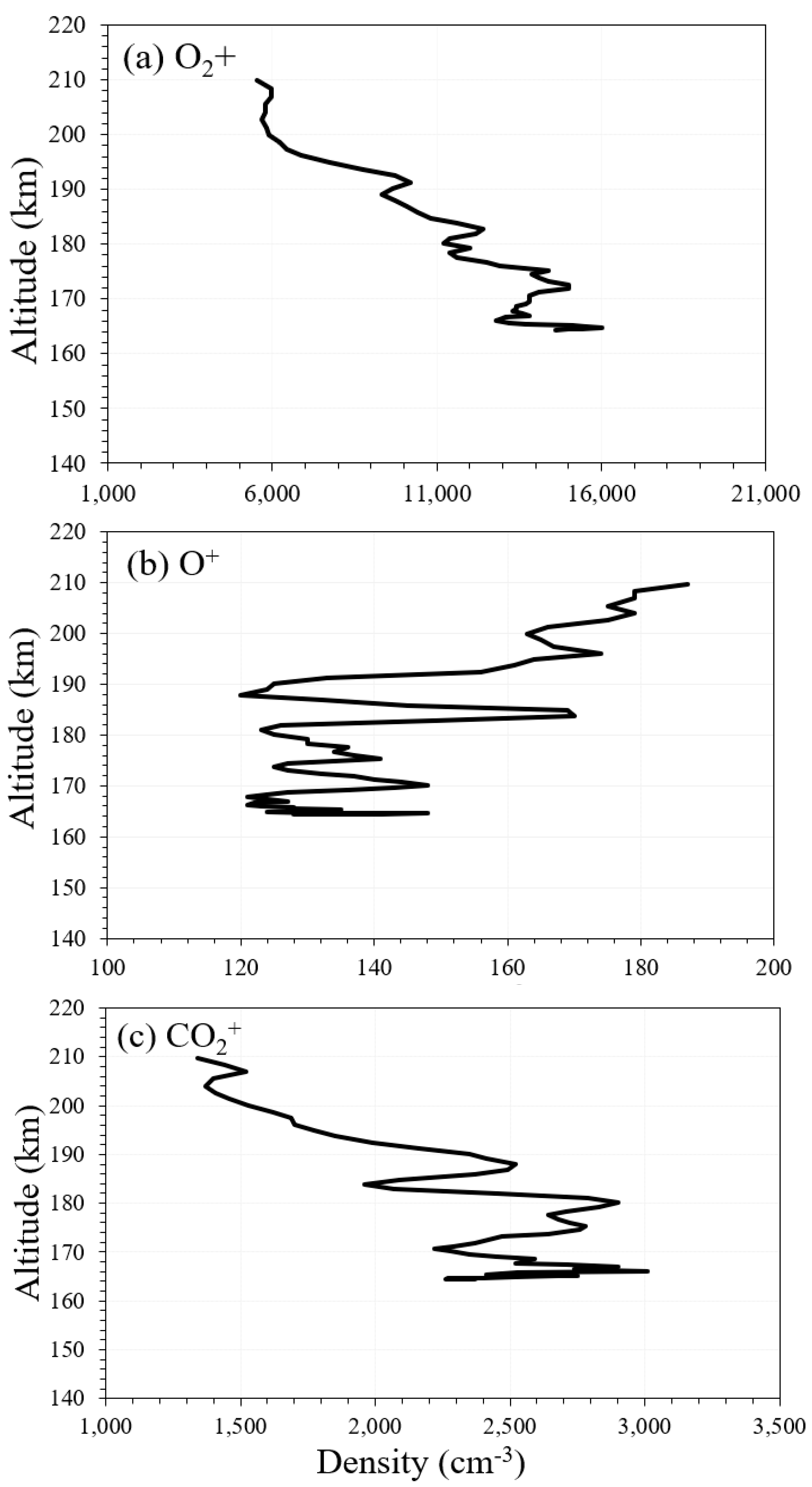
12] (
Figure 1a–c), which are key tracers of ionospheric chemistry and transport. Complementary measurements of ion energy and velocity are also provided by the SupraThermal And Thermal Ion Composition (STATIC) instrument [
13], although the present study focuses on NGIMS-derived ion densities.
O
2+ is the dominant molecular ion in the Martian ionosphere at lower altitudes and is primarily produced through photoionization of CO
2 followed by ion–neutral chemistry, making it a sensitive tracer of local ionospheric production and loss processes [
12,
14]. Variations in O
2+ density with altitude reflect changes in recombination rates and ion confinement, which can be strongly influenced by crustal magnetic fields that inhibit vertical transport [
8].
O
+, a lighter atomic ion, becomes more prominent at higher altitudes as a result of the combined effects of dissociation, transport, and ion escape processes, and its extended vertical structure makes it particularly sensitive to magnetic topology and plasma transport along field lines [
7,
15]. Enhanced O
+ densities are often observed in regions of strong crustal magnetism, where magnetic cusps and open field lines facilitate upward ion flow and escape [
8,
16,
17]. The relatively low O
+ densities observed in
Figure 1b are consistent with typical MAVEN NGIMS observations at these altitudes, where molecular ions dominate and O
+ becomes more significant only at higher altitudes.
CO
2+, as a primary ionization product of the neutral atmosphere, closely follows solar extreme ultraviolet (EUV) radiation and serves as a baseline indicator of ion production [
18]. Deviations in CO
2+ density profiles from expected photochemical equilibrium can indicate magnetic shielding, altered ion–neutral chemistry, or localized plasma heating associated with crustal magnetic anomalies [
19].
Together, O
2+, O
+, and CO
2+ provide complementary diagnostics of ionospheric chemistry, transport, and magnetic field control, making them effective indicators of crustal field strength and magnetic topology in the Martian upper atmosphere [
5,
7].
Dust storms are a recurring feature of the Martian climate, ranging from frequent local and regional events to rare planet-encircling storms that typically occur only once every several Mars years [
20,
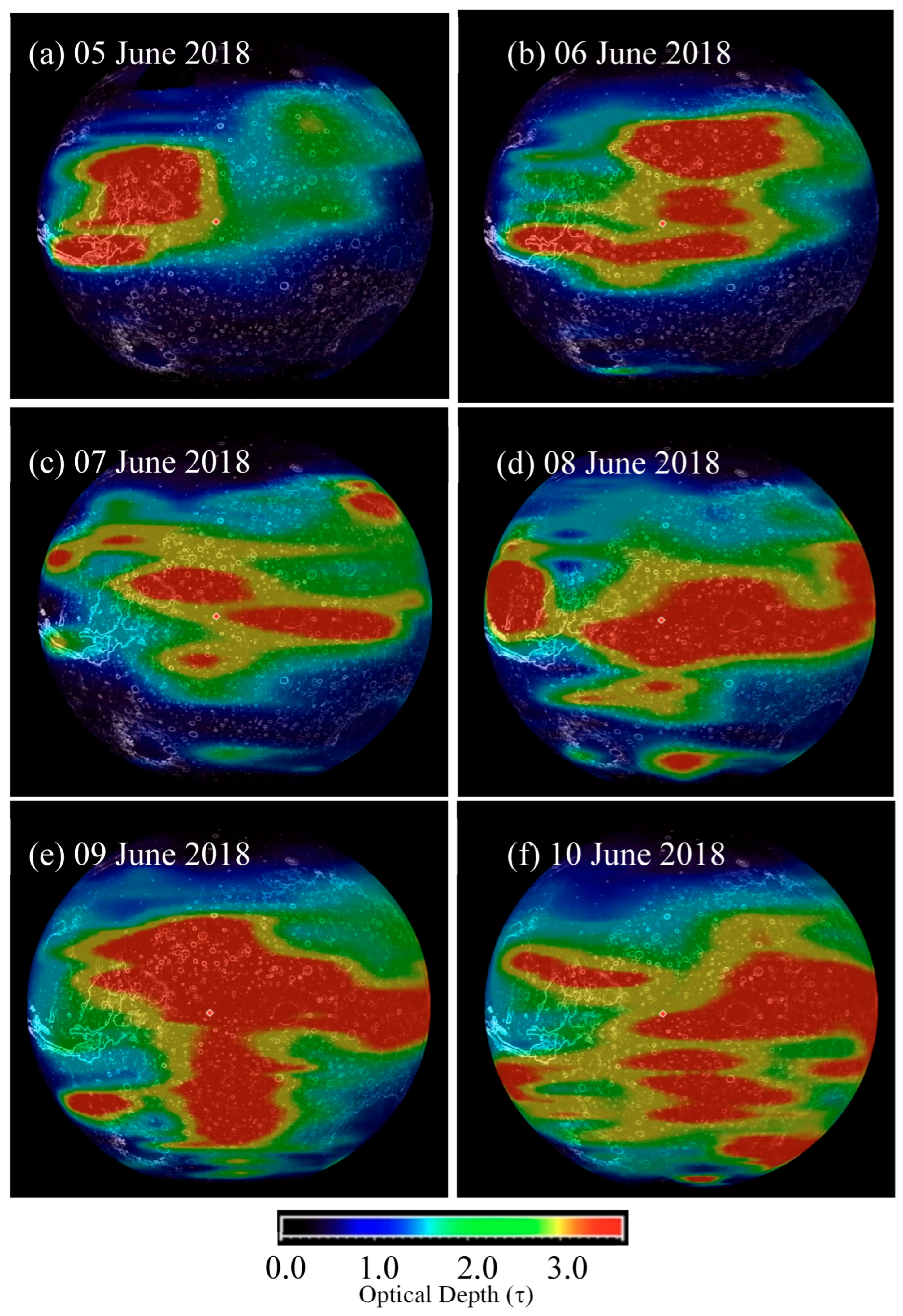
21]. The 2018 Mars dust storm (
Figure 2) began as regional activity and was first detected on 31 May 2018 in daily MARCI global maps [
21]. It then intensified and expanded into a planet-encircling (global) dust event over the following days to weeks. Analyses of the event’s evolution and atmospheric response, including changes in dust opacity and thermal structure, show that it developed into a rapid, system-wide disturbance rather than a localized storm [
22]. Because the 2018 dust event evolved from regional to global coverage, it can provide a natural experiment for testing how ionospheric structures respond under strongly dust-loaded conditions [
23]. It also provides a tool with which to investigate how the Martian crustal magnetic field interacts with ionic species under disturbed conditions.
During the 2018 global dust storm, enhanced dust loading led to substantial heating and expansion of the Martian atmosphere [
22], driving upward transport of neutral species into the upper atmosphere [
25]. This thermospheric expansion, driven by increased heating and associated increases in scale height, altered ion production and loss processes by redistributing neutral species to higher altitudes, resulting in enhanced and more variable densities of major ion species, including O
2+, O
+, and CO
2+ [
26]. Under these disturbed conditions, the ionospheric structure exhibited stronger dependence on magnetic topology, with differences between magnetic field environments becoming more pronounced than during quiet periods. Under these disturbed conditions, the ionospheric structure became more sensitive to magnetic topology than during quiet periods. Crustal magnetic fields modulated the storm-driven ion response by either confining ions in strong-field regions or permitting enhanced transport and variability in weak-field regions [
8].
As a result, thermospheric expansion and the associated increase in scale height during the dust storm enhanced the contrast in ion density distributions between different magnetic field regimes relative to typical quiet-time conditions. Consequently, regions that appear undetermined under nominal conditions exhibited ion characteristics consistent with strong or weak magnetic field behavior during the storm. These observations demonstrate that dust-storm-induced ionospheric enhancement exposes magnetic connectivity that is otherwise difficult to detect. Magnetic connectivity refers to the linkage of ionospheric regions through crustal magnetic field topology, whereby plasma behavior at a given location is influenced by its magnetic connection to strong crustal field regions rather than by its geographic position alone. Ion composition can thus serve as an effective diagnostic of crustal magnetic field influence under extreme atmospheric forcing.
A central thesis of this study is that ion composition can be used as a diagnostic of crustal magnetic field influence in the Martian ionosphere, particularly under disturbed atmospheric conditions. We hypothesize that during periods of enhanced atmospheric forcing, such as the 2018 global dust storm, magnetic control of the ionospheric structure becomes more pronounced and spatially extensive. Specifically, we propose that storm-driven increases in ion production and transport amplify differences between strong and weak magnetic field environments. Under this hypothesis, ion signatures reflect the underlying magnetic topology and field line connectivity, which are not strictly confined to geographic boundaries defined by static masks. Observations that fall outside the predefined latitude–longitude masks used to represent strong and weak crustal magnetic field regions are classified as “geographically undetermined,” meaning their magnetic environment is not defined by geographic location alone. The presence of strong-like ion behavior in geographically undetermined regions provides direct support for this hypothesis. The presence of strong-like ion behavior in geographically undetermined regions suggests that the influence of crustal magnetic topology may extend beyond the predefined geographic masks used to represent strong crustal field regions. It is important to mention that ion composition is used not as a proxy for magnetic field strength itself, but as a diagnostic of how crustal magnetic fields influence plasma transport, confinement, and ionospheric structure under realistic atmospheric conditions. The results further imply that quiet-time conditions may obscure magnetic effects that become detectable only when the ionosphere is strongly perturbed. By testing ion-based classifications against spatial proximity to magnetic regions, this work investigates how ion composition varies across strong, weak, and geographically undetermined crustal magnetic field regions during the 2018 dust storm. By constraining solar zenith angle and altitude, and by comparing ion signatures across these regimes, we assess whether ion composition can serve as a tracer of magnetic connectivity beyond static geographic definitions.
2. Methodology
We use in situ measurements from the NGIMS/MAVEN mission [
11] and magnetic field information from the Magnetometer (MAG/MAVEN) [
3]. The analysis period spans from 04 June to 17 June 2018, encompassing the development and peak of the June 2018 global dust storm. Ion densities of O
2+, O
+, and CO
2+ are examined as primary tracers of ionospheric chemistry and transport.
In this work, the analysis focuses on the variability of the major ion species O2+, O+, and CO2+ as indicators of ionospheric behavior under different magnetic field environments. The objective is not to derive a complete compositional model of the Martian ionosphere, but rather to examine how variations in these dominant ions reflect differences in ion production, transport, and magnetic topology.
To minimize variability driven by solar illumination and altitude, the data are restricted to altitudes between 160 and 210 km and solar zenith angles between 61° and 65°. Longitudes are expressed in a 0–360° eastward system for consistency with MAVEN and magnetic field conventions.
To compare observations in “strong” versus “weak” crustal field environments, regions were defined using geographic masks representing areas of known strong crustal magnetic anomalies and weak-field regions identified from global crustal field models [
3,
5]. Rather than applying a fixed magnetic field magnitude threshold at a specific altitude, this approach was adopted because crustal field strength at ionospheric altitudes varies significantly with altitude, latitude, and magnetic topology, and a single |B| threshold does not reliably distinguish between different magnetic configurations (e.g., closed, open, or cusp-like field lines) that control ionospheric transport. A single magnetic field magnitude cutoff does not reliably distinguish between different magnetic configurations (e.g., closed, open, or cusp-like field lines) that control ionospheric transport. While magnetic topology can, in principle, be characterized using field orientation (e.g., field angle from MAG measurements), this study does not explicitly resolve field line geometry. Instead, topology is inferred statistically through geographic masks informed by crustal magnetic field models. Observations that do not fall within these predefined masks are classified as geographically undetermined.
Statistical distributions of ion densities are constructed separately for strong, weak, and undetermined regions. Median values and interquartile ranges are used to characterize differences between regimes and to reduce sensitivity to outliers. Undetermined observations are further classified as strong-like or weak-like based on their relative proximity in a multidimensional ion density space, defined by the measured densities of O2+, O+, and CO2+, to the median values of the strong and weak populations.
To assess spatial consistency, great-circle distances are computed between each undetermined observation and the nearest strong and weak crustal magnetic field regions, as defined by the geographic masks described in
Section 2. These regions correspond to areas of well-known strong crustal magnetic anomalies and weak-field regions, as illustrated in
Section 3. Observations that fall outside these predefined masks are classified as geographically undetermined. In addition, each observation is independently classified as strong-like or weak-like based on its proximity in ion density space (defined by O
2+, O
+, and CO
2+ densities) to the median values of the strong and weak populations. The distance-based comparison is then used to evaluate whether the ion-based classification is consistent with the nearest magnetic field environment. All results are examined in the context of storm-time atmospheric perturbations to assess the extent to which crustal magnetic fields modulate the ionospheric structure under disturbed conditions.
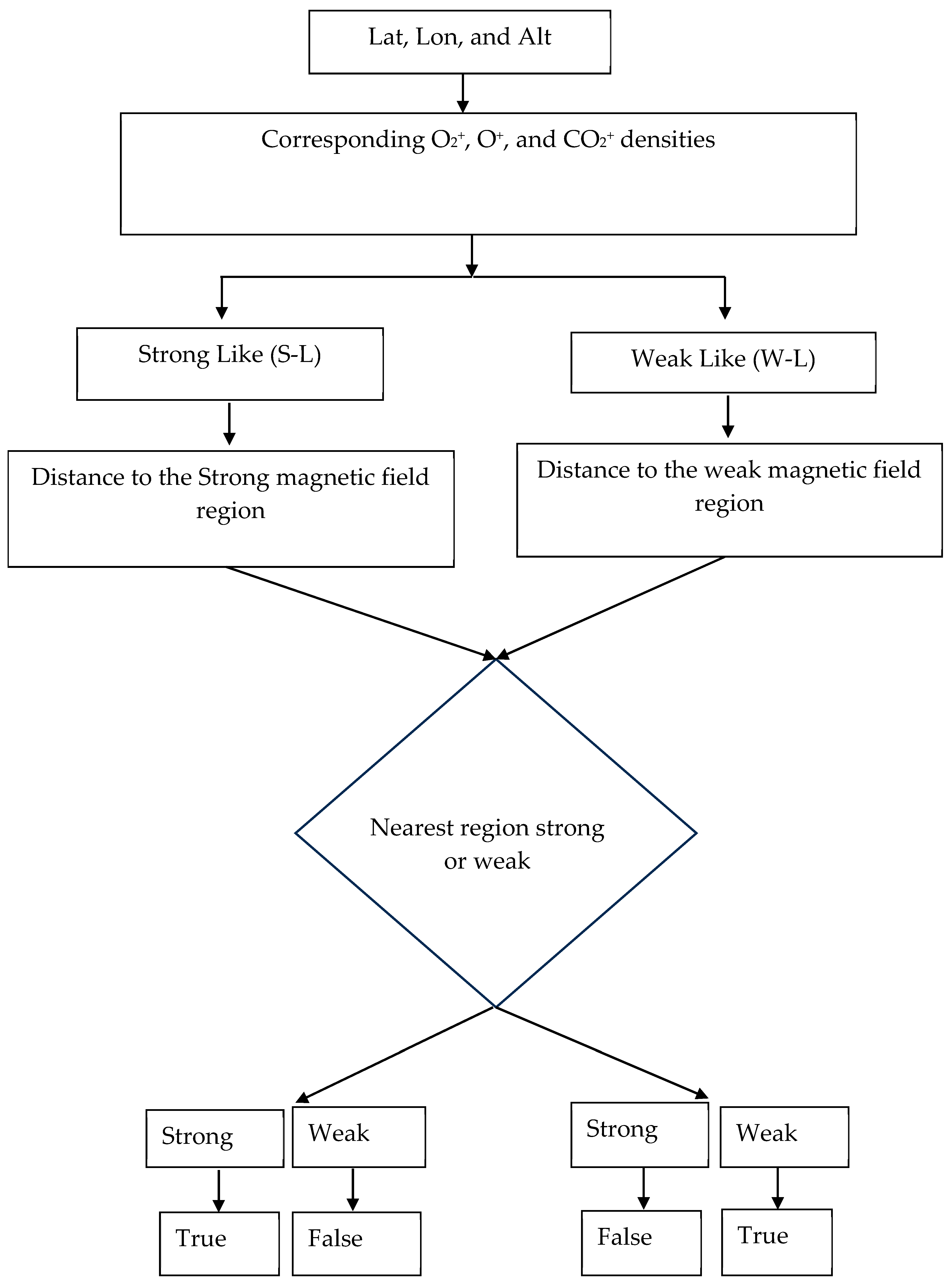
Figure 3 presents a schematic chart of the analysis workflow used to evaluate the relationship between ionospheric observations and crustal magnetic field environments. The diagram begins with individual NGIMS measurements, for which the spacecraft location (latitude, longitude, and altitude) and the corresponding ion densities of O
2+, O
+, and CO
2+ are obtained. These ion measurements form the primary input to the classification procedure. In the next step, ion density characteristics are compared against reference distributions derived from regions of known strong and weak crustal magnetic fields, where reference distributions are defined by the statistical distributions (median values and interquartile ranges) of O
2+, O
+, and CO
2+ densities measured in regions of known strong and weak crustal magnetic fields. Based on this comparison, each observation is provisionally categorized as strong-like (S-L), weak-like (W-L), or ambiguous (A) according to its ion composition.
The chart then illustrates how geographic context is incorporated into the analysis. For each observation point, the great-circle distance to the nearest predefined strong crustal magnetic field region and the nearest weak magnetic field region is calculated. These distances are used to determine the magnetic field environment that is geographically closest to the observation. The nearest magnetic field region is identified by comparing the two distances, yielding a spatial classification of either strong or weak.
In the final stage of the flow chart, the ion-based classification is evaluated against the geographically nearest magnetic field region. When the ion-based classification agrees with the nearest magnetic environment, the result is labelled as a true consistency. When the two classifications disagree, the result is labelled as a false consistency. This final comparison provides a quantitative measure of how well the ion composition reflects the underlying magnetic field structure. Together, the steps shown in
Figure 3 demonstrate how ionospheric observations, spatial proximity, and magnetic field context are systematically combined to assess magnetic connectivity beyond simple geographic masks.
Within the altitude range examined (160–210 km), the ionosphere–thermosphere coupling varies with altitude, and vertical gradients in neutral density and ion composition can influence ion densities. To reduce the impact of these variations, the analysis is restricted to a relatively narrow altitude interval and applied consistently across all magnetic field regions. The results are therefore based on statistical distributions aggregated over this range, allowing the comparison of relative differences between magnetic environments rather than detailed altitude-dependent structure.
3. Results
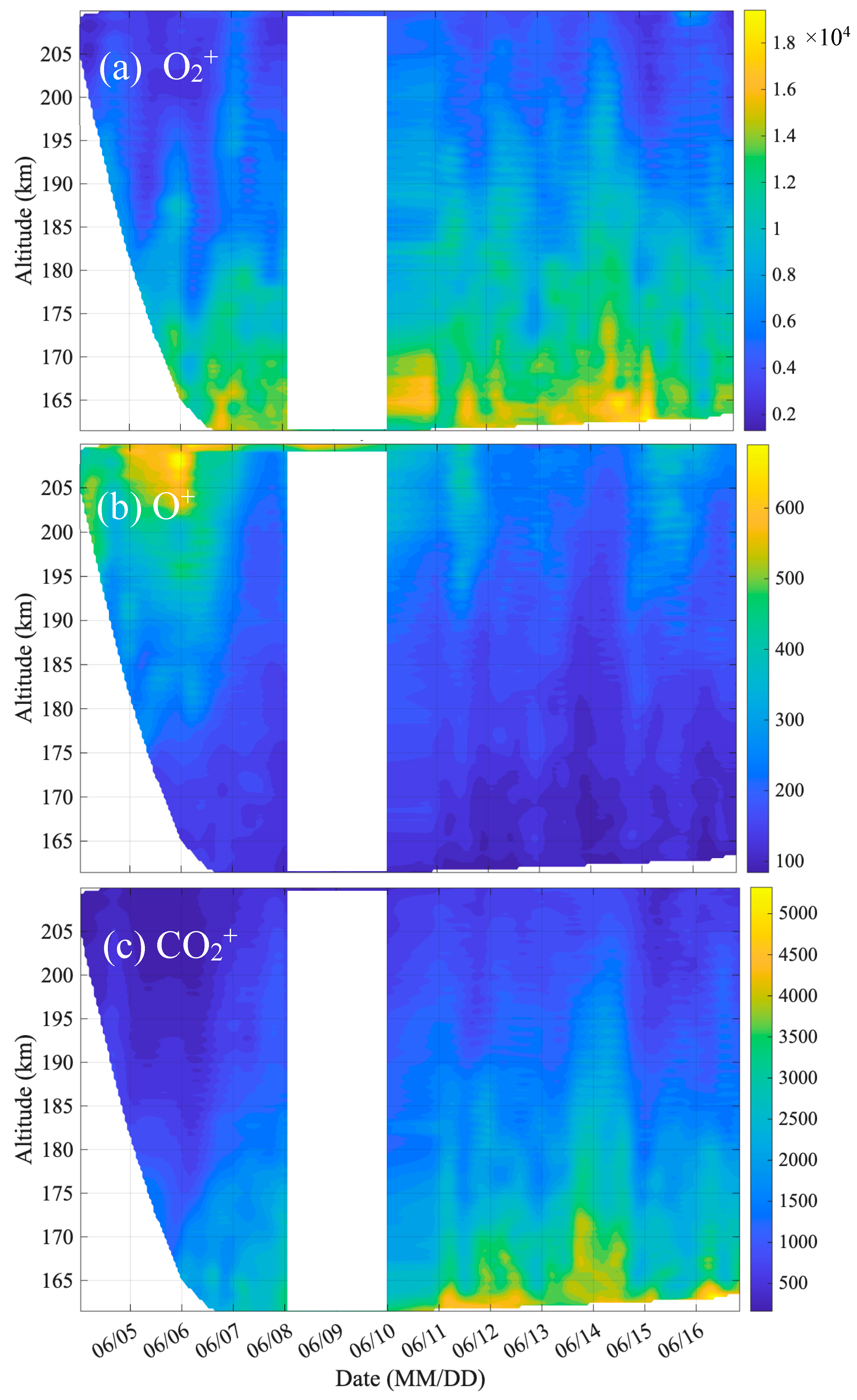
The O
2+ density (
Figure 4a) exhibits a clear altitude dependence throughout the interval, with the highest densities consistently observed at lower altitudes (~165–175 km) and decreasing with increasing altitude. From 5 to 7 June, enhanced O
2+ densities are evident, followed by a brief data gap around 8–10 June. After 10 June, O
2+ densities increase again and remain elevated through 16 June, particularly at lower altitudes. Temporal variability is pronounced, with localized enhancements suggesting changes in ion production and transport during the dust storm period. Overall, O
2+ dominates the ion population and shows the strongest response to storm-time atmospheric conditions.
In contrast, O
+ densities (
Figure 4b) are generally lower than O
2+ but display distinct altitude and temporal structure. Elevated O
+ densities are observed at higher altitudes (~190–210 km), particularly early in the interval, around 5–6 June. After this period, O
+ densities decrease and show reduced variability compared to O
2+, especially at lower altitudes. Sporadic enhancements occur at higher altitudes after 10 June, indicating possible changes in photochemical balance and ion transport. The vertical distribution of O
+ reflects its sensitivity to both photochemical production and magnetic-field-controlled transport processes.
CO
2+ densities (
Figure 4c) show intermediate behaviour between O
2+ and O
+, with higher values concentrated at lower altitudes and decreasing with height. Enhanced CO
2+ densities are evident after 10 June, coincident with the recovery of data coverage and increased atmospheric disturbance. Temporal variability is pronounced, particularly below ~175 km, suggesting strong coupling to neutral CO
2 density and ionization rates during the dust storm. Compared to O
2+, CO
2+ exhibits greater relative variability, consistent with its dependence on rapidly changing neutral conditions. These observations indicate that CO
2+ responds strongly to storm-driven atmospheric dynamics while remaining modulated by altitude-dependent chemistry.
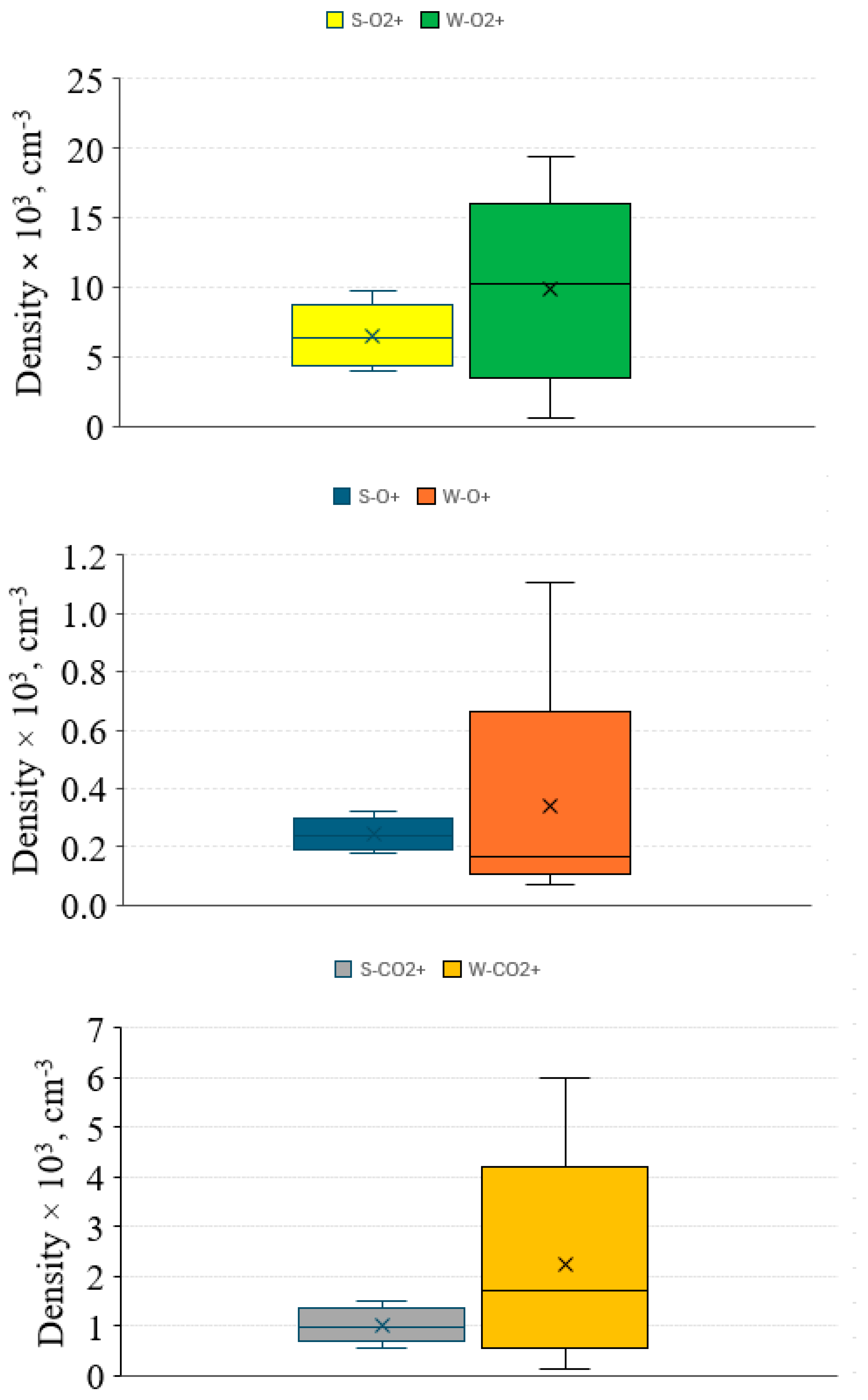
Figure 5 shows a clear dependence of ion densities on crustal magnetic field strength at solar zenith angles of 61–65°. O
2+ densities are systematically higher in weak-magnetic-field regions (W) than in strong-field regions (S), with the weak population exhibiting both higher median values and greater variability. In contrast, O
+ densities show reduced median values in weak regions but substantially increased spread, indicating enhanced variability consistent with less constrained plasma transport in these regions. CO
2+ densities are also elevated and far more variable in weak regions, indicating increased ion production and vertical mixing under reduced magnetic confinement. Strong-field regions consistently exhibit narrower interquartile ranges across all three species, consistent with magnetic trapping and reduced plasma variability. Together, these results demonstrate that crustal magnetic fields regulate both the magnitude and variability of Martian ion composition. The consistent behaviour across multiple ion species supports a magnetic-topology-controlled ionospheric response rather than a purely neutral or illumination-driven effect.
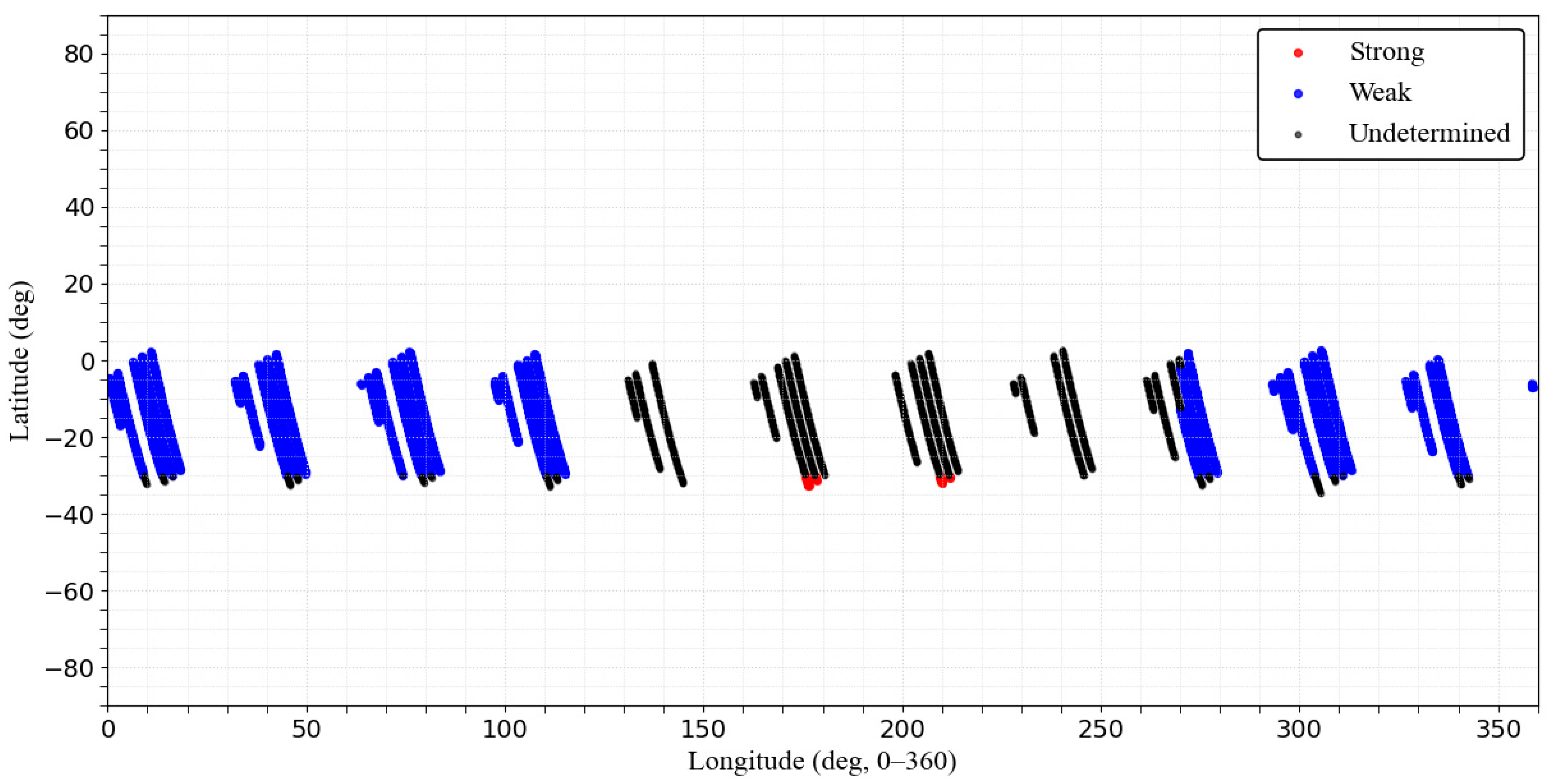
Figure 6 presents the global distribution of observations classified as strong-like, weak-like, and undetermined based on their position in ion density space defined by O
2+, O
+, and CO
2+ densities. These classifications are derived from the statistical distributions shown in
Figure 5. The spatial distribution of observations classified as “strong-like” based on ion composition is independent of their predefined geographic magnetic field classification. The strong-field points cluster predominantly in the southern hemisphere between approximately −30° and −33° latitude, consistent with the location of major Martian crustal magnetic anomalies. Longitudinally, these points are concentrated within two narrow bands centre near 175–180° E and 210–215° E, indicating localized regions of enhanced magnetic influence. The limited latitudinal spread suggests a strong geographic confinement of ionospheric signatures associated with intense crustal magnetism. This clustering supports the interpretation that ion densities such as O
2+, O
+, and CO
2+ are sensitive tracers of underlying magnetic topology. The absence of widespread strong-like points outside these bands is consistent with the known spatial confinement of crustal magnetic anomalies and demonstrates that composition-based classification accurately reflects this underlying magnetic structure. Overall, the observed clustering of strong-like observations corresponds closely to the locations of intense crustal magnetic anomalies in the Martian southern highlands, as shown in global crustal field maps [
5], providing independent validation of the ion-based classification. In
Figure 6 the red dots indicate locations where O
2+, O
+, and CO
2+ densities exhibit strong-field-like behaviour. Points are shown in Mars-fixed coordinates with longitude expressed in the 0–360° eastward system. The clustering of points in the southern hemisphere reflects the spatial confinement of intense crustal magnetic anomalies and demonstrates the ability of ion composition to trace underlying magnetic topology.
Strong-field points (red) are confined to localized regions in the southern hemisphere, consistent with the spatial extent of intense crustal magnetic anomalies. Weak-field points (blue) are broadly distributed across low and mid-latitudes, reflecting regions of minimal crustal magnetic influence. Undetermined points (black) occupy intermediate geographic locations, often surrounding or bridging strong and weak regions. The longitudinal banding reflects MAVEN orbital sampling and repeated periapsis passes. Notably, many undetermined points lie adjacent to strong-field clusters, suggesting magnetic connectivity beyond strict geographic masks. This distribution demonstrates that ion composition can be used to identify magnetic connectivity beyond predefined geographic masks, highlighting the limitations of purely location-based classifications.
The ion density boxplots demonstrate clear and systematic differences between strong- and weak-magnetic-field regions, with weak regions exhibiting higher median densities and greater variability across O
2+, O
+, and CO
2+. The observed differences between strong- and weak-magnetic-field regions reflect systematic shifts in the underlying ion density distributions, as indicated by consistent changes in medians and interquartile ranges across multiple ion species, and are not attributable to differences in sample size. The spatial distributions shown in
Figure 6 provide the geographic context for these statistical results. Strong-field observations cluster in discrete southern highland regions, consistent with known crustal magnetic anomalies, and exhibit reduced variability in the boxplots. This reduced spread reflects differences in the underlying distributions rather than simply the number of samples, as similar behavior is observed across multiple ion species. In contrast, weak-field observations are broadly distributed, reflecting broader spatial variability consistent with reduced magnetic confinement in weak-magnetic-field regions. Undetermined points occupy intermediate geographic locations and often lie adjacent to strong-field clusters. Their ion density distributions closely resemble those of strong-field regions, linking their boxplot behaviour to magnetic connectivity rather than strict geographic classification. Together, the statistical and spatial analyses show that ion composition provides a robust tracer of crustal magnetic field influence at Mars. It should be noted that the number of observations classified as strong-like is smaller than those classified as weak due to the limited spatial extent of strong crustal magnetic anomalies and orbital sampling. However, the reduced variability observed in strong-field regions is not an artifact of sample size but reflects more constrained ionospheric behavior.
Table A1 lists representative observations obtained within regions of strong crustal magnetic fields on Mars, identified based on the measured ion densities of O
2+, O
+, and CO
2+. The table reports the geographic location (latitude and longitude), spacecraft altitude, and corresponding densities of O
2+, O
+, and CO
2+ measured by MAVEN NGIMS. All observations are confined to southern hemisphere latitudes where intense crustal magnetic anomalies are known to occur. Ion densities show relatively stable values across a narrow altitude range of ~194–209 km, consistent with magnetic confinement effects. O
2+ dominates the ion population at these locations, while O
+ and CO
2+ exhibit reduced variability compared to weak-field regions. The consistent classification of all entries as strong (S) highlights the coherence between ion composition and underlying magnetic topology.
Table A1 (
Appendix A) provides a quantitative context for the strong-field ion distributions discussed in
Figure 6.
Table A2 presents a representative sample of ion density measurements obtained within regions of weak crustal magnetic fields on Mars. The table includes geographic location (latitude and longitude), spacecraft altitude, and corresponding densities of O
2+, O
+, and CO
2+ measured by MAVEN NGIMS. Unlike
Table A1, this table does not list all weak-field observations but instead provides a subset illustrating the characteristic ion behaviour in these regions. The sampled observations span a comparable altitude range to the strong-field cases, enabling direct comparison between magnetic regimes. Ion densities in weak regions generally exhibit higher variability and, in some cases, elevated O
2+ and CO
2+ values relative to strong-field locations. The broader spread in ion densities reflects reduced magnetic confinement and enhanced plasma transport along open field lines. This sample underscores the contrasting ionospheric conditions associated with weak crustal magnetic fields and complements the full statistical analysis presented in
Figure 5.
Table A3 presents a comprehensive list of observations classified as geographically undetermined, defined as observations that fall outside the predefined geographic masks representing strong- and weak-crustal-magnetic-field regions. For each location, the table reports latitude, longitude, altitude, and the corresponding ion densities of O
2+, O
+, and CO
2+ measured by MAVEN NGIMS. Based on the ion density distributions established for strong- and weak-magnetic-field regions (
Table A1 and
Table A2), each undetermined observation is classified as strong-like (S-L), weak-like (W-L), or ambiguous (A). To assess the spatial consistency of this ion-based classification, the great-circle distance from each observation to the nearest predefined strong-magnetic-field (SMF) region and to the nearest predefined weak-magnetic-field (WMF) region, as defined by the geographic masks described in
Section 2, is calculated and not derived from the colored distributions shown in
Figure 6. These distances are reported in kilometres and used to identify the nearest magnetic regime for each point. The table further lists the distance to this nearest region and indicates whether the spatial proximity is consistent with the ion-based classification. A consistency flag (T or F) is assigned to denote agreement or disagreement between compositional and geographic classifications. Many strong-like undetermined observations are found closer to strong-magnetic-field regions, supporting the interpretation that ion composition traces magnetic connectivity. Conversely, some points classified as strong-like or weak-like are geographically closer to the opposite regime, highlighting the limitations of fixed geographic masks. Ambiguous cases typically occur where distances to strong and weak regions are comparable. Overall,
Table A2 demonstrates that ion composition provides an independent diagnostic of magnetic field influence that extends beyond static geographic definitions.
4. Discussion
Figure 1 illustrates representative vertical profiles of O
2+, O
+, and CO
2+ densities, highlighting the altitude-dependent structure of the Martian ionosphere under disturbed conditions and providing context for the subsequent statistical and spatial analyses.
Figure 2 places the ionospheric observations in the broader context of the evolving atmospheric disturbance during the 2018 global dust storm and demonstrates the rapid increase and global expansion of aerosol optical depth between 05 and 10 June, indicating strong atmospheric heating and enhanced vertical transport during this period. These conditions provide the background against which the altitude profiles of O
2+, O
+, and CO
2+ shown in
Figure 1, measured during MAVEN orbit #7726 on 16 June during the 2018 dust storm, should be interpreted. The ion altitude distributions reflect an ionosphere influenced by a dynamically expanding neutral atmosphere, where transport processes become significant relative to photochemical timescales and modify the expected equilibrium structure. Enhanced dust loading increases the supply of neutrals to ionospheric altitudes, thereby modifying ion production, recombination, and transport processes. Importantly, the timing of the dust storm evolution coincides with the period analyzed in
Figure 1, suggesting that the observed ion structure is influenced by storm-driven atmospheric dynamics.
Figure 1 represents ionospheric conditions during the dust storm, which are expected to differ from the typical background structure. The combination of
Figure 1 and
Figure 2 supports the interpretation that the 2018 dust storm acted as a large-scale driver of ionospheric variability. This storm-time enhancement provides a unique opportunity to examine how crustal magnetic fields modulate the ionospheric structure under extreme forcing, motivating the subsequent magnetic-field-based analysis.
The methodology summarized in
Figure 3 is critical because it provides a systematic framework for linking ionospheric observations to crustal magnetic field environments beyond simple geographic classification. By independently evaluating ion-based signatures and spatial proximity to magnetic regions, the approach allows magnetic connectivity to be assessed in a quantitative and testable manner. This dual-classification strategy reduces the ambiguity inherent in fixed geographic masks and reveals magnetic influence that would otherwise remain hidden. As a result, the flow-chart-based method strengthens the physical interpretation of the observed ionospheric variability under disturbed conditions shown in
Figure 4.
Figure 5 provides further insight into how crustal magnetic fields modulate the Martian ionosphere under storm-time conditions by placing the statistical results in a broader physical context. Rather than simply reflecting differences in mean ion densities, the distributions shown in this figure illustrate how magnetic topology influences ionospheric variability and stability. The reduced statistical variability observed in the ion density distributions of strong-field regions, as indicated by narrower interquartile ranges in
Figure 5, is consistent with more constrained ionospheric behavior under the same thermospheric forcing conditions. In contrast, the broader distributions in weak-field regions are consistent with more open magnetic configurations that allow enhanced vertical transport and interaction with the surrounding plasma environment. The behaviour highlighted in
Figure 5 indicates that magnetic effects are not limited to modifying absolute ion densities but also regulate the dynamical response of the ionosphere to external perturbations. Under dust storm conditions, increased neutral densities and elevated ion production amplify these differences, making magnetic control more apparent than during quiescent periods. This figure therefore supports the interpretation that crustal magnetic fields act as a stabilizing influence on the ionosphere during extreme atmospheric events. Importantly, the results shown in
Figure 5 reinforce the conclusion that ion composition variability is a key diagnostic of magnetic influence. The observed contrasts imply that magnetic topology governs not only where ions are produced, but how they are retained or transported once formed. These findings are consistent with the interpretation that storm-time conditions enhance the observable influence of crustal magnetic topology within a coupled thermosphere–ionosphere system. It is also important to mention that we explicitly acknowledge uncertainties in the manuscript and clarify that the conclusions are based on statistical differences between populations rather than on individual measurements.
Figure 5 and
Figure 6 collectively illustrate how ionospheric structure and magnetic topology are coupled under storm-time conditions.
Figure 6 shows that ion-composition-based classifications exhibit coherent spatial patterns, indicating that ion signatures are not governed solely by local atmospheric variability. Instead, these patterns suggest that crustal magnetic fields organize ionospheric behaviour over regional scales. The clustering evident in
Figure 6 supports the interpretation that ion composition acts as a tracer of magnetic connectivity rather than merely reflecting geographic location.
Figure 6 extends this interpretation by demonstrating that observations classified as strong-like but geographically undetermined are often spatially adjacent to known strong crustal magnetic anomalies. This proximity implies that magnetic influence can extend beyond static geographic boundaries traditionally used to define strong-field regions. The results suggest that magnetic connectivity, rather than fixed latitude–longitude masks, plays a key role in shaping ionospheric response during disturbed periods. Such behaviour is consistent with complex field line geometries that allow magnetic influence to propagate laterally. The limited number of observations (twenty-eight points from four MAVEN orbits) reflects the restricted spatial sampling of periapsis passes during the selected interval. While the clustering is consistent with the known locations of strong crustal magnetic anomalies, it is also influenced by orbital sampling and should therefore be interpreted in that context.
Figure 6 further highlights the contrasting spatial coherence of strong- and weak-magnetic-field regimes. The separation between these regimes indicates that crustal magnetic fields impose a large-scale organizational structure on the ionosphere when atmospheric forcing is enhanced. Together, these figures demonstrate that dust storm conditions amplify magnetic control, revealing connections that are less apparent during quiescent periods. This reinforces the conclusion that ion composition provides a useful indicator of magnetic-field-related variability under extreme atmospheric forcing conditions.
A robust diagnostic of magnetic field influence under extreme atmospheric forcing.
Table A1,
Table A2 and
Table A3 provide complementary perspectives on how ion composition reflects crustal magnetic field influence under disturbed atmospheric conditions.
Table A1 characterizes the ionospheric environment within regions of strong crustal magnetism, highlighting relatively stable ion densities and reduced variability consistent with magnetic confinement. This behaviour supports the interpretation that strong magnetic fields suppress vertical and horizontal ion transport, even during periods of enhanced atmospheric forcing. In contrast,
Table A2 illustrates the broader range of ion densities observed in weak-field regions, implying greater sensitivity to storm-driven transport and coupling to the surrounding plasma environment. The differences between
Table A1 and
Table A2 therefore underscore the role of magnetic topology in regulating ionospheric stability rather than simply controlling mean density levels.
Table A3 extends this analysis by examining observations that fall outside predefined strong and weak geographic masks. The classification of these undetermined observations based on ion composition reveals that many exhibit characteristics closely aligned with strong-field regions. Their proximity to known magnetic anomalies suggests that magnetic influence extends beyond simple geographic boundaries. The distance-based consistency analysis further demonstrates that ion-based classifications often correspond to the nearest magnetic environment, reinforcing the physical relevance of the method. At the same time, cases of inconsistency highlight the limitations of static classification schemes. Together,
Table A1,
Table A2 and
Table A3 demonstrate that ion composition provides an effective diagnostic of magnetic connectivity and emphasize the need to consider both spatial proximity and magnetic topology when interpreting Martian ionospheric observations.
In the altitude range examined here, the ionosphere is closely coupled to the thermosphere, and variations in neutral density and scale height, particularly during global dust storms, can influence ion production and loss processes. The June 2018 dust storm, for example, produced substantial thermospheric heating and expansion, leading to enhanced neutral densities and vertical atmospheric redistribution, which in turn affected ionospheric structure and variability [
27]. As a result, some portion of the observed variability may reflect storm-driven changes in the neutral background atmosphere. However, the analysis presented here compares observations across different magnetic field environments under the same temporal interval and solar illumination conditions, such that large-scale thermospheric perturbations act as a common background forcing. The differences reported in this study therefore represent relative variations associated with magnetic topology and ion transport processes, rather than a complete decoupling of ionospheric and thermospheric effects.
While this study examines the dominant ion species individually, it is important to note that ionospheric composition is governed by coupled chemical and transport processes that can vary in time and space. Localized enhancements, particularly in O+, may arise from variations in ion transport, neutral winds, or temporal evolution. The analysis presented here does not explicitly resolve these processes but instead focuses on systematic differences in the dominant ion populations across magnetic field environments. The consistency of these differences across multiple ion species suggests that they reflect underlying magnetic topology effects rather than isolated, species-specific variability.
The combined use of ion density statistics (median and interquartile range), great-circle distance metrics, and classification consistency analysis provides a quantitative framework for evaluating magnetic-field-related variability in the Martian ionosphere.
We also note that the same geometric altitude may correspond to different ionospheric regimes in strong and weak crustal magnetic field regions. For example, ion densities near 200 km may remain closer to photochemical equilibrium in weak-field regions while becoming increasingly influenced by transport processes in strongly magnetized regions. The present analysis therefore does not assume identical local plasma regimes across all magnetic environments but instead examines relative differences in ion density behavior within the same constrained altitude and solar illumination conditions.
5. Conclusions
In this study, we investigated the influence of Martian crustal magnetic fields on ionospheric ion composition during the May–June 2018 global dust storm using in situ MAVEN NGIMS observations. By restricting the analysis to narrow altitude and solar zenith angle ranges, we isolated magnetic field effects from variations driven by illumination and vertical structure. We found systematic differences in O2+, O+, and CO2+ densities between regions of strong and weak crustal magnetic fields, with strong-field regions exhibiting reduced variability consistent with magnetic confinement.
Weak-field regions show higher variability in ion densities, while strong-field regions exhibit more constrained distributions; this difference is reflected in the statistical properties of the populations rather than the number of samples. Importantly, observations classified as geographically undetermined, defined as those outside predefined strong- and weak-magnetic-field masks, exhibit ion density characteristics like those of strong-field regions.
The spatial clustering of these strong-like observations near known crustal magnetic anomalies suggests that ion composition reflects the combined behavior of the dominant ion species, reflecting magnetic-field-related variability beyond simple geographic classification.
These results suggest that static geographic masks may underestimate the spatial extent of crustal magnetic influence during disturbed conditions. The 2018 dust storm likely acted as an amplifier, enhancing ionospheric variability and making magnetic effects more apparent than under typical conditions. Our findings support the interpretation that ion composition can serve as a useful diagnostic of magnetic topology at Mars. More broadly, this study indicates that magnetic connectivity, in addition to geographic location, should be considered when interpreting ionospheric structure and dynamics.
It is important to note that ionospheric densities on Mars can be influenced by several factors in addition to crustal magnetic field strength, including solar wind conditions, magnetic field geometry, and neutral atmospheric winds. These processes may locally modify ion densities through variations in plasma transport and ion–neutral interactions. In this study, we focus on relative comparisons between strong- and weak-magnetic-field regions observed under the same temporal and illumination conditions, which help reduce the influence of large-scale external drivers. Because the analysis compares observations across different magnetic environments during the same time intervals, background variations associated with the solar wind or thermospheric dynamics are expected to affect all regions similarly. The consistent differences observed between magnetic regimes therefore suggest that crustal magnetic topology plays a significant role in modulating ionospheric variability, although additional processes such as neutral winds may contribute to local variations. Although solar wind and the Interplanetary Magnetic Field (IMF) conditions can significantly influence the Martian ionosphere, the analysis presented here compares observations across different magnetic field environments within the same temporal intervals, such that solar wind variability acts as a common background driver and does not bias the relative differences observed between strong- and weak-crustal-magnetic-field regions.
It is also important to point out that crustal magnetic fields on Mars vary significantly over spatial scales smaller than the horizontal distance covered by MAVEN near periapsis, and that magnetic topology may change substantially along the spacecraft trajectory. The present study therefore does not attempt to resolve local magnetic field geometry or field line topology at individual observation points. Instead, the analysis uses regional magnetic classifications informed by crustal field models to investigate statistical differences between broad magnetic environments. The conclusions should therefore be interpreted as population-level trends associated with magnetic-field-related variability rather than precise topology reconstruction.
Future studies combining ion composition, magnetic field topology, and neutral atmosphere measurements across both storm-time and quiet conditions will further improve understanding of magnetic control in the Martian upper atmosphere.