TD-DFT Investigation of Sulfur and Chlorine Species as Potential Contributors to Venusian Unknown UV Absorber
Abstract
1. Introduction
2. Computational Methods
2.1. Computational Method Validation and Isomer Selection
2.2. Vibronic Broadening and Reflection Principle Modeling
3. Results and Discussion
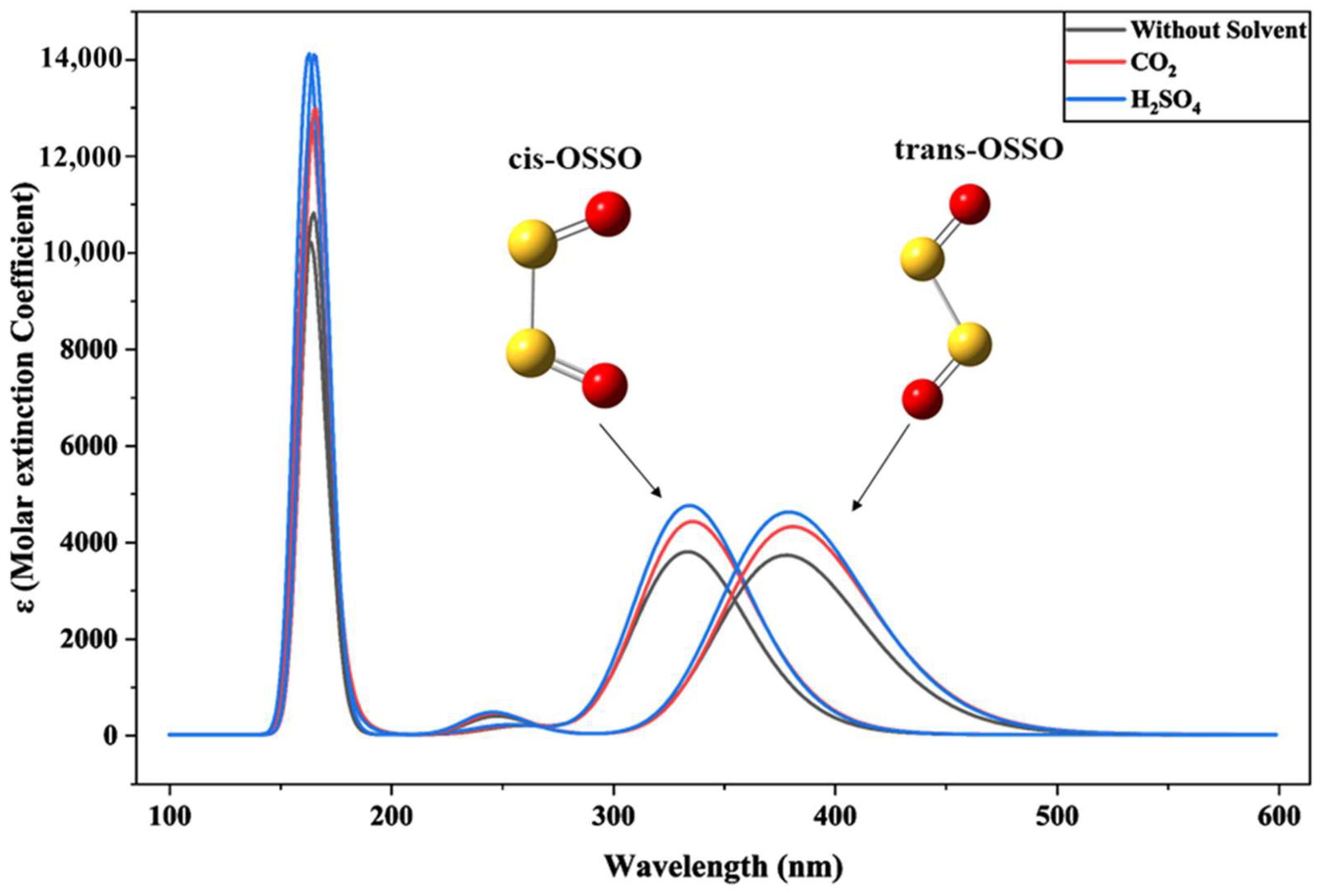
3.1. UV-Vis Spectral Characteristics of c-OSSO and t-OSSO
3.1.1. In Gas Phase (Without Solvent)
3.1.2. In CO2 Solvent
3.1.3. In H2SO4 Solvent
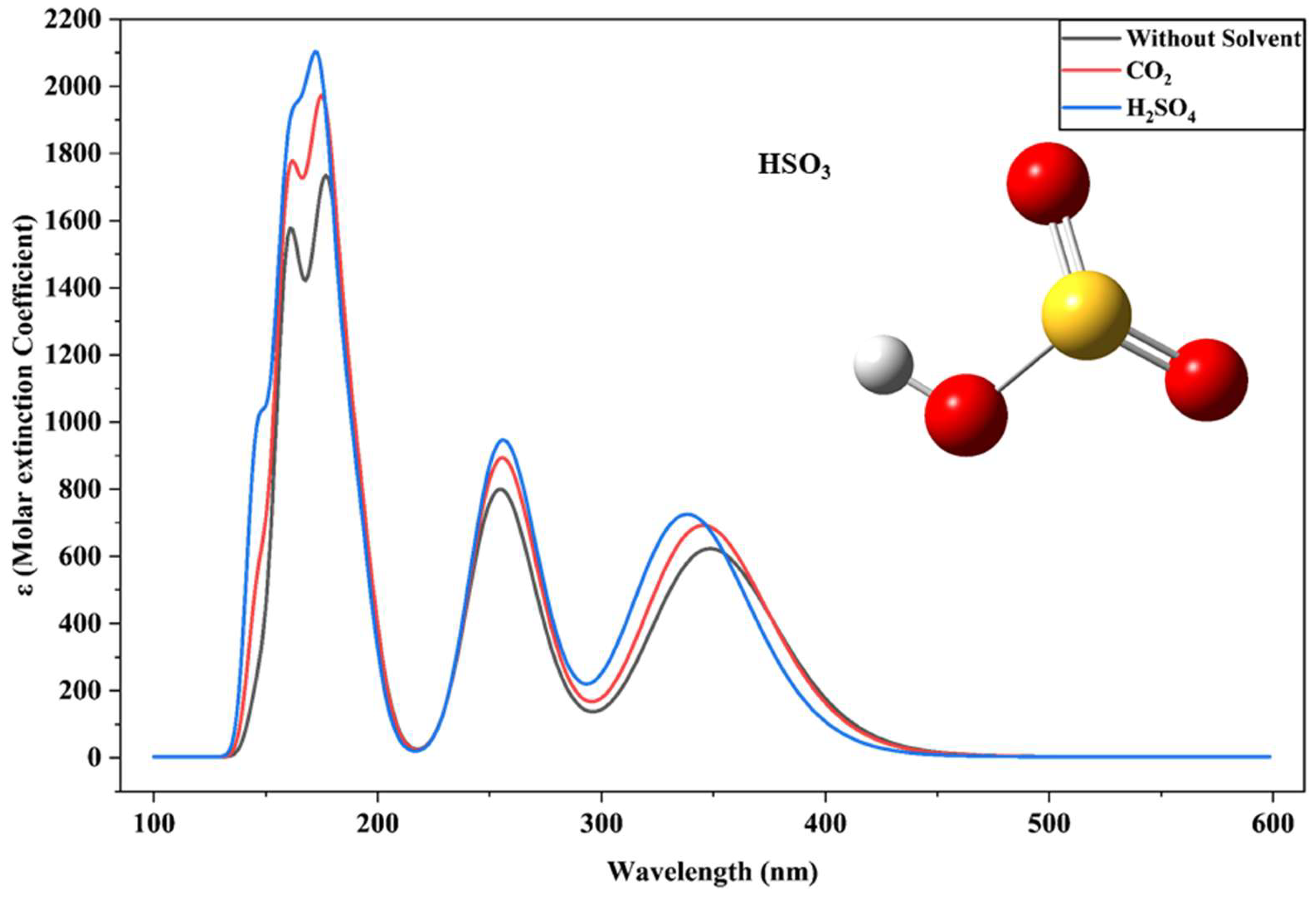
3.2. UV-Vis Spectral Characteristics of HSO3
3.2.1. In Gas Phase (Without Solvent)
3.2.2. In CO2 Solvent
3.2.3. In H2SO4 Solvent
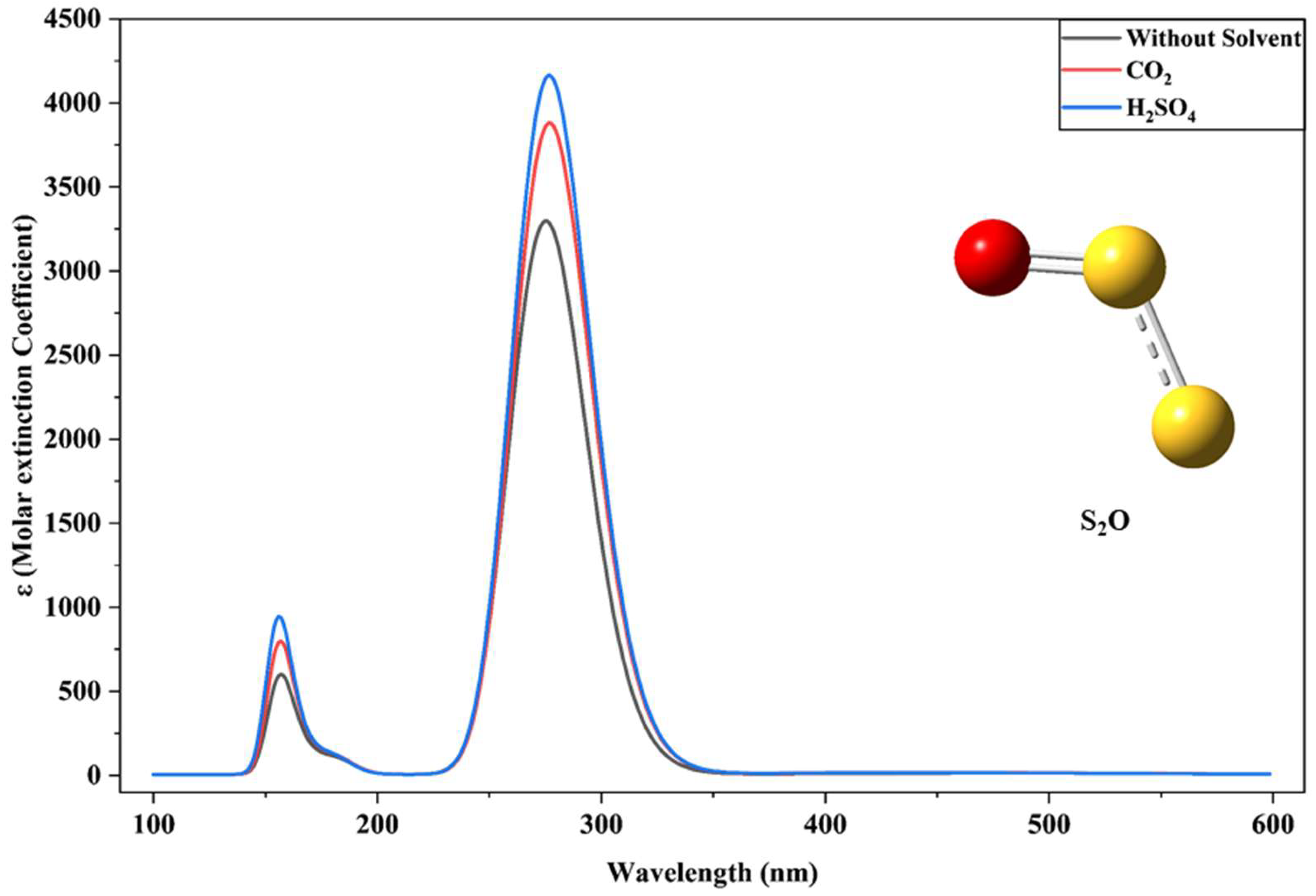
3.3. UV-Vis Spectral Characteristics of S2O
3.3.1. In Gas Phase (Without Solvent)
3.3.2. In CO2 Solvent
3.3.3. In H2SO4 Solvent
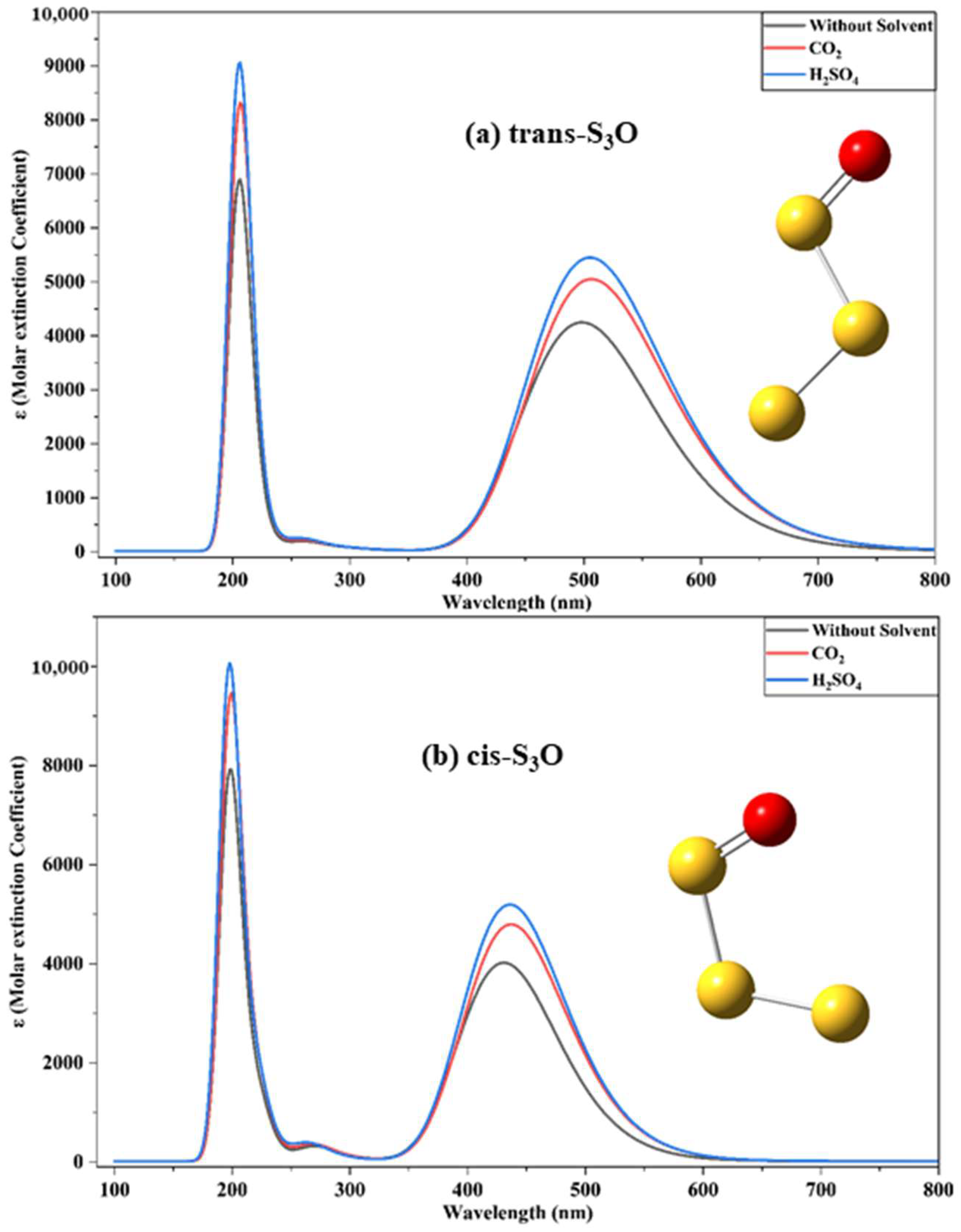
3.4. UV-Vis Spectral Characteristics of Cis-S3O and Trans-S3O
3.4.1. In Gas Phase (Without Solvent)
3.4.2. In CO2 Solvent
3.4.3. In H2SO4 Solvent
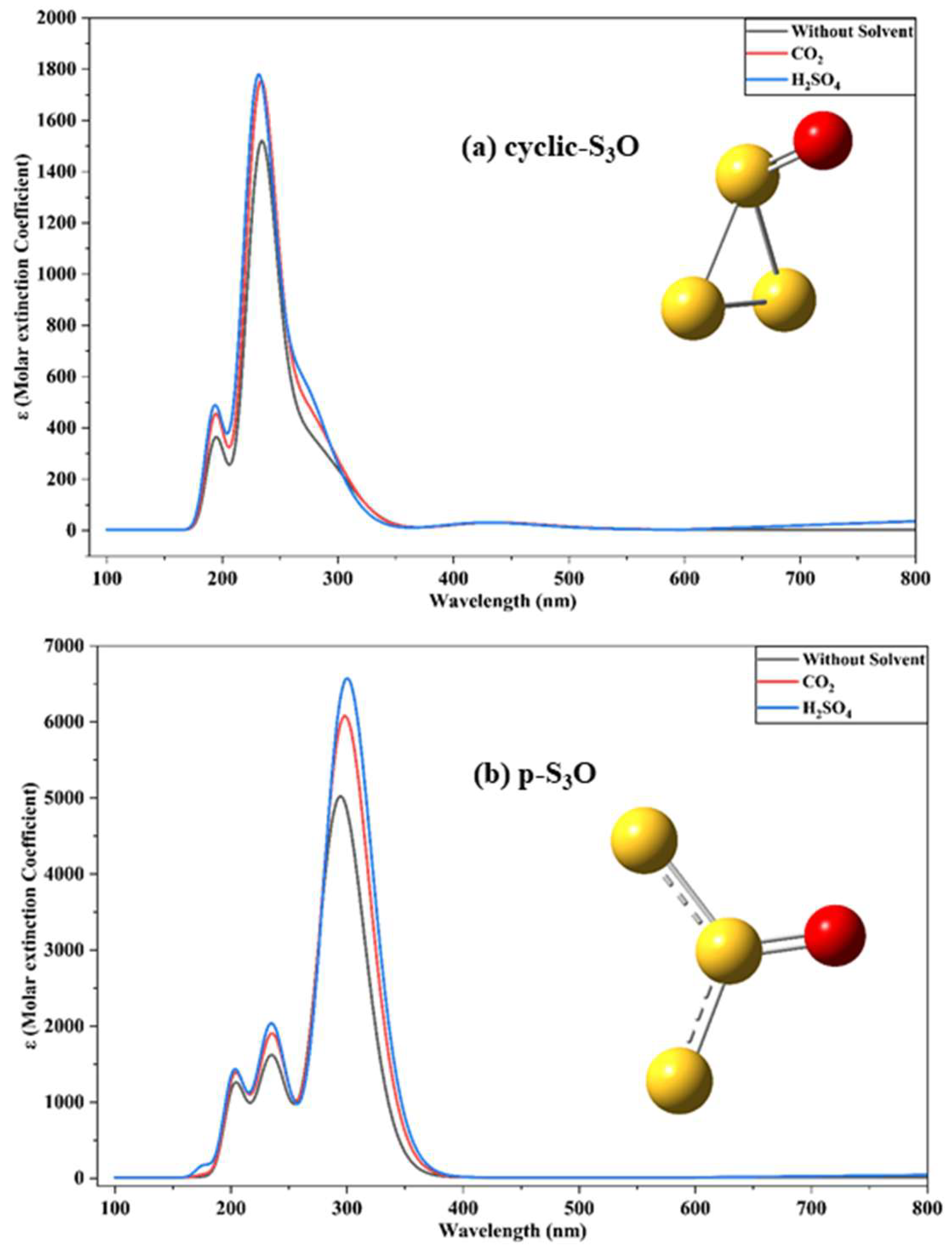
3.5. UV-Vis Spectral Characteristics of Cyclic-S3O and Planer-S3O
3.5.1. In Gas Phase (Without Solvent)
3.5.2. In CO2 Solvent
3.5.3. In H2SO4 Solvent
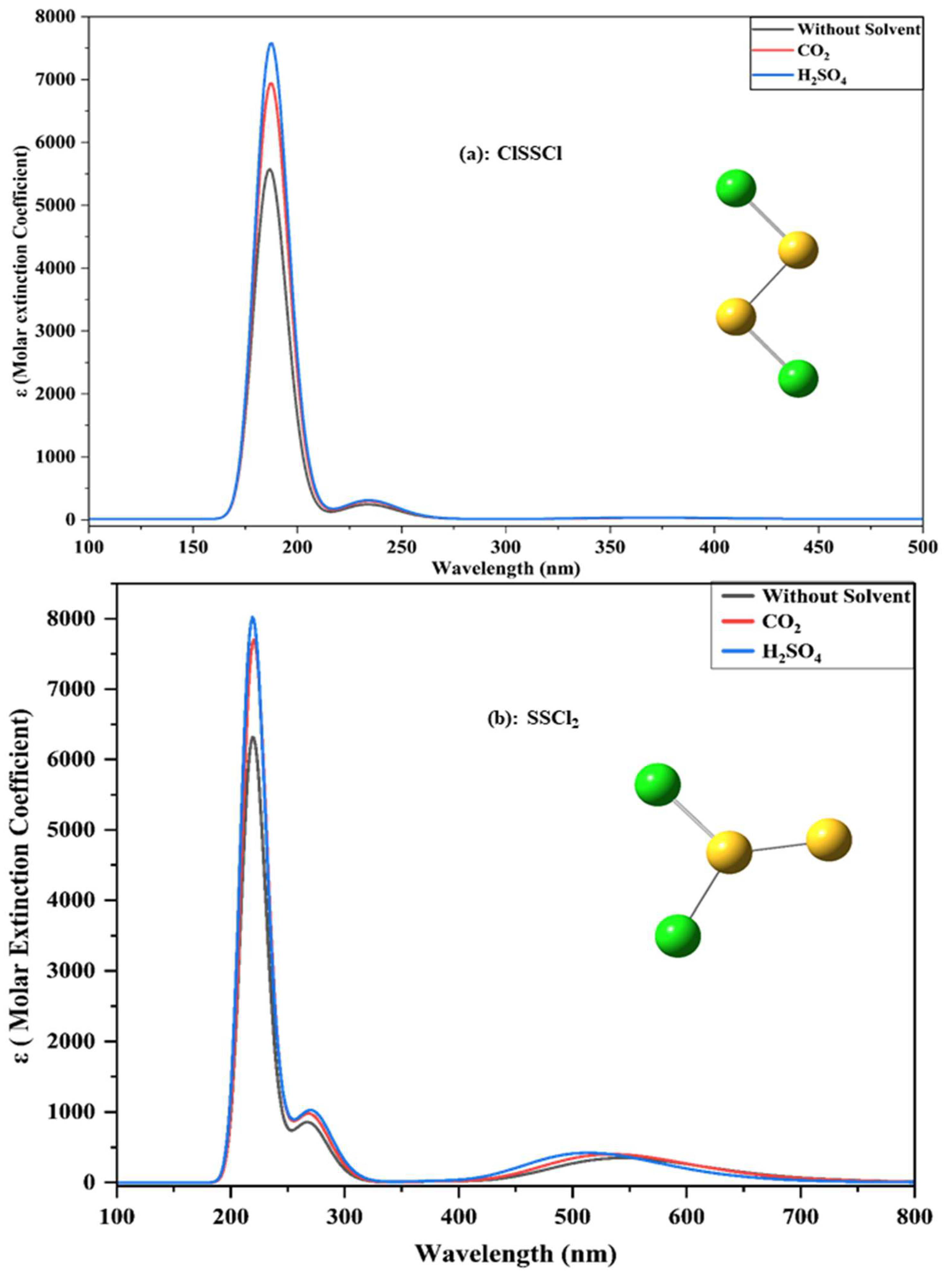
3.6. UV-Vis Spectral Characteristics of ClSSCl (Disulfur Dichloride) and SSCl2 (Thiothionyl Chloride)
3.6.1. In Gas Phase (Without Solvent)
3.6.2. In CO2 Solvent
3.6.3. In H2SO4 Solvent
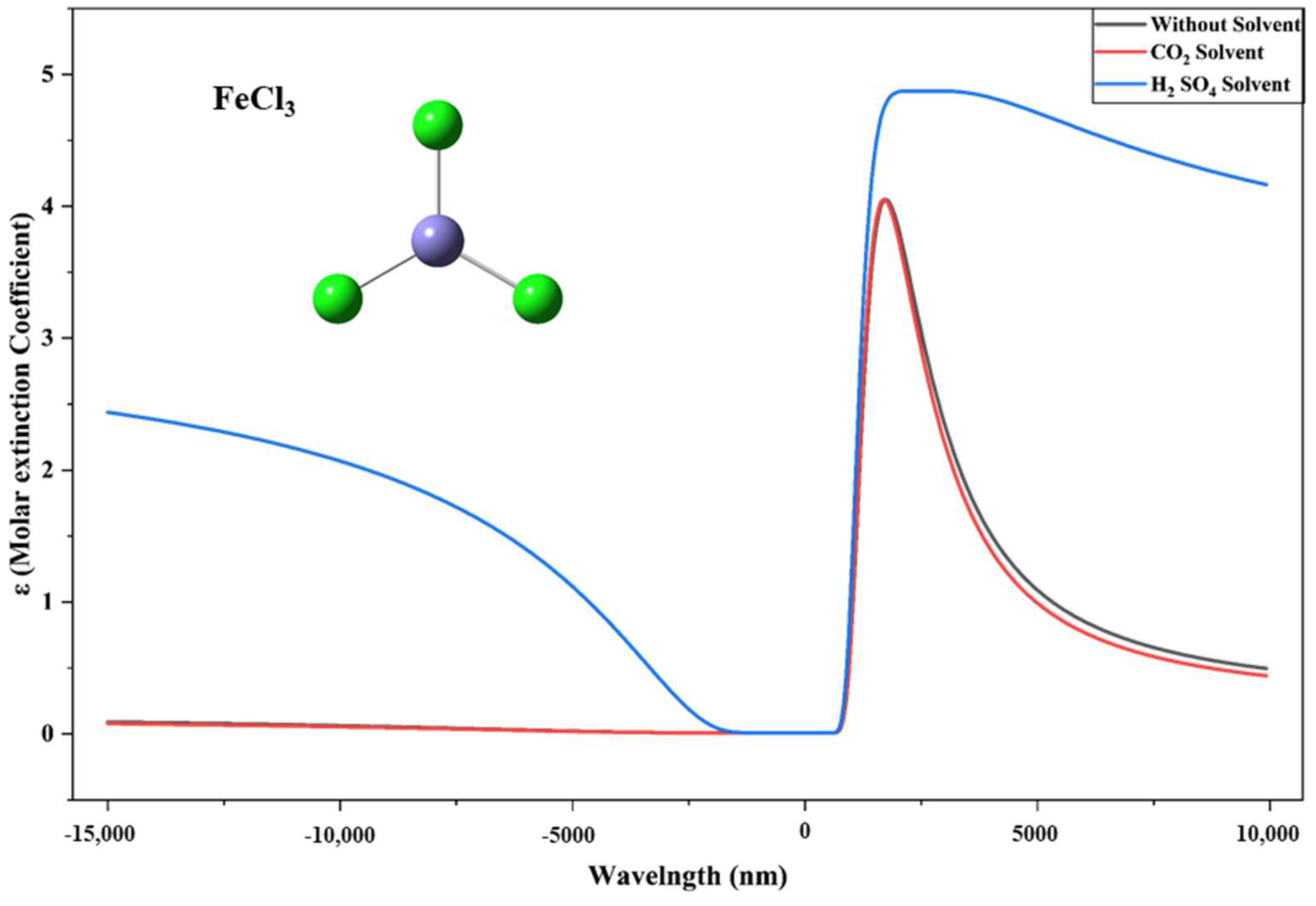
3.7. UV-Vis Spectral Characteristics of FeCl3
3.7.1. In Gas Phase (Without Solvent)
3.7.2. In CO2 Solvent
3.7.3. In H2SO4 Solvent
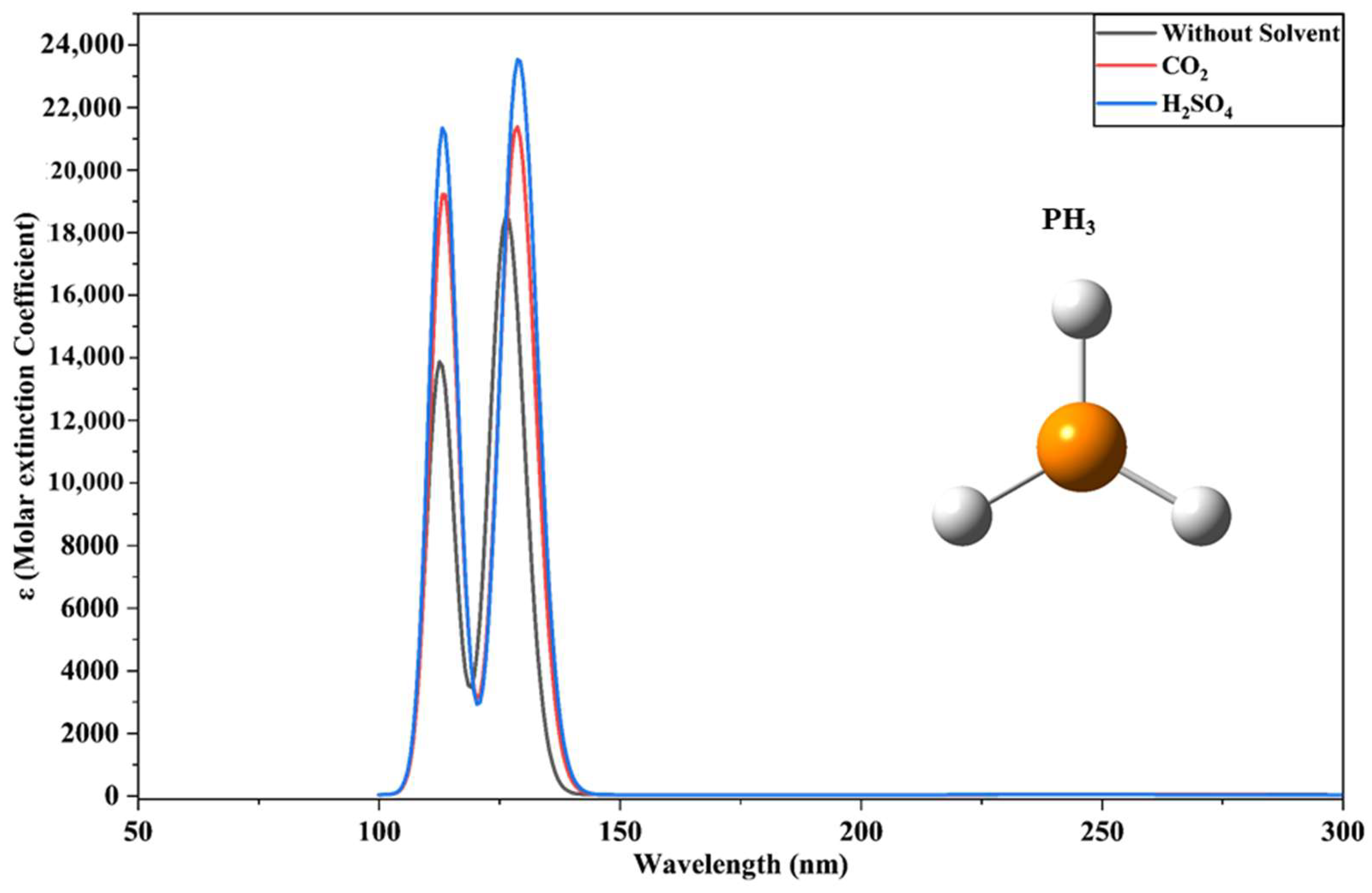
3.8. UV-Vis Spectral Analysis of Phosphine (PH3)
3.8.1. In Gas Phase (Without Solvent)
3.8.2. In CO2 and H2SO4 Solvent
4. Spectroscopic Analysis of the Venusian Atmospheric Chromophores
4.1. Assessment of Contribution to the Unknown UV Absorber
4.2. Atmospheric Formation Pathways and Chemical Viability
5. Vibronic Broadening, Photometric Viability, and Candidate Limitations
6. Conclusions
- Near-UV Absorbers: t-OSSO dominates the 365 nm unknown absorber window via a highly allowed, bathochromically shifted π → π* transition in the aerosol phase (379.37 nm, f = 0.1140). This primary absorption is supported by the kinetically trapped thiothionyl chloride (SSCl2) isomer, which introduces a highly stable, broadband absorber, seamlessly bridging the gap between sulfur opacity and halogen radical chemistry.
- Visible-Light Absorbers: Our solvated calculations confirm that the addition of a single sulfur atom shifts the primary absorption into the visible spectrum. Solvated cis-S3O absorbs heavily at 436.31 nm (f = 0.1280), effectively filtering the blue light required to produce the planet’s characteristic yellow hue.
- Mid-UV Shields and Deep-UV Reservoirs: Disulfur monoxide (S2O) and planar-S3O exhibit intense mid-UV absorption (276.93 nm and 301.26 nm, respectively), acting as highly efficient photolytic shields in the lower clouds. Conversely, linear S2Cl2 is entirely transparent in the near-UV but possesses a massive, hyperchromic vacuum-UV transition (187.59 nm, f = 0.1873) that guarantees rapid photolysis if lofted above the cloud tops.
- The Transition Metal Constraint: The failure of implicit continuum modeling to locate any allowed UV-visible transitions for monomeric FeCl3 (yielding only forbidden d-d transitions near 1594 nm) provides a critical computational boundary. To generate the intense LMCT bands observed experimentally, transition metals must undergo explicit covalent solvolysis with the H2SO4 matrix.
- By deploying a semi-classical Reflection Principle approach to map dissociative excited-state potentials, we demonstrated that standard harmonic Franck-Condon models fail to capture the photophysics of polysulfur oxides. Instead, the continuous absorption tail is driven by the extreme ground-state fluxionality of the OSSO backbone. While control species (such as S2Cl2, OS2, and cyclic isomers) suffer a complete collapse of transition probability upon structural elongation, the unconstrained cis- and trans-OSSO chains maintain intense, symmetry-allowed charge-transfer transitions deep into the visible spectrum (>600 nm). This uniquely isolates the fluxional OSSO motif as the requisite structural driver for the Venusian unknown UV-visible absorber.
Supplementary Materials
Author Contributions
Funding
Data Availability Statement
Conflicts of Interest
References
- Molaverdikhani, K.; McGouldrick, K.; Esposito, L.W. The Abundance and Vertical Distribution of the Unknown Ultraviolet Absorber in the Venusian Atmosphere from Analysis of Venus Monitoring Camera Images. Icarus 2012, 217, 648–660. [Google Scholar] [CrossRef]
- Bullock, M.A.; Grinspoon, D.H. The Atmosphere and Climate of Venus. Comp. Climatol. Terr. Planets 2013, 1, 19–54. [Google Scholar]
- Pérez-Hoyos, S.; Sánchez-Lavega, A.; García-Muñoz, A.; Irwin, P.G.; Peralta, J.; Holsclaw, G.; McClintock, W.; Sanz-Requena, J.F. Venus Upper Clouds and the UV Absorber from MESSENGER/MASCS Observations. J. Geophys. Res. Planets 2018, 123, 145–162. [Google Scholar] [CrossRef]
- Esposito, L.W.; Knollenberg, R.G.; Marov, M.I.; Toon, O.B.; Turco, R.P. The Clouds and Hazes of Venus. In Venus; University of Arizona Press: Tucson, AZ, USA, 1983; pp. 484–564. [Google Scholar]
- Svedhem, H.; Titov, D.V.; Taylor, F.W.; Witasse, O. Venus as a More Earth-like Planet. Nature 2007, 450, 629–632. [Google Scholar] [CrossRef]
- Peralta, J.; Lee, Y.J.; McGouldrick, K.; Sagawa, H.; Sánchez-Lavega, A.; Imamura, T.; Widemann, T.; Nakamura, M. Overview of Useful Spectral Regions for Venus: An Update to Encourage Observations Complementary to the Akatsuki Mission. Icarus 2017, 288, 235–239. [Google Scholar] [CrossRef]
- Nakamura, M.; Imamura, T.; Ishii, N.; Abe, T.; Satoh, T.; Suzuki, M.; Ueno, M.; Yamazaki, A.; Iwagami, N.; Watanabe, S.; et al. Overview of Venus Orbiter, Akatsuki. Earth Planets Space 2011, 63, 443–457. [Google Scholar] [CrossRef]
- Glaze, L.S.; Wilson, C.F.; Zasova, L.V.; Nakamura, M.; Limaye, S. Future of Venus Research and Exploration. Space Sci. Rev. 2018, 214, 89. [Google Scholar] [CrossRef]
- Barker, E.S. Detection of SO2 in the UV Spectrum of Venus. Geophys. Res. Lett. 1979, 6, 117–120. [Google Scholar] [CrossRef]
- Zolotov, M. Sulfur on Venus: Atmospheric, Surface, and Interior Processes. In The Role of Sulfur in Planetary Processes; Harlov, D.E., Pokrovski, G.S., Eds.; Springer: Cham, Switzerland, 2026. [Google Scholar]
- Frandsen, B.N.; Wennberg, P.O.; Kjaergaard, H.G. Identification of OSSO as a near-UV Absorber in the Venusian Atmosphere. Geophys. Res. Lett. 2016, 43, 11–146. [Google Scholar] [CrossRef]
- Mills, F.; Marcq, E.; Yung, Y.; Parkinson, C.; Jessup, K.L.; Vandaele, A.C. Atmospheric Chemistry on Venus: An Overview of Unresolved Issues. In Proceedings of the 50th Lunar and Planetary Science Conference, The Woodlands, TX, USA, 18–22 March 2019; p. LPI-Contribution No. 2132. [Google Scholar]
- Yung, Y.L.; Demore, W.B. Photochemistry of the Stratosphere of Venus: Implications for Atmospheric Evolution. Icarus 1982, 51, 199–247. [Google Scholar] [CrossRef]
- Marcq, E.; Mills, F.P.; Parkinson, C.D.; Vandaele, A.C. Composition and Chemistry of the Neutral Atmosphere of Venus. Space Sci. Rev. 2018, 214, 10. [Google Scholar] [CrossRef]
- Mills, F.; Esposito, L.W.; Yung, Y.L. Atmospheric Composition, Chemistry, and Clouds. Exploring Venus as a Terrestrial Planet; The American Geophysical Union: Washington, DC, USA, 2007. [Google Scholar]
- Titov, D.V.; Ignatiev, N.I.; McGouldrick, K.; Wilquet, V.; Wilson, C.F. Clouds and Hazes of Venus. Space Sci. Rev. 2018, 214, 126. [Google Scholar] [CrossRef]
- Egan, J.V.; James, A.D.; Plane, J.M. Laboratory Measurements of Ferric Chloride (FeCl3) under Venusian Conditions. ACS Earth Space Chem. 2025, 9, 2127–2136. [Google Scholar] [CrossRef]
- Bierson, C.; Zhang, X. Chemical Cycling in the Venusian Atmosphere: A Full Photochemical Model from the Surface to 110 Km. J. Geophys. Res. Planets 2020, 125, e2019JE006159. [Google Scholar] [CrossRef]
- Dreuw, A.; Head-Gordon, M. Single-Reference Ab Initio Methods for the Calculation of Excited States of Large Molecules. Chem. Rev. 2005, 105, 4009–4037. [Google Scholar] [CrossRef]
- Laurent, A.D.; Jacquemin, D. TD-DFT Benchmarks: A Review. Int. J. Quantum Chem. 2013, 113, 2019–2039. [Google Scholar] [CrossRef]
- Francés-Monerris, A.; Carmona-García, J.; Trabelsi, T.; Saiz-Lopez, A.; Lyons, J.R.; Francisco, J.S.; Roca-Sanjuán, D. Photochemical and Thermochemical Pathways to S2 and Polysulfur Formation in the Atmosphere of Venus. Nat. Commun. 2022, 13, 4425. [Google Scholar] [CrossRef] [PubMed]
- Jiang, C.Z.; Rimmer, P.B.; Lozano, G.G.; Tosca, N.J.; Kufner, C.L.; Sasselov, D.D.; Thompson, S.J. Iron-Sulfur Chemistry Can Explain the Ultraviolet Absorber in the Clouds of Venus. Sci. Adv. 2024, 10, eadg8826. [Google Scholar] [CrossRef]
- Krasnopolsky, V.A. Chemical Composition of Venus Atmosphere and Clouds: Some Unsolved Problems. Planet. Space Sci. 2006, 54, 1352–1359. [Google Scholar] [CrossRef]
- Peach, M.J.; Benfield, P.; Helgaker, T.; Tozer, D.J. Excitation Energies in Density Functional Theory: An Evaluation and a Diagnostic Test. J. Chem. Phys. 2008, 128, 044118. [Google Scholar] [CrossRef]
- Yanai, T.; Tew, D.P.; Handy, N.C. A New Hybrid Exchange–Correlation Functional Using the Coulomb-Attenuating Method (CAM-B3LYP). Chem. Phys. Lett. 2004, 393, 51–57. [Google Scholar] [CrossRef]
- Marenich, A.V.; Cramer, C.J.; Truhlar, D.G. Universal Solvation Model Based on Solute Electron Density and on a Continuum Model of the Solvent Defined by the Bulk Dielectric Constant and Atomic Surface Tensions. J. Phys. Chem. B 2009, 113, 6378–6396. [Google Scholar] [CrossRef] [PubMed]
- Titov, D.V.; Bullock, M.A.; Crisp, D.; Renno, N.O.; Taylor, F.W.; Zasova, L.V. Radiation in the Atmosphere of Venus. Geophys. Monogr. Am. Geophys. Union 2007, 176, 121. [Google Scholar]
- Frisch, M.; Trucks, G.; Schlegel, H.; Scuseria, G.; Robb, M.; Cheeseman, J.; Scalmani, G.; Barone, V.; Petersson, G.; Nakatsuji, H.; et al. Gaussian 16, Revision A.03; Gaussian, Inc.: Wallingford, CT, USA, 2016; Available online: https://gaussian.com/relnotes_a03/ (accessed on 18 May 2026).
- Frisch, M.; Trucks, G.; Schlegel, H.; Scuseria, G.; Robb, M.; Cheeseman, J.; Scalmani, G.; Barone, V.; Petersson, G.; Nakatsuji, H.; et al. Gaussian 16; Gaussian, Inc.: Wallingford, CT, USA, 2016; Available online: https://gaussian.com/gaussian16/ (accessed on 18 May 2026).
- Dennington, R.; Keith, T.A.; Millam, J.M. GaussView, Version 6.0. 16.; Semichem Inc.: Shawnee Mission, KS, USA, 2016; pp. 143–150. [Google Scholar]
- Basilevsky, A.T.; Head, J.W. The Surface of Venus. Rep. Prog. Phys. 2003, 66, 1699–1734. [Google Scholar] [CrossRef]
- Zhao, Y.; Truhlar, D.G. The M06 Suite of Density Functionals for Main Group Thermochemistry, Thermochemical Kinetics, Noncovalent Interactions, Excited States, and Transition Elements: Two New Functionals and Systematic Testing of Four M06-Class Functionals and 12 Other Functionals. Theor. Chem. Acc. 2008, 120, 215–241. [Google Scholar]
- Zhao, Y.; Truhlar, D.G. Density Functionals with Broad Applicability in Chemistry. Acc. Chem. Res. 2008, 41, 157–167. [Google Scholar] [CrossRef] [PubMed]
- Walker, M.; Harvey, A.J.; Sen, A.; Dessent, C.E. Performance of M06, M06-2X, and M06-HF Density Functionals for Conformationally Flexible Anionic Clusters: M06 Functionals Perform Better than B3LYP for a Model System with Dispersion and Ionic Hydrogen-Bonding Interactions. J. Phys. Chem. A 2013, 117, 12590–12600. [Google Scholar] [CrossRef]
- Weigend, F.; Furche, F.; Ahlrichs, R. Gaussian Basis Sets of Quadruple Zeta Valence Quality for Atoms H–Kr. J. Chem. Phys. 2003, 119, 12753–12762. [Google Scholar] [CrossRef]
- Weigend, F. Accurate Coulomb-Fitting Basis Sets for H to Rn. Phys. Chem. Chem. Phys. 2006, 8, 1057–1065. [Google Scholar] [CrossRef]
- Runge, E.; Gross, E.K. Density-Functional Theory for Time-Dependent Systems. Phys. Rev. Lett. 1984, 52, 997. [Google Scholar] [CrossRef]
- Tawada, Y.; Tsuneda, T.; Yanagisawa, S.; Yanai, T.; Hirao, K. A Long-Range-Corrected Time-Dependent Density Functional Theory. J. Chem. Phys. 2004, 120, 8425–8433. [Google Scholar] [CrossRef]
- Dreuw, A.; Head-Gordon, M. Failure of Time-Dependent Density Functional Theory for Long-Range Charge-Transfer Excited States: The Zincbacteriochlorin−Bacteriochlorin and Bacteriochlorophyll−Spheroidene Complexes. J. Am. Chem. Soc. 2004, 126, 4007–4016. [Google Scholar] [CrossRef] [PubMed]
- Peach, M.J.G.; Helgaker, T.; Sałek, P.; Keal, T.W.; Lutnæs, O.B.; Tozer, D.J.; Handy, N.C. Assessment of a Coulomb-Attenuated Exchange–Correlation Energy Functional. Phys. Chem. Chem. Phys. 2006, 8, 558–562. [Google Scholar] [CrossRef]
- Jacquemin, D.; Perpète, E.A.; Scuseria, G.E.; Ciofini, I.; Adamo, C. TD-DFT Performance for the Visible Absorption Spectra of Organic Dyes: Conventional versus Long-Range Hybrids. J. Chem. Theory Comput. 2008, 4, 123–135. [Google Scholar] [CrossRef]
- Zasova, L.V.; Ignatiev, N.; Khatuntsev, I.; Linkin, V. Structure of the Venus Atmosphere. Planet. Space Sci. 2007, 55, 1712–1728. [Google Scholar] [CrossRef]
- Tomasi, J.; Mennucci, B.; Cammi, R. Quantum Mechanical Continuum Solvation Models. Chem. Rev. 2005, 105, 2999–3094. [Google Scholar] [CrossRef]
- Reichardt, C. Solvatochromic Dyes as Solvent Polarity Indicators. Chem. Rev. 1994, 94, 2319–2358. [Google Scholar] [CrossRef]
- Cobos, C.J.; Croce, A.E. Theoretical Study of the Electronic Spectrum of Disulfur Monoxide. Z. Naturforschung A 2014, 69, 215–219. [Google Scholar] [CrossRef]
- Trabelsi, T. Spectroscopic Characterization of S3 O Isomers: Potential Contributor to the Unknown UV Absorber in Venus’s Atmosphere. J. Phys. Chem. A 2025, 129, 4870–4878. [Google Scholar] [CrossRef]
- Trabelsi, T.; Francico, J.S. Chlorine–Sulfur Isomers as Parents of ClS2 and SCl2 on Venus: Spectroscopy and Photochemistry of ClSSCl, SSCl2, and (ClS)2. J. Chem. Phys. 2026, 164, 084302. [Google Scholar] [CrossRef]
- Lee, S.-Y. Energy Shift Correction for the Reflection Approximation. J. Chem. Phys. 1985, 82, 4588–4594. [Google Scholar] [CrossRef]
- Sršeň, Š.; Slavíček, P. Optimal Representation of the Nuclear Ensemble: Application to Electronic Spectroscopy. J. Chem. Theory Comput. 2021, 17, 6395–6404. [Google Scholar] [CrossRef] [PubMed]
- Jank, D.; Ončák, M.; Jin, S.; Van Der Linde, C.; Beyer, M.K. Multiconfigurational Character of Repulsive A2 Σg+ State Leaves Strong Signature in the Photodissociation Spectrum of Zn2+. J. Am. Chem. Soc. 2024, 146, 16385–16388. [Google Scholar] [CrossRef] [PubMed]
- Jessup, K.L.; Marcq, E.; Mills, F.; Mahieux, A.; Limaye, S.; Wilson, C.; Allen, M.; Bertaux, J.-L.; Markiewicz, W.; Roman, T.; et al. Coordinated Hubble Space Telescope and Venus Express Observations of Venus’ Upper Cloud Deck. Icarus 2015, 258, 309–336. [Google Scholar] [CrossRef]
- Bains, W.; Petkowski, J.J.; Seager, S.; Ranjan, S.; Sousa-Silva, C.; Rimmer, P.B.; Zhan, Z.; Greaves, J.S.; Richards, A.M.S. Phosphine on Venus Cannot Be Explained by Conventional Processes. Astrobiology 2021, 21, 1277–1304. [Google Scholar] [CrossRef] [PubMed]
- Greaves, J.S.; Richards, A.M.S.; Bains, W.; Rimmer, P.B.; Clements, D.L.; Seager, S.; Petkowski, J.J.; Sousa-Silva, C.; Ranjan, S.; Fraser, H.J. Re-Analysis of Phosphine in Venus’ Clouds. Nat. Astron. 2021, 5, 636–639. [Google Scholar] [CrossRef]
- Bertaux, J.; Widemann, T.; Hauchecorne, A.; Moroz, V.I.; Ekonomov, A.P. VEGA 1 and VEGA 2 Entry Probes: An Investigation of Local UV Absorption (220–400 Nm) in the Atmosphere of Venus (SO2 Aerosols, Cloud Structure). J. Geophys. Res. 1996, 101, 12709–12745. [Google Scholar] [CrossRef]
- Zhang, X.; Liang, M.C.; Mills, F.P.; Belyaev, D.A.; Yung, Y.L. Sulfur Chemistry in the Middle Atmosphere of Venus. Icarus 2012, 217, 714–739. [Google Scholar] [CrossRef]
- Sánchez-Lavega, A.; Lebonnois, S.; Imamura, T.; Read, P.; Luz, D. The Atmospheric Dynamics of Venus. Space Sci. Rev. 2017, 212, 1541–1616. [Google Scholar] [CrossRef]
- Krasnopolsky, V.A. A Photochemical Model for the Venus Atmosphere at 47–112km. Icarus 2012, 218, 230–246. [Google Scholar] [CrossRef]
- Krasnopolsky, V.A. S3 and S4 Abundances and Improved Chemical Kinetic Model for the Lower Atmosphere of Venus. Icarus 2013, 225, 570–580. [Google Scholar] [CrossRef]


| Molecule | Structural Form | Gas Phase | H2SO4 Solvent (Aerosol) | CO2 Solvent (Bulk) | |||
|---|---|---|---|---|---|---|---|
| λmax | f | λmax | f | λmax | f | ||
| S2O2 (OSSO) | t-OSSO | 378.19 | 0.0919 | 379.37 | 0.1140 | 381.09 | 0.1065 |
| c-OSSO | 333.70 | 0.0936 | 334.51 | 0.1173 | 335.98 | 0.1091 | |
| HSO3 Radical | Ground State | 348.81 | 0.0152 | 338.70 | 0.0177 | 345.73 | 0.0169 |
| S2O | Ground State | 275.48 | 0.0814 | 276.93 | 0.1028 | 277.13 | 0.0958 |
| S3O | cis-S3O | 431.17 | 0.0990 | 436.31 | 0.1280 | 437.30 | 0.1181 |
| trans-S3O | 498.62 | 0.1047 | 505.61 | 0.1344 | 506.82 | 0.1245 | |
| planar-S3O | 296.17 | 0.1065 | 301.26 | 0.1551 | 299.51 | 0.1391 | |
| cyclic-S3O | 231.57 | 0.0213 | 227.03 | 0.0195 | 230.19 | 0.0221 | |
| S2Cl2 | ClSSCl (Gauche Isomer) | 370.65 | 0.0005 | 367.30 | 0.0006 | 369.78 | 0.0005 |
| SSCl2 (Pyramidal Isomer) | 268.30 | 0.0207 | 271.84 | 0.0244 | 269.72 | 0.0235 | |
| FeCl3 | Monomeric Complex | >1500.0 | <0.0001 | >1500.0 | <0.0001 | >1500.0 | <0.0001 |
| PH3 | Ground State | 258.43 | 0.0003 | 237.61 | 0.0001 | 251.61 | 0.0002 |
Disclaimer/Publisher’s Note: The statements, opinions and data contained in all publications are solely those of the individual author(s) and contributor(s) and not of MDPI and/or the editor(s). MDPI and/or the editor(s) disclaim responsibility for any injury to people or property resulting from any ideas, methods, instructions or products referred to in the content. |
© 2026 by the authors. Licensee MDPI, Basel, Switzerland. This article is an open access article distributed under the terms and conditions of the Creative Commons Attribution (CC BY) license.
Share and Cite
Pandey, P.; Mishra, P.; Singh, R.; Yadav, M.; Shivani; Ahamad, A.; Misra, A.; Tandon, P.; Shukla, A. TD-DFT Investigation of Sulfur and Chlorine Species as Potential Contributors to Venusian Unknown UV Absorber. Universe 2026, 12, 151. https://doi.org/10.3390/universe12050151
Pandey P, Mishra P, Singh R, Yadav M, Shivani, Ahamad A, Misra A, Tandon P, Shukla A. TD-DFT Investigation of Sulfur and Chlorine Species as Potential Contributors to Venusian Unknown UV Absorber. Universe. 2026; 12(5):151. https://doi.org/10.3390/universe12050151
Chicago/Turabian StylePandey, Parmanand, Pravi Mishra, Rachana Singh, Manisha Yadav, Shivani, Aftab Ahamad, Alka Misra, Poonam Tandon, and Amritanshu Shukla. 2026. "TD-DFT Investigation of Sulfur and Chlorine Species as Potential Contributors to Venusian Unknown UV Absorber" Universe 12, no. 5: 151. https://doi.org/10.3390/universe12050151
APA StylePandey, P., Mishra, P., Singh, R., Yadav, M., Shivani, Ahamad, A., Misra, A., Tandon, P., & Shukla, A. (2026). TD-DFT Investigation of Sulfur and Chlorine Species as Potential Contributors to Venusian Unknown UV Absorber. Universe, 12(5), 151. https://doi.org/10.3390/universe12050151