1. Introduction
Black holes represent the most extreme solutions of general relativity, embodying the nonlinear regime of gravity where spacetime curvature, causal structure, and gravitational dynamics are driven to their theoretical limits. From a theoretical perspective, they provide a framework in which strong field effects can be explored, allowing fundamental notions such as event horizons, spacetime singularities, and global causality to be rigorously defined and tested [
1,
2,
3,
4]. In recent years, this theoretical domain has been transformed by observations. The direct detection of gravitational waves from compact binary mergers by the LIGO-VIRGO-KAGRA (LVK) collaboration has confirmed the existence of black holes as dynamical astrophysical objects and enabled quantitative tests of gravity in the highly nonlinear regime [
5,
6,
7,
8,
9,
10]. In parallel, images of supermassive black holes obtained by the Event Horizon Telescope (EHT) have provided direct observational access to the photon sphere region and to the immediate vicinity of the event horizon [
11,
12,
13,
14,
15]. Together, these observations have established black holes as precision probes of strong gravity.
These developments motivate the study of black holes beyond the idealized vacuum regime. Astrophysical black holes are embedded in environments containing matter and fields, whose presence can modify both local and global properties of the spacetime [
16,
17,
18,
19,
20]. In particular, black holes in the presence of nonstandard or exotic fluids allow one to investigate how matter content influences causal structure, horizon behavior, and the nature of spacetime singularities, as well as their imprints in gravitational wave signals and quasinormal mode spectra [
21,
22,
23,
24,
25,
26,
27].
In this context, models in which black holes are embedded in dark fluids provide a useful framework to investigate environmental effects on black hole physics. Among the proposed candidates, Chaplygin gas and its generalizations have attracted considerable attention as unified dark sector models capable of describing both dark matter and dark energy within a single fluid. In particular, the Chaplygin-like dark fluid considered is characterized by the equation of state
, which leads to an energy density that interpolates between matter-like behavior at small radial distances and a cosmological constant at large scales. More specifically, for small values of the radial coordinate, the energy density behaves as
, while at large distances it approaches a constant value
, effectively acting as a positive cosmological constant [
28,
29].
This property makes black hole solutions immersed in Chaplygin-like dark fluids particularly interesting for astrophysical applications, since they allow one to simultaneously model local matter effects near the event horizon and large-scale cosmological expansion. Moreover, previous studies have shown that the presence of the Chaplygin-like fluid can modify observable properties of black holes, including their optical appearance and shadow, which may be constrained by Event Horizon Telescope observations [
30]. In addition, the interaction between the surrounding fluid and perturbative fields can affect the quasinormal mode spectrum [
31], potentially leaving imprints on the gravitational-wave ringdown signal. Therefore, investigating perturbations in these backgrounds provides a useful way to explore how environmental effects associated with dark sector models may influence observable signatures of black holes.
Black holes immersed in Chaplygin-like dark fluids arise as exact, spherically symmetric solutions of the Einstein equations sourced by an effective fluid characterized by a nonlinear equation of state [
28,
29,
30,
31,
32]. Such a fluid interpolates between matter behavior at small radial distances and a positive cosmological constant component at large distances, providing a description of a medium that captures both local and asymptotic matter effects.
In this work, we analyze the causal structure of spherically symmetric black hole solutions immersed in a Chaplygin-like dark fluid. We examine the global properties of the spacetime by identifying horizons and singularities and by determining how their existence and multiplicity depend on the parameters that characterize the solution. The analysis allow us to establish bounds on the parameters
Q and
B, delimiting the regions of parameter space where the spacetime admits an event horizon, a Cauchy horizon and a cosmological horizon, as well as configurations corresponding to extremal black holes. In
Section 2, we review the black hole solution, summarizing its main properties. In
Section 3, we investigate how the causal structure of the spacetime depends on the parameters that characterize the solution, with particular emphasis on the behavior of horizons and singularities. Finally, in
Section 4, we present a discussion of the results and our final remarks.
2. Background Black Hole Solution
In this section, we review the main properties of the spherically symmetric black hole solution immersed in a Chaplygin-like dark fluid, which will serve as the background spacetime throughout this work. Following the procedure adopted in previous studies of black holes immersed in Chaplygin-like dark fluids [
29,
30,
31], we briefly summarize the main steps leading to the relevant expressions used in this work.
We consider a static and spherically symmetric black hole solution sourced by a Chaplygin-like dark fluid, described by the line element
where the metric function
is determined by the Einstein equations coupled to an anisotropic energy–momentum tensor,
Here,
denotes the energy density of the fluid, while
and
are the radial and tangential pressure components, respectively. The vector
is the four-velocity of the fluid, and
is a projection tensor, where
is a spacelike unit vector orthogonal to
, satisfying
The condition
is imposed to ensure a static configuration of the fluid and to guarantee the continuity of the energy density across the event horizon [
29]. Assuming a nonlinear equation of state of Chaplygin type,
with
, the tangential pressure is given by
. Such expression for the tangential pressure
follows from the anisotropic stress–energy tensor of the Chaplygin-like dark fluid (
2) together with the equation of state
and the condition
[
28].
From the energy–momentum tensor (
2), one obtains the exact expression for the energy density,
where
q is a positive constant related to the intensity of the Chaplygin-like dark fluid. This expression for the energy density is obtained by solving the Einstein equations for a static and spherically symmetric spacetime (
1) sourced by the Chaplygin-like dark fluid (
2):
As discussed in [
31], at small radial distances the energy density behaves as
which corresponds to a matter profile with
. In the asymptotic regime, the energy density approaches a constant value,
effectively mimicking a positive cosmological constant at large distances.
It is also worth noting that the energy density remains finite at the event horizon
. The regularity of the fluid across the event horizon is given by the condition
. As discussed in [
28], when crossing the event horizon the roles of the temporal and radial coordinates interchange, since inside the horizon
and
, implying that the coordinate
r becomes timelike. In this situation the energy density and pressure remain continuous across the horizon only if the condition
is satisfied. Otherwise, if
and
, the pressure would become discontinuous at the horizon and the corresponding solution would necessarily be dynamical. Therefore, imposing
guarantees that the Chaplygin-like dark fluid remains static and that the stress–energy tensor is continuous across the horizon.
Solving the Einstein equations with (
5) and (
2), we obtain the lapse function
where the parameters
b and
q characterize the contribution of the Chaplygin-like dark fluid to the spacetime geometry. The metric function
is obtained by substituting the energy density profile of (
5) into the Einstein equations. Integrating the resulting differential equations yields the analytical form of the lapse function shown above.
Here, we reparameterize the constants
and
in order to simplify the lapse function,
In the limit , the solution reduces to the Schwarzschild–de Sitter black hole, with an effective cosmological constant . In the limit where both parameters vanish, and , the metric consistently reduces to the Schwarzschild solution.
At large radial distances, the lapse function asymptotically behaves as
indicating the presence of a pseudo-cosmological horizon. As discussed in [
29], the parameter
q primarily controls the existence and location of the event horizon
, while
B determines the position of the pseudo-cosmological horizon
.
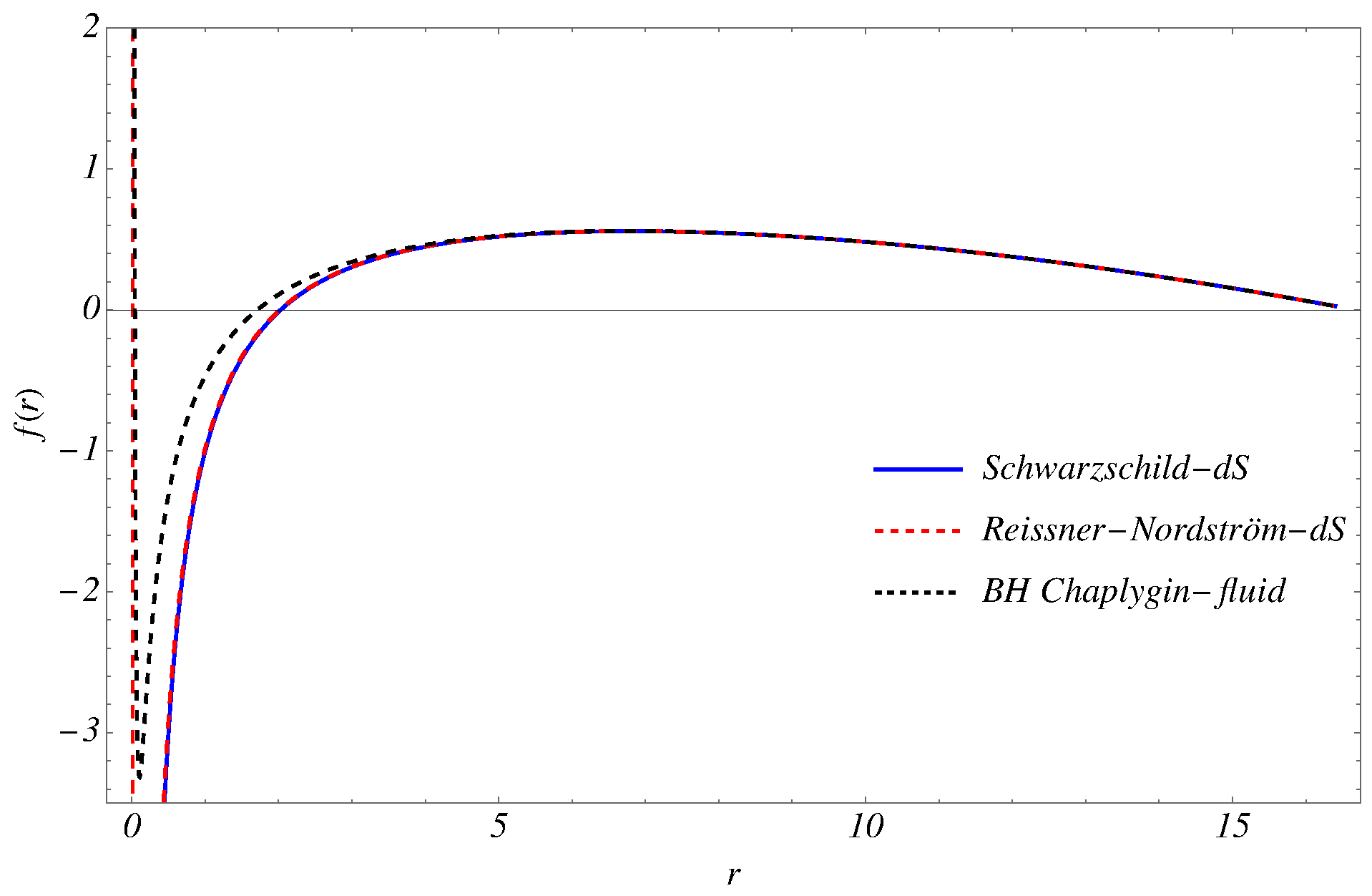
The behavior of the lapse function (
11) is illustrated in
Figure 1, where we compare the present solution with the Schwarzschild–de Sitter and Reissner–Nordström–de Sitter cases, highlighting the modifications introduced by the Chaplygin-like dark fluid.
3. Curvature Scalars, Parameter Space and Horizon Structure
The determination of the causal structure of the black hole solution we are characterizing starts with the Ricci and Riemmann curvature invariants. In terms of (
1) we have
in which prime denotes derivative relative to
r. Scalars (
13) to (
15) when applied to the lapse function (
12) yield
The curvature invariants have a physical singularity at
if
or
represented as a timelike or spacelike structure depending on the presence of
M and
Q. The curvature near the singularity is stronger then in the counterpart solution, the Reissner–Nordström–de Sitter spacetime: in this case the Kretschman scalar diverges as
at
, and for the Chaplygin black hole the Arcsinh function enhances the singularity character at
.
A central point in the causal structure of the black hole, besides the singularity nature, is the existence of horizons. Considering the diagonal line-element (
1), killing horizons are defined by the condition
. Those surfaces also represent event horizons in the static spherically symmetric geometries where
. Thus, for our Chaplygin black hole, horizons are defined by the singular points of (
12)
The function also establishes the direction of curves in light-cone generators, thus completely enlightening the causal structure of the black hole. It provides the usual interpretation of the coordinates r and t in each block of a Penrose diagram, similarly to the counterpart solution of RNdS. We present such a diagram at the end of this section, after analyzing the conditions under which horizons exist.
We begin the analysis of
f by examining its behavior in the manifold asymptotic regions,
Relations (
20) and (
21) establish the existence of at last one horizon whenever the Chaplygin fluid is present with
Q and
B. In specific cases we discussed in the previous section, the metric reduces to well-known solutions of general relativity (Schwarzschild and Schwarzschild–de Sitter). Considering the existence of at least one singular point for
f, we want to establish the maximum number of roots for
and, particularly, under what conditions those solutions exist. With that purpose, we propose two reparametrizations of
r in what follows.
Firstly, for the sake of simplicity, we can eliminate
M of
f by rewriting the radial coordinate and spacetime constants,
bringing
Considering the existence of nonlinear terms in (
25), we cannot directly determine its singular points. Nevertheless, the analysis can be carried further with the derivative of
f,
and a new radial coordinate
that brings both the function and its derivative to a suitable form,
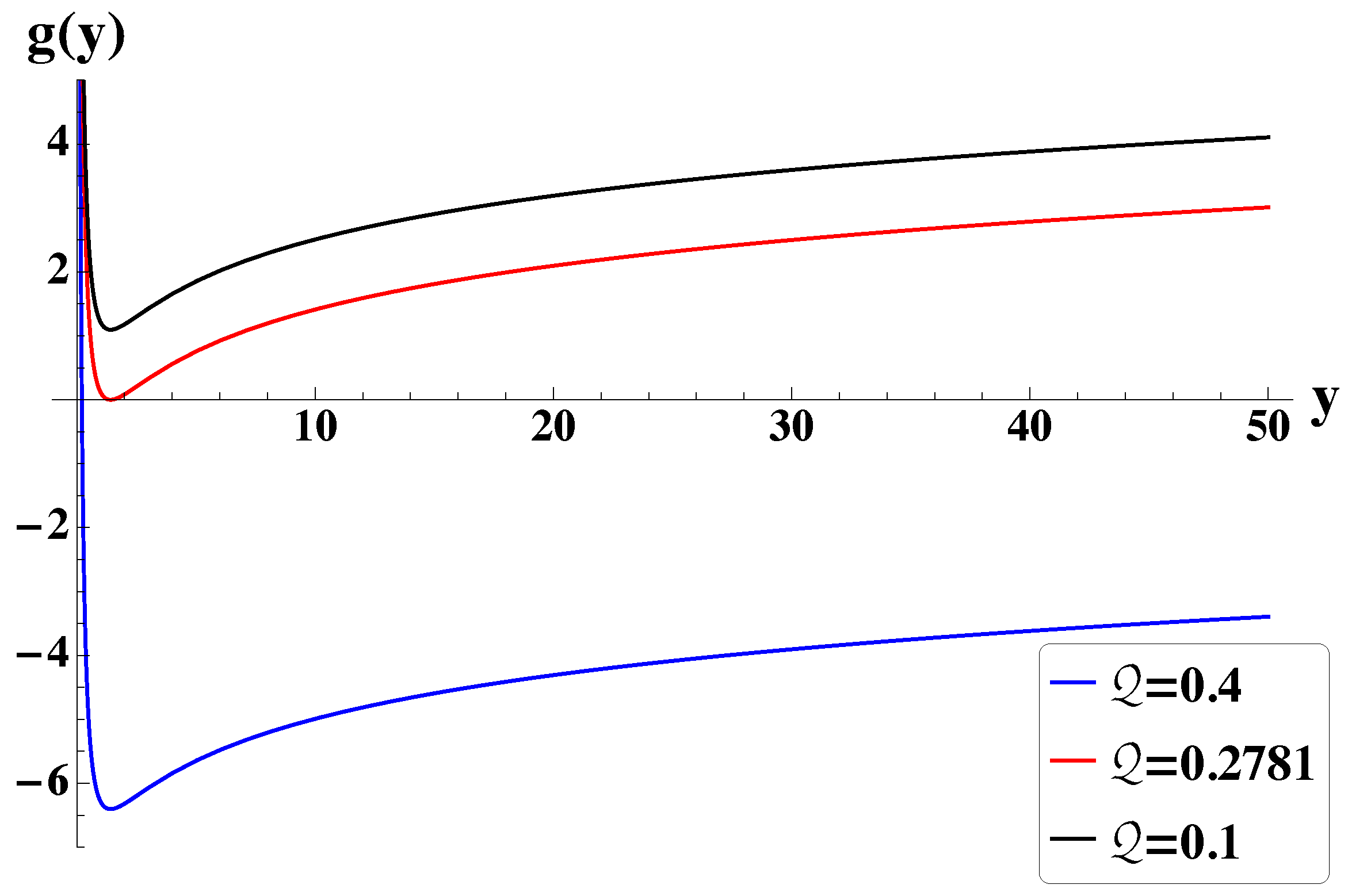
The interesting feature about
is that its profile closely resembles the Newtonian potential of the two-body problem, exhibiting exactly one saddle point for
. We display some exemplary plots of
g in
Figure 2. Considering the derivative of
g,
we have just one solution for
in the region
,
. In such cases,
is a minimum saddle point. As a consequence, if
the spacetime has precisely one horizon since
f has no stationary points. That condition defines the threshold charge of the black hole as
setting the upper bound of
,
aproximately
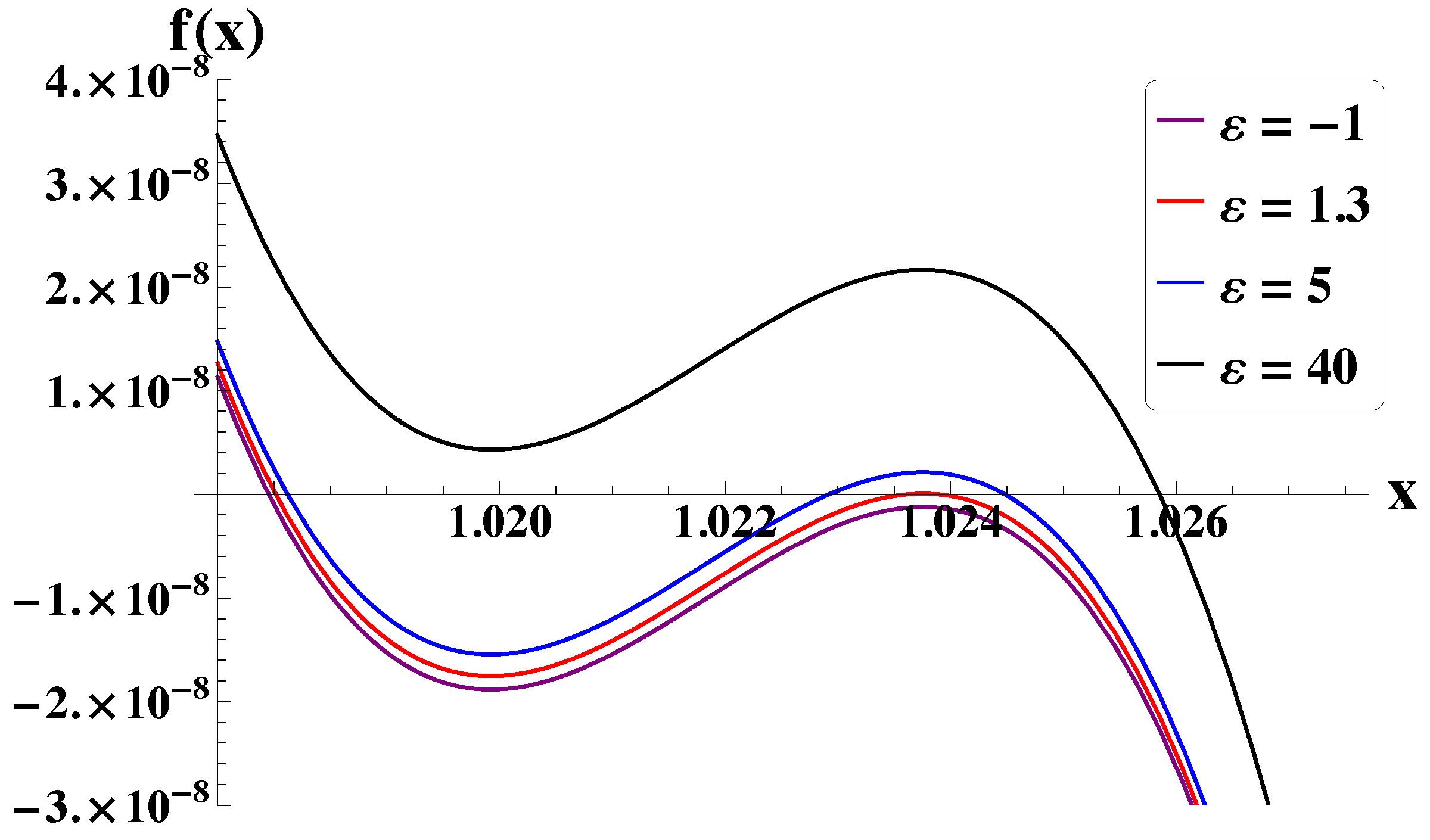
We display a panel with the near-extremal black hole considering the critical value of charge (and of cosmological term) in
Figure 3. Interestingly enough, the threshold for the Chaplygin solution is much smaller than that of a Reissner–Nordström spacetime
or of a Reissner–Nordström–de Sitter black hole
[
33].
The existence of two stationary points in
f settles the first condition for a three-horizon solution. In the threshold situation, one of those points must still coincide with a singular point of
f that can be written with (
27) and (
28) as
Equation (
34) can be also expressed as
and
Substituting
into (
35) and then the arcsinh term into (
33) we obtain
in which
.
is a third-order polynomial possessing three roots
expressed as
with
In the above expression, depending on the values of
and
we may have either
or
. In the first case, considering the expression (
40) we see that
, bringing as a consequence
and
and forbidding positive real solutions for
(except for the critical value
).
If
, the set of
renders three real roots, two of them positive, and a third negative, as we may demonstrate in what follows. With the definition of the new constants
we can write
and rewrite (
37)–(
39) as
Here, it is important to notice that, since
and
,
must be in
. Then the solutions (
44)–(
46) are constrained within
since
. The equation satisfies very nicely the Girard relations for the solutions of a cubic polynomial as expected. In the range
we have that
always and
as a consequence of
. This brings as a consequence that
and
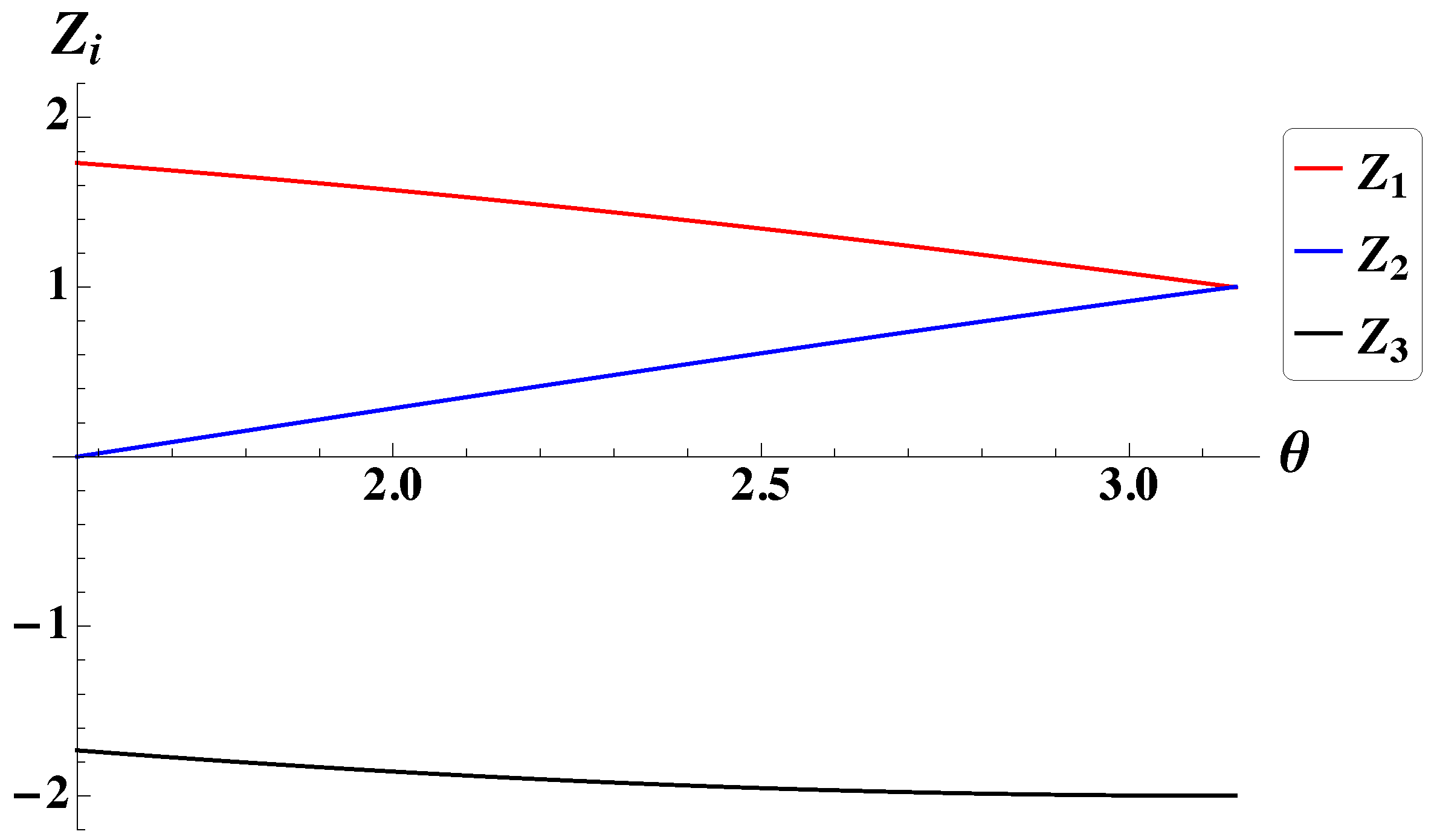
< 0. In
Figure 4, we display all
functions unraveling the critical point for the geometric parameters
and
: once
we have two horizons coalesced to a single
, defining the threshold for the geometry as
and
.
We apprehend the critical condition for the cosmological term as
representing the maximum value that
B can attain in the Chapligyn geometry, beyond which the spacetime presents only one horizon (cosmological). We display a quasi-extremal geometry for the lapse function in
Figure 3.
In the analysis we demonstrate the existence of two critical points beyond which the spacetime presents only one horizon, either cosmological, or, Cauchy . In both cases the asymptotic region, is dynamically defined by a negative lapse function, similar to that of a Reissner–Nordström–de Sitter black hole when the cosmological supersedes a critical value.
Both of the thresholds (
31) and (
47) represent the critical values above which the geometry is covered by only one horizon (cosmological). They cannot provide, however, the limits on
for a particular
or vice versa. The determination of each critical point relating
and
is achieved with the following procedure: choosing a particular
, the equation
provides exactly two solutions,
and
. In turn, those two solutions of
g when substituted as singular points of Equation (
27)
set the maximum and minimum values of
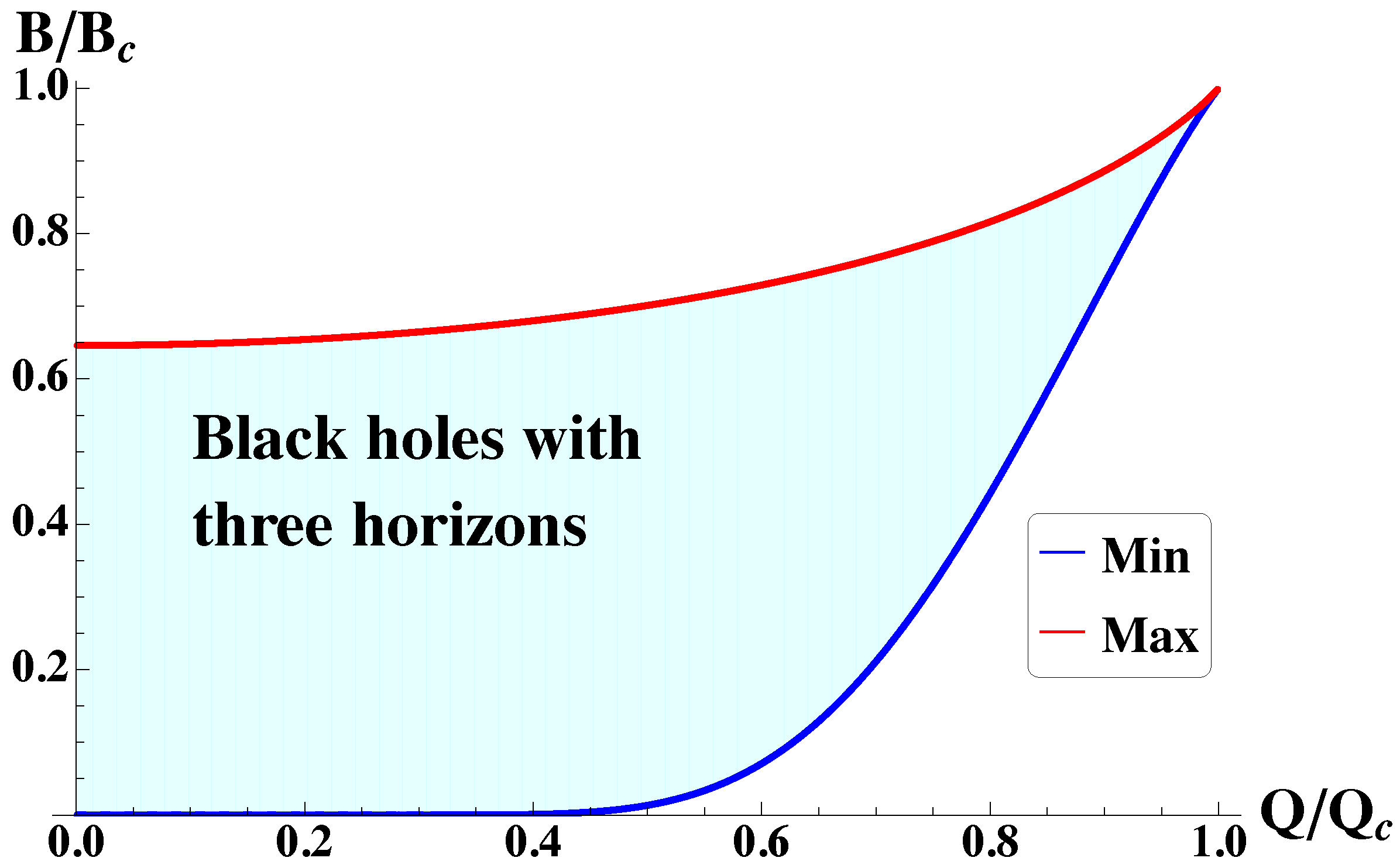
. Such a procedure can be performed only numerically and we provide a plot on the thresholds relating both properties for the existence of a three horizons black hole in
Figure 5.
In
Figure 5, we observe that for each value of
there exists a maximum and a minimum value of
for which the black hole solution remains physically acceptable, exhibiting three horizons. In contrast to its Reissner–Nordström–de Sitter counterpart, the Chaplygin solution requires a minimum value of
(associated with the cosmological term) in order to remain well-behaved.
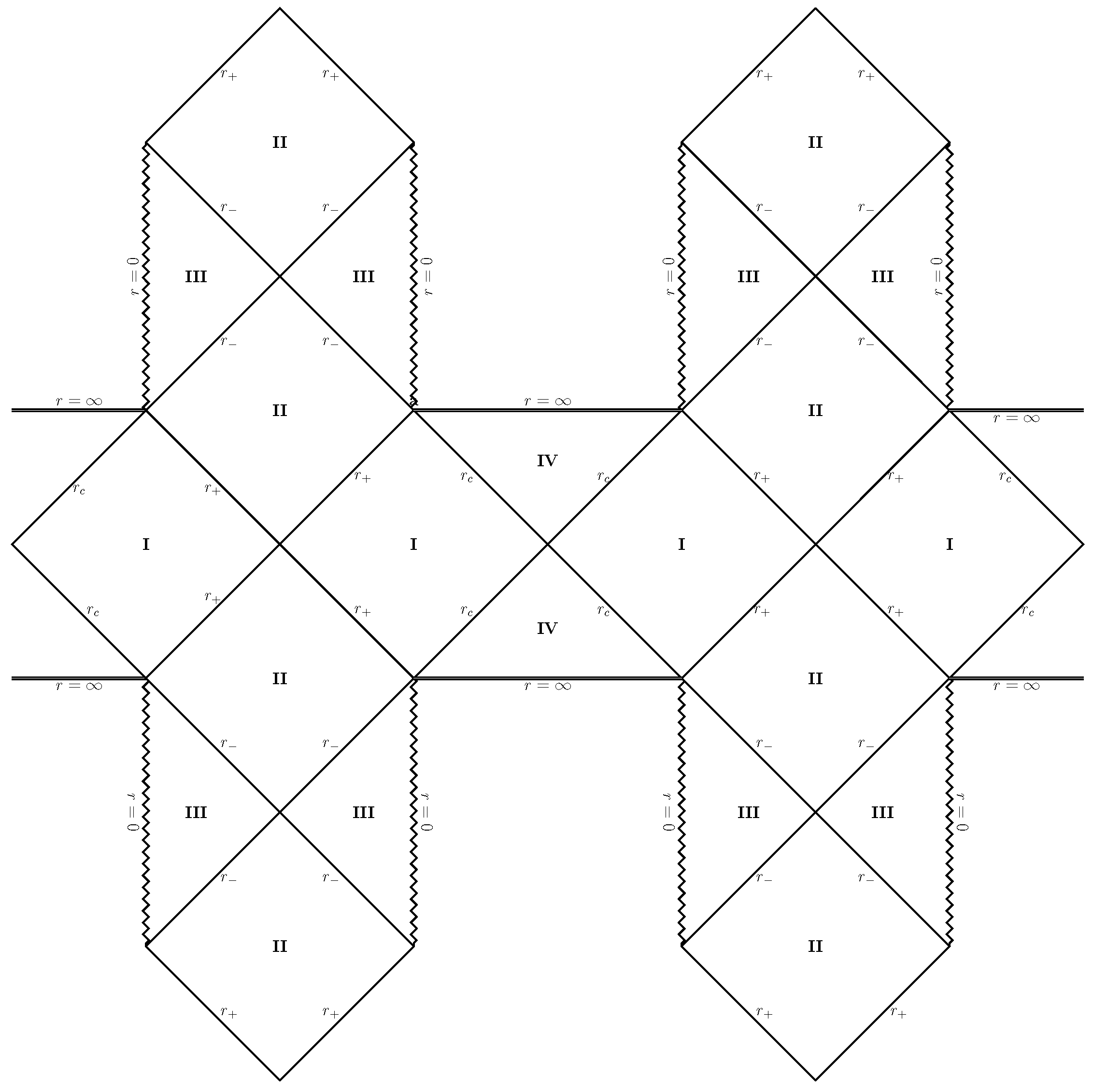
To conclude this section, we present the necessary formulae for a final panel showing a three-horizon Penrose diagram, which highlights the causally connected regions of the manifold endowed with the Chaplygin metric. We begin by rewriting the lapse function
given in Equation (
12) in terms of its three real positive roots
, which correspond, respectively, to the cosmological horizon, the event horizon, and the Cauchy horizon with
.
Since the singular points are restricted to
F and
presents no real solution, the important part of the tortoise coordinate
(that reveals its causal diagram) can defined as usual by
where
with
,
and
being the superficial gravity at Cauchy, event and cosmological horizons, respectively. So, the tortoise coordinate
reads
The complete profile of the tortoise coordinate can be obtained only numerically as
in which
are infinite polynomials of
r with no real singular points. For our purposes, those functions acquire numerical values in each part of the diagram and can be reincorporated in the gravity sufaces,
, turning it to the form of (
53).
From the tortoise coordinate, we introduce the usual double-null coordinates
We now perform an analysis of the geometry in the neighborhood of each horizon in order to construct the Kruskal-type extensions and the Penrose diagram.
Near the cosmological horizon , the lapse function can be written as
where the the plus sign means
and the minus sign
, suggesting the following set of Kruskal-type coordinates near the cosmological horizon:
where the plus sign refers to
and the minus to
, so
Following the same steps for neighborhoods of the event horizon
and Cauchy
To construct the Penrose diagram we introduce double-null coordinates adapted to each root
of the lapse function
. The compactification is then performed through
from which the Penrose coordinates are defined as
By matching the overlapping coordinate patches across the different horizons, the metric can be smoothly extended through them, allowing the construction of the conformal diagram. The resulting causal structure in
Figure 6 coincides with that of the Reissner–Nordström–de Sitter geometry, displaying an infinite sequence of regions separated by the Cauchy (
), event (
), and cosmological horizons (
), together with a time-like singularity located at
. Consequently, although the metric function is modified by the presence of the Chaplygin dark fluid, the global causal structure of the spacetime remains the same as that of the standard Reissner–Nordström–de Sitter solution.