When deriving the equations for the velocity, density, pressure, and accretion rate in our paper [
1], an unintentional error in taking the square root of
by
(the correct value would be
) led to erroneous conclusions regarding phantom accretion onto the objects under consideration. The list consists of Equations (28)–(30)
and (38)–(41)
As a consequence of this error, in the Abstract, the text “Our conclusion is that the mass of SBH due to phantom accretion decreases consistently with known results, while, in contrast, the mass of EBWH increases. Exactly an opposite behavior emerges for non-phantom accretion to these two objects.” must be changed to “Our conclusion is that the mass of SBH due to phantom and non-phantom accretion increases consistently with known results, while, in contrast, the mass of EBWH decreases.”.
The text after Equation (31) “For the accretion of quintessence, dust, and stiff matter to take place, we need to have , , while for the phantom matter, the behavior is the opposite, , , but for both cases, from Equation (20).” must be changed to “For the accretion of phantom, quintessence, dust, and stiff matter to take place, we need to have , , and from Equation (20).”.
The text after Equation (31) “The remarkable result is that, while the profiles and change depending on the values of and , the rate of change of central mass , being proportional to , depends only of the sign of since .” must be changed to “The remarkable result is that, while the profiles and change depending on the values of and , the rate of change of central mass , being proportional to , depends only of the sign of since .”.
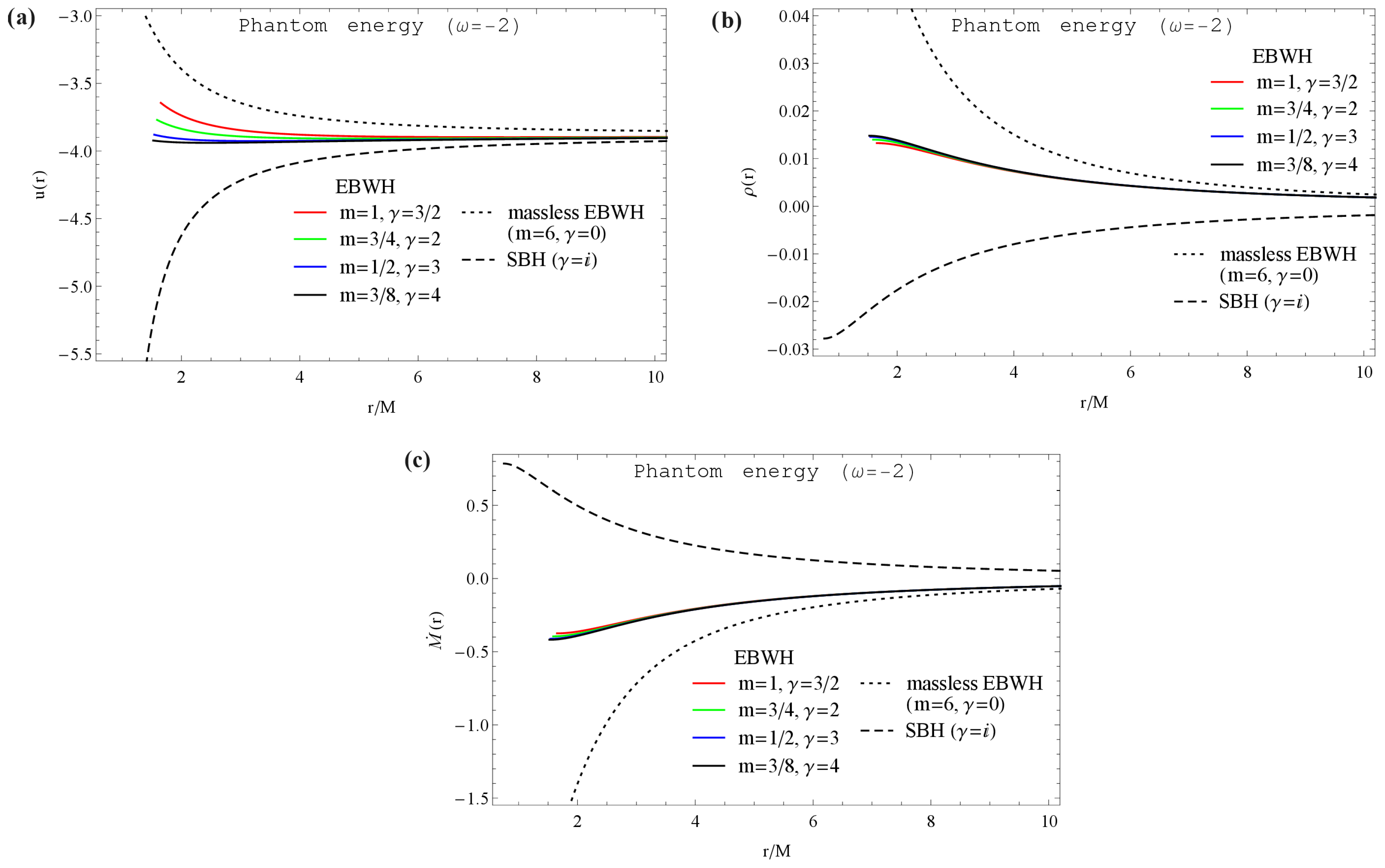
The text in Section 5 in indent 3 “On the other hand, although the profiles differ considerably in the vicinity of the sources for the same central mass , the EBWH velocity profiles remain lower than that of SBH at all radii, showing that the phantom matter also accretes to EBWH.” must be changed to “On the other hand, although the profiles differ considerably in the vicinity of the sources for the same central mass , the EBWH velocity profiles higher than that of SBH at all radii, showing that the phantom matter also accretes to EBWH.”.
The text in Section 5 in indent 4 “Figure 1b represents density profiles of phantom fluid. It is seen that the density of fluid accreting to EBWH is less than that accreting to SBH. In the case of massive EBWH, density increases in the vicinity of the throat (and horizon is case of SBH). In addition, lowering γ also lowers the density of flow. In contrast, near the throat of massless EBWH (), the density becomes minimum.” must be changed to “Figure 1b represents density profiles of phantom fluid. It is seen that the density of fluid accreting to EBWH is higher than that accreting to SBH. In the case of massive EBWH, density increases in the vicinity of the throat (and horizon is case of SBH). In addition, lowering γ also lowers the density of flow. In contrast, near the throat of massless EBWH (), the density becomes maximum.”.
The text in Section 5 in indent 5 “Figure 1c represents the rate of change of mass against the radial coordinate . As we can see, the accretion of phantom energy decreases the mass of SBH, since as a result of , , in perfect accordance with the conclusion in [27], but increases the mass of EBWH since as a result of . We can see from Figure 1c that the property is shared also by the Wheelerian mass of massless EBWH.” must be changed to “Figure 1c represents the rate of change of mass against the radial coordinate . As we can see, the accretion of phantom energy increases the mass of SBH, since as a result of , , but decreases the mass of EBWH since as a result of . We can see from Figure 1c that the property is shared also by the Wheelerian mass of massless EBWH.”.
The text in Section 5 in indent 8 “Most notably, an opposite picture emerges for the mass change due to non-phantom accretion defined by the signs of . The non-phantom flow has , so the only determining factor is . Figures 2c, 3c and 4c show that the non-phantom accretion increases the mass of SBH () but decreases the mass of EBWH ().” must be removed.
The text in Section 6 “While our analysis supports the known behavior of phantom accretion to BHs [20,27], the remarkable result we obtain is that the phantom matter accretion rate to WHs is exactly the opposite to that of BHs: phantom accretion decreases the mass of SBH consistently with known results, while in contrast, the mass of EBWH increases. Accretion to massless EBWH (meaning accretion to its nonzero Wheelerian mass) shares the same patterns as those of the massive EBWH; hence, there is no way to distinguish massive and massless objects by means of accretion flow. However, non-phantom accretion (quintessence, dust, stiff matter) to EBWH shares the same behavior of mass variation as that of BHs. We conclude that the above contrasting behavior of accretion could be the physical signatures of the distinct topologies of the accreting central objects.” must be changed to “While our analysis supports the known behavior of phantom accretion to BHs [20,27], the remarkable result we obtain is that the matter accretion rate to WHs is exactly the opposite to that of BHs: phantom and non-phantom (quintessence, dust, stiff matter) accretion increases the mass of SBH consistently with known results, while in contrast, the mass of EBWH decreases. Accretion to massless EBWH (meaning accretion to its nonzero Wheelerian mass) shares the same patterns as those of the massive EBWH; hence, there is no way to distinguish massive and massless objects by means of accretion flow. We conclude that the above contrasting behavior of accretion could be the physical signatures of the distinct topologies of the accreting central objects.”.
Figure 1 must be changed.
Figure 1.
Velocity profile (a), energy density (b) of phantom energy () and rate of change of mass (c) of EBWH versus for different values of and m, which satisfies . For illustration, we used the set of constants , and .
Figure 1.
Velocity profile (a), energy density (b) of phantom energy () and rate of change of mass (c) of EBWH versus for different values of and m, which satisfies . For illustration, we used the set of constants , and .