Article

Next-Generation Gravitational Redshift Tests Simulated Using an Optical Link and a High-Precision Cesium Atomic Clock in Space


by
Abdelrahim Ruby
1,2,3,
Wenbin Shen
1,2,*,
Ahmed Shaker
3,
Pengfei Zhang
2,
Kuangchao Wu
4,
Mostafa Ashry
5 and
Ziyu Shen
6
1
State Key Laboratory of Information Engineering in Surveying, Mapping and Remote Sensing, Wuhan University, Wuhan 430079, China
2
Time and Frequency Geodesy Center, School of Geodesy and Geomatics, Wuhan University, Wuhan 430079, China
3
Geomatics Engineering Department, Faculty of Engineering at Shoubra, Benha University, Cairo 11629, Egypt
4
School of Surveying and Land Information Engineering, Henan Polytechnic University, Jiaozuo 454000, China
5
Civil Engineering Department, Faculty of Engineering, Minia University, Minia 61111, Egypt
6
School of Resource, Environmental Science and Engineering, Hubei University of Science and Technology, Xianning 437100, China
*
Author to whom correspondence should be addressed.
Universe 2026, 12(3), 82; https://doi.org/10.3390/universe12030082
Submission received: 3 February 2026 / Revised: 5 March 2026 / Accepted: 12 March 2026 / Published: 15 March 2026
(This article belongs to the Section Gravitation)

Abstract

The Atomic Clock Ensemble in Space (ACES) mission, currently operating aboard the International Space Station (ISS), is designed to provide high-precision time and frequency measurements and to test fundamental aspects of relativistic physics. Gravitational redshift (GRS), a fundamental prediction of General Relativity (GR), implies that clocks positioned at different gravitational potentials experience relative time dilation. Previous GRS experiments have focused primarily on microwave technologies, with negligible experimental coverage in the optical domain, particularly for ground-to-space links. Motivated by the European Laser Timing (ELT) experiment and the high-precision laser-cooled cesium clock aboard ACES, we introduce and evaluate an optical time-transfer method designed to achieve high-accuracy measurements of GRS. In the absence of actual ELT/ACES optical data, a high-fidelity numerical simulation framework was developed to assess the performance of this method. The framework incorporates representative ELT/ACES mission parameters, including the space-based cesium clock and the H-MASER clock located at the reference ground station, both providing frequency stability at the level of 10 15 for 1000 s averaging time. Applying a ± 1 σ filtering criterion, we obtain a simulated dataset comprising 33 ELT/ACES passes, representing a total observation time of 4.38 h over a single week. Analysis of this high-fidelity dataset reveals a GRS deviation from GR of ( 7.19 ± 0.63 ) × 10 5 , achieving a 3.4 orders of magnitude improvement over the best previous laser-ranging experiment conducted at the University of Maryland (UMD), USA, 51 years ago. These simulation results demonstrate that the optical time-transfer link constitutes a powerful tool for testing fundamental physics and, when combined with next-generation optical atomic clocks, enables unprecedented capabilities in space-based timekeeping and geoscience applications.

1. Introduction

The ACES mission [1,2,3] encountered significant programmatic delays in the early 2020s, mainly due to technical challenges and broader operational disruptions. The mission was ultimately launched on 21 April 2025 and successfully installed on the external Columbus module of the International Space Station (ISS). The ACES payload incorporates two ultra-stable reference clocks and employs two time and frequency transfer links operating in the microwave and optical domains. The long-term accuracy and stability of the onboard timescale are provided by the cold-atom cesium clock PHARAO (Projet d’Horloge Atomique par Refroidissement d’Atomes en Orbite), whereas the short-term stability is ensured by an onboard space hydrogen maser (SHM). Comparisons between the PHARAO and SHM timescales and those of ground-based reference stations are enabled through a two-way microwave link [4,5,6] and the ELT experiment [7]. The SHM achieves exceptional short-term frequency stability, reaching 7.9 × 10 14 at 1 s and approaching a stability limit of 1.5 × 10 15 at 10 4 s. In contrast, the PHARAO cold-atom cesium clock exhibits a frequency stability of 1.1 × 10 13 / τ , where τ is the integration time in seconds, and a long-term accuracy of 1.1 × 10 16 [8]. This configuration allows it to provide high-precision synchronization between ground and space clocks, with instability and inaccuracy at the ( 1 2 )   ×   10 16 level, facilitating stringent tests of fundamental relativistic physics and advanced space-based metrology experiments, while simultaneously supporting a wide range of applications in geoscience and Earth observation [3].
Thus, the ACES mission provides ideal conditions for testing GR [9,10,11], proposed by Albert Einstein in 1915, owing to the exceptional precision and stability of its onboard clocks [12]. GRS is a key prediction of GR, dictating that clocks experience time dilation when situated at different gravitational potentials [13,14]. Additionally, the GRS arises from the Einstein Equivalence Principle (EEP), which encompasses the universality of free fall, local Lorentz invariance, and local position invariance. The deviation parameter α provides a phenomenological measure of departures from GR predictions and can be interpreted within specific alternative theories of gravity, such as scalar–tensor frameworks like Brans–Dicke-type models [10,15] or dilaton-field scenarios, where violations of local position invariance naturally yield non-zero α . It should be emphasized that α is an effective parameter: while convenient and widely used to compare experiments and constrain broad classes of theories, it does not represent the most general possible modification of GR. This context clarifies the theoretical scope and limitations of α and highlights how existing measurements provide meaningful constraints on well-known alternative gravity models. In a practical GRS experiment using atomic clocks and formulated in the time domain, the primary objective is to detect deviations between the observed elapsed proper time and the theoretically predicted proper time due to relativistic effects [14].
Consider the comparison of two nominally identical, highly stable atomic clocks: a space clock, denoted by S, and a ground-based clock, denoted by G. Before launch, both clocks are co-located at the ground station hosting clock G, where they are calibrated side by side under identical environmental and operational conditions [16,17,18]. Following this initial synchronization and calibration phase, once clock S is deployed in orbit, any observed time deviations between clocks S and G are expected to originate predominantly from relativistic effects, as predicted by GR.
Theoretical expression for the relativistic time offset between the space clock S and the ground clock G is given by [13,17]:
Δ τ GS ( t ) = ( 1 + α ) path Δ U GS ( t ) c 2 + Δ v GS 2 ( t ) 2 c 2   d t
where Δ τ GS ( t ) denotes the observed proper-time difference between the ground clock G and the space clock S. The parameter α is a dimensionless violation parameter characterizing deviations from General Relativity (GR), with α = 0 corresponding to exact agreement with GR, and c denotes the speed of light in vacuum. The terms Δ U GS ( t ) and Δ v GS 2 ( t ) represent the gravitational potential difference and the relative squared velocity difference between clocks S and G, respectively. The infinitesimal element d t represents a differential increment of a common coordinate time t in the chosen reference frame (e.g., the Earth-Centered Earth-Fixed frame), which allows the positions and velocities of both clocks S and G to be evaluated synchronously at each instant. This ensures that the integral accumulates the differences Δ U GS ( t ) and Δ v GS 2 ( t ) along the same timeline, despite the clocks following different spatial trajectories. For consistency, the chosen coordinate system is described in Section 3.2.
In Equation (1), the first term inside the integral accounts for the GRS, while the second term represents the second-order Doppler effect associated with special-relativistic time dilation. Assuming that the second-order Doppler contribution is correctly modeled and independently validated, the GRS constitutes the primary relativistic effect under investigation in this study and is parameterized by the violation parameter α . In experiments, the accumulated proper-time difference Δ τ GS ( t ) is accessed by measuring the fractional frequency shifts between the clocks and integrating these shifts over time, thereby providing a direct link between the theoretical expression and the observable clock data.
During the past decades, GRS experiments have employed various methodologies, progressively improving the precision with which the violation parameter α is constrained [13,14,19]. More recently, theoretical proposals have explored the interplay between quantum mechanics and GRS using advanced atomic clock systems [20,21,22]. These approaches include quantum clocks in gravitational potentials, clock networks for distributed time comparisons, and atom interferometric schemes sensitive to relativistic quantum phases. Such proposals extend beyond classical tests by probing quantum coherence in gravitational fields and leveraging entanglement-enhanced measurements of time dilation, thereby opening avenues for testing quantum aspects of gravity.
The development of advanced atomic clocks and high-accuracy time–frequency transfer techniques has further enhanced the sensitivity of these measurements. Notably, recent ground-based optical lattice clock experiments have achieved fractional frequency sensitivities at or below the 10 18 level [23], representing the current state of the art in resolving gravitationally induced frequency shifts. Although these experiments are not space-based, they provide an important benchmark for precision and illustrate the potential impact of improved clock performance on tests of GRS. The violation parameter α quantifies deviations from the general-relativistic prediction of the gravitational redshift, and the achievable uncertainty on α scales directly with the precision of the measured fractional frequency shift and the magnitude of the gravitational potential difference probed. This explicit connection clarifies how advances in clock performance translate into tighter constraints on α , independent of the experimental platform.
For the space experiment, the GREAT (Galileo Gravitational Redshift Test with Eccentric sATellites) experiment utilized Galileo satellites launched on 22 August 2014. Analysis of the satellite GSAT0201 over 359 days yielded a deviation parameter of α = ( 0.77 ± 2.73 ) × 10 5 , while that of GSAT0202 over 649 days showed α = ( 6.75 ± 5.62 ) × 10 5 [24]. By combining data from both Galileo satellites over a total duration of 1008 days, the precision was further improved to α = ( 0.19 ± 2.48 ) × 10 5 [25]. Both GSAT0201 and GSAT0202 satellites are equipped with passive hydrogen maser (PHM) clocks. At an averaging time of 10 4 s, their fractional frequency stabilities are 1.62 × 10 13 and 3.22 × 10 13 , respectively. The GREAT clocks are periodically steered back to their nominal frequencies; however, the resulting frequency retrace corresponds to a timing accuracy no better than 0.18 μ s d 1 [24,26]. Another recent example is the China Space Station (CSS), launched in October 2022, which features an advanced strontium optical lattice clock with a stability of 2.6 × 10 15 / τ and an accuracy at the 10 17 level [27]. Simulated 40-day experiments using a microwave two-way frequency link in combination with a ground-based optical clock with a stability of 1 × 10 15 / τ predict that the CSS could achieve a deviation parameter as low as α = ( 0.26 ± 4.89 ) × 10 7 [28].
In the context of ACES, simulation studies of microwave time–frequency transfer links indicate the potential to test the GRS with an accuracy at the level of 10 6 [6,29,30]. Beyond ACES, several dedicated and proposed space missions have pursued comparable or improved sensitivities. The Space-Time Explorer and Quantum Equivalence Space Test (STE-QUEST) mission aims to achieve an accuracy of 10 7 in redshift measurements [31]. The RadioAstron space radio telescope is expected to reach a precision of approximately 10 5 [32], while the VERITAS (Venus Emissivity, Radio Science, InSAR, Topography, and Spectroscopy) mission targets accuracy on the order of 10 6 [33].
While most previous space-based GRS experiments have relied on microwave links for frequency comparison, the use of optical techniques for space-based high-precision time comparison remains relatively limited. It is important to note that high-precision ground-based optical clock comparisons [23,34,35] have already provided stringent tests of the GRS; however, such experiments are fundamentally different from ground-to-space GRS measurements.
Optical time-transfer links [36,37,38] offer several intrinsic advantages, including reduced sensitivity to ionospheric disturbances, improved resilience to atmospheric propagation delays, higher modulation bandwidths, enhanced timing accuracy, and unambiguous signal interpretation. Although such systems face practical challenges, most notably weather dependence and the substantial infrastructure requirements of the ground segment, optical time transfer has the potential to improve measurement precision by one to two orders of magnitude relative to conventional microwave-based methods [39,40,41,42].
The first laser-ranging-based experiment to verify GR through tests of GRS and time dilation using atomic clocks was conducted in 1975 by Professor Carroll Alley (1927–2016) and his team at the UMD, USA. These experiments were conducted at the Patuxent Naval Air Test Center using a Navy P-3C anti-submarine patrol plane, a military version of the Lockheed Electra, capable of staying aloft for 15–16 h continuously at altitudes up to 10,700 m. The aircraft was deliberately operated at as low a speed as possible to maximize the relativistic potential effect, which was the main objective of the experiments. However, the plane could not fly safely below approximately 200 knots (0.103 km s−1) due to stall constraints at high altitudes. This speed is measured relative to the ground station in the Earth-Centered Earth-Fixed (ECEF) frame, where the ground clock velocity is effectively zero, and it minimizes the second-order Doppler term Δ v GS 2 ( t ) / ( 2 c 2 ) in Equation (1).1 The UMD experiment achieved an accuracy corresponding to a deviation parameter of α = ( 1.30 ± 1.6 ) × 10 2 [17]. These results were derived from 15 individual measurements obtained during five dedicated flight campaigns using a military aircraft. During each flight, stepwise altitude changes were performed at approximately 7.62 km, 9.14 km, and 10.67 km. Each campaign employed three cesium atomic clocks onboard the aircraft and three identical reference clocks on the ground, all exhibiting a frequency stability of 2 × 10 14 per day.
Recent advancements in free-space optical time-transfer links, such as the Chinese Laser Timing (CLT) payload aboard the CSS mission [43], now employ onboard optical clocks with stability and accuracy reaching 10 17 , enabling GRS tests up to four orders of magnitude more precise than the original UMD experiments [44]. Motivated by the ELT experiment and the high-precision laser-cooled cesium clock onboard the ACES mission, we propose and rigorously evaluate an optical time-transfer approach specifically designed to enable ultra-high-accuracy measurements of the GRS. The ELT/ACES configuration is expected to achieve sub-picosecond-level time synchronization between ground-based reference laser stations and the ACES payload. At the time considered in this study, the ELT/ACES mission was still in its commissioning and testing phase, and the operational laser time-transfer chain had not yet been fully established. Consequently, no validated in-orbit ELT/ACES experimental data were available for scientific analysis.
To address this limitation, we developed a high-fidelity numerical simulation framework based on a two-way laser time-transfer link to assess the achievable performance of optical GRS measurements. These simulations are fully consistent with the expected mission configuration and performance, providing a realistic evaluation of the experiment’s potential capabilities. Importantly, this simulation framework serves as a critical preparatory tool for upcoming real data from the ACES/ELT mission (still in its early operational phase as of 2026), allowing researchers to refine analysis techniques, identify potential challenges in optical time transfer, and establish performance benchmarks ahead of actual observations. Analysis of the simulated data demonstrates that the resulting constraint on the GRS deviation parameter exceeds that of the landmark 1975 UMD airborne experiment by approximately 3.4 orders of magnitude, highlighting the superiority of optical methods over traditional microwave approaches.
These results underscore the substantial potential of laser timing experiments to advance fundamental physics, support relativistic geodesy, and enable next-generation space-based scientific measurements. Specifically, relativistic geodesy exploits the GRS predicted by GR to determine differences in the Earth’s gravitational potential (geopotential) through high-precision clock comparisons. Such approaches enable precise determination of geopotential and orthometric heights, facilitate the unification of global height systems [28,45], and contribute to enhanced geoid modeling and the integration of digital elevation models for regional applications [46,47]. Overall, even as a simulation-based study, this work provides immediate value by demonstrating the optical method’s capability to significantly outperform earlier experiments and by offering a robust framework to guide the analysis of future ELT/ACES observations.
This paper is organized as follows. Section 2 introduces the optical space link and the associated time and frequency reference systems, with particular emphasis on the ACES time and frequency reference system and the ELT experiment. Section 3 presents the methodology for testing the gravitational redshift, including the initial clock behavior for redshift estimation, the redshift estimation formulation, the optical time-transfer and synchronization model, and a detailed analysis of error sources affecting laser time-transfer links. Section 4 describes the simulation framework and experimental scenarios, covering data simulation, orbit modeling, optical time-delay modeling, and noise contributions in the optical link. Section 5 analyzes the expected stability and sensitivity of the optical gravitational redshift measurement, including an assessment of the achievable measurement uncertainty. Finally, Section 6 summarizes the main findings and discusses their implications and perspectives for future high-precision gravitational redshift experiments.

2. Space Link and Time Reference Systems

The International Space Station (ISS) provides a unique platform for microgravity and space-based scientific research. Orbiting the Earth at altitudes between 370 and 460 km with an inclination of 51.6 , the ISS completes approximately 15.5 revolutions per day, covering nearly 90% of the populated regions of the planet [48]. This orbital configuration enables a wide range of experiments, including tests of general relativity, investigations of potential variations in fundamental physical constants, and high-precision time and frequency metrology. Within this framework, the ACES mission, launched aboard the ISS on 21 April 2025, represents a major step toward space-based relativistic clock comparisons. In the following, we summarize the key specifications and performance metrics of the ACES clocks and time-transfer system, which are consolidated in Table 1.

2.1. ACES Time and Frequency Reference System

The ACES payload integrates two ultra-stable atomic clocks and dual time- and frequency-transfer links operating in the microwave and optical domains. The primary frequency standard is PHARAO, a laser-cooled cesium clock developed by CNES with contributions from SYRTE and LKB. PHARAO provides the long-term accuracy reference for ACES, while short-term stability and continuity are ensured by the onboard space hydrogen maser (SHM), which serves as a flywheel oscillator.
Rather than repeating detailed stability and accuracy figures already introduced earlier, the key performance benchmarks of PHARAO and SHM relevant to this study are summarized in Table 1. The present analysis assumes these clocks operate at their nominal in-orbit performance levels and focuses on their role within the ground-to-space optical time-transfer experiment.

2.2. European Laser Timing (ELT) Experiment

The ELT experiment is the optical time-transfer component of ACES, developed by the Czech Technical University in Prague. ELT enables two-way optical time transfer between the ISS and ground stations via Satellite Laser 266 Ranging (SLR) techniques [6,7,49], supporting high-precision clock comparisons and relativistic experiments.
For the purposes of this work, ELT is treated as a calibrated optical link providing picosecond-level timing observables between the ACES timescale and ground clocks. Detailed hardware descriptions and pre-flight performance characterizations are therefore omitted here and replaced by the summary parameters listed in Table 1.
In common-view operation, ELT contributes an estimated timing uncertainty of 4.24 ps, leading to an overall end-to-end time-transfer uncertainty of 5 ps when combined with other system contributions [50]. This level of performance is sufficient for the gravitational redshift analysis presented in the following sections.
Table 1. Key Specifications and Performance Metrics of the ACES Clocks and Time-Transfer System.
SystemTypeStabilityUncertaintyReference
PHARAOCs cold-atom clock 1.1 × 10 13   τ 1 / 2 1.1 × 10 16 [8]
SHMSpace H-maser 7.9 × 10 14 @ 1 s 10 15 [1,51]
MWLMicrowave link1 ps @ 1 day 10 16 [2,51]
ELTOptical SLR link1 ps @ 1 day∼50 ps[50,51]

3. Methodology for Gravitational Redshift Test

3.1. Clock Behavior Prior to Gravitational Redshift Estimation

We consider the comparison of two nominally identical and highly stable atomic clocks: a space clock, denoted by S, and a ground-based clock, denoted by G. The proper times of each clock are affected by their local environments. Clock G is influenced by factors such as hardware imperfections, minor temperature fluctuations, electromagnetic interference, and a stronger local gravitational potential, all of which tend to slow the clock frequency [52]. In contrast, clock S is sensitive to radiation, microgravity, and temperature variations, particularly in high-radiation regions such as the South Atlantic Anomaly [53,54]. These environmental and operational effects induce deviations in the measured proper times, which directly affect synchronization.
Prior to launch of clock S, both clocks are co-located at the ground station hosting clock G, where they are calibrated side-by-side under identical environmental and operational conditions [16,17,18]. This procedure eliminates intrinsic differences between the clocks, such as manufacturing tolerances, long-term aging effects, or internal hardware offsets, and minimizes external perturbations related to radiation, magnetic fields, temperature, pressure, and other environmental factors in the subsequent ground-to-space comparison. Consequently, while the clocks experience distinct environmental influences once separated, the pre-launch co-location and calibration effectively suppress shared instrumental biases, ensuring that the measured rate differences post-deployment are dominated by relativistic effects, including gravitational redshift and kinematic time dilation. Residual non-relativistic noises, arising from radiation, temperature variations, or orbital modeling uncertainties, are quantified and corrected using established numerical and physical models [24,55,56,57,58], thereby preserving the validity of the relativistic attribution. In this study, we consider an idealized scenario in which the two clocks are assumed to be perfectly calibrated, with no initial time offset or calibration error. Residual random phase noise, which is not directly measurable, is incorporated into the numerical models described below.

3.2. Redshift Estimation Formulation

Clock synchronization critically depends on the adopted space–time coordinate system [59,60,61,62]. In this study, a rotating Earth-Centered Earth-Fixed (ECEF) reference frame, aligned with the Earth’s surface, is adopted, with Universal Time Coordinated (UTC) used as the time coordinate for gravitational redshift estimation.
In the weak-field, slow-motion approximation of General GR, applicable to the low-orbit regime of the ACES mission where gravitational fields are weak and velocities are c , the relationship between proper time and coordinate time is described by the following expression [63]:
d τ d t 1 = U c 2 v 2 2 c 2 + O ( c 3 ) ,
where d τ and d t denote infinitesimal increments of proper time and coordinate time (i.e., UTC), respectively; U = U E + V is the total Newtonian gravitational potential, consisting of the Earth’s gravitational potential U E and tidal contributions V from external celestial bodies (e.g., the Moon, Sun, and planets), with the centrifugal potential explicitly excluded ( U 0 ); and v is the coordinate velocity of the clock. Higher-order terms O ( c 3 ) have been previously analyzed [61,64] and are negligible for measurements with uncertainties greater than 1 × 10 16 .
For space missions like ACES, targeting instabilities and inaccuracies at the 1 × 10 16 level, the Earth’s gravitational potential at radial distance r, geocentric latitude ϕ , and longitude λ is a solution to Laplace’s equation, 2 U = 0 , and can be expressed as a series expansion in spherical harmonics [65,66]:
U E ( r , ϕ , λ ) = G M E r n = 2 R E r n m = 0 n C ¯ n m cos ( m λ ) + S ¯ n m sin ( m λ ) P ¯ n m ( sin ϕ ) ,
where n and m denote the spherical harmonic degree and order, respectively; C ¯ n m and S ¯ n m are normalized geopotential coefficients; P ¯ n m are normalized associated Legendre functions; G M E is the Earth’s gravitational parameter; and R E is the reference Earth radius.
Tidal perturbations from external celestial bodies, primarily the Moon and Sun, must also be considered. Among these, solid Earth tides are the most significant, arising from differential gravitational attraction and deforming the Earth’s surface by tens of centimeters daily [67]. The tidal potential at an arbitrary location ( r , ϕ , λ ) and epoch t, generated by external bodies j, is expressed as [68]:
V ( t ) = j G M j n = 2 r n r j   n + 1 P n ( cos θ j ) ,
where G M j and r j are the gravitational parameter and geocentric distance of body j, r is the geocentric distance to the computation point, θ j is the geocentric zenith angle between the point and the body, and P n is the Legendre polynomial of degree n. Detailed calculation methods are provided in [67,69]. In the subsequent analysis, these spherical-harmonic expansions are used to compute gravitational potential differences along the satellite orbit and at the ground station, which then serve as inputs to the gravitational redshift model and the evaluation of the deviation parameter α . In numerical implementations, the series is truncated at a finite degree and order sufficient to achieve the desired accuracy.
With respect to an ideal reference clock at rest in zero gravitational potential, the fractional frequency shift between the space clock S and ground clock G, using Equation (2), is:
d τ S d t d τ G d t = U S U G c 2 V S V G c 2 v S 2 v G 2 2 c 2 ,
where d τ G / d t and d τ S / d t are the rates of proper time relative to coordinate time at clocks G and S, respectively. The first term corresponds to the gravitational redshift, the second term accounts for tidal perturbations, and the third term represents kinematic time dilation due to relative velocities.
Integrating Equation (5) over a coordinate time interval [ t 0 , t ] yields the accumulated proper-time difference:
t 0 t d τ S d t d τ G d t d t = [ τ S ( t ) τ G ( t ) ] [ τ S ( t 0 ) τ G ( t 0 ) ] .
Defining Δ τ G S ( t ) = τ S ( t ) τ G ( t ) , the accumulated proper-time difference can be expressed as:
Δ τ G S ( t ) = Δ τ 0 ( t 0 ) t 0 t U S U G c 2 d t t 0 t V S V G c 2 d t t 0 t v S 2 v G 2 2 c 2 d t ,
where Δ τ 0 ( t 0 ) is the initial clock offset.
Following standard conventions for testing general relativity, Equation (1) can be used to introduce a phenomenological parameter α quantifying potential deviations from the predicted gravitational redshift, as follows:
Δ τ G S ( t ) = Δ τ 0 ( t 0 ) ( 1 + α )   t 0 t Δ U G S ( t ) c 2   d t t 0 t Δ V G S ( t ) c 2   d t t 0 t Δ v G S 2 ( t ) 2 c 2   d t
where Δ U G S = U S U G , Δ V G S = V S V G , and Δ v G S 2 = v S 2 v G 2 . From (8), the relationship between the observed elapsed proper-time difference and its theoretical prediction can be expressed as:
Δ τ obs ( t ) = Δ τ 0 ( t 0 ) + α   Δ τ m ( t ) ,
with
Δ τ obs ( t ) = Δ τ G S ( t ) + t 0 t Δ U G S ( t ) c 2 d t + t 0 t Δ V G S ( t ) c 2 d t + t 0 t Δ v G S 2 ( t ) 2 c 2 d t ,
Δ τ m ( t ) = t 0 t Δ U G S ( t ) c 2 d t .
where Δ τ obs ( t ) denotes the cumulative observed proper-time difference obtained from the optical time-transfer measurement, while Δ τ m ( t ) represents the cumulative proper-time difference predicted by theoretical or modeled computations between the two clocks. In the context of this simulation, Δ τ obs ( t ) represents the expected value constructed from simulated optical time-transfer measurements and modeled corrections, rather than a direct numerical observation. The primary objective of this study is the determination of the violation parameter α . Within the framework of GR, Equation (8) predicts α = 0 . Any statistically significant deviation from this value would thus provide evidence for a potential departure from the gravitational redshift predicted by GR.
The parameters Δ τ 0 and α are estimated using a mean-centered linear least-squares regression [70]. Defining the model in matrix form for n observations:
Y = X β + ϵ ,
where Equation (12) represents a (generally overdetermined) linear system, with n > 2 , solved in the ordinary least-squares sense.
Here,
Y = Δ τ obs ( t 1 ) Δ τ obs ( t 2 ) Δ τ obs ( t n ) , X = Δ τ m ( t 1 ) 1 Δ τ m ( t 2 ) 1 Δ τ m ( t n ) 1 , β = α Δ τ 0 , ϵ = ϵ ( t 1 ) ϵ ( t 2 ) ϵ ( t n ) .
The least-squares solution is
β ^ = ( X T X ) 1 X T Y ,
which follows from minimizing the sum of squared residuals ϵ 2 under the assumption that X has full column rank. The solution cannot be written as β = X 1 Y because the design matrix X is generally rectangular and therefore not directly invertible.
The corresponding covariance matrix of the parameter estimates is
cov ( β ) = σ 0 2 ( X T X ) 1 = σ α 2 σ α Δ τ 0 σ α Δ τ 0 σ Δ τ 0 2 ,
where σ 0 2 is the noise variance estimated from the residuals:
σ 0 2 = 1 n 2 i = 1 n ( Y i Y ^ i ) 2 .
where Y ^ i denotes the estimated (predicted) value of the i-th observation obtained from the fitted linear model, i.e., the i-th component of the vector X β ^ . This notation clearly distinguishes the observed quantities Y i , the model predictions Y ^ i , and the corresponding residuals = Y i Y ^ i , ensuring consistency throughout Equations (12)–(16).
The uncertainties and correlation coefficient of the estimated parameters are
σ Δ τ 0 = σ Δ τ 0 2 , σ α = σ α 2 , ρ = σ α Δ τ 0 σ α   σ Δ τ 0 .
To improve robustness across multiple ELT/ACES passes, individual estimates of Δ τ 0 and α are combined using weighted averages with corresponding weighted standard deviations.

3.3. Optical Time-Transfer and Synchronization Model

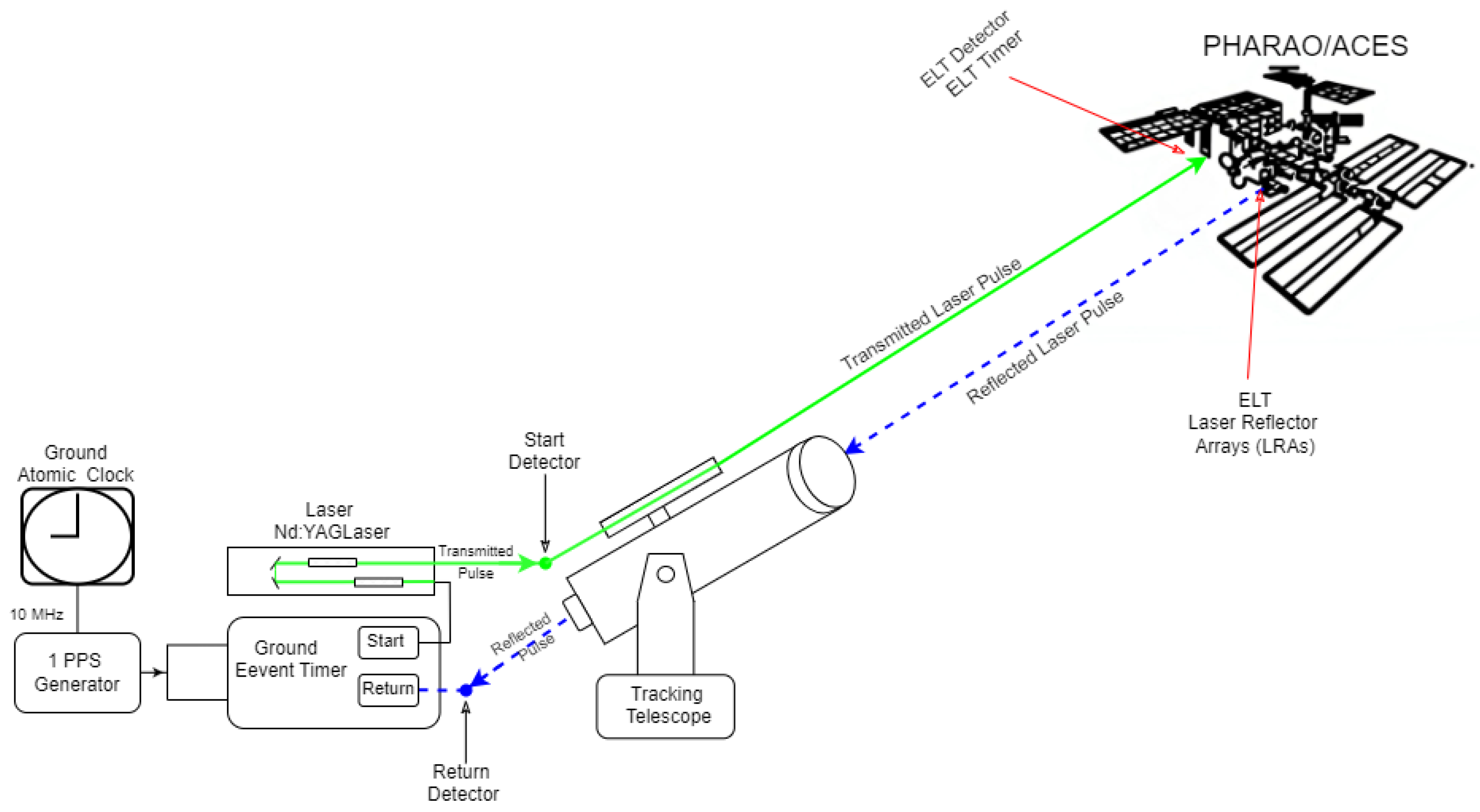
Within the framework of Einstein’s distant-clock synchronization, realized through a two-way laser time-transfer link, the procedure assumes the constancy of the speed of light and an inertial reference frame for both the uplink and downlink signal propagation [71]. The schematic principle of the two-way laser time-transfer technique is illustrated in Figure 1.
In this configuration, the SLR ground clock emits laser pulses at proper time τ 1 , which propagate toward the space clock S. Upon arrival, the pulses are reflected by the laser retroreflector arrays (LRAs) and return to G, where they are detected at proper time τ 3 . The ELT/ACES onboard detection and timing unit records the pulse reception at τ 2 . Using this two-way configuration, the optical time difference between the ground-based clock G and the space clock S is given by [17,57,72]:
Δ τ G S ( t ) = τ 2 1 2 ( τ 1 + τ 3 ) + i δ τ i ( t )
where Δ τ G S ( t ) represents the optical time offset between the two clocks; if δ τ i ( t ) = 0 , the clocks are considered synchronized. The summation i δ τ i ( t ) represents the optical time-delay corrections, with each term δ τ i ( t ) accounting for various delays, including geometric effects, contributions from Earth rotation, and atmospheric propagation effects. Additionally, these terms incorporate systematic biases and offsets in the laser ranging data, as well as calibration factors for the ground-based laser station and instrument-related effects within the space segment. The primary contributors to timing errors in the two-way laser time-transfer link are discussed in the subsequent section.

3.4. Error Sources in Laser Time-Transfer Link

Unlike traditional microwave-based techniques such as the Global Navigation Satellite System (GNSS) and Two-Way Satellite Time and Frequency Transfer (TWSTFT) [73], optical time transfer exploits the much shorter wavelength of laser radiation. This enables reduced beam diffraction, lower susceptibility to atmospheric dispersion, and significantly diminished multipath effects. As a result, optical links provide higher temporal resolution, increased modulation bandwidth, and more robust and unambiguous time-transfer observables, making them particularly well suited for high-precision clock comparisons between ground and space.
The frequency bias of a hydrogen maser (H-MASER) ground frequency standard typically ranges from 5 × 10 16 to 1 × 10 15 , depending on the specific system and its calibration [74,75]. In this simulation study, the relative frequency accuracy of the Masers at the Geodetic Observatory Wettzell, Germany, is assumed to be 1 × 10 15 . Only terms of time-delay order 1 / c 2 are considered in the two-way laser time-transfer link. Therefore, the dominant contributions to the optical time-delay error between the ground clock G and the space clock S can be expressed as:
i δ τ i ( t ) = Δ τ atm + Δ τ Sag + Δ τ GeM + Δ τ sys
where Δ τ atm is the atmospheric delay, Δ τ Sag represents the Sagnac effect, Δ τ GeM denotes geometric effects, and Δ τ sys includes instrumental and systematic contributions. In addition, as indicated in Equation (10), relativistic corrections must simultaneously account for the second-order Doppler effect due to the clocks’ velocities and the gravitational redshift resulting from both the clocks’ altitudes and the contributions of external gravitational fields.
Atmospheric refraction introduces systematic delays in nearly all space geodetic techniques, including SLR, GNSS, and satellite altimetry. Unlike microwave-based methods, SLR uses optical pulses, which are largely insensitive to ionospheric effects and only moderately affected by tropospheric water vapor. The dominant contribution is the hydrostatic (dry) component, averaging approximately 2.3 m at zenith and exceeding 14 m at 10° elevation, while the wet component is typically below 10 mm at zenith [76]. SLR atmospheric modeling represents the tropospheric delay as a zenith delay scaled by an elevation-dependent mapping function. In this study, the ILRS-standard FCULa mapping function together with Mendes–Pavlis’s zenith delay model is used to simulate optical tropospheric delays. Detailed calculation methods for the optical tropospheric delay can be found in [77].
The Sagnac effect, caused by the Earth’s rotation, introduces a differential propagation time for laser pulses exchanged between a rotating ground station and an orbiting ELT/ACES mission. This effect is significant in high-precision laser time-transfer experiments, as uplink and downlink paths differ in length, leading to systematic timing biases.
To provide a more explicit derivation, consider light propagation in the ECEF rotating frame, where the coordinate time of flight along a light path is given by Δ t = d s / c , where d s is the line element along the trajectory. In the rotating frame, the metric contains off-diagonal components g 0 j ( ω × r ) j / c , with Earth’s angular velocity ω and position vector r . Retaining terms linear in ω , the line integral yields the Sagnac contribution [78]:
Δ τ Sag 2 c 2 ω · A ,
where A is the projected area enclosed by the path from the ground station to the satellite and back (or the effective one-way path in two-way averaging), projected onto the equatorial plane. The dot product arises naturally from the line integral of r   d r along the path, giving a term proportional to ω · r   d r ω · A . This shows that the Sagnac delay is a geometric effect of the rotating frame, proportional to Earth’s angular speed ω and not directly to linear velocity, though the local ground velocity v G = ω × r G enters implicitly in the vector form.
In optical time-transfer links, evaluated at the ground emission time, the Sagnac time delay is expressed as [57]:
Δ τ Sag = 2   D · v G c 2 ,
where v G is the instantaneous velocity of the ground station, c is the speed of light, and D is the instantaneous separation vector between the satellite and ground clocks. In optical time-transfer links, such as those used in ELT/ACES, the Sagnac contributions along the uplink and downlink paths do not fully cancel, as the pulses travel from ground to satellite and back. The residual delay is accurately captured by the projected area or equivalently via the vector dot product 2   D · v G .
This derivation provides a self-contained explanation connecting the classic Sagnac area dependence with the linearized rotating-frame metric approach. For further details, see [78] for a review of Sagnac effects in GNSSs, and [57] for applications in laser time transfer where the signal path is explicitly modeled from ground to satellite and back.
In optical time-transfer experiments, geometric delays arise from the spatial configuration of the spacecraft and its optical subsystems. The main contributors include the spacecraft center-of-mass (CoM) displacement, the geometry and mounting of the LRAs, and the separation between reflection and detection points within the onboard optical payload. These factors introduce both fixed and time-dependent delays in the laser signal path, which must be accurately modeled to achieve sub-nanosecond synchronization [79]. Geometric correction is strongly attitude-dependent, as the relative orientation between the LRAs, detection optics, and CoM continuously changes along the orbit. In the ELT/ACES mission, the payload is mounted outside the ISS, introducing a spatial offset of a few meters relative to the station’s CoM. Considering the ISS mass (450,000 kg) and dimensions (109 m × 73 m), the geometric correction consists of two main components: the separation between reflection and detection points, and the offset of the LRAs relative to the ISS CoM.
Instrumental delays are a major source of systematic error in laser time-transfer missions and require careful calibration in both ground and space segments [80,81]. On the ground, calibration accounts for delays from optical fibers, electronics, photodetectors, and event timers, achieving accuracies at the 1–2 ps level, though extreme variations can exceed 100 ps [42]. In the space segment, calibration is more challenging due to thermal variations, radiation, and limited access, with typical accuracies ranging from 4 to 35 ps [82]. Accurate modeling and calibration of these delays are essential for picosecond-level synchronization, with space-segment uncertainties remaining the primary limitation for high-precision laser time-transfer links. Since the final ELT/ACES experiment report is not yet available, these geometric and instrumental delays are not included in the present simulation study.

4. Simulation Framework and Experimental Scenarios

During the period addressed in this work, the ELT/ACES mission had not yet reached full operational status, as it was still undergoing commissioning. The laser-based time-transfer system was not yet qualified for routine scientific exploitation, and no validated laser time-transfer products had been released. Consequently, ELT/ACES observational data could not be incorporated in the present study. The simulation framework and experimental scenarios presented below are therefore designed to represent the anticipated in-orbit performance of the mission.

4.1. Simulation Procedure and Ground Station Characterization

Accordingly, the analysis is limited to SLR stations equipped with ultra-stable frequency standards, well-characterized and calibrated instrumental delays, and full compliance with ISS laser safety requirements. In this study, only the primary reference station in Wettzell, Germany, is employed to evaluate gravitational redshift measurements using the ELT/ACES configuration. The geographic coordinates and time–frequency standard characteristics of this station are summarized in Table 2.
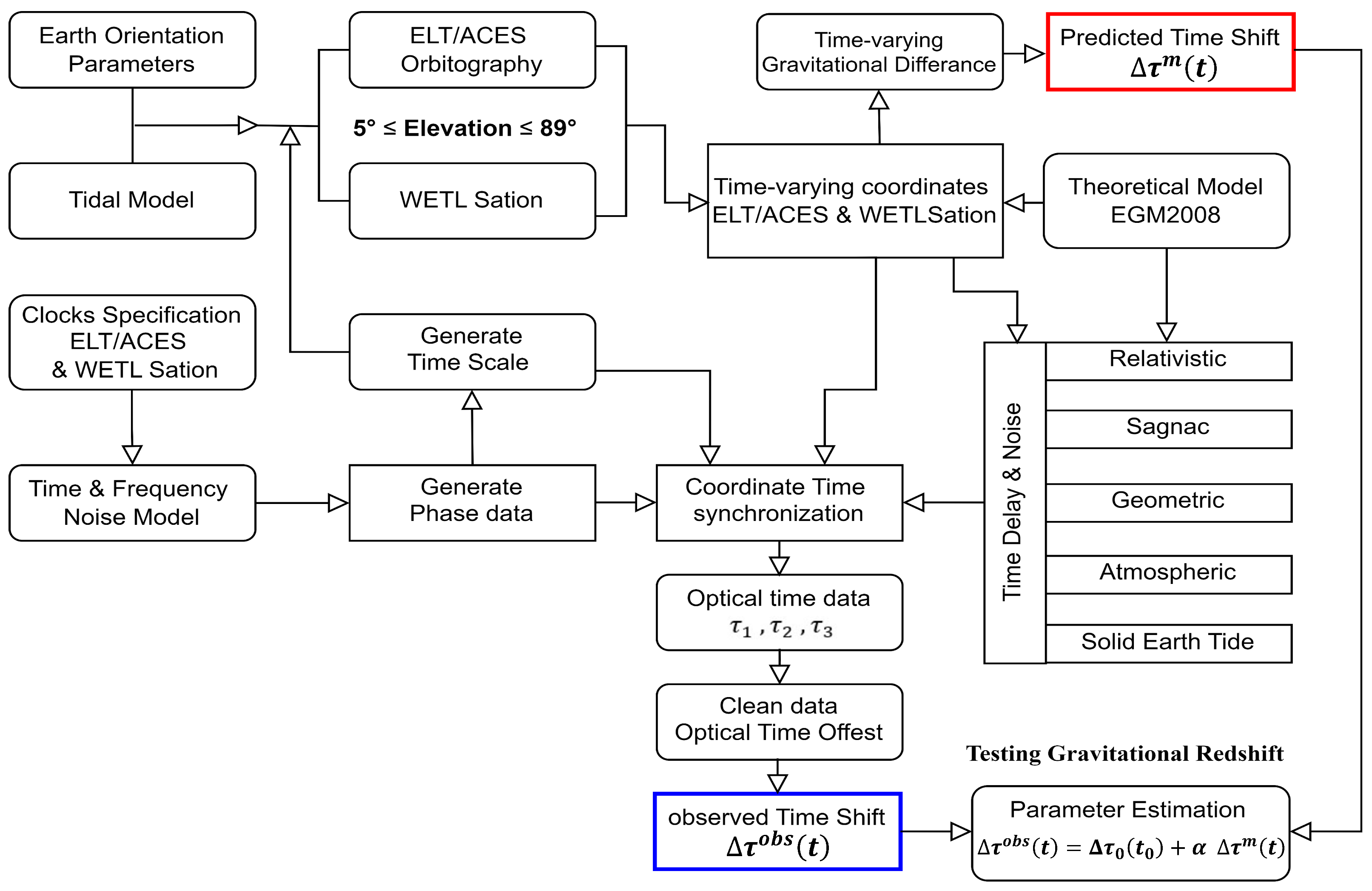
In this simulation, the Earth Gravitational Model EGM2008 [85] is adopted to represent the theoretical gravitational potential field, complete to spherical harmonic degree and order 2159, with additional coefficients provided up to degree 2190 and order 2159. The associated scaling parameters are G M E = 398,600.4415 km 3 / s 2 and R E = 6,378,136.3 m. The simulation workflow for conducting gravitational redshift tests with the ELT/ACES experiment is schematically illustrated in Figure 2. The dataset spans a seven-day period in March 2025, corresponding to Modified Julian Dates (MJDs) 60,735 to 60,741. Table 3 summarizes the key parameters and models adopted in the simulation, including gravitational potential, tidal contributions, satellite orbit, clock characteristics, and optical time-transfer corrections.
The simulation workflow begins with the definition of Earth orientation parameters, tidal effects, ELT/ACES orbital ephemerides, and the characteristics of the WETL ground clock and the ELT/ACES space clock. These inputs are combined with time- and frequency-domain noise models to generate synthetic timescale data and clock phase deviations. Using space–time coordinate synchronization, simulated optical time-transfer observations are produced, incorporating all relevant relativistic and propagation effects, including gravitational redshift, second-order Doppler, Sagnac, geometric, atmospheric, and solid Earth tide delays. Simultaneously, the time-varying gravitational potential difference between the ELT/ACES space clock and the WETL ground clock is computed using the EGM2008 reference model, providing the predicted gravitational signal. Following preprocessing and cleaning of the optical time-offset data, a linear least-squares model is applied to estimate the gravitational redshift parameters. Each stage of this workflow is described in detail in the following sections, corresponding to the sequence illustrated in Figure 2.

4.2. Simulation of Orbit ELT/ACES Data

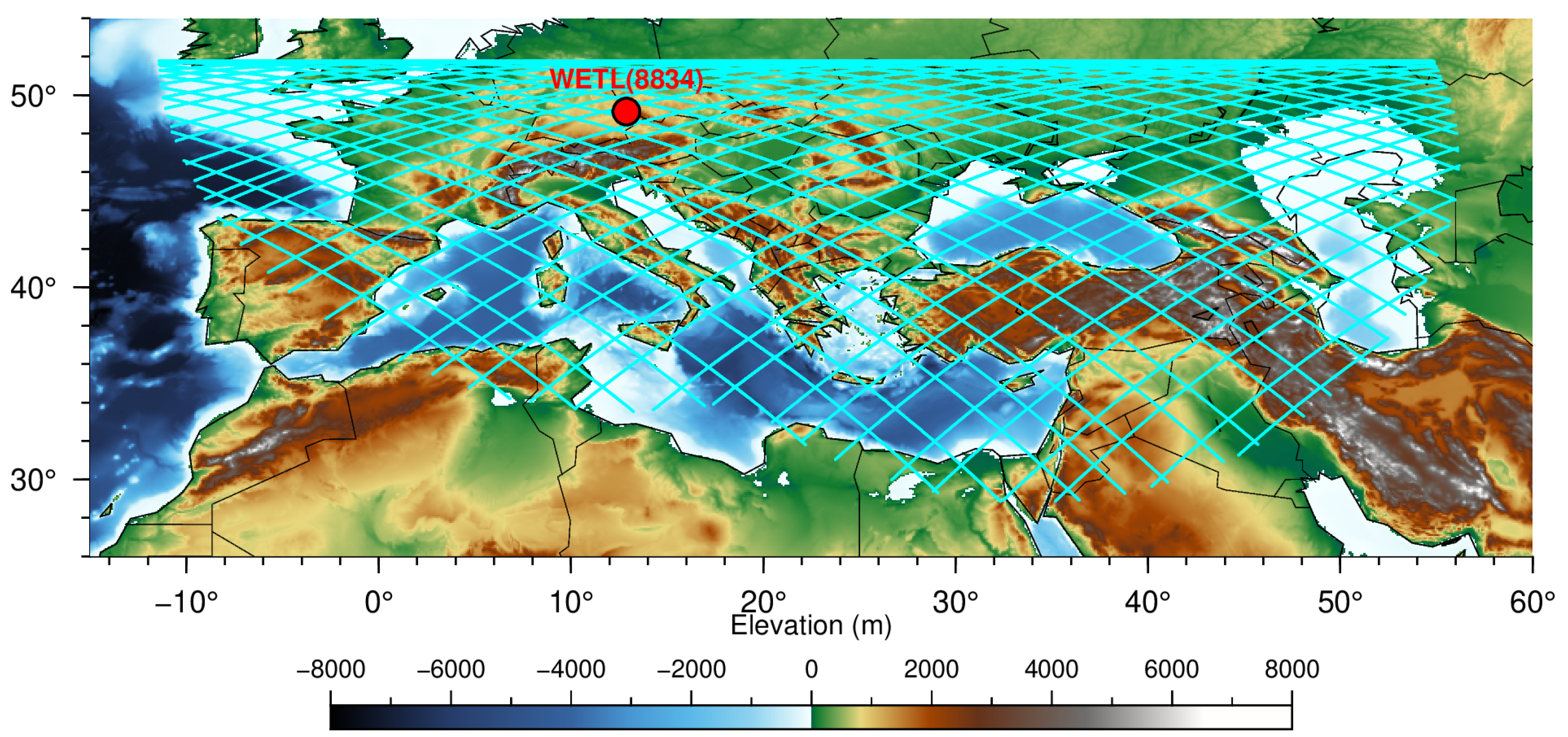
In the absence of precise ELT/ACES orbital ephemerides, a dedicated Python-based simulation framework was developed to generate and analyze the International Space Station (ISS) trajectory using publicly available Two-Line Element (TLE) data. This framework provides the basis for modeling the orbital motion of the ELT/ACES payload aboard the ISS, enabling the computation of time-tagged position and velocity vectors in multiple reference frames, as well as the identification of satellite visibility periods from the WETL ground station. For consistency with the physical configuration of the mission, the orbital motion of the ACES/ISS center of mass was adopted throughout the analysis. The simulation dataset covers a continuous seven-day interval, from MJDs 60735 to 60741, with a temporal resolution of 1.0 s. This time span was selected to ensure adequate sampling of orbital geometry variations and ground station visibility conditions. Figure 3 illustrates the geographic location of the WETL station along with the simulated seven-day ground track of the ELT/ACES mission. Satellite visibility from the WETL station was determined by computing the topocentric elevation angle of the ELT/ACES relative to the local horizon.
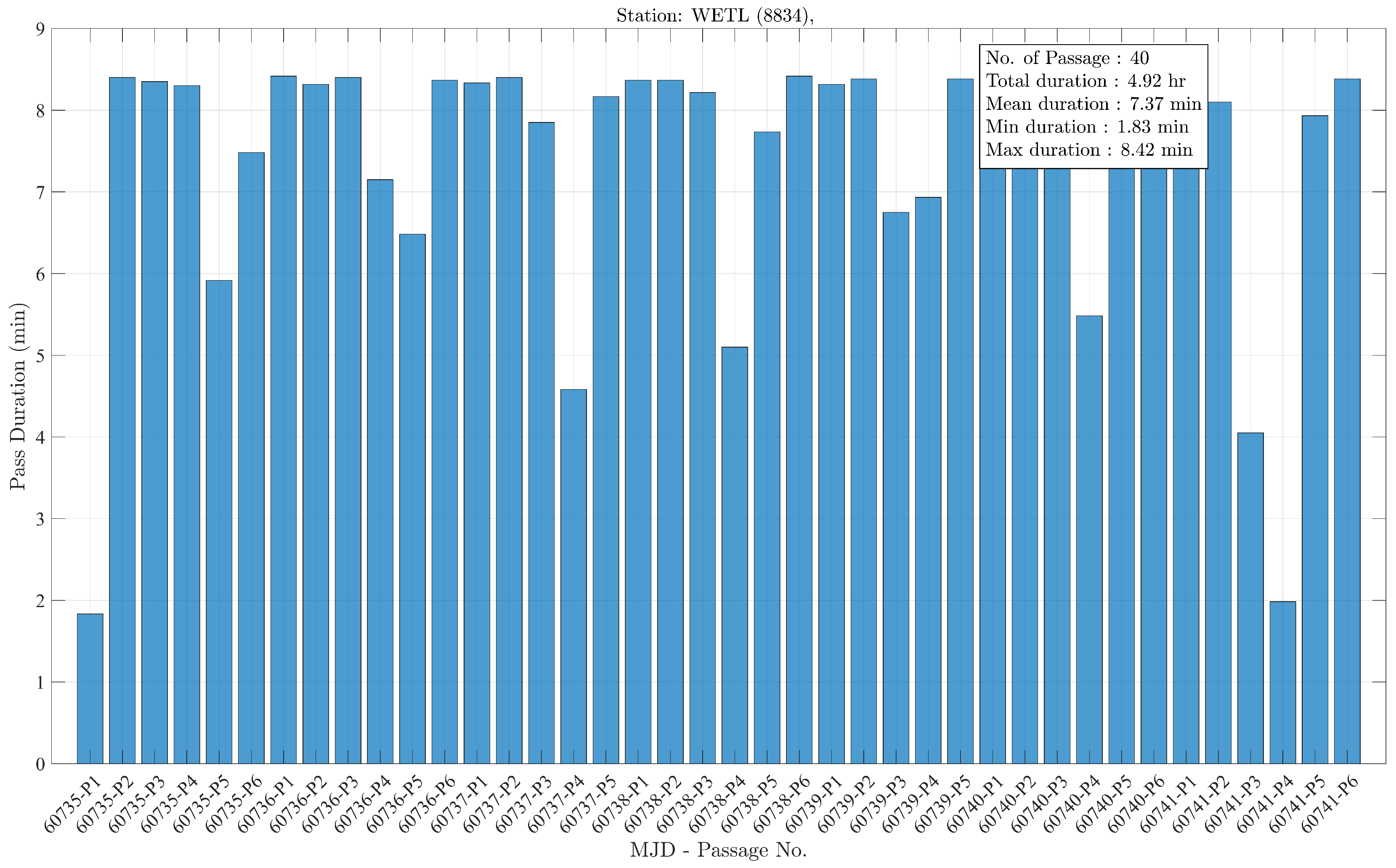
Only passes with topocentric elevation angles between 5° and 89° were retained. This range excludes low-elevation observations affected by atmospheric refraction and high noise, while avoiding near-zenith geometries that may introduce instabilities due to rapid variations in tropospheric delay, higher background noise in the SPAD, or detector saturation risks during high-elevation segments.These selection criteria ensure that the analysis considers only high-quality observation intervals. Over the MJD 60735–60741 interval, a total of 40 ELT/ACES passes were identified over the WETL station, corresponding to approximately 5–6 passes per day. The average pass duration is approximately 7 min, with the longest passes extending up to 8 min. Figure 4 illustrates the daily distribution of ELT/ACES pass durations, highlighting the variability induced by orbital geometry, station latitude, and local viewing conditions. This variability significantly influences the temporal coverage and sensitivity of the simulated gravitational redshift measurements.

4.3. Simulation and Modeling of Optical Time Delays

The simulation of optical time delays in the ELT/ACES time-transfer link accounts for atmospheric, gravitational, Doppler, and tidal contributions within a consistent geocentric framework. In a real ELT/ACES experiment, additional systematic environmental perturbations and instrumental noise-induced delays may be present; however, in the present study, their impact is expected to be minor, as such effects are effectively absorbed into the initial time offset term in Equation (9), under the assumption that these noise sources are quasi-constant over the pass duration or are modeled as offsets. Time-varying perturbations would require separate correction. Consequently, these contributions are not explicitly modeled.
Tropospheric delays were modeled using the IERS-recommended zenith delay formulation of Mendes and Pavlis [77], combined with the FCULa elevation-dependent mapping function [77,87]. This combination, which has been the ILRS standard since 2007 [67], provides millimeter- to sub-millimeter-level accuracy for optical wavelengths and is therefore well suited for high-precision optical time-transfer simulations. Meteorological inputs required for tropospheric modeling were obtained from HGPT2, an ERA5-based extension of the Hourly Global Pressure and Temperature model [86,91]. HGPT2 enhances delay accuracy by incorporating relative humidity, zenith wet delay, and precipitable water vapor derived from two decades of high-resolution atmospheric reanalysis data.
Gravitational potential calculations were performed in geocentric coordinates using the EGM2008 geopotential model in conjunction with GeographicLib [92], which provides high-accuracy geodetic and gravitational computations. Tidal effects were modeled by combining classical tidal deformation theory with planetary ephemerides. The Sun and Moon position vectors relative to the Earth’s center of mass were computed using the SPICE toolkit [89,90], with planetary and lunar ephemerides provided through JPL kernels and Earth Orientation Parameters supplied by the IERS [67]. The Doppler effect depends on the relative translational motion between the ELT/ACES mission and the WETL station along the optical line of sight, whereas the Sagnac effect arises from laser propagation in the rotating terrestrial reference frame and is governed by Earth’s angular velocity and the geometry of the space–ground link.
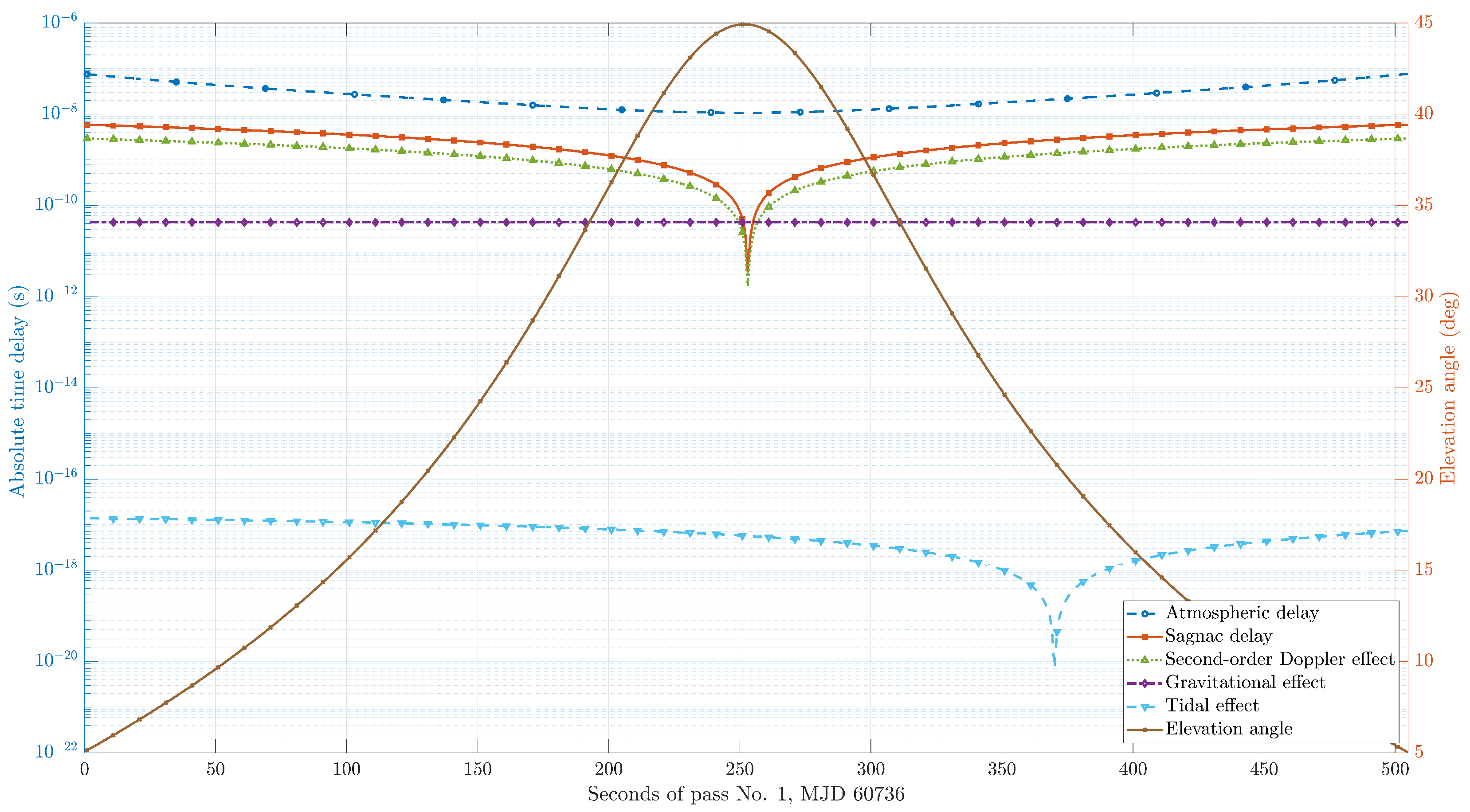
To illustrate the relative magnitude of the individual delay contributions, a representative ELT/ACES pass was analyzed. Pass No. 1 on MJD 60736, corresponding to the longest pass over the WETL station with a duration of approximately 8 min (see Figure 4), was selected for this purpose. The simulated absolute values of the one-way optical time-transfer delays for this pass are summarized in Table 4, while their temporal distributions are presented in Figure 5.
Table 4 shows that the atmospheric delay is the dominant contributor to the one-way optical time transfer, with a mean magnitude of 2.85 × 10 8 s and a standard deviation of 1.75 × 10 8 s, reflecting variability in tropospheric refractive effects along the optical propagation path. The Sagnac delay, arising from Earth’s rotation, represents the second-largest contribution, with a mean value of 1.48 × 10 9 s, and constitutes a significant systematic effect that must be accurately modeled. Gravitational and Doppler effects are several orders of magnitude smaller, while space and ground tidal contributions are negligible at the 10 18 s level. In a two-way laser time-transfer configuration, many of these systematic effects are substantially reduced due to the near reciprocity of the uplink and downlink signal paths.

4.4. Simulation of Noise Contributions in Optical Link

Accurate representation of noise processes affecting time and frequency references is essential for realistic simulation of optical time-transfer experiments. In this study, noise contributions originating from the SLR ground segment, the ELT/ACES space segment, and the optical time-transfer link are explicitly considered to ensure reliable assessment of system performance and parameter estimation sensitivity. The stochastic behavior of time and frequency sources is modeled using power-law spectral densities of fractional frequency fluctuations, following the formalism introduced by Lesage and Audoin [93].
The one-sided power spectral density is expressed as
S y ( f F ) = β = 2 2 h β f F β ,
where S y ( f F ) denotes the fractional frequency deviation power spectral density, with y = Δ ν / ν representing the relative frequency fluctuation (dimensionless), h β represents the noise intensity coefficient, β is the spectral exponent characterizing the noise process, and f F is the Fourier frequency. The exponents β = 2 , 1 , 0 , 1 , 2 correspond to random-walk frequency modulation (RWFM), flicker frequency modulation (FFM), white frequency modulation (WFM), flicker phase modulation (FPM), and white phase modulation (WPM), respectively.
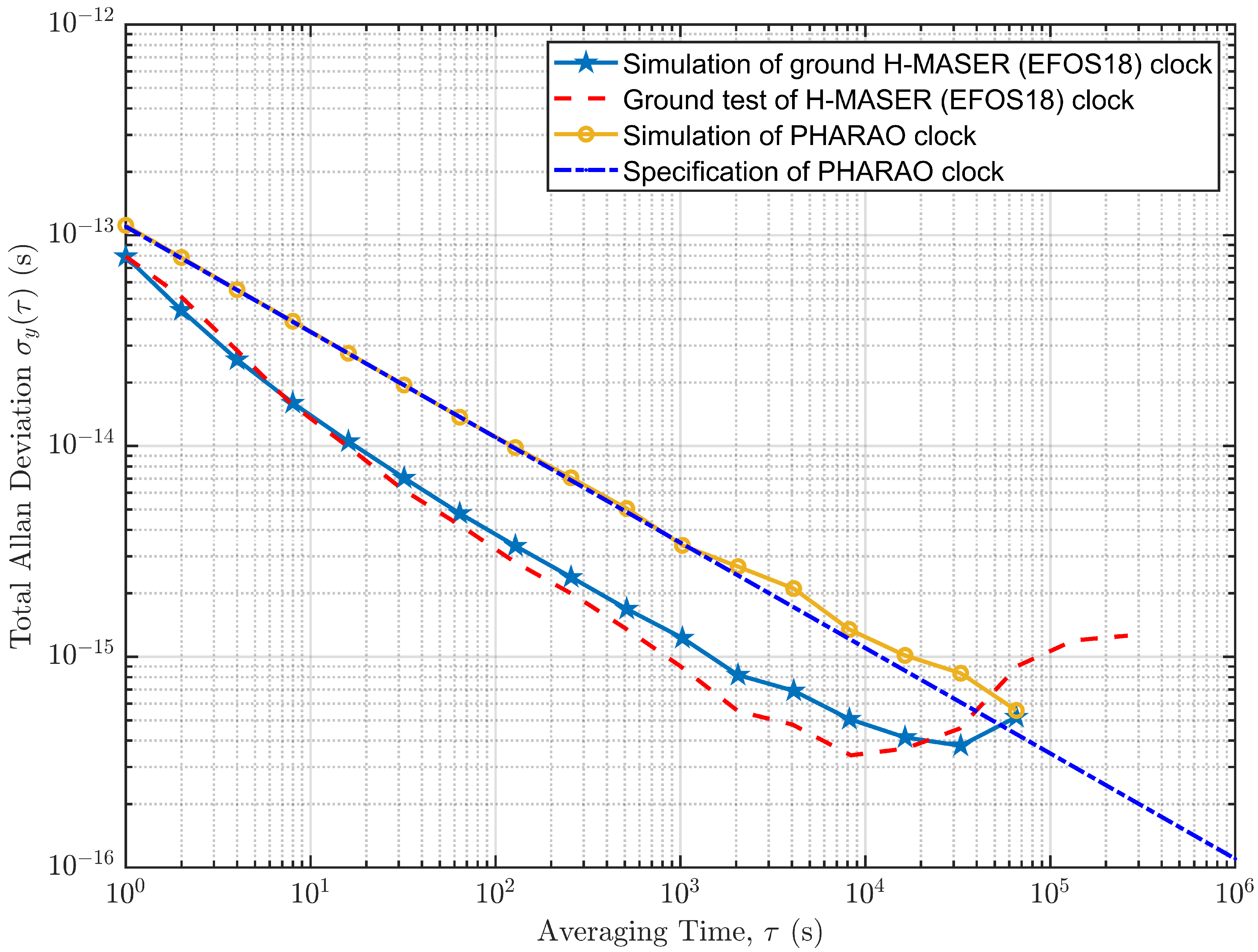
The relative contribution of these noise processes depends strongly on the underlying oscillator technology and atomic reference used at each station. For the WETL station considered in this study, H-MASERS (EFOS 18) provide superior short-term frequency stability, typically constrained by thermal noise and resonator quality. At intermediate timescales, they exhibit a characteristic flicker frequency noise floor, while long-term behavior is dominated by frequency drift arising from wall collisions, Zeeman shifts, and relaxation processes within the storage bulb [75,94]. The frequency stability of the H-MASERS (EFOS 18) at the WETL station was evaluated using a continuous 15-day data set acquired between 3 April and 18 April 2013. The resulting Allan deviation is 7.94 × 10 14 at an averaging time of 1 s and improves to 9.06 × 10 16 at an averaging time of 1000 s [84], as illustrated in Figure 6.
In the present simulation, fractional frequency noise realizations for the H-MASER (EFOS 18) at the WETL station and the PHARAO clock onboard ACES were generated using the Allantools Python library2. To verify that the generated noise realizations conform to the intended design specifications, the Allan variance is employed as the primary diagnostic metric. The square root of the Allan variance, known as the Allan deviation (ADEV), provides a direct means of assessing noise characteristics across different averaging times. The Allan variance is defined as [95]:
σ y 2 ( τ ) = 1 2 ( N 2 ) τ 2 i = 1 N 2 x i + 2 2 x i + 1 + x i 2 ,
where x i denotes the phase time series at the i-th sample, N is the total number of data points, and τ is the averaging (measurement) interval. This formulation enables quantitative comparison between simulated noise behavior and expected clock performance over a wide range of timescales.
Figure 6 presents the simulated Allan deviation curves for the H-MASERS (EFOS 18) at the WETL station and the PHARAO clock onboard ACES. At short averaging times, their fractional frequency stabilities are approximately 7.95 × 10 14 and 1.11 × 10 13 , respectively, consistent with the expected short-term performance of these advanced atomic clocks. At longer averaging times, specifically at τ = 6.55 × 10 4 s, the stabilities improve to 6.14 × 10 16 for the WETL H-MASERS (EFOS 18) and 3.0 × 10 16 for the PHARAO/ACES clock. These results highlight the superior long-term stability of the space PHARAO and the ground-based H-MASERS (EFOS 18), confirming that the simulated noise realizations accurately reflect the design performance targets for these time and frequency standards.
As illustrated in Figure 6, although multiple sources of random noise contribute to the ACES clock signals, the PHARAO clock is predominantly characterized by WFM and RWFM. Moreover, real ELT/ACES optical observations are constrained by short satellite pass durations, typically ranging from 1 to 8 min over the WETL station, as shown in Figure 4. Over such short observation intervals, non-white noise processes contribute negligibly to the overall ground-to-space frequency instability.
Under the same short-timescale assumption, additional noise contributions affecting the optical ground-to-space time-transfer link, arising from uncertainties in the relative position and velocity of the ELT/ACES payload and the WETL station, as well as from gravitational, atmospheric, and tidal effects, are also approximated as white noise processes. The corresponding noise levels for these contributions are summarized in Table 5 and are superimposed onto the ideal (noise-free) observables in the simulation. This approach provides a realistic yet computationally efficient representation of the dominant stochastic effects governing the optical link during short-duration ELT/ACES passes.
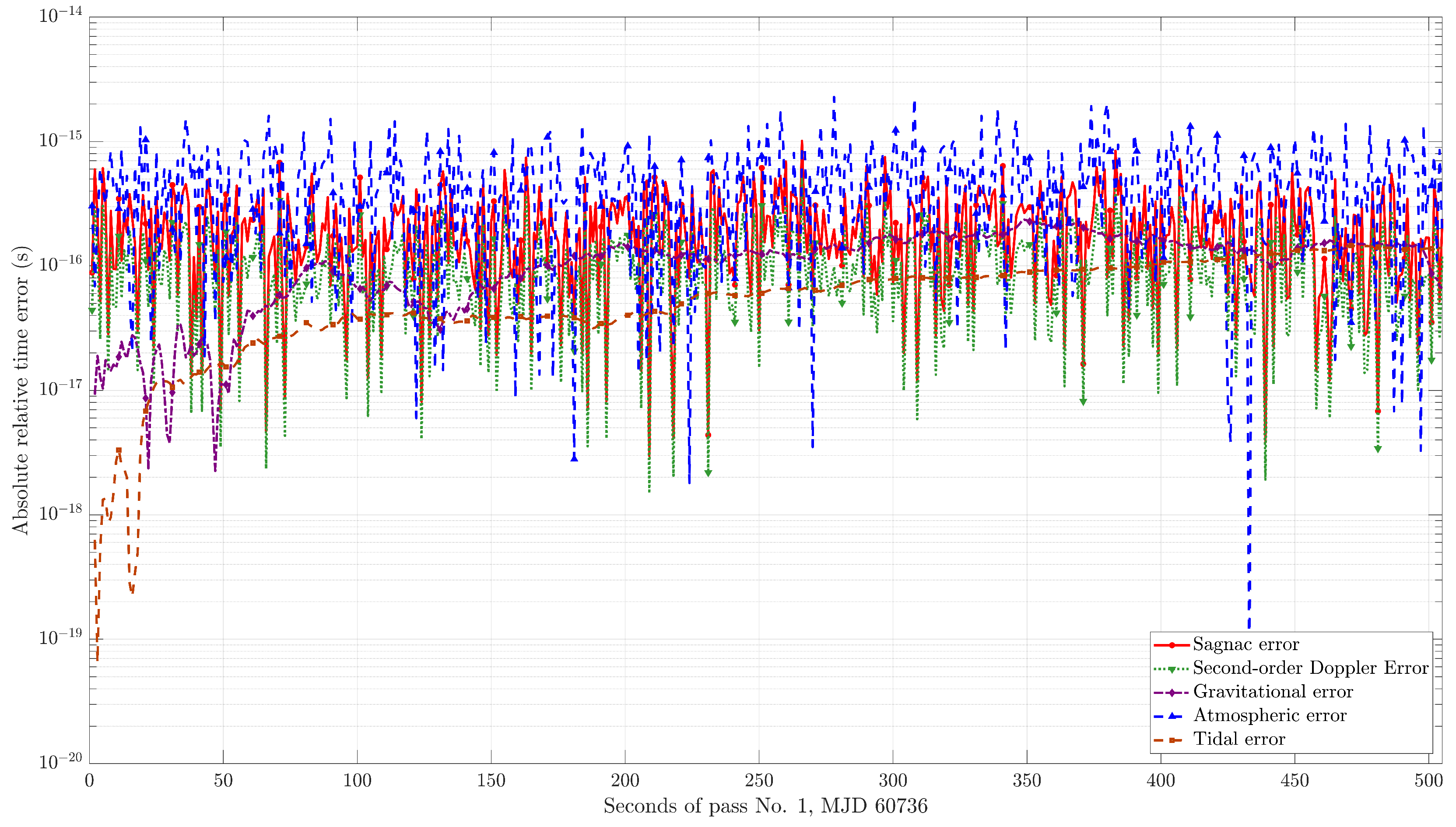
At the 10 16 fractional time-delay level targeted by ACES, only a limited subset of relativistic and propagation effects contributes significantly to the total optical time-transfer error budget. Table 5 presents a statistical summary of the dominant residual error sources in the optical time-transfer link at the WETL station for Pass No. 6 on MJD 60736, while the corresponding temporal variations are illustrated in Figure 7.
Among the considered effects, the atmospheric delay represents the largest contribution to the residual error budget, followed by the gravitational redshift, Sagnac, and second-order Doppler effects, all exhibiting magnitudes on the order of 10 16 s. In contrast, the tidal contribution remains at the level of 4.56 × 10 17 s, which is more than one order of magnitude smaller than the dominant terms. Given its comparatively small magnitude and associated uncertainty, the tidal error contributes negligibly to the total residual budget and can therefore be safely neglected at the accuracy level considered in this analysis. This result justifies the exclusion of explicit tidal-delay modeling in the subsequent parameter estimation without compromising the fidelity of the simulated optical time-transfer observables.

4.5. Simulation of Optical Time Offset

As real SLR Normal Point (NP) [96,97] data from ELT/ACES optical time-transfer observations are not yet available, synthetic ground-to-space optical time-offset measurements are generated within a coordinate-time synchronization framework. This approach enables a controlled and internally consistent evaluation of the optical time-transfer performance and its sensitivity to both relativistic and stochastic effects. Following the methodology outlined in Section 3.2, the simulated optical time offset between the ground station and the space clock Equation (18) at epoch t i is expressed as
Δ τ GS ( t i ) = Δ T GS ( t i ) + k = 1 n δ x k ( t i ) ,
where Δ T GS ( t i ) represents the ideal, noise-free optical time offset between the space clock S and the ground clock G, and δ x k ( t i ) denotes the individual noise contributions associated with the optical time-transfer link, as described in Section 4.4. These terms collectively account for clock noise, propagation uncertainties, and residual stochastic effects.
The ideal optical time offset is defined using the standard two-way time-transfer formulation [98] as
Δ T GS ( t i ) = 1 2 T 12 T 23 ,
where T 12 = t 2 t 1 and T 23 = t 3 t 2 denote the coordinate times of flight of the uplink and downlink laser signals, respectively. The accurate determination of the coordinate time-transfer model, and hence of T 12 and T 23 , constitutes a central challenge in relativistic time-transfer links [99]. In this study, the coordinate time transfer is modeled within the weak-field approximation, based on the relativistic formalism developed by Petit and Wolf [60]. This formulation consistently incorporates post-Newtonian relativistic corrections up to the required order of accuracy.

5. Expected Stability and Sensitivity Analysis

This section presents the assessment of gravitational redshift measurements derived from the simulated ELT/ACES datasets introduced in Section 4, highlighting the predicted uncertainty of these measurements and their potential for applying the optical-link clock-synchronization scheme to geoscience.

5.1. Stability of Optical Redshift Measurement

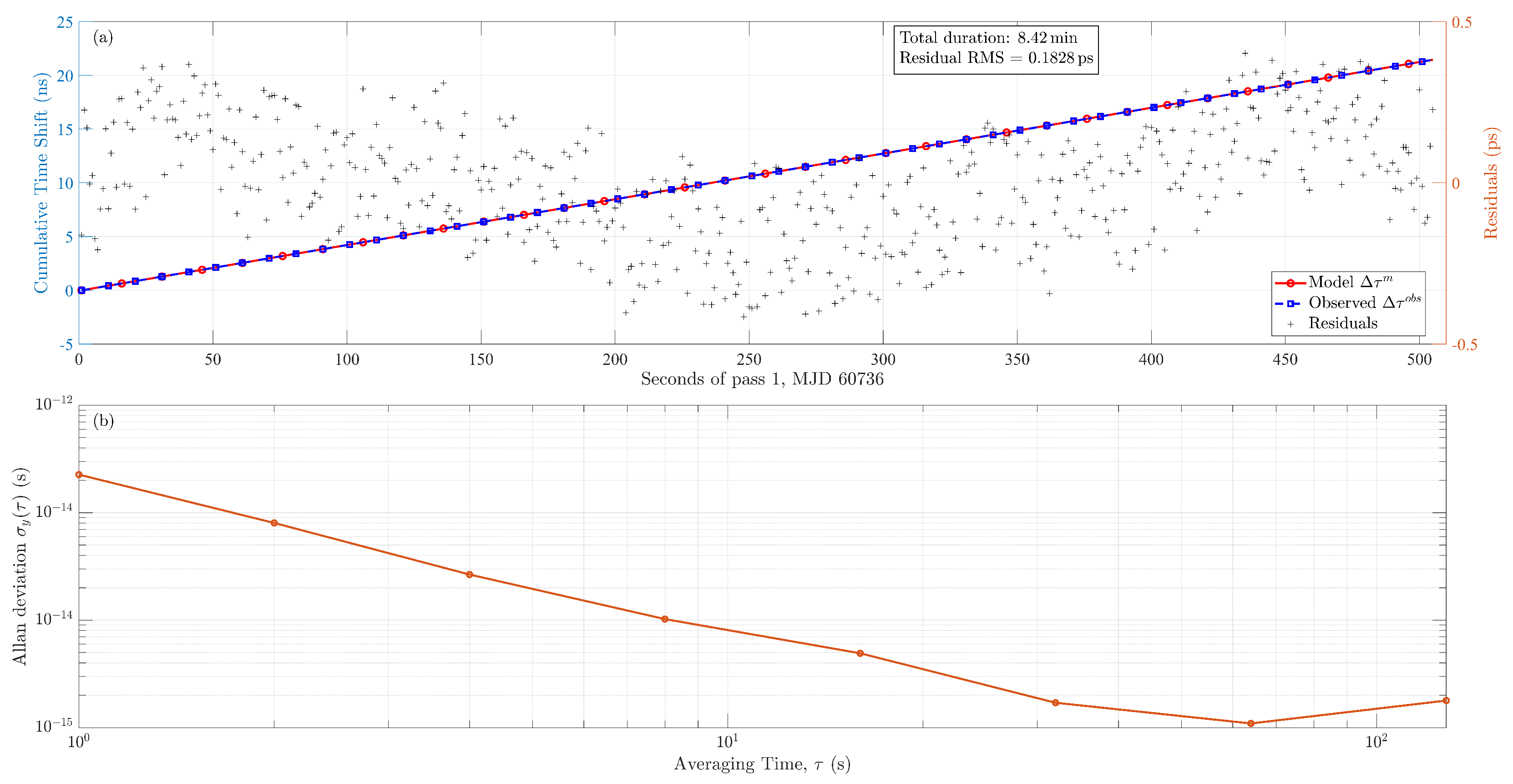
The performance of the gravitational redshift measurement is evaluated through the stability of the optical ground-to-space time-difference series. This stability is quantified using the Allan deviation, which provides a standard and robust metric for characterizing time-transfer noise and frequency stability over a wide range of averaging times. As a representative case study, ELT/ACES Pass No. 1 over the WETL station on MJD 60736 is analyzed. This pass has a total duration of 8.42 min and a favorable orbital geometry, making it well suited for assessing short-term stability and parameter estimation performance.
Figure 8a presents the observed and modeled gravitational redshift signals between the ELT/ACES space clock and the WETL ground clock, together with the corresponding residuals. Figure 8b shows the Allan deviation of the optical ground-to-space time-transfer link for this pass, illustrating the achievable stability over the available averaging times. The estimated gravitational redshift parameters derived from this analysis are summarized in Table 6.
The residuals exhibit an apparent sinusoidal behavior with a period of roughly 420 s, as shown in Figure 8a. This 420 s periodicity may stem from uncompensated orbital or tidal variations or low-frequency noise in the time-transfer link; further modeling is recommended. Over the approximately 8 min pass, the residuals between the observed and theoretical gravitational redshift signals exhibit a mean value of 7.52 × 10 17 ps and a root-mean-square (RMS) of approximately 0.183 ps (Figure 8a). These results demonstrate the extremely high precision achievable with the optical time-transfer link and confirm the excellent agreement between the measurement model and the simulated observations. Such low residual levels are essential for resolving relativistic frequency shifts at the targeted accuracy level.
This performance is further supported by the Allan deviation shown in Figure 8b, which highlights the outstanding short-term stability of the the redshift measurements. A stability level of 2.3 × 10 13 at an averaging time of τ = 1 s is achieved, consistent with the intrinsic short-term performance of the PHARAO/ACES space clock and the ground-based H-maser atomic clock. For longer averaging times ( τ > 30 s), the stability becomes progressively limited by the intrinsic noise of the ground and space clocks rather than by the optical link itself. The Allan deviation reaches 2.1 × 10 15 at τ = 30 s and further improves to 1.5 × 10 15 at τ = 100 s, indicating that the optical link performance remains well below the clock noise level over these averaging intervals.
The parameter estimates reported in Table 6 further illustrate the quality of the solution. The initial time offset is determined as Δ τ 0 = ( 3.50 ± 0.04 ) × 10 14 s, indicating a stable and well-constrained synchronization over the full pass duration. The estimated gravitational redshift violation parameter, α = ( 7.27 ± 0.01 ) × 10 5 , exhibits a very small formal uncertainty, reflecting the high sensitivity of the ELT/ACES optical time-transfer measurements to relativistic frequency shifts. The very low correlation between Δ τ 0 and α demonstrates that these parameters are effectively decoupled in the estimation process, thereby enhancing the robustness and reliability of the solution. Moreover, the small error variance, σ 0 2 = 3.35 × 10 26 , confirms the internal consistency of the model and the overall high quality of the single-pass fit.
Taken together, these results confirm that the optical time-transfer link meets the stringent precision requirements for high-accuracy relativistic timing experiments. They support the ELT/ACES objective of achieving timing resolutions at the femtosecond level when results from multiple passes are coherently combined, provided that both the ground and space segment calibrations are accurately controlled.
In the following section, we focus on the analysis of the gravitational redshift violation parameter α , extending the investigation to all independent ELT/ACES passes simulated over the WETL station. This enables a comprehensive assessment of the expected measurement uncertainty in gravitational redshift tests over the full duration of the ELT/ACES mission.

5.2. Expected Uncertainty in Optical Redshift Measurement

To ensure reliable statistical inference across ELT/ACES passes characterized by heterogeneous uncertainties in the estimated GRS violation parameter α obtained from the least-squares model (Equation (14)), individual pass-wise estimates are combined using a weighted averaging scheme. The corresponding weighted standard deviation is adopted as a measure of the overall uncertainty.
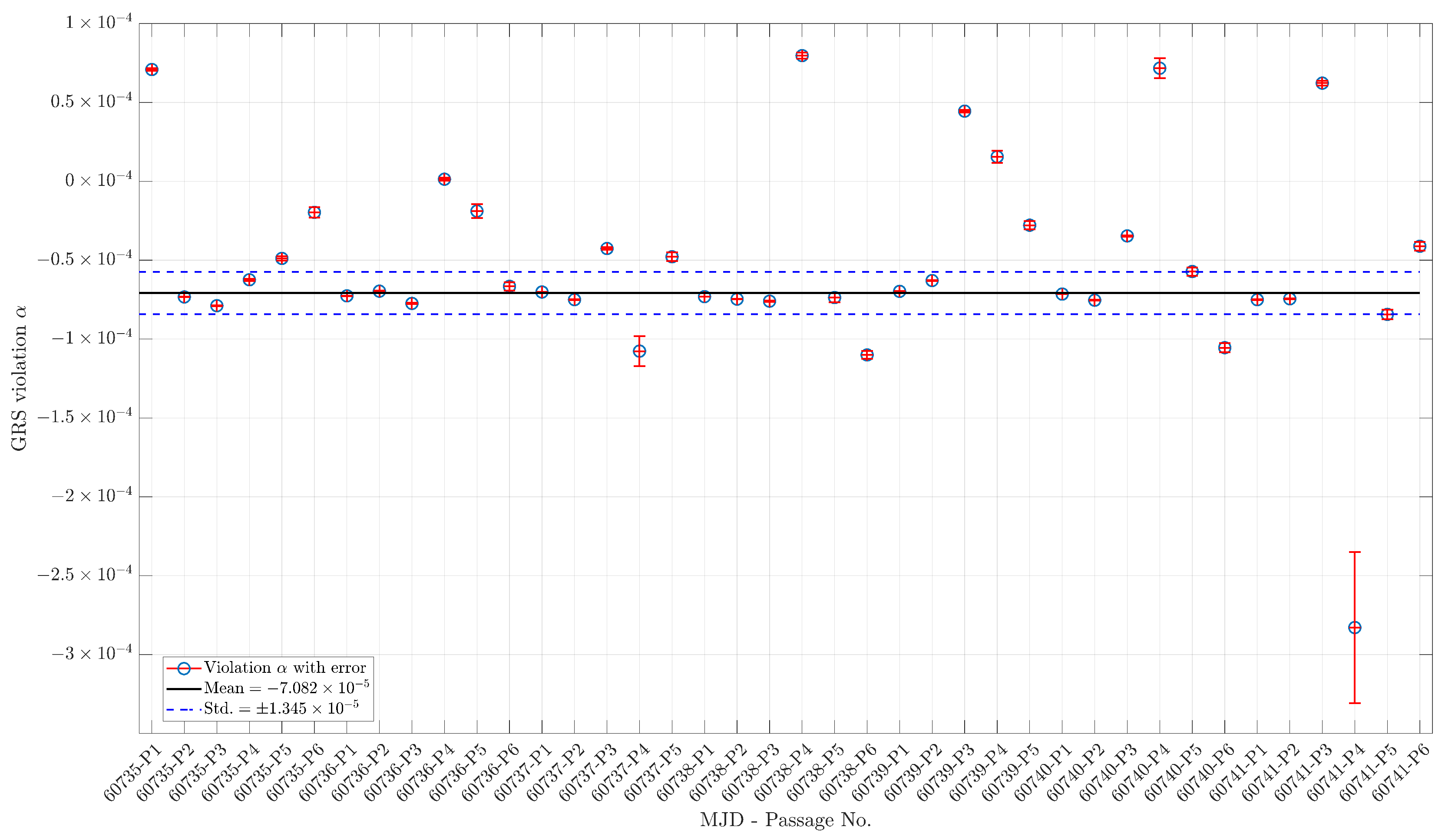
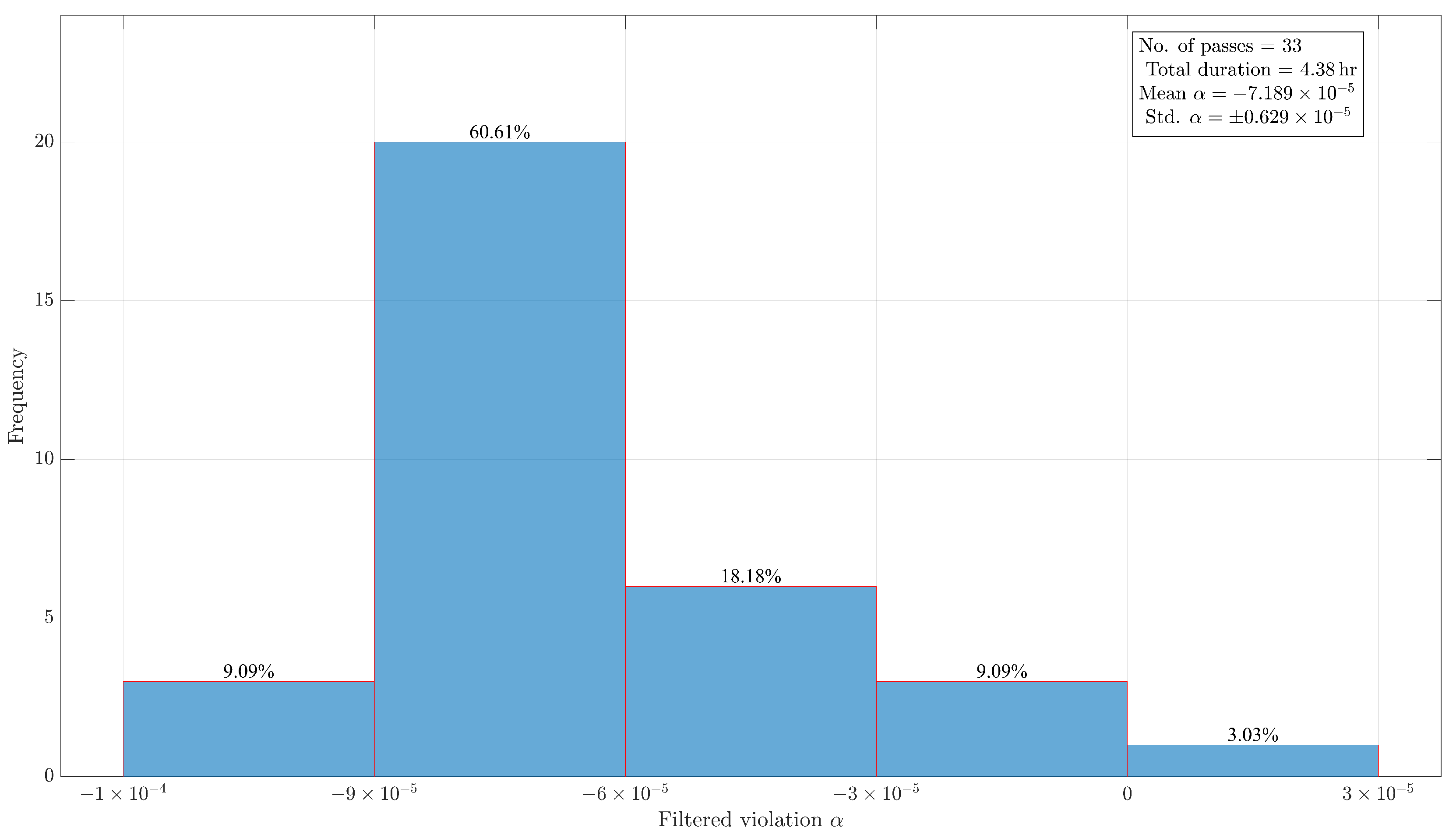
Figure 9 presents the individual estimates of the GRS violation parameter α for all ELT/ACES passes over the WETL station during the interval MJD 60735–60741. Table 7 summarizes the combined estimates of α derived from these independent passes, reported both before and after applying a ± 1 σ filtering criterion to suppress statistically inconsistent or low-quality measurements. The distribution of the filtered α values is illustrated in Figure 10, providing insight into the statistical behavior of the redshift violation parameter over the analyzed period.
Prior to filtering, the dataset comprises 40 individual ELT/ACES passes, corresponding to a total effective observation duration of 4.92 h. The resulting uncertainty in the gravitational redshift violation parameter is α = ± 1.35 × 10 5 . After applying the ± 1 σ filtering criterion, 33 ELT/ACES passes are retained, yielding a slightly reduced total observation time of 4.38 h. The filtered dataset produces a revised uncertainty of α = ± 0.63 × 10 5 , representing an improvement by a factor of approximately 2.1 relative to the unfiltered case.
As illustrated in Figure 10, this substantial reduction in uncertainty is accompanied by a visibly narrower distribution with minimal tail contributions, demonstrating that the applied filtering strategy effectively suppresses outliers and mitigates the influence of noise-dominated or anomalous simulation realizations. These results confirm the robustness of the weighted averaging and filtering approach for enhancing the precision of gravitational redshift tests using ELT/ACES optical time-transfer observations.
Importantly, the mean value of the gravitational redshift violation parameter changes only slightly, from 7.09 × 10 5 before filtering to 7.19 × 10 5 after applying the ± 1 σ criterion. This minimal shift indicates that the filtering process does not introduce any systematic bias. The observed consistency confirms that the reduction in uncertainty primarily reflects an improvement in precision rather than a distortion of the estimated gravitational redshift violation parameter.
The histogram in Figure 10 shows that the majority of the filtered measurements (approximately 60.61%) are concentrated in the bin centered near α 6 × 10 5 , indicating a strong clustering of values around the mean. A smaller fraction of measurements populates the distribution tails. About 9.09% fall in the negative tail around α 1 × 10 4 , reflecting occasional larger negative deviations. An additional 18.18% lie in the interval between 6 × 10 5 and 3 × 10 5 , while about 9.09% fall between 3 × 10 5 and 0. Only 3.03% of the measurements appear in the positive tail between 0 and ∼ 3 × 10 5 , indicating that positive excursions are rare. Overall, the distribution exhibits a slight skew toward negative values, consistent with the negative mean of α . This minor negative skew may indicate the presence of a systematic bias inherent to the simulation framework, which consistently produces small negative deviations; further investigation through refined modeling assumptions and sensitivity analyses is warranted.
These results demonstrate that the combination of the ground-based H-MASERS (EFOS 18) clock at the WETL station and the cold-atom PHARAO clock onboard ACES, linked via the ELT optical link, provides consistent and reliable measurements of the gravitational redshift throughout the simulated period.
This performance represents a significant improvement over the earliest laser time-transfer-based experiment conducted by UMD 51 years ago, which reported α = ± 1.6 × 10 2 [17], corresponding to a factor of approximately 2570 (3.41 orders of magnitude).
Although the simulation is constructed under the assumption of GR (i.e., α = 0 ), and further assumes that the two clocks are perfectly calibrated on the ground prior to the experiment, the single-pass analysis yields a non-zero value α = ( 7.27 ± 0.01 ) × 10 5 , while the combined estimate over multiple passes gives α = ( 7.19 ± 0.63 ) × 10 5 . In a real experiment, residual clock desynchronization and in-flight calibration adjustments are expected and would need to be explicitly estimated and corrected. The high formal significance of the single-pass result reflects the small statistical uncertainty within the adopted model. The presence of a non-zero central value in a GR-consistent simulation indicates the influence of unmodeled or imperfectly modeled systematic effects, such as simplifications in the treatment of noise sources (e.g., assuming quasi-constant perturbations absorbed into an initial offset), incomplete higher-order relativistic corrections, or approximations in orbital dynamics and atmospheric delay modeling. The reduced deviation in the combined estimate suggests partial averaging of these effects across passes. Looking ahead, future optical time-transfer experiments, such as the CLT experiment onboard the CSS mission [43], are expected to improve the precision of gravitational redshift tests by approximately four orders of magnitude, benefiting from the superior stability of modern optical clocks deployed on the CSS platform [28,44].

6. Conclusions and Outlook

The optical time-transfer link provides a simple and reliable method for remote time comparison, enabling direct tests of the gravitational redshift (GRS) by comparing clocks located at different gravitational potentials. Building on the European Laser Timing experiment and the high-precision cesium clock onboard the Atomic Clock Ensemble in Space (ACES), we investigate the feasibility of high-precision GRS measurements using an optical link between ground and space clocks. Through high-fidelity numerical simulations, we demonstrate that optical time transfer between ground and space constitutes a mature and powerful approach for GRS tests, offering a clear performance advantage over traditional microwave-based techniques. Although the ELT/ACES mission is still in its early operational phase and validated in-orbit optical data are not yet available, the developed simulation framework provides immediate scientific value by quantifying achievable sensitivity and identifying the dominant limiting factors. Assuming fractional frequency stabilities at the level of 10 15 at 1000 s for both the space-based cesium clock and the ground H-maser, analysis of one week of simulated data, comprising 33 passes and a cumulative observation time of 4.38 h, yields a GRS deviation of ( 7.19 ± 0.63 ) × 10 5 relative to the reference value, corresponding to an improvement of roughly three orders of magnitude over previous optical experiments.
The simulation framework developed in this study can be directly applied to forthcoming ELT/ACES experimental data as they become available. It provides a robust tool for validating real observations, interpreting time-transfer residuals, and disentangling instrumental, environmental, and relativistic effects. In this way, the present work bridges the gap between theoretical predictions and experimental realization, ensuring efficient and reliable scientific exploitation of future ELT/ACES data. The demonstrated improvement of approximately 3.4 orders of magnitude over the 1975 UMD airborne experiment highlights the transformative potential of optical time-transfer techniques for relativistic geodesy and precision tests of fundamental physics.
This simulation-based investigation is not intended to replace experimental validation, but rather to serve as a critical preparatory step for forthcoming ELT/ACES observations. High-fidelity simulations enable performance assessment under realistic mission constraints, provide a controlled environment for refining data analysis strategies, and facilitate the identification of dominant error sources and limitations in optical time-transfer links. As such, this work establishes well-defined performance benchmarks and clarifies the expected scientific return of the ELT/ACES configuration ahead of full-scale experimental operations.
Nevertheless, significant practical challenges remain when transitioning from simulations to real experimental data. Individual satellite passes above a ground laser station are short, typically lasting only 1–8 min, limiting data volume and short-term statistical averaging. In addition, optical time-transfer measurements are sensitive to environmental conditions such as cloud cover and atmospheric turbulence, as well as to residual clock desynchronization, in-flight calibration adjustments, and imperfectly modeled systematic effects, including higher-order relativistic corrections and propagation delays, which must be explicitly estimated and mitigated to achieve unbiased gravitational redshift measurements.
Looking forward, recent advances in optical atomic clocks and ultra-stable optical links, with fractional frequency uncertainties approaching 10 19 , open the path to significantly more stringent tests of gravitational theories. The integration of next-generation optical clocks with advanced optical time- and frequency-transfer techniques will enable longer-duration observations and unprecedented measurement precision, with far-reaching implications for fundamental physics, relativistic geodesy, and Earth science applications.

Author Contributions

A.R. conceived the study, developed the simulation framework, performed the numerical analyses, and drafted the manuscript. W.S. supervised the research, contributed to the theoretical formulation, and critically reviewed the manuscript. A.S. assisted in result verification and manuscript revision. P.Z., K.W. and M.A. contributed to figure preparation and analysis of error sources. Z.S. assisted with the simulation design, data interpretation, and validation of results. All authors have read and agreed to the published version of the manuscript.

Funding

This study is supported by the National Natural Science Foundation of China (NSFC) (Grant Nos. 42388102, 42030105, and 42274011) and the Space Station Project (2020-228). The authors also acknowledge the support of the National Gravitation Laboratory, Huazhong University of Science and Technology, Wuhan 430074, P.R. China.

Data Availability Statement

The original contributions presented in this study are included in the article. The results are based on numerical simulations, and all models, parameters, and methods used to reproduce them are described in the manuscript. Further inquiries can be directed to the corresponding author.

Acknowledgments

The authors thank Johann Eckl (Federal Agency for Cartography and Geodesy, Geodetic Observatory Wettzell) for kindly providing information on the current commissioning status of the ELT/ACES time-transfer system. The authors acknowledge the Earthdata Forum, which provides an open platform where the scientific user community and subject matter experts from NASA Distributed Active Archive Centers (DAACs), along with other contributors, exchange knowledge on research needs. We also acknowledge the SLR Mail service, a mail exploder used to disseminate general information related to International Laser Ranging Service (ILRS) activities. Finally, the authors sincerely thank the anonymous reviewers for their constructive comments and valuable suggestions, which significantly improved the quality and clarity of this manuscript.

Conflicts of Interest

The authors declare no conflicts of interest.

Notes

1
P-3C Orion aircraft specifications are available from the Naval Air Systems Command: https://www.navair.navy.mil/product/P-3C-Orion (accessed on 3 February 2026).
2
A python library for calculating Allan deviation and related time & frequency statistics: https://github.com/aewallin/allantools (accessed on 3 February 2026).

References

  1. Cacciapuoti, L.; Salomon, C. Atomic clock ensemble in space. J. Phys. Conf. Ser. 2011, 327, 12049. [Google Scholar] [CrossRef]
  2. Laurent, P.; Massonnet, D.; Cacciapuoti, L.; Salomon, C. The ACES/PHARAO space mission. Comptes Rendus Phys. 2015, 16, 540–552. [Google Scholar] [CrossRef]
  3. Cacciapuoti, L.; Armano, M.; Much, R.; Sy, O.; Helm, A.; Hess, M.P.; Kehrer, J.; Koller, S.; Niedermaier, T.; Esnault, F.X.; et al. Testing gravity with cold-atom clocks in space. The ACES mission. Eur. Phys. J. D 2020, 74, 164. [Google Scholar] [CrossRef]
  4. Duchayne, L. Transfert de Temps de Haute Performance: Le Lien Micro-Onde de la Mission ACES. Ph.D. Thesis, Observatoire de Paris, Paris, France, 2008. Available online: https://theses.hal.science/tel-00349882 (accessed on 3 February 2026).
  5. Delva, P.; Meynadier, F.; Poncin-Lafitte, C.L.; Laurent, P.; Wolf, P. Time and frequency transfer with a MicroWave Link in the ACES/PHARAO mission. In Proceedings of the 2012 European Frequency and Time Forum; IEEE: Gothenburg, Sweden, 2012; pp. 28–35. [Google Scholar] [CrossRef]
  6. Meynadier, F.; Delva, P.; le Poncin-Lafitte, C.; Guerlin, C.; Wolf, P. Atomic clock ensemble in space (ACES) data analysis. Class. Quantum Gravity 2018, 35, 35018. [Google Scholar] [CrossRef]
  7. Schreiber, U.; Prochazka, I.; Lauber, P.; Hugentobler, U.; Schafer, W.; Cacciapuoti, L.; Nasca, R. The european laser timing (ELT) experiment on-board ACES. In Proceedings of the 2009 IEEE International Frequency Control Symposium Joint with the 22nd European Frequency and Time Forum, Besancon, France, 20–24 April; pp. 594–599. [CrossRef]
  8. Laurent, P.; Esnaut, F.X.; Gibble, K.; Peterman, P.; Lévèque, T.; Delaroche, C.; Grosjean, O.; Moric, I.; Abgrall, M.; Massonnet, D.; et al. Qualification and frequency accuracy of the space-based primary frequency standard PHARAO. Metrologia 2020, 57, 055005. [Google Scholar] [CrossRef]
  9. Krishnendu, N.V.; Ohme, F. Testing General Relativity with Gravitational Waves: An Overview. Universe 2021, 7, 497. [Google Scholar] [CrossRef]
  10. Paunković, N.; Vojinović, M. Equivalence Principle in Classical and Quantum Gravity. Universe 2022, 8, 598. [Google Scholar] [CrossRef]
  11. Giulini, D.; Jetzer, P. Current and Future Tests of General Relativity. Universe 2022, 8, 143. [Google Scholar] [CrossRef]
  12. Trageser, W. Die Feldgleichungen der Gravitation. In Das Relativitätsprinzip: Eine Sammlung von Originalarbeiten zur Relativitätstheorie Einsteins; Trageser, W., Ed.; Springer: Berlin/Heidelberg, Germany, 2018; pp. 137–141. [Google Scholar] [CrossRef]
  13. Will, C.M. The Confrontation between General Relativity and Experiment. Living Rev. Relativ. 2014, 17, 4. [Google Scholar] [CrossRef] [PubMed]
  14. Will, C.M. Theory and Experiment in Gravitational Physics, 2nd ed.; Cambridge University Press: Cambridge, MA, USA, 2018; p. 360. [Google Scholar]
  15. Brans, C.; Dicke, R.H. Mach’s Principle and a Relativistic Theory of Gravitation. Phys. Rev. 1961, 124, 925–935. [Google Scholar] [CrossRef]
  16. Easton, R.L.; Buisson, J.A.; McCaskill, T.B. Initial Results of the NAVSTAR GPS NTS-2 Satellite; Technical Report; Interim Report on a Continuing NRL Problem; NRL Problem R04-16, Project PM-16-211/058C/3W34110000; Naval Research Laboratory: Washington, DC, USA, 1978; Available online: https://apps.dtic.mil/sti/tr/pdf/ADA058591.pdf (accessed on 3 February 2026).
  17. Alley, C. Proper Time Experiments in Gravitational Fields with Atomic Clocks, Aircraft, and Laser Light Pulses. In Quantum Optics, Experimental Gravity, and Measurement Theory; Pierre, M.O.M., Scully, Eds.; Springer: Boston, MA, USA, 1983; pp. 363–427. [Google Scholar] [CrossRef]
  18. Starker, S.; Nau, H.; Hammes, J. The Shuttle Experiment Navex Completed on Spacelab Mission D1. In Proceedings of the 17th Annual Precise Time and Time Interval Systems and Applications Meeting; DuPont Plaza Hotel: Washington, DC, USA, 1985; pp. 405–412. Available online: https://apps.dtic.mil/sti/tr/pdf/ADA498623.pdf (accessed on 3 February 2026).
  19. Wex, N.; Kramer, M. Gravity Tests with Radio Pulsars. Universe 2020, 6, 156. [Google Scholar] [CrossRef]
  20. Chu, A.; Martínez-Lahuerta, V.J.; Miklos, M.; Kim, K.; Zoller, P.; Hammerer, K.; Ye, J.; Rey, A.M. Exploring the Dynamical Interplay between Mass-Energy Equivalence, Interactions, and Entanglement in an Optical Lattice Clock. Phys. Rev. Lett. 2025, 134, 093201. [Google Scholar] [CrossRef]
  21. Borregaard, J.; Pikovski, I. Testing quantum theory on curved spacetime with quantum networks. Phys. Rev. Res. 2025, 7, 023192. [Google Scholar] [CrossRef]
  22. Paczos, J.; Foo, J.; Zych, M. Witnessing mass-energy equivalence with trapped atom interferometers. Quantum 2025, 9, 1827. [Google Scholar] [CrossRef]
  23. Tobias, B.; Colin, J.K.; Alexander, A.; Dhruv, K.; John, M.R.; Eric, O.; Alexander, S.; Jun, Y. Resolving the gravitational redshift across a millimetre-scale atomic sample. Nature 2022, 602, 420–424. [Google Scholar] [CrossRef]
  24. Delva, P.; Puchades, N.; Schönemann, E.; Dilssner, F.; Courde, C.; Bertone, S.; Gonzalez, F.; Hees, A.; Poncin-Lafitte, C.L.; Meynadier, F.; et al. Gravitational Redshift Test Using Eccentric Galileo Satellites. Phys. Rev. Lett. 2018, 121, 231101. [Google Scholar] [CrossRef]
  25. Delva, P.; Puchades, N.; Schönemann, E.; Dilssner, F.; Courde, C.; Bertone, S.; Gonzalez, F.; Hees, A.; Poncin-Lafitte, C.L.; Meynadier, F.; et al. A new test of gravitational redshift using Galileo satellites: The GREAT experiment. C. R. Phys. 2019, 20, 176–182. [Google Scholar] [CrossRef]
  26. Huang, G.; Cui, B.; Xu, Y.; Zhang, Q. Characteristics and performance evaluation of Galileo on-orbit satellites atomic clocks during 2014–2017. Adv. Space Res. 2019, 63, 2899–2911. [Google Scholar] [CrossRef]
  27. Guo, Y.; Bai, Y.; Gao, S.; Pan, Z.; Han, Z.; Gao, Y.; Lu, X. A Satellite-Ground Precise Time Synchronization Method and Analysis on Time Delay Error Caused by Motion. In China Satellite Navigation Conference (CSNC 2021) Proceedings; Lecture Notes in Electrical Engineering; Springer: Berlin/Heidelberg, Germany, 2021; Volume 774, pp. 158–171. [Google Scholar] [CrossRef]
  28. Shen, W.; Zhang, P.; Shen, Z.; Xu, R.; Sun, X.; Ashry, M.; Ruby, A.; Xu, W.; Wu, K.; Wu, Y.; et al. Testing gravitational redshift based on microwave frequency links onboard the China Space Station. Phys. Rev. D 2023, 108, 64031. [Google Scholar] [CrossRef]
  29. Savalle, E.; Guerlin, C.; Delva, P.; Meynadier, F.; Poncin-Lafitte, C.L.; Wolf, P. Gravitational redshift test with the future ACES mission. Class. Quantum Gravity 2019, 36, 245004. [Google Scholar] [CrossRef]
  30. Sun, X.; Shen, W.B.; Shen, Z.; Cai, C.; Xu, W.; Zhang, P. Test of gravitational red-shift based on tri-frequency combination of microwave frequency links. Eur. Phys. J. C 2021, 81, 634. [Google Scholar] [CrossRef]
  31. Altschul, B.; Bailey, Q.G.; Blanchet, L.; Bongs, K.; Bouyer, P.; Cacciapuoti, L.; Capozziello, S.; Gaaloul, N.; Giulini, D.; Hartwig, J.; et al. Quantum tests of the Einstein Equivalence Principle with the STE–QUEST space mission. Adv. Space Res. 2015, 55, 501–524. [Google Scholar] [CrossRef]
  32. Litvinov, D.A.; Rudenko, V.N.; Alakoz, A.V.; Bach, U.; Bartel, N.; Belonenko, A.V.; Belousov, K.G.; Bietenholz, M.; Biriukov, A.V.; Carman, R.; et al. Probing the gravitational redshift with an Earth-orbiting satellite. Phys. Lett. Sect. A Gen. At. Solid State Phys. 2018, 382, 2192–2198. [Google Scholar] [CrossRef]
  33. Marchi, F.D.; Cascioli, G.; Ely, T.; Iess, L.; Burt, E.A.; Hensley, S.; Mazarico, E. Testing the gravitational redshift with an inner Solar System probe: The VERITAS case. Phys. Rev. D 2023, 107, 64032. [Google Scholar] [CrossRef]
  34. Masao, T.; Ichiro, U.; Noriaki, O.; Toshihiro, Y.; Kensuke, K.; Hisaaki, S.; Hidetoshi, K. Test of general relativity by a pair of transportable optical lattice clocks. Nat. Photonics 2020, 14, 411–415. [Google Scholar] [CrossRef]
  35. Xin, Z.; Jonathan, D.; Matthew, C.C.; Hong Ming, L.; Shimon, K. A lab-based test of the gravitational redshift with a miniature clock network. Nat. Commun. 2023, 14, 4886. [Google Scholar] [CrossRef]
  36. Fridelance, P.; Veillet, C. Operation and data analysis in the LASSO experiment. Metrologia 1995, 32, 27–33. [Google Scholar] [CrossRef]
  37. Guillemot, P.; Samain, E.; Vrancken, P.; Exertier, P.; Leon, S. Time transfer by laser link-T2L2: An Opportunity to Calibrate RF Links. In Proceedings of the 40th Annual Precise Time and Time Interval Systems and Applications Meeting, Reston, VA, USA, 1–4 December 2008; pp. 95–106. Available online: https://www.ion.org/publications/abstract.cfm?articleID=10625 (accessed on 3 February 2026).
  38. Meng, W.; Zhang, H.; Huang, P.; Wang, J.; Zhang, Z.; Liao, Y.; Ye, Y.; Hu, W.; Wang, Y.; Chen, W.; et al. Design and experiment of onboard laser time transfer in Chinese Beidou navigation satellites. Adv. Space Res. 2013, 51, 951–958. [Google Scholar] [CrossRef]
  39. Lewandowski, W.; Petit, G.; Baumont, F.; Gaignebet, J.; Grudler, P.; Veillet, C.; Klepczynski, W.J.; Wiant, J. Comparison of LASSO and GPS time transfers. In Proceedings of the 25th Annual Precise Time and Time Interval Systems and Applications Meeting, Marina del Rey, CA, USA, 29 November–2 December 1993; pp. 357–366. Available online: https://www.ion.org/publications/browse.cfm?proceedingsID=118 (accessed on 3 February 2026).
  40. Guillemot, P.; Laurent, P.; Achkar, J.; Rovera, D.; Samain, E.; Exertier, P.; Leon, S. Improvement of comparisons between T2L2 & RF links. In Proceedings of the 2012 European Frequency and Time Forum, Gothenburg, Sweden, 23–27 April 2012; pp. 345–348. [Google Scholar] [CrossRef]
  41. Rovera, G.D.; Abgrall, M.; Courde, C.; Exertier, P.; Fridelance, P.; Guillemot, G.; Laas-Bourez, M.; Martin, N.; Samain, E.; Sherwood, R.; et al. A direct comparison between two independently calibrated time transfer techniques: T2L2 and GPS Common-Views. J. Phys. Conf. Ser. 2016, 723, 12037. [Google Scholar] [CrossRef]
  42. Exertier, P.; Samain, E.; Courde, C.; Aimar, M.; Torre, J.; Rovera, G.; Abgrall, M.; Uhrich, P.; Sherwood, R.; Herold, G.; et al. Sub-ns time transfer consistency: A direct comparison between GPS CV and T2L2. Metrologia 2016, 53, 1395. [Google Scholar] [CrossRef]
  43. Geng, R.; Wu, Z.; Huang, Y.; Cheng, Z.; Yu, R.; Tang, K.; Zhang, H.; Meng, W.; Deng, H.; Long, M.; et al. A complete analysis of the link uncertainty budget for pulsed laser time transfer on China space station. Adv. Space Res. 2024, 73, 2548–2566. [Google Scholar] [CrossRef]
  44. Ruby, A.; Shen, W.; Shaker, A.; Shen, Z.; Zhang, P.; Shen, Z. Testing Gravitational Redshift through Simulation Based on the China Space Station Laser Timing Experiment. In Proceedings of the 23rd International Workshop on Laser Ranging (23IWLR), Kunming, China, 20–26 October 2024; Available online: https://23rdworkshop.casconf.cn/static/1740551897888198656/pages/file/28aeb901b3874ea886a6cf1e6e34c29f.pdf (accessed on 3 February 2026).
  45. Wu, K.; Shen, W.B.; Fok, H.S.; Lian, Z.; Zhang, P.; Li, L.; Wang, L.; Ning, A.; Xu, R.; Shen, Z. Measuring intercontinental-scale geopotential difference using atomic clock frequency comparison with PPP technique. Adv. Space Res. 2025, 77, 472–490. [Google Scholar] [CrossRef]
  46. Shaker, A.; Saad, A.; Elharty, A. Toward the Combination of the Most Reliable Terrestrial and Satellite Gravimetric Data for Precise Geoid Determination of Egypt. Eng. Res. J. 2023, 52, 85–92. [Google Scholar] [CrossRef]
  47. Shaker, A.; Saad, A.; Saad, S.; Fatah, A. Fitting the Global Digital Elevation Models into the Local Height System. Eng. Res. J. 2023, 52, 30–39. [Google Scholar] [CrossRef]
  48. Catchpole, J.E. The International Space Station: Building for the Future, 1st ed.; Jointly Published with Praxis Publishing; Praxis: Chichester, UK, 2008; p. 389. [Google Scholar] [CrossRef]
  49. Prochazka, I.; Kodet, J.; Blazej, J.; Schreiber, U.; Cacciapuoti, L. Development of the European Laser Timing instrumentation for the ACES time transfer using laser pulses. In Proceedings of the EFTF 2010—24th European Frequency and Time Forum, Noordwijk, The Netherlands, 13–16 April 2010. [Google Scholar] [CrossRef]
  50. Kodet, J.; Schreiber, U.; Schlicht, A.; Eckl, J. ACES Mission Update: Scientific Objectives and Ground Station Requirements. In Proceedings of the 23rd International Workshop on Laser Ranging, Kunming, China, 20–26 October 2024; Available online: https://23rdworkshop.casconf.cn/static/1740551897888198656/pages/file/0c6dd0fa8a0f4d46bb6450b71cfe3743.pdf (accessed on 3 February 2026).
  51. Cacciapuoti, L.; Busso, A.; Jansen, R.; Pataraia, S.; Peignier, T.; Weinberg, S.; Crescence, P.; Helm, A.; Kehrer, J.; Koller, S.; et al. Atomic Clock Ensemble in Space. J. Phys. Conf. Ser. 2024, 2889, 012005. [Google Scholar] [CrossRef]
  52. Vanier, J.; Tomescu, C. The Quantum Physics of Atomic Frequency Standards: Recent Developments, 2nd ed.; CRC Press: Boca Raton, FL, USA, 2024; pp. 1–526. [Google Scholar] [CrossRef]
  53. Willis, P.; Heflin, M.B.; Haines, B.J.; Bar-Sever, Y.E.; Bertiger, W.I.; Mandea, M. Is the Jason-2 DORIS oscillator also affected by the South Atlantic Anomaly? Adv. Space Res. 2016, 58, 2617–2627. [Google Scholar] [CrossRef]
  54. Jalabert, E.; Mercier, F. Analysis of South Atlantic Anomaly perturbations on Sentinel-3A Ultra Stable Oscillator. Impact on DORIS phase measurement and DORIS station positioning. Adv. Space Res. 2018, 62, 174–190. [Google Scholar] [CrossRef]
  55. Allan, D.W. Clock Characterization Tutorial. In Proceedings of the 15th Annual Precise Time and Time Interval Systems and Applications Meeting; Naval Research Laboratory: Washington, DC, USA, 1983. Available online: https://tf.nist.gov/general/pdf/2082.pdf (accessed on 3 February 2026).
  56. Allan, D.W. Time and Frequency (Time-Domain) Characterization, Estimation, and Prediction of Precision Clocks and Oscillators. IEEE Trans. Ultrason. Ferroelectr. Freq. Control 1987, 34, 647–654. [Google Scholar] [CrossRef]
  57. Exertier, P.; Samain, E.; Martin, N.; Courde, C.; Laas-Bourez, M.; Foussard, C.; Guillemot, P. Time Transfer by Laser Link: Data analysis and validation to the ps level. Adv. Space Res. 2014, 54, 2371–2385. [Google Scholar] [CrossRef]
  58. Beard, R.; Senior, K. Clocks. In Springer Handbook of Global Navigation Satellite Systems; Montenbruck, O.T.P.J., Ed.; Springer International Publishing: Cham, Switzerland, 2017; pp. 121–164. [Google Scholar] [CrossRef]
  59. Klioner, S.A. The problem of clock synchronization: A relativistic approach. Celest. Mech. Dyn. Astron. 1992, 53, 81–109. [Google Scholar] [CrossRef]
  60. Petit, G.; Wolf, P. Relativistic Theory for Picosecond Time Transfer in the Vicinity of the Earth. Astron. Astrophys. 1994, 286, 971–977. Available online: https://adsabs.harvard.edu/full/1994A%26A...286..971P (accessed on 3 February 2026).
  61. Petit, G.; Wolf, P. Relativistic theory for time comparisons: A review. Metrologia 2005, 42, S138–S144. [Google Scholar] [CrossRef]
  62. Petit, G.; Wolf, P.; Delva, P. Atomic time, clocks, and clock comparisons in relativistic spacetime: A review. Appl. Exp. 2014, 2, 249–279. [Google Scholar] [CrossRef]
  63. Audoin, C.; Guinot, B. The Measurement of Time: Time, Frequency and the Atomic Clock; Cambridge University Press: Cambridge, MA, USA, 2001. [Google Scholar]
  64. Wolf, P.; Petit, G. Relativistic theory for clock syntonization and the realization of geocentric coordinate times. Astron. Astrophys. 1995, 304, 653. Available online: https://articles.adsabs.harvard.edu/pdf/1995A%26A...304..653W (accessed on 3 February 2026).
  65. Hofmann-Wellenhof, B.; Moritz, H. Physical Geodesy, 2nd ed.; Springer: Vienna, Austria, 2006; pp. 1–403. [Google Scholar] [CrossRef]
  66. Barthelmes, F. Definition of Functionals of the Geopotential and Their Calculation from Spherical Harmonic Models; Scientific Technical Report (09/02); Deutsches GeoForschungsZentrum GFZ: Potsdam, Germany, 2013; 32p. [Google Scholar] [CrossRef]
  67. Petit, G.; Luzum, B. IERS Conventions (2010); IERS Technical Note No. 36; International Earth Rotation and Reference Systems Service (IERS): Frankfurt am Main, Germany, 2010; Available online: https://iers-conventions.obspm.fr/content/tn36.pdf (accessed on 3 February 2026).
  68. Kudryavtsev, S.M. Improved harmonic development of the Earth tide-generating potential. J. Geod. 2004, 77, 829–838. [Google Scholar] [CrossRef]
  69. Souchay, J.; Mathis, S.; Tokieda, T. (Eds.) Tides in Astronomy and Astrophysics; Astrophysics and Space Science Library; Springer: Berlin/Heidelberg, Germany, 2013; Volume 861. [Google Scholar] [CrossRef]
  70. Draper, N.R.; Smith, H. Applied Regression Analysis, 3rd ed.; First Published: 9 April 1998; John Wiley & Sons: New York, NY, USA, 1998. [Google Scholar] [CrossRef]
  71. Einstein, A. Zur Elektrodynamik bewegter Körper. Ann. Phys. 1905, 322, 891–921. [Google Scholar] [CrossRef]
  72. Zhu, X.; Wang, Y.; Li, Z.; Li, X.; Wu, G. Two-Way Single-Photon Laser Time Transfer for High-Speed Moving Platforms. Photonics 2024, 11, 1028. [Google Scholar] [CrossRef]
  73. Cheng, P.; Shen, W.; Sun, X.; Cai, C.; Wu, K.; Shen, Z. Measuring Height Difference Using Two-Way Satellite Time and Frequency Transfer. Remote Sens. 2022, 14, 451. [Google Scholar] [CrossRef]
  74. Mattison, E.M. Physics of systematic frequency variations in hydrogen masers. IEEE Trans. Ultrason. Ferroelectr. Freq. Control 1992, 39, 250–255. [Google Scholar] [CrossRef] [PubMed]
  75. Dai, J.; Liu, T.; Cai, Y.; Chen, Z.; Li, Q. Review of the development of the hydrogen maser technique and a brief introduction to its space applications. Front. Phys. 2022, 10, 995361. [Google Scholar] [CrossRef]
  76. Hulley, G.C.; Pavlis, E.C. A ray-tracing technique for improving Satellite Laser Ranging atmospheric delay corrections, including the effects of horizontal refractivity gradients. J. Geophys. Res. (Solid Earth) 2007, 112, B06417:1–19. [Google Scholar] [CrossRef]
  77. Mendes, V.B.; Pavlis, E.C. High-accuracy zenith delay prediction at optical wavelengths. Geophys. Res. Lett. 2004, 31, L14602:1–5. [Google Scholar] [CrossRef]
  78. Ashby, N. Relativistic Effects in the Global Positioning System. J. Syst. Eng. Electron. 1995, 6, 199–237. Available online: https://ieeexplore.ieee.org/abstract/document/6074806 (accessed on 3 February 2026).
  79. Samain, E.; Vrancken, P.; Guillemot, P.; Fridelance, P.; Exertier, P. Time transfer by laser link (T2L2): Characterization and calibration of the flight instrument. Metrologia 2014, 51, 503. [Google Scholar] [CrossRef]
  80. Samain, E.; Exertier, P.; Guillemot, P.; Pierron, F.; Albanese, D.; Paris, J.; Torre, J.M.; Leon, S. Time Transfer by Laser Link—T2L2: Current status of the validation program. In Proceedings of the EFTF—2010 24th European Frequency and Time Forum, Noordwijk, The Netherlands, 13–16 April 2010; pp. 1–8. [Google Scholar] [CrossRef]
  81. Prochazka, I.; Kodet, J.; Blazej, J.; Kirchner, G.; Koidl, F.; Wang, P. Identification and calibration of one-way delays in satellite laser ranging systems. Adv. Space Res. 2017, 59, 2466–2472. [Google Scholar] [CrossRef]
  82. Exertier, P.; Bonnefond, P.; Deleflie, F.; Barlier, F.; Kasser, M.; Biancale, R.; Ménard, Y. Contribution of laser ranging to Earth’s sciences. Comptes Rendus Geosci. 2006, 338, 958–967. [Google Scholar] [CrossRef]
  83. International Laser Ranging Service. Wettzell SLR Station—Site Log and Station Information. ILRS Operational Active Station Identification Page, NASA/ILRS. 2025. Available online: https://ilrs.gsfc.nasa.gov/network/stations/active/WETL_station_info.html?log (accessed on 3 February 2026).
  84. Bürkel, C.; Kodet, J.; Kronschnabel, G.; Plötz, C.; Schreiber, U.; Schüler, T. Comparison of the Masers at the Geodetic Observatory Wettzell. In Proceedings of the Global Geodesy and the Role of VGOS—Fundamental to Sustainable Development; Armstrong, K.L., Baver, K.D., Behrend, D., Eds.; NASA/CP-2019-219039; NASA: Longyearbyen, Svalbard, 2018. Available online: https://ivscc.gsfc.nasa.gov/publications/gm2018/32_buerkel_etal.pdf (accessed on 3 February 2026).
  85. Pavlis, N.K.; Holmes, S.A.; Kenyon, S.C.; Factor, J.K. The development and evaluation of the Earth Gravitational Model 2008(EGM2008). J. Geophys. Res. Solid Earth 2012, 117, B04406:1–38. [Google Scholar] [CrossRef]
  86. Mateus, P.; Catalão, J.; Mendes, V.B.; Nico, G. An ERA5-Based Hourly Global Pressure and Temperature (HGPT) Model. Remote Sens. 2020, 12, 1098. [Google Scholar] [CrossRef]
  87. Mendes, V.; Prates, G.; Pavlis, E.; Pavlis, D.; Langley, R. Improved mapping functions for atmospheric refraction correction in SLR. Geophys. Res. Lett. 2002, 29, 1414. [Google Scholar] [CrossRef]
  88. Samain, E.; Exertier, P.; Courde, C.; Fridelance, P.; Guillemot, P.; Laas-Bourez, M.; Torre, J.M. Time transfer by laser link: A complete analysis of the uncertainty budget. Metrologia 2015, 52, 423. [Google Scholar] [CrossRef]
  89. Acton, C.H. Ancillary data services of NASA’s Navigation and Ancillary Information Facility. Planet. Space Sci. 1996, 44, 65–70. [Google Scholar] [CrossRef]
  90. NASA Navigation and Ancillary Information Facility. SPICE Toolkit. Jet Propulsion Laboratory, California Institute of Technology. 2025. Available online: https://naif.jpl.nasa.gov/naif/toolkit.html (accessed on 3 February 2026).
  91. Mateus, P.; Mendes, V.B.; Plecha, S.M.; Bonafoni, S.; Luiz, I.D. HGPT2: An ERA5-Based Global Model to Estimate Relative Humidity. Remote Sens. 2021, 13, 2179. [Google Scholar] [CrossRef]
  92. Karney, C.F. Algorithms for geodesics. J. Geod. 2013, 87, 43–55. [Google Scholar] [CrossRef]
  93. Lesage, P.; Audoin, C. Characterization and measurement of time and frequency stability. Radio Sci. 1979, 14, 521–539. [Google Scholar] [CrossRef]
  94. Vanier, J.; Audoin, C. The Quantum Physics of Atomic Frequency Standards; CRC Press: New York, NY, USA, 1989. [Google Scholar] [CrossRef]
  95. Allan, D.W.; Barnes, J.A. A Modified “Allan Variance” with Increased Oscillator Characterization Ability. In Proceedings of the Thirty Fifth Annual Frequency Control Symposium, Philadelphia, PA, USA, 27–29 May 1981; pp. 470–475. [Google Scholar] [CrossRef]
  96. Strugarek, D.; Sośnica, K.; Arnold, D.; Jäggi, A.; Zajdel, R.; Bury, G.; Drożdżewski, M. Determination of Global Geodetic Parameters Using Satellite Laser Ranging Measurements to Sentinel-3 Satellites. Remote Sens. 2019, 11, 2282. [Google Scholar] [CrossRef]
  97. Biskupek, L.; Müller, J.; Torre, J.M. Benefit of New High-Precision LLR Data for the Determination of Relativistic Parameters. Universe 2021, 7, 34. [Google Scholar] [CrossRef]
  98. Alley, C.O.; Nelson, R.A.; Shih, Y.H.; Agnew, B.W.; Bartolo, R.E.; Broomfield, J.T.; Fogleman, J.A.; Hunt, J.C.; Li, M.G.; Perry, M.A.; et al. Differential Comparison of the One-way Speed of Light in the East-West and West-East Directions on the Rotating Earth. In Proceedings of the 20th Annual Precise Time and Time Interval Systems and Applications Meeting; Sheraton Premiere Hotel: Vienna, VA, USA, 1988; pp. 261–286. Available online: https://apps.dtic.mil/sti/tr/pdf/ADA519904.pdf (accessed on 3 February 2026).
  99. Blanchet, L.; Salomon, C.; Teyssandier, P.; Wolf, P. Relativistic theory for time and frequency transfer to order c−3. Astron. Astrophys. 2001, 370, 320–329. [Google Scholar] [CrossRef]
Figure 1. Schematic representation of the main components of the ELT/ACES time-transfer system. The ground segment includes a clock to be synchronized, a telescope, a laser, detectors, and an event timer, whereas the space segment contains an onboard ELT detector, the event timer, Laser Reflector Arrays (LRAs), and the ACES clock.
Universe 12 00082 g001
Figure 2. Workflow of the ELT/ACES simulation experiment illustrating the implementation stages of this study. The procedure includes the definition of Earth orientation parameters, tidal effects, orbital ephemerides, and clock characteristics; generation of synthetic timescale data; computation of optical time-transfer observables including relativistic and propagation corrections; and calculation of gravitational potential differences using the EGM2008 model. The predicted time shift Δ τ m ( t ) (red frame) is obtained from the theoretical model, while the observed time shift Δ τ o b s ( t ) (blue frame) is derived from the simulated optical time-transfer data after preprocessing. These quantities are subsequently used in the linear least-squares estimation of the gravitational redshift parameter.
Universe 12 00082 g002
Figure 3. Geographic location of the WETL ground station and the seven-day trajectory of the ELT/ACES mission, overlaid on Earth’s topography. Observation visibility is shown for elevation angles between 5° and 89°.
Universe 12 00082 g003
Figure 4. Daily pass-duration statistics of the ELT/ACES mission over the WETL station during MJD 60735–60741.
Universe 12 00082 g004
Figure 5. Simulated time delays in the one-way optical time-transfer link at the WETL station for pass No. 1 on MJD 60736, shown in different colors. The x-axis shows the time within the pass [s], and the right-hand (secondary) axis indicates the elevation angle of the ISS relative to the ground station [°].
Universe 12 00082 g005
Figure 6. Total Allan deviation of the H-MASER (EFOS18) at WETL and the PHARAO clock onboard ACES. solid line with stars: simulated H-MASER (EFOS18); Dashed line: measured H-MASER (EFOS18) based on a continuous 15-day dataset acquired between 3 April and 18 April 2013 [84]; solid line with circles: simulated PHARAO; dashed dotted line: PHARAO specification ( 1.1 × 10 13 / τ , τ in seconds).
Universe 12 00082 g006
Figure 7. Residual error contributions in the optical time-transfer link at the WETL station for pass No. 1 on MJD 60736.
Universe 12 00082 g007
Figure 8. Analysis of the optical gravitational redshift measurement between the ELT/ACES payload and the WETL station for Pass No. 1 on MJD 60736. (a) Observed and modeled cumulative time shift (ns), with corresponding residuals shown on the right axis (ps). (b) Stability of the ground-to-space gravitational redshift measurements.
Universe 12 00082 g008
Figure 9. Estimated redshift violation parameter for all ELT/ACES passes over the WETL station during MJD 60735–60741. Circles with error bars denote the violation estimate for each individual pass. The solid line indicates the weighted mean value, while the dashed blue lines represent the weighted standard deviation. Weights are the inverse variances 1 / σ i 2 , where the variances are derived from the least-squares estimation.
Universe 12 00082 g009
Figure 10. Distribution of the filtered redshift violation parameter for ELT/ACES passes over the WETL station during MJD 60735–60741.
Universe 12 00082 g010
Table 2. Geographic Coordinates, ILRS Identifier, and Time–Frequency Standard Characteristics of the Wettzell SLR Ground Station [83,84].
ParameterValueNotes/References
SLR StationWettzellGermany
Position: Latitude [deg.]49.144421
Position: Longitude [deg.]12.878015
Elevation [m]665.0
ILRS CodeWETLILRS site 4-Character Code
ILRS Number8834ILRS site ID Number identifier
Frequency Standard TypeH-MASERHigh-stability atomic clock
ModelEFOS 18Operational model of H-maser
Short-term stability 7.94 × 10 14 corresponding to an integration time of 1 s
Long-term stability 1.26 × 10 15 corresponding to integration times of 10 3 10 4 s
Table 3. Key parameters and models adopted for the ELT/ACES simulation.
ItemsStrategies/Details
Space mission nameInternational Space Station (ISS)
Altitude370–460 km
Orbit inclination 51.6
Eccentricity0.0006205
Orbital speed7.6636 km/s
Orbit dataTLE file from https://celestrak.org (accessed 3 February 2026)
ELT/ACES orbit interval1.0 s
Position accuracy ± 0.1 m
Velocity accuracy ± 1 × 10 5 m/s
PHARAO/ACES clock stability 1.1 × 10 13 / τ
Space–time coordinate synchronizationTwo-Way Laser Time Synchronization Model [60]
Observation elevation angle 5 Elevation 89
Observation period and intervalMJD 60735–60741; interval = 1.0 s
SLR station coordinate and accuracySLRF2014 realization of ITRF2014; https://cddis.nasa.gov/archive/slr/products/pos+eop (accessed 3 February 2026)
Meteorological dataERA5-based Hourly Global Pressure and Temperature (HGPT) Model [86]; https://github.com/pjmateus/hgpt_model (accessed 3 February 2026)
Laser wavelength532 nm
Gravity field model & noiseEGM2008 [85], noise: 0.3 m2/s2 (space), 0.8 m2/s2 (ground)
Tropospheric model & noiseMendes and Pavlis (2004) [77,87], noise 1 fs [88]
Tidal potential & noiseSPICE toolkit [89,90], noise 0.1 m2/s2 (space and ground)
Table 4. Statistical summary of simulated absolute time delays in the one-way optical time-transfer link at the WETL station for pass No. 1 on MJD 60736.
Sources of Time DelayMagnitude (s)STD (s)Min (s)Max (s)
Atmospheric effect 2.85 × 10 8 1.75 × 10 8 1.08 × 10 8 7.71 × 10 8
Sagnac effect 1.48 × 10 9 8.51 × 10 10 1.77 × 10 12 2.95 × 10 9
Gravitational effect 4.23 × 10 11 6.3 × 10 15 4.26 × 10 11 4.26 × 10 11
Doppler effect 4.23 × 10 11 6.3 × 10 15 4.26 × 10 11 4.26 × 10 11
Space tidal effect 6.77 × 10 18 4.11 × 10 18 6.91 × 10 21 1.38 × 10 17
Ground tidal effect 3.72 × 10 18 4.39 × 10 20 3.63 × 10 18 3.79 × 10 18
Table 5. Statistical summary of residual error sources in the optical time-transfer link at the WETL station for pass No. 1 on MJD 60736.
Residual Error SourcesMagnitude (s)Uncertainty (s)
Sagnac error 3.0 × 10 16 7.37 × 10 18
Second-order Doppler error 1.5 × 10 16 3.69 × 10 18
Gravitational error 1.81 × 10 16 3.39 × 10 18
Atmospheric error 7.12 × 10 16 1.96 × 10 18
Tidal error 4.56 × 10 17 2.59 × 10 18
Table 6. Estimated gravitational redshift parameters for a single ELT/ACES pass over the WETL station (Pass No. 1, MJD 60736) with a duration of approximately 8.42 min (505 points).
ParameterEstimated Value
Initial offset ( Δ τ 0 ) ( 3.50 ± 0.04 ) × 10 14 s
GRS violation parameter ( α ) ( 7.27 ± 0.01 ) × 10 5
Correlation ( ρ Δ τ 0 , α ) 6.76 × 10 17
Error variance ( σ 0 2 ) 3.35 × 10 26
Table 7. Gravitational redshift violation parameter estimates for ELT/ACES passes over the WETL station (MJD 60735–60741), before and after ± 1 σ filtering.
ParameterBefore FilteringAfter Filtering ( ± 1 σ )
Number of passes4033
Observation duration (h)4.924.38
GRS violation parameter ( α ) ( 7.09 ± 1.35 ) × 10 5 ( 7.19 ± 0.63 ) × 10 5
Disclaimer/Publisher’s Note: The statements, opinions and data contained in all publications are solely those of the individual author(s) and contributor(s) and not of MDPI and/or the editor(s). MDPI and/or the editor(s) disclaim responsibility for any injury to people or property resulting from any ideas, methods, instructions or products referred to in the content.