Article

Color–Distance Relations in Cometary Comae: A 14-Comet, Multi-Epoch Statistical Study

by
Alberto Silva Betzler
1,2,*,
Ingrid dos Santos Delfino
3,
Agábio Brasil dos Santos
4 and
Orahcio Felicio de Sousa
3
1
Departamento de Física da Terra e do Meio Ambiente, Instituto de Física, Universidade Federal da Bahia, Salvador 40170-280, Bahia, Brazil
2
Centro de Ciência e Tecnologia em Energia e Sustentabilidade, Universidade Federal do Recôncavo da Bahia, Feira de Santana 44085-132, Bahia, Brazil
3
Centro de Formação de Professores, Universidade Federal do Recôncavo da Bahia, Amargosa 45300-000, Bahia, Brazil
4
Instituto de Matemática e Estatística, Universidade Federal da Bahia, Salvador 40170-110, Bahia, Brazil
*
Author to whom correspondence should be addressed.
Universe 2026, 12(3), 65; https://doi.org/10.3390/universe12030065

Submission received: 14 December 2025 / Revised: 1 February 2026 / Accepted: 25 February 2026 / Published: 27 February 2026
(This article belongs to the Special Issue Detection and Tracking of Near-Earth Asteroids)

Abstract

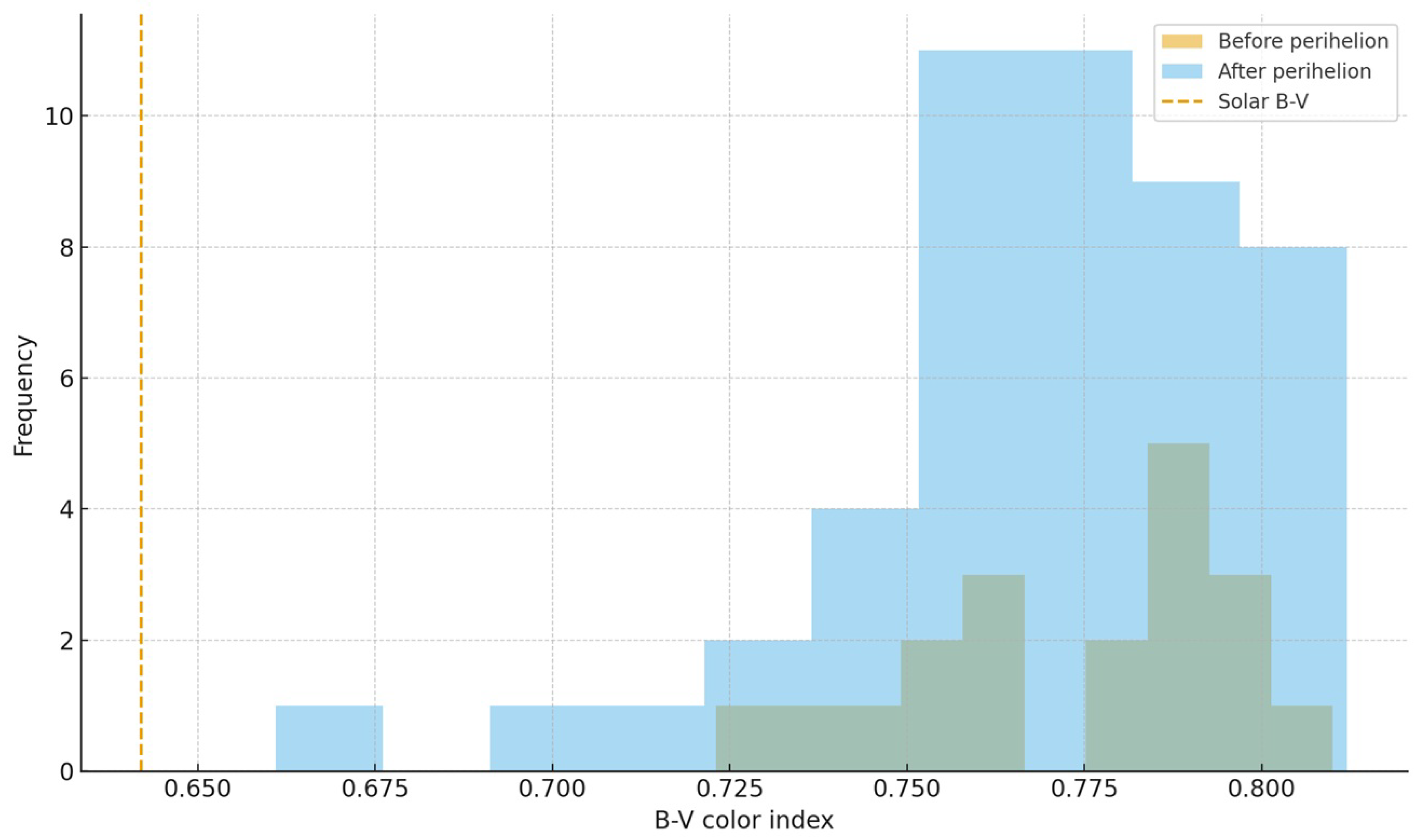
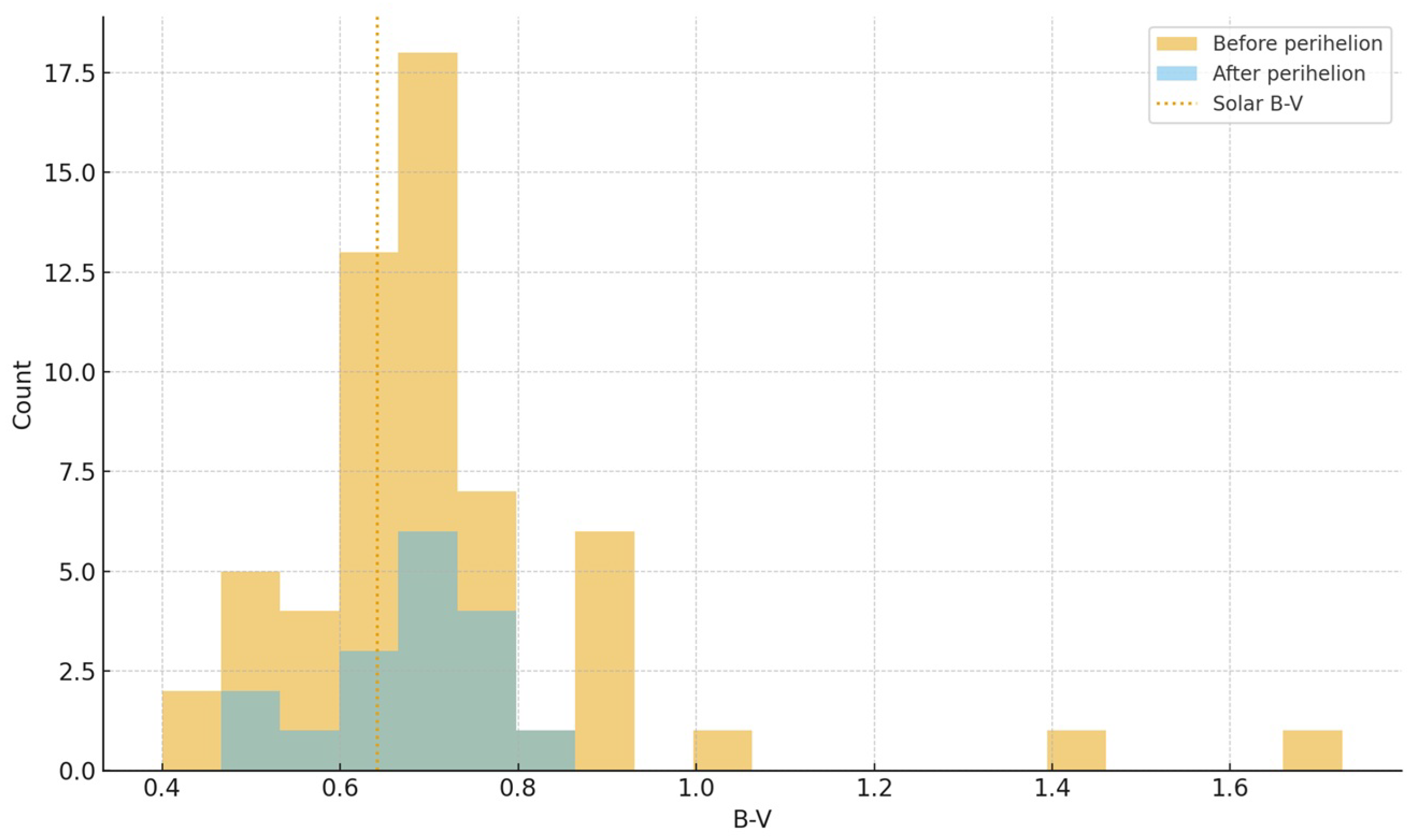
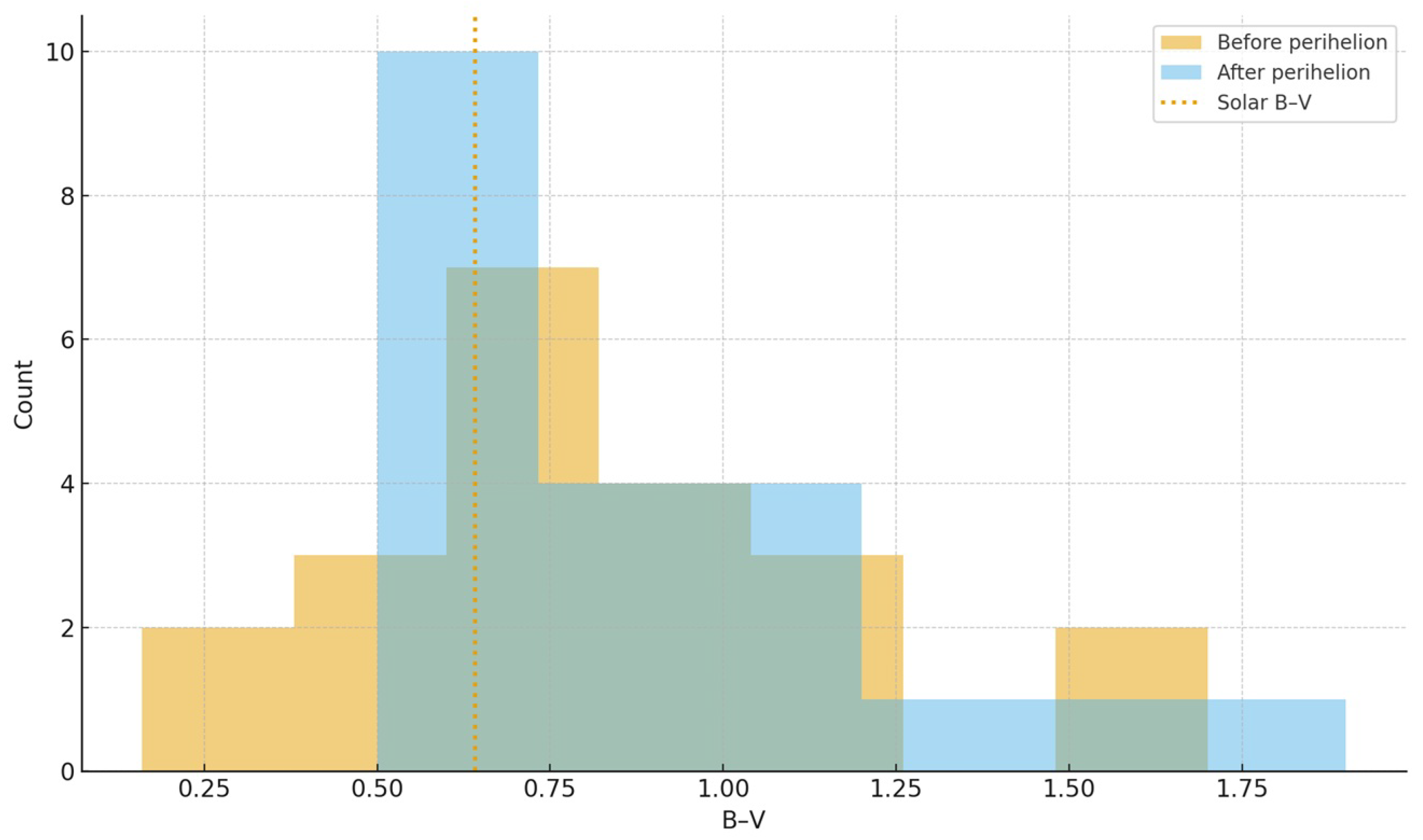
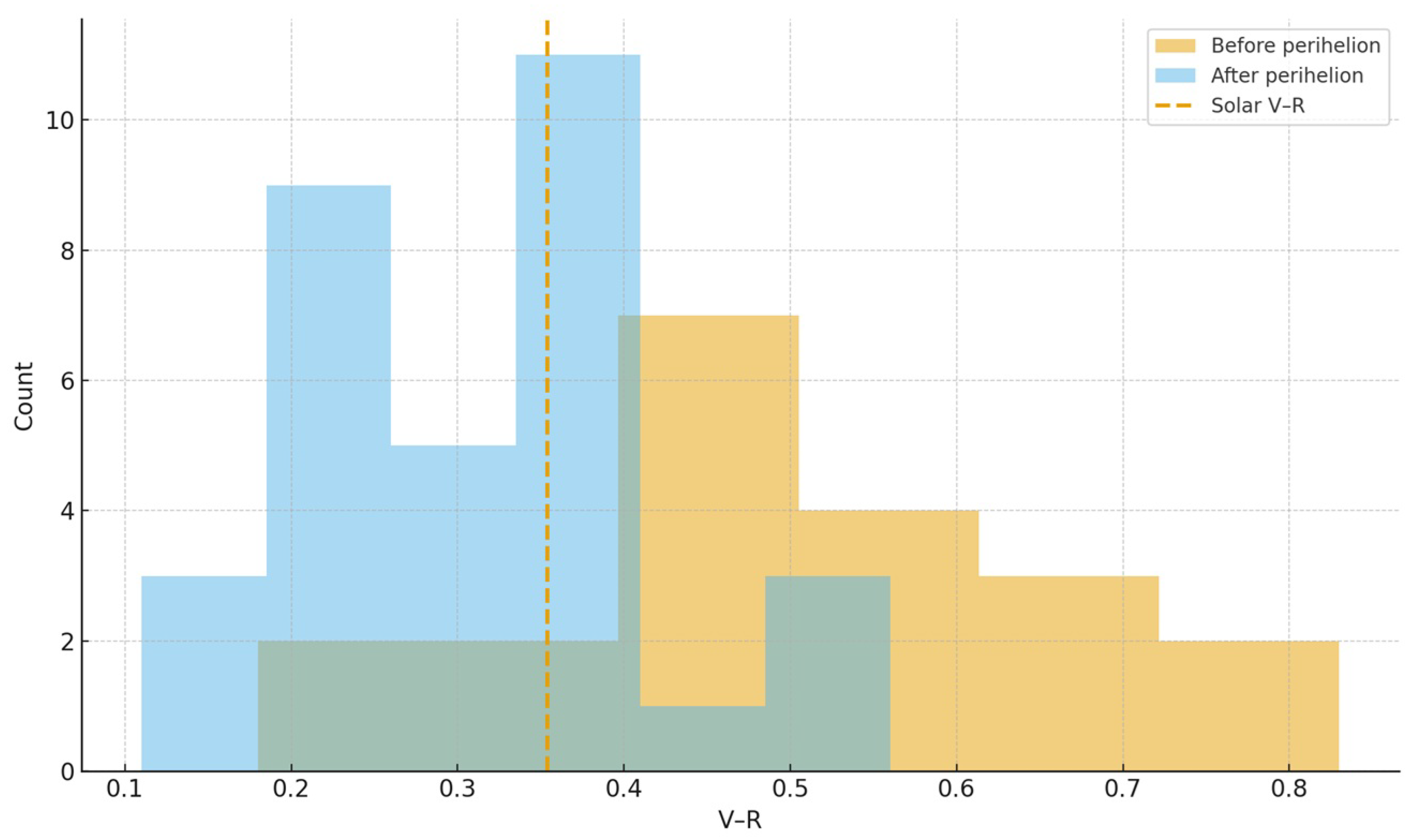
Color–distance relations in the comae of 14 comets are analyzed using homogeneous broadband UBV/BVRI photometry. The sample includes several inner-Solar-System–reaching comets, including a subset from near-Earth orbits in the dynamical sense (perihelion distance q<1.3 au), so the results are directly relevant to the near-Earth meteoroid environment. For each comet, we combine robust color statistics, rank-correlation tests, and simple activity laws to define two empirical diagnostics: an absolute color at 1 au and a differential heliocentric color index that measures color changes with distance. The ensemble does not follow a single universal trend; instead, we identify three empirical classes. One class of comets shows significant color gradients, usually confined to blue-sensitive indices and consistent with varying gas-to-dust ratios along the orbit. A second class exhibits colors that are persistently redder than the Sun and are statistically consistent with being constant both with heliocentric distance and across perihelion. A third class of “step comets” shows discrete changes in color level between pre- and post-perihelion branches, most often in red or red–near-IR indices, with little or no monotonic color–distance correlation within each branch. Several objects therefore defy the intuitive expectation of becoming bluer as they approach the Sun, emphasizing that heliocentric color evolution is highly object-dependent and that multi-epoch color monitoring is essential for interpreting cometary coma behavior.
Keywords: comets: general; techniques: photometric; methods: statistical; color indices; heliocentric distance; cometary comae; gas-to-dust ratio; near-Earth meteoroids comets: general; techniques: photometric; methods: statistical; color indices; heliocentric distance; cometary comae; gas-to-dust ratio; near-Earth meteoroids