1. Introduction
The basic scenario of the solar dynamo was suggested by Parker [
1,
2]. It is employed in mean-field dynamo models, which simulate the large-scale dynamo as a cyclic transformation of the poloidal magnetic field to the toroidal by the differential rotation and regeneration of the poloidal magnetic field from the toroidal by the
-effect. The
effect can arise from different sources. For example, it can stem from the cyclonic turbulent convection and the systematic tilt magnetic field inside bipolar solar active regions (hereafter, BMR) at the solar surface. Both effects represent the breaking of the reflection symmetry of the turbulent motion and magnetic field inside the convection zone. As a result, the large-scale dynamo produces a helical large-scale magnetic field with positive helicity in the northern hemisphere and negative helicity in the southern hemisphere. The conservation of the total magnetic helicity results in opposite hemispheric helicity rule for the small-scale magnetic field. The theoretical arguments of Pouquet et al. [
3], Frisch et al. [
4] and Kleeorin and Ruzmaikin [
5] showed that the obtained distribution of the small-scale magnetic helicity opposes the turbulent generation of the large-scale poloidal magnetic field in stellar convective zones.
The nonlinear feedback of magnetic helicity on the turbulent dynamo has motivated studies of magnetic helicity transport as a means to overcome the constraints imposed by magnetic helicity conservation in large-scale dynamos [
6,
7,
8]. In particular, the results of Pipin [
9], Kleeorin and Rogachevskii [
10] and Gopalakrishnan and Subramanian [
11] (hereafter P08, KR22, and GS23, respectively) showed that large-scale vorticity can generate magnetic helicity even when the original turbulent motions and magnetic fields are completely non-helical. For this effect, the small-scale magnetic fields produced by the small-scale dynamo are essential. The small-scale dynamo is expected to operate in the turbulent media of stellar convective envelopes [
12].
In the stellar convection zone, large-scale vorticity is associated with the presence of differential rotation and meridional circulation. Both types of large-scale flow contribute to the generation of magnetic helicity flux, which is associated with magnetic activity on the solar surface. Differential rotation is considered the main source of magnetic helicity transport from the solar convection zone to the outer layers of the Sun [
13,
14,
15]. The results of Prior and Yeates [
16] and Pipin et al. [
17] showed that differential rotation can be the primary source of the hemispheric helicity rule of the magnetic field in solar active regions.
Following the analytical results of Gopalakrishnan and Subramanian [
11] (hereafter GS23) and the results of the numerical simulations mentioned above, we conclude that differential rotation can be an important source for production the small-scale magnetic helicity in the solar convection zone. It is noteworthy that this source of magnetic helicity is rarely included in dynamo models. The results of Guerrero et al. [
18] showed that differential rotation can be important for the helicity flux. The so-called Vishniac–Cho flux [
7], which they studied, is nonlinear in the large-scale magnetic field and is therefore likely to be important in supercritical dynamo regimes. However, the results of P08, KR22, and GS23 showed that large-scale vorticity produces magnetic helicity even in the linear regime with respect to the strength of the large-scale magnetic field. This term should dominate in slightly overcritical dynamos. Here, we study this effect in a mean-field dynamo for the first time. Our plan is as follows. In the next chapter, we formulate the dynamo model and the basic assumptions behind it. In
Section 3, we present the results of the dynamo model and compare the new effects of helicity generation with the standard effects of the large-scale dynamo. Finally, in
Section 4, we discuss our findings and draw the main conclusions of the paper.
2. The Dynamo Model
The evolution of the large-scale magnetic field,
, in the highly conductive turbulent medium is governed by the induction equation:
where
is the mean electromotive force of the turbulent flows and magnetic field; and
is the large-scale flow. Here, the angle brackets mark the averaging over the ensemble of fluctuations. Usually, see, e.g., Pipin et al. [
17], we distinguish the axisymmetric and nonaxisymmetric components of the magnetic field and flows:
where the overline marks the longitudinal average. In this paper, we study the axisymmetric mean-field dynamo and set
and
. In following the line of Krause and Rädler [
19], the axisymmetric field is decomposed into the sum of the poloidal and toroidal parts:
where the scalars
A and
B and the angular velocity
are the functions of time and spatial variables:
r is the radius and
is the co-latitude (the polar angle);
is the unit vector along the azimuth; and
is the meridional circulation. The details of our model can be found in [
20]. The dynamo model employs the mean electromotive force,
, as follows:
where
describes the turbulent generation by the hydrodynamic and magnetic helicity,
is the turbulent pumping, and
is the eddy magnetic diffusivity tensor. The
-effect tensor includes the effect of the magnetic helicity conservation ([
5,
21]),
Here
is the dynamo parameter characterizing the magnitude of the hydrodynamic
-effect,
is the small-scale magnetic helicity density, where
is the fluctuating small-scale magnetic field and
is its vector-potential;
and
are dimensionless and describe the anisotropic properties of the kinetic and magnetic parts of
-effect. Their profiles depend on the mean density stratification, the equipartition parameter:
where
and
are the parameters of the background turbulence characterizing the intensities of the kinetic and magnetic fluctuations. In the mean-field models these parameters should be known in advance. The profile of the convective velocity
is taken from the solar interior model MESA; see comments below. We avoid the direct modeling of the small-scale dynamo and express the intensity of the magnetic fluctuations via Equation (
8). The radial profiles of
and
depends strongly on the Coriolis number:
where
is the global angular velocity of the star. The convective flow parameters
and
are the convective turnover time and the mixing length, respectively. They quantify the typical time and length scales of the turbulent convection. The magnetic quenching function
depends on the parameter
, [
22]. We include the descriptions of
and
, as well as the turbulent pumping tensor,
, and the eddy magnetic diffusivity tensor,
, in the
Appendix A.
The intensity of convective turbulence,
, is determined by the mean entropy distribution obtained from the mean-field heat transport equation. The evolution equation for the mean entropy takes into account the anisotropy of convective heat transport due to the global rotation and magnetic field. In this equation, variations of the mean entropy represent effects of the large-scale magnetic field and flow as perturbative deviations of the entropy profile from a prescribed reference state. The reference profiles of the mean thermodynamic quantities and the convective turnover time,
, are adopted from the MESA stellar evolution model [
23,
24]. A more detailed description of the methodology and underlying assumptions is provided in [
22]. We use the mixing-length approximation to define the profiles of the eddy heat conductivity,
, eddy viscosity,
, eddy diffusivity,
, and the RMS convective velocity,
, as follows:
where we introduce the smooth decrease of
,
, and
toward the bottom of the convection zone, and we set
. The smooth transition in
is usually seen in the direct numerical simulation of the stellar convection zone [
25,
26]. However, the local character of the mixing-length approximation for the convective heat transport does not allow taking it into account. Moreover, the sharp decrease of
toward the bottom results in the high gradient of turbulent intensity in this region, and the smooth procedure alleviates this behavior. Currently, there is no a satisfactory solution for this issue within the mean-field framework. The magnitude of smoothing affects the properties of the dynamo solution inside the overshoot region because of inversion of the
-effect in this region and the effect of the diamagnetic pumping [
27]; see
Figure 1 below. The dynamo domain is divided for two parts. The convection zone extends from
to
. The model employs the overshoot layer below the convection zone to describe the transition from the differential rotation of the convection zone to the rigid rotation in the radiative zone at the position
. In the transition region, the turbulent parameters are defined following the results of Ludwig et al. [
28]; also see Paxton et al. [
23]. We apply an exponential decrease in all turbulent coefficients (except the eddy viscosity and eddy diffusivity) with a decrement of −100; i.e., they are multiplied by a factor of
, where
z is the distance from the bottom of the convection zone. The eddy viscosity and eddy diffusivity are kept finite at the bottom of the tachocline; i.e., for the eddy viscosity coefficient profile within the tachocline, we set
where
is the value at the bottom of the convection zone,
is the value inside the tachocline, and
z is the distance from the bottom of the convection zone. We use
in the model.This procedure allows us to account for the adjustment of the differential rotation within the tachocline over a finite temporal interval of approximately 100 years. We adopt an analogous treatment for the magnetic eddy diffusivity to satisfy numerical stability constraints. Under these assumptions, we obtain values for the differential rotation at and below the base of the convection zone that are consistent with helioseismic inferences. In future work, this parametrized approach should be superseded by a fully self-consistent model of the tachocline. The angular velocity profile,
, and the meridional circulation,
, are defined by conservation of the angular momentum and azimuthal vorticity
. In this paper, we use the kinematic models, excluding the magnetic feedback on the large-scale flow and heat transport and taking the large-scale flow and the entropy profile from the solution of the angular momentum balance and heat transport equations for a rotating convection zone. The model shows an agreement of the angular velocity profile with helioseismology results for
. The dynamo models show a cycle period of 22 years when
and
(see [
22]).
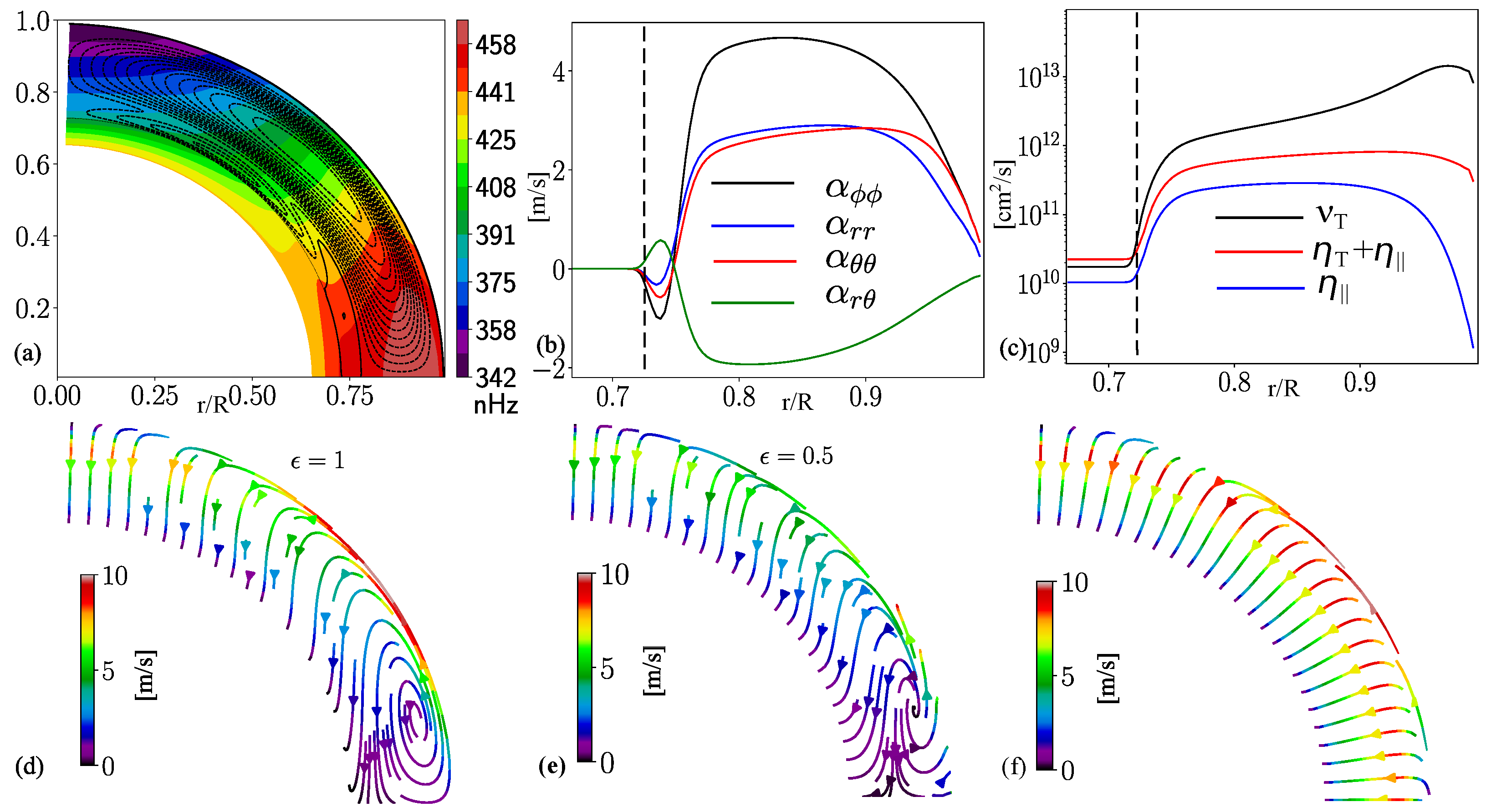
Figure 1 shows the profiles of the large-scale flows, the hydrodynamic
-effect and the diffusivity profiles. We note the inverse sign of the
-effect tensor components and the rotational quenching of the turbulent diffusivity profile toward the bottom of the convection zone, which is marked by the dashed line.
Figure 1d–f show streamlines of the effective drift velocity of the large-scale magnetic field due to the turbulent pumping and the meridional circulation. We see that the effective drift patterns are different for the toroidal and poloidal magnetic fields. Furthermore, this depends on the magnetic fluctuations via the equipartition parameter
because of the diamagnetic pumping. These effects were extensively discussed in [
27,
29].
Figure 1.
(
a) The meridional circulation (streamlines) and the angular velocity distributions, where the magnitude of circulation velocity is 13 m/s on the surface at a latitude of 45°; (
b) the
-effect tensor distributions at a latitude of 45°, where the dashed line shows the convection zone boundary; (
c) radial dependencies of the total,
, and the rotational induced part,
, of the eddy magnetic diffusivity and the eddy viscosity profile,
; (
d) streamlines of the effective drift velocity of large-scale toroidal magnetic field due to the turbulent pumping and the meridional circulation for the case of equipartition between the intensity of the magnetic fluctuations and turbulent motions,
; (
e) the same as (
d) when the energy of the magnetic fluctuations is less by factor of two than the energy of turbulent flows; (
f) streamlines of the effective drift velocity of the large-scale poloidal magnetic field. We use
numpy/scipy [
30,
31] together with
matplotlib [
32] for post-processing and visualization.
Figure 1.
(
a) The meridional circulation (streamlines) and the angular velocity distributions, where the magnitude of circulation velocity is 13 m/s on the surface at a latitude of 45°; (
b) the
-effect tensor distributions at a latitude of 45°, where the dashed line shows the convection zone boundary; (
c) radial dependencies of the total,
, and the rotational induced part,
, of the eddy magnetic diffusivity and the eddy viscosity profile,
; (
d) streamlines of the effective drift velocity of large-scale toroidal magnetic field due to the turbulent pumping and the meridional circulation for the case of equipartition between the intensity of the magnetic fluctuations and turbulent motions,
; (
e) the same as (
d) when the energy of the magnetic fluctuations is less by factor of two than the energy of turbulent flows; (
f) streamlines of the effective drift velocity of the large-scale poloidal magnetic field. We use
numpy/scipy [
30,
31] together with
matplotlib [
32] for post-processing and visualization.

In this paper, we employ the conservation of the total magnetic helicity [
33,
34],
, where integration is done over the volume of the convection zone. In spherical mean-field dynamo models, the magnetic helicity of the large-scale magnetic field and its vector potential—potentially including the nonaxisymmetric contributions associated with active regions as well [
17]—is typically formulated in terms of Chandrasekhar–Kendall potentials. Under this representation, and assuming a spherical harmonic expansion of the Chandrasekhar–Kendall potentials (see [
19,
35]), the magnetic helicity of the large-scale field uniquely characterizes the linkage between the toroidal and poloidal components generated by the dynamo. In this paper, we focus on an axisymmetric dynamo model. The axisymmetric vector potential satisfies the Coulomb gauge by default. The differential form of the conservation law is as follows:
where
is the turbulent flux of the small-scale magnetic helicity density,
. It is noteworthy that the magnetic helicity of the large-scale axisymmetric magnetic field is gauge-invariant by definition. The analytical derivations of the turbulent fluxes
given by Gopalakrishnan and Subramanian [
11] employed the Coulomb gauge for the small-scale vector potential,
. In Equation (
14) we neglect effects of the Ohmic diffusion of the small- and large-scale magnetic helicity, and the Ohmic diffusion of the large-scale current helicity. The Ohmic dissipation of the small-scale current helicity was approximated as follows [
21]:
where we set
. Following the results of Gopalakrishnan and Subramanian [
11] (hereafter, GS2023) we take
in the following form:
where
is the Fickian flux by the turbulent diffusion of the magnetic helicity; and
and
stand for the random advection flux and the new Vishniac flux (NV), respectively. For
, GS2023 got
Calculations in GS2023 ignore the effects of the Coriolis force and the large-scale magnetic field on the helicity flux. Following P08, magnetic helicity generation in rotating turbulence is quenched by the Coriolis force. Quenching functions are also required for numerical stability. In constructing a dynamo model that includes helicity generation due to large-scale vorticity and small-scale magnetic fields, we therefore incorporate rotational and magnetic quenching of the transport effects in a heuristic way, using quenching functions suggested by P08 and adopting the same form as for the magnetic part of the alpha-effect. Since the diffusive flux,
, is proportional to the magnetic eddy diffusivity, we apply the same rotational quenching functions as for the isotropic part of the eddy diffusivity tensor; i.e, we set
where we set
, and for compatibility with the results of Mitra et al. [
36], we will use
(the range of 0.1–0.5 is employed in the dynamo model). Following to the results of GS23, we get for the random advection flux,
:
where
; also, in transforming the expression given by GS23, we use Equation (
8) and
. The latter requires the assumption of the local statistical isotropy of the fluctuating magnetic fields [
37]. Using
, we transform
to
We do the same reduction for GS23’s
flux. After such simplification, we get
The constant in the last equation is
, and it is
if we consider the results of KR22 (see expression
in their Eq(E6)). The free parameter
measures the efficiency of helicity production. In our reduction of the
given by GS23, we neglect the combined term with the numerical factor
, which is two orders of magnitude smaller than that given by Equation (
21). For numerical stability, we include the algebraic quenching of the flux given by the same function as for the
-effect.
The large-scale vorticity is computed from the angular velocity distribution, which is provided by the hydrodynamic part of the model. In the spherical coordinate system, we have
where
, and
is the global angular velocity of the star. We neglect the azimuthal part of the large-scale vorticity due to the meridional circulation, because it is expected to be two orders of magnitude smaller than the effect of the differential rotation.
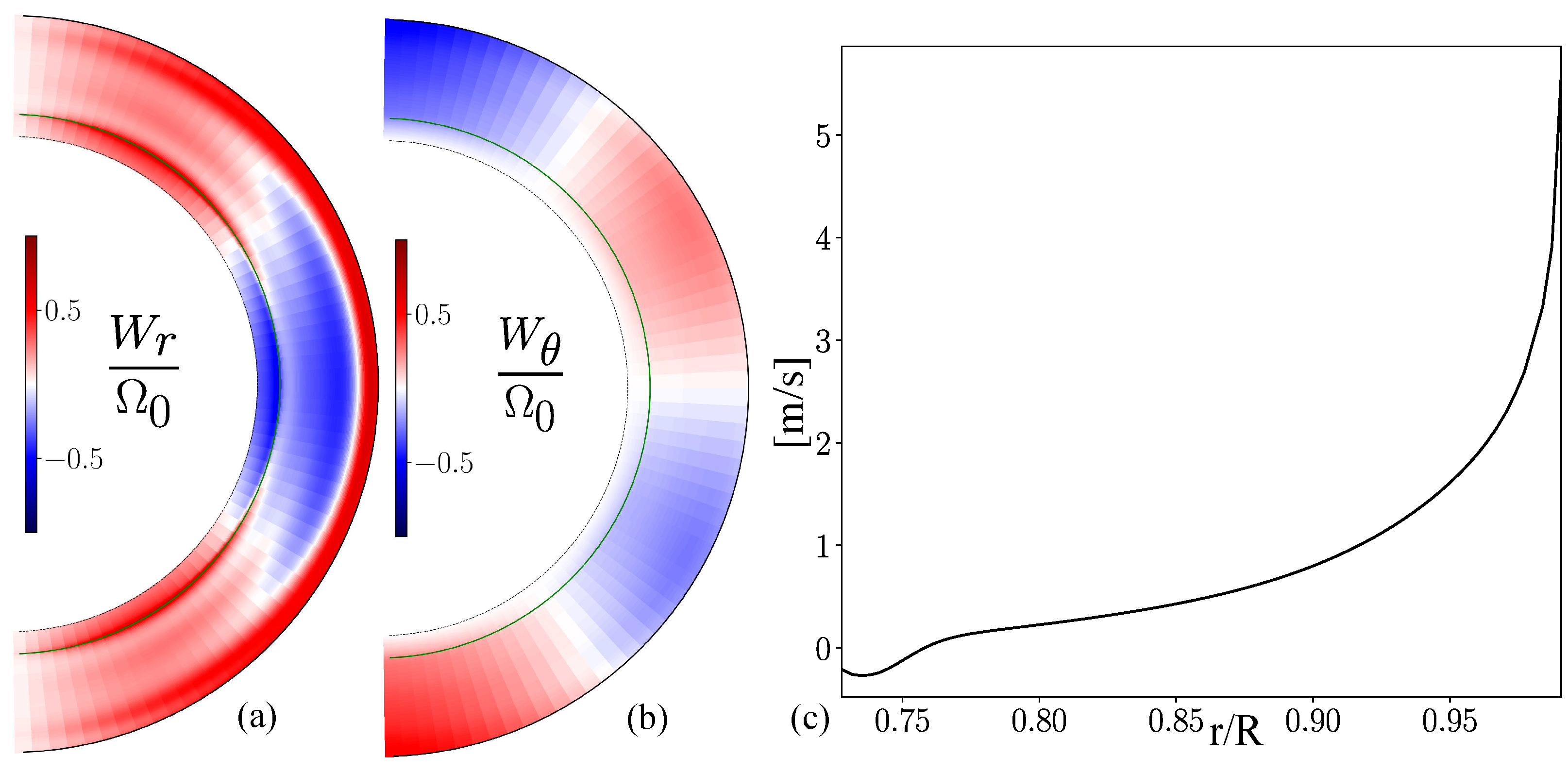
Figure 2 shows the distribution of the large-scale vorticity in the solar convection zone and the velocity of the small-scale helicity transport by
. The latter is outward in the main part of the convection zone and inward near the bottom.
Both flux and describe the magnetic helicity generation from the large-scale flow and the small-scale magnetic fluctuations due to the turbulent dynamo. Hence they can produce the large-scale dynamo effect even if the kinetic -effect is negligible. Furthermore, we see that the large-scale vorticity affects the nonlinear balance of the helicity distributions in the radial and latitudinal directions.
We summarize the assumptions underlying the implementation of the turbulent flux
in the dynamo model. First, the general form of this term is derived analytically from the fundamental MHD equations, explicitly retaining nonlinear third-order moments (see P08, KR22, and GS23). Second, within the dynamo model, we employ the linear approximation of
with respect to the global rotation and mean magnetic field. For the fluxes
and
, we adopt quenching functions motivated by P08’s results for the magnetic contribution to the
-effect. This approximation is justified in the weakly nonlinear regime characterized by
. The impact of global rotation on
and
is currently not well constrained and warrants further investigation. Third, we assume that magnetic fluctuations scale with the kinetic energy of the turbulent motions (see Equation (
8)), as expected for fully developed MHD turbulence at a high magnetic Reynolds number
. We additionally assume local statistical isotropy of the magnetic fluctuations in order to relate the small-scale magnetic and current helicity density.
The dynamo model employs the zero-magnetic-field boundary conditions at the bottom of the overshoot layer,
, whereas at the top, we smoothly connect the dynamo solution with the outer harmonic magnetic field [
38], which satisfies
for the region
and the radial magnetic field for
. We use
as suggested by the results of the above-cited paper; see details in the
Appendix A.
The numerical code employs the pseudo-spectral method of integration in latitude with 64 Legendre nodes from the north to the south poles. In the radius, it utilizes the finite differences with 120 mesh points from the bottom of the dynamo domain
to the top
.
Table 1 contains the description of the runs, which will be discussed in the next chapter. Each run was started from the weak poloidal field of the equally mixed parity and 1 G strength. The solution was followed until it reached the stationary stage. The models with
have a higher dynamo threshold than those with
.
3. Results
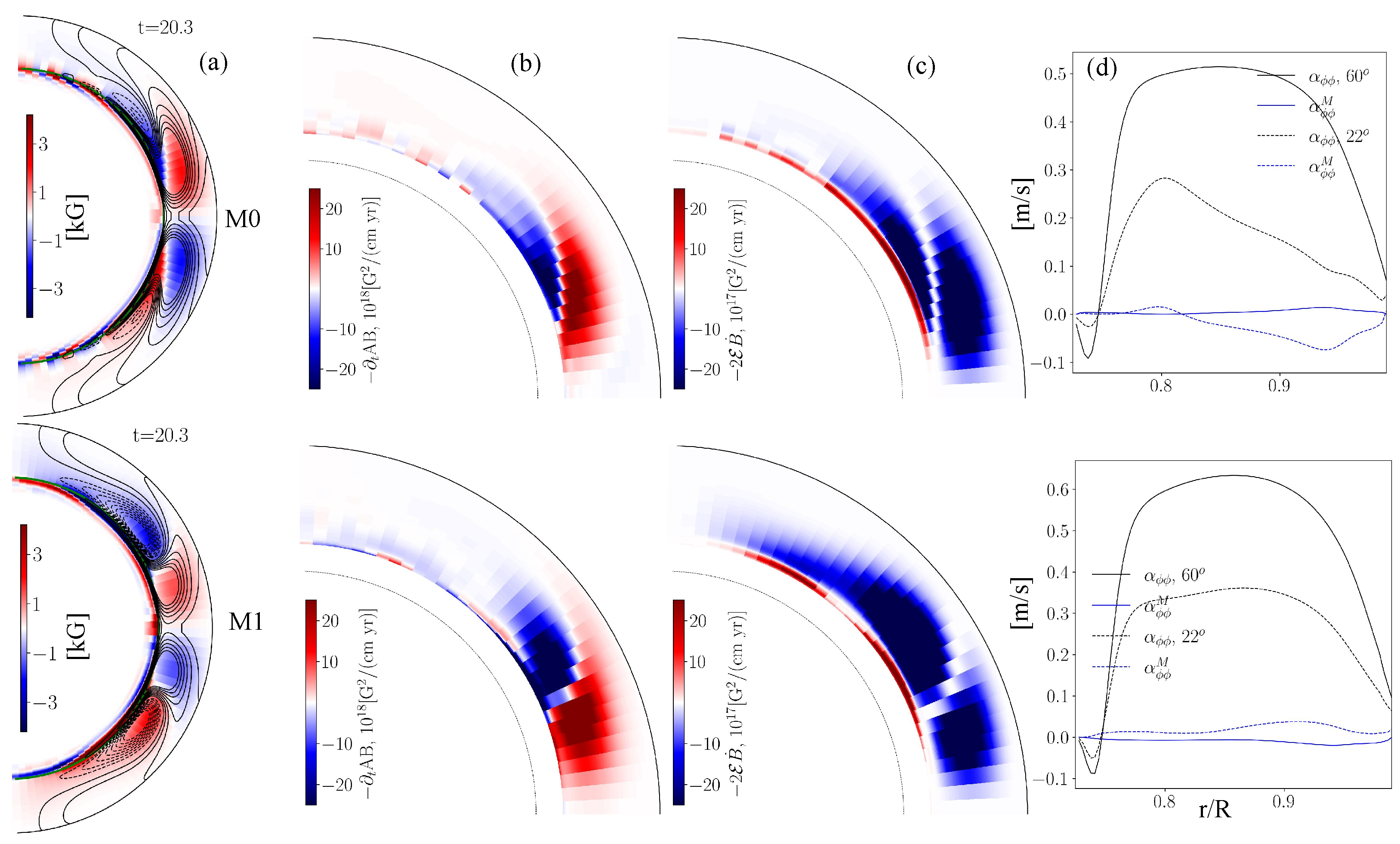
Figure 3 shows the snapshots of the reference models M0 and M1 for the decaying phase of the magnetic cycle. We see that the reduction in the intensity of the magnetic fluctuations, i.e.,
, results in a considerable change in the pattern of the dynamo activity. Firstly, the radial propagation of the dynamo waves is not seen in case M1. Secondly, the activity of the toroidal filed is concentrated strongly at the bottom of the convection zone. This effect results in a decrease in the magnitude of the toroidal magnetic field flux in run M1 in comparison to run M0. Run M1 shows a longer dynamo period than run M0 because the toroidal magnetic field concentrates at the region with low magnetic diffusivity. All these effects in run M1 are mainly because of diamagnetic pumping, which is not active in the case of
. The (d) column in
Figure 3 shows variations in the total
-effect and its magnetic part, which is due to small-scale magnetic helicity generation. The dynamic variations in the
-effect at low latitudes in run M0 are greater than in run M1.
The addition of helicity generation due to large-scale vorticity results in a strong modification of the total
-effect, both near the bottom and the top of the convection zone.
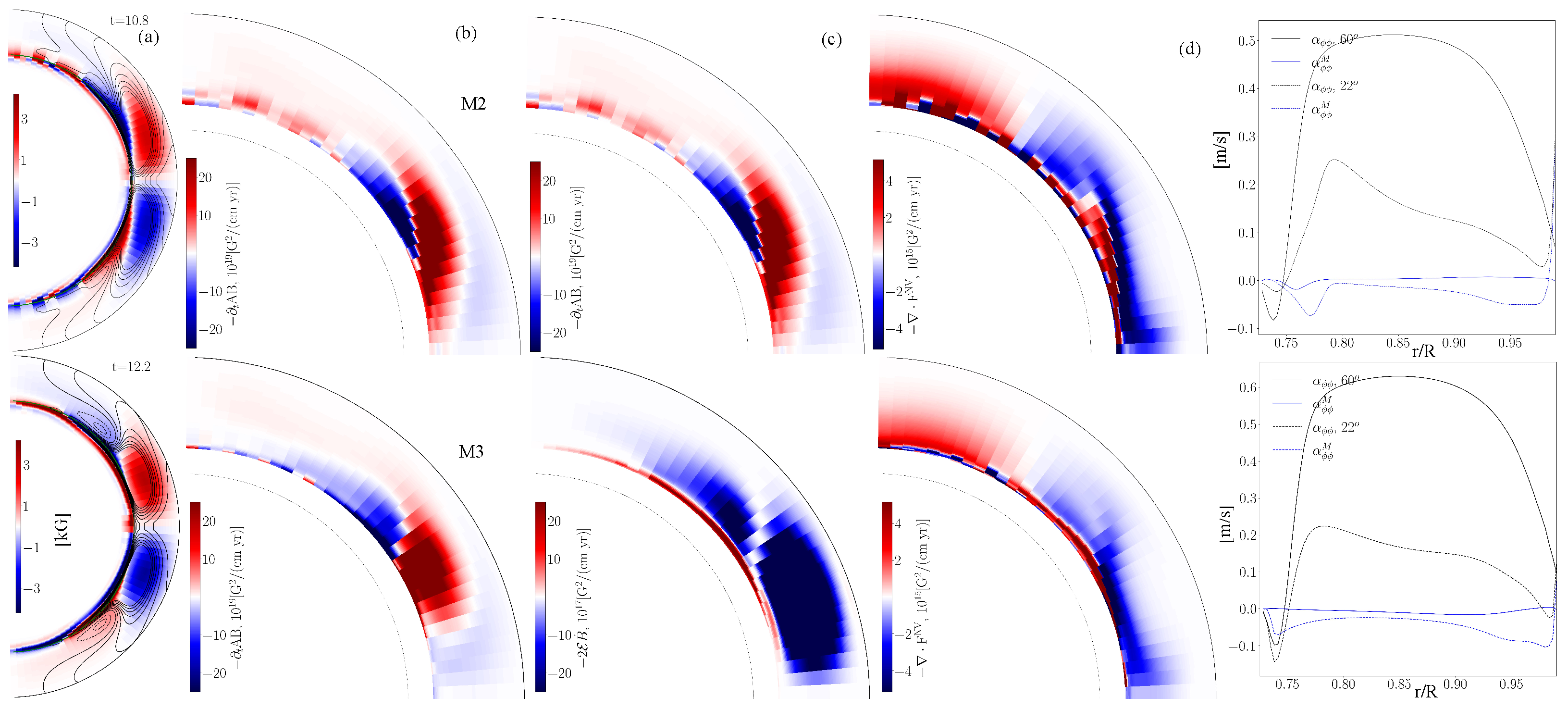
Figure 4 shows the snapshots of the magnetic field distribution and helicity generation rate in the dynamo model for the decaying phase of the activity cycle. The runs show that in the main part of the convection zone, the small-scale helicity generation rate by
is an order of magnitude smaller than that by the standard
-effect. We find that the effects have the same magnitudes near the bottom of the convection zone and near the surface in the polar regions of the star. Run M2 demonstrates the significant change in the total
-effect in these regions. The animations that were constructed using the results of runs M2 and M3 showed significant variations in the
-effect in the magnetic cycle because of the new source of magnetic helicity generation. Similarly to case M1, run M3 shows a decrease in the
-effect variations in the bulk of the convection zone in comparison to run M2. In run M2, the increase in the total
-effect near the surface in the polar regions, when compared to run M0, leads to a stronger magnitude of the magnetic cycle. Simultaneously, run M2 shows a wider region of the inverted
-effect at low latitudes near the bottom of the convection zone than run M0. Following to the Parker–Yoshimura rule [
39], this amplifies the propagation of the dynamo wave in this region toward the equator and downward. This seems to affect the period of the dynamo cycle in the bulk of the convection zone; see
Table 1.
Similarly to runs M0 and M1, a decrease in the level of the magnetic fluctuations to
results in a change in the dynamo wave propagation pattern and an increase in the toroidal magnetic field near the bottom of the convection zone and in the overshoot layer. The latter results in a decrease in the
-effect modulation near the bottom of the convection zone. Run M3 shows a smaller modulation of the
-effect near the top of the convection zone in comparison to run M2.
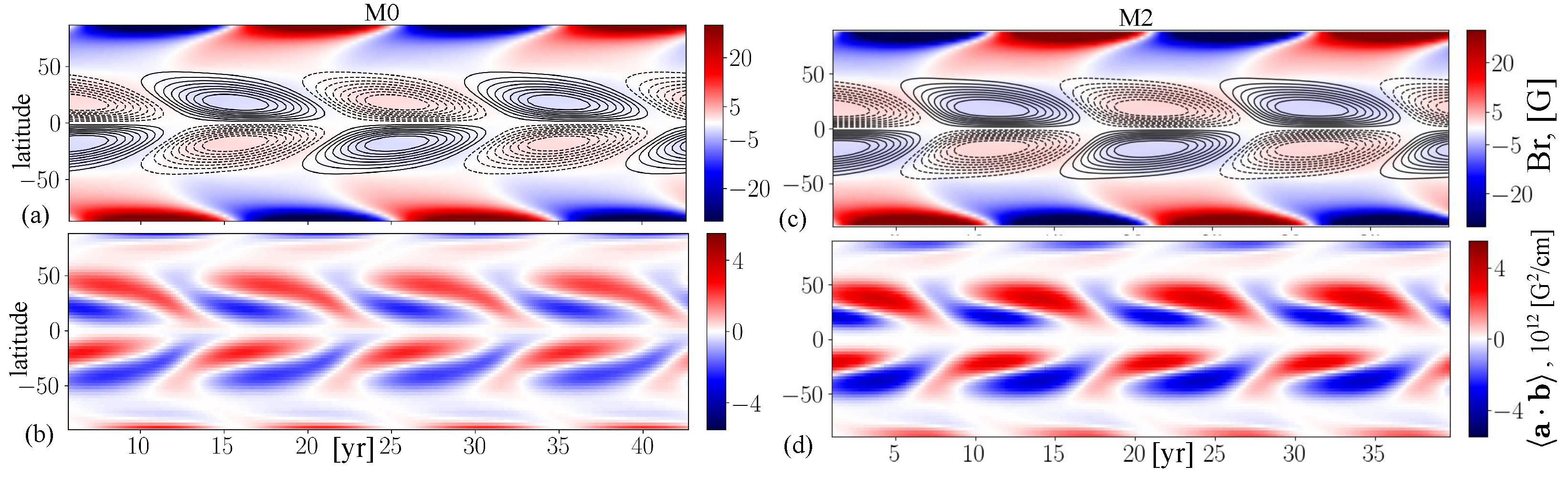
Figure 5 illustrates the increase in dynamo efficiency in run M2 in comparison to run M0 using the time–latitude diagrams of the large-scale magnetic field and small-scale magnetic helicity. In the northern hemisphere of the star, run M2 shows an increase in the generation of the positive small-scale magnetic helicity around 50° latitude during the decaying phase of the magnetic cycle, when the radial magnetic field grows in the polar regions.
Table 1 shows that the magnitude of the polar magnetic field in run M2 is larger by a factor of two than that in run M0.
In this paper, I discuss only a few runs for the purpose of illustrating the dynamo effects caused by the large-scale vorticity and the fluctuating magnetic field that stem from the small-scale dynamo. Let us discuss the effect of the parameter variations. When the small-scale dynamo is absent,
1, then the helicity transport by turbulent motions and stratification effects decrease by an order of magnitude; see
Figure 2c. The flux
disappears in this case. The moderate reduction in the small-scale parameter,
, see runs M1 and M3, results in a decrease in the dynamo efficiency of the convective envelope. The decrease in
results in an increase in the critical dynamo threshold of the
-effect. We find a longer dynamo period with an increase in the turbulent diffusion flux. This results in a reduction in the subsequent magnetic cycles overlap as well. The latter affects the extended mode of the torsional oscillations [
22].
A subsequent question of interest concerns the impact of the heuristically introduced quenching functions associated with the source term
on the characteristics of the dynamo solution. Magnetic quenching is required to ensure the nonlinear stability of the dynamo and modifies the sign of the gradient that enters the definition of
. This influence is clearly demonstrated by models M3 and M4 in
Figure 4c, which exhibit a change in the sign of
between the two dynamo waves. Furthermore, it must be taken into account that magnetic quenching activates the
contribution associated with the latitudinal component of the large-scale vorticity, owing to the fact that the mean magnetic field exhibits a latitudinal inhomogeneity.
Rotational quenching constrains the generation of small-scale magnetic helicity near the base of the convection zone. The results of models M3 and M4 demonstrate that the nonlocal Vishniac–Cho flux, , exerts a substantial influence on the radial profiles of the -effect. In particular, increases the depth range near the bottom of the convection zone over which the -effect reverses sign.
We additionally performed numerical simulations in which the rotational quenching of by the Coriolis number is neglected. Under these conditions, we find that the toroidal magnetic field in the bulk of the convection zone is substantially diminished, whereas it is correspondingly amplified in the vicinity of the base of the convection zone. In this simulation, we find that magnetic activity progressively migrates from the convection zone into the overshoot layer, and the solar-type dynamo waves disappear.
The above comments show that both rotational and magnetic quenching substantially modify the properties of the dynamo solution. Consequently, the results presented in this study should be regarded as preliminary and warrant further investigation, particularly a more comprehensive theoretical description of the magnetic helicity flux.
4. Discussion and Conclusions
In this paper, we examine the large-scale dynamo effects arising from the divergence of the helicity flux associated with large-scale vorticity and small-scale dynamo-generated magnetic fluctuations. Magnetic helicity flux is commonly invoked as a mechanism to mitigate the so-called catastrophic quenching of the
-effect [
40]. In this framework, helicity production is constrained by the conservation of total magnetic helicity in large-scale dynamos and appears as a response to the generation of large-scale magnetic fields by the kinetic
-effect. The results of Kleeorin et al. [
6], Vishniac and Cho [
7], Field and Blackman [
41] demonstrated that catastrophic quenching can be alleviated when magnetic helicity transport by turbulent motions is taken into account.
The generation of small-scale magnetic helicity in
dynamos is a nonlinear effect regarding the mean magnetic field
. Analytical studies by Kleeorin and Rogachevskii [
10], Subramanian and Brandenburg [
42] showed that small-scale helicity can be produced by the combined action of large-scale vorticity and a random small-scale magnetic field generated by the small-scale dynamo. The generation of a preferred hemispheric sign of magnetic helicity from an initially random magnetic field distribution through differential rotation has been known for a long time (see, e.g., [
13,
14,
43]). Numerical models show that differential rotation produces predominantly negative magnetic helicity in low-latitude regions of the northern hemisphere and positive helicity in the corresponding regions of the southern hemisphere [
16,
17], with the opposite sign pattern emerging at higher latitudes. The resulting magnetic helicity contributes to the dynamo process and must therefore be explicitly included in dynamo modeling.
The recent studies by KR22 and GS23 provide a general analytical formulation of this effect. In the present work, we examine this mechanism for the first time in the framework of solar-type dynamo models. The corresponding additional dynamo source term implemented in our model is constructed in a heuristic manner, owing to the fact that the influence of the Coriolis force and the large-scale magnetic field on is not yet well constrained. This limitation reduces the robustness of all inferences drawn from the numerical simulations presented here.
The results of our runs show that the new source of magnetic helicity modifies the patterns of dynamo wave propagation inside the convection zone, increasing the amplitude and the dynamo period. These changes are caused by the modification of the
-effect. The source
is concentrated at the boundaries of the convection zone because of variation in the differential rotation, the convective turnover time
and the mean density stratification. These factors result in modulation of the
-effect near the boundaries. Near the bottom of the dynamo domain
increases the inversion of the
-effect. In following the Parker–Yoshimura rule, the negative
(in the northern hemisphere) and the positive gradient of the angular velocity result in amplification of the equatorward dynamo waves in equatorial regions near the bottom of the convection zone. Simultaneously, the negative shear in the polar regions, together with the negative gradient of the mean density and the small-scale dynamo magnetic field, amplifies the generation of the poloidal magnetic field near the surface in the polar regions of the star. The latter means that the polar magnetic field can be regenerated from the toroidal magnetic field directly at high latitudes. Therefore, the large-scale vorticity amplifies the action of the kinetic
-effect in the polar regions of the star. Similarly to the
dynamo, see Kitchatinov and Olemskoy [
44], the new dynamo source
is likely to be important for the fast-rotating stars that have the finite amplitude of the differential rotation.
The obtained results show that the turbulent generation of the large-scale magnetic field in the stellar convection zone can be interpreted, at least partially, as arising from the global coherence of random small-scale magnetic structures induced by the action of large-scale shear. This interpretation has also been discussed by [
45]; see references therein. Their simulations demonstrate the onset of global dynamo instability arising from the interaction between helical flows and shear, provided that both the magnetic Reynolds number
and the shear amplitude are sufficiently large [
46]. Ref. [
45] contended that, although the growth rate is governed by small-scale physical processes, the characteristic period of the resulting coherent structures is determined by mean-field considerations. This behavior differs from that of mean-field dynamo models, in which the instability growth rate is controlled jointly by small-scale and large-scale processes, and the dynamo period is determined by the ratio between the amplitudes of the dynamo source terms and the turbulent diffusivity. In the model developed here, the interaction between stochastic magnetic fields and large-scale shear modifies both the growth rate and the dynamo period by redistributing the turbulent sources responsible for the generation of the poloidal magnetic field within the convection zone.
Let us summarize our findings. Using the mean-field dynamo model, we study the effects of large-scale vorticity and magnetic fluctuations on the large-scale dynamo. The intensity of the magnetic fluctuations is given by the equipartition parameter
. Its effect on small-scale helicity production was estimated earlier in analytical studies of Pipin [
9], Kleeorin and Rogachevskii [
10] and Gopalakrishnan and Subramanian [
11] using the mean-field MHD framework. Our dynamo models show a crucial role of magnetic helicity production via large-scale vorticity in the large-scale dynamo process. This affects magnetic field generation near the boundaries of the dynamo domain because of the strong variation in the mean turbulent parameters in these regions. Our results suggest that the large-scale poloidal magnetic field can be regenerated directly in the polar regions of the Sun through differential rotation and small-scale magnetic fluctuations. Therefore, this effect should be taken into account when predicting the solar cycle based on polar magnetic field data. We hope that a future study will clarify the nonlinear impact of global rotation and magnetic fields on the level of magnetic helicity production by differential rotation and magnetic fluctuations.