1. Introduction
Following the pioneering paper of Casimir [
1], it has been understood that external boundaries can lead to nontrivial modifications of the vacuum energy density arising in quantum field theory. As a result, Casimir’s original idea stimulated a broad and systematic investigation of quantum vacuum phenomena in the presence of boundaries of various geometrical configurations and composed of different materials. These studies have explored how the shape, size, and physical properties of boundaries influence vacuum fluctuations and associated observable effects (see, e.g., refs. [
2,
3,
4,
5]).
In the present paper, we analyze the phenomenon of vacuum polarization (change of vacuum energy) generated by the presence of a linear magnetic topological defect. The defect is represented by an infinitely long, cylindrical, finite-thickness tube that is impenetrable to the quantized matter field and carrying a magnetic flux confined within its interior. Such a configuration provides a convenient and physically motivated setting for studying the connections between topology, boundary conditions, and quantum vacuum effects.
Within the framework of second-quantized-field theory, the magnetic defect gives rise to a number of nontrivial vacuum phenomena in the region exterior to the tube. In particular, it induces vacuum energy, generates a vacuum current flowing around the defect, and leads to the emergence of an associated magnetic flux outside the tube (see, e.g., the pioneering papers reported in [
6,
7,
8,
9,
10]). Since these phenomena originate from the combined action of the boundary condition imposed on the tube’s surface and the magnetic flux enclosed within the defect, these quantum effects are generally recognized as the Casimir–Bohm–Aharonov effect [
11], emphasizing their relation to both the boundary-induced Casimir effect and topological Aharonov–Bohm-type contributions [
12].
We consider the charged scalar matter field (
) that interacts with the space-time curvature and is described by the Lagrangian density:
where
is the scalar–curvature coupling constant (curvature coupling), i.e., the parameter describing the scalar field’s interaction with the curvature of space-time (
R), and
is the covariant derivative, which includes the vector field (
) associated with a
gauge symmetry. The energy–momentum tensor (EMT) is obtained by varying the action expressed as
with respect to the metric tensor: [
13,
14,
15]
where
is the canonical energy–momentum tensor. It is evident that the dependence of the scalar field’s EMT on the curvature coupling (
) remains when the Ricci tensor is
, as well as in flat space, where the Riemann tensor is
. This clearly follows from the fact that the terms arising from varying
with respect to the metric tensor after integration by parts lead to terms in the form of
. These terms do not contain a curvature scalar, so they do not vanish with it.
It should be noted that originally, the curvature-coupling term was introduced into the equation of motion for a scalar field with the aim of ensuring conformal invariance of the corresponding field theory. In
-dimensional space-time, this symmetry is realized only for a particular value of the curvature coupling (
). The presence of conformal symmetry has important physical consequences for the properties of the energy–momentum tensor. Specifically, this implies that the trace of the energy–momentum tensor vanishes in the massless theory. As a direct consequence of this, divergences in the Casimir energy associated with flat boundaries are absent, highlighting the regularizing role played by conformal invariance in vacuum energy calculations [
3,
4]. An analogous situation arises in the case of the electromagnetic field, where conformal invariance also plays an important conceptual and technical role. Nevertheless, there are no fundamental reasons to exclude or disregard alternative values of the curvature coupling beyond the conformal one.
The curvature coupling (
) can be directly interpreted as the sensitivity of the scalar field to curvature (
R) [
16,
17]. It is interesting to note that the coefficient of R in the effective action of quantized fields after regularization plays the role of the “elasticity” of space in the well-known Sakharov hypothesis, according to which gravitational interaction is not fundamental but is the effective “elasticity” of space-time arising from quantum fluctuations of matter [
18].
For a scalar field, a nonvanishing value of the curvature coupling (
) leads to a modification of the effective mass of particles, thereby influencing a wide range of physical processes. In particular, it affects mechanisms of particle creation and decay, plays a significant role during the inflationary stage of the Universe’s evolution [
19], and has important implications for dark matter phenomenology and the formation of large-scale cosmic structures [
20]. Furthermore, the value of
impacts the stability of the electroweak vacuum [
21], among other phenomena. Despite these numerous theoretical and phenomenological motivations, it remains an open question as to what exact value of the curvature coupling occurs in nature, and it continues to be the subject of ongoing research.
The present paper focuses on changes in the vacuum energy of a charged massive scalar field (
) in flat space-time in the presence of a magnetic tube of radius
, which is impenetrable to the matter field [
22]. Our analysis focuses on how the induced vacuum energy depends on the curvature coupling. On the boundary of the tube, we adopt the most general Robin-type boundary condition for the field expressed as
where
serves as a parameter of the boundary condition and varies within the interval of
. The limiting values of
and
reproduce the Dirichlet and Neumann boundary conditions, respectively. The vacuum energy induced in these particular cases has been previously studied in [
23,
24,
25,
26].
In [
27], it was demonstrated that in a flat, two-dimensional space, the total vacuum energy of a scalar field induced by an impenetrable cylindrical tube characterized by Robin-type boundary conditions and an internal magnetic flux exhibits a dependence on the curvature coupling (
). In the present paper, we aim to extend this result to the physically relevant case of three-dimensional space.
2. Induced Vacuum Energy Density: General Relations
In the case of a static background [
15,
28,
29], the operator of the second-quantized charged scalar field takes the form of
where
and
(
and
) denote the creation and annihilation operators for scalar particles (antiparticle). The
label represents the complete set of quantum numbers that uniquely characterize a given state. The quantity of
is the corresponding energy of the state. The
notation indicates a combined sum over discrete quantum numbers (
) and integration over continuous ones with an appropriate measure. Wave functions (
) satisfy the stationary Klein–Gordon equation:
where ∇ stands for the covariant spatial derivative in the external background field.
The vacuum energy density is defined as the expectation value of the
component of the energy–momentum tensor in the vacuum state. In flat space-time, it can be written as
where
denotes the canonical energy density (
), which is independent of
. It should be noted that for
, the energy density reduces to its canonical form [
30].
We consider a static background consisting of a cylindrical tube of finite thickness that contains a magnetic flux. The coordinate system is chosen such that the tube is aligned with the
z-axis. The covariant derivative is defined as
,
. The vector potential has a single nonvanishing component outside the tube, i.e.,
where
denotes the magnetic flux confined within the tube and
corresponds to the angular variable in the polar coordinate system
on the plane orthogonal to the tube’s axis.
In flat space-time, the function satisfying Equation (
6) and obeying the Robin boundary conditions (
4) at the surface of an impenetrable tube with radius
can be expressed as follows in the region outside the tube (see
Appendix A):
where
is the parameter characterizing the boundary condition (
4), and
were
denotes the factor that ensures the proper normalization of the functions;
;
; and index
n takes values from
, the set of all integers. The
and
symbols represent the Bessel functions of the first and second kinds, respectively, of order
[
31]. The prime notation applied to a function indicates differentiation with respect to its argument.
Unfortunately, the definition (
7) exhibits ultraviolet divergences and requires renormalization. For the considered setup, where the magnetic field is confined outside the region available to the matter field, the renormalization procedure requires only a single subtraction: removing the contribution corresponding to vanishing magnetic flux [
32]. The induced vacuum energy is defined as the difference between the vacuum energies of an impenetrable tube with and without magnetic flux, evaluated at a fixed value of the tube thickness. The surface divergence associated with the tube boundary (Casimir surface energy), which depends only on the boundary geometry and imposed boundary conditions [
3,
4,
33,
34], is independent of the magnetic flux and therefore cancels in the subtraction. For this reason, when computing the induced vacuum energy, we do not separate the contributions of the bulk- and surface-divergent termss(ee, e.g., ref. [
35]). Therefore, the renormalized vacuum energy density can be written as [
25]
where
represents the radial component of the Laplacian operator acting on the plane perpendicular to the tube. The
G function is introduced as follows:
A comprehensive discussion of the properties and different representations of the
S function can be found in [
27].
It is important to emphasize that because the summation in (
16) extends over an infinite range, the
S function and, consequently, the
G function, along with all related induced physical quantities, depend solely on the fractional part of the magnetic flux contained within the tube. This fractional magnetic flux is defined as
where
denotes the integer part of the quantity (
u), i.e., the greatest integer less than or equal to
u.
Furthermore, the dependence of all physical quantities on F exhibits symmetry under the transformation of . This symmetry reflects the topological nature of the effect and is a consequence of the fact that the matter field does not penetrate into the region of space where the magnetic field is present. It therefore represents a clear manifestation of the Aharonov–Bohm phenomenon, emphasizing that only the fractional part of the magnetic flux has physical significance in this setting.
3. Induced Vacuum Energy: Dependence on the Curvature Coupling
Since the induced vacuum energy density (
14) is a function solely of the radial distance in the plane orthogonal to the cylindrical tube, it exhibits no dependence on the longitudinal coordinate. As a consequence, when one attempts to compute the total induced vacuum energy in
-dimensional space-time by integrating this density over the entire spatial volume, the integration along the
z-direction (perpendicular to the transverse plane of the tube) leads to a divergence.
For this reason, from a physical point of view, it is more appropriate and meaningful to restrict the analysis to the induced vacuum energy defined per unit length of the tube or, equivalently, to consider the energy integrated only over the plane orthogonal to the tube. This approach yields a finite and well-defined quantity that captures the physically relevant vacuum polarization effects associated with the presence of the magnetic defect.
In this paper, we will focus only on the contribution to the induced vacuum energy (
14) in the plane orthogonal to the tube that is proportional to
. By exchanging the order of integration over
r and
p, this contribution to the induced vacuum energy can be rewritten in terms of the corresponding induced vacuum energy in two-dimensional space-time (for details, see [
25]):
where
determines the induced vacuum energy in two-dimensional space-time:
Using the method obtained in [
27] for the vacuum energy (
) in
-dimensional flat space-time induced by a magnetic tube of thickness
, we numerically compute
for other tube thicknesses. In our analysis, we fix the magnetic flux inside the tube at the half-integer value (
), for which the induced vacuum energy is known to be maximal, as established analytically in the case of a singular magnetic vortex [
6,
30]. In the case of a magnetic tube of finite radius, we expect the induced vacuum energy to be a more complicated function of the magnetic flux but to remain proportional to
, as in the case of a singular magnetic vortex. For simplicity, we also restrict ourselves to considering only negativevalues of the parameter characterizing the boundary condition (
), since for positive values of the
parameter, the calculations would have to be more involved, taking into account the emergence of bound states in the solutions of (
6) (see [
22]).
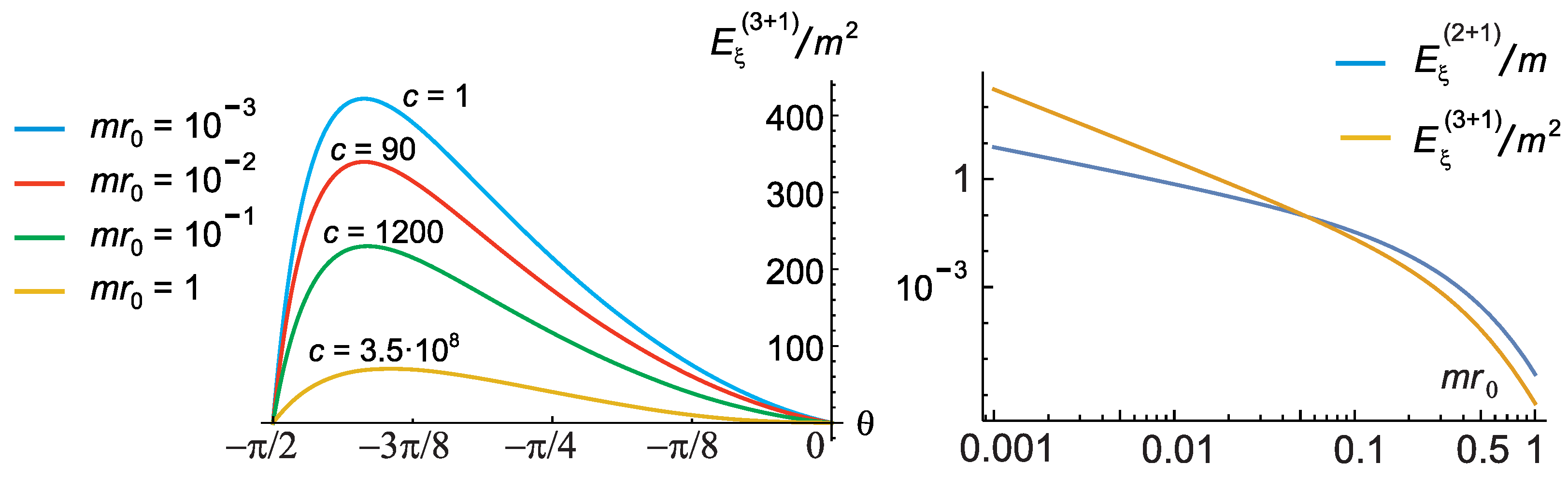
We computed the induced vacuum energy numerically in
-dimensional flat space-time and compared the results with those obtained in
-dimensional space-time, as illustrated in
Figure 1. One can see that the induced dimensionless vacuum energy in three-dimensional flat space-time (
) induced by the presence of the magnetic topological defect is independent of the curvature coupling (
) only in the limiting cases of Dirichlet (
) and Neumann (
) boundary conditions, where
. For intermediate values (
), the induced vacuum energy (
) is nonzero. One can also see that
rapidly decreases with increasing tube thickness (
; see left panel). Furthermore, a comparison of the induced vacuum energy in three- and two-dimensional space-time for the partial case of a boundary condition parameter of
shows that for thin magnetic tubes (
), the dimensionless induced vacuum energy is larger in
-dimensional space–time. In contrast, for thick magnetic tubes (
), the dimensionless induced vacuum energy becomes larger in
-dimensional space–time, as shown in the right panel.
4. Dependence on the Boundary-Condition Parameter
In the previous section, we derived the dependence of the induced vacuum energy (
) on the boundary-condition parameter for various magnetic-tube thicknesses (see
Figure 1). We now focus on a detailed investigation of the
dependence of more subtle features of the vacuum effect.
First, let us discuss the asymptotic behavior of the induced vacuum energy () for the case of infinitely thin and sufficiently thick tubes. Please note that since quantum effects depend on the dimensionless thickness of the tube (), there are actually two possible scenarios: either the tube radius () or the scalar-field mass (m) becomes infinitely large or small.
The asymptotic relation for the case of
can be obtained from (
18):
It should be noted that the asymptotic dependence of the induced energy (∼
) is fully consistent with the results obtained in the approach of the singular magnetic vortex (see, e.g., refs. [
6,
30,
32]). As one can see, relation (
21) does not depend on mass and contains only one dimensional parameter (
). Therefore, the relation expressed as
∼
can be obtained only from dimensional analysis. We would like to remind you that
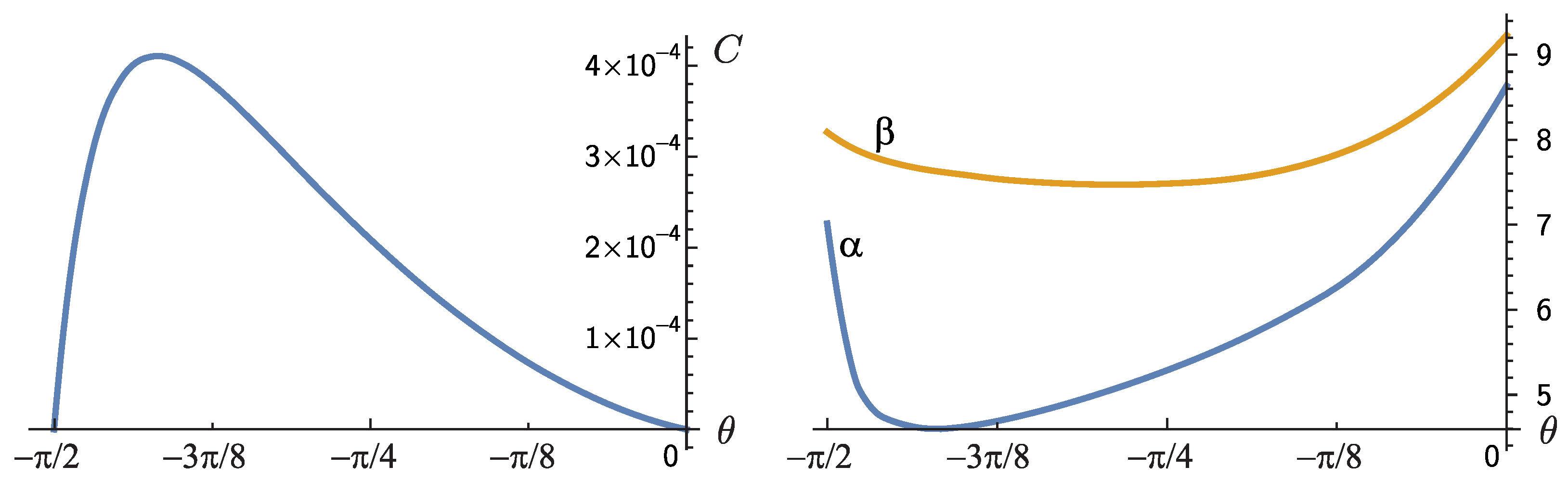
is not the full induced vacuum energy but the corresponding energy density integrated only over the coordinates in the plane perpendicular to the tube. The dependence of the coefficient (
) in (
21) on boundary-condition parameter
at half-integer magnetic flux inside the tube (
) is presented in
Figure 2. As one can see, this dependence qualitatively reproduces behavior of the induced vacuum energy (
) as a function of the
parameter (see
Figure 1).
The asymptotic relation for the case of
follows from (
18) by employing the asymptotic expression for the
function, i.e., for the induced vacuum energy in
-dimensional space (see (
19)). Numerical analysis indicates that this function can be well approximated at large
values as
where
and
are positive coefficients depending on the
and
F parameters. Substituting this asymptotic form into (
18), the integration can be performed explicitly, yielding
where
denotes the MacDonald function.
The dependence of the
and
coefficients in (
21) on the boundary-condition parameter (
) at half-integer magnetic flux inside the tube (
) is presented in
Figure 2. One can observe the expected correlation: if the induced vacuum energy at a given
is larger at intermediate values of the
parameters, then it also decreases more slowly as
increases.
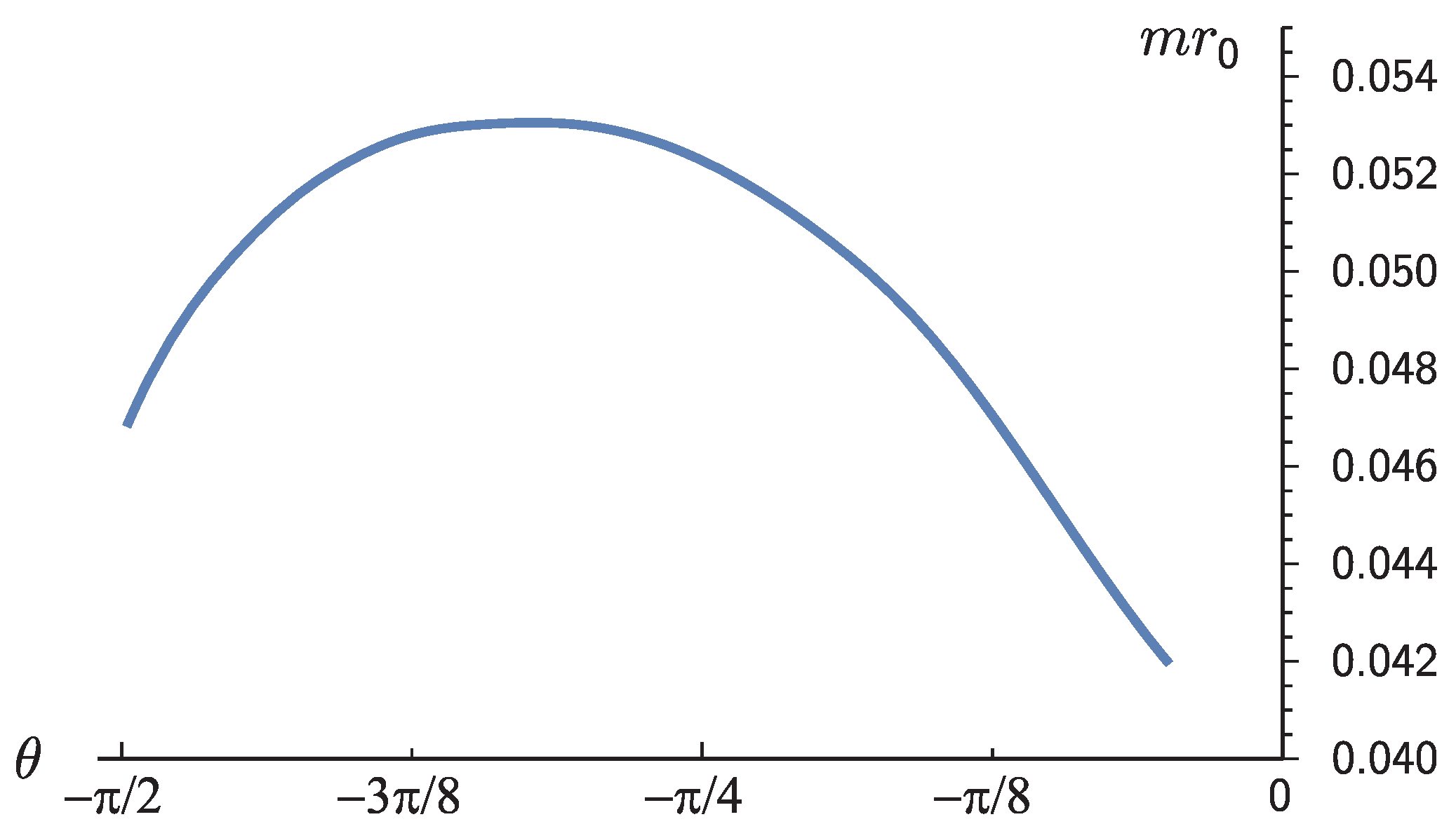
Finally, we became interested in the question of the tube thickness (
) below which the dimensionless induced vacuum energy in
-dimensional space-time becomes larger than that in
-dimensional space-time. This behavior is illustrated in
Figure 1, where the situation is shown for a particular value of the parameter characterizing the boundary condition (
). We investigated the value of the tube thickness (
) at which the dimensionless induced vacuum energy in
-dimensional space-time equals the corresponding dimensionless induced energy in
-dimensional space-time as a function of the boundary-condition parameter (see
Figure 3). Somewhat unexpectedly, our analysis shows that the corresponding value of the magnetic-tube thickness is practically independent of
and is approximately
.
5. Conclusions
We studied vacuum polarization (change of vacuum energy) of a charged massive scalar field induced by a magnetic topological defect in flat -dimensional space-time. The defect was modeled as an impenetrable-to-matter-field, finite-thickness tube with magnetic flux inside. On the boundary of the tube, we adopt the most general Robin-type boundary condition for the field, allowing for an analysis of vacuum effects in a fully general setting. Our attention was focused on studying the dependence of the induced vacuum energy in flat space-time on the curvature coupling (), which governs the interaction between the scalar field and the space-time curvature.
We find that, in flat space-time, the induced vacuum energy within the plane perpendicular to the tube can be written as and does not depend on the curvature coupling () only in the special cases of Dirichlet and Neumann boundary conditions, i.e., when the induced vacuum energy vanishes. In contrast, when general Robin boundary conditions are imposed, the induced vacuum energy exhibits an explicit dependence on the curvature coupling () and demonstrates a nontrivial sensitivity to the boundary-condition parameter (). Our conclusion is that, in principle, precise experimental observations of vacuum polarization in flat space-time may serve as an independent approach to investigate the curvature coupling parameter ().
For values of
in the range of
, we numerically evaluated
(see the left panel of
Figure 1). As can be observed from our analysis, the magnitude of the induced vacuum energy increases significantly as the thickness of the magnetic tube (
) decreases. However, for magnetic tubes of large thickness (
), the induced vacuum energy decreases very rapidly. The dependence of
on the boundary-condition parameter is nontrivial: it is a smooth function with a single maximum. As the thickness of the tube decreases, the boundary-condition parameter (
) at which the induced energy attains its maximum shifts gradually toward lower values, approaching
in the limit of an infinitely thin tube (see the left panel of
Figure 2).
We carried out a detailed analysis of the asymptotic behavior of the induced vacuum energy (
) in the limiting cases of an ultra-thin (
) and significantly thick (
) magnetic tube see (the corresponding relations (
21) and (
23)). Additionally, we examined the dependence of the asymptotic coefficients on the boundary-condition parameter (
) (see
Figure 2).
Finally, we became interested in the question of the tube thickness (
) below which the dimensionless induced vacuum energy in
-dimensional space-time becomes larger than that in
-dimensional space-time (see right panel of
Figure 1 for a particular value of the boundary-condition parameter (
)). We studied the tube thickness (
) at which the induced dimensionless vacuum energy in
-dimensional space-time coincides with that in
-dimensional spacetime and how it depends on the boundary-condition parameter (
) (see
Figure 3). Remarkably, this characteristic thickness turns out to be nearly independent of
and is approximately
.
It would be interesting to further investigate the vacuum energy induced by a magnetic tube with Robin boundary conditions and a positive boundary parameter. In this regime, the Klein–Gordon equation may contain bound state solutions, which can make a significant contribution to the induced vacuum energy. This could yield interesting and nontrivial results similar to those discussed in [
22] and in [
36] for the Casimir effect, where this was done for the first time.




 ,
,