


Conditional Cosmological Recurrence in Finite Hilbert Spaces and Holographic Bounds Within Causal Patches



Abstract
1. Introduction
- Classical intuition (well-known example).
- From boxes to causal diamonds.
- Conventions.
- Novel contributions.
- 1.
- Explicit micro-to-macro bridge. A concrete microcanonical counting under gravitational caps (Proposition 1, Appendix C) demonstrates how infrared discretization and holographic bounds enforce bounded operational dimension, making finiteness tangible rather than heuristic.
- 2.
- Conditional and falsifiable framing. The CCR theorem (Theorem 1) is stated in strictly conditional form: if causal patches admit finite D (assumption (A1)), recurrence follows rigorously; and if future quantum gravity shows , CCR is falsified. This clean if–then structure emphasizes testability.
- 3.
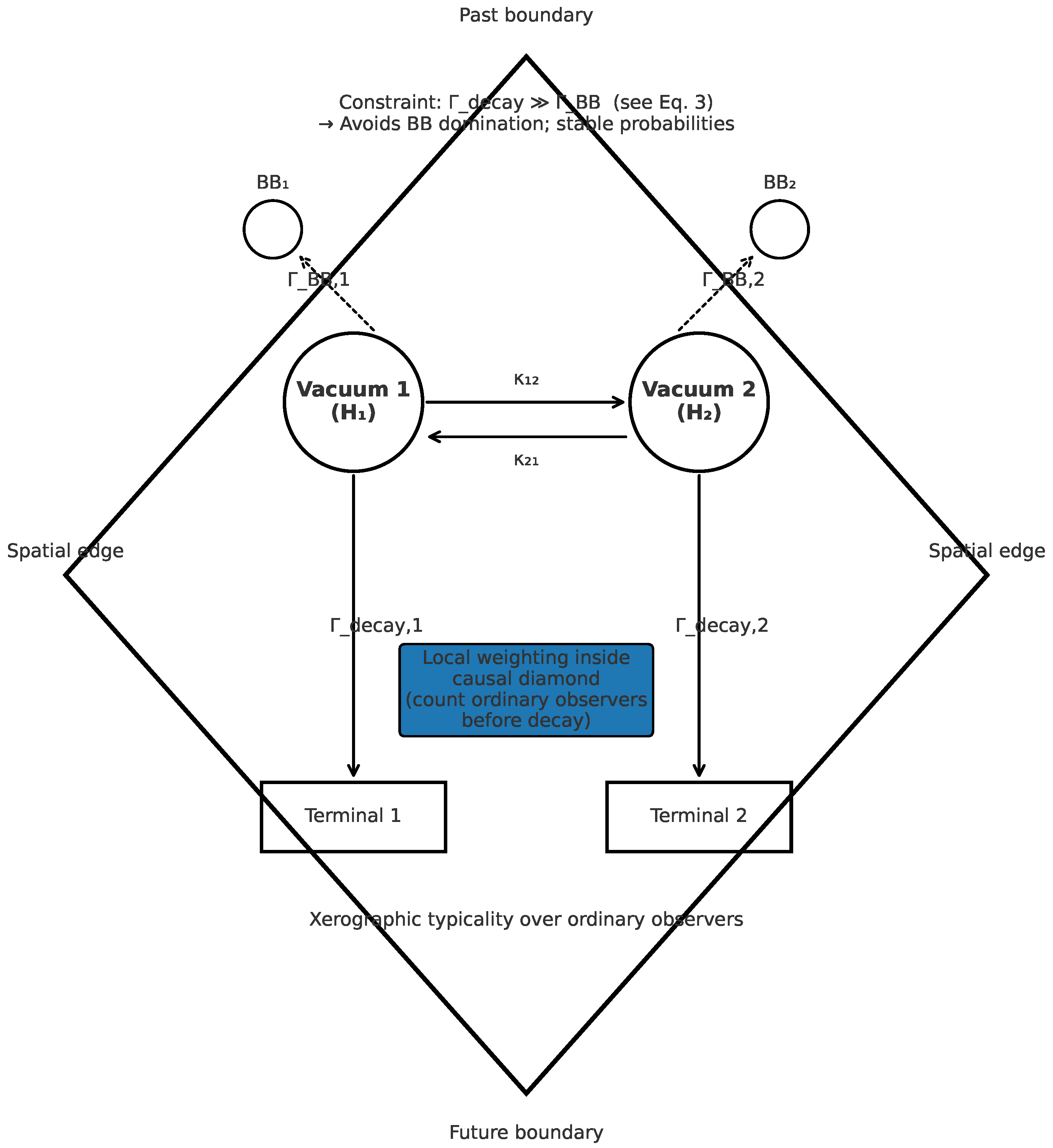
- Minimalistic measure prescription. A compact causal-diamond measure with xerographic typicality and a single no-Boltzmann-brain constraint (Section 4.1) avoids volume-weighting pathologies while remaining falsifiable.
2. Materials and Methods
2.1. Originality and Scope
- 1.
- Explicit constructive micro-to-macro derivation. A concrete microcanonical counting argument under a gravitational energy cap (Proposition 1, Appendix C) is presented, showing explicitly how infrared discretization and holographic entropy bounds combine to enforce a bounded operational Hilbert space dimension. This makes the finiteness assumption tangible rather than heuristic.
- 2.
- Conditional and falsifiable framing. The “Conditional Cosmological Recurrence” (CCR) theorem is stated in a strictly conditional form: if causal patches admit a finite Hilbert space dimension (assumption (A1)), then recurrence follows rigorously from unitarity. Conversely, if future quantum gravity demonstrates that , the entire framework is falsified. This clean if–then structure is rarely made explicit in the prior literature and emphasizes testability.
- 3.
- Minimalistic measure prescription. To address predictivity in eternally inflating settings, a compact causal-diamond measure is introduced, combined with xerographic typicality and a single no-Boltzmann-brain constraint. This avoids the volume-weighting pathologies highlighted in earlier works while keeping the prescription lean and falsifiable.
| Key Point: The framework does not claim that the universe must recur. Rather, if gravitational entropy bounds apply to causal patches (yielding a finite Hilbert space dimension), then recurrence follows mathematically. The “if” is the physics question; the “then” is rigorous mathematics. |
- Conditional Nature.
- Separation of rigor and assumptions.
2.2. From Electrons to a Finite Cosmic State Count: A Counting Argument
- Clarification: Two independent arguments.
- 1.
- Microcanonical finiteness: Finite spatial volume ⇒ discrete modes (IR), and gravitational collapse threshold ⇒ finite occupation (UV). Together, these imply the accessible Fock space is finite-dimensional.
- 2.
- Holographic bound: The area-law entropy bound (from black-hole thermodynamics and holographic arguments) provides an independent constraint on operational distinguishability: .
- Clarification: Three notions of finiteness.
- 1.
- Kinematical finiteness: The spacetime itself is fundamentally discrete at the Planck scale, as in causal set theory [18] or loop quantum gravity. In such approaches, the continuum is an emergent, coarse-grained description, and the number of degrees of freedom in any finite region is strictly finite by construction.
- 2.
- Operational finiteness: Even in a continuum quantum field theory, the number of operationally distinguishable states within a region is finite when measured to a fixed resolution in trace distance. This counting is made precise via metric entropy and packing arguments (see Appendix A), and yields an effective dimension that is finite for any , with .
- 3.
- Thermodynamic finiteness: Holographic entropy bounds impose an upper limit on the von Neumann entropy accessible within a causal patch: . This constrains the dimension of the effective Hilbert space via , which is finite (though extremely large) if A is finite.
2.3. Assumptions and Definitions
- (A1)
- (A2)
- Unitary dynamics: , with self-adjoint Hamiltonian H.
- (A3)
- Sector mixing (optional): Dynamics are not confined to a null-measure subset within the relevant superselection sector.
- (A4)
- Finite-resolution observers: Macrostates identified up to a trace-distance tolerance on local density matrices.
- 1.
- Discrete spectrum: Finite-dimensional Hilbert space ⇒ purely discrete spectrum .
- 2.
- Non-degeneracy: For generic Hamiltonians, eigenvalues are distinct. Degeneracies, if present, do not obstruct recurrence [6].
- 3.
- Absence of continuous spectrum: No accumulation points in below the gravitational cap .
- 4.
- Diophantine gaps: Quantitative lower bounds on recurrence times rely on the energy differences , avoiding low-order rational relations (Diophantine conditions). For generic quantum systems, the spectrum is expected to be linearly independent over the rationals. Under such conditions, rigorous theorems on simultaneous Diophantine approximation [21,22] ensure that the return time scales at least exponentially with the dimension D.
2.4. CCR Theorem and Coarse-Grained Recurrence
- Recurrence time (careful statement).
3. Results
Toy Models and Metrics (Summary)
- Models.
- Metrics and thresholds.
- Key observations (from numerical runs).
- Interpretation.
- Cosmological Consequences
- Predictivity in eternal inflation. A finite Hilbert space dimension implies a finite outcome space, resolving the measure ambiguities of volume-weighted approaches. Probabilities are then defined over a compact state space, yielding a falsifiable statistical framework.
- Boltzmann-brain constraint. In conventional measures, observers dominated by Boltzmann brains undermine predictivity. In the CCR framework, imposing the single condition ensures that ordinary observers prevail, thereby avoiding the paradox.
- Observational falsifiability. If future developments in quantum gravity or cosmology demonstrate unbounded entropy growth in causal patches, the CCR framework would be falsified in its entirety. Conversely, any evidence for metastable vacuum decay would be consistent with the no-BB prescription.
- Conceptual bridge. The CCR program provides a bridge between holographic entropy bounds and macroscopic cosmology. In this sense, “recurrence” is not merely a mathematical curiosity but a structural constraint with direct implications for cosmological predictivity.
- Beyond a Single Patch: Multiverse Considerations
4. Discussion
4.1. Measure and Predictivity
- Why ambiguity arises.
- Prescription.
- Xerographic typicality (definition).
- Implementation.
- Worked example: two-vacuum toy model (no-BB in action)
- Comparison with alternative measures.
- Pragmatic choice.
- Necessity and robustness of the no-BB constraint.
4.2. Information/Computation Bounds (CS Viewpoint)
- Bit budget.
- Operation rate.
- Implication.
4.3. Indirect Observational Probes
- Bubble collisions (eternal inflation): disk-like imprints in CMB temperature/polarization; non-detection constrains the landscape of eternal-inflation scenarios consistent with CCR.
- Dark-energy metastability: either small deviations or lower bounds on consistent with the no-BB prescription, providing a key falsifiability condition.
- Primordial GWs: spectra incompatible with simple slow-roll but compatible with cyclic/pre-inflationary scenarios, potentially hinting at finite-dimensional pre-inflationary dynamics.
- Final remark.
- Falsifiability and direct tests.
- Detection of ever-growing horizon entropy in accelerating expansion (requiring sustained entropy production beyond ).
- Observation of cosmological dynamics inconsistent with any finite state budget (e.g., unbounded particle production rates).
- Demonstration from completed quantum gravity that causal patches admit .
4.4. Rigor Addendum: Theorem-Level vs. Assumptions
- Theorem-level results (rigorous).
- (i)
- For finite-dimensional and unitary evolution, quantum almost-periodicity and recurrences follow directly (Bocchieri–Loinger).
- (ii)
- Coarse-grained/local recurrences follow from almost-periodicity together with continuity of the partial trace in trace norm.
- (iii)
- Canonical typicality results (e.g., Goldstein–Lebowitz–Tumulka–Zanghì; Popescu–Short–Winter) establish the operational relevance of coarse-grained returns.
- Physics-level assumptions.
- The finiteness of the operational state budget (A1) is not a theorem but an assumption, motivated by Bekenstein–Hawking/Gibbons–Hawking entropy bounds and supported in Loop Quantum Gravity (LQG) and holographic contexts.
- The microcanonical counting with a gravitational energy cap developed herein provides a physically controlled argument for free/weakly coupled fields.
- ETH/ergodicity statements are used in their standard “genericity” sense.
- Summary.
4.5. Limitations and Open Issues
4.5.1. Breakdown Scenarios
- Infinite volume limits.
- Unbounded entropy growth.
- Continuous spectra/non-compact holography.
- Non-unitary evolution.
- Consequence. In all the above scenarios, the key CCR hypothesis (finite operational D) fails. Global quantum recurrences are not mathematically guaranteed; at best, one may observe model-dependent quasi-recurrences or ergodic features, but no universal bound on return times.
4.5.2. Caveats and Consequences
- Unitarity fails at cosmological scales (as in certain objective-collapse or non-Hamiltonian models),
- The causal patch framework may not be the correct coarse-graining of cosmology,
- Non-unitary models: Objective-collapse dynamics would invalidate recurrence,
- Sector locking/non-ergodicity: Horizons and conserved charges may confine dynamics; recurrence then holds only within sectors,
- Measure ambiguity: Different measures yield different predictions; the prescription in Section 4.1 satisfies basic sanity checks but remains an assumption. The no-BB constraint is stated once, canonically, in Section 4.1,
- Timescales: Global recurrences occur on timescales at least double-exponential in (Remark 2); only coarse-grained returns may have operational relevance,
- Falsifiability: The finite-dimensional Hilbert space conjecture (A1) could be falsified if any observation demonstrates unbounded entropy growth within a causal patch.
4.5.3. Compatibility with Holography and Swampland
- de Sitter holography: Entropic bounds in FRW/de Sitter are compelling but not rigorously derived from a completed quantum gravity,
- Closing remark.
4.6. Connections to Broader Frameworks
- String theory and holography.
5. Conclusions
Author Contributions
Funding
Data Availability Statement
Acknowledgments
Conflicts of Interest
Abbreviations
| CCR | Conditional Cosmological Recurrence |
| CMB | Cosmic Microwave Background |
| QG | Quantum Gravity |
| ETH | Eigenstate Thermalization Hypothesis |
| BB | Boltzmann Brain |
Appendix A. Operational Dimension via Metric Entropy
- Sketch.

| Resolution | Illustrative Bound |
|---|---|
| ≲ | |
| ≲ | |
| ≲ |
Appendix B. Physical Motivation for (A1): Finite Hilbert Space from Energy–Information Bounds
- Caveat.
Appendix B.1. Holographic and Bekenstein Bounds
Appendix B.2. Coverage Ratio and Saturation
Appendix B.3. Dynamic Feedback in FRW Cosmology
Appendix B.4. Implication for CCR
Appendix C. Microcanonical Counting with a Gravitational Cap
- 1.
- Time Dependence and Static Patches: The microcanonical count relies on a well-defined energy functional, which is strictly valid for static backgrounds (e.g., the static patch of de Sitter space). In dynamical settings where the horizon area grows, the entropy bound increases. However, at any discrete time slice, the snapshot entropy remains finite. Our argument applies to the asymptotic or quasi-stationary limit (late-time de Sitter), where the horizon area stabilizes or evolves adiabatically.
- 2.
- Interactions and Strong Coupling: The transition from free to interacting theories modifies the spectrum but does not destroy finiteness under a hard energy cap. Interactions (e.g., ) introduce energy shifts and bound states. While attractive interactions lower energy levels, they do not generate an infinite density of states below a fixed cutoff , provided the theory admits a UV regulator or is part of a finite-rank gauge group. In strongly coupled holographic setups (e.g., SYM), the count is replaced by the density of states of the dual CFT, which remains finite for finite conformal charge and energy [45,46].
- 3.
- Gauge Redundancies: In gauge theories (electromagnetism, gravity), the naive mode counting includes unphysical longitudinal modes. Properly identifying the physical Hilbert space requires quotienting by the gauge group (constraints). This procedure strictly reduces the number of independent states compared to the free scalar baseline. Thus, our estimate serves as a conservative upper bound: accounting for gauge invariance strengthens the finiteness claim.
- 4.
- UV Completion: The counting assumes a cutoff logic compatible with various UV completions. In Loop Quantum Gravity, the horizon Hilbert space is explicitly finite due to the discrete area spectrum [47]. In String Theory, while the Hagedorn density grows exponentially, the gravitational collapse threshold prevents accessing the divergent regime. Thus, finiteness is a generic feature protected by the gravitational cap, largely independent of the specific UV details.
- String landscape and eternal inflation.
- Swampland perspective.
- Loop quantum gravity and isolated horizons.
- Causal set theory.
- Explicit bounds (free field, cubic box).
Appendix D. Dual Holographic Bounds: Black Holes and De Sitter Horizons
Appendix D.1. Black Hole Holographic Bound
Appendix D.2. De Sitter Horizon Bound
Appendix D.3. Implication for Hilbert Space Dimensionality
- Remark.
Appendix E. Quantitative Recurrence Estimates
Appendix F. Conclusions and Future Directions
- Future directions.
Appendix G. Related Works and Novelty
- Banks, Fischler et al. on de Sitter Hilbert Space Finiteness [7,8]: Propose that a positive cosmological constant implies a finite-dimensional Hilbert space, with entropy given by the de Sitter horizon area. Later holographic formulations further emphasized finite Hilbert space descriptions as fundamental in quantum gravity.
- Bousso’s Covariant Entropy Bound [5]: Provides a generalized entropy bound applicable to arbitrary null surfaces, consistent with the holographic limit adopted in CCR.
- Dyson, Kleban, and Susskind on Cosmological Recurrence [15]: Discuss Poincaré recurrence in cosmology, emphasizing its inevitability in finite systems and the associated measure problems—problems CCR reframes as conditional statements dependent on gravitational entropy bounds.
- Boltzmann Brain and Measure Pathologies [14]: Address the prevalence of Boltzmann brains in de Sitter cosmology. CCR incorporates this line of work by enforcing a no-BB constraint within its causal-diamond measure prescription.
- Novelty Relative to Prior Work
- (i)
- Micro-to-macro bridge to finite D.
- (ii)
- Conditional framing with falsifiability.
- (iii)
- Unified local measure with a single no-BB constraint.
- Remark.
Appendix H. Methods for Toy Models
- Remark.
- Computational Implementation.
- (i)
- The toy model uses rescaled dimensionless time units with and unit energy spacing.
- (ii)
- The threshold allows for approximate returns, not exact microstate recurrence.
- (iii)
- For small D, the Diophantine gaps are not yet in the asymptotic regime; scaling becomes more pronounced for (see Appendix I).
- Global signal (finite-D).
- Local proxy.
- Numerics.
Appendix I. Scaling of Recurrence Times
- DisclaimerThe following derivation is schematic: it provides order-of-magnitude scaling estimates rather than exact recurrence times. The intent is to illustrate why, under holographic entropy bounds, global recurrences are generically double-exponential in . Precise control requires number-theoretic bounds on Diophantine approximation, which only reinforce (rather than weaken) the double-exponential growth quoted here.
Appendix J. Summary Figures and Tables

| Scenario | Observable? | ||
|---|---|---|---|
| Global (de Sitter) | yrs | No | |
| Coarse-grained subsystem | yrs * | No | |
| Toy model () | ∼ units | Yes (verified) |
| 1 | That is, the number of independent quantum states consistent with the entropy bound. |
| 2 | For any quantum system with finite-dimensional Hilbert space and unitary evolution, the state returns arbitrarily close to its initial condition. This is the quantum analog of Poincaré recurrence. |
| 3 | This is the standard holographic entropy bound: the maximum number of accessible quantum states cannot exceed the exponential of the maximal entropy. |
References
- Bekenstein, J.D. Black Holes and Entropy. Phys. Rev. D 1973, 7, 2333–2346. [Google Scholar] [CrossRef]
- Hawking, S.W. Particle Creation by Black Holes. Commun. Math. Phys. 1975, 43, 199–220. [Google Scholar] [CrossRef]
- ’t Hooft, G. Dimensional Reduction in Quantum Gravity. arXiv 1993, arXiv:gr-qc/9310026. [Google Scholar]
- Susskind, L. The World as a Hologram. J. Math. Phys. 1995, 36, 6377–6396. [Google Scholar] [CrossRef]
- Bousso, R. A Covariant Entropy Conjecture. J. High Energy Phys. 1999, 1999, 004. [Google Scholar] [CrossRef]
- Bocchieri, P.; Loinger, A. Quantum Recurrence Theorem. Phys. Rev. 1957, 107, 337–338. [Google Scholar] [CrossRef]
- Banks, T.; Fischler, W. M-theory observables for cosmological space-times. arXiv 2001, arXiv:hep-th/0102077. [Google Scholar] [CrossRef]
- Banks, T.; Fischler, W. Holographic cosmology 3.0. arXiv 2003, arXiv:hep-th/0310288. [Google Scholar] [CrossRef]
- Obied, G.; Ooguri, H.; Spodyneiko, L.; Vafa, C. de Sitter Space and the Swampland. arXiv 2018, arXiv:1806.08362. [Google Scholar] [CrossRef]
- Ooguri, H.; Palti, E.; Shiu, G.; Vafa, C. Distance and de Sitter Conjectures on the Swampland. Phys. Lett. B 2019, 788, 180–184. [Google Scholar] [CrossRef]
- Chakraborty, T.; Chakravarty, J.; Godet, V.; Lunts, P.; Simón, J. The Hilbert space of de Sitter quantum gravity. J. High Energy Phys. 2024, 2024, 132. [Google Scholar] [CrossRef]
- Chandrasekaran, V.; Longo, R.; Penington, G.; Witten, E. An algebra of observables for de Sitter space. J. High Energy Phys. 2023, 2023, 82. [Google Scholar] [CrossRef]
- Bousso, R. Holographic Probabilities in Eternal Inflation. Phys. Rev. Lett. 2006, 97, 191302. [Google Scholar] [CrossRef] [PubMed]
- Boddy, K.K.; Carroll, S.M.; Pollack, J. De Sitter Space Without Dynamical Quantum Fluctuations. Found. Phys. 2016, 46, 702–735. [Google Scholar] [CrossRef]
- Dyson, L.; Kleban, M.; Susskind, L. Disturbing Implications of a Cosmological Constant. J. High Energy Phys. 2002, 2002, 011. [Google Scholar] [CrossRef]
- Deutsch, J.M. Quantum statistical mechanics in a closed system. Phys. Rev. A 1991, 43, 2046–2049. [Google Scholar] [CrossRef]
- Goldstein, S.; Lebowitz, J.L.; Tumulka, R.; Zanghì, N. Canonical Typicality. Phys. Rev. Lett. 2006, 96, 050403. [Google Scholar] [CrossRef]
- Bombelli, L.; Lee, J.; Meyer, D.; Sorkin, R.D. Space-Time as a Causal Set. Phys. Rev. Lett. 1987, 59, 521. [Google Scholar] [CrossRef]
- Balasubramanian, V.; Nomura, Y.; Ugajin, T. de Sitter space is sometimes not empty. J. High Energy Phys. 2024, 2024, 135. [Google Scholar] [CrossRef]
- Banks, T. My Personal History With the Quantum Theory of de Sitter Space. arXiv 2023, arXiv:2312.10729. [Google Scholar] [CrossRef]
- Cassels, J.W.S. An Introduction to Diophantine Approximation; Cambridge University Press: Cambridge, UK, 1957. [Google Scholar]
- Schmidt, W.M. Diophantine Approximation; Lecture Notes in Mathematics; Springer: Berlin/Heidelberg, Germany, 1980; Volume 785. [Google Scholar]
- Sekino, Y.; Susskind, L. Fast Scramblers. J. High Energy Phys. 2008, 2008, 065. [Google Scholar] [CrossRef]
- Hayden, P.; Preskill, J. Black Holes as Mirrors: Quantum Information in Random Subsystems. J. High Energy Phys. 2007, 2007, 120. [Google Scholar] [CrossRef]
- Maldacena, J.; Shenker, S.H.; Stanford, D. A Bound on Chaos. J. High Energy Phys. 2016, 2016, 106. [Google Scholar] [CrossRef]
- Popescu, S.; Short, A.J.; Winter, A. Entanglement and the Foundations of Statistical Mechanics. Nat. Phys. 2006, 2, 754. [Google Scholar] [CrossRef]
- Srednicki, M. Chaos and Quantum Thermalization. Phys. Rev. E 1994, 50, 888. [Google Scholar] [CrossRef]
- Tasaki, H. From Quantum Dynamics to the Canonical Distribution: General Picture and a Rigorous Example. Phys. Rev. Lett. 1998, 80, 1373–1376. [Google Scholar] [CrossRef]
- Reimann, P. Foundation of Statistical Mechanics under Experimentally Realistic Conditions. Phys. Rev. Lett. 2008, 101, 190403. [Google Scholar] [CrossRef] [PubMed]
- Page, D.N. Is Our Universe Likely to Decay within 20 Billion Years? Phys. Rev. D 2008, 78, 063535. [Google Scholar] [CrossRef][Green Version]
- Albrecht, A.; Sorbo, L. Can the Universe Afford Inflation? Phys. Rev. D 2004, 70, 063528. [Google Scholar] [CrossRef]
- Garriga, J.; Schwartz-Perlov, D.; Vilenkin, A.; Winitzki, S. Probabilities in the Inflationary Multiverse. J. Cosmol. Astropart. Phys. 2006, 2006, 017. [Google Scholar] [CrossRef]
- Margolus, N.; Levitin, L.B. The maximum speed of dynamical evolution. Phys. D Nonlinear Phenom. 1998, 120, 188–195. [Google Scholar] [CrossRef]
- Lloyd, S. Ultimate physical limits to computation. Nature 2000, 406, 1047–1054. [Google Scholar] [CrossRef]
- Cornish, N.J.; Spergel, D.N.; Starkman, G.D. Circles in the Sky: Finding Topology with the Microwave Background Radiation. Class. Quantum Gravity 1998, 15, 2657–2670. [Google Scholar] [CrossRef]
- Collaboration, P. Planck 2015 results. XVIII. Background geometry and topology of the Universe. Astron. Astrophys. 2016, 594, A18. [Google Scholar] [CrossRef]
- Wehus, I.K.; Eriksen, H.K. A Search for Concentric Circles in the 7-Year WMAP Temperature Sky Maps. Astrophys. J. Lett. 2011, 733, L29. [Google Scholar] [CrossRef]
- Collaboration, P. Planck 2015 results. XVI. Isotropy and statistics of the CMB. Astron. Astrophys. 2016, 594, A16. [Google Scholar] [CrossRef]
- Collaboration, C.S. CMB-S4 Science Book, First Edition. arXiv 2016, arXiv:1610.02743. [Google Scholar] [CrossRef]
- Banks, T.; Fischler, W. Holographic Cosmology. arXiv 2004, arXiv:hep-th/0405200. [Google Scholar] [CrossRef]
- Witten, E. Quantum Gravity in de Sitter Space. arXiv 2001, arXiv:hep-th/0106109. [Google Scholar] [CrossRef]
- Banks, T. Cosmological Breaking of Supersymmetry? Int. J. Mod. Phys. A 2001, 16, 910. [Google Scholar] [CrossRef]
- A, S.; Banks, T. Holographic spacetime model of inflation and its predictions for the CMB primordial spectra. Phys. Rev. D 2025, 112, 023516. [Google Scholar] [CrossRef]
- de Boer, J.; Liska, D.; Salehi Vaziri, K. Microstate counting from defects in de Sitter. arXiv 2024, arXiv:2511.09624. [Google Scholar]
- Strominger, A.; Vafa, C. Microscopic origin of the Bekenstein-Hawking entropy. Phys. Lett. B 1996, 379, 99–104. [Google Scholar] [CrossRef]
- Kinney, J.; Maldacena, J.; Minwalla, S.; Raju, S. An Index for 4 Dimensional Super Conformal Theories. Commun. Math. Phys. 2007, 275, 209–254. [Google Scholar] [CrossRef]
- Ashtekar, A.; Baez, J.; Corichi, A.; Krasnov, K. Quantum geometry and black hole entropy. Phys. Rev. Lett. 1998, 80, 904. [Google Scholar] [CrossRef]
- Gibbons, G.W.; Hawking, S.W. Cosmological event horizons, thermodynamics, and particle creation. Phys. Rev. D 1977, 15, 2738–2751. [Google Scholar] [CrossRef]
- Rigol, M.; Dunjko, V.; Olshanii, M. Thermalization and Its Mechanism for Generic Isolated Quantum Systems. Nature 2008, 452, 854. [Google Scholar] [CrossRef]
- IEEE Standards Association. IEEE Standard for Floating-Point Arithmetic; IEEE: New York, NY, USA, 2008; pp. 1–70. [Google Scholar] [CrossRef]


| Regime | Timescale | Operational? |
|---|---|---|
| Global microstate | No | |
| Coarse-grained A | Typically No | |
| Scrambling | Yes (toy models) |
| Model | ||||
|---|---|---|---|---|
| Random Finite-D | 45.6 | n/a * | 12.3 | 5.7 |
Disclaimer/Publisher’s Note: The statements, opinions and data contained in all publications are solely those of the individual author(s) and contributor(s) and not of MDPI and/or the editor(s). MDPI and/or the editor(s) disclaim responsibility for any injury to people or property resulting from any ideas, methods, instructions or products referred to in the content. |
© 2025 by the authors. Licensee MDPI, Basel, Switzerland. This article is an open access article distributed under the terms and conditions of the Creative Commons Attribution (CC BY) license.
Share and Cite
Chronis, N.; Sifakis, N. Conditional Cosmological Recurrence in Finite Hilbert Spaces and Holographic Bounds Within Causal Patches. Universe 2026, 12, 10. https://doi.org/10.3390/universe12010010
Chronis N, Sifakis N. Conditional Cosmological Recurrence in Finite Hilbert Spaces and Holographic Bounds Within Causal Patches. Universe. 2026; 12(1):10. https://doi.org/10.3390/universe12010010
Chicago/Turabian StyleChronis, Nikolaos, and Nikolaos Sifakis. 2026. "Conditional Cosmological Recurrence in Finite Hilbert Spaces and Holographic Bounds Within Causal Patches" Universe 12, no. 1: 10. https://doi.org/10.3390/universe12010010
APA StyleChronis, N., & Sifakis, N. (2026). Conditional Cosmological Recurrence in Finite Hilbert Spaces and Holographic Bounds Within Causal Patches. Universe, 12(1), 10. https://doi.org/10.3390/universe12010010