You are currently viewing a new version of our website. To view the old version click .
Universe
  • Article
  • Open Access

5 December 2025

Evolution of the Magnetic Activity of the Single Giant OP Andromedae Between 1993 and 2025

,
,
,
,
,
,
,
,
and
1
Institute of Astronomy and NAO, Bulgarian Academy of Sciences, 72 Tsarigradsko Chaussee Blvd., 1784 Sofia, Bulgaria
2
Institut de Recherche en Astrophysique et Planètologie, Université de Toulouse, 14 Avenue Èdouard Belin, 31400 Toulouse, France
3
Faculty of Physics, Sofia University “St. Kliment Ohridski”, 5 James Bourchier Blvd., 1164 Sofia, Bulgaria
*
Author to whom correspondence should be addressed.
This article belongs to the Special Issue Magnetic Fields and Activity in Stars: Origins and Evolution

Abstract

We investigate the long-term magnetic variability of OP And, a magnetically active single K giant, between 1993 and 2025. To track magnetic activity, we analyze the variability of the H α line and two lines of the calcium infrared triplet. The variability of the H α line reveals that the activity level of OP And is higher in the period 1993–2000, while during the period 2010–2016 it is lower, possibly close to an eventual minimum. Recent data (2020–2025) indicate an increase of the activity level again. The flare frequency rate and the calcium infrared triplet data (when available) follow the same behavior. In addition, the structure of the H α line also changes with the activity level: when the activity is higher, we observe a blue-shifted component of this line, interpreted as an expanding hot area above the photosphere, but during the lower activity interval it is almost absent. Our results are in a good agreement with the idea that the magnetic field influences the mass outflow in this giant. Additionally, we examine how flare frequency correlates with overall activity. While a complete activity cycle remains undetermined, the recent upward trend suggests that the eventual activity cycle of OP And seems to be slightly longer than 30 years. More years of observations are necessary to reach the next maximum and to determine the exact duration of the cycle.

1. Introduction

OP And (HD 9746) is a K1 III single active giant. The rotational period is P rot = 76 d [1,2] and a projected rotational velocity of 8.7 km s 1 is determined [3]. The mass of this star is about 2.0   M , the effective temperature is T eff = 4420 K, the surface gravity log g = 2.3 [4] and the metallicity [Fe/H] = 0.0 [5]. From an evolutionary point of view, the star is situated at the end of the first dredge-up phase, just beginning to climb the red giant branch (RGB). Only one giant with fast rotation and high magnetic activity is known at this position on the Hertzsprung–Russel diagram (HRD): V1192 Ori [4]. The Rossby number of OP And is estimated to be 0.47 [6] and is in agreement with its observed high activity level. Its value below unity presumes that the α Ω dynamo operates there. In addition, the star also follows the magnetic field–rotational period relation for single cool giants [4].
This giant is also known for its high lithium abundance, log ε ( Li ) = 3.5 [7]. This means that OP And is among the giants with the highest lithium abundance known. Taking into account that it is situated on the right from the majority of fast rotating and active stars on the so-called “first magnetic strip” on the HRD, shown in [4,6], a planet engulfment episode is not excluded for this cool giant.
No radial velocity variations were observed by [3], down to a measurement accuracy of 0.33 km s 1 . A similar result has been reported by [8,9], and so it seems that OP And is a single star. Further studies [10,11,12] also support this conclusion. In any case, no evidence for a close companion to contaminate the rotation and activity of the giant is found. Furthermore, our spectral studies covering more than 30 years found no long-term radial velocity variation, excluding a distant secondary.
The spectrum of OP And is characterized by significant variability in H α , the lines of the CaII infrared triplet (hereafter CaIRT) and the CaII H&K lines, all of which are well-known indicators of magnetic activity. The spectral profiles of these lines in OP And are those of absorption lines but with an emission component in their cores, which fills the absorption to a variable degree in time [2,11,12,13]. In addition, the profile of the H α line also displays a blue-shifted (at 79 km s 1 ) emission component of variable intensity [10], which is considered to be caused by a hot expanding area located above the photosphere, linked to mass loss [14]. Sometimes during flare events, H α also displays a red-shifted emission component [10]. In the literature, examples of the profiles of the mentioned activity indicators in the spectrum of OP And can be seen in [10,12] both in a quiet state and during flares.
Ref. [15] suggested the presence of circumstellar material around this giant on the basis of infrared data. Later, ref. [2] found the position of OP And with respect to the MgII Dividing line [16]. It illustrates that on the RGB, OP And has just crossed the MgII Dividing line, with it being at the onset of chromospheric outflow. How the magnetic field contaminates the outflow during the eventual activity cycle is a topic of interest for our study.
The eventual activity cycle of OP And refers to a possible long-term variability in its magnetic activity, possibly similar to the solar cycle. Such a variability is not necessarily strictly periodic: both the amplitude and duration of individual cycles may vary, and successive cycles can differ from one another, as it is in the Sun [17]. This variability can influence the chromospheric and coronal environment, governing the strength and structure of stellar mass outflow.
Our spectral dataset covers the time interval 1993–2025, more than 30 years. The length of this dataset presents a unique possibility to study the long-term activity behavior of this unusual magnetic K giant and to search for an eventual cycle.

2. Observations and Methods

In this work, we present previously unpublished observations of OP And in high resolution spectroscopy which correspond to 38 observations that span over 6 years. These new observations were obtained with the high-resolution ( R 32,000) spectrograph ESpeRo [18] at the 2-m telescope of the Rozhen National Astronomical Observatory (NAO), Bulgaria. In order to study the long-term magnetic activity variability of the star, we also use data from previous studies, which together with our new measurements compound to 110 individual dates of observations taken over the course of 31 years. These observations are presented in [12]. For our analysis, we use three spectral lines which are known indicators of flare activity: H α ( λ 6563 Å) and two lines of the CaIRT, λ 8498 Å and λ 8662 Å. In the previous studies of OP And we refer to in this work, other spectral lines were used as well: the calcium H&K lines (at 3968 Å and 3933 Å, respectively) and the remaining middle line of the CaIRT (at 8542 Å). These lines are widely used as indicators of stellar chromospheric activity; however, we do not use them in our present study due to instrumental limitations. The Ca H&K lines are at the very end of the spectral range of ESpeRo, where the signal-to-noise ratio is too low in the case of the relatively cool OP And. The CaIRT lines are well-known indicators of stellar chromospheric activity. Ref. [19] demonstrated through non-local thermodynamic equilibrium modeling that these lines trace changes in chromospheric temperature and density, making them reliable indicators of stellar activity, especially in late-type stars. Building on this, ref. [20] compared the CaIRT lines with the classical calcium H&K lines and found that the triplet can also be used as an activity indicator, although it is not as sensitive as the H&K lines. The CaIRT offers observational advantages for cooler stars, where the H&K lines become weak or inaccessible (as in the present case). However, in the spectra obtained with ESpeRo, the middle line of the CaIRT is located in an overlapping region of the echelle orders: at the very end of one and also at the very beginning of the next. This introduces a significant error to the measured intensity of the spectral line due to it being at the very edge of the CCD matrix. In principle, the line profile can be obtained by averaging the profiles obtained from both echelle orders, but it is unclear how reliable the result would be. To avoid working with such uncertain measurements, we decided not to include the 8542 Å line in our analysis. Nevertheless, the Narval spectra obtained in 2008 and 2010, in which all three lines of the CaIRT are present, clearly show that these lines exhibit the same behavior. Consequently, the exclusion of the 8542 Å line does not compromise the validity of our results. Since H α is the only spectral line for which measurements are available over the entire time span of the observational dataset, we will primarily focus on this line in our analysis, and the measurements of the CaIRT lines, when they are available, will be used mainly as confirmation of the overall behavior of the activity level inferred from the variability of H α .
The newly presented observations were reduced using DESpeRo (v1.0.0) [21], a fully automated data reduction software (DRS) written specifically for the ESpeRo instrument. The DRS is written in Python3 and extracts high-resolution stellar spectra from raw .fits images. From the resulting spectra, the Image Reduction and Analysis Facility [22] (IRAF, v2.17.1) was used to measure the relative intensity R c of the spectral lines—the intensity at the bottom of the spectral line divided by the intensity of the adjacent continuum, following the procedure described in [23].
The full log of observations is shown in Table A1 in the Appendix A. The first column of the table lists the calendar dates of observations, as well as the instrument used to obtain them, denoted as follows:
  • C—the Coude spectrograph (R ≈ 20,000) at the 2-m telescope of the Rozhen NAO, data presented in [24];
  • N—the Narval spectropolarimeter (R ≈ 65,000) at the 2-m telescope Bernard-Lyot, France, data presented in [11];
  • E—the ESpeRo spectrograph (R ≈ 32,000) at the 2-m telescope of the Rozhen NAO, previously published data presented in [12].
All data up to and including 7 March 2018 have been previously presented in [12] (as discussed in this paper, the observations obtained with Narval in 2008 and 2010 had their spectral resolution lowered in order to enable comparison of the relative intensities measured from them to those in the rest of the dataset). The last 38 observations spanning over 6 years have not been previously published and were all obtained with ESpeRo. Many of the observations consist of more than a single exposure. In these cases, all the spectra obtained in the same night were examined individually to check if the profiles of the selected three spectral lines show noticeable differences in their depth and/or shape between the individual exposures. Such differences could occur in the event of a flare, observed in a state with significant short-term variability. For most observations, this was not the case and these spectra were combined into a median spectra in order to reduce noise. In some cases, however (the dates 18 August 1994, 9 June 1996), the spectral lines show clear differences in individual spectra obtained during the same night. These exposures were not combined into a median one, but instead were measured separately and so appear in the Table A1 as two separate observations. The second column shows the Julian date (JD) of the observations. Columns number 3 to 8 show the relative intensities R c and their error of measurement σ of the three spectral lines studied in this paper: H α , CaII λ 8498 Å, and CaII λ 8662 Å. The last column lists whether the observation shows a flare. We consider an observation to be a certain flare if (a) several activity indicators show significantly higher values than those measured in proximate dates, caused by increased emission at the line core (i.e., we observe the flare in several indicators); (b) different spectra taken during the same night show differences which are typical for a flare event (i.e., we observe the temporal evolution of the flare). An observation is considered a suspected flare if only a single spectral indicator shows an increased emission component. These are the same criteria that are used in [12]. In the last column, observations that are considered a certain flare are noted with a “C”, and those that are considered a suspected flare are noted with an “S”, and next to this notation, the reason for this classification is also noted: “H α ” or “CaIRT” means that the flare is observed in the respective indicator, “SI” means it has been observed in several indicators, and “SS” means it has been observed in several consecutive spectra obtained during the same night or during consecutive nights. The horizontal line at 7 March 2018 indicates where data from previous studies end and where the previously unpublished observations begin.

3. Results

3.1. The H α Line

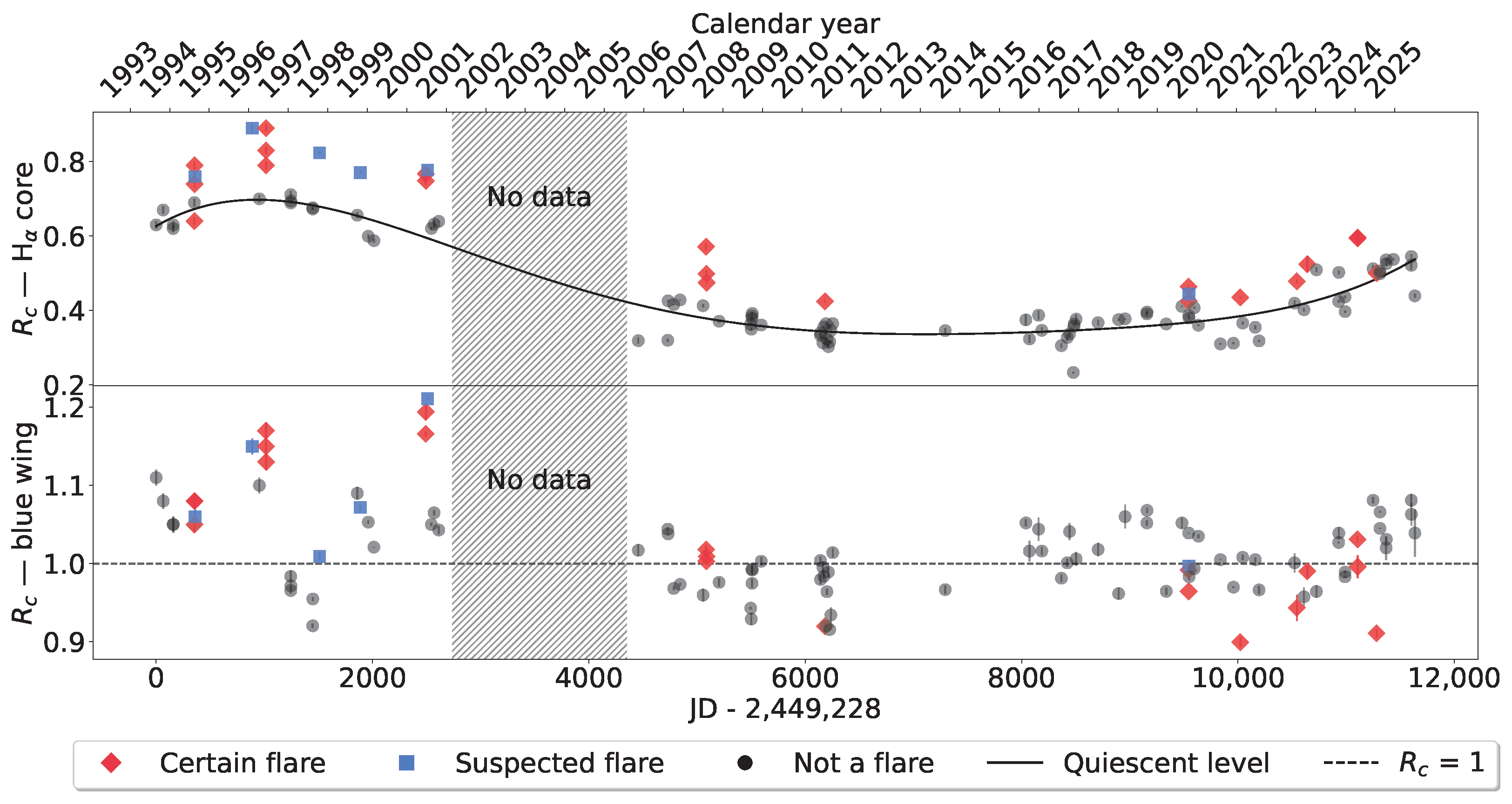
Figure 1 shows the temporal evolution of the relative intensity R c of H α (top panel) and its blue-shifted component (bottom panel) between 1993 and 2025. In the figure, judging from the relative intensity at the bottom of H α , it can be seen that the activity of OP And is at a relatively high level between 1993 and 2000. The activity level is significantly lower between 2010 and 2016, indicating a possible minimum. After that, it appears to be steadily increasing again. If we exclude the points which show flares, either certain or suspected, we can demonstrate the activity level of the star in the quiescent state (not perturbed by flares) by fitting the remaining points (which are represented by black circles in Figure 1) with a function (represented by the black curve in the top panel of Figure 1). To fit the data, a polynomial of the fifth degree was used, because it describes the general trends in the dataset without overfitting. We point out that this fit is not intended to be used as a strict measurement of the activity level, but is only a rough quantitative evaluation of it. Due to the fact that no data is available between 22 October 2000 and 10 November 2005 (as shown in Figure 1), the true behavior of the activity level during this period remains unknown. However, this data gap is relatively short, covering only about 16% of the dataset, and so it is not expected to significantly affect the overall variability trend.
Figure 1. Variability of the relative intensity R c of H α (top panel) and its blue-shifted emission component (bottom panel) in the spectrum of OP And between 1993 and 2025. The x-axes show time in Julian dates JD (starting from the JD of the first observation in the dataset, 2,449,228, bottom) and calendar year (top). The different symbols of the scatter plot represent whether the observation shows a flare or not, as described in Section 2. Error bars are present for all points, but in most cases they are smaller than the point marker. The typical value of the error for the measurements of H α is 0.005, and for those of its blue wing is 0.004 (see Table A1 for more details). The black curve in the top panel represents the quiescent (when no flare is present) activity level, approximated by a polynomial of the fifth degree (see the text), and the dashed horizontal line represents the level of the continuum. The dashed portion of the figure indicates the period between 22 October 2000 and 10 November 2005 for which no data are available; consequently, the true behavior of the activity level during this interval remains unknown.
The blue-shifted component of H α (whose evolution is shown in the bottom panel of Figure 1) shifted by about 79 km s 1 with respect to the restframe velocity of the star [10], and shows significant variability throughout the studied time window. During the perceived maximum of 1993–2000, this component is mostly present and in emission, being significantly above the level of the pseudo-continuum (shown with a dashed horizontal line), and during flares it is visibly higher than during the quiescent state. During the lower activity phase (2005–2016), this blue-shifted component is almost never present—its relative intensity is at or below unity. From 2016 onward, the emission component is again occasionally present; however, in contrast with the interval 1993–2000, it is not stronger during flares. Since the blue-shifted component is linked to mass loss [12], this suggests that mass loss is not as strong in recent times as it was in 1993–2000. A possible reason for the difference in the emission level of the blue-shifted component of H α during flares between the previous (1993–2000) and current (2016–2025) higher activity states might be a difference in the height of the magnetic loops. More on the topic can be found in Section 4.
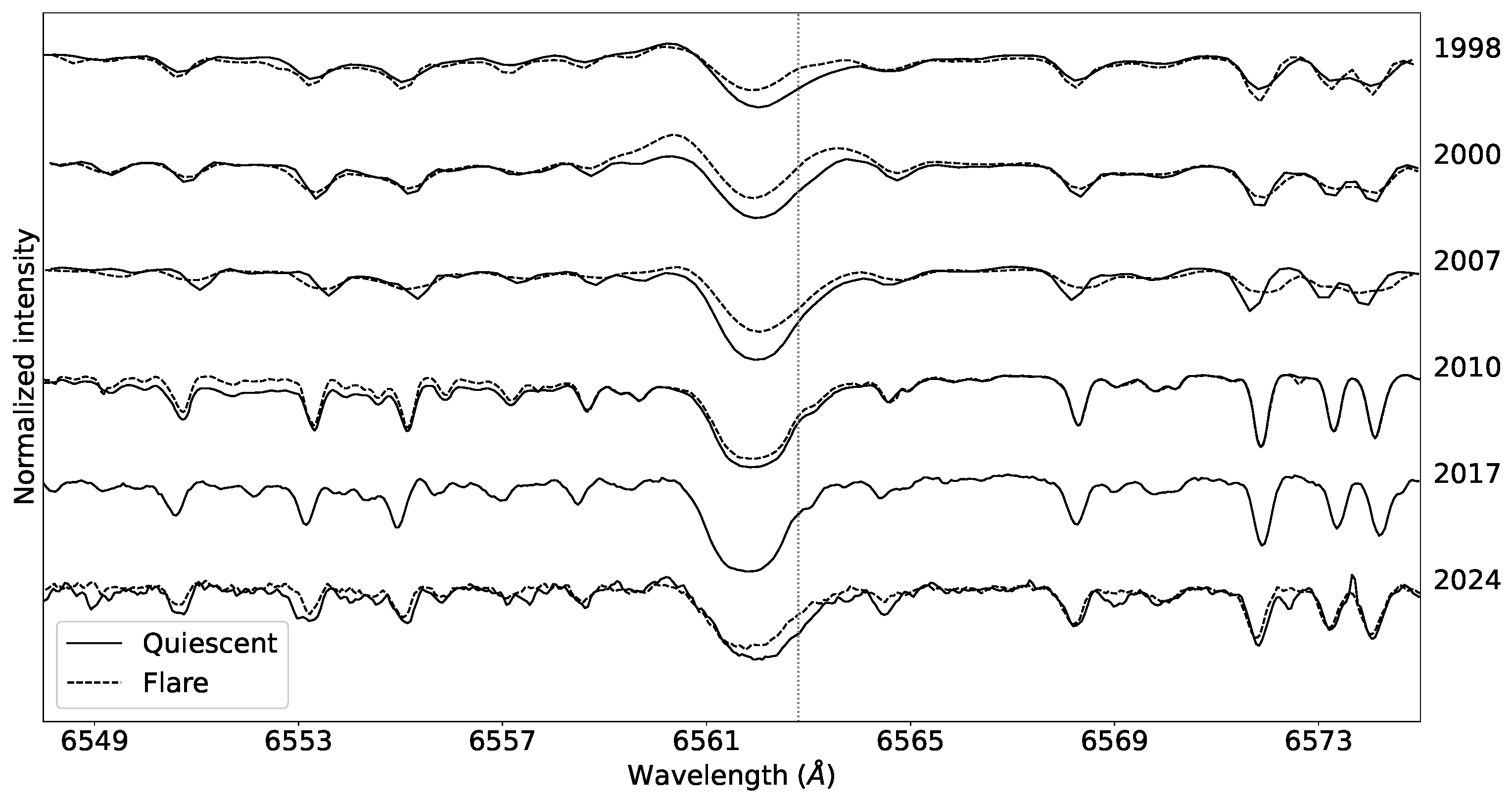
Figure 2 gives an illustration of the temporal variability of the spectrum of OP And in the region of the H α line. In the figure, spectra of the star are shown both during the quiescent state and during flares for six different observational seasons. It can be seen that the spectrum of OP And evolves significantly with time. The H α line is much more shallow in the beginning of the dataset and begins to deepen as time advances up to around 2016, from which point on it starts to slowly become more shallow again. In the early seasons, a blue-shifted emission component of H α , likely associated with mass loss [12], is often visible. This feature is absent in the spectrum of the star between 2010 and 2016, but reappears from 2016 onward.
Figure 2. Temporal variability of the profile of the H α line in the spectrum of OP And. The vertical dotted gray line indicates the wavelength of H α . Spectra taken during the same calendar year are shown using the same vertical shift, and the year itself is noted next to the relevant spectra, on the right. For each season, a spectrum obtained during the quiescent state (solid line) and during a flare event (dashed line) are displayed, except for the 2017 season, which is close to the perceived activity minimum and for which no flares are observed.

3.2. The Calcium Infrared Triplet

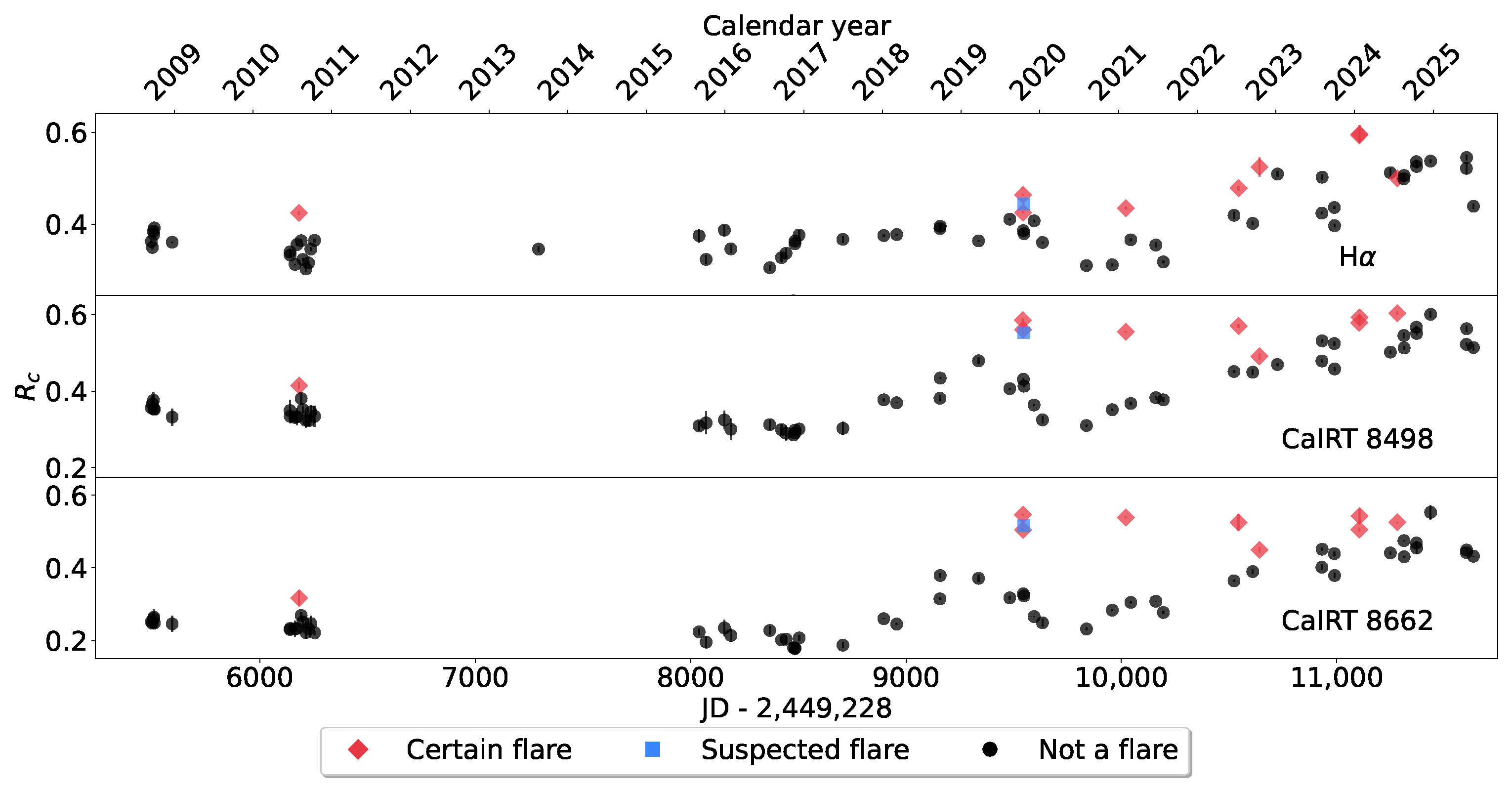
Figure 3 shows the temporal evolution of the activity indicators H α and the two lines of the CaIRT between 2008 and 2025. Measurements of the CaIRT lines are only available from 2008 onward and are used as a confirmation of the long-term activity level estimated from the profile of H α , as well as to confirm the presence of a flare, as described in Section 2. In Figure 3, it can be seen that the behavior of the CaIRT lines generally follows that of H α , with some particular flares (in 2020 and 2021) being more pronounced in the CaIRT lines. The behavior of these two lines helps identify possible flares in the dataset.
Figure 3. Variability of the relative intensity R c of H α and the two lines of the CaIRT (at 8498 and 8662 Å) in the spectrum of OP And between 2008 and 2025. See the legend of Figure 1.

3.3. Flare Frequency

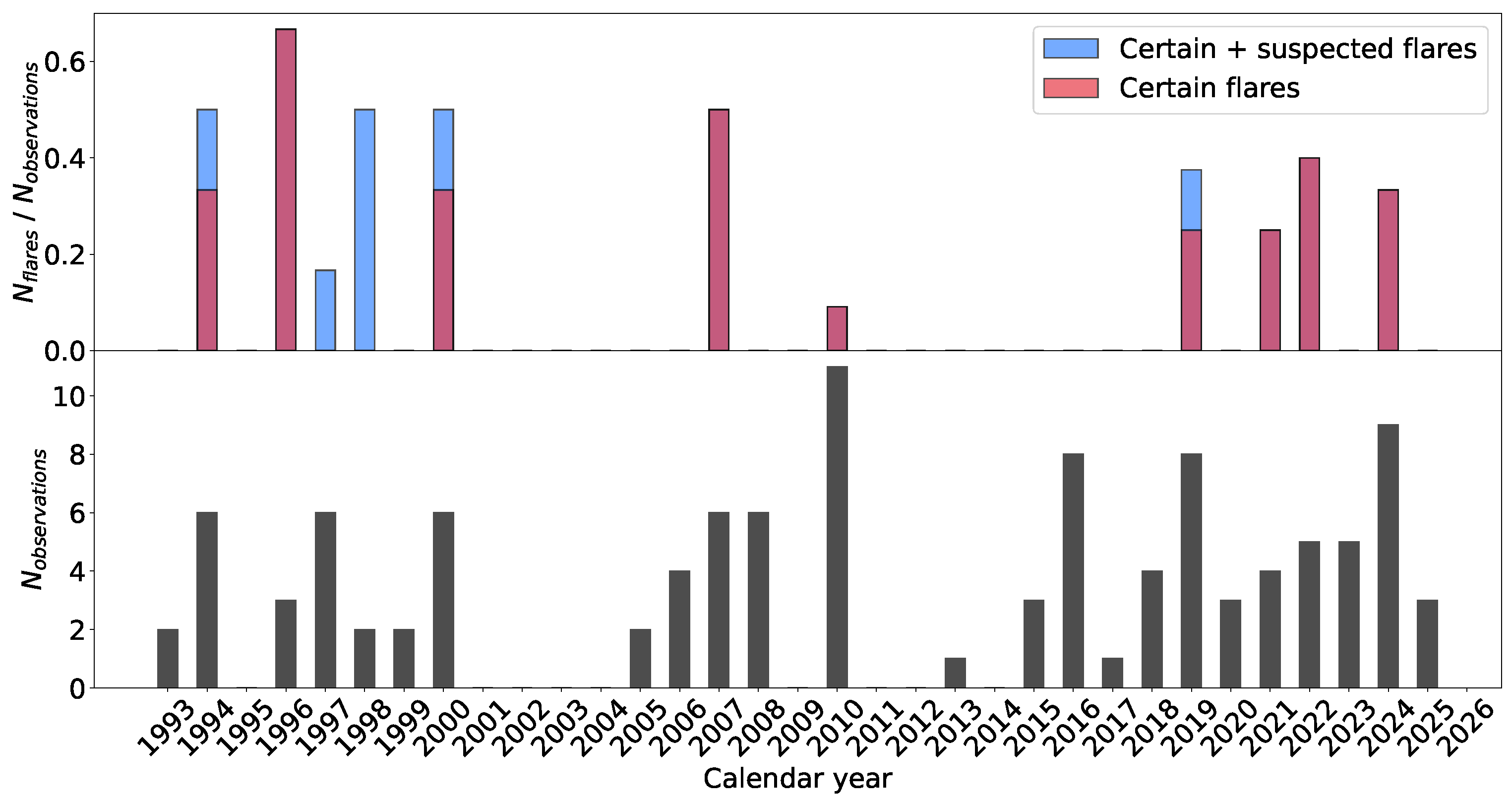
Our dataset consists of a total of 110 different dates of observations, of which 23 show the presence of a flare (18 with certainty, while the remaining 5 are suspected—see Table A1 for details). However, flares do not seem to occur at the same rate over the course of time. The observed ratio of flares to the total number of observations for each calendar year over the course of the dataset is shown graphically in Figure 4. When comparing these results with the estimation of the quiescent activity level shown in Figure 1, it appears that the observed flare rate has a close correlation with the activity level: considering that the suspected flares are indeed such, the flare rate appears highest during 1996, which roughly coincides with the maximum of the estimated quiescent activity level; conversely, between 2008 and 2018 there is only a single registered flare in 34 observations, which in turn coincides with the observed lower activity level. In the last few years of the dataset, flares are observed more often than during the perceived minimum. However, as we have previously seen in Figure 1 and Figure 2, their intensity during the 2020s is clearly below the level registered in the 1990s.
Figure 4. (Top panel): the ratio of the number of detected flares to the total number of observations per calendar year. (Bottom panel): the total number of observations per calendar year.

4. Discussion

From the available data, it can be seen that the activity level of OP And was much higher between 1993 and 2000 than at any other time the star was observed. The higher activity is characterized by the following:
  • A higher quiescent (flares excluded) activity level;
  • Stronger flares;
  • More frequent flares;
  • Presence of a blue-shifted emission component of H α that is likely associated with mass loss [12].
Since this period, the activity level has been steadily decreasing until it reached a perceived minimum around 2010–2016, which all the studied indicators of flare activity in this work point to. After this time, the activity level has been steadily increasing, and although the quiescent level of H α in 2024 and 2025 approaches that of the previous perceived maximum around the year 1996 (see Figure 1), it does not match it completely. It seems that the activity level of the star is increasing gradually, but the eventual period could be more than 30 years (the length of our dataset). The H α blue-shifted emission component also follows this variability behavior. During the minimum it completely disappears and only reappears after 2016. Since this component is linked to mass loss, this means that mass outflow depends on the activity level in OP And. The blue-shifted emission component of H α shows greater intensity during the 1993–2000 high activity state than during the 2016–2025 one. A possible reason for this difference might be a difference in the height of the magnetic loops. We suspect that the magnetic loops during the 1993–2000 active state were, on average, much higher above the photosphere of the star than they are during the present one. At higher altitudes r, the escape velocity v esc is lower ( v esc r 1 ). During a flare, the magnetic loops reconnect and the plasma is no longer bound to them, and if its velocity is greater than v esc , mass loss may occur. Thus, a greater height of the magnetic loops during the 1993–2000 period than during the 2016–2025 one may explain the stronger emission in the blue-shifted component of H α . Alternatively, the different behavior of the blue-shifted H α emission component between the 1993–2000 and 2016–2025 periods may reflect variations in the filling factor, i.e., the fraction of the stellar surface covered by magnetic regions. Since OP And has crossed the MgII Dividing line, its magnetic loops may already become open at the level of the chromosphere, leading to chromospheric mass outflow, as discussed in [2]. Consequently, a larger filling factor during the 1993–2000 period could also account for the observed higher mass outflow, traced by a stronger emission in the blue-shifted component due to the larger number of surfacing magnetic loops. On the other hand, magnetic loops that reach higher altitudes can lead to flares that last longer, due to the fact that more mass is trapped inside the loops. This supports the hypothesis that the magnetic loops were larger in the 1990s than at present times, because long flares (lasting more than one day) are observed on three occasions during the 1993–2000 period (18–19 August 1994, 8–9 June 1996, and 24–25 June 2000) but never during the 2016–2025 one.
Ref. [25] studied the long-term variability (from mid-1983 to mid-1995) of the calcium H&K chromospheric lines of cool giants and found different cases of activity variability—variable, long-term trend, cyclic, and flat. The authors conclude that about 40% of the 175 giants studied by them show possible cyclic activity. Another nearly 40% of their sample show variable records. This means that either not all giants go through magnetic activity cycles, or that part of the cycles might be much longer than 12 years—the length of their dataset.
In addition, ref. [26] reported a 13 yr cycle of the G giant 37 Com from photometric measurements. The rotational period of this giant is 110 days [4]. Ref. [27] use datasets from the “HK project” at Mount Wilson Observatory [28,29] to search for chromospheric activity cycles through the variations of the S-index. Their sample consists mostly of dwarf stars, but it also includes three giants. Their rotational periods are 43, 35, and 42 days and the length of their cycles is 6, 9, and 8 years, respectively. Hence, from the scanty information known for the activity cycles in cool giants, we find no clear correlation between the cycle length and the rotational period. More studies in this direction could clarify the picture. However, from the present study it is clear that the eventual activity cycle of OP And is longer than 30 years. From the latest data (after 2016), it appears that the activity level is steadily increasing, possibly towards a new maximum. As discussed in the Introduction, the amplitude of the new maximum must not necessarily match that of the previous one. Consequently, it is not excluded that our dataset already contains the new maximum. In order to be able to assess the length of the eventual cycle, one must first observe that the activity level begins to decline again. That could become clear after 5–10 more years of observations.
Long-term photometric and CaII S-index observations of the Sun and various types of active stars (e.g., cool dwarfs, RS CVn systems, FK Com stars) have shown that starspot cycles are often multiple and that the period of each cycle can vary [30,31]. It was also found that for the faster rotators more than one activity cycle is often met. A recent long-term study of magnetic field variability in solar-type dwarfs by [32] confirms these findings.
In the case of OP And, our data reveal a smooth variability pattern consistent with a single cycle, in agreement with the findings of [30].

5. Conclusions

Our spectral study of the activity indicator H α in the period 1993–2025 revealed that the activity level of OP And varies smoothly in time. In the period 1993–1999 it was near maximum, and in the period 2005–2016 the activity reached its minimum. Later on, it begins to increase gradually and in 2025 it is approaching the maximum level detected in the 1990s. The behavior of the two lines of the CaII infrared triplet (CaIRT)— λ 8498 Å and λ 8662 Å—(when observed) is similar to that of the core of H α . In total, 23 flares were detected and the flare frequency follows the maximum and minimum determined by the activity indicator H α .
We also studied the long-term behavior of the blue-shifted emission component of H α that is interpreted as a hot expanding area located above the photosphere, linked to mass outflow. We found that during the minimum, the emission is absent, but appeared again with the increase of the activity level after it. This is an indication that the magnetic activity also controls the mass loss in OP And. We suspect that the lower level of the intensity of this emission component between 2016 and 2025 with respect to the 1990s could be due to a smaller on-average height of the magnetic loops in the more recent high activity period.
It seems that the suspected activity cycle of this cool giant is longer than 30 years. To date, it appears to be the longest one known in such an evolved star. More observations are necessary to determine its exact length.

Author Contributions

Conceptualization, S.G. and R.K.-A.; methodology, S.G., R.K.-A., A.B. and R.B.; software, S.G. and R.B.; formal analysis, S.G., R.K.-A. and R.B.; investigation, S.G., R.K.-A. and A.B.; data curation, S.G., R.K.-A., A.B., R.B., D.K., M.A., P.P., D.C., A.K., M.G., N.T., H.M., B.S., R.Z., M.M. (Milen Minev) and M.M. (Miroslav Moyseev); writing—original draft preparation, S.G. and R.K.-A.; writing—review and editing, R.K.-A.; visualization, S.G.; supervision, R.K.-A.; project administration, R.K.-A. and A.B.; funding acquisition, R.K.-A. and A.B. All authors have read and agreed to the published version of the manuscript.

Funding

The Narval observations in 2008 were supported under the OPTICON program. The observations in 2010 were funded by the Bulgarian National Science Fund (NSF), contract No. DSAB 02/3. S.G., R.K.A., M.B. and H.M. acknowledge partial financial support from the Bulgarian NSF, contract No. DN 08/1. H.M. and A.K. acknowledge partial financial support from the Bulgarian NSF, contract No. DN 18/13. The ESpeRo observations from 2017 onward were obtained under the RACIO project supported by the Ministry of Education and Science of Bulgaria through the Bulgarian National Roadmap for Research Infrastructure.

Data Availability Statement

The Narval observations from 2008 and 2010 are publicly available at PolarBase (https://www.polarbase.ovgso.fr/). The observations obtained with the 2-m telescope at the Rozhen National Astronomical Observatory can be made available upon request by contacting the corresponding author via email.

Acknowledgments

The Narval observations in 2008 are granted under OPTICON program. The observations in 2010 are funded under Bulgarian NSF contract DSAB 02/3. S.G., R.K.A., M.B. and H.M. acknowledge partial financial support under Bulgarian NSF contract DN 08/1. H.M. and A.K. acknowledge partial financial support under Bulgarian NSF contract DN 18/13. The ESpeRo observations from 2017 onward were obtained under the RACIO project supported by the Ministry of Education and Science of Bulgaria (Bulgarian National Roadmap for Research Infrastructure). We are grateful to the anonymous referees whose thoughtful comments and suggestions contributed to the improvement of the manuscript.

Conflicts of Interest

The authors declare no conflicts of interest. The funders had no role in the design of the study; in the collection, analyses, or interpretation of data; in the writing of the manuscript; or in the decision to publish the results.

Appendix A. Log of Observations

Table A1. Log of observations of OP And. The columns show the calendar date of the observation and the instrument with which it was obtained (see Section 2), the Julian date (JD) starting from 2,449,228 (the JD of the first observation in the dataset), relative intensities of the H α line, its blue-shifted emission component (“H α B” for short) and the 8498 Å and 8662 Å lines of the calcium infrared triplet, along with their respective error of measurement (the root-mean-square scatter of the pixel intensities within a narrow interval containing the core of the measured line), and, in the last column, whether the observation is considered a flare (“C” for “Certain” or “S” for “Suspected”) together with the justification for this (“SS” means the flare is seen in several spectra, and “SI” means it is seen in several indicators). See Section 2 for a detailed explanation.
Date,
Instrument
JD+H α σ (H α )H α B σ (H α B)CaIRT
8498 Å
σ (8498)CaIRT
8662 Å
σ (8662)Flare,
Reason
1993/08/29 C00.6300.0101.1100.010
1993/11/02 C650.6700.0101.0800.010
1994/02/01 C1570.6200.0101.0500.010
1994/02/02 C1580.6300.0101.0500.010
1994/08/17 C3530.6900.0101.0500.010
1994/08/18 C3540.6400.0101.0500.010C, SS
1994/08/18 C3550.7400.0101.0800.010C, SS
1994/08/19 C3550.7900.0101.0800.010C, SS
1994/08/23 C3590.7600.0101.0600.010S, H α
1996/02/02 C8880.8900.0101.1500.010S, H α
1996/04/08 C9540.7000.0101.1000.010
1996/06/08 C10150.8900.0101.1700.010C, SS
1996/06/09 C10150.8300.0101.1500.010C, SS
1996/06/09 C10160.7900.0101.1300.010C, SS
1997/01/23 C12440.7110.0090.9840.007
1997/01/24 C12450.6890.0020.9660.004
1997/01/25 C12460.6940.0020.9720.003
1997/08/14 C14470.6760.0050.9200.002
1997/08/15 C14480.6730.0020.9550.002
1997/10/16 C15100.8230.0041.0090.004S, H α
1998/09/30 C18590.6560.0081.0900.008
1998/10/28 C18870.7710.0021.0720.003S, H α
1999/01/10 C19610.5990.0061.0530.002
1999/03/03 C20130.5870.0051.0210.000
2000/06/24 C24920.7480.0111.1660.003C, SS
2000/06/25 C24930.7670.0111.1940.010C, SS
2000/07/11 C25090.7770.0061.2110.001S, H α
2000/08/15 C25440.6200.0041.0500.002
2000/09/09 C25690.6320.0101.0650.003
2000/10/22 C26120.6400.0011.0430.005
2005/11/10 C44570.3190.0081.0170.008
2006/08/09 C47290.3200.0041.0440.002
2006/08/12 C47320.4260.0031.0380.001
2006/10/03 C47840.4160.0010.9680.002
2006/12/01 C48430.4280.0010.9730.002
2007/07/01 C50550.4130.0040.9600.008
2007/07/30 C50830.5710.0101.0180.006C, SS
2007/08/02 C50860.4980.0071.0030.001C, SS
2007/08/03 C50880.4750.0041.0090.008C, SS
2007/11/27 C52040.3710.0040.9760.005
2008/09/15 N54960.3620.0030.9430.0020.3560.0150.2520.011
2008/09/20 N55010.3490.0040.9290.0080.3670.0210.2480.012
2008/09/25 N55060.3850.0030.9930.0050.3760.0210.2600.013
2008/09/27 N55080.3780.0040.9750.0060.3530.0070.2640.021
2008/09/29 N55100.3920.0030.9920.0060.3520.0110.2480.010
2008/12/21 N55930.3610.0011.0030.0050.3320.0220.2460.022
2010/06/21 N61400.3400.0051.0040.0050.3490.0270.2310.003
2010/06/22 N61410.3330.0050.9800.0060.3340.0180.2330.009
2010/07/14 N61630.3130.0010.9950.0070.3310.0020.2320.022
2010/07/23 N61720.3560.0030.9840.0030.3330.0220.2330.007
2010/08/02 N61820.4240.0040.9200.0070.4140.0090.3170.019C, SI
2010/08/12 N61920.3640.0030.9200.0040.3800.0150.2690.009
2010/08/20 N62000.3230.0030.9640.0040.3510.0100.2510.014
2010/09/03 N62140.3030.0060.9890.0060.3240.0180.2220.016
2010/09/15 N62260.3160.0040.9160.0000.3230.0150.2330.005
2010/09/26 N62370.3460.0040.9340.0100.3450.0180.2460.022
2010/10/13 N62540.3650.0041.0140.0060.3340.0270.2210.006
2013/08/17 C72940.3460.0060.9670.005
2015/09/02 E80390.3750.0151.0520.0040.3090.0120.2240.009
2015/10/04 E80720.3230.0101.0160.0130.3170.0300.1960.016
2015/12/28 E81570.3870.0111.0440.0150.3240.0240.2350.023
2016/01/27 E81870.3460.0091.0160.0050.3000.0280.2140.018
2016/07/26 E83670.3050.0060.9810.0050.3120.0130.2280.012
2016/09/18 E84220.3270.0091.0010.0050.2990.0150.2020.007
2016/10/10 E84430.3370.0101.0410.0110.2900.0190.2040.011
2016/11/13 E84780.2330.0020.2850.0020.1800.001
2016/11/19 E84840.3570.0010.2900.0010.1780.001
2016/11/20 E84850.3630.0020.2980.0020.1790.002
2016/12/09 E85040.3770.0111.0060.0080.3010.0020.2070.007
2017/06/30 E87070.3670.0081.0180.0080.3020.0170.1870.008
2018/01/06 E88970.3750.0030.9620.0070.3770.0040.2600.001
2018/03/07 E89570.3770.0011.0600.0150.3690.0000.2450.002
2018/09/24 E91580.3910.0051.0520.0030.3810.0070.3150.003
2018/09/25 E91590.3960.0051.0680.0030.4340.0020.3790.006
2019/03/22 E93370.3640.0010.9650.0040.4790.0080.3710.010
2019/08/14 E94820.4110.0021.0520.0070.4060.0020.3180.005
2019/10/14 E95430.4640.0020.9920.0040.5850.0030.5470.002C, SI, SS
2019/10/15 E95440.4250.0020.9640.0000.5600.0010.5050.004C, SI, SS
2019/10/16 E95450.3860.0041.0390.0000.4310.0030.3290.001
2019/10/18 E95470.4440.0010.9970.0080.5520.0030.5160.001S, CaI
2019/10/19 E95480.3790.0020.9830.0040.4130.0030.3230.002
2019/12/05 E95950.4070.0020.9940.0000.3630.0030.2660.001
2020/01/13 E96340.3600.0021.0350.0020.3250.0090.2490.011
2020/08/04 E98380.3100.0021.0050.0000.3100.0030.2320.004
2020/12/02 E99580.3120.0020.9700.0010.3510.0030.2840.002
2021/02/03 E10,0210.4350.0030.8990.0060.5550.0010.5390.002C, SI
2021/02/26 E10,0440.3660.0031.0080.0030.3680.0040.3050.003
2021/06/22 E10,1600.3550.0051.0050.0030.3830.0040.3080.001
2021/07/27 E10,1950.3180.0030.9660.0050.3770.0060.2770.004
2022/06/20 E10,5230.4190.0081.0010.0120.4510.0030.3640.003
2022/07/11 E10,5440.4780.0050.9430.0160.5700.0050.5250.022C, SI
2022/09/15 E10,6100.4020.0040.9580.0120.4490.0070.3900.006
2022/10/16 E10,6410.5240.0210.9900.0080.4910.0080.4490.008C, SI
2023/01/08 E10,7250.5090.0060.9640.0080.4690.003
2023/08/02 E10,9310.4240.0031.0270.0010.4790.0040.4020.007
2023/08/03 E10,9320.5020.0051.0390.0070.5310.0050.4510.004
2023/09/29 E10,9890.4360.0030.9830.0010.5240.0050.4390.006
2023/09/30 E10,9900.3970.0030.9890.0020.4580.0040.3790.007
2024/01/23 E11,1050.5940.0141.0310.0050.5780.0040.5050.005C, SI
2024/01/24 E11,1060.5960.0190.9960.0140.5920.0070.5430.019C, SI
2024/06/15 E11,2490.5120.0091.0810.0040.5020.0040.4410.004
2024/07/17 E11,2810.5000.0080.9110.0050.6030.0040.5260.002C, SI
2024/08/17 E11,3120.4990.0061.0450.0010.5450.0070.4750.001
2024/08/18 E11,3130.5060.0061.0660.0010.5130.0050.4310.002
2024/10/14 E11,3700.5360.0041.0200.0150.5670.0040.4690.005
2024/10/15 E11,3710.5260.0041.0310.0020.5510.0050.4550.017
2024/12/19 E11,4360.5370.0030.6010.0080.5530.020
2025/06/03 E11,6020.5210.0111.0810.0080.5220.0040.4420.001
2025/06/04 E11,6030.5450.0051.0630.0140.5630.0080.4490.003
2025/07/06 E11,6350.4390.0051.0390.0300.5140.0070.4320.001

References

  1. Strassmeier, K.G.; Hall, D.S. Photometric Variability in Chromospherically Active Stars. II. The Rapidly Rotating Single Stars. Astrophys. J. Suppl. Ser. 1988, 67, 453. [Google Scholar] [CrossRef]
  2. Konstantinova-Antova, R.K.; Schröder, K.P.; Ivanov, M.M.; Antov, A.P.; Kolev, D.Z. OP And—An active single giant with evidence for mass loss? In Proceedings of the 13th Cambridge Workshop on Cool Stars, Stellar Systems and the Sun, Hamburg, Germany, 5–9 July 2004; Favata, F., Hussain, G.A.J., Battrick, B., Eds.; ESA Special Publication: Noordwijk, The Netherlands, 2005; Volume 560, p. 715. [Google Scholar]
  3. de Medeiros, J.R.; Mayor, M. VizieR Online Data Catalog: RV and Vsini of Evolved Stars (de Medeiros+ 1999); Centre de Données Astronomiques de Strasbourg (CDS): Strasbourg, France, 1999. [Google Scholar]
  4. Aurière, M.; Konstantinova-Antova, R.; Charbonnel, C.; Wade, G.A.; Tsvetkova, S.; Petit, P.; Dintrans, B.; Drake, N.A.; Decressin, T.; Lagarde, N.; et al. The magnetic fields at the surface of active single G-K giants. Astron. Astrophys. 2015, 574, A90. [Google Scholar] [CrossRef]
  5. Balachandran, S.C.; Fekel, F.C.; Henry, G.W.; Uitenbroek, H. Two K Giants with Supermeteoritic Lithium Abundances: HDE 233517 and HD 9746. Astrophys. J. 2000, 542, 978–988. [Google Scholar] [CrossRef]
  6. Charbonnel, C.; Decressin, T.; Lagarde, N.; Gallet, F.; Palacios, A.; Aurière, M.; Konstantinova-Antova, R.; Mathis, S.; Anderson, R.I.; Dintrans, B. The magnetic strip(s) in the advanced phases of stellar evolution. Theoretical convective turnover timescale and Rossby number for low- and intermediate-mass stars up to the AGB at various metallicities. Astron. Astrophys. 2017, 605, A102. [Google Scholar] [CrossRef]
  7. Drake, N.A.; de la Reza, R.; da Silva, L.; Lambert, D.L. Rapidly Rotating Lithium-rich K Giants: The New Case of the Giant PDS 365. Astron. J. 2002, 123, 2703–2714. [Google Scholar] [CrossRef]
  8. Abt, H.A.; Biggs, E.S. Bibliography of Stellar Radial Velocities; Latham Process Corp.: New York, NY, USA, 1972. [Google Scholar]
  9. Fekel, F.C.; Moffett, T.J.; Henry, G.W. A Survey of Chromospherically Active Stars. Astrophys. J. Suppl. Ser. 1986, 60, 551. [Google Scholar] [CrossRef]
  10. Konstantinova-Antova, R.K.; Ivanov, M.M.; Antov, A.P. OP And—An interesting chromospherically active K giant. In Proceedings of the IAU Symposium, Vienna, Austria, 9–13 October 1995; Strassmeier, K.G., Ed.; Volume 176, p. 178. [Google Scholar]
  11. Borisova, A.; Konstantinova-Antova, R.; Aurière, M.; Petit, P.; Tsvetkova, S. A spectral study of the active giant OP And in the period 1979–2010. Bulg. Astron. J. 2012, 18, 27. [Google Scholar]
  12. Georgiev, S.; Konstantinova-Antova, R.; Borisova, A.; Kolev, D.; Auruière, M.; Petit, P.; Belcheva, M.; Markov, H.; Bogdanovski, R.; Spassov, B.; et al. A long-term spectral study of the single active giant OP andromedae. In Proceedings of the 10th Jubilee International Conference of the Balkan Physical Union, Sofia, Bulgaria, 26–30 August 2018; American Institute of Physics Conference Series. Volume 2075, p. 090003. [Google Scholar] [CrossRef]
  13. Strassmeier, K.G.; Fekel, F.C.; Bopp, B.W.; Dempsey, R.C.; Henry, G.W. Chromospheric CA II H and K and H alpha Emission in Single and Binary Stars of Spectra Types F6–M2. Astrophys. J. Ser. 1990, 72, 191. [Google Scholar] [CrossRef]
  14. Mihalas, D. Stellar Atmospheres; W.H. Freeman: San Francisco, CA, USA, 1978. [Google Scholar]
  15. de la Reza, R.; Drake, N.A.; da Silva, L.; Torres, C.A.O.; Martin, E.L. On a Rapid Lithium Enrichment and Depletion of K Giant Stars. Astrophys. J. 1997, 482, L77–L80. [Google Scholar] [CrossRef][Green Version]
  16. Stencel, R.E.; Mullan, D.J.; Linsky, J.L.; Basri, G.S.; Worden, S.P. The outher atmospheres of cool stars. VII. High resolution, absolute flux profiles of the MG II H and K lines in stars of spectral types F8 to M5. Astrophys. J. Suppl. Ser. 1980, 44, 383–402. [Google Scholar] [CrossRef]
  17. Balogh, A.; Hudson, H.S.; Petrovay, K.; von Steiger, R. Introduction to the Solar Activity Cycle: Overview of Causes and Consequences. Space Sci. Rev. 2014, 186, 1–15. [Google Scholar] [CrossRef]
  18. Bonev, T.; Markov, H.; Tomov, T.; Bogdanovski, R.; Markishki, P.; Belcheva, M.; Dimitrov, W.; Kamiński, K.; Milushev, I.; Musaev, F.; et al. ESpeRo: Echelle Spectrograph Rozhen. Bulg. Astron. J. 2017, 26, 67. [Google Scholar] [CrossRef]
  19. Andretta, V.; Busà, I.; Gomez, M.T.; Terranegra, L. The Ca II Infrared Triplet as a stellar activity diagnostic. I. Non-LTE photospheric profiles and definition of the RIRT indicator. Astron. Astrophys. 2005, 430, 669–677. [Google Scholar] [CrossRef]
  20. Martin, J.; Fuhrmeister, B.; Mittag, M.; Schmidt, T.O.B.; Hempelmann, A.; González-Pérez, J.N.; Schmitt, J.H.M.M. The Ca II infrared triplet’s performance as an activity indicator compared to Ca II H and K. Empirical relations to convert Ca II infrared triplet measurements to common activity indices. Astron. Astrophys. 2017, 605, A113. [Google Scholar] [CrossRef]
  21. Georgiev, S.; Moyseev, M.; Stoyanov, K.; Konstantinova-Antova, R.; Galabova, M. DESpeRo: Data reduction software for the Echelle Spectrograph Rozhen. Bulg. Astron. J. 2025, 43, 98. [Google Scholar]
  22. Tody, D. The IRAF Data Reduction and Analysis System. In Proceedings of the Instrumentation in Astronomy VI, Tucson, AZ, USA, 4–8 March 1986; Crawford, D.L., Ed.; Society of Photo-Optical Instrumentation Engineers (SPIE): Bellingham, WA, USA, 1986; Volume 627, p. 733. [Google Scholar] [CrossRef]
  23. Eaton, J.A. Hα Measurements for Cool Giants. Astron. J. 1995, 109, 1797. [Google Scholar] [CrossRef]
  24. Konstantinova-Antova, R. Study of Chromospheric Activity in Single G and K Giant Stars. Ph.D. Thesis, Bulgarian Academy of Sciences, Sofia, Bulgaria, 29 August 2001. [Google Scholar]
  25. Baliunas, S.L.; Donahue, R.A.; Soon, W.; Henry, G.W. Activity Cycles in Lower Main Sequence and POST Main Sequence Stars: The HK Project. In Proceedings of the Cool Stars, Stellar Systems, and the Sun, 1998, Cambridge, MA, USA, 15–19 July 1997; Donahue, R.A., Bookbinder, J.A., Eds.; Astronomical Society of the Pacific Conference Series. Volume 154, p. 153. [Google Scholar]
  26. Donahue, R.A. Long-term stellar activity: Three decades of observations. In Proceedings of the Stellar Surface Structure, Vienna, Austria, 9–13 October 1995; Strassmeier, K.G., Linsky, J.L., Eds.; Volume 176, p. 261. [Google Scholar]
  27. Willamo, T.; Hackman, T.; Lehtinen, J.J.; Käpylä, M.J.; Olspert, N.; Viviani, M.; Warnecke, J. Shapes of stellar activity cycles. Astron. Astrophys. 2020, 638, A69. [Google Scholar] [CrossRef]
  28. Wilson, O.C. Flux Measurements at the Centers of Stellar H- and K-Lines. Astrophys. J. 1968, 153, 221. [Google Scholar] [CrossRef]
  29. Wilson, O.C. Chromospheric variations in main-sequence stars. Astrophys. J. 1978, 226, 379–396. [Google Scholar] [CrossRef]
  30. Oláh, K.; Kolláth, Z.; Granzer, T.; Strassmeier, K.G.; Lanza, A.F.; Järvinen, S.; Korhonen, H.; Baliunas, S.L.; Soon, W.; Messina, S.; et al. Multiple and changing cycles of active stars. II. Results. Astron. Astrophys. 2009, 501, 703–713. [Google Scholar] [CrossRef]
  31. Oláh, K.; Kovári, Z.; Petrovay, K.; Soon, W.; Baliunas, S.; Kolláth, Z.; Vida, K. Magnetic cycles at different ages of stars. Astron. Astrophys. 2016, 590, A133. [Google Scholar] [CrossRef]
  32. Bellotti, S.; Petit, P.; Jeffers, S.V.; Marsden, S.C.; Morin, J.; Vidotto, A.A.; Folsom, C.P.; See, V.; do Nascimento, J.D. A BCool survey of stellar magnetic cycles. Astron. Astrophys. 2025, 693, A269. [Google Scholar] [CrossRef]
Disclaimer/Publisher’s Note: The statements, opinions and data contained in all publications are solely those of the individual author(s) and contributor(s) and not of MDPI and/or the editor(s). MDPI and/or the editor(s) disclaim responsibility for any injury to people or property resulting from any ideas, methods, instructions or products referred to in the content.

Article Metrics

Citations

Article Access Statistics

Multiple requests from the same IP address are counted as one view.