
Next Article in Journal
Three Decades of FCNC Studies in 3-3-1 Model with Right-Handed Neutrinos: From Z′-Dominance to the Alignment Limit
Previous Article in Journal
Black-Hole Evaporation for Cosmological Observers
 
 
Due to scheduled maintenance work on our servers, there may be short service disruptions on this website between 11:00 and 12:00 CEST on March 28th.
Article

Characteristics of the Solar Differential Rotation and Activity During Solar Cycle No. 24
1
Faculty of Physics, University of Rijeka, 51000 Rijeka, Croatia
2
Kanzelhöhe Observatory for Solar and Environmental Research, University of Graz, 9521 Treffen am Ossiacher See, Austria
3
Zagreb Astronomical Observatory, 10000 Zagreb, Croatia
4
Hvar Observatory, Faculty of Geodesy, University of Zagreb, 10000 Zagreb, Croatia
5
Institute of Physics, University of Graz, 8010 Graz, Austria
*
Author to whom correspondence should be addressed.
Universe 2025, 11(12), 395; https://doi.org/10.3390/universe11120395
Submission received: 30 September 2025 / Revised: 19 November 2025 / Accepted: 28 November 2025 / Published: 3 December 2025
(This article belongs to the Section Solar and Stellar Physics)

Abstract

An analysis of the solar differential rotation (DR) during solar cycle No. 24 (SC24) (2009–2019), based on the Kanzelhöhe Observatory for Solar and Environmental Research (KSO) data set, is presented. The white-light images were processed and positions of sunspot groups were extracted using the morphological image processing technique. The sample was constrained to ±58° in central meridian distance (CMD). Two methods were applied to derive the sidereal angular rotation rate (ω) and, in turn, the solar rotation parameters A and B: (a) calculating synodic rotation velocities from daily CMD differences and elapsed time (daily shift method); (b) applying a robust linear least-squares fit to the time series CMD(t) for each sunspot group. To assess the relationship between rotation parameters and solar activity, we analyzed the yearly mean total sunspot number from the Sunspot Index and Long-term Solar Observations (SILSO). This study marks the first complete analysis of SC24 using the KSO sunspot groups’ data. Our goal is to extend the previous analysis of DR from the KSO data to the present, especially because the Solar Optical Observing Network/United States Air Force/National Oceanic and Atmospheric Administration data set (SOON/USAF/NOAA) and Debrecen Photoheliographic Data (DPD) catalogues do not provide data after 2018.

1. Introduction

The analysis of the solar differential rotation (DR) using sunspot groups during the solar cycle No. 24 (SC24) is important as it ensures consistency in the processing and interpretation of recent observational data, which enables integration into the broader long-term context when combined with already available datasets that cover previous cycles. Differential rotation is a key ingredient of the solar dynamo and tracking its variation with the solar cycle provides crucial insights into the mechanisms that govern solar activity [1,2,3,4]. Since SC24 was unusually weak compared to previous cycles, studying its DR offers a unique opportunity to investigate how a reduced cycle amplitude affects solar dynamics [5,6,7].
Therefore, extending the long-term datasets of sunspot group positions both into the past and into the present is of great importance, as it provides coverage of a time series spanning several centuries which is suitable for long-term and cycle-to-cycle studies [8,9,10]. Extending the datasets to encompass the most recent years is also important, given the present lack of adequate coverage for SC24 and SC25. Well-established datasets such as the Greenwich Photoheliographic Results (GPR1) [11,12] and its continuations (Solar Optical Observing Network/United States Air Force/National Oceanic and Atmospheric Administration, SOON/USAF/NOAA2 and Debrecen Photoheliographic Data, DPD3) [13,14] have provided valuable long-term sunspot groups position records, but they have not been updated beyond 2018. This has created a gap in user-friendly, publicly available sunspot group positions data. The Kanzelhöhe Observatory for Solar and Environmental Research (KSO) observations, with its historical sunspot drawings and white-light images, represents an excellent dataset to fill this gap, extending coverage and ensuring continuity in the solar DR studies. Previous analyses have confirmed that KSO data align well with DPD and GPR records [15], making it a reliable source for such analysis.
Thus, continuing the determination of sunspot group positions in the present time remains scientifically meaningful and valuable. Although sunspot groups provide the longest available datasets of this kind and are directly linked to active-region magnetic flux emergence, which makes them valuable for investigating the activity–rotation connection, there are several limitations that need to be considered. These include: (a) the latitude bias, as sunspots appear only within restricted latitude belts [16,17,18]; (b) the evolution and intrinsic motions of sunspots, which may bias rotation estimates [19,20,21]; (c) projection and measurement errors in historical records [22,23]; (d) the anchoring depth ambiguity of different spot types, so the measured rotation may not uniformly represent the surface plasma rotation [16]. Despite the challenges in interpreting results due to potential errors from the listed limitations, the lack of recent data and the need for long-term, century-scale studies highlight the importance of completing new comprehensive catalogues.
Therefore, our study focuses on the extension of the KSO sunspot group position and velocity dataset in order to make the KSO catalogue complete, which is important for investigating long-term variations in the solar DR profile. The database of sunspot group positions, photospheric DR parameters, their changes over time, north–south rotational asymmetry, and the dependence of DR on solar activity have already been determined from the KSO sunspot drawings and white light images for the timespan 1964–2016 [15,24]. We aim to extend those studies to a longer period by expanding the database of sunspot group positions from KSO to include the years before 1964 [25] and after 2016 (present work). In this way, only solar cycle 18 and 25 remain to be processed, after which the KSO catalogue (1944–present) of sunspot group positions and rotational velocities will be completed.
Therefore, in this work, we extend the analysis of sunspot group positions and DR parameters derived from KSO observations to the SC24 (2009–2019), demonstrating the viability of this dataset for long-term solar rotation studies. So far, an analysis of the photospheric DR using KSO sunspot groups data has never been performed for the entire SC24.

2. Materials and Methods

Since the main objective of this work is to present the latest results that will be included in the KSO sunspot group positions and velocities catalogue, the applied methods (for the determination of the heliographic positions of sunspot groups, as well as the method for the determination of the rotation velocities) had to remain consistent with that used in previous studies [15,24]. Maintaining this consistency with our earlier studies not only preserves methodological continuity but also supports the goal of building a long-term comprehensive catalogue of sunspot group positions and rotation velocities.
We used an automatic method for the determination of the heliographic positions of sunspot groups by morphological image processing [26], on white light images from KSO for the time period 2009–2019 (SC24). Details on the creation of white-light images and the improvements made to the cameras over the years are available in [27]. The automatic method for the determination of the heliographic positions has been enhanced since its use in our earlier studies. A change in the camera—improved bit depth from 1024 grey levels to 4096 grey levels—and additional preprocessing of the images—unsharp masking and large scale inhomogeneities filtering—led to a better contrast in the used images. A reduction in the mask size (from 25 arcsec to 20 arcsec on the solar disc) for the dilation and erosion operations for finding the dark features was necessary, as smaller spots were previously removed by the erosion process. In other words, the method itself remained unchanged. The improved version merely enables the identification of a larger number of sunspot groups.
As an output of the automatic method raw FITS images and DAT files are prepared every observing day by KSO. As the KSO FTP server has recently been deactivated, due to security reasons, the FITS and DAT files used for determining sunspot group positions are now available on the KSO synoptic archives webpage [28]. The DAT files used in our study can be found at https://cesar.kso.ac.at/sunspot_drawings/automatic/ (accessed on 30 September 2025), and the FITS files at https://www.kso.ac.at/phokads/FITS/synoptic/ (accessed on 30 September 2025). From the FITS header, the values of the position angle P of the northern extremity of the axis of rotation, measured eastwards from the North Point of the solar disk, and the heliographic latitude B0 of the center of the solar disk were obtained, while the solar radii along with the X and Y pixel coordinates of the sunspot group center of gravity (computed from umbral pixels) came from the related DAT file.
Based on the formulas provided by [29] (pp. 189–192) and [30] (pp. 169–175), the heliographic positions of the sunspot groups were determined and then subjected to a central meridian distance (CMD) filter of ±58°. All positions with CMD greater than 58° in either hemisphere were excluded to avoid solar limb effects [31].
Synodic rotation velocities were determined using two well-established methods: the daily shift (DS) and the robust linear least-squares fit (rLSQ). In the DS method, synodic rotation velocities were calculated from the daily changes in central meridian distance (CMD) and the corresponding elapsed time t. In the rLSQ method, velocities were obtained by fitting a straight line to the measured CMD(t) positions for each tracer (sunspot group), using at least three consecutive measurements. In this method, the slope of the fitted line represents the synodic rotation velocity.
The velocities were then converted to sidereal values [32,33,34] and the data were subjected to a velocity filter of 11–17 deg/day. Subsequently, the DR parameters A and B were determined by applying the least-squares fitting of the standard DR law equation,
ω b = A + B   s i n 2 b
where ω is sidereal rotation velocity and b is heliographic latitude. Parameters were calculated for each year of the studied period, as well as for the entire SC24.
For each sunspot group, the DS method provides several rotation velocity values (depending on the number of days the sunspot group is observed), whereas the rLSQ approach gives only one. Consequently, the total number of velocity values obtained with rLSQ is much smaller than the number obtained with DS. To bring these datasets into agreement, we averaged the DS velocities so that every group was represented only by a single rotation velocity.
This work originated following the completion of a master’s thesis by student Tomislav Mihojević, where preliminary results have been presented [35]. Meanwhile, the automated method for determination of the heliographic positions was improved, all calculations were redone, and the analyses were expanded.

3. Results

Preliminary results for SC24 were published in [15]; however, at that time, the cycle was only partially covered (2009–2016), whereas it is now fully analyzed (2009–2019). Also, as mentioned in Section 2, the automatic method has been improved. We are interested in whether the results obtained in [15,24] for SC24 will differ given the inclusion of additional years.
The solar DR law, represented by Equation (1) is determined for the whole SC24, considering the northern and southern hemispheres together (absolute value of heliographic latitude has been used, i.e., |b|). Results of fittings for each method used (DS, rLSQ) and time period (separate years and whole cycle) are listed in Table 1.
In order to properly interpret and evaluate the results, we verified the assumptions of the least squares method for both methods, namely homoscedasticity and normality of the residuals of the sidereal rotation velocity values. It was demonstrated that the variance of the residuals is consistent across all values of the heliographic latitude b, and that the distribution of the residuals is adequate to allow for the application of standard statistical methods when the sample size is large.
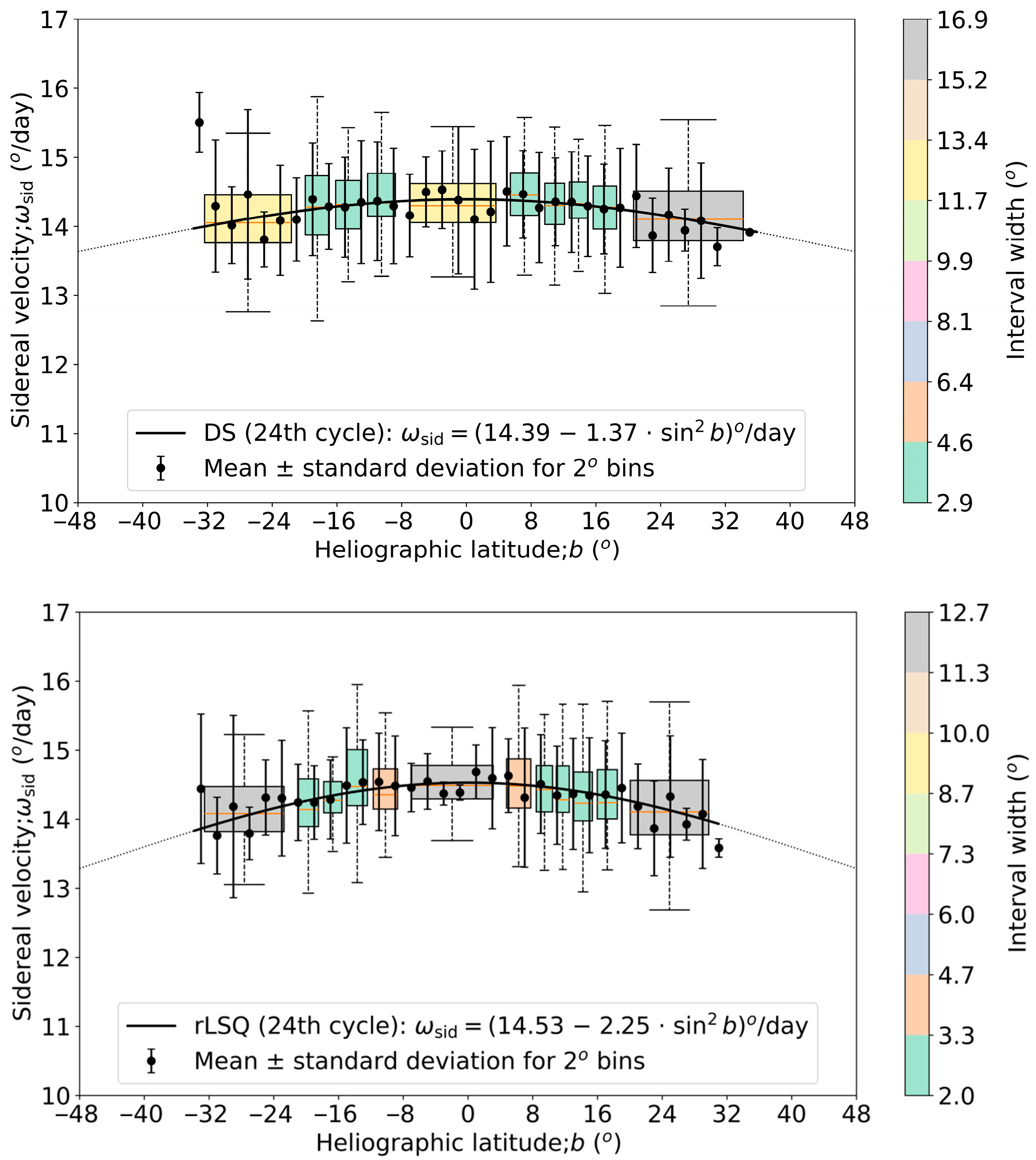
The results of photospheric solar DR during SC24 (2009–2019), derived by tracing sunspot groups in KSO white-light images, are presented on Figure 1. It shows the solar DR profiles (black line) calculated from the KSO sunspot groups rotation velocities determined using the DS method (top panel) and using the rLSQ method (bottom panel). Dots and error bars indicate the mean values and standard deviations of sidereal rotation velocities calculated within 2-degree latitude bins. To maintain a constant number of sidereal velocities per bin, box-and-whisker plots are constructed using heliographic latitude intervals of unequal width. Orange lines denote median values, and for clarity, boxplots are scaled to 80% of the full bin width. In short, a box-and-whisker plot displays the middle 50% of data (interquartile range) as the box height, with whiskers showing the full data range excluding outliers. Changes in box height indicate data dispersion, while changes in box width reflect varying data density across latitudes.
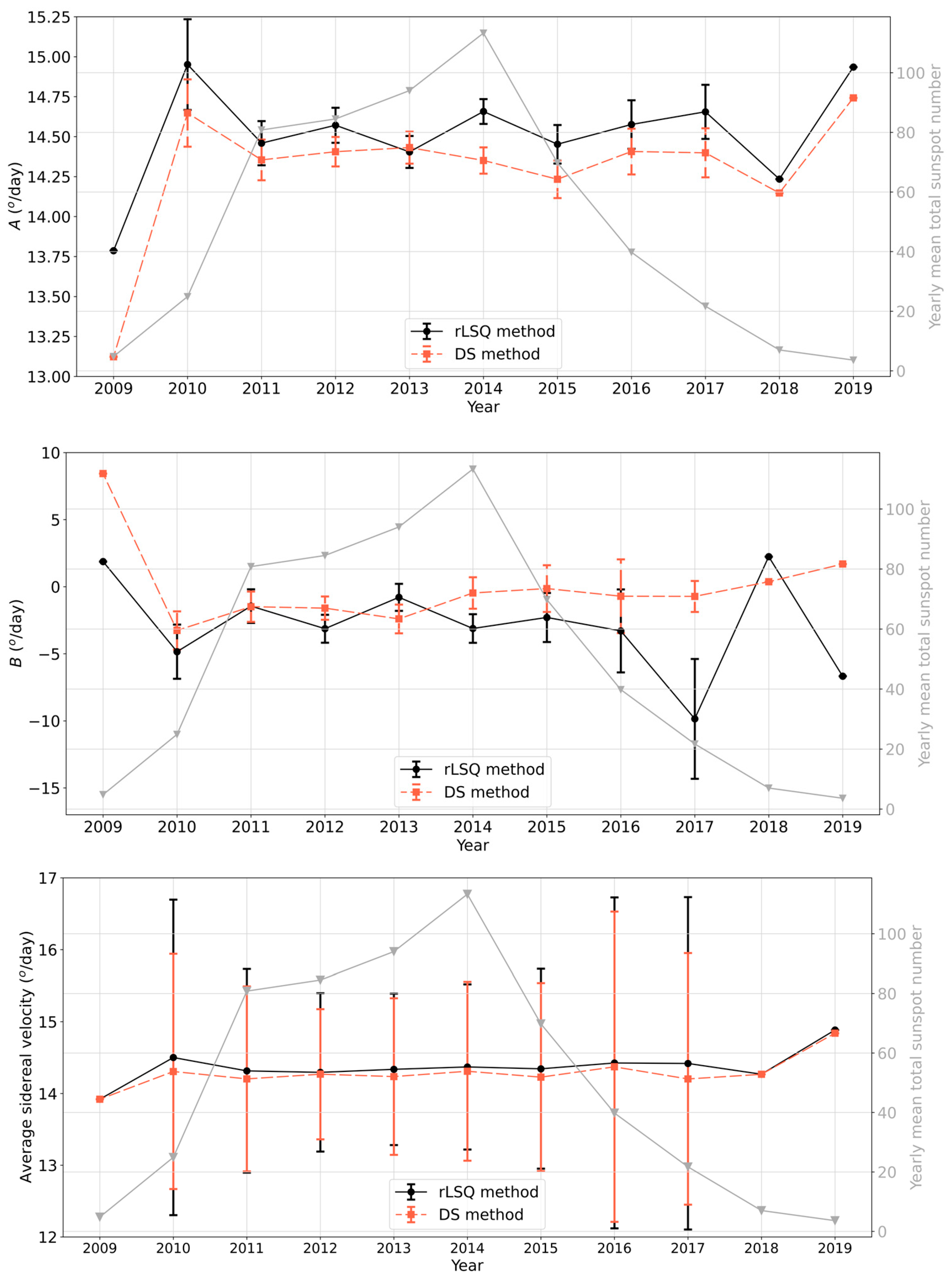
Figure 2 illustrates, for the period 2009–2019, annual values of the DR parameters along with the average sidereal rotation velocity, derived using the rLSQ and DS methods. Average sidereal rotation velocities have been calculated using an equation
ω i ¯ = 1 b m a x b m i n b m i n b m a x A i + B i   sin 2 b d b
where bmax (bmin), the lower and upper limits of integration, were set to correspond to the lowest and highest heliographic latitudes of the appearing sunspots during each year, respectively. The recalibrated yearly mean total sunspot numbers (version 2.0; [36,37,38]) from the SILSO World Data Center [39], Royal Observatory of Belgium, Brussels, are also plotted using grey triangles.
In the top and middle panels of Figure 2, some data points appear without error bars, as their corresponding uncertainties exceed the panel limits. Such points represent values of parameters A and B derived from fewer than 25 points of the calculated sidereal rotation velocities. This is an insufficient sample for a reliable least-squares fit to the DR law and often results in physically unreliable or uninterpretable parameter estimates.
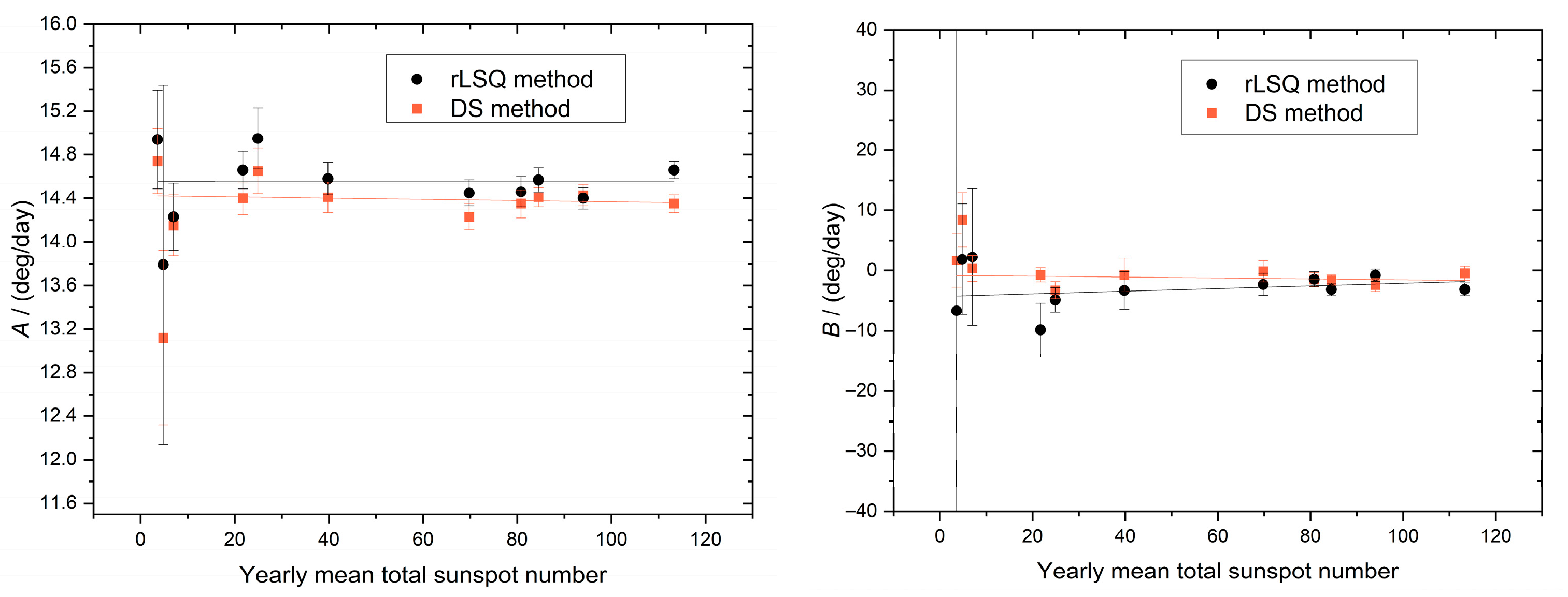
Figure 3 shows the dependence of parameters A and B on solar activity. Obtained values of yearly parameters A and B for the entire SC24 (2009–2019) were used, while solar activity for each year was represented by the SILSO yearly mean total sunspot numbers. Black circles represent measurements obtained using the DS method, while red squares correspond to the rLSQ method. The respective color-coded linear regression lines are fitted to the corresponding data points, and the statistical details of these fits are listed in Table 2.
Both panels of Figure 3 show that measurement errors are larger in years with fewer observations, typically during periods of minimum solar activity. This is especially evident in 2009, our first year of measurements, when there were no sunspot observations on as many as 260 days.
We compared the results from different references using the equation:
A = A 1 A 2 < 1 σ A 1 + 1 σ A 2
This equation provides a criterion for testing whether any two parameters differ significantly, with A1 and A2 used only as examples. A difference exceeding three times the combined standard errors is considered statistically significant, whereas a smaller difference is statistically insignificant. All parameter pairs that satisfy Equation (2) are therefore regarded as statistically equivalent. The results were compared over nearly the same time periods within SC24. However, due to limited data for the more recent years, we could not restrict the comparison to sunspot group–based results. Instead, we included all available references that provide values of A and B for SC24, including those based on other tracers such as coronal bright points (CBPs) and flux modulation.
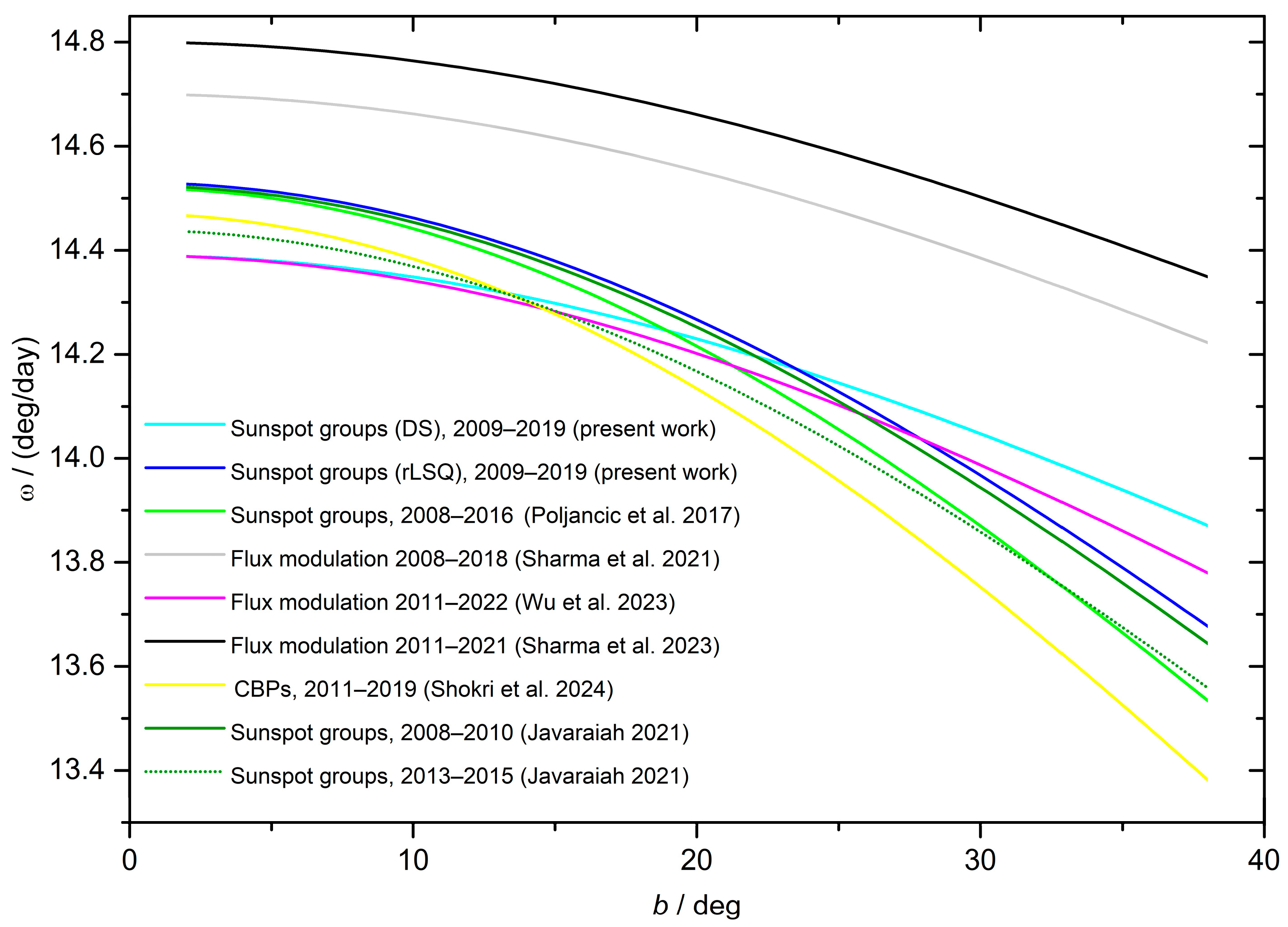
Table 3 presents a statistical comparison of DR parameters A and B for SC24, as obtained in this study from KSO data using both the DS and rLSQ methods, with corresponding results reported by other authors. The comparison is based on inequalities calculated according to Equation (3) and is performed for both hemispheres combined. The agreement between the different sets of parameters is color-coded; green, orange, and yellow indicate that the compared values statistically coincide within one, two, or three common σ, respectively, while red marks cases where the discrepancy exceeds three σ, indicating statistically significant differences. Figure 4 shows the differential rotation profiles for SC24, as determined by various authors using different tracers.

4. Discussion

A comparison between the parameters A and B for the complete SC24 dataset (last row of Table 1), and the results for the incomplete SC24 dataset covering the years 2008–2016 [15] (Table 2, rows 5 and 26), reveals a strong agreement between the two. This is supported by the statistical analysis presented in Table 3, where inequalities in the first two rows are within the green and orange thresholds, indicating that the differences between corresponding parameters are less than 1 or 2 common sigma, respectively. We therefore conclude that the inclusion of additional years, i.e., the completion of SC24 with data from all relevant years, did not lead to any statistically significant changes in the equatorial rotation rate (parameter A) or the DR gradient (parameter B).
Excluding the edge years of the cycle (2009, 2018, and 2019) during which fewer than 25 measurements were available for parameter estimation, we observe (top panel of Figure 2) that the values of parameter A tend to be slightly higher during the periods of solar activity minimum (notably in 2010 and 2017), and generally lower in the years around solar maximum (2014). This trend is more pronounced in the DS method compared to rLSQ, which is further supported by the analysis of the rotation–activity relationship (see left panel of Figure 3 and the first two rows of Table 2). The results suggest a weak anti-correlation between parameter A and yearly mean total sunspot numbers for the DS method (Pearson’s r = −0.154), in contrast to a negligible anti-correlation observed for rLSQ, although neither are statistically significant. Although numerous studies have reported anti-correlation between parameter A and yearly mean total sunspot numbers across different time intervals (entire cycles or specific cycle phases) [24,25,31,45,46,47,48,49,50,51] and the tendency we obtained seems to exhibit a similar pattern, this interpretation should be treated with caution due to statistical insignificance.
As visible in the top and middle panels of Figure 2, the yearly DS values of the rotation parameter A are generally lower than those obtained with the rLSQ method, while the DS values of parameter B are generally less negative (the DS method indicates a slightly more rigid rotation and lower equatorial velocity especially during periods with higher solar activity). Since the differences between the yearly DS and rLSQ results from Table 1, calculated using Equation (3), are not statistically significant (all differences are within 1σ or 2σ), this slight offset is most likely a consequence of the method used to derive the rotational velocities rather than a physical effect.
In this study we analyzed only one cycle, but once the KSO catalogue of sunspot group positions and rotation velocities is complete a comprehensive analysis across seven solar cycles will be possible, allowing one to examine reported characteristics in the behavior of parameter A. The first is the suggested existence of a 22-year cycle in the equatorial rotation rate, which starts in an even-numbered cycle and ends in the subsequent odd-numbered cycle [49,52]. It has also been confirmed in [24] (using several binning strategies and time-series analysis techniques, including the Lomb–Scargle periodogram, epoch folding, and phase dispersion minimization) that parameter A exhibits a strong and statistically significant periodicity of approximately 1.9 solar cycles, and that it is modulated in phase with the full 22-year magnetic cycle. The next characteristic in the behavior of parameter A was reported in [52]: the mean value of A is significantly larger in odd-numbered solar cycles than in even-numbered ones. A similar tendency was observed in [24], where the values of parameter A (obtained using the DS method) also appear slightly higher in odd-numbered cycles. Once the KSO catalogue of sunspot groups positions and rotation velocities is complete (the processing of SC18 and SC25 is still pending), we will be able to perform a comprehensive analysis across all processed cycles and determine whether these patterns are indeed genuine.
Regarding the results for parameter B, and again excluding the edge years of the cycle (2009, 2018, and 2019), the DS results in the middle panel of Figure 2 reveal more negative values of B at the beginning of the cycle (during the ascending part), with a slight gradual increase (less negative B—more rigid rotation) toward the next minimum, i.e., during the descending part of the cycle. An almost identical pattern was obtained in two studies that examined the behavior of parameter B in phase space using phase averaging [24,50]. Although [50] analyzed the rotation using coronal tracers, the brightness of the coronal green line, they found that at the decline phase of the cycle, B decreases and the rotation approaches a more rigid form. Despite the fact that [24] used data covering only part of SC24 (up to 2016), the same behavior of parameter B was confirmed in that study as well. However, this observed behavior contrasts with theoretical predictions, e.g., [53,54,55,56,57], which suggest that the Sun should rotate more rigidly near activity maxima and more differentially near minima. In other words, B is expected to correlate with solar activity: lower (more negative) values during activity minima and higher (less negative) values during maxima.
In SC24, this theoretical expectation is not clearly confirmed. If we also consider results in the right panel of Figure 3 and the last two rows of Table 2, a weak anti-correlation is found between B and yearly mean sunspot numbers for the DS method (Pearson’s r = −0.189), and a moderate positive correlation for rLSQ (r = 0.357), although neither is statistically significant. This lack of a clear linear correlation is consistent with results obtained for the incomplete SC24 in [24], where the absence of a confirmed relationship was attributed to a possible intra-cycle alternation between anticorrelation and correlation phases, reflecting a more complex interaction between DR and solar activity.
Several studies examining SC24 reveal a complex and sometimes contradictory relationship between the solar DR parameters A (equatorial rotation rate) and B (latitudinal gradient) and solar activity. Two recent studies, [24,44], found that A tends to remain relatively stable or slightly higher during solar minima, while B often becomes more negative (indicating stronger DR) near activity maxima, deviating from some theoretical predictions of more rigid rotation at maxima. In [40] an inverse relation in the solar transition region, with less pronounced DR during high activity, has been observed. In [43], where coronal bright points were studied, only a slight positive correlation between the equatorial rotation rate and solar activity was reported, along with a slight negative correlation in the latitudinal gradient, again suggesting a weak or ambiguous dependence on solar activity indicators. Thus, these results indicate that the relationship between DR and solar activity is highly dependent on the method, tracer, and atmospheric layer used, with often weak or even opposite trends being detected. The present study’s findings align with this broader picture, where SC24 shows only minor and statistically insignificant correlations, further supporting the view that the connection between rotation parameters and solar activity is non-linear, variable across the cycle, and possibly modulated by hemispheric or structural asymmetries.
Naturally, the results may also be affected by the well-known limitations of sunspot groups as tracers (restricted latitude range, intrinsic evolution and motions, uncertainties in historical measurements, and the ambiguity in anchoring depth) [19,58] (p. 50). These effects can introduce systematic shifts in the inferred rotation rate, e.g., the faster decay of the following part of a sunspot group can produce an apparent displacement of the area-weighted center toward the leading part, thereby biasing the measured rotation [21]. Their comparison of rotation rates derived from white-light continuum images and line-of-sight magnetograms for a set of 670 active regions showed a mean difference of about 0.45° day−1, indicating that white-light measurements may lack the precision required for detailed differential rotation studies. Also, increase in size and complexity of the sunspot groups over the course of their lifetime and throughout the solar cycle causes their rotation rates to vary accordingly—less complex groups tend to rotate more rapidly, whereas larger, more developed groups rotate more slowly [46,59,60].
However, it is also emphasized in [21] that magnetic tracers have their own major limitation: they are available only for recent decades, making long-term or century-scale analyses impossible. In contrast, despite their shortcomings, sunspot-group observations offer an undeniable advantage, the existence of datasets extending back over hundreds of years, enabling rotation-rate studies across numerous solar cycles and providing essential continuity for long-term analysis. This further reinforces the importance of completing new comprehensive catalogues.
Given these considerations, it became clear that our KSO measurements for SC24 needed to be compared with results obtained from other authors and datasets. This comparison is particularly relevant because the agreement between our results and those from other studies indicates that the KSO measurements are fully comparable to these established data sources. It must be emphasized that, although Table 3 compares results from different atmospheric layers, methods, and tracers, only the KSO DS results and the results from [43], derived using CBPs, for parameter B shows a statistically significant difference (indicated by a red inequality). The rest of the table is predominantly green and orange, indicating that the results for the equatorial rotation velocity (parameter A) and the DR gradient (parameter B) are statistically identical (i.e., show significant agreement) with the results from other studies.

5. Conclusions

This study was undertaken to extend the KSO sunspot group catalogue to cover SC24 (2009–2019), addressing the data gap left by the discontinuation of updates to other major sunspot catalogues. For the first time, the entire SC24 has been analyzed using KSO sunspot group data, enabling a consistent continuation of long-term DR studies.
The results indicate phase-dependent variations in the equatorial rotation velocity (parameter A), with slightly lower values near solar maximum and slightly higher values near solar minimum, particularly noticeable for the DS method. The observed trend in parameter B for the DS method (becoming less negative in the descending phase of the cycle) deviates from some theoretical expectations but remains consistent with earlier empirical results for SC24, while the rLSQ method shows the opposite behavior, with B becoming more negative during the descending phase of the cycle. However, correlations with solar activity indices remain weak or statistically insignificant, consistent with the complex and layer-dependent results reported in recent studies.
The comparison of KSO parameters for SC24 with results from other studies, which use different methods and cover various solar layers, showed that the parameter values agree significantly (with only one notable exception), further confirming the reliability of the KSO dataset. With SC24 completed, and only SC18 and SC25 remaining, the KSO catalogue is close to becoming a coherent dataset for the study of solar DR across multiple solar cycles.
Since the correlations between rotation parameters and solar activity are not statistically significant, future studies could instead focus on the variation in the amplitude of torsional oscillations with solar activity [61]. In [61], torsional oscillations for SC23 and SC24 are demonstrated and properties that remain consistent across different measurement techniques are highlighted. In line with this, they find that the acceleration derived from torsional oscillations provides a more reliable indicator of long-term trends than the residual velocity magnitude. Investigating torsional oscillations in future works using complete KSO data may therefore offer a more informative and promising approach than the analysis of the overall differential rotation alone. Also, after the completion of the KSO catalogue, we plan to carry out the following analyses: (a) examine the North–South (N–S) asymmetry in the solar rotation profile and compare it with the N–S asymmetry of solar activity based on KSO and SILSO sunspot numbers; (b) study horizontal Reynolds stresses responsible for the transport of angular momentum toward the solar equator; (c) perform a comparative analysis of sunspot group and coronal bright point (CBP) data with respect to solar rotation, meridional flows, N–S asymmetry, and Reynolds stresses.

Author Contributions

Conceptualization, I.P.B., R.B., R.J.-Š., A.M.V. and A.H.; methodology, I.P.B. and R.B.; software, I.P.B., L.Š., W.P. and D.H.; validation, I.P.B. and L.Š.; formal analysis, I.P.B., L.Š. and K.L.; investigation, I.P.B.; resources, W.P., A.M.V. and A.H.; data curation, I.P.B., K.L. and L.Š.; writing—original draft preparation, I.P.B.; writing—review and editing, R.B., R.J.-Š., A.M.V., W.P., A.H. and T.J.; visualization, L.Š., I.P.B., K.L. and T.J.; supervision, R.B., A.H. and A.M.V.; project administration, I.P.B.; funding acquisition, I.P.B. and R.B. All authors have read and agreed to the published version of the manuscript.

Funding

This research was partially funded by the University of Rijeka through the projects: Uniri-iskusni-23-256 (Time-domain astrophysics: Centennial variability of solar rotation and stellar variability in future LSST data), uniri-iz-25-107 (Time-domain variability and transients in astrophysics—ASTROVAR) and University of Rijeka international mobility projects (INT-159 and INT-199). Funding was also received from the Horizon 2020 project SOLARNET (824135, 2019–2023). In addition, we recognize the support provided by the Austrian–Croatian Bilateral Scientific Projects “Multi-Wavelength Analysis of Solar Rotation Profil” and “Analysis of solar eruptive phenomena from cradle to grave”, funded by Ministry of Science, Education and Youth (Croatia).

Data Availability Statement

The corresponding author can provide the data produced and/or analyzed in the current study upon reasonable request.

Acknowledgments

We would like to express our gratitude to the KSO and the entire team for their readiness to make the data available.

Conflicts of Interest

The authors declare no conflicts of interest.

Abbreviations

The following abbreviations are used in this manuscript:
DRDifferential rotation
KSOKanzelhöhe Observatory for Solar and Environmental Research
DSDaily shift
rLSQRobust linear least-squares fit
CMDCentral meridian distance
SILSOSunspot Index and Long-term Solar Observations
SOON/USAF/NOAASolar Optical Observing Network/United States Air Force/National Oceanic and Atmospheric Administration data set
DPDDebrecen Photoheliographic Data
GPRGreenwich Photoheliographic Results
SC24Solar cycle No. 24

Notes

1
https://solarscience.msfc.nasa.gov/greenwch.shtml (accessed on 30 September 2025).
2
http://fenyi.solarobs.epss.hun-ren.hu/GPR/ (accessed on 30 September 2025).
3
http://fenyi.solarobs.epss.hun-ren.hu/DPD/ (accessed on 30 September 2025).

References

  1. Sudar, D.; Brajša, R.; Skokić, I.; Poljančić Beljan, I.; Wöhl, H. Meridional Motion and Reynolds Stress from Debrecen Photoheliographic Data. Sol. Phys. 2017, 292, 86. [Google Scholar] [CrossRef]
  2. Ruždjak, D.; Sudar, D.; Brajša, R.; Skokić, I.; Poljančić Beljan, I.; Jurdana-Šepić, R.; Hanslmeier, A.; Veronig, A.; Pötzi, W. Meridional Motions and Reynolds Stress Determined by Using Kanzelhöhe Drawings and White Light Solar Images from 1964 to 2016. Sol. Phys. 2018, 293, 59. [Google Scholar] [CrossRef]
  3. Sudar, D.; Brajša, R. Solar Rotation in the Period 1611-1631 Determined Using Observations of Christoph Scheiner. Sol. Phys. 2022, 297, 132. [Google Scholar] [CrossRef]
  4. Ruždjak, D.; Brajša, R.; Skokić, I.; Sudar, D.; Hanslmeier, A. On the Periodicities in Solar Rotation and Activity Determined from Sunspot-Group Data and Possible Connection with Rossby-Like Waves. Sol. Phys. 2023, 298, 39. [Google Scholar] [CrossRef]
  5. Nagy, M.; Lemerle, A.; Labonville, F.; Petrovay, K.; Charbonneau, P. The Effect of “Rogue” Active Regions on the Solar Cycle. Sol. Phys. 2017, 292, 167. [Google Scholar] [CrossRef]
  6. Upton, L.; Hathaway, D.H. Effects of Meridional Flow Variations on Solar Cycles 23 and 24. Astrophys. J. 2014, 792, 142. [Google Scholar] [CrossRef]
  7. Brajša, R.; Verbanac, G.; Bandić, M.; Hanslmeier, A.; Skokić, I.; Sudar, D. A Prediction for the 25th Solar Cycle Maximum Amplitude. Astron. Nachrichten 2022, 343, e2113960. [Google Scholar] [CrossRef]
  8. Vaquero, J.M. Historical Sunspot Observations: A Review. Adv. Space Res. 2007, 40, 929–941. [Google Scholar] [CrossRef]
  9. Pevtsov, A.; Clette, F. To Understand Future Solar Activity, One Has to Know the Past. Eos 2017, 98. [Google Scholar] [CrossRef]
  10. Vaquero, J.M.; Vázquez, M. The Sun Recorded Through History: Scientific Data Extracted from Historical Documents; Astrophysics and Space Science Library; Springer: Berlin/Heidelberg, Germany, 2009; Volume 361. [Google Scholar]
  11. Willis, D.M.; Davda, V.N.; Stephenson, F.R. Comparison between Oriental and Occidental Sunspot Observations. Q. J. R. Astron. Soc. 1996, 37, 189. [Google Scholar]
  12. Willis, D.M.; Coffey, H.E.; Henwood, R.; Erwin, E.H.; Hoyt, D.V.; Wild, M.N.; Denig, W.F. The Greenwich Photo-Heliographic Results (1874–1976): Summary of the Observations, Applications, Datasets, Definitions and Errors. Sol. Phys. 2013, 288, 117–139. [Google Scholar] [CrossRef]
  13. Baranyi, T.; Győri, L.; Ludmány, A. On-Line Tools for Solar Data Compiled at the Debrecen Observatory and Their Extensions with the Greenwich Sunspot Data. Sol. Phys. 2016, 291, 3081–3102. [Google Scholar] [CrossRef]
  14. Győri, L.; Ludmány, A.; Baranyi, T. Comparative Analysis of Debrecen Sunspot Catalogues. Mon. Not. R. Astron. Soc. 2017, 465, 1259–1273. [Google Scholar] [CrossRef]
  15. Poljančić Beljan, I.; Jurdana-Šepić, R.; Brajša, R.; Sudar, D.; Ruždjak, D.; Hržina, D.; Pötzi, W.; Hanslmeier, A.; Veronig, A.; Skokić, I.; et al. Solar Differential Rotation in the Period 1964–2016 Determined by the Kanzelhöhe Data Set. Astron. Astrophys. 2017, 606, A72. [Google Scholar] [CrossRef]
  16. Solanki, S.K. Sunspots: An Overview. Astron. Astrophys. Rev. 2003, 11, 153–286. [Google Scholar] [CrossRef]
  17. Chang, H.-Y. Latitudinal Distribution of Sunspot and North-South Asymmetry Revisited. J. Astron. Space Sci. 2018, 35, 55–66. [Google Scholar] [CrossRef]
  18. Martin, S.F. Observations Key to Understanding Solar Cycles: A Review. Front. Astron. Space Sci. 2024, 10, 1177097. [Google Scholar] [CrossRef]
  19. Schroeter, E.H. The Solar Differential Rotation-Present Status of Observations. Sol. Phys. 1985, 100, 141. [Google Scholar] [CrossRef]
  20. Ward, F. Determination of the Solar-Rotation Rate from the Motion of Identifiable Features. Astrophys. J. 1966, 145, 416. [Google Scholar] [CrossRef]
  21. Kutsenko, A.S.; Abramenko, V.I. Probing the Rotation Rate of Solar Active Regions: The Comparison of Methods. Open Astron. 2022, 30, 219–224. [Google Scholar] [CrossRef]
  22. Arlt, R.; Vaquero, J.M. Historical Sunspot Records. Living Rev. Sol. Phys. 2020, 17, 1. [Google Scholar] [CrossRef]
  23. Tlatov, A.G.; Tlatova, K.A. Differential Rotation of Individual Sunspots and Pores. Astrophys. J. 2024, 977, 110. [Google Scholar] [CrossRef]
  24. Poljančić Beljan, I.; Jurdana-Šepić, R.; Jurkić, T.; Brajša, R.; Skokić, I.; Sudar, D.; Ruždjak, D.; Hržina, D.; Pötzi, W.; Hanslmeier, A.; et al. Variation in Solar Differential Rotation and Activity in the Period 1964–2016 Determined by the Kanzelhöhe Data Set. Astron. Astrophys. 2022, 663, A24. [Google Scholar] [CrossRef]
  25. Poljančić Beljan, I.; Šibenik, L.; Jurkić, T.; Lončarić, K.; Jurdana-Šepić, R.; Hržina, D.; Pötzi, W.; Brajša, R.; Veronig, A.M.; Hanslmeier, A. An Analysis of the Solar Differential Rotation in Solar Cycle No. 19 (1954–1964) Determined Using Kanzelhöhe Sunspot Group Positions. Sol. Phys. 2025, 300, 118. [Google Scholar] [CrossRef]
  26. Watson, F.; Fletcher, L.; Dalla, S.; Marshall, D. Modelling the Longitudinal Asymmetry in Sunspot Emergence; The Role of the Wilson Depression. Sol. Phys. 2009, 260, 5–19. [Google Scholar] [CrossRef]
  27. Pötzi, W. Digitizing the KSO White Light Images. Cent. Eur. Astrophys. Bull. 2010, 34, 1–12. [Google Scholar]
  28. Kanzelhöhe Observatory Synoptic Archives. Available online: https://cesar.kso.ac.at/info/ftp.php (accessed on 27 September 2025).
  29. Meeus, J. Astronomical Algorithms; Willmann-Bell, Inc.: Richmond, VA, USA, 1991. [Google Scholar]
  30. Smart, W.M.; Green, R.M. Textbook on Spherical Astronomy; Cambridge University Press: Cambridge, UK, 1977. [Google Scholar]
  31. Balthasar, H.; Vazquez, M.; Woehl, H. Differential Rotation of Sunspot Groups in the Period from 1874 through 1976 and Changes of the Rotation Velocity within the Solar Cycle. Astron. Astrophys. 1986, 155, 87–98. [Google Scholar]
  32. Roša, D.; Brajša, R.; Vršnak, B.; Wöhl, H. The Relation between the Synodic and Sidereal Rotation Period of the Sun. Sol. Phys. 1995, 159, 393–398. [Google Scholar] [CrossRef]
  33. Brajša, R.; Wöhl, H.; Vršnak, B.; Ruždjak, D.; Sudar, D.; Roša, D.; Hržina, D. Differential Rotation of Stable Recurrent Sunspot Groups. Sol. Phys. 2002, 206, 229–241. [Google Scholar] [CrossRef]
  34. Skokić, I.; Brajša, R.; Roša, D.; Hržina, D.; Wöhl, H. Validity of the Relations Between the Synodic and Sidereal Rotation Velocities of the Sun. Sol. Phys. 2014, 289, 1471–1476. [Google Scholar] [CrossRef]
  35. Mihojević, T. Ovisnost Rotacije i Aktivnosti Sunca Tijekom 24. Sunčevog Ciklusa. Master’s Thesis, University of Rijeka, Rijeka, Croatia, 2022. [Google Scholar]
  36. Clette, F.; Svalgaard, L.; Vaquero, J.M.; Cliver, E.W. Revisiting the Sunspot Number. A 400-Year Perspective on the Solar Cycle. Space Sci. Rev. 2014, 186, 35–103. [Google Scholar] [CrossRef]
  37. Clette, F.; Svalgaard, L.; Cliver, E.W.; Vaquero, J.M.; Lefèvre, L. The New Sunspot and Group Numbers: A Full Recalibration. IAU Gen. Assem. 2015, 29, 2249591. [Google Scholar]
  38. Clette, F.; Svalgaard, L.; Vaquero, J.M.; Cliver, E.W. Revisiting the Sunspot Number. In The Solar Activity Cycle; Space Sciences Series of ISSI; Springer: New York, NY, USA, 2015; Volume 53, pp. 35–103. [Google Scholar]
  39. SILSO World Data Center: 1954–1964, The International Sunspot Number. Available online: https://www.sidc.be/SILSO/home (accessed on 30 September 2025).
  40. Sharma, J.; Kumar, B.; Malik, A.K.; Vats, H.O. Differential Rotation of the Solar Transition Region from STEREO/EUVI 30.4-Nm Images. Mon. Not. R. Astron. Soc. 2021, 506, 4952–4959. [Google Scholar] [CrossRef]
  41. Wu, Q.-R.; Zheng, S.; Zeng, S.-G.; Wan, M.; Zeng, X.-Y.; Deng, L.-H.; Huang, Y. Rotational Characteristics of the Solar Transition Region Using SDO/AIA 304 Å Images. Astrophys. J. 2023, 954, 20. [Google Scholar] [CrossRef]
  42. Sharma, J.; Malik, A.K.; Vats, H.O.; Banerjee, S.K. Rotational Properties of Solar EUV Corona Using SDO/AIA-19.3-Nm Observations. Mon. Not. R. Astron. Soc. 2023, 521, 1079–1085. [Google Scholar] [CrossRef]
  43. Shokri, Z.; Alipour, N.; Safari, H. Solar Rotation and Activity for Cycle 24 from SDO/AIA Observations. Astrophys. J. 2024, 972, 46. [Google Scholar] [CrossRef]
  44. Javaraiah, J. Long–Term Variations in Solar Differential Rotation and Sunspot Activity, II: Differential Rotation Around the Maxima and Minima of Solar Cycles 12–24. Sol. Phys. 2020, 295, 170. [Google Scholar] [CrossRef]
  45. Lustig, G. Solar Rotation 1947-1981-Determined from Sunspot Data. Astron. Astrophys. 1983, 125, 355–358. [Google Scholar]
  46. Gilman, P.A.; Howard, R. Variations in Solar Rotation with the Sunspot Cycle. Astrophys. J. 1984, 283, 385–391. [Google Scholar] [CrossRef]
  47. Brajša, R.; Ruždjak, D.; Wöhl, H. Temporal Variations of the Solar Rotation Determined by Sunspot Groups. Sol. Phys. 2006, 237, 365–382. [Google Scholar] [CrossRef]
  48. Jurdana-Šepić, R.; Brajša, R.; Wöhl, H.; Hanslmeier, A.; Poljančić, I.; Svalgaard, L.; Gissot, S.F. A Relationship between the Solar Rotation and Activity in the Period 1998–2006 Analysed by Tracing Small Bright Coronal Structures in SOHO-EIT Images. Astron. Astrophys. 2011, 534, A17. [Google Scholar] [CrossRef]
  49. Li, K.J.; Feng, W.; Shi, X.J.; Xie, J.L.; Gao, P.X.; Liang, H.F. Long-Term Variations of Solar Differential Rotation and Sunspot Activity: Revisited. Sol. Phys. 2014, 289, 759–768. [Google Scholar] [CrossRef][Green Version]
  50. Badalyan, O.G.; Obridko, V.N. 22-Year Cycle of Differential Rotation of the Solar Corona and the Rule by Gnevyshev-Ohl. Mon. Not. R. Astron. Soc. 2017, 466, 4535–4539. [Google Scholar] [CrossRef]
  51. Ruždjak, D.; Brajša, R.; Sudar, D.; Skokić, I.; Poljančić Beljan, I. A Relationship Between the Solar Rotation and Activity Analysed by Tracing Sunspot Groups. Sol. Phys. 2017, 292, 179. [Google Scholar] [CrossRef]
  52. Javaraiah, J.; Bertello, L.; Ulrich, R.K. Long-Term Variations in Solar Differential Rotation and Sunspot Activity. Sol. Phys. 2005, 232, 25–40. [Google Scholar] [CrossRef]
  53. Brun, A.S.; Miesch, M.S.; Toomre, J. Global-Scale Turbulent Convection and Magnetic Dynamo Action in the Solar Envelope. Astrophys. J. 2004, 614, 1073–1098. [Google Scholar] [CrossRef]
  54. Brun, A.S. Rotation and Magnetism of Solar-like Stars: From Scaling Laws to Spot-Dynamos. Proc. Int. Astron. Union 2013, 9, 114–125. [Google Scholar] [CrossRef]
  55. Lanza, A.F. On the Time Dependence of Differential Rotation in Young Late-Type Stars. Mon. Not. R. Astron. Soc. 2006, 373, 819–826. [Google Scholar] [CrossRef][Green Version]
  56. Lanza, A.F. Angular Momentum Conservation and Torsional Oscillations in the Sun and Solar-like Stars. Astron. Astrophys. 2007, 471, 1011–1022. [Google Scholar] [CrossRef][Green Version]
  57. Varela, J.; Strugarek, A.; Brun, A.S. Characterizing the Feedback of Magnetic Field on the Differential Rotation of Solar-like Stars. Adv. Space Res. 2016, 58, 1507–1521. [Google Scholar] [CrossRef]
  58. Brajša, R.; Hanslmeier, A. Solar Rotation; UNITEXT for Physics; Springer Nature: Singapore, 2024; ISBN 978-981-97-6878-3. [Google Scholar]
  59. Ruždjak, D.; Ruždjak, V.; Brajša, R.; Wöhl, H. Deceleration of the Rotational Velocities of Sunspot Groups during Their Evolution. Sol. Phys. 2004, 221, 225–236. [Google Scholar] [CrossRef]
  60. Ruždjak, D.; Brajša, R.; Sudar, D.; Wöhl, H. The Influence of the Evolution of Sunspot Groups on the Determination of the Solar Velocity Field. Sol. Phys. 2005, 229, 35–43. [Google Scholar] [CrossRef]
  61. Mahajan, S.S.; Upton, L.A.; Antia, H.M.; Basu, S.; DeRosa, M.L.; Hess Webber, S.A.; Hoeksema, J.T.; Jain, K.; Komm, R.W.; Larson, T.; et al. The Sun’s Large-Scale Flows I: Measurements of Differential Rotation & Torsional Oscillation. Sol. Phys. 2024, 299, 38. [Google Scholar] [CrossRef]
Figure 1. Solar DR profiles for SC24 (2009–2019), derived from Kanzelhöhe Observatory for Solar and Environmental Research (KSO) sunspot group data using the DS method and the rLSQ method (last row in Table 1).
Universe 11 00395 g001
Figure 2. Annual values of DR parameter A (top panel), parameter B (middle panel) and average sidereal velocity (bottom panel) and their corresponding standard errors for all years covered by SC24 (2009–2019). Black lines with circles show results for rLSQ method, dashed red lines with squares show results for DS method and full grey lines with triangles show values of Sunspot Index and Long-term Solar Observations (SILSO) yearly mean total sunspot numbers.
Universe 11 00395 g002
Figure 3. Yearly values of the solar DR parameters A and B vs. SILSO yearly mean total sunspot numbers as an indicator of solar activity.
Universe 11 00395 g003
Figure 4. Differential rotation profiles for SC24, as determined by various authors using different tracers. For numerical values of DR parameters (concerning present paper results) refer to the last row of Table 1. The heliographic latitude is represented by b, and the sidereal rotation velocity is represented by ω. Curves correspond to the following sources: “Poljančić et al., 2017” [15]; “Sharma et al., 2021” [40]; “Wu et al., 2023” [41]; “Sharma et al., 2023” [42]; “Shokri et al., 2024” [43]; “Javaraiah 2020 (2008–2010)” [44]; “Javaraiah 2020 (2013–2015)” [44].
Universe 11 00395 g004
Table 1. Annual values of differential rotation (DR) parameters and their corresponding standard errors for individual years of SC24, as well as for the whole SC24. N + S (N—northern hemisphere, S—southern hemisphere) indicates that the calculations were performed for both hemispheres combined. Parameters A and B, along with their associated standard errors, are expressed in degrees per day (°/day). N v l is the number of calculated sidereal rotation velocities using a ±58° central meridian distance (CMD) filter and a velocity filter of 11–17°/day.
DS (N + S)rLSQ (N + S)
YearA σ A B σ B N v l *A σ A B σ B N v l *
200913.120.808.434.521213.791.651.889.189
201014.650.21−3.261.434914.950.28−4.842.0238
201114.350.13−1.491.1314714.460.14−1.451.25129
201214.410.09−1.600.8715914.570.11−3.131.04133
201314.430.10−2.401.0718014.400.10−0.791.01140
201414.350.08−0.471.1721214.660.08−3.111.06179
201514.230.12−0.141.7512714.450.12−2.291.83111
201614.410.14−0.712.757414.580.15−3.293.1062
201714.400.15−0.721.164614.660.179.854.4736
201814.150.280.372.161414.230.312.2411.3810
201914.740.301.694.451214.940.45−6.6755.106
SC24 (2009–2019)14.390.04−1.370.42101114.530.04−2.250.44853
* The sum of the calculated velocities from individual years does not necessarily have to be equal to the number of calculated velocities for the entire cycle (when all the data are combined), because the same group can appear on the solar disk in multiple years.
Table 2. Statistical results obtained by fitting a linear regression line between parameters A and B and solar activity expressed by the relative Wolf number, respectively. N denotes the number of years/data points; Slope A (Slope B) refers to the slope of the corresponding linear fit; r is the Pearson correlation coefficient; p represents the corresponding p-value.
MethodSlope A/(°/Day)Nrp
DS0.00056 ± 0.00119110.1540.650
rLSQ0.00001 ± 0.00145110.0020.996
MethodSlope B/(°/Day)Nrp
DS0.00750 ± 0.01297110.1890.577
rLSQ0.02205 ± 0.01925110.3570.282
Table 3. Comparison of the DR parameters A and B for SC24, derived by various authors (rows), with those obtained in this study using KSO DS/rLSQ data (columns). Inequalities are derived using Equation (3). The results are shown for both hemispheres combined.
ABAB
Tracers, Time Period, ReferenceSunspot Groups (DS),
2009–2019 *
Sunspot Groups (rLSQ),
2009–2019 *
Sunspot groups (DS), 2008–2016, [15]<2σ<2σ<1σ<1σ
Sunspot groups (rLSQ), 2008–2016, [15]<2σ<2σ<1σ<1σ
Flux modulation, 2008–2018, [40]<2σ<1σ<1σ<2σ
Flux modulation, 2011–2022, [41]<1σ<1σ<2σ<2σ
Flux modulation, 2011–2021, [42]<3σ<1σ<2σ<2σ
CBPs, 2011–2019, [43]<2σ>3σ<2σ<2σ
Sunspot groups, 2008–2010, [44] <2σ<2σ<1σ<1σ
Sunspot groups, 2013–2015, [44]<1σ<2σ<2σ<1σ
* Present paper, Table 1, last row.
Disclaimer/Publisher’s Note: The statements, opinions and data contained in all publications are solely those of the individual author(s) and contributor(s) and not of MDPI and/or the editor(s). MDPI and/or the editor(s) disclaim responsibility for any injury to people or property resulting from any ideas, methods, instructions or products referred to in the content.