Review

A Dual-Target Microbial Therapeutic Strategy for Treating Metabolic Diseases: Complementary Mechanisms and Clinical Prospects of Lactiplantibacillus plantarum and Akkermansia muciniphila

1
College of Pharmacy and Bioengineering, Chongqing University of Technology, Chongqing 400054, China
2
Academy of Chinese Medical Sciences, Henan University of Chinese Medicine, Zhengzhou 450046, China
3
Cambridge-Suda Genomic Resource Center, Suzhou Medical College, Soochow University, Suzhou 215123, China
*
Authors to whom correspondence should be addressed.
These authors contributed equally to this work.
Metabolites 2026, 16(4), 259; https://doi.org/10.3390/metabo16040259
Submission received: 17 March 2026 / Revised: 28 March 2026 / Accepted: 3 April 2026 / Published: 13 April 2026
(This article belongs to the Section Microbiology and Ecological Metabolomics)

Abstract

Metabolic diseases, including obesity, type 2 diabetes, and their related complications, have emerged as major global public health challenges. Increasing evidence indicates that gut microbiota dysbiosis contributes to disrupted metabolic homeostasis, chronic low-grade inflammation, and progression of metabolic disorders. Among candidate microbiome-based interventions, Lactiplantibacillus plantarum (L. plantarum) and Akkermansia muciniphila (A. muciniphila) have attracted particular attention because they regulate host metabolism through partially distinct yet potentially complementary mechanisms. L. plantarum has been associated with modulation of appetite-related hormones, adipose tissue remodeling, reinforcement of intestinal barrier function, and attenuation of inflammatory signaling. A. muciniphila has been linked to strengthening of the mucus barrier, production of beneficial metabolites, and improvement in immune and metabolic homeostasis. However, current evidence remains fragmented across strain-specific studies, heterogeneous formulations, and predominantly single-strain experimental designs, and direct comparative evidence for combined administration is still limited. This review synthesizes current epidemiological, mechanistic, preclinical, and clinical evidence on L. plantarum and A. muciniphila, with emphasis on their physiological traits, gut ecological adaptability, pathway-based metabolic effects, and translational challenges in obesity, type 2 diabetes, and related complications. We further highlight the ecological rationale for their functional complementarity and discuss priorities for future combination studies and precision implementation. Overall, the available literature supports functional complementarity and possible additive metabolic benefits, but synergistic effects in humans remain unconfirmed. A clearer understanding of strain identity, active therapeutic entities, delivery strategies, and host context will be essential for advancing this dual-target microbial strategy toward clinically meaningful applications.

1. Introduction

Metabolic diseases are a group of chronic conditions that are characterized by imbalanced energy intake and expenditure, leading to the dysregulation of energy-supplying substances such as glucose, fatty acids, and cholesterol. According to recent global epidemiological estimates, more than 1.9 billion adults worldwide are overweight, of whom approximately 650 million are living with obesity, while an estimated 537 million adults were living with diabetes globally in 2021 [1,2,3]. Disorders of glucose and lipid metabolism, along with their severe complications—such as atherosclerotic cardiovascular disease, stroke, and metabolic dysfunction-associated steatotic liver disease (MASLD)—represent one of the most significant public health challenges of the 21st century, posing great threats to human health [4]. These disease spectrums arise from a series of interconnected and complex pathological conditions. Metabolic diseases share some similar risk factors, such as chronic inflammation, oxidative stress, and gut microbiota dysbiosis. Although conventional pharmacological treatments and lifestyle interventions can largely alleviate these diseases, they still present certain limitations, including poor patient adherence and notable side effects. These constraints hinder effective disease prevention and treatment, underscoring the urgent need for the exploration and development of alternative approaches.
The human gastrointestinal tract hosts a complex microbial ecosystem, predominantly composed of bacteria along with viruses, fungi, and archaea, which collectively exert profound influences on host physiology, metabolism, and immune function [5]. Recently, the impact of gut bacteria on host homeostasis has garnered increasing attention, both within the gastrointestinal tract and in distant organs. Research has revealed that gut microbes play critical roles in maintaining intestinal barrier integrity and regulating immune responses, significantly influencing health and disease susceptibility [6]. At the genus level, commonly reported gut taxa include Bacteroides, Bifidobacterium, Ruminococcus, Prevotella, Roseburia, and Lactobacillus [7,8]. At the species level, both Akkermansia muciniphila (A. muciniphila) and Lactiplantibacillus plantarum (L. plantarum) are frequently discussed in relation to host metabolism and immunity regulation [9,10,11,12]. An imbalanced gut microbiota has been shown to be linked with a range of conditions, from metabolic disorders like obesity and diabetes to autoimmune diseases and cancer. Multiple studies have characterized microbial signatures associated with increased metabolic disease risk and explored how gut bacteria influence inflammation, metabolic homeostasis, and host susceptibility to disease [13]. This underscores the profound impact of gut microbiota on host health. The intricate relationship between gut microbes and disease development highlights the need for targeted interventions in disease prevention and treatment strategies [14,15].
Among gut microorganisms, strains such as L. plantarum and A. muciniphila have attracted considerable attention due to their potential roles in metabolic regulation [11,16]. Clinical studies suggest that administering L. plantarum TCCC11824 to obese patients can improve body weight and serum low-density lipoprotein cholesterol (LDL-C) outcomes [17]. In contrast, early-stage clinical research indicates that pasteurized A. muciniphila can improve selected metabolic parameters in overweight or obese subjects [18]. Notably, beyond interventional studies, population-based and mechanistic evidence further links these organisms to host metabolic phenotypes; in particular, higher A. muciniphila abundance is often associated with more favorable metabolic profiles and inversely related to metabolic disease risk [19,20]. Phylogenetically, these organisms belong to Firmicutes and Verrucomicrobiota, respectively, and represent functionally relevant components of the gut ecosystem. Intervention strategies involving these two organisms are often framed as exogenous supplementation in the case of L. plantarum and endogenous enrichment or targeted modulation in the case of A. muciniphila. Emerging evidence also suggests a potential indirect ecological interaction between them. Multi-omics and mechanistic studies indicate that L. plantarum-mediated metabolic remodeling may promote enrichment of A. muciniphila through cross-feeding-related processes, thereby providing preliminary support for their potential functional complementarity within the gut ecosystem [21,22].
Despite growing interest in L. plantarum and A. muciniphila as microbiome-based interventions, several knowledge gaps still limit mechanistic clarity and clinical translation. The evidence base is dominated by single-strain studies and preclinical models, with substantial heterogeneity in strains, dosing regimens, formulations, and endpoints. Moreover, strain-resolved pathways linking microbial outputs such as short-chain fatty acids (SCFAs) and bile acid remodeling to host receptors and downstream signaling pathways—including G protein-coupled receptors 41 and 43 (GPR41/43), the farnesoid X receptor (FXR), Takeda G protein-coupled receptor 5 (TGR5), glucagon-like peptide-1 (GLP-1), and AMP-activated protein kinase (AMPK)—remain incompletely defined. Direct comparative human evidence for combined administration remains limited, and interaction effects beyond additivity are rarely tested. Reported benefits may also arise from distinct bioactive entities, including viable or pasteurized cells, defined surface proteins (e.g., Amuc_1100), extracellular vesicles, or metabolites/secreted factors, each with different stability and dosing implications [18,19,23]. Finally, host context—including habitual diet, baseline microbiota, medications, and comorbidities—likely shapes responsiveness and safety profiles. Accordingly, this review synthesizes epidemiological, mechanistic, and clinical evidence to summarize the physiological traits and gut adaptability of L. plantarum and A. muciniphila, organize reported benefits within a pathway-based framework for obesity, type 2 diabetes, and related complications, and highlight translational challenges and priorities for future combination trials and precision implementation.

2. Review Design and Literature Search

This article is a narrative review that synthesizes preclinical and clinical evidence on L. plantarum and A. muciniphila, with an emphasis on mechanistic pathways (e.g., SCFAs, bile acid signaling, barrier integrity/endotoxemia, immune–metabolic crosstalk, and enteroendocrine regulation) relevant to metabolic diseases.
To ensure coverage of key lines of evidence, we searched PubMed, Web of Science, Embase and Cochrane library from 2005 to 31 January 2026. Searches combined controlled vocabulary (when available) and free-text key words. A core query combined organism terms with metabolic outcomes: (“Lactiplantibacillus plantarum” OR “Lactobacillus plantarum” OR “L. plantarum”) AND (“Akkermansia muciniphila” OR “A. muciniphila”) AND (obesity OR “type 2 diabetes” OR “insulin resistance” OR “metabolic syndrome” OR NAFLD OR NASH OR dyslipidemia). Reference lists of eligible articles and relevant reviews were screened to identify additional studies. A total of 117 relevant publications were identified, and the references cited in this review represent key studies supporting the mechanistic synthesis presented herein.

3. Physiological Features and Gut Ecological Adaptation of L. plantarum and A. muciniphila

As a Gram-positive bacterium belonging to the Firmicutes phylum, L. plantarum is a versatile microorganism. It possesses unique physiological characteristics and is widely found in natural environments, the human gastrointestinal tract, and various fermented foods [24], allowing it to occupy a distinct ecological niche within the gut microbiome [25]. L. plantarum exerts positive effects on host health [26,27], attributable to its antibacterial [27], antioxidant [28,29], and acid tolerance properties [28,30], as well as its capacity to adhere to intestinal surfaces and mucus [27,31]. Its prominent application value in both the food industry and pharmaceutical fields has made it a research focus in recent years. Comparative genomics indicates substantial genome diversity across L. plantarum strains and a broad repertoire of carbohydrate-active enzymes and transport systems, supporting flexible utilization of diverse dietary carbohydrates and, in some contexts, host-derived glycans [32,33,34,35,36]. Additionally, it can produce lactic acid along with other metabolites such as alcohols, ketones, and B vitamins. This metabolic diversity confers niche adaptability across different environments and facilitates the establishment of interaction networks with other gut microbiota through mechanisms like cross-feeding [37]. Hussain et al. reported that oral administration of L. plantarum LB818 in obese mice restored the gut microbiota composition and promoted the abundance of beneficial bacteria, including A. muciniphila, Bacteroides, Bifidobacterium, and Lactobacillus [26]. Certain strains of L. plantarum can also secrete broad-spectrum bacteriocins (e.g., plantaricin), which modulate microbial community structure [38]. In the medical field, preclinical studies suggest that selected L. plantarum strains may modulate the gut–brain and gut–liver axes in models of neurodegeneration, mood disorders, and liver injury; however, robust clinical evidence for these indications remains limited compared with metabolic endpoints [1,39,40,41].
In contrast, A. muciniphila, a representative genus of the Verrucomicrobiota phylum, occupies a distinct ecological niche compared to L. plantarum [42]. First isolated from human feces in 2004, it is a specialized mucin degrader that colonizes the intestinal mucus layer. It utilizes mucins secreted by goblet cells as its primary carbon and nitrogen sources, possessing a complete metabolic system dedicated to mucin cleavage [43]. Genomic sequencing reveals an abundance of genes encoding glycoside hydrolases, sulfatases, and sialidases, enabling efficient degradation of complex O-glycosylated mucin structures [44]. Unlike typical commensals that acquire nutrients by co-digesting dietary compounds with the host, A. muciniphila adopts a “mucus-adapted, mucin-specialized commensal” lifestyle. Its metabolic activity promotes mucin secretion by goblet cells, maintaining mucin homeostasis and reinforcing the intestinal barrier function [9,18,45]. This barrier enhancement helps prevent pathogen invasion and reduces inflammation. Furthermore, its metabolism generates short-chain fatty acids like acetate and propionate, which nourish colonocytes and participate in systemic metabolic regulation. These mechanisms underpin its observed health benefits. Since the landmark discovery in 2013 that its supplementation alleviates obesity [46], higher A. muciniphila abundance has been consistently linked to metabolic health in humans, including improved glucose homeostasis, reduced adiposity, enhanced insulin sensitivity [46,47], and modulated fatty acid and bile acid metabolism [48,49].
Microbial effects in the gut are shaped not only by host signaling but also by microbe–microbe interactions. Accordingly, several reports suggest that L. plantarum and A. muciniphila may influence each other’s fitness through niche-dependent microenvironmental and metabolic routes—for example, by altering local redox conditions and through substrate cascades involving dietary and mucus-derived glycans, with the balance between facilitation and competition depending on diet and baseline community structure [22,50,51,52]. These ecological considerations provide a conceptual foundation for the pathway-oriented framework presented in the following section.

4. Mechanistic Pathways Linking L. plantarum and A. muciniphila to Metabolic Benefits

4.1. Ecological Rationale for Functional Complementarity

Although direct combination trials are still limited, there is growing ecological and experimental evidence supporting functional interaction between L. plantarum and A. muciniphila in the gut. First, they preferentially occupy partially distinct niches: L. plantarum is typically more active in the small intestine and proximal colon lumen where dietary carbohydrates are abundant, whereas A. muciniphila is enriched at the colonic mucus layer and specializes in mucin utilization. This spatial partitioning reduces direct competition and enables division of labor across intestinal compartments. Second, A. muciniphila-driven mucin turnover can liberate oligosaccharides and monosaccharides that may become available to other commensals (including lactobacilli), while L. plantarum can rapidly ferment available substrates to lactate and acetate, which can be further converted by the broader community into butyrate/propionate—metabolites that reinforce barrier function and modulate enteroendocrine signaling. Consistent with this cross-feeding concept, recent multi-omics and mechanistic studies have shown that L. plantarum SFF123-mediated metabolic remodeling promotes the enrichment of A. muciniphila through tryptophan metabolism and retinoic acid biosynthesis [22]. Additionally, L. plantarum LB818 administration in obese mice was reported to increase the abundance of A. muciniphila, Bacteroides, and Bifidobacterium, suggesting a favorable ecological shift that may support mucus-associated communities [26]. Third, L. plantarum is aerotolerant and may influence local redox conditions and inflammatory tone, which could indirectly favor mucus-associated anaerobes and stabilize mucus-associated communities. Collectively, these features support a mechanistic model in which the two organisms may be complementary across space, substrates, and timing, providing a rationale for future combination studies that include appropriate monotherapy and combination arms to formally test interaction beyond additivity.
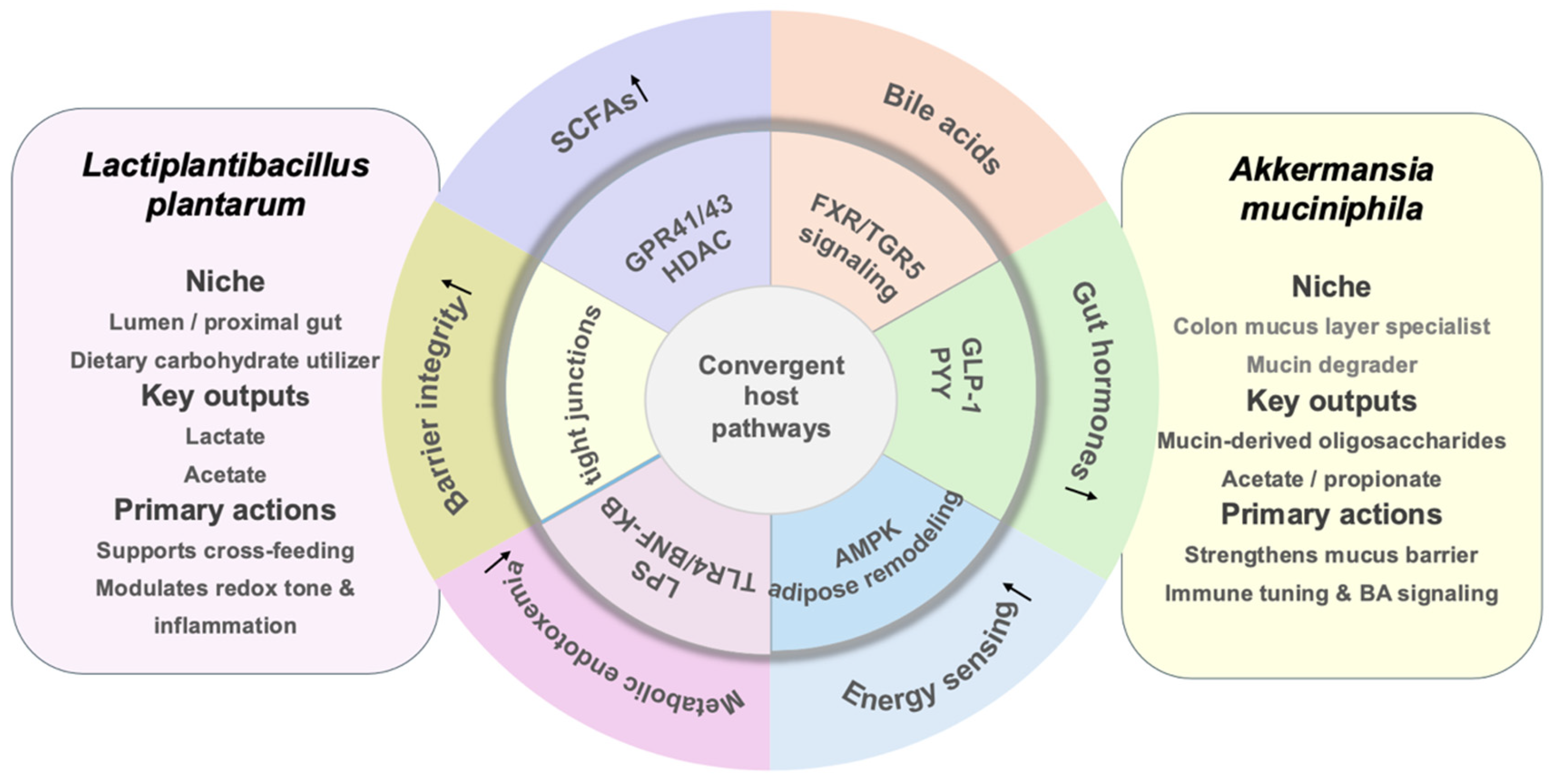
Rather than attributing the effects of these two strains to a single mechanism, current evidence points to several recurring host–microbe axes through which they may exert metabolic benefits. These include SCFA production and carbohydrate fermentation [53], bile acid remodeling and FXR/TGR5 signaling [54], intestinal barrier integrity and metabolic endotoxemia [55], immune–metabolic reprogramming [56], and energy-sensing pathways such as AMPK [57]. Figure 1 provides a schematic overview of these convergent pathways.
The schematic highlights niche partitioning, substrate/metabolite cross-feeding, and convergence on key metabolic signaling axes (SCFAs–GPR41/43/HDAC, bile acids–FXR/TGR5, barrier integrity (mucus, tight junctions) and lipopolysaccharide (LPS) translocation, immune–metabolic tuning, gut hormones, and AMPK-related energy sensing). Because direct comparative factorial trials remain limited, this figure presents a hypothesis-generating mechanistic framework grounded primarily in single-strain and preclinical evidence. Arrow direction legend: Upward arrows (↑) indicate an increase or upregulation; downward arrows (↓) indicate a decrease or downregulation.

4.2. SCFA-Mediated Signaling

SCFAs, primarily acetate, propionate, and butyrate, serve as key signaling molecules linking gut microbial metabolism to host metabolic health [53]. L. plantarum and A. muciniphila contribute to SCFA-related effects through distinct substrate preferences and metabolic routes. L. plantarum primarily ferments dietary carbohydrates to lactate and acetate, and its genome encodes a broad repertoire of carbohydrate-active enzymes that support flexible carbohydrate utilization [32]. In contrast, A. muciniphila degrades mucin-derived glycans and produces metabolites including acetate and propionate [58]. These microbial products can activate receptors such as GPR41 and GPR43 on enteroendocrine cells, thereby promoting GLP-1 and peptide YY (PYY) secretion and influencing appetite regulation and glycemic control [59]. SCFAs also exert histone deacetylase-inhibitory effects, which may dampen inflammation and improve insulin sensitivity. Accordingly, the complementary substrate utilization of these two organisms provides a biologically plausible route for convergent metabolic benefits, although direct evidence from combination studies remains limited. This pathway is summarized schematically in Figure 1.

4.3. Bile Acid Remodeling and FXR/TGR5 Signaling

Multiple L. plantarum strains display bile tolerance and can influence bile acid composition (including via bile salt hydrolase activity), which may reshape downstream signaling via FXR and TGR5 [54]. Consistent with this axis, strain NCHBL-004 increased active GLP-1 after oral glucose and shifted the gut microbiome toward SCFA- and secondary bile acid-associated functions, consistent with a possible involvement of bile acid–TGR5 signaling, although direct receptor activation was not tested [60]. A. muciniphila has also been associated with shifts in bile acid profiles and bile acid–receptor signaling, providing an additional route through which mucus-layer remodeling may couple to enteroendocrine outputs and downstream metabolic phenotypes [61,62]. In turn, bile acid–receptor signaling may serve as a mechanistic bridge between microbiota remodeling, enteroendocrine outputs, and downstream metabolic phenotypes.

4.4. Intestinal Barrier Reinforcement and Metabolic Endotoxemia

A recurring feature in metabolic disease models is impaired barrier function with increased translocation of microbial products such as LPS, driving chronic low-grade inflammation. A. muciniphila preferentially colonizes the mucus layer and is frequently associated with improved mucus thickness, tighter junctional integrity, and reduced endotoxemia; in parallel, L. plantarum has been reported to support barrier repair through effects on tight junction proteins and local inflammatory tone. Framing barrier protection as a measurable intermediate also clarifies how metabolic outcomes can improve without large changes in calorie intake [19,46,55,63,64].

4.5. Immune–Metabolic Reprogramming

Both strains have been linked to modulation of innate and adaptive immune signaling, including attenuation of nuclear factor kappa-B (NF-κB)-related inflammatory programs, shifts in macrophage polarization, and reinforcement of regulatory immune responses in relevant experimental settings [56,65,66,67]. In this pathway-oriented framework, the key outcome is not merely “anti-inflammatory”, but attenuation of the metabolically detrimental immune tone that can sustain insulin resistance, adipose tissue dysfunction, and ectopic lipid deposition. Notably, reported immune effects are often context dependent (strain, dose, host background, and tissue), and are best interpreted as mechanistic plausibility rather than universal, clinically confirmed effects.

4.6. Enteroendocrine Signaling (GLP-1 and Related Hormones)

Changes in SCFAs and bile acids can converge on enteroendocrine cells to regulate hormone secretion (e.g., GLP-1, PYY, ghrelin), providing a proximal mechanism for altered appetite, postprandial glycemia, and energy handling [68,69,70,71]. In this context, L. plantarum may shape the luminal metabolite milieu through carbohydrate fermentation (e.g., lactate production) that supports SCFA-producing networks, whereas A. muciniphila can contribute to acetate/propionate pools via mucin-derived glycan metabolism and may also influence bile acid profiles, thereby modulating enteroendocrine outputs. This endocrine route is particularly useful for interpreting why certain strains show benefits in energy intake and glycemic variability even when body-weight changes are modest, because hormone outputs may shift earlier and more sensitively than anthropometric endpoints.

4.7. Energy Sensing and Adipose Tissue Remodeling (AMPK and Thermogenic Programs)

Beyond improving gut barrier function and dampening pro-inflammatory immune tone, multiple experimental studies have further linked L. plantarum and A. muciniphila to enhanced energy expenditure and adipose tissue remodeling; among the proposed mediators, host energy-sensing pathways—exemplified by AMPK—are often viewed as plausible candidates for driving mitochondrial programs and thermogenesis-related transcriptional outputs. AMPK is a canonical regulator of brown adipose activation and mitochondrial programs, providing a mechanistic basis for interpreting reported shifts in lipid handling and white adipose tissue plasticity beyond simple caloric restriction [72]. In support of organism-specific links to this axis, pasteurized A. muciniphila has been reported to improve metabolic phenotypes alongside changes consistent with increased whole-body energy handling even when body-weight changes are modest, highlighting that endocrine and metabolic readouts may respond earlier than anthropometric endpoints [73]. Likewise, selected L. plantarum interventions in diet-induced metabolic models have been associated with improved lipid metabolism together with modulation of AMPK-related pathways, consistent with a role for cellular energy sensing in adipose and hepatic remodeling [74]. Moreover, A. muciniphila-derived acetate has been shown to engage the hepatic AMPK/SIRT1/PGC-1α (sirtuin 1/peroxisome proliferator-activated receptor gamma coactivator 1-alpha) axis in metabolic liver disease models, providing a concrete metabolite-to-signaling route by which microbiota shifts may couple to host energy metabolism [57]. Importantly, however, most mechanistic evidence to date is derived from single-strain and preclinical studies. Well-controlled factorial experiments that include both monotherapies and the combination, and that formally evaluate whether effects exceed additivity remain limited [75].

5. Inter-Organ Crosstalk in Metabolic Complications: Beyond Localized Effects

The extension of the regulatory mechanisms described above suggests that these two strains may jointly contribute to multi-organ protection against metabolic complications. Chronic low-grade inflammation serves as a pathological bridge linking metabolic disorders to multi-organ injury. This persistent, mild inflammatory state provides an important pathophysiological basis for complications associated with obesity, diabetes, and related metabolic diseases. Beyond the intestinal environment, L. plantarum and A. muciniphila have been reported to modulate immune cell function and suppress pro-inflammatory signaling, thereby providing systemic protective signals to distal organs such as the liver, heart, and brain. Notably, however, the relative contribution of each strain and the extent of any additive or synergistic interaction require direct combination studies for confirmation.
The systemic anti-inflammatory effects of L. plantarum arise from its ability to modulate key host immune response programs. At the molecular level, strain FRT4 suppresses the overactivation of the classical pro-inflammatory Toll-like receptor 4 (TLR4)/NF-κB signaling pathway through a Foxo1-dependent mechanism, thereby reducing the production of core pro-inflammatory cytokines such as tumor necrosis factor-alpha (TNF-α) and interleukin-6 (IL-6) at their source [76]. Its impact is also evident at the cellular level. Mechanistic studies indicate that selected L. plantarum strains or their derivatives can reprogram macrophage states, suppressing M1-associated inflammatory outputs and promoting an M2-like anti-inflammatory phenotype [66,77]. This modulation of innate immune cell states provides a cellular basis for its broad anti-inflammatory effects.
Interestingly, A. muciniphila also demonstrates substantial systemic anti-inflammatory potential through modulation of both innate and adaptive immunity. On the innate immune side, it suppresses excessive activation of the NLR family pyrin domain containing 3 (NLRP3) inflammasome, a critical intracellular danger-sensing complex that amplifies inflammatory responses. By inhibiting NLRP3 activation, A. muciniphila may attenuate upstream inflammatory amplification [78]. Within the adaptive immune compartment, strain Amuc_1434 has been reported to enhance CD8+ T-cell activity, indicating an immunoregulatory effect that may contribute to host defense and immune homeostasis [79]. In addition, A. muciniphila has been associated with enhanced regulatory T (Treg) cell responses in some settings, supporting a broader role in immune balance [80]. Collectively, these findings suggest that A. muciniphila may help restrain systemic inflammation and support immune homeostasis, which could contribute to protection against inflammation-related metabolic complications.
Based on the mechanisms summarized above, L. plantarum and A. muciniphila demonstrate distinct protective effects across multiple organ systems. By inhibiting the NF-κB pathway, L. plantarum FRT4 mitigates hepatic inflammatory stress, providing a molecular basis for potential benefit in metabolic liver disease, including non-alcoholic fatty liver disease (NAFLD)-related pathology [76]. In the liver, A. muciniphila strain Amuc_1100 has been reported to reduce cholesterol levels and ameliorate features associated with progression toward steatohepatitis in preclinical models [81]. Within the cardiovascular system, studies of selected L. plantarum strains support cardiovascular benefits through anti-inflammatory and endothelial-protective effects in atherosclerosis-prone mouse models and in patients with coronary artery disease [82,83].
In the central nervous system, L. plantarum HEAL9 has been reported to alleviate cognitive and motor impairments in SAMP8 mice, accompanied by reduced astrocyte and microglia activation, lower levels of inflammatory mediators such as interleukin-1 beta (IL-1β) and NLRP3, and decreased amyloid-beta 1-42 (Aβ1-42) accumulation [40]. In a diabetic mouse model, alternate-day fasting was associated with enrichment of A. muciniphila, shifts in host–microbe co-metabolites, and improved neuroinflammation and behavioral outcomes [84]. Additionally, two strains of A. muciniphila, GMB0476 and GMB2066, were reported to enhance spatial memory performance by activating brain-derived neurotrophic factor (BDNF) signaling [85].Together, these findings support the possibility that L. plantarum and A. muciniphila may contribute to neuroprotective effects via the gut–brain axis mechanisms. Ultimately, however, these organ-specific anti-inflammatory actions still need to translate into clinically evaluable outcomes. Taken together, these organ-level observations support the plausibility of a shared anti-inflammatory and barrier-centered systems framework, while remaining hypothesis-generating in the absence of robust human combination trials.
In terms of barrier reinforcement, L. plantarum and A. muciniphila are often discussed as functionally complementary because they preferentially target different barrier layers. Several L. plantarum strains (e.g., WH021) primarily support the epithelial (cellular) barrier by upregulating tight-junction components such as occludin and zonula occludens-1 (ZO-1), thereby strengthening intercellular junction integrity in intestinal epithelial cells [2]. In contrast, A. muciniphila preferentially resides in the mucus (chemical) barrier by stimulating goblet-cell activity and increasing mucus-layer thickness, helping shield the epithelium from luminal insults [44]. In vivo permeability assays further support barrier benefits for each organism in specific contexts; for example, selected A. muciniphila strains and L. plantarum interventions have been reported to reduce fluorescein isothiocyanate-dextran (FITC-dextran) translocation and/or restore tight-junction architecture relative to controls, consistent with improved barrier function and reduced translocation of microbial products [86]. Notably, however, direct factorial studies that include each monotherapy arm and the combination and that formally test whether co-administration improves permeability readouts beyond additivity remain limited. Therefore, while a complementary barrier-restorative model is mechanistically plausible, the magnitude and reproducibility of combination benefits require validation across additional models and, critically, in humans.
At the immunomodulatory level, L. plantarum and A. muciniphila have each been linked to attenuation of pro-inflammatory signaling, potentially supporting complementary immune effects across contexts. For example, selected L. plantarum strains can dampen TLR4/NF-κB-related inflammatory programs, consistent with a capacity to reduce excessive innate immune activation [76]. In parallel, A. muciniphila has been associated with tolerogenic immune pathways in some settings, including induction of regulatory T cells [80]. In a non-alcoholic steatohepatitis (NASH) model, A. muciniphila supplementation improved inflammatory readouts and modulated hepatic immune cell composition, with flow-cytometric evidence consistent with reduced pro-inflammatory macrophage features and a shift toward more reparative macrophage phenotypes [65]. Together, these findings support mechanistic plausibility for immunometabolic benefits, while rigorous factorial studies that directly test whether co-administration yields effects beyond additivity—and clinical confirmation of combination efficacy—remain limited.
Beyond obesity, type 2 diabetes, and NAFLD/NASH, growing preclinical and emerging clinical literature links L. plantarum and A. muciniphila to phenotypes in immune regulation, cardiometabolic risk, neurocognitive outcomes, and selected oncologic setting, with the strength of evidence varying substantially by strain, disease context, and endpoint [87,88,89,90]. In oncology in particular, A. muciniphila has repeatedly been associated with response to immune checkpoint blockade and can modulate the tumor immune microenvironment in experimental models, motivating interest in its use as a biomarker and potential adjuvant in defined contexts [91,92]. Collectively, these observations highlight the pleiotropic nature of host–microbe interactions. Rather than representing universal, strain-specific effects, the therapeutic outcomes are more accurately viewed as disease-contextual manifestations of a limited set of shared mechanistic axes—including barrier integrity, bile acid–FXR/TGR5 signaling, and SCFA-mediated immunometabolism, as summarized in Table 1.

6. Evolution of the Intestinal Microbiota During Combined Probiotics and Healthy Lifestyle Interventions

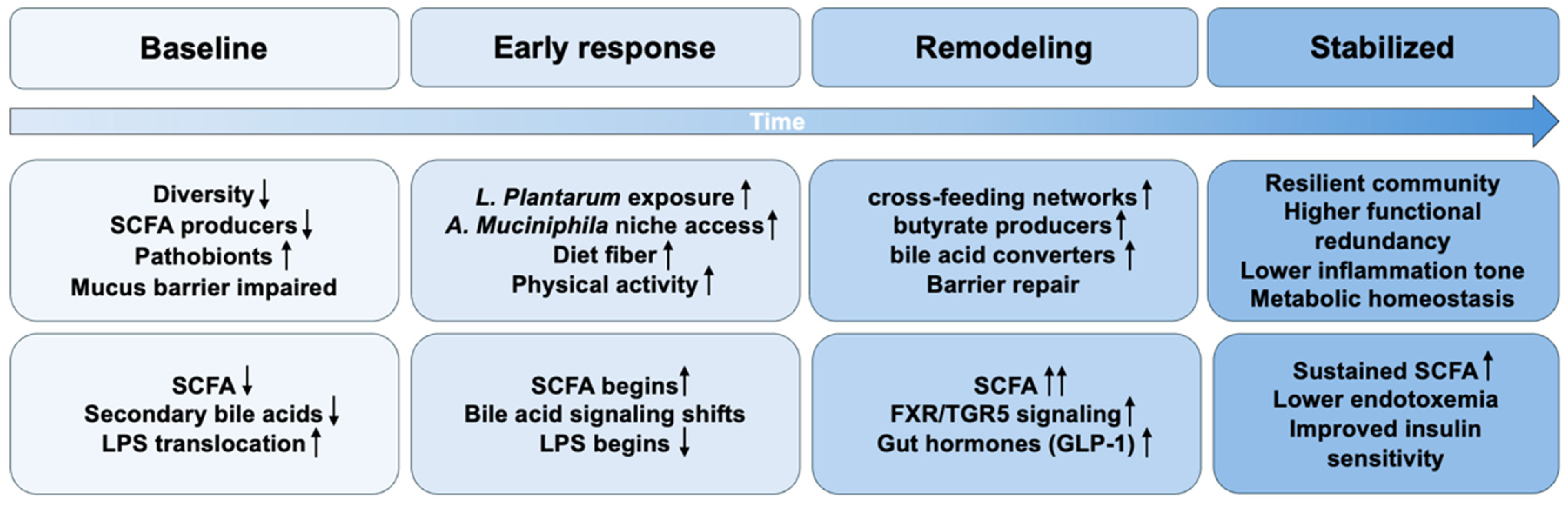
Figure 2 presents a conceptual, stage-based model describing how the gut microbiota may evolve during a combined intervention that integrates probiotics (L. plantarum and A. muciniphila) with healthy lifestyle measures (e.g., increased dietary fiber intake and regular physical activity). In the early phase, the model proposes niche engagement and initial metabolic shifts, including increased lactate and acetate availability and mucus-layer-associated colonization. This may be followed by community-level functional remodeling through cross-feeding interactions and enrichment of SCFA-producing taxa. With sustained lifestyle support, microbial functions relevant to host metabolism, such as SCFA production, bile acid signaling through FXR/TGR5, and reduced endotoxin translocation, may become more stable, potentially contributing to improved gut hormone signaling (e.g., GLP-1), lower inflammatory tone, and enhanced insulin sensitivity. This framework is intended to guide hypothesis-driven study design and mechanistic testing; it should not be interpreted as evidence of definitive synergistic effects in humans without direct comparative factorial trials that include each monotherapy arm and the combination.
The diagram illustrates a conceptual progression from baseline dysbiosis, through early response and functional remodeling, to the establishment of a more stable ecosystem, accompanied by sustained improvements in microbial functions, including short-chain fatty acid production, bile acid signaling, reduced lipopolysaccharide/endotoxemia, and downstream host metabolic outcomes.

7. Limitations

Several limitations should be considered when interpreting the current evidence base for L. plantarum and A. muciniphila. First, strain-level heterogeneity is substantial. L. plantarum exhibits broad genomic and metabolic diversity, whereas A. muciniphila shows strain- and preparation-specific effects (e.g., live vs. pasteurized cells or defined components). Accordingly, results obtained with one strain or formulation should not be assumed to apply to others. This highlights the importance of clear strain identification, genome-informed functional annotation, and dose–response characterization.
Second, the bioactive entity and delivery format remain incompletely standardized. Reported benefits may derive from viable cells, non-viable preparations (e.g., pasteurized A. muciniphila), extracellular vesicles, defined surface proteins (e.g., Amuc_1100), cell-wall-associated molecules, bacteriocins, or secreted metabolites, and these may differ in stability, manufacturing requirements, and site of action along the gut. Formulation constraints (e.g., oxygen sensitivity, shelf life, encapsulation, and colon-targeted release) and co-interventions (e.g., dietary fiber, prebiotics, and medications) can strongly influence engraftment and functional readouts.
Third, host context can confound both efficacy and safety. Baseline microbiome configuration, habitual diet, metabolic status, age, and concomitant drug exposure (notably antibiotics and antidiabetic agents) may shape responder phenotypes and the dominant mechanism of action (e.g., SCFA-related effects vs. bile acid signaling). Long-term safety and tolerability—particularly in vulnerable populations—require continued monitoring, and mechanistic claims should be interpreted in light of disease stage and mucosal barrier status.
Finally, direct evidence for combined administration remains limited. Many mechanistic insights are derived from single-strain studies and preclinical models, whereas direct comparative factorial trials, standardized endpoints, and sufficiently long follow-up in humans are scarce. Future studies integrating multi-omics with well-controlled clinical designs will be essential to determine whether the proposed complementarity translates into reproducible clinical benefit.

8. Challenges and Opportunities in Clinical Translation

Building on the evidence limitations outlined above, this section focuses on practical translational bottlenecks and emerging solutions. While L. plantarum and A. muciniphila have shown promising potential in preclinical studies, translation from laboratory findings to clinical application remains challenging. Key barriers include strain-specific functional heterogeneity, formulation stability and delivery efficiency, and limitations in current clinical evaluation frameworks. At the same time, these challenges are driving the development of more precise screening, formulation, and trial-design strategies.
A primary obstacle to effective clinical translation is the functional heterogeneity of bacterial strains. Studies indicate that different L. plantarum strains can differ substantially in functional gene content, which may translate into marked differences in metabolic regulatory capacity and antibacterial activity [12,97]. This degree of strain specificity underscores the need for more rigorous strain selection and characterization criteria. Emerging approaches are moving toward more personalized matching strategies, integrating host microbiota profiles, metabolic parameters, and clinical context to improve strain selection and intervention responsiveness, including through machine-learning-assisted prediction frameworks [98,99].
A second closely related barrier is the inconsistent definition of the active therapeutic entity across studies. In practice, “probiotic” and “postbiotic” interventions may involve distinct pharmacological mechanisms: live L. plantarum preparations may act through transient engraftment and metabolite production, whereas biological activity may also arise from non-viable biomass, secreted factors, or purified components. For A. muciniphila, pasteurized preparations, specific molecules such as Amuc_1100, as well as extracellular vesicles have all been implicated as functional effectors in preclinical studies [18,19,100]. Clear reporting and standardization of what is administered, including strain identity, viability status, dose units, and quality-control specifications are essential for reproducibility, safety evaluation, and regulatory translation.
Despite the growing body of mechanistic evidence, clinical translation remains constrained by formulation and delivery. For strict anaerobes such as A. muciniphila, maintaining viability during production and storage, while preserving resistance to gastric and bile stress during delivery, remains a central formulation challenge. Microencapsulation and drying-based stabilization have been shown to improve survival during storage and simulated upper gastrointestinal transit, supporting the feasibility of viable-cell delivery under physiologically relevant stress conditions [101,102]. More advanced microencapsulation strategies, including multilayer systems that integrate oxygen/anaerobic protection, pH-responsive release, and mucoadhesive retention, are increasingly being developed to improve delivery efficiency and intestinal persistence [103,104]. Notably, pasteurized A. muciniphila can retain bioactivity in experimental and clinical contexts, supporting the development of stable non-viable formulations or postbiotic products [18,19]. Regulatory assessments have further supported the feasibility of pasteurized preparations as stable products for human use [105]. Collectively, these formulation advances are consistent with the integrated pathway model summarized in Figure 1.
On the regulatory side, requirements for live biotherapeutic and microbiome-based products are evolving, with increasing emphasis on strain identity, potency characterization, genomic stability, and product consistency. These requirements are directly relevant to the translational development of L. plantarum and A. muciniphila formulations [18,106,107]. Looking ahead, progress will likely depend on clearer postbiotic product definitions, engineered functional strains enabled by synthetic biology, and more individualized delivery strategies [108,109].
Clinical evidence is gradually expanding but remains heterogeneous. Early-phase studies suggest that pasteurized A. muciniphila may improve selected metabolic parameters in overweight or obese adults [108]. In addition, emerging trials of A. muciniphila supplementation in overweight/obese individuals with T2D suggest metabolic benefits in subgroups, with efficacy depending on baseline abundance [110]. For L. plantarum, recent randomized evidence suggests possible modest improvements in LDL-C and total cholesterol in some populations, while pooled analyses indicate that effects on glycemic and lipid outcomes are often small and strain- and population-dependent [111,112,113]; however, some strain-specific RCTs (e.g., LMT1-48) have reported reductions in body-fat-related outcomes in selected cohorts [114].
Safety considerations also require careful attention, particularly for long-term use and in vulnerable populations. Although lactobacilli have a long history of use and are widely regarded as safe in general populations, bacteremia and sepsis attributable to certain Lactobacillus strains have been reported in immunocompromised or critically ill patients [115]. In parallel, context-dependent risks have been reported for A. muciniphila in specific experimental settings, where host genetic background, microbiota configuration, dietary context, or coexisting disease may influence outcomes [116,117]. These observations support the need for more comprehensive safety evaluation, careful patient stratification, and long-term monitoring during clinical translation.

9. Conclusions

This review synthesizes current evidence on Lactiplantibacillus plantarum and Akkermansia muciniphila as a dual-target microbial strategy for metabolic disease intervention. By organizing findings around key host metabolic pathways, including SCFA-related signaling, bile acid–FXR/TGR5 axes, gut barrier integrity, and immune–metabolic crosstalk, we highlight how these organisms may exert complementary functions across the gut–liver–adipose and gut–brain axes.

However, most mechanistic insights are derived from single-strain studies and preclinical models, and direct comparative evidence for combined administration in humans remains limited. Accordingly, the current literature supports functional complementarity and possible additive effects, rather than confirmed synergistic effects in humans.
Future work should prioritize well-controlled comparative factorial trials with standardized strain identification, explicit active-entity definitions (e.g., live cells, pasteurized preparations, extracellular vesicles, and defined molecular effectors), and harmonized endpoints. Integrating multi-omics with organoid and gnotobiotic models may further clarify context dependence, safety, and whether combination effects can exceed additivity under specific biological or clinical conditions.

Author Contributions

K.H. and Z.J. designed article, S.L. and M.W. and wrote the article, Z.J., X.S. and K.H. critically revised the article. All authors have read and agreed to the published version of the manuscript.

Funding

This work was financially supported by Chongqing University of Technology, Scientific Research Project of Chongqing Municipal Education Commission (grant number: KJQN202401144), Chongqing Municipal Science and Technology Commission General Programme (grant number: CSTB2025NSCQ-GPX0230) and the joint funding project (grant number: gzlcx20233379 and gzlcx20253283) from Chongqing University of Technology.

Institutional Review Board Statement

Not applicable.

Informed Consent Statement

Not applicable.

Data Availability Statement

No new data were created or analyzed in this study.

Conflicts of Interest

The authors declare that the research was conducted in the absence of any commercial or financial relationships that could be construed as a potential conflict of interest.

References

  1. Fan, Y.; Dong, Y.; Gai, Z.; Zhang, Y.; Han, M. Lactiplantibacillus plantarum Lp05 Protects against Ethanol-Induced Liver Injury in Zebrafish through Metabolic and Microbiota Modulation. Sci. Rep. 2025, 15, 22584. [Google Scholar] [CrossRef]
  2. He, B.-L.; Cui, R.; Hu, T.-G.; Wu, H. Lactiplantibacillus plantarum WH021 Alleviates Lipopolysaccharide-Induced Neuroinflammation via Regulating the Intestinal Microenvironment and Protecting the Barrier Integrity. J. Agric. Food Chem. 2025, 73, 14300–14313. [Google Scholar] [CrossRef]
  3. Kim, A.-R.; Jeon, S.-G.; Park, S.-J.; Hong, H.; Kim, B.K.; Kim, H.-R.; Hong, C.-P.; Yang, B.-G. Alleviation of Adipose Tissue Inflammation and Obesity Suppression by a Probiotic Strain That Induces GLP-1 Secretion. Microorganisms 2025, 13, 1211. [Google Scholar] [CrossRef]
  4. Kumar, A.; Kumar, V.; Pramanik, J.; Rustagi, S.; Prajapati, B.; Jebreen, A.; Pande, R. Lactiplantibacillus plantarum as a Complementary Approach for Diabetes Treatment and Management. Curr. Nutr. Rep. 2025, 14, 72. [Google Scholar] [CrossRef]
  5. Thursby, E.; Juge, N. Introduction to the Human Gut Microbiota. Biochem. J. 2017, 474, 1823–1836. [Google Scholar] [CrossRef]
  6. Takiishi, T.; Fenero, C.I.M.; Câmara, N.O.S. Intestinal Barrier and Gut Microbiota: Shaping Our Immune Responses throughout Life. Tissue Barriers 2017, 5, e1373208. [Google Scholar] [CrossRef]
  7. Piquer-Esteban, S.; Ruiz-Ruiz, S.; Arnau, V.; Diaz, W.; Moya, A. Exploring the Universal Healthy Human Gut Microbiota around the World. Comput. Struct. Biotechnol. J. 2022, 20, 421–433. [Google Scholar] [CrossRef]
  8. Rinninella, E.; Tohumcu, E.; Raoul, P.; Fiorani, M.; Cintoni, M.; Mele, M.C.; Cammarota, G.; Gasbarrini, A.; Ianiro, G. The Role of Diet in Shaping Human Gut Microbiota. Best Pract. Res. Clin. Gastroenterol. 2023, 62–63, 101828. [Google Scholar] [CrossRef]
  9. Liu, M.-J.; Yang, J.-Y.; Yan, Z.-H.; Hu, S.; Li, J.-Q.; Xu, Z.-X.; Jian, Y.-P. Recent Findings in Akkermansia muciniphila-Regulated Metabolism and Its Role in Intestinal Diseases. Clin. Nutr. 2022, 41, 2333–2344. [Google Scholar] [CrossRef]
  10. Hao, Y.; Li, J.; Wang, J.; Chen, Y. Mechanisms of Health Improvement by Lactiplantibacillus plantarum Based on Animal and Human Trials: A Review. Fermentation 2024, 10, 73. [Google Scholar] [CrossRef]
  11. Zhao, Y.; Yang, H.; Wu, P.; Yang, S.; Xue, W.; Xu, B.; Zhang, S.; Tang, B.; Xu, D. Akkermansia muciniphila: A Promising Probiotic against Inflammation and Metabolic Disorders. Virulence 2024, 15, 2375555. [Google Scholar] [CrossRef]
  12. Zhang, Z.; Niu, H.; Qu, Q.; Guo, D.; Wan, X.; Yang, Q.; Mo, Z.; Tan, S.; Xiang, Q.; Tian, X.; et al. Advancements in Lactiplantibacillus plantarum: Probiotic Characteristics, Gene Editing Technologies and Applications. Crit. Rev. Food Sci. Nutr. 2025, 65, 6623–6644. [Google Scholar] [CrossRef]
  13. Asnicar, F.; Manghi, P.; Fackelmann, G.; Baldanzi, G.; Bakker, E.; Ricci, L.; Piccinno, G.; Piperni, E.; Mladenovic, K.; Amati, F.; et al. Gut Micro-Organisms Associated with Health, Nutrition and Dietary Interventions. Nature 2026, 650, 450–458. [Google Scholar] [CrossRef]
  14. Hou, K.; Wu, Z.-X.; Chen, X.-Y.; Wang, J.-Q.; Zhang, D.; Xiao, C.; Zhu, D.; Koya, J.B.; Wei, L.; Li, J.; et al. Microbiota in Health and Diseases. Signal Transduct. Target. Ther. 2022, 7, 135. [Google Scholar] [CrossRef]
  15. Davoutis, E.; Gkiafi, Z.; Lykoudis, P.M. Bringing Gut Microbiota into the Spotlight of Clinical Research and Medical Practice. World J. Clin. Cases 2024, 12, 2293–2300. [Google Scholar] [CrossRef]
  16. Li, C.-P.; Chen, C.-C.; Hsiao, Y.; Kao, C.-H.; Chen, C.-C.; Yang, H.-J.; Tsai, R.-Y. The Role of Lactobacillus plantarum in Reducing Obesity and Inflammation: A Meta-Analysis. Int. J. Mol. Sci. 2024, 25, 7608. [Google Scholar] [CrossRef]
  17. Feng, X.; Hu, H.; Zhong, F.; Hou, Y.; Li, X.; Qin, Q.; Yang, Y.; Luo, X. Lactiplantibacillus plantarum TCCC11824 Exerts Hypolipidemic and Anti-Obesity Effects through Regulation of NF-κB-HMGCR Pathway and Gut Microbiota in Mice and Clinical Patients. Nutrition 2025, 130, 112598. [Google Scholar] [CrossRef]
  18. Depommier, C.; Everard, A.; Druart, C.; Plovier, H.; Van Hul, M.; Vieira-Silva, S.; Falony, G.; Raes, J.; Maiter, D.; Delzenne, N.M.; et al. Supplementation with Akkermansia muciniphila in Overweight and Obese Human Volunteers: A Proof-of-Concept Exploratory Study. Nat. Med. 2019, 25, 1096–1103. [Google Scholar] [CrossRef]
  19. Plovier, H.; Everard, A.; Druart, C.; Depommier, C.; Van Hul, M.; Geurts, L.; Chilloux, J.; Ottman, N.; Duparc, T.; Lichtenstein, L.; et al. A Purified Membrane Protein from Akkermansia muciniphila or the Pasteurized Bacterium Improves Metabolism in Obese and Diabetic Mice. Nat. Med. 2017, 23, 107–113. [Google Scholar] [CrossRef]
  20. Rodrigues, V.F.; Elias-Oliveira, J.; Pereira, Í.S.; Pereira, J.A.; Barbosa, S.C.; Machado, M.S.G.; Carlos, D. Akkermansia muciniphila and Gut Immune System: A Good Friendship That Attenuates Inflammatory Bowel Disease, Obesity, and Diabetes. Front. Immunol. 2022, 13, 934695. [Google Scholar] [CrossRef]
  21. Mruk-Mazurkiewicz, H.; Kulaszyńska, M.; Czarnecka, W.; Podkówka, A.; Ekstedt, N.; Zawodny, P.; Wierzbicka-Woś, A.; Marlicz, W.; Skupin, B.; Stachowska, E.; et al. Insights into the Mechanisms of Action of Akkermansia muciniphila in the Treatment of Non-Communicable Diseases. Nutrients 2024, 16, 1695. [Google Scholar] [CrossRef]
  22. Qu, X.; Zhang, T.; Zhang, Y.; Wang, W.; Zhang, Y.; Zhou, S.; Liu, J.; Dong, X.; Liu, Y. Multi-Omics Insights of Lactiplantibacillus plantarum SFFI23 Tryptophan Metabolism in Alleviating Colitis: Cross-Feeding-Driven Akkermansia muciniphila Enrichment and Retinoic Acid Biosynthesis. Food Biosci. 2025, 68, 106770. [Google Scholar] [CrossRef]
  23. Chen, X.; Li, Q.; Xie, J.; Nie, S. Immunomodulatory Effects of Probiotic-Derived Extracellular Vesicles: Opportunities and Challenges. J. Agric. Food Chem. 2024, 72, 19259–19273. [Google Scholar] [CrossRef]
  24. Zheng, J.; Wittouck, S.; Salvetti, E.; Franz, C.M.A.P.; Harris, H.M.B.; Mattarelli, P.; O’Toole, P.W.; Pot, B.; Vandamme, P.; Walter, J.; et al. A Taxonomic Note on the Genus Lactobacillus: Description of 23 Novel Genera, Emended Description of the Genus Lactobacillus Beijerinck 1901, and Union of Lactobacillaceae and Leuconostocaceae. Int. J. Syst. Evol. Microbiol. 2020, 70, 2782–2858. [Google Scholar] [CrossRef]
  25. Echegaray, N.; Yilmaz, B.; Sharma, H.; Kumar, M.; Pateiro, M.; Ozogul, F.; Lorenzo, J.M. A Novel Approach to Lactiplantibacillus plantarum: From Probiotic Properties to the Omics Insights. Microbiol. Res. 2023, 268, 127289. [Google Scholar] [CrossRef]
  26. Hussain, A.; Kwon, M.H.; Kim, H.K.; Lee, H.S.; Cho, J.S.; Lee, Y.I. Anti-Obesity Effect of Lactobacillus plantarum LB818 Is Associated with Regulation of Gut Microbiota in High-Fat Diet-Fed Obese Mice. J. Med. Food 2020, 23, 750–759. [Google Scholar] [CrossRef]
  27. Yilmaz, B.; Bangar, S.P.; Echegaray, N.; Suri, S.; Tomasevic, I.; Manuel Lorenzo, J.; Melekoglu, E.; Rocha, J.M.; Ozogul, F. The Impacts of Lactiplantibacillus plantarum on the Functional Properties of Fermented Foods: A Review of Current Knowledge. Microorganisms 2022, 10, 826. [Google Scholar] [CrossRef]
  28. Tang, W.; Li, C.; He, Z.; Pan, F.; Pan, S.; Wang, Y. Probiotic Properties and Cellular Antioxidant Activity of Lactobacillus plantarum MA2 Isolated from Tibetan Kefir Grains. Probiotics Antimicrob. Proteins 2018, 10, 523–533. [Google Scholar] [CrossRef]
  29. Tian, Y.; Wang, Y.; Zhang, N.; Xiao, M.; Zhang, J.; Xing, X.; Zhang, Y.; Fan, Y.; Li, X.; Nan, B.; et al. Antioxidant Mechanism of Lactiplantibacillus plantarum KM1 Under H2O2 Stress by Proteomics Analysis. Front. Microbiol. 2022, 13, 897387. [Google Scholar] [CrossRef]
  30. Islam, S.; Biswas, S.; Jabin, T.; Moniruzzaman, M.; Biswas, J.; Uddin, M.d.S.; Akhtar-E-Ekram, M.; Elgorban, A.M.; Ghodake, G.; Syed, A.; et al. Probiotic Potential of Lactobacillus plantarum DMR14 for Preserving and Extending Shelf Life of Fruits and Fruit Juice. Heliyon 2023, 9, e17382. [Google Scholar] [CrossRef]
  31. Garcia-Gonzalez, N.; Prete, R.; Battista, N.; Corsetti, A. Adhesion Properties of Food-Associated Lactobacillus plantarum Strains on Human Intestinal Epithelial Cells and Modulation of IL-8 Release. Front. Microbiol. 2018, 9, 2392. [Google Scholar] [CrossRef]
  32. Kleerebezem, M.; Boekhorst, J.; Van Kranenburg, R.; Molenaar, D.; Kuipers, O.P.; Leer, R.; Tarchini, R.; Peters, S.A.; Sandbrink, H.M.; Fiers, M.W.E.J.; et al. Complete Genome Sequence of Lactobacillus plantarum WCFS1. Proc. Natl. Acad. Sci. USA 2003, 100, 1990–1995. [Google Scholar] [CrossRef]
  33. Molenaar, D.; Bringel, F.; Schuren, F.H.; De Vos, W.M.; Siezen, R.J.; Kleerebezem, M. Exploring Lactobacillus plantarum Genome Diversity by Using Microarrays. J. Bacteriol. 2005, 187, 6119–6127. [Google Scholar] [CrossRef]
  34. Siezen, R.J.; Van Hylckama Vlieg, J.E. Genomic Diversity and Versatility of Lactobacillus plantarum, a Natural Metabolic Engineer. Microb. Cell Fact. 2011, 10, S3. [Google Scholar] [CrossRef]
  35. Van Den Nieuwboer, M.; Van Hemert, S.; Claassen, E.; De Vos, W.M. Lactobacillus plantarum WCFS 1 and Its Host Interaction: A Dozen Years after the Genome. Microb. Biotechnol. 2016, 9, 452–465. [Google Scholar] [CrossRef]
  36. Zúñiga, M.; Monedero, V.; Yebra, M.J. Utilization of Host-Derived Glycans by Intestinal Lactobacillus and Bifidobacterium Species. Front. Microbiol. 2018, 9, 1917. [Google Scholar] [CrossRef]
  37. Borjihan, Q.; Yang, Z.; Liu, K.; Yang, C.; Zhang, X.; Yao, G. Comparative Genomics and Metabolite Analysis of Lactiplantibacillus plantarum Strains in Dairy and Vegetable Fermentation Environments. Food Biosci. 2025, 65, 106058. [Google Scholar] [CrossRef]
  38. Wu, A.; Fu, Y.; Kong, L.; Shen, Q.; Liu, M.; Zeng, X.; Wu, Z.; Guo, Y.; Pan, D. Production of a Class IIb Bacteriocin with Broad-Spectrum Antimicrobial Activity in Lactiplantibacillus plantarum RUB1. Probiotics Antimicrob. Proteins 2021, 13, 1820–1832. [Google Scholar] [CrossRef]
  39. Beltrán-Velasco, A.I.; Reiriz, M.; Uceda, S.; Echeverry-Alzate, V. Lactiplantibacillus (Lactobacillus) Plantarum as a Complementary Treatment to Improve Symptomatology in Neurodegenerative Disease: A Systematic Review of Open Access Literature. Int. J. Mol. Sci. 2024, 25, 3010. [Google Scholar] [CrossRef]
  40. Salvo, C.D.; D’Antongiovanni, V.; Benvenuti, L.; d’Amati, A.; Ippolito, C.; Segnani, C.; Pierucci, C.; Bellini, G.; Annese, T.; Virgintino, D.; et al. Lactiplantibacillus plantarum HEAL9 Attenuates Cognitive Impairment and Progression of Alzheimer’s Disease and Related Bowel Symptoms in SAMP8 Mice by Modulating Microbiota-Gut-Inflammasome-Brain Axis. Food Funct. 2024, 15, 10323–10338. [Google Scholar] [CrossRef]
  41. Duarte Luiz, J.; Manassi, C.; Magnani, M.; Cruz, A.G.D.; Pimentel, T.C.; Verruck, S. Lactiplantibacillus plantarum as a Promising Adjuvant for Neurological Disorders Therapy through the Brain-Gut Axis and Related Action Pathways. Crit. Rev. Food Sci. Nutr. 2025, 65, 715–727. [Google Scholar] [CrossRef]
  42. Ding, Y.; Hou, Y.; Lao, X. The Role of Akkermansia muciniphila in Disease Regulation. Probiotics Antimicrob. Proteins 2025, 17, 2027–2038. [Google Scholar] [CrossRef]
  43. Panzetta, M.E.; Valdivia, R.H. Akkermansia in the Gastrointestinal Tract as a Modifier of Human Health. Gut Microbes 2024, 16, 2406379. [Google Scholar] [CrossRef] [PubMed]
  44. Mo, C.; Lou, X.; Xue, J.; Shi, Z.; Zhao, Y.; Wang, F.; Chen, G. The Influence of Akkermansia muciniphila on Intestinal Barrier Function. Gut Pathog. 2024, 16, 41. [Google Scholar] [CrossRef] [PubMed]
  45. Ottman, N.; Reunanen, J.; Meijerink, M.; Pietilä, T.E.; Kainulainen, V.; Klievink, J.; Huuskonen, L.; Aalvink, S.; Skurnik, M.; Boeren, S.; et al. Pili-like Proteins of Akkermansia muciniphila Modulate Host Immune Responses and Gut Barrier Function. PLoS ONE 2017, 12, e0173004. [Google Scholar] [CrossRef]
  46. Everard, A.; Belzer, C.; Geurts, L.; Ouwerkerk, J.P.; Druart, C.; Bindels, L.B.; Guiot, Y.; Derrien, M.; Muccioli, G.G.; Delzenne, N.M.; et al. Cross-Talk between Akkermansia muciniphila and Intestinal Epithelium Controls Diet-Induced Obesity. Proc. Natl. Acad. Sci. USA 2013, 110, 9066–9071. [Google Scholar] [CrossRef]
  47. Dao, M.C.; Everard, A.; Aron-Wisnewsky, J.; Sokolovska, N.; Prifti, E.; Verger, E.O.; Kayser, B.D.; Levenez, F.; Chilloux, J.; Hoyles, L.; et al. Akkermansia muciniphila and Improved Metabolic Health during a Dietary Intervention in Obesity: Relationship with Gut Microbiome Richness and Ecology. Gut 2016, 65, 426–436. [Google Scholar] [CrossRef]
  48. Cani, P.D.; Depommier, C.; Derrien, M.; Everard, A.; De Vos, W.M. Akkermansia muciniphila: Paradigm for next-Generation Beneficial Microorganisms. Nat. Rev. Gastroenterol. Hepatol. 2022, 19, 625–637. [Google Scholar] [CrossRef]
  49. Wu, W.; Kaicen, W.; Bian, X.; Yang, L.; Ding, S.; Li, Y.; Li, S.; Zhuge, A.; Li, L. Akkermansia muciniphila alleviates high-fat-diet-related metabolic-associated fatty liver disease by modulating gut microbiota and bile acids. Microb. Biotechnol. 2023, 16, 1924–1939. [Google Scholar] [CrossRef]
  50. Muramatsu, M.K.; Winter, S.E. Nutrient Acquisition Strategies by Gut Microbes. Cell Host Microbe 2024, 32, 863–874. [Google Scholar] [CrossRef]
  51. Jiang, S.; Zhang, Z.; Shen, S.; Li, J.; Su, S.; Du, L.; Ma, W.; Zhang, J. Leuconostoc citreum Enhances the Colonization Ability of Lactiplantibacillus plantarum in the Gut by Synergistically Modifying the Intestinal Niche. Gut Microbes 2025, 17, 2447819. [Google Scholar] [CrossRef]
  52. Liang, L.; Yang, Z.; Fu, X. Ecology of the Gut Microbiota and Colonization Resistance: Mechanisms and Therapeutic Implications. FEMS Microbiol. Ecol. 2025, 102, fiaf124. [Google Scholar] [CrossRef] [PubMed]
  53. Koh, A.; De Vadder, F.; Kovatcheva-Datchary, P.; Bäckhed, F. From Dietary Fiber to Host Physiology: Short-Chain Fatty Acids as Key Bacterial Metabolites. Cell 2016, 165, 1332–1345. [Google Scholar] [CrossRef] [PubMed]
  54. Chiang, J.Y.L.; Ferrell, J.M. Bile Acid Receptors FXR and TGR5 Signaling in Fatty Liver Diseases and Therapy. Am. J. Physiol.-Gastrointest. Liver Physiol. 2020, 318, G554–G573. [Google Scholar] [CrossRef] [PubMed]
  55. Cani, P.D.; Bibiloni, R.; Knauf, C.; Waget, A.; Neyrinck, A.M.; Delzenne, N.M.; Burcelin, R. Changes in Gut Microbiota Control Metabolic Endotoxemia-Induced Inflammation in High-Fat Diet–Induced Obesity and Diabetes in Mice. Diabetes 2008, 57, 1470–1481. [Google Scholar] [CrossRef]
  56. Van Baarlen, P.; Troost, F.J.; Van Hemert, S.; Van Der Meer, C.; De Vos, W.M.; De Groot, P.J.; Hooiveld, G.J.E.J.; Brummer, R.-J.M.; Kleerebezem, M. Differential NF-κB Pathways Induction by Lactobacillus plantarum in the Duodenum of Healthy Humans Correlating with Immune Tolerance. Proc. Natl. Acad. Sci. USA 2009, 106, 2371–2376. [Google Scholar] [CrossRef]
  57. Zhuge, A.; Li, S.; Han, S.; Yuan, Y.; Shen, J.; Wu, W.; Wang, K.; Xia, J.; Wang, Q.; Gu, Y.; et al. Akkermansia muciniphila-Derived Acetate Activates the Hepatic AMPK/SIRT1/PGC-1α Axis to Alleviate Ferroptosis in Metabolic-Associated Fatty Liver Disease. Acta Pharm. Sin. B 2025, 15, 151–167. [Google Scholar] [CrossRef]
  58. Elzinga, J.; Narimatsu, Y.; De Haan, N.; Clausen, H.; De Vos, W.M.; Tytgat, H.L.P. Binding of Akkermansia muciniphila to Mucin Is O-Glycan Specific. Nat. Commun. 2024, 15, 4582. [Google Scholar] [CrossRef]
  59. Tolhurst, G.; Heffron, H.; Lam, Y.S.; Parker, H.E.; Habib, A.M.; Diakogiannaki, E.; Cameron, J.; Grosse, J.; Reimann, F.; Gribble, F.M. Short-Chain Fatty Acids Stimulate Glucagon-Like Peptide-1 Secretion via the G-Protein–Coupled Receptor FFAR2. Diabetes 2012, 61, 364–371. [Google Scholar] [CrossRef]
  60. Jang, A.-R.; Jung, D.-H.; Lee, T.-S.; Kim, J.-K.; Lee, Y.-B.; Lee, J.-Y.; Kim, S.-Y.; Yoo, Y.-C.; Ahn, J.-H.; Hong, E.-H.; et al. Lactobacillus plantarum NCHBL-004 Modulates High-Fat Diet-Induced Weight Gain and Enhances GLP-1 Production for Blood Glucose Regulation. Nutrition 2024, 128, 112565. [Google Scholar] [CrossRef]
  61. Song, Z.; Chen, J.; Ji, Y.; Yang, Q.; Chen, Y.; Wang, F.; Wu, Z. Amuc Attenuates High-Fat Diet-Induced Metabolic Disorders Linked to the Regulation of Fatty Acid Metabolism, Bile Acid Metabolism, and the Gut Microbiota in Mice. Int. J. Biol. Macromol. 2023, 242, 124650. [Google Scholar] [CrossRef]
  62. Bu, F.; Zhang, K.; Song, B.; He, L.; Lu, Z.; Yuan, X.; Chen, C.; Jiang, F.; Tao, Y.; Zhang, W.; et al. Akkermansia muciniphila Alleviates Experimental Colitis through FXR-Mediated Repression of Unspliced XBP1. mSystems 2026, 11, e01589-25. [Google Scholar] [CrossRef] [PubMed]
  63. Allam-Ndoul, B.; Pulido-Mateos, E.C.; Bégin, F.; St-Arnaud, G.; Tinoco Mar, B.A.; Mayer, T.; Dumais, E.; Flamand, N.; Raymond, F.; Roy, D.; et al. Lactiplantibacillus plantarum Strengthens the Intestinal Barrier: Involvement of the Endocannabinoidome. Am. J. Physiol.-Gastrointest. Liver Physiol. 2025, 329, G245–G260. [Google Scholar] [CrossRef] [PubMed]
  64. Chen, B.; Gautron, L. Gut-Derived Lipopolysaccharides and Metabolic Endotoxemia: A Critical Review. Am. J. Physiol.-Endocrinol. Metab. 2025, 329, E746–E754. [Google Scholar] [CrossRef] [PubMed]
  65. Han, Y.; Ling, Q.; Wu, L.; Wang, X.; Wang, Z.; Chen, J.; Zheng, Z.; Zhou, Z.; Jia, L.; Li, L.; et al. Akkermansia muciniphila Inhibits Nonalcoholic Steatohepatitis by Orchestrating TLR2-Activated γδT17 Cell and Macrophage Polarization. Gut Microbes 2023, 15, 2221485. [Google Scholar] [CrossRef]
  66. Gong, S.; Zeng, R.; Liu, L.; Wang, R.; Xue, M.; Dong, H.; Wu, Z.; Zhang, Y. Extracellular Vesicles from a Novel Lactiplantibacillus plantarum Strain Suppress Inflammation and Promote M2 Macrophage Polarization. Front. Immunol. 2024, 15, 1459213. [Google Scholar] [CrossRef]
  67. Peña-Cearra, A.; Palacios, A.; Pellon, A.; Castelo, J.; Pasco, S.T.; Seoane, I.; Barriales, D.; Martin, J.E.; Pascual-Itoiz, M.Á.; Gonzalez-Lopez, M.; et al. Akkermansia muciniphila-Induced Trained Immune Phenotype Increases Bacterial Intracellular Survival and Attenuates Inflammation. Commun. Biol. 2024, 7, 192. [Google Scholar] [CrossRef]
  68. Nøhr, M.K.; Pedersen, M.H.; Gille, A.; Egerod, K.L.; Engelstoft, M.S.; Husted, A.S.; Sichlau, R.M.; Grunddal, K.V.; Seier Poulsen, S.; Han, S.; et al. GPR41/FFAR3 and GPR43/FFAR2 as Cosensors for Short-Chain Fatty Acids in Enteroendocrine Cells vs FFAR3 in Enteric Neurons and FFAR2 in Enteric Leukocytes. Endocrinology 2013, 154, 3552–3564. [Google Scholar] [CrossRef]
  69. Masse, K.E.; Lu, V.B. Short-Chain Fatty Acids, Secondary Bile Acids and Indoles: Gut Microbial Metabolites with Effects on Enteroendocrine Cell Function and Their Potential as Therapies for Metabolic Disease. Front. Endocrinol. 2023, 14, 1169624. [Google Scholar] [CrossRef]
  70. Fleishman, J.S.; Kumar, S. Bile Acid Metabolism and Signaling in Health and Disease: Molecular Mechanisms and Therapeutic Targets. Signal Transduct. Target. Ther. 2024, 9, 97. [Google Scholar] [CrossRef]
  71. Yu, M.; Yu, B.; Chen, D. The Effects of Gut Microbiota on Appetite Regulation and the Underlying Mechanisms. Gut Microbes 2024, 16, 2414796. [Google Scholar] [CrossRef]
  72. Van Der Vaart, J.I.; Boon, M.R.; Houtkooper, R.H. The Role of AMPK Signaling in Brown Adipose Tissue Activation. Cells 2021, 10, 1122. [Google Scholar] [CrossRef] [PubMed]
  73. Depommier, C.; Van Hul, M.; Everard, A.; Delzenne, N.M.; De Vos, W.M.; Cani, P.D. Pasteurized Akkermansia muciniphila Increases Whole-Body Energy Expenditure and Fecal Energy Excretion in Diet-Induced Obese Mice. Gut Microbes 2020, 11, 1231–1245. [Google Scholar] [CrossRef] [PubMed]
  74. Gao, Y.; Zhu, A.; Li, J.; Liu, H.; Li, X.; Zhang, H. Lactiplantibacillus plantarum Attenuates Diet-Induced Obesity and Insulin Resistance Through Gut Microbiota-Driven PPAR/PI3K -Axis Modulation. Microb. Biotechnol. 2025, 18, e70227. [Google Scholar] [CrossRef] [PubMed]
  75. Shaheen, N.; Khursheed, W.; Gurung, B.; Wang, S. Akkermansia muciniphila: A Key Player in Gut Microbiota-Based Disease Modulation. Microbiol. Res. 2025, 301, 128317. [Google Scholar] [CrossRef]
  76. Li, D.; Meng, K.; Liu, G.; Wen, Z.; Han, Y.; Liu, W.; Xu, X.; Song, L.; Cai, H.; Yang, P. Lactiplantibacillus plantarum FRT4 Protects against Fatty Liver Hemorrhage Syndrome: Regulating Gut Microbiota and FoxO/TLR-4/NF-κB Signaling Pathway in Laying Hens. Microbiome 2025, 13, 88. [Google Scholar] [CrossRef]
  77. Kim, W.; Lee, E.J.; Bae, I.; Myoung, K.; Kim, S.T.; Park, P.J.; Lee, K.; Pham, A.V.Q.; Ko, J.; Oh, S.H.; et al. Lactobacillus plantarum -derived Extracellular Vesicles Induce Anti-inflammatory M2 Macrophage Polarization in Vitro. J. Extracell. Vesicle 2020, 9, 1793514. [Google Scholar] [CrossRef]
  78. Wang, W.; Shi, S.; Su, M.; Li, Y.; Yao, X.; Jiang, J.; Yao, W.; Qin, X.; Wang, Z.; Tang, C. Akkermansia muciniphila Akk11 Supplementation Attenuates MPTP-Induced Neurodegeneration by Inhibiting Microglial NLRP3 Inflammasome. Probiotics Antimicrob. Proteins 2025, 17, 2348–2361. [Google Scholar] [CrossRef]
  79. Zhu, J.; Qin, S.; Gu, R.; Ji, S.; Wu, G.; Gu, K. Amuc_1434 From Akkermansia muciniphila Enhances CD8+ T Cell-Mediated Anti-Tumor Immunity by Suppressing PD-L1 in Colorectal Cancer. FASEB J. 2025, 39, e70540. [Google Scholar] [CrossRef]
  80. Rodrigues, V.F.; Elias-Oliveira, J.; Pereira, Í.S.; Pereira, J.A.; Barbosa, S.C.; Machado, M.S.G.; Guimarães, J.B.; Pacheco, T.C.F.; Bortolucci, J.; Zaramela, L.S.; et al. Akkermansia muciniphila Restrains Type 1 Diabetes Onset by Eliciting cDC2 and Treg Cell Differentiation in NOD and STZ-Induced Experimental Models. Life Sci. 2025, 372, 123624. [Google Scholar] [CrossRef]
  81. Qu, D.; Chen, M.; Zhu, H.; Liu, X.; Cui, Y.; Zhou, W.; Zhang, M. Akkermansia muciniphila and Its Outer Membrane Protein Amuc_1100 Prevent High-Fat Diet-Induced Nonalcoholic Fatty Liver Disease in Mice. Biochem. Biophys. Res. Commun. 2023, 684, 149131. [Google Scholar] [CrossRef] [PubMed]
  82. Malik, M.; Suboc, T.M.; Tyagi, S.; Salzman, N.; Wang, J.; Ying, R.; Tanner, M.J.; Kakarla, M.; Baker, J.E.; Widlansky, M.E. Lactobacillus plantarum 299v Supplementation Improves Vascular Endothelial Function and Reduces Inflammatory Biomarkers in Men With Stable Coronary Artery Disease. Circ. Res. 2018, 123, 1091–1102. [Google Scholar] [CrossRef] [PubMed]
  83. Hassan, A.; Luqman, A.; Zhang, K.; Ullah, M.; Din, A.U.; Xiaoling, L.; Wang, G. Impact of Probiotic Lactiplantibacillus plantarum ATCC 14917 on Atherosclerotic Plaque and Its Mechanism. World J. Microbiol. Biotechnol. 2024, 40, 198. [Google Scholar] [CrossRef]
  84. Gong, K.; Zhang, S.; Pan, Y.; Cai, Q.; Wu, M.; Yin, X.; Ma, J.; Ji, H.; Wang, Z.; Wu, W.; et al. Alternate Day Fasting Alleviates Neuroinflammation in Diabetic Mice by Regulating δ-Valerobetaine-Carnitine-Microglia Axis via Enrichment of Akkermansia muciniphila. Microbiome 2025, 13, 202. [Google Scholar] [CrossRef]
  85. Ahn, J.-S.; Kim, S.; Han, E.-J.; Hong, S.-T.; Chung, H.-J. Increasing Spatial Working Memory in Mice with Akkermansia muciniphila. Commun. Biol. 2025, 8, 546. [Google Scholar] [CrossRef] [PubMed]
  86. Liu, Q.; Lu, W.; Tian, F.; Zhao, J.; Zhang, H.; Hong, K.; Yu, L. Akkermansia muciniphila Exerts Strain-Specific Effects on DSS-Induced Ulcerative Colitis in Mice. Front. Cell. Infect. Microbiol. 2021, 11, 698914. [Google Scholar] [CrossRef]
  87. Niu, H.; Zhou, M.; Zogona, D.; Xing, Z.; Wu, T.; Chen, R.; Cui, D.; Liang, F.; Xu, X. Akkermansia muciniphila: A Potential Candidate for Ameliorating Metabolic Diseases. Front. Immunol. 2024, 15, 1370658. [Google Scholar] [CrossRef]
  88. Chatsirisakul, O.; Leenabanchong, N.; Siripaopradit, Y.; Chang, C.-W.; Buhngamongkol, P.; Pongpirul, K. Strain-Specific Therapeutic Potential of Lactiplantibacillus plantarum: A Systematic Scoping Review. Nutrients 2025, 17, 1165. [Google Scholar] [CrossRef]
  89. Feng, J.; Hu, X.; Liu, J.; Wang, W.; Chen, L.; Pang, R.; Zhang, A. Akkermansia muciniphila in Neurological Disorders: Mechanisms and Therapeutic Potential via the Gut-Brain Axis. Front. Neurosci. 2025, 19, 1650807. [Google Scholar] [CrossRef]
  90. Tobias, J.; Heinl, S.; Dendinovic, K.; Ramić, A.; Schmid, A.; Daniel, C.; Wiedermann, U. The Benefits of Lactiplantibacillus plantarum: From Immunomodulator to Vaccine Vector. Immunol. Lett. 2025, 272, 106971. [Google Scholar] [CrossRef]
  91. Shi, Y.; Fu, Y.; Tang, D. The Microbial Revolution: Akkermansia muciniphila’s Role in Overcoming Immunotherapy Challenges. Int. Immunopharmacol. 2025, 164, 115374. [Google Scholar] [CrossRef]
  92. Wu, X.Q.; Ying, F.; Chung, K.P.S.; Leung, C.O.N.; Leung, R.W.H.; So, K.K.H.; Lei, M.M.L.; Chau, W.K.; Tong, M.; Yu, J.; et al. Intestinal Akkermansia muciniphila Complements the Efficacy of PD1 Therapy in MAFLD-Related Hepatocellular Carcinoma. Cell Rep. Med. 2025, 6, 101900. [Google Scholar] [CrossRef] [PubMed]
  93. Li, M.; Van Esch, B.C.A.M.; Henricks, P.A.J.; Folkerts, G.; Garssen, J. The Anti-Inflammatory Effects of Short Chain Fatty Acids on Lipopolysaccharide- or Tumor Necrosis Factor α-Stimulated Endothelial Cells via Activation of GPR41/43 and Inhibition of HDACs. Front. Pharmacol. 2018, 9, 533. [Google Scholar] [CrossRef] [PubMed]
  94. Zhang, H.; Pan, Y.; Jiang, Y.; Chen, M.; Ma, X.; Yu, X.; Ren, D.; Jiang, B. Akkermansia muciniphila ONE Effectively Ameliorates Dextran Sulfate Sodium (DSS)-Induced Ulcerative Colitis in Mice. NPJ Sci. Food 2024, 8, 97. [Google Scholar] [CrossRef] [PubMed]
  95. Wang, H.; Wang, Y.; Zhong, Y.; Yu, B.; Liu, D.; Jia, C.; Wu, J.; Zeng, G.; Wang, Q.; Liu, F.; et al. Pasteurized Akkermansia muciniphila Ameliorates Preeclampsia via Inhibiting Mitochondrial Dysfunction-Mediated Placental Apoptosis in Vivo and in Vitro. Free Radic. Biol. Med. 2025, 234, 233–247. [Google Scholar] [CrossRef]
  96. Liu, J.-H.; Yue, T.; Luo, Z.-W.; Cao, J.; Yan, Z.-Q.; Jin, L.; Wan, T.-F.; Shuai, C.-J.; Wang, Z.-G.; Zhou, Y.; et al. Akkermansia muciniphila Promotes Type H Vessel Formation and Bone Fracture Healing by Reducing Gut Permeability and Inflammation. Dis. Models Mech. 2020, 13, dmm043620. [Google Scholar] [CrossRef]
  97. Garcia-Gonzalez, N.; Bottacini, F.; Van Sinderen, D.; Gahan, C.G.M.; Corsetti, A. Comparative Genomics of Lactiplantibacillus plantarum: Insights Into Probiotic Markers in Strains Isolated From the Human Gastrointestinal Tract and Fermented Foods. Front. Microbiol. 2022, 13, 854266. [Google Scholar] [CrossRef]
  98. Wang, T.; Holscher, H.D.; Maslov, S.; Hu, F.B.; Weiss, S.T.; Liu, Y.-Y. Predicting Metabolite Response to Dietary Intervention Using Deep Learning. Nat. Commun. 2025, 16, 815. [Google Scholar] [CrossRef]
  99. Zhang, Y.; Zhou, K.; Chen, X.; Zhang, H.; Han, J.; Ning, K. A Temporal-Aware Machine Learning Framework Enables Microbial Community Dynamics Prediction with Personalized Precision. Microbiome 2025, 13, 261. [Google Scholar] [CrossRef]
  100. Chelakkot, C.; Choi, Y.; Kim, D.-K.; Park, H.T.; Ghim, J.; Kwon, Y.; Jeon, J.; Kim, M.-S.; Jee, Y.-K.; Gho, Y.S.; et al. Akkermansia muciniphila-Derived Extracellular Vesicles Influence Gut Permeability through the Regulation of Tight Junctions. Exp. Mol. Med. 2018, 50, e450. [Google Scholar] [CrossRef]
  101. Van Der Ark, K.C.H.; Nugroho, A.D.W.; Berton-Carabin, C.; Wang, C.; Belzer, C.; De Vos, W.M.; Schroen, K. Encapsulation of the Therapeutic Microbe Akkermansia muciniphila in a Double Emulsion Enhances Survival in Simulated Gastric Conditions. Food Res. Int. 2017, 102, 372–379. [Google Scholar] [CrossRef]
  102. Marcial-Coba, M.S.; Cieplak, T.; Cahú, T.B.; Blennow, A.; Knøchel, S.; Nielsen, D.S. Viability of Microencapsulated Akkermansia muciniphila and Lactobacillus plantarum during Freeze-Drying, Storage and in Vitro Simulated Upper Gastrointestinal Tract Passage. Food Funct. 2018, 9, 5868–5879. [Google Scholar] [CrossRef]
  103. Agriopoulou, S.; Smaoui, S.; Chaari, M.; Varzakas, T.; Can Karaca, A.; Jafari, S.M. Encapsulation of Probiotics within Double/Multiple Layer Beads/Carriers: A Concise Review. Molecules 2024, 29, 2431. [Google Scholar] [CrossRef]
  104. Ye, W.-Y.; Cai, Y. Akkermansia muciniphila: A Microbial Guardian against Oxidative Stress–Gut Microbiota Crosstalk and Clinical Prospects. J. Transl. Med. 2025, 23, 1169. [Google Scholar] [CrossRef]
  105. EFSA Panel on Nutrition, Novel Foods and Food Allergens (NDA); Turck, D.; Bohn, T.; Castenmiller, J.; De Henauw, S.; Hirsch-Ernst, K.I.; Maciuk, A.; Mangelsdorf, I.; McArdle, H.J.; Naska, A.; et al. Safety of Pasteurised Akkermansia muciniphila as a Novel Food Pursuant to Regulation (EU) 2015/2283. EFSA J. 2021, 19, e06780. [Google Scholar] [CrossRef]
  106. Salminen, S.; Collado, M.C.; Endo, A.; Hill, C.; Lebeer, S.; Quigley, E.M.M.; Sanders, M.E.; Shamir, R.; Swann, J.R.; Szajewska, H.; et al. The International Scientific Association of Probiotics and Prebiotics (ISAPP) Consensus Statement on the Definition and Scope of Postbiotics. Nat. Rev. Gastroenterol. Hepatol. 2021, 18, 649–667. [Google Scholar] [CrossRef]
  107. Tseng, C.-H.; Wong, S.; Yu, J.; Lee, Y.Y.; Terauchi, J.; Lai, H.-C.; Luo, J.-C.; Kao, C.Y.; Yu, S.-L.; Liou, J.-M.; et al. Development of Live Biotherapeutic Products: A Position Statement of Asia-Pacific Microbiota Consortium. Gut 2025, 74, 706–713. [Google Scholar] [CrossRef]
  108. Brittain, N.Y.; Finbloom, J.A. Bioinspired Approaches to Encapsulate and Deliver Bacterial Live Biotherapeutic Products. Adv. Drug Deliv. Rev. 2025, 225, 115663. [Google Scholar] [CrossRef]
  109. Ye, F.; Zheng, H. Synthetic Biology-Driven Microbial Therapeutics: Integrated Platforms for Disease Diagnosis and Intervention. Health Eng. 2025, 1, 9460011. [Google Scholar] [CrossRef]
  110. Zhang, Y.; Liu, R.; Chen, Y.; Cao, Z.; Liu, C.; Bao, R.; Wang, Y.; Huang, S.; Pan, S.; Qin, L.; et al. Akkermansia muciniphila Supplementation in Patients with Overweight/Obese Type 2 Diabetes: Efficacy Depends on Its Baseline Levels in the Gut. Cell Metab. 2025, 37, 592–605.e6. [Google Scholar] [CrossRef]
  111. Zhong, H.; Wang, L.; Jia, F.; Yan, Y.; Xiong, F.; Li, Y.; Hidayat, K.; Guan, R. Effects of Lactobacillus plantarum Supplementation on Glucose and Lipid Metabolism in Type 2 Diabetes Mellitus and Prediabetes: A Systematic Review and Meta-Analysis of Randomized Controlled Trials. Clin. Nutr. ESPEN 2024, 61, 377–384. [Google Scholar] [CrossRef]
  112. Zuo, J.; Huang, D.; Liu, J.; Wang, Z.; Ren, Y.; Su, Y.; Ma, Y. Effect of Probiotics Containing Lactobacillus plantarum on Blood Lipids: Systematic Review, Meta-Analysis, and Network Pharmacological Analysis. Foods 2025, 14, 3300. [Google Scholar] [CrossRef]
  113. Ma, G.; Li, Y.; He, C.; Li, J.; Xie, J.; Alballa, M.M.; Xu, K.; Feng, X.; He, J.; Jia, K.; et al. Effects of Lactiplantibacillus plantarum on Moderate Dyslipidemia before Medication Involving Gut Microbiota and Host Genetics. NPJ Sci. Food 2026, 10, 85. [Google Scholar] [CrossRef]
  114. Lee, S.-B.; Yoo, B.; Baeg, C.; Yun, J.; Ryu, D.; Kim, G.; Kim, S.; Shin, H.; Lee, J.H. A 12-Week, Randomized, Double-Blind, Placebo-Controlled Study to Evaluate the Efficacy and Safety of Lactobacillus plantarum LMT1-48 on Body Fat Loss. Nutrients 2025, 17, 1191. [Google Scholar] [CrossRef]
  115. Kullar, R.; Goldstein, E.J.C.; Johnson, S.; McFarland, L.V. Lactobacillus Bacteremia and Probiotics: A Review. Microorganisms 2023, 11, 896. [Google Scholar] [CrossRef]
  116. Luo, Y.; Lan, C.; Li, H.; Ouyang, Q.; Kong, F.; Wu, A.; Ren, Z.; Tian, G.; Cai, J.; Yu, B.; et al. Rational Consideration of Akkermansia muciniphila Targeting Intestinal Health: Advantages and Challenges. NPJ Biofilms Microbiomes 2022, 8, 81. [Google Scholar] [CrossRef]
  117. Parrish, A.; Boudaud, M.; Grant, E.T.; Willieme, S.; Neumann, M.; Wolter, M.; Craig, S.Z.; De Sciscio, A.; Cosma, A.; Hunewald, O.; et al. Akkermansia muciniphila Exacerbates Food Allergy in Fibre-Deprived Mice. Nat. Microbiol. 2023, 8, 1863–1879. [Google Scholar] [CrossRef]
Figure 1. Conceptual framework for complementary (potentially additive) mechanisms of L. plantarum and A. muciniphila.
Metabolites 16 00259 g001
Figure 2. Schematic representation of intestinal microbiota evolution and associated host pathways during combined intervention with probiotics (L. plantarum + A. muciniphila) and healthy lifestyle intervention. Arrow direction and quantity legend: Upward arrows (↑) indicate an increase or upregulation; downward arrows (↓) indicate a decrease or downregulation. The number of arrows reflects the relative magnitude of change: one arrow (↑ or ↓) indicates a mild change, two arrows (↑↑ or ↓↓) indicates a moderate change.
Metabolites 16 00259 g002
Table 1. Reported implications of L. plantarum and A. muciniphila in non-metabolic disease areas (representative evidence).
Disease AreaReported Direction of EffectEvidence LevelKey Mediators/AxesRepresentative References
Cardiovascular disease/atherosclerosisImproved lipid/inflammation profiles; reduced plaque burden in modelsPreclinical; human associationSCFAs; bile acids; barrier–LPS; vascular inflammation[83,93]
Type 1 diabetes/autoimmunityDelayed onset or reduced severity in modelsPreclinicalBarrier integrity; immune tolerance (Treg/Th1 balance); endotoxemia[6,80]
Inflammatory bowel disease (e.g., UC)Attenuated colitis activity in models/clinical adjunct settingsPreclinical; limited humanMucus layer support; tight junctions; anti-inflammatory cytokine shifts[5,94]
Neurocognitive disorders (AD-like impairment; memory)Improved cognitive readouts in animal modelsPreclinicalGut–brain axis; inflammation; SCFA signaling; neurotrophin pathways[40,85]
Cancer/immunotherapy sensitizationEnhanced anti-tumor immunity in modelsPreclinical; translational rationaleImmune–metabolic tuning; CD8+ T cell activity; microbial metabolites[79]
Pregnancy complications (e.g., preeclampsia)Improved inflammatory/vascular features in modelsPreclinicalInflammation; endothelial function; barrier–LPS axis[95]
Toxicant-related injury/bone metabolismMitigated injury phenotypes in animal modelsPreclinicalImmune modulation; oxidative stress; metabolite signaling[96]
Disclaimer/Publisher’s Note: The statements, opinions and data contained in all publications are solely those of the individual author(s) and contributor(s) and not of MDPI and/or the editor(s). MDPI and/or the editor(s) disclaim responsibility for any injury to people or property resulting from any ideas, methods, instructions or products referred to in the content.