
Revisiting Thyroglobulin Measurement: Current Methods and Future Perspectives Using Dried Blood Spot Sampling for Enhanced Clinical Practice
 , , , ,
  , , , and
Abstract
1. Introduction
2. Immunometric Assays for Thyroglobulin Measurements in Clinical Settings
2.1. Radioimmunoassay
2.2. Immunoassay
2.3. Antibody Interference
3. State of the Art of Mass Spectrometry as a Tool for Thyroglobulin Measurements
Targeted Proteomics with Selective Peptide Enrichment
4. Dried Blood Spot: A Microsampling Technique for Remote Sample Collection
4.1. Dried Blood Spot Microsampling and LC-MS/MS for Routine Molecular Testing
4.2. Dried Blood Spot Microsampling for Thyroglobulin Assays
5. Conclusions and Future Directions
Author Contributions
Funding
Institutional Review Board Statement
Informed Consent Statement
Data Availability Statement
Conflicts of Interest
Abbreviations
| ATA | American Thyroid Association |
| Tg-Abs | Anti-thyroglobulin antibodies |
| CRM | Certified reference material |
| ECLIA | Chemiluminescent enzyme immunoassay |
| CID | Collision-induced dissociation |
| DTC | Differentiated thyroid carcinoma |
| DELFIA | Dissociation-enhanced lanthanide fluorescent immunoassay |
| DBS | Dried blood spot |
| DBS-MS | Dried blood spot MS-based tool |
| ELISA | Enzyme-linked immunosorbent assay |
| ETA | European Thyroid Association |
| FSP | FSPDDSAGASALLR |
| Hct | Hematocrit |
| HAs | Heterophile antibodies |
| HAMAs | Human anti-mouse antibodies |
| IMAs | Immunoassays |
| IEMA | Immunoenzymometric assay |
| iqDBS | Internal quantitative DBS |
| IS | Internal standard |
| µLC–MS/MS | LC-MS/MS system operating at microliter/minute flow rates |
| LOD | Limit of detection |
| LOQ | Limit of quantification |
| LLOQ | Lower limit of quantification |
| LC-MS/MS | Liquid chromatography tandem mass spectrometry |
| LC-QqQ | Liquid chromatography triple quadrupole |
| m/z | Mass-to-charge ratio |
| MRM | Multiple reaction monitoring |
| PTC | Papillary thyroid cancer |
| RIAs | Radioimmunoassays |
| 2nd-RIAs | Second generation RIAs |
| SISCAPA® | Stable isotope standards captured by anti-peptide antibodies |
| Tg-DBS | Tg analyses on DBS |
| Tg-DBS-ELISA | Tg-DBS enzyme-linked immunosorbent assay |
| Tg-2nd-IMAs | Tg-second generation IMAs |
| TDM | Therapeutic drug monitoring |
| Tg | Thyroglobulin |
| TSH | Thyroid-stimulating hormone |
| TRACE | Time-resolved amplified cryptate emission |
| UHPLC | Ultrahigh-performance liquid chromatography |
| VIF | VIFDANAPVAVR |
References
- Beynon, M.E.; Pinneri, K. An Overview of the Thyroid Gland and Thyroid-Related Deaths for the Forensic Pathologist. Acad. Forensic Pathol. 2016, 6, 217–236. [Google Scholar] [CrossRef] [Scilit]
- Ringel, M.D.; Sosa, J.A.; Baloch, Z.; Bischoff, L.; Bloom, G.; Brent, G.A. American Thyroid Association Management Guidelines for Adult Patients with Differentiated Thyroid Cancer. Thyroid 2025, 35, 841–985. [Google Scholar] [CrossRef] [Scilit]
- Durante, C.; Hegedüs, L.; Czarniecka, A.; Paschke, R.; Russ, G.; Schmitt, F. European Thyroid Association Clinical Practice Guidelines for Thyroid Nodule Management. Eur. Thyroid J. 2023, 12, e230067. [Google Scholar] [CrossRef] [Scilit]
- Rigbi, S.; Joshua, B.-Z.; Baraf, L.; Yoel, U.; Fraenkel, M. Thyroglobulin Is a Poor Predictor of Differentiated Thyroid Cancer in Patients Who Undergo Surgery for Thyroid Nodular Diseases. Eur. Arch. Otorhinolaryngol. 2023, 280, 1311–1319. [Google Scholar] [CrossRef] [Scilit]
- Sung, H.; Ferlay, J.; Siegel, R.L.; Laversanne, M.; Soerjomataram, I.; Jemal, A. Global Cancer Statistics 2020: GLOBOCAN Estimates of Incidence and Mortality Worldwide for 36 Cancers in 185 Countries. CA Cancer J. Clin. 2021, 71, 209–249. [Google Scholar] [CrossRef] [Scilit]
- Van Herle, A.J.; Uller, R.P.; Matthews, N.I.; Brown, J. Radioimmunoassay for Measurement of Thyroglobulin in Human Serum. J. Clin. Investig. 1973, 52, 1320–1327. [Google Scholar] [CrossRef] [Scilit] [PubMed]
- Algeciras-Schimnich, A. Thyroglobulin Measurement in the Management of Patients with Differentiated Thyroid Cancer. Crit. Rev. Clin. Lab. Sci. 2018, 55, 205–218. [Google Scholar] [CrossRef] [Scilit] [PubMed]
- Rahmoun, M.N.; Bendahmane, I. Anti-Thyroglobulin Antibodies in Differentiated Thyroid Carcinoma Patients: Study of the Clinical and Biological Parameters. Ann. Endocrinol. 2014, 75, 15–18. [Google Scholar] [CrossRef] [Scilit] [PubMed]
- Giovanella, L.; Ghelfo, A. Undetectable Serum Thyroglobulin Due to Negative Interference of Heterophile Antibodies in Relapsing Thyroid Carcinoma. Clin. Chem. 2007, 53, 1871–1872. [Google Scholar] [CrossRef] [Scilit]
- Spencer, C.; Lopresti, J.; Fatemi, S. How Sensitive (Second-Generation) Thyroglobulin Measurement Is Changing Paradigms for Monitoring Patients with Differentiated Thyroid Cancer, in the Absence or Presence of Thyroglobulin Autoantibodies. Curr. Opin. Endocrinol. Diabetes Obes. 2014, 21, 394–404. [Google Scholar] [CrossRef] [Scilit]
- Hoofnagle, A.N.; Roth, M.Y. Clinical Review: Improving the Measurement of Serum Thyroglobulin with Mass Spectrometry. J. Clin. Endocrinol. Metab. 2013, 98, 1343–1352. [Google Scholar] [CrossRef] [Scilit]
- Hoofnagle, A.N.; Becker, J.O.; Wener, M.H.; Heinecke, J.W. Quantification of Thyroglobulin, a Low-Abundance Serum Protein, by Immunoaffinity Peptide Enrichment and Tandem Mass Spectrometry. Clin. Chem. 2008, 54, 1796–1804. [Google Scholar] [CrossRef] [Scilit]
- Lei, B.; Prow, T.W. A Review of Microsampling Techniques and Their Social Impact. Biomed. Microdevices 2019, 21, 81. [Google Scholar] [CrossRef] [Scilit]
- Nakajima, D.; Ohara, O.; Kawashima, Y. Toward Proteome-Wide Exploration of Proteins in Dried Blood Spots Using Liquid Chromatography-Coupled Mass Spectrometry. Proteomics 2021, 21, e2100019. [Google Scholar] [CrossRef] [Scilit]
- Henderson, C.M.; Bollinger, J.G.; Becker, J.O.; Wallace, J.M.; Laha, T.J.; Maccoss, M.J. Quantification by Nano Liquid Chromatography Parallel Reaction Monitoring Mass Spectrometry of Human Apolipoprotein A-I, Apolipoprotein B, and Hemoglobin A1c in Dried Blood Spots. Proteomics Clin. Appl. 2017, 11, 7–8. [Google Scholar] [CrossRef] [Scilit] [PubMed]
- Xu, Y.; Fang, W.; Zeng, W.; Leijen, S.; Woolf, E.J. Evaluation of Dried Blood Spot (DBS) Technology versus Plasma Analysis for the Determination of MK-1775 by HILIC-MS/MS in Support of Clinical Studies. Anal. Bioanal. Chem. 2012, 404, 3037–3048. [Google Scholar] [CrossRef] [Scilit] [PubMed]
- Vialaret, J.; Vignon, M.; Hirtz, C.; Badiou, S.; Baptista, G.; Fichter, L. Use of Dried Blood Spots for Monitoring Inflammatory and Nutritional Biomarkers in the Elderly. Clin. Chem. Lab. Med. 2023, 62, 881–890. [Google Scholar] [CrossRef] [Scilit]
- Wada, Y.; Kadoya, M.; Okamoto, N. Mass Spectrometry of Transferrin and Apolipoprotein CIII from Dried Blood Spots for Congenital Disorders of Glycosylation. Mass Spectrom. 2022, 11, A0113. [Google Scholar] [CrossRef] [Scilit] [PubMed]
- Feldt-Rasmussen, U.; Profilis, C.; Colinet, E.; Black, E.; Bornet, H.; Bourdoux, P.; Carayon, P.; Ericsson, U.B.; Koutras, D.A.; Lamas de Leon, L.; et al. Human Thyroglobulin Reference Material (CRM 457). 1st Part: Assessment of Homogeneity, Stability and Immunoreactivity. Ann. Biol. Clin. 1996, 54, 337–342. [Google Scholar]
- Feldt-Rasmussen, U.; Profilis, C.; Colinet, E.; Black, E.; Bornet, H.; Bourdoux, P.; Carayon, P.; Ericsson, U.B.; Koutras, D.A.; Lamas de Leon, L.; et al. Human Thyroglobulin Reference Material (CRM 457). 2nd Part: Physicochemical Characterization and Certification. Ann. Biol. Clin. 1996, 54, 343–348. [Google Scholar]
- Ucar, B.; Sen, M.; Acar, T.; Demirkol, M.O. Determination of Thyroglobulin Levels by Radioimmunoassay Method in Anti Thyroglobulin Positive Differentiated Thyroid Patients: One Center Clinical Experience. Appl. Radiat. Isot. 2020, 166, 109400. [Google Scholar] [CrossRef] [Scilit]
- Giovanella, L.; Toffalori, E.; Ceriani, L.; Caputo, M.; Verburg, F. Thyroglobulin and Thyroglobulin Autoantibodies Measurement Using the Automated KRYPTOR® Platform in Patients with Differentiated Thyroid Carcinoma. Horm. Metab. Res. 2011, 43, 728–730. [Google Scholar] [CrossRef] [Scilit]
- Ponder, M.; Lamos, E.; Munir, K. Two Cases of Armour Thyroid Interference in Thyroglobulin Monitoring for Thyroid Cancer. Case Rep. Endocrinol. 2021, 2021, 1152572. [Google Scholar] [CrossRef] [Scilit]
- Iervasi, A.; Iervasi, G.; Ferdeghini, M.; Solimeo, C.; Bottoni, A.; Rossi, L.; Colato, C.; Zucchelli, G.C. Clinical Relevance of Highly Sensitive Tg Assay in Monitoring Patients Treated for Differentiated Thyroid Cancer. Clin. Endocrinol. 2007, 67, 434–441. [Google Scholar] [CrossRef] [Scilit]
- Castagna, M.G.; Jury, T.; Cipri, H.P.; Belardini, C.; Fioravanti, V.; Pasqui, C. The Use of Ultrasensitive Thyroglobulin Assays Reduces but Does Not Abolish the Need for TSH Stimulation in Patients with Differentiated Thyroid Carcinoma. J. Endocrinol. Investig. 2011, 34, e219–e223. [Google Scholar]
- Giovanella, L.; Imperiali, M.; Ferrari, A.; Palumbo, A.; Furlani, L.; Graziani, M.S. Serum Thyroglobulin Reference Values According to NACB Criteria in Healthy Subjects with Normal Thyroid Ultrasound. Clin. Chem. Lab. Med. 2012, 50, 891–893. [Google Scholar] [CrossRef] [Scilit] [PubMed]
- Kim, M.; Jeon, M.J.; Kim, W.G.; Lee, J.J.; Ryu, J.S.; Cho, E.J. Comparison of Thyroglobulin Measurements Using Three Different Immunoassay Kits: A BRAMHS Tg-Plus RIA Kit, a BRAMHS HTg Sensitive Kryptor Kit, and a Beckman Coulter ACCESS Immunoassay Kit. Endocrinol. Metab. 2016, 31, 462–468. [Google Scholar] [CrossRef] [Scilit] [PubMed]
- Trimboli, P.; Imperiali, M.; Piccardo, A.; Campennì, A.; Giordani, I.; Ruggeri, R.M. Multicentre Clinical Evaluation of the New Highly Sensitive Elecsys® Thyroglobulin II Assay in Patients with Differentiated Thyroid Carcinoma. Clin. Endocrinol. 2018, 88, 295–302. [Google Scholar] [CrossRef] [Scilit] [PubMed]
- Trimboli, P.; Zilioli, V.; Imperiali, M.; Giovanella, L. Thyroglobulin Autoantibodies before Radioiodine Ablation Predict Differentiated Thyroid Cancer Outcome. Clin. Chem. Lab. Med. 1995, 55, 1995–2001. [Google Scholar] [CrossRef] [Scilit]
- Giovanella, L.; Verburg, F.A.; Trimboli, P.; Imperiali, M.; Keller, F.; Ceriani, L. Measuring Thyroglobulin in Patients with Thyroglobulin Autoantibodies: Evaluation of the Clinical Impact of BRAHMS Kryptor® Tg-Minirecovery Test in a Large Series of Patients with Differentiated Thyroid Carcinoma. Clin. Chem. Lab. Med. 2019, 57, 1185–1191. [Google Scholar] [CrossRef] [Scilit]
- Schoonen, L.; Neele, M.; Van Toor, H.; Van Kinschot, C.; Van Noord, C.; Visser, W.E. Impact of Thyroglobulin and Thyroglobulin Antibody Assay Performance on the Differential Classification of DTC Patients. J. Endocr. Soc. 2022, 6, bvab166. [Google Scholar] [CrossRef] [Scilit]
- Van Kinschot, C.; Peeters, R.P.; Van Den Berg, S.; Verburg, F.A.; Van Noord, C.; Van Ginhoven, T.M. Thyroglobulin and Thyroglobulin Antibodies: Assay-Dependent Management Consequences in Patients with Differentiated Thyroid Carcinoma. Clin. Chem. Lab. Med. 2022, 60, 756–765. [Google Scholar] [CrossRef] [Scilit]
- Cennamo, M.; Civita, L.; Curci, E.; Liotti, A.; Braschi, A.; Terracciano, U. Comparison between a New Thyroglobulin Assay with the Well-Established Beckman Access Immunoassay: A Preliminary Report. J. Clin. Lab. Anal. 2021, 35, e23589. [Google Scholar] [CrossRef] [Scilit]
- Broecker-Preuss, M.; Mehnert, I.; Gilman, E.; Herrmann, K.; Weber, M.; Görges, R. Evaluation of a New Automated Assay for High-Sensitivity Thyroglobulin Measurement and Comparison with Two Established High-Sensitivity Thyroglobulin Assays. Pract. Lab. Med. 2021, 26, e00250. [Google Scholar] [CrossRef] [Scilit]
- Sipos, J.A.; Aloi, J.; Gianoukakis, A.; Lee, S.L.; Klopper, J.P.; Kung, J.T. Thyroglobulin Cutoff Values for Detecting Excellent Response to Therapy in Patients With Differentiated Thyroid Cancer. J. Endocr. Soc. 2023, 7, bvad102. [Google Scholar] [CrossRef] [Scilit]
- Kitamura, Y.; Narita, S.; Kuroda, Y.; Yagi, S.; Aoyagi, K. A Novel Thyroglobulin Immunoassay Using the Specimen-Pretreatment Process Improves the Accuracy of Thyroglobulin Measurements in Anti-Thyroglobulin Positive Specimens. J. Appl. Lab. Med. 2021, 6, 1463–1475. [Google Scholar] [CrossRef] [Scilit] [PubMed]
- Kitamura, Y.; Narita, S.; Yagi, S.; Aoyagi, K. Thyroglobulin Immunoassay with a Fully Automated Pretreatment Process Provides Accurate Thyroglobulin Values in Anti-Thyroglobulin Antibody Positive Specimens. Clin. Biochem. 2023, 118, 110598. [Google Scholar] [CrossRef] [Scilit] [PubMed]
- Persoon, A.C.M.; Van Den Ouweland, J.M.W.; Wilde, J.; Kema, I.P.; Wolffenbuttel, B.H.R.; Links, T.P. Clinical Utility of an Automated Immunochemiluminometric Thyroglobulin Assay in Differentiated Thyroid Carcinoma. Clin. Chem. 2006, 52, 686–691. [Google Scholar] [CrossRef] [Scilit] [PubMed]
- Kato, R.; Maruyama, M.; Sekino, T.; Kasuga, Y. A New Assay for Thyroglobulin Concentration in Serum Using Monoclonal Antibodies against Synthetic Peptides. Clin. Chim. Acta 2000, 298, 69–84. [Google Scholar] [CrossRef] [Scilit]
- Trimboli, P.; Zilioli, V.; Imperiali, M.; Ceriani, L.; Giovanella, L. High-Sensitive Basal Serum Thyroglobulin 6–12 Months after Thyroid Ablation Is Strongly Associated with Early Response to Therapy and Event-Free Survival in Patients with Low-to-Intermediate Risk Differentiated Thyroid Carcinomas. Eur. J. Endocrinol. 2017, 176, 497–504. [Google Scholar] [CrossRef] [Scilit]
- Spencer, C.; Petrovic, I.; Fatemi, S.; Lopresti, J. Serum Thyroglobulin (Tg) Monitoring of Patients with Differentiated Thyroid Cancer Using Sensitive (Second-Generation) Immunometric Assays Can Be Disrupted by False-Negative and False-Positive Serum Thyroglobulin Autoantibody Misclassifications. J. Clin. Endocrinol. Metab. 2014, 99, 4589–4599. [Google Scholar] [CrossRef] [Scilit]
- Broughton, M.N.; Nome, R.; Sandven, I.; Paus, E.; Bjøro, T. Characterization of a New Highly Sensitive Immunometric Assay for Thyroglobulin with Reduced Interference from Autoantibodies. Tumour Biol. 2016, 37, 7729–7739. [Google Scholar] [CrossRef] [Scilit]
- de Meer, S.G.A.; Vorselaars, W.M.C.M.; Kist, J.W.; Stokkel, M.P.M.; de Keizer, B.; Valk, G.D.; Borel Rinkes, I.H.M.; Vriens, M.R. Follow-up of Patients with Thyroglobulin-Antibodies: Rising Tg-Ab Trend Is a Risk Factor for Recurrence of Differentiated Thyroid Cancer. Endocr. Res. 2017, 42, 302–310. [Google Scholar] [CrossRef] [Scilit]
- Dekker, B.L.; Van Der Horst-Schrivers, A.; Brouwers, A.H.; Shuford, C.M.; Kema, I.P.; Kobold, M. Clinical Irrelevance of Lower Titer Thyroglobulin Autoantibodies in Patients with Differentiated Thyroid Carcinoma. Eur. Thyroid. J. 2022, 11, e220137. [Google Scholar] [CrossRef] [Scilit]
- Daurizio, F.; Metus, P.; Ferrari, A.; Caruso, B.; Castello, R.; Villalta, D. Definition of the Upper Reference Limit for Thyroglobulin Antibodies According to the National Academy of Clinical Biochemistry Guidelines: Comparison of Eleven Different Automated Methods. Auto. Immun. Highlights 2017, 8, 8. [Google Scholar] [CrossRef] [Scilit] [PubMed]
- Spencer, C.A. Clinical Review: Clinical Utility of Thyroglobulin Antibody (TgAb) Measurements for Patients with Differentiated Thyroid Cancers (DTC). J. Clin. Endocrinol. Metab. 2011, 96, 3615–3627. [Google Scholar] [CrossRef] [Scilit] [PubMed]
- Spencer, C.A.; Bergoglio, L.M.; Kazarosyan, M.; Fatemi, S.; Lopresti, J.S. Clinical Impact of Thyroglobulin (Tg) and Tg Autoantibody Method Differences on the Management of Patients with Differentiated Thyroid Carcinomas. J. Clin. Endocrinol. Metab. 2005, 90, 5566–5575. [Google Scholar] [CrossRef] [Scilit] [PubMed]
- Giovanella, L.; Keller, F.; Ceriani, L.; Tozzoli, R. Heterophile Antibodies May Falsely Increase or Decrease Thyroglobulin Measurement in Patients with Differentiated Thyroid Carcinoma. Clin. Chem. Lab. Med. 2009, 47, 952–954. [Google Scholar] [CrossRef] [Scilit]
- Verburg, F.A.; Wäschle, K.; Reiners, C.; Giovanella, L.; Lentjes, E. Heterophile Antibodies Rarely Influence the Measurement of Thyroglobulin and Thyroglobulin Antibodies in Differentiated Thyroid Cancer Patients. Horm. Metab. Res. 2010, 42, 736–739. [Google Scholar] [CrossRef] [Scilit]
- Dasgupta, A.; Wahed, A. Chapter 2 -Immunoassay Platform and Designs. Clin. Chem. Immunol. Lab. Qual. Control 2014, 19–34. [Google Scholar] [CrossRef] [Scilit]
- Dasgupta, A. Issues of Interferences in Clinical Chemistry Tests Including Heterophilic Antibody Interferences; Elsevier: Amsterdam, The Netherlands, 2019; pp. 75–98. [Google Scholar]
- Barbesino, G.; Algeciras-Schimnich, A.; Bornhorst, J.A. False Positives in Thyroglobulin Determinations Due to the Presence of Heterophile Antibodies: An Underrecognized and Consequential Clinical Problem. Endocr. Pract. 2021, 27, 396–400. [Google Scholar] [CrossRef] [Scilit] [PubMed]
- Bolstad, N.; Warren, D.J.; Nustad, K. Heterophilic Antibody Interference in Immunometric Assays. Best Pract. Res. Clin. Endocrinol. Metab. 2013, 27, 647–661. [Google Scholar] [CrossRef] [Scilit] [PubMed]
- Spruill, L.; Constantin, M.A.; Andrews, D.M.; Zhu, Y. Heterophilic Antibody Interference in a Chemiluminescent Immunometric Erythropoietin Assay. Clin. Chim. Acta 2010, 411, 1156–1157. [Google Scholar] [CrossRef] [Scilit]
- Dasgupta, A.; Sepulveda, J.L. Accurate Results in the Clinical Laboratory: A Guide to Error Detection and Correction; Elsevier: Amsterdam, The Netherlands, 2019. [Google Scholar]
- Kutluay, I.G.; Bozdayi, M.A.; Ulusal, H.; Tarakcioglu, M. The Effect of Heterophilic Antibody Interference in Thyroglobulin Measurement on Different Immunoassay Devices. Turk. Biyokim. Derg. 2023, 48, 215–217. [Google Scholar] [CrossRef] [Scilit]
- Đorić, I.; Šelemetjev, S. Challenges and Current Advances in the Methodology of Thyroglobulin Measurements. Bioanalysis 2024, 16, 49–60. [Google Scholar] [CrossRef] [Scilit]
- Birhanu, A.G. Mass Spectrometry-Based Proteomics as an Emerging Tool in Clinical Laboratories. Clin. Proteom. 2023, 20, 32. [Google Scholar] [CrossRef] [Scilit]
- Jimenez, C.R.; Verheul, H. Mass Spectrometry-Based Proteomics: From Cancer Biology to Protein Biomarkers, Drug Targets, and Clinical Applications. Am. Soc. Clin. Oncol. Educ. Book 2014, 34, e504–e510. [Google Scholar] [CrossRef] [Scilit]
- Liebler, D.C. Introduction to Proteomics: Tools for the New Biology; Springer Science & Business Media: New York, NY, USA, 2001. [Google Scholar]
- Shuford, C.M.; Walters, J.J.; Holland, P.M.; Sreenivasan, U.; Askari, N.; Ray, K. Absolute Protein Quantification by Mass Spectrometry: Not as Simple as Advertised. Anal. Chem. 2017, 89, 7406–7415. [Google Scholar] [CrossRef] [Scilit]
- Zakaria, R.; Allen, K.J.; Koplin, J.J.; Roche, P.; Greaves, R.F. Advantages and Challenges of Dried Blood Spot Analysis by Mass Spectrometry across the Total Testing Process. EJIFCC 2016, 27, 288–317. [Google Scholar] [PubMed]
- Jin, Y.; Zhai, T.; Wang, Y.; Li, J.; Wang, T.; Huang, J. Recent Advances in Liquid Chromatography-Tandem Mass Spectrometry for the Detection of Thyroid Hormones and Thyroglobulin in Clinical Samples: A Review. J. Sep. Sci. 2024, 47, e2400466. [Google Scholar] [CrossRef] [Scilit]
- Ma, Y.; Wang, D.; Li, H.; Ma, X.; Zou, Y.; Mu, D.; Yu, S.; Cheng, X.; Qiu, L. Liquid Chromatography-Tandem Mass Spectrometry in Clinical Laboratory Protein Measurement. Clin. Chim. Acta 2024, 562, 119846. [Google Scholar] [CrossRef] [Scilit]
- Nishihara, E.; Hobo, Y.; Miyauchi, A.; Ito, Y.; Higuchi, M.; Hirokawa, M.; Ito, M.; Fukata, S.; Nishikawa, M.; Akamizu, T. Serum Thyroglobulin Evaluation on LC-MS/MS and Immunoassay in TgAb-Positive Patients with Papillary Thyroid Carcinoma. Eur. Thyroid J. 2022, 11, e210041. [Google Scholar] [CrossRef] [Scilit]
- Clarke, N.J.; Zhang, Y.; Reitz, R.E. A Novel Mass Spectrometry–Based Assay for the Accurate Measurement of Thyroglobulin from Patient Samples Containing Antithyroglobulin Autoantibodies. J. Investig. Med. 2012, 60, 1157–1163. [Google Scholar] [CrossRef] [Scilit]
- Kushnir, M.M.; Rockwood, A.L.; Roberts, W.L.; Abraham, D.; Hoofnagle, A.N.; Meikle, A.W. Measurement of Thyroglobulin by Liquid Chromatography-Tandem Mass Spectrometry in Serum and Plasma in the Presence of Antithyroglobulin Autoantibodies. Clin. Chem. 2013, 59, 982–990. [Google Scholar] [CrossRef] [Scilit] [PubMed]
- Wheeler, S.E.; Liu, L.; Blair, H.C.; Sivak, R.; Longo, N.; Tischler, J.; Mulvey, K.; Palmer, O.M.P. Clinical Laboratory Verification of Thyroglobulin Concentrations in the Presence of Autoantibodies to Thyroglobulin: Comparison of EIA, Radioimmunoassay and LC MS/MS Measurements in an Urban Hospital. BMC Res. Notes 2017, 10, 725. [Google Scholar] [CrossRef] [Scilit]
- Shuford, C.M.; Johnson, J.S.; Thompson, J.W.; Holland, P.L.; Hoofnagle, A.N.; Grant, R.P. More Sensitivity Is Always Better: Measuring Sub-Clinical Levels of Serum Thyroglobulin on a ΜLC-MS/MS System. Clin. Mass Spectrom. 2020, 15, 29–35. [Google Scholar] [CrossRef] [Scilit] [PubMed]
- Shi, J.; Phipps, W.S.; Owusu, B.Y.; Henderson, C.M.; Laha, T.J.; Becker, J.O.; Razavi, M.; Emrick, M.A.; Hoofnagle, A.N. A Distributable LC-MS/MS Method for the Measurement of Serum Thyroglobulin. J. Mass Spectrom. Adv. Clin. Lab. 2022, 26, 28–33. [Google Scholar] [CrossRef] [Scilit]
- Adaixo, R.; Steiner, E.M.; Righetto, R.D.; Schmidt, A.; Stahlberg, H.; Taylor, N.M.I. Cryo-EM Structure of Native Human Thyroglobulin. Nat. Commun. 2022, 13, 61. [Google Scholar] [CrossRef] [Scilit]
- Kayili, H.M.; Salih, B. Site-Specific N-Glycosylation Analysis of Human Thyroid Thyroglobulin by Mass Spectrometry-Based Glyco-Analytical Strategies. J. Proteomics 2022, 267, 104700. [Google Scholar] [CrossRef] [Scilit]
- van der Gugten, J.G.; Razavi, M.; Holmes, D.T. Quantitation of Thyroglobulin in Serum Using SISCAPA and Liquid Chromatography-Tandem Mass Spectrometry (LC-MS/MS). Methods Mol. Biol. 2022, 2546, 473–483. [Google Scholar] [PubMed]
- Razavi, M.; Anderson, N.L.; Pope, M.E.; Yip, R.; Larkin, S.S.; Miller, C.A.; Pearson, T.W. High Precision Tryptic Digestion and SISCAPA-MS Quantification of Human Plasma Proteins Using the Agilent Bravo Automated Liquid Handling Platform; 2014, 5991-4120EN. Available online: https://www.agilent.com/cs/library/applications/5991-4120EN.pdf?srsltid=AfmBOorfs5-SLEhDqJqqc0zrny2hoArlnqZswSYsuOFo6wSAm9RtnHNo (accessed on 10 October 2025).
- Tsakalof, A.; Sysoev, A.A.; Vyatkina, K.V.; Eganov, A.A.; Eroshchenko, N.N.; Kiryushin, A.N.; Adamov, A.Y.; Danilova, E.Y.; Nosyrev, A.E. Current Role and Potential of Triple Quadrupole Mass Spectrometry in Biomedical Research and Clinical Applications. Molecules 2024, 29, 5808. [Google Scholar] [CrossRef] [Scilit]
- Vesper, H.W.; Botelho, J.C.; Shacklady, C.; Smith, A.; Myers, G.L. CDC Project on Standardizing Steroid Hormone Measurements. Steroids 2008, 73, 1286–1292. [Google Scholar] [CrossRef] [Scilit]
- Handelsman, D.J.; Wartofsky, L. Requirement for Mass Spectrometry Sex Steroid Assays in the Journal of Clinical Endocrinology and Metabolism. J. Clin. Endocrinol. Metab. 2013, 98, 3971–3973. [Google Scholar] [CrossRef] [Scilit] [PubMed]
- Foley, D.; Razavi, M.; Wardle, R.; Trudeau, L.; Mira, N.; Calton, L.; Balloch, S.; Hammond, G. Quantification of Thyroglobulin in Serum for Clinical Research Using SISCAPA Workflow Combined with LC-MS/MS. Clin. Chim. Acta 2024, 558, 119641. [Google Scholar] [CrossRef] [Scilit]
- Anderson, N.L.; Anderson, N.G. The Human Plasma Proteome: History, Character, and Diagnostic Prospects. Mol. Cell. Proteom. 2002, 1, 845–867. [Google Scholar] [CrossRef] [Scilit]
- Rai, A.J.; Vitzthum, F.; Lomas, L. Analysis of Serum versus Plasma for Proteomic Biomarker Discovery. Methods Mol. Biol. 2009, 520, 541–550. [Google Scholar]
- Schwenk, J.M. Comparative Protein Profiling of Serum and Plasma Using Antibody Suspension Bead Arrays. Proteomics 2010, 10, 5326–5335. [Google Scholar] [CrossRef] [Scilit] [PubMed]
- Geyer, P.E.; Holdt, L.M.; Teupser, D.; Mann, M. Revisiting Biomarker Discovery by Plasma Proteomics. Mol. Syst. Biol. 2017, 13, 942. [Google Scholar] [CrossRef] [Scilit]
- Hoofnagle, A.N.; Wener, M.H. The Fundamental Flaws of Immunoassays and the Potential for LC-MS/MS in Clinical Measurement. Clin. Chem. 2009, 55, 1129–1135. [Google Scholar]
- Johnson, J.S.; Razavi, M.; Murphy, J.; Larkin, S.; Rainville, P.D. Improving the Detection of Thyroglobulin in Human Plasma for Clinical Research by Combining SISCAPA Enrichment and Microflow LC-MS, 720005509. 2016. Available online: https://www.waters.com/content/dam/waters/en/app-notes/2016/720005509/720005509-it.pdf (accessed on 10 October 2025).
- Grace Van Der Gugten, J.; Holmes, D.T.; Blake, D. Quantification of Thyroglobulin in Serum by LC-MS/MS. 2021. Available online: https://sciex.com/content/dam/SCIEX/tech-notes/clinical/ruo-mkt-02-13301/Thyroglobulin-in-serum_Citrine_RUO-MKT-02-13301-A.pdf (accessed on 10 October 2025).
- Anderson, L.; Pope, M.; Razavi, M.; Pearson, T.; Werner, P.; Waddell, K.; Miller, C. High Sensitivity SISCAPA-Based Peptide Quantitation Using UHPLC and the 6490 QQQ with IFunnel Technology. 2011. Available online: https://lcms.cz/labrulez-bucket-strapi-h3hsga3/5990_8999en_lo_e106d826d3/5990-8999en_lo.pdf (accessed on 10 October 2025).
- Bossi, E.; Limo, E.; Pagani, L.; Monza, N.; Serrao, S.; Denti, V.; Astarita, G.; Paglia, G. Revolutionizing Blood Collection: Innovations, Applications, and the Potential of Microsampling Technologies for Monitoring Metabolites and Lipids. Metabolites 2024, 14, 46. [Google Scholar] [CrossRef] [Scilit]
- McDade, T.W. Development and Validation of Assay Protocols for Use with Dried Blood Spot Samples. Am. J. Hum. Biol. 2014, 26, 1–9. [Google Scholar] [CrossRef] [Scilit]
- Scriver, C.C. A Simple Phenylalanine Method for Detecting Phenylketonuria in Large Populations of Newborn Infants, by Robert Guthrie and Ada Susi. Pediatrics 1998, 102, 236–237. [Google Scholar] [CrossRef] [Scilit]
- Soulier, A.; Poiteau, L.; Rosa, I.; Hézode, C.; Roudot-Thoraval, F.; Pawlotsky, J.-M.; Chevaliez, S. Dried Blood Spots: A Tool to Ensure Broad Access to Hepatitis C Screening, Diagnosis, and Treatment Monitoring. J. Infect. Dis. 2016, 213, 1087–1095. [Google Scholar] [CrossRef] [Scilit]
- Jack, K.; Irving, W.L. Using Dried Blood Spot Testing for Diagnosing Viral Hepatitis. Br. J. Nurs. 2020, 29, 1155–1158. [Google Scholar] [CrossRef] [Scilit]
- Gwinn, M.; Pappaioanou, M.; George, J.R.; Hannon, W.H.; Wasser, S.C.; Redus, M.A.; Hoff, R.; Grady, G.F.; Willoughby, A.; Novello, A.C. Prevalence of HIV Infection in Childbearing Women in the United States. Surveillance Using Newborn Blood Samples. JAMA 1991, 265, 1704–1708. [Google Scholar] [CrossRef] [Scilit]
- Barbi, M.; Binda, S.; Primache, V.; Tettamanti, A.; Negri, C.; Brambilla, C. Use of Guthrie Cards for the Early Diagnosis of Neonatal Herpes Simplex Virus Disease. Pediatr. Infect. Dis. J. 1998, 17, 251–252. [Google Scholar] [CrossRef] [Scilit] [PubMed]
- Janitz, A.E.; Marcotte, E.L.; Barr, D.B.; Xu, C.; Peck, J.D.; Campbell, J.E. Exposure to Persistent Organic Pollutants in Newborn Dried Blood Spots and Childhood Acute Myeloid Leukemia. Environ. Res. 2024, 244, 117954. [Google Scholar] [CrossRef] [Scilit]
- Bota, B.; Ward, V.; Lamoureux, M.; Santander, E.; Ducharme, R.; Hawken, S.; Potter, B.K.; Atito, R.; Nyamanda, B.; Munga, S.; et al. Unlocking the Global Health Potential of Dried Blood Spot Cards. J. Glob. Health 2022, 12, 03027. [Google Scholar] [CrossRef] [Scilit] [PubMed]
- Abu-Rabie, P.; Denniff, P.; Spooner, N.; Chowdhry, B.Z.; Pullen, F.S. Investigation of Different Approaches to Incorporating Internal Standard in DBS Quantitative Bioanalytical Workflows and Their Effect on Nullifying Hematocrit-Based Assay Bias. Anal. Chem. 2015, 87, 4996–5003. [Google Scholar] [CrossRef] [Scilit] [PubMed]
- Velghe, S.; Stove, C.P. Evaluation of the Capitainer-B Microfluidic Device as a New Hematocrit-Independent Alternative for Dried Blood Spot Collection. Anal. Chem. 2018, 90, 12893–12899. [Google Scholar] [CrossRef] [Scilit]
- Abu-Rabie, P.; Denniff, P.; Spooner, N.; Brynjolffssen, J.; Galluzzo, P.; Sanders, G. Method of Applying Internal Standard to Dried Matrix Spot Samples for Use in Quantitative Bioanalysis. Anal. Chem. 2011, 83, 8779–8786. [Google Scholar] [CrossRef] [Scilit]
- Li, W.; Chace, D.H.; Garrett, T.J. Quantitation of Phenylalanine and Tyrosine from Dried Blood/Plasma Spots with Impregnated Stable Isotope Internal Standards (SIIS) by FIA-SRM. Clin. Chim. Acta 2023, 549, 117551. [Google Scholar] [CrossRef] [Scilit]
- Skogvold, H.B.; Rootwelt, H.; Reubsaet, L.; Elgstøen, K.B.P.; Wilson, S.R. Dried Blood Spot Analysis with Liquid Chromatography and Mass Spectrometry: Trends in Clinical Chemistry. J. Sep. Sci. 2023, 46, e2300210. [Google Scholar] [CrossRef] [Scilit]
- Martial, L.C.; Aarnoutse, R.E.; Schreuder, M.F.; Henriet, S.S.; Brüggemann, R.J.M.; Joore, M.A. Cost Evaluation of Dried Blood Spot Home Sampling as Compared to Conventional Sampling for Therapeutic Drug Monitoring in Children. PLoS ONE 2016, 11, e0167433. [Google Scholar] [CrossRef] [Scilit] [PubMed]
- Sosnoff, C.S.; Ann, Q.; Bernert, J.T., Jr.; Powell, M.K.; Miller, B.B.; Henderson, L.O.; Hannon, W.H.; Fernhoff, P.; Sampson, E.J. Analysis of Benzoylecgonine in Dried Blood Spots by Liquid Chromatography--Atmospheric Pressure Chemical Ionization Tandem Mass Spectrometry. J. Anal. Toxicol. 1996, 20, 179–184. [Google Scholar] [CrossRef] [Scilit]
- Chace, D.H.; Kalas, T.A.; Naylor, E.W. The Application of Tandem Mass Spectrometry to Neonatal Screening for Inherited Disorders of Intermediary Metabolism. Annu. Rev. Genom. Hum. Genet. 2002, 3, 17–45. [Google Scholar] [CrossRef] [Scilit]
- Carducci, C.; Santagata, S.; Leuzzi, V.; Carducci, C.; Artiola, C.; Giovanniello, T.; Battini, R.; Antonozzi, I. Quantitative Determination of Guanidinoacetate and Creatine in Dried Blood Spot by Flow Injection Analysis-Electrospray Tandem Mass Spectrometry. Clin. Chim. Acta 2006, 364, 180–187. [Google Scholar] [CrossRef] [Scilit]
- Daniel, Y.A.; Turner, C.; Haynes, R.M.; Hunt, B.J.; Dalton, R.N. Quantification of Hemoglobin A2 by Tandem Mass Spectrometry. Clin. Chem. 2007, 53, 1448–1454. [Google Scholar] [CrossRef] [Scilit]
- Schultz, M.J.; Netzel, B.C.; Singh, R.H.; Pino, G.B.; Gavrilov, D.K.; Oglesbee, D.; Raymond, K.M.; Rinaldo, P.; Tortorelli, S.; Smith, W.E.; et al. Laboratory Monitoring of Patients with Hereditary Tyrosinemia Type I. Mol. Genet. Metab. 2020, 130, 247–254. [Google Scholar] [CrossRef] [Scilit]
- Nybo, M.; Fruekilde, P.N.; Andersen-Ranberg, K. Measurement of Vitamin D in Dried Blood Spots Stored under Different Temperature Conditions. Ann. Clin. Biochem. 2021, 58, 461–467. [Google Scholar] [CrossRef] [Scilit]
- Zhan, X.; Han, L.; Qiu, W.; Gu, X.; Guo, J.; Chang, S.; Wang, Y.; Zhang, H. Steroid Profile in Dried Blood Spots by Liquid Chromatography Tandem Mass Spectrometry: Application to Newborn Screening for Congenital Adrenal Hyperplasia in China. Steroids 2022, 185, 109056. [Google Scholar] [CrossRef] [Scilit]
- Feng, D.; Wang, Z.; Li, H.; Shi, X.; Zou, L.; Kong, H.; Xu, Z.; Yu, C.; Hu, C.; Xu, G. Steroid Profiling for the Diagnosis of Congenital Adrenal Hyperplasia by Microbore Ultra-Performance Liquid Chromatography-Tandem Mass Spectrometry. Clin. Chim. Acta 2023, 543, 117304. [Google Scholar] [CrossRef] [Scilit]
- Liu, S.; Liu, Y.; Wu, X.; Liu, Z. Metabolomic Analysis for Asymptomatic Hyperuricemia and Gout Based on a Combination of Dried Blood Spot Sampling and Mass Spectrometry Technology. J. Orthop. Surg. Res. 2023, 18, 769. [Google Scholar] [CrossRef] [Scilit]
- Pajares-García, S.; González de Aledo-Castillo, J.M.; Flores-Jiménez, J.E.; Collado, T.; Pérez, J.; Paredes-Fuentes, A.J.; Argudo-Ramírez, A.; López-Galera, R.M.; Prats, B.; García-Villoria, J. Analysis of a Second-Tier Test Panel in Dried Blood Spot Samples Using Liquid Chromatography-Tandem Mass Spectrometry in Catalonia’s Newborn Screening Programme. Clin. Chem. Lab. Med. 2024, 62, 493–505. [Google Scholar] [CrossRef] [Scilit]
- Chiu, H.-H.; Lin, S.-Y.; Zhang, C.-G.; Tsai, C.-C.; Tang, S.-C.; Kuo, C.-H. A Comparative Study of Plasma and Dried Blood Spot Metabolomics and Its Application to Diabetes Mellitus. Clin. Chim. Acta 2024, 552, 117655. [Google Scholar] [CrossRef] [Scilit] [PubMed]
- Antunes, M.V.; Charão, M.F.; Linden, R. Dried Blood Spots Analysis with Mass Spectrometry: Potentials and Pitfalls in Therapeutic Drug Monitoring. Clin. Biochem. 2016, 49, 1035–1046. [Google Scholar] [CrossRef] [Scilit] [PubMed]
- Seymour, C.; Shaner, R.L.; Feyereisen, M.C.; Wharton, R.E.; Kaplan, P.; Hamelin, E.I.; Johnson, R.C. Determination of Fentanyl Analog Exposure Using Dried Blood Spots with LC-MS-MS. J. Anal. Toxicol. 2019, 43, 266–276. [Google Scholar] [CrossRef] [Scilit]
- Deprez, S.; Stove, C.P. Fully Automated Dried Blood Spot Extraction Coupled to Liquid Chromatography-Tandem Mass Spectrometry for Therapeutic Drug Monitoring of Immunosuppressants. J. Chromatogr. A 2021, 1653, 462430. [Google Scholar] [CrossRef] [Scilit] [PubMed]
- Braal, C.L.; Lam, M.H.; Rienks, T.; van Tilborg, C.J.; Heuts, W.; Heijns, J.B.; Bos, M.E.M.M.; Mathijssen, R.H.J.; de Bruijn, P.; Koolen, S.L.W. Quantification of Ribociclib in Dried Blood Spots by LC-MS/MS: Method Development and Clinical Validation. J. Pharm. Biomed. Anal. 2021, 201, 114118. [Google Scholar] [CrossRef] [Scilit]
- Duthaler, U.; Berger, B.; Erb, S.; Battegay, M.; Letang, E.; Gaugler, S.; Natamatungiro, A.; Mnzava, D.; Donzelli, M.; Krähenbühl, S.; et al. Using Dried Blood Spots to Facilitate Therapeutic Drug Monitoring of Antiretroviral Drugs in Resource-Poor Regions. J. Antimicrob. Chemother. 2018, 73, 2729–2737. [Google Scholar] [CrossRef] [Scilit]
- Bahmany, S.; Hassanzai, M.; Flint, R.B.; van Onzenoort, H.A.W.; de Winter, B.C.M.; Koch, B.C.P. Dried Blood Spot Analysis for the Quantification of Vancomycin and Creatinine Using Liquid Chromatography—Tandem Mass Spectrometry: Method Development and Validation. Clin. Chim. Acta 2024, 553, 117689. [Google Scholar] [CrossRef] [Scilit] [PubMed]
- Nishio, T.; Toukairin, Y.; Hoshi, T.; Arai, T.; Nogami, M. Quantification of Nine Psychotropic Drugs in Postmortem Dried Blood Spot Samples by Liquid Chromatography-Tandem Mass Spectrometry for Simple Toxicological Analysis. J. Pharm. Biomed. Anal. 2023, 233, 115438. [Google Scholar] [CrossRef] [Scilit] [PubMed]
- Chen, Y.; Wang, Y.; Guo, B.; Fan, Y.; Wu, H.; Li, X.; Li, Y.; Huang, X.; Chen, M.; Liu, X.; et al. A Simple and Rapid HPLC-MS/MS Method for Therapeutic Drug Monitoring of Amikacin in Dried Matrix Spots. J. Chromatogr. B Analyt. Technol. Biomed. Life Sci. 2023, 1220, 123592. [Google Scholar] [CrossRef] [Scilit]
- Iuraşcu, M.-I.; Balla, Z.; Pereira, C.; Andrási, N.; Varga, L.; Csuka, D.; Szilágyi, Á.; Tripolszki, K.; Khan, S.; Susnea, I.; et al. Application of a Dried Blood Spot Based Proteomic and Genetic Assay for Diagnosing Hereditary Angioedema. Clin. Transl. Allergy 2023, 13, e12317. [Google Scholar] [CrossRef] [Scilit] [PubMed]
- Thomas, A.; Thevis, M. Analysis of Insulin and Insulin Analogs from Dried Blood Spots by Means of Liquid Chromatography-High Resolution Mass Spectrometry. Drug Test. Anal. 2018, 10, 1761–1768. [Google Scholar] [CrossRef] [Scilit]
- Luginbühl, M.; Gaugler, S. The Application of Fully Automated Dried Blood Spot Analysis for Liquid Chromatography-Tandem Mass Spectrometry Using the CAMAG DBS-MS 500 Autosampler. Clin. Biochem. 2020, 82, 33–39. [Google Scholar] [CrossRef] [Scilit]
- Ren, Z.; Sun, G.; Zhang, Q.; Zou, S.; Chen, J.; Zhao, W.; Hou, G.; Zhong, Z.; Li, J.; Ye, Y.; et al. LC-MS/MS-Based Absolute Quantitation of Hemoglobin Subunits from Dried Blood Spots Reveals Novel Biomarkers for α-Thalassemia Silent Carriers. Anal. Chem. 2023, 95, 9244–9251. [Google Scholar] [CrossRef] [Scilit]
- Carling, R.S.; Barclay, Z.; Cantley, N.; Ghansah, N.; Hogg, S.L.; Horman, A.; Moat, S.J.; Cowen, S.; Hopley, C.; Deaves, C.; et al. Simple Steps to Achieve Harmonisation and Standardisation of Dried Blood Spot Phenylalanine Measurements and Facilitate Consistent Management of Patients with Phenylketonuria. Clin. Chem. Lab. Med. 2025, 63, 1336–1343. [Google Scholar] [CrossRef] [Scilit]
- Genzen, J.R. Regulation of Laboratory-Developed Tests. Am. J. Clin. Pathol. 2019, 152, 122–131. [Google Scholar] [CrossRef] [Scilit]
- Spitzenberger, F.; Patel, J.; Gebuhr, I.; Kruttwig, K.; Safi, A.; Meisel, C. Laboratory-Developed Tests: Design of a Regulatory Strategy in Compliance with the International State-of-the-Art and the Regulation (EU) 2017/746 (EU IVDR [in Vitro Diagnostic Medical Device Regulation]). Ther. Innov. Regul. Sci. 2022, 56, 47–64. [Google Scholar] [CrossRef] [Scilit]
- Zimmermann, M.B.; Moretti, D.; Chaouki, N.; Torresani, T. Development of a Dried Whole-Blood Spot Thyroglobulin Assay and Its Evaluation as an Indicator of Thyroid Status in Goitrous Children Receiving Iodized Salt. Am. J. Clin. Nutr. 2003, 77, 1453–1458. [Google Scholar] [CrossRef] [Scilit] [PubMed]
- Zimmermann, M.B.; de Benoist, B.; Corigliano, S.; Jooste, P.L.; Molinari, L.; Moosa, K.; Pretell, E.A.; Al-Dallal, Z.S.; Wei, Y.; Zu-Pei, C.; et al. Assessment of Iodine Status Using Dried Blood Spot Thyroglobulin: Development of Reference Material and Establishment of an International Reference Range in Iodine-Sufficient Children. J. Clin. Endocrinol. Metab. 2006, 91, 4881–4887. [Google Scholar] [CrossRef] [Scilit]
- Zimmermann, M.B.; Aeberli, I.; Andersson, M.; Assey, V.; Yorg, J.A.J.; Jooste, P.; Jukić, T.; Kartono, D.; Kusić, Z.; Pretell, E.; et al. Thyroglobulin Is a Sensitive Measure of Both Deficient and Excess Iodine Intakes in Children and Indicates No Adverse Effects on Thyroid Function in the UIC Range of 100-299 Μg/L: A UNICEF/ICCIDD Study Group Report. J. Clin. Endocrinol. Metab. 2013, 98, 1271–1280. [Google Scholar] [CrossRef] [Scilit]
- Jukić, T.; Zimmermann, M.B.; Granić, R.; Prpić, M.; Krilić, D.; Juresa, V.; Katalenić, M.; Kusić, Z. Sufficient Iodine Intake in Schoolchildren from the Zagreb Area: Assessment with Dried Blod Spot Thyroglobulin as a New Functional Biomarker for Iodine Deficiency. Acta Clin. Croat. 2015, 54, 424–431. [Google Scholar]
- Stinca, S.; Andersson, M.; Erhardt, J.; Zimmermann, M.B. Development and Validation of a New Low-Cost Enzyme-Linked Immunoassay for Serum and Dried Blood Spot Thyroglobulin. Thyroid 2015, 25, 1297–1305. [Google Scholar] [CrossRef] [Scilit] [PubMed]
- Pearce, E.N.; Caldwell, K.L. Urinary Iodine, Thyroid Function, and Thyroglobulin as Biomarkers of Iodine Status. Am. J. Clin. Nutr. 2016, 104 (Suppl. 3), 898S–901S. [Google Scholar] [CrossRef] [Scilit]
- Stinca, S.; Andersson, M.; Weibel, S.; Herter-Aeberli, I.; Fingerhut, R.; Gowachirapant, S.; Hess, S.Y.; Jaiswal, N.; Jukic, T.; Kusic, Z.; et al. Dried Blood Spot Thyroglobulin as a Biomarker of Iodine Status in Pregnant Women. J. Clin. Endocrinol. Metab. 2017, 102, 23–32. [Google Scholar] [CrossRef] [Scilit]
- Manousou, S.; Andersson, M.; Eggertsen, R.; Hunziker, S.; Hulthén, L.; Nyström, H.F. Iodine Deficiency in Pregnant Women in Sweden: A National Cross-Sectional Study. Eur. J. Nutr. 2020, 59, 2535–2545. [Google Scholar] [CrossRef] [Scilit]
- Avramovska, M.; Kostova, N.M.; Karanfilski, B.; Hunziker, S.; Vaskova, O.; Dimitrov, G.; Dzikova, E.; Markova, A.D.; Lega, M.H.; Tofoski, G.; et al. Thyroid Function of Pregnant Women and Perinatal Outcomes in North Macedonia. Rev. Bras. Ginecol. Obstet. 2021, 43, 736–742. [Google Scholar] [CrossRef] [PubMed]
- Razavi, M.; Anderson, N.L.; Yip, R.; Pope, M.E.; Pearson, T.W. Multiplexed Longitudinal Measurement of Protein Biomarkers in DBS Using an Automated SISCAPA Workflow. Bioanalysis 2016, 8, 1597–1609. [Google Scholar] [CrossRef] [Scilit]



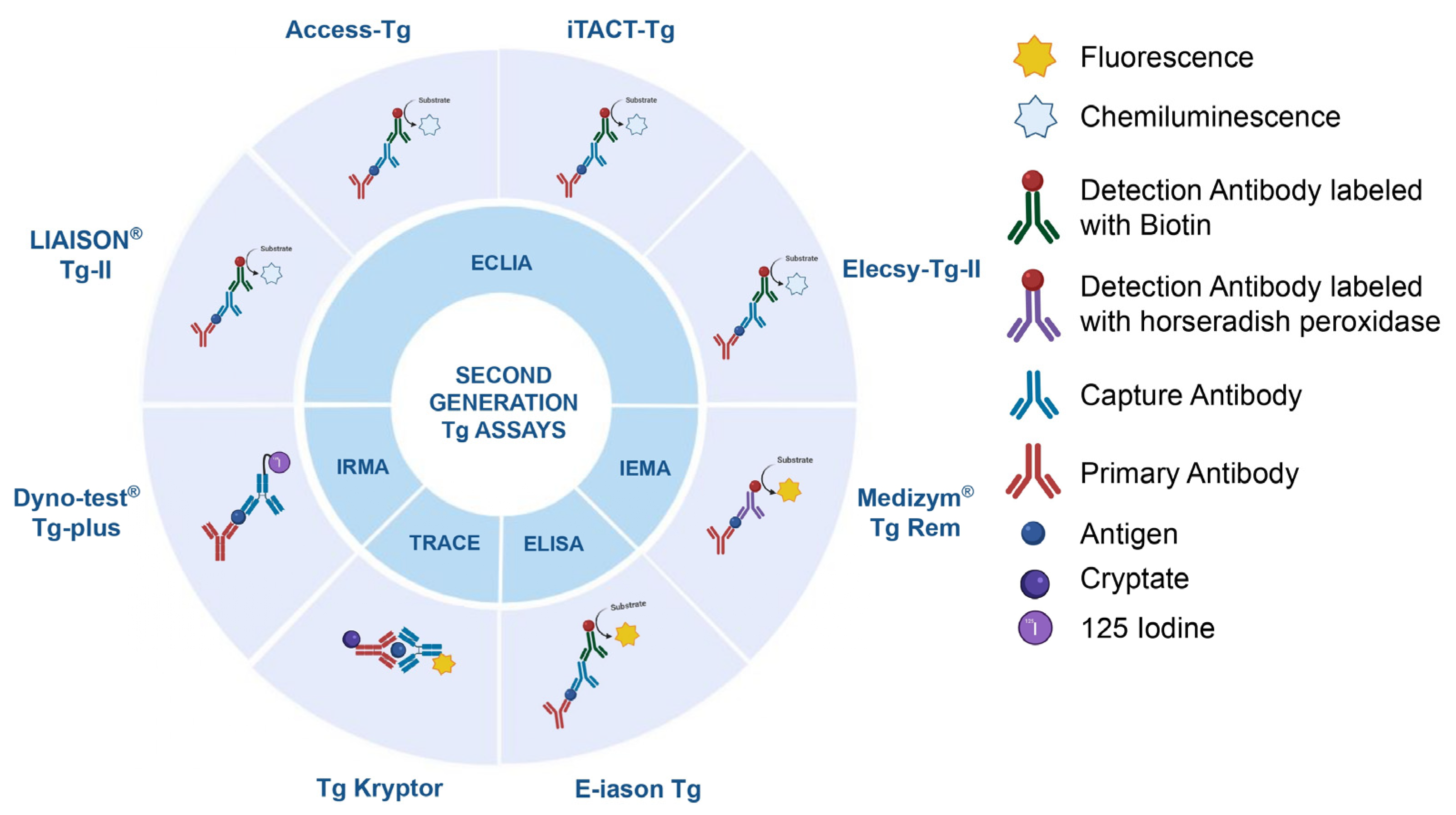
| Year | Kit | Manufacturer | Method | CRM 457 | Sample | LOQ | LOD |
|---|---|---|---|---|---|---|---|
| 2007 [24] | Access Tg | Beckman Coulter, Brea, CA, USA | ECLIA | Yes | Serum | 0.1 ng/mL | NA |
| 2011 [25] | NA | ||||||
| 2012 [26] | 0.01 ng/mL | ||||||
| 2016 [27] | NA | ||||||
| 2018 [28] | 0.05 ng/mL | ||||||
| 2011 [25] | E-iason | Iason, Graz-Seiersberg, Austria | ELISA | Yes | Serum | 0.03–0.04 ng/mL | NA |
| 2011 [22] | Dyno-test ® Tg-plus | BRAHMS GmbH, Hennigsdorf, Germany | IRMA | Yes | Serum | 0.1 ng/mL | 0.05 ng/mL |
| 2016 [27] | Tg-Kryptor | BRAHMS GmbH, Hennigsdorf, Germany | TRACE | Yes | Serum | 0.15 ng/mL | 0.09 ng/mL |
| 2017 [29] | NA | ||||||
| 2019 [30] | NA | ||||||
| 2019 [30] | NA | ||||||
| 2021 [31] | NA | ||||||
| 2022 [32] | NA | ||||||
| 2021 [33] | LIAISON® Tg II | DiaSorin, Saluggia, Italy | ECLIA | Yes | Serum | 0.10 ng/mL | NA |
| 2021 [34] | 0.057 ng/mL | ||||||
| 2021 [34] | Medizym® Tg Rem | Medipan, Blankenfelde-Mahlow, Germany | EIMA | Yes | Serum | 0.09 ng/mL | 0.026 ng/mL |
| 2021 [34] | Elecsy-Tg-II | Roche Diagnostic, Rotkreuz, Switzerland | ECLIA | Yes | Serum | 0.10 ng/mL | 0.04 ng/mL |
| 2023 [35] | NA | ||||||
| 2021 [36] | iTACT-Tg | Fujirebio Inc., Tokyo, Japan | ECLIA | Yes | Serum | 0.03 ng/mL | NA |
| 2023 [37] | Serum, Plasma |
| Year | Antibody Peptide | IS | Sample | Volume | Reference Material | LOD | LLOQ | Additional Method Aspects |
|---|---|---|---|---|---|---|---|---|
| 2008 [12] | Polyclonal (rabbit) anti-VIF | tSIL Peptide | Serum | 100 μL | CRM 457 | 2.6 ng/mL | 2.6 ng/mL | NA |
| 2012 [66] | Polyclonal (chicken) anti-VIF | tSIL Peptide | Serum | 100 μL | NA | 0.3 ng/mL | 0.4 ng/mL | NA |
| 2013 [67] | Polyclonal (rabbit) anti-VIF | cSIL Peptide | Serum and Plasma | 500 μL | NA | 0.25 ng/mL | 0.5 ng/mL | Protein Precipitation |
| 2020 [69] | Monoclonal anti-FSP | cSIL Peptide | Serum | 400 μL | NA | 0.0057 ng/mL | 0.02 ng/mL | Micro-flow chromatography |
| 2022 [73] | Monoclonal anti-FSP | tSIL Peptide | Serum | 400 μL | Husky Ref | NA | 0.1 ng/mL | SISCAPA® Technology |
| 2022 [70] | Monoclonal anti-FSP | tSIL Peptide | Serum | 400 μL | Husky Ref | NA | 0.15 ng/mL | Mobile Phase DMSO-SISCAPA® Technology |
| Vendors | LC System | MS System | SISCAPA® Tg Peptides |
|---|---|---|---|
| Waters Corporation [78] | ACQUITY UPLC I-Class PLUS FL System | Xevo TQ Absolute Mass Spectrometer | FSP |
| Waters Corporation [84] | ACQUITY UPLC M-Class | Xevo TQ-S operating in MRM Mode with Unit Mass Resolution | FSP |
| Sciex [85] | NA | Citrine Triple Quad MS/MS System | FSP |
| Agilent Technologies [86] | Agilent 1290 Infinity LC | Agilent 6490 Triple Quadrupole MS with iFunnel technology | FSP and VIF |
Disclaimer/Publisher’s Note: The statements, opinions and data contained in all publications are solely those of the individual author(s) and contributor(s) and not of MDPI and/or the editor(s). MDPI and/or the editor(s) disclaim responsibility for any injury to people or property resulting from any ideas, methods, instructions or products referred to in the content. |
© 2025 by the authors. Licensee MDPI, Basel, Switzerland. This article is an open access article distributed under the terms and conditions of the Creative Commons Attribution (CC BY) license (https://creativecommons.org/licenses/by/4.0/).
Share and Cite
Monza, N.; Fumagalli, C.; Pagani, L.; Porto, N.S.; Di Nicoli, F.; Chinello, C.; Serrao, S.; Bossi, E.; Nobile, M.; Pagni, F.; et al. Revisiting Thyroglobulin Measurement: Current Methods and Future Perspectives Using Dried Blood Spot Sampling for Enhanced Clinical Practice. Metabolites 2025, 15, 769. https://doi.org/10.3390/metabo15120769
Monza N, Fumagalli C, Pagani L, Porto NS, Di Nicoli F, Chinello C, Serrao S, Bossi E, Nobile M, Pagni F, et al. Revisiting Thyroglobulin Measurement: Current Methods and Future Perspectives Using Dried Blood Spot Sampling for Enhanced Clinical Practice. Metabolites. 2025; 15(12):769. https://doi.org/10.3390/metabo15120769
Chicago/Turabian StyleMonza, Nicole, Claudia Fumagalli, Lisa Pagani, Natalia Shelly Porto, Felisia Di Nicoli, Clizia Chinello, Simone Serrao, Eleonora Bossi, Marta Nobile, Fabio Pagni, and et al. 2025. "Revisiting Thyroglobulin Measurement: Current Methods and Future Perspectives Using Dried Blood Spot Sampling for Enhanced Clinical Practice" Metabolites 15, no. 12: 769. https://doi.org/10.3390/metabo15120769
APA StyleMonza, N., Fumagalli, C., Pagani, L., Porto, N. S., Di Nicoli, F., Chinello, C., Serrao, S., Bossi, E., Nobile, M., Pagni, F., Magni, F., & Denti, V. (2025). Revisiting Thyroglobulin Measurement: Current Methods and Future Perspectives Using Dried Blood Spot Sampling for Enhanced Clinical Practice. Metabolites, 15(12), 769. https://doi.org/10.3390/metabo15120769