


Abstract
This study reports the exclusive and rapid synthesis of twenty-four derivatives of 1-((mono/bis)trifluoromethyl)phenyl-3-(4-arylthiazol-2-yl)thioureas (series 7, 9 and 11), along with their antimicrobial activities against Candida albicans, Mycobacterium smegmatis and seven additional bacterial strains. The anticancer potential of these compounds was evaluated against various human cancer cell lines, including A549 (lung adenocarcinoma), HeLa (cervical carcinoma), IMR32 (neuroblastoma), MCF-7 (breast adenocarcinoma), HCT116 (colon cancer) and DU145 (prostate cancer). Among these, 1-(3,5-bistrifluoromethylphenyl)-3-(thiazol-2-yl)thiourea (7i) and 1-(4-trifluoromethylphenyl)-3-(4-(3-chlorophenyl)thiazol-2-yl)thiourea (11h) demonstrated significant antimicrobial activity against M. luteus, S. aureus, S. aureus 1 and C. albicans. Additionally, 1-(4-(3-chlorophenyl)thiazol-2-yl)-3-(3-trifluoromethylphenyl)thiourea (9g) and 1-(4-trifluoromethylphenyl)-3-(4-(2-fluorophenyl)thiazol-2-yl)thiourea (11g) showed activity against Mycobacterium smegmatis. The bioassay tests indicated that many of the thiourea derivatives exhibited moderate activity against the A549, HeLa, MCF-7 and HCT116 cancer cell lines.
1. Introduction
The increasing mortality rate in humans due to infections caused by multidrug-resistant pathogens is a serious concern [1,2,3]. Immunocompromised patients suffering from cancer and HIV, as well as patients in post-surgery wards, are vulnerable to fungal infections caused by the Candida species, and the incidence of patients being admitted to intensive care units for treatment of sepsis with adequate antibiotics to relieve severe suffering has become common [4,5,6,7]. Tuberculosis (TB) is another prevalent infectious disease, responsible for the premature deaths of over 1.24 million people in 2024, including 150,000 people with HIV [8]. The prolonged period of standard multidrug therapy for TB patients [9,10] often leads to non-compliance with the treatment regimen, leading to the emergence of drug resistance [11]. Similarly, cancer poses an increasing risk of human affliction across the globe and is a serious economic threat to underdeveloped and emerging nations. In order to mitigate the complications associated with the current treatment protocols using the available drugs, it is necessary to identify new anticancer, antibacterial and antifungal agents with alternative mechanisms of action [12,13,14]. In view of this rationale, we have planned to prepare more new molecules containing known pharmacophores for evaluating their anticancer and anti-infective potential.
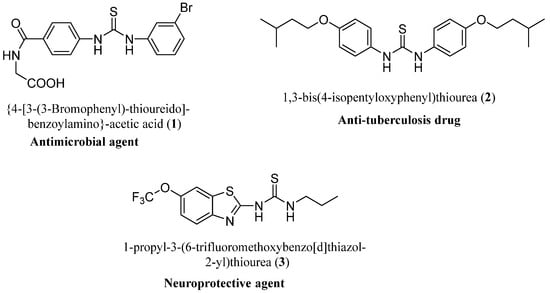
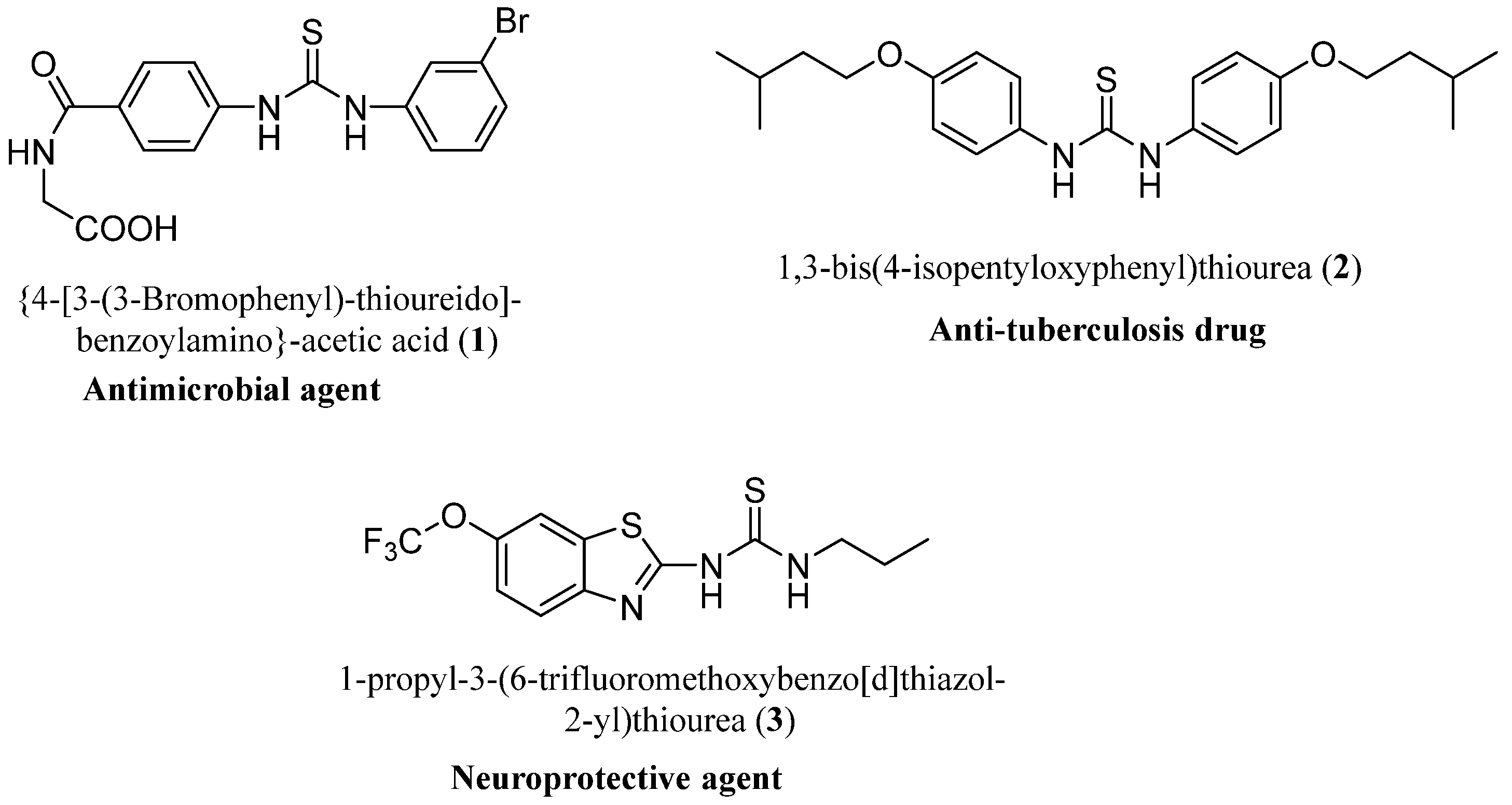
The ubiquitous thiazole motifs are part of many known biologically active natural and synthetic molecules reported as antimicrobial agents (e.g., sulfathiazole) [15,16,17], anticancer agents [18,19,20], antituberculars [21,22,23], human thymidylate synthase (hTS) inhibitors [24], human glucagon receptor antagonists (hGluR) and glucokinase activators [25,26]. The electrostatic potential energy maps of thiazole-thiourea derivatives have been studied [27]. There are numerous methods [28,29,30,31] for the synthesis of thioureas and their significance has been reported. It is also known that several compounds possessing the thiourea structural motif have exhibited a wide range of biological properties, including antimicrobial [32], antifungal [33], antitubercular [34], antimalarial [35], antidiabetic [36], antihypertensive [37], anticancer [38,39] and urease inhibition activities [40]. Some thiourea derivatives are reported to prevent oxidative damage and have the potential to be used as free radical scavengers [41]. The immense pharmacological potential of thiazole-thiourea compounds has prompted us to synthesize several new molecules containing both the pharmacophore units in a single molecular scaffold for evaluating their antimicrobial and antiproliferative activities [42,43,44]. The structures of four known biologically active thioureas, such as 2-{4-(3-(3-bromophenylthioureido)benzamido}acetic acid (1), 1,3-bis(4-isopentyloxyphenyl) thiourea (2), 1-propyl-3-(6-trifluoromethoxybenzo[d]thiazol-2-yl)thiourea (3), are shown in Figure 1.
Figure 1.
Structures of biologically active thioureas (1–3).
Previously, the author of this article reported the anti-inflammatory and antioxidant activity of several 2-(2,4-dioxo-1,3-thizolidin-5-yl)acetamides and anticancer evaluation of 3-aryl-6-phenylimidazo [2,1-b]thiazoles [45,46]. In the present investigation, we have prepared a decent library of fluorine-containing 1-aryl-3-(4-arylthiazol-2-yl)thiourea derivatives and screened them in vitro for their antiproliferative ability and also their antimicrobial potential involving antifungal, antibacterial and antimycobacterial activities.
2. Materials and Methods
2.1. Materials and Instruments
All the reagents and solvents are purchased from Sigma-Aldrich and Alfa Aesar. Solvents are distilled and dried before use. Melting points are determined on the Veego (VMP-MP) melting point apparatus and are uncorrected. Merck 60 F254 silica gel-coated glass sheets are used for thin-layer chromatography and spots are visualized under UV light. Infrared spectra are recorded on a Perkin-Elmer FT-IR 1600 spectrometer. 1H NMR and 13C NMR spectra are recorded on Bruker Avance 300 MHz and Bruker Inova 400 MHz spectrometers with TMS as the internal standard. Chemical shifts (δ) are given in parts per million, and coupling constants are given as absolute values expressed in Hertz. Proton coupling patterns are described as singlet (s), doublet (d), triplet (t), quartet (q), multiplet (m) and broad (br). EI-MS and HRMS are performed with a Jeol AccuTOF™ GCv 4G A time-of-flight mass spectrometer.
2.2. Synthesis
2.2.1. General Procedure for Synthesis of 1-(3,5-Bistrifluoromethylphenyl)-3-(4-arylthiazol-2-yl)urea Derivatives (7a–i)
A mixture of the respective 4-(substituted-phenyl)-1,3-thiazol-2-amine 5 (1.14 mmol), 3,5-bis(trifluoromethyl)phenyl isothiocyanate 6 (1.25 mmol) and anhydrous toluene (5 mL) is taken into a 20 mL pressure tube and stirred at 110 °C for 2–8 h. After completion of the reaction (monitored by TLC), the reaction mixture is cooled to room temperature. The solid obtained is separated by filtration and washed with 3 × 5 mL of ethyl acetate, followed by 3 × 5 mL of methanol to yield the corresponding 1-(3,5-bistrifluoromethylphenyl)-3-(4-arylthiazol-2-yl)thiourea 7 as a pure product.
2.2.2. Spectral Data of Synthesized Compounds (7a–i)
1-(3,5-Bistrifluoromethylphenyl)-3-(4-phenylthiazol-2-yl)thiourea (7a).
Yield 92%; mp 252–254 °C; IR (KBr) cm−1: 3177 (NH), 3031 (Ar-H), 1279 (C=S), 1132 (C-F); 1H NMR (DMSO-d6, 300 MHz) δ (ppm): 7.14 (s, 1H, thiazole-H), 7.33 (t, J = 7.0, 8.0 Hz, 1H, Ar-H), 7.41 (t, J = 7.0 Hz, 2H, Ar-H), 7.66 (s, 1H, Ar-H), 7.79 (d, J = 7.0 Hz, 2H, Ar-H), 8.35 (s, 2H, Ar-H), 11.81 (br s, 1H, NH, D2O exchangeable); 13C NMR (DMSO-d6, 75 MHz) δ (ppm): 106.9, 116.8, 117.6 (CF3, q, 1JCF = 272.8 Hz), 122.5, 125.7, 128.2, 128.6, 129.6 (CF3, q, 2JCF = 33.0 Hz), 141.0, 147.1, 164.8, 178.9; EI-MS (m/z): 447 [M+]; HRMS (EI) calcd for C18H11F6N3S2 [M+]: 447.0298; found: 447.0315.
1-(3,5-Bistrifluoromethylphenyl)-3-(4-(4-(trifluoromethyl)phenyl)thiazol-2-yl)thiourea (7b).
Yield 94%; mp 277–279 °C; IR (KBr) cm−1: 3170 (NH), 3025 (Ar-H), 1287 (C=S), 1123 (C-F); 1H NMR (DMSO-d6, 300 MHz) δ (ppm): 7.20 (s, 1H, thiazole-H), 7.57–7.60 (m, 3H, Ar-H), 7.84 (d, J = 8.0 Hz, 2H, Ar-H), 8.20 (s, 2H, Ar-H), 11.61 (br s, 1H, NH, D2O exchangeable). EI-MS (m/z): 515 [M+]; HRMS (EI) calcd for C19H10F9N3S2 [M+]: 515.01724; found: 515.0190.
1-(3,5-Bistrifluoromethylphenyl)-3-(4-(4-chlorophenyl)thiazol-2-yl)thiourea (7c).
Yield 94%; mp 268–270 °C; IR (KBr) cm−1: 3170 (NH), 3025 (Ar-H), 1287 (C=S), 1123 (C-F), 778 (C-Cl); 1H NMR (DMSO-d6, 300 MHz) δ (ppm): 7.50 (d, J = 8.2 Hz, 2H, Ar-H), 7.60 (s, 1H, thiazole-H), 7.85 (m, 3H, Ar-H), 8.37 (s, 2H, Ar-H), 10.77 (br s, 1H, NH, D2O exchangeable); 13C NMR (DMSO-d6, 75 MHz) δ (ppm): 107.9, 117.2, 119.8 (CF3, q, 1JCF = 273.3Hz), 122.9, 127.4, 128.7, 129.8(CF3, q, 2JCF = 32.6 Hz), 132.6, 140.8, 147.2, 168.9 177.0; EI-MS (m/z): 481[M+]; HRMS (EI) calcd for C18H10Cl F6 N3S2 [M+]: 481.9987; found: 481.9977.
1-(3,5-Bistrifluoromethylphenyl)-3-(4-(4-bromophenyl)thiazol-2-yl)thiourea (7d).
Yield 90%; mp 272–274 °C; IR (KBr) cm−1: 3173 (NH), 3031 (Ar-H), 1284 (C=S), 1124 (C-F), 696 (C-Br); 1H NMR (DMSO-d6, 300 MHz) δ (ppm): 7.24 (s, 1H, thiazole-H), 7.52 (d, J = 8.3 Hz, 2H, Ar-H), 7.66 (s, 1H, Ar-H), 7.71 (d, J = 8.1 Hz, 2H, Ar-H), 8.32 (s, 2H, Ar-H); 13C NMR (DMSO-d6, 75 MHz) δ (ppm): 106.2, 117.2, 119.0 (CF3, q, 1JCF = 272.4 Hz), 121.0, 122.2, 126.6, 130.3, 130.6, 130.9, 131.9, 139.7, 148.1, 168.1, 176.3; EI-MS (m/z): 524 [M+]; HRMS (EI) calcd for C18H10 BrF6N3S2 [M+]: 524.9403; found: 524.9410.
1-(3,5-Bistrifluoromethylphenyl)-3-(4-(4-iodophenyl)thiazol-2-yl)thiourea (7e).
Yield 91%; mp 266–268 °C; IR (KBr) cm−1: 3175 (NH), 3031 (Ar-H), 1285 (C=S), 1124 (C-F), 650 (C-I); 1H NMR (DMSO-d6, 300 MHz) δ (ppm): 7.16 (s, 1H, thiazole-H), 7.49–7.54 (m, 2H, Ar-H), 7.57 (s, 1H, Ar-H), 7.64–7.67 (m, 2H, Ar-H), 8.20 (s, 2H, Ar-H). EI-MS (m/z): 572 [M+]; HRMS (EI) calcd for C18H10F6IN3S2 [M+]: 572.9265; found: 572.9269.
1-(3,5-Bistrifluoromethylphenyl)-3-(4-(2-chlorophenyl)thiazol-2-yl)thiourea (7f).
Yield 92%; mp 182–184 °C; IR (KBr) cm−1: 3178 (NH), 3034 (Ar-H), 1280 (C=S), 1124 (C-F), 737 (C-Cl); 1H NMR (DMSO-d6, 300 MHz) δ (ppm): 7.33–7.36 (m, 3H, thiazole-H merged, Ar-H), 7.48 (d, J = 7.1 Hz,1H, Ar-H), 7.64 (s, 1H, Ar-H), 7.74 (d, J = 6.12 Hz, 1H, Ar-H), 8.34 (s, 2H, Ar-H), 11.78 (br s, 1H, NH, D2O exchangeable). EI-MS (m/z): 481 [M+]; HRMS (EI) calcd for C18H10Cl F6 N3S2 [M+]: 481.9987; found: 481.9977.
1-(3,5-Bistrifluoromethylphenyl)-3-(4-(2-fluorophenyl)thiazol-2-yl)thiourea (7g).
Yield 90%; mp 208–210 °C; IR (KBr) cm−1: 3176 (NH), 3033 (Ar-H), 1279 (C=S), 1130 (C-F); 1H NMR (DMSO-d6, 300 MHz) δ (ppm): 7.25–7.31 (m, 2H, thiazole-H, Ar-H), 7.40–7.48 (m, 1H, Ar-H), 7.55 (s, 1H, Ar-H), 7.87 (s, 1H, Ar-H), 8.03–8.09 (m, 1H, Ar-H), 8.55 (s, 2H, Ar-H), 11.57 (br s, 1H, NH, D2O exchangeable). EI-MS (m/z): 465 [M+]; HRMS (EI) calcd for C18H10F7N3S2 [M+]: 465.0204; found: 465.0187.
1-(3,5-Bistrifluoromethylphenyl)-3-(4-(2-tolyl)thiazol-2-yl)thiourea (7h).
Yield 93%; mp 170–172 °C; IR (KBr) cm−1: 3183 (NH), 3035 (Ar-H), 1278 (C=S), 1125 (C-F); 1H NMR (DMSO-d6, 300 MHz) δ (ppm): 6.75 (s, 1H, thiazole-H), 7.17–7.20 (m, 3H, Ar-H), 7.43–7.45 (m, 1H, Ar-H), 7.53 (s, 1H, Ar-H), 8.20 (s, 2H, Ar-H), 11.48 (br s, NH, D2O exchangeable). EI-MS (m/z): 461 [M+]; HRMS (EI) calcd for C19H13F6N3S2 [M+]: 461.0455; found: 461.0457.
1-(3,5-Bistrifluoromethylphenyl)-3-(thiazol-2-yl)thiourea (7i).
Yield 93%; mp 168–170 °C; IR (KBr) cm−1: 3170 (NH), 3025 (Ar-H), 1287 (C=S), 1123 (C-F); 1H NMR (DMSO-d6, 300 MHz) δ (ppm): 7.02 (d, J = 4.4 Hz, 1H, thiazole-H), 7.51 (d, J = 4.4 Hz, 1H, thiazole-H), 7.65 (s, 1H, Ar-H), 8.46 (s, 2H, Ar-H) 10.52 (br s, 1H, NH, D2O exchangeable). EI-MS (m/z): 370 [M+]; HRMS (EI) calcd for C12H7F6N3S2 [M+]: 370.9985; found: 370.9998.
2.2.3. General Procedure for the Synthesis of 1-(3-Trifluoromethylphenyl)-3-(4-(substituted-phenyl)thiazol-2-yl)thiourea (9a–g)
A mixture of 3-(trifluoromethyl)phenyl isothiocyanate 8 (1.25 mmol), along with the respective 4-(substituted-phenyl)-1,3-thiazol-2-amine 5 (1.14 mmol) in anhydrous toluene (5 mL), is taken into a 20 mL pressure tube and heated under stirring at 110 °C for 2–8 h. After completion of the reaction, indicated by disappearance of starting material on TLC, the reaction mixture is cooled to room temperature and the precipitated product is filtered off, washed with 3 × 5 mL of ethyl acetate followed by another 3 × 5 mL of methanol to yield the corresponding 1-(3-trifluoromethylphenyl)-3-(4-(substituted-phenyl)thiazol-2-yl)thiourea 9 as pure product.
2.2.4. Spectral Data of Synthesized Compounds (9a–g)
1-(3-Trifluoromethylphenyl)-3-(4-phenylthiazol-2-yl)thiourea (9a).
Yield 80%; mp 250–252 °C; IR (KBr) cm−1: 3177 (NH), 3024 (Ar-H), 1220 (C=S), 1128 (C-F); 1H NMR (DMSO-d6, 300 MHz) δ (ppm): 7.32–7.35 (m, 2H, thiazole-H merged, Ar-H), 7.42–7.45 (m, 4H, Ar-H), 7.50 (s, 1H, Ar-H), 7.92–8.01 (m, 3H, Ar-H) 11.70 (br s, 1H, NH, D2O exchangeable). EI-MS (m/z): 379 [M+]; HRMS (EI) calcd for C17H12F3N3S2 [M+]: 379.0424; found: 379.0438.
1-(3-Trifluoromethylphenyl)-3-(4-(4-trifluoromethylphenyl)thiazol-2-yl)thiourea (9b).
Yield 73%; mp 277–279 °C; IR (KBr) cm−1: 3171 (NH), 3021 (Ar-H), 1222 (C=S), 1131 (C-F); 1H NMR (DMSO d6+Acetone-d6, 300 MHz) δ (ppm): 7.80–7.86 (m, thiazole-H merged, 5H, Ar-H), 8.23–8.26 (d, J = 8.0 Hz, 4H, Ar-H), 11.64 (br s, 1H, NH, D2O exchangeable). EI-MS (m/z): 447 [M+]; HRMS (EI) calcd for C18H11F6N3S2 [M+]: 447.0298; found: 447.0278.
1-(4-(4-Chlorophenyl)thiazol-2-yl)-3-(3-trifluoromethylphenyl)thiourea (9c).
Yield 76%; mp 256–258 °C; IR (KBr) cm-1: 3167 (NH), 3022 (Ar-H), 1229 (C=S), 1158 (C-F), 736 (C-Cl); 1H NMR (DMSO-d6, 300 MHz) δ (ppm): 7.52–7.55 (m, 4H, thiazole-H merged, Ar-H), 7.73 (s, 1H, Ar-H), 7.95–7.97 (m, 4H, Ar-H), 11.91 (br s, 1H, NH, D2O exchangeable). EI-MS (m/z): 413 [M+]; HRMS (EI) calcd for C17H11ClF3N3S2 [M+]: 413.0035; found: 413.0031.
1-(3-Trifluoromethylphenyl)-3-(4-(4-fluorophenyl)thiazol-2-yl)thiourea (9d).
Yield 75%; mp 252–254 °C; IR (KBr) cm−1: 3171 (NH), 3018 (Ar-H), 1226 (C=S), 1160 (C-F); 1H NMR (DMSO-d6, 300 MHz) δ (ppm): 7.29–7.35 (m, 4H, thiazole-H merged, Ar-H), 7.65 (s, 1H, Ar-H), 7.96–8.01 (m, 4H, Ar-H), 11.72 (br s, 1H, NH, D2O exchangeable). EI-MS (m/z): 397 [M+]; HRMS (EI) calcd for C17H11F4N3S2 [M+]: 397.0330; found: 397.0324.
1-(3-Trifluoromethylphenyl)-3-(4-(2-tolyl)thiazol-2-yl)thiourea (9e).
Yield 84%; mp 192–194 °C; IR (KBr) cm−1: 3165 (NH), 3018 (Ar-H), 1248 (C=S), 1164 (C-F); 1H NMR (DMSO-d6, 300 MHz) δ (ppm): 2.46 (s, 3H), 6.82 (s, 1H, thiazole-H), 7.22–7.30 (m, 5H, Ar-H), 7.42–7.54 (m, 3H, Ar-H), 10.30 (br s, 1H, NH, D2O exchangeable). EI-MS (m/z): 393 [M+]; HRMS (EI) calcd for C18H14F3N3S2 [M+]: 393.0581; found: 393.0583.
1-(3-Trifluoromethylphenyl)-3-(4-(3-trifluoromethylphenyl)thiazol-2-yl)thiourea (9f).
Yield 71%; mp 234–236 °C; IR (KBr) cm−1: 3174 (NH), 3025 (Ar-H), 1235 (C=S), 1158 (C-F); 1H NMR (DMSO-d6, 300 MHz) δ (ppm): 7.58–7.74 (m, 5H, thiazole-H merged, Ar-H), 8.12–8.25 (m, 4H, Ar-H), 11.74 (br s, 1H, NH, D2O exchangeable). EI-MS (m/z): 447 [M+]; HRMS (EI) calcd for C18H11F6N3S2 [M+]: 447.0298; found: 447.0289.
1-(4-(3-Chlorophenyl)thiazol-2-yl)-3-(3-trifluoromethylphenyl)thiourea (9g).
Yield 72%; mp 252–254 °C; IR (KBr) cm−1: 3177 (NH), 3031 (Ar-H), 1279 (C=S), 1132 (C-F), 730 (C-Cl); 1H NMR (DMSO-d6, 300 MHz) δ (ppm): 7.42–7.53 (m, 4H, thiazole-H merged, Ar-H), 7.87 (s, 1H, Ar-H), 7.95 (d, J = 6.9 Hz, 2H, Ar-H), 8.04 (s, 2H), 12.13 (br s, 1H, NH, D2O exchangeable). EI-MS (m/z): 413 [M+]; HRMS (EI) calcd for C17H11ClF3N3S2 [M+]: 413.0035; found: 413.0031.
2.2.5. General Procedure for the Synthesis of 1-(4-Trifluoromethylphenyl)-3-(4-(substituted-phenyl)thiazol-2-yl)thiourea (11a–h)
A mixture of 4-trifluoromethylphenyl isothiocyanate 10 (1.25 mmol) along with the corresponding 4-(substituted-phenyl)-1,3-thiazol-2-amine 5 (1.14 mmol) in anhydrous toluene (5 mL) taken in a 20 mL pressure tube is stirred under heating at 110 °C for 2–8 h. After the consumption of starting material (monitored by TLC), the reaction mixture is cooled to room temperature and the solid product obtained is filtered off, washed with 3 × 5 mL of ethyl acetate followed by another 3 × 5 mL of methanol to yield the respective 1-(4-trifluoromethylphenyl)-3-(4-(substituted-phenyl)thiazol-2-yl)thiourea (11) in pure form.
2.2.6. Spectral Data of Synthesized Compounds (11a–h)
1-(4-Trifluoromethylphenyl)-3-(4-phenylthiazol-2-yl)thiourea (11a).
Yield 78%; mp 220–222 °C; IR (KBr) cm−1: 3171 (NH), 3020 (Ar-H), 1263 (C=S), 1165 (C-F); 1H NMR (DMSO-d6, 300 MHz) δ (ppm): 7.28–7.44 (m, 5H, thiazole-H overlapped with Ar-H), 7.58 (d, J = 7.7 Hz, 1H, Ar-H), 7.78 (m, 2H, Ar-H), 7.91 (d, J = 7.7 Hz, 2H, Ar-H), 11.68 (br s, 1H, NH, D2O exchangeable). EI-MS (m/z): 379 [M+]; HRMS (EI) calcd for C18H11F6N3S2 [M+]: 379.0424; found: 379.0431.
1-(4-Trifluoromethylphenyl)-3-(4-(4-trifluoromethylphenyl)thiazol-2-yl)thiourea (11b).
Yield 72%; mp 278–280 °C; IR (KBr) cm−1: 3168 (NH), 3019 (Ar-H), 1221 (C=S), 1131 (C-F); 1H NMR (DMSO-d6+Acetone-d6, 300 MHz) δ (ppm): 7.80 (d, 8.1 Hz, 4H, Ar-H), 7.87 (s, thiazole-H, 1H), 8.22 (d, J = 8.1 Hz, 4H, Ar-H). EI-MS (m/z): 447 [M+]; HRMS (EI) calcd for C18H11F6N3S2 [M+]: 447.0298; found: 447.0282.
1-(4-(4-Chlorophenyl)thiazol-2-yl)-3-(4-trifluoromethylphenyl)thiourea (11c).
Yield 74%; mp 252–254 °C; IR (KBr) cm−1: 3163 (NH), 3003 (Ar-H), 1256 (C=S), 1169 (C-F); 1H NMR (DMSO-d6, 300 MHz) δ (ppm): 7.52 (d, J = 8.2 Hz, 4H, Ar-H), 7.70 (s, 1H, thiazole-H), 7.94 (d, J = 8.2 Hz, 4H, Ar-H), 12.22 (br s, 1H, NH, D2O exchangeable); 13C NMR (DMSO-d6+CDCl3, 75 MHz) δ (ppm): 105.6, 120.7 (CF3, q, J = 271.2 Hz), 121.0, 124.0, 125.6, 127.1, 131.5, 140.6, 149.8, 168.1, 176.1; EI-MS (m/z): 413 [M+]; HRMS (EI) calcd for C17H11ClF3N3S2 [M+]: 413.0035; found: 413.0024.
1-(4-Trifluoromethylphenyl)-3-(4-(4-fluorophenyl)thiazol-2-yl)thiourea (11d).
Yield 73%; mp 257–259 °C; IR (KBr) cm−1: 3177 (NH), 3015 (Ar-H), 1254 (C=S), 1170 (C-F); 1H NMR (DMSO-d6+Acetoned6, 300 MHz) δ (ppm): 7.27–7.33 (m, 4H, Ar-H), 7.65 (s, thiazole-H, 1H), 8.03–8.07 (m, 4H) 11.90 (br s, 1H, NH, D2O exchangeable). EI-MS (m/z):397 [M+]; HRMS (EI) calcd for C17H11F4N3S2 [M+]: 397.0330; found: 397.0343.
1-(4-(4-Ethylphenyl)thiazol-2-yl)-3-(4-trifluoromethylphenyl)thiourea (11e).
Yield 78%; mp 232–234 °C; IR (KBr) cm−1: 3163 (NH), 3004 (Ar-H), 1261 (C=S), 1172 (C-F); 1H NMR (DMSO-d6, 300 MHz) δ (ppm): 1.22–1.28 (m, 3H, CH3), 2.63–2.71 (m, 2H, CH2), 7.11 (s, 1H, thiazole-H), 7.24 (d, J = 7.9 Hz, 2H, Ar-H), 7.62–7.78 (m, 4H, Ar-H), 7.94 (d, J = 7.9 Hz, 2H, Ar-H). EI-MS (m/z): 407 [M+]; HRMS (EI) calcd for C19H16F3N3S2 [M+]: 407.0737; found: 407.0745.
1-(4-Trifluoromethylphenyl)-3-(4-(3-(trifluoromethyl)phenyl)thiazol-2-yl)thiourea (11f).
Yield 73%; mp 220–222 °C; IR (KBr) cm−1: 3167 (NH), 3019 (Ar-H), 1263 (C=S), 1132 (C-F); 1H NMR (DMSO-d6, 300 MHz) δ (ppm): 7.35 (s, 1H, thiazole-H), 7.58–7.65 (m, 4H), 7.72 (s, 1H, Ar-H), 7.93 (d, J = 8.1 Hz, 2H, Ar-H), 8.15 (s, 1H, Ar-H), 11.76 (br s, 1H, NH, D2O exchangeable). EI-MS (m/z): 447 [M+]; HRMS (EI) calcd for C18H11F6N3S2 [M+]: 447.0298; found: 447.0311.
1-(4-Trifluoromethylphenyl)-3-(4-(2-fluorophenyl)thiazol-2-yl)thiourea (11g).
Yield 74%; mp 251–253 °C; IR (KBr) cm−1: 3165 (NH), 3019 (Ar-H), 1217 (C=S), 1172 (C-F); 1H NMR (DMSO-d6, 300 MHz) δ (ppm): 7.16–7.23 (m, 2H, Ar-H), 7.29–7.44 (m, 6H), 7.69 (s, 1H, thiazole-H); EI-MS (m/z): 397 [M+]; HRMS (EI) calcd for C17H11F4N3S2 [M+]: 397.0330; found: 397.0311.
1-(4-(3-Chlorophenyl)thiazol-2-yl)-3-(4-trifluoromethylphenyl)thiourea (11h).
Yield 73%; mp 230–232 °C; IR (KBr) cm−1: 3167 (NH), 3022 (Ar-H), 1227 (C=S), 1171 (C-F), 730 (C-Cl); 1H NMR (DMSO-d6, 300 MHz) δ (ppm): 7.23–7.35 (m, 3H, thiazole-H overlapped with Ar-H), 7.49–7.92 (m, 6H, Ar-H) 11.92 (br s, 1H, NH, D2O exchangeable); 13C NMR (DMSO-d6, 75 MHz) δ (ppm): 109.2, 119.0 (CF3, q, J = 270.6 Hz) 122.9, 124.1, 125.2, 125.6, 127.8, 130.5, 133.6, 142.9, 144.3, 168.9, 179.6; EI-MS (m/z): 413 [M+]; HRMS (EI) calcd for C17H11ClF3N3S2 [M+]: 413.0035; found: 413.0045.
2.3. Pharmacology
2.3.1. Experiments In Vitro
In the in vitro assays, each experiment is performed at least in triplicate, and the standard deviation of absorbance is less than 10% of the mean.
2.3.2. Antimicrobial Assay
The antimicrobial activity of the synthesized compounds is determined using the well diffusion method [47] against different pathogenic bacteria and Candida strains procured from the Microbial Type Culture Collection and Gene Bank (MTCC), CSIR-Institute of Microbial Technology, Chandigarh, India. The pathogenic reference strains are seeded on the surface of the media Petri plates, containing Muller–Hinton agar with 0.1 mL of previously prepared microbial suspensions individually containing 1.5 × 10⁸ cfu mL−1 (equal to 0.5 McFarland). Wells of 6.0 mm diameter are prepared in the media plates using a cork borer, and the synthesized thiourea derivatives dissolved in 10% DMSO at a dose range of 125–0.97 µg are added to each well under sterile conditions in a laminar air flow chamber. Standard antibiotic solutions of ciprofloxacin (bacterial strains) and miconazole (Candida strains) at a dose range of 125–0.97 µg well−1 served as positive controls, while the well containing DMSO served as a negative control. The plates are incubated for 24 h at 30 °C, and the well containing the least concentration showing the inhibition zone is considered the minimum inhibitory concentration. All experiments are carried out in triplicates and mean values are represented.
2.3.3. Antimycobacterial Assay
The test compounds are dissolved in DMSO/DMF and stock solutions are prepared. Micro dilution plates are prepared by serial dilutions of each compound directly on the plate. Mycobacterium smegmatis cells (1 × 10⁶ cells/well) are seeded and the plates are incubated at 37 °C [48]. After 24–36 h of incubation, 20 μL of 5 mg/mL MTT is added to each well and incubated for 4 h. The plates are centrifuged at 4000 rpm for 10 min, and the supernatant from each well is discarded. A total of 150 μL of dimethyl sulfoxide (DMSO) is added and the formazan crystals are dissolved. The absorbance is measured using a microplate reader (BioTek, Winooski, VT, USA) at a wavelength of OD 540 nm.
2.3.4. Cell Cultures, Maintenance and Anti-Proliferative Evaluation
The cell lines, A549, HeLa, IMR32, MCF-7, HCT116 and DU145, which are used in this study, are procured from American Type Culture Collection (ATCC), United States. The synthesized test compounds are evaluated for their in vitro antiproliferative activity in these four different human cancer cell lines. A protocol of 48 h of continuous drug exposure is used, and a SRB cell proliferation assay [49] is used to estimate cell viability or growth. All the cell lines are grown in Dulbecco’s modified Eagle’s medium (containing 10% FBS in a humidified atmosphere of 5% CO2 at 37 °C). Cells are trypsinized when sub-confluent from T25 flasks/60 mm dishes and seeded in 96-well plates in 100 μL aliquots at plating densities depending on the doubling time of individual cell lines. The microtiter plates are incubated at 37 °C, 5% CO2, 95% air and 100% relative humidity for 24 h prior to the addition of experimental drugs and are incubated for 48 h with different doses (0.01, 0.1, 1, 10, 100 µM) of prepared derivatives. After 48 h incubation at 37 °C, cell monolayers are fixed by the addition of 10% (wt/vol) cold trichloroacetic acid and incubated at 4 °C for 1 h and are then stained with 0.057% SRB dissolved in 1% acetic acid for 30 min at room temperature. Unbound SRB is washed with 1% acetic acid. The protein-bound dye is dissolved in a 10 mM Tris base solution for OD determination at 510 nm using a microplate reader (EnSpire, Perkin Elmer, Springfield, IL, USA). Using the seven absorbance measurements [time zero, (Tz), control growth, (C) and test growth in the presence of drug at the five concentration levels (Ti)], the percentage growth is calculated at each of the drug concentration levels. Percentage growth inhibition is calculated as follows:
- [(Ti − Tz)/(C − Tz)] × 100 for concentrations for which Ti >/= Tz.
- [(Ti − Tz)/Tz] × 100 for concentrations for which Ti < Tz.
Three dose–response parameters are calculated for each experimental agent. Growth inhibition of 50% (GI50) is calculated from [(Ti − Tz)/(C − Tz)] × 100 = 50, which is the drug concentration resulting in a 50% reduction in the net protein increase (as measured by SRB staining) in control cells during the drug incubation. The drug concentration resulting in total growth inhibition (TGI) is calculated from Ti = Tz. The IC50 (concentration of drug resulting in a 50% reduction in the measured protein at the end of the drug treatment as compared to that at the beginning) indicates a net loss of cells following treatment, which is calculated from [(Ti − Tz)/Tz] × 100 = −50. Values are calculated for each of these three parameters if the level of activity is reached; however, if the effect is not reached or is exceeded, the value for that parameter is expressed as greater or less than the maximum or minimum concentration tested.
3. Results and Discussion
3.1. Chemistry
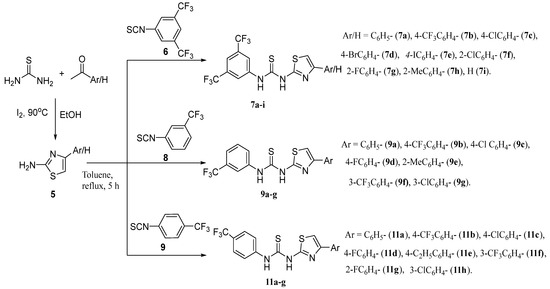
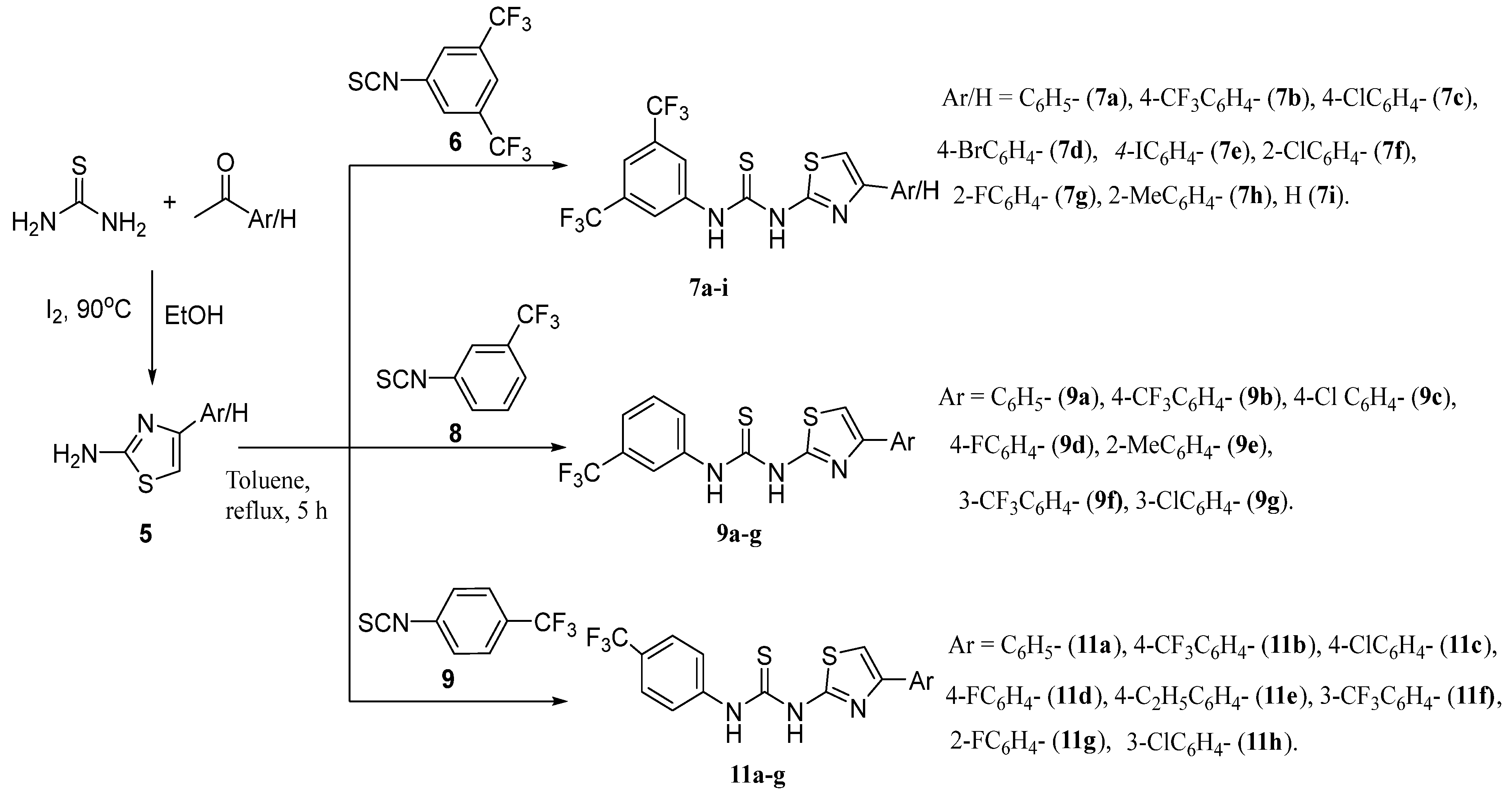
Initially, the required 2-amino-4-arylthiazoles (5) were prepared by a known protocol [38,39] involving condensation and iodine-catalyzed cyclisation of thiourea with the corresponding acetophenones at 100 °C for 8 h. The thiazol-2-amine and 4-aryl-thiazol-2-amines (5) thus obtained were individually reacted with 3, 5-bis(trifluoromethyl)phenyl isothiocyanate (6) in dry toluene, while stirring under reflux conditions to obtain the corresponding 1-{3,5-bis(trifluoromethyl)phenyl}-3-(4-substituted-thiazol-2-yl)urea derivatives (7a–i) in excellent yield. Similar nucleophilic addition reaction of the individual 2-amino-4-arylthiazoles (5) with 3-trifluoromethylphenyl isothiocyanate (8) has afforded the respective 1-(3-trifluoromethylphenyl)-3-(4-arylthiazol-2-yl)thiourea derivatives (9a–g) in 71–84% yield. The individual reaction of thiazol-2-amines 5 with 4-(trifluoromethyl)phenyl isothiocyanate (10) in refluxing dry toluene has resulted in the formation of 1-(4-trifluoromethylphenyl)-3-(4-arylthiazol-2-yl)thiourea derivatives (11a–h) in 72–78% yield. The exclusive formation of the respective thioureas in all these nucleophilic addition reactions has avoided chromatographic separation of possible side products. The general synthetic pathway and list of the prepared N-thiazolyl-thiourea derivatives 7a–i, 9a–g and 11a–h are depicted in Scheme 1. Molecular structures and physical characteristics of target compounds are presented in Table S1 in S.I.
Scheme 1.
Synthesis of thiazolyl-thiourea derivatives 7a–i, 9a–g and 11a–h.
3.2. Biology
3.2.1. Antimicrobial Activity
All the newly synthesized thioureas (7a–i, 9a–g and 11a–h) were screened for their antibacterial and antifungal activity against M. luteus, S. aureus, S. aureus1, B. subtilis, E. coli, P. aeruginosa, K. planticola and C. albicans, using the agar well diffusion method. The results of the antimicrobial study for only the active compounds are presented in Table 1. These results indicate that 1-(3,5-bistrifluoromethylphenyl)-3-(thiazol-2-yl)thiourea (7i), 1-(3-trifluoromethylphenyl)-3-(4-phenyl thiazol-2-yl)thiourea (9a), 1-(4-trifluoromethylphenyl)-3-(4-(4-trifluoromethylphenyl)thiazol-2-yl)thiourea (11b), 1-(4-trifluoromethylphenyl)-3-(4-(4-ethylphenyl) thiazol-2-yl) thiourea (11e) and 1-(4-trifluoromethylphenyl)-3-(4-(3-chlorophenyl)thiazol-2-yl)thiourea (11h) have shown moderate to significant activity against all the tested bacterial strains with MIC values ranging from 3.9 to 31.2 µg mL−1.
Table 1.
In vitro antibacterial and antifungal activities of the thioureas and standards (MIC µg mL−1) a.
The compounds 7i and 11h turned out to be the best among all the thioureas with MIC values of 3.9 µg mL−1 against the Gram-positive bacterial strains of Micrococcus luteus, Staphylococcus aureus and Staphylococcus aureus. Their antifungal activity against Candida albicans is equivalent to micanazole, a standard drug, with an MIC value of 7.8 µg mL−1. Compound 11h is also active against Escherichia coli (MIC value: 7.8 µg mL−1). 1-(3,5-Bistrifluoromethylphenyl)-3-(4-p-iodophenylthiazol-2-yl)thiourea (7e) is moderately active against Staphylococcus aureus1 and Klebsiella planticola, while 1-(3-trifluoromethylphenyl)-3-(4-(3-chlorophenyl)thiazol-2-yl)thiourea (9g) is moderately active against Bacillus subtilis and Pseudomonas aeruginosa with an MIC value of 31.2 µg mL−1.
3.2.2. Antimycobacterial Activity
The individual target compounds (7a–i), (9a–g) and (11a–h) were dissolved in DMSO and their antituberculosis activity against Mycobacterium smegmatis was determined by MTT assay, employing Kanamycin as a positive control. It is observed that only six compounds, viz., 3-(4-(2-tolyl)thiazol-2-yl) -(9e), 3-(4-(3-trifluoromethylphenyl)thiazol-2-yl)- (9f) and 3-(4-(3-chlorophenyl)thiazol-2-yl)- (9g) substituted 1-(3-trifluoromethylphenyl)thiourea compounds and the 1-(4-trifluoromethylphenyl)thioureas 11f–h having 3-(4-(3-trifluoromethylphenyl)thiazol-2-yl)- (11f), 3-(4-(2-fluorophenyl)thiazol-2-yl)- (11g) and 3-(4-(3-chlorophenyl)thiazol-2-yl)- (11h) substituents were found to have IC50 values of <250 µg mL−1. The antimycobacterial activity data for these thioureas, in terms of their IC50 values is presented in Table 2.
Table 2.
In vitro antituberculosis activity of the thiourea derivatives 9e–g and 11f–h.
It is interesting to note that only the thioureas containing (mono-trifluoromethyl)phenyl- group on one N-atom and 4-(2/3-substituted-phenyl)thiazol-2-yl- moiety on the other N-atom of thiourea exhibited reasonable antimycobacterial activity. Particularly, the 1-trifluoromethylphenyl-3-(thiazol-2-yl)thiourea derivatives having 3-chlorophenyl- (9g) or 2-fluorophenyl- substituent (11g) at 4-position of the thiazole ring possessed significant antitubercular activity with IC50 values of 71 and 76 µg mL−1, respectively, which are comparable to the IC50 of 35 µg mL−1 obtained for the kanamycin drug under similar conditions. The compounds 9e and 11f have shown moderate activity. The 1-(3,5-bistrifluoromethyl)phenyl-3-(4-arylthiazol-2-yl)thiourea derivatives (7a–i) and the 1- trifluoromethylphenyl-3-(4-(4-substituted-phenyl)thiazol-2-yl)thiourea compounds (9a–d and 11a–e) are inactive.
3.2.3. Anti-Proliferative Activity
All the twenty-four synthesized thioureas derivatives were assayed for their anticancer potential against six cell lines comprising A549 (human lung adenocarcinoma epithelial cells), HeLa (human cervical carcinoma cells), IMR32 (human neuroblastoma cells), MCF-7 (human breast adenocarcinoma cells), HCT116 (human colon cancer cells) and DU145 (human prostate cancer cells), using doxorubicin and combretastatin as a standard drugs for comparison. The IC50 data generated with respect to these compounds and the standards are listed in Table 3. Most of the synthesized compounds exerted poor to moderate anti-tumor effects against all six human cancer cell lines. The 1-(3,5-bistrifluoromethylphenyl)-3-(thiazol-2-yl)thiourea (7i) and its analogs containing 4-phenyl- (7a), 4-(4-trifluorophenyl)- (7b), 4-(4-chlorophenyl)- (7c), 4-(4-bromophenyl- (7d), 4-(4-iodophenyl- (7e), 4-(2-chlorophenyl)- (7f), 4-(2-fluorophenyl)- (7g) and 4-(2-tolyl)- (7h) substituent on the thiazole ring exhibited moderate antiproliferative activity against human lung adenocarcinoma epithelial, HeLa, breast adenocarcinoma and colon cancer cells with IC50 values closer to 25 µM. In general, the 1-(3,5-bistrifluoromethylphenyl)-thiourea compounds (7a–i) are more active than the 1-(3/4-trifluoromethylphenyl)-thiourea derivatives (9 and 11). Within the 1-monotrifluoromethylphenyl-thioureas (9a–g and 11a–h), 4-(4-substituted-phenyl)thiazol-2-yl- compounds (9a–d and 11a–e) have shown relatively poor activity in comparison to their analogs containing 4-(3-substituted-phenyl)thiazol-2-yl- moiety (9e–g and 11f–h). Compound 11g has exhibited more affinity to HeLa cells (IC50 = 17 µM), while 11h has shown moderate activity to neuroblastoma and prostate cancer cells.
Table 3.
Anti-proliferative ability of newly synthesized thiourea compounds 7a–i, 9a–g and 11a–h.
3.2.4. Structure–Activity Relationship
The combination of a thiazole ring with a thiourea pharmacophore provides a favorable framework for biological activity, enabling multiple intermolecular interactions with microbial targets. The structure–activity relationship analyses highlight the importance of lipophilic and electron-withdrawing substituents on the thiazole ring, which improve membrane penetration and target engagement. Enhanced antifungal potency has been correlated with aromatic substitution patterns and increased lipophilicity, suggesting that membrane interaction and inhibition of sterol biosynthesis-related enzymes may contribute to their mechanism of action. The incorporation of a trifluoromethyl group (CF3) generally increases the lipophilicity of a molecule. The trifluoromethyl (CF3) group is a privileged substituent in drug design, offering benefits that extend well beyond increased lipophilicity. Its strong electron-withdrawing nature modulates acidity and enhances target binding, while its metabolic robustness improves in vivo stability. CF3 also influences molecular conformation and engages in unique polar-hydrophobic interactions, contributing to better potency, selectivity and resistance mitigation. These multifaceted effects explain its frequent use in antimicrobial and antitubercular agents. This property is widely exploited in the pharmaceutical industry to optimize drug candidates. Our new series of thiazolyl thiourea was designed to meet these rules.
From the class of Compounds 7a–i, containing the thiourea substituted by a 3,5-bis(trifluoromethyl)phenyl, 7i, unsubstituted on the thiazole ring, has exhibited significant antimicrobial/antifungal activity, suggesting that a lower molecular weight increases the antimicrobial/antifungal activity. From the class of compounds 9a–g and 11a–h, containing the thiourea substituted by a 3-trifluoromethylphenyl, respectively, 4-trifluromethylphenyl, 11h has exhibited significant antimicrobial/antifungal activity, suggesting that the -CF3 group in the para position on the phenyl ring substituted thiourea (9g vs. its counterpart 11h) increases the activity.
Regarding the antimycobacterial activity, class 7a–i are inactive against mycobacterium bacteria (7 vs. 9, respectively, 11), suggesting that the 3,5-bis(trifluoromethyl)phenyl moiety does not favor the activity against the mycobacterium bacteria. Furthermore, the position of the substitution is important. For example, the compounds 9b, 9c, 9d and 11b, 11c, 11d, 11e containing 4-(4- substituted phenyl) thiazol-2-yl moiety on the N-atom thiourea show no activity against the mycobacterium bacteria, together with 9a and 11a, containing (unsubstituted phenyl) thiazole moiety. Generally, the 2/3 position is suitable for substitution to increase the activity against the mycobacterium bacteria. (9b, 9c, 9d vs. 9e, 9f, 9g/11b, 11c, 11d vs. 11f, 11g, 11h). The most active compound against mycobacterium bacteria was compound 9g, having 3-chlorophenyl at the 4-position of the thiazole ring, suggesting that the type of the substituent on the phenyl ring, besides the position, is important. (9g vs. 9f), together with 11g having 2-fluorophenyl-substituent at 4-position. Work is in progress to gain deeper insight into the structure–activity relationship (SAR) of this new interesting class of thiazolyl thioureas.
Regarding the anti-proliferative activity, the entire series of compounds shows poor to moderate cytotoxic activity. No clear tendency for higher activity of these compounds can be deduced from these results. Since the log p values of all tested compounds are in the same range, influences on cytotoxicity activity cannot be deduced either.
4. Conclusions
Thus, a decent library of new 1-aryl-3-(4-aryl-1,3-thiazol-2-yl) thioureas compounds containing one or more CF3-substituents on the N1-aryl moiety were synthesized and evaluated for their antibacterial, anticancer, antifungal and antituberculosis activities. Several of them have exhibited moderate activity against various microbes and human cancer cells. The variations observed in their activity potential against microbes are correlated with the presence of different substituents on both aryl groups in these compounds. Compounds 9g and 11g are significantly active against Mycobacterium smegmatis, while compounds 7i and 11h have shown pronounced activity against Candida albicans. The thiazolyl-thioureas may serve as a new platform for developing new antimicrobial agents and, particularly, new antimycobacterial and antifungal agents. Notably, the recent literature [42,43,44] reveals significant advancements in synthesizing thiazolyl-thiourea derivatives, with multiple studies demonstrating their promising antimicrobial activities across a range of pathogens. Our newly synthesized compounds, particularly 7i and 11h, show substantial efficacy against both Gram-positive and Gram-negative strains, indicating their potential for broader applications when compared to previous classes. Additionally, their improved selectivity towards specific pathogens like Candida albicans may help mitigate side effects and reduce the risk of resistance development, further emphasizing the therapeutic potential of these compounds.
Entry for the Table of Contents
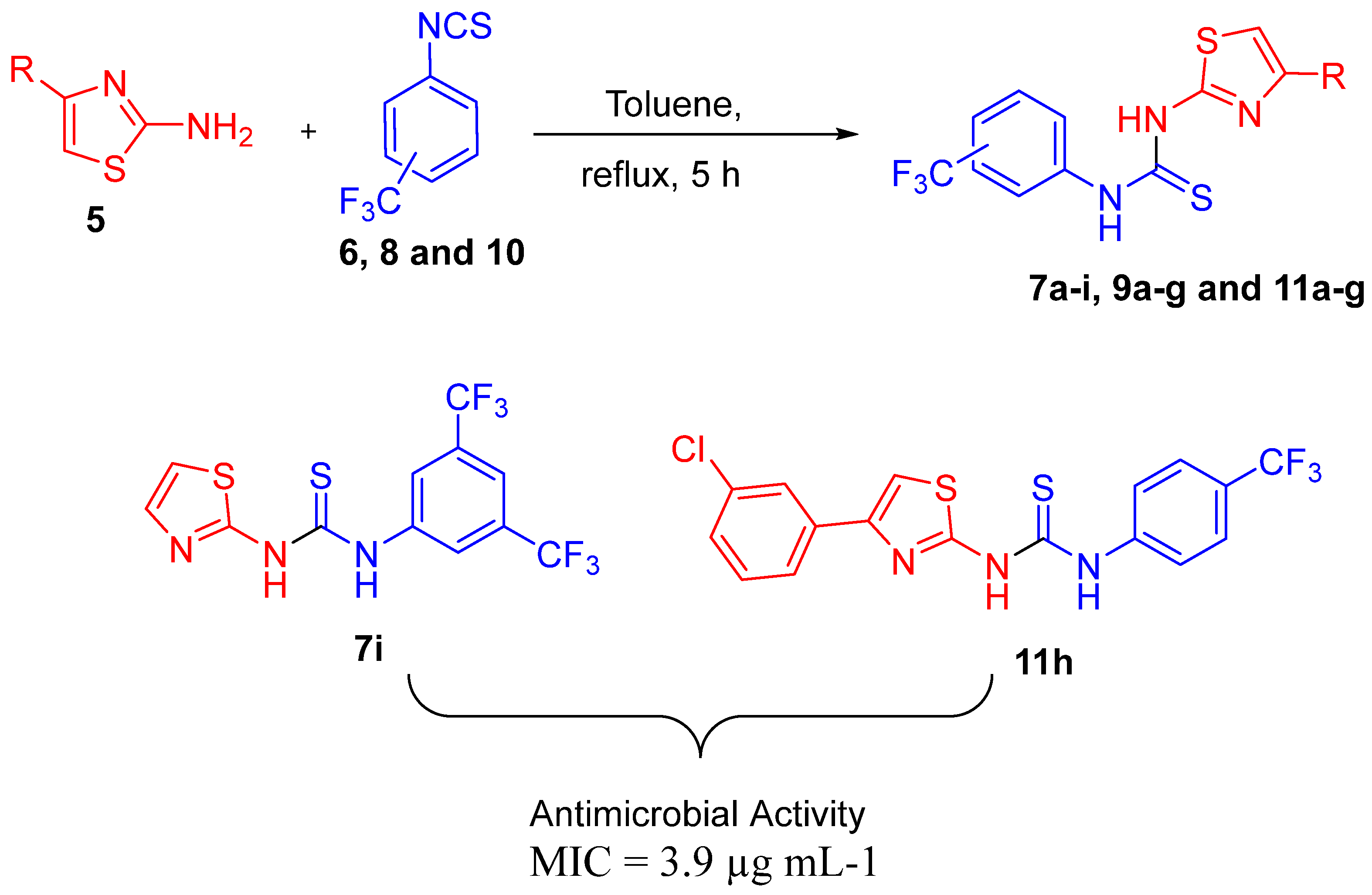
A series of novel 1-aryl-3-(4-arylthiazol-2-yl) thioureas (7a-i, 9a-g and 11a-h) were prepared; the evaluation for antimicrobial and antiproliferative activity against and promising compounds were identified.
Supplementary Materials
The following supporting information can be downloaded at: https://www.mdpi.com/article/10.3390/scipharm94010011/s1, Details of the experimental procedures and the characterization data for all the derivatives are provided in supporting information, together with the molecular and physical characteristics of target compounds.
Author Contributions
Conceptualization, C.N.; Methodology chemistry, S.A. and S.K.; Methodology biology, M.D.T.; Investigation, S.A. and S.K.; Writing—Original Draft, S.A, and S.K., Writing—Review and Editing, S.AC.N.; Funding Acquisition and Resources and Supervision, C.N. All authors have read and agreed to the published version of the manuscript.
Funding
This research received no external funding.
Data Availability Statement
Not applicable.
Acknowledgments
The authors are grateful to the Council of Scientific and Industrial Research (CSIR), New Delhi, India and Center for Regenerative Medicine and Health, CRMH, HKISI, Hong Kong.
Conflicts of Interest
The authors declare no conflicts of interest.
References
- Boucher, H.W.; Talbot, G.H.; Bradley, J.S.; Edwards, J.E.; Gilbert, D.; Rice, L.B.; Scheld, M.; Spellberg, B.; Bartlett, J. Bad Bugs, No Drugs: No ESKAPE! An Update from the Infectious Diseases Society of America. Clin. Infect. Dis. 2009, 48, 1–12. [Google Scholar] [CrossRef] [Scilit]
- Cooper, M.A.; Shlaes, D. Fix the antibiotics pipeline. Nature 2011, 472, 32. [Google Scholar] [CrossRef] [Scilit]
- Komorowski, A.S.; Lo Carson, K.L.; Kapoor, A.K.; Smieja, M.; Loeb, M.; Mertz, D.; Bai, A.D. More Than a Decade Since the Latest CONSORT Non-inferiority Trials Extension: Do Infectious Diseases Trials Do Enough? Clin. Infect. Dis. 2024, 78, 324–329. [Google Scholar] [CrossRef] [Scilit]
- Garnacho-Montero, J.; Garcia-Garmendia, J.L.; Barrero-Almodovar, A.; Jimenez, F.J.; Perez-Paredes, C.; Ortiz-Leyba, C. Impact of adequate empirical antibiotic therapy on the outcome of patients admitted to the intensive care unit with sepsis. Crit. Care Med. 2003, 31, 2742–2751. [Google Scholar] [CrossRef] [Scilit]
- Morales, D.K.; Hogan, D.A. Candida albicans Interactions with Bacteria in the Context of Human Health and Disease. PLOS Pathog. 2010, 6, e1000886. [Google Scholar] [CrossRef] [Scilit]
- Pitman, S.K.; Drew, R.H.; Perfect, J.R. Addressing current medical needs in invasive fungal infection prevention and treatment with new antifungal agents, strategies and formulations. Expert Opin. Emerg. Drugs 2011, 16, 559–586. [Google Scholar] [CrossRef] [Scilit] [PubMed]
- Kinamon, T.; Gopinath, R.; Waack, U.; Needles, M.; Rubin, D.; Collyar, D.; Doernberg, S.B.; Hamasaki, S.E.T.; Holland, T.L.; Anderson, J.H.; et al. Exploration of a Potential Desirability of Outcome Ranking Endpoint for Complicated Intra-Abdominal Infections Using 9 Registrational Trials for Antibacterial Drugs. Clin. Infect. Dis. 2023, 77, 649–656. [Google Scholar] [CrossRef] [Scilit] [PubMed]
- World Health Organization. World Health Organization Report; WHO: Geneva, Switzerland, 2024. [Google Scholar]
- Zumla, A.I.; Gillespie, S.H.; Hoelscher, M.; Philips, P.P.; Cole, S.T.; Abubakar, I.; McHugh, T.D.; Schito, M.; Maeurer, M.; Nunn, A.J. New antituberculosis drugs, regimens, and adjunct therapies: Needs, advances, and future prospects. Lancet Infect. Dis. 2014, 14, 327–340. [Google Scholar] [CrossRef] [Scilit] [PubMed]
- Cui, Y.; Lanne, A.; Avula, S.; Salih, M.A.H.; Peng, X.; Milne, G.; Jones, G.; Ritchie, J.; Zhao, Y.; Frampton, J.; et al. Discovery of novel fluorescent amino-pyrazolines that detect and kill Mycobacterium tuberculosis. Eur. J. Med. Chem. 2025, 297, 117889. [Google Scholar] [CrossRef] [Scilit]
- Mikiashvili, L.; Kempker, R.R.; Chakhaia, T.S.; Bablishvili, N.; Avaliani, Z.; Lomtadze, N.; Schechter, M.C.; Kipiani, M. Impact of Prior Tuberculosis Treatment with New/Companion Drugs on Clinical Outcomes in Patients Receiving Concomitant Bedaquiline and Delamanid for Multidrug- and Rifampicin-Resistant Tuberculosis. Clin. Infect. Dis. 2024, 78, 1043–1052. [Google Scholar] [CrossRef] [Scilit]
- Mac Dougall, C.; Polk, R.E. Antimicrobial Stewardship Programs in Health Care Systems. Clin. Microbiol. Rev. 2005, 18, 638–656. [Google Scholar] [CrossRef] [Scilit]
- Mah, T.F.; O’Toole, G.A. Mechanisms of biofilm resistance to antimicrobial agents. Trends Microbiol. 2001, 9, 34–39. [Google Scholar] [CrossRef] [Scilit]
- Cui, Y.; Lanne, A.; Peng, X.; Browne, E.; Bhatt, A.; Coltman, N.J.; Craven, P.; Cox, L.R.; Cundy, N.J.; Dale, K.; et al. Azetidines Kill Multidrug-Resistant Mycobacterium tuberculosis without Detectable Resistance by Blocking Mycolate Assembly. J. Med. Chem. 2024, 67, 2529–2548. [Google Scholar] [CrossRef] [Scilit] [PubMed]
- Abhishek, D.K.; Afiya, A.; Afra, T.A.; Anupama, M.; Shadiya, C.K. Design, Synthesis, Characterization, Evaluation Antimicrobial Evaluation of 2—Amino Thiazole Based Lead Compound: Docking Analysis of Ortho and Meta Substituted Analogues. ChemRxiv 2025. [Google Scholar] [CrossRef] [Scilit]
- Cottenceau, G.; Besson, T.; Gautier, V.; Rees, C.W.; Pons, A.-M. Antibacterial evaluation of novel N-Arylimino-1,2,3-dithiazoles and N-arylcyanothioformamides. Bioorganic Med. Chem. Lett. 1996, 6, 529–532. [Google Scholar] [CrossRef] [Scilit]
- Testard, A.; Picot, L.; Lozach, O.; Blairvacq, M.; Meijer, L.; Piot, J.-M.; Thiéry, V.; Besson, T. Synthesis and evaluation of the antiproliferative activity of novel thiazoloquinazolinone kinases inhibitors. J. Enzym. Inhib. Med. Chem. 2005, 20, 557–568. [Google Scholar] [CrossRef] [Scilit]
- Gu, X.H.; Wan, X.Z.; Jiang, B. Syntheses and biological activities of bis(3-indolyl)thiazoles, analogues of marine bis(indole)alkaloid nortopsentins. Bioorganic Med. Chem. Lett. 1999, 9, 569–572. [Google Scholar] [CrossRef] [Scilit]
- Kumar, Y.; Green, R.; Wise, D.S.; Wotring, L.L.; Townsend, L.B. Synthesis of 2,4-disubstituted thiazoles and selenazoles as potential antifilarial and antitumor agents. 2. 2-Arylamido and 2-alkylamido derivatives of 2-amino-4-(isothiocyanatomethyl)thiazole and 2-amino-4-(isothiocyanatomethyl)selenazole. J. Med. Chem. 1993, 36, 3849–3852. [Google Scholar] [CrossRef] [Scilit] [PubMed]
- Sharma, P.S.; Bansal, K.K.; Sharma, A.; Sharma, D.; Deep, A. Thiazole-containing compounds as therapeutic targets for cancer therapy. Eur. J. Med. Chem. 2020, 188, 112016. [Google Scholar] [CrossRef] [Scilit] [PubMed]
- Andreani, A.; Granaiola, M.; Leoni, A.; Locatelli, A.; Morigi, R. Synthesis and antitubercular activity of imidazo [2,1-b]thiazoles. Eur. J. Med. Chem. 2001, 36, 743–746. [Google Scholar] [CrossRef] [Scilit]
- Kesicki, E.A.; Bailey, M.A.; Ovechkina, Y.; Early, J.V.; Alling, T.; Bowman, J.; Zuniga, E.S.; Dalai, S.; Kumar, N.; Masquelin, T.; et al. Synthesis and Evaluation of the 2-Aminothiazoles as Anti-Tubercular Agents. PLoS ONE 2016, 11, e0155209. [Google Scholar] [CrossRef] [Scilit]
- Zhao, X.; Di, J.; Luo, D.; Verma, R.; Verma, S.K.; Verma, S.; Ravindar, L.; Koshle, A.; Dewangan, H.K.; Gupta, R.; et al. Thiazole—A promising scaffold for antituberculosis agents and structure-activity relationships studies. Bioorganic Chem. 2025, 154, 108035. [Google Scholar] [CrossRef] [Scilit] [PubMed]
- Carosati, E.; Tochowicz, A.; Marverti, G.; Guaitoli, G.; Benedetti, P.; Ferrari, S.; Stroud, R.M.; Finer-Moore, J.; Luciani, R.; Farina, D.; et al. Inhibitor of Ovarian Cancer Cells Growth by Virtual Screening: A New Thiazole Derivative Targeting Human Thymidylate Synthase. J. Med. Chem. 2012, 55, 10272–10276. [Google Scholar] [CrossRef] [Scilit] [PubMed]
- Madsen, P.; Kodra, J.T.; Behrens, C.; Nishimura, E.; Jeppesen, C.B.; Pridal, L.; Andersen, B.; Knudsen, L.B.; Valcarce-Aspegren, C.; Guldbrandt, M.; et al. Human Glucagon Receptor Antagonists with Thiazole Cores. A Novel Series with Superior Pharmacokinetic Properties. J. Med. Chem. 2009, 52, 2989–3000. [Google Scholar] [CrossRef] [Scilit]
- Iino, T.; Tsukahara, D.; Kamata, K.; Sasaki, K.; Ohyama, S.; Hosaka, H.; Hasegawa, T.; Chiba, M.; Nagata, Y.; Jun-ichi, E.; et al. Discovery of potent and orally active 3-alkoxy-5-phenoxy-N-thiazolyl benzamides as novel allosteric glucokinase activators. Bioorganic Med. Chem. 2009, 17, 2733–2743. [Google Scholar] [CrossRef] [Scilit]
- Abdel-Sattar, N.E.A.; El-Naggar, A.M.; Abdel-Mottaleb, M.S.A. Novel Thiazole Derivatives of Medicinal Potential: Synthesis and Modeling. J. Chem. 2017, 2017, 4102796. [Google Scholar] [CrossRef] [Scilit]
- Štrukil, V. Mechanochemical synthesis of thioureas, ureas and guanidines. Beilstein J. Org. Chem. 2017, 13, 1828–1849. [Google Scholar] [CrossRef] [Scilit] [PubMed]
- Maddani, M.R.; Prabhu, K.R. A Concise Synthesis of Substituted Thiourea Derivatives in Aqueous Medium. J. Org. Chem. 2010, 75, 2327–2332. [Google Scholar] [CrossRef] [Scilit]
- Hassan, G.S.; El-Messery, S.M.; Al-Omary, F.A.; Al-Rashood, S.T.; Shabayek, M.I.; Abulfadl, Y.S.; Habib, E.E.; El-Hallouty, S.M.; Fayad, W.; Mohamed, K.M.; et al. Nonclassical antifolates, part 4. 5-(2-Aminothiazol-4-yl)-4-phenyl-4H-1,2,4-triazole-3-thiols as a new class of DHFR inhibitors: Synthesis, biological evaluation and molecular modeling study. Eur. J. Med. Chem. 2013, 66, 135–145. [Google Scholar] [CrossRef] [Scilit]
- Taha, M.; Rahim, F.; Khan, I.U.; Uddin, N.; Farooq, R.K.; Wadood, A.; Rehman, A.U.; Khan, K.M. Synthesis of Thiazole-Based-Thiourea Analogs: As Anticancer, Antiglycation and Antioxidant Agents, Structure Activity Relationship Analysis and Docking Study. J. Biomol. Struct. Dyn. 2023, 41, 12077–12092. [Google Scholar] [CrossRef] [Scilit]
- El-Gaby, M.S.A.; Micky, J.A.; Taha, N.M.; El-Sharief, M.A.M. Antimicrobial Activity of Some Novel Thiourea, Hydrazine, Fused Pyrimidine and 2-(4-Substituted)anilinobenzoazole Derivatives Containing Sulfonamido Moieties. J. Chin. Chem. Soc. 2002, 49, 407–414. [Google Scholar] [CrossRef] [Scilit]
- Eweis, M.; Elkholy, S.S.; Elsabee, M.Z. Antifungal efficacy of chitosan and its thiourea derivatives upon the growth of some sugar-beet pathogens. Int. J. Biol. Macromol. 2006, 38, 1–8. [Google Scholar] [CrossRef] [Scilit]
- Upadhayaya, R.S.; Kulkarni, G.M.; Vasireddy, N.R.; Vandavasi, J.K.; Dixit, S.S.; Sharma, V.; Chattopadhyaya, J. Design, synthesis and biological evaluation of novel triazole, urea and thiourea derivatives of quinoline against Mycobacterium tuberculosis. Bioorganic Med. Chem. 2009, 17, 4681–4692. [Google Scholar] [CrossRef] [Scilit] [PubMed]
- Mahajan, A.; Yeh, S.; Nell, M.; Van Rensburg, C.E.J.; Chibale, K. Synthesis of new 7-chloro quinolinyl thioureas and their biological investigation as potential antimalarial and anticancer agents. Bioorganic Med. Chem. Lett. 2007, 17, 5683–5685. [Google Scholar] [CrossRef] [Scilit] [PubMed]
- Faidallah, H.M.; Khan, K.; Asir, A. Synthesis and biological evaluation of new 3-trifluoromethylpyrazolesulfonyl-urea and thiourea derivatives as antidiabetic and antimicrobial agents. J. Fluor. Chem. 2011, 132, 131–137. [Google Scholar] [CrossRef] [Scilit]
- Love, B.; Bender, P.E.; Bowman, H.; Helt, A.; McLean, R.; Jen, T. Amidines. 3. Thioureas possessing antihypertensive activity. J. Med. Chem. 1972, 15, 1024–1027. [Google Scholar] [CrossRef] [Scilit]
- Hallur, G.; Jimeno, A.; Dalrymple, S.; Zhu, T.; Jung, M.K.; Hidalgo, M.; Isaacs, J.T.; Sukumar, S.; Hamel, E.; Khan, S.R. Benzoylphenylurea Sulfur Analogues with Potent Antitumor Activity. J. Med. Chem. 2006, 49, 2357–2360. [Google Scholar] [CrossRef] [Scilit]
- Manjula, S.N.; Noolvi, N.M.; Parihar, K.V.; Reddy, S.A.M.; Ramani, V.; Gadad, A.K.; Sing, G.; Kutty, N.G.; Rao, C.M. Synthesis and antitumor activity of optically active thiourea and their 2-aminobenzothiazole derivatives: A novel class of anticancer agents. Eur. J. Med. Chem. 2009, 44, 2923–2929. [Google Scholar] [CrossRef] [Scilit]
- Khan, K.M.; Naz, F.; Taha, M.; Khan, A.; Perveen, S.; Choudhary, M.I.; Voelter, W. Synthesis and in vitro urease inhibitory activity of N,N′-disubstituted thioureas. Eur. J. Med. Chem. 2014, 74, 314–323. [Google Scholar] [CrossRef] [Scilit]
- Kim, S.G.; Kim, H.J.; Yang, C.H. Thioureas differentially induce rat hepatic microsomal epoxide hydrolase and rGSTA2 irrespective of their oxygen radical scavenging effect: Effects on toxicant-induced liver injury. Chem. Biol. Interact. 1999, 117, 117–134. [Google Scholar] [CrossRef] [Scilit] [PubMed]
- Stefanska, J.; Nowicka, G.; Struga, M.; Szulczyk, D.; Koziol, A.E.; Augustynowicz-Kopec, E.; Napiorkowska, A.; Bielenica, A.; Filipowski, W.; Filipowska, A.; et al. Antimicrobial and Anti-biofilm Activity of Thiourea Derivatives Incorporating a 2-Aminothiazole Scaffold. Chem. Pharm. Bull. 2015, 63, 225–236. [Google Scholar] [CrossRef] [Scilit]
- Hashem, H.E.; Amr, A.E.; Azmy, E.M. Synthesis, Antimicrobial Activity and Molecular Docking of Novel Thiourea Derivatives Tagged with Thiadiazole, Imidazole and Triazine Moieties as Potential DNA Gyrase and Topoisomerase IV Inhibitors. Molecules 2020, 25, 2766. [Google Scholar] [CrossRef] [Scilit]
- Thanh, N.D.; Lan, P.H.; Hai, D.S.; Anh, H.H.; Kim Giang, N.T.; Kim Van, H.T.; Toan, V.N.; Triad, N.M.; Toan, D.N. Thiourea derivatives containing 4-arylthiazoles and D-glucose moiety: Design, synthesis, antimicrobial activity evaluation, and molecular docking/dynamics simulations. RSC Med. Chem. 2023, 14, 1114. [Google Scholar] [CrossRef] [Scilit]
- Koppireddi, S.; Reddy Komsani, J.; Avula, S.; Pombala, S.; Vasamsetti, S.; Kotamraju, S.; Yadla, R. Novel 2-(2,4-dioxo-1,3-thiazolidin-5-yl)acetamides as antioxidant and/or antiinflammatory compounds. Eur. J. Med. Chem. 2013, 66, 305–313. [Google Scholar] [CrossRef] [Scilit]
- Koppireddi, S.; Chilaka, D.R.K.; Avula, S.; Komsani, J.R.; Kotamraju, S.; Yadla, R. Synthesis and anticancer evaluation of 3-aryl-6-phenylimidazo [2,1-b]thiazoles. Bioorganic Med. Chem. Lett. 2014, 24, 5428–5431. [Google Scholar] [CrossRef] [Scilit] [PubMed]
- Amsterdam, D. Antibiotics in Laboratory Medicine, 4th ed.; Williams, Wilkins, Baltimore: Hagerstown, MD, USA, 1996; p. 52. [Google Scholar]
- McGaw, L.J.; Lall, N.; Hlokwe, T.M.; Michel, A.L.; Meyer, J.J.; Eloff, J.N. Purified Compounds and Extracts from Euclea Species with Antimycobacterial Activity against Mycobacterium bovis and Fast-Growing Mycobacteria. Biol. Pharm. Bull. 2008, 31, 1429–1433. [Google Scholar] [CrossRef] [Scilit] [PubMed]
- Kaal, A.; Rao, M.P.; Das, P.; Swapna, P.; Polepalli, S.; Nimbarte, V.D.; Mullagiri, K.; Kovvuri, J.; Jain, N. Synthesis and Biological Evaluation of Imidazo[2,1-b][1,3,4]thiadiazole-Linked Oxindoles as Potent Tubulin Polymerization Inhibitors. ChemMedChem 2014, 9, 1463–1475. [Google Scholar] [CrossRef] [Scilit]

Disclaimer/Publisher’s Note: The statements, opinions and data contained in all publications are solely those of the individual author(s) and contributor(s) and not of MDPI and/or the editor(s). MDPI and/or the editor(s) disclaim responsibility for any injury to people or property resulting from any ideas, methods, instructions or products referred to in the content. |
© 2026 by the authors. Published by MDPI on behalf of the Österreichische Pharmazeutische Gesellschaft. Licensee MDPI, Basel, Switzerland. This article is an open access article distributed under the terms and conditions of the Creative Commons Attribution (CC BY) license.