Skip to Content
  • Article
  • Open Access

17 October 2022

Business Intelligence and Analytics (BIA) Usage in the Banking Industry Sector: An Application of the TOE Framework

,
,
and
1
School of Business, The University of Jordan, Amman 11942, Jordan
2
School of Business, Jadara University, Irbid 733, Jordan
*
Author to whom correspondence should be addressed.

Abstract

This study aims to examine the factors that influence business intelligence and analytics (BIA) usage in the banking sector. Based on a comprehensive literature review, a theoretical model was developed to explore the impact of three key factors on business intelligence and analytics adoption and usage in the banking sector, namely technological, organizational, and environmental factors. The study used the Statistical Package for the Social Sciences (SPSS) to analyze data collected from 120 employees of Jordan Arab bank. The results revealed the critical impact of not only the existence of data and technology infrastructure but also the importance and availability of management and human resources support and capabilities. This study suggests that, more importantly, successful planning for business intelligence and analytics should go beyond the technology aspects to gain the full benefits of such technology, especially in the banking sector. Yet, we argue that more research needs to be conducted, especially in the context of developing countries, to fully understand how banking sectors can successfully implement and utilize business intelligence and analytics.

1. Introduction

Business intelligence and analytics (BIA) is considered one of the most critical technologies, systems, practices, and applications that help organizations develop a deeper understanding of business data and gain a competitive advantage while improving operations and product development and strengthening relationships with customers [1,2]. BIA has an even more important role in the banking sector by enabling experts and managers to make better, accurate, timely, and relevant decisions so as to increase the productivity and profitability of the bank and be able to comply with the different regulatory and environmental dimensions of this sector [3].
BIA, nowadays, is a trendy issue and a compulsory prerequisite for creating an outstanding corporate image, which goes in line with implementing a successful plan regarding using technology extensively. Thus, this supports business decisions and gains a competitive advantage in today’s dynamic environment, which requires outstanding efforts for dedicating massive budgets to research and development (R&D). Data are a focal point and are considered the fuel of the future since they can be processed efficiently and used effectively in supporting risky occurrences and decisions that can be heavily reflected in the performance of corporates [4,5].
Business intelligence (BI) is an umbrella term that includes structures, tools, databases, applications, and methodologies to analyze data by converting raw data into meaningful and helpful information to support business managers’ decisions [6]. Banking areas, such as branch performance, sales, risk assessment, electronic banking, customer segmentation, and retention, are generally excellent for applying various business concepts and analytics, technologies, and tools, including data mining (DM), data warehousing, and decision support systems (DSS). Therefore, top management must constantly focus on solving challenging problems and seizing opportunities for the banking sector to succeed and excel in today’s business environment. This requires computerized support for managerial decision making, thereby implying a need for decision support, business intelligence, and analytics systems [7]. Business intelligence systems (BIS) emerged from technical solutions that provide data integration, analytical capabilities, and data mining to provide stakeholders at various levels with valuable information to make their decisions effectively and successfully.
In this regard, data analyses can contribute to solving and developing banking problems and reaching the best results for decision making [8]. Managers cannot see the correlation between different variables in business data because the volume of data is constantly increasing, and it is substantial. Moreover, managers need additional work to reach a conclusion related to the behavioral pattern and the wants and needs of customers. In addition, many additional works are needed to understand and retain the right customers and acquire new ones; consequently, business intelligence through data analyses helps managers and product managers identify different categories of customers, develop products or services aligned with customer needs, define competition and pricing strategy, improve revenue management, increase sales, and expand the customer segment [5].
Researchers have defined business intelligence as the ability of businesses to think, plan, predict, solve problems, understand, devise new ways to improve business and decision-making processes appropriately, enable effective actions, and help create and achieve business goals [9]. Accordingly, the processes, technologies, tools, applications, data, databases, dashboards, scorecards, and online analytical processing (OLAP) are stated to play a role in enabling the capabilities that define business intelligence [10]. BIA practices and tools are seen as critical enablers for data-driven decision making and provide the framework and support banks’ needs to make accurate and fact-based decisions and do business successfully and distinctively [11].
Even though the research interest in business intelligence and analytics usage in the banking-industry sector is increasing, past studies supporting the area cannot be considered as highly grown. Further, the existing literature does not provide satisfactory evidence as to what factors affect business intelligence and analytics usage in addition to the inconsistencies in the results. At the same time, banks’ use of business intelligence and analytics remains high, especially with the availability of huge data sets on customers that can help better decision making in this context. Thus, this study seeks to examine what factors affect the use of business intelligence and analytics in the banking sector in an effort to help this sector plan for better business intelligence and analytics use and adoption.
The following section presents a review of key related literature, and, after that, Section 3 explains the theoretical framework and hypotheses development. Data collection and methodology are presented in Section 4, whereas Section 5 presents the research results. After the discussion of the results in Section 6, Section 7 presents the research contributions, and the last section presents the conclusion along with the limitations and directions for further research.

2. Literature Review and Background

2.1. Business Intelligence and Analytics (BIA)

The term business intelligence (BI) was popularized during the 1990s and could be considered a term encompassing a wide variety of processes and software used to collect, analyze, and disseminate data in the interest of better decision making [12] that includes infrastructures, tools, technologies, databases, applications, and methodologies. BI has been used as an umbrella term to describe concepts and methods for improving business decision making using fact-based support systems [5].
The main goals of business intelligence are to enable interactive and easy access to diverse data, data processing, and transformation to create meaningful and valuable information that can support business managers and analysts in making decisions [13,14]. BI technically entails various software solutions and technologies from extract transform and load (ETL) tools, data warehouse, OLAP technology, data extraction, reporting applications, and an interface that supports the user and web access [1,15]. In its basic form, the BIA process will extract the data needed using ETL technologies, stores them in DW, and the generated reports with the help of OLAP, data mining. Other reporting tools are accessed by end-users through the user interface [16].
In the extract (ETL) process, ETL packages extract data from internal and external sources, eliminate data errors and redundancies, and provide tailored data for access and analysis to be loaded to data warehouse [17]. The data warehouse is a type of database in which data are collected from different databases in different business units, and then are organized and validated to help make decisions within the organization [18]. Later, and depending on the organizations’ needed OLAP technologies—which are multidimensional models that include relational databases and report writing—data mining will produce business reporting for sales, budgeting, and even forecasting [16]. Data mining (DM), which is a fundamental technology that supports BIA, uses a quantitative data analysis tool to identify patterns and rules in data resources and find logical relationships that summarize data in a new, understandable, and useful way to support organizational business intelligence and management decisions [19,20,21]. A key value of data mining in business intelligence and analytics is to anticipate a particular behavior or outcome based on data models, in what is known as predictive analytics, thus giving the most likely outcome leading to better management decisions and future planning [6,22].

2.2. Business Intelligence Application in the Banking Industry Sector

Banks have always been the leading organizations in using the latest technologies, applications, and tools that can improve their business or increase productivity, profits, sales, or give them a competitive advantage among competitors. Similar to other technologies, business intelligence and analytics promises to help the bank acquire much more and better insights than the classical report technologies and provide more accurate and precise data analyses. In fact, BIA enables them to raise both operational and management levels of data underrating and analysis that can lead to increased sales and profits [7,23].
Yet, how banks run and use business intelligence and analytics is a factor of success and differentiation. Business intelligence needs to not only integrate customer information all through the bank to improve efficiency and improve customer service but also needs to enable the bank to utilize all data sources and business intelligence applications. According to [16], business intelligence and analytics have a very significant and critical role on bank performance, product marketing and promoting strategies, risk management, and customer acquisition and retention.
In summary, the literature review of the strategic impact of business intelligence made by [24] clearly shows the important role of business intelligence and analytics. However, more research is needed to understand not just the benefit of such technologies in the banking sector but also how banks are adopting and using such technologies in this sector.

3. Theoretical Framework and Hypotheses Development

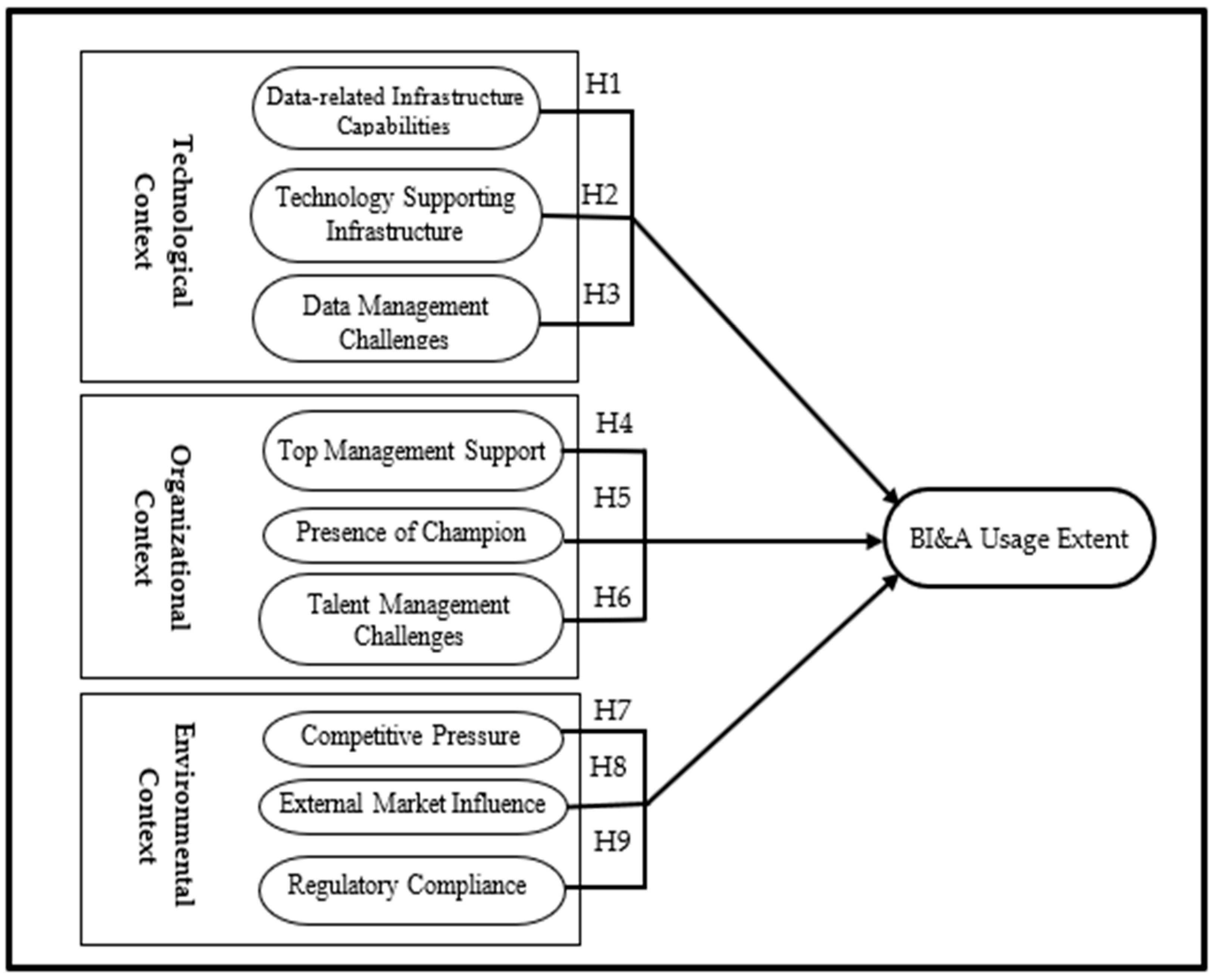
Although technology adoption is very well structured, very few studies have been conducted to determine the influencing factors associated with the adoption of BI systems [25]. Following [26], this study uses the technology–organization–environment (TOE) framework developed by [27] to examine those three elements that influence how banks adopt and implement business intelligence and analytics technology, namely the technological, the organizational, and the environmental contexts. Consequently, this study expanded the TOE framework by including new vital additional elements based on the recommendations of [28], namely technology-supporting infrastructure and the presence of a champion, as represented in Figure 1. The following sections explain in detail the theoretical framework and its key elements.
Figure 1. Theoretical Framework.
The main reason for applying the TOE framework in the current study context is due to the mentioned framework and is one of the most holistic frameworks that can explain technology adoption in organizations [24]. In addition, the TOE framework looks more into the organization as a whole, not only on the individual level on how the organization adopts and accepts the use of new technologies. Hence, this framework can give more details in all terms. This is why numerous researchers used the TOE framework as a theoretical foundation for studying organizational adoption and use of new technologies since it was introduced in 1990 [26]. Not only this, but it agrees with Awa et al. [25], who claimed that the TOE framework brings both human and nonhuman actors into the network, which is a strength that handles the illusion of accumulated traditions and technocentric predictions of most other frameworks (e.g., TAM, TRA, UTAUT, and TPB). Hence, we believe that the TOE framework will help to achieve a more complete understanding of business intelligence and analytics adoption and use in the banking sector in Jordan.

3.1. Technological Context

The technological context consists of three key elements:

3.1.1. Data-Related Infrastructure Capabilities

Data can be viewed as a large-scale local need, an essential component, and a driver of innovation; they can be considered an asset for any organization, especially banks. Since they mainly help in the development of any products, it is recommended to understand them in a unique and innovative way. According to [29], the use of intelligent data tools is an important component for effective data mining and is an indispensable enabling factor for using BIA. Hence, the following hypothesis will be tested:
Hypothesis 1 (H1).
There is a statistically significant effect of the level of data-related infrastructure capabilities on the level of BIA usage extent.

3.1.2. Technology Supporting Infrastructure

Information Technology (IT) Infrastructure is a broad set of supporting technologies and necessary standards that enable organizations to share data and manipulate resources through a compatible and interconnected manner [1,28]. The availability and compatibility of the IT infrastructure allow companies to obtain and share real-time information and analyze customer data, develop products, analyze competitive markets, and share data and process resources across business units through a compliant, interconnected, and unified IT infrastructure [4]. Hence, we argue that a proper IT infrastructure can heavily enhance the use of BIA in the banking industry. Therefore, the following hypothesis will be tested:
Hypothesis 2 (H2).
There is a statistically significant effect of the level of technology-supporting infrastructure on the level of BIA usage extent.

3.1.3. Data-Management Challenges

Data management is one of the challenges of using BIA. It is crucial to use BIA data that are reliable, current, relevant, predictable, and accurate [30,31,32]. Data quality is a fundamental issue in the selective investigation of data and refers to the consistency and breadth of the data [33,34]. Today’s business intelligence frameworks can work with different types of data, such as mathematical and nonmathematical data, and their quality is very critical. In fact, data quality explains why some correlations are effective with their BI engine while others are not. Examination indicates that clean, actionable data may be key factors for achieving business intelligence [35,36]. Yet, the task of ensuring data quality is an unpredictable endeavor and requires sustained effort [31]. Thus, the following hypothesis will be tested:
Hypothesis 3 (H3).
There is a statistically significant effect of the level of data-management challenges on the level of BIA usage extent.

3.2. Organizational Context

The organizational context comprises three key elements:

3.2.1. Top-Management Support

Senior-management support ranks highly as a critical success factor (CSF) for BIA [37]. In fact, senior-management support is essential to the success of BIA, according to Ref. [38], and is, perhaps, the biggest barrier to using business intelligence. High-level hierarchical management needs to deliberately focus on the use of business intelligence and business to maximize its benefits [39]. In addition, BIA must be driven from the most important levels within banks, and the inability to do so leads BIA drivers to be unable to reach the maximum capacity [39]. Senior-management support helps drive the use of business intelligence and intelligence by overseeing change measures, acquiring core assets, and supporting collaboration between specialized units [30,40]. Accordingly, the following hypothesis will be tested:
Hypothesis 4 (H4).
There is a statistically significant effect of the level of top-management support on the level of BIA usage extent.

3.2.2. Presence-of-Champion

It refers to a highly enthusiastic person with in-depth knowledge of the organization’s business processes and the technological innovation being discussed and committed to the innovation. Champions promote innovation by providing information, creating awareness, providing material resources, providing political support, and gaining organizational acceptance of the innovation, which are crucial for the successful adoption and implementation [5]. We believe that the presence of a champion that leads and supports the adoption and use of BIA in banks will have a huge impact. Thus, the following hypothesis will be tested:
Hypothesis 5 (H5).
There is a statistically significant effect of the level of presence of the champion on the level of BIA usage extent.

3.2.3. Talent-Management Challenges

To execute BIA adequately, a mix of business and IT experts is considered significant [31]. Experts who have the necessary abilities, especially the logical capacities, are needed to utilize the full potential of BIA tools and technology [41]. Hence, we argue that the presence of talent in both business and technology aspects will play a key role in the use and utilization of BIA in the banking sector. Therefore, the following hypothesis will be tested:
Hypothesis 6 (H6).
There is a statistically significant effect of the level of talent-management challenges on the level of BIA usage extent.

3.3. Environmental Context

The environmental context comprises three key elements:

3.3.1. Competitive Pressure

It refers to the pressure factor that the bank feels from its competitors in the financial field. This competition makes banks look for better technologies to raise their efficiency, increase their efficiency and deals, and increase the number of customers [42]. In fact, technology adoption and usage in the banking sector are heavily driven by competition [43]. Hence, the following hypothesis will be tested:
Hypothesis 7 (H7).
There is a statistically significant effect of the level of competitive pressure on the level of BIA usage extent.

3.3.2. External Market Influence

In addition to the competition, the banking sector is always under the external pressures of new products (services) and demanding customers. Hence, banks always rely on new technologies, such as data warehouses and BIA, as strategic initiatives to counter these factors [44]. In [45], it is noted that banks facing environmental uncertainties “engage in greater advisory and research activities” to understand their internal and market activities better. In addition, [26] emphasized that banks have a higher use of IT and technologies, such as business intelligence, which can greatly impact their effort to address external market influences [12]. Consequently, the following hypothesis will be tested:
Hypothesis 8 (H8).
There is a statistically significant effect of the level of external market influence on the level of BIA usage extent.

3.3.3. Regulatory Compliance

The banking-industry sector is a very regulated sector, and compliance with laws and regulations requires achieving a high level of accuracy in data collection and analyses [44]. For example, in the United States, the Foreign Account Tax Compliance Act (FATCA) expects banks to meet the requirements of explicit monetary details. In the context of the current study, the value of BIA usage in this setup, it is very important to collect and analyze accurate and productive data to meet the administrative disclosure requirements and other compliance regulations [44,46]. Thus, the following hypothesis is suggested:
Hypothesis 9 (H9).
There is a statistically significant effect of the level of regulatory compliance on the level of BIA usage extent.
Building on previous discussions and based on the TOE framework, the conceptual model is summarized in Figure 1, which presents the factors considered for this study within the technological, organizational, and environmental contexts of the TOE framework.

4. Research Methodology

4.1. Population and Sample Study

The study population consists of Jordanian commercial banks that use business intelligence and analytics on a large scale. After communicating with the banks, it was clear that the Arab Bank is the distinguished and pioneering bank in this field in Jordan, namely in using business intelligence and analytics programs. However, other banks are still at the beginning of their use and establishment of such technology. Hence, basically, the study population consists of all employees in the risk-management department, compliance department, information-technology department, branches, and sales department at the Arab Bank. However, due to the difficulty of involving all of the study population in all 81 branches of the Arab Bank, the study used a convenience sampling of the population.

4.2. Data Collection Methods

This study used the questionnaire as a tool for the field study through the preparation of the questionnaire. Its axes and items are based on the theoretical framework of the study as well as previous studies related to the subject of the study. The questionnaire included three main sections with 61 questions. A five-point Likert scale was used, which consists of strongly agree (5), agree (4), neutral (3), disagree (2), and strongly disagree (1) in answering the questions of the survey. Later, online questionnaires were sent through email (Google Form), due to the precautionary conditions and measures applied during the COVID-19 pandemic. Out of all online questionnaires distributed, 120 questionnaires were retrieved and defined as valid and were verified.
To ensure the minimum sample size, [47] suggested that the sample size should be ten times the largest number of structural paths directed at a particular latent variable in the structural model. The research model has nine structural paths directed to the BIA usage variable; the minimum sample size required is 90. For more accuracy, we ran the statistical analysis software G*Power, the most known and commonly used free software, which allows approximating power parameters for the research design by applying different methods and various user interfaces. Based on the criteria of an effect size f2 = 0.15, error probability α = 0.05, number of predictors 9, and power (1 - β) = 0.80, the results indicate that a sample of 114 is required in this study. Consequently, our final sample of 120 in this study is suitable for SPSS analysis purposes.

4.3. Validity and Reliability Test (Pretest)

In order to ensure clarity of the questionnaire and validate the accuracy of the instrument and the responses provided [48], the content-validity test was conducted with 30 experts and professors from the study community. In addition to determining the extent of the internal homogeneity of the study tool, the correlation coefficients between each statement and the degree of the phrase contained in the axis to which it belongs was used. Next, a reliability test was carried out using Cronbach’s Alpha test to measure the internal consistency of the study tool. The results of the Cronbach’s Alpha test were as follows:
As the results in Table 1 show, the value of Cronbach alpha for all measures of the study tool is high and above 0.70, which indicates that the study tool is of a high degree of reliability and stability and is sufficient to achieve the purposes of the study [49,50].
Table 1. Results of research tool reliability.

5. Research Results

This study used SPSS to analyze the data collected through the questionnaire. Descriptive analyses have been used to underhand the demographic characteristics of the sample, whereas the mean, standard deviation, and relative weight were used to analyze the questionnaire statements and understand the attitudes of the respondents toward the statements of the study instrument. In addition, Pearson’s correlation coefficient was used to determine the level of internal homogeneity of the study tool. Finally, a simple-regression coefficient was used to test the relationships between the independent variables and the dependent variable.

5.1. Demographic Characteristics of the Sample

Table 2 shows the key analysis of the demographic data that describe the sample. In this study, the respondents were 78 males (65%) and 42 females (35%), whereby most of them were above 40 years old. In addition, most of the respondents were bachelor’s degree holders (73%) with more than 5 years of experience. Interestingly, most of the respondents were managers or heads of sections (totaling 75.83%).
Table 2. Demographic characteristics of the study sample.

5.2. Results of the Measurement Items Analysis

The results of the mean average score, standard deviation, and relative weights, which were computed for all the study statements (items) of the independent and dependent variables to understand the attitudes of the respondents toward the statements of the study instrument.

5.2.1. The First Dimension: The Technological Context

As Table 3 shows, all measurements items of the data-related infrastructure capabilities were high, and it shows the high level of the data-related infrastructure capabilities in the Arab Bank from the viewpoint of the study sample, with a mean of 3.827 and a standard deviation of 1.070. The same can be said about all expressions of the technology-supporting infrastructure and shows the high level of the technology-supporting infrastructure in the Arab Bank from the viewpoint of the study sample, with a mean of 3.825 and a standard deviation of 1.096. In addition, all statements (items) of the data-management challenges revealed the high level of the data-management challenges in the Arab Bank from the viewpoint of the study sample, with a mean of 3.730 and a standard deviation of 1.244. Overall, Table 3 shows the high level of the dimension of the technological context in the Arab Bank from the viewpoint of the study sample, with a general mean of 3.794 and a standard deviation of 1.137.
Table 3. Mean average score, standard deviation, and relative weight of the technological-context measurements items.

5.2.2. The Second Dimension: The Organizational Context

As can be seen in Table 4, all measurement items of the top-management support were high, and it demonstrates a high level of top-management support in the Arab Bank from the viewpoint of the study sample, with a mean of 3.817 and a standard deviation of 1.051. The same can be seen for all statements (items) of the presence-of-champion, with a mean of 3.792 and a standard deviation of 1.196. Further, all statements (items) of the talent-management challenges were with a mean of 3.730 and a standard deviation of 1.177. Overall, the organizational context from the viewpoint of the study sample was high with a mean of 3.779 and a standard deviation of 1.141.
Table 4. Mean average score, standard deviation, and relative weight of the organizational-context measurements items.

5.2.3. The Third Dimension: The Environmental Context

Table 5 shows that all measurement items of the competitive pressure were high, with a mean of 3.827 and a standard deviation of 1.145. The same can be seen for the external market influence and regulatory compliance, with means of 3.917 and 3.842 in addition to standard deviations of 1.079 and 1.123, respectively. Overall, Table 5 shows a mean of 3.862 and a standard deviation of 1.116.
Table 5. Mean average score, standard deviation, and relative weight of the environmental-context measurements items.

5.2.4. The Dependent Variable: The BIA Usage Extent

As can be seen in Table 6, all measurements items of the BIA usage extent were high, with a mean of 3.795 and a standard deviation of 1.126.
Table 6. Mean average, standard deviation, and relative weight of the BIA-usage-extent measurements items.

5.3. Results of the Regression Coefficient Analysis

Finally, Table 7 shows the results of simple-regression test results and the coefficient related to each factor and the relationships between each independent variable and the dependent variable. The results reveal the significance of the model as a whole, as the F value was significant at the level 0.01 for all main variables. In fact, the results reveal a significant effect of the level of data-related infrastructure capabilities, the level of technology-supporting infrastructure, the level of data-management challenges, the level of top-management support, the level of presence-of-champion, the level of talent-management challenges, the level of competitive pressure, the level of external market influence, and the level of regulatory compliance on the level of BIA usage extent at the level 0.01, thereby supporting all hypotheses of this study. However, it is worth noting that the level of effect of each variable on the level of BIA usage extent varies from 2.505% to 3.222%.
Table 7. Results of hypotheses testing.

6. Discussion

This study examined the factors affecting business intelligence and analytics use in the banking sector. The factors analyzed in this study were organized in three dimensions that include technological, organizational, and environmental contexts based on the TOE framework. The results showed that data infrastructure and data-management capabilities have a significant effect on the extent to which business intelligence is used, and business and technology-supporting infrastructure has a significant impact as well. In fact, organizations, especially banks, need to have a robust data infrastructure that serves as the base layer for business intelligence, with an advanced IT infrastructure to better deploy business intelligence applications across business functions to have higher rates of BIA usage.
One of the most important factors that is necessary to adopt and use business intelligence in the banking context was the support of senior management, and the results showed that such support has a significant impact, as expected. Senior management and a great “champion” can initiate the use of business intelligence within their organizations, not only through providing the necessary resources, but also by encouraging their use and utilization in all bank operations and management decisions. In fact, resilient and sound senior management has a huge impact on BIA adoption, whereby the higher level of talent management results in the higher pioneering of the bank in the use of BIA.
The results clearly show the importance of the environmental dimension on the level of using BIA. The higher the competitive pressure and the greater the competition between sectors, the more banks will increase their BIA usage. Moreover, the results revealed the influence of the external market factors on increasing the adoption and usage of business intelligence as a way to create competitive advantages. Organizations view the effective use of BIA as a strategy that drives organizational performance and uses their critical data to outperform competitors. Thus, the strategic use of business intelligence adds advantages to organizations. Finally, the results show the impact of regulatory compliance on the level of BIA usage, whereby the higher the rate of regulatory compliance, the higher the rate of BIA usage. In fact, BIA represents an important tool for banks to comply with not only local and internal regulations but also international standards and regulations.

7. Contributions

First of all, this research contributes to the literature on business intelligence and analytics by attempting to explore the impact of the TOE framework on business intelligence and analytics usage in developing-country contexts. This comprehensive framework, which has guided numerous studies in the developed world, has revealed some interesting insights on how different this can be in a developing-country context such as Jordan. In addition, another key contribution of this study arises from the empirical analysis of this framework, which revealed some practical and comprehensive guidelines that can help banks in such a context plan better for their business intelligence and analytics projects. Finally, we argue that this research will be the foundation that can help other researchers dig deep into understanding how banks, especially those in developing countries, can utilize business intelligence and analytics.

8. Conclusions

Business intelligence and analytics is a key tool that deals with large amounts of diverse data, whether structured or unstructured [2], thus providing banks with the huge value of achieving better operations and great competitive advantages. With the dynamic environment we are facing nowadays, every bank should emphasize the importance of implementing a massive business-intelligence system to keep up with the fast pace of technology. In this study, we studied the factors that influence the use of business intelligence and analytics in the banking sector. Different factors have been examined, including technical, organizational, and environmental dimensions. The results of the analysis confirmed not only the importance of these factors on business intelligence and analytics adoption and use but also on the huge value for the banking sector that can be achieved by such technology. In fact, it is extremely important to understand the dynamics of these factors, not only to achieve better usage of business intelligence, but also to better plan and implement such technologies in the banking sector.
The results presented in this study reveal that to achieve better fact-based decision making, business-intelligence technologies require the presence of quality-level data-related infrastructure capabilities, great senior-management support and better “market environment” awareness. Yet, the researchers believe that more factors with more comprehensive and larger populations need to be studied in order to fully understand the critical success factor of BIA usage and utilization. That is, further research can test the proposed model in different contexts, such as the Jordanian public-shareholding firms as they invest heavily in BIA systems, and, in turn, more generalizable results can be obtained. In addition, future research could apply the model to developed countries to compare the results with those of developing counties. Finally, the researchers examined the impact of BIA on firm performance and innovation capabilities, but more research is needed to examine the BIA adoption on organizational effectiveness in a holistic view. To conclude, the results of this study are of supreme implication to the literature in this research area and can motivate additional crucial studies to shed more light on their standings.


Author Contributions

Conceptualization, M.A.-O. and M.A.-M.; methodology, M.A.-M.; software, M.A.-O.; validation, M.A.-M., M.A.-O. and A.B.M.; formal analysis, M.A.-O.; investigation, M.A.-O.; resources, A.B.M.; data curation, A.B.M.; writing—original draft preparation, M.A.-O., R.M. and M.A.-M.; writing—review and editing, R.M.; visualization, A.B.M.; supervision, R.M.; project administration, M.A.-O. All authors have read and agreed to the published version of the manuscript.

Funding

This research received no external funding.

Institutional Review Board Statement

Not applicable.

Data Availability Statement

Not applicable.

Acknowledgments

The authors would like to acknowledge the valuable contributions of the reviewers and editors who have provided critical suggestions to improve the quality of the article. The suggested comments have helped in improving the quality of the article considerably.

Conflicts of Interest

The authors declare no conflict of interest.

References

  1. Al-Okaily, A.; Al-Okaily, M.; Teoh, A.P.; Al-Debei, M. An Empirical Study on Data Warehouse Systems Effectiveness: The Case of Jordanian Banks in the Business Intelligence Era. EuroMed J. Bus. 2022; ahead-of-print. [Google Scholar] [CrossRef]
  2. Ajah, I.A.; Nweke, H.F. Big data and business analytics: Trends, platforms, success factors and applications. Big Data Cogn. Comput. 2019, 3, 32. [Google Scholar] [CrossRef]
  3. Nithya, N.; Kiruthika, R. Impact of Business Intelligence Adoption on performance of banks: A conceptual framework. J. Ambient. Intell. Humaniz. Comput. 2021, 12, 3139–3150. [Google Scholar] [CrossRef]
  4. Al-Okaily, A.; Al-Okaily, M.; Teoh, A.P. Evaluating ERP systems success: Evidence from Jordanian firms in the age of the digital business. VINE J. Inf. Knowl. Manag. Syst. 2021; ahead-of-print. [Google Scholar] [CrossRef]
  5. Al-Okaily, M.; Al-Okaily, A. An Empirical Assessment of Enterprise Information Systems Success in a Developing Country: The Jordanian Experience. TQM J. 2022; ahead-of-print. [Google Scholar] [CrossRef]
  6. Turban, E.; Sharda, R.; Delen, D. Decision Support and Business Intelligence System; Prentice Hall: Englewood Cliffs, NJ, USA, 2011. [Google Scholar]
  7. Moro, S.; Cortez, P.; Rita, P. Business intelligence in banking: A literature analysis from 2002 to 2013 using text mining and latent Dirichlet allocation. Expert Syst. Appl. 2015, 42, 1314–1324. [Google Scholar] [CrossRef]
  8. Al-Madadha, A.; Al Khasawneh, M.H.; Al Haddid, O.; Al-Adwan, A.S. Adoption of Telecommuting in the Banking Industry: A Technology Acceptance Model Approach. Interdiscip. J. Inf. Knowl. Manag. 2022, 17, 443–470. [Google Scholar] [CrossRef]
  9. Aws, A.L.; Ping, T.A.; Al-Okaily, M. Towards business intelligence success measurement in an organization: A conceptual study. J. Syst. Manag. Sci. 2021, 11, 155–170. [Google Scholar]
  10. Wells, D. Business Analytics—Getting the Point. BeyeNetwork. 2008. Available online: http://www.b-eyenetwork.com/view/7133 (accessed on 5 January 2022).
  11. Shollo, A.; Galliers, R.D. Towards an understanding of the role of business intelligence systems in organisational knowing. Inf. Syst. J. 2016, 26, 339–367. [Google Scholar] [CrossRef]
  12. Davenport, T.H. Competing on analytics. Harv. Bus. Rev. 2006, 84, 98. [Google Scholar]
  13. Wixom, B.H.; Watson, H.J.; Werner, T. Developing an enterprise business intelligence capability: The Norfolk Southern journey. MIS Q. Exec. 2011, 10, 61–71. [Google Scholar]
  14. Turban, E.; Sharda, R.; Aronson, J.E.; King, D. Business Intelligence: A Managerial Approach; Pearson Prentice Hall: Upper Saddle River, NJ, USA, 2008; pp. 58–59. [Google Scholar]
  15. Al-Khatib, A.W.; Al-ghanem, E.M. Radical innovation, incremental innovation, and competitive advantage, the moderating role of technological intensity: Evidence from the manufacturing sector in Jordan. Eur. Bus. Rev. 2022, 34, 344–369. [Google Scholar] [CrossRef]
  16. Rao, G.K.; Kumar, R. Framework to integrate business intelligence and knowledge management in banking industry. Rev. Bus. Technol. Res. 2011, 4. [Google Scholar] [CrossRef]
  17. Vassiliadis, P. A survey of extract–transform–load technology. Int. J. Data Warehous. Min. (IJDWM) 2009, 5, 1–27. [Google Scholar] [CrossRef]
  18. Kimball, R.; Ross, M. The Data Warehouse Toolkit: The Complete Guide to Dimensional Modeling; John Wiley & Sons: Hoboken, NJ, USA, 2011. [Google Scholar]
  19. Jackson, J. Data mining; a conceptual overview. Commun. Assoc. Inf. Syst. 2002, 8, 19. [Google Scholar] [CrossRef]
  20. Han, J.; Kamber, M.; Pei, J. Data Mining: Concepts and Techniques, 3rd ed.; The Morgan Kaufmann Series in Data Management Systems; Morgan Kaufmann: San Francisco, CA, USA, 2011. [Google Scholar]
  21. Bhasin, M.L. Data mining: A competitive tool in the banking and retail industries. Chart. Acc. New Delhi 2006, 55, 588. [Google Scholar]
  22. Al-Qudah, A.A.; Hamdan, A.; Al-Okaily, M.; Alhaddad, L. The impact of green lending on credit risk: Evidence from UAE’s banks. Environ. Sci. Pollut. Res. 2022. [Google Scholar] [CrossRef] [PubMed]
  23. Curko, K.; Bach, M.P.; Radonic, G. Business intelligence and business process management in banking operations. In Proceedings of the 2007 29th International Conference on Information Technology Interfaces, Dubrovnik, Croatia, 25–28 June 2007; pp. 57–62. [Google Scholar]
  24. Mortezaei, A.; Sangari, M.S.; Nazari-Shirkouhi, S.; Razmi, J. The Impact of Business Intelligence (BI) Competence on Customer Relationship Management (CRM) Process: An Empirical Investigation of the Banking Industry. J. Inf. Technol. Manag. 2018, 10, 209–234. [Google Scholar]
  25. Awa, H.O.; Ukoha, O.; Emecheta, B.C. Using TOE theoretical framework to study the adoption of ERP solution. Cogent Bus. Manag. 2016, 3, 1196571. [Google Scholar] [CrossRef]
  26. Rouhani, S.; Ashrafi, A.; Ravasan, A.Z.; Afshari, S. Business intelligence systems adoption model: An empirical investigation. J. Organ. End User Comput. (JOEUC) 2018, 30, 43–70. [Google Scholar] [CrossRef]
  27. Malladi, S.; Krishnan, M. Determinants of usage variations of business intelligence & analytics in organizations—An empirical analysis. In Proceedings of the Thirty Fourth International Conference on Information Systems, Milan, Italy, 15–18 December 2013; pp. 1–22. [Google Scholar]
  28. Tornatzky, L.; Fleischer, M. The Process of Technology Innovation; Lexington Books: Lexington, MA, USA, 1990. [Google Scholar]
  29. Tassey, G. The Roles and Economic Impacts of Technology Infrastructure, Version 3. National Institute of Standards and Technology; 2008. Available online: https://www.nist.gov/system/files/documents/2017/05/09/Measurement_Infrastr_Roles_Impacts_v3.pdf (accessed on 18 June 2022).
  30. Al-Bashayreh, M.; Almajali, D.; Altamimi, A.; Masa’deh, R.E.; Al-Okaily, M. An Empirical Investigation of Reasons Influencing Student Acceptance and Rejection of Mobile Learning Apps Usage. Sustainability 2022, 14, 4325. [Google Scholar] [CrossRef]
  31. Mungree, D.; Rudra, A.; Morien, D. A framework for understanding the critical success factors of enterprise business intelligence implementation. In Proceedings of the 9th Americas Conference on Information Systems, Chicago, IL, USA, 15–17 August 2013. [Google Scholar]
  32. Yeoh, W.; Koronios, A. Critical success factors for business intelligence systems. J. Comput. Inf. Syst. 2010, 50, 23–32. [Google Scholar]
  33. Ramamurthy, K.R.; Sen, A.; Sinha, A.P. An empirical investigation of the key determinants of data warehouse adoption. Decis. Support Syst. 2008, 44, 817–841. [Google Scholar] [CrossRef]
  34. Al-Okaily, M.; Alghazzawi, R.; Alkhwaldi, A.F.; Al-Okaily, A. The effect of digital accounting systems on the decision-making quality in the banking industry sector: A mediated-moderated model. Glob. Knowl. Mem. Commun. 2022; ahead-of-print. [Google Scholar] [CrossRef]
  35. Giovinazzo, W. BI: Only as Good as Its Data Quality. Information Management Special Reports. Available online: http://www.information-management.com/specialreports/2009_157/business_intelligence_bi_data_quality_governance_de-cision_making-10015888-1.html (accessed on 3 December 2021).
  36. Hujran, O.; Alarabiat, A.; Al-Adwan, A.S.; Al-Debei, M. Digitally transforming electronic governments into smart governments: SMARTGOV, an extended maturity model. Inf. Dev. 2021. [Google Scholar] [CrossRef]
  37. Eckerson, W. Smart companies in the 21st century: The secrets of creating successful business intelligence solutions. TDWI Rep. Ser. 2003, 7, 1–38. [Google Scholar]
  38. Bijker, M.; Hart, M. Factors influencing pervasiveness of organisational business intelligence. In BUSTECH 2013, the Third International Conference on Business Intelligence and Technology; European Research Institute in Service Science (ERISS): Valencia, Spain, 2013; pp. 21–26. [Google Scholar]
  39. Watson, H.J.; Wixom, B.H. The current state of business intelligence. Computer 2007, 40, 96–99. [Google Scholar] [CrossRef]
  40. LaValle, S.; Lesser, E.; Shockley, R.; Hopkins, M.S.; Kruschwitz, N. Big data, analytics and the path from insights to value. MIT Sloan Manag. Rev. 2011, 52, 21–32. [Google Scholar]
  41. Luftman, J.; Derksen, B.; Dwivedi, R.; Santana, M.; Zadeh, H.S.; Rigoni, E. Influential IT management trends: An international study. J. Inf. Technol. 2015, 30, 293–305. [Google Scholar] [CrossRef]
  42. AL-Khatib, A.W. Can Big Data Analytics Capabilities Promote a Competitive Advantage? Green Radical Innovation, Green Incremental Innovation and Data-Driven Culture in a Moderated Mediation Model. Bus. Process Manag. J. 2022; ahead-of-print. [Google Scholar] [CrossRef]
  43. Al-Omoush, K.S.; Al Attar, M.K.; Saleh, I.H.; Alsmadi, A.A. The drivers of E-banking entrepreneurship: An empirical study. Int. J. Bank Mark. 2019, 38, 485–500. [Google Scholar] [CrossRef]
  44. Alsmadi, A.; Alfityani, A.; Alhwamdeh, L.; Al_hazimeh, A.; Al-Gasawneh, J. Intentions to use FinTech in the Jordanian banking industry. Int. J. Data Netw. Sci. 2022, 6, 1351–1358. [Google Scholar] [CrossRef]
  45. Themistocleous, M.; Irani, Z.; Kuljis, J.; Love, P.E. Extending the information system lifecycle through enterprise application integration: A case study experience. In Proceedings of the 37th Annual Hawaii International Conference on System Sciences, Big Island, HI, USA, 5–8 January 2004. [Google Scholar]
  46. Ramakrishnan, T.; Jones, M.C.; Sidorova, A. Factors influencing business intelligence (BI) data collection strategies: An empirical investigation. Decis. Support Syst. 2012, 52, 486–496. [Google Scholar] [CrossRef]
  47. Masrek, M.N.; Jamaludin, A.; Hashim, D.M. Determinants of strategic utilization of information systems: A conceptual framework. J. Softw. 2009, 4, 591–598. [Google Scholar] [CrossRef]
  48. Solomon, J.; Maroun, W. Integrated Reporting: The Influence of King III on Social, Ethical and Environmental Reporting; LThe Association of Chartered Certified Accountants: London, UK, 2012. [Google Scholar]
  49. Sekaran, U.; Bougie, R. Research Methods for Business, 6th ed.; John Wiley & Sons: Hoboken, NJ, USA, 2010. [Google Scholar]
  50. Hair, J.F.; Ringle, C.M.; Sarstedt, M. PLS-SEM: Indeed a silver bullet. J. Mark. Theory Pract. 2011, 19, 139–152. [Google Scholar] [CrossRef]
Publisher’s Note: MDPI stays neutral with regard to jurisdictional claims in published maps and institutional affiliations.

Article Metrics

Citations

Article Access Statistics

Multiple requests from the same IP address are counted as one view.