
Association Between Workday Sleep Deprivation, Weekend Catch-Up Sleep, and Abdominal Adiposity Indicators: A Cross-Sectional Study Among Brazilian Female Fixed-Shift Workers

 , , , , and
Abstract
1. Introduction
2. Materials and Methods
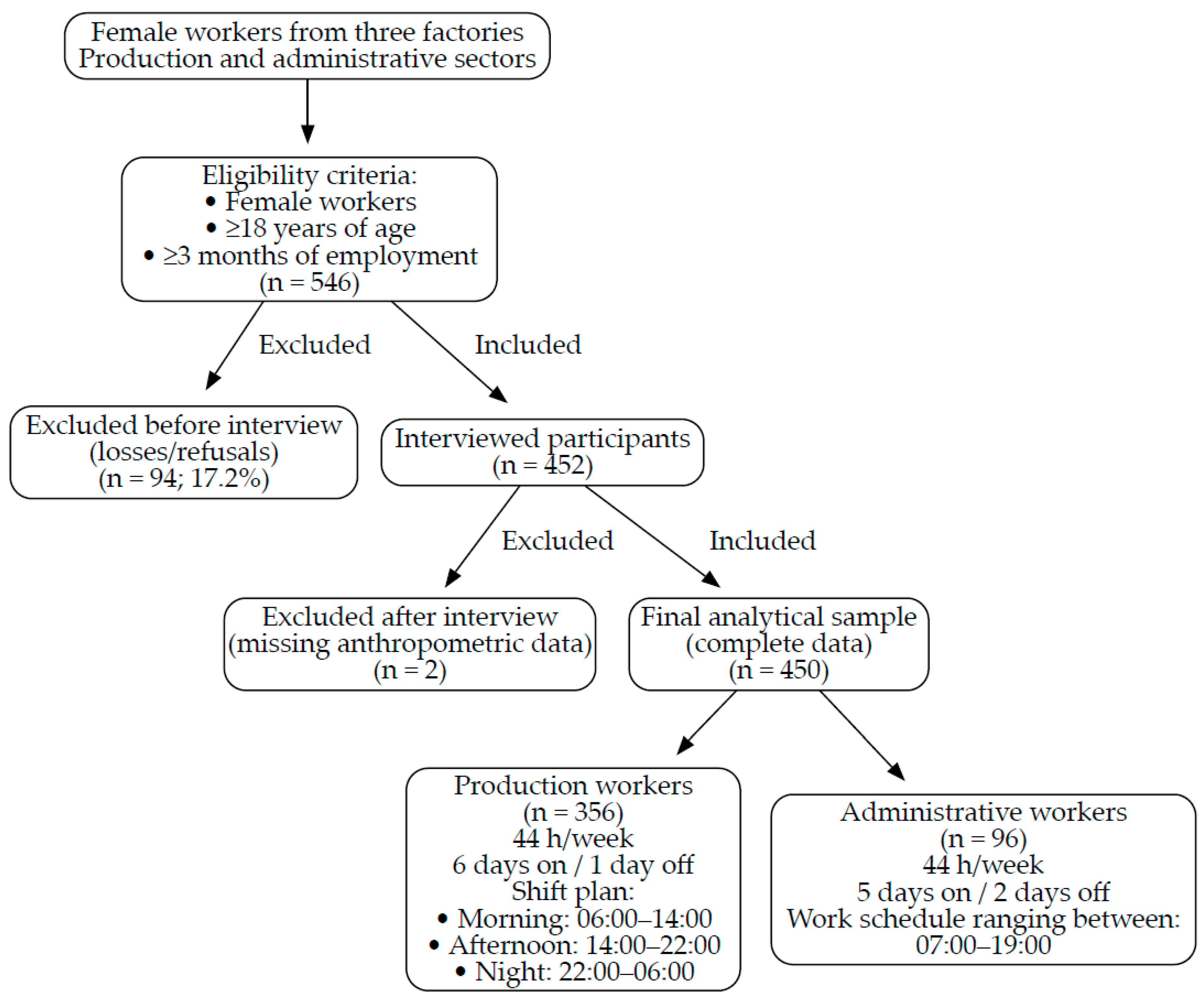
2.1. Study Design and Population
2.2. Sample
2.3. Data Collection and Instruments
2.4. Outcomes: Abdominal Adiposity Indicators
2.5. Main Exposures: Workday Sleep Deprivation and Weekend Catch-Up Sleep
2.6. Covariates
2.7. Statistical Analyses
3. Results
4. Discussion
5. Conclusions
Author Contributions
Funding
Institutional Review Board Statement
Informed Consent Statement
Data Availability Statement
Acknowledgments
Conflicts of Interest
Abbreviations
| BMI | Body mass index |
| WC | Waist circumference |
| WHtR | Waist-to-height ratio |
| WWI | Weight-to-waist index |
| C-Index | Conicity index |
| PR | Prevalence ratio |
| CI | Confidence interval |
| IQR | Interquartile ranges |
References
- Xue, R.; Li, Q.; Geng, Y.; Wang, H.; Wang, F.; Zhang, S. Abdominal obesity and risk of CVD: A dose-response meta-analysis of thirty-one prospective studies. Br. J. Nutr. 2021, 126, 1420–1430. [Google Scholar] [CrossRef] [PubMed]
- Abdi Dezfouli, R.; Mohammadian Khonsari, N.; Hosseinpour, A.; Asadi, S.; Ejtahed, H.S.; Qorbani, M. Waist to height ratio as a simple tool for predicting mortality: A systematic review and meta-analysis. Int. J. Obes. 2023, 47, 1286–1301. [Google Scholar] [CrossRef]
- Emamat, H.; Jamshidi, A.; Farhadi, A.; Ghalandari, H.; Ghasemi, M.; Tangestani, H. The association between the visceral to subcutaneous abdominal fat ratio and the risk of cardiovascular diseases: A systematic review. BMC Public Health 2024, 24, 1827. [Google Scholar] [CrossRef]
- Czernichow, S.; Kengne, A.P.; Stamatakis, E.; Hamer, M.; Batty, G.D. Body mass index, waist circumference and waist-hip ratio: Which is the better discriminator of cardiovascular disease mortality risk? Evidence from an individual-participant meta-analysis of 82 864 participants from nine cohort studies. Obes. Rev. 2011, 12, 680–687. [Google Scholar] [CrossRef]
- Lee, C.M.; Huxley, R.R.; Wildman, R.P.; Woodward, M. Indices of abdominal obesity are better discriminators of cardiovascular risk factors than BMI: A meta-analysis. J. Clin. Epidemiol. 2008, 61, 646–653. [Google Scholar] [CrossRef]
- Jayedi, A.; Soltani, S.; Zargar, M.S.; Khan, T.A.; Shab-Bidar, S. Central fatness and risk of all cause mortality: Systematic review and dose-response meta-analysis of 72 prospective cohort studies. BMJ 2020, 370, m3324. [Google Scholar] [CrossRef]
- Wong, M.C.S.; Huang, J.; Wang, J.; Chan, P.S.F.; Lok, V.; Chen, X.; Leung, C.; Wang, H.H.X.; Lao, X.Q.; Zheng, Z.J. Global, regional and time-trend prevalence of central obesity: A systematic review and meta-analysis of 13.2 million subjects. Eur. J. Epidemiol. 2020, 35, 673–683. [Google Scholar] [CrossRef] [PubMed]
- NHLBI. Sleep Deprivation and Deficiency. What Are Sleep Deprivation and Deficiency? National Heart, Lung, and Blood Institute. 2022. Available online: https://www.nhlbi.nih.gov/health/sleep-deprivation (accessed on 9 May 2025).
- Li, J.; Cao, D.; Huang, Y.; Chen, Z.; Wang, R.; Dong, Q.; Wei, Q.; Liu, L. Sleep duration and health outcomes: An umbrella review. Sleep Breath. 2022, 26, 1479–1501. [Google Scholar] [CrossRef]
- Yin, J.; Jin, X.; Shan, Z.; Li, S.; Huang, H.; Li, P.; Peng, X.; Peng, Z.; Yu, K.; Bao, W.; et al. Relationship of sleep duration with all-cause mortality and cardiovascular events: A systematic review and dose-response meta-analysis of prospective cohort studies. J. Am. Heart Assoc. 2017, 6, e005947. [Google Scholar] [CrossRef] [PubMed]
- Kohanmoo, A.; Akhlaghi, M.; Sasani, N.; Nouripour, F.; Lombardo, C.; Kazemi, A. Short sleep duration is associated with higher risk of central obesity in adults: A systematic review and meta-analysis of prospective cohort studies. Obes. Sci. Pract. 2024, 10, e772. [Google Scholar] [CrossRef]
- Pizinger, T.M.; Aggarwal, B.; St-Onge, M.P. Sleep extension in short sleepers: An evaluation of feasibility and effectiveness for weight management and cardiometabolic disease prevention. Front. Endocrinol. 2018, 9, 392. [Google Scholar] [CrossRef]
- Gao, C.; Gao, L.; Hu, K.; Li, P. Decoding the weekend sleep dilemma: The health impacts of catching up on sleep. Sleep 2024, 47, zsae159. [Google Scholar] [CrossRef]
- Sletten, T.L.; Weaver, M.D.; Foster, R.G.; Gozal, D.; Klerman, E.B.; Rajaratnam, S.M.W.; Roenneberg, T.; Takahashi, J.S.; Turek, F.W.; Vitiello, M.V.; et al. The importance of sleep regularity: A consensus statement of the National Sleep Foundation sleep timing and variability panel. Sleep Health 2023, 9, 801–820. [Google Scholar] [CrossRef]
- Zhu, H.; Qin, S.; Wu, M. Association between weekend catch-up sleep and cardiovascular disease: Evidence from the National Health and Nutrition Examination Surveys 2017–2018. Sleep Health 2024, 10, 98–103. [Google Scholar] [CrossRef]
- Chaput, J.P.; Biswas, R.K.; Ahmadi, M.; Cistulli, P.A.; Rajaratnam, S.M.W.; Hamer, M.; Stamatakis, E. Device-measured weekend catch-up sleep, mortality, and cardiovascular disease incidence in adults. Sleep 2024, 47, zsae135. [Google Scholar] [CrossRef] [PubMed]
- Jeong, W.; Song, M.J.; Shin, J.H.; Kim, J.H. Association between weekend catch-up sleep and obesity among working adults: A cross-sectional nationwide population-based study. Life 2025, 15, 1562. [Google Scholar] [CrossRef]
- Im, H.J.; Baek, S.H.; Chu, M.K.; Yang, K.I.; Kim, W.J.; Park, S.H.; Thomas, R.J.; Yun, C.H. Association between weekend catch-up sleep and lower body mass: Population-based study. Sleep 2017, 40, zsx089. [Google Scholar] [CrossRef]
- Lee, H.J.; Cho, S.; Lee, S.H.; Kim, S.J.; Kim, K.M.; Chu, M.K. Catch-up sleep on free days and body mass index: Results from the seventh Korea National Health and Nutrition Examination Survey, 2016. J. Clin. Sleep Med. 2024, 20, 39–47. [Google Scholar] [CrossRef] [PubMed]
- de Oliveira Lima, M.; Pedrosa, A.K.P.; de Oliveira, P.M.B.; de Menezes, R.C.E.; Serenini, R.; Longo-Silva, G. Circadian misalignment proxies, BMI, and chronic conditions: The role for weekday to weekend sleep differences. Sleep Breath. 2024, 28, 1799–1808. [Google Scholar] [CrossRef] [PubMed]
- Pacheco, D.; Rehman, A. Shift Work Disorder. What Is Shift Work? Sleep Foundation. Available online: https://www.sleepfoundation.org/shift-work-disorder/what-shift-work (accessed on 11 May 2025).
- Costa, G. Sleep deprivation due to shift work. Handb. Clin. Neurol. 2015, 131, 437–446. [Google Scholar] [CrossRef]
- Boivin, D.B.; Boudreau, P. Impacts of shift work on sleep and circadian rhythms. Pathol. Biol. 2014, 62, 292–301. [Google Scholar] [CrossRef]
- Macagnan, J.; Pattussi, M.P.; Canuto, R.; Henn, R.L.; Fassa, A.G.; Olinto, M.T. Impact of nightshift work on overweight and abdominal obesity among workers of a poultry processing plant in southern Brazil. Chronobiol. Int. 2012, 29, 336–343. [Google Scholar] [CrossRef]
- Sun, M.; Feng, W.; Wang, F.; Zhang, L.; Wu, Z.; Li, Z.; Zhang, B.; He, Y.; Xie, S.; Li, M.; et al. Night shift work exposure profile and obesity: Baseline results from a Chinese night shift worker cohort. PLoS ONE 2018, 13, e0196989. [Google Scholar] [CrossRef]
- Sun, M.; Feng, W.; Wang, F.; Li, P.; Li, Z.; Li, M.; Tse, G.; Vlaanderen, J.; Vermeulen, R.; Tse, L.A. Meta-analysis on shift work and risks of specific obesity types. Obes. Rev. 2018, 19, 28–40. [Google Scholar] [CrossRef]
- Obesity: Preventing and Managing the Global Epidemic: Report of a WHO Consultation; World Health Organization: Geneva, Switzerland, 2000; Available online: https://apps.who.int/iris/bitstream/10665/42330/1/WHO_TRS_894.pdf (accessed on 28 May 2025).
- Waist Circumference and Waist-Hip Ratio. Report of a WHO Expert Consultation; World Health Organization: Geneva, Switzerland, 2008; Available online: https://www.who.int/publications/i/item/9789241501491 (accessed on 20 May 2025).
- Ashwell, M.; Hsieh, S.D. Six reasons why the waist-to-height ratio is a rapid and effective global indicator for health risks of obesity and how its use could simplify the international public health message on obesity. Int. J. Food Sci. Nutr. 2005, 56, 303–307. [Google Scholar] [CrossRef]
- Browning, L.M.; Hsieh, S.D.; Ashwell, M. A systematic review of waist-to-height ratio as a screening tool for the prediction of cardiovascular disease and diabetes: 0.5 could be a suitable global boundary value. Nutr. Res. Rev. 2010, 23, 247–269. [Google Scholar] [CrossRef]
- Gibson, S.; Ashwell, M. A simple cut-off for waist-to-height ratio (0.5) can act as an indicator for cardiometabolic risk: Recent data from adults in the Health Survey for England. Br. J. Nutr. 2020, 123, 681–690. [Google Scholar] [CrossRef] [PubMed]
- Park, Y.; Kim, N.H.; Kwon, T.Y.; Kim, S.G. A novel adiposity index as an integrated predictor of cardiometabolic disease morbidity and mortality. Sci. Rep. 2018, 8, 16753. [Google Scholar] [CrossRef] [PubMed]
- Han, Y.; Shi, J.; Gao, P.; Zhang, L.; Niu, X.; Fu, N. The weight-adjusted-waist index predicts all-cause and cardiovascular mortality in general US adults. Clinics 2023, 78, 100248. [Google Scholar] [CrossRef]
- Kim, K.J.; Son, S.; Kim, K.J.; Kim, S.G.; Kim, N.H. Weight-adjusted waist as an integrated index for fat, muscle and bone health in adults. J. Cachexia Sarcopenia Muscle 2023, 14, 2196–2203. [Google Scholar] [CrossRef] [PubMed]
- Valdez, R. A simple model-based index of abdominal adiposity. J. Clin. Epidemiol. 1991, 44, 955–956. [Google Scholar] [CrossRef]
- do Prado, C.B.; Martins, C.A.; Cremonini, A.C.P.; Ferreira, J.R.S.; Cattafesta, M.; Almeida-de-Souza, J.; Zandonade, E.; Bezerra, O.; Salaroli, L.B. Cut points of the conicity index and associated factors in brazilian rural workers. Nutrients 2022, 14, 4487. [Google Scholar] [CrossRef] [PubMed]
- Andrade, M.D.; Freitas, M.C.; Sakumoto, A.M.; Pappiani, C.; Andrade, S.C.; Vieira, V.L.; Damasceno, N.R. Association of the conicity index with diabetes and hypertension in Brazilian women. Arch. Endocrinol. Metab. 2016, 60, 436–442. [Google Scholar] [CrossRef] [PubMed]
- Rubino, F.; Cummings, D.E.; Eckel, R.H.; Cohen, R.V.; Wilding, J.P.H.; Brown, W.A.; Stanford, F.C.; Batterham, R.L.; Farooqi, I.S.; Farpour-Lambert, N.J.; et al. Definition and diagnostic criteria of clinical obesity. Lancet Diabetes Endocrinol. 2025, 13, 221–262. [Google Scholar] [CrossRef] [PubMed]
- Kim, Y.; An, H.J.; Seo, Y.G. Optimal cutoffs of sleep timing and sleep duration for cardiovascular risk factors. Diabetes Res. Clin. Pract. 2023, 204, 110894. [Google Scholar] [CrossRef]
- Landis, J.R.; Koch, G.G. The measurement of observer agreement for categorical data. Biometrics 1977, 33, 159–174. [Google Scholar] [CrossRef]
- Victora, C.G.; Huttly, S.R.; Fuchs, S.C.; Olinto, M.T. The role of conceptual frameworks in epidemiological analysis: A hierarchical approach. Int. J. Epidemiol. 1997, 26, 224–227. [Google Scholar] [CrossRef]
- Martins-Silva, T.; Vaz, J.D.S.; Mola, C.L.; Assuncao, M.C.F.; Tovo-Rodrigues, L. Prevalence of obesity in rural and urban areas in Brazil: National Health Survey, 2013. Rev. Bras. Epidemiol. 2019, 22, e190049. [Google Scholar] [CrossRef]
- Vera-Ponce, V.J.; Loayza-Castro, J.A.; Zuzunaga-Montoya, F.E.; Vasquez-Romero, L.E.M.; Sanchez-Tamay, N.M.; Bustamante-Rodriguez, J.C.; Ballena-Caicedo, J.; Gutierrez De Carrillo, C.I. Abdominal obesity prevalence in Latin America: A systematic review and meta-analysis comparing ATP III and IDF criteria. Front. Endocrinol. 2025, 16, 1562060. [Google Scholar] [CrossRef]
- Sperry, S.D.; Scully, I.D.; Gramzow, R.H.; Jorgensen, R.S. Sleep duration and waist circumference in adults: A meta-analysis. Sleep 2015, 38, 1269–1276. [Google Scholar] [CrossRef]
- Stich, F.M.; Huwiler, S.; D’Hulst, G.; Lustenberger, C. The potential role of sleep in promoting a healthy body composition: Underlying mechanisms determining muscle, fat, and bone mass and their association with sleep. Neuroendocrinology 2022, 112, 673–701. [Google Scholar] [CrossRef]
- Chaput, J.P.; McHill, A.W.; Cox, R.C.; Broussard, J.L.; Dutil, C.; da Costa, B.G.G.; Sampasa-Kanyinga, H.; Wright, K.P., Jr. The role of insufficient sleep and circadian misalignment in obesity. Nat. Rev. Endocrinol. 2023, 19, 82–97. [Google Scholar] [CrossRef]
- van Egmond, L.T.; Meth, E.M.S.; Engstrom, J.; Ilemosoglou, M.; Keller, J.A.; Vogel, H.; Benedict, C. Effects of acute sleep loss on leptin, ghrelin, and adiponectin in adults with healthy weight and obesity: A laboratory study. Obesity 2023, 31, 635–641. [Google Scholar] [CrossRef]
- Lin, J.; Jiang, Y.; Wang, G.; Meng, M.; Zhu, Q.; Mei, H.; Liu, S.; Jiang, F. Associations of short sleep duration with appetite-regulating hormones and adipokines: A systematic review and meta-analysis. Obes. Rev. 2020, 21, e13051. [Google Scholar] [CrossRef] [PubMed]
- Balbo, M.; Leproult, R.; Van Cauter, E. Impact of sleep and its disturbances on hypothalamo-pituitary-adrenal axis activity. Int. J. Endocrinol. 2010, 2010, 759234. [Google Scholar] [CrossRef] [PubMed]
- Hirotsu, C.; Tufik, S.; Andersen, M.L. Interactions between sleep, stress, and metabolism: From physiological to pathological conditions. Sleep Sci. 2015, 8, 143–152. [Google Scholar] [CrossRef]
- Depner, C.M.; Melanson, E.L.; Eckel, R.H.; Snell-Bergeon, J.K.; Perreault, L.; Bergman, B.C.; Higgins, J.A.; Guerin, M.K.; Stothard, E.R.; Morton, S.J.; et al. Ad libitum weekend recovery sleep fails to prevent metabolic dysregulation during a repeating pattern of insufficient sleep and weekend recovery sleep. Curr. Biol. 2019, 29, 957–967.E4. [Google Scholar] [CrossRef]
- Theodoro, H.; Bassani, D.G.; da Silva, J.C.; Mendes, K.G.; Cibeira, G.H.; Schenkel, J.C.; Olinto, M.T.A. Behavioural characteristics and abdominal obesity among Brazilian shift working women. Public Health Nutr. 2021, 24, 253–259. [Google Scholar] [CrossRef] [PubMed]
- Vasconcelos, S.P.; Lemos, L.C.; Moreno, C.R.C. Night shift work and sleep disturbances in women: A scoping review. Sleep Med. Clin. 2023, 18, 533–543. [Google Scholar] [CrossRef]
- Smith, K.L.; Danyluk, A.B.; Munir, S.S.; Covassin, N. Shift work and obesity risk-are there sex differences? Curr. Diabetes Rep. 2022, 22, 341–352. [Google Scholar] [CrossRef]
- Broussard, J.L.; Van Cauter, E. Disturbances of sleep and circadian rhythms: Novel risk factors for obesity. Curr. Opin. Endocrinol. Diabetes Obes. 2016, 23, 353–359. [Google Scholar] [CrossRef]
- Antunes, L.C.; Levandovski, R.; Dantas, G.; Caumo, W.; Hidalgo, M.P. Obesity and shift work: Chronobiological aspects. Nutr. Res. Rev. 2010, 23, 155–168. [Google Scholar] [CrossRef]
- Qian, J.; Morris, C.J.; Caputo, R.; Wang, W.; Garaulet, M.; Scheer, F. Sex differences in the circadian misalignment effects on energy regulation. Proc. Natl. Acad. Sci. USA 2019, 116, 23806–23812. [Google Scholar] [CrossRef]
- Chaput, J.P.; Dutil, C.; Featherstone, R.; Ross, R.; Giangregorio, L.; Saunders, T.J.; Janssen, I.; Poitras, V.J.; Kho, M.E.; Ross-White, A.; et al. Sleep duration and health in adults: An overview of systematic reviews. Appl. Physiol. Nutr. Metab. 2020, 45, S218–S231. [Google Scholar] [CrossRef]
- Chaput, J.P.; Dutil, C.; Featherstone, R.; Ross, R.; Giangregorio, L.; Saunders, T.J.; Janssen, I.; Poitras, V.J.; Kho, M.E.; Ross-White, A.; et al. Sleep timing, sleep consistency, and health in adults: A systematic review. Appl. Physiol. Nutr. Metab. 2020, 45, S232–S247. [Google Scholar] [CrossRef] [PubMed]
- Hirshkowitz, M.; Whiton, K.; Albert, S.M.; Alessi, C.; Bruni, O.; DonCarlos, L.; Hazen, N.; Herman, J.; Katz, E.S.; Kheirandish-Gozal, L.; et al. National Sleep Foundation’s sleep time duration recommendations: Methodology and results summary. Sleep Health 2015, 1, 40–43. [Google Scholar] [CrossRef]
- Timothy Garvey, W. Clinical definition of overweight and obesity. In Bariatric Endocrinology: Evaluation and Management of Adiposity, Adiposopathy and Related Diseases; Gonzalez-Campoy, J.M., Hurley, D.L., Garvey, W.T., Eds.; Springer International Publishing: Cham, Switzerland, 2019; pp. 121–143. [Google Scholar]
- Mahmoud, I.; Al-Wandi, A.S.; Gharaibeh, S.S.; Mohamed, S.A. Concordances and correlations between anthropometric indices of obesity: A systematic review. Public Health 2021, 198, 301–306. [Google Scholar] [CrossRef]
- Baek, J.; Han, K.; Choi-Kwon, S. Sleep diary- and actigraphy-derived sleep parameters of 8-hour fast-rotating shift work nurses: A prospective descriptive study. Int. J. Nurs. Stud. 2020, 112, 103719. [Google Scholar] [CrossRef] [PubMed]
- Lauderdale, D.S.; Knutson, K.L.; Yan, L.L.; Liu, K.; Rathouz, P.J. Self-reported and measured sleep duration: How similar are they? Epidemiology 2008, 19, 838–845. [Google Scholar] [CrossRef] [PubMed]


| Characteristics | Waist Circumference (WC) | Waist-to-Height Ratio (WHtR) | Weight-to-Waist Index (WWI) | Conicity Index (C-Index) | WC (≥88 cm) & BMI (≥30 kg/m2) | |||||||||||
|---|---|---|---|---|---|---|---|---|---|---|---|---|---|---|---|---|
| Overall | <88 cm | ≥88 cm | p a | ≤0.5 | >0.5 | p a | <11 cm/√kg | ≥11 cm/√kg | p a | <1.27 | ≥1.27 | p a | No | Yes | p a | |
| Overall, n (%) | 450 (100) | 246 (54.7) | 204 (45.3) | 236 (52.4) | 214 (47.6) | 332 (73.8) | 118 (26.2) | 332 (73.8) | 118 (26.2) | 321 (71.3) | 129 (28.7) | |||||
| Age, yrs | ||||||||||||||||
| Mean ± SD | 34.9 ± 9.9 | 32.4 ± 9.9 | 38.0 ± 9.1 | <0.001 | 32.0 ± 9.7 | 38.1 ± 9.3 | <0.001 | 32.7 ± 9.6 | 41.2 ± 8.1 | <0.001 | 33.0 ± 9.7 | 40.4 ± 8.5 | <0.001 | 34.3 ± 10.3 | 36.6 ± 8.8 | 0.025 |
| Skin color/race, n (%) | ||||||||||||||||
| White | 315 (70.0) | 172 (69.9) | 143 (70.1) | 167 (70.8) | 148 (69.2) | 227 (68.4) | 88 (74.6) | 226 (68.1) | 89 (75.4) | 225 (70.1) | 90 (69.8) | |||||
| Other b | 135 (30.0) | 74 (30.1) | 61 (29.9) | 0.967 | 69 (29.2) | 66 (30.8) | 0.711 | 105 (31.6) | 30 (25.4) | 0.207 | 106 (31.9) | 29 (24.6) | 0.134 | 96 (29.9) | 39 (30.2) | 0.946 |
| Marital status, n (%) | ||||||||||||||||
| Without a partner | 231 (51.3) | 143 (58.1) | 88 (43.1) | 138 (58.5) | 93 (43.5) | 179 (53.9) | 52 (44.1) | 176 (53.0) | 55 (46.6) | 176 (54.8) | 55 (42.6) | |||||
| With a partner | 219 (48.7) | 103 (41.9) | 116 (56.9) | 0.002 | 98 (41.5) | 121 (56.5) | 0.001 | 153 (46.1) | 66 (55.9) | 0.066 | 156 (47.0) | 63 (53.4) | 0.232 | 145 (45.2) | 74 (57.4) | 0.019 |
| Education level, yrs | ||||||||||||||||
| Mean ± SD | 12.0 ± 2.5 | 12.4 ± 2.6 | 11.6 ± 2.3 | <0.001 | 12.5 ± 2.6 | 11.5 ± 2.3 | <0.001 | 12.4 ± 2.6 | 10.9 ± 2.0 | <0.001 | 12.2 ± 2.6 | 11.4 ± 2.2 | 0.002 | 12.1 ± 2.6 | 11.7 ± 2.3 | 0.084 |
| Income c, N = 446 | ||||||||||||||||
| Median [IQR] | 1.2[0.8–1.7] | 1.2[0.9–1.9] | 1.0[0.7–1.5] | 0.003 | 1.2[0.9–1.9] | 1.0[0.7–1.4] | <0.001 | 1.2[0.8–1.8] | 1.0[0.8–1.4] | 0.004 | 1.2[0.8–1.8] | 1.0[0.8–1.5] | 0.067 | 1.2[0.8–1.8] | 1.0[0.8–1.4] | 0.021 |
| Head of household, n (%) | ||||||||||||||||
| No | 292 (64.9) | 174 (70.7) | 118 (57.8) | 166 (70.3) | 126 (58.9) | 225 (67.8) | 67 (56.8) | 224 (67.5) | 68 (57.6) | 218 (67.9) | 74 (57.4) | |||||
| Yes | 158 (35.1) | 72 (29.3) | 86 (42.2) | 0.004 | 70 (29.7) | 88 (41.1) | 0.011 | 107 (32.2) | 51 (43.2) | 0.032 | 108 (32.5) | 50 (42.4) | 0.054 | 103 (32.1) | 55 (42.6) | 0.034 |
| Physical activity, n (%) | ||||||||||||||||
| No | 322 (71.6) | 164 (66.7) | 158 (77.4) | 153 (64.8) | 169 (79.0) | 221 (66.6) | 101 (85.6) | 225 (67.8) | 97 (82.2) | 221 (68.8) | 101 (78.3) | |||||
| Yes | 128 (28.4) | 82 (33.3) | 46 (22.6) | 0.012 | 83 (35.2) | 45 (21.0) | 0.001 | 111 (33.4) | 17 (14.4) | <0.001 | 107 (32.2) | 21 (17.8) | 0.003 | 100 (31.1) | 28 (21.7) | 0.045 |
| Smoking history, n (%) | ||||||||||||||||
| Non-smoker | 342 (76.0) | 190 (77.2) | 152 (74.5) | 183 (77.5) | 159 (74.3) | 253 (76.2) | 89 (75.4) | 252 (75.9) | 90 (76.3) | 241 (75.1) | 101 (78.3) | |||||
| Smoker/former smoker | 108 (24.0) | 56 (22.8) | 52 (25.5) | 0.500 | 53 (22.5) | 55 (25.7) | 0.421 | 79 (23.8) | 29 (24.6) | 0.865 | 80 (24.1) | 28 (23.7) | 0.936 | 80 (24.9) | 28 (21.7) | 0.470 |
| Alcohol consumption, n (%) | ||||||||||||||||
| No or less than once per week | 315 (70.0) | 166 (67.5) | 149 (73.0) | 155 (65.7) | 160 (74.8) | 219 (66.0) | 96 (81.4) | 221 (66.6) | 94 (79.7) | 222 (69.2) | 93 (72.1) | |||||
| At least once per week | 135 (30.0) | 80 (32.5) | 55 (27.0) | 0.200 | 81 (34.3) | 54 (25.2) | 0.036 | 113 (34.0) | 22 (18.6) | 0.002 | 111 (33.4) | 24 (20.3) | 0.008 | 99 (30.8) | 36 (27.9) | 0.539 |
| Number of meals per day | ||||||||||||||||
| Median [IQR] | 4.0[3.0–4.0] | 4.0[3.0–4.0] | 4.0[3.0–4.0] | 0.025 | 4.0[3.0–5.0] | 4.0[3.0–4.0] | 0.025 | 4.0[3.0–4.0] | 4.0[3.0–4.0] | 0.603 | 4.0[3.0–4.0] | 4.0[3.0–4.0] | 0.897 | 4.0[3.0–4.0] | 3.0[3.0–4.0] | 0.002 |
| Age at menarche, years, N = 449 | ||||||||||||||||
| Mean ± SD | 12.4 ± 1.6 | 12.6 ± 1.5 | 12.0 ± 1.7 | <0.001 | 12.6 ± 1.6 | 12.1 ± 1.6 | <0.001 | 12.5 ± 1.6 | 12.0 ± 1.6 | 0.012 | 12.5 ± 1.6 | 12.1 ± 1.6 | 0.035 | 12.6 ± 1.5 | 11.9 ± 1.7 | <0.001 |
| Parity | ||||||||||||||||
| Median [IQR] | 1.0[0.0–2.0] | 1.0[0.0–2.0] | 1.0[0.0–2.0] | <0.001 | 1.0[0.0–2.0] | 1.0[1.0–2.0] | <0.001 | 1.0[0.0–2.0] | 1.5[1.0–2.0] | <0.001 | 1.0[0.0–2.0] | 1.0[1.0–2.0] | <0.001 | 1.0[0.0–2.0] | 1.0[0.0–2.0] | 0.018 |
| Work shift, n (%) | ||||||||||||||||
| Day shift | 353 (78.4) | 203 (82.5) | 150 (73.5) | 192 (81.4) | 161 (75.2) | 265 (79.8) | 88 (74.6) | 263 (79.2) | 90 (76.3) | 261 (81.3) | 92 (71.3) | |||||
| Night shift | 97 (21.6) | 43 (17.5) | 54 (26.5) | 0.021 | 44 (18.6) | 53 (24.8) | 0.115 | 67 (20.2) | 30 (25.4) | 0.234 | 69 (20.8) | 28 (23.7) | 0.504 | 60 (18.7) | 37 (28.7) | 0.020 |
| Workday sleep duration, h | ||||||||||||||||
| Mean ± SD | 6.6 ± 1.7 | 6.9 ± 1.6 | 6.2 ± 1.8 | <0.001 | 6.9 ± 1.7 | 6.3 ± 1.7 | <0.001 | 6.7 ± 1.7 | 6.2 ± 1.8 | 0.003 | 6.7 ± 1.7 | 6.3 ± 1.7 | 0.019 | 6.8 ± 1.7 | 6.1 ± 1.8 | <0.001 |
| Weekend sleep duration, h | ||||||||||||||||
| Mean ± SD | 8.8 ± 2.4 | 8.7 ± 2.2 | 8.9 ± 2.6 | 0.551 | 8.7 ± 2.3 | 8.9 ± 2.5 | 0.283 | 8.8 ± 2.3 | 8.9 ± 2.8 | 0.629 | 8.8 ± 2.2 | 8.8 ± 2.8 | 0.862 | 8.7 ± 2.3 | 9.0 ± 2.7 | 0.174 |
| Weekly average sleep duration, h | ||||||||||||||||
| Mean ± SD | 6.9 ± 1.6 | 7.2 ± 1.5 | 6.7 ± 1.6 | <0.001 | 7.2 ± 1.5 | 6.7 ± 1.6 | 0.001 | 7.1 ± 1.5 | 6.6 ± 1.6 | 0.005 | 7.1 ± 1.6 | 6.7 ± 1.6 | 0.023 | 7.1 ± 1.5 | 6.5 ± 1.6 | <0.001 |
| Catch-up sleep, h | ||||||||||||||||
| Median [IQR] | 2.0[0.0–3.7] | 1.6[0.0–3.0] | 2.4[0.2–4.0] | 0.004 | 1.6[0.0–3.0] | 2.3[0.3–4.0] | 0.002 | 1.8[0.1–3.4] | 2.0[0.0–4.0] | 0.247 | 1.8[0.1–3.6] | 2.0[0.0–3.8] | 0.440 | 1.7[0.0–3.1] | 2.7[1.0–4.5] | <0.001 |
| Characteristics | Workday Sleep Deprivation (h/d) | Weekend Catch-Up Sleep (h) | ||||
|---|---|---|---|---|---|---|
| ≥6 | <6 | p a | ≤2 | >2 | p a | |
| Overall, n (%) | 328 (72.9) | 122 (27.1) | 255 (56.7) | 195 (43.3) | ||
| Age, years | ||||||
| Mean ± SD | 34.7 ± 10.2 | 35.5 ± 9.3 | 0.449 | 34.6 ± 10.1 | 35.4 ± 9.8 | 0.360 |
| Skin color/race, n (%) | ||||||
| White | 235 (71.7) | 80 (65.6) | 176 (69.0) | 139 (71.3) | ||
| Other b | 93 (28.3) | 42 (34.4) | 0.211 | 79 (31.0) | 56 (28.7) | 0.604 |
| Marital status, n (%) | ||||||
| Without a partner | 167 (50.9) | 64 (52.5) | 139 (54.5) | 92 (47.2) | ||
| With a partner | 161 (49.1) | 58 (47.5) | 0.771 | 116 (45.5) | 103 (52.8) | 0.123 |
| Education level, years | ||||||
| Mean ± SD | 12.2 ± 2.6 | 11.5 ± 2.1 | 0.006 | 12.1 ± 2.7 | 11.9 ± 2.3 | 0.289 |
| Income c, N = 446 | ||||||
| Median [IQR] | 1.2[0.8–1.8] | 1.0[0.8–1.5] | 0.026 | 1.1[0.8–1.7] | 1.1[0.8–1.7] | 0.857 |
| Head of household, n (%) | ||||||
| No | 217 (66.2) | 75 (61.5) | 166 (65.1) | 126 (64.6) | ||
| Yes | 111 (33.8) | 47 (38.5) | 0.355 | 89 (34.9) | 69 (35.4) | 0.915 |
| Physical activity, n (%) | ||||||
| No | 231 (70.4) | 91 (74.6) | 185 (72.6) | 137 (70.3) | ||
| Yes | 97 (29.6) | 31 (25.4) | 0.384 | 70 (27.4) | 58 (29.7) | 0.593 |
| Smoking history, n (%) | ||||||
| Non-smoker | 259 (79.0) | 83 (68.0) | 196 (76.9) | 146 (74.9) | ||
| Smoker/former smoker | 69 (21.0) | 39 (32.0) | 0.016 | 59 (23.1) | 49 (25.1) | 0.624 |
| Alcohol consumption, n (%) | ||||||
| No or less than once per week | 229 (69.8) | 86 (70.5) | 181 (71.0) | 134 (68.7) | ||
| At least once per week | 99 (30.2) | 36 (29.5) | 0.890 | 74 (29.0) | 61 (31.3) | 0.604 |
| Number of meals per day | ||||||
| Median [IQR] | 4.0[3.0–4.0] | 3.0[3.0–4.0] | <0.001 | 4.0[3.0–5.0] | 4.0[3.0–4.0] | 0.017 |
| Age at menarche, years, N = 449 | ||||||
| Mean ± SD | 12.5 ± 1.6 | 12.1 ± 1.7 | 0.048 | 12.4 ± 1.7 | 12.3 ± 1.5 | 0.390 |
| Parity | ||||||
| Median [IQR] | 1.0[0.0–2.0] | 1.0[0.0–2.0] | 0.061 | 1.0[0.0–2.0] | 1.0[0.0–2.0] | 0.158 |
| Work shift, n (%) | ||||||
| Day shift | 294 (89.6) | 59 (48.4) | 215 (84.3) | 138 (70.8) | ||
| Night shift | 34 (10.4) | 63 (51.6) | <0.001 | 40 (15.7) | 57 (29.2) | 0.001 |
| Workday sleep duration, h | ||||||
| Mean ± SD | 7.4 ± 1.1 | 4.3 ± 0.9 | <0.001 | 7.2 ± 1.6 | 5.8 ± 1.5 | <0.001 |
| Weekend sleep duration, h | ||||||
| Mean ± SD | 8.9 ± 2.1 | 8.4 ± 3.1 | 0.034 | 7.6 ± 2.0 | 10.4 ± 2.0 | <0.001 |
| Weekly average sleep duration, h | ||||||
| Mean ± SD | 7.7 ± 1.0 | 4.9 ± 0.9 | <0.001 | 7.3 ± 1.6 | 6.5 ± 1.4 | <0.001 |
| Catch-up sleep, h | ||||||
| Median [IQR] | 1.6[0–3] | 3.9[1.5–5.8] | <0.001 | 0.6[0.0–1.5] | 4[3.0–5.7] | <0.001 |
| Workday Sleep Deprivation (h/d) | Model I | Model II | Model III | Model IV | |
|---|---|---|---|---|---|
| n (%) | PR (95% CI) | PR (95% CI) | PR (95% CI) | PR (95% CI) | |
| N = 450 | WC ≥ 88 cm | ||||
| ≥6 (n = 328) | 130 (39.6) | 1.00 | 1.00 | 1.00 | 1.00 |
| <6 (n = 122) | 74 (60.7) | 1.53 (1.26–1.86) | 1.43 (1.19–1.73) | 1.32 (1.08–1.60) | 1.37 (1.10–1.69) |
| N = 450 | WHtR > 0.50 | ||||
| ≥6 (n = 328) | 142 (43.3) | 1.00 | 1.00 | 1.00 | 1.00 |
| <6 (n = 122) | 72 (59.0) | 1.36 (1.12–1.65) | 1.26 (1.06–1.51) | 1.16 (0.97–1.39) | 1.25 (1.02–1.53) |
| N = 450 | WWI ≥ 11 cm/√kg | ||||
| ≥6 (n = 328) | 75 (22.9) | 1.00 | 1.00 | 1.00 | 1.00 |
| <6 (n = 122) | 43 (35.3) | 1.54 (1.13–2.11) | 1.38 (1.04–1.85) | 1.31 (0.98–1.17) | 1.48 (1.07–2.04) |
| N = 450 | C-Index ≥ 1.27 | ||||
| ≥6 (n = 328) | 77 (23.5) | 1.00 | 1.00 | 1.00 | 1.00 |
| <6 (n = 122) | 41 (33.6) | 1.43 (1.04–1.97) | 1.35 (1.00–1.82) | 1.31 (0.97–1.77) | 1.43 (1.03–1.99) |
| N = 450 | WC ≥ 88 cm & BMI ≥ 30 kg/m2 | ||||
| ≥6 (n = 328) | 77 (23.5) | 1.00 | 1.00 | 1.00 | 1.00 |
| <6 (n = 122) | 52 (42.6) | 1.82 (1.37–2.41) | 1.72 (1.29–2.29) | 1.53 (1.15–2.04) | 1.59 (1.17–2.16) |
| Weekend Catch-Up Sleep (h) | Model I | Model II | Model III | Model IV | |
|---|---|---|---|---|---|
| n (%) | PR (95% CI) | PR (95% CI) | PR (95% CI) | PR (95% CI) | |
| N = 450 | WC ≥ 88 cm | ||||
| ≤2 (n = 255) | 100 (39.2) | 1.00 | 1.00 | 1.00 | 1.00 |
| >2 (n = 195) | 104 (53.3) | 1.36 (1.11–1.66) | 1.28 (1.06–1.56) | 1.24 (1.03–1.51) | 1.20 (0.99–1.45) |
| N = 450 | WHtR > 0.50 | ||||
| ≤2 (n = 255) | 105 (41.2) | 1.00 | 1.00 | 1.00 | 1.00 |
| >2 (n = 195) | 109 (55.9) | 1.36 (1.12–1.65) | 1.28 (1.07–1.54) | 1.25 (1.04–1.50) | 1.24 (1.03–1.49) |
| N = 450 | WWI ≥ 11 | ||||
| ≤2 (n = 255) | 62 (24.3) | 1.00 | 1.00 | 1.00 | 1.00 |
| >2 (n = 195) | 56 (28.7) | 1.18 (0.87–1.61) | 1.09 (0.82–1.46) | 1.05 (0.79–1.40) | 1.03 (0.77–1.38) |
| N = 450 | C-Index ≥ 1.27 | ||||
| ≤2 (n = 255) | 64 (25.1) | 1.00 | 1.00 | 1.00 | 1.00 |
| >2 (n = 195) | 54 (27.7) | 1.10 (0.81–1.51) | 1.04 (0.77–1.40) | 1.02 (0.76–1.37) | 1.00 (0.74–1.34) |
| N = 450 | WC ≥ 88 cm & BMI ≥ 30 kg/m2 | ||||
| ≤2 (n = 255) | 58 (22.8) | 1.00 | 1.00 | 1.00 | 1.00 |
| >2 (n = 195) | 71 (36.4) | 1.60 (1.19–2.15) | 1.52 (1.14–2.04) | 1.47 (1.11–1.96) | 1.40 (1.05–1.87) |
Disclaimer/Publisher’s Note: The statements, opinions and data contained in all publications are solely those of the individual author(s) and contributor(s) and not of MDPI and/or the editor(s). MDPI and/or the editor(s) disclaim responsibility for any injury to people or property resulting from any ideas, methods, instructions or products referred to in the content. |
© 2026 by the authors. Licensee MDPI, Basel, Switzerland. This article is an open access article distributed under the terms and conditions of the Creative Commons Attribution (CC BY) license.
Share and Cite
Garcez, A.; Vilela, S.; da Silva, J.C.; Kohl, I.S.; Arruda, H.C.d.; Olinto, M.T.A. Association Between Workday Sleep Deprivation, Weekend Catch-Up Sleep, and Abdominal Adiposity Indicators: A Cross-Sectional Study Among Brazilian Female Fixed-Shift Workers. Diseases 2026, 14, 43. https://doi.org/10.3390/diseases14020043
Garcez A, Vilela S, da Silva JC, Kohl IS, Arruda HCd, Olinto MTA. Association Between Workday Sleep Deprivation, Weekend Catch-Up Sleep, and Abdominal Adiposity Indicators: A Cross-Sectional Study Among Brazilian Female Fixed-Shift Workers. Diseases. 2026; 14(2):43. https://doi.org/10.3390/diseases14020043
Chicago/Turabian StyleGarcez, Anderson, Sofia Vilela, Janaína Cristina da Silva, Ingrid Stähler Kohl, Harrison Canabarro de Arruda, and Maria Teresa Anselmo Olinto. 2026. "Association Between Workday Sleep Deprivation, Weekend Catch-Up Sleep, and Abdominal Adiposity Indicators: A Cross-Sectional Study Among Brazilian Female Fixed-Shift Workers" Diseases 14, no. 2: 43. https://doi.org/10.3390/diseases14020043
APA StyleGarcez, A., Vilela, S., da Silva, J. C., Kohl, I. S., Arruda, H. C. d., & Olinto, M. T. A. (2026). Association Between Workday Sleep Deprivation, Weekend Catch-Up Sleep, and Abdominal Adiposity Indicators: A Cross-Sectional Study Among Brazilian Female Fixed-Shift Workers. Diseases, 14(2), 43. https://doi.org/10.3390/diseases14020043