CD36 rs1761667 Polymorphism and Its Impact on Molecular Signatures in Bladder Cancer

 , , and
Abstract
1. Introduction
2. Materials and Methods
2.1. Study Design/Participants/Inclusion Criteria/Clinical Evaluation
2.2. DNA Extraction and Genotyping
2.3. RNA Extraction and Gene Expression
2.4. Statistical Analysis
3. Results
3.1. Demographic Study/Biochemical Characteristics
3.2. Genotypes and Allele Frequencies
3.3. qPCR Analysis/CD36 mRNA Expression in Patients with BC
4. Discussion
5. Conclusions
Supplementary Materials
Author Contributions
Funding
Institutional Review Board Statement
Informed Consent Statement
Data Availability Statement
Conflicts of Interest
Abbreviations
| BC | Bladder cancer |
| bp | Base pair |
| IQR | Interquartile range |
| MIBC | Muscle-invasive bladder cancer |
| NMIBC | Non-muscle-invasive bladder cancer |
| PCR-RFLP | Polymerase chain reaction–restriction fragment length polymorphism |
| RT-qPCR | Reverse transcription quantitative PCR |
| T2DM | Type 2 diabetes mellitus |
| SD | Standard deviation |
References
- Lobo, N.; Afferi, L.; Moschini, M.; Mostafid, H.; Porten, S.; Psutka, S.P.; Gupta, S.; Smith, A.B.; Williams, S.B.; Lotan, Y. Epidemiology, Screening, and Prevention of Bladder Cancer. Eur. Urol. Oncol. 2022, 5, 628–639. [Google Scholar] [CrossRef] [PubMed]
- Sung, H.; Ferlay, J.; Siegel, R.L.; Laversanne, M.; Soerjomataram, I.; Jemal, A.; Bray, F. Global Cancer Statistics 2020: GLOBOCAN Estimates of Incidence and Mortality Worldwide for 36 Cancers in 185 Countries. CA Cancer J. Clin. 2021, 71, 209–249. [Google Scholar] [CrossRef] [PubMed]
- Antoni, S.; Ferlay, J.; Soerjomataram, I.; Znaor, A.; Jemal, A.; Bray, F. Bladder Cancer Incidence and Mortality: A Global Overview and Recent Trends. Eur. Urol. 2017, 71, 96–108. [Google Scholar] [CrossRef] [PubMed]
- Raspollini, M.R.; Comperat, E.M.; Lopez-Beltran, A.; Montironi, R.; Cimadamore, A.; Tsuzuki, T.; Netto, G.J. News in the classification of WHO 2022 bladder tumors. Pathologica 2023, 115, 32. [Google Scholar] [CrossRef]
- Matuszczak, M.; Kiljańczyk, A.; Salagierski, M. A Liquid Biopsy in Bladder Cancer—The Current Landscape in Urinary Biomarkers. Int. J. Mol. Sci. 2022, 23, 8597. [Google Scholar] [CrossRef]
- Witjes, J.A.; Bruins, H.M.; Cathomas, R.; Compérat, E.M.; Cowan, N.C.; Gakis, G.; Hernández, V.; Espinós, E.L.; Lorch, A.; Neuzillet, Y.; et al. European Association of Urology Guidelines on Muscle-invasive and Metastatic Bladder Cancer: Summary of the 2020 Guidelines. Eur. Urol. 2021, 79, 82–104. [Google Scholar] [CrossRef]
- Wang, J.; Li, Y. CD36 tango in cancer: Signaling pathways and functions. Theranostics 2019, 9, 4893–4908. [Google Scholar] [CrossRef]
- Pardo, J.C.; Sanhueza, T.; de Porras, V.R.; Etxaniz, O.; Rodriguez, H.; Martinez-Cardús, A.; Grande, E.; Castellano, D.; Climent, M.A.; Lobato, T.; et al. Prognostic Impact of CD36 Immunohistochemical Expression in Patients with Muscle-Invasive Bladder Cancer Treated with Cystectomy and Adjuvant Chemotherapy. J. Clin. Med. 2022, 11, 497. [Google Scholar] [CrossRef]
- Bizzarri, F.P.; Campetella, M.; Russo, P.; Palermo, G.; Moosavi, S.K.; Rossi, F.; D’amico, L.; Cretì, A.; Gavi, F.; Panio, E.; et al. Prognostic Value of PLR, SIRI, PIV, SII, and NLR in Non-Muscle Invasive Bladder Cancer: Can Inflammatory Factors Influence Pathogenesis and Outcomes? Cancers 2025, 17, 2189. [Google Scholar] [CrossRef]
- El Maged, A.M.A.; Badr, N.M.; Mohamed, H.L. An Insight into Prognostic Impact of TIPE2 & CD36 Immunohistochemical Expression in Urothelial Carcinoma. Iran. J. Pathol. 2025, 20, 58–67. [Google Scholar] [CrossRef]
- Rać, M.E.; Safranow, K.; Poncyljusz, W. Molecular Basis of Human CD36 Gene Mutations. Mol. Med. 2007, 13, 288–296. [Google Scholar] [CrossRef] [PubMed]
- Yazdanpanah, Z.; Salehi-Abargouei, A.; Mollahosseini, M.; Sheikhha, M.H.; Mirzaei, M.; Mozaffari-Khosravi, H. The cluster of differentiation 36 (CD36) rs1761667 polymorphism interacts with dietary patterns to affect cardiometabolic risk factors and metabolic syndrome risk in apparently healthy individuals. Br. J. Nutr. 2023, 130, 1510–1520. [Google Scholar] [CrossRef] [PubMed]
- Zhang, Y.; Ling, Z.; Deng, S.; Du, H.; Yin, Y.; Yuan, J.; She, Q.; Chen, Y. Associations between CD36 gene polymorphisms and susceptibility to coronary artery heart disease. Braz. J. Med. Biol. Res. 2014, 47, 895–903. [Google Scholar] [CrossRef] [PubMed]
- Boghdady, A.; Arafa, U.A.; Sabet, E.A.; Salama, E.; El Sharawy, A.; Elbadry, M.I. Association between rs1761667 polymorphism of CD36 gene and risk of coronary atherosclerosis in Egyptian population. Cardiovasc. Diagn. Ther. 2016, 6, 120–130. [Google Scholar] [CrossRef]
- Banerjee, M.; Gautam, S.; Saxena, M.; Bid, H.K.; Agrawal, C. Association of CD36 gene variants rs1761667 (G>A) and rs1527483 (C>T) with Type 2 diabetes in North Indian population. Int. J. Diabetes Mellit. 2010, 2, 179–183. [Google Scholar] [CrossRef]
- Sayed, A.; Šerý, O.; Plesnik, J.; Daoudi, H.; Rouabah, A.; Rouabah, L.; A Khan, N. CD36 AA genotype is associated with decreased lipid taste perception in young obese, but not lean, children. Int. J. Obes. 2015, 39, 920–924. [Google Scholar] [CrossRef]
- Bayoumy, N.M.; El-Shabrawi, M.; Hassan, H.H. Association of cluster of differentiation 36 gene variant rs1761667 (G > A) with metabolic syndrome in Egyptian adults. Saudi Med. J. 2012, 33, 489–494. [Google Scholar]
- Shukla, A.K.; Shamsad, A.; Kushwah, A.S.; Singh, S.; Usman, K.; Banerjee, M. CD36 gene variant rs1761667(G/A) as a biomarker in obese type 2 diabetes mellitus cases. Egypt. J. Med. Hum. Genet. 2024, 25, 9. [Google Scholar] [CrossRef]
- Holmes, M.; Connor, T.; Oldmeadow, C.; Pockney, P.G.; Scott, R.J.; Talseth-Palmer, B.A. CD36—A plausible modifier of disease phenotype in familial adenomatous polyposis. Hered. Cancer Clin. Pract. 2018, 16, 14. [Google Scholar] [CrossRef]
- Abdel-Hamed, A.R.; Fakhry, M.M.; Mesbah, N.M.; Abo-Elmatty, D.M.; Sayed-Ahmed, M.M.; Osman, A.-M.M.; Ahmed, O.S. CD-36 variants and circulating miRNAs as prognostic biomarkers and potential therapeutic targets in breast cancer patients. Gene Rep. 2024, 35, 101906. [Google Scholar] [CrossRef]
- El Ouali, E.M.; Kartibou, J.; Del Coso, J.; El Makhzen, B.; Bouguenouch, L.; El Akbir, R.; El Haboussi, A.; Akhouayri, O.; Ibrahimi, A.; Mesfioui, A.; et al. Exploring the Association Between CD36 rs1761667 Polymorphism and Susceptibility to Non-Contact Tissue Injuries in Moroccan Elite Cyclists and Field Hockey Players: A Pilot Study. Genes 2025, 16, 651. [Google Scholar] [CrossRef]
- Alattar, A.G.; Storry, J.R.; Olsson, M.L. Evidence that CD36 is expressed on red blood cells and constitutes a novel blood group system of clinical importance. Vox Sang. 2024, 119, 496–504. [Google Scholar] [CrossRef] [PubMed]
- Livak, K.J.; Schmittgen, T.D. Analysis of relative gene expression data using real-time quantitative PCR and the 2−ΔΔCT Method. Methods 2001, 25, 402–408. [Google Scholar] [CrossRef] [PubMed]



| Target | Application | Primer Sequence (5′ → 3′) |
|---|---|---|
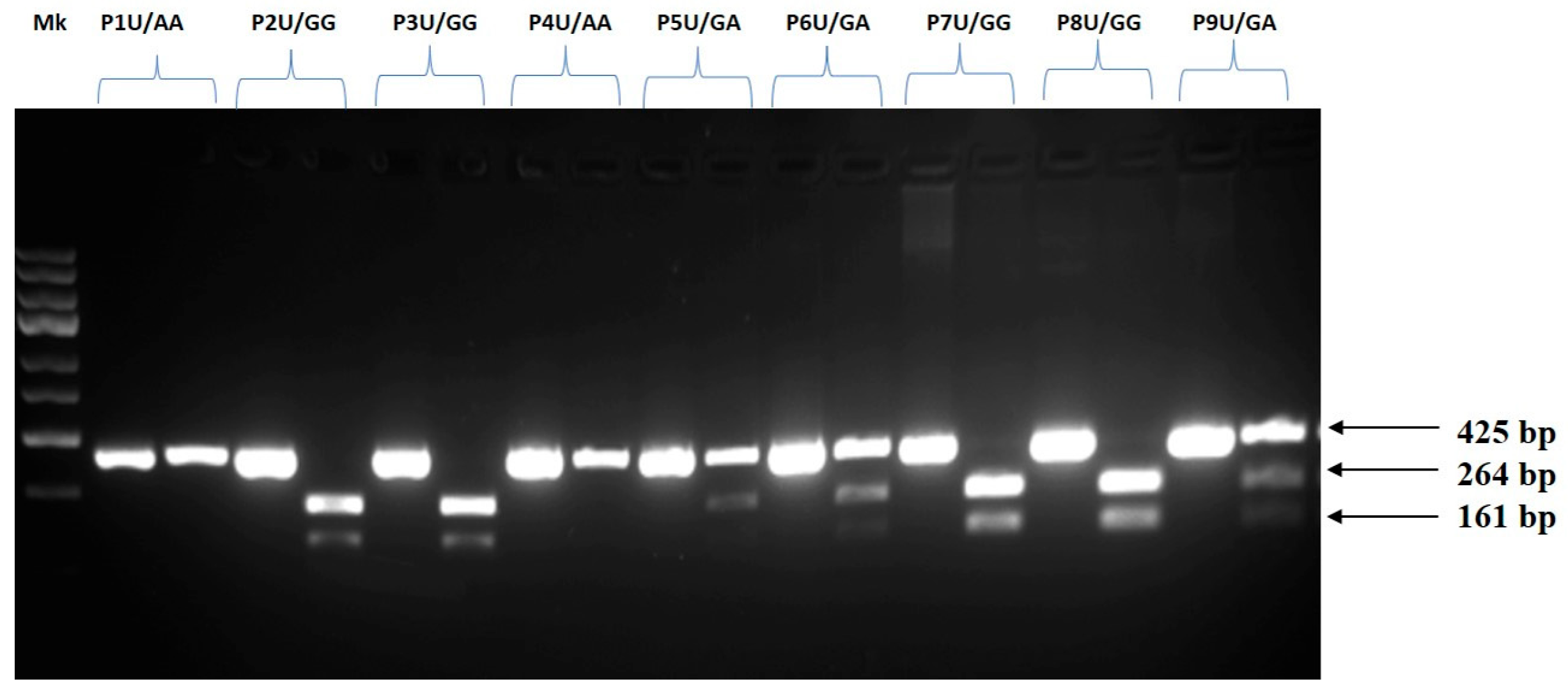
| rs1761667 | PCR-RFLP | F: CAAGGTCTGGTATCCACCTGTT R: ATGAAGCTTCCCGCCTTAGAA |
| CD36 | RT-qPCR | F: GGCTGTGACCGGAACTGTG R: AGGTCTCCAACTGGCATTAG |
| GAPDH | RT-qPCR | F: ACCCACTCCTCCACCTTTGA R: CTGTTGCTGTAGCCAAATTCG |
| Total (n = 30) | NMIBC (n = 25, 83.3%) | MIBC (n = 5, 16.7%) | |||||||
|---|---|---|---|---|---|---|---|---|---|
| Sex | F (n = 7, 23.3%) | F (n = 4, 16%) | F (n = 3, 60%) | ||||||
| M (n = 23, 76.7%) | M (n = 21, 84%) | M (n = 2, 40%) | |||||||
| Mean ± SD | Min–max | Mean ± SD | Min–max | Mean ± SD | Min –max | ||||
| Age | 70.9 ± 10.57 | 39–85 | 70.32 ± 11.13 | 39–85 | 73.80 ± 7.29 | 64–83 | |||
| BMI | 28.51 ± 7.02 | 20.76–55.1 | 29.41 ± 7.32 | 20.76–55.1 | 24.01 ± 2.36 | 20.76–27.18 | |||
| Yes (n, %) | No (n, %) | Yes (n, %) | No (n, %) | Yes (n, %) | No (n, %) | ||||
| Smoker (available for 27p) | 14 (51.9) | 13 (48.1) | 12 (57.1) | 9 (42.9) | 2 (33.3) | 4 (66.7) | |||
| Obesity | 8 (25.8) | 23 (74.2) | 7 (28) | 18 (72) | 1 (16.7) | 5 (83.3) | |||
| Hypertension (28p) | 11 (39.3) | 17 (60.7) | 10 (45.5) | 12 (54.5) | 1 (16.7) | 5 (83.3) | |||
| Diabetes | 4 (12.9) | 27 (87.1) | 4 (16) | 21 (84) | 0 | 6 (100) | |||
| Heart failure (30p) | 4 (13.3) | 26 (86.7) | 3 (12.5) | 21 (87.5) | 1 (16.7) | 5 (83.3) | |||
| Coronary heart disease (30p) | 1 (3.3) | 29 (96.7) | 1 (4.2) | 23 (95.8) | 0 | 6 (100) | |||
| Dyslipidemia (30p) | 7 (23.3) | 23 (76.7) | 7 (28) | 18 (72) | 0 | 5 (100) | |||
| n = 19 (%) | ||
|---|---|---|
| Age | 66.21 ± 9.89% (mean, SD) | 45–84 (min–max) |
| Sex | F: 2 (10.5%), M: 17 (89.5%) | — |
| Genotypic Frequencies | Patients | Control | p Value | ||
|---|---|---|---|---|---|
| Total (n = 30) | (%) | Total (n = 19) | (%) | ||
| AA | 5 | 16.7% | 5 | 26.3% | |
| GA | 15 | 50% | 3 | 15.8% | 0.053 |
| GG | 10 | 33.3% | 11 | 57.9% | |
| Genotype | Patients n = 30 (%) | Controls n = 19 (%) | CD36 Expression (Patients) Median (IQR) | CD36 Expression (Controls) Median (IQR) |
|---|---|---|---|---|
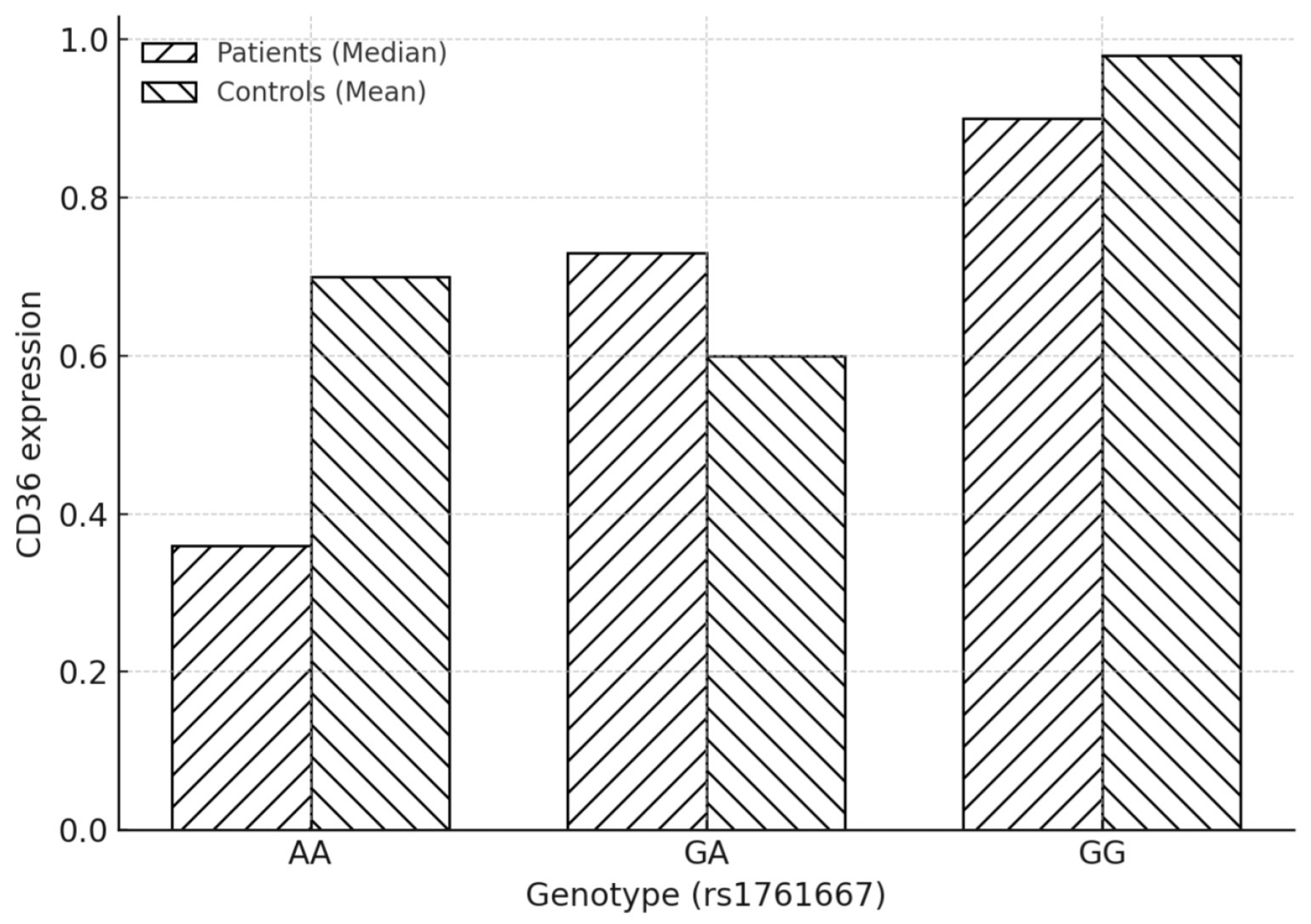
| AA | 5 (16.7%) | 5 (26.3%) | 0.36 (0.60) | 0.71 (0.30) |
| GA | 15 (50.0%) | 3 (15.8%) | 0.73 (0.63) | 0.46 (0.31) |
| GG | 10 (33.3%) | 11 (57.9%) | 0.90 (0.73) | 0.97 (0.21) |
| Genotype | Patients, Median (IQR) | Controls, Median (IQR) |
|---|---|---|
| AA | 0.36 (0.60) | 0.71 (0.30) |
| GA | 0.73 (0.63) | 0.46 (0.31) |
| GG | 0.90 (0.73) | 0.97 (0.21) |
| Genotype | No Dyslipidemia (n, %) | Dyslipidemia (n, %) | Total | Pearson χ2 = 1.863, df = 2, p = 0.394 |
| AA | 4 (80.0%) | 1 (20.0%) | 5 | |
| GG | 9 (90.0%) | 1 (10.0%) | 10 | |
| GA | 10 (66.7%) | 5 (33.3%) | 15 | |
| Total | 23 (76.7%) | 7 (23.3%) | 30 |
| Tumor Grade | Alive at 2 Years n (%) | Death at 2 Years n (%) | Total n (%) |
|---|---|---|---|
| G1 | 3 (100%) | 0 | 3 (10%) |
| G2 | 7 (100%) | 0 | 7 (23.3%) |
| G3 | 10 (50%) | 10 (50%) | 20 (66.7%) |
| Total | 20 (66.7%) | 10 (33.3%) | 30 (100%) |
Disclaimer/Publisher’s Note: The statements, opinions and data contained in all publications are solely those of the individual author(s) and contributor(s) and not of MDPI and/or the editor(s). MDPI and/or the editor(s) disclaim responsibility for any injury to people or property resulting from any ideas, methods, instructions or products referred to in the content. |
© 2026 by the authors. Licensee MDPI, Basel, Switzerland. This article is an open access article distributed under the terms and conditions of the Creative Commons Attribution (CC BY) license.
Share and Cite
Pavalean, M.I.; Lambrescu, I.M.; Gaina, G.; Madan, V.L.; Hinescu, M.E.; Ceafalan, L.C. CD36 rs1761667 Polymorphism and Its Impact on Molecular Signatures in Bladder Cancer. Diseases 2026, 14, 44. https://doi.org/10.3390/diseases14020044
Pavalean MI, Lambrescu IM, Gaina G, Madan VL, Hinescu ME, Ceafalan LC. CD36 rs1761667 Polymorphism and Its Impact on Molecular Signatures in Bladder Cancer. Diseases. 2026; 14(2):44. https://doi.org/10.3390/diseases14020044
Chicago/Turabian StylePavalean, Mihai Ioan, Ioana Maria Lambrescu, Gisela Gaina, Victor Lucian Madan, Mihail Eugen Hinescu, and Laura Cristina Ceafalan. 2026. "CD36 rs1761667 Polymorphism and Its Impact on Molecular Signatures in Bladder Cancer" Diseases 14, no. 2: 44. https://doi.org/10.3390/diseases14020044
APA StylePavalean, M. I., Lambrescu, I. M., Gaina, G., Madan, V. L., Hinescu, M. E., & Ceafalan, L. C. (2026). CD36 rs1761667 Polymorphism and Its Impact on Molecular Signatures in Bladder Cancer. Diseases, 14(2), 44. https://doi.org/10.3390/diseases14020044