Abstract
Network slicing is gaining an increasing importance as an effective way to introduce flexibility in the management of resources in 5G networks. We envision a scenario where a set of network operators outsource their respective networks to one Infrastructure Provider (InP), and use network slicing mechanisms to request the resources as needed for service provision. The InP is then responsible for the network operation and maintenance, while the network operators become Virtual Network Operators (VNOs). We model a setting where two VNOs compete for the users in terms of quality of service, by strategically distributing its share of the aggregated cells capacity managed by the InP among its subscribers. The results show that the rate is allocated among the subscribers at each cell in a way that mimics the overall share that each VNO is entitled to, and that this allocation is the Nash equilibrium of the strategic slicing game between the VNOs. We conclude that network sharing and slicing provide an attractive flexibility in the allocation of resources without the need to enforce a policy through the InP.
1. Introduction
The current mobile network architecture uses a relatively monolithic access and transport framework to accommodate a variety of services such as mobile traffic for smart phones, OTT (Over-The-Top) content, feature phones, data cards, and embedded M2M devices. It is anticipated that this architecture will not be flexible and scalable enough to support the coming 5G network, which demands very diverse use cases and sometimes extreme requirements—in terms of performance, scalability and availability. Furthermore, the introduction of new network services should me made more efficiently [1].
In the above scenario, network slicing is gaining an increasing importance as an effective way to introduce flexibility in the management of network resources. A network slice is a collection of network resources, selected in order to satisfy the requirements—e.g., in terms of performance—of the service(s) to be provided by the slice. An enabling aspect of network slicing is virtualization. Virtualization of network resources allows operators to share the same physical resource in a flexible and dynamic manner in order to exploit the available resources in a more efficient way [2].
Within the above context, we envision a scenario where a set of network operators outsource their respective networks to one Infrastructure Provider (InP), and use network slicing mechanisms to request the resources as needed for service provision. The InP is then responsible for the network operation and maintenance, while the network operators become Virtual Network Operators (VNOs), since they no longer own the network infrastructure but request them from the InP. We can also envision other emergent players becoming VNOs, e.g., OTT service providers. Even Vertical Industry players may take this role, when needing connectivity services for their sensors or their smart vehicles [3,4].
We propose a business model where the VNOs provide service to end users. This service may be characterized by a series of performance constraints, e.g., transmission rate. In addition, each VNO gets revenues from its subscribers. To support the service, the VNOs request dynamically access and core network resources from an InP. The InP may charge a price for each requested resource, setup a long-term contract with each VNO or just work as a supporting unit to the VNOs.
The main contributions of this paper are the following:
- A business model for VNOs is proposed, where the resources are outsourced to an InP and supplied to the VNOs through network slicing.
- A game theory-based analysis of the competition between the VNOs that implement such business model is performed.
- The Nash equilibrium of such competition game is calculated and it is shown that results in a resource allocation that matches the entitlement or contribution of each VNO.
The analysis applies concepts from microeconomics and from discrete-choice analysis in modeling the users. Game theory is thoroughly used in the paper and specifically in modeling and analyzing the competition between the VNOs.
Related Work
Game theory is a well-known discipline from mathematics, and its application to the modeling and analysis of the interactions in microeconomics is long-standing [5]. There is, however, a relatively recent trend in computer networks engineering to incorporate game theory-based models in order to take into account either the selfish behavior of the devices (terminals, servers) or the economic incentives of the agents (users, providers). Our work belongs to this trend, and it shares this feature with the works referred below.
Specifically, many recent works apply game theory to the analysis of service provision in a competitive environment, within the context of telecommunications or internet-related services. For example, references [6,7,8,9] analyze the provision of mobile communication services in cognitive radio and femtocell contexts, where the resource supporting the service is the spectrum. References [10,11] analyze the provision of sensing data-based services, where the data is supplied by wireless sensor networks. References [12,13,14] analyze the provision of cloud services, where the supporting resources are computation and storage. In all of the above works, the service providers intermediate between the resource providers and the users, which is also the role played by the VNOs in our work. However, our work departs from these works in that the resources supplied by the InP are typically distributed geographically; in other words, the service received by a user can only be supported by the resources available in the vicinity of the user, not by the entirety of the resource pool.
There are only a few works, however, that model the economic relationships that emerge in network slicing-based resource allocation within the context of 5G. References [15,16,17] analyze the global profit maximization problem of a set of independent Mobile VNOs that request slices from an Mobile Network Operator (MNO), and propose several allocation mechanisms for solving this system optimization problem. Our work departs from these works in that the MNO decides and executes the complete allocation to all users in a centralized manner, while the VNOs in our work participate in the allocation decision.
Finally, our work closely relates to the work in [18,19], which propose optimal resource allocation mechanisms within the context of 5G network slicing and geographically distributed resources. In these two works and ours, the allocation is of a distributed nature, that is, the VNOs are involved in the allocation—as opposed to a centralized scheme. Specifically, our work is inspired by the proposal in [18]. However, our work differs importantly from these two works in that we model the VNOs and the users as different agents with their particular incentives, which are the profits and the user utility, respectively. In [18,19], each VNO operates as a proxy of its subscribers; this may fail to properly model the VNO’s incentives and the corresponding business model. This difference has also an important implication in the user behaviour modelling: while in our work the number of subscribers for each VNO depends on the VNOs allocation decision, in [18,19], it is independent from it, since the number of subscribers is fixed a priori as a parameter.
The paper is structured as follows. In Section 2, the model for the VNOs, the users, and the InP is described. In Section 3, a strategic game is presented for the interaction between the VNOs and the Nash equilibrium for the game is formulated. In Section 4, the resulting resource allocation, subscribers and profit distribution at the equilibrium are discussed. In addition, finally, Section 5 draws the conclusions.
2. Model
In this section, we propose a model amenable for the analysis of the service provision by VNOs, within a network slicing framework.
2.1. System Model
A network consists of a set of resources managed by an InP and leased by a set of VNOs (or equivalently, network slices). We focus on mobile service operators and, specifically, on the radio access network, so that the resources may be the data rate available in a cell.
The resources leased by the VNOs are used to deliver service to a set of users. We define the following subsets of users: (the users at cell r), (VNO s’s subscribers), and (the intersection).
Each VNO s is entitled to a share of the total amount of resources available in the network, such that . This share was agreed when the operators pooled their networks and outsourced their operation to the InP and will then be proportional to the total amount of resources contributed.
The VNO allocates the resource for providing services to its subscribers in the following way. VNO s distributes its share among its subscribers, assigning a weight to , such that . The weight assignment decision is notified to the InP, who proceeds to perform the actual resource allocation at each individual cell. The resource allocated for the service provision to each user is the transmission rate. The InP allocates a rate to the set given by
where is cell r capacity.
Please note that in this allocation scheme, VNO s chooses weight for the set of its subscribers at cell r and the InP performs the actual rate allocation at each individual cell according to (1). Proceeding in such indirect way, the capacity constraint at each cell is automatically enforced, i.e., .
2.2. Economic Model
Each VNO provides service to users based on the resource allocation agreed with the InP, according to the description made above. Pricing for the service provision consists of a flat-rate price . We assume that variable costs incurred by the VNOs are zero, so that only fixed costs are incurred. Furthermore, since the fixed costs are not relevant to the weight decision made by the VNOs, they are not include in the analysis.
We use a discrete-choice model for the modeling of the users’ choices, which is frequently used in econometrics [20]. Specifically, given a discrete set of options, the utility of a user making the choice s is assumed to be equal to : the term encompasses the objective aspects of option s and is the same for all users in , while is an unobserved user-specific value that is modeled on the global level as a random variable. From the distribution of these i.i.d. variables, one can compute the probability that a user selects option s, and when the user population size is sufficiently large, this corresponds to the proportion of users making that choice. In our model, the user choice is the choice of one of the VNOs in .
To model the objective part of the users’ utility, each subscriber pays the price to VNO s, and receives service at cell r supported by a rate . Following [21], we propose
Firstly, the higher the rate a subscriber receives, the higher the utility the user derives from the service. The dependence is logarithmic, as there is an increasing evidence that user experience and satisfaction in telecommunication scenarios follow logarithmic laws [22]. Secondly, the dependence on the price is through a negative logarithm, instead; or in other words, the ratio is proposed to be the relevant magnitude for the utility. In addition, thirdly, is a sensitivity parameter.
To model the unobserved user-specific part of the utility, following the literature on discrete-choice models, we assume that each user-specific random variable follows a Gumbel distribution of mean 0 and parameter . The choice of the Gumbel distribution allows us to obtain a logistic function, as shown below.
With the users’ utility modeled as stated above, it can be shown [23] that the fraction of the number of users that subscribe to VNO s over the total number of users at cell r is
where is the users’ sensitivity parameter, that is, it models the sensitivity to the rate-to-price ratio.
Please note that we assume that the users are price-takers, which is a sensible assumption for a sufficiently high number of users at each cell. The price-taking assumption is commonplace in microeconomics when the users are small compared to the operators. This allows to assume that the prices are parameters in the utility-maximization problems faced by the users; or, in other words, that the user does not anticipate the potential effect of his/her decision in the final price.
As argued in the next section, and for the sake of simplicity, we assume that the service price is the same for every VNO, i.e., . The number of subscribers is then given by
The rate allocated by the InP to one subscriber of VNO s, assuming that the rate is equally distributed in and taking into account (1), is given by
3. Game Model and Analysis
The revenue of VNO s is equal to the sum of the price paid by each subscriber:
Each VNO is assumed to operate in order to maximize its revenues. We will analyze the competition between the VNOs in terms of quality of service, that is, on how each VNO sets weight at cell r in order to attract the users. We denote the weight vector set by VNO s as , with one component for each . We are assuming that the competition is not in terms of prices. This may reflect a situation where a regulatory authority has fixed the price. Or either, it may correspond to a situation where the time frame of the weight setting—hours or days—is much shorter that the time frame of the price setting—weeks or months.
From (8), it can be inferred that VNO s’s profit depends not only on , but also on ( refers to all VNOs other than VNO s). This dependence can be made explicit as follows: . Moreover, this dependence is strategic, that is, VNO s takes into account not only that depends on , but also that each competitor sets taking into account that depends on . Game theory provides the theoretical foundation for analyzing this strategic relationship. Specifically, since each VNO acts in an independent and selfish manner, the appropriate game-theoretical models are the non-cooperative ones. In such games, the solution concept, that is, the profile of strategies where each player has no incentive to deviate, is the Nash equilibrium. The Nash equilibrium does not prescribe any iterative algorithm or evolutionary dynamics for arriving to the equilibrium, since it is an static concept. In our model, the players are the VNOs, the strategies are the weights, and the incentives are the revenues. To sum up, given , VNO s will choose so that
where denotes the positive orthant.
The revenue maximization problems form the strategic game, which we call strategic slicing. We will model the strategic slicing as a two-stage game, where in the first stage, each VNO sets its weights and reports its assignment to the InP, as described in Section 2.1, in a simultaneous and non-cooperative way; and in the second stage, the users subscribe to a VNO, as described in Section 2.2. We use the Subgame Perfect Nash equilibrium as a solution concept, whereby, at the first stage, the weights that each VNO chooses at each cell are such that it gets no revenue improvement from changing the weights assuming that the competitor VNOs do not deviate from the equilibrium weights, anticipating the subscription decision of the users at the second stage.We will model the strategic slicing as a one-shot game, where each VNO sets its weights and reports its assignment to the InP, as described in Section 2.1, in a simultaneous and non-cooperative way. In the Nash equilibrium each VNO chooses weights at each cell such that it gets no revenue improvement from changing the weights assuming that the competitor VNOs do not deviate from the equilibrium weights. In the whole game, the subscription decision of the users is anticipated by the VNOs.
We undertake the analysis of the case of two VNOs, referred hereafter as a and b, so that (7) simplifies to
We first derive the solution of VNO a’s revenue maximization problem, which will yield the best response function . Since VNO s’s revenue is a concave function in VNO s’s strategies, the Karush-Kuhn-Tucker theorem will give necessary and sufficient conditions for the revenue maximizing weights. These conditions yield that the solution is at the upper boundary
and that the following singular point condition must hold
Similarly, for VNO b’s best response , the solution is at
with the additional condition
4. Results and Discussion
In this section, the values for the weights, number of subscribers, VNO revenues and subscriber’s rates are computed for the Nash equilibrium (although the asterisk is absent for lightening the notation) that results from the competition described in Section 3.
We have performed the numerical computations of the solution of (13)–(16) for two cells, hereafter referred to as I and II, but the conclusions can be extended for any number of cells, on the basis of the analysis formulation made in Section 3. The values for the parameters used are displayed in Table 1. This parameter setting illustrates a basic asymmetric scenario between two cells in terms of capacity and of number of users.
Table 1.
Parameter values for the numerical computations.
Please note that the numerical computations performed are a numerical solving of the system of Equations (13)–(16) in order to compute the Nash equilibrium. Furthermore, these computations are not to be implemented necessarily by the VNOs: microeconomics abstracts away these implementation details. Our work may be extended, although it will be beyond the scope of this paper, through formulating a hypothesis for the concrete operation of the market, ranging from the nineteen-century Walras’ tattônement [24] to modern evolutionary-based explanations [25].
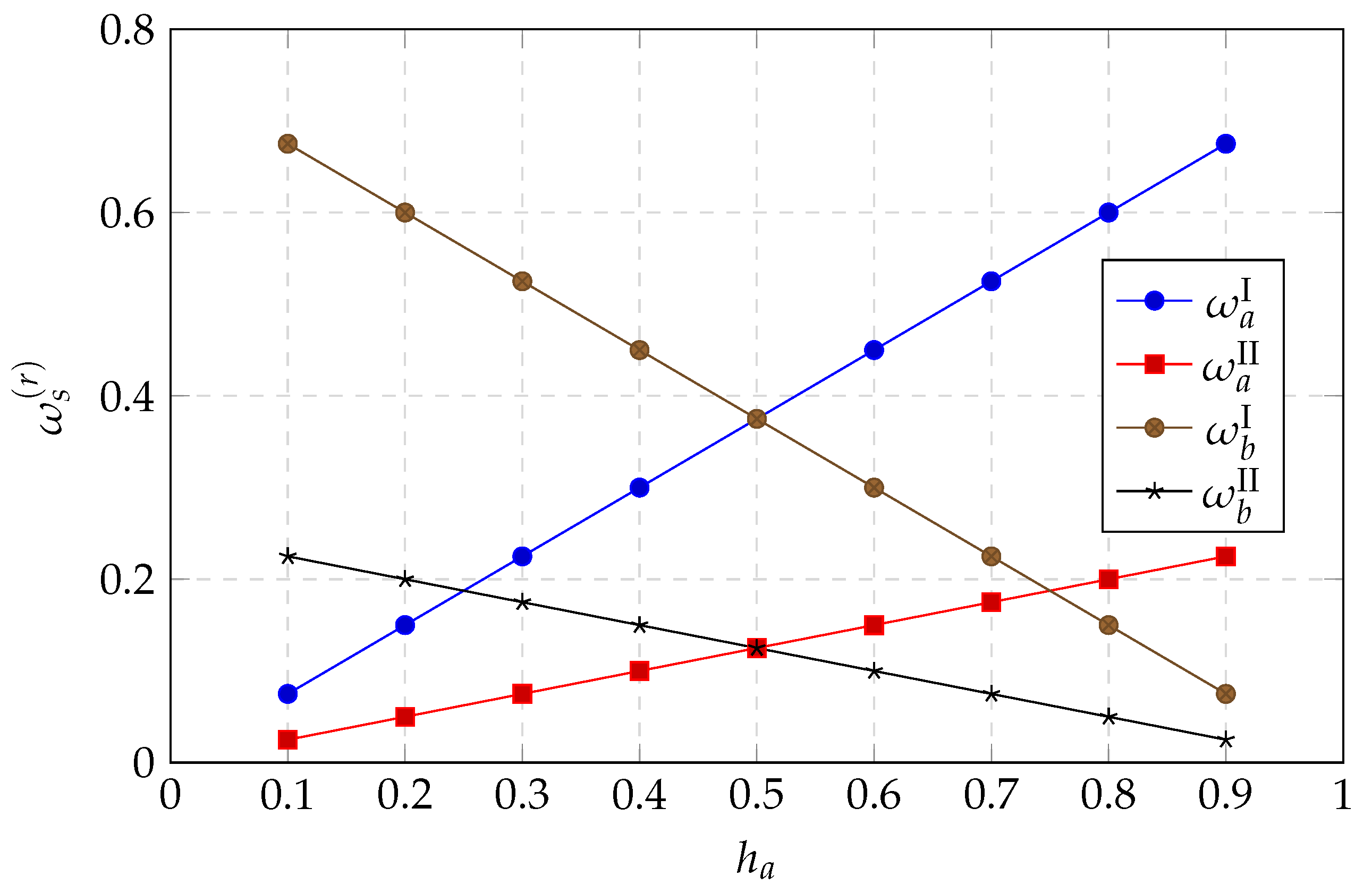
Figure 1 shows the weight assignment to the subscribers of each VNO at each cell, as a function of VNO a’s share (VNO b’s share is ). As expected, the higher the share, the higher the assigned weights. Furthermore, the dependence is linear. However, each VNO weights differently its subscribers at each cell. In the parameter setting under study, each cell has a different capacity and each cell covers different number of users. The fact that the capacities are different does not have any influence, since according to (13)–(16), the weights do not depend on the value of the capacities. However, the different number of users at each cell has an influence on the weights: the higher the number of users at a cell, the higher the weights for the subscribers.
Figure 1.
Weight assignment.
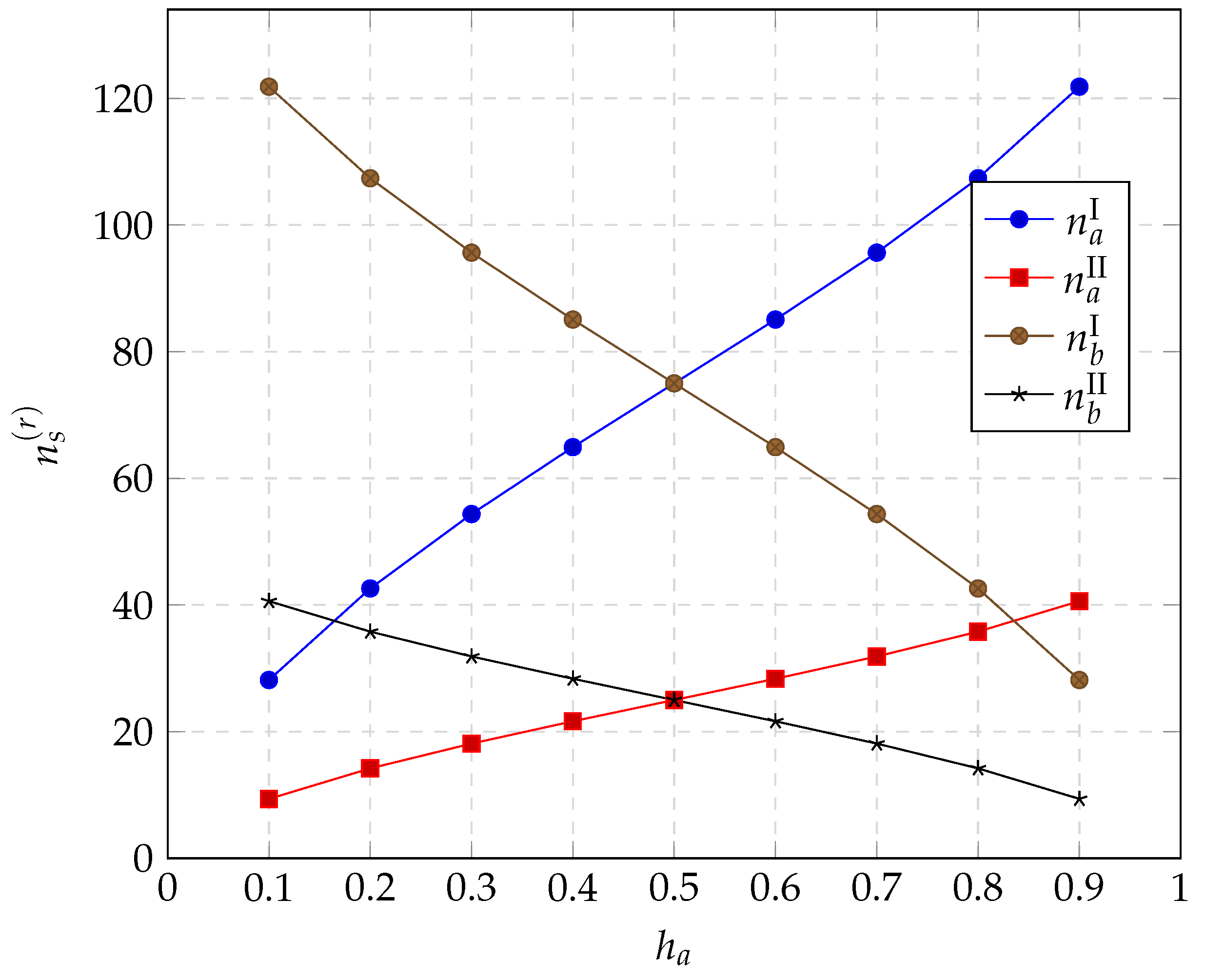
Figure 2 shows the number of subscribers for each VNO at each cell, as a function of VNO a’s share . Again, the higher the share, the higher the number of subscribers. The number of subscribers do not depend on the capacities, as (12) and the above discussion explains. However, the number of subscribers does reflect the different number of users at each cell.
Figure 2.
Number of subscribers.
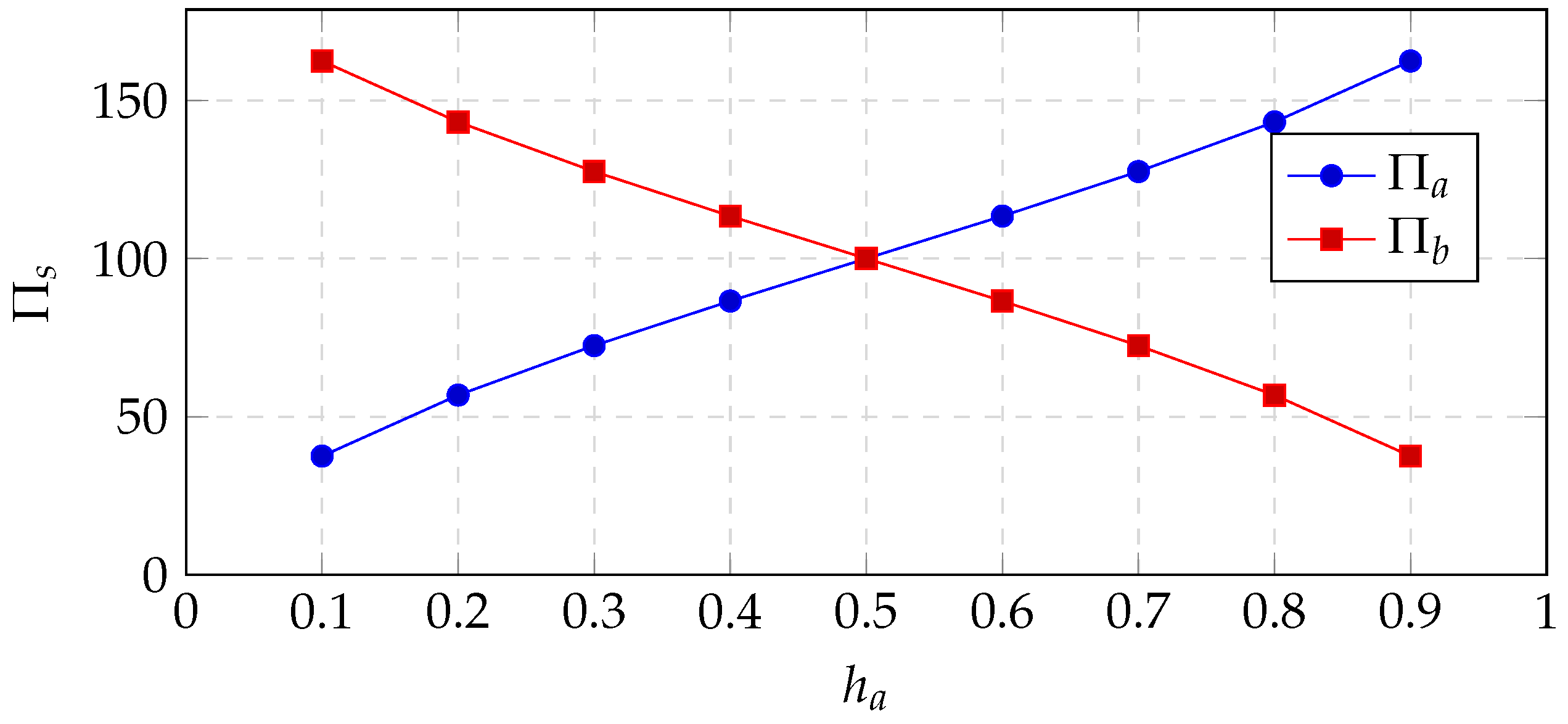
Since the VNO’s revenues at each cell are proportional to the number of subscribers, we only represent the total revenue of each VNO (Figure 3), which shows that are increasing in its own share.
Figure 3.
Total VNO’s revenue.
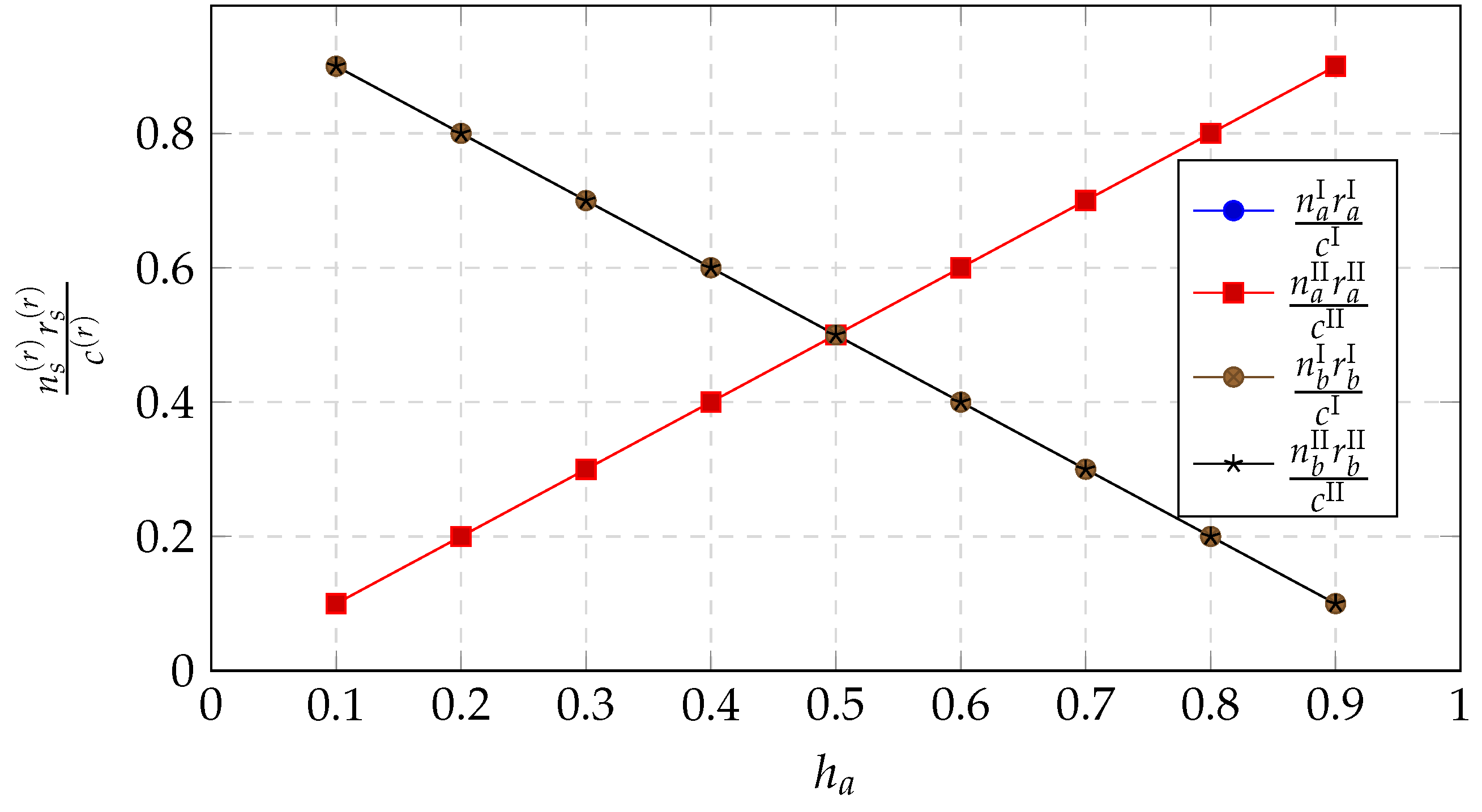
Finally, we focus on the aggregate rate assignment that results from strategic slicing. Figure 4 shows this quantity, i.e., , divided by the cell capacity , as a function of VNO a’s share . We see that the following relationship holds: This relationship means that the InP performs a rate allocation that enforces each VNO share at each cell, which is a desirable outcome from an engineering point of view. This result is surprising and is caused by the particular weight allocation decision made by each VNO for each cell. Indeed, each VNO assigns a weight for its subscribers that is independent from the cell capacity but dependent on the number of users at the cell.
Figure 4.
Aggregate rate over the cell capacity.
This aggregate rate assignment is interesting because, first, the InP executes the rate allocation following the instructions that each VNOs gives in their slice request, that is, the InP does not follow any system-wide objective, but it merely acts as the agent of each VNO; second, the VNO share of resources was agreed based on the total contribution of resources by each VNO, regardless of the concrete contribution of resources at each cell (i.e., no VNO is excluded from any cell on the basis of the previous ownership of the infrastructure); and third, each VNO is trying to maximize its revenue, that is, takes a decision based only on its own incentives.
5. Conclusions
In this work, a business model is proposed and analyzed where the VNOs provide mobile communications services to final users and provision themselves with resources from an InP by means of network slicing mechanisms. The results show that the rate is allocated among the subscribers at each cell in a way that mimics the overall share that each VNO is entitled to, and that this allocation is the Nash equilibrium of the strategic slicing game between the VNOs. This allows us to conclude that network sharing and slicing provides an attractive flexibility in the allocation of resources without the need to enforce or control a policy through the InP.
Author Contributions
Conceptualization, L.G.; Formal analysis, L.G., J.R.V. and V.P.; Investigation, V.P.; Visualization, J.R.V.; Writing—original draft, L.G.; Writing—review & editing, J.R.V. and V.P.
Funding
This work has been supported by the Spanish Ministry of Economy and Competitiveness through project TIN2013-47272-C2-1- R (cosupported by the European Social Fund) and by Institute ITACA-UPV through “Convocatorias Ayudas 2018-5”.
Conflicts of Interest
The authors declare no conflict of interest.
References
- NGMN Alliance. Description of Network Slicing Concept. In Next Generation Mobile Networks, White Paper; NGMN Alliance: Frankfurt am Main, Germany, 2016. [Google Scholar]
- Jiang, M.; Condoluci, M.; Mahmoodi, T. Network slicing management & prioritization in 5G mobile systems. In Proceedings of the European Wireless Conference, EW 2016, Oulu, Finland, 18–20 May 2016; pp. 197–202. [Google Scholar]
- Samdanis, K.; Costa-Perez, X.; Sciancalepore, V. From network sharing to multi-tenancy: The 5G network slice broker. IEEE Commun. Mag. 2016, 54, 32–39. [Google Scholar] [CrossRef]
- NGMN Alliance. 5G white paper. In Next Generation Mobile Networks, White Paper; NGMN Alliance: Frankfurt am Main, Germany, 2015. [Google Scholar]
- Vives, X. Oligopoly Pricing: Old Ideas and New Tools; MIT Press: Cambridge, MA, USA, 2001. [Google Scholar]
- Niyato, D.; Hossain, E. Competitive pricing for spectrum sharing in cognitive radio networks: Dynamic game, inefficiency of nash equilibrium, and collusion. IEEE J. Sel. Areas Commun. 2008, 26, 192–202. [Google Scholar] [CrossRef]
- Guijarro, L.; Pla, V.; Tuffin, B.; Maille, P.; Vidal, J.R. Competition and Bargaining in Wireless Networks with Spectrum Leasing. In Proceedings of the 2011 IEEE Global Telecommunications Conference (GLOBECOM 2011), Houston, TX, USA, 5–9 December 2011; pp. 1–6. [Google Scholar]
- Duan, L.; Huang, J.; Shou, B. Economics of femtocell service provision. IEEE Trans. Mob. Comput. 2013, 12, 2261–2273. [Google Scholar] [CrossRef]
- Guijarro, L.; Pla, V.; Vidal, J.R.; Martinez, J. Femtocell operator entry decision with spectrum bargaining and service competition. IEEE Commun. Lett. 2012, 16, 1976–1979. [Google Scholar] [CrossRef]
- Guijarro, L.; Pla, V.; Vidal, J.R.; Naldi, M. Maximum-profit two-sided pricing in service platforms based on wireless sensor networks. IEEE Wirel. Commun. Lett. 2016, 5, 8–11. [Google Scholar] [CrossRef]
- Guijarro, L.; Pla, V.; Vidal, J.R.; Naldi, M. Game theoretical analysis of service provision for the Internet of Things based on sensor virtualization. IEEE J. Sel. Areas Commun. 2017, 35, 691–706. [Google Scholar] [CrossRef]
- Liu, C.; Li, K.; Xu, C.; Li, K. Strategy configurations of multiple users competition for cloud service reservation. IEEE Trans. Parallel Distrib. Syst. 2016, 27, 508–520. [Google Scholar] [CrossRef]
- Liu, C.; Li, K.; Li, K.; Buyya, R. A new cloud service mechanism for profit optimizations of a cloud provider and its users. IEEE Trans. Cloud Comput. 2017. [Google Scholar] [CrossRef]
- Li, K.; Liu, C.; Li, K.; Zomaya, A.Y. A framework of price bidding configurations for resource usage in cloud computing. IEEE Trans. Parallel Distrib. Syst. 2016, 27, 2168–2181. [Google Scholar] [CrossRef]
- Han, B.; Tayade, S.; Schotten, H.D. Modeling profit of sliced 5G networks for advanced network resource management and slice implementation. In Proceedings of the 2017 IEEE Symposium on Computers and Communications (ISCC), Heraklion, Greece, 3–6 July 2017; pp. 576–581. [Google Scholar]
- Han, B.; Feng, D.; Ji, L.; Schotten, H.D. A Profit-Maximizing Strategy of Network Resource Management for 5G Tenant Slices. arXiv, 2017; arXiv:1709.09229. [Google Scholar]
- Han, B.; Lianghai, J.; Schotten, H.D. Slice as an Evolutionary Service: Genetic Optimization for Inter-Slice Resource Management in 5G Networks. IEEE Access 2018. [Google Scholar] [CrossRef]
- Caballero, P.; Banchs, A.; de Veciana, G.; Costa-Pérez, X. Network slicing games: Enabling customization in multi-tenant networks. In Proceedings of the INFOCOM 2017-IEEE Conference on Computer Communications, Atlanta, GA, USA, 1–4 May 2017; pp. 1–9. [Google Scholar]
- Oladejo, S.O.; Falowo, O.E. 5G network slicing: A multi-tenancy scenario. In Proceedings of the 2017 IEEE GlobalWireless Summit (GWS), Cape Town, South Africa, 15–18 October 2017; pp. 88–92. [Google Scholar]
- Ben-Akiva, M.E.; Lerman, S.R. Discrete Choice Analysis: Theory and Application to Travel Demand; MIT Press: Cambridge, MA, USA, 1985; Volume 9. [Google Scholar]
- Maillé, P.; Tuffin, B. Telecommunication Network Economics: From Theory to Applications; Cambridge University Press: Cambridge, UK, 2014. [Google Scholar]
- Reichl, P.; Tuffin, B.; Schatz, R. Logarithmic laws in service quality perception: Where microeconomics meets psychophysics and quality of experience. Telecommun. Syst. 2011, 52, 587–600. [Google Scholar] [CrossRef]
- Train, K.E. Discrete Choice Methods with Simulation; Cambridge University Press: Cambridge, UK, 2009. [Google Scholar]
- Courcoubetis, C.; Weber, R. Pricing Communication Networks: Economics, Technology and Modelling; John Wiley & Sons: Cambridge, MA, USA, 2003. [Google Scholar]
- Price, T.C. Using co-evolutionary programming to simulate strategic behaviour in markets. J. Evol. Econ. 1997, 7, 219–254. [Google Scholar] [CrossRef]
© 2018 by the authors. Licensee MDPI, Basel, Switzerland. This article is an open access article distributed under the terms and conditions of the Creative Commons Attribution (CC BY) license (http://creativecommons.org/licenses/by/4.0/).