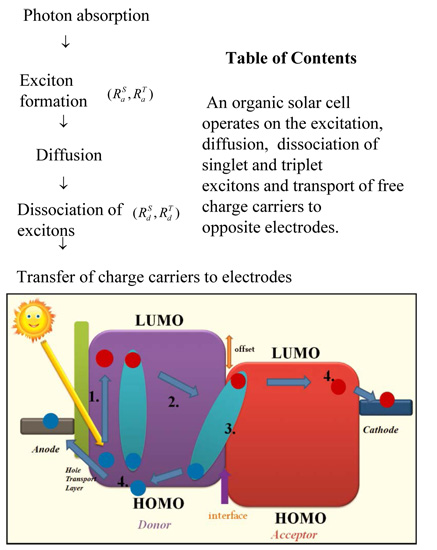
A Theoretical Study on the Operation Principle of Hybrid Solar Cells


Abstract
1. Introduction
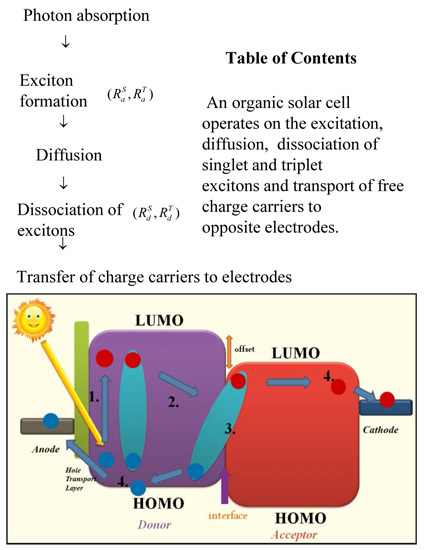
2. Operation Mechanism in Hybrid Solar Cells
2.1. Excitation of Singlet and Triplet Excitons
2.2. Exciton Diffusion to Organic-Inorganic Interface
2.3. Exciton Dissociation at the Organic-Inorganic Interface
3. Results and Discussion

| Mechanism | Parameter | Value |
|---|---|---|
| Excitation | 1.27 × 10¹⁰ s−1 | |
| 3.09 × 10⁵ s−1 | ||
| Diffusion | DS | 1.99 cm2 s−1 |
| DT | 2.71 × 10⁻⁶ cm2·s−1 | |
| 2.82 × 10² nm | ||
| 1.17 nm | ||
| Dissociation | 2.60 × 10¹⁷ s−1 | |
| 2.98 × 10¹² s−1 | ||
| Charge transport | F | 3.36 × 10⁻¹² N |
4. Conclusions
Author Contributions
Conflicts of Interest
References
- Wright, M.; Uddin, A. Organic—Inorganic hybrid solar cells: A comparative review. Sol. Energy Mater. Sol. Cells 2012, 107, 87–111. [Google Scholar] [CrossRef]
- Chandrasekaran, J.; Nithyaprakash, D.; Ajjan, K.B.; Maruthamuthu, S.; Manoharan, D.; Kumar, S. Hybrid solar cell based on blending of organic and inorganic materials—An overview. Renew. Sustain. Energy Rev. 2011, 15, 1228–1238. [Google Scholar] [CrossRef]
- Arici, E.; Sariciftci, N.S.; Meissner, D. Hybrid solar cells. Encycl. Nanosci. Nanotechnol. 2004, 3, 929–944. [Google Scholar]
- Narayan, M.R.; Singh, J. Roles of binding energy and diffusion length of singlet and triplet excitons in organic heterojunction solar cells. Phys. Status Solidi 2012, 9, 2386–2389. [Google Scholar] [CrossRef]
- Narayan, M.R.; Singh, J. Effect of exciton-spin-orbit-photon interaction in the performance of organic solar cells. Eur. Phys. J. B 2013, 86, 1–4. [Google Scholar] [CrossRef]
- Narayan, M.R.; Singh, J. Effect of simultaneous excitation of singlet and triplet excitons on the operation of organic solar cells. J. Appl. Phys. 2013, 114, 154515–154517. [Google Scholar] [CrossRef]
- Narayan, M.R.; Singh, J. Study of the mechanism and rate of exciton dissociation at the donor-acceptor interface in bulk-heterojunction organic solar cells. J. Appl. Phys. 2013, 114, 073510–073517. [Google Scholar] [CrossRef]
- Narayan, M.R.; Singh, J. Exciton dissociation and design optimization in p3ht:Pcbm bulk-heterojunction organic solar cell. Can. J. Phys. 2013, 92, 853–856. [Google Scholar] [CrossRef]
- Narayan, M.R.; Singh, J. Optimizing the design of flexible ptb7:Pc71bm bulk-heterojunction and p3ht:Sinw hybrid organic solar cells. J. Nanosci. Nanotechnol. 2013, 1, 8. [Google Scholar]
- Syu, H.; Shiu, S.; Lin, C. Silicon nanowire/organic hybrid solar cell with efficiency of 8.40%. Sol. Energy Mater. Sol. Cells 2012, 98, 267–272. [Google Scholar] [CrossRef]
- Plass, R.; Pelet, S.; Krueger, J.; Grätzel, M.; Bach, U. Quantum dot sensitization of organic-inorganic hybrid solar cells. J. Phys. Chem. B 2002, 106, 7578–7580. [Google Scholar] [CrossRef]
- Beek, W.J.; Wienk, M.M.; Janssen, R.A. Efficient hybrid solar cells from zinc oxide nanoparticles and a conjugated polymer. Adv. Mater. 2004, 16, 1009–1013. [Google Scholar] [CrossRef]
- Huynh, W.U.; Dittmer, J.J.; Alivisatos, A.P. Hybrid nanorod-polymer solar cells. Science 2002, 295, 2425–2427. [Google Scholar] [CrossRef] [PubMed]
- Roncali, J. Molecular bulk heterojunctions: An emerging approach to organic solar cells. Acc. Chem. Res. 2009, 42, 1719–1730. [Google Scholar] [CrossRef] [PubMed]
- Kippelen, B.; Brédas, J.L. Organic photovoltaics. Energy Environ. Sci. 2009, 2, 251–261. [Google Scholar] [CrossRef]
- Brédas, J.L.; Norton, J.E.; Cornil, J.; Coropceanu, V. Molecular understanding of organic solar cells: The challenges. Acc. Chem. Res. 2009, 42, 1691–1699. [Google Scholar] [CrossRef] [PubMed]
- Steinbacher, F.S.; Krause, R.; Hunze, A.; Winnacker, A. Triplet exciton transfer mechanism between phosphorescent organic dye molecules. Phys. Status Solidi 2012, 209, 340–346. [Google Scholar] [CrossRef]
- Lunt, R.R.; Giebink, N.C.; Belak, A.A.; Benziger, J.B.; Forrest, S.R. Exciton diffusion lengths of organic semiconductor thin films measured by spectrally resolved photoluminescence quenching. J. Appl. Phys. 2009, 105, 053711–053717. [Google Scholar] [CrossRef]
- Zhu, X.-Y.; Yang, Q.; Muntwiler, M. Charge-transfer excitons at organic semiconductor surfaces and interfaces. Acc. Chem. Res. 2009, 42, 1779–1787. [Google Scholar] [CrossRef] [PubMed]
- Scharber, M.C.; Mühlbacher, D.; Koppe, M.; Denk, P.; Waldauf, C.; Heeger, A.J.; Brabec, C.J. Design rules for donors in bulk-heterojunction solar cells—Towards 10% energy-conversion efficiency. Adv. Mater. 2006, 18, 789–794. [Google Scholar] [CrossRef]
- Kendrick, M.J.; Neunzert, A.; Payne, M.M.; Purushothaman, B.; Rose, B.D.; Anthony, J.E.; Haley, M.M.; Ostroverkhova, O. Formation of the donor-acceptor charge transfer exciton and its contribution to charge photogeneration and recombination in small-molecule bulk heterojunctions. J. Phys. Chem. C 2012, 116, 18108–18116. [Google Scholar] [CrossRef]
- Bruder, I. Organic Solar Cells: Correlation between Molecular Structure, Morphology and Device Performance; Max-Planck-Institut für Festkörperforschung: Stuttgart, Germany, 2010. [Google Scholar]
- Davenas, J.; Dkhil, S.B.; Cornu, D.; Rybak, A. Silicon nanowire/p3ht hybrid solar cells: Effect of the electron localization at wire nanodiameters. Energy Proced. 2012, 31, 136–143. [Google Scholar] [CrossRef]
- Liu, K.; Qu, S.; Zhang, X.; Tan, F.; Wang, Z. Improved photovoltaic performance of silicon nanowire/organic hybrid solar cells by incorporating silver nanoparticles. Nanoscale Res. Lett. 2013, 8, 1–6. [Google Scholar] [CrossRef] [PubMed]
- Dang, M.T.; Hirsch, L.; Wantz, G. P3ht: Pcbm, best seller in polymer photovoltaic research. Adv. Mater. 2011, 23, 3597–3602. [Google Scholar] [CrossRef] [PubMed]
- Chen, D.; Nakahara, A.; Wei, D.; Nordlund, D.; Russell, T.P. P3ht/pcbm bulk heterojunction organic photovoltaics: Correlating efficiency and morphology. Nano Lett. 2010, 11, 561–567. [Google Scholar] [CrossRef] [PubMed]
- Kuo, C.Y.; Gau, C. Arrangement of band structure for organic-inorganic photovoltaics embedded with silicon nanowire arrays grown on indium tin oxide glass. Appl. Phys. Lett. 2009, 95, 053302. [Google Scholar] [CrossRef]
- Huang, J.-S.; Goh, T.; Li, X.; Sfeir, M.Y.; Bielinski, E.A.; Tomasulo, S.; Lee, M.L.; Hazari, N.; Taylor, A.D. Polymer bulk heterojunction solar cells employing forster resonance energy transfer. Nat. Photonics 2013, 7, 479–485. [Google Scholar] [CrossRef]
- Mangold, H. Charge Separation and Recombination in Novel Polymeric Absorber Materials for Organic Solar Cells—A Photophysical Study. Ph.D. Thesis, Johannes Gutenberg-Universität Mainz, Mainz, Germany, 2013. [Google Scholar]
- Azizi, S.; Braik, M.; Dridi, C.; Ouada, H.B.; Ryback, A.; Davenas, J. Study of charge transport in p3ht: Sinw-based photovoltaic devices. Appl. Phys. A 2012, 108, 99–106. [Google Scholar] [CrossRef]
- Köhler, A.; Beljonne, D. The singlet-triplet exchange energy in conjugated polymers. Adv. Func. Mater. 2004, 14, 11–18. [Google Scholar] [CrossRef]
- Blom, P.W.M.; Mihailetchi, V.D.; Koster, L.J.A.; Markov, D.E. Device physics of polymer: Fullerene bulk heterojunction solar cells. Adv. Mater. 2007, 19, 1551–1566. [Google Scholar] [CrossRef]
- Huang, J.; Hsiao, C.; Syu, S.; Chao, J.; Lin, C. Well-aligned single-crystalline silicon nanowire hybrid solar cells on glass. Sol. Energy Mater. Sol. Cells 2009, 93, 621–624. [Google Scholar] [CrossRef]
© 2015 by the authors; licensee MDPI, Basel, Switzerland. This article is an open access article distributed under the terms and conditions of the Creative Commons Attribution license (http://creativecommons.org/licenses/by/4.0/).
Share and Cite
Narayan, M.; Singh, J. A Theoretical Study on the Operation Principle of Hybrid Solar Cells. Electronics 2015, 4, 303-310. https://doi.org/10.3390/electronics4020303
Narayan M, Singh J. A Theoretical Study on the Operation Principle of Hybrid Solar Cells. Electronics. 2015; 4(2):303-310. https://doi.org/10.3390/electronics4020303
Chicago/Turabian StyleNarayan, Monishka, and Jai Singh. 2015. "A Theoretical Study on the Operation Principle of Hybrid Solar Cells" Electronics 4, no. 2: 303-310. https://doi.org/10.3390/electronics4020303
APA StyleNarayan, M., & Singh, J. (2015). A Theoretical Study on the Operation Principle of Hybrid Solar Cells. Electronics, 4(2), 303-310. https://doi.org/10.3390/electronics4020303