1. Introduction
Ferromagnetic cores are an important component of magnetic elements such as inductors and transformers [
1,
2,
3]. They are commonly used in switch-mode power conversion systems, where they operate as energy storage elements or provide galvanic isolation between the input and output of the system [
3,
4,
5,
6]. The properties of these cores limit the maximum operating frequency of these systems and their energy efficiency.
During operation of the above-mentioned elements, their cores are periodically remagnetized, causing energy loss. The macroscopic effect of these losses is an increase in the core temperature during operation [
7,
8,
9,
10,
11,
12,
13]. According to the classical Steinmetz formula [
1,
14,
15,
16], core loss increases with an increase in the frequency
f and amplitude of magnetic flux density
Bm.
One of the commonly used methods for determining the loss per volume
PV (lossiness) of ferromagnetic cores is to measure the area of their magnetization curve
B(
H) [
11,
17,
18,
19], representing the dependence of the flux density
B on magnetic force
H. During operation of the above-mentioned elements, their cores are periodically remagnetized, causing energy loss. The macroscopic effect of these losses is an increase in the core temperature during operation [
7,
8,
9,
10,
11,
12,
13]. According to the formula given, among others, in [
11,
16,
17,
20], the loss are the product of the frequency and the integral of the magnetic flux density
B with respect to the magnetic force
H, calculated along the closed magnetization curve. This approach to determining the loss is called the hysteresis method. As shown in [
21], for ferrite cores, the loss values obtained using the hysteresis method are overestimated compared to the calorimetric method proposed in the cited paper. The discrepancies between the obtained results can be several-fold.
Unfortunately, the method described in [
21] is applicable only to ferromagnetic cores made of materials with low resistivity, which are not brittle and whose surface is not coated with an insulating substance. These limitations make it impossible to use this method for loss measurements of nanocrystalline materials, Ni-Zn ferrites, and powdered iron materials or its alloys.
The hysteresis method [
17] is simple to implement in the low frequency range, but causes some problems in the high frequency range [
22,
23,
24]. In this range, significant deformations of the magnetization curve
B(
H) can be observed. Therefore, a typical simplification is to measure the core loss for selected values of frequency
f and the amplitude of magnetic flux density
Bm, determine the parameters occurring in the Steinmetz model based on the obtained results, and extrapolate the loss values over a wide range of amplitudes of magnetic flux density and frequency values. For this reason, the
PV(
Bm,
f) dependences presented by ferromagnetic core manufacturers are straight lines on a log–log scale [
25,
26].
Papers [
27,
28,
29,
30,
31] present various methods and measurement systems for characterizing the properties of magnetic materials based on
B(H) hysteresis loop measurements. Fiorillo [
27] highlights the problems with the repeatability and accuracy of measurement results. Csizmadia et al. [
28] propose a measurement system for recording hysteresis curves of printed iron cores. Fathabad et al. [
29] and Charubin [
30] describe a computer-controlled, automated system for assessing the magnetic properties of thin, soft magnetic materials and measuring hysteresis loops. Tumański [
31] presents modern methods for measuring the magnetic parameters of electrical sheets. In particular, a hysteresis loop measurement system is presented, which includes an RC integrator with an operational amplifier. Orosz et al. [
32] describe the method of both the modelling and measurements of iron power loss in the rotating machines.
The papers [
20,
33,
34] describe standard methods for determining the lesses of soft metallic and powder ferromagnetic materials. They are based on the observation that the loss is proportional to the area of the hysteresis loop. These methods utilize sinusoidal excitation with an adjustable amplitude, and the values of the magnetic force
H, flux density
B, and loss
PV are determined based on the measured values of the current in primary winding, the voltage in secondary winding, and the geometric dimensions of the tested toroidal core. The scope of applicability of the described method is limited to frequencies ranging from 20 Hz to 100 kHz. To determine the loss value, it is necessary to integrate the product of the voltage in secondary winding and the current in primary winding. Neither the cited standard [
20] nor the cited papers above specify how to perform this operation. The cited papers do not consider the suitability of the described method for ferrite or nanocrystalline cores. The method of measuring the magnetization curve
B(
H) is also not considered in the cited standard, meanwhile many technical parameters can be obtained analysing this curve.
In the book [
2], a classic RC integrator was used to determine the time course of
B(
t). The output voltage of this circuit was proportional to the flux density in core B. This method of determining flux density was hereinafter called the analogue method. A characteristic feature of the analogue method is the use of an analogue RC network to integrate the voltage on transformer secondary winding, and the output voltage of this network is used to determine the waveform of flux density
B(
t). As mentioned in cited papers [
2,
30,
31,
33,
34], the problem of measuring magnetic hysteresis loops and determining loss per unit of volume of the magnetic core, especially for frequencies higher than 100 kHz, is very difficult and problematic.
In the case of recording the waveform of the voltage on the secondary winding of a transformer, the B(t) course can be determined using numerical integration. This method is called the digital method. A characteristic feature of the digital method is the use of the waveform of the voltage on the secondary winding as the input data for the computer algorithm of numerical integration. The result of such an algorithm is the waveform of flux density B(t).
As mentioned earlier, although there are many papers devoted to methods for measuring the hysteresis loop, despite the standardization of this procedure, many contemporary papers still draw attention to the problem of measuring this curve and determining power loss in ferromagnetic cores [
28,
29,
35]. Both analogue and digital methods are reported in the literature; however, a direct comparison between these methods, as well as a discussion of the advantages and disadvantages of each of them, has not been provided for different types of ferromagnetic materials.
The aim of this paper was to compare the usefulness of the analogue and digital measurement methods to obtain magnetization characteristics of ferromagnetic cores and to analyze the influence of the accuracy of the measurements of
B(
H) characteristics on the accuracy of determining the loss of ferromagnetic cores made of selected soft magnetic materials. Investigations were performed for two kinds of ferromagnetic cores made of ferrite or nanocrystals. Particular attention should be paid to the fact that this paper analyzes ferrite cores, which are commonly used in power electronic systems, as well as nanocrystalline cores, whose importance is increasing and which are attracting growing interest due to their high magnetic permeability. Unfortunately, the information in the datasheet for these cores is limited and often insufficient for the proper design of inductors or transformers used in the mentioned systems [
36,
37]. Measurements illustrating the influence of frequency and flux density on the accuracy of the considered measurement methods were performed, and their results are shown and discussed. Based on the data provided by the producers, power loss in both types of cores operating at different values of the flux density amplitude
Bm and frequency
f were determined and compared with the results of calculations using the classical Steinmetz model. Analytical relationships taking into account the effect of core operating conditions on the Steinmetz model coefficients were proposed and experimentally verified. The accuracy of measurements of power dissipated in the tested ferromagnetic core, performed using hysteresis loops measured with analogue and digital methods and calculated using the modified Steinmetz model, was analyzed using manufacturer data.
The presented results prove that the analogue method can cause large distortions of the measured B(H) characteristics, especially in the high frequency range. Using the area values of such measured characteristics in the calculation of power dissipated in the ferromagnetic core may result in a large overestimation of this power. The use of the digital method allows one to eliminate the above problems.
2. Measurement Method and Setup
The concept of the hysteresis measurement method requires determining the magnetization characteristics
B(
H) of the tested ferromagnetic cores at different values of the amplitude of magnetic flux density
Bm and frequency
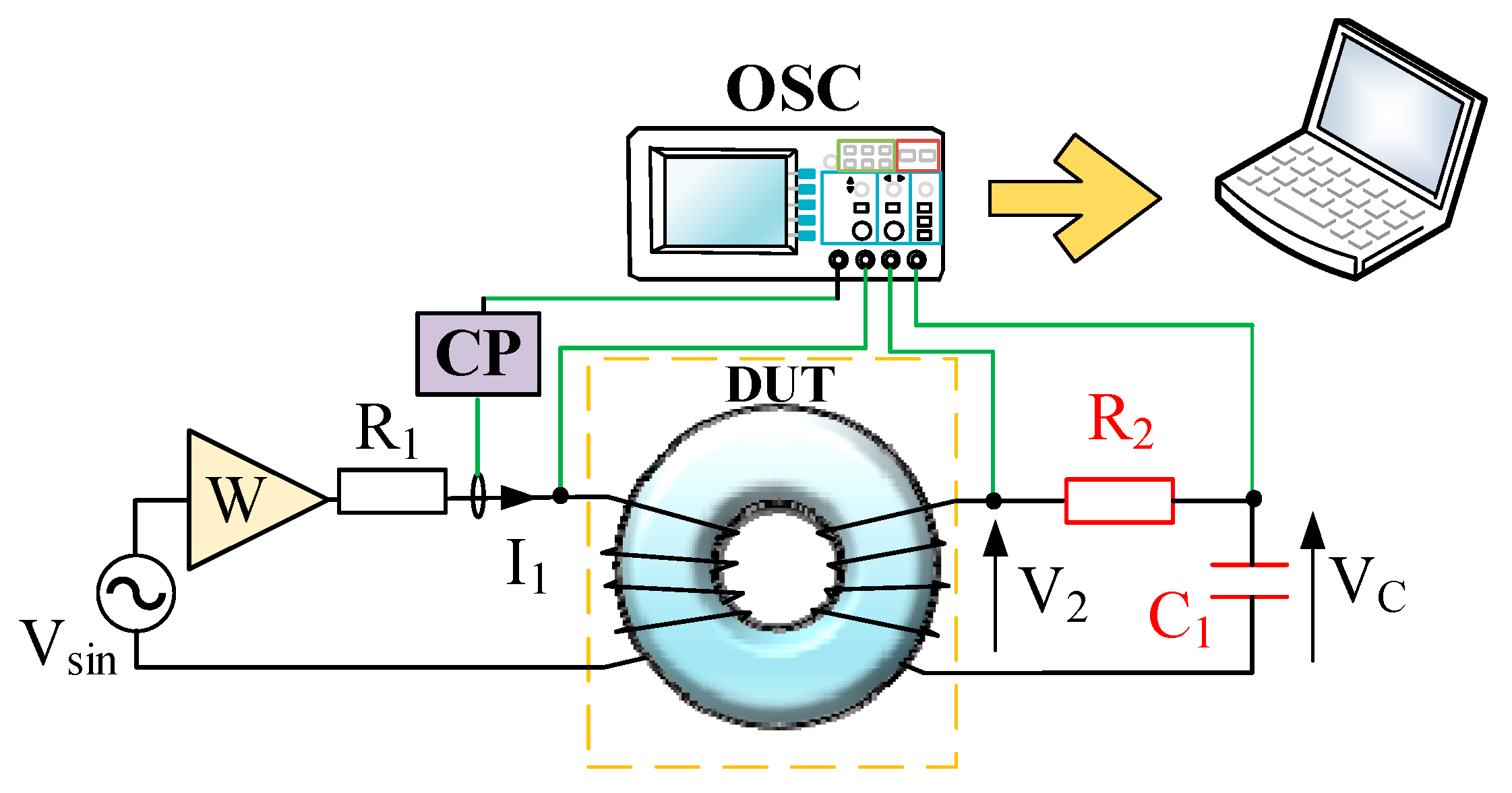
f. The measurement of this characteristic was performed using the setup shown in
Figure 1.
In the considered measurement setup, the tested core (DUT) was contained within a transformer. The transformer’s primary winding was powered by the power amplifier W, which was excited by a sinusoidal voltage generator
Vsin. The primary winding current I
1 was limited by the resistor
R1. The waveform of this current was recorded by an oscilloscope (OSC) via a current probe (CP). The transformer’s secondary winding load is represented by an integrating circuit containing resistor R
2 and capacitor
C1. The waveforms of voltage
VC across the capacitor and the voltage
V2 across the secondary winding were also recorded using the oscilloscope. The results recorded by the oscilloscope were transmitted via the USB port to a computer, which performed the appropriate calculations. Components
R2 and
C1 (marked in
Figure 1 with red) were used only in the analogue method.
The measurement setup used a Textronix, Beaverton, OR, USA, TCPS 300 current probe (CP) with a cut-off frequency of 100 MHz [
38]. A GWINSTEK, New Taipei City, Taiwan, GDS2104A oscilloscope with a 100 MHz bandwidth [
39] was used to record the voltage and current waveforms.
The instantaneous value of the magnetic field
H was determined using the following formula:
where
z1 is the number of turns on the primary winding of the transformer,
I1 is the current of this winding, and
lFe is the length of the magnetic path in the core.
In turn, in the analogue method, the value of the magnetic flux density
B is described by the following formula [
2]:
where
z2 is the number of turns on the secondary winding of the transformer,
SFe is the active cross-sectional area of the core, and
VC,
R2 and
C1 are marked in
Figure 1.
The condition for obtaining the correct waveform
B(
t) based on Formula (2) is that the resistance
R2 is much higher than the impedance modulus of capacitor
C1. This means that the variable component of voltage
VC should be much smaller than voltage
V2 on the secondary winding of the tested transformer. This results in a small amplitude of voltage
VC and the requirement for a high-resolution voltage measurement using an oscilloscope. To eliminate the problem described above, the digital method was used, in which the time waveform of voltage
V2 on the secondary winding of the transformer was measured and the corresponding waveform of magnetic flux density
B(
t) was calculated in Excel software using the following formula:
The measurement setup uses an AETECHRON, Elkhart, IN, USA, 7228 (W) power amplifier, a Tektronix TP-300 (CP) current probe, and a GWINSTEK GDS2104A (OSC) oscilloscope. The values of the passive components are R1 = 47 Ω, C1 = 3.3 µF.
While measuring the hysteresis loop after achieving a steady state, the temperature TC was measured using an Optex, Shiga, Japan, PT-3S pyrometer. This measurement was performed only for the ferrite core. For the nanocrystalline core, such a measurement is invalid because the core is placed inside a plastic container, the temperature of which can be significantly lower than the core temperature.
3. Tested Cores
The tests were carried out for toroidal ferrite and nanocrystalline cores. Both the tested cores had similar dimensions (outer diameter: 25 mm, inner diameter: 15 mm, height: 10 mm). A core made of 3F3 ferrite [
40] and a nanocrystalline core made of M-070 material [
41] were considered. The medium-frequency power material, 3F3, is suitable for use in power and general-purpose transformers at frequencies of 0.2–0.5 MHz. This material belongs to soft ferrites Mn-Zn. In turn, M-070 is a nanocrystalline material made of the alloy Fe
73.5 Cu
1 Nb
3 Si
15.5 B
7. This alloy contains iron, copper, niobium, silicon and boron. It is made of a tape with a thickness of approximately 20 μm. The values of the basic material parameters of the tested cores are summarized in
Table 1.
The initial magnetic permittivity μi ranges from 2000 for the 3F3 core to 60,000 for the M-070 core. The saturation of magnetic flux density Bsat for the ferrite core is about three times lower than for the nanocrystalline core. PV for the nanocrystalline core is nine times higher than for the ferrite core. The Curie temperature TCurie is 200 °C for the 3F3 core and 600 °C for the M-070 core. The resistivity ρ is 200 times higher for the ferrite core than for the nanocrystalline core.
The tested transformers contain windings with a diameter of 1 mm, made of enameled copper wire. Two windings are located on opposite sides of the core. During testing, the transformers were placed horizontally on a table.
4. Modelling Power Loss in Ferromagnetic Cores
According to the classical dependence [
17,
20], the core loss per unit of volume
PV can be determined based on the hysteresis loop area using the following formula:
The
PV(
f,
Bm) dependence is often approximated using the classical Steinmetz model of the following form [
1,
9]:
where
PV0,
α, and
β are model parameters.
The model described by Formula (5) does not provide satisfactory agreement with the measurement results for modern ferromagnetic materials. Therefore, a modified form of this model described by following formula was proposed:
where
d and
Tm are model parameters, and
TC denotes the core temperature. Formula (6) is a modified version of the classical Steinmetz model, and the values of the parameters
α,
β, and
Tm depend on the frequency
f and the amplitude of magnetic flux density
Bm.
The dependence of
PV on temperature
TC introduced in Formula (6) is described by a quadratic function. Its form results from the approximation of the
PV(
TC) dependence given in the datasheets of ferrite cores, e.g., [
42]. In these dependences, the minimum of the considered function for fixed values of
Bm and
f occurs at a fixed value of temperature
Tm.
The manufacturer’s data presents graphs illustrating the influence of the amplitude of magnetic flux density
Bm, frequency
f, and temperature
TC on the loss of the materials used in the tested ferromagnetic cores. The
PV(
Bm) and
PV(
f) graphs are straight lines on a log–log scale. Based on the manufacturer’s data, the values of the parameters of the loss model, described by Formula (5), were determined for the considered cores. When determining the values of these parameters, the coordinates of five points located on these characteristics corresponding to a fixed temperature value, two
Bm values at a constant
f value and two
f values at a constant
Bm value were used. The values of these parameters are summarized in
Table 2.
As can be seen in
Table 2, the values of
α parameter determined for considered cores differ only slightly (less than 10%), whereas the values of
β parameter are much more diverse—they differ by as much as 40%. The
PV0 coefficient changes its value up to forty-fold.
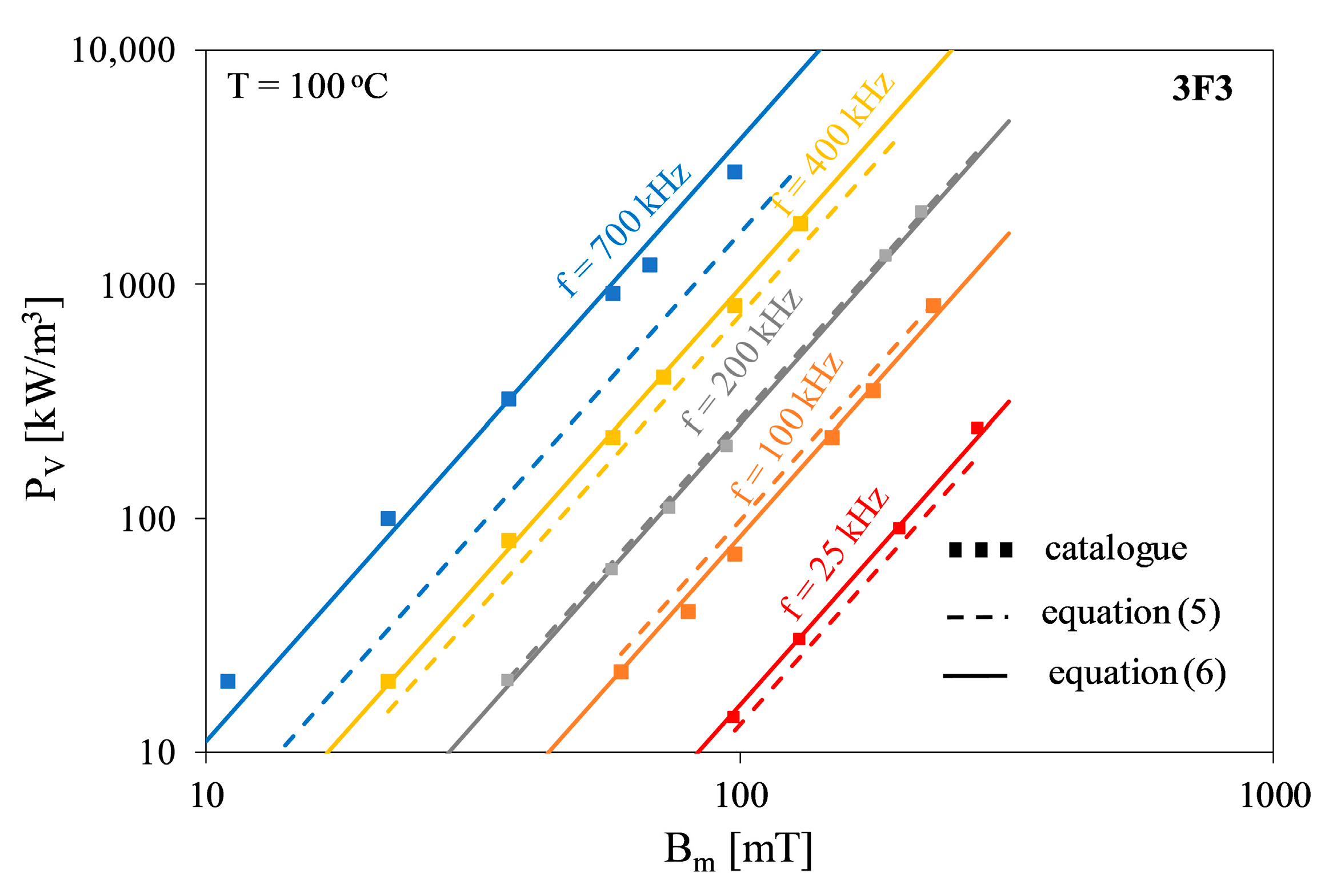
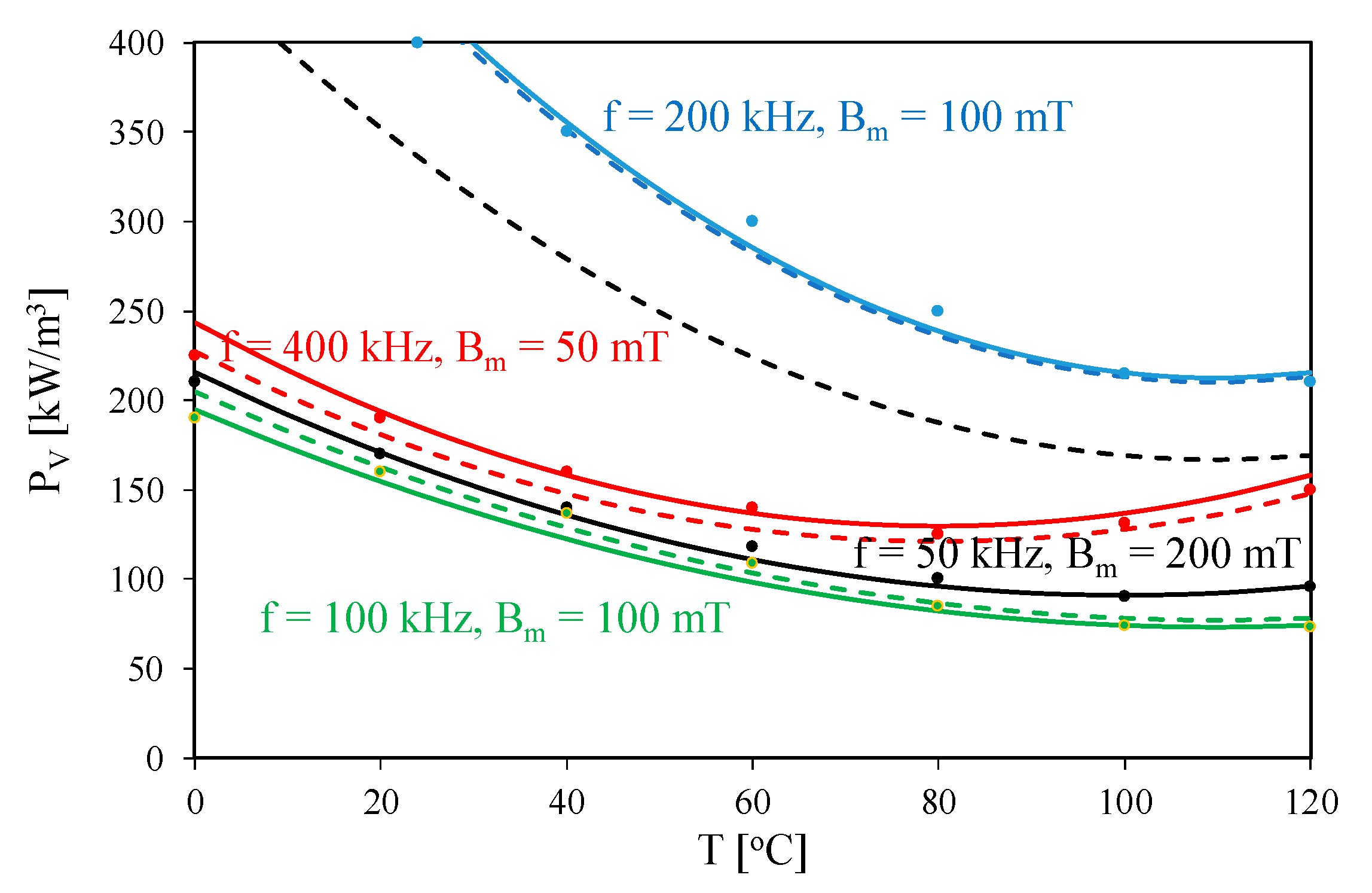
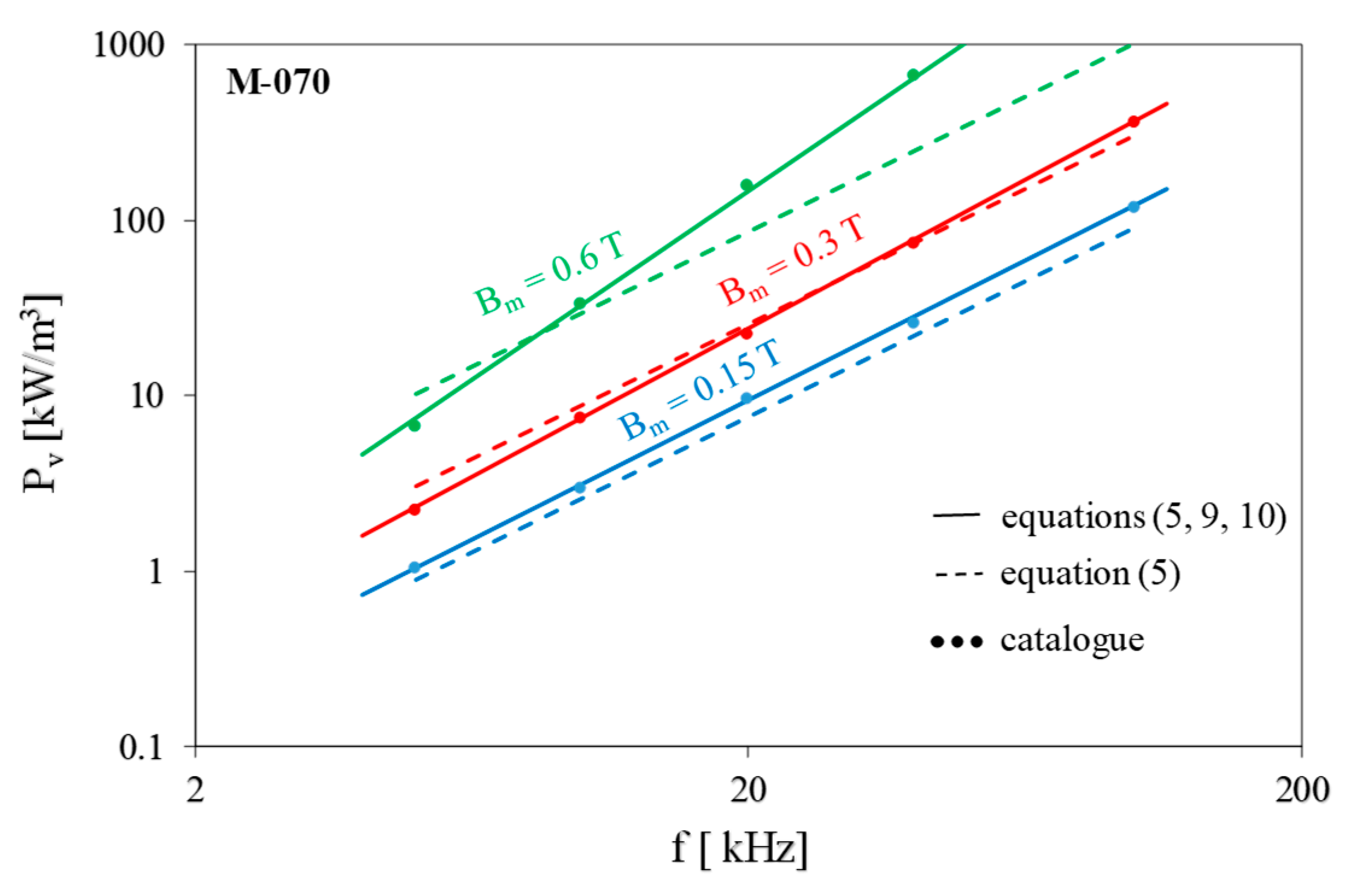
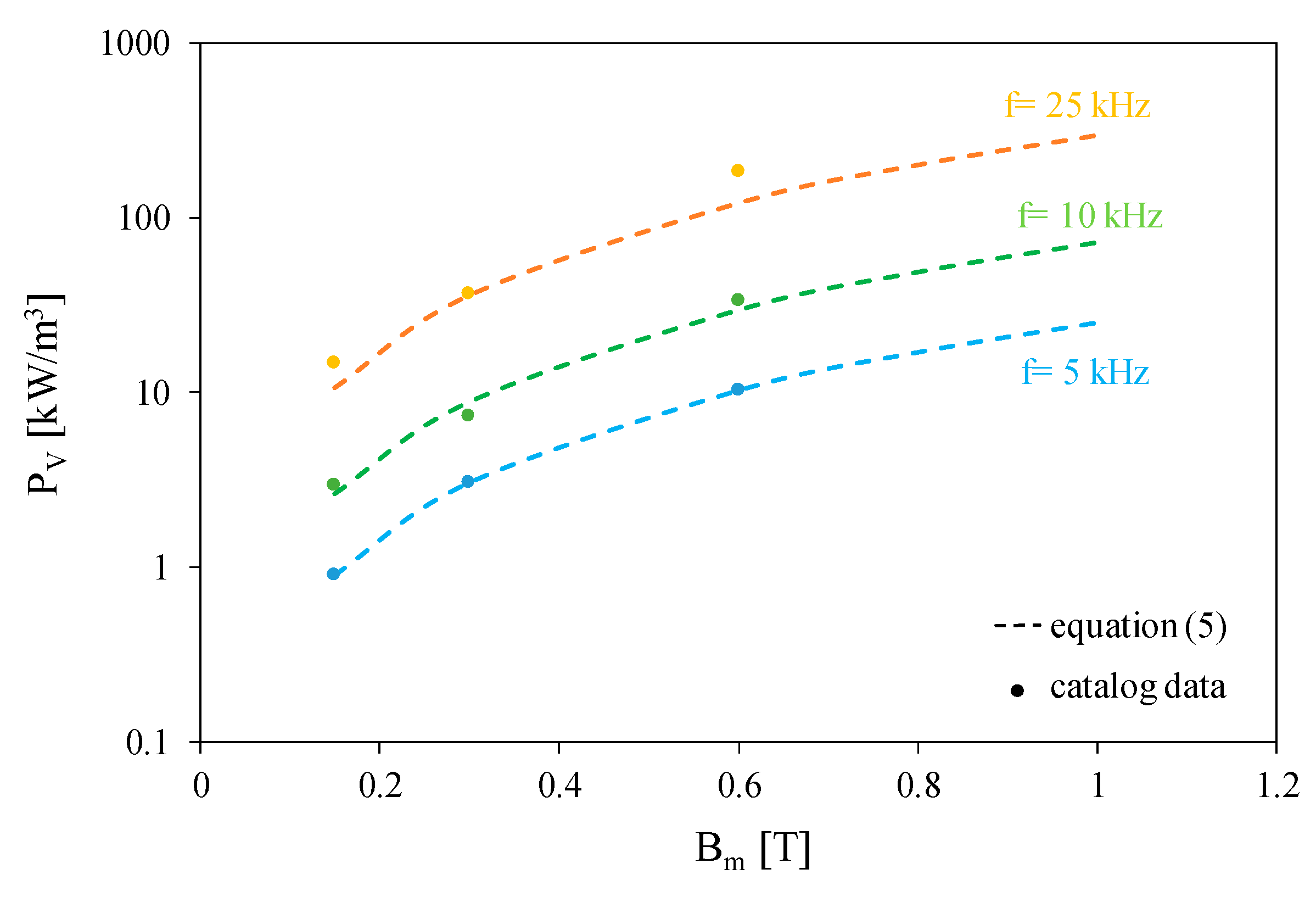
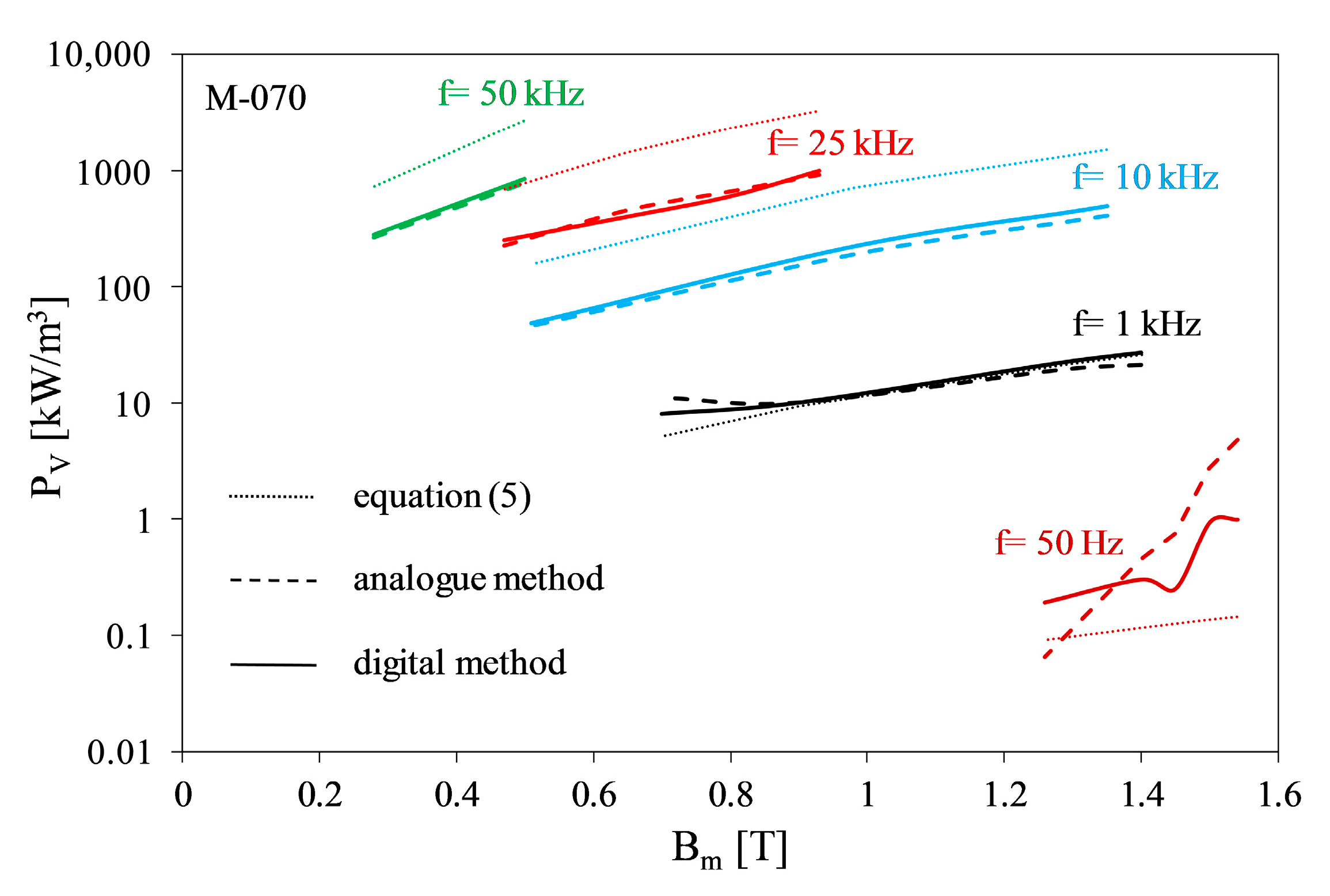
Figure 2,
Figure 3 and
Figure 4 show the dependences of the loss of the tested cores on the frequency
f, temperature
TC and amplitude of magnetic flux density
Bm, given by the manufacturer [
40,
41] (points) and as calculated (lines). In these figures, the dashed lines denote the results of the calculations based on Formula (5) and the values of the parameters given in
Table 2. The solid lines correspond to the results obtained from Formula (6), which takes into account the empirical dependences of the parameters
α,
β and
Tm on f, and
Bm.
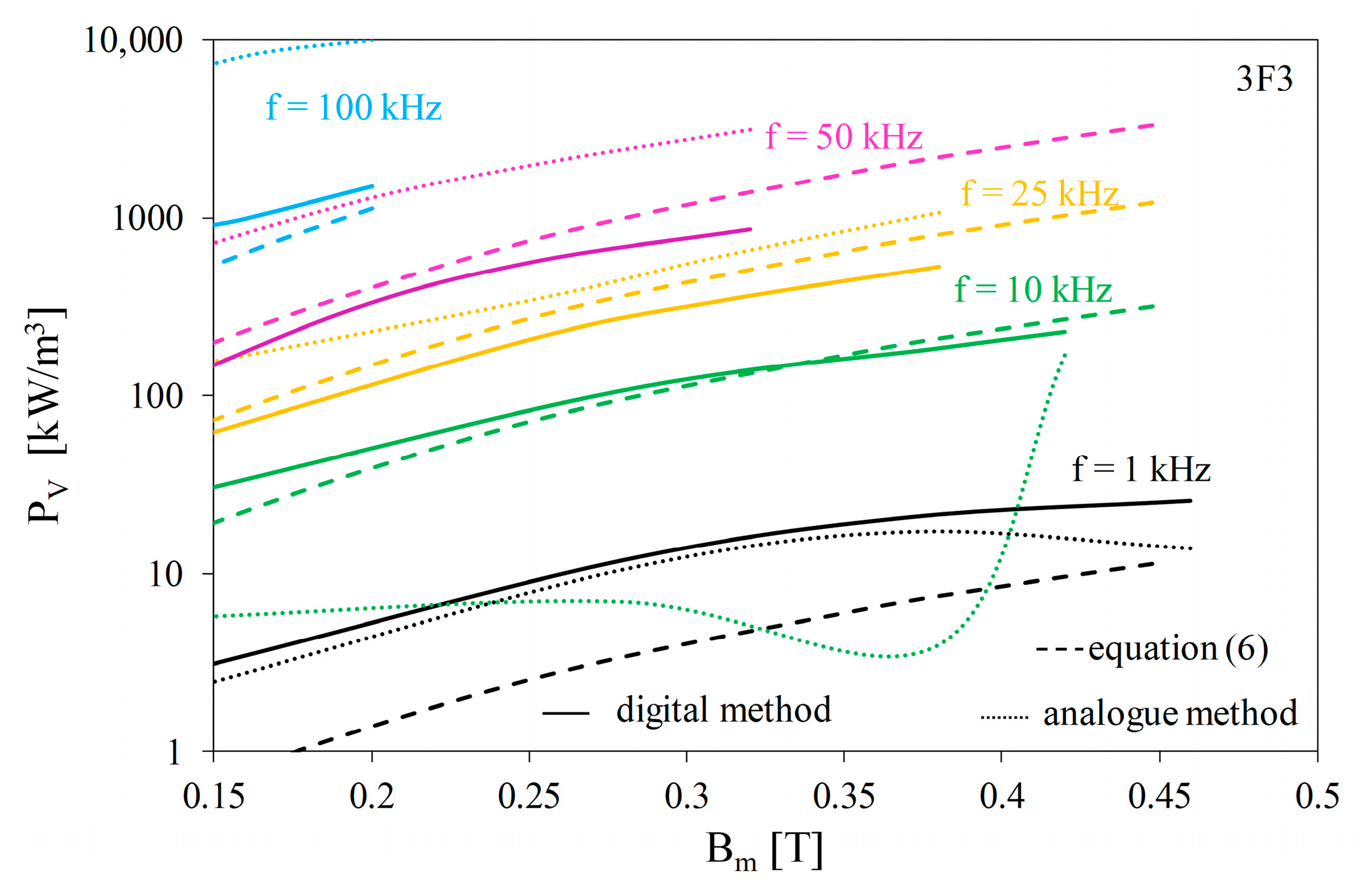
Figure 2 shows the dependence of
PV in the 3F3 core on
Bm at selected frequency values,
f.
As can be seen, the PV(Bm) dependence in a log–log scale is a straight line. It can be seen that the catalogue data and the calculation results using Formula (5) are close to each other only at f = 200 kHz. At other frequency values, the calculated PV values differ (up to two-fold) from the values declared by the manufacturer. In contrast, calculations using Formula (6) model the manufacturer’s dependences very well.
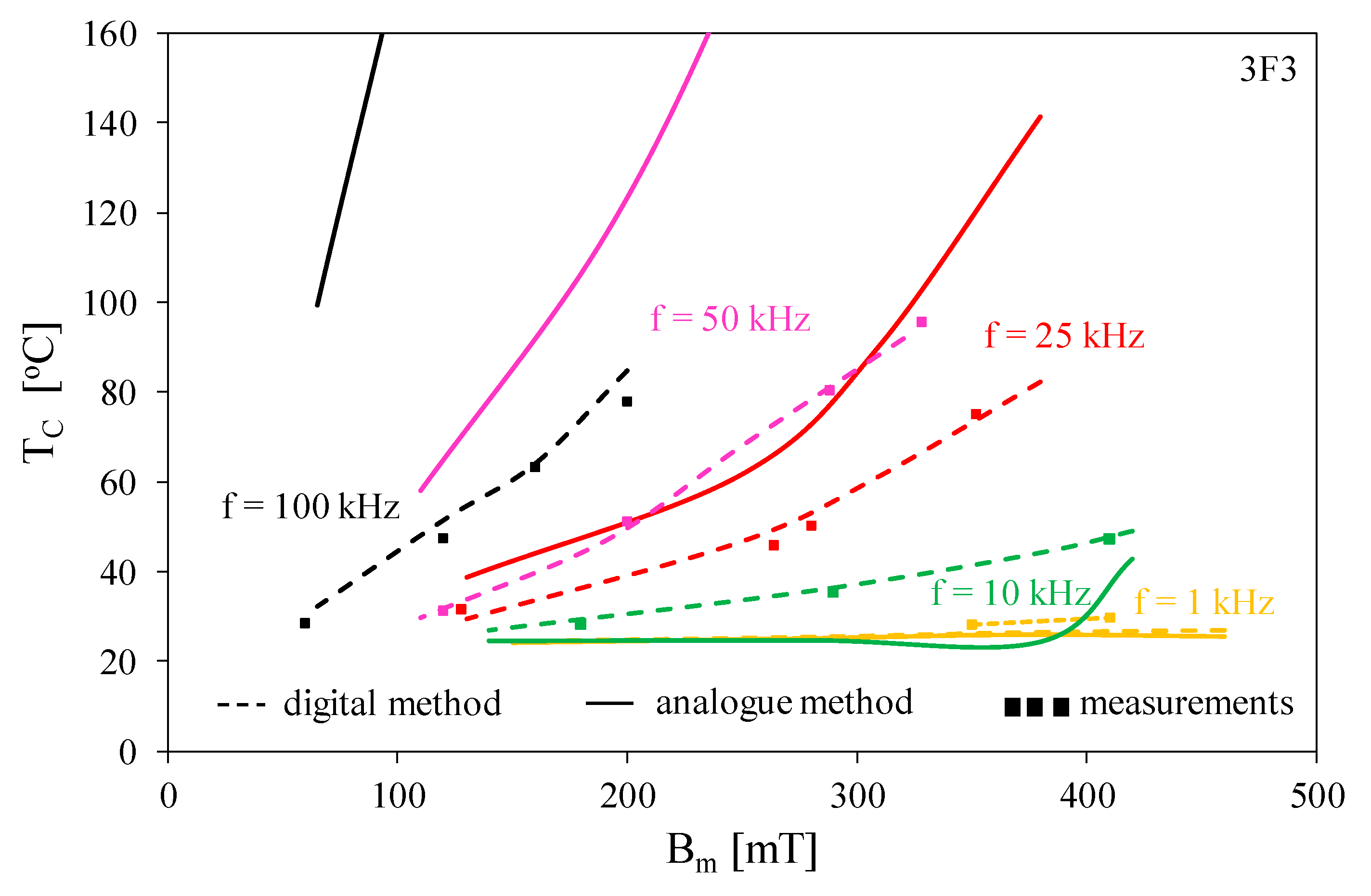
The influence of temperature on 3F3 core loss is illustrated in
Figure 3 for selected values of
f and
Bm.
Figure 3 shows that the loss model given by Formula (6) allows for good agreement between the calculation and measurement results for all considered operating conditions. In contrast, the classic Formula (5) does not take into account the influence of temperature. Therefore, the dashed line in this figure indicates the results obtained from Formula (6), with fixed values of all parameters appearing in this formula. It is clear that omitting the influence of f on the model parameter values results in significant discrepancies between the calculation results and the manufacturer’s data. At
f = 50 kHz and
Bm = 200 mT, these discrepancies reach up to 100%.
The dependences of parameters
α and
β used in the calculations shown in
Figure 2 and
Figure 3 are as follows:
Formulas (7) and (8) were obtained by approximating the dependences α(f) and Tm(f) using a second-degree polynomial. The coordinates of individual points on the approximated characteristics were obtained by selecting the values of the parameters α and Tm that ensure the best fit of the calculated and measured PV(Bm) and PV(TC) graphs for individual values of frequency f.
The MAX(x,y) function in Formula (8) takes the value of the larger of its two arguments. The values of the parameters in Formulas (6)–(8) for the 3F3 core are summarized in
Table 3.
In the case of the M-070 core, no impact of temperature on the loss value was observed; however, obtaining consistency of the calculation results with the manufacturer’s data required taking into account the dependence of
α and
β coefficients on
Bm. These dependences take the following forms:
where
k11,
k12,
k13,
k14,
k15 and
k16 are model parameters. The values of coefficients occurring in Formulas (5), (9) and (10) for core M-070 are summarized in
Table 4.
Formulas (9) and (10) were obtained by approximating the dependences α(Bm) and β(Bm) using a second-degree polynomial. The coordinates of individual points on the approximated characteristics were obtained by selecting the values of parameters α and β that ensured the best fit of the calculated and measured PV(f) graphs for each frequency, Bm.
Figure 4 presents the calculated and catalogue dependence of
PV on
Bm for a nanocrystalline core.
Figure 4 shows that the Steinmetz model with fixed values of
α and
β parameters enables accurate determination of the loss value in a wide range of frequency changes only at lower values of
Bm.
For the highest of the considered Bm values, the slope of the PV(f) dependence increases significantly, and the literature model does not take this phenomenon into account. In turn, the proposed modification of the classical model allows for obtaining good agreement between the calculation results and the manufacturer’s data in all considered operating conditions.
5. Measurements of B(H) Characteristics
This section analyses the problem of determining the hysteresis loop
B(
H) of selected ferromagnetic cores using the measurement setup shown in
Figure 1. The results presented in this section were obtained for two values of resistance
R2 equal to 47 Ω and 10 kΩ, respectively, using the analogue and digital measurement methods.
Magnetization curves were measured for transformers containing cores made from the materials described in
Section 3. The measurements were performed over a wide range of
f and
Bm values. The range of
Bm values up to the B
sat values for the tested cores was considered. The frequencies at which the measurements were performed are in the range from 50 Hz to 100 kHz, which corresponds to almost the entire range expected by the standard [
20]. The results are shown in
Section 5.1 for the 3F3 core and in
Section 5.2 for the M-070 core. The results obtained using the analogue and digital methods were compared in each case.
5.1. 3F3 Core
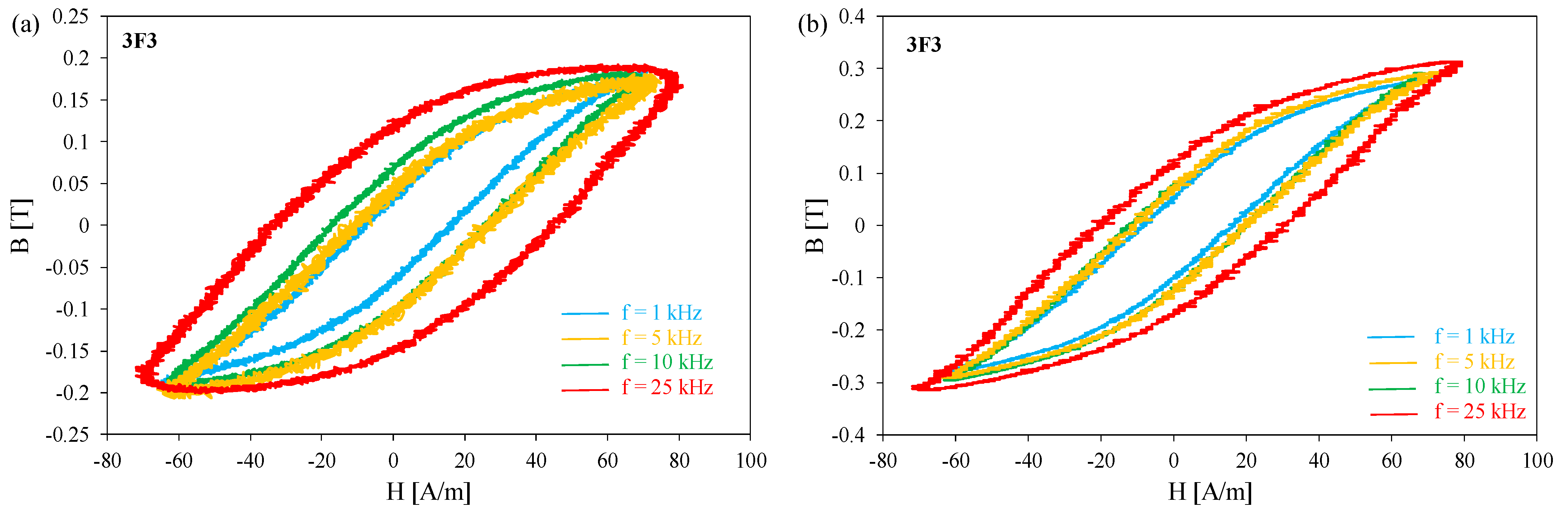
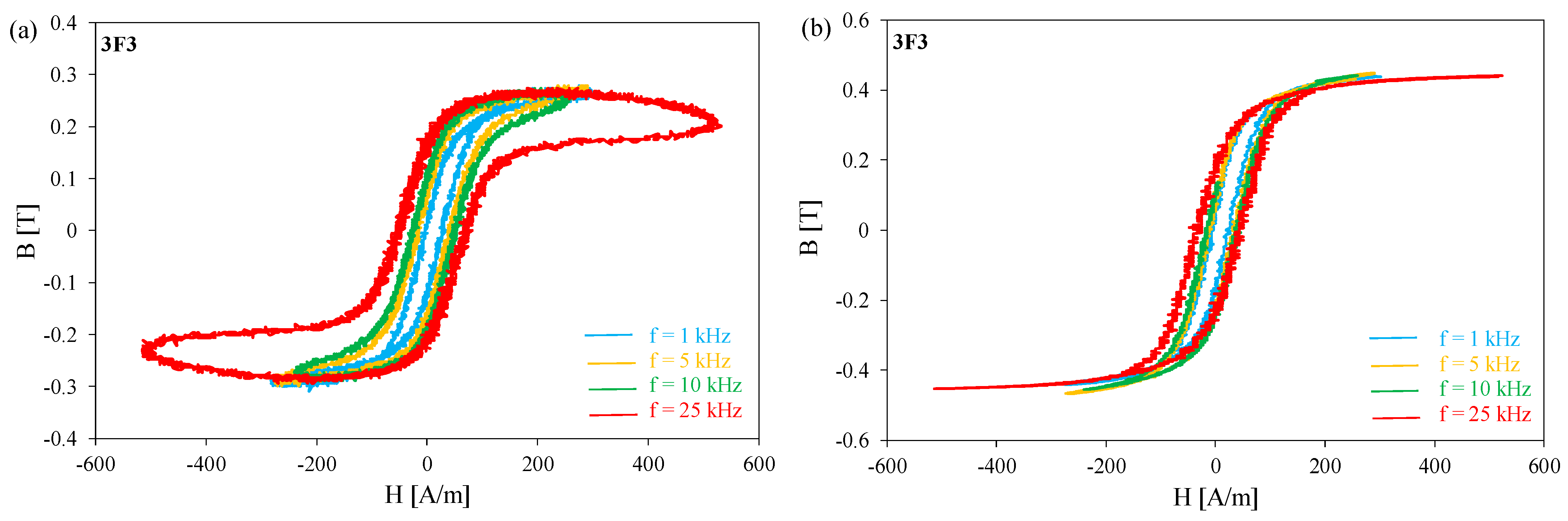
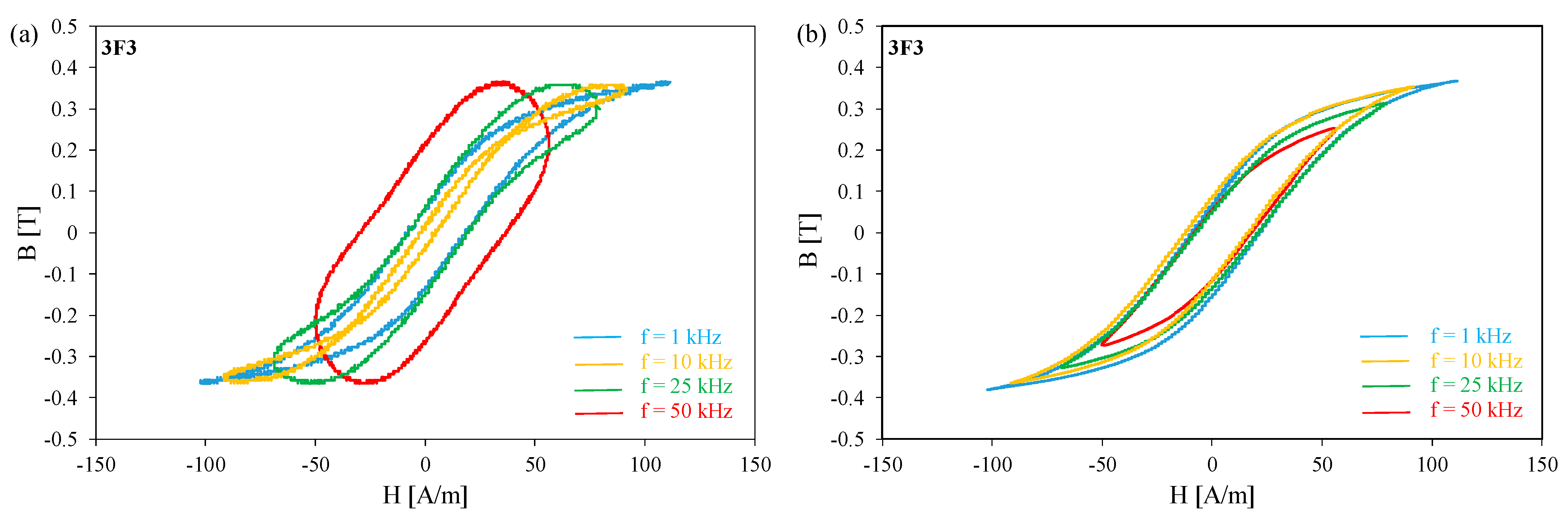
Figure 5 and
Figure 6 present the
B(
H) curves measured at
Bm = 0.2 T (
Figure 5) and
Bm = 0.3 T (
Figure 6). During the measurements, the resistance of resistor
R2 was 47 Ω, and 12 turns were wound on both windings of the transformer.
As can be seen, an increase in the frequency value, at a fixed value of
Bm, results in an increase in the size of the hysteresis loop, and, in particular in, its area. However, it is worth noting in
Figure 5 that the changes in the hysteresis loop area are smaller than the changes in frequency. For example, a change in frequency from 1 kHz to 10 kHz only caused a doubling of the hysteresis loop area. In turn, an increase in frequency from 10 kHz to 25 kHz resulted in more than a doubling of the hysteresis loop area.
Comparing the
B(
H) curves shown in
Figure 5a,b, significant differences in the shapes of these curves can be seen. The values of
Bm obtained using both methods also differ significantly. The analogue method achieved a
Bm of 0.2 T, whereas the digital method achieved a
Bm of 0.32 T. This means a discrepancy between the measurement results of up to 60%.
In turn,
Figure 6 shows that the shape of the hysteresis loop and its dimensions significantly depend on the used measurement method. Differences were observed for the highest of the considered frequency values. The hysteresis loops presented in
Figure 6a deviate from the shape of such relationships presented in the literature. This is particularly true for the curve corresponding to the frequency
f = 25 kHz.
In turn,
B(
H) curves visible in
Figure 6b have a shape similar to that presented in the manufacturer’s materials. In particular, the saturation range of the magnetization curve at
Bm = 0.44 T is clearly visible.
The discrepancies between the magnetization curve measurement results obtained using both the considered methods, presented in
Figure 5 and
Figure 6, are the result of using a low-resistance resistor
R2 in the measuring setup. For the 3.3 μF capacitor
C1, the integrator’s time constant was only 155.1 μs. This means that this setup can correctly integrate the voltage
VC and ensure the validity of Formula (2) only for frequencies significantly higher than 1 kHz. At the same time, the voltage amplitude
VC should be much smaller than the voltage amplitude
V2, which limits the accuracy of measuring these voltages. Therefore, in further studies, a circuit containing a 10 kΩ resistor
R2 was used. In this case, with the same capacitance
C1 value as in the previous examples, a time constant of 33 ms was obtained. This means that the circuit will correctly integrate signals with frequencies significantly higher than 5 Hz.
Figure 7 shows the magnetization curves measured by both methods at selected frequency values.
As can be seen, despite the proper selection of the RC time constant in the measurement setup, there are clear differences between the measurement results obtained using both measurement methods. In particular, the use of the analogue measurement method causes significant distortions of the
B(
H) curve. Such distortions are not visible in
Figure 7b, which shows the results obtained using the digital method. The differences between the results obtained for both methods increase with increasing frequency. In addition to the differences in shape, it is worth noting the differences in the areas of the determined hysteresis loops and the values of the determined amplitude of magnetic flux density.
The changes in the shape of the hysteresis loop with changing frequency, visible in
Figure 5,
Figure 6 and
Figure 7, are the result of increased energy losses with increasing frequency. They are caused by more frequent remagnetization of the core and the associated friction of the Bloch walls of adjacent ferromagnetic domains. In turn, an increase in the flux density amplitude results in an increase in the number of ferromagnetic domains that require remagnetization during each period of the excitation signal.
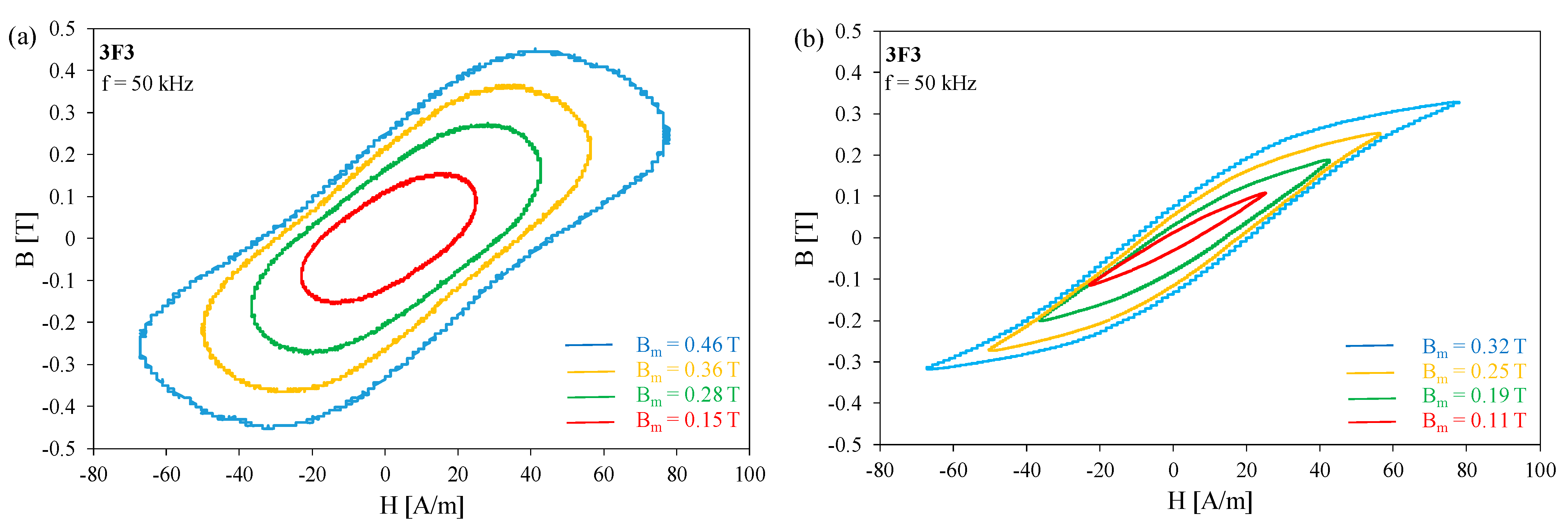
Observing the
B(
H) characteristics shown in
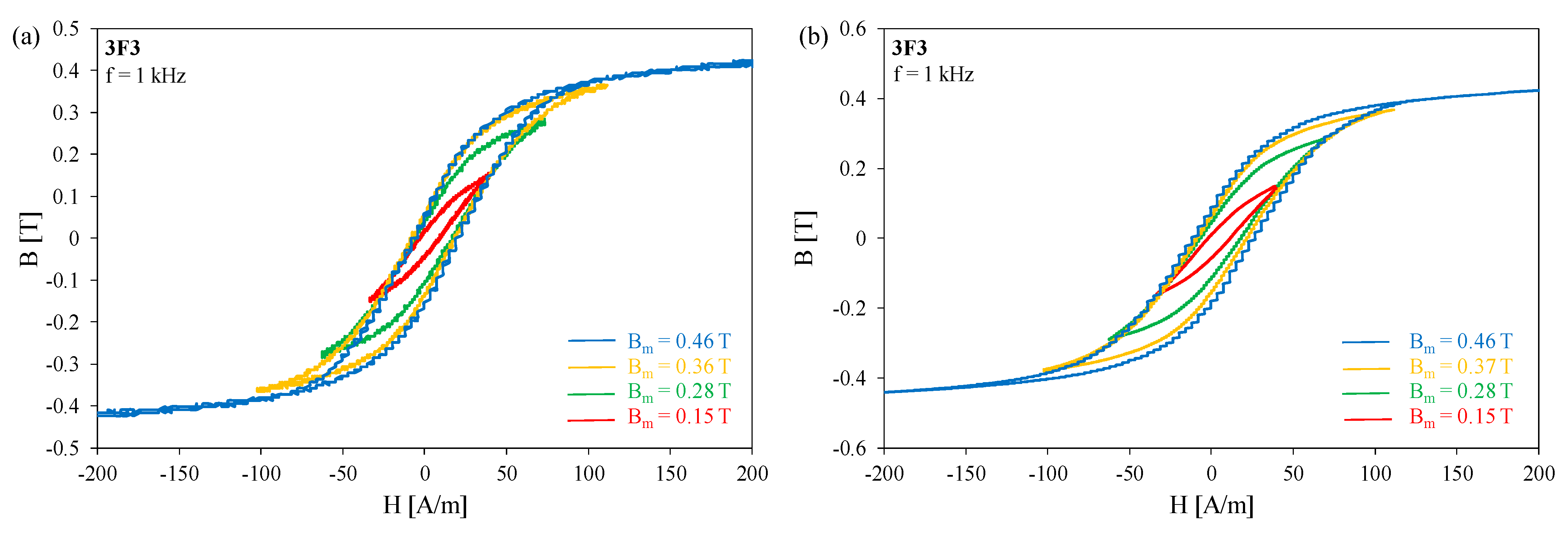
Figure 8, one can see a strong influence of
Bm on the hysteresis loop area. When this amplitude changes from 0.15 T to 0.46 T, the area of the
B(
H) curve increases as much as 12 times. It is worth noting that the results obtained using both methods are similar, but the hysteresis loop area obtained using the digital method is slightly larger than that obtained using the analogue method.
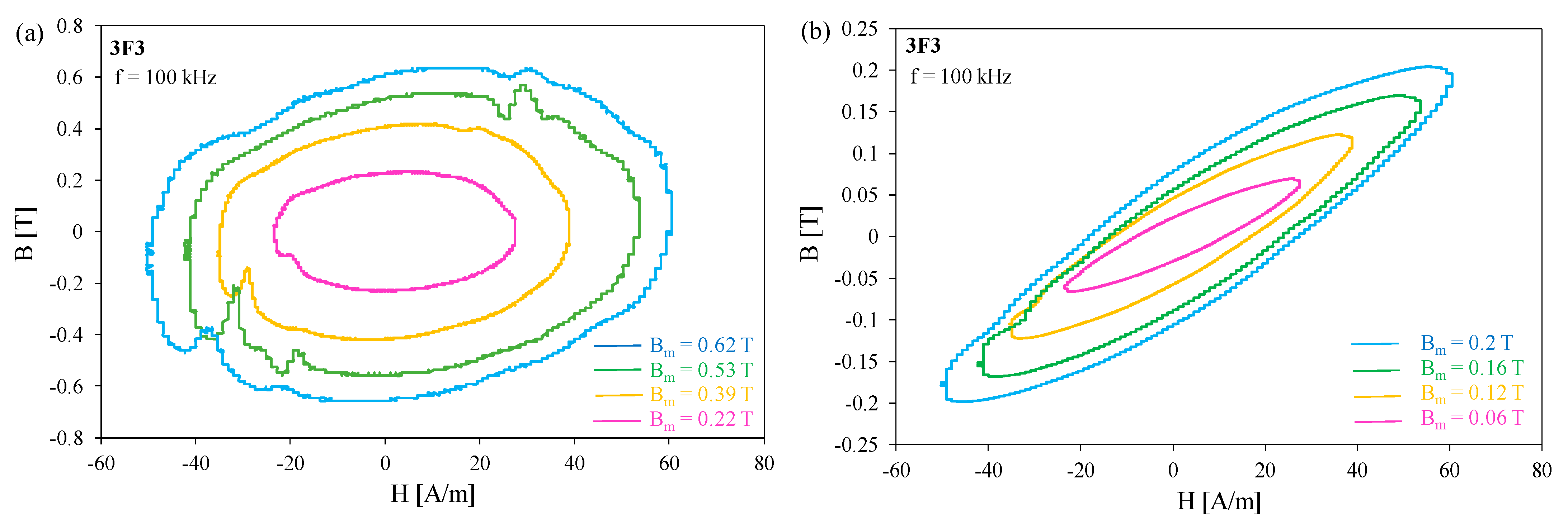
Similarly, the sizes of the magnetization curves shown in
Figure 9 change, with the coercive field value for the
B(
H) curves obtained at
f = 10 kHz being smaller when using the digital method. In
Figure 8a and
Figure 9a, small loops are visible at high values of H. This is the result of the low resolution of measurements performed using the analogue method.
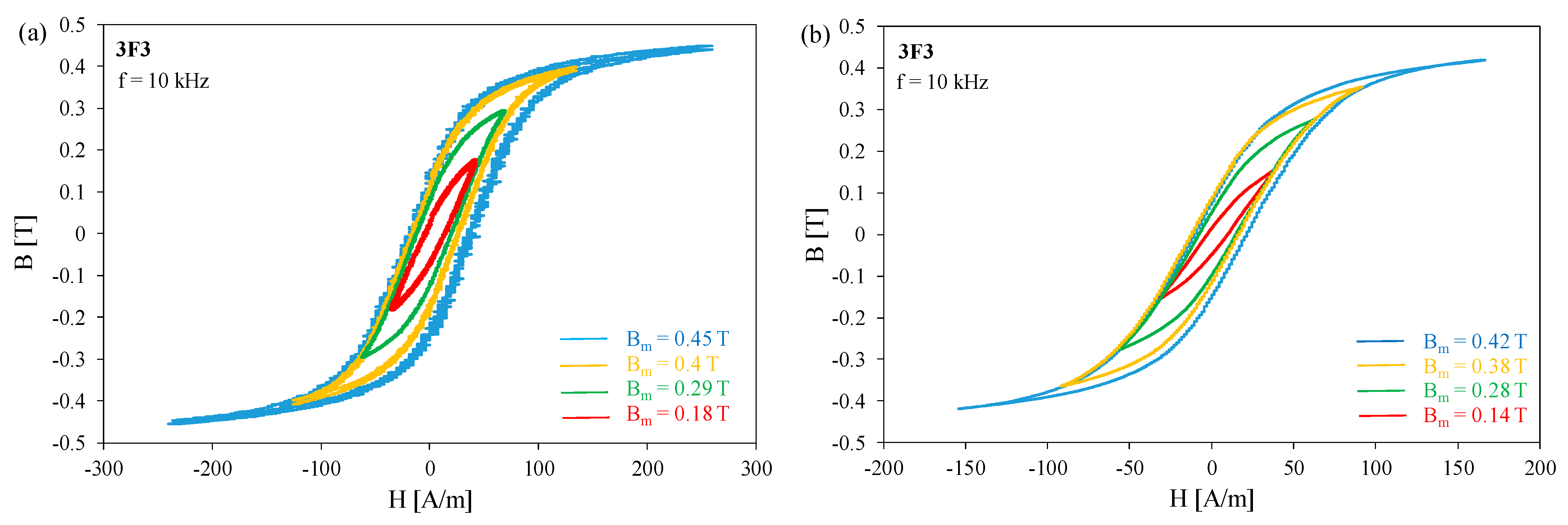
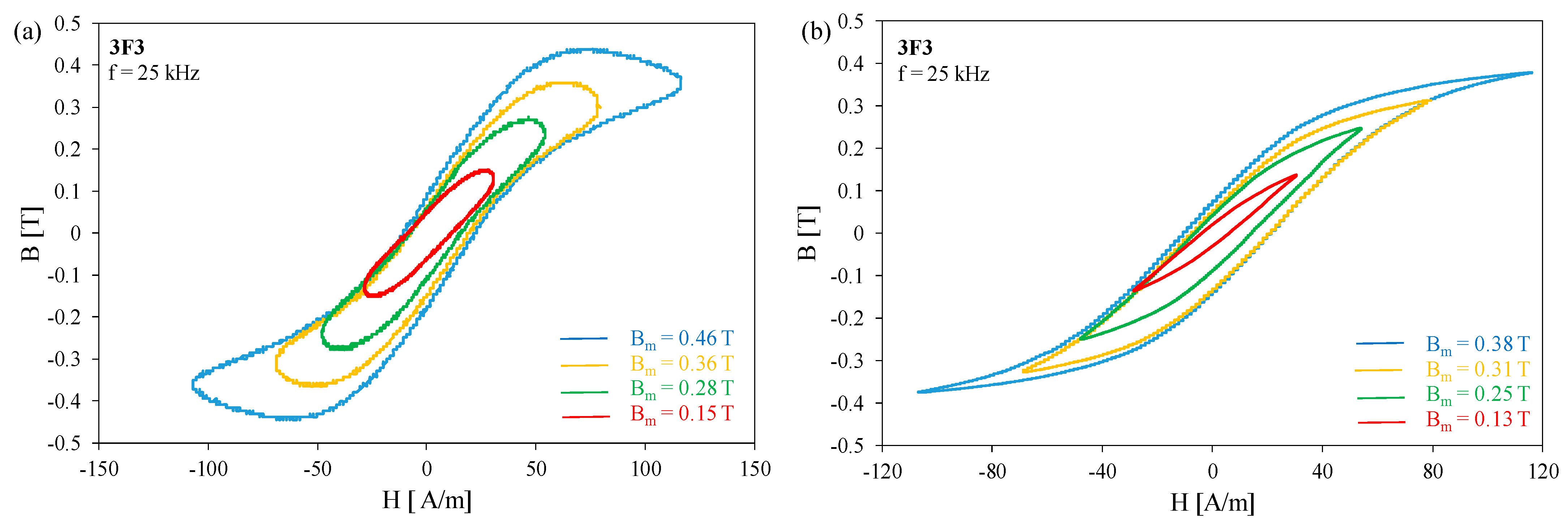
B(
H) curves determined using the classical method at frequencies of 25 kHz or higher (
Figure 10a,
Figure 11a and
Figure 12a) significantly deviate from their typical shape. This defect is not visible in the
B(
H) curves determined using the digital method (
Figure 10b,
Figure 11b and
Figure 12b).
Particularly large differences in the B(H) curves determined using both methods are visible for the highest values of Bm. For B(H) curves determined using the classical method and corresponding to the above-mentioned frequency values, at the highest of the considered Bm values, a decrease in the magnetic flux density value B was observed with an increase in the magnetic force H. Under these conditions, the magnetization curve surface increases with increasing Bm much more than observed at lower frequency values. It is also worth noting that an increase in frequency causes a decrease in the amplitude of magnetic flux density, at which saturation of the characteristic is observed.
It is worth paying attention to the
B(
H) curves shown in
Figure 11a and
Figure 12a. Both their shape (close to an ellipse) and
Bm values (higher than the saturation of magnetic flux density) indicate an unphysical course of these dependences. On the other hand, the digital method allows for obtaining typical
B(
H) curves for each of the considered frequency values.
Figure 8,
Figure 9,
Figure 10,
Figure 11 and
Figure 12 show that only at the highest saturation flux density values does the tested core enter the saturation range, and its operating point forms a large hysteresis loop. At lower
Bm values, one of the small hysteresis loops is observed, the size of which decreases with decreasing
Bm values. Each of them exhibits central symmetry with respect to the origin.
5.2. M-070 Core
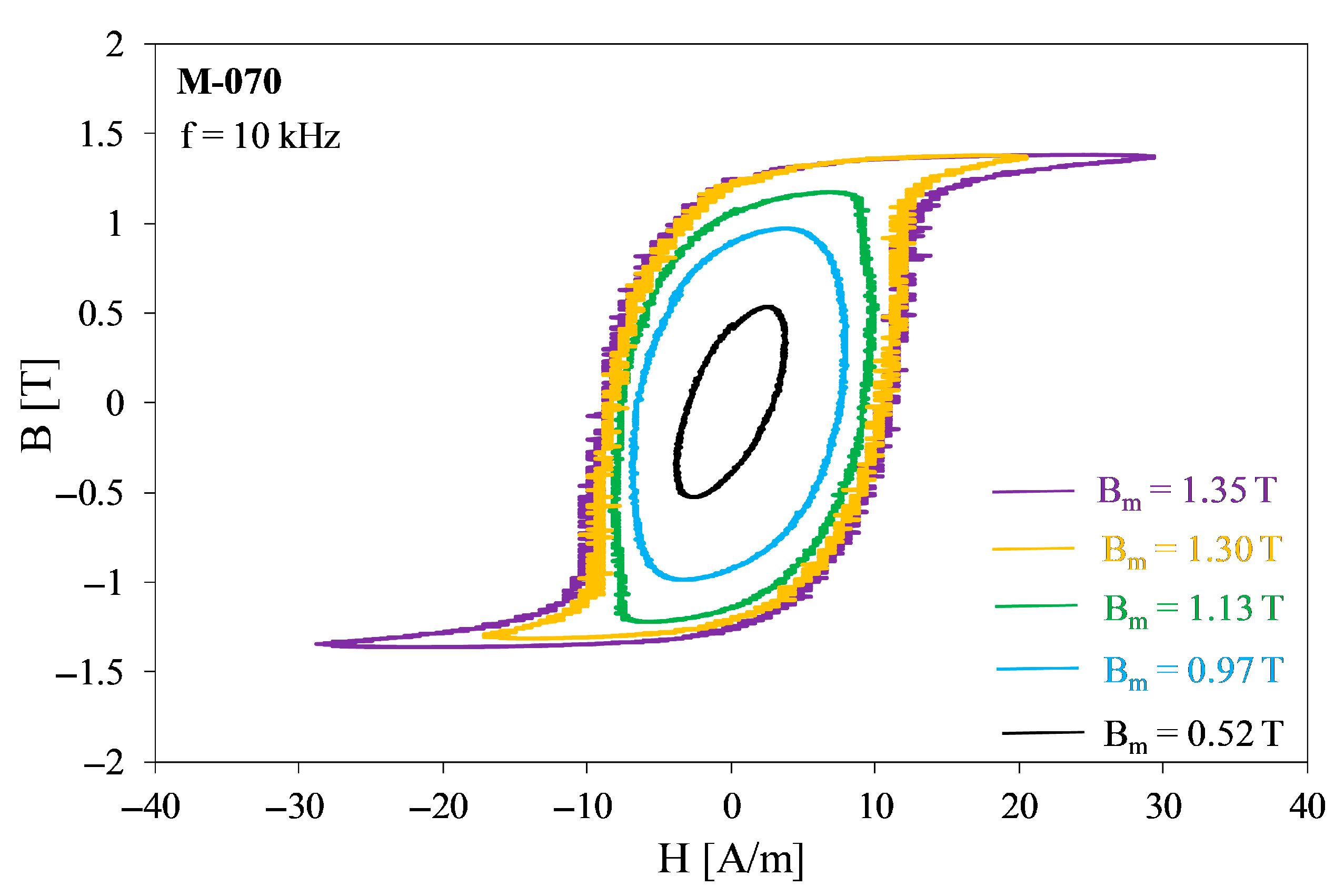
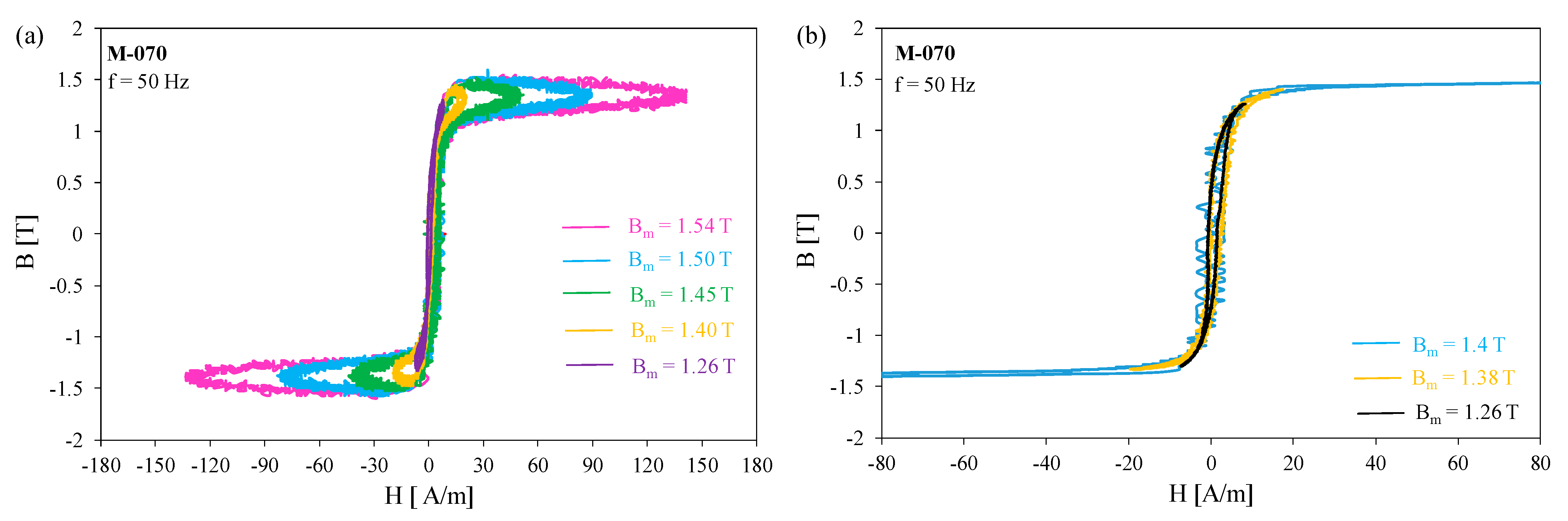
Figure 13,
Figure 14,
Figure 15,
Figure 16,
Figure 17 and
Figure 18 present the results of measurements carried out for a nanocrystalline core made of M-070 material. All measurements, the results of which are presented in this section, were carried out with the resistance
R2 = 10 kΩ, and 18 turns were wound on each transformer winding.
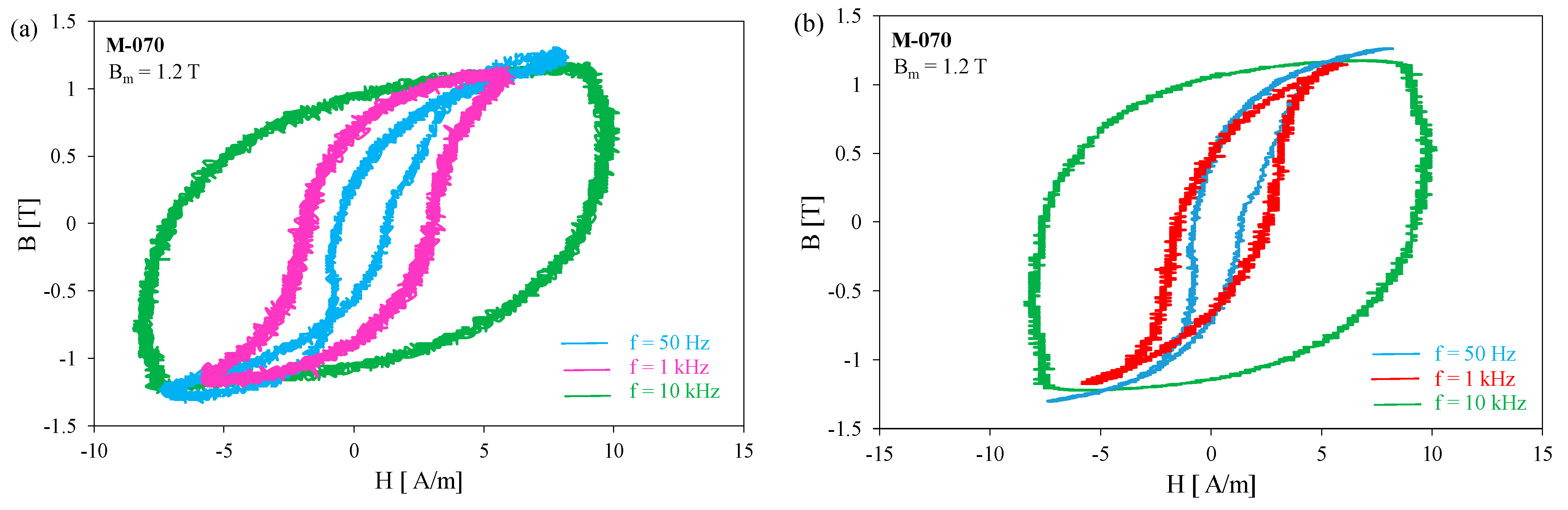
Figure 13 illustrates the influence of frequency on the magnetization curves of the considered core at
Bm = 1.2 T.
It is worth noting that the presented hysteresis loops are much narrower than the B(H) curves for ferrite cores presented in the previous section. The M-070 core enters saturation at H values of just a few A/m. Increasing the frequency causes an increase in the width of these loops. The typical shape of the B(H) curve was obtained only for a frequency of f = 1 kHz. For the considered case, the results obtained using the classical and digital methods were very similar.
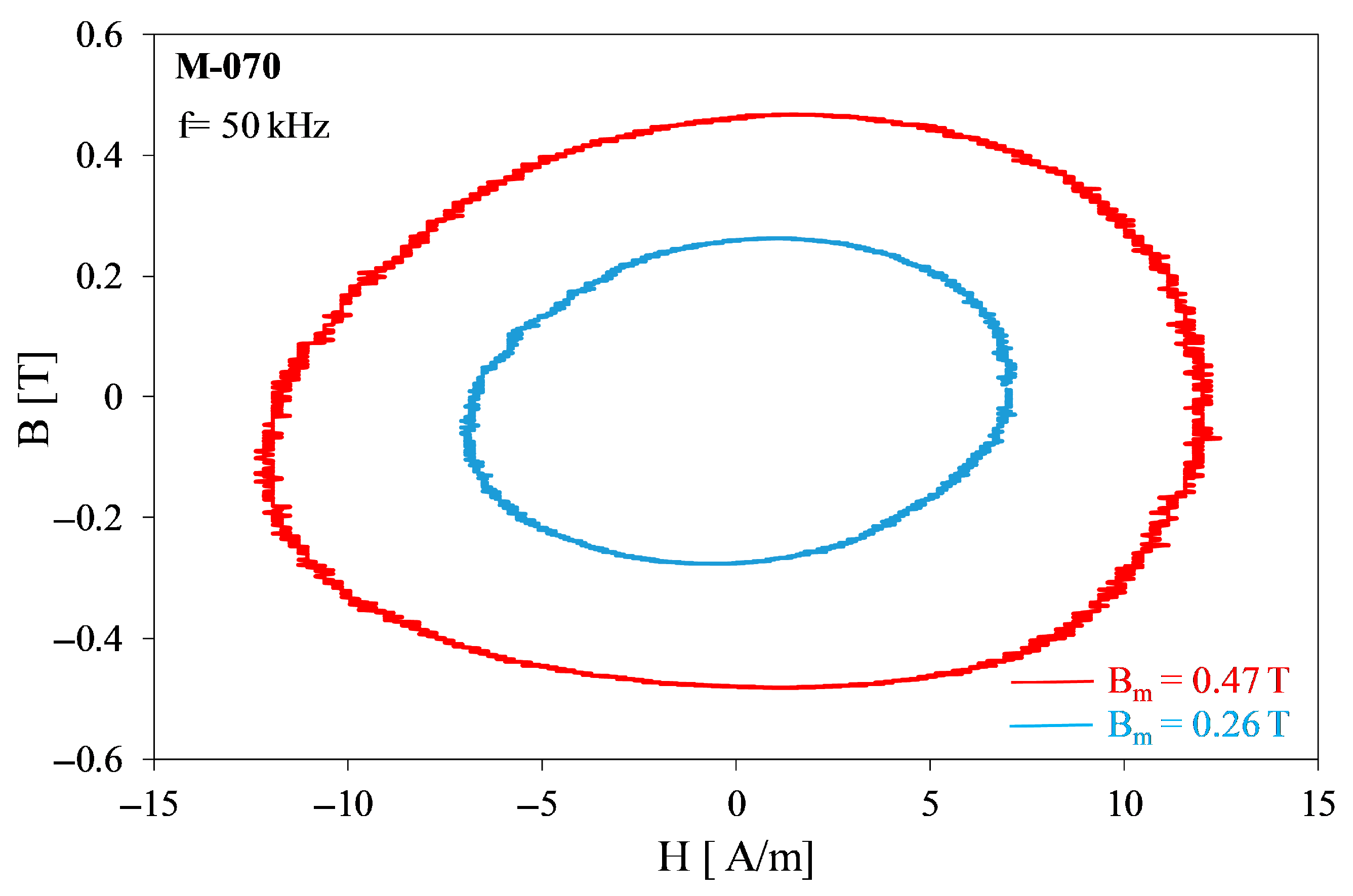
Figure 14,
Figure 15,
Figure 16,
Figure 17 and
Figure 18 illustrate the influence of the amplitude of magnetic flux density on the course of the magnetization curves measured at different frequencies.
Figure 14 concerns
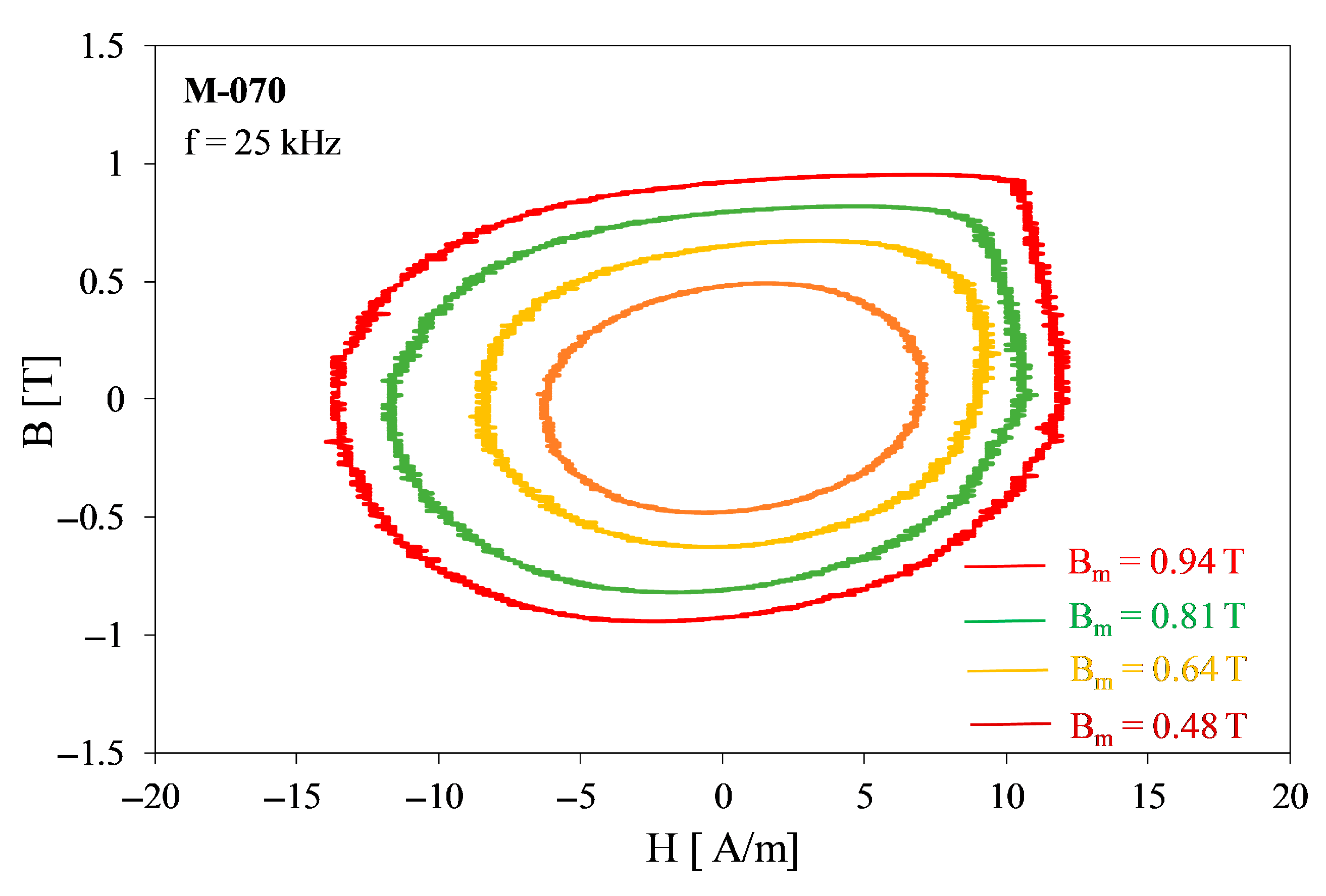
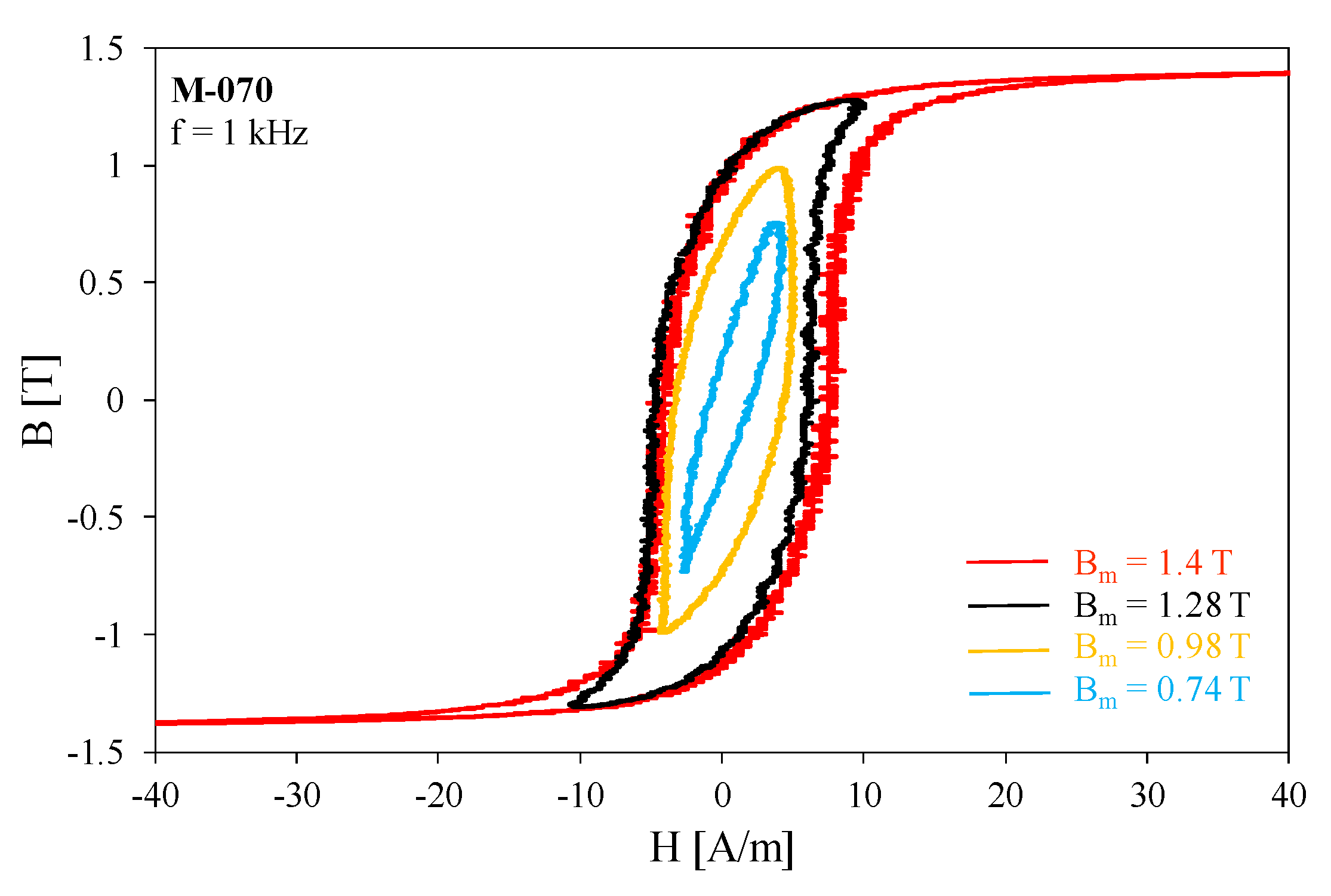
f = 50 kHz,
Figure 15 concerns
f = 25 kHz,
Figure 16 concerns
f = 10 kHz,
Figure 17 concerns
f = 1 kHz, and
Figure 18 concerns
f = 50 Hz. For most of the performed measurements, almost identical results were obtained using the classical and digital methods. Visible differences occurred only for the lowest of the considered frequencies. Therefore,
Figure 14,
Figure 15,
Figure 16,
Figure 17 and
Figure 18 present only the measurement results obtained using the digital method.
In
Figure 14,
Figure 15,
Figure 16,
Figure 17 and
Figure 18, at higher frequencies than those considered, it is not possible to obtain an amplitude of magnetic flux density corresponding to the core saturation in the applied measurement setup. This is because the maximum amplitude of the output voltage of the power amplifier that supplies the primary winding of the tested transformer is limited. Increasing frequency means that the same voltage value in this winding can be obtained with increasingly lower core amplitudes of magnetic flux density. It is also worth noting that increasing frequency causes an increase in the coercive field value and an increase in the hysteresis loop area. At low frequencies, a broadening of the portion of the
B(
H) characteristic corresponding to the saturation range is observed.
Comparing the hysteresis loop dimensions obtained for different Bm values, changing the value of this parameter results in a change in the hysteresis loop area proportional to the square of the change in Bm. It is worth emphasizing that the magnetization curves determined using the analogue and digital methods differ only slightly when the frequency is not lower than 1 kHz. However, these differences are significant, especially in the saturation range at the lowest frequency considered (f = 50 Hz). This is the result of too small a difference between the period of the measured signal and the time constant R2C1 of the integrator. The oscillations visible in the measured hysteresis loops are the result of the low resolution of the analog-to-digital converters contained in the oscilloscope used for the measurements.
5.3. Discussion
Comparing the results obtained for both cores, using the analogue method, correct B(H) curves can be obtained when the integrator’s time constant is much greater than the supply signal period. This condition is not sufficient for measuring ferrite core characteristics. Therefore, using the digital method is beneficial for both core types and allows for reliable B(H) curve measurement results.
It is worth noting that small oscillations are visible in the measured hysteresis loop waveforms. These are related to the limited resolution of the analogue-to-digital converters in the oscilloscope used. Typically, for very high sampling frequency, the resolution of analogue-to-digital converters does not exceed 10 bits. It corresponds to the minimum allowable relative error equal to 0.1%. In turn, the steps visible in some of the presented
B(
H) waveforms result from ferromagnetic proprties related to the remagnetization of ferromagnetic domains [
2].
7. Conclusions
This paper considers the problem of measuring the hysteresis loop B(H) and determining core losses. The measurement method and setup used are described. The magnetization curves of ferromagnetic cores made of ferrites or nanocrystalline material were determined using analogue and digital methods. The causes of incorrect results obtained when measuring magnetization curves using the analogue method were identified. One of these causes is an incorrectly chosen value of the RC circuit time constant. The second reason is the low accuracy of the voltage measurement at the output of the integrator. It is demonstrated that even with the correct selection of the integrator time constant, significantly deformation of the magnetization curves B(H) can occur when using the analogue measurement method. The digital method allows for the elimination of such distortion.
The core operating conditions corresponding to significant distortions of the B(H) characteristics were identified. These distortions become more pronounced the higher the frequency of the excitation signal.
The main results of this research are as follows:
- (a)
Validations of the digital and analogue methods for measuring the magnetization characteristic B(H) of two types of ferromagnetic cores made of ferrite or nanocrystals;
- (b)
Analysis of the influence of the frequency and flux density on the accuracy of the considered measurement methods;
- (c)
Comparison and analysis of the accuracy of power loss measurements in the ferromagnetic core using hysteresis loops obtained using the analogue and digital methods and calculated using the modified Steinmetz model.
It has been shown that the classical Steinmetz’s formula for calculating core losses is applicable within a limited range of Bm and f changes, where no significant distortions of the hysteresis loop B(H) are observed. In particular, it has been shown that the analogue method exhibits significant errors at low frequencies and at Bm values close to the saturation of magnetic flux density. For ferrite and nanocrystalline cores, it is necessary to consider the dependence of α and β coefficients on the frequency and amplitude of magnetic flux density in order to achieve consistency between the PV(f, Bm, T) formulas calculated from Steinmetz’s model and the manufacturer’s specifications.
Steady-state measurements of the ferrite core temperature TC for selected Bm and f values confirmed that the loss factor determined using the digital measurement method allows for the correct calculation of the core temperature increase resulting from self-heating. However, achieving good agreement between the calculation and measurement results requires considering the decreasing dependence of thermal resistance on frequency or introducing an appropriate correction factor to the dependences describing the effect of frequency on the loss factor.
The presented results of this research can be used in the characterization of ferromagnetic cores. The proposed method allows determination of loss values over a wide range of magnetic flux density amplitudes and frequencies up to 100 kHz. References [
43,
44,
45] indicate that in the higher frequency range, there are problems related to the observed phase shift between
B and
H. In the cited papers, special methods for calibrating measurement probes were proposed, enabling measurements in the higher frequency range, even exceeding several hundred kilohertz. The development of these methods will be the subject of our future research.