Distributed Integrated Energy System Optimization Method Based on Stackelberg Game

Abstract
1. Introduction
- (1)
- The dynamic transmission law of carbon cost in a multi-agent game is revealed. Different from previous studies that attribute carbon emission responsibility to a single subject, we deeply discuss how the ladder-type carbon trading scheme transmits the cost signal of low-carbon transformation to the supply side and the demand side in real time through IESO’s pricing leverage. Through this model, we can observe how the carbon price signal induces DIESS and SUT to change their original operating inertia, which provides a new perspective for understanding the role of the carbon market in a multi-energy coupling environment.
- (2)
- Formulating a low-carbon coupling dispatch strategy based on refined P2G modeling. We have introduced a two-stage P2G carbon reduction process and integrated it deeply with the ladder-type carbon trading mechanism. Our simulation analysis reveals that within a game environment, P2G acts not only as a tool for energy conversion but also as a “buffer” that regulates the pricing elasticity of the entire system. This refined modeling approach uncovers the non-linear evolutionary relationship between energy conversion efficiency and economic returns across different carbon price intervals, offering a more operational scheme for the low-carbon scheduling of IES.
- (3)
- Designing and validating a hybrid optimization framework that balances computational efficiency and solution quality. Given the complex mathematical features of the leader–follower game model—such as non-convexity, non-smoothness, and discrete variables—we have designed a GA–CPLEX hybrid solution scheme. By strategically partitioning the responsibilities between external pricing searches and internal linear programming, this framework effectively avoids the pitfalls of local optima common in pure heuristic algorithms while ensuring the uniqueness and rigor of the followers’ responses in each iteration. Comparative experiments across multiple scenarios demonstrate the superiority of this scheme in handling complex bi-level optimization problems.
2. Distributed Integrated Energy System Frame
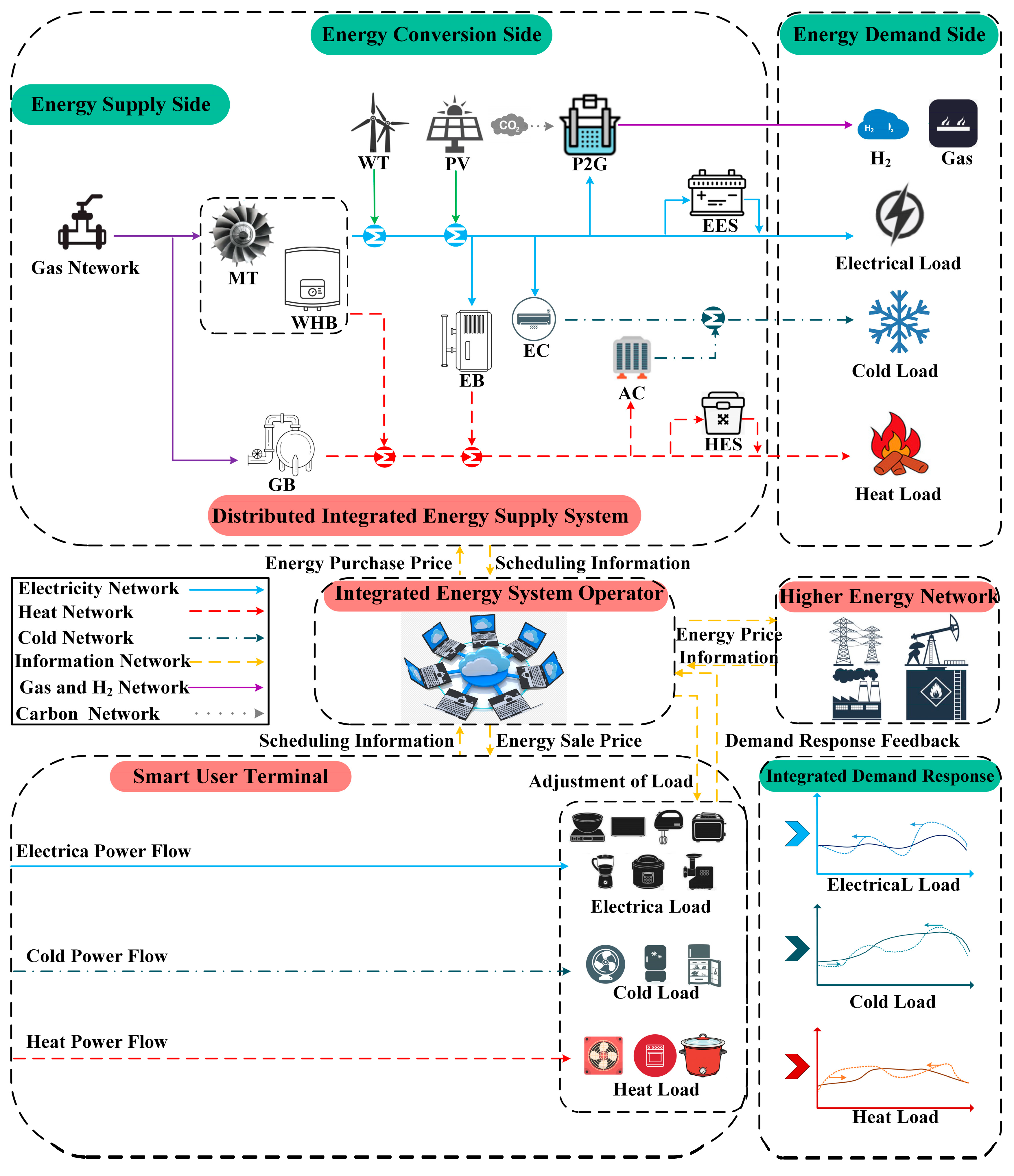
2.1. Structure of Integrated Energy System Operator
2.2. Structure of the Distributed Integrated Energy Supply System
2.3. Structure of the Smart User Terminal
3. Distributed Integrated Energy System Model
3.1. Integrated Energy System Operator Model
3.2. Distributed Integrated Energy Supply System Model
3.3. Energy Storage Equipment Model
3.4. Coupling Device Model
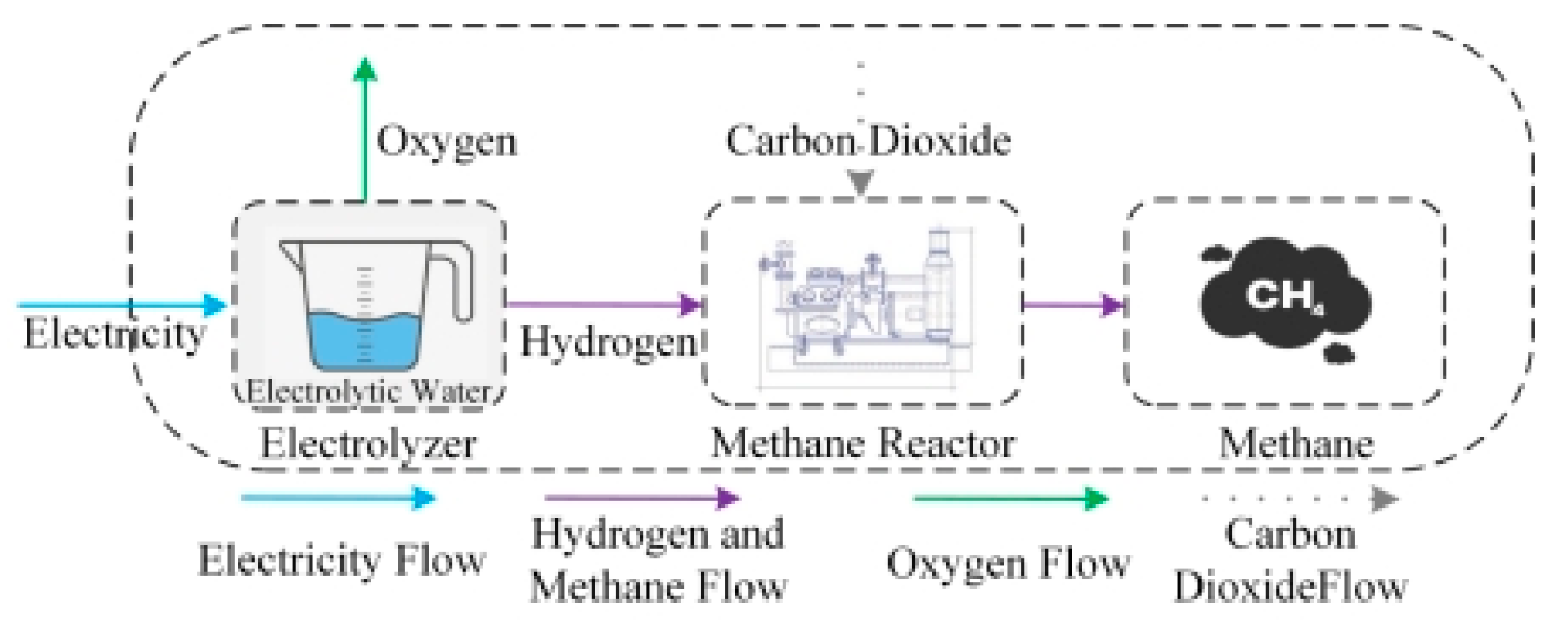
3.5. P2G Equipment Carbon Reduction Model
3.6. Ladder-Type Carbon Trading Scheme
3.7. Smart User Terminal Model
3.8. Integrated Demand Response Model
4. Units Stackelberg Game Framework
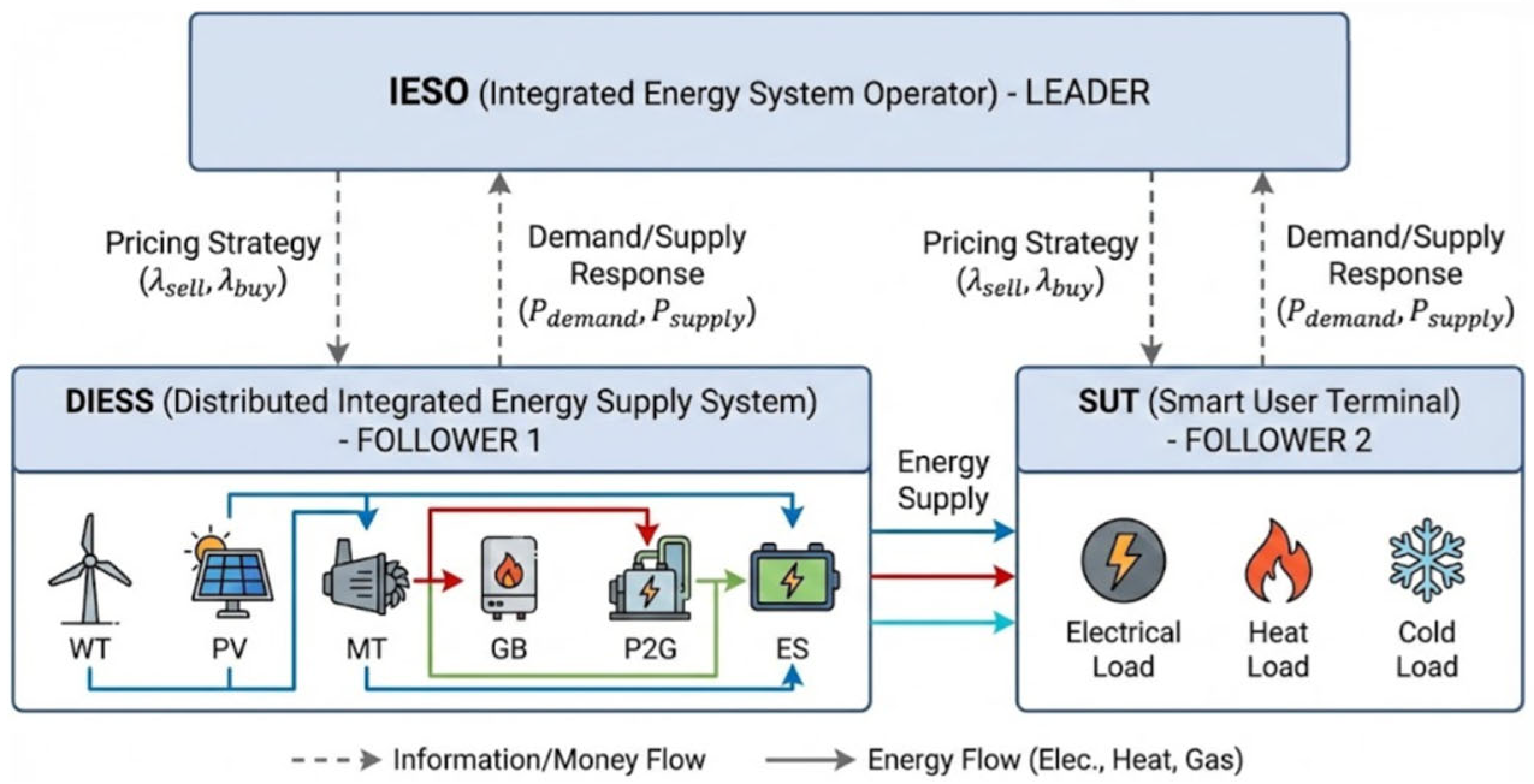
4.1. Basic Concept
4.2. Analysis of Equilibrium Existence and Mathematical Rigor
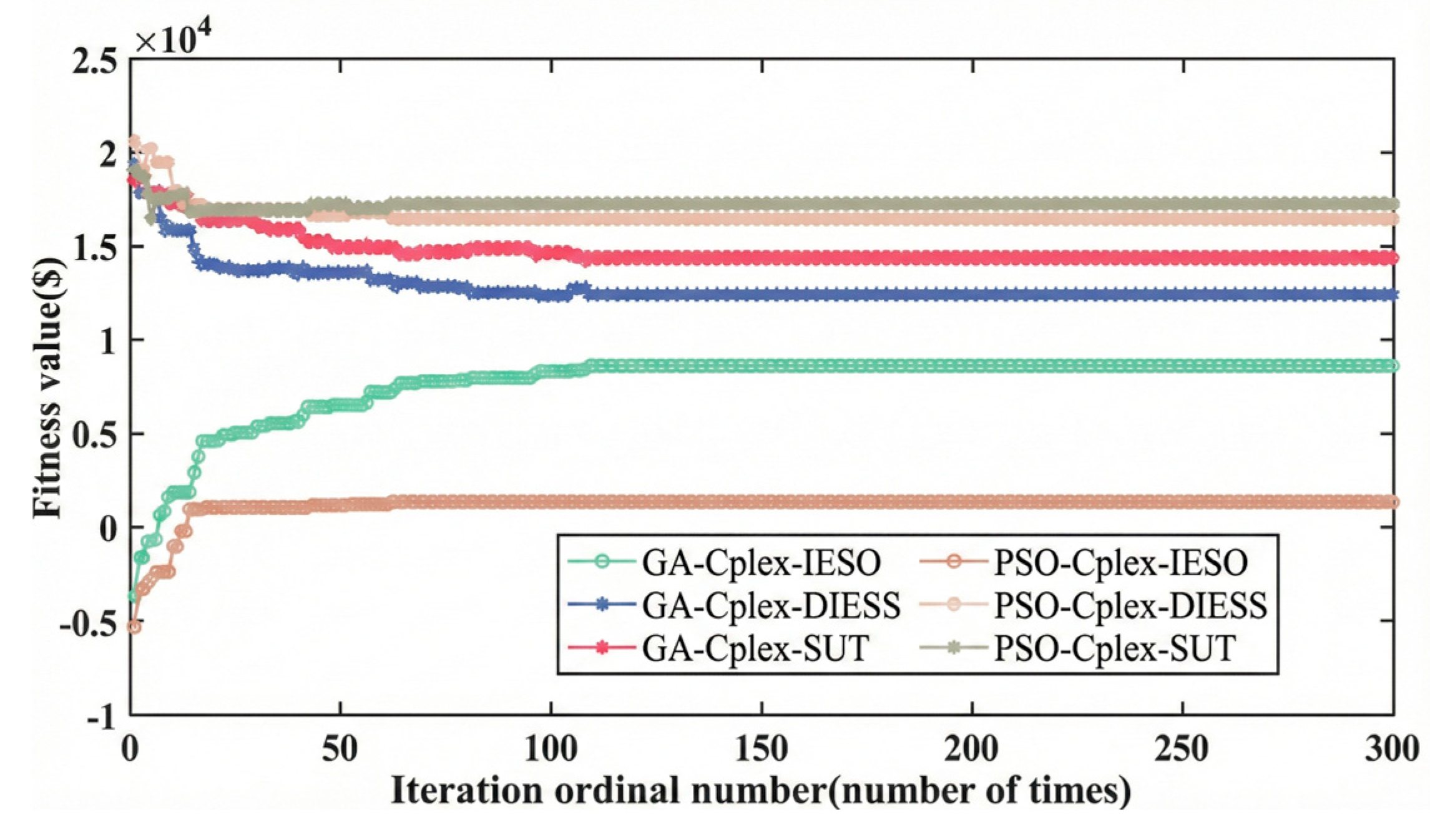
4.3. Solution Methodology: The Strategic GA–CPLEX Framework
5. Analysis of Example
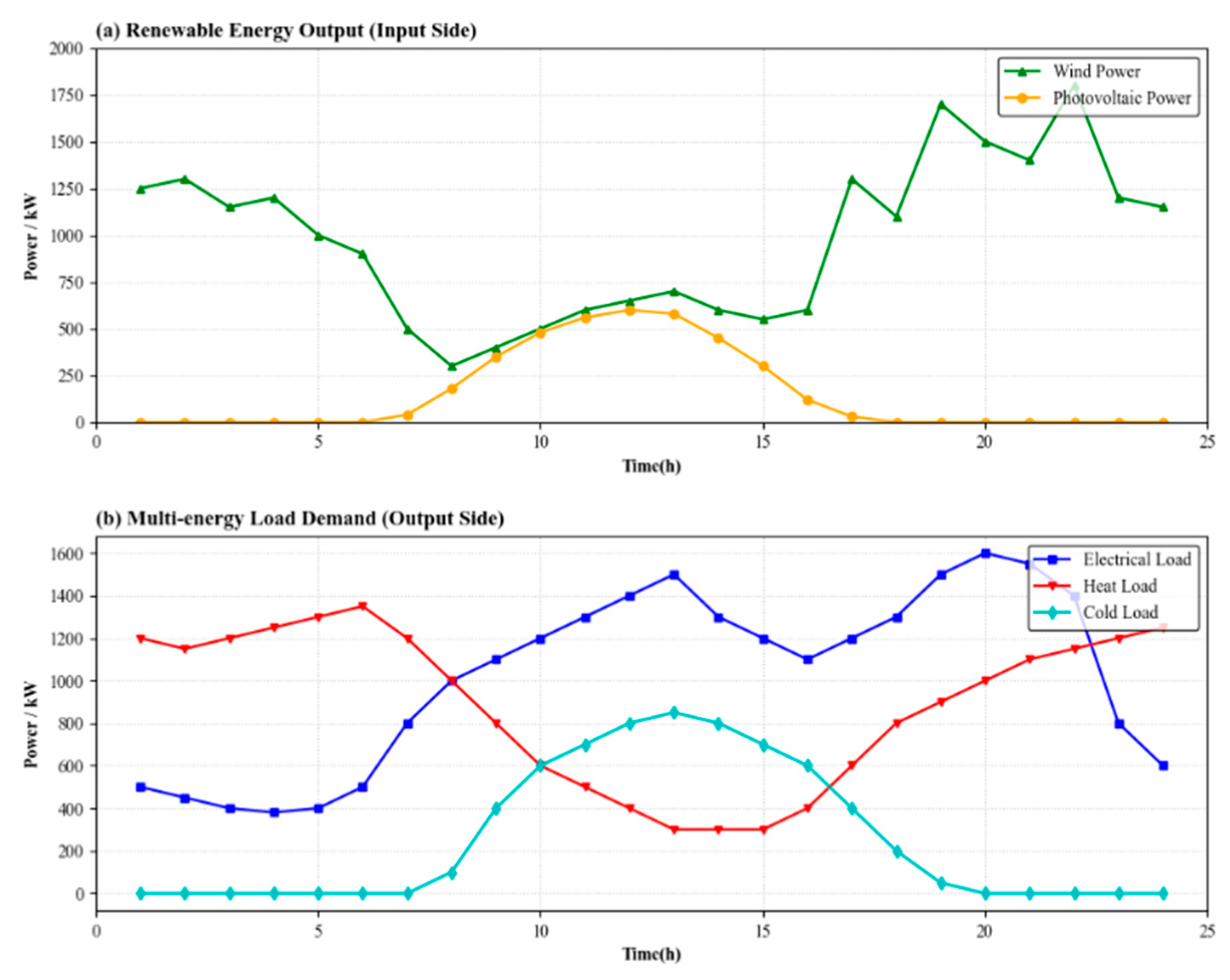
5.1. Simulation Data
5.2. Discussion of the Findings of the Stackelberg Game Optimization Strategy
5.3. Benefit Analysis Under Different Pricing Strategies
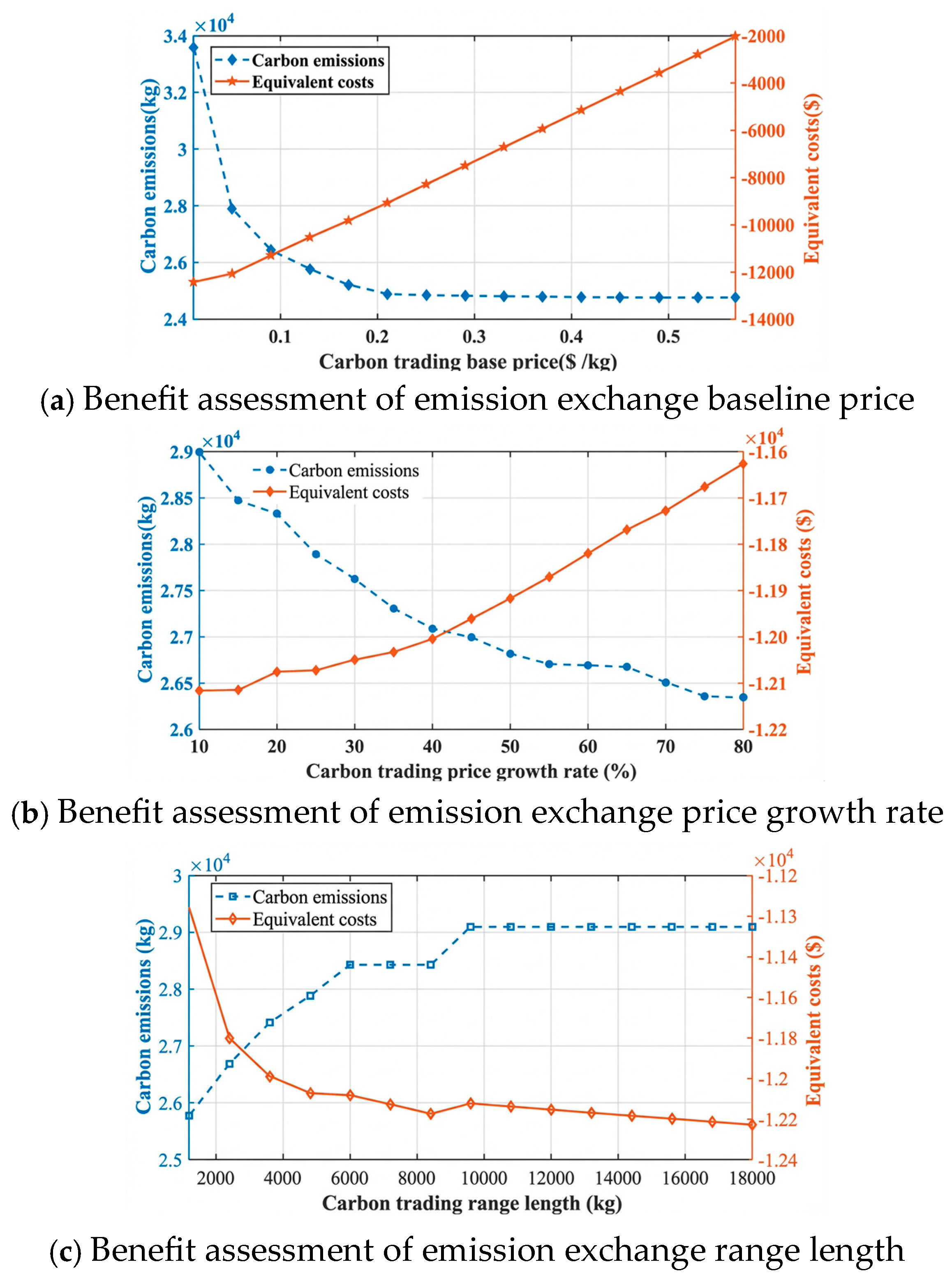
5.4. Analysis of Benefits Under Different Ladder-Type Carbon Trading Scheme Parameters
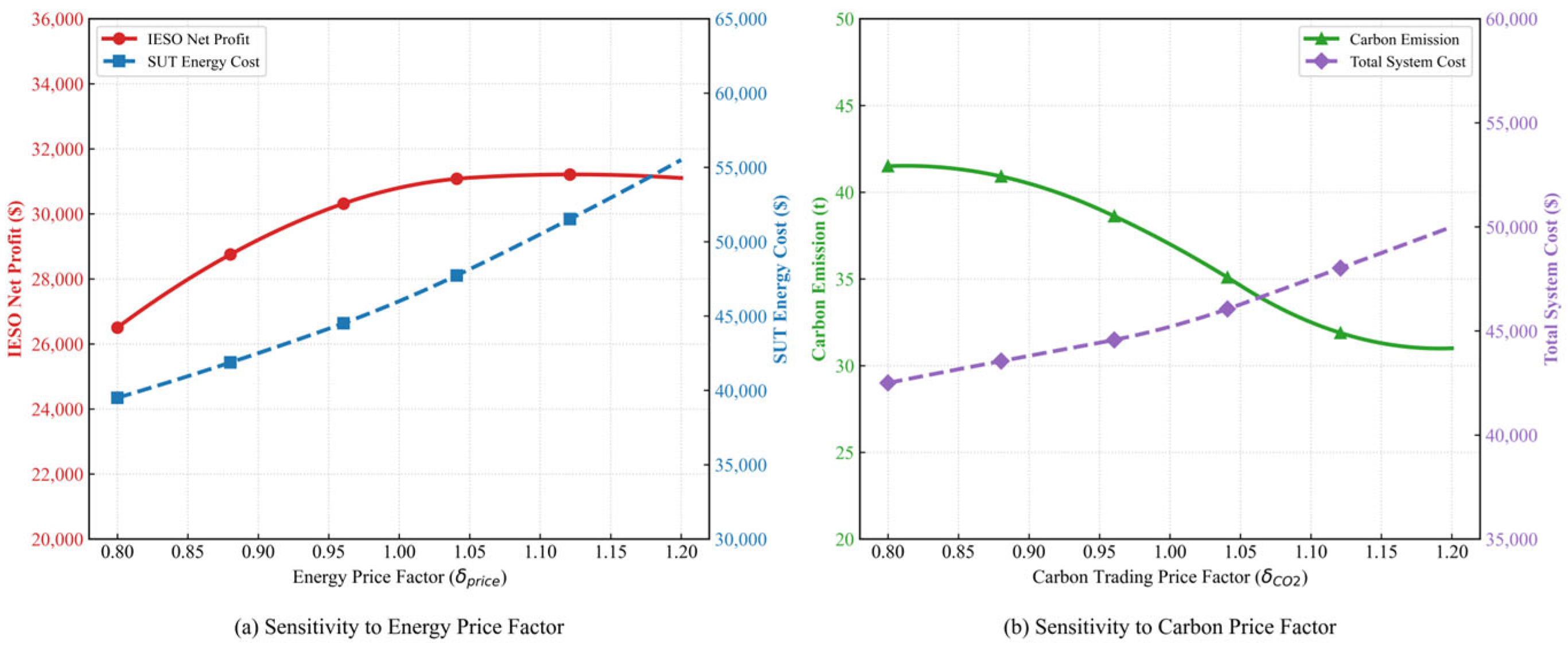
5.5. Robustness and Sensitivity Analysis Under Fluctuating Environments
6. Conclusions
- (1)
- The dynamic transmission law of carbon costs in a multi-agent game is revealed. This research moves beyond traditional centralized models to demonstrate how the ladder-type carbon trading scheme transmits cost signals from the IESO’s pricing leverage to both the supply and demand sides in real time. This mechanism induces game subjects to change their original operating inertia, providing a new perspective on the role of carbon markets in a multi-energy coupling environment.
- (2)
- A low-carbon coupling dispatch strategy based on refined P2G modeling is formulated. By introducing a two-stage P2G process integrated with ladder-type carbon trading, this work identifies P2G as a strategic “buffer” that regulates the pricing elasticity of the entire system. This refined approach uncovers the non-linear relationship between conversion efficiency and economic returns, achieving a 10.7% improvement in total cost efficiency compared to traditional fixed-price mechanisms.
- (3)
- A hybrid GA-CPLEX optimization framework is designed and validated to balance computational efficiency and solution quality. By strategically partitioning the global pricing search from deterministic linear programming, the framework effectively avoids local optima and handles the non-smooth “kinks” of carbon signals with a 99% success rate. Sensitivity analysis confirms the model’s resilience, maintaining stable equilibrium points.
Author Contributions
Funding
Data Availability Statement
Conflicts of Interest
Abbreviations
| IES | Integrated energy system |
| DIESS | Directory of open access journals |
| IESO | Integrated energy system operator |
| SUT | Smart user terminal |
| IDR | Integrated Demand Response |
| P2G | Power-to-Gas |
| MT | Micro Turbine |
| HRSG | Heat Recovery Steam Generator |
| GB | Gas Fired Boiler |
| EB | Electric Boiler |
| EC | Electric Chiller |
| AC | Absorption Chiller |
| WT | Wind Turbine |
| PV | Photovoltaic |
| EES | Electric Energy Storage |
| HES | Heat Energy Storage |
| EH | Energy Hub |
| LHV | Lower Heating Value |
| SOC | State of Charge |
| GA | Genetic Algorithm |
| PSO | Particle Swarm Optimization |
| ADMM | Alternating Direction Method of Multipliers |
| KKT | Karush-Kuhn-Tucker |
Nomenclature
| Indices and sets | |
| Symbol | Definition |
| i | Index for coupling devices |
| m, M | Index and total number of energy types |
| n, N | Index and total number of energy forms |
| t, T | Index and total number of time periods in scheduling cycle |
| Parameters | |
| Symbol | Definition |
| Upper limit of average selling energy price | |
| Price of IESO purchasing energy m from DIESS at time t | |
| Price of IESO purchasing energy m from upper-level energy network at time t | |
| Price of IESO selling energy m to upper-level energy network at time t | |
| Unit penalty cost for energy m | |
| Price of IESO selling energy m to SUT at time t | |
| Time interval | |
| Fuel cost coefficients of GB | |
| Fuel cost coefficients of MT | |
| Energy conversion efficiency of coupling device i for energy n | |
| Upper and lower limits of GB thermal power | |
| Upper and lower limits of input power for coupling device i | |
| Upper and lower limits of output power for coupling device i | |
| Upper and lower limits of MT electrical power | |
| Charging and discharging efficiency of energy storage device n | |
| Upper and lower limits of charging power for energy storage device n | |
| Upper and lower limits of discharging power for energy storage device n | |
| Upper and lower limits of capacity for energy storage device n | |
| Conversion efficiency of P2G equipment | |
| Lower heating value of gas source | |
| Molar mass of CO2 | |
| Output volume of methane | |
| Molar volume of methane | |
| Carbon emission coefficients of GB | |
| Carbon emission coefficients of MT | |
| Price growth rate of ladder-type carbon trading | |
| Carbon emission quotas of MT and GB | |
| Interval length of ladder-type carbon trading | |
| Benchmark price of ladder-type carbon trading | |
| Baseline load of energy n at time t | |
| Curtailable load ratio of energy n | |
| Transferable load ratio of energy n | |
| User preference coefficients for energy n | |
| Curtailment compensation coefficient of energy n | |
| Variables | |
| Symbol | Definition |
| Energy purchasing cost of energy m at time t | |
| Energy interaction cost of energy m at time t | |
| Penalty cost of energy m at time t | |
| Energy selling revenue of energy m at time t | |
| Total revenue of IESO | |
| Carbon trading cost of DIESS | |
| Energy supply cost of energy m at time t | |
| Fuel cost at time t | |
| Total revenue of DIESS | |
| Thermal power output of GB at time t | |
| Input power of energy n for coupling device i at time t | |
| Output power of energy n for coupling device i at time t | |
| Electrical power output of MT at time t | |
| Charging status indicator of energy storage device n at time t | |
| Discharging status indicator of energy storage device n at time t | |
| Charging power of energy storage device n at time t | |
| Discharging power of energy storage device n at time t | |
| State of charge of energy storage device n at time t | |
| Carbon emissions absorbed by P2G equipment | |
| Total carbon emission quota | |
| Carbon trading volume | |
| Actual carbon emissions of MT and GB | |
| Consumer surplus of SUT | |
| Load demand of energy n at time t | |
| Purchasing power of energy m at time t | |
| Curtailable load of energy n at time t | |
| Transferable load of energy n at time t | |
| Utility function of energy n at time t | |
References
- Yang, M.; Guo, Y.; Fan, F. Ultra-Short-Term Prediction of Wind Farm Cluster Power Based on Embedded Graph Structure Learning with Spatiotemporal Information Gain. IEEE Trans. Sustain. Energy 2025, 16, 308–322. [Google Scholar] [CrossRef]
- Yang, M.; Jiang, Y.; Xu, C.; Wang, B.; Wang, Z.; Su, X. Day-ahead wind farm cluster power prediction based on trend categorization and spatial information integration model. Appl. Energy 2025, 388, 125580. [Google Scholar] [CrossRef]
- Yang, M.; Shen, X.; Huang, D.; Su, X. Fluctuation Classification and Feature Factor Extraction to Forecast Very Short-Term Photovoltaic Output Powers. CSEE J. Power Energy Syst. 2025, 11, 661–670. [Google Scholar] [CrossRef]
- Yang, M.; Wang, K.; Su, X.; Ma, M.; Wu, G.; Huang, D. Short-term photovoltaic output probability prediction method considering the spatio-temporal-condition dependence of prediction error. CSEE J. Power Energy Syst. 2023; Early Access. [Google Scholar] [CrossRef]
- Dong, Z.; Zhao, J.; Wen, F.; Xue, Y. From Smart Grid to Energy Internet: Basic Concept and Research Framework. Autom. Electr. Power Syst. 2023, 47, 679–690. [Google Scholar]
- Wang, C.; Lv, C.; Li, P.; Li, S.; Zhao, K. Multiple Time-scale Optimal Scheduling of Community Integrated Energy System Based on Model Predictive Control. Proc. CSEE 2019, 39, 6791–6803+7093. [Google Scholar]
- Pan, H.; Gao, H.; Yang, Y.; Ma, W.; Zhao, Y.; Liu, J. Multi-type Retail Packages Design and Multi-level Market Power Purchase Strategy for Electricity Retailers Based on Master-slave Game. Proc. CSEE 2022, 42, 4785–4800. [Google Scholar]
- Leng, R.; Li, Z.; Xu, Y. Two-stage Stochastic Programming for Coordinated Operation of Distributed Energy Resources in Unbalanced Active Distribution Networks with Diverse Correlated Uncertainties. J. Mod. Power Syst. Clean Energy 2023, 11, 120–131. [Google Scholar] [CrossRef]
- Ju, L.; Tan, Z.; Li, H.; Tan, Q.; Yu, X.; Song, X. Multiobjective operation optimization and evaluation model for CCHP and renewable energy based hybrid energy system driven by distributed energy resources in China. Energy 2016, 111, 322–340. [Google Scholar] [CrossRef]
- Yang, X.; Leng, Z.; Xu, S.; Yang, C.; Yang, L.; Liu, K.; Song, Y.; Zhang, L. Multi-objective optimal scheduling for CCHP microgrids considering peak-load reduction by augmented ε-constraint method. Renew. Energy 2021, 172, 408–423. [Google Scholar]
- Zhou, X.; Ai, Q. Distributed economic and environmental dispatch in two kinds of CCHP microgrid clusters. Int. J. Electr. Power Energy Syst. 2019, 112, 109–126. [Google Scholar] [CrossRef]
- Li, K.; Ye, N.; Li, S.; Wang, H.; Zhang, C. Distributed collaborative operation strategies in multi-agent integrated energy system considering integrated demand response based on game theory. Energy 2023, 273, 127137. [Google Scholar] [CrossRef]
- Tan, J.; Li, Y.; Zhang, X.; Pan, W.; Ruan, W. Operation of a commercial district integrated energy system considering dynamic integrated demand response: A Stackelberg game approach. Energy 2023, 274, 126888. [Google Scholar] [CrossRef]
- Li, S.; Zhang, L.; Nie, L.; Wang, J. Trading strategy and benefit optimization of load aggregators in integrated energy systems considering integrated demand response: A hierarchical Stackelberg game. Energy 2022, 249, 123678. [Google Scholar] [CrossRef]
- Zhang, G.; Niu, Y.; Xie, T.; Zhang, K. Multi-level distributed demand response study for a multi-park integrated energy system. Energy Rep. 2023, 9, 2676–2689. [Google Scholar] [CrossRef]
- Li, Y.; Wang, B.; Yang, Z.; Li, J.; Chen, C. Hierarchical stochastic scheduling of multi-community integrated energy systems in uncertain environments via Stackelberg game. Appl. Energy 2022, 308, 118392. [Google Scholar] [CrossRef]
- Wu, Q.; Xie, Z.; Li, Q.; Ren, H.; Yang, Y. Economic optimization method of multi-stakeholder in a multi-microgrid system based on Stackelberg game theory. Energy Rep. 2022, 8, 344–351. [Google Scholar]
- Liu, X.; Ji, Z.; Sun, W.; He, Q. Robust game-theoretic optimization for energy management in community-based energy system. Electr. Power Syst. Res. 2023, 214, 108939. [Google Scholar]
- Hu, Y.; Zhang, M.; Wang, K.; Wang, D. Optimization of orderly charging strategy of electric vehicle based on improved alternating direction method of multipliers. J. Energy Storage 2022, 55, 105483. [Google Scholar] [CrossRef]
- Zhang, N.; Yang, D.; Zhang, H.; Luo, Y. Distributed control strategy of DC microgrid based on consistency theory. Energy Rep. 2022, 8, 739–750. [Google Scholar] [CrossRef]
- Cai, Y.; Lu, Z.; Pan, Y.; He, L.; Guo, X.; Zhang, J. Optimal scheduling of a hybrid AC/DC multi-energy microgrid considering uncertainties and Stackelberg game-based integrated demand response. Int. J. Electr. Power Energy Syst. 2022, 142, 108341. [Google Scholar]
- Feng, C.; Li, Z.; Shahidehpour, M.; Wen, F.; Li, Q. Stackelberg game based transactive pricing for optimal demand response in power distribution systems. Int. J. Electr. Power Energy Syst. 2020, 118, 105764. [Google Scholar] [CrossRef]
- Zhang, Y.; Zhao, H.; Li, B.; Wang, X. Research on dynamic pricing and operation optimization strategy of integrated energy system based on Stackelberg game. Int. J. Electr. Power Energy Syst. 2022, 143, 108446. [Google Scholar] [CrossRef]
- Wei, W.; Chen, Y.; Liu, F.; Mei, S.W.; Tian, F.; Zhang, X. Stackelberg game Based Retailer Pricing Scheme and EV Charging Management in Smart Residential Area. Power Syst. Technol. 2015, 39, 939–945. [Google Scholar]
- Zhang, H.; Zhang, S.; Cheng, H.; Zhang, X.; Gu, Q. A State-of-the-Art Review on Stackelberg game and Its Applications in Power Market. Trans. China Electrotech. Soc. 2022, 37, 3250–3262. [Google Scholar]
- Yang, S.; Tan, Z.; Zhou, J.; Xue, F.; Gao, H.; Lin, H.; Zhou, F.A. A two-level game optimal dispatching model for the park integrated energy system considering Stackelberg and cooperative games. Int. J. Electr. Power Energy Syst. 2021, 130, 106959. [Google Scholar] [CrossRef]
- Zhang, P.; Zhang, B.; Yin, J.; Shi, J. County-Level Distributed PV Day-Ahead Power Prediction Based on Grey Correlation Analysis and Transformer-GCAN Model. IEEE Trans. Sustain. Energy 2026, 17, 709–717. [Google Scholar]
- Jia, L.; Pang, X.; Wang, G.; Zhong, Y. A Day-Ahead Wind Power Forecasting Method Based on Physical Limitation Characteristics and Wind Speed Trend Clustering. In Proceedings of the 2025 6th International Conference on Electrical Technology and Automatic Control (ICETAC), Nanjing, China, 20–22 June 2025; pp. 161–164. [Google Scholar]
- Sun, H.; Sun, X.; Kou, L.; Zhang, B.; Zhu, X. Optimal scheduling of park-level integrated energy system considering ladder-type carbon trading mechanism and flexible load. Energy Rep. 2023, 9, 3417–3430. [Google Scholar] [CrossRef]
- Wang, L.; Dong, H.; Lin, J.; Zeng, M. Multi-objective optimal scheduling model with IGDT method of integrated energy system considering ladder-type carbon trading mechanism. Int. J. Electr. Power Energy Syst. 2022, 143, 108386. [Google Scholar]
- Zhang, X.; Liu, X.; Zhong, J. Integrated Energy System Planning Considering a Reward and Punishment Ladder-type Carbon Trading and Electric-thermal Transfer Load Uncertainty. Proc. CSEE 2020, 40, 6132–6142. [Google Scholar]
- Wu, Q.; Li, C. Modeling and operation optimization of hydrogen-based integrated energy system with refined power-to-gas and carbon-capture-storage technologies under carbon trading. Energy 2023, 270, 126832. [Google Scholar] [CrossRef]





| Multi-Agent Stackelberg Game | Ladder-Type Carbon Trading | Two-Stage Refined P2G | Handling of Non-Smooth “Kinks” | Behavioral Coupling Analysis | |
|---|---|---|---|---|---|
| [16,17,19,20] | Yes | Yes | Partial | No | No |
| [29,30,31] | No | Yes | No | No | No |
| [32] | No | No | Yes | No | No |
| body of the work | Yes | Yes | Yes | Yes | Yes |
| Parameter | Value |
|---|---|
| Population Size () | 50 |
| Max Generations () | 200 |
| Crossover/Mutation Rate | 0.8/0.05 |
| Stopping Criteria |
| Methodology | Avg. Total Cost ($) | Comp. Time (s) | Iterations to Converge | Success Rate (%) |
|---|---|---|---|---|
| GA–CPLEX | 43,050.2 | 145.6 | 82 | 99% |
| PSO–CPLEX | 44,720.5 | 112.4 | 126 | 94% |
| KKT-based | 48,150.8 | 42.5 | \ | 32% |
| ADMM | 45,980.3 | 288.7 | 450 | 68% |
| Scenario | Utility Function ($) | Energy Purchase Cost ($) | Consumer Surplus ($) | |
|---|---|---|---|---|
| Before IDR | Scenario 2 | 37,206 | 27,236 | 9970 |
| Scenario 3 | 37,206 | 26,726 | 10,480 | |
| After IDR | Scenario 2 | 38,085 | 24,323 | 13,762 |
| Scenario 3 | 38,011 | 23,505 | 14,506 |
| Scenario | Energy Sales Revenue ($) | Energy Purchase Cost ($) | Energy Interaction Gains ($) | Penalty Cost ($) | Revenue ($) |
|---|---|---|---|---|---|
| Scenario 2 | 28,454.85 | 16,951.07 | 4132.36 | 459.76 | 11,044.02 |
| Scenario 3 | 27,787.63 | 18,923.85 | 4282.65 | 386.44 | 8477.34 |
| Scenario | Energy Sales Revenue ($) | Energy Supply Cost ($) | Carbon Footprints (kg) | P2G Carbon Footprint Reductions (kg) | Total Revenue ($) |
|---|---|---|---|---|---|
| Scenario 2 | 16,780.00 | 5396.49 | 26,851.16 | 128.17 | 10,525.83 |
| Scenario 3 | 18,768.55 | 5489.27 | 27,887.24 | 106.44 | 12,073.09 |
| Scenario | Effectiveness Function ($) | Energy Purchase Cost ($) | Consumer Surplus ($) | Total IDR Percentage (%) | Total Affiliate Revenue ($) |
|---|---|---|---|---|---|
| Scenario 2 | 38,084.88 | 24,322.50 | 13,762.37 | 10.12 | 35,332.22 |
| Scenario 3 | 38,010.96 | 23,505.03 | 14,505.93 | 10.32 | 35,056.36 |
| Scenario | Equivalent Output of MT (kW·h) | Equivalent Output of GB (kW·h) | Carbon Footprints (kg) | Total Amount of Energy Sold by DIESS (kW·h) | Total Revenue of DIESS ($) | Total Revenue of IESO ($) | Consumer Surplus of SUT ($) | Total Affiliate Revenue ($) | |
|---|---|---|---|---|---|---|---|---|---|
| Pricing strategy for scenario 2 | Scenario 2 | 17,988.29 | 7200.00 | 27,595.24 | 52,842.68 | 10,525.83 | 11,044.03 | 13,762 | 35,331.86 |
| Scenario 3 | 18,349.90 | 7200.00 | 26,851.16 | 53,118.38 | 12,016.64 | 8958.05 | 13,580 | 34,554.69 | |
| Pricing strategy for scenario 3 | Scenario 2 | 19,296.72 | 7152.33 | 30,044.41 | 53,830.01 | 12,483.03 | 8477.40 | 13,343 | 34,303.43 |
| Scenario 3 | 18,297.57 | 7200.00 | 27,887.24 | 52,910.42 | 12,073.09 | 8833.74 | 14,505.93 | 35,412.76 |
Disclaimer/Publisher’s Note: The statements, opinions and data contained in all publications are solely those of the individual author(s) and contributor(s) and not of MDPI and/or the editor(s). MDPI and/or the editor(s) disclaim responsibility for any injury to people or property resulting from any ideas, methods, instructions or products referred to in the content. |
© 2026 by the authors. Licensee MDPI, Basel, Switzerland. This article is an open access article distributed under the terms and conditions of the Creative Commons Attribution (CC BY) license.
Share and Cite
Yang, M.; Tang, W.; Li, J.; Sun, P. Distributed Integrated Energy System Optimization Method Based on Stackelberg Game. Electronics 2026, 15, 721. https://doi.org/10.3390/electronics15040721
Yang M, Tang W, Li J, Sun P. Distributed Integrated Energy System Optimization Method Based on Stackelberg Game. Electronics. 2026; 15(4):721. https://doi.org/10.3390/electronics15040721
Chicago/Turabian StyleYang, Mao, Weining Tang, Jianbin Li, and Peng Sun. 2026. "Distributed Integrated Energy System Optimization Method Based on Stackelberg Game" Electronics 15, no. 4: 721. https://doi.org/10.3390/electronics15040721
APA StyleYang, M., Tang, W., Li, J., & Sun, P. (2026). Distributed Integrated Energy System Optimization Method Based on Stackelberg Game. Electronics, 15(4), 721. https://doi.org/10.3390/electronics15040721