
Article

Channel Estimation for RIS-Assisted Multi-User mmWave MIMO Systems via Joint Correlation

1
School of Electronic Information, Central South University, Changsha 410075, China
2
School of Electronic Information and Communications, Huazhong University of Science and Technology, Wuhan 430074, China
*
Author to whom correspondence should be addressed.
Electronics 2026, 15(3), 594; https://doi.org/10.3390/electronics15030594
Submission received: 22 December 2025 / Revised: 27 January 2026 / Accepted: 28 January 2026 / Published: 29 January 2026

Abstract

Reconfigurable intelligent surface (RIS) demonstrates significant potential in millimeter-wave (mmWave) multiple-input multiple-output (MIMO) wireless communication systems. However, the introduction of RIS leads to a substantial number of parameters in the channel matrix, making channel estimation highly challenging. By exploiting the sparsity of mmWave channels, compressed sensing algorithms, such as the orthogonal matching pursuit (OMP) algorithm, can significantly reduce the pilot overhead. Nevertheless, traditional OMP algorithms typically require extensive prior knowledge about the number of effective paths, which is often difficult to obtain. To address this problem, we propose a novel multi-user joint correlation allocation (MUJCA) algorithm, which requires only minimal and easily measurable prior information. Our key idea is to divide the RIS coverage area into multiple sub-regions, each associated with a known number of scatterers, which is a pre-measured quantity, with users distributed within these sub-regions. Then, the MUJCA algorithm exploits joint correlation of multiple users to facilitate sparse channel recovery and transforms it back into the spatial channel. Simulation results show that the proposed MUJCA achieves higher channel estimation accuracy than existing benchmark algorithms.

1. Introduction

With the advancement of wireless communication technology, the number of communication devices and mobile data traffic continue to increase, while low-frequency band spectrum resources have become saturated. Millimeter-wave (mmWave) has garnered widespread attention in research on the 6th generation (6G) mobile communication technology [1,2,3,4]. Operating in the frequency range of 30 to 300 GHz, mmWave providing broader spectrum resources that enable higher data transmission rates [5]. However, mmWave suffers from significant path loss and weak penetration capability, experiencing notable attenuation during propagation [6,7]. Multiple-input multiple-output (MIMO) technology, which deploys multiple antennas at both the transmitter and receiver, has significantly enhanced the capacity and spectral efficiency of wireless communication systems [8]. Not limited to communications, where it serves as a core technology for 5G and future 6G systems by enabling high-speed data transmission through spatial multiplexing and diversity techniques, MIMO also demonstrates high-precision target detection and parameter estimation capabilities in radar applications [9]. MIMO systems integrated with reconfigurable intelligent surface (RIS) and mmWave communications are now driving the advancement of wireless networks towards higher performance and broader coverage, showcasing substantial application potential [10]. RIS is a planar structure composed of numerous low-cost, individually controllable passive reflective elements, and it demonstrates great application prospects in mmWave MIMO systems [11,12]. By adjusting the phase and amplitude of these elements, it enables optimization of wireless signal propagation paths from base station (BS) to user equipment (UE), thereby enhancing wireless coverage and transmission performance [13,14]. In some studies, the integration of RIS with rate-splitting multiple access (RSMA) has been shown to not only enhance spectral efficiency, support massive connectivity, and achieve ultra-reliable low-latency communications, but also effectively reduce eavesdropping risks, thereby significantly improving data transmission secrecy [15]. However, RIS poses the following challenges for channel estimation [16,17]. The passive RIS lacks active transceivers, forcing cascaded channel estimation at the BS or UE. Moreover, the massive number of reflective elements results in substantial pilot overhead.
To address the substantial pilot overhead incurred by introducing RIS, the sparsity of mmWave channels in the angular-domain can be leveraged to formulate the channel estimation problem as a sparse signal recovery problem, that can be solved using compressed sensing algorithms [18]. Ref. [18] employed the properties of Kronecker product and Khatri-Rao product to transform the estimation of channel matrices into a compressed sensing problem, which was then solved using the orthogonal matching pursuit (OMP) algorithm. To further reduce pilot overhead, researchers have conducted studies on the structural sparsity characteristics of angular-domain cascaded channels. Ref. [19] pointed out that since the channel between BS and RIS is common to all users, the angular-domain cascaded channels exhibit row-block sparsity, and accordingly proposed an OMP algorithm based on row-structured sparsity. Ref. [20] pointed out that different users share partially common RIS-UE channels, introduced column sparsity based on row sparsity, and proposed a dual-structured sparsity OMP (DS-OMP) algorithm. Ref. [21] pointed out that the angular-domain channel matrices of different users share common non-zero rows and common column index offsets, and that the non-zero rows of different users’ angular-domain channel matrices exhibit common non-zero element column indices after compensating for column index offsets. Based on this, the three-step OMP (TS-OMP) algorithm was proposed. Ref. [22] utilizes partially active RIS elements to acquire multi-path channel information at specific locations and constructs a channel map. By leveraging the channel map to optimize RIS reflection coefficients, this channel map based channel estimation (CMCE) method enhances the energy of the received signal and maintains high channel estimation accuracy even with low pilot overhead.
However, the algorithms discussed above necessitate extensive prior knowledge about the number of effective paths. Each scatterer provides one effective path. In practical scenarios, acquiring the number of effective paths between each individual user and the RIS is challenging, as it is impractical to measure in real time the number of scatterers between each user and the RIS, which would constitute a prohibitively large amount of prior knowledge. However, the RIS is typically deployed at a fixed position to serve a specific coverage area, where the scattering environment is static and can be measured in advance. We propose a model in which the RIS coverage area is divided into multiple sub-regions, each associated with a known number of scatterers, and users are distributed across these sub-regions. Additionally, we propose the measurement method for the number of scatterers in each sub-region. Based on this model, we introduce a novel method to jointly estimate the cascaded channels of all users by exploiting the multi-user joint correlation.
The main contributions of this paper are as follows:
1.
We propose a novel system model. Leveraging the typical fixed deployment of the RIS, we model its coverage area as being divided into multiple sub-regions, each with a pre-measurable and known number of scatterers, while users are distributed across these sub-regions. This model shifts the requirement from extensive user-specific information to minimal, static, scatterer-dependent prior knowledge, which is feasible to acquire.
2.
We propose the measurement method for the number of scatterers in each sub-region.
3.
We propose an algorithm to estimate the non-zero row support of the angular-domain sparse channel matrix by screening the high-energy vectors corresponding to this row support within the received signal matrix.
4.
We propose a multi-user joint correlation allocation (MUJCA) algorithm. This algorithm leverages the multi-user joint correlation to jointly estimate the non-zero column support for all users, and then recovers the sparse angular-domain cascaded channels, which are finally transformed back to the spatial domain.
Notation: Upper-case and lower-case boldface letters A and a denote matrices and vectors, respectively. a T denotes the transpose of vector a . A T , A H and A denote the transpose, conjugate transpose and pseudo-inverse of A , respectively. diag a denotes the diagonal matrix with elements of a on its diagonal. · F denotes the Frobenius norm. ⊗ denotes the Kronecker product. I K denotes the K-order identity matrix.

2. System Model and Compressed Sensing Problem Formulation

2.1. System Model

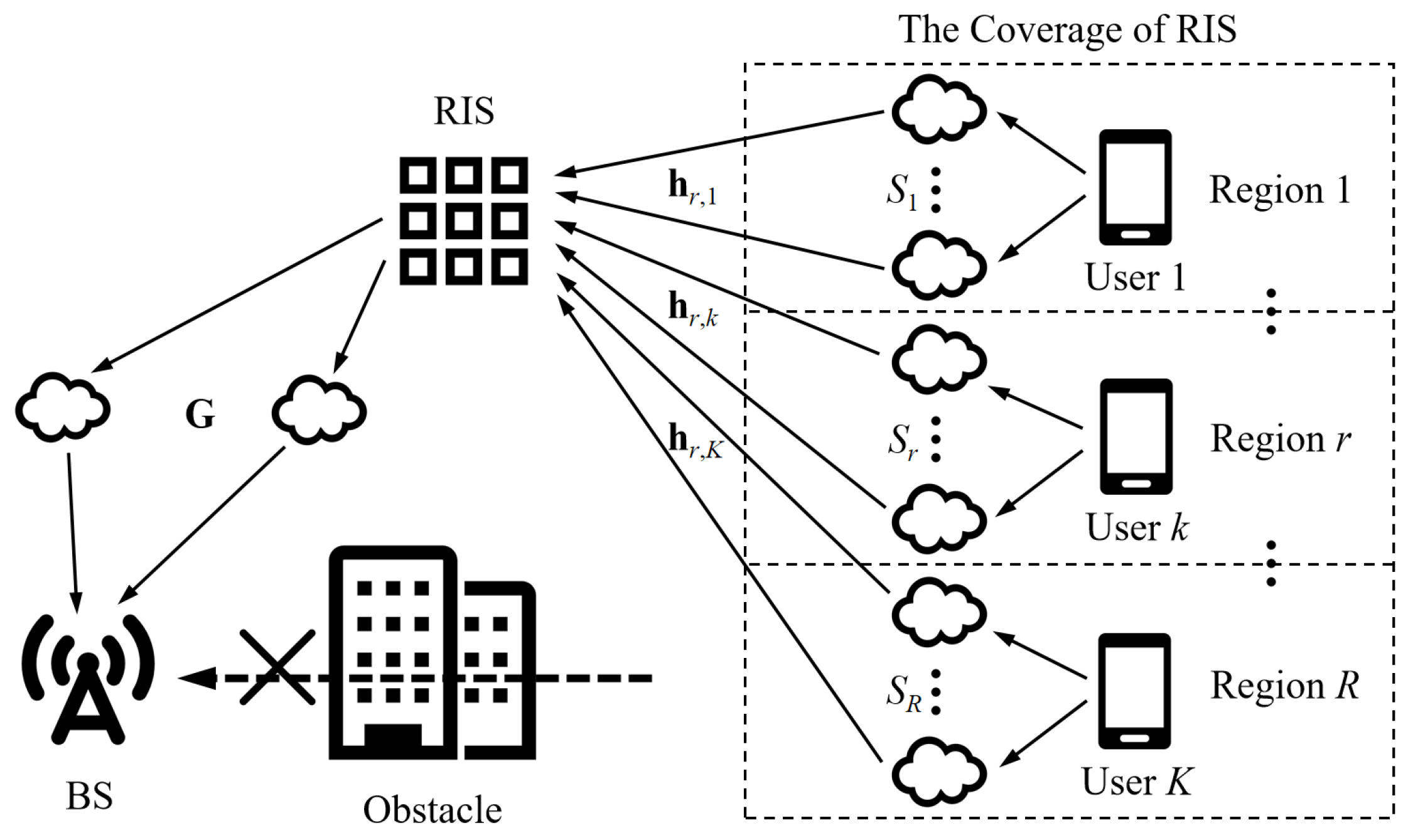
As shown in Figure 1, we consider a communication system where a BS communicates with multiple users via a RIS. In this system, the BS is equipped with M M = M 1 × M 2 antennas, the RIS is equipped with N N = N 1 × N 2 passive reflecting elements, and each of the K users is equipped with a single antenna. In this paper, it is assumed that the direct link between the BS and each user is blocked, and the BS and users communicate exclusively through the cascaded channel. We divide the coverage area of the RIS into R sub-regions, where the number of scatterers in the r-th sub-region is denoted by S r . K users are distributed across these R sub-regions, but which specific sub-region each user belongs to is unknown. We model the system using the Saleh–Valenzuela (S–V) channel model. The channel from the RIS to the BS is denoted as G , and the channel from the k-th user to the RIS is denoted as h r , k . The expressions for G and h r , k are presented respectively as follows [20,23,24]:
G = M N L G l 1 = 1 L G α l 1 G b θ l 1 G r , ϕ l 1 G r a θ l 1 G t , ϕ l 1 G t T ,
h r , k = N L r , k l 2 = 1 L r , k α l 2 r , k a θ l 2 r , k , ϕ l 2 r , k ,
where L G denotes the number of paths from the RIS to the BS. α l 1 G , θ l 1 G r ϕ l 1 G r , θ l 1 G t ϕ l 1 G t denote the path loss, the azimuth (elevation) angle of arrival (AoA) at the BS side, and the azimuth (elevation) angle of departure (AoD) at the RIS side for the l 1 -th path, respectively. b θ , ϕ and a θ , ϕ are denoted as the steering vectors of the BS array and the RIS array, respectively. L r , k denotes the number of paths from the k-th user to the RIS, α l 2 r , k and θ l 2 r , k ϕ l 2 r , k denote the path loss and the azimuth (elevation) angle of arrival (AoA) at the RIS side for the l 2 -th path, respectively. In this paper, both the RIS and BS employ uniform planar arrays. The steering vector a θ , ϕ at the RIS side can be expressed as:
a θ , ϕ = 1 N e j 2 π d sin θ cos ϕ n 1 / λ e j 2 π d sin ϕ n 2 / λ ,
where n 1 = 0 , 1 , , N 1 1 , n 2 = 0 , 1 , , N 2 1 , λ denotes the carrier wavelength, and d denotes the antenna spacing. We set d / λ = 1 / 2 for simplicity. The steering vector b θ , ϕ at the BS side follows the same principle.

2.2. Compressed Sensing Problem Formulation

In this paper, since the direct link is blocked, we only consider the estimation of the cascaded channel. We divide the channel estimation protocol into Q time slots. In each time slot, all users transmit known pilot symbols to the BS through the RIS using the orthogonal pilot transmission strategy for uplink channel estimation. Let y k , q C M × 1 denote the received signal at the BS from the k-th user in the q-th time slot. The signal y k , q can be expressed as:
y k , q = G diag θ q h r , k s k , q + w k , q ,
where s k , q denotes the pilot symbol transmitted by the k-th user. For convenience, we set s k , q = 1 . θ q C N × 1 denotes the reflecting coefficient vector at the RIS, which consists of the reflecting coefficients of all RIS reflecting elements. w k , q C M × 1 denotes the complex Gaussian white noise. Since diag θ q h r , k = diag h r , k θ q [25], we can express the above equation as:
y k , q = G diag h r , k θ q + w k , q .
The cascaded channel of the k-th user is denoted by H k C M × N , and the expression is given by:
H k = G diag h r , k .
Substituting (6) into (5), we get:
y k , q = H k θ q + w k , q .
After the pilot transmission over Q time slots, the received signal at the BS can be expressed as:
Y k = H k Θ + W k ,
where Y k C M × Q , Θ C N × Q , and  W k C M × Q contain the received signals, the reflecting coefficient vectors, and the noise over Q time slots, respectively.
H k can be decomposed into the sparse angular-domain cascaded channel H ˜ k C M × N as:
H k = U M H ˜ k U N T ,
where U M C M × M and U N C N × N denote the DFT dictionary matrices at the BS and RIS respectively. The column vectors of U M and U N denote the steering vectors at discrete angles for the BS and RIS respectively.
Then, substituting (9) into (8), we get:
Y k = U M H ˜ k U N T Θ + W k .
To formulate the above equation into the standard form of compressed sensing model, we left-multiply both sides by U M H and take the conjugate transpose:
U M H Y k H = U N T Θ H H ˜ k H + U M H W k H .
By reorganizing the above equation, we obtain the standard compressed sensing model:
Y ˜ k = Θ ˜ H ˜ k H + W ˜ k ,
where Y ˜ k = U M H Y k H C Q × M denotes the measurement matrix, Θ ˜ = U N T Θ H C Q × N denotes the sensing matrix, and  W ˜ k = U M H W k H C Q × M denotes the noise matrix.
Based on (12), by utilizing the known Y ˜ k and Θ ˜ matrices, the sparse solution of the angular-domain cascaded channel matrix H ˜ k H can be obtained through traditional compressed sensing algorithms such as the OMP algorithm.

3. Proposed Cascaded Channel Estimation Method

3.1. The Structure of Sparsity in Rows and Columns of the Angular-Domain Cascaded Channels

To develop a channel estimation method optimized for the system model in this paper, we need to analyze the structure of sparsity in rows and columns of the angular-domain cascaded channel matrix. From (9), we obtain:
H ˜ k = U M H H k U N H T .
Expanding H k in the above equation, we can get:
H ˜ k = M N L G L r , k l 1 = 1 L G l 2 = 1 L r , k α l 1 G α l 2 r , k U M H b θ l 1 G r , ϕ l 1 G r U N H a θ l 1 G t + θ l 2 r , k , ϕ l 1 G t + ϕ l 2 r , k T .
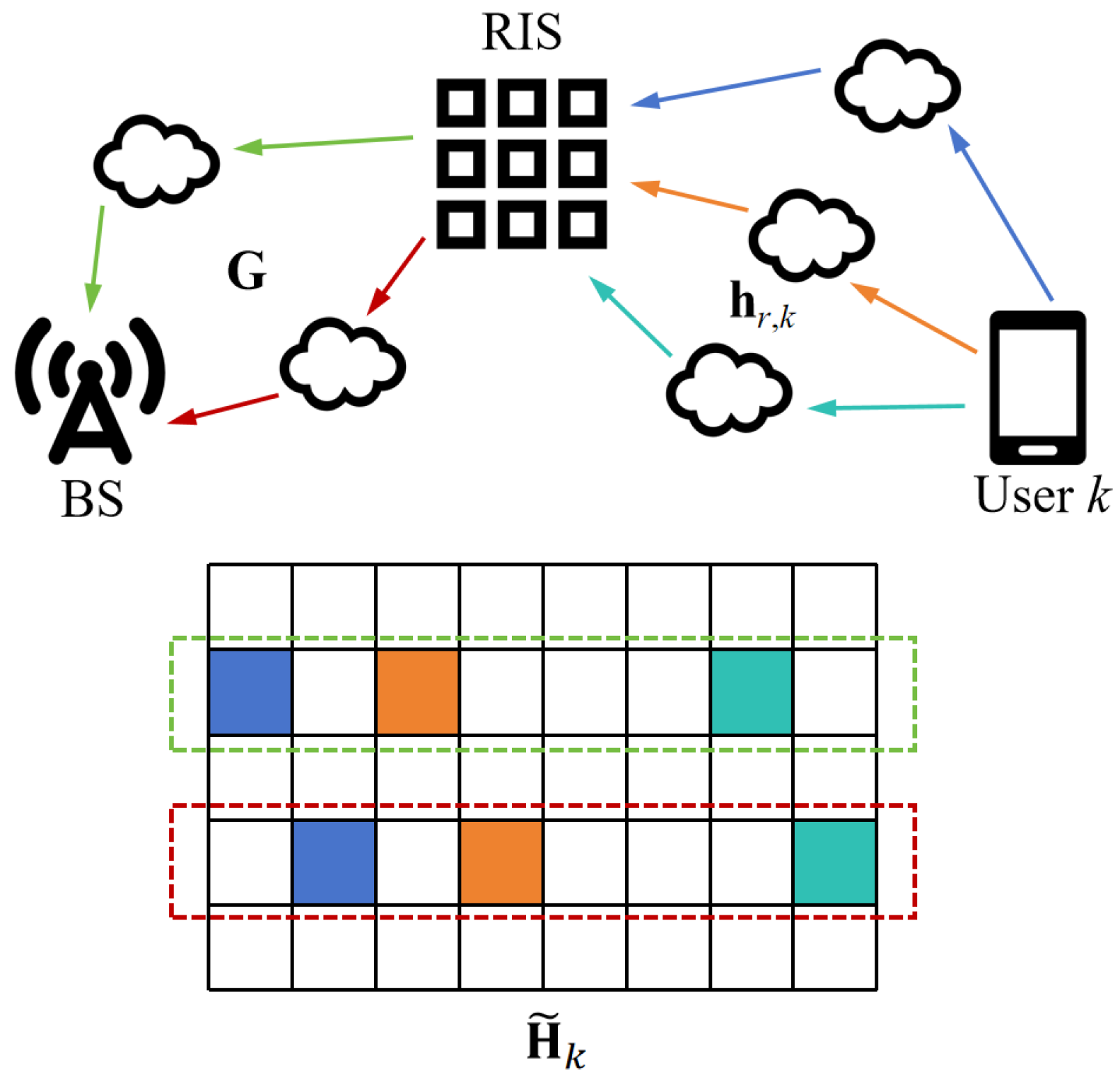
For the vector U M H b θ , ϕ , only the element at the position corresponding to the θ , ϕ angle is non-zero. The same applies to the vector U N H a θ , ϕ . Thus, each complete reflection path consisting of l 1 -path and l 2 -path can provide a non-zero element for H ˜ k , where the row of this non-zero element is related to θ l 1 G r , ϕ l 1 G r , and the column is related to θ l 1 G t + θ l 2 r , k , ϕ l 1 G t + ϕ l 2 r , k . Therefore, the non-zero elements in H ˜ k are concentrated in the rows corresponding to the L G l 1 -paths from the RIS to the BS and the columns corresponding to the L r , k l 2 -paths from the user to the RIS, as shown in Figure 2. These rows and columns are denoted as the non-zero row support and non-zero column support, respectively.

3.2. The Proposed Multi-User Joint Correlation Allocation Algorithm

Since the l 1 -paths from RIS to BS are shared by all users, the sparse channels H ˜ k for all users share the same non-zero row support. However, since the l 2 -paths are different, the non-zero column supports vary among users. However, for an individual user, the different non-zero rows possess an identical number of non-zero column elements, as shown in Figure 2. Moreover, since the specific sub-region of each user is unknown, the number of scatterers between each user and the RIS is also unknown. Therefore, the exact value of L r , k cannot be obtained, and we can only know that L r , k S 1 , , S R , which means the sparsity level of each user’s angular-domain cascaded channel is unknown.
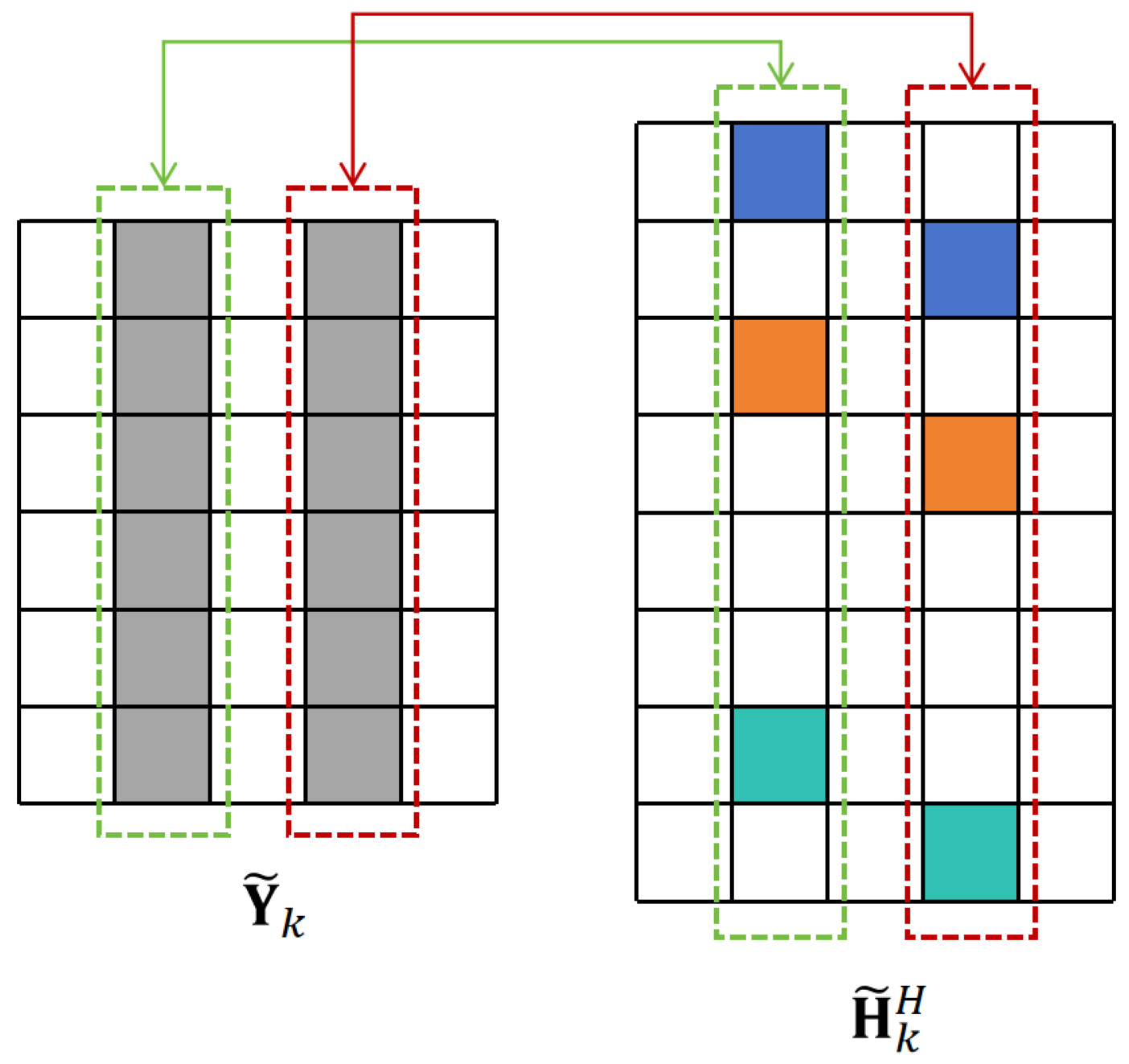
Based on (12), the non-zero row support of H ˜ k can be obtained by computing the largest L G columns in Y ˜ k , Figure 3 illustrates this relationship. Given that the value of L G is unknown, we propose Algorithm 1 to estimate the non-zero row support of H ˜ k . This is achieved by first calculating the energy of each column in the received signal matrix Y ˜ k for all users. The core idea is then to sort these columns in descending order of energy. Since the low-energy trailing portion, which is dominated by noise, is flat, we scan backward from the end to detect the point of a significant energy jump. Finally, the columns preceding this jump point are identified as corresponding to the L G   l 1 -paths from the RIS to the BS.
Algorithm 1: Common Row Support Estimation
  
  Input: Y ˜ k : k , M , K
  
  Output: Ω r , L G
  1
Initialization: Ω r = , ρ = 0 M × 1
  2
ρ m = k = 1 K Y ˜ k : , m F 2 , m = 1 , 2 , , M
  3
ρ s , n = sort ρ
  4
for  m = 1 , 2 , , M 1  do
  5
       δ = ρ s M m ρ s M m + 1 ρ s M m + 1
  6
      if  δ > δ t h  then
  7
             L G = M m
  8
            break
  9
      end if
10
end for
11
Ω r = maxindices ρ , L G
In the estimation of the non-zero column support of H ˜ k , we cannot get the specific number due to the unknown L r , k . Nevertheless, we can consider all users jointly. At the joint scale of all users, the total number of non-zero column elements in each non-zero row of all users should remain relatively constant. The allocation of these non-zero column elements to each user depends on their correlation strength.
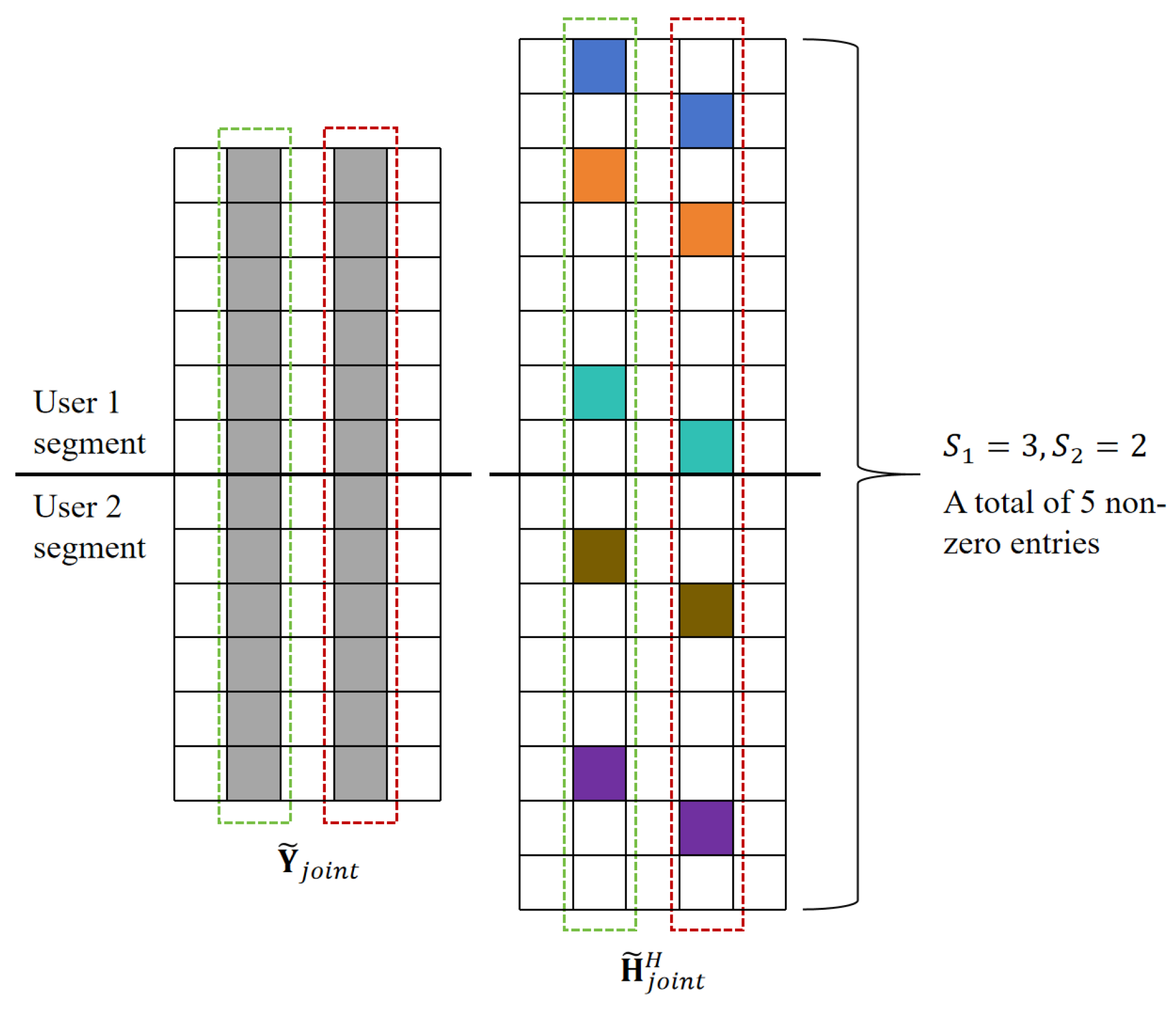
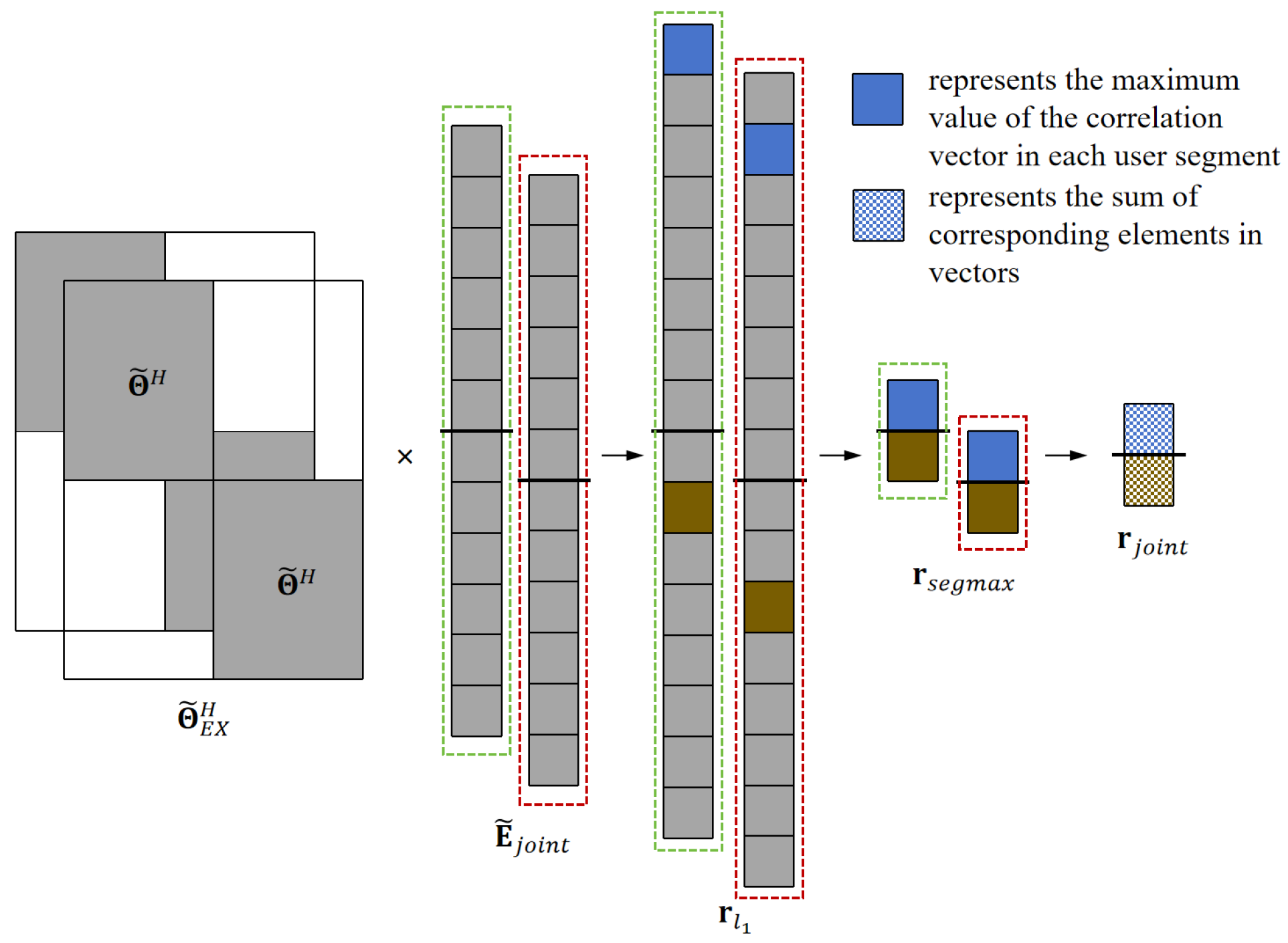
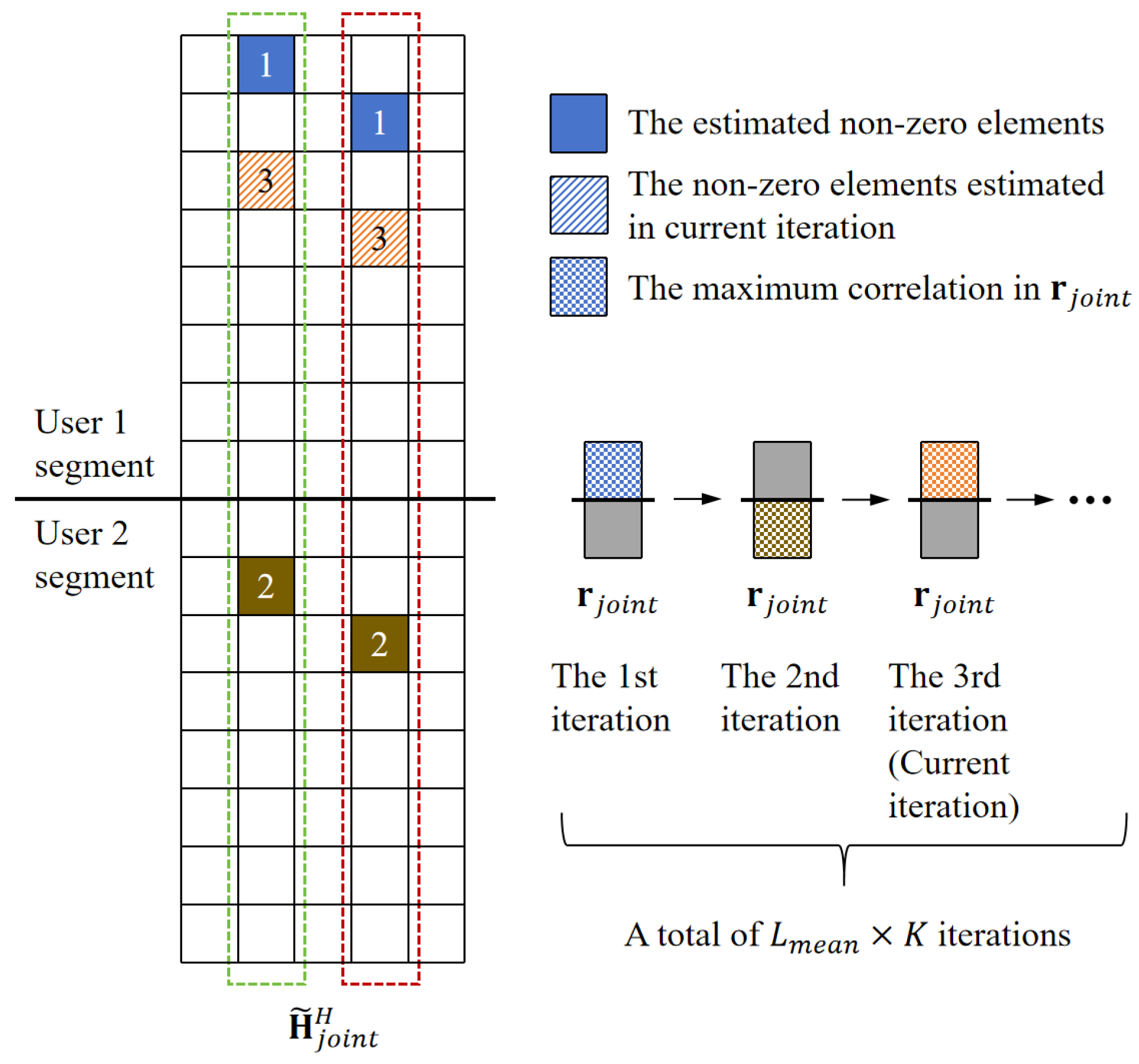
Specifically, since L r , k takes values from the set S 1 , , S R , let L m e a n denote the mean value of S 1 , , S R . We can consider that for each non-zero row in H ˜ k , the total number of non-zero column elements across all users is L m e a n × K , as shown in Figure 4. In each iteration, we compute the correlations between the corresponding residuals in the E ˜ j o i n t and the extended sensing matrix Θ ˜ E X , ultimately obtaining a joint correlation vector r j o i n t . The user segment to which the maximum correlation in the joint correlation vector belongs then determines which user is allocated a non-zero column element in the current iteration. Figure 5 illustrates the processing of the joint correlation. Through L m e a n × K iteration cycles, these L m e a n × K non-zero column elements are allocated to different users according to their correlation strengths, as shown in Figure 6.
Based on the above idea, we propose a multi-user joint correlation allocation (MUJCA) algorithm, as shown in Algorithm 2. The detailed description of the MUJCA algorithm is as follows:
Step 2 utilizes the Kronecker product to transform the sensing matrix Θ ˜ into a block-diagonal extended sensing matrix Θ ˜ E X to support multi-user joint processing.
Steps 3–6 construct the multi-user joint measurement vector. For each column index in Ω r , the corresponding columns from the measurement matrices Y ˜ k of all K users are vertically concatenated to form the multi-user joint measurement vector y ˜ j o i n t .
Step 7 initializes the residual matrix E ˜ j o i n t , each column of the E ˜ j o i n t matrix is the residual of each joint non-zero row.
Steps 8–26 estimate the non-zero column support. In each iteration cycle, one non-zero column element is estimated for each of all joint non-zero rows. To ensure the same number of non-zero column elements for all non-zero rows of individual user, the non-zero column elements estimated in each iteration cycle will be allocated to the same user segment of the joint non-zero rows. The detailed explanations of the specific steps are as follows:
Algorithm 2: Multi-User Joint Correlation Allocation Algorithm
   
 Input: Y ˜ k : k , Θ ˜ , Ω r , M , N , K , L G , L m e a n , Q
   
 Output: H ^ k , k
  1
Initialization: Ω c l 1 l 1 = 1 L G = , Y ˜ j o i n t = 0 Q K × L G , E ˜ j o i n t = 0 Q K × L G , H ˜ ^ k = 0 M × N : k
  2
Θ ˜ E X = I K Θ ˜
  3
for  l 1 = 1 , 2 , , L G   do
  4
        y ˜ j o i n t = y ˜ j o i n t ; Y ˜ k : , Ω r l 1 , k = 1 , 2 , , K
  5
        Y ˜ j o i n t : , l 1 = y ˜ j o i n t
  6
end for
  7
E ˜ j o i n t = Y ˜ j o i n t
  8
for  l 2 = 1 , 2 , , L m e a n × K   do
  9
       for  l 1 = 1 , 2 , , L G   do
10
               r l 1 = sqr abs Θ ˜ E X H E ˜ j o i n t : , l 1
11
               r s e g m a x k = getmax r l 1 , k 1 N + 1 , k N , k = 1 , 2 , , K
12
               r j o i n t = r j o i n t + r s e g m a x
13
       end for
14
        u = maxindex r j o i n t
15
       for  l 1 = 1 , 2 , , L G   do
16
               r s o r t e d , n = sort r l 1
17
               x = 1 , P = n x
18
              while  P < u 1 N + 1 or P > u N   do
19
                     x = x + 1 , P = n x
20
              end while
21
               Ω c l 1 = Ω c l 1 P
22
               h ˜ ^ j o i n t Ω c l 1 = Θ ˜ E X : , Ω c l 1 Y ˜ j o i n t : , l 1
23
               E ˜ j o i n t : , l 1 = Y ˜ j o i n t : , l 1 Θ ˜ E X h ˜ ^ j o i n t
24
               H ˜ ^ j o i n t : , l 1 = h ˜ ^ j o i n t
25
       end for
26
end for
27
for  l 1 = 1 , 2 , , L G   do
28
        H ˜ ^ t e m p = reshape H ˜ ^ j o i n t : , l 1 , N , K
29
        H ˜ ^ k H : , Ω r l 1 = H ˜ ^ t e m p : , k , k = 1 , 2 , , K
30
end for
31
H ^ k = U M H H ˜ ^ k U N , k
Steps 9–14 determine which user to allocate the non-zero column elements in the current iteration cycle. For each joint non-zero row, the correlation vector r l 1 is calculated between its corresponding residual in the E ˜ j o i n t and each atom in the Θ ˜ E X , where the correlation is denoted by inner product. Then, through Step 11, the maximum values within each user segment of r l 1 are selected to form a K-dimensional user segment maximum correlation vector r s e g m a x . The  r s e g m a x vectors of all joint non-zero rows are superimposed to obtain the multi-user joint correlation vector r j o i n t . Finally, the user with the maximum correlation in r j o i n t is selected as the target user for allocating the non-zero column elements in this iteration cycle.
Steps 15–25 estimate one non-zero column element for each non-zero row of the user determined in Steps 9–14. First, r l 1 is sorted in descending order, with its sorted index values stored in n . The first index value in n is initially selected. Steps 18–20 indicate that if this index value is not within the current selected user segment, the next index value in n is sequentially selected until an index value within the current user segment is found. This index value is then added to the non-zero column support of that joint non-zero row. Subsequently, for each joint non-zero row, based on the currently selected non-zero column support, the corresponding multi-user joint channel vector h ˜ ^ j o i n t is estimated using the Least Squares (LS) algorithm. Then, the residual matrix E ˜ j o i n t is updated.
When L m e a n × K iteration cycles are completed, Steps 27–30 process the multi-user joint channel H ˜ ^ j o i n t to recover the angular-domain cascaded channel estimation results for each individual user.
Finally, the angular-domain cascaded channel is converted back to the spatial channel through Step 31.
The custom functions used in the algorithms are described in Table 1.

3.3. Proposed Sub-Region Scatterer Measurement Method

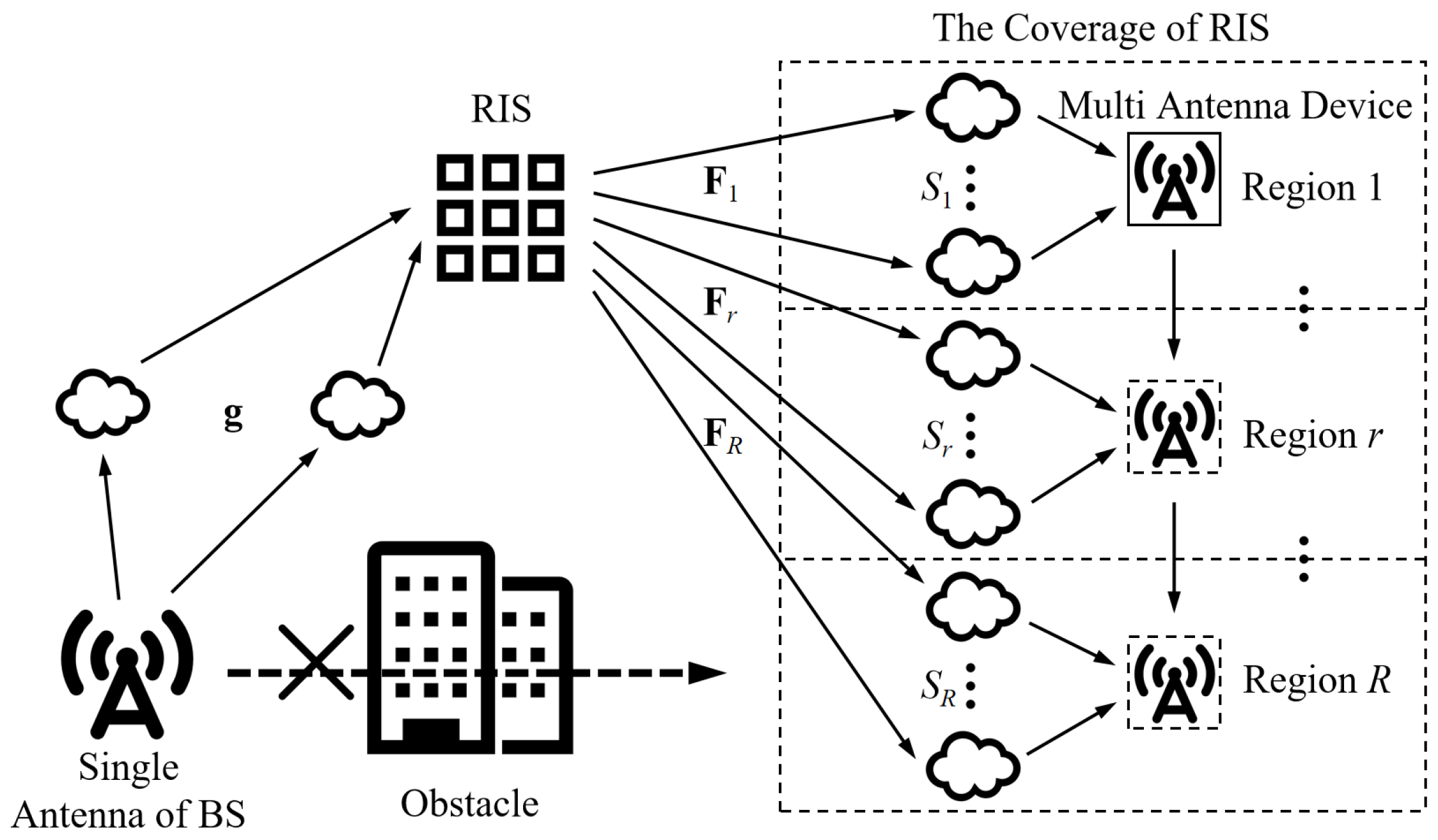
This section presents a method for measuring the number of scatterers in each sub-region. As illustrated in Figure 7, a downlink channel is considered where only a single antenna at the BS is activated for transmission, the RIS comprises N reflecting elements, and a receiving device equipped with Z Z = Z 1 × Z 2 antennas is deployed in the sub-region to receive the signal. The channel from the BS to the RIS is denoted by g , and the channel from the RIS to the r-th sub-region is denoted by F r . The expressions for g and F r are given below:
g = N L g l 1 = 1 L g α l 1 g a θ l 1 g , ϕ l 1 g ,
F r = Z N S r l 2 = 1 S r α l 2 F r c θ l 2 F r , r , ϕ l 2 F r , r a θ l 2 F r , t , ϕ l 2 F r , t T ,
where L g denotes the number of paths from the BS to the RIS. α l 1 g and θ l 1 g ϕ l 1 g denote the path loss and the azimuth (elevation) angle of arrival (AoA) at the RIS side for the l 1 -th path, respectively. S r is the number of scatterers in the r-th sub-region. Since each scatterer provides one effective path, we let S r denotes the number of paths from the RIS to the r-th sub-region. α l 2 F r , θ l 2 F r , r ϕ l 2 F r , r , θ l 2 F r , t ϕ l 2 F r , t denote the path loss, the azimuth (elevation) angle of arrival (AoA) at the receiving device side, and the azimuth (elevation) angle of departure (AoD) at the RIS side for the l 2 -th path, respectively. a θ , ϕ and c θ , ϕ are denoted as the steering vectors of the RIS array and the receiving device array, respectively. Both the RIS and receiving device employ uniform planar arrays.
The cascaded channel of the r-th sub-region is denoted by H r C Z × N , and the expression is given by:
H r = F r diag g .
H r can be decomposed into the sparse angular-domain cascaded channel H ˜ r C Z × N as:
H r = U Z H ˜ r U N T ,
where U Z C Z × Z and U N C N × N denote the DFT dictionary matrices at the receiving device and RIS respectively. The column vectors of U Z and U N denote the steering vectors at discrete angles for the receiving device and RIS respectively.
We consider the transmission of pilot symbols over Q time slots. Let y r , q C Z × 1 denote the received signal in the q-th time slot at the receiving device in the r-th sub-region. The signal y r , q can be expressed as:
y r , q = F r diag ( θ q ) g s r , q + w r , q = F r diag ( g ) θ q s r , q + w r , q ,
where s r , q denotes the pilot symbol received by the receiving device in the r-th sub-region. θ q C N × 1 denotes the reflecting coefficient vector at the RIS, which consists of the reflecting coefficients of all RIS reflecting elements. w r , q C Z × 1 denotes the complex Gaussian white noise.
For convenience, we set s r , q = 1 . Substituting (17) into (19), we get:
y r , q = H r θ q + w r , q .
After the pilot transmission over Q time slots, the received signal at the BS can be expressed as:
Y r = H r Θ + W r ,
where Y r C Z × Q , Θ C N × Q , and  W r C Z × Q contain the received signals, the reflecting coefficient vectors, and the noise over Q time slots, respectively.
Then substituting (18) into (21), we get:
Y r = U Z H ˜ r U N T Θ + W r .
By reorganizing the above equation, we obtain the standard compressed sensing model:
Y ˜ r = Θ ˜ H ˜ r H + W ˜ r ,
where Y ˜ r = U Z H Y r H C Q × Z denotes the measurement matrix, Θ ˜ = U N T Θ H C Q × N denotes the sensing matrix, and  W ˜ r = U Z H W r H C Q × Z denotes the noise matrix.
According to Section 3.1, the non-zero rows of the uplink cascaded channel correspond to the L G   l 1 -paths. When a downlink channel is adopted, the non-zero rows of the downlink cascaded channel correspond to the S r   l 2 -paths. Based on (23), the  S r non-zero rows of H ˜ r correspond to the S r high-energy columns in Y ˜ r . Therefore, by applying Algorithm 3 to screen for the high-energy columns in Y r , we can obtain the scatterer count S r for the r-th sub-region.
Algorithm 3: Sub-Region Scatterer Measurement
  
  Input: Y ˜ r : r , Z
  
  Output: S r
  1
Initialization: ρ = 0 Z × 1
  2
ρ z = Y ˜ r : , z F 2 , z = 1 , 2 , , Z
  3
ρ s , n = sort ρ
  4
for  z = 1 , 2 , , Z 1  do
  5
       δ = ρ s Z z ρ s Z z + 1 ρ s Z z + 1
  6
      if  δ > δ t h  then
  7
             S r = Z z
  8
            break
  9
      end if
10
end for

3.4. Computational Complexity Analysis

In this subsection, we analyze the computational complexity of the proposed algorithm. The computational complexity arises mainly from estimating the non-zero column support in Steps 8–26 of Algorithm 2. This procedure contains two major loops. The computational complexity of Steps 9–13 is approximately O L G N Q K 2 , while that of Steps 15–25 is approximately O L G Q K L m e a n 2 + N Q K 2 . Considering the total number of iterations is L m e a n × K , the overall computational complexity is O L G L m e a n N Q K 3 + O L G L m e a n 3 Q K 2 .
Table 2 shows the computational complexity of the proposed algorithm and the benchmark algorithms. The proposed algorithm achieves higher channel estimation accuracy than benchmarks under minimal prior knowledge through multi-user joint processing, at the cost of a computational complexity that grows more substantially with the user count.

4. Results and Discussion

In this section, we conduct simulation experiments to validate the proposed MUJCA algorithm, and compare it with the conventional OMP algorithm [18], Row-structured sparsity OMP algorithm [19], DS-OMP algorithm [20], and CMCE algorithm [22]. In the simulation experiments, the parameter settings are shown in Table 3. For convenience of simulation, we set the number of scatterers in different sub-regions as integer values within the continuous interval L m e a n R 1 2 , L m e a n + R 1 2 . In this paper, the normalized mean square error (NMSE) is defined as follows:
NMSE = k = 1 K H k H ^ k F 2 H k F 2 .
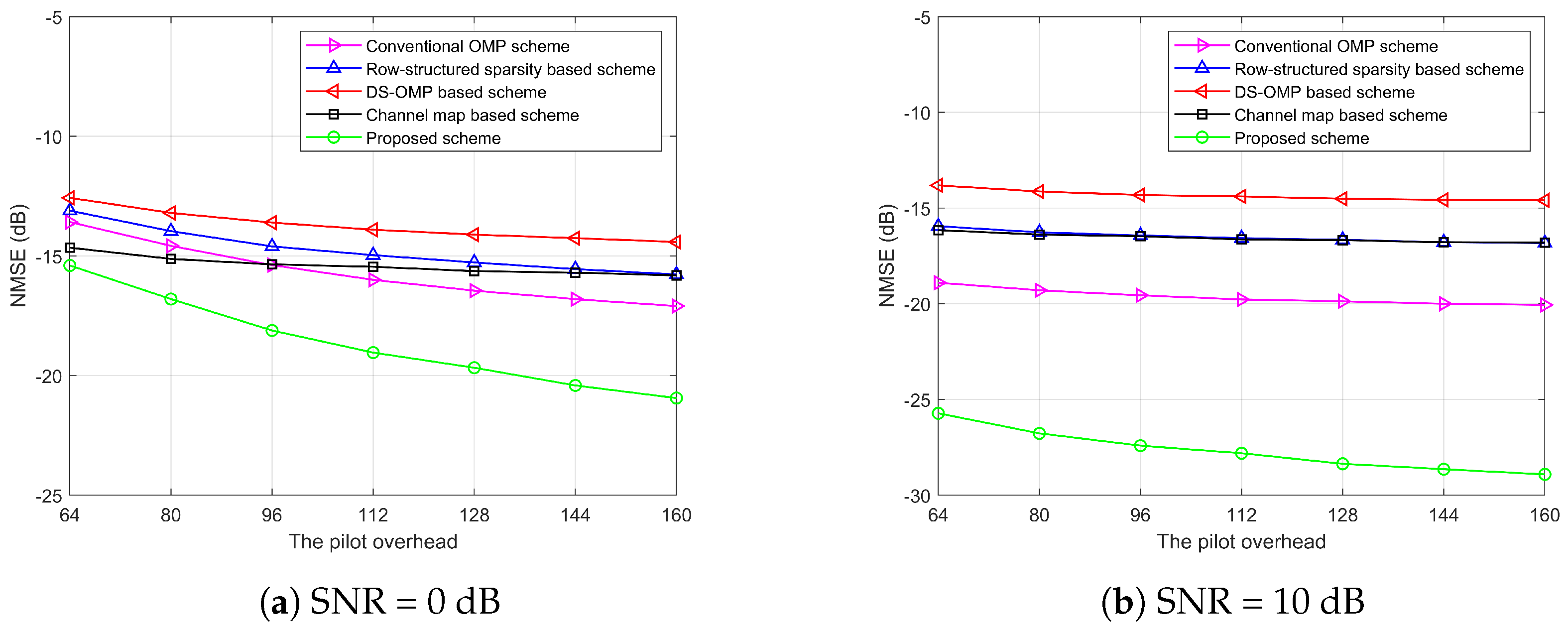
Figure 8 shows the NMSE versus pilot overhead (64 to 160) with different SNR. The proposed algorithm achieves the highest accuracy, and its accuracy improvement trend with increasing pilots is faster than other algorithms. In Figure 8a, to achieve −15 dB NMSE, the proposed algorithm requires only 64 pilot overhead, while CMCE needs 80, conventional OMP algorithm needs 96, and row-structured sparsity OMP algorithm needs 128, corresponding to approximately 20%, 34%, and 50% reduction in pilot overhead respectively. This indicates that the proposed algorithm requires less pilot overhead to achieve the same estimation accuracy. As shown in Figure 8b, under an SNR of 10 dB, the proposed algorithm maintains an NMSE advantage of over 5 dB against the benchmarks across pilot overhead ranging from 64 to 160. Combining the observations from Figure 8a,b, the proposed algorithm exhibits more pronounced accuracy improvement from increased SNR at lower pilot overhead, compared to the high-pilot regime.
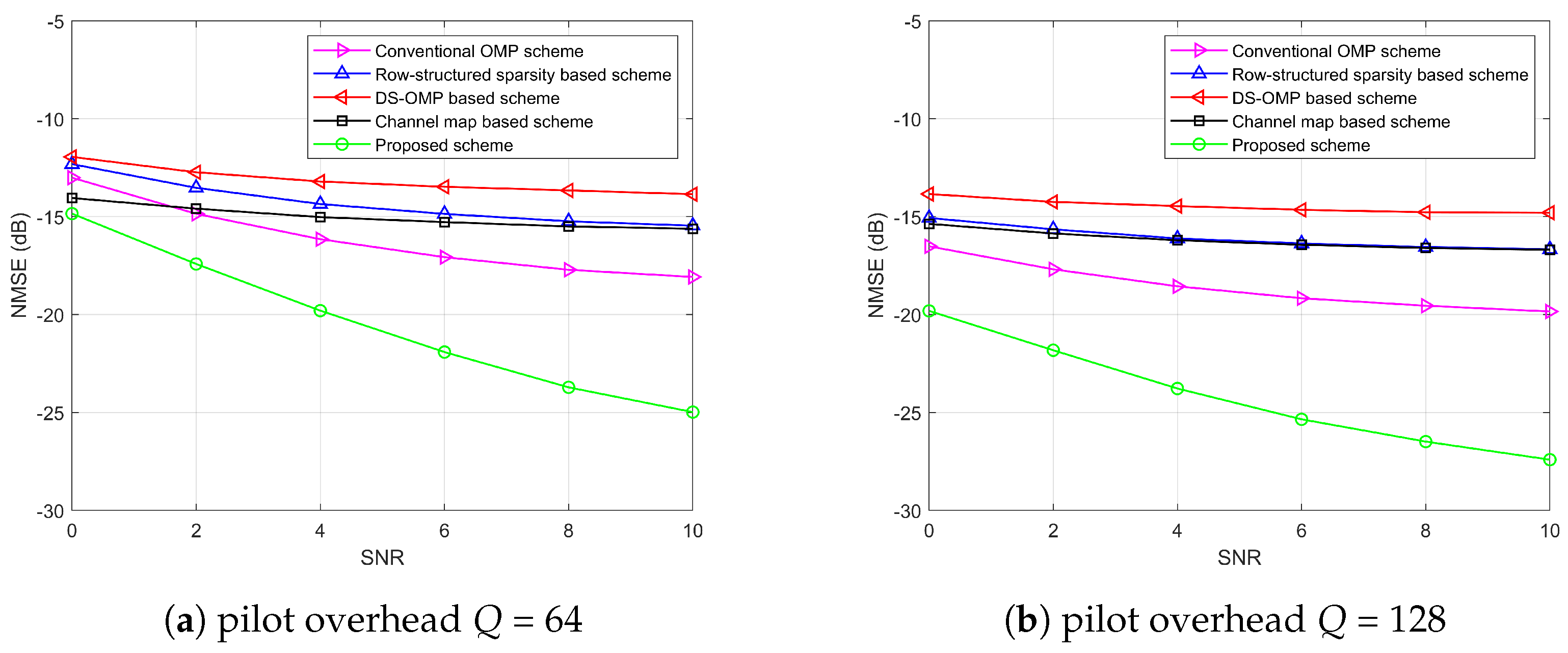
Figure 9 shows the NMSE versus SNR (0 dB to 10 dB) with different pilot overhead. The proposed algorithm consistently achieves the highest accuracy. At 0 dB SNR, increasing the pilot overhead from 64 to 128 leads to a significant performance gain for the proposed algorithm. The steepness of the curves in Figure 9a,b shows that as more pilots are used, the algorithm’s performance becomes markedly less sensitive to variations in SNR. This trend indicates that with sufficient pilots, the proposed method effectively mitigates the limitations imposed by low SNR conditions.
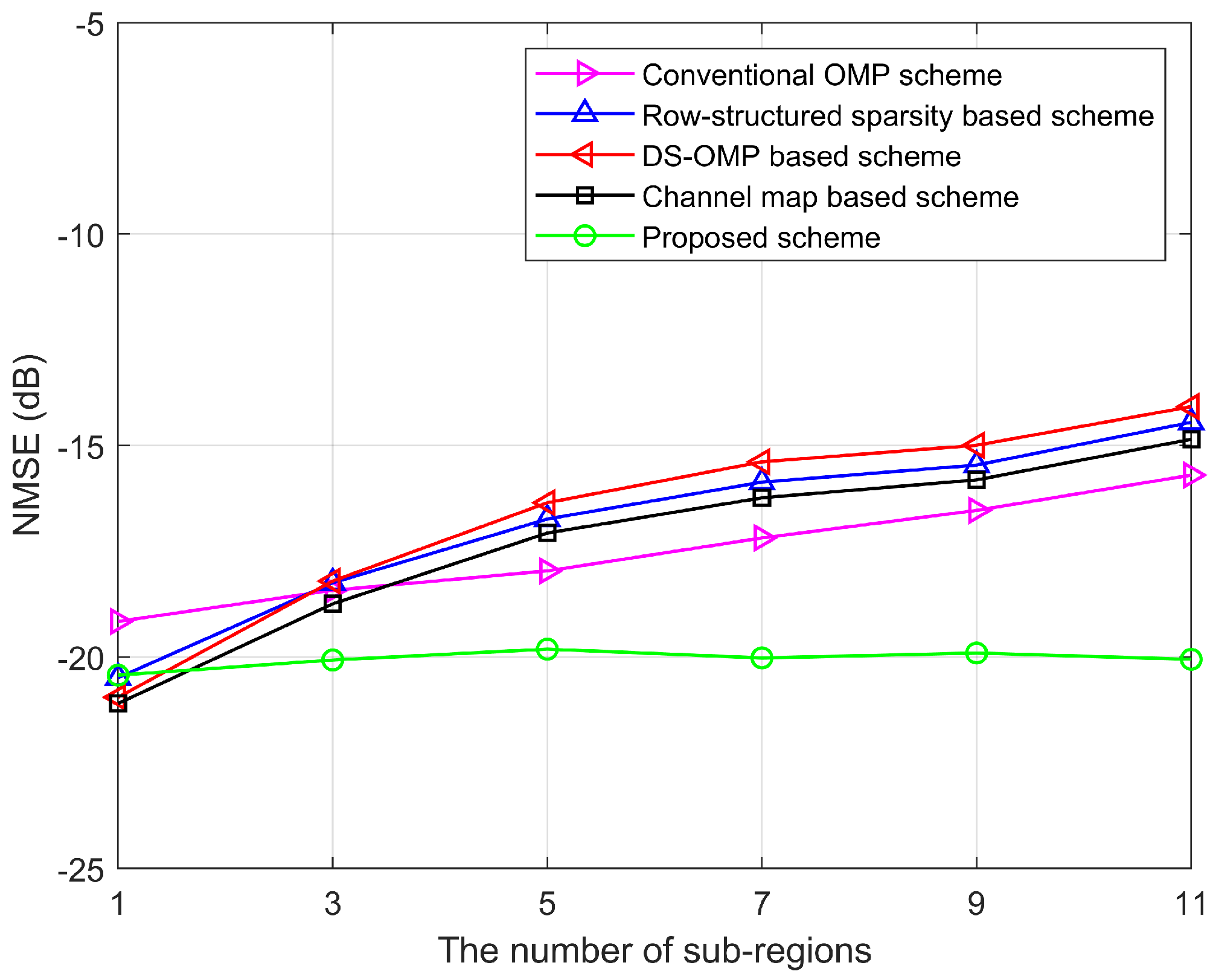
Figure 10 shows the NMSE versus the number of sub-regions R. The parameter R characterizes the complexity of the scattering environment. A larger R leads to a wider fluctuation range in the number of l 2 -paths, implying a more complex environment. Physically, a higher R indicates a greater disparity in scatterer density across different regions within the RIS coverage area. When R = 1 , which corresponds to having no sub-region division, it implies that all users share a common number of scatterers. When R is greater than 1, the accuracy of the proposed algorithm is higher than that of other algorithms. Moreover, the accuracy of other algorithms decreases as R increases, while the accuracy of the proposed algorithm remains stable. This indicates that the proposed algorithm holds a greater advantage over the benchmarks in more complex scattering environments.
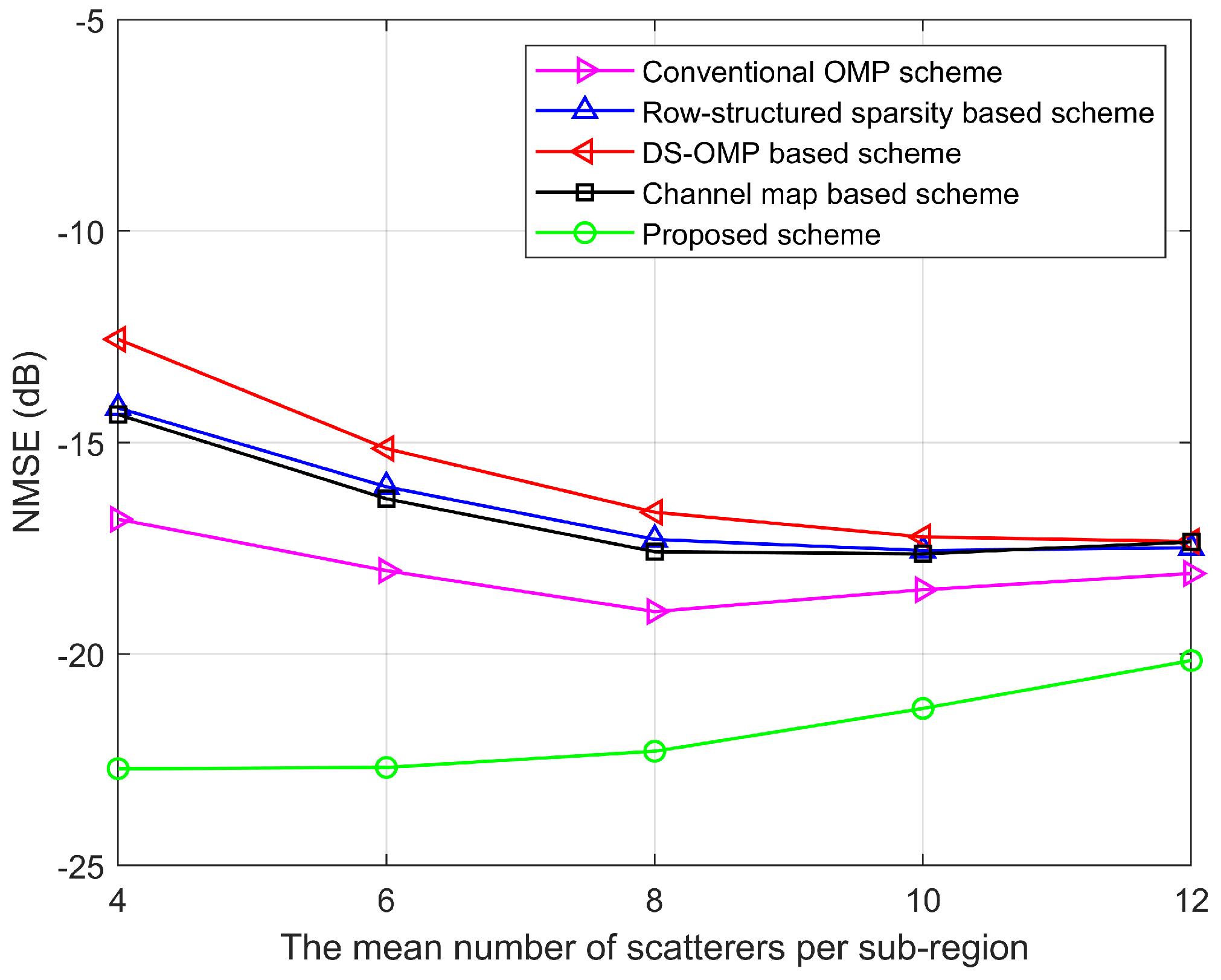
Figure 11 shows the NMSE versus the mean number of scatterers per sub-region. The parameter L m e a n represents the density of the scattering environment, where a larger L m e a n indicates denser scattering and a smaller value indicates sparser scattering. When L m e a n = 4 , the proposed algorithm reduces the NMSE by more than 5 dB compared to the benchmarks, demonstrating its substantial advantage under sparse scattering conditions. As the environment becomes denser, with L m e a n increasing beyond 8, all algorithms begin to exhibit a similar trend; nevertheless, the proposed algorithm maintains a consistent performance advantage.
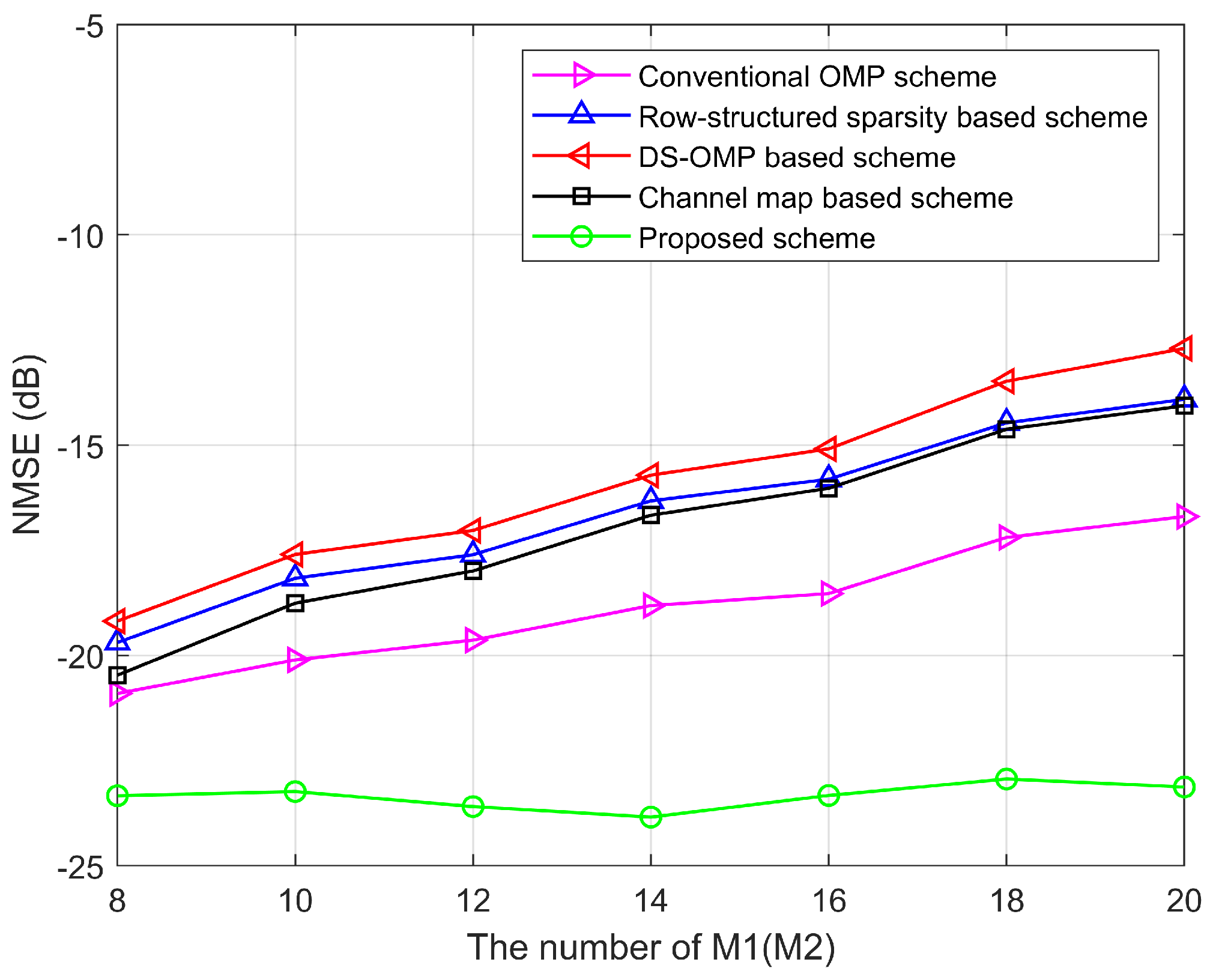
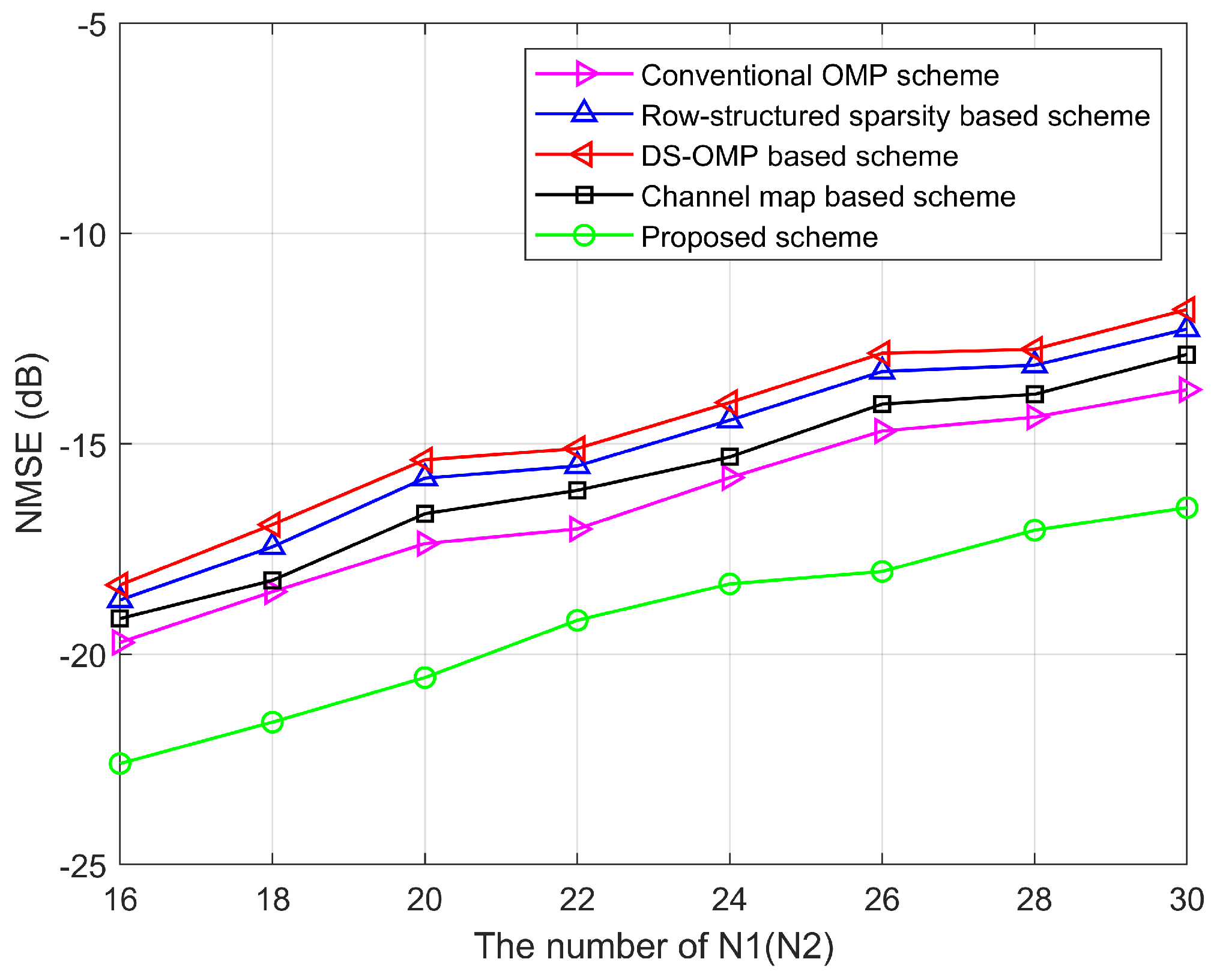
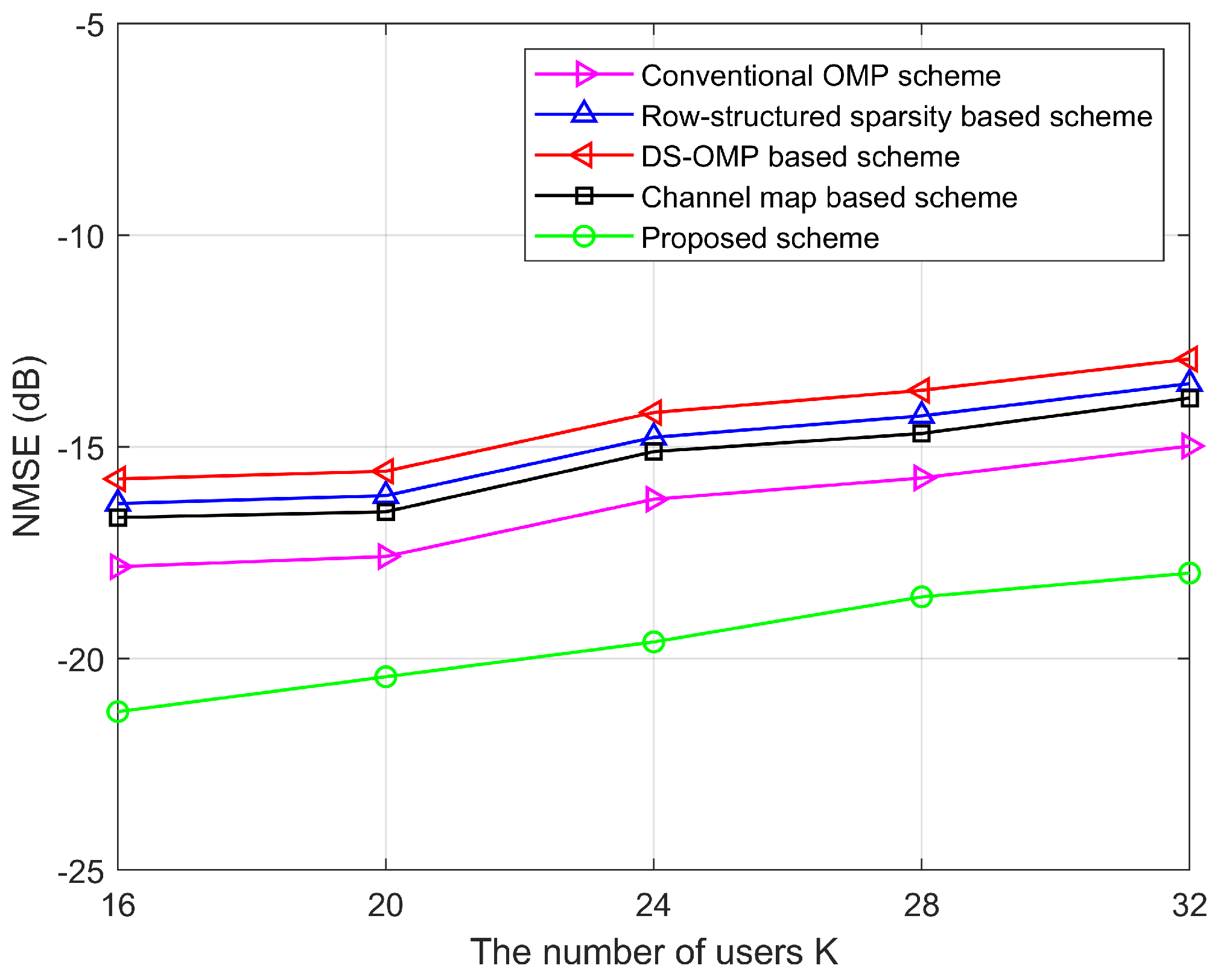
We investigate the impact of the number of BS antennas and RIS reflecting elements on the algorithm’s performance. As shown in Figure 12, as the number of BS antennas increases, the performance of the benchmarks degrades, whereas the proposed algorithm remains stable. This robustness enables the proposed algorithm to adapt well to massive MIMO scenarios. Figure 13 shows that with an increasing number of RIS elements, all algorithms degrade following a similar trend; nevertheless, the proposed one maintains a considerable advantage. Thus, it is capable of adapting to RIS deployments of varying scales. Similarly, as the number of users K increases, all algorithms follow the same trend, as shown in Figure 14, but the proposed algorithm maintains a considerable accuracy advantage.
We evaluate the proposed sub-region scatterer measurement method using the total absolute percentage error (TAPE) as the accuracy metric. TAPE reflects the ratio of the total absolute estimation error across all sub-regions to the sum of the true values. This metric is well-suited for evaluation as the primary objective of our method is to obtain the aggregate distribution of the scatterer count over all sub-regions. TAPE is defined as follows:
TAPE = r = 1 R S r S ^ r r = 1 R S r × 100 % .
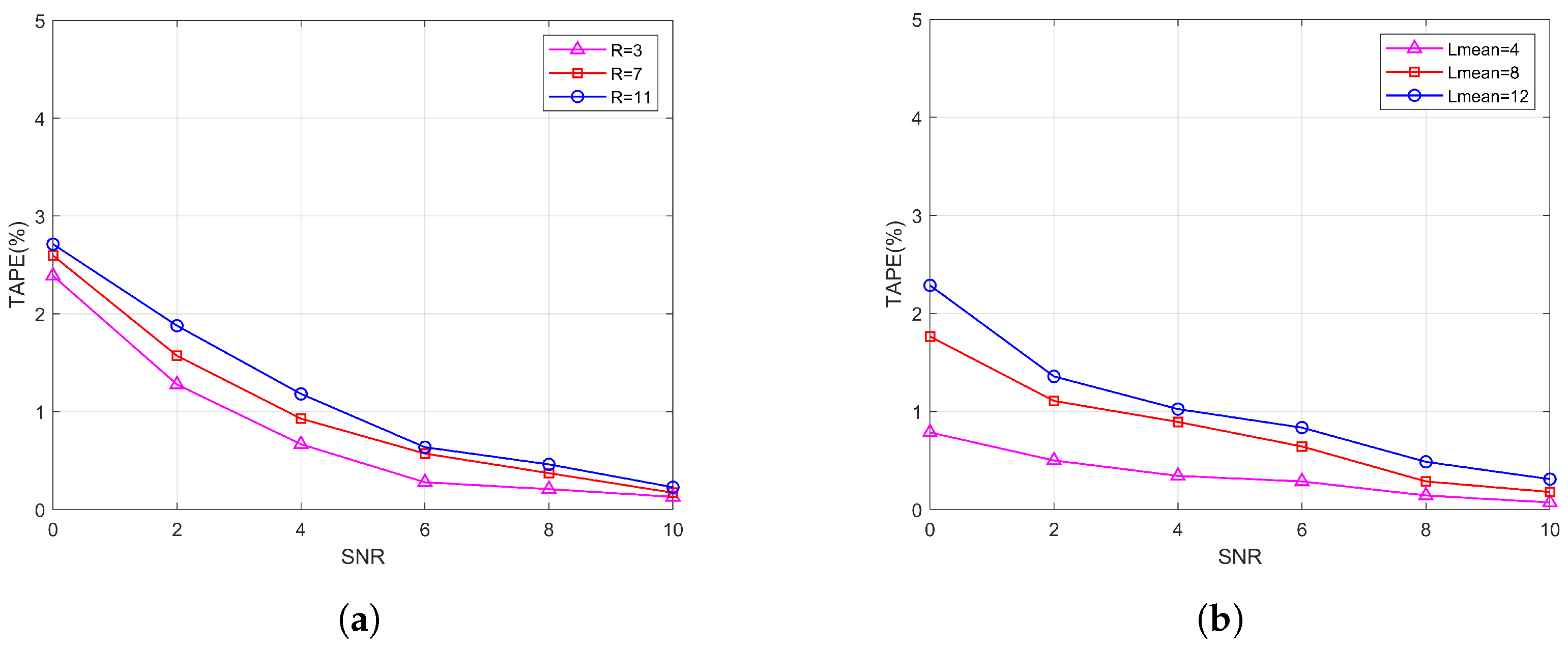
Simulations were conducted under varying levels of scattering environment complexity and density. Given that the sorted noise energies are highly flat with minimal relative differences, we set the threshold δ t h = 0.1 to identify the transition point from noise columns to effective energy columns. Overall, Figure 15 shows that under all considered conditions, the TAPE remains below 3% as the SNR increases from 0 dB to 10 dB. Specifically, at the favorable SNR of 10 dB, the TAPE is consistently below 1%. Figure 15a indicates that the method’s accuracy exhibits minor fluctuations across different scattering complexity levels, demonstrating its robustness. In Figure 15b, while a performance gap exists between dense and sparse scattering environments at low SNR, this gap diminishes rapidly with increasing SNR. Furthermore, even in a highly dense scattering environment with L m e a n = 12 , the TAPE does not exceed 3% at low SNR. These results confirm that the estimates provided by the proposed sub-region scatterer measurement method are reliable and accurately reflect the scatterer count level across all sub-regions.
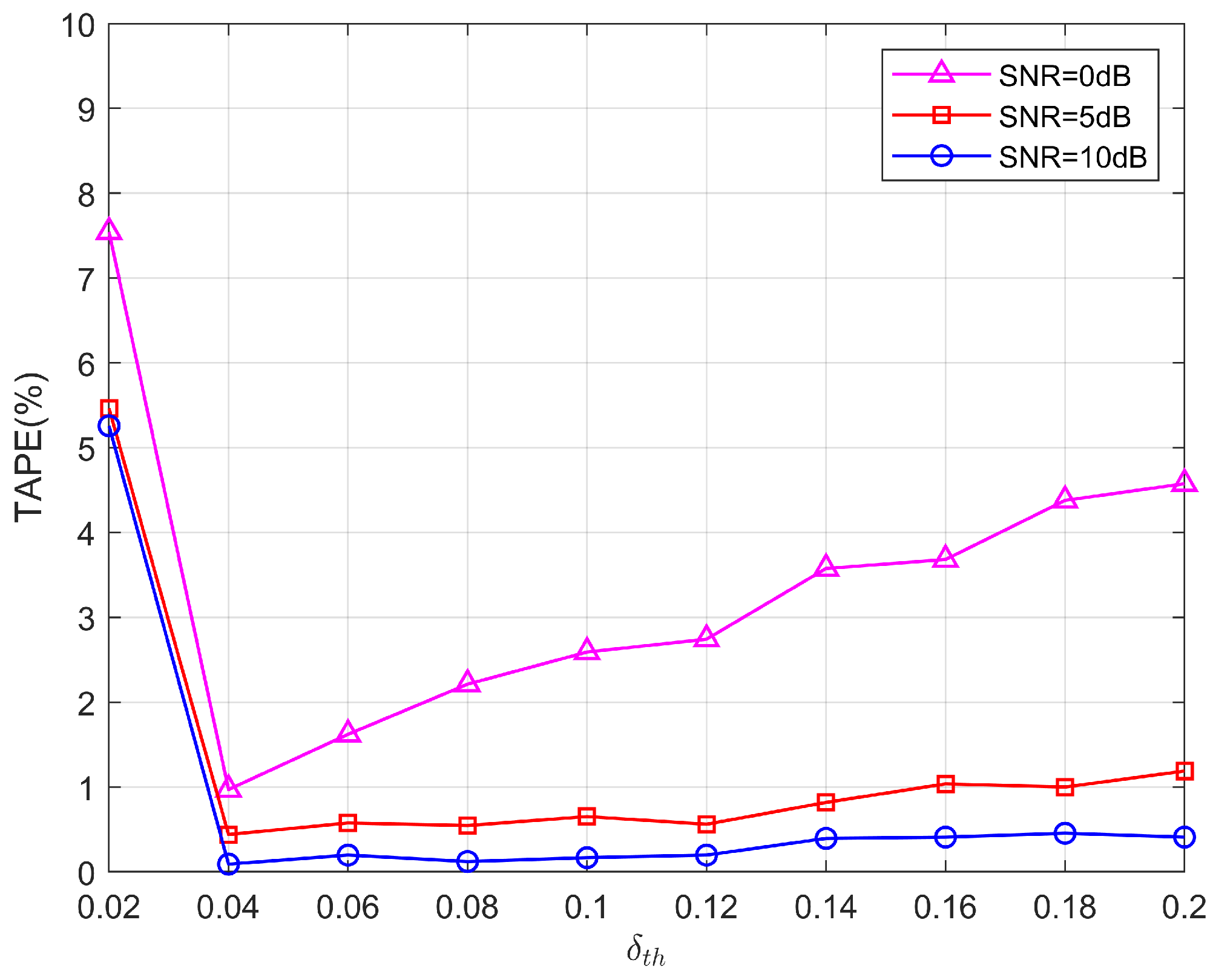
We investigate the impact of the threshold δ t h on the TAPE under different SNR conditions. The parameters are set to R = 11 and L m e a n = 12 , representing a relatively complex scattering environment. As shown in Figure 16, when δ t h = 0.02 , the TAPE is relatively high. This is because an excessively low threshold mistakenly identifies minor variations between different noise energy levels as the transition from noise to effective signal energy. Therefore, to avoid this issue and allow for a certain margin, setting δ t h = 0.1 is a suitably chosen typical value. At an SNR of 0 dB, the TAPE increases with δ t h when δ t h > 0.02 . In contrast, for high SNR levels, the TAPE shows little sensitivity to variations in δ t h .

5. Conclusions

In this paper, we propose a channel estimation algorithm named MUJCA to address the difficulty of acquiring the prior knowledge about the number of effective paths between individual users and the RIS in RIS-assisted multi-user mmWave MIMO systems. Simulations demonstrate that MUJCA outperforms benchmark algorithms, achieving higher channel estimation accuracy under the same pilot overhead and SNR conditions. The algorithm exhibits consistent robustness across all evaluated diverse scenarios, confirming its potential for adaptable deployment in practical environments. Furthermore, the proposed sub-region scatterer measurement method is validated, with results confirming the reliability of the prior knowledge on sub-region scatterer counts it provides.
However, the proposed MUJCA algorithm still has limitations: it relies on a static scattering environment; its computational complexity increases rapidly with the number of users; and its performance has been evaluated only under relatively ideal channel conditions. Future work will focus on investigating the effects of introducing dynamic scattering environments, exploring low-complexity optimization, and evaluating performance under non-ideal channel conditions along with non-ideal RIS characteristics, such as mutual coupling effects.
The introduction of dynamic environments, such as vehicles temporarily stopping in a sub-region, leads to new effective paths. This results in additional non-zero column elements added to the existing column support corresponding to the static environment. A viable approach is to identify these newly introduced dynamic paths by analyzing the distinction between the characteristics of effective path data and noise data, based on the static environment’s column support. To reduce computational complexity, a promising approach is to partition a large number of users into multiple groups when the user count is high. Joint processing is performed within each group, while sequential or parallel processing is adopted across groups, aiming to strike a balance between performance and complexity. We will pursue more in-depth studies to ultimately enhance the algorithm’s potential for real-world application.

Author Contributions

Writing—original draft preparation, software, N.Z.; conceptualization and methodology, N.Z. and N.L.; visualization, N.Z.; writing—review and editing, N.Z., N.L. and H.D.; resources, H.D. All authors have read and agreed to the published version of the manuscript.

Funding

This research received no external funding.

Data Availability Statement

Data are contained within the article.

Acknowledgments

We are grateful to the High Performance Computing Center of Central South University for assistance with the computations.

Conflicts of Interest

The authors declare no conflicts of interest.

References

  1. Saad, W.; Bennis, M.; Chen, M. A Vision of 6G Wireless Systems: Applications, Trends, Technologies, and Open Research Problems. IEEE Netw. 2020, 34, 134–142. [Google Scholar] [CrossRef]
  2. Bagheri, A.; Safaei, M.; Araghi, A.; Shahabi, S.M.M.; Wang, F.; Khalily, M.; Tafazolli, R. Mathematical Model and Real-World Demonstration of Multi-Beam and Wide-Beam Reconfigurable Intelligent Surface. IEEE Access 2023, 11, 19613–19621. [Google Scholar] [CrossRef]
  3. Salah, M.; Elsherbini, M.M.; Omer, O.A. RIS-Focus: On the Optimal Placement of the Focal Plane for Outdoor Beam Routing. IEEE Access 2022, 10, 53053–53065. [Google Scholar] [CrossRef]
  4. Tang, J.; Du, X.; Chen, Z.; Zhang, X.; So, D.K.C.; Wong, K.K.; Chambers, J.A. Joint Sparsity and Low-Rank Minimization for Reconfigurable Intelligent Surface-Assisted Channel Estimation. IEEE Trans. Commun. 2024, 72, 1688–1700. [Google Scholar] [CrossRef]
  5. Rangan, S.; Rappaport, T.S.; Erkip, E. Millimeter-Wave Cellular Wireless Networks: Potentials and Challenges. Proc. IEEE 2014, 102, 366–385. [Google Scholar] [CrossRef]
  6. Shafi, M.; Zhang, J.; Tataria, H.; Molisch, A.F.; Sun, S.; Rappaport, T.S.; Tufvesson, F.; Wu, S.; Kitao, K. Microwave vs. Millimeter-Wave Propagation Channels: Key Differences and Impact on 5G Cellular Systems. IEEE Commun. Mag. 2018, 56, 14–20. [Google Scholar] [CrossRef]
  7. Hong, W.; Jiang, Z.H.; Yu, C.; Hou, D.; Wang, H.; Guo, C.; Hu, Y.; Kuai, L.; Yu, Y.; Jiang, Z.; et al. The Role of Millimeter-Wave Technologies in 5G/6G Wireless Communications. IEEE J. Microw. 2021, 1, 101–122. [Google Scholar] [CrossRef]
  8. Wang, X.; Wan, L.; Huang, M.; Shen, C.; Zhang, K. Polarization Channel Estimation for Circular and Non-Circular Signals in Massive MIMO Systems. IEEE J. Sel. Top. Signal Process. 2019, 13, 1001–1016. [Google Scholar] [CrossRef]
  9. Wang, X.; Guo, Y.; Wen, F.; He, J.; Truong, T.K. EMVS-MIMO Radar With Sparse Rx Geometry: Tensor Modeling and 2-D Direction Finding. IEEE Trans. Aerosp. Electron. Syst. 2023, 59, 8062–8075. [Google Scholar] [CrossRef]
  10. Kumar, A.; Sharma, S.; Kumar, M.H.; Singh, G. RIS-Assisted Terahertz Communications for 6G Networks: A Comprehensive Overview. IEEE Access 2025, 13, 96337–96364. [Google Scholar] [CrossRef]
  11. Hu, S.; Rusek, F.; Edfors, O. Beyond Massive MIMO: The Potential of Data Transmission With Large Intelligent Surfaces. IEEE Trans. Signal Process. 2018, 66, 2746–2758. [Google Scholar] [CrossRef]
  12. Zhang, Z.; Dai, L. A Joint Precoding Framework for Wideband Reconfigurable Intelligent Surface-Aided Cell-Free Network. IEEE Trans. Signal Process. 2021, 69, 4085–4101. [Google Scholar] [CrossRef]
  13. Stratidakis, G.; Droulias, S.; Alexiou, A. Optimal Position and Orientation Study of Reconfigurable Intelligent Surfaces in a Mobile User Environment. IEEE Trans. Antennas Propag. 2022, 70, 8863–8871. [Google Scholar] [CrossRef]
  14. Wu, Q.; Zhang, R. Towards Smart and Reconfigurable Environment: Intelligent Reflecting Surface Aided Wireless Network. IEEE Commun. Mag. 2020, 58, 106–112. [Google Scholar] [CrossRef]
  15. Tran, P.T.; Tran, T.N.; Nguyen, B.C.; Hoang, T.M.; Dung, L.T.; Kim, T. Enhancing Secrecy Performance of Full-Duplex Relaying Systems Using IRS and RSMA. IEEE Trans. Mob. Comput. 2026, 25, 878–891. [Google Scholar] [CrossRef]
  16. Yuan, X.; Zhang, Y.J.A.; Shi, Y.; Yan, W.; Liu, H. Reconfigurable-Intelligent-Surface Empowered Wireless Communications: Challenges and Opportunities. IEEE Wirel. Commun. 2021, 28, 136–143. [Google Scholar] [CrossRef]
  17. Wu, Q.; Zhang, S.; Zheng, B.; You, C.; Zhang, R. Intelligent Reflecting Surface-Aided Wireless Communications: A Tutorial. IEEE Trans. Commun. 2021, 69, 3313–3351. [Google Scholar] [CrossRef]
  18. Wang, P.; Fang, J.; Duan, H.; Li, H. Compressed Channel Estimation for Intelligent Reflecting Surface-Assisted Millimeter Wave Systems. IEEE Signal Process. Lett. 2020, 27, 905–909. [Google Scholar] [CrossRef]
  19. Chen, J.; Liang, Y.C.; Cheng, H.V.; Yu, W. Channel Estimation for Reconfigurable Intelligent Surface Aided Multi-User mmWave MIMO Systems. IEEE Trans. Wirel. Commun. 2023, 22, 6853–6869. [Google Scholar] [CrossRef]
  20. Wei, X.; Shen, D.; Dai, L. Channel Estimation for RIS Assisted Wireless Communications—Part II: An Improved Solution Based on Double-Structured Sparsity. IEEE Commun. Lett. 2021, 25, 1403–1407. [Google Scholar] [CrossRef]
  21. Wu, J.; Li, Y.; Xin, L. Joint Channel Estimation for RIS-Assisted Wireless Communication System. In Proceedings of the 2022 IEEE Wireless Communications and Networking Conference (WCNC), Austin, TX, USA, 10–13 April 2022; pp. 1087–1092. [Google Scholar] [CrossRef]
  22. Xie, L.; Zhou, E.; Zhou, W.; Liang, J.; Tang, X.; Dong, Z. Channel Estimation for RIS Assisted Wireless Communication Systems Based on the Channel Map. In Proceedings of the 2024 9th International Conference on Computer and Communication Systems (ICCCS), Xi’an, China, 19–22 April 2024; pp. 936–942. [Google Scholar] [CrossRef]
  23. Tsai, C.R.; Liu, Y.H.; Wu, A.Y. Efficient Compressive Channel Estimation for Millimeter-Wave Large-Scale Antenna Systems. IEEE Trans. Signal Process. 2018, 66, 2414–2428. [Google Scholar] [CrossRef]
  24. Liu, H.; Yuan, X.; Zhang, Y.J.A. Matrix-Calibration-Based Cascaded Channel Estimation for Reconfigurable Intelligent Surface Assisted Multiuser MIMO. IEEE J. Sel. Areas Commun. 2020, 38, 2621–2636. [Google Scholar] [CrossRef]
  25. Wu, Q.; Zhang, R. Intelligent Reflecting Surface Enhanced Wireless Network via Joint Active and Passive Beamforming. IEEE Trans. Wirel. Commun. 2019, 18, 5394–5409. [Google Scholar] [CrossRef]
Figure 1. RIS-assisted communication system with sub-region division.
Electronics 15 00594 g001
Figure 2. The association between the sparsity of the angular-domain cascaded channel and the BS-RIS and RIS-UE paths.
Electronics 15 00594 g002
Figure 3. The association between Y ˜ k and H ˜ k .
Electronics 15 00594 g003
Figure 4. Multi-user joint non-zero column support.
Electronics 15 00594 g004
Figure 5. Illustration of the joint correlation.
Electronics 15 00594 g005
Figure 6. Allocation of non-zero column elements based on joint correlation.
Electronics 15 00594 g006
Figure 7. Downlink channel for measuring the number of scatterers per sub-region.
Electronics 15 00594 g007
Figure 8. NMSE performance vs. pilot overhead Q with different SNR.
Electronics 15 00594 g008
Figure 9. NMSE performance vs. SNR with different Q.
Electronics 15 00594 g009
Figure 10. NMSE performance vs. R.
Electronics 15 00594 g010
Figure 11. NMSE performance vs. L m e a n .
Electronics 15 00594 g011
Figure 12. NMSE performance vs. BS array size M 1 ( M 2 ) .
Electronics 15 00594 g012
Figure 13. NMSE performance vs. RIS array size N 1 ( N 2 ) .
Electronics 15 00594 g013
Figure 14. NMSE performance vs. K.
Electronics 15 00594 g014
Figure 15. TAPE performance vs. SNR under various R and L m e a n conditions. (a) TAPE performance vs. SNR with different R; (b) TAPE performance vs. SNR with different L m e a n .
Electronics 15 00594 g015
Figure 16. TAPE performance vs. δ t h .
Electronics 15 00594 g016
Table 1. Custom functions in this paper.
FunctionDefinition
maxindices a , x get the indices of the top x elements in a
maxindex a get the index of the maximum element in a
a ; b concatenate vectors vertically
abs a compute the modulus of vector elements
sqr a square each element of the vector
getmax a , x , y get the maximum value of the x-th to y-th elements in a
sort a sort a in descending order and return sorted a and its indices
reshape a , x , y reshape vector to x × y matrix
Table 2. Complexity of the proposed algorithm and benchmarks.
AlgorithmComplexity
OMP [18] O L G L m e a n M N Q K
Row-structured sparsity OMP [19] O K M Q + O L G L m e a n 3 N Q K
DS-OMP [20] O K M Q + O L G L m e a n 3 N Q K
CMCE [22] O N 2 Q K + O K M Q + O L G L m e a n 3 N Q K
MUJCA (proposed) O L G L m e a n N Q K 3 + O L G L m e a n 3 Q K 2
Table 3. Simulation parameters.
ParameterDefinitionDefault Value
MThe number of BS antennas64
M 1 , M 2 The number of BS antennas per row/column8
NThe number of RIS elements256
N 1 , N 2 The number of RIS elements per row/column16
KThe number of users16
L G The number of paths (RIS to BS)5
L m e a n The mean number of scatterers in each sub-region8
RThe number of sub-regions9
d B R The distance between BS and RIS10 m
α l G The complex gain of paths (RIS to BS) 10 3 d B R 2.2
d R U The distance between RIS and user100 m
α l h , k The complex gain of paths (k-th user to RIS) 10 3 d R U 2.8
Disclaimer/Publisher’s Note: The statements, opinions and data contained in all publications are solely those of the individual author(s) and contributor(s) and not of MDPI and/or the editor(s). MDPI and/or the editor(s) disclaim responsibility for any injury to people or property resulting from any ideas, methods, instructions or products referred to in the content.