Abstract
Building information models (BIMs) serve as a foundational tool for digital management of existing structures. Traditional methods suffer from low automation and heavy reliance on manual intervention. This paper proposes an automated method for structural component dimension recognition and BIM modeling based on 3D point cloud data. The proposed methodology follows a three-step workflow. First, the raw point cloud is semantically segmented using the PointNet++ deep learning network, and individual structural components are effectively isolated using the Fast Euclidean Clustering (FEC) algorithm. Second, the principal axis of each component is determined through Principal Component Analysis, and the Random Sample Consensus (RANSAC) algorithm is applied to fit the boundary lines of the projected cross-sections, enabling the automated extraction of geometric dimensions. Finally, an automated script maps the extracted geometric parameters to standard IFC entities to generate the BIM model. The experimental results demonstrate that the average dimensional error for beams and columns is within 3 mm, with the exception of specific occluded components. This study realizes the efficient transformation from point cloud data to BIM models through an automated workflow, providing reliable technical support for the digital reconstruction of existing buildings.
1. Introduction
Geometric quality control is a crucial task of Structural Health Monitoring (SHM) and the lifecycle management of reinforced concrete frame structures, as the actual cross-sectional dimensions of beams and columns are directly related to structural safety, serviceability, and compliance with design specifications [1,2]. To assess the structural performance of existing buildings accurately, engineers require precise “as-built” models. The actual cross-sectional dimensions of beams and columns often deviate from design plans due to construction errors or environmental degradation. Traditional field inspection relies on manual measurements conducted at a limited number of sampling points on selected structural members [3,4], which is labor-intensive and fails to represent the overall dimensional quality of the structural members. Therefore, a fast and automated method for obtaining the geometric dimensions and generating parametric BIM models is urgently needed to improve inspection efficiency and facilitate the digital management of existing buildings [5].
With the rapid advancement of digital construction and 3D reconstruction technologies, point cloud data have become a powerful tool for geometric analysis in civil engineering [6,7,8]. A point cloud is a collection of discrete three-dimensional points that record precise spatial information [9]. Recent developments in point cloud acquisition technologies, such as terrestrial laser scanning [10,11], backpack laser scanning [12], and unmanned aerial vehicles (UAVs) [13], have enabled the efficient collection of high-precision point cloud data. Point clouds generated by UAV-based oblique photogrammetry can provide sufficient accuracy for geometric analysis [14]. Despite their advantages, point clouds are inherently unstructured, meaning that the points are independent and lack explicit topological relationships or shape information [15]. Consequently, extracting structural geometry from large, noisy, and unorganized point cloud data has become a central challenge.
To address this, various algorithms have been proposed for point cloud segmentation and semantic understanding [16,17]. Common segmentation techniques include Random Sample Consensus (RANSAC) [18], region-growing [19], and Principal Component Analysis (PCA)-based algorithms [20]. In recent years, machine learning-based approaches such as PointNet [21], PointNet++ [22], and PointCNN have also been applied to various stages of point cloud processing, improving robustness and automation [21]. Semantic segmentation methods have proven effective in identifying key structural components within point clouds across diverse applications, including buildings [23,24], bridges [25,26,27], tunnels [28], and towers [29]. These methods partition the dataset into distinct subsets, each corresponding to an individual structural component [30,31]. However, semantic segmentation alone is insufficient for engineering applications. It merely assigns a class to points but does not generate the geometric parameters (e.g., length, width, height) required for Building Information Modeling (BIM) or structural analysis. Therefore, segmentation must be integrated with robust geometric extraction algorithms to be useful for digitizing existing structures.
Several studies have explored automated extraction of structural geometry and BIM generation from point clouds. Wang et al. [32] and Kim et al. [33] utilized TLS for dimensional quality evaluation of prefabricated elements. For cast-in-place components, Kim et al. [34] applied PCA and RANSAC to automatically extract key features of formwork and reinforcement, addressing the inefficiency of manual inspection. Bosché et al. [35] proposed a Scan-vs-BIM approach to compare reconstructed point clouds with design models for detecting dimensional deviations. Some studies have explored automated methods for extracting structural geometry from point cloud data to BIM generation [36]. With the rapid development of deep learning, semantic-based automated modeling has made significant advances [37]. The introduction of PointNet in 2017 was a major milestone for this field. For example, Jing et al. [38] developed BridgeNet, a 3D neural network trained on synthetic datasets, which achieved state-of-the-art performance in the automated segmentation of masonry arch bridges from laser scanning data. Despite these advances, most existing methodologies primarily focus on architectural elements such as walls, floors, and ceilings based on planar assumptions or Manhattan World constraints. These methods are effective for reconstructing the enclosing boundaries of a room but struggle with the “skeletal” nature of frame structures. Unlike walls, beams and columns are linear members defined by their cross-sectional profiles and longitudinal axes. General planar fitting algorithms often fail to distinguish the specific geometric logic of frame members.
This study proposes an automated approach for the dimension recognition and parametric BIM reconstruction of reinforced concrete frame structures using 3D point clouds. By integrating deep learning-based semantic segmentation with robust geometric feature extraction algorithms, the proposed framework efficiently transforms raw point cloud data into semantically rich Industry Foundation Classes (IFC) models. This research bridges the gap between raw scan data and structural performance assessment, providing a high-precision foundation for the intelligent SHM and digital lifecycle management of existing buildings.
2. Methodology
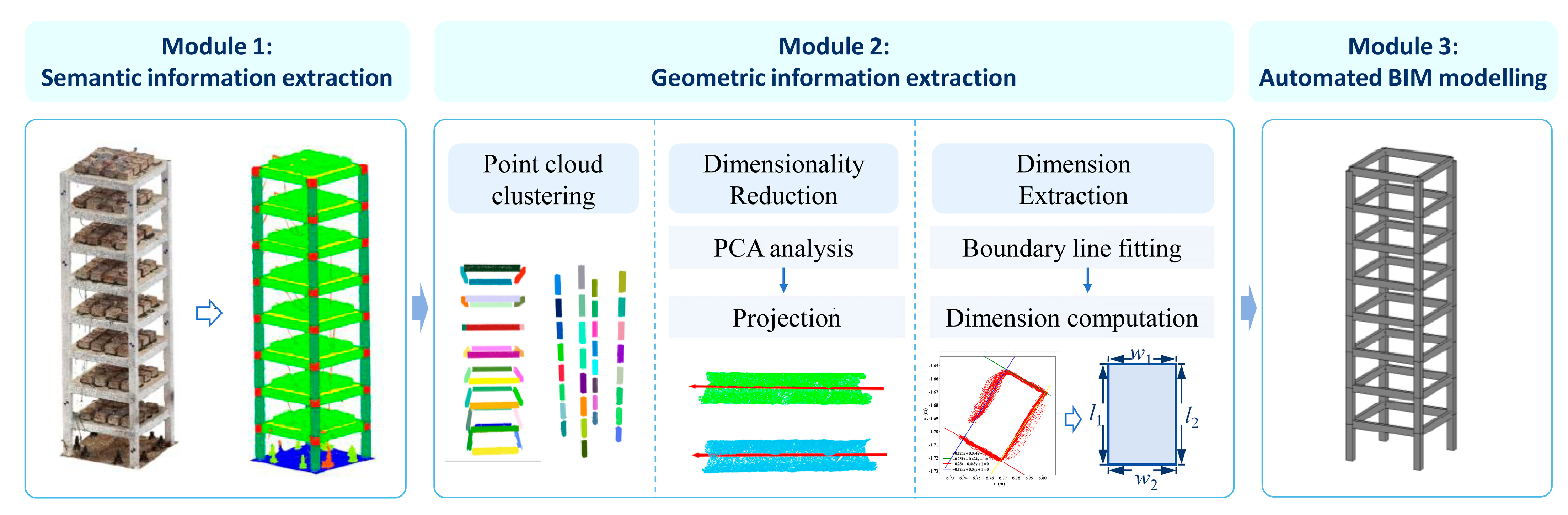
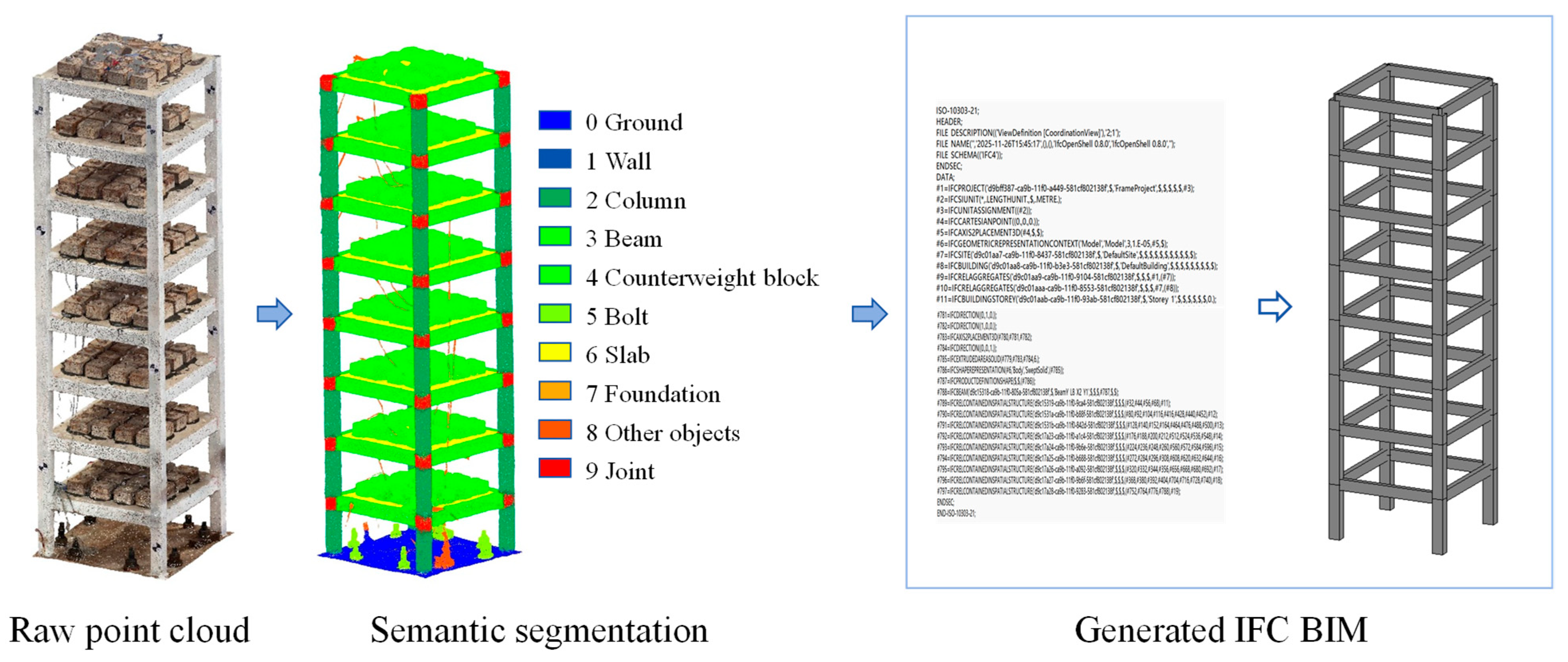
The proposed methodology for automated dimension recognition of reinforced concrete frame components follows a three-step workflow, as illustrated in Figure 1. First, the semantic information extraction module classifies the raw point cloud into distinct structural categories. Second, geometric information extraction is conducted by clustering points to isolate individual components, reducing dimensionality via Principal Component Analysis, and computing dimensions through boundary line fitting. Finally, the derived geometric parameters are automatically mapped to standard Industry Foundation Classes entities to generate the parametric model.
Figure 1.
Workflow of the proposed method.
2.1. Semantic Segmentation of Point Clouds
2.1.1. PointNet++ Network
The PointNet++ model [22] is adopted in this study for semantic segmentation of 3D point cloud data from frame structures. While various contemporary deep learning architectures have been developed, such as dynamic graph-based methods (e.g., DGCNN) [39], Point Transformer [40], and KPConv [41], PointNet++ was selected as the backbone network for this study. The primary reason is that RC frame structures consist of components with relatively regular and distinct geometric primitives. PointNet++’s hierarchical set abstraction layers effectively capture both fine-grained local geometric details and global spatial relationships, which are sufficient for distinguishing beams, columns, and slabs. Furthermore, compared to more complex contemporary networks, PointNet++ offers a proven balance between inference speed and segmentation accuracy.
Specifically, in the PointNet++ architecture, the input point cloud is processed through multiple set abstraction layers. Each layer samples a subset of points, groups neighboring points based on spatial distance, and applies PointNet-based feature extraction within each group, allowing the model to learn detailed geometric information of different components. The extracted features are then propagated and interpolated back to the original point resolution using feature propagation layers. Finally, the segmentation head outputs semantic labels for each point, enabling the distinction between beams, columns, and various non-structural objects within the point cloud.
2.1.2. Dataset Preparation and Annotation
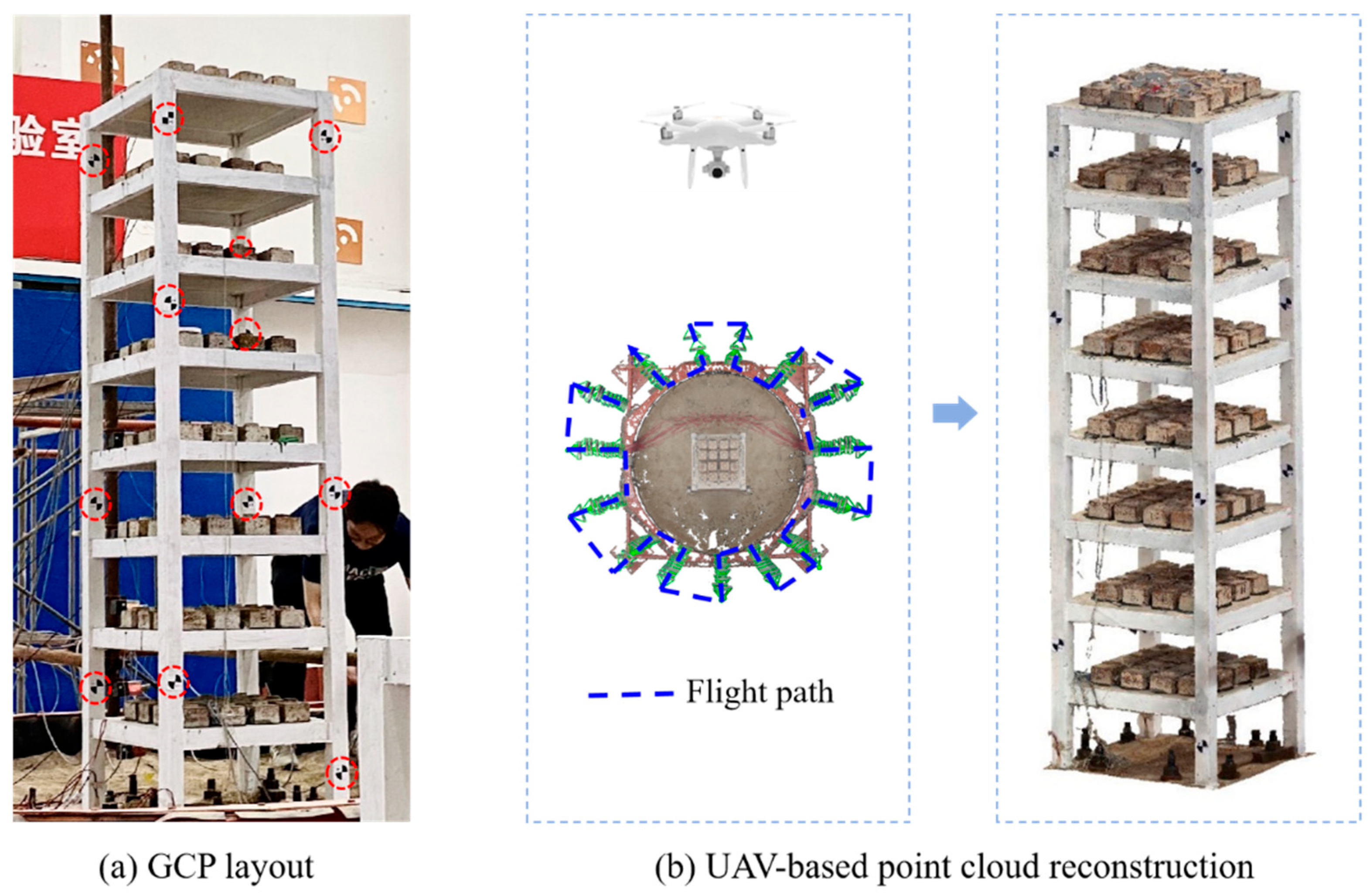
To train and validate the semantic segmentation network, a specialized dataset of concrete frame structures was constructed. Data collection for the 3D reconstruction was conducted using a DJI PHANTOM 4 Pro drone (DJI, Shenzhen, China), equipped with a one-inch CMOS sensor and a high-quality lens, enabling high-resolution, low-distortion imaging with a pixel size of up to 20 megapixels. The device supports autofocus from 1 m to infinity and is equipped with a mechanical shutter to minimize motion blur. To ensure complete and detailed reconstruction of the frame model, a circular flight pattern was adopted, as shown in Figure 2. During the flight, the camera of the drone was adjusted to maintain a distance of 2–3 m from the structure, enabling the capture of high-resolution images and ensuring that detailed local features were accurately reflected in the final 3D point cloud model. Manual control was employed to handle potential unforeseen situations, ensuring flexibility and safety throughout the operation. Additionally, 12 ground control points (GCPs) were measured using total station, as shown in Figure 2a. These GCPs were essential for aligning the point cloud data to the real-world geographic coordinate system. By using the GCPs, the size, position, and accuracy of the point cloud model were precisely calibrated, ensuring accurate spatial alignment. The point cloud model was then generated through an image-based 3D reconstruction process using ContextCapture 10.16.
Figure 2.
Point cloud reconstruction of the frame structure model.
To construct the point cloud dataset for training and testing the semantic segmentation network, four scaled concrete frame models are constructed. During the laboratory tests, external excitation is applied to the foundations to induce settlement and deformation. This procedure simulates potential foundation settlement and structural deformation that may occur during the construction stage of engineering structures. A total of 10 point cloud models are obtained from these tests. To make the trained network applicable to frame structures with different numbers of stories, the original point clouds are first partitioned floor by floor. Each frame model is divided into sub-models with 2, 4, 6, and 8 stories, which increases the number of point cloud models from 10 to 40.
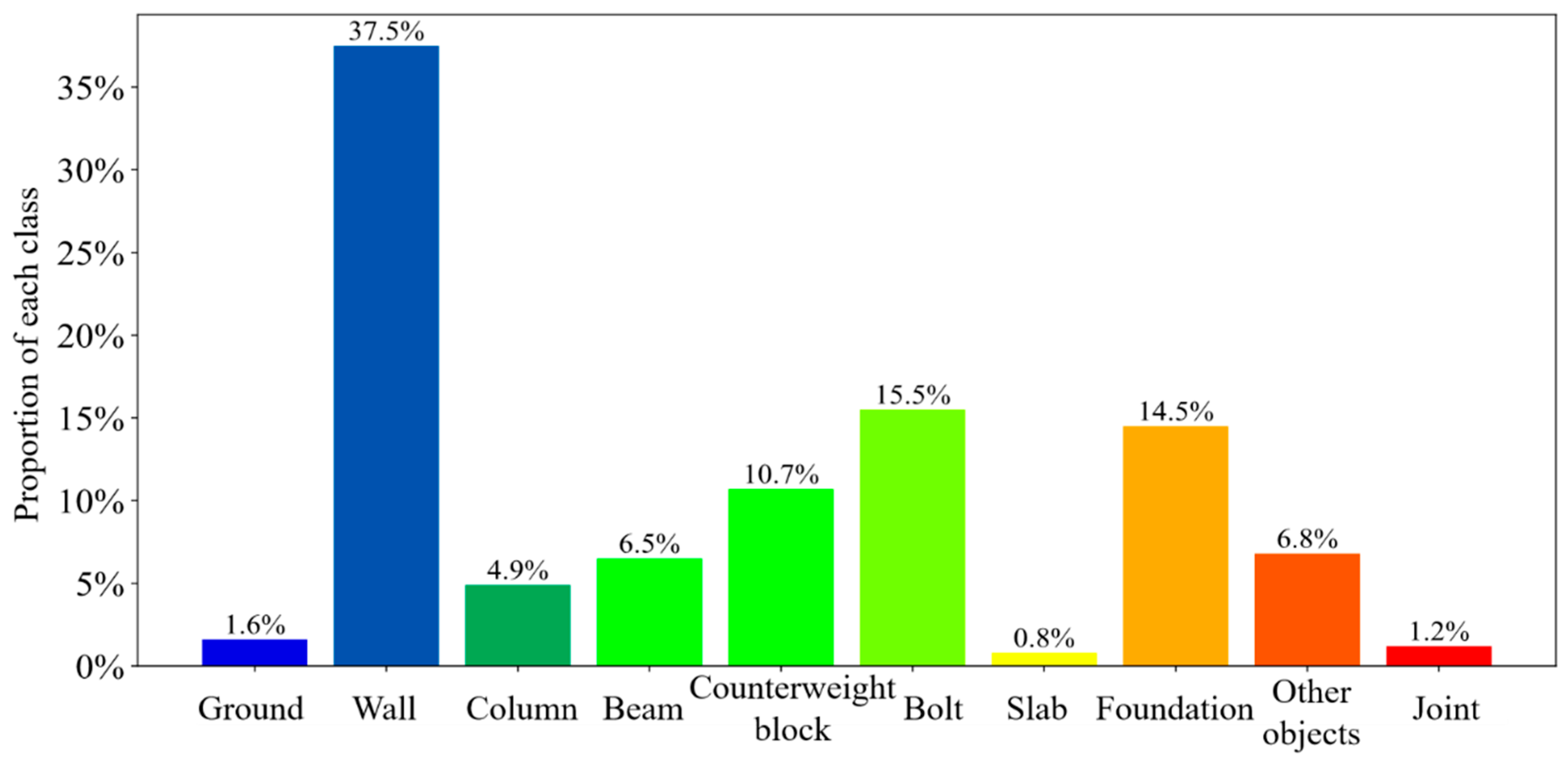
Further data augmentation is then performed by combining six commonly used operations for point cloud data: point shuffling, translation, rotation, scaling, noise addition, and random point dropping. Random 3D rotations are applied around the three coordinate axes, and each rotation angle is sampled from the interval [−0.18, 0.18] radians to avoid excessive rotation. A random scaling factor is applied to slightly enlarge or shrink the point clouds. The maximum proportion of added noise is 20%, and the maximum ratio of randomly dropped points is also 20%. Each of the 40 models is augmented five times, resulting in a total of 240 point cloud models. This comprehensive data augmentation strategy is specifically designed to enhance the diversity of the training data and mitigate the potential bias caused by the inherent class imbalance shown in Figure 3. By introducing geometric variations and noise, the network is forced to learn robust feature representations for structural components, ensuring that the recognition performance of key elements like beams and columns is not compromised by the dominance of background points.
Figure 3.
Proportion of points in each class in the concrete frame point cloud dataset.
2.1.3. Implementation Details
The experiments are conducted on a workstation equipped with an AMD Ryzen 9 5950X @ 4.00 GHz CPU, 128 GB of RAM, and two NVIDIA GeForce RTX 3060 GPUs, with Python 3.9.13, PyTorch 2.0.0, CUDA Toolkit 11.8.0, and cuDNN 8.9.6.50. The dataset contains 240 point cloud models, of which 200 are used for training and 40 for testing. The selection of hyperparameters was determined through empirical tuning to balance segmentation accuracy and hardware constraints. A step-decay learning rate schedule was adopted to ensure model convergence. The initial learning rate was set to 0.001, with a decay rate of 0.7 applied every 10 epochs, over a total of 96 epochs. Regarding data preprocessing, given the massive volume and redundancy of the raw laser-scanned point clouds, direct processing poses a heavy computational burden. To balance the reduction in training time with the preservation of local geometric details, the number of input points per sample was set to 14,336. This parameter was determined empirically: strictly downsampling the raw data to 14,336 points significantly reduces input dimensionality and accelerates training efficiency. Unlike lower resolutions, retaining 14,336 points maintains sufficient point density to prevent the loss of fine-grained topological features in beam-column joints and small connections. Furthermore, constrained by the 12 GB memory limit of the RTX 3060 GPU, the batch size was set to the hardware-permitted maximum of 24 to optimize parallel computing efficiency. Under this configuration, each training epoch required approximately 20 min.
2.2. Geometric Information Extraction
2.2.1. Point Cloud Clustering
After extracting structural components through point cloud segmentation, clustering is required to further partition the data into individual elements. Clustering refers to the process of partitioning a point cloud dataset into several non-overlapping groups, with each cluster typically corresponding to an independent physical component. This process relies on characteristics such as spatial distance and density distribution to determine the association between points. Common point cloud clustering methods include density-based clustering and region-growing clustering.
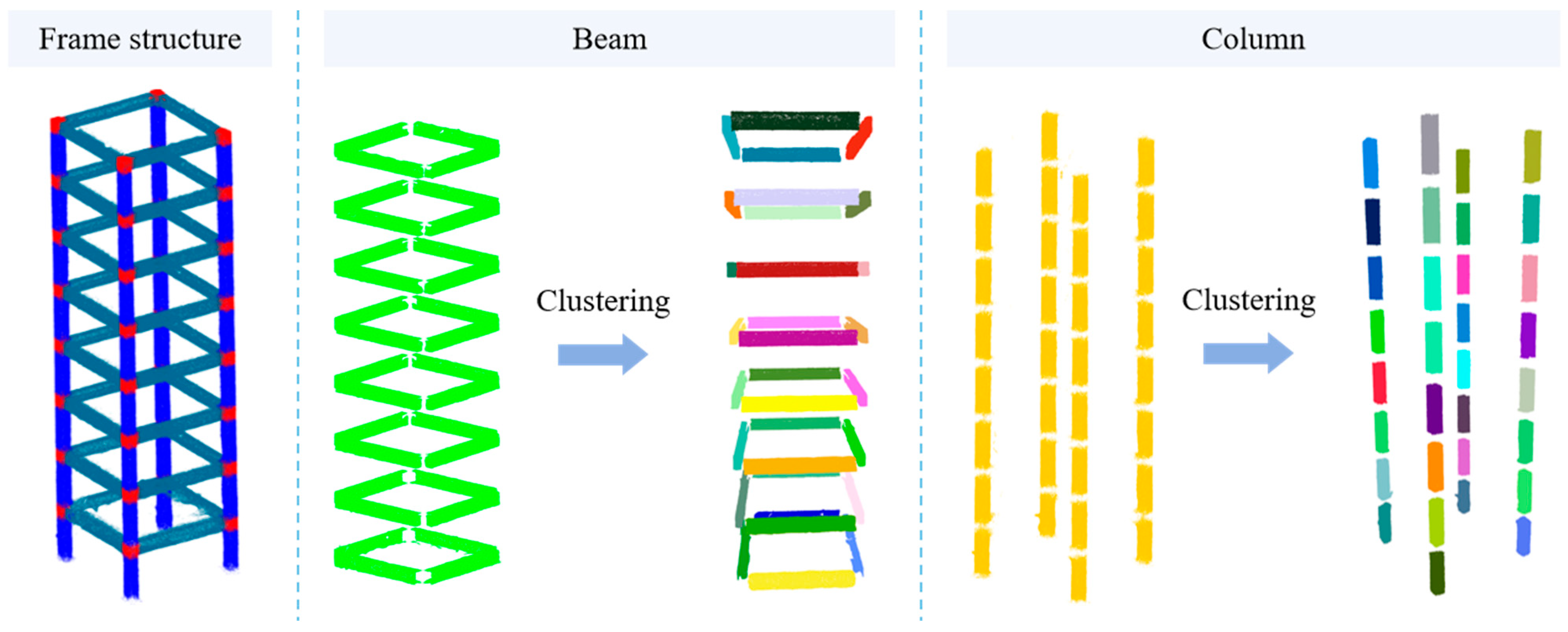
In this study, the Fast Euclidean Clustering (FEC) algorithm [42] is adopted for point cloud segmentation, which offers high computational efficiency. A kd-tree data structure accelerates the search for neighboring points. For each unlabeled point, the algorithm searches for all points within a given radius threshold in its neighborhood. If any of the neighboring points have already been assigned a cluster label, the current point and its neighbors are merged into the cluster with the smallest label value, thereby unifying the points of the same physical component. If all neighboring points remain unlabeled, a new cluster label is assigned. This process is iteratively performed until all points are assigned to clusters. As shown in Figure 4, each cluster label corresponds to an individual component in the point cloud, enabling the automatic segmentation of beams and columns within the frame.
Figure 4.
The process of point cloud clustering.
2.2.2. Dimensionality Reduction
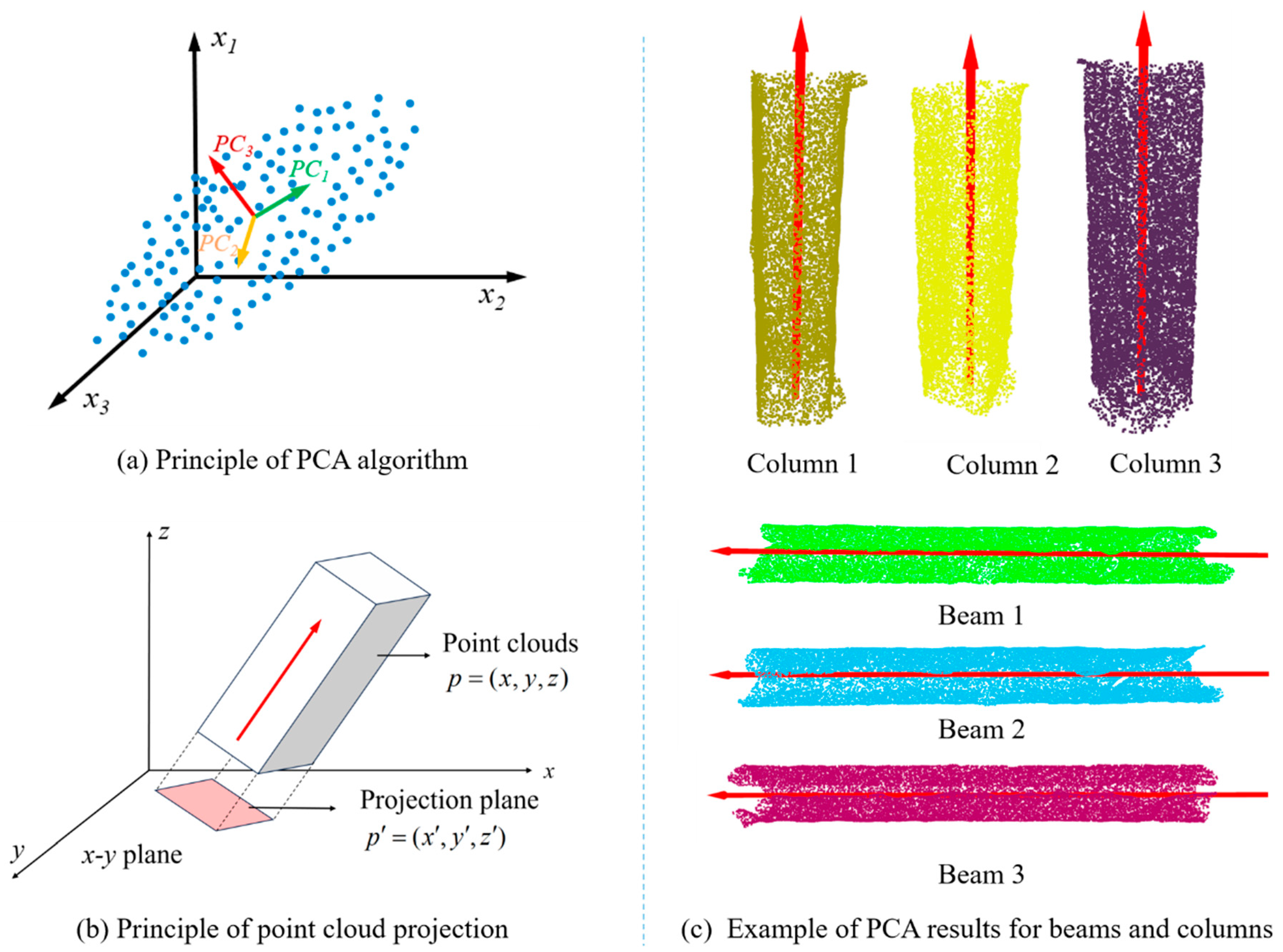
For linear structural elements such as beams and columns, extracting their cross-sectional geometry from point cloud data requires reducing the dimensionality of the dataset while preserving the essential structural information. This is typically achieved by projecting the three-dimensional point cloud of each component onto a two-dimensional plane perpendicular to its principal axis. The principal axis of a beam or column, which approximates its longitudinal centerline, can be determined by analyzing the main direction of the point cloud distribution. As shown in Figure 5, Principal Component Analysis (PCA) is employed to identify this principal direction. PCA is a widely used technique for dimensionality reduction, designed to find the directions in which the data exhibit the greatest variance. By calculating the eigenvectors of the covariance matrix of the point cloud, PCA identifies the first principal eigenvector as the axis along which the points are most widely distributed. This eigenvector thus serves as an effective approximation of the structural component’s central axis. Projecting the point cloud onto a plane normal to this axis produces a two-dimensional cross-sectional view, which forms the basis for subsequent geometric analysis.
Figure 5.
Point cloud projection.
2.2.3. Automated Dimension Extraction
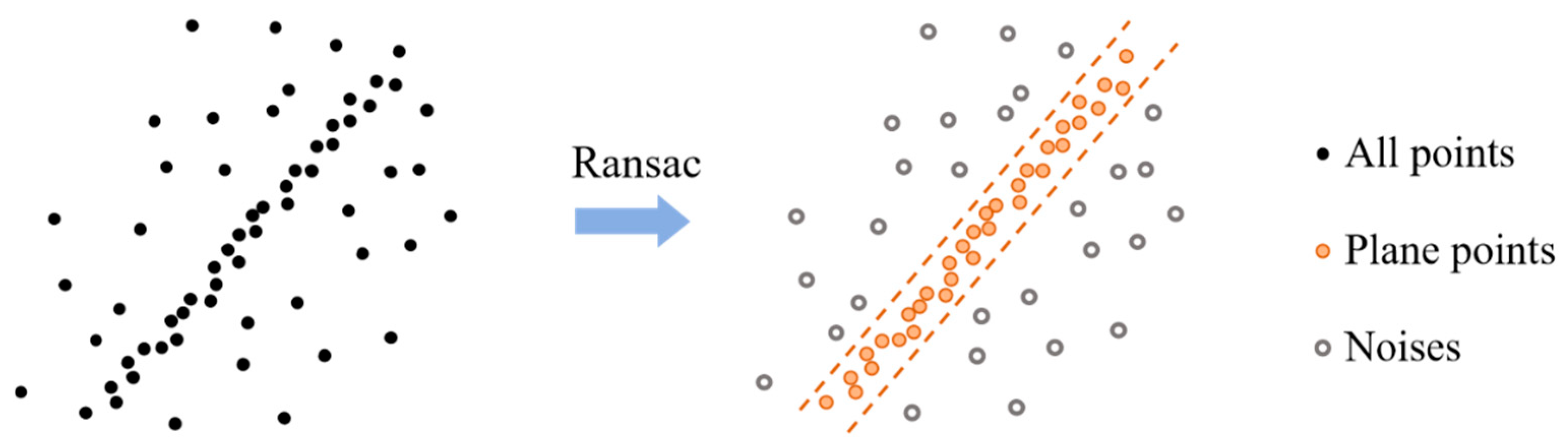
To extract the cross-sectional dimensions from the projected point cloud, the Random Sample Consensus (RANSAC) algorithm is employed to robustly fit straight lines to the boundary points of the cross-section. As shown in Figure 6, RANSAC identifies each boundary line by randomly sampling minimal subsets of points to generate candidate line models, evaluating the inliers that best fit the majority of points. Once a boundary is detected, its inlier points are removed from the dataset, and the process is repeated to find the next boundary. For a typical rectangular cross-section, this iterative fitting yields four boundary lines corresponding to the edges of the section.
Figure 6.
Ransac algorithm.
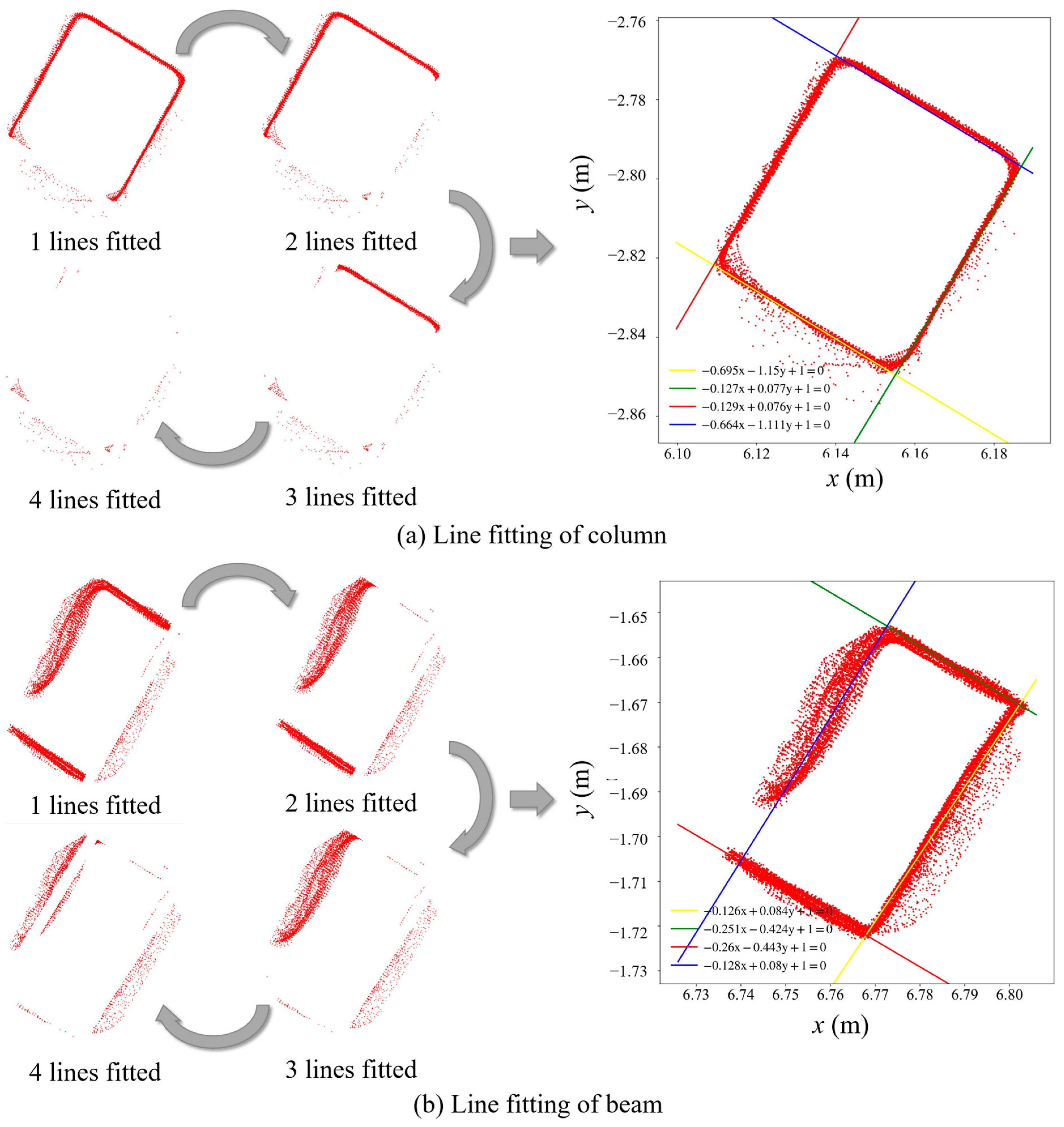
After obtaining the equations for the four boundary lines, the coordinates of their intersection points are calculated. Each pair of neighboring lines forms a vertex of the cross-section. To determine whether two lines are adjacent, the angle between each pair is evaluated. Since the four boundary lines are fitted independently based on the discrete point cloud data, the fitted lines reflect the actual surface conditions of the As-Built structure rather than a theoretical perfect rectangle. Consequently, slight deviations from orthogonality may occur due to surface roughness or noise. To ensure the reliability of the geometric topology, a tolerance threshold is applied, and those with an angle close to 90° are identified as neighboring boundaries. The intersection points of these pairs are then taken as the four vertices of the cross-section. The intersection coordinates for two lines can be computed according to Equations (1)–(3).
The edge lengths of the cross-section are calculated by determining the Euclidean distances between each pair of adjacent intersection points. To ensure that a computed distance represents an actual edge of the cross-section, it is necessary to verify that the two intersection points share a common boundary line. Only when this condition is met can the distance be regarded as a valid edge length. After this verification, the lengths of all four edges can be accurately obtained, thus defining the dimensions of the component’s cross-section, as illustrated in Figure 7. This workflow ensures precise estimation of the cross-sectional dimensions. The complete procedure for dimension extraction is summarized in Algorithm 1.
| Algorithm 1. Calculation of Cross-Section Edge Lengths |
| Input: : array of x-coefficients of line equations;: array of y-coefficients of line equations Output: : edge lengths of the cross-section 1: // Initialization 2: : intersection coordinates 3: : edge index 4: Icaled: indices of edges already computed 5: : The number of lines 6: : computed edge lengths 7: // Compute intersection coordinates 8: for each i in [1, 2, …, − 1] do: 9: for each j in [i, …,] do: 10: , 11: if then: 12: 13: add (x, y) to , add (i, j) to . 14: end 15: end 16: end 17: // The number of intersections 18: // Compute edge lengths 19: for each i in [1, 2, …, − 1] do: 20: for each j in [i, …, ] do: 21: , 22: if there exists a common line index in (, ) then: 23: Ico-edge common line index in (, ) 24: if Ico-edge not in Icaled then: 25: 26: Add Ico-edge to Icaled 27: Add to 28: end 29: end 30: end 31: end 32: return |
Figure 7.
Line fitting based on Ransac algorithm.
2.3. Automated BIM Modelling
An automated BIM modeling workflow for frame structures is established based on the geometric parameters of structural components extracted from point clouds. An automatic modeling script is developed in Python using the open-source IFC library IFCOpenShell, which maps the recognized component types and geometric dimensions to parametric IFC elements. For each identified component, a local coordinate system is generated, and a rectangular extrusion solid is constructed according to its cross-sectional dimensions and axis length, which is then instantiated as IfcColumn, IfcBeam, and other relevant IFC entities. Finally, all components are attached to their corresponding storey nodes and exported as an IFC file, which can be directly opened and visualized in Revit 2023 and other mainstream BIM software.
3. Results and Analysis
3.1. Semantic Segmentation Performance
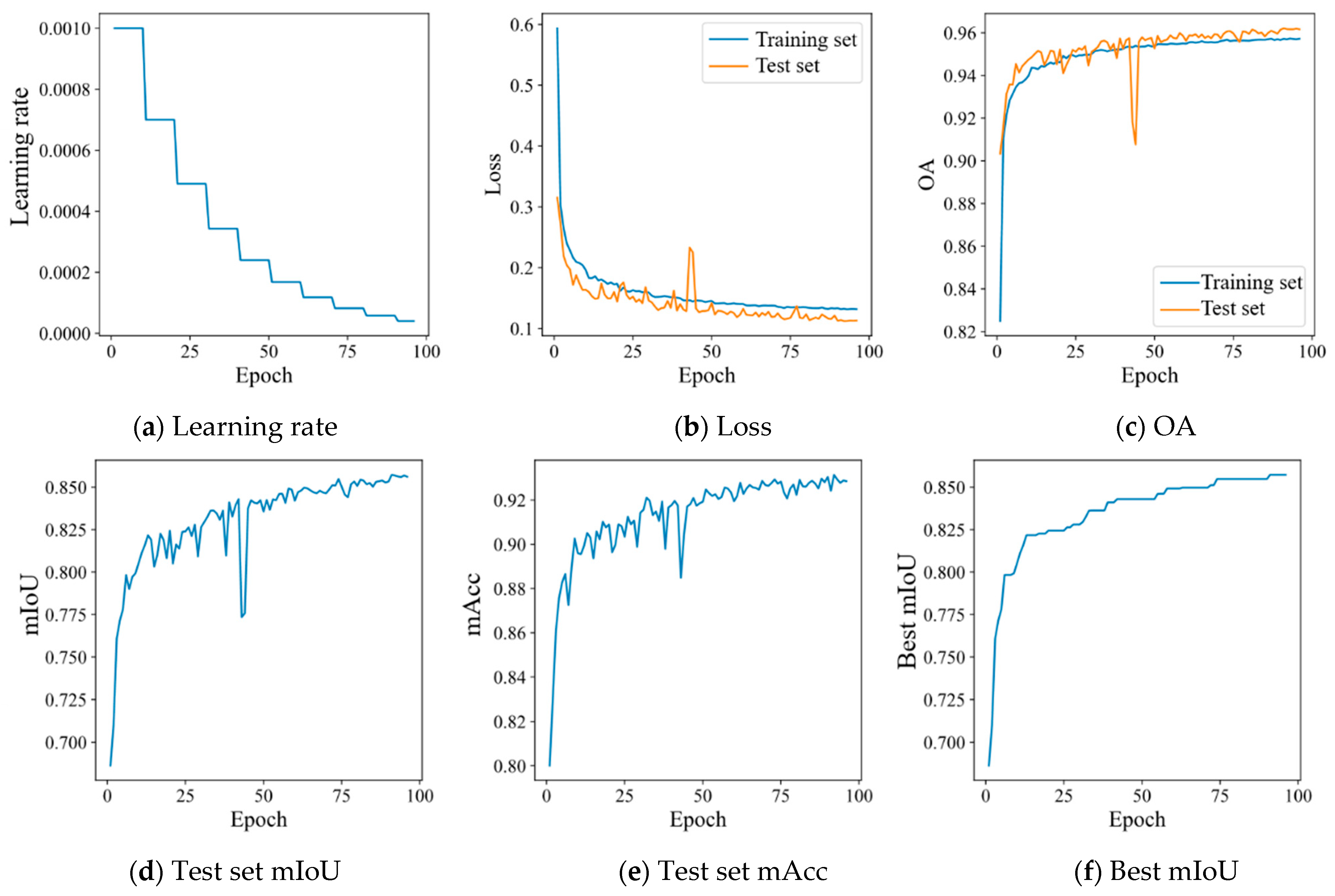
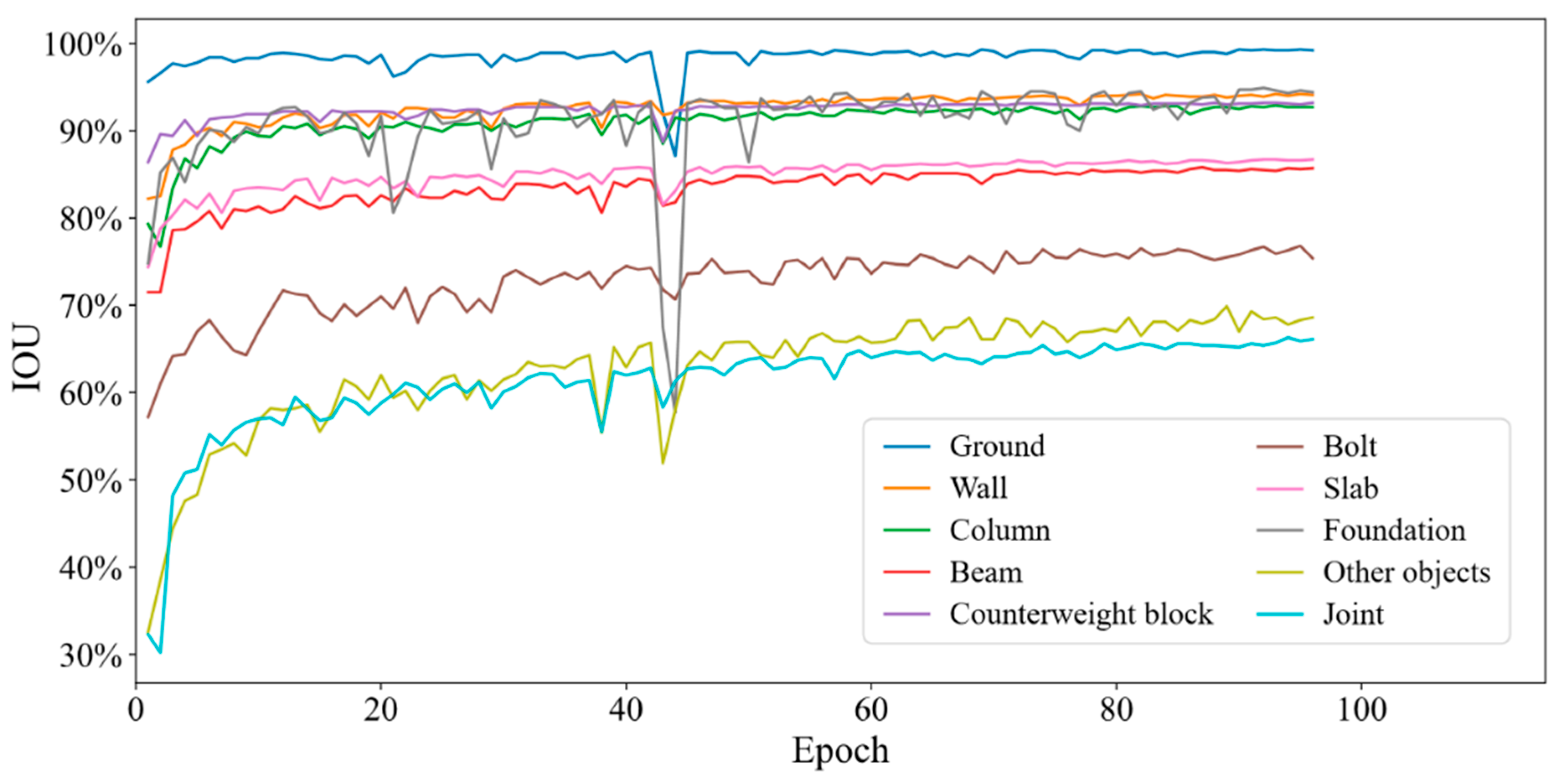
Based on the dataset and implementation details described in Section 2.1.2 and Section 2.1.3, the training process of the PointNet++ model was evaluated using loss, overall accuracy (OA), mean intersection over union (mIoU), and mean accuracy (mAcc). The learning rate decreases steadily according to the step-decay schedule, as shown in Figure 8a. Figure 8b shows that both training and test losses drop rapidly at first and then stabilise at about 0.13 and 0.11, respectively. The test loss fluctuates around epoch 45 but remains lower than the training loss for most epochs, indicating good generalisation. Figure 8c shows that OA for both sets increases quickly and converges, with final values of 95% for training and 96% for testing. The mIoU and mAcc on the test set, shown in Figure 8d,e, follow similar trends, stabilising at about 86% and 93%. Figure 8f presents the best mIoU on the test set during training. Figure 9 shows the IoU curves for each semantic class on the training set.
Figure 8.
Variation in each metric.
Figure 9.
Variation in IoU for each class during training.
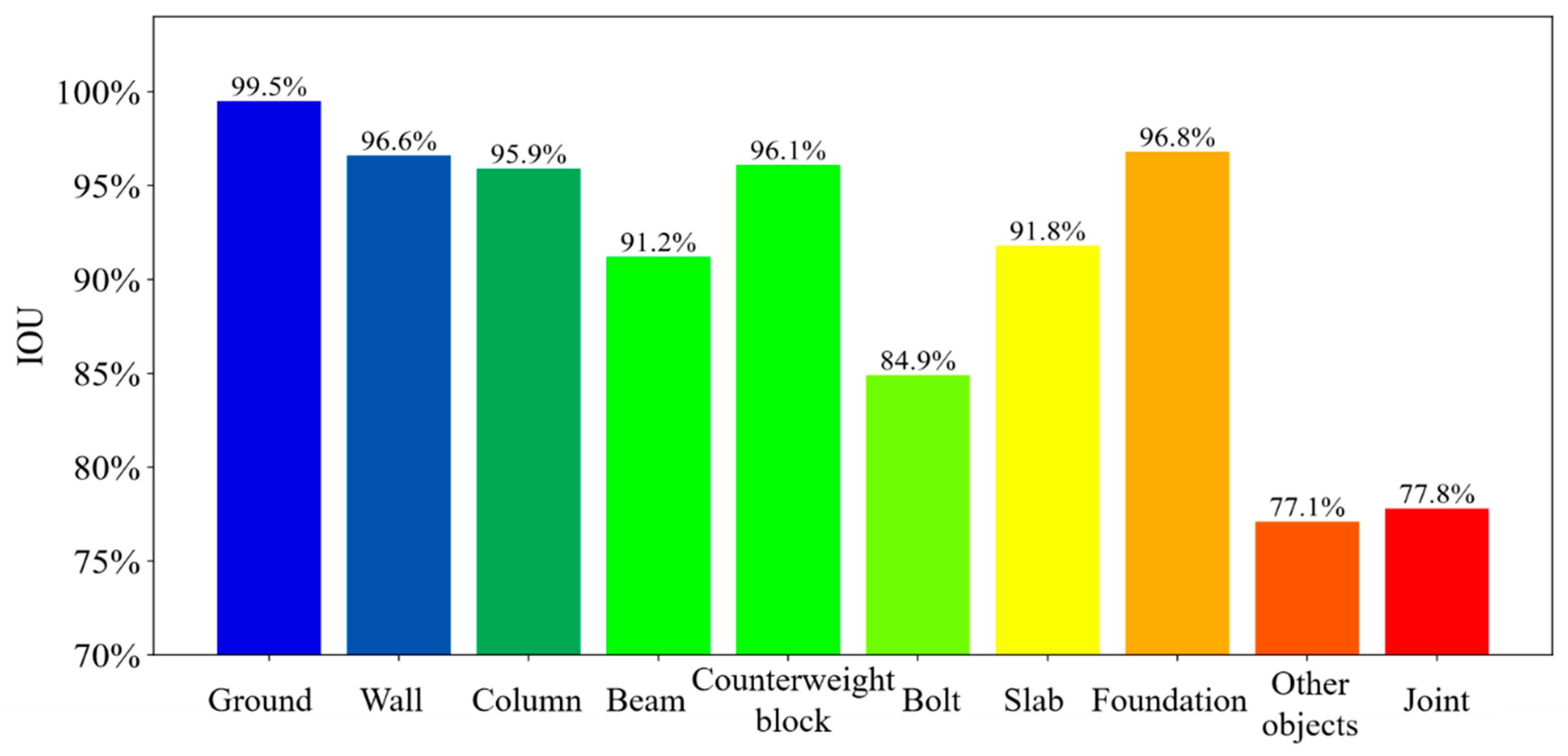
The trained PointNet++ network is tested on 40 point cloud models. The average inference time is about 2 min per model under the described hardware configuration. The quantitative results show that the point cloud models achieve an mIoU of 90.8%, an mAcc of 94.92%, and an OA of 97.8%. All three metrics exceed 90%, which indicates that the overall segmentation performance is very good. The IoU of each semantic class on the test set is summarised in Figure 10. The IoU values for bolts, miscellaneous objects, and joints are relatively lower. This is likely due to their small physical scale and complex local geometric features, which make boundary delineation more challenging compared to large planar elements. However, benefiting from the data augmentation strategy which enhances the learning of global geometric structures, the key structural members maintained high recognition precision. The ground, wall, column, beam, counterweight block, slab, and foundation classes all have IoU values higher than 90%. Since the primary focus of this study is on beams and columns for subsequent BIM modeling, the lower accuracy of the auxiliary classes does not affect the effectiveness of the later geometric information extraction and BIM reconstruction.
Figure 10.
IoU of each class on the test set.
3.2. Geometric Information Extraction and BIM Reconstruction Results
3.2.1. Computational Efficiency Evaluation
The radius threshold dth and maximum neighbor count Thmax are critical for segmentation quality. If dth exceeds 10 mm, noise points bridge the gaps between adjacent joints, causing under-segmentation. Conversely, a dth below 2 mm causes over-segmentation where sparse regions fragment a single component. In this study, dth was set to 5 mm based on the average point spacing to balance connectivity and separation. Additionally, Thmax was set to 50 to optimize efficiency. Experiments showed that 50 neighbors sufficiently capture local geometry, whereas higher values increase kd-tree search time without improving accuracy.
Performance evaluations were conducted on a workstation equipped with an Intel(R) Core(TM) i7-14700KF CPU, using the point cloud model of an eight-story frame structure. Under these optimal parameter settings, the FEC algorithm successfully isolated all structural members, as shown in Figure 4. The clustering process required only 128 s for all beam point clouds and 48 s for column point clouds.
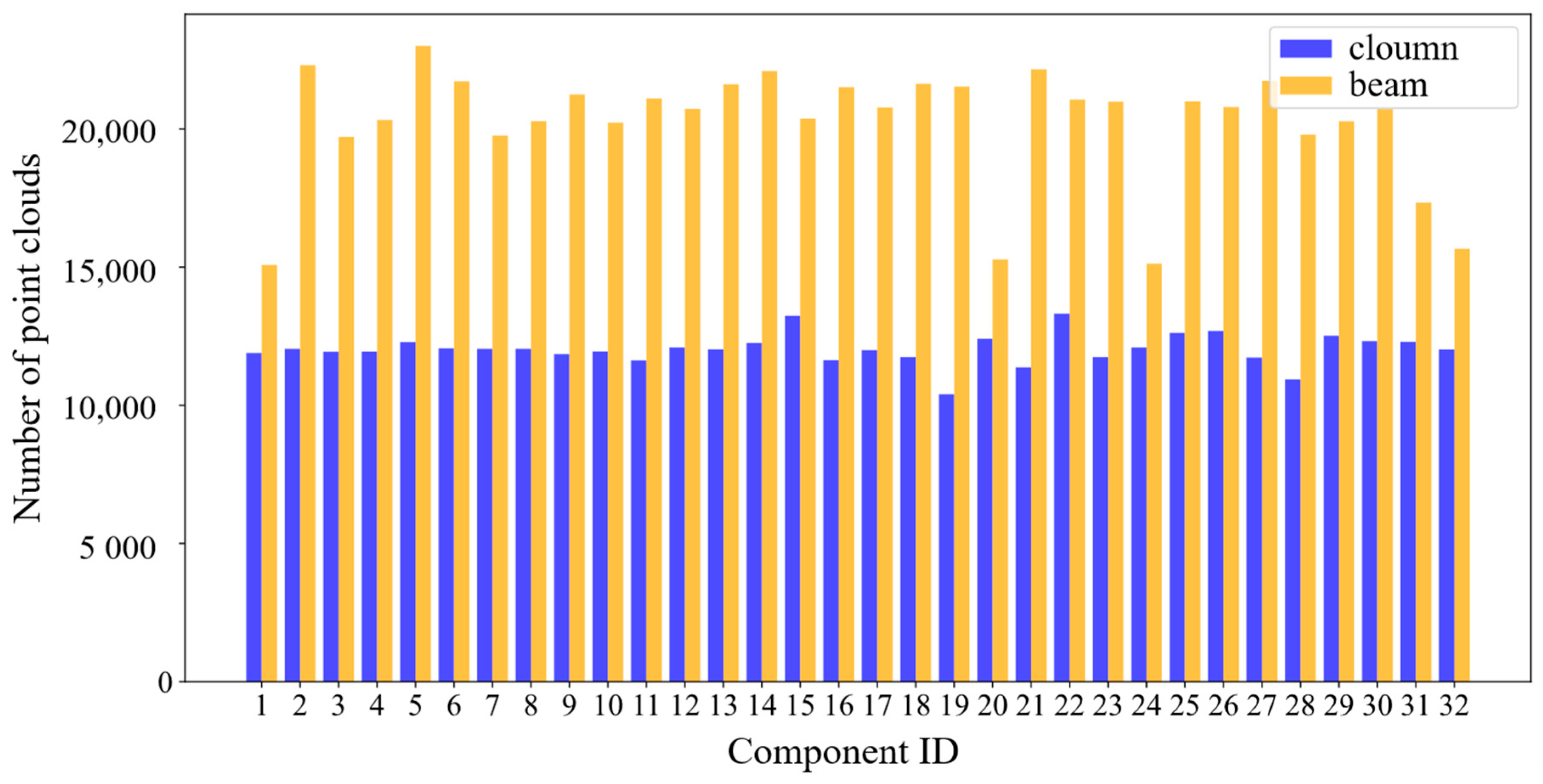
As shown in Figure 11, the total number of points for the beam components was 647,144, averaging 20,223 points per beam. For the columns, the total was 385,480 points, with an average of 12,046 points per column. The total time for geometric information extraction required for all 32 beams was 42 min, with an average time of 78.7 s per beam. The total time required for the 32 columns was 13 min, with an average time of 24.4 s per column.
Figure 11.
Statistical analysis of point cloud number for each component after clustering.
3.2.2. The Accuracy Evaluation
The generated BIM model is shown in Figure 12. To verify the accuracy of the BIM reconstruction results, the dimensions automatically identified by the algorithm were compared with those obtained from manual measurements. The results are presented in Table 1. Since two sides of each beam are connected to the floor slab and cannot be measured directly, only the two exposed sides were measured in practice as the actual length and width of the beam. According to Table 1, the average errors of the automatic recognition for the four sides (w1, l1, w2, and l2) of the 32 beams are 4.7 mm, 1.8 mm, 4.2 mm, and 1.7 mm, respectively.
Figure 12.
Automated BIM modelling.
Table 1.
The comparison between manually measured and automatically identified beam dimensions (mm).
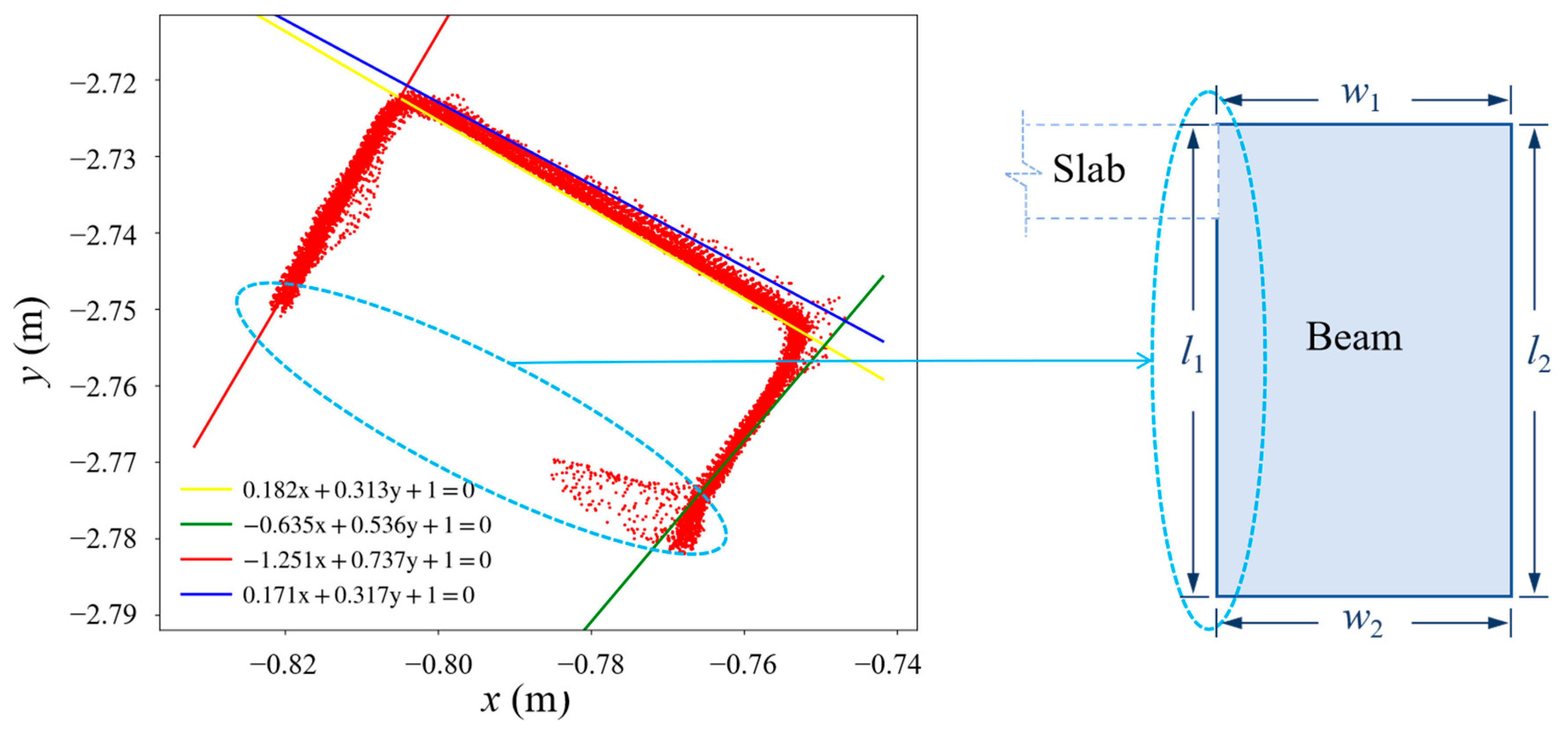
As shown in Table 1, three beams, Nos. 24, 27, and 32, show abnormal recognition results, and the errors of w1 and w2 exceed 2 cm. For example, for Beam No. 32, the errors of the four sides identified by the algorithm are 25.6 mm, 3.4 mm, 27.9 mm, and 4.2 mm, respectively. As shown in Figure 13, the point cloud model of beam No. 32 indicates that one side of the point cloud is missing. The missing side is l1, which is the inner side. Due to the small size of the scaled-down frame model, it is difficult for the UAV to capture clear images of the inner side of the beam, which leads to missing data during point cloud reconstruction. As a result, the l2 side is fitted twice during the modeling process, causing abnormal errors for w1 and w2. After excluding the three abnormal beams, the average errors of w1, l1, w2, and l2 for the remaining beams are 2.3 mm, 1.7 mm, 1.8 mm, and 1.6 mm, respectively. The corresponding average relative errors are 7.61%, 2.89%, 5.91%, and 2.64%.
Figure 13.
Line fitting of Beam No. 32.
Table 2 compares the manually measured and automatically identified dimensions for columns. For the 32 column components, the average errors for w1, l1, w2, and l2 are 1.9 mm, 1.4 mm, 2.0 mm, and 1.4 mm, respectively, with relative errors of 3.72%, 2.28%, 3.91%, and 2.28%.
Table 2.
The comparison between automatically identified and manually measured column dimensions (mm).
Column recognition attains higher accuracy and a lower error compared to beams.
4. Discussion
4.1. Applicability to Full-Scale Conditions
While the experimental validation was conducted on 1:10 scale frame models in a laboratory environment, the transferability to full-scale structures under field conditions involves complexities such as increased noise, variable lighting, and occlusions. To address these challenges, the proposed workflow incorporates several robust features. First, the PointNet++ network was trained using data augmentation including 20% noise and point dropping (as described in Section 2.1.2), enabling it to handle degraded data quality. Second, the RANSAC fitting process is inherently resistant to outliers, ensuring reliable dimension extraction even in noisy environments. Third, by decoupling geometric analysis from color and intensity data, the method remains invariant to lighting and material variability. Since the underlying geometric principles are scale-invariant, the proposed method holds significant potential for full-scale structural modeling. For large-scale point clouds, computational efficiency should also be considered. Implementing downsampling of raw data can significantly reduce the computational load while maintaining the required dimensional accuracy for BIM reconstruction.
4.2. Data Completeness
The proposed method achieved high accuracy for most structural components. Large deviations occurred in three beams, primarily due to restricted UAV flight paths in the scaled model, which led to incomplete point cloud coverage. Beams and columns with well-covered external faces showed accurate dimension recognition. This indicates that the large errors are isolated cases caused by missing data rather than systematic deficiencies of the algorithm. In practical engineering scenarios, larger structures typically allow for more flexible image capture and improved viewpoint coverage, resulting in more complete reconstructions and, consequently, better performance of the proposed workflow. To improve robustness, a reliability index combining point density and RANSAC inlier ratio can be incorporated. For example, when the inlier count for plane fitting falls below a predefined threshold, the component can be flagged as low-confidence or incomplete instead of reporting a potentially unreliable dimension. This strategy enables targeted manual verification while preserving overall automation efficiency. In addition, integrating hole-filling methods to compensate for occlusions and limited viewpoints may further reduce data gaps and improve recognition accuracy in challenging cases.
4.3. Application Scope and Limitations
While the proposed method demonstrates high accuracy on the validation dataset, its application to fully operational buildings faces challenges due to environmental complexities. The presence of non-structural elements such as glass curtain walls and indoor furniture poses occlusion challenges for point cloud recognition. Therefore, the primary application scope of this study is the construction stage after formwork removal or the deep renovation phase where the structural frames are exposed. For the digitization of fully occupied buildings, future implementations would require pre-processing steps including clutter removal algorithms to filter out non-structural interferences before geometric extraction.
5. Conclusions
This study proposes an automated framework for the dimension recognition and BIM reconstruction of reinforced concrete frame structures based on 3D point clouds. The proposed methodology integrates deep learning with robust geometric extraction algorithms to achieve efficient Scan-to-BIM conversion. The principal findings and contributions of this research are summarized in the following three points:
- (1)
- Establishment of an Automated Scan-to-BIM Workflow: A complete technical route was developed, seamlessly linking point cloud semantic segmentation (PointNet++), individual component isolation (FEC clustering), and geometric parameter extraction (PCA and RANSAC). This workflow effectively addresses the challenge of reconstructing frame members, which differs significantly from planar wall reconstruction. An automated Python script based on IFCOpenShell was further developed to map extracted parameters to standard IfcBeam and IfcColumn entities, enabling the direct generation of editable BIM models compatible with mainstream software like Revit.
- (2)
- High-Performance Semantic Segmentation: The trained PointNet++ network demonstrated exceptional robustness in classifying structural components. Quantitative evaluations on the test set yielded an Overall Accuracy (OA) of 97.8%, a Mean Accuracy (mAcc) of 94.92%, and a Mean Intersection over Union (mIoU) of 90.8%. Notably, critical structural elements such as beams, columns, and slabs all maintained IoU scores exceeding 90%, proving that the data augmentation strategy effectively mitigated class imbalance and ensured reliable recognition even in the presence of noise.
- (3)
- Precise Dimension Extraction and Geometric Accuracy: Experimental validation confirmed that the proposed geometric extraction algorithm satisfies the accuracy requirements for engineering reverse modeling. For structural components with complete data coverage, the average dimensional error for columns ranged from 1.4 mm to 2.0 mm, while beams exhibited average errors between 1.6 mm and 2.3 mm, excluding specific occluded cases. These results indicate that the integration of PCA dimensionality reduction and RANSAC boundary fitting can effectively resist point cloud noise and accurately restore the As-Built dimensions of existing structures.
Future research will focus on addressing the identified limitations, specifically by: (1) introducing symmetry-based geometric completion algorithms to resolve modeling errors caused by occlusion; and (2) validating the method’s generalization capabilities in complex, full-scale real-world building scenarios under varying environmental conditions.
Author Contributions
F.Z.: Writing—original draft, Software, Methodology, Conceptualization, Writing—review and editing, Visualization. J.L.: Validation, Software, Writing—review and editing, Methodology. P.L.: Writing—review and editing, Visualization, Supervision, Validation. L.C.: Writing—review and editing, Supervision, Validation, Funding acquisition. Q.X.: Validation, Writing—review and editing, Visualization. All authors have read and agreed to the published version of the manuscript.
Funding
This research was funded by the National Key R&D Program of China (Grant No. 2023YFC3805004).
Data Availability Statement
The original contributions presented in this study are included in this article. Further inquiries can be directed to the corresponding author.
Conflicts of Interest
The authors declare that they have no known competing financial interests or personal relationships that could have appeared to influence the work reported in this paper.
References
- Wei, X.; Liu, Y.; Zuo, X.; Zhong, J.; Yuan, Y.; Wang, Y.; Li, C.; Zou, Y. Automated Arch Profile Extraction from Point Clouds and Its Application in Arch Bridge Construction Monitoring. Buildings 2025, 15, 2912. [Google Scholar] [CrossRef]
- Wu, H.; Ma, M.; Yang, Y.; Han, L.; Wu, S. On-Site Measuring Robot Technology for Post-Construction Quality Assessment of Building Projects. Buildings 2024, 14, 3085. [Google Scholar] [CrossRef]
- Jiang, S.; Yang, Y.; Gu, S.; Li, J.; Hou, Y. Bridge Geometric Shape Measurement Using LiDAR–Camera Fusion Mapping and Learning-Based Segmentation Method. Buildings 2025, 15, 1458. [Google Scholar] [CrossRef]
- Reuland, Y.; Lestuzzi, P.; Smith, I.F.C. An engineering approach to model-class selection for measurement-supported post-earthquake assessment. Eng. Struct. 2019, 197, 109408. [Google Scholar] [CrossRef]
- Maboudi, M.; Backhaus, J.; Mai, I.; Ghassoun, Y.; Khedar, Y.; Lowke, D.; Riedel, B.; Bestmann, U.; Gerke, M. Very high resolution bridge deformation monitoring using UAV-based photogrammetry. J. Civ. Struct. Health Monit. 2025, 15, 3489–3508. [Google Scholar] [CrossRef]
- Wang, D.; Liu, J.; Jiang, H.; Liu, P.; Jiang, Q. Existing Buildings Recognition and BIM Generation Based on Multi-Plane Segmentation and Deep Learning. Buildings 2025, 15, 691. [Google Scholar] [CrossRef]
- Piekarczuk, A.; Mazurek, A.; Szer, J.; Szer, I. A Case Study of 3D Scanning Techniques in Civil Engineering Using the Terrestrial Laser Scanning Technique. Buildings 2024, 14, 3703. [Google Scholar] [CrossRef]
- Zhao, J.; Chen, J.; Liang, Y.; Xu, Z. Feature Selection-Based Method for Scaffolding Assembly Quality Inspection Using Point Cloud Data. Buildings 2024, 14, 2518. [Google Scholar] [CrossRef]
- Patil, J.; Kalantari, M. Automatic Scan-to-BIM—The Impact of Semantic Segmentation Accuracy. Buildings 2025, 15, 1126. [Google Scholar] [CrossRef]
- Keitaanniemi, A.; Virtanen, J.-P.; Rönnholm, P.; Kukko, A.; Rantanen, T.; Vaaja, M. The Combined Use of SLAM Laser Scanning and TLS for the 3D Indoor Mapping. Buildings 2021, 11, 386. [Google Scholar] [CrossRef]
- Nowak, R.; Orłowicz, R.; Rutkowski, R. Use of TLS (LiDAR) for Building Diagnostics with the Example of a Historic Building in Karlino. Buildings 2020, 10, 24. [Google Scholar] [CrossRef]
- Masiero, A.; Fissore, F.; Guarnieri, A.; Pirotti, F.; Visintini, D.; Vettore, A. Performance evaluation of two indoor mapping systems: Low-Cost UWB-aided photogrammetry and backpack laser scanning. Appl. Sci. 2018, 8, 416. [Google Scholar] [CrossRef]
- Li, J.; Peng, Y.; Tang, Z.; Li, Z. Three-Dimensional Reconstruction of Railway Bridges Based on Unmanned Aerial Vehicle–Terrestrial Laser Scanner Point Cloud Fusion. Buildings 2023, 13, 2841. [Google Scholar] [CrossRef]
- Zhou, Z.; Gong, J.; Guo, M. Image-Based 3D Reconstruction for Posthurricane Residential Building Damage Assessment. J. Comput. Civ. Eng. 2016, 30, 04015015. [Google Scholar] [CrossRef]
- Hao, D.; Li, Y.; Liu, H.; Xu, Z.; Zhang, J.; Ren, J.; Wu, J. Deformation monitoring of large steel structure based on terrestrial laser scanning technology. Measurement 2025, 248, 116962. [Google Scholar] [CrossRef]
- Ma, J.W.; Czerniawski, T.; Leite, F. Semantic segmentation of point clouds of building interiors with deep learning: Augmenting training datasets with synthetic BIM-based point clouds. Autom. Constr. 2020, 113, 103144. [Google Scholar] [CrossRef]
- Perez-Perez, Y.; Golparvar-Fard, M.; El-Rayes, K. Segmentation of point clouds via joint semantic and geometric features for 3D modeling of the built environment. Autom. Constr. 2021, 125, 103584. [Google Scholar] [CrossRef]
- Schnabel, R.; Wahl, R.; Klein, R. Efficient RANSAC for point-cloud shape detection. In Computer Graphics Forum; Wiley: Hoboken, NJ, USA, 2007; Volume 26, pp. 214–226. [Google Scholar]
- Adams, R.; Bischof, L. Seeded region growing. IEEE Trans. Pattern Anal. Mach. Intell. 1994, 16, 641–647. [Google Scholar] [CrossRef]
- Yang, J.; Zhang, D.; Frangi, A.F.; Yang, J.-Y. Two-Dimensional PCA: A New Approach to Appearance-Based Face Representation and Recognition. IEEE Trans. Pattern Anal. Mach. Intell. 2004, 26, 131–137. [Google Scholar] [CrossRef] [PubMed]
- Charles, R.Q.; Su, H.; Kaichun, M.; Guibas, L.J. PointNet: Deep Learning on Point Sets for 3D Classification and Segmentation. In Proceedings of the 2017 IEEE Conference on Computer Vision and Pattern Recognition (CVPR), Honolulu, HI, USA, 21–26 July 2017. [Google Scholar]
- Qi, C.R.; Yi, L.; Su, H.; Guibas, L.J. PointNet++: Deep Hierarchical Feature Learning on Point Sets in a Metric Space. In Proceedings of the Advances in Neural Information Processing Systems 30 (NIPS 2017), Long Beach, CA, USA, 4–9 December 2017. [Google Scholar]
- Hamid-Lakzaeian, F. Point cloud segmentation and classification of structural elements in multi-planar masonry building facades. Autom. Constr. 2020, 118, 103232. [Google Scholar] [CrossRef]
- Zhou, Z.; Gong, J. Automated Analysis of Mobile LiDAR Data for Component-Level Damage Assessment of Building Structures during Large Coastal Storm Events. Comput. Aided Civ. Eng. 2018, 33, 373–392. [Google Scholar] [CrossRef]
- Kim, H.; Yoon, J.; Sim, S. Automated bridge component recognition from point clouds using deep learning. Struct. Control Health Monit. 2020, 27, e2591. [Google Scholar] [CrossRef]
- Lu, R.; Brilakis, I.; Middleton, C.R. Detection of Structural Components in Point Clouds of Existing RC Bridges. Comput. Aided Civ. Eng. 2019, 34, 191–212. [Google Scholar] [CrossRef]
- Pan, Y.; Dong, Y.; Wang, D.; Chen, A.; Ye, Z. Three-Dimensional Reconstruction of Structural Surface Model of Heritage Bridges Using UAV-Based Photogrammetric Point Clouds. Remote Sens. 2019, 11, 1204. [Google Scholar] [CrossRef]
- Yi, C.; Lu, D.; Xie, Q.; Xu, J.; Wang, J. Tunnel Deformation Inspection via Global Spatial Axis Extraction from 3D Raw Point Cloud. Sensors 2020, 20, 6815. [Google Scholar] [CrossRef]
- Dabrowski, P.S. Novel PCSE-based approach of inclined structures geometry analysis on the example of the Leaning Tower of Pisa. Measurement 2022, 189, 110462. [Google Scholar] [CrossRef]
- Yang, S.; Hou, M.; Li, S. Three-Dimensional Point Cloud Semantic Segmentation for Cultural Heritage: A Comprehensive Review. Remote Sens. 2023, 15, 548. [Google Scholar] [CrossRef]
- Lee, J.S.; Park, J.; Ryu, Y.-M. Semantic segmentation of bridge components based on hierarchical point cloud model. Autom. Constr. 2021, 130, 103847. [Google Scholar] [CrossRef]
- Wang, Q.; Kim, M.-K.; Cheng, J.C.P.; Sohn, H. Automated quality assessment of precast concrete elements with geometry irregularities using terrestrial laser scanning. Autom. Constr. 2016, 68, 170–182. [Google Scholar] [CrossRef]
- Kim, M.-K.; Sohn, H.; Chang, C.-C. Automated dimensional quality assessment of precast concrete panels using terrestrial laser scanning. Autom. Constr. 2014, 45, 163–177. [Google Scholar] [CrossRef]
- Kim, M.-K.; Thedja, J.P.P.; Wang, Q. Automated dimensional quality assessment for formwork and rebar of reinforced concrete components using 3D point cloud data. Autom. Constr. 2020, 112, 103077. [Google Scholar] [CrossRef]
- Bosché, F.; Ahmed, M.; Turkan, Y.; Haas, C.T.; Haas, R. The value of integrating Scan-to-BIM and Scan-vs-BIM techniques for construction monitoring using laser scanning and BIM: The case of cylindrical MEP components. Autom. Constr. 2015, 49, 201–213. [Google Scholar] [CrossRef]
- Shu, J.; Zeng, Z.; Li, W.; Zhou, S.; Zhang, C.; Xu, C.; Zhang, H. Automatic geometric digital twin of box girder bridge using a laser-scanned point cloud. Autom. Constr. 2024, 168, 105781. [Google Scholar] [CrossRef]
- Pantoja-Rosero, B.G.; Achanta, R.; Kozinski, M.; Fua, P.; Perez-Cruz, F.; Beyer, K. Generating LOD3 building models from structure-from-motion and semantic segmentation. Autom. Constr. 2022, 141, 104430. [Google Scholar] [CrossRef]
- Jing, Y.; Sheil, B.; Acikgoz, S. Segmentation of large-scale masonry arch bridge point clouds with a synthetic simulator and the BridgeNet neural network. Autom. Constr. 2022, 142, 104459. [Google Scholar] [CrossRef]
- Wang, Y.; Sun, Y.; Liu, Z.; Sarma, S.E.; Bronstein, M.M.; Solomon, J.M. Dynamic Graph CNN for Learning on Point Clouds. ACM Trans. Graph. 2019, 38, 1–12. [Google Scholar] [CrossRef]
- Zhao, H.; Jiang, L.; Jia, J.; Torr, P.H.S.; Koltun, V. Point Transformer. In Proceedings of the IEEE/CVF International Conference on Computer Vision, Montreal, BC, Canada, 11–17 October 2021. [Google Scholar]
- Thomas, H.; Qi, C.R.; Deschaud, J.-E.; Marcotegui, B.; Goulette, F.; Guibas, L. KPConv: Flexible and Deformable Convolution for Point Clouds. In Proceedings of the 2019 IEEE/CVF International Conference on Computer Vision (ICCV), Seoul, Republic of Korea, 27 October–2 November 2019. [Google Scholar]
- Cao, Y.; Wang, Y.; Xue, Y.; Zhang, H.; Lao, Y. FEC: Fast Euclidean Clustering for Point Cloud Segmentation. Drones 2022, 6, 325. [Google Scholar] [CrossRef]
Disclaimer/Publisher’s Note: The statements, opinions and data contained in all publications are solely those of the individual author(s) and contributor(s) and not of MDPI and/or the editor(s). MDPI and/or the editor(s) disclaim responsibility for any injury to people or property resulting from any ideas, methods, instructions or products referred to in the content. |
© 2026 by the authors. Licensee MDPI, Basel, Switzerland. This article is an open access article distributed under the terms and conditions of the Creative Commons Attribution (CC BY) license.