Article

Power Losses of the High-Voltage High-Frequency Coaxial Cable Energy Transfer System

1
Power Electronics, Electrical Drives and Robotics Department (KENER), Silesian University of Technology, Krzywoustego 2, 44-100 Gliwice, Poland
2
KOMAG Institute of Mining Technology, Pszczyńska 37, 44-100 Gliwice, Poland
*
Author to whom correspondence should be addressed.
Electronics 2026, 15(1), 93; https://doi.org/10.3390/electronics15010093 (registering DOI)
Submission received: 3 November 2025 / Revised: 19 December 2025 / Accepted: 22 December 2025 / Published: 24 December 2025
(This article belongs to the Special Issue Smart Grid Technologies and Energy Conversion Systems)

Abstract

The paper shows the construction and operation of the High-Voltage High-Frequency Coaxial Cable Energy Transfer System dedicated to a three-phase 500 V mining grid with an ungrounded neutral point. The correct operation of the model was verified through simulation and experiments. This paper focuses on the overall system efficiency and the power loss analysis of its components. Based on these measurements, it is concluded that the presented system is suitable for mining applications, where high energy conversion efficiency is essential due to the difficulty of dissipating heat to the environment.

1. Introduction

Power electronic converters are employed in a wide range of applications, including industrial systems, energy systems, transportation, and consumer electronics. In all these cases, their operation involves converting electrical energy from one form to another. This conversion is subject to power losses. To ensure proper operation with limited converter internal temperatures, it is necessary to use sufficiently efficient cooling. This is most often carried out using forced air fans. In high-power converters, a more expensive solution is also used, i.e., liquid cooling with deionized water or other liquids [1,2]. However, in some applications, implementing forced cooling systems is exceptionally challenging, such as in underground mining. This is due to the presence of an explosive or dusty atmosphere, high humidity, and strong vibrations, which can lead to leaks in liquid-cooling systems. The solution to such a problem is the need to build highly efficient converters that achieve lower power losses, resulting in lower temperatures inside the converter and, in turn, extending their service life.
In underground mining applications, electrical energy is often transmitted over long distances while maintaining relatively low power losses. This can be achieved using low- or high-voltage three-phase systems operating at 50/60 Hz, or through direct-voltage transmission, e.g., LVDC or HVDC [3,4]. The use of electric systems is also associated with the integration of energy storage, typically in the form of batteries. The adoption of battery-powered electric systems for underground mine transportation helps to reduce emissions, noise levels, and ventilation requirements [5,6].
Currently, most power transmission systems are composed of multiple interconnected subsystems. In such architectures, voltage conversion is frequently required, along with galvanic isolation to enable series interconnection of subsystems and to ensure proper fault decoupling between them. These functionalities are typically achieved using converters equipped with transformers, most often operating at medium frequencies inside isolated DC-DC converters. Numerous studies demonstrate the integration of isolated DC-DC converters with photovoltaic (PV) installations [7,8], battery energy storage systems (BESS) [9,10], and wind energy conversion systems (WECS) [11,12]. Hybrid configurations combining, for example, PV systems with energy storage units have also been widely reported [13,14,15]. Publications on modular multilevel converters (MMC) designed as HVDC interfaces for utility-scale PV systems emphasize that such systems typically incorporate isolated DC–DC conversion stages or medium-frequency transformers to provide galvanic isolation, voltage adaptation, and fault decoupling, even though the MMC itself is not an isolated converter topology [15]. Although the present work focuses on a single-phase high-voltage, high-frequency cable-based energy transfer system intended for underground mining applications, the challenges related to electrical isolation, fault decoupling, and efficient power transfer are conceptually aligned with those encountered in modern HVDC systems interfacing renewable energy sources.
This paper analyzes an electric energy transmission system using a single-phase high-voltage cable operating at 10 kHz [16,17]. This solution is economically justified by the lower cost of a high-voltage cable compared to a three-phase or HVDC cable, as well as its much lower weight. Reducing the weight of the cable significantly facilitates its transport and installation in mining applications.
The use of a high-voltage, high-frequency cable requires converters that convert energy from the 50 Hz circuit to the high-frequency circuit and from the high-frequency circuit to either direct voltage or a 50 Hz alternating voltage circuit. Another obstacle when using high-frequency cables is the occurrence of radiated disturbances. These disturbances can be effectively eliminated by using an appropriate cable, e.g., a coaxial cable [18]. Using a high-voltage cable reduces the active cross-section of the conductor; however, this is achieved at the expense of strengthening the cable insulation. However, this action has a more beneficial effect on the insulation-to-copper weight ratio. This means the high-voltage cable will have a lower specific weight (given in kg/km).
A power transmission system was developed based on a concept similar to the Single Wire Energy Transfer (SWET) principle [19,20]. Such systems are characterized by a simplified structure, a reduced number of conductors, and high efficiency resulting from resonant operation at a high frequency. Additional advantages include lower voltage drops and improved operational safety, as high-frequency current is less hazardous to humans compared to a 50 Hz mains current. However, since the use of the earth as a return path is not permitted in mining environments due to safety requirements and the protection of electrical equipment, a coaxial cable was selected for energy transmission, while maintaining high-voltage and high-frequency operating parameters.
The energy transfer system using a coaxial cable can employ resonant inverters with various resonant-circuit topologies [21]. In the developed system, a resonant converter topology was selected, consisting of two series-resonant circuits separated by the capacitance representing the coaxial cable. This converter is referred to in the paper as a dual resonant converter.
The choice of this resonant circuit topology was motivated by its relative simplicity and its ability to maintain a stable output voltage transfer function regardless of load power variations. The designed resonant circuit was selected solely because its resonant frequency was approximately equal to the switching frequency of 10 kHz.
The main contributions of this work are as follows:
(1)
A complete modeling framework for the medium-frequency energy-transfer system, including all converters and passive components, enabling system-level analysis.
(2)
A comprehensive loss analysis covering semiconductors, inductors, transformers, and the medium-frequency cable, identifying dominant loss mechanisms and their impact on natural-cooling operation constraints.
The paper is organized as follows: Section 2 provides a general description of a high-voltage, high-frequency coaxial cable energy transfer system divided into its component converters. Section 3 presents an analytical model of power losses for all component converters in the analyzed energy transfer system, providing a detailed description. Section 4 will present a summary of the results obtained for the entire High-Voltage High-Frequency Coaxial Cable Energy Transfer system, whereas Section 4 will present the conclusions.

2. Description of the System

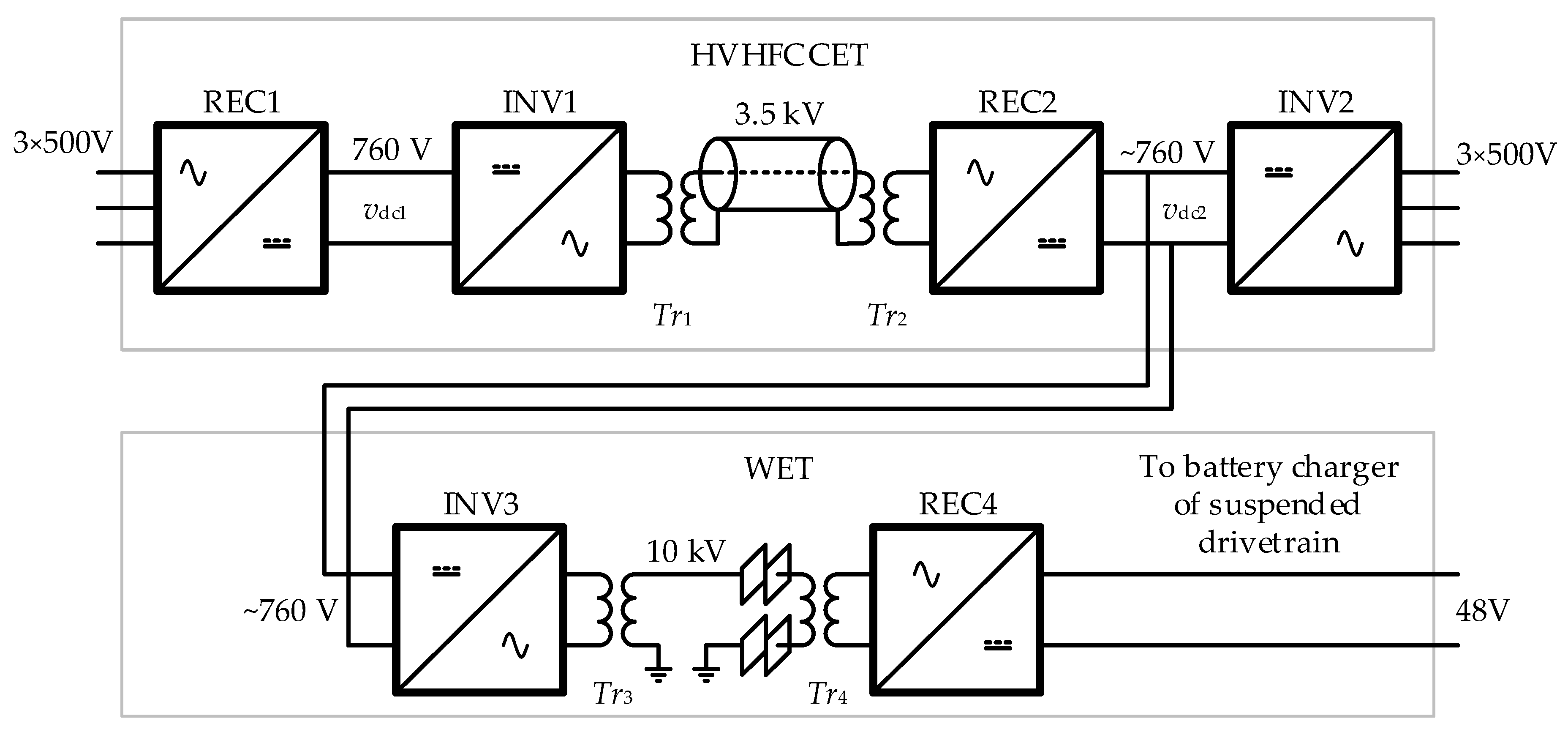
The High-Voltage High-Frequency Coaxial Cable Energy Transfer (HVHFCCET) and Wireless Energy Transfer (WET) systems, together with their main electrical parameters, are presented in Figure 1.
The High-Voltage High-Frequency Coaxial Cable Energy Transfer is composed of the following components:
  • REC1 is a grid-tied three-phase converter operating as a rectifier with a power factor close to unity. The converter is equipped with an LCL-type AC filter, whose general design principles for grid-connected applications are described in [22,23], while the detailed design methodology of the specific LCL filter used in this work is presented in publication [24]. The converter operates at a switching frequency of 50 kHz. For a grid line-to-line voltage of 500 V, the output DC-link voltage is set to 760 V and can be increased up to 870 V.
  • INV1 is a converter that operates as a resonant inverter to deliver the energy to High-Voltage High-Frequency Coaxial Cable (HVHFCC) through a resonant tank and the Tr1 transformer. The switching frequency is set to 10 kHz, and the HVHFCC operating voltage is 3.5 kV. The transformer Tr1 is a step-up transformer with the turns ratio Nprim/Nsec = 0.2288.
  • A 100 m coaxial cable RG11/U was used as the HVHFCC. The RG11/U cable meets the US Military specification MIL-C-17, with a nominal peak voltage of 5.2 kV and a characteristic impedance of Z = 75 Ω.
  • Transformer TR2 with the second resonant tank and REC2 rectifier converts energy from the coaxial cable to a DC output, at which the voltage is varied between 700 V and 870 V. The combination of converters INV1 and REC2, two transformers Tr1 and Tr2, a coaxial cable, and two resonant circuits forms a converter known as the dual-series resonant converter. The transformer TR2 is a step-down transformer with the turns ratio Nsec/Nprim = 4.3703.
  • INV2 is a three-phase inverter. Converter INV2 is structurally identical to REC1; however, the direction of power transfer is opposite. In REC1, power flows from the AC side to the DC side, while in INV2, it flows from the DC side to the AC side. The inverter produces a three-phase 500 V, 50 Hz supply. An LCL filter with the same topology as that used in REC1 is connected to the INV2 output. INV2 is controlled using PWM with a switching frequency of 50 kHz, and third-harmonic injection is applied to the modulation signals to increase the available modulation range.
The Wireless Energy Transfer is used to supply the battery charger of the suspended drivetrain. This system is composed of the following components:
  • INV3 is a resonant inverter, which operates as a high-frequency, high-voltage AC source to deliver the energy to the REC4 converter through the TR3 transformer, a capacitive coupler, and TR4. The switching frequency of INV3 is equal to 300 kHz.
  • Transformer TR4 with the REC4 is mounted on the moving part of the suspended monorail and converts energy from the capacitive coupler to a 48 V DC voltage. This voltage feeds the battery charger.
The Wireless Energy Transfer has been thoroughly covered in refs. [16,17] and is beyond the scope of the present paper. The rated power of the entire system (HVHFCCET with WET) is 7 kW, of which 2 kW is associated with the WET section, while the remaining 5 kW is transferred to the three-phase output of the INV2 converter. Since the INV3 and REC4 converter stage is not analyzed in this work, it is assumed that the total output power at the output of the INV2 converter may vary from 0 to 7 kW.
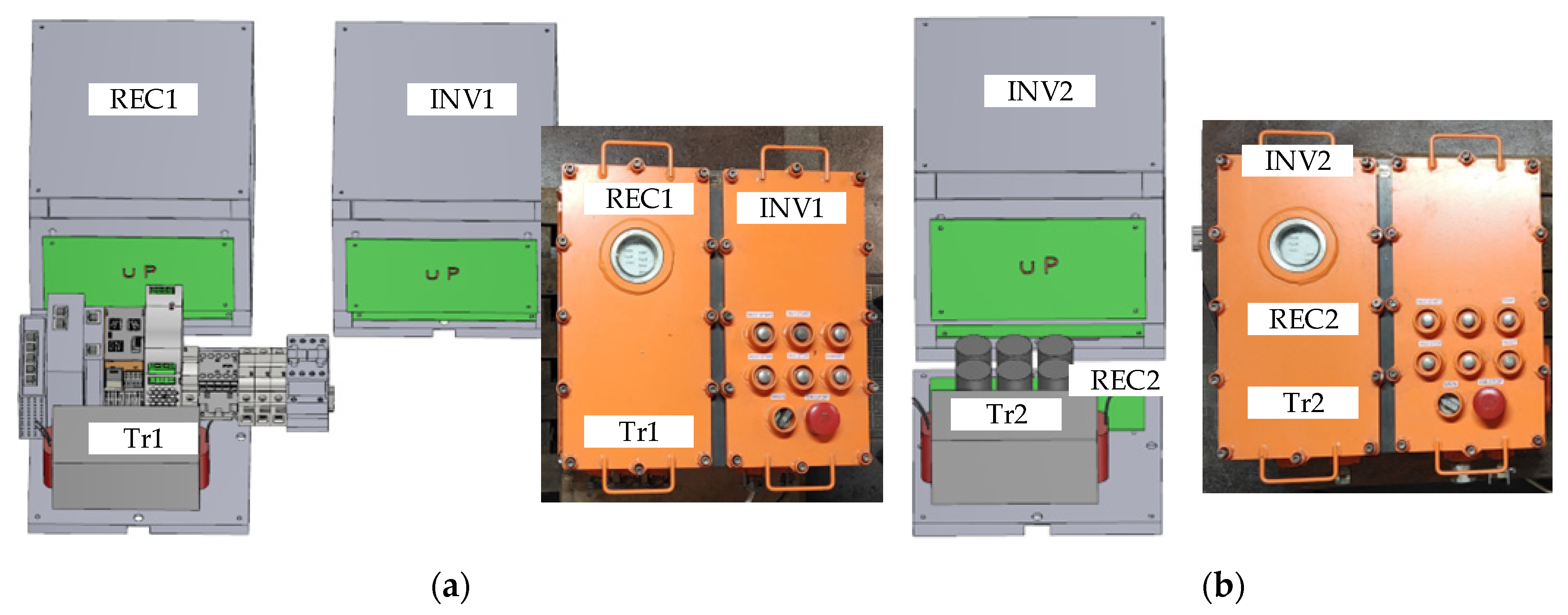
Figure 2 illustrates the physical arrangement of the main components of the HVHFCCET system within two explosion-proof enclosures. The first enclosure (Figure 2a) houses the REC1 and INV1 converters together with the input-side resonant circuit. The second enclosure (Figure 2b) contains the output-side resonant circuit as well as the INV2 and REC2 converters.

3. Power Loss Analysis

Power loss calculations and measurements were performed for three parts of the converter system. In the first part, the power losses of the AC grid converter, comprising the REC1 converter and grid filters, are presented. In the second part, the power losses of a dual resonant converter composed of the INV1 resonant converter, transformers with the coaxial cable, and the REC2 converter are depicted. In the third part, the power losses of the INV2 converter with filters are shown.

3.1. AC Grid Converter Losses

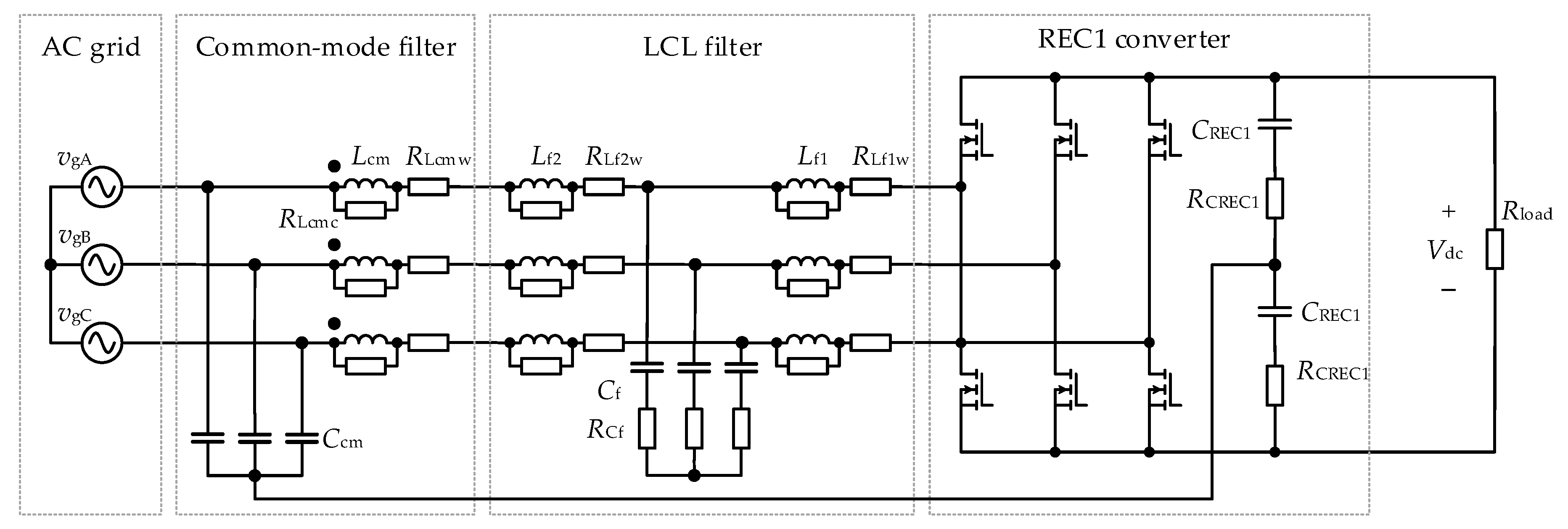
Figure 3 shows the connection of the REC1 converter to the three-phase 500 V grid. The REC1 is a two-level SiC MOSFET converter switching at a frequency of fS = 50 kHz. Between the grid and the converter, a common-mode filter and an LCL filter are placed. The common-mode filter suppresses 50 kHz disturbances and their harmonics.
Table 1 presents the key parameters of the REC1 converter and the filters, including the resistive components where power losses occur. The parameters listed in Table 1 are a combination of design values (e.g., voltages) and experimentally measured characteristics of the passive filter elements, including their inductances and capacitances. The winding resistances of the inductors were determined for the highest winding temperature expected during the rated power transfer of 7 kW.

3.1.1. REC1 Converter Losses

The power loss calculations begin with the REC1 converter, which, when operating in conjunction with the power grid, exhibits sinusoidal phase currents. The transistors switch at 50 kHz. In the REC1 converter, losses PT,REC1 occur primarily in the transistors and consist of conduction and switching losses. The purpose of the REC1 converter is to maintain a constant DC-link voltage of Vdc = 760 V.
Conduction losses depend on the phase current and are described by (1):
P Tcon I O = 3 R DSon I O 2
where RDSon is the on-state resistance of a single MOSFET and equals 23 mΩ (for appropriate gate voltage and temperature values), and factor 3 accounts for the number of converter phases. Equation (1) is valid due to the switched operation of the converter; each phase current flows through the one turned-on MOSFET. This is true when the dead time is relatively low, and its effect is neglected.
MOSFET switching losses are calculated based on the switching energy characteristics provided in the transistor’s datasheet [25]. These energies depend on the switched currents, the DC-link voltage, the gate resistance, and the temperature. The energy characteristics are given as functions of the MOSFET current, iT, as (2).
e on i T , V dc = a on i T + b on V dc V dc ;         e off i T , V dc = a off i T + b off V dc V dc
where Vdc is the DC-link voltage, and Vdc = 600 V is the voltage at which the power loss measurements described in the datasheet were conducted. In this formula, a linear relationship between the DC voltage and the power losses is assumed. Switching energies are obtained from the datasheet, considering the gate resistance influence; thus, the following coefficients are obtained: aon = 24.84 μJ/A, bon = 227.7 μJ, aoff = 0, boff = 111.4 μJ/A.
Assuming grid currents are sinusoidal, the switching power losses in all six MOSFETs of the REC1 converter are given by (3).
P Tsw I O , V dc = 6 f S a on + a off π 2 I O + b on + b off 2 V dc V dc
where the DC-link voltage is constant at Vdc = 760 V.
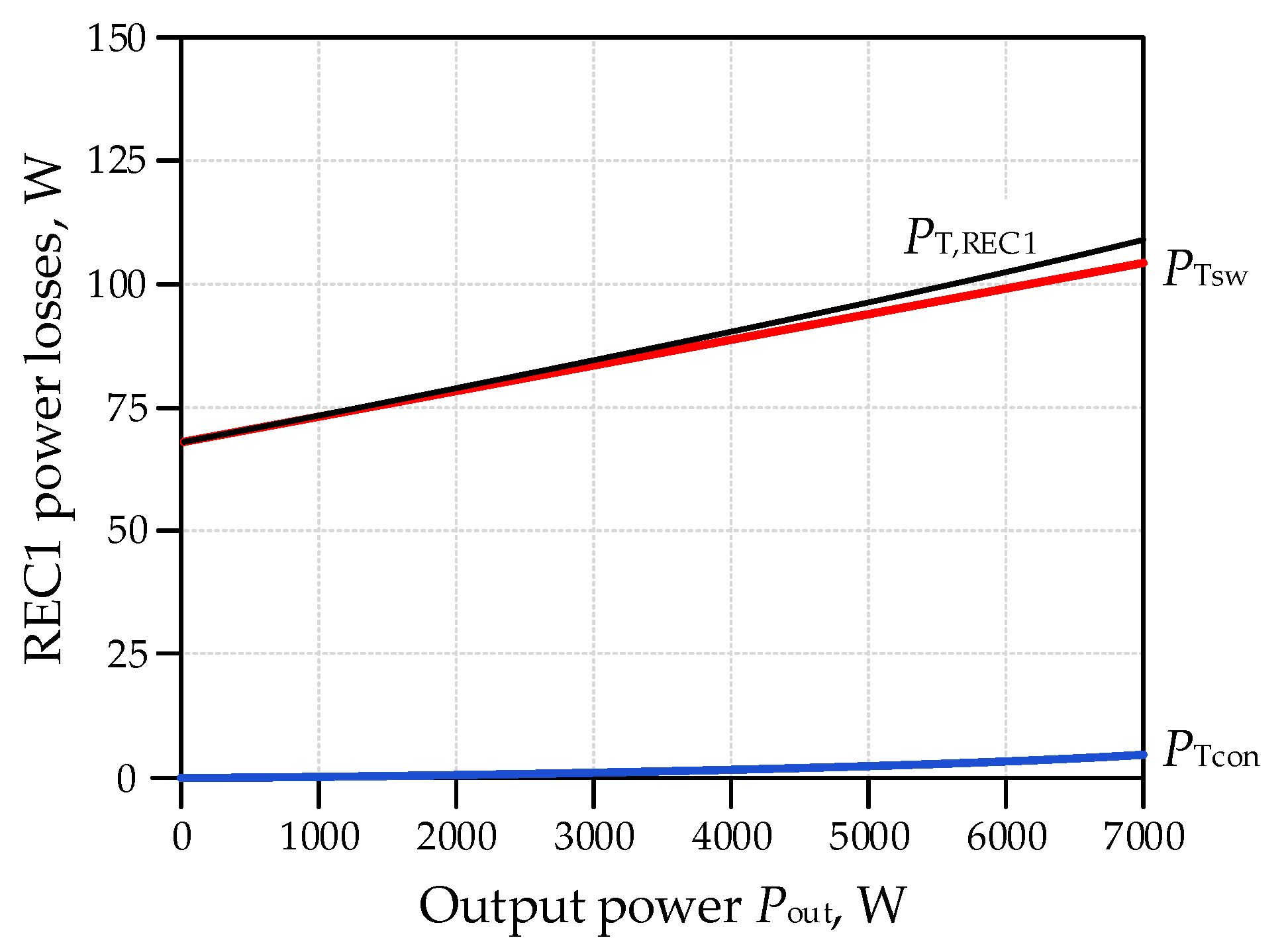
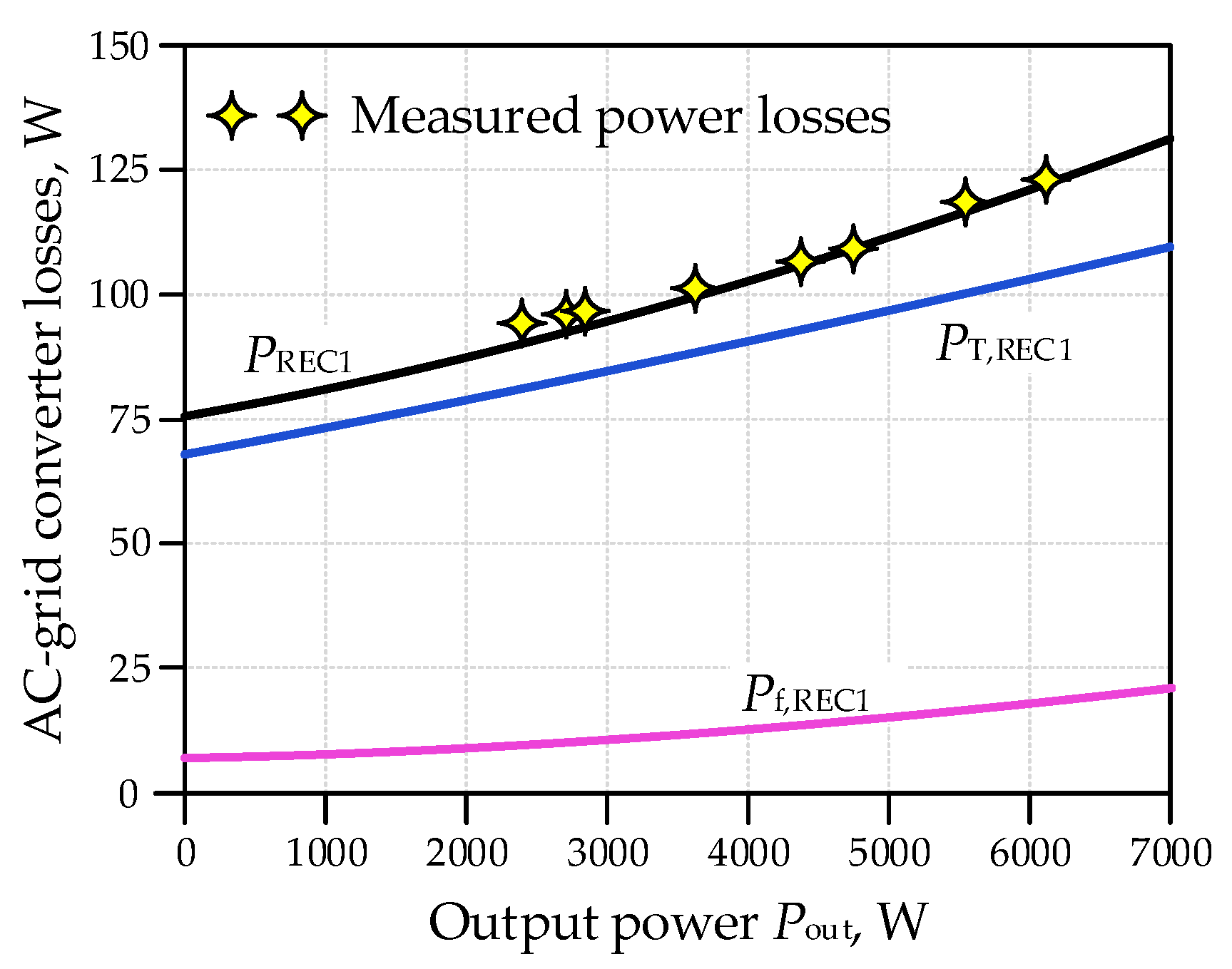
Total transistor power losses of the REC1 converter, PT,REC1, which are the sum of the switching and conduction power losses, are presented as functions of the output power Pout in Figure 4. It is assumed that the phase currents IO are symmetrical and with the power factor close to unity, the corresponding relationship is given in (4).
I O = P O 3 V g
Figure 4 shows that, for the selected switching frequency of 50 kHz, the switching losses PTsw are significantly higher than the conduction losses PTcon. This behaviour results from operating SiC MOSFETs at a relatively high switching frequency, which was chosen to meet the required filter and converter performance constraints.
It should be noted that, in the analysis of REC1 power losses, the output power Pout refers to the power at the DC-link of this converter, which differs from the other cases presented in this paper, where the output power is consistently defined at the end of the subsystem rather than at the INV2 output. Only in the final part of the paper are the power losses of the entire converter system reported with respect to the unified output power Pout at the INV2 output.

3.1.2. Power Losses Generated in Passive Filters of the AC Grid Converter

In the later stages of the REC1 converter power loss calculations, all losses in the LCL and common-mode filter resistances, PCB trace resistances, and the wires connecting the filters to the transistors are considered. For each phase, these resistances are equal to RPCB = 5 mΩ and Rwire = 3 mΩ. The total resistance of the filters, PCB traces, and wires is Rf = RLf1w + RLf2w + RLf1w + RLcmw + RPCB + Rwire = 69 mΩ, and power losses across these resistances are calculated from (5).
P fw = 3 R f P O 3 V g η 2
where η is the efficiency of the converter, assumed to be 98%, is taken into account due to the phase current increase caused by the addition of the converter’s power losses.
In addition to conduction losses in the filters, there are also losses in the series damping resistors of the LCL filter and core losses in the inductors. In the Lf1 inductors, the core losses for each core are PLf1core = 0.6 W, mainly caused by the high-frequency current component. In the Lf2 inductors, the core losses are almost 0 W, since the phase current is nearly sinusoidal. This occurs because the high-frequency current components flow through the Lf1 inductors and the Cf capacitors.
The currents flowing through the Cf capacitors are, in simplified terms, triangular with a frequency of fS = 50 kHz, and their RMS value is practically independent of the output power of the REC1 converter. Based on measurements and simulations, the RMS value of these currents was determined to be ICf = 0.78 A, resulting in power losses in the RCf filter resistor of PRCf = 0.6 W.
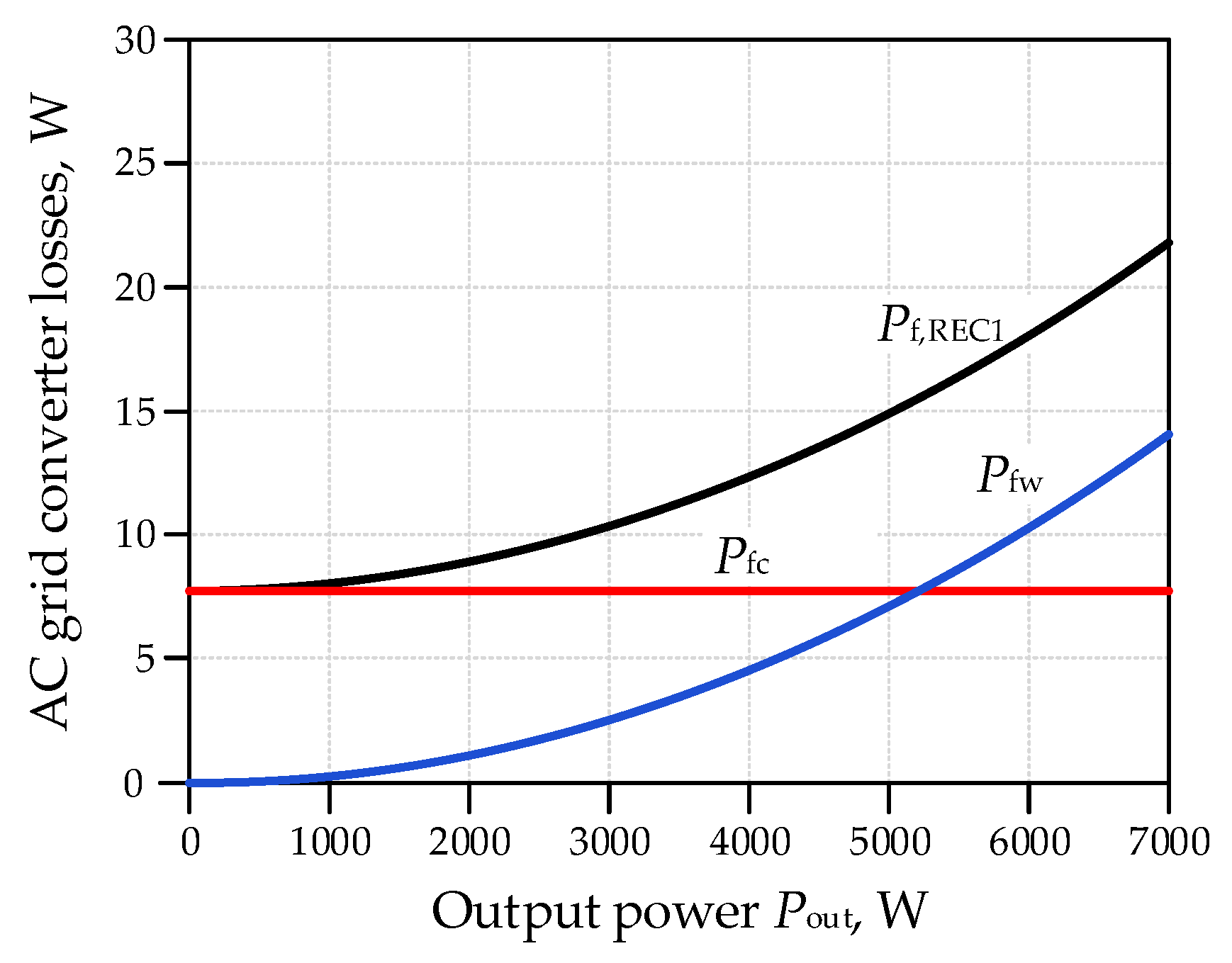
Another source of power losses in the supply path of the REC1 converter, which are not conduction losses, are the core losses in the common-mode choke. It should be noted that this choke compensates common-mode currents at a level of 50 mA [24]. This causes a temperature rise in the choke of approximately 40 °C, allowing the core losses to be estimated at PLcmcore = 4 W. Due to the operation of the REC1 converter with the AC grid, it operates with an almost constant modulation index. Therefore, the common-mode current value does not depend on the output power. Power losses in the AC-grid converter filters, which are independent of the load power, are given in (6).
P fc = 3 P Lf 1 core + 3 P RCf + P Lcmcore = 3 0.6   W + 3 0.6   W + 4   W = 7.6   W
Figure 5 shows the total power losses Pf,REC1 inside the filters of the AC grid converter, along with their components: Pfw and Pfc.

3.1.3. Power Losses Generated in the AC Grid Converter

The sum of all power losses generated inside the transistors and the passive filter of the REC1 converter is shown in Figure 6. These losses are compared with the power losses measured during the efficiency measurement of the converter. The output power was limited to 8 operating points.
Figure 6 shows that the calculated power losses closely match the measured losses. Based on this, it can be concluded that the presented power loss analysis accurately reflects the actual power losses in the REC1 converter.
The simulation analysis has been performed to reveal the power losses in the DC-link capacitors, showing that these losses depend on the output power and at maximum power are equal to 1 W. These power losses, which make a small contribution to the total power losses, are not considered in the analysis presented here.

3.2. Dual Resonant Converter Losses

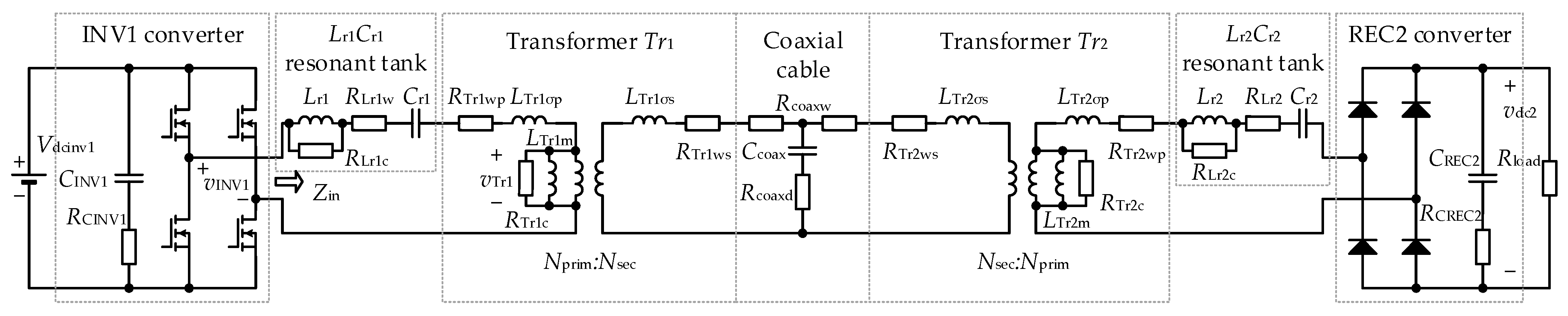
The second part of the High-Voltage High-Frequency Coaxial Cable Energy Transfer System is the dual resonant converter shown in Figure 7. This converter is composed of the INV1 converter, the input Lr1Cr1 resonant tank, transformer Tr1, coaxial cable, transformer Tr2, the output resonant tank Lr2Cr2, and diode rectifier REC2. The parameter values of the converter components are shown in Table 2. The switching frequency is fS = 10 kHz.
Power losses are generated in both semiconductor and passive components. Power losses of passive components are represented in Figure 7 by resistors. More specifically, these are losses in the following components:
  • Conduction and switching losses in INV1 converter transistors, PINV1Tcon, PINV1Tsw.
  • Winding losses in Lr1 and Lr2 inductors, PLr1w, PLr2w.
  • Core losses in Lr1 and Lr2 inductors, PLr1c and PLr2c.
  • Primary winding losses in Tr1 and Tr2 transformers, PTr1wp, PTr2wp.
  • Core losses in Tr1 and Tr2 transformers, PTr1c, PTr2c.
  • Secondary winding losses in Tr1 and Tr2 transformers, PTr1ws, PTr2ws.
  • Wire and dielectric losses in the coaxial cable, Pcoaxw, Pcoaxd.
  • Conduction and switching losses in REC2 converter diodes, PREC2Dcon, PREC2Dsw.
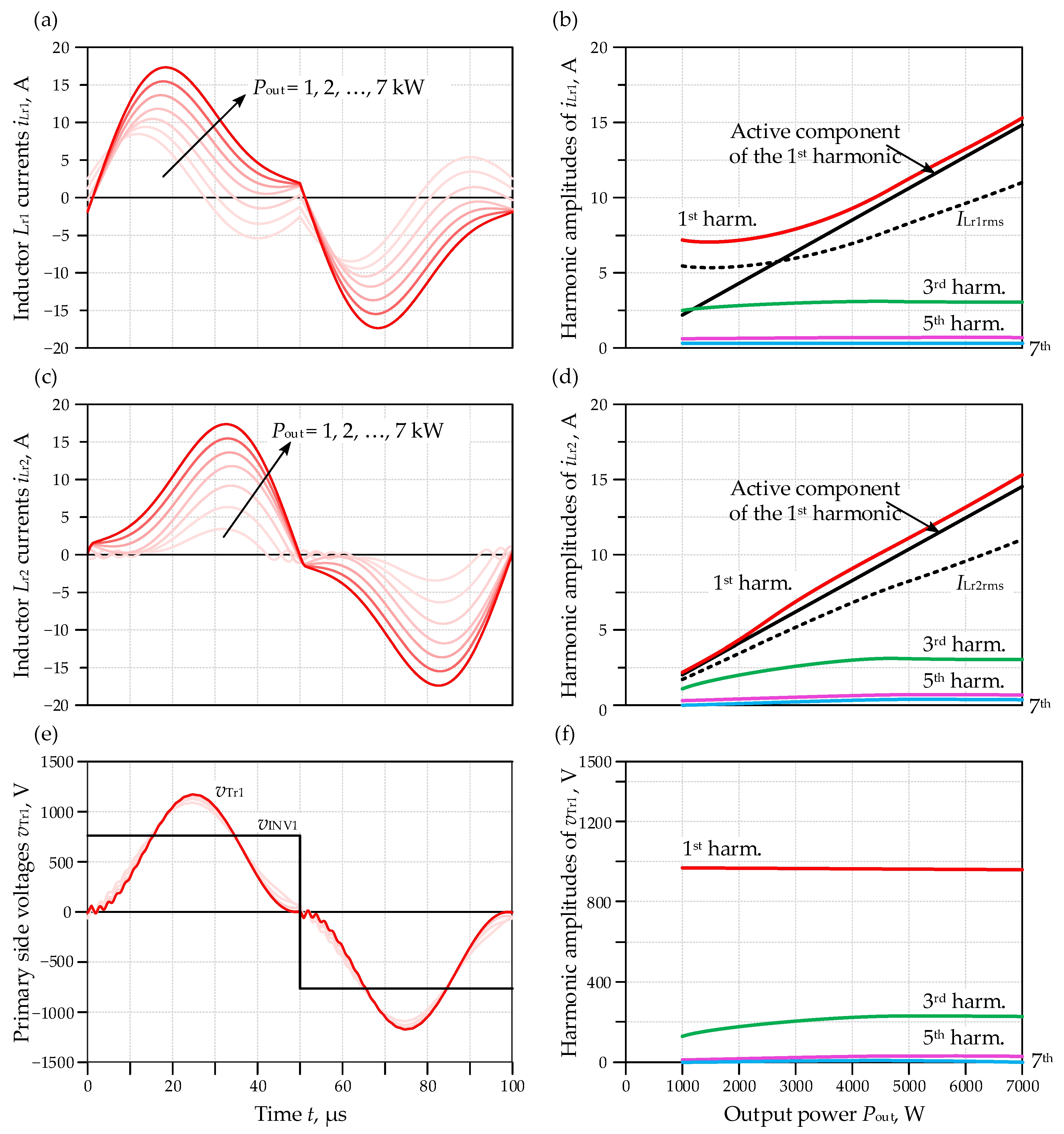
For calculating power losses, the operating conditions of the dual-series resonant converter are presented as waveforms of the resonant inductor currents iLr1 and iLr2, and transformer Tr1 primary-side voltage vTr1p, along with their harmonic spectra for output powers ranging from 1 kW to 7 kW. These waveforms and harmonics are obtained in the GeckoCIRCUITS simulator (Gecko-Simulations AG, Zurich, Switzerland) and presented in Figure 8.
The RMS values of the resonant inductor current can be used to calculate conduction power losses in the inductor and transformer windings, the coaxial cable resistance, and conduction losses in the transistors of the INV1 converter and the diodes of the REC2 converter.
Based on the harmonic analysis of the currents iLr1 and iLr2, it is evident that in the current of the resonant inductor Lr1, there is a significant difference between the amplitude of the fundamental harmonic current and the amplitude of the active component. Such a difference does not occur in the current of the inductor Lr2. This difference is because the current in inductor Lr1 contains a capacitive component of the coaxial cable current. This component has a constant amplitude of approximately 7 A. Still, as the output power Pout increases, the active component becomes dominant, causing the amplitude of the fundamental harmonic and the active component to have similar values.
Both resonant circuits (Lr1-Cr1, Lr2-Cr2) have been designed to be tuned to a resonance frequency close to the switching frequency fS = 10 kHz (7).
f r = 1 2 π L r 1 C r 1 = 1 2 π L r 2 C r 2 = 10.116   kHz
Due to the presence of the coaxial cable capacitance, the resonance frequency shifts to the value determined by (8).
f rsh = 1 2 π L r 1 + L Tr 1 σ p + N 1 N 2 2 L Tr 1 σ s C r 1 N 2 N 1 2 C coax C r 1 + N 2 N 1 2 C coax = 16.695   kHz
The occurrence of the resonance frequency frsh above the switching frequency fS causes the passive circuit between the INV1 and REC2 converters to exhibit a capacitive character for the fundamental harmonic and an inductive character for the higher-order harmonics present in the output voltage of the INV1 converter, such as the 3rd, 5th, 7th, and so on.
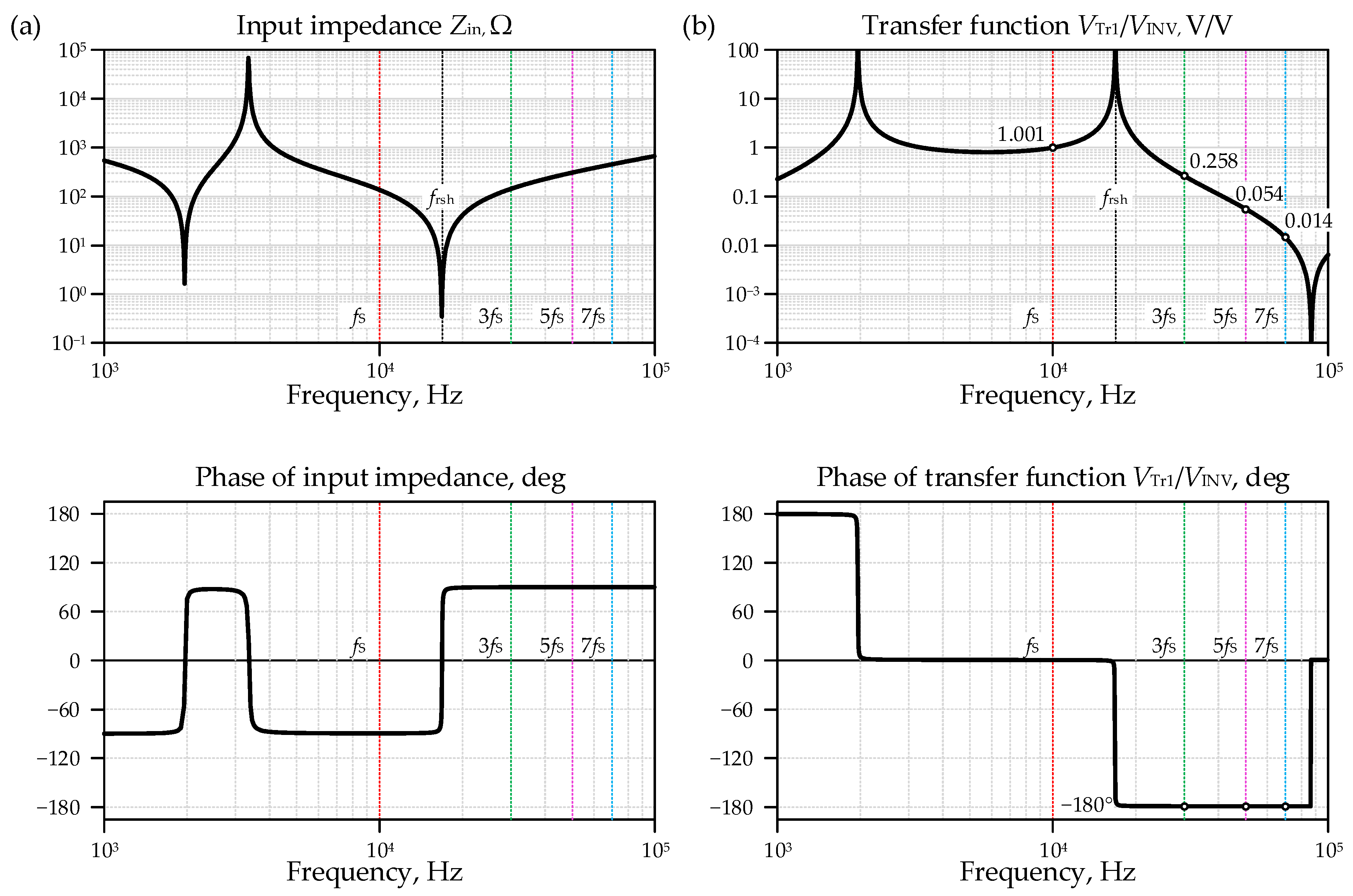
In Figure 8, the primary-side voltage of the transformer is shown to change relative to the output voltage of the INV1 converter. This change is due to phase shifts in the higher harmonics. It can be explained by the input impedance characteristics as a function of frequency, as shown in Figure 9a. The input impedance Zin(ω) is measured at the output terminals of the INV1 converter with the REC2 converter disconnected. The voltage at the transformer terminals can be expressed using the following transfer function (9).
V Tr 1 ω V INV 1 ω = Z in ω R Lr 1 w j ω L r 1 + j 1 ω C r 1 R Tr 1 wp j ω L Tr 1 σ p Z in ω
The transfer function (9) is presented as a frequency response in Figure 9b. The output voltage waveform of the INV1 converter, VINV1, is a rectangular waveform consisting of odd harmonics. Based on the transfer function (9), it can be seen that the transformer voltage VTr1 contains the fundamental harmonic with the same amplitude as the inverter voltage VINV1, with the same phase shift. Higher harmonics, such as the 3rd, 5th, and 7th, have smaller amplitudes relative to the amplitudes of the harmonics in the voltage VINV1, and their phase shift angles are −180°. The voltage waveform at the transformer terminals is needed to calculate power losses in the transformer core and in the coaxial cable dielectric. It is also worth noting that the presented impedance characteristics were obtained under the assumption that the passive circuit between the INV1 and REC2 converters is unloaded. The analysis presented in the article is based on simulation waveforms that account for the output power consumption on the DC side of the REC2 converter.

3.2.1. Power Losses in Resonant Inductor Lr1

The losses in the resonant inductor are generated inside its winding and magnetic core. The specifications of this inductor are shown in Table 3.
Winding losses depend on the rms value of the inductor current ILr1rms, winding resistance, and temperature according to (10).
P Lr 1 w T = I Lr 1 rms 2 R Lr 1 w 1 + α Cu T 20 ° C
where αCu is the temperature coefficient for copper, αCu = 0.0039 1/K, T is the temperature given in °C, and RLr1w is the inductor winding resistance at 20 °C.
For example, for an output power of Pout = 7 kW, the rms current value is ILr1rms = 11.0 A. Assuming that the inductor heats to 60 °C, the power losses calculated from (10) are 3.56 W. The exact temperature to which the resonant inductor heats up will be calculated after the introduction of its thermal model and the calculation of core power losses.
The Generalized Steinmetz Equation [26,27] is used to calculate power losses in the magnetic core of the resonant inductor. This method uses the ferrite material coefficients for the Steinmetz Equation with sinusoidal excitation. These coefficients for material 3C94 are as follows: kc = 3.53 W/m3, α = 1.42, β = 2.885. Power losses in the inductor core using the Generalized Steinmetz Equation are given as (11). These power losses are given for the set temperature T = 100 °C.
P Lr 1 c , 100 ° C = V c 1 T S 0 T S k 1 d B t d t α B t β α d t
where Vc is the core volume, TS is the switching period, TS = 1/fS = 100 μs, k1 is given as (12).
k 1 = k c 2 π α 1 0 2 π cos θ α sin θ β α d θ = 1.251 W m 3
B(t) is the magnetic flux density in the core of the inductor and is given as (13).
B t = L r 1 i Lr 1 t N A c
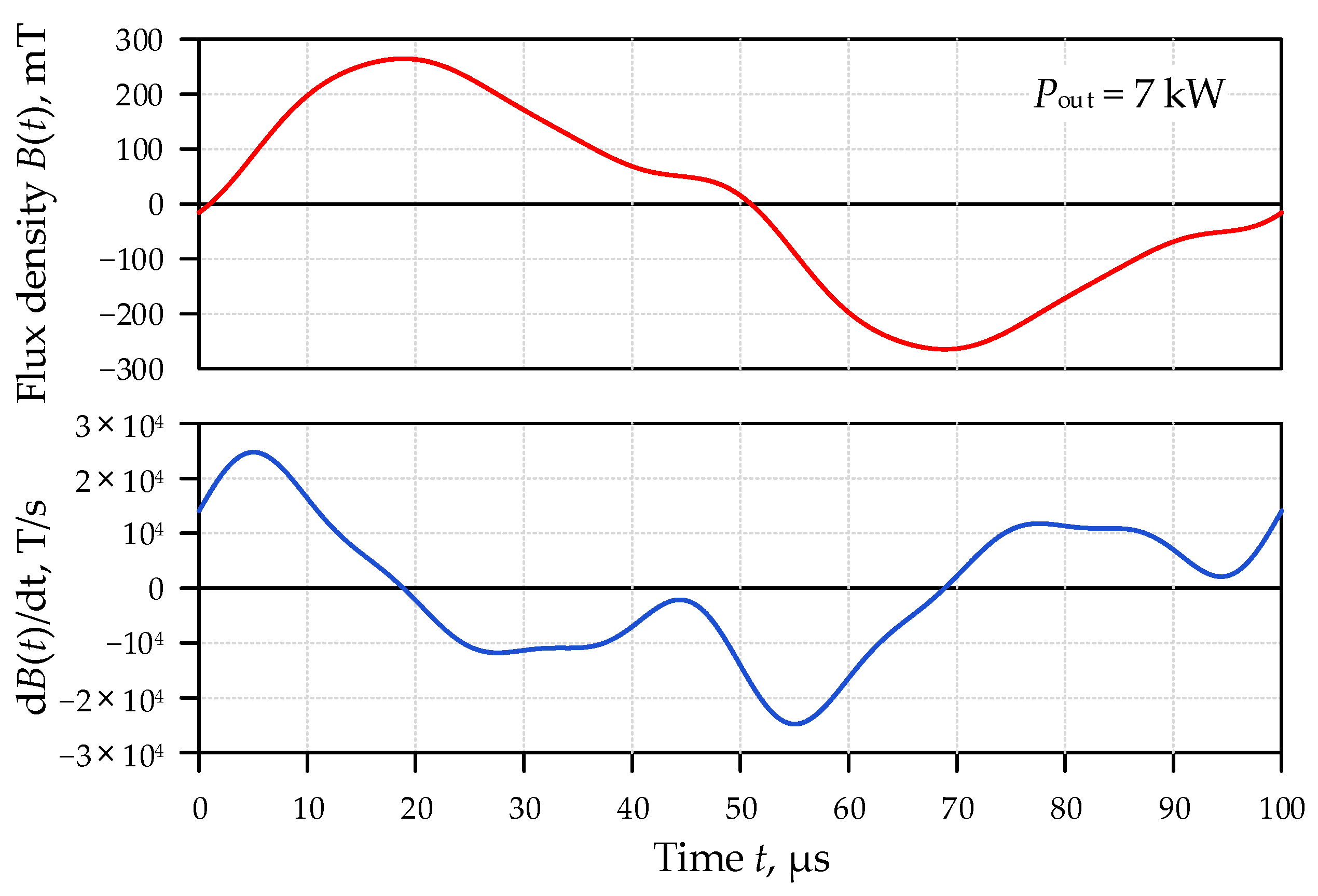
By representing the inductor current as a harmonic series, determining the magnetic flux density B(t) and its derivative dB(t)/dt is relatively simple. The Fourier series consists of odd harmonics, i.e., 1st, 3rd, 5th, and 7th. As an example, for an output power Pout = 7 kW, both magnetic flux density and its derivative are shown in Figure 10.
Substituting the relationships (12) and (13) into formula (11), the obtained power losses are for a temperature of 100 °C. At other temperatures, the losses in the magnetic core may be higher, and the exact relationship between temperature and losses is described for the 3C94 material with (14).
Y 3 C 94 T =   1.25359 10 4 T 2 0.02226 T + 1.97278
Multiplying core losses (11) by the function Y3C94(T), temperature-dependent losses are obtained (15).
P Lr 1 c T = P Lr 1 c , 100 ° C Y 3 C 94 T
Total power losses in the inductor Lr1 are the sum of the winding (10) and core losses (15) as given in (16) and are presented as functions of temperature in Figure 11a.
P Lr 1 T = P Lr 1 w T + P Lr 1 c T
The exact temperature value to which the inductor will heat up can be determined by the heat transfer relation Pdiss(T). It is the relationship describing two heat transfer phenomena between the inductor and its surroundings at ambient temperature Ta. These phenomena are radiation Prad(T) and convection Pconv(T) as given in (17)–(19) [28]. The amount of heat transferred from the inductor depends on the inductor temperature T, which is assumed to be uniform at its surface, the surface A from which the heat is dissipated, the ambient temperature, which is assumed to be Ta = 20 °C, the emissivity of the inductor surface E (assumed to be 0.9), and inductor height h.
P diss T = P rad T + P conv T
P rad T = σ E A T + 273.15   ° C 4 T a + 273.15 ° C 4
P conv T = 1.34 A T + T a 1.25 h 0.25
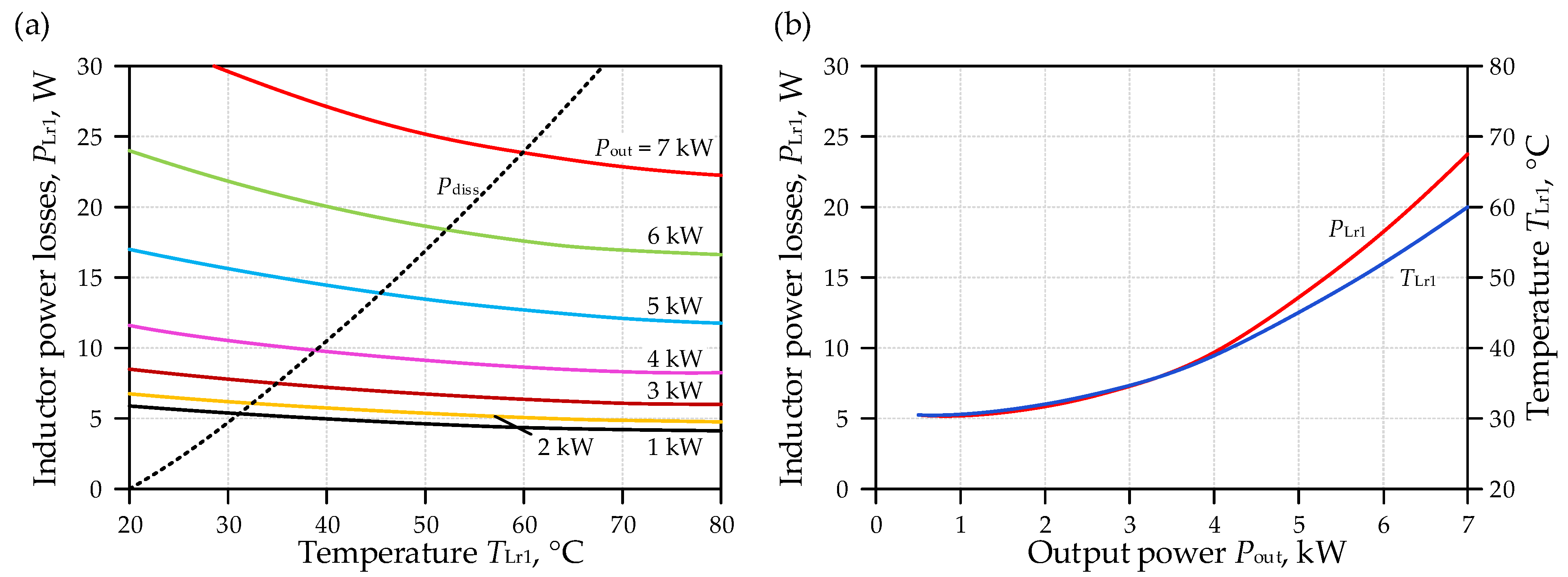
where σ is the Stefan-Boltzmann constant equal to 5.7 × 10⁻⁸ Wm−2K−4, the areas A in (18) and (19) for the inductor Lr1 are different because heat is not released from the bottom surface of the inductor via the convection process. Area A in (18) is 514.7 cm2, and 407.8 cm2 in (19). The characteristic of heat transfer Pdiss is shown in Figure 11a together with the characteristics of the power losses of the inductor, PLr1. At the intersection of these characteristics, the exact value of power loss and inductor temperature is obtained. The resultant inductor power loss and temperature characteristics given for the specific output power Pout are shown in Figure 11b.
From Figure 11a, it can be seen that the power losses in the Lr1 inductor, as a function of temperature T, decrease with increasing T. This is because the dominant losses in the inductor are core losses. The function Y(T) for 3C94 material has a minimum near T = 100 °C. In all cases, power losses PLr1 increase with increasing output power Pout. The total power dissipation for inductor Lr1 at an output of 7 kW is 23.8 W at a fixed temperature of TLr1 = 60 °C.

3.2.2. Power Losses in Transformer Tr1

Transformer Tr1 is intended to step up the voltage in the coaxial cable relative to the voltage of converter INV1. The voltage in the coaxial cable line is 3.5 kV. The specifications of transformer Tr1 are shown in Table 4. As the transformer was custom-designed, not all of its parameters were available to the authors. Winding losses are evaluated from the measured winding resistances at 10 kHz, while core losses are determined from no-load loss measurements conducted under laboratory conditions, outside the complete system.
The magnetizing inductance LTr1m listed in Table 1 and Table 4 was obtained from no-load measurements performed at the actual operating voltage and frequency of the converters. This method provides more reliable values than small-signal impedance analysis, which does not reproduce the real magnetic operating point of medium-frequency transformers. Since both transformers Tr1 and Tr2 share identical geometry and core material, the same measurement procedure is applied to both.
The primary winding current is equal to the resonant inductor current. In the analysis, the magnetizing current of the transformer is neglected. The primary winding losses depend on the rms value of the winding current ILr1rms, winding resistance, and temperature T according to (20).
P Tr 1 wp T = I Lr 1 rms 2 R Tr 1 wp 1 + α Cu T 20 ° C
For example, for an output power of Pout = 7 kW, the rms current value is ILr1rms = 11.0 A. Assuming that the transformer heats up to 60 °C, the power losses calculated from (20) are 20.14 W.
Because the magnetizing current is assumed to be zero, the secondary winding current is given as (Nprim/Nsec)iLr1. Thus, the secondary winding power losses can be expressed as (21).
P Tr 1 ws T = N prim N sec I Lr 1 rms 2 R Tr 1 ws 1 + α Cu T 20 ° C
At an output power of Pout = 7 kW and a temperature of 60 °C, the power losses on the secondary winding (21) are 12.74 W.
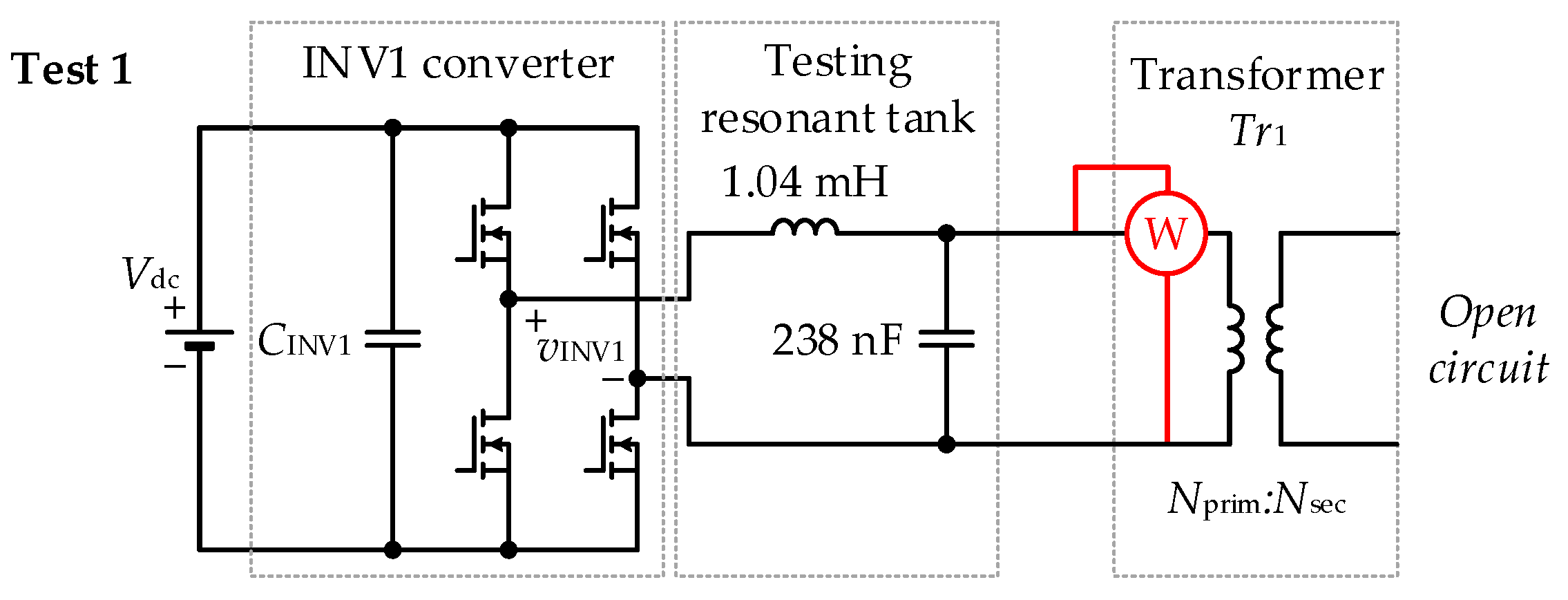
The core losses of the transformer were measured during its no-load operation in the test setup shown in Figure 12. The resonant circuit, consisting of an inductor and a capacitor connected in parallel to the primary side of the transformer, has a resonant frequency of 10 kHz and a high quality factor. As a result, the voltage on the primary side of the transformer during the no-load loss measurements was practically sinusoidal.
In the test setup shown in Figure 12, the amplitude of the transformer primary-side voltage was controlled by the DC voltage of inverter INV1. To reproduce the transformer voltage conditions, it was assumed that the sinusoidal voltage amplitude during the no-load test would equal the supply system peak voltage. The peak transformer voltage is obtained as the algebraic sum of the harmonic voltage amplitudes (22).
V Tr 1 m = V Tr 1 , 1 h + V Tr 1 , 3 h V Tr 1 , 5 h + V Tr 1 , 7 h = 1157   V
where the amplitudes of the 1st, 3rd, 5th, and 7th harmonics of the transformer voltage, VTr1,1h, VTr1,3h, VTr1,5h, and VTr1,7h are equal to 965 V, 210 V, 25 V, and 7 V, respectively, the minus sign of the 5th harmonic follows from the fact that in the square-wave voltage of inverter INV1, the 1st and 5th harmonics reach their maximum at the same instant, while the other harmonics are negative. Due to the −180° phase shift in the transfer function (9) for the 3rd–7th harmonics, their signs are inverted.
In the no-load test of the transformer (Figure 9), the measured power losses were 32.5 W. These losses were attributed entirely to the core and assumed to be constant, independent of output power and temperature. No significant variation in no-load losses with temperature was observed. Although both output power and temperature affect core losses, these effects were neglected for simplicity. This assumption is justified because the no-load losses remain essentially constant, as the fundamental voltage component applied to the transformer does not vary with load and is the dominant contributor to core losses.
Total power losses in the transformer Tr1 are the sum of losses of both windings (20), (21), and core losses PTr1c as given in (23) and are presented as functions of temperature in Figure 13a.
P Tr 1 T = P Tr 1 wp T + P Tr 1 ws T + P Tr 1 c
For calculating the heat transfer from the transformer Tr1, a similar approach is used to that applied to the inductor (17)–(19). It is assumed that the temperature of both transformer windings and the core is the same and uniformly distributed on the surface of the transformer. Another assumption is that the transformer is a cuboid without considering the dimensions of the winding extending beyond the core outline.
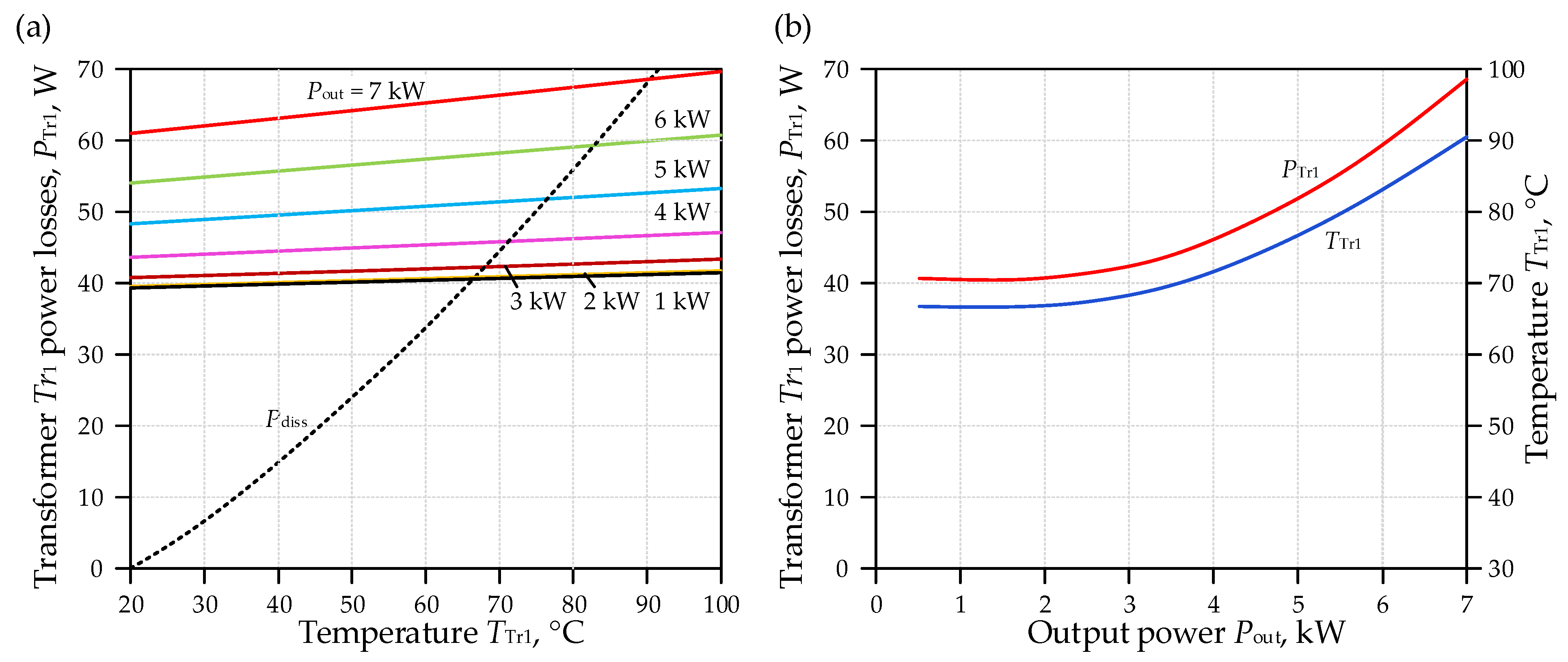
By analyzing the power loss characteristics shown in Figure 13a, it can be observed that the losses are less dependent on temperature compared to those in the Lr1 inductor. This is due to the behavior of core losses in the transformer, which are higher than in the inductor. As a result, the transformer losses do not drop below 39 W and increase up to 70 W at an output power of 7 kW. At this point, the transformer temperature reaches 90 °C.
The black and orange curves in Figure 13a correspond to 1 kW and 2 kW operation, respectively. Their close overlap results from dominant core losses, which are largely independent of the transferred power, and from nearly identical RMS current values, with the power increase mainly related to a change in the power factor (see Figure 8b).
In the developed HVHFCCET system, the transformer Tr1 was installed inside an aluminum enclosure with proper electrical insulation, which allowed effective dissipation of the heat generated in the transformer, reducing its temperature by more than 20 °C.
In the HVHFCCET system, a second transformer Tr2, with the exact specifications as Tr1 is used. The voltage on the HV side of Tr2 is assumed equal to the secondary voltage of Tr1, since the voltage drop across the coaxial cable is negligible. Consequently, the core losses of Tr2 are considered the same as those of Tr1. Moreover, because the capacitive current of the coaxial cable has little effect on the RMS current of Tr1, both transformers are assumed to operate under the same current conditions and thus exhibit equal power losses.

3.2.3. Power Losses in Coaxial Cable

In a coaxial cable, two factors cause power losses. The first is conduction losses in the copper centre conductor and braid shield, and the second is due to dielectric dissipation in a polyethylene insulator. The coaxial cable specifications are shown in Table 5. The inductance of the coaxial cable is much smaller than the leakage inductances at the high-voltage side of transformers and is neglected in the analysis.
The resistance Rcoax listed in Table 5 includes contributions of the inner conductor and the shield, and is specified at 20 °C. The current in the coaxial cable is determined by the transformer primary side current iLr1 multiplied by the transformer turns ratio. It is assumed that this current flows through the entire coaxial cable, resulting in conduction losses according to (24). This means that, under this assumption, the capacitive current component of the coaxial cable does not spread evenly along its length; it flows unattenuated to the end of the cable. This assumption avoids using a distributed coaxial cable model and simplifies the analysis without causing significant errors.
P Coaxw T = N prim N sec I Lr 1 2 R coax 1 + α Cu T 20 ° C
The exact temperature T at which the coaxial cable heats up will be calculated after introducing its thermal model and analyzing power losses in the cable dielectric.
The cause of power losses in the dielectric of the coaxial cable is its operation at a high peak voltage (up to 5.06 kV), at a relatively high frequency (fS = 10 kHz), with the presence of harmonics. The coaxial cable dielectric is made from polyethylene, which has a well-known relative permittivity εr = 2.3; however, its dissipation factor tan(δ) varies due to the value of the electric field strength applied, frequency, and temperature [29,30]. Knowing the dissipation factor, tan(δ), the applied voltage, which is the voltage at the secondary side of the transformer Tr1, the operating frequency, and the capacitance of the coaxial cable, Ccoax, the dielectric power loss can be determined by (25).
P Coaxd = N sec N prim V Tr 1 m 2 2 ω C coax tan δ
In the literature, dissipation factor values are reported in the range of 10−4 to 10−2. Such a wide spread results from the fact that these values are usually specified either at the power frequency (e.g., 50 Hz) or at different electric field strengths [31]. In the analyzed case, the electric field in the coaxial cable exceeds 3 kV/mm. The presence of higher harmonics in the voltage also causes a change in the dissipation factor [32].
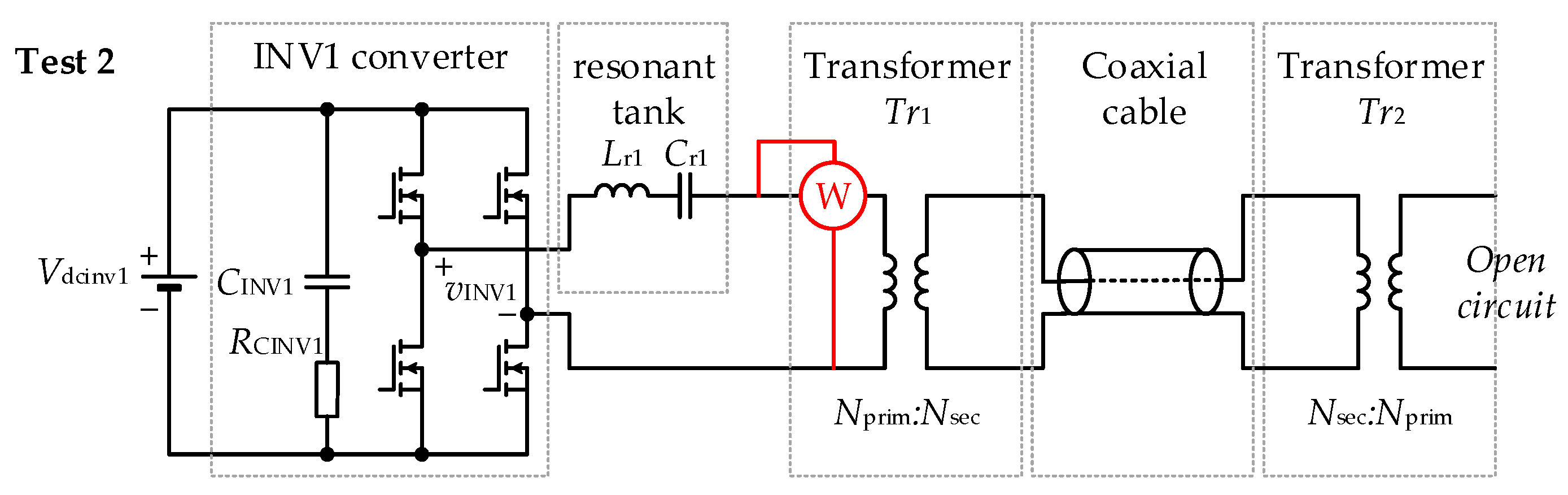
Due to the difficulty in determining the loss tangent in a coaxial cable under high-voltage, high-frequency conditions, it was decided to perform two no-load measurement tests with the dual-resonant converter. In test 2 (Figure 14), a transformer Tr2 was connected to the coaxial cable output, with its low-voltage side disconnected from the rest of the circuit. On the primary (low-voltage) side of transformer Tr1, the power losses Ptest2 (26) were measured. Ptest2 corresponds to the no-load power losses of both transformers Tr1 and Tr2, as well as the dielectric losses in the coaxial cable, PCoaxd. This approach is justified because the turn ratios of both transformers are the same, and under the assumption that the coaxial cable does not distort the voltage at the high-voltage sides of the transformers.
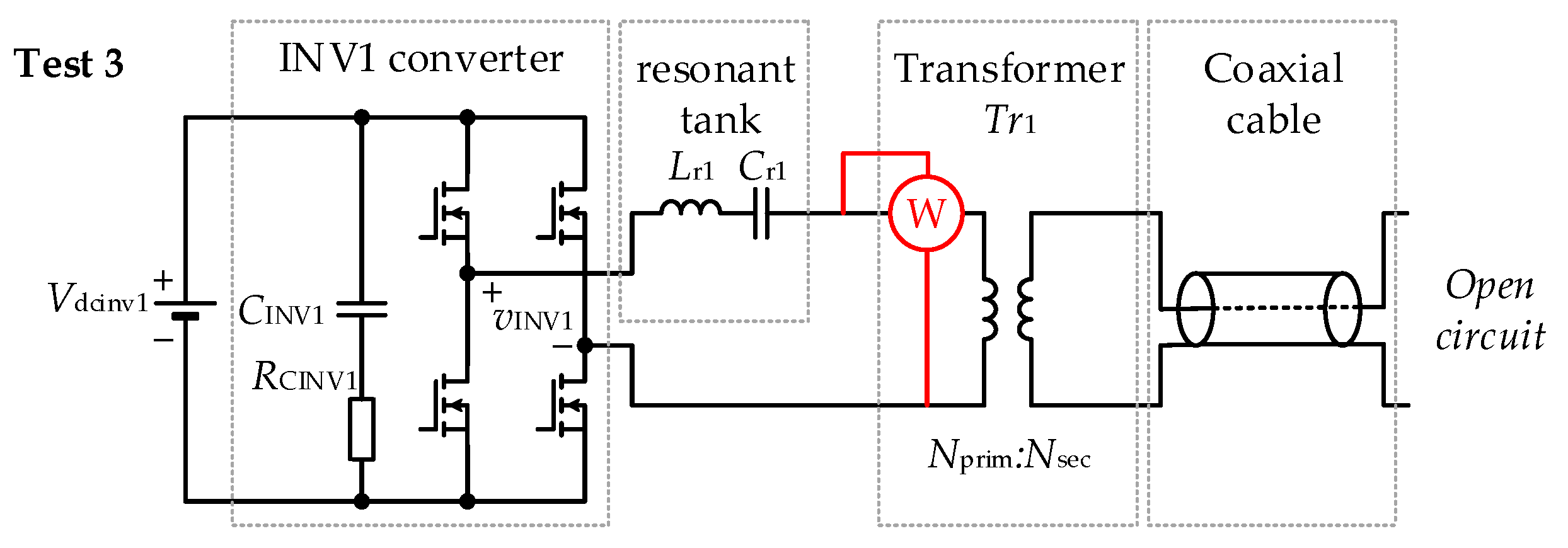
In the third test (Figure 15), the power losses were measured with the second transformer Tr2, disconnected from the coaxial cable. In this case, the measured power Ptest3 (27) corresponds to the sum of the no-load losses of a single transformer and the dielectric losses in the coaxial cable. By rearranging (26) and (27), the dielectric power losses (28) can be determined, which are assumed to be independent of the output power of the converter system.
P Test 2 =   2 P Tr + P Coaxd
P Test 3 = P Tr + P Coaxd
P Coaxd = 2 P Test 3 P Test 2
The losses in both tests were measured using an impedance analyzer on the primary side of transformer Tr1, while ensuring that the maximum voltage was close to the rated value VTr1m = 1157 V. In Test 2, the measured power was PTest2 = 77.8 W. In contrast, in Test 3, it was PTest3 = 44.9 W. Based on (28), the coaxial dielectric losses were determined as Pcoaxd = 12.0 W.
Similarly to transformer core losses, it was assumed that dielectric losses are independent of the power transmitted through the coaxial cable and of the temperature, since no variations in the cable temperature were observed during the tests.
By substituting into (25) the values of voltage and power losses Pcoaxd, and taking into account the cable capacitance Ccoax = 6.7 nF, it can be determined that the dissipation factor tan(δ) = 0.0022.

3.2.4. Power Losses in Converter INV1

The INV1 converter is a resonant full-bridge converter that generates a rectangular output voltage at 10 kHz. The same MOSFET devices as in the REC1 converter are employed in its design. The DC-link voltage is also identical to that of REC1, Vdc = 760 V. Therefore, the same loss calculation method as for the transistors of REC1 can be applied, except that the output current is non-sinusoidal. The transistors may operate under ZVS conditions. Additionally, in this case, the operating frequency is 10 kHz, and the number of transistors is four. The conduction losses are expressed by (29).
P Tcon = 2 R DSon I Lr 1 rms 2
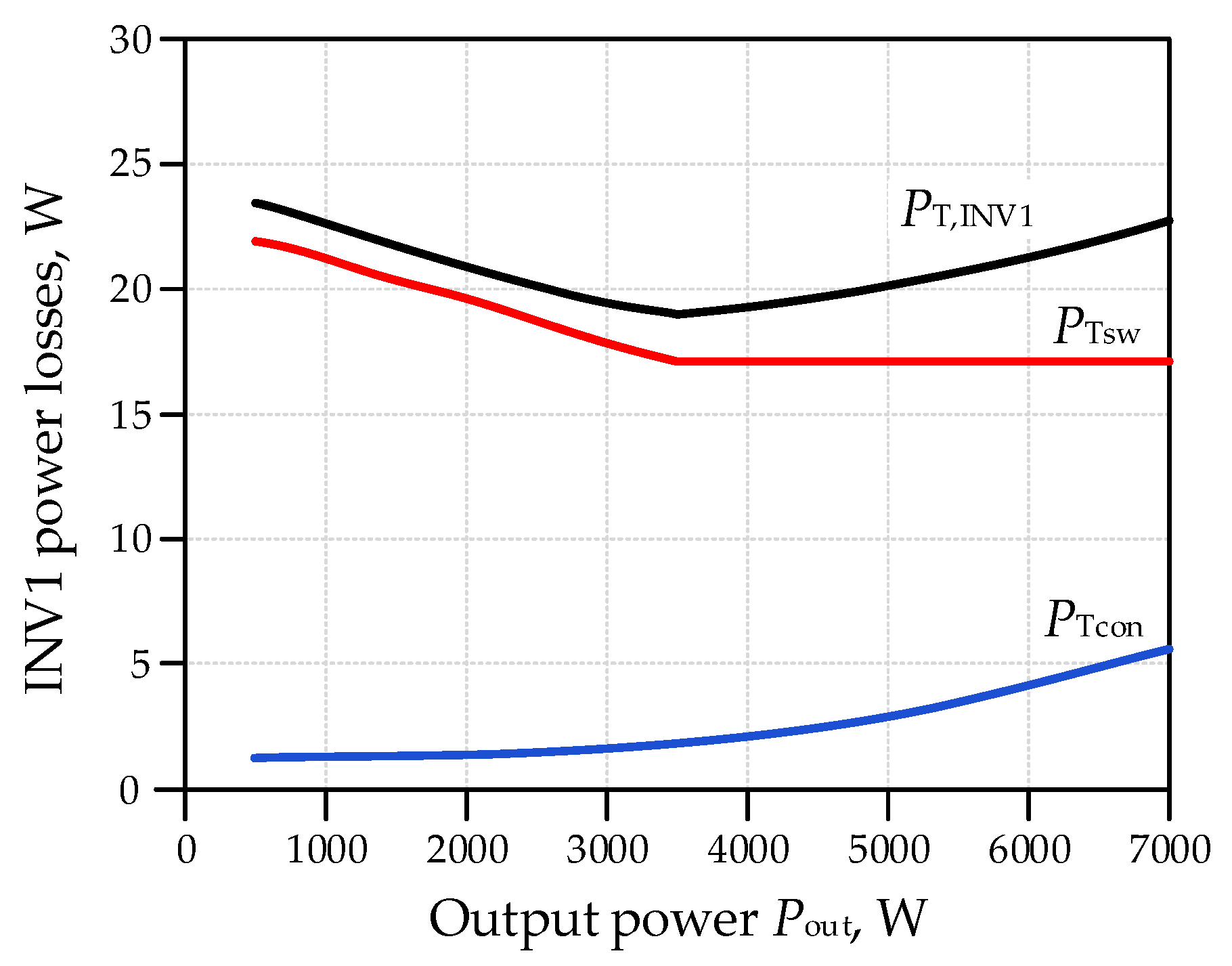
The factor of 2 in (29) arises from the fact that, in the INV1 converter, two transistors are always conducting. Knowing the rms value of the output current, which is also the current of the resonant inductor Lr1 and is shown in Figure 8, the conduction loss characteristic as a function of the output power can be determined, as presented in Figure 16.
It is worth emphasizing that the conduction- and switching-loss models used in this work remain consistent across REC1, INV1, and INV2 despite the different modulation strategies applied in these converters. This results from the use of MOSFET-based 2L-VSI topologies, whose loss characteristics are fundamentally simpler than those of IGBT counterparts. Unlike IGBTs, MOSFETs exhibit symmetric bidirectional conduction through the channel without threshold-voltage–dependent conduction behavior. As a consequence, the analytical expressions for conduction losses (1), (29) differ only in the number of conducting converter legs. Similarly, the influence of PWM type (SPWM, third-harmonic injection, or square-wave operation in the case of INV1) on switching losses is limited, provided that the current waveforms at the switching instants remain comparable. For these reasons, a unified MOSFET loss model is used throughout the analysis, and factors such as rms currents, the MOSFET on-state resistance, and the number of converter legs differentiate the resulting loss profiles. This also explains why the results obtained here cannot be directly compared with those from IGBT-based studies [33], where the modulation strategy has a much greater impact on the analytical formulations of both conduction and switching losses.
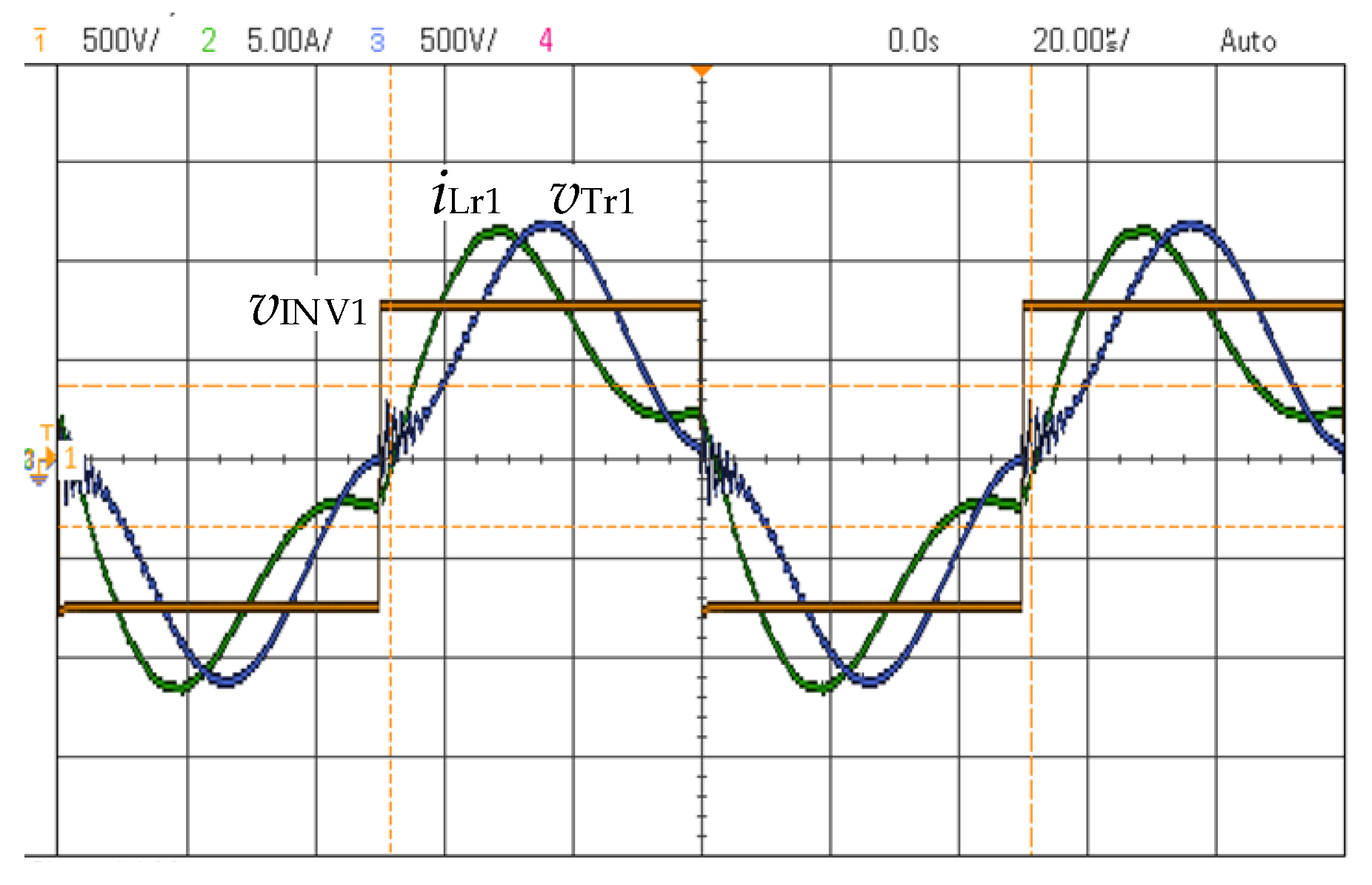
The switching power losses in the INV1 converter are caused by nonzero current values at the switching instants. Since the input impedance Zin(ω) at the switching frequency fS = 10 kHz is capacitive (Figure 9), ZVS conditions are not achieved at low load power. Only for Pout > 3.5 kW does the circuit characteristic become inductive, enabling ZVS operation. An example waveform of the output current of the INV1 converter, iLr1, at Pout = 4.5 kW is shown in Figure 17.
Under ZVS conditions, power losses are generated during transistor turn-off, whereas at low output power Pout, when ZVS conditions are not satisfied, losses occur during turn-on. Based on the current waveforms obtained from simulation (Figure 8), the current values were determined as Ion at t = 0, Ion = iLr1(0), and Ioff = iLr1(1/(2fS)). Since the INV1 converter has four transistors, the switching losses are expressed by (30).
P Tsw = 4 f S e on I on + e off I off V dc V dc
In (30), the switching frequency is fS = 10 kHz, the DC-link voltage is Vdc = 760 V, and the voltage at which the datasheet switching losses were measured is V’dc = 600 V.
The energy values eon and eoff were taken from the datasheet with correction factors applied to account for the influence of the gate resistance on switching energy losses. Figure 16 presents the switching energy loss characteristic as a function of the output power.
It can be observed that higher switching power losses occur at low output power, where no ZVS conditions exist, whereas above 3.5 kW, the losses stabilize at a constant level. This is mainly because the applied MOSFET devices exhibit higher turn-on than turn-off losses, resulting in a significant reduction in switching power losses under ZVS operation. Furthermore, it should be noted that the lower switching power losses in the INV1 converter compared to the REC1 converter are due to the INV1 converter’s resonant nature and a switching frequency that is 5 times lower than that of the REC1 converter.

3.2.5. Power Losses in Converter REC2

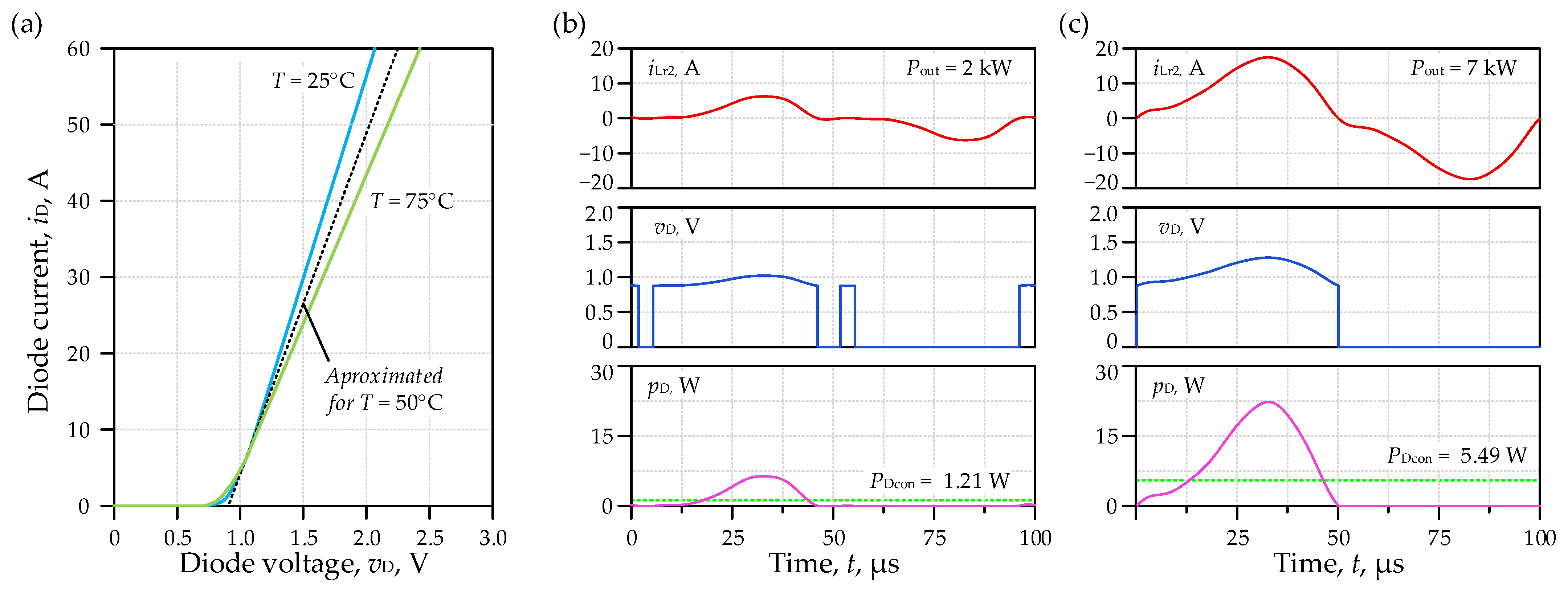
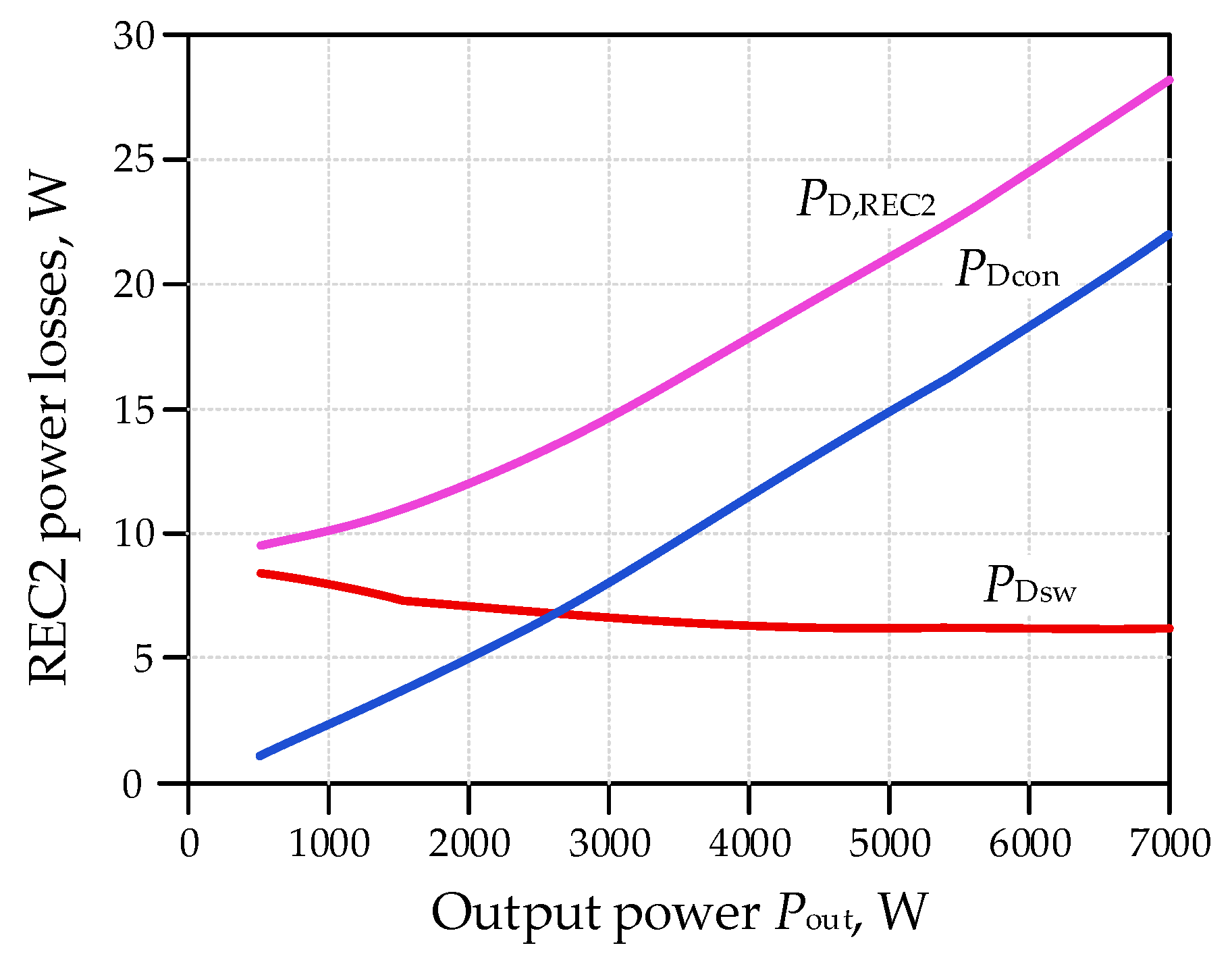
The REC2 rectifier is built using 1200 V SiC Schottky barrier diodes [34] due to the output characteristics of the diodes (Figure 18a), conduction losses will occur as expressed by (31). Although the conduction characteristic is temperature-dependent, in this analysis, it is assumed that the diodes operate at a constant temperature of 50 °C. This corresponds to the maximum diode temperature observed during the tests, thereby simplifying the power-loss analysis.
P Dcon = 4 1 T S 0 T S v D i Lr 2 i Lr 2   d t
In (31), the integration is carried out over the whole switching period TS = 1/fS = 100 μs, even though the diodes conduct current for roughly half of it. This approach is motivated by oscillations in the rectifier input current waveforms at low current levels, which make the diode conduction time ambiguous. Such a definition allows the conduction losses in the diodes to be properly determined, since the diode voltage drop vD(iLr2) is equal to zero for negative values of iLr2, as shown in Figure 18b,c. One can see that oscillations of the iLr2 at Pout = 2 kW do not influence the diode’s instantaneous power.
The conduction power losses characteristic of all four diodes in REC2 as a function of the output power Pout is shown in Figure 19.
SiC Schottky diodes have zero reverse-recovery charge, but their junction capacitance still causes switching losses [35,36]. The switching losses, described by (32), scale linearly with the rectifier dc-link voltage. It should also be noted that during the tests, the output voltage vdc2 depended on the output power and varied linearly, taking the values vdc21 = 788 V at Pout1 = 2.2 kW, and vdc22 = 711 V at Pout2 = 5.8 kW.
P Dsw = 4 f S Q D v dc 2 v dc 2
By considering both linear functions in (32), the switching power loss characteristic of the REC2 rectifier diodes can be determined. This characteristic, together with the total converter losses, is presented in Figure 19.
Based on Figure 19, the total power losses in the REC2 converter at the maximum output power of Pout = 7 kW are comparable to those in the INV2 converter. The switching losses decrease with increasing Pout, due to the reduction in vdc2.

3.2.6. Power Losses in Dual Resonant Converter Tracks and Wires

The last factor contributing to power losses in the dual resonant converter is the resistance of the wires, PCB traces, and the inductors connecting the DC circuits of REC1 to INV2 and REC2 to INV2. The total connection resistance is 62 mΩ, consisting of 20 mΩ from PCB traces, 10 mΩ from wires, and 32 mΩ from the dc-link inductors. It is assumed, as a simplification, that the inductor current iLr1 flows through all additional resistances. At an output power of Pout = 7 kW, the rms current is 11 A, resulting in a total power loss of 7.5 W in the wires and traces. Due to their negligible influence, the series resistances of the DC-link capacitors are not considered in the power loss calculation.

3.2.7. Power Losses Generated in the Dual Resonant Converter

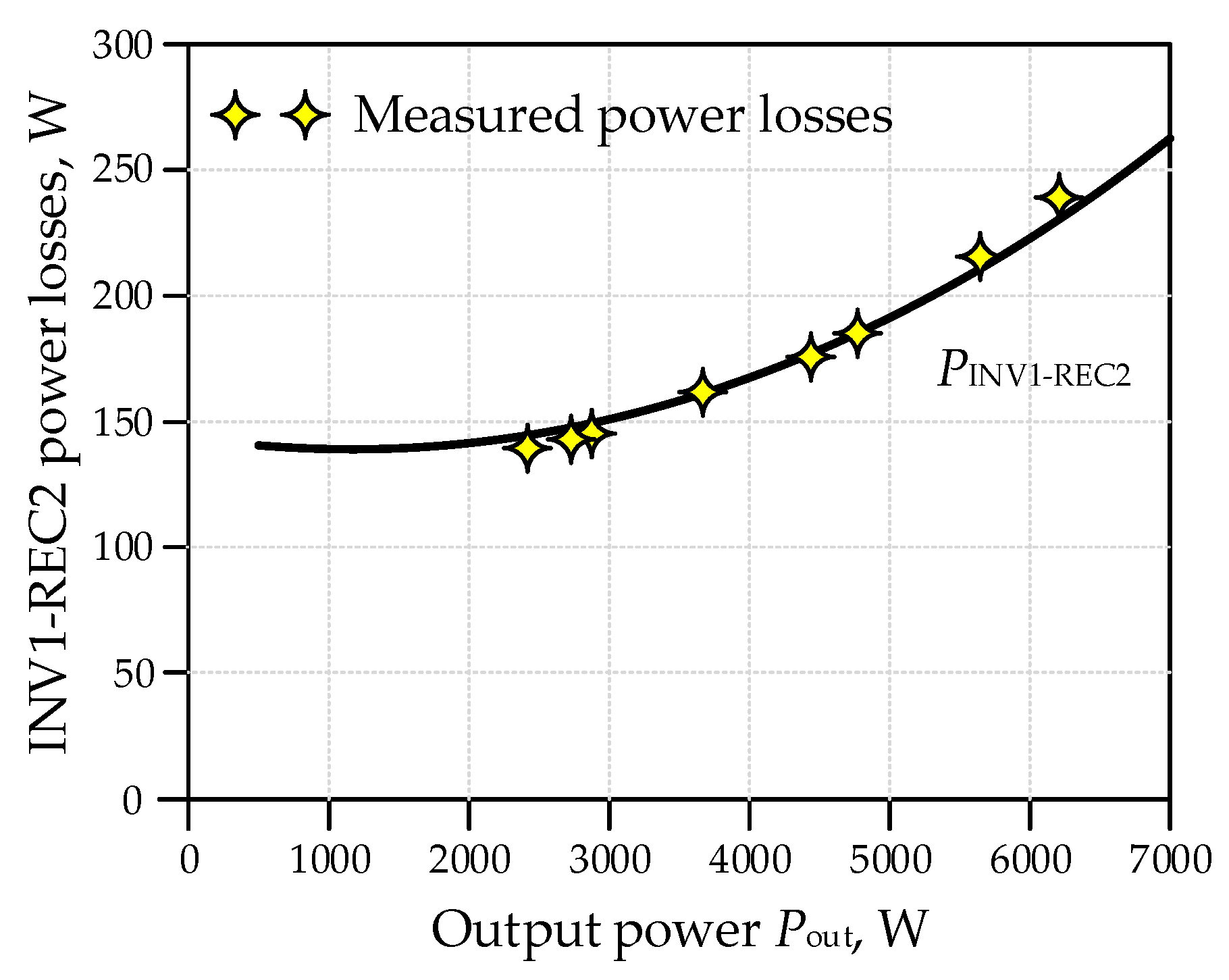
The total power losses in the components of the dual resonant converter are shown in Figure 20. These losses are compared with the power losses measured during the converter’s efficiency test. The output power was limited to 8 operating points.
Figure 20 shows that the calculated power losses closely match the measured losses. Based on this, it can be concluded that the presented power loss analysis accurately reflects the actual power losses in the dual resonant converter.

3.3. Output Converter Losses

In the output stage, the INV2 converter operates as a three-phase inverter supplying the load. Its operation is analogous to that of the REC1 converter (Figure 3), except that the phase current direction is reversed. The INV2 converter uses the same SiC MOSFET devices as in the REC1 converter. The passive filters employed in INV2 share the same structure and parameters as those of the grid-side converter.
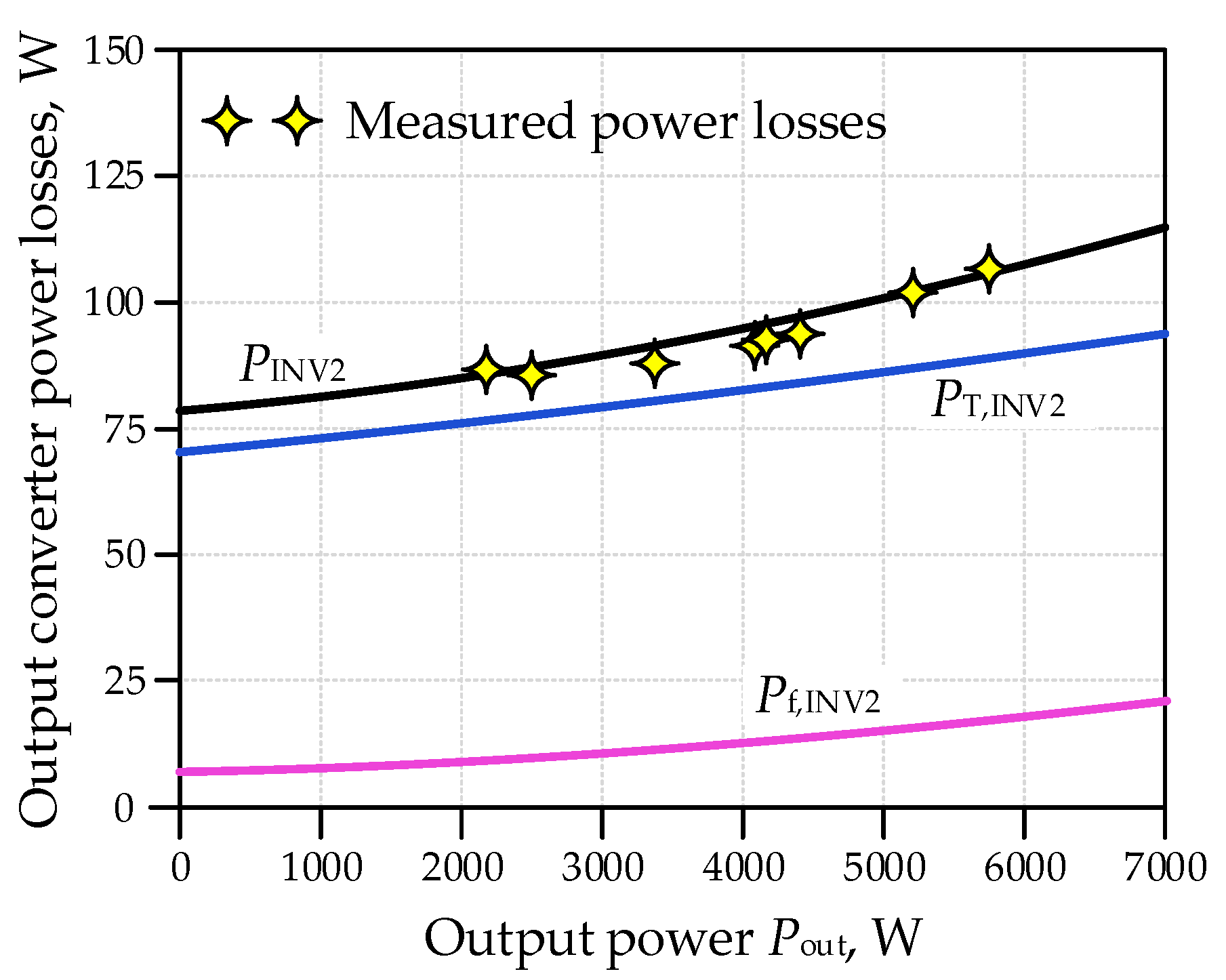
An additional distinction, beyond the reversed direction of phase currents, is the observed decrease in the dc-link voltage between converters REC2 and INV2 during system-level testing. Variations in the dc-link voltage, vdc2, are compensated at the INV2 converter output by adjusting the modulation index. For power loss analysis, the same relationships applied to the REC1 converter can be extended to the INV2 converter; nevertheless, the reduction in DC-link voltage results in lower switching losses. The total power losses of the INV2 converter are presented as a function of the output power in Figure 21.

4. Conclusions

This paper presents an analysis of power losses in a converter system employing a high-voltage, high-frequency coaxial cable energy transfer. All significant sources of losses have been identified, and the loss characteristics are presented as functions of output power and, in some cases, temperature. Temperature-dependent loss characteristics are essential for modeling the losses in inductive components.
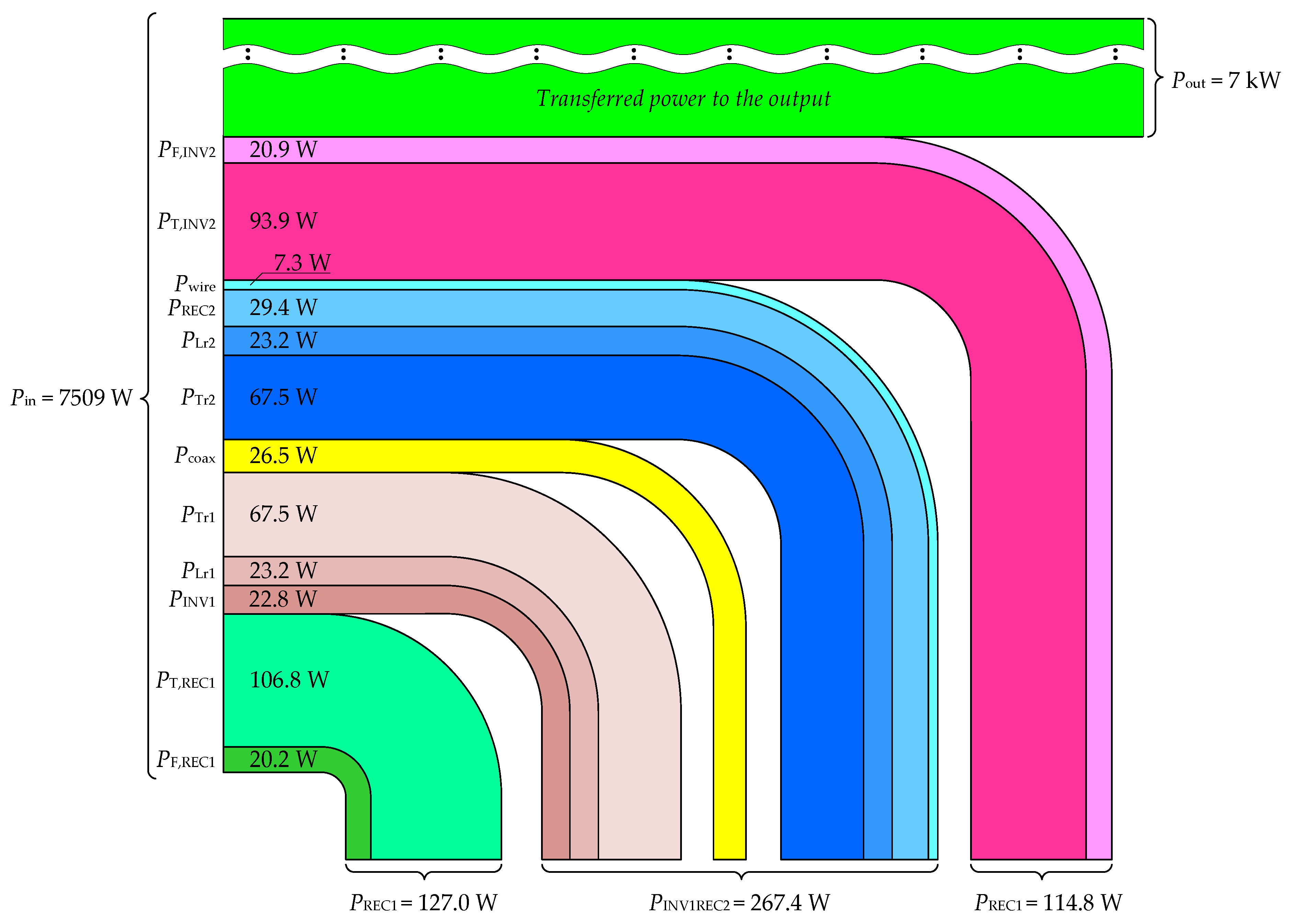
Figure 22 illustrates the distribution of power losses across the individual components of the power transmission system. The power losses for this example were calculated based on the approximation of the characteristics of all components of the converter system and are presented for an output power of 7 kW.
It can be observed that the highest power losses occur in the dual resonant converter, PINV1REC2 = 267.4 W. This is primarily due to the large number of components in this converter, the presence of two voltage conversion stages, and the inclusion of both the INV1 and REC2 converters. The other converters exhibit lower losses, with the lowest observed in the INV2 converter. This reduction is attributed to its operation at a lower DC-link voltage compared to the REC1 converter. The lower losses are mainly due to the reduction in switching losses, which are the dominant loss component in both REC1 and INV2 converters.
The total power losses in the HVHFCCET system at an output power of 7 kW amount to 509 W, yielding an efficiency of 93.2%. The most considerable losses are observed in the resonant transformers. In subsequent research carried out by the authors, the transformers will be subjected to detailed analysis and optimized for efficiency.
It is worth emphasizing that the investigated coaxial cable line had a length of 100 m, for which the measured cable losses were 26.5 W at the maximum output power of 7 kW. Assuming linear scaling of resistive losses, extending the cable length to 1 km would result in losses of approximately 265 W.
For comparison, an equivalent conventional three-phase cable line operating at 500 V and 50 Hz, realized using a three-core copper cable with a conductor cross-section of 4 mm2, would exhibit losses of approximately 907 W at the same transmitted power. Consequently, for a 1 km transmission distance, cable losses in the three-phase system are more than 3.4 times higher than those of the coaxial cable.
When total system losses are considered, the HVHFCCET system with a 1 km coaxial cable would exhibit overall losses of approximately 747 W, which are lower than the losses in the three-phase cable alone. The crossover point, at which the total losses of both systems become equal, occurs at a cable length of approximately 750 m. Below this distance, conventional three-phase transmission remains more efficient, as confirmed by the experimental 100 m setup, for which the HVHFCCET system losses reached 509 W compared to calculated 90.7 W in the three-phase cable.
An additional advantage of the HVHFCCET approach is the significantly lower mass of the transmission line. The mass of the RG-11/U coaxial cable is approximately 140 kg/km, compared to about 252 kg/km for a non-shielded three-core cable. Considering that armored cables are typically required in mining applications, the proposed coaxial-based solution can be up to two times lighter than conventional three-phase cable systems.
The developed power transmission system was designed for underground coal mines and, due to the need to limit earth-return currents, employed a coaxial cable. In future research, the authors plan to use the developed transmission system for Single Wire Energy Transfer (SWET), including overhead lines. It is anticipated that the resonant circuits will need to be redesigned to maximize energy transfer through the ground, i.e., to make the system independent of the unpredictable ground impedance, which varies with line location and weather conditions.

Author Contributions

Conceptualization, M.Z. and M.K.; methodology, M.Z., Z.K. and M.K.; software, K.P., J.M. and M.J.; validation, A.B., A.D., K.F., J.H., G.J., M.J., P.L. (Paweł Lasek), P.L. (Piotr Legutko), J.M., B.P., K.P. and M.Z.; formal analysis, M.Z., P.L. (Paweł Lasek) and M.K.; investigation, G.J., M.K., P.L. (Paweł Lasek) and M.Z.; resources, A.B., A.D., P.L. (Piotr Legutko) and M.S.; writing—original draft preparation, M.Z., G.J., K.P.; writing—review and editing, M.Z., M.K.; visualization, J.H., G.J. and P.L. (Piotr Legutko); project administration, K.S. and M.K.; funding acquisition, K.S., B.P. and M.K. All authors have read and agreed to the published version of the manuscript.

Funding

Funded by the European Union. Views and opinions expressed are, however, those of the author(s) only and do not necessarily reflect those of the European Union or European Research Executive Agency. Neither the European Union nor the granting authority can be held responsible for them. Scientific paper published as part of an international project POSTEN RFCS-2024-JT, co-funded by the European Union Research Fund for Coal and Steel (RFCS) in the years 2025–2029; grant agreement no: 101193769. Scientific paper published as part of an international project POSTEN RFCS-2024-JT, co-funded by the Ministry of Science and Higher Education’s program “PMW” in the years 2025–2029; contract no. W33/FBWiS/2025.Electronics 15 00093 i001

Institutional Review Board Statement

Not applicable.

Informed Consent Statement

Not applicable.

Data Availability Statement

The original contributions presented in this study are included in the article. Further inquiries can be directed to the corresponding author.

Conflicts of Interest

The authors declare no conflicts of interest.

References

  1. Abramushkina, E.; Zhaksylyk, A.; Geury, T.; El Baghdadi, M.; Hegazy, O. A Thorough Review of Cooling Concepts and Thermal Management Techniques for Automotive WBG Inverters: Topology, Technology and Integration Level. Energies 2021, 14, 4981. [Google Scholar] [CrossRef]
  2. Blinov, A.; Vinnikov, D.; Lehtla, T. Cooling Methods for High-Power Electronic Systems. Sci. J. Riga Tech. Univ. 2011, 29, 79–86. [Google Scholar] [CrossRef]
  3. Jahromi, M.G.; Mirzaeva, G.; Mitchell, S.D.; Gay, D. DC power vs AC power for mobile mining equipment. In Proceedings of the IEEE Industry Application Society Annual Meeting, Vancouver, BC, Canada, 5–9 October 2014; pp. 1–8. [Google Scholar] [CrossRef]
  4. Pursiainen, J.; Rekola, J.; Juntunen, R.; Valtee, M.; Peltoniemi, P. DC microgrid concept for mine environment. In Proceedings of the 22nd European Conference on Power Electronics and Applications (EPE’20 ECCE Europe), Lyon, France, 7–11 September 2020; pp. 1–10. [Google Scholar] [CrossRef]
  5. Szlązak, N.; Korzec, M.; Cheng, J. Using Battery-Powered Suspended Monorails in Underground Hard Coal Mines to Improve Working Conditions in the Roadway. Energies 2022, 15, 7527. [Google Scholar] [CrossRef]
  6. Kuslap, E.; Li, J.; Talehatibieke, A.; Hitch, M. Battery Electric Vehicles in Underground Mining: Benefits, Challenges, and Safety Considerations. Energies 2025, 18, 3588. [Google Scholar] [CrossRef]
  7. Rojas, C.A.; Kouro, S.; Perez, M.A.; Echeverria, J. DC–DC MMC for HVdc Grid Interface of Utility-Scale Photovoltaic Conversion Systems. IEEE Trans. Ind. Electron. 2018, 65, 352–362. [Google Scholar] [CrossRef]
  8. Carrasco, J.M.; Franquelo, L.G.; Bialasiewicz, J.T.; Galvan, E.; Portillo-Guisado, R.C.; Prats, M.A.M.; Leon, J.I.; Moreno-Alfonso, N. Power-Electronic Systems for the Grid Integration of Renewable Energy Sources: A Survey. IEEE Trans. Ind. Electron. 2006, 53, 1002–1016. [Google Scholar] [CrossRef]
  9. Lawder, M.T.; Suthar, B.; Northrop, P.W.C.; De, S.; Hoff, C.M.; Leitermann, O.; Crow, M.L.; Santhanagopalan, S.; Subramanian, V.R. Battery Energy Storage System (BESS) and Battery Management System (BMS) for Grid-Scale Applications. Proc. IEEE 2014, 102, 1014–1030. [Google Scholar] [CrossRef]
  10. Oudalov, A.; Chartouni, D.; Ohler, C. Optimizing a Battery Energy Storage System for Primary Frequency Control. IEEE Trans. Power Syst. 2007, 22, 1259–1266. [Google Scholar] [CrossRef]
  11. Yaramasu, V.; Wu, B.; Sen, P.C.; Kouro, S.; Narimani, M. High-Power Wind Energy Conversion Systems: State-of-the-Art and Emerging Technologies. Proc. IEEE 2015, 103, 740–788. [Google Scholar] [CrossRef]
  12. Fathabadi, H. Novel Maximum Electrical and Mechanical Power Tracking Controllers for Wind Energy Conversion Systems. IEEE J. Emerg. Sel. Topics Power Electron. 2017, 5, 1739–1745. [Google Scholar] [CrossRef]
  13. Zhang, L.; Zhang, Z.; Qin, J.; Shi, D.; Wang, Z. Design and Performance Evaluation of the Modular Multilevel Converter (MMC)-based Grid-tied PV-Battery Conversion System. In Proceedings of the 2018 IEEE Energy Conversion Congress and Exposition (ECCE), Portland, OR, USA, 23–27 September 2018; pp. 2649–2654. [Google Scholar] [CrossRef]
  14. Zhang, X.; Jin, J. MMC-Based PV Grid-Connected System with SMES-Battery Hybrid Energy Storage. In Proceedings of the 2023 IEEE International Conference on Applied Superconductivity and Electromagnetic Devices (ASEMD), Tianjin, China, 27 October 2023; IEEE: New York, NY, USA, 2023; pp. 1–2. [Google Scholar]
  15. Bayat, H.; Yazdani, A. A Hybrid MMC-Based Photovoltaic and Battery Energy Storage System. IEEE Power Energy Technol. Syst. J. 2019, 6, 32–40. [Google Scholar] [CrossRef]
  16. Skóra, M.; Rogala-Rojek, J.; Jendrysik, S.; Stankiewicz, K.; Polnik, B.; Kaczmarczyk, Z.; Kasprzak, M.; Lasek, P.; Przybyła, K. Innovative Capacitive Wireless Power System for Machines and Devices. Energies 2025, 18, 521. [Google Scholar] [CrossRef]
  17. Kasprzak, M.; Kaczmarczyk, Z.; Frania, K.; Kierepka, K.; Przybyla, K.; Zimoch, P. High Voltage High Frequency Single Wire Energy Transfer. In Proceedings of the 2022 IEEE 20th International Power Electronics and Motion Control Conference (PEMC), Brasov, Romania, 25 September 2022; pp. 487–492. [Google Scholar] [CrossRef]
  18. Wu, X.; Shi, X.; Jia, J.; Zhao, H.; Li, X. Shield Reliability Analysis-Based Transfer Impedance Optimization Model for Double Shielded Cable of Electric Vehicle. Math. Probl. Eng. 2021, 2021, 5373094. [Google Scholar] [CrossRef]
  19. Bolshev, V.; Yuferev, L.; Vinogradov, A.; Bukreev, A. Single-Wire Transmission Methods: Justification of a Single-Wire Resonant Power Transmission System. Energies 2023, 16, 5089. [Google Scholar] [CrossRef]
  20. Jin, X.; Chen, X.; Qi, C.; Mu, X. Modeling and Construction of Single-Wire Power Transmission Based on Multilayer Tesla Coil. IEEE Trans. Power Electron. 2023, 38, 6682–6695. [Google Scholar] [CrossRef]
  21. Kazimierczuk, M.K.; Czarkowski, D. Resonant Power Converters, 2nd ed.; Wiley: Hoboken, NJ, USA, 2011. [Google Scholar]
  22. Reznik, A.; Simoes, M.G.; Al-Durra, A.; Muyeen, S.M. LCL Filter Design and Performance Analysis for Grid-Interconnected Systems. IEEE Trans. Ind. Appl. 2014, 50, 1225–1232. [Google Scholar] [CrossRef]
  23. Kim, Y.; Kim, H. Optimal Design of LCL Filter in Grid–connected Inverters. IET Power Electron. 2019, 12, 1774–1782. [Google Scholar] [CrossRef]
  24. Zygmanowski, M.; Jarek, G.; Michalak, J.; Jelen, M. Design of the AC Filter for Two-Level Converter Operating in IT Grids. In Proceedings of the 2022 IEEE 20th International Power Electronics and Motion Control Conference (PEMC), Brasov, Romania, 25 September 2022; IEEE: New York, NY, USA, 2022; pp. 493–497. [Google Scholar]
  25. Infineon Technologies AG. FF23MR12W1M1P_B11 EasyDUAL Module with CoolSiC™ Trench MOSFET and PressFIT Datasheet. Available online: https://www.infineon.com/part/FF23MR12W1M1P-B11 (accessed on 17 July 2024).
  26. Venkatachalam, K.; Sullivan, C.R.; Abdallah, T.; Tacca, H. Accurate Prediction of Ferrite Core Loss with Nonsinusoidal Waveforms Using Only Steinmetz Parameters. In Proceedings of the 2002 IEEE Workshop on Computers in Power Electronics, Mayagüez, Puerto Rico, 3–4 June 2002; IEEE: New York, NY, USA, 2002; pp. 36–41. [Google Scholar]
  27. Reinert, J.; Brockmeyer, A.; De Doncker, R.W. Calculation of Losses in Ferro- and Ferrimagnetic Materials Based on the Modified Steinmetz Equation. In Proceedings of the Conference Record of the 1999 IEEE Industry Applications Conference. Thirty-Fourth IAS Annual Meeting (Cat. No.99CH36370), Phoenix, AZ, USA, 3–7 October 1999; IEEE: New York, NY, USA, 1999; Volume 3, pp. 2087–2092. [Google Scholar]
  28. Undeland, M.; Robbins, W. Power Electronics: Converter Applications and Design, 3rd ed.; Wiley & Sons: Hoboken, NJ, USA, 2003. [Google Scholar]
  29. Stancu, C.; Notingher, P.V.; Panaitescu, D.; Marinescu, V. Dielectric Losses in Polyethylene/Neodymium Composites. In Proceedings of the 2014 International Conference on Optimization of Electrical and Electronic Equipment (OPTIM), Bran, Romania, 22–24 May 2014; IEEE: New York, NY, USA, 2014; pp. 223–230. [Google Scholar]
  30. Konecna, Z. Temperature Dependence of Electrical Parameters of Coaxial Cables. In Proceedings of the 2016 Conference on Diagnostics in Electrical Engineering (Diagnostika), Pilsen, Czech Republic, 6–8 September 2016; IEEE: New York, NY, USA, 2016; pp. 1–4. [Google Scholar]
  31. Kosaki, M.; Tokoro, T.; Nakamori, M.; Nagao, M. High Field Dielectric Dissipation Factor of Polyethylene. In Proceedings of the 1984 IEEE International Conference on Electrical Insulation, Montreal, QC, Canada, 11–13 June 1984; IEEE: New York, NY, USA, 1984; pp. 81–84. [Google Scholar]
  32. Florkowski, M.; Kuniewski, M.; Mikrut, P. Effect of Voltage Harmonics on Dielectric Losses and Dissipation Factor Interpretation in High-Voltage Insulating Materials. Electr. Power Syst. Res. 2024, 226, 109973. [Google Scholar] [CrossRef]
  33. Alcaide, A.M.; Leon, J.I.; Rojas, C.A.; Berger, J.G.; Stowhas-Villa, A.; Wilson-Veas, A.H.; Buticchi, G.; Kouro, S. The Role of Modulation Techniques on Power Device Thermal Performance in Two-Level VSI Converters. Electronics 2025, 14, 2934. [Google Scholar] [CrossRef]
  34. Datasheet of Zero Recovery Silicon Carbide Schottky Diode MSC030SDA170B. Available online: https://ww1.microchip.com/downloads/aemDocuments/documents/PSDS/ProductDocuments/DataSheets/Microsemi_MSC030SDA170B_SiC_Schottky_Diode_Datasheet_A.pdf (accessed on 8 March 2025).
  35. Galigekere, V.P.; Kazimierczuk, M.K. Performance of SiC Schottky Diodes. In Proceedings of the 2007 50th Midwest Symposium on Circuits and Systems, Montreal, QC, Canada, 5 August 2007; IEEE: New York, NY, USA, 2007; pp. 682–685. [Google Scholar]
  36. Adamowicz, M.; Giziewski, S.; Pietryka, J.; Krzeminski, Z. Performance Comparison of SiC Schottky Diodes and Silicon Ultra Fast Recovery Diodes. In Proceedings of the 2011 7th International Conference-Workshop Compatibility and Power Electronics (CPE), Tallinn, Estonia, 1–3 June 2011; IEEE: New York, NY, USA, 2011; pp. 144–149. [Google Scholar]
Figure 1. General schematic of HVHFCCET and WET systems.
Electronics 15 00093 g001
Figure 2. Three-dimensional models and photographs presenting the arrangement of components in explosion-proof housings: (a) converters REC1 and INV1, (b) converters REC2 and INV2.
Electronics 15 00093 g002
Figure 3. The detailed schematic of the REC1 converter connected to the AC grid through the common-mode filter and the LCL filter.
Electronics 15 00093 g003
Figure 4. Transistor power losses in the REC1 converter are divided into conduction and switching losses.
Electronics 15 00093 g004
Figure 5. Power losses in the passive filter of the REC1 converter.
Electronics 15 00093 g005
Figure 6. Power losses in the AC grid converter.
Electronics 15 00093 g006
Figure 7. The detailed schematic of the dual resonant converter, including transformers Tr1 and Tr2, and the high-voltage, high-frequency coaxial cable.
Electronics 15 00093 g007
Figure 8. Current and voltage waveforms and harmonic amplitudes in the dual resonant converter for the output power ranging from 1 kW to 7 kW: (a) inductor Lr1 current waveforms, (b) harmonic amplitudes of the inductor Lr1 currents, (c) inductor Lr2 current waveforms, (d) harmonic amplitudes of the inductor Lr2 currents, (e) waveforms of the transformer Tr1 primary side voltages, (f) harmonic amplitudes of the transformer Tr1 primary side voltages.
Electronics 15 00093 g008
Figure 9. Frequency characteristics. (a) the input impedance Zin of the dual resonant circuit, (b) the transfer function VTr1/VINV.
Electronics 15 00093 g009
Figure 10. Waveforms of the flux density and its derivative inside the magnetic core of the resonant inductor obtained for output power Pout = 7 kW.
Electronics 15 00093 g010
Figure 11. Characteristics of inductor Lr1 power losses, (a) power losses given as functions of temperature together with heat transfer Pdiss, (b) stabilized inductor losses and temperatures for specific output power Pout.
Electronics 15 00093 g011
Figure 12. Schematic of the test circuit for measuring the core losses of transformer Tr1.
Electronics 15 00093 g012
Figure 13. Characteristics of transformer Tr1 power losses, (a) power losses given as functions of temperature together with heat transfer Pdiss, (b) stabilized transformer losses and temperatures for specific output power Pout.
Electronics 15 00093 g013
Figure 14. Schematic of the second test circuit for determining power losses in the coaxial cable.
Electronics 15 00093 g014
Figure 15. Schematic of the third test circuit for determining power losses in the coaxial cable.
Electronics 15 00093 g015
Figure 16. Transistor losses in the INV1 converter are divided into conduction and switching losses.
Electronics 15 00093 g016
Figure 17. Output voltage and current waveforms of the INV1 converter and the primary-side voltage of the transformer Tr1.
Electronics 15 00093 g017
Figure 18. SiC Schottky barrier diode conduction characteristics, (a) forward current vs. forward voltage characteristic [22], (b) input current, diode voltage, and single diode instantaneous power at Pout = 2 kW, (c) input current, diode voltage, and single diode instantaneous power at Pout = 7 kW.
Electronics 15 00093 g018
Figure 19. Diode conduction losses in the REC2 converter.
Electronics 15 00093 g019
Figure 20. Power losses in the dual resonant converter.
Electronics 15 00093 g020
Figure 21. Power losses in the output converter.
Electronics 15 00093 g021
Figure 22. Power loss diagram of HVHFCCET system at the maximum output power Pout = 7 kW.
Electronics 15 00093 g022
Table 1. Parameters of components of the AC grid converter with its filters.
ParameterSymbolValue
AC grid voltage, phase-to-phase rms valueVg500 V
REC1 converter DC voltageVdc760 V
Common-mode choke inductanceLcm29 mH
Common-mode filter capacitanceCcm100 nF
Common-mode choke winding resistanceRLcmw10 mΩ
LCL filter inductance Lf1Lf1500 μH
LCL filter inductance Lf2Lf265 μH
LCL filter capacitance CfCf1 μF
Winding resistance of inductor Lf1RLf1w35 mΩ
Winding resistance of inductor Lf2RLf2w16 mΩ
Series resistance in the capacitor path RCfRCf1 Ω
The series equivalent resistance of the DC-link capacitorsRCREC126 mΩ
DC-link capacitancesCINV1, CREC2705 μF
Table 2. Parameters of components of the dual resonant converter.
ParameterSymbolValue
INV1 converter DC voltageVdcin1760 V
Resonant tank inductanceLr1, Lr21.04 mH
Resonant tank capacitanceCr1, Cr2238 nF
Winding resistance of inductor Lr1 @20 °CRLr1w, RLr2w25.5 mΩ
Transformer Tr1, Tr2 primary side voltageVprim800 V
Transformer Tr1, Tr2 secondary side voltageVsec3500 V
Transformer Tr1, Tr2 numbers of turnsNprim/Nsec27/118
Transformer Tr1, Tr2 primary side winding resistance @20 °CRTr1wp, RTr2wp100 mΩ
Transformer Tr1, Tr2 secondary side winding resistance @20 °CRTr1ws, RTr2ws1.2 Ω
Transformer Tr1, Tr2 magnetizing inductanceLTr1m, LTr2m35 mH
Transformer Tr1, Tr2 primary side leakage inductanceLTr1σp, LTr2σp26 μH
Transformer Tr1, Tr2 secondary side leakage inductanceLTr1σs, LTr2σs497 μH
Coaxial cable lengthlcoax100 m
Coaxial cable wire resistanceRcoaxw2.3 Ω
Coaxial cable capacitanceCcoax6.7 nF
Input and output capacitancesCINV1, CREC2705 μF
Parameters not listed in the table but presented on the schematic in Figure 7 are discussed in more detail in the following subsections.
Table 3. Resonant inductor Lr1 core and winding specification.
ParameterSymbolValue
InductanceLr11.04 mH
Type of the core---E65
Number of stacked coresNc6
Number of turnsN21
Cross-sectional area of magnetic coresAc32.4 cm2
Core material---3C94
Core size (all cores)wm × h × l65 mm × 65.6 mm × 164.4 mm
Core volume (all cores)Vc474 cm3
Winding resistance @20 °CRLr1w25.5 mΩ
Table 4. Transformer Tr1 core and winding specification.
ParameterSymbolValue
Magnetizing inductanceLTr1m35 mH
Number of turnsNprim/Nsec27/118
Core size (all cores)wm × h × l80 mm × 76.2 mm × 198 mm
Primary winding resistance @20 °CRTr1wp144 mΩ
Secondary winding resistance @20 °CRTr1ws1.74 Ω
Table 5. Coaxial cable specification.
ParameterSymbolValue
Type of coaxial cable---RG11/U
Cable lengthlcoax100 m
Characteristic impedanceZ75 Ω
Cable capacitanceCcoax6.7 nF
Cable resistanceRcoax2.26 Ω
Disclaimer/Publisher’s Note: The statements, opinions and data contained in all publications are solely those of the individual author(s) and contributor(s) and not of MDPI and/or the editor(s). MDPI and/or the editor(s) disclaim responsibility for any injury to people or property resulting from any ideas, methods, instructions or products referred to in the content.