Impacts of Connected and Automated Driving: From Personal Acceptance to the Effects in Society: A Multi-Factor Review




Abstract
1. Introduction
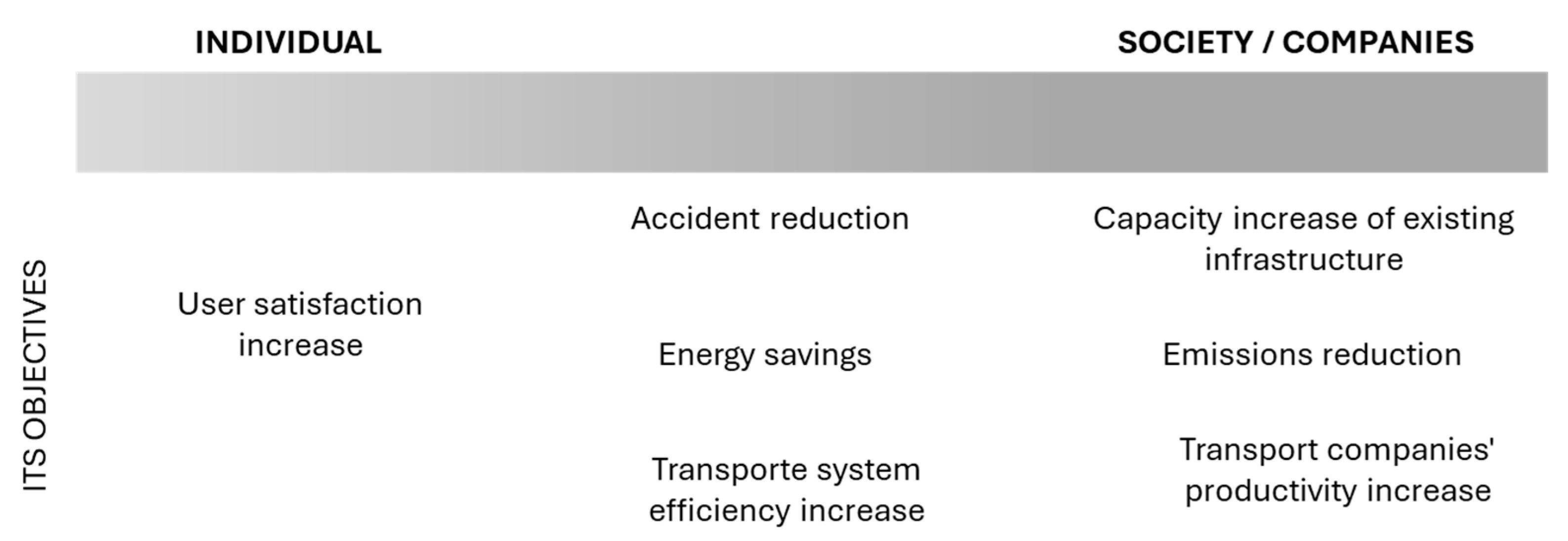
- -
- Technical, to improve perception and decision-making capabilities in more complex scenarios.
- -
- Economic, since some of the components of perception and decision-making systems are still expensive within the price of the vehicle.
- -
- Regulatory, necessary to ensure the safety and robustness of vehicle operation, as well as to establish possible changes in traffic rules in the event of the coexistence of autonomous and traditional vehicles.
- -
- Social acceptance, both among users of these vehicles and among users of other vehicles or pedestrians.
2. Literature Review Method
- -
- Focused specifically on autonomous, connected, or shared vehicles.
- -
- Addressed at least one of the impacts considered in this review: energy consumption, emissions, traffic, safety, vehicle-kilometers traveled (VKT), vehicle fleet size, economic impacts, collateral effects, barriers, or public acceptance.
- -
- Reported quantitative and comparable results.
- -
- Peer-reviewed scientific publications.
- -
- Written in English or Spanish.
- -
- Absence of quantitative results (e.g., conceptual articles or technological development papers without impact assessment).
- -
- Non-academic or purely divulgative content.
- -
- Restricted access preventing full-text analysis.
- -
- Studies focusing exclusively on technical system development without addressing impacts.
- -
- Studies dealing only with public acceptance. These papers were used solely to support the state-of-the-art section on acceptance but not included in the quantitative impact review.
3. Connected and Automated Vehicles Acceptance Parameters
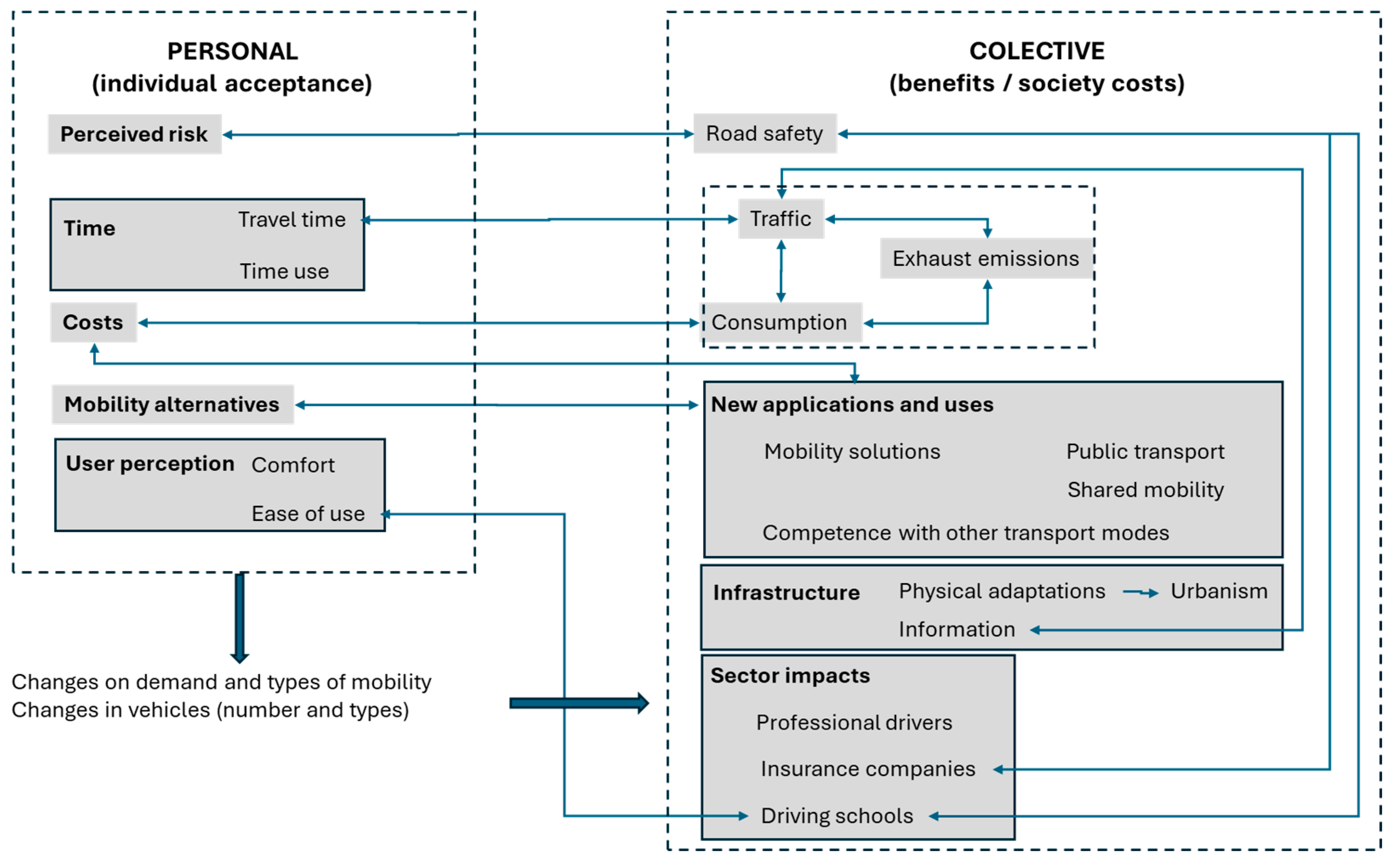
4. Correlation Between Individual Motivations and Social Impacts
5. Social Impacts of Connected and Automated Vehicles
5.1. Impact on Road Safety
5.2. Impact on Traffic Efficiency
5.3. Impact on Consumption (Fuel/Energy)
5.4. Impact on Exhaust Emissions
5.5. System-Level, Economic and Collateral Impacts
6. Discussion
6.1. Analysis of Effect Ranges
6.2. Effect of the Penetration Rate
7. Conclusions
Author Contributions
Funding
Informed Consent Statement
Data Availability Statement
Acknowledgments
Conflicts of Interest
References
- SAE J3016_201401; Taxonomy and Definitions for Terms Related to On-Road Motor Vehicle Automated Driving Systems. SAE International: Washington, DC, USA, 2014.
- ANFAC. Barómetro Sobre Vehículo Autónomo y Conectado; Asociación Nacional de Fabricantes de Automóviles y Camiones: Madrid, Spain, 2024. (In Spanish) [Google Scholar]
- Sun, G.; Zhang, Y.; Yu, H.; Du, X.; Guizani, M. Intersection Fog-Based Distributed Routing for V2V Communication in Urban Vehicular Ad Hoc Networks. IEEE Trans. Intell. Transp. Syst. 2020, 21, 2409–2426. [Google Scholar] [CrossRef]
- Cummings, M.L.; Bauchwitz, B. Safety implications of variability in autonomous driving assist alerting. IEEE Trans. Intell. Transp. Syst. 2022, 23, 12039–12049. [Google Scholar] [CrossRef]
- Malakorn, K.J.; Park, B. Assessment of mobility, energy, and environment impacts of IntelliDrive-based cooperative adaptive cruise control. In Proceedings of the 2010 IEEE International Symposium on Sustainable Systems and Technology, Arlington, VA, USA, 17–19 May 2010; pp. 1–6. [Google Scholar]
- Kalra, N.; Paddock, S.M. Driving to safety: How many miles of driving would it take to demonstrate autonomous vehicle reliability? Transp. Res. Part A Policy Pract. 2016, 94, 182–193. [Google Scholar] [CrossRef]
- Scanlon, J.M.; Kusano, K.D.; Daniel, T.; Alderson, C.; Ogle, A.; Victor, T. Waymo simulated driving behavior in reconstructed fatal crashes. Accid. Anal. Prev. 2021, 163, 106454. [Google Scholar] [CrossRef]
- Vienna Convention on Road Traffic. Amendment for Autonomous Systems. In Proceedings of the Vienna Convention, Geneva,Switzerland, 15 May 2014.
- Zhao, J.; Zhao, W.; Deng, B.; Wang, Z.; Zhang, F.; Zheng, W.; Cao, W.; Nan, J.; Lian, Y.; Burke, A.F. Autonomous driving system: A comprehensive survey. Expert Syst. Appl. 2024, 242, 122836. [Google Scholar] [CrossRef]
- Xu, Z.; Zhang, K.; Min, H.; Wang, Z.; Zhao, X.; Liu, P. What drives people to accept automated vehicles? Findings from a field experiment. Transp. Res. Part C Emerg. Technol. 2018, 95, 320–334. [Google Scholar] [CrossRef]
- Li, G.; Yang, Y.; Zhang, T.; Qu, X.; Cao, D.; Cheng, B.; Li, K. Risk assessment based collision avoidance decision-making for autonomous vehicles in multi-scenarios. Transp. Res. Part C 2021, 122, 102820. [Google Scholar] [CrossRef]
- Bae, I.; Moon, J.; Seo, J. Toward a Comfortable Driving Experience for a Self-Driving Shuttle Bus. Electronics 2019, 8, 943. [Google Scholar] [CrossRef]
- Shiwakoti, N.; Stasinopoulos, P.; Fedele, F. Investigating the state of connected and autonomous vehicles: A literature Review. Transp. Res. Procedia 2020, 48, 870–882. [Google Scholar] [CrossRef]
- Domenteanu, A.; Diaconu, P.; Florescu, M.S.; Delcea, C. The Road to Autonomy: A Systematic Review Through AI in Autonomous Vehicles. Electronics 2025, 14, 4174. [Google Scholar] [CrossRef]
- Hasiri, A.; Kermanshah, A. Exploring the Role of Autonomous Trucks in Addressing Challenges within the Trucking Industry: A Comprehensive Review. Systems 2024, 12, 320. [Google Scholar] [CrossRef]
- Janatabadi, F.; Ermagun, A. Empirical evidence of bias in public acceptance of autonomous vehicles. Transp. Res. Part F Psychol. Behav. 2022, 84, 330–347. [Google Scholar] [CrossRef]
- Kacperski, C.; Kutzner, F.; Vogel, T. Consequences of autonomous vehicles: Ambivalent expectations and their impact on acceptance. Transp. Res. Part F Traffic Psychol. Behav. 2021, 81, 282–294. [Google Scholar] [CrossRef]
- Kapser, S.; Abdelrahman, M. Acceptance of autonomous delivery vehicles for last-mile delivery in Germany—Extending UTAUT2 with risk perceptions. Transp. Res. Part C Emerg. Technol. 2020, 111, 210–225. [Google Scholar] [CrossRef]
- Durlik, I.; Miller, T.; Kostecka, E.; Zwierzewicz, Z.; Łobodzińska, A. Cybersecurity in Autonomous Vehicles—Are We Ready for the Challenge? Electronics 2024, 13, 2654. [Google Scholar] [CrossRef]
- Petit, J.; Shladover, S.E. Potential Cyberattacks on Automated Vehicles. IEEE Trans. Intell. Transp. Syst. 2015, 16, 546–556. [Google Scholar] [CrossRef]
- Zhang, T.; Tao, D.; Qu, X.; Zhang, X.; Zeng, J.; Zhu, H.; Zhu, H. Automated vehicle acceptance in China: Social influence and initial trust are key determinants. Transp. Res. Part C Emerg. Technol. 2020, 112, 220–233. [Google Scholar] [CrossRef]
- Zhang, T.; Tao, D.; Qu, X.; Zhang, X.; Lin, R.; Zhang, W. The roles of initial trust and perceived risk in public’s acceptance of automated vehicles. Transp. Res. Part C Emerg. Technol. 2019, 98, 207–220. [Google Scholar] [CrossRef]
- Zou, X.; Logan, D.B.; Vu, H.L. Modeling public acceptance of private autonomous vehicles: Value of time and motion sickness viewpoints. Transp. Res. Part C 2022, 137, 103548. [Google Scholar] [CrossRef]
- Hulse, L.M.; Xie, H.; Galea, E.R. Perceptions of autonomous vehicles: Relationships with road users, risk, gender and age. Saf. Sci. 2018, 102, 1–13. [Google Scholar] [CrossRef]
- Wang, S.; Li, Z.; Wang, Y.; Wyatt, D.A. How do age and gender influence the acceptance of automated vehicles?—Revealing the hidden mediating effects from the built environment and personal factors. Transp. Res. Part A 2022, 165, 376–394. [Google Scholar] [CrossRef]
- Gkartzonikas, C.; Ke, Y.; Gkritza, K. A tale of two modes: Who will use single user and shared autonomous vehicles. Case Stud. Transp. Policy 2022, 10, 1566–1580. [Google Scholar] [CrossRef]
- Kacperski, C.; Vogel, T.; Kutzner, F. Ambivalence in stakeholders’ views on connected and autonomous vehicles. HCI in Mobility, Transport, and Automotive Systems. In Automated Driving and In-Vehicle Experience Design; Krömker, H., Ed.; Springer: Cham, Switzerland, 2020; pp. 46–57. [Google Scholar]
- Dichabeng, P.; Merat, N.; Markkula, G. Factors that influence the acceptance of future shared automated vehicles—A focus group study with United Kingdom drivers. Transp. Res. Part F Traffic Psychol. Behav. 2021, 82, 121–140. [Google Scholar] [CrossRef]
- Duboz, A.; Mourtzouchou, A.; Grosso, M.; Kolarova, V.; Cordera, R.; Nägele, S.; Alonso Raposo, M.; Krause, J.; Garus, A.; Eisenmann, C.; et al. Exploring the acceptance of connected and automated vehicles: Focus group discussions with experts and non-experts in transport. Transp. Res. Part F Traffic Psychol. Behav. 2022, 89, 200–221. [Google Scholar] [CrossRef]
- Pyrialakou, V.D.; Gkartzonikas, C.; Gatlin, J.D.; Gkritza, K. Perceptions of safety on a shared road: Driving, cycling, or walking near an autonomous vehicle. J. Saf. Res. 2020, 72, 249–258. [Google Scholar] [CrossRef]
- Petit, J.; Charron, C.; Mars, F. A pilot study on the dynamics of online risk assessment by the passenger of a self-driving car among pedestrians. HCI in Mobility, Transport, and Automotive Systems. In Automated Driving and In-Vehicle Experience Design; Krömker, H., Ed.; Springer: Cham, Switzerland, 2020; pp. 101–113. [Google Scholar]
- Liu, P.; Xu, Z.; Zhao, X. Road tests of self-driving vehicles: Affective and cognitive pathways in acceptance formation. Transp. Res. Part A Policy Pract. 2019, 124, 354–369. [Google Scholar] [CrossRef]
- Jamson, A.H.; Merat, N.; Carsten, O.M.J.; Lai, F.C.H. Behavioural changes in drivers experiencing highly-automated vehicle control in varying traffic conditions. Transp. Res. Part C Emerg. Technol. 2013, 30, 116–125. [Google Scholar] [CrossRef]
- He, X.; Stapel, J.; Wang, M.; Happee, R. Modelling perceived risk and trust in driving automation reacting to merging and braking vehicles. Transp. Res. Part F Traffic Psychol. Behav. 2022, 86, 178–195. [Google Scholar] [CrossRef]
- Danner, S.; Feierle, A.; Gary, S.; Bengler, K. The effects of displaying availability sections of an automated driving function. Front. Future Transp. 2023, 4, 1153599. [Google Scholar] [CrossRef]
- Pérez-Moreno, E.; Naranjo, J.E.; Hernández, M.J.; Ruíz, T.; Valle, A.; Cruz, A.; Serradilla, F.; Jiménez, F. Perceived risk and acceptance of automated vehicles users to unexpected hazard situations in real driving conditions. Behav. Inf. Technol. 2025, 1–18. [Google Scholar] [CrossRef]
- Palatinus, Z.; Volosin, M.; Csábi, E.; Hallgató, E.; Hajnal, E.; Lukovics, M.; Prónay, S.; Ujházi, T.; Osztobányi, L.; Szabó, B.; et al. Physiological measurements in social acceptance of self driving technologies. Sci. Rep. 2022, 12, 13312. [Google Scholar] [CrossRef]
- Saifuzzaman, M.; Zheng, Z. Incorporating human-factors in car-following models: A review of recent developments and research needs. Transp. Res. Part C Emerg. Technol. 2014, 48, 379–403. [Google Scholar] [CrossRef]
- Molina, N.; Navas, F.; González, D.; Mahtout, I.; Milanés, V. Impressions after an automated mobility experience: An acceptance study. Transp. Res. Part F Traffic Psychol. Behav. 2021, 81, 27–40. [Google Scholar] [CrossRef]
- Montoro, L.; Useche, S.A.; Alonso, F.; Lijarcio, I.; Bosó-Seguí, P.; Martí-Belda, A. Perceived safety and attributed value as predictors of the intention to use autonomous vehicles: A national study with Spanish drivers. Saf. Sci. 2019, 120, 865–876. [Google Scholar] [CrossRef]
- Pascale, M.T.; Rodwell, D.; Coughlan, P.; Kaye, S.-A.; Demmel, S.; Dehkordi, S.G.; Bond, A.; Lewis, I.; Rakotonirainy, A.; Glaser, S. Passengers’ acceptance and perceptions of risk while riding in an automated vehicle on open, public roads. Transp. Res. Part F Traffic Psychol. Behav. 2021, 83, 274–290. [Google Scholar] [CrossRef]
- Bellem, H.; Thiel, B.; Schrauf, M.; Krems, J.F. Comfort in automated driving: An analysis of preferences for different automated driving styles and their dependence on personality traits. Transp. Res. Part F Traffic Psychol. Behav. 2018, 55, 90–100. [Google Scholar] [CrossRef]
- Pakusch, C.; Stevens, G.; Boden, A.; Bossauer, P. Unintended effects of autonomous driving: A study on mobility preferences in the future. Sustainability 2018, 10, 7. [Google Scholar] [CrossRef]
- Dos Santos, F.L.M.; Duboz, A.; Grosso, M.; Alonso Raposo, M.; Krause, J.; Mourtzouchou, A.; Balahur, A.; Ciuffo, B. An acceptance divergence? Media, citizens and policy perspectives on autonomous cars in the European Union. Transp. Res. Part A Policy Pract. 2022, 158, 224–238. [Google Scholar] [CrossRef]
- Qu, W.; Xu, J.; Ge, Y.; Sun, X.; Zhang, K. Development and validation of a questionnaire to assess public receptivity toward autonomous vehicles and its relation with the traffic safety climate in China. Accid. Anal. Prev. 2019, 128, 78–86. [Google Scholar] [CrossRef]
- Xing, Y.; Lv, C.; Cao, D.; Hang, P. Toward human-vehicle collaboration: Review and perspectives on human-centered collaborative automated driving. Transp. Res. Part C Emerg. Technol. 2021, 128, 103199. [Google Scholar] [CrossRef]
- Marcano, M.; Díaz, S.; Pérez, J.; Irigoyen, E. A Review of Shared Control for Automated Vehicles: Theory and Applications. IEEE Trans. Hum.-Mach. Syst. 2020, 50, 475–491. [Google Scholar] [CrossRef]
- European Commission. Expectations and Concerns of Connected and Automated Driving; EU: Brussels, Belgium, 2020.
- Jing, P.; Xu, G.; Chen, Y.; Shi, Y.; Zhan, F. The Determinants behind the Acceptance of Autonomous Vehicles: A Systematic Review. Sustainability 2020, 12, 1719. [Google Scholar] [CrossRef]
- Verband der Automobilindustrie e.V. Automation. In From Driver Assistance Systems to Automated Driving; Springer Nature: Berlin, Germany, 2020. [Google Scholar]
- Moura Vicente, D.; Soares Pereira, R.; Alves Leal, A. Legal Aspects of Autonomous Systems. In ICASL: International Conference on Autonomous Systems and the Law; Springer: Berlin/Heidelberg, Germany, 2024. [Google Scholar]
- Sever, T.; Contissa, G. Automated driving regulations—Where are we now? Transp. Res. Interdiscip. Perspect. 2024, 24, 101033. [Google Scholar] [CrossRef]
- Baldini, G. Testing and Certification of Automated Vehicles Including Cybersecurity and Artificial Intelligence Aspects; EUR 30472 EN; Publications Office of the European Union: Luxembourg, 2020. [Google Scholar]
- Automated Vehicle Safety Consortium. AVSC Best Practice for Automated Driving System-Dedicated Vehicles (ADS-DVs) Safety Inspection Framework; SAE Industry Technologies Consortia: Warrendale, PA, USA, 2024. [Google Scholar]
- Lee, D.; Hess, D.J. Regulations for on-road testing of connected and automated vehicles: Assessing the potential for global safety harmonization. Transp. Res. Part A Policy Pract. 2020, 136, 85–98. [Google Scholar] [CrossRef]
- Talebpour, A.; Mahmassani, H.S. Influence of connected and autonomous vehicles on traffic flow stability and throughput. Transp. Res. Part C Emerg. Technol. 2016, 71, 143–163. [Google Scholar] [CrossRef]
- Abdeen, M.A.R.; Yasar, A.; Benaida, M.; Sheltami, T.; Zavantis, D.; El-Hansali, Y. Evaluating the impacts of autonomous vehicles’ market penetration. Sustainability 2022, 14, 16. [Google Scholar] [CrossRef]
- Pan, S.; Fulton, L.M.; Roy, A.; Jung, J.; Choi, Y.; Gao, H.O. Shared use of electric autonomous vehicles: Air quality and health impacts of future mobility in the United States. Renew. Sustain. Energy Rev. 2021, 149, 111380. [Google Scholar] [CrossRef]
- Silva, Ó.; Cordera, R.; González-González, E.; Nogués, S. Environmental impacts of autonomous vehicles: A review. Sci. Total Environ. 2022, 830, 154615. [Google Scholar] [CrossRef]
- Liu, Q.; Zhao, F.; Liu, Z.; Hao, H. Smart route selection and static WPT for CAVs. Appl. Energy 2019, 254, 113597. [Google Scholar]
- Rostami-Shahrbabaki, M. V2V WPT success rate facilitated by CACC. IEEE Trans. Veh. Technol. 2022, in press. [Google Scholar]
- Zöldy, M. Legal barriers of utilization of autonomous vehicles as part of green mobility. In Proceedings of the 4th International Congress of Automotive and Transport Engineering (AMMA 2018), Cluj-Napoca, Romania, 17–19 October 2018; Burnete, N., Varga, B., Eds.; Springer: Cham, Switzerland, 2019; pp. 323–330. [Google Scholar]
- Konca, M.; Forrest, A. Autonomous Cars and Society. Bachelor’s Thesis, Worcester Polytechnic Institute, Worcester, MA, USA, 2007. [Google Scholar]
- Faisal, A.; Kamruzzaman, M.; Yigitcanlar, T.; Currie, G. Understanding autonomous vehicles: A systematic literature review on capability, impact, planning and policy. J. Transp. Land Use 2019, 12, 45–72. [Google Scholar] [CrossRef]
- Fagnant, D.J.; Kockelman, K. Preparing a nation for autonomous vehicles: Opportunities, barriers and policy recommendations. Transp. Res. Part A Policy Pract. 2015, 77, 167–181. [Google Scholar] [CrossRef]
- Chaparro, L. ¿A Dónde Te Llevo Humano? Science Media Centre España: Madrid, Spain, 2019. [Google Scholar]
- Ruiz, E. La Ciudad Inteligente y su Impacto en la Vida Urbana. Master’s Thesis, ETSAM–Universidad Politécnica de Madrid, Madrid, Spain, 2018. (In Spanish). [Google Scholar]
- Coicheci, S.; Filip, I. Self-driving vehicles: Current status of development and technical challenges to overcome. In Proceedings of the 2020 IEEE 14th International Symposium on Applied Computational Intelligence and Informatics (SACI), Timisoara, Romania, 21–23 May 2020; pp. 255–260. [Google Scholar]
- El Diario. Los Vehículos Totalmente Autónomos Solo Evitarán El 34%; El Diario: Madrid, Spain, 2020. (In Spanish) [Google Scholar]
- European Commission. Final Report; C-ITS Platform: Brussels, Belgium, 2016.
- Yue, L.; Abdel-Aty, M.; Wu, Y.; Wang, L. Assessment of the safety benefits of vehicles’ advanced driver assistance, connectivity and lowlevel automation systems. Accid. Anal. Prev. 2018, 117, 55–64. [Google Scholar] [CrossRef] [PubMed]
- Jiménez, F.; Naranjo, J.E.; Gómez, Ó. Autonomous collision avoidance system based on accurate knowledge of the vehicle surroundings. IET Intell. Transp. Syst. 2015, 9, 105–117. [Google Scholar] [CrossRef]
- Martínez, C.; Jiménez, F. Implementation of a potential field-based decision-making algorithm on autonomous vehicles for driving in complex environments. Sensors 2019, 19, 15. [Google Scholar] [CrossRef] [PubMed]
- Favarò, F.M.; Nader, N.; Eurich, S.O.; Tripp, M.; Varadaraju, N. Examining accident reports involving autonomous vehicles in California. PLoS ONE 2017, 12, e0184952. [Google Scholar] [CrossRef]
- Gibbs, S. Google Sibling Waymo Launches Fully Autonomous Ride-Hailing Service; The Guardian: London, UK, 2017. [Google Scholar]
- Jeong, E.; Oh, C.; Lee, S. Is vehicle automation enough to prevent crashes? Role of traffic operations in automated driving environments for traffic safety. Accid. Anal. Prev. 2017, 104, 115–124. [Google Scholar] [CrossRef]
- Sonata, I.; Heryadi, Y.; Lukas, L.; Wibowo, A. Autonomous car using cnn Deep learning algorithm. J. Phys. Conf. Ser. 2021, 1869, 012071. [Google Scholar] [CrossRef]
- Nair, D.J.; Dixit, V.V.; Chand, S. Autonomous vehicles: Disengagements, accidents and reaction times. Nat. Clim. Change 2016, 6, 1037–1042. [Google Scholar]
- Yao, S.; Guan, R.; Peng, Z.; Xu, C.; Shi, Y.; Ding, W.; Lim, E.G.; Yue, Y.; Seo, H.; Man, K.L.; et al. Exploring Radar Data Representations in Autonomous Driving: A Comprehensive Review. IEEE Trans. Intell. Transp. Syst. 2025, 26, 7401–7425. [Google Scholar] [CrossRef]
- Zhu, B.; Cao, X.; Zhang, P.; Zhao, J.; Han, J.; Tang, R. High-Fidelity Ultrasonic Radar In-the-Loop Accelerated Test for Automatic Parking Systems. IEEE Trans. Intell. Transp. Syst. 2025, 26, 17055–17067. [Google Scholar] [CrossRef]
- Song, D.; Zhu, B.; Zhao, J.; Han, J. Modeling lane-changing spatiotemporal features based on the driving behavior generation mechanism of human drivers. Expert Syst. Appl. 2025, 284, 127974. [Google Scholar] [CrossRef]
- Zhou, Z.; Wang, Y.; Liu, R.; Wei, C.; Du, H.; Yin, C. Short-Term Lateral Behavior Reasoning for Target Vehicles Considering Driver Preview Characteristic. IEEE Trans. Intell. Transp. Syst. 2022, 23, 11801–11810. [Google Scholar] [CrossRef]
- Liang, J.; Tan, C.; Yan, L.; Zhou, J.; Yin, G.; Yang, K. Interaction-Aware Trajectory Prediction for Safe Motion Planning in Autonomous Driving: A Transformer-Transfer Learning Approach. IEEE Trans. Intell. Transp. Syst. 2025, 26, 17080–17095. [Google Scholar] [CrossRef]
- Patella, S.M.; Scrucca, F.; Asdrubali, F.; Carrese, S. Carbon footprint of autonomous vehicles at the urban mobility system level: A traffic simulation-based approach. Transp. Res. Part D Transp. Environ. 2019, 74, 189–200. [Google Scholar] [CrossRef]
- Ivanchev, J.; Fonseca, J.; Knoll, A. Electrification and automation of road transport: Impact analysis of heat and carbon emissions for Singapore. In Proceedings of the 23rd IEEE International Conference on Intelligent Transportation Systems (ITSC), Rhodes, Greece, 20–23 September 2020; pp. 1–8. [Google Scholar]
- Tomás, R.F.; Fernandes, P.; Macedo, E.; Bandeira, J.M.; Coelho, M.C. Assessing the emission impacts of autonomous vehicles on metropolitan freeways. Transp. Res. Procedia 2020, 47, 617–624. [Google Scholar] [CrossRef]
- Li, D.; Wagner, P. Impacts of gradual automated vehicle penetration on motorway operation: A comprehensive evaluation. Eur. Transp. Res. Rev. 2019, 11, 36. [Google Scholar] [CrossRef]
- Ross, C.; Guhathakurta, S. Autonomous vehicles and energy impacts: A scenario analysis. Energy Procedia 2017, 143, 47–52. [Google Scholar] [CrossRef]
- Mouftah, H.T.; Chehri, A. Autonomous vehicles in the sustainable cities, the beginning of a green adventure. Sustain. Cities Soc. 2019, 51, 101761. [Google Scholar] [CrossRef]
- Igliński, H.; Babiak, M. Analysis of the potential of autonomous vehicles in reducing the emissions of greenhouse gases in road transport. Procedia Eng. 2017, 192, 353–358. [Google Scholar] [CrossRef]
- Djavadian, S.; Tu, R.; Farooq, B.; Hatzopoulou, M. Multi-objective eco-routing for dynamic control of connected automated vehicles. Transp. Res. Part D Transp. Environ. 2020, 87, 102528. [Google Scholar] [CrossRef]
- Van Arem, B.; Milakis, D.; van Wee, B. Policy and society related implications of automated driving: A review of literature and directions for future research. J. Intell. Transp. Syst. 2017, 21, 324–348. [Google Scholar] [CrossRef]
- Maciejewski, M.; Bischoff, J. Congestion effects of autonomous taxi fleets. Transport 2018, 33, 971–980. [Google Scholar] [CrossRef]
- Yeneneh, K.; Walle, M.; Mamo, T. Traffic dynamics in cooperative adaptive cruise control (CACC) vehicle platoons: Analyzing congestion and merge behaviors. Phys. A Stat. Mech. Its Appl. 2025, 673, 130724. [Google Scholar] [CrossRef]
- Qiao, Y.; Meng, T.; Qin, H.; Hu, Z.; Zhong, Z. Vehicle-to-Infrastructure-Based Traffic Signal Optimization for Isolated Intersection. Sustainability 2023, 15, 6631. [Google Scholar] [CrossRef]
- European Commission. Study on the Deployment of C-ITS in Europe: Final Report; European Commission: Brussels, Belgium, 2016; pp. 1–120.
- Anderson, J.M.; Nidhi, K.; Stanley, K.D.; Sorensen, P.; Samaras, C.; Oluwatola, O.A. Autonomous Vehicle Technology: A Guide for Policymakers; RAND Corporation: Santa Monica, CA, USA, 2016. [Google Scholar]
- Gkartzonikas, C.; Gkritza, K. What have we learned? A review of stated preference and choice studies on autonomous vehicles. Transp. Res. Part C Emerg. Technol. 2019, 104, 38–52. [Google Scholar] [CrossRef]
- Hoogendoorn, R.G.; van Arerm, B.; Hoogendoom, S. Automated driving, traffic flow efficiency, and human factors: Literature review. Transp. Res. Rec. 2014, 2422, 79–87. [Google Scholar] [CrossRef]
- Li, Y. Privacy-preserving schemes for connected vehicles: Survey and classification. IEEE Commun. Surv. Tutor. 2021, 23, 1397–1432. [Google Scholar]
- Faezipour, M.; Nourani, M.; Saeed, A.; Addepalli, S. Progress and challenges in intelligent vehicle area networks. IEEE Intell. Transp. Syst. Mag. 2012, 4, 6–17. [Google Scholar] [CrossRef]
- Bagloee, S.A.; Tavana, M.; Asadi, M.; Oliver, T. Autonomous vehicles: Challenges, opportunities, and future implications for transportation policies. J. Mod. Transp. 2016, 24, 284–303. [Google Scholar] [CrossRef]
- Jungblut, E.; Grube, T.; Linssen, J.; Stolten, D. Fuel-saving opportunities for automated vehicles: A driving cycle analysis. Transp. Res. Interdiscip. Perspect. 2023, 22, 100964. [Google Scholar] [CrossRef]
- Kopelias, P.; Demiridi, E.; Vogiatzis, K.; Skabardonis, A.; Zafiropoulou, V. Connected autonomous vehicles—Environmental impacts—A review. Sci. Total Environ. 2020, 712, 135237. [Google Scholar] [CrossRef] [PubMed]
- Islam, E.S.; Moawad, A.; Kim, N.; Rousseau, A. Vehicle electrification impacts on energy consumption for different connected-autonomous vehicle scenario runs. World Electr. Veh. J. 2020, 11, 1. [Google Scholar] [CrossRef]
- Shaheen, S.; Greenblatt, J.B. Automated vehicles, on-demand mobility, and environmental impacts. Curr. Sustain. Renew. Energy Rep. 2015, 2, 74–81. [Google Scholar]
- Cokyasar, T.; Auld, J.; Javanmardi, M.; Verbas, O.; de Souza, F. Analyzing energy and mobility impacts of privately-owned autonomous vehicles. In Proceedings of the 2020 IEEE 23rd International Conference on Intelligent Transportation Systems (ITSC), Rhodes, Greece, 20–23 September 2020; pp. 1–6. [Google Scholar]
- Safford, H.R.; Qu, S.; Taiebat, M.; Brown, A.L.; Xu, M. A review on energy, environmental, and sustainability implications of connected and automated vehicles. Environ. Sci. Technol. 2018, 52, 11449–11465. [Google Scholar] [CrossRef]
- Wadud, Z.; MacKenzie, D.; Leiby, P. Help or hindrance? The travel, energy and carbon impacts of highly automated vehicles. Transp. Res. Part A Policy Pract. 2016, 86, 1–18. [Google Scholar] [CrossRef]
- Liu, F.; Zhao, F.; Liu, Z.; Hao, H. Can autonomous vehicles reduce greenhouse gas emissions? A country-level evaluation. Energy Policy 2019, 132, 462–473. [Google Scholar] [CrossRef]
- Chen, Y.; Gonder, J.; Young, S.; Wood, E. Quantifying autonomous vehicles national fuel consumption impacts: A data-rich approach. Transp. Res. Part A Policy Pract. 2019, 122, 134–145. [Google Scholar] [CrossRef]
- Zhang, C.; Yang, F.; Ke, X.; Liu, Z.; Yuan, C. Predictive modeling of energy consumption and greenhouse gas emissions from autonomous electric vehicle operations. Appl. Energy 2019, 254, 113597. [Google Scholar] [CrossRef]
- Edwards, S.; Hill, G.; Goodman, P.; Blythe, P.; Mitchell, P.; Huebner, Y. Quantifying the impact of a real world cooperative-ITS deployment across multiple cities. Transp. Res. Part A Policy Pract. 2018, 115, 102–113. [Google Scholar] [CrossRef]
- Shaheen, S.; Cohen, A. Shared mobility: An overview of definitions, current practices, and its relationship to Mobility on Demand and Mobility as a Service. Transp. Res. Part D Transp. Environ. 2019, 71, 14–26. [Google Scholar]
- Martin, E.W.; Shaheen, S.A. Greenhouse gas emission impacts of carsharing in North America. Transp. Res. Part A Policy Pract. 2011, 45, 421–434. [Google Scholar] [CrossRef]
- Becker, H.; Balac, M.; Ciari, F.; Axhausen, K.W. Assessing the welfare impacts of shared mobility and automation: A case study of Switzerland. Transp. Res. Part D Transp. Environ. 2017, 50, 254–267. [Google Scholar]
- Santos, G. Sustainability and shared mobility models: An economic analysis. Res. Transp. Econ. 2018, 69, 87–95. [Google Scholar]
- Chen, T.D.; Kockelman, K.M. Carsharing’s life-cycle impacts on energy use and greenhouse gas emissions. J. Transp. Geogr. 2016, 54, 95–106. [Google Scholar] [CrossRef]
- Bösch, P.M.; Becker, F.; Becker, H.; Axhausen, K.W. Cost-based analysis of autonomous mobility services. Transp. Res. Part A Policy Pract. 2018, 116, 75–90. [Google Scholar] [CrossRef]
- Krueger, R.; Rashidi, T.H.; Rose, J.M. Preferences for shared autonomous vehicles. Transp. Policy 2016, 52, 10–21. [Google Scholar] [CrossRef]
- Cohen, A.; Shaheen, S. Planning for shared mobility. Transp. Res. Rec. 2016, 2542, 80–88. [Google Scholar]
- Massar, M.; Reza, I.; Rahman, S.M.; Abdullah, S.M.H.; Jamal, A.; Al-Ismail, F.S. Impacts of autonomous vehicles on greenhouse gas emissions—Positive or negative? Int. J. Environ. Res. Public Health 2021, 18, 5567. [Google Scholar] [CrossRef]
- Fernandes, P.; Bandeira, J.M.; Coelho, M.C. A macroscopic approach for assessing the environmental performance of shared, automated, electric mobility in an intercity corridor. J. Intell. Transp. Syst. 2025, 29, 348–364. [Google Scholar] [CrossRef]
- Le, Z.H.; Zimmerman, N. Air quality and greenhouse gas implications of autonomous vehicles in Vancouver, Canada. Transp. Res. Part D Transp. Environ. 2021, 90, 102677. [Google Scholar]
- De Kleine, R.D.; Wallington, T.J.; Kim, H.C.; Gawron, J.H.; Keoleian, G.A. Life cycle assessment of connected and automated vehicles: Sensing and computing subsystem and vehicle level effects. Environ. Sci. Technol. 2018, 52, 3249–3256. [Google Scholar] [CrossRef] [PubMed]
- Rafael, S.; Correia, L.P.; Lopes, D.; Bandeira, J.; Coelho, M.C.; Andrade, M.; Borrego, C.; Miranda, A.I. Autonomous vehicles opportunities for cities air quality. Sci. Total Environ. 2020, 712, 136546. [Google Scholar] [CrossRef] [PubMed]
- Liu, J.; Kockelman, K.; Nichols, A. Anticipating the emissions impacts of smoother driving by connected and autonomous vehicles, using the MOVES model. In Proceedings of the 95th Transportation Research Board Annual Meeting, Washington, DC, USA, 8–12 January 2017. [Google Scholar]
- Wang, W.; Zhong, H.; Zeng, Y.; Liu, Y.; Chen, J. A Carbon Emission Calculation Model for Roadside Parking. Int. J. Environ. Res. Public Health 2021, 18, 1906. [Google Scholar] [CrossRef] [PubMed]
- Stogios, C. Investigating the Effects of Automated Vehicle Driving Operations on Road Emissions and Traffic Performance. Master’s Thesis, University of Toronto, Toronto, ON, Canada, 2018. [Google Scholar]
- Godsmark, P.; Kirk, B.; Gill, V.; Flemming, B. Automated vehicles: The coming of the next disruptive technology. In Proceedings of the Conference Board of Canada, Ottawa, ON, Canada, 4 February 2015. [Google Scholar]
- Bernhart, W.; Olschewski, I.; Burkard, C.; Yoon, M. Automated Vehicles Index; Automotive Competence Center & fka Forschungsgesellschaft Kraftfahrwesen mbH: Aachen, Germanny, 2018. [Google Scholar]
- Wallace, R.; Spulber, A.; Dennis, E.P. International Scan of Connected and Automated Vehicle Technology Deployment Efforts; Center for Automotive Research: Ann Arbor, MI, USA, 2022. [Google Scholar]
- Dokic, J.; Müller, B.; Meyer, G. European Roadmap Smart Systems for Automated Driving; European Technology Platform on Smart Systems Integration (EPoSS): Berlin, Germany, 2015. [Google Scholar]
- Haque, A.M.; Brakewood, C. A synthesis and comparison of American automated shuttle pilot projects. Case Stud. Transp. Policy 2020, 8, 928–937. [Google Scholar] [CrossRef]
- Iclodean, C.; Cordos, N.; Varga, B.O. Autonomous Shuttle Bus for Public Transportation: A Review. Energies 2020, 13, 2917. [Google Scholar] [CrossRef]
- Harper, C.D.; Hendrickson, C.T.; Mangones, S.; Samaras, C. Estimating potential increases in travel with autonomous vehicles for the nondriving, elderly and people with travel-restrictive medical conditions. Transp. Res. Part C Emerg. Technol. 2016, 72, 1–9. [Google Scholar] [CrossRef]
- Berger, M.; Soteropoulos, A.; Ciari, F. Impacts of automated vehicles on travel behaviour and land use: An international review of modelling studies. Transp. Rev. 2019, 39, 29–49. [Google Scholar]
- Zhang, W.; Guhathakurta, S.; Khalil, E.B. The impact of private autonomous vehicles on vehicle ownership and unoccupied VMT generation. Transp. Res. Part C Emerg. Technol. 2018, 90, 156–165. [Google Scholar] [CrossRef]
- Brown, A.; Gonder, J.; Repac, B. An analysis of possible energy impacts of automated vehicles. In Road Vehicle Automation; Meyer, G., Beiker, S., Eds.; Springer International Publishing: Cham, Switzerland, 2014; pp. 137–153. [Google Scholar]
- Childress, S.; Nichols, B.; Charlton, B.; Coe, S. Using an activity-based model to explore the potential impacts of automated vehicles. Transp. Res. Rec. 2015, 2493, 99–106. [Google Scholar] [CrossRef]
- Johnson, C. Readiness of the Road Network for Connected and Autonomous Vehicles; RAC Foundation: London, UK, 2017. [Google Scholar]
- Pape, D.; Habtemichael, F. Infrastructure Initiatives to Apply Connected- and Automated-Vehicle Technology to Roadway Departures; Report No. 100091970-5; U.S. Department of Transportation: Washington, DC, USA; Federal Highway Administration: Washington, DC, USA, 2018. [Google Scholar]
- Transport Systems Catapult. Future Proofing Infrastructure for Connected and Autonomous Vehicles; Technical Report; Transport Systems Catapult: Buckinghamshire, UK, 2017. [Google Scholar]
- Liu, Y.; Tight, M.; Sun, Q.; Kang, R. A systematic review: Road infrastructure requirement for connected and autonomous vehicles (CAVs). J. Phys. Conf. Ser. 2019, 1187, 042073. [Google Scholar] [CrossRef]
- Ye, X.; Wang, X.; Liu, S.; Tarko, A.P. Feasibility study of highway alignment design controls for autonomous vehicles. Accid. Anal. Prev. 2021, 159, 106252. [Google Scholar] [CrossRef] [PubMed]
- Wang, S.; Yu, B.; Ma, Y.; Liu, J.; Zhou, W. Impacts of Different Driving Automation Levels on Highway Geometric Design from the Perspective of Trucks. J. Adv. Transp. 2021, 2021, 5541878. [Google Scholar] [CrossRef]
- Marr, J.; Benjamin, S.; Zhang, A. Implications of Pavement Markings for Machine Vision; Austroads, Ltd.: Sidney, Australia, 2020. [Google Scholar]
- Lengyel, H.; Szalay, Z. Test scenario for road sign recognition systems with special attention on traffic sign anomalies. In Proceedings of the 2019 IEEE 19th International Symposium on Computational Intelligence and Informatics and 7th IEEE International Conference on Recent Achievements in Mechatronics, Automation, Computer Sciences and Robotics (CINTI-MACRo), Szeged, Hungary, 14–16 November 2019. [Google Scholar]
- Wang, X.; Qin, D.; Cafiso, S.; Liang, K.K.; Zhu, X. Operational design domain of autonomous vehicles at skewed intersection. Accid. Anal. Prev. 2021, 159, 106241. [Google Scholar] [CrossRef] [PubMed]
- Gopalakrishna, D.; Carlson, P.J.; Sweatman, P.; Raghunathan, D.; Brown, L.; Serulle, N.U. Impacts of Automated Vehicles on Highway Infrastructure; Department of Transportation, Federal Highway Administration: Washington, DC, USA, 2021. [Google Scholar]
- Carreras, A.; Daura, X.; Erhart, J.; Ruehrup, S. Road infrastructure support levels for automated driving. In Proceedings of the 25th ITS World Congress, Atlanta, GA, USA, 17–21 September 2018. [Google Scholar]
- Rahman, M.M.; Thill, J.-C. Impacts of connected and autonomous vehicles on urban transportation and environment: A comprehensive review. Sustain. Cities Soc. 2023, 96, 104649. [Google Scholar] [CrossRef]
- Clements, L.M.; Kockelman, K.M. Economic effects of automated vehicles. Transp. Res. Rec. 2017, 2606, 106–114. [Google Scholar] [CrossRef]
- Vignon, D.; Bahrami, S. Safety, liability, and insurance markets in the age of automated driving. Transp. Res. Part B Methodol. 2025, 191, 103115. [Google Scholar] [CrossRef]
- Lin, X.; Lee, C.-Y.; Fan, C.K. Exploring the Impacts of Autonomous Vehicles on the Insurance Industry and Strategies for Adaptation. World Electr. Veh. J. 2025, 16, 119. [Google Scholar] [CrossRef]
- Smith, B.W.; Svensson, J. Automated and Autonomous Driving: Regulation under Uncertainty; UC Berkeley Transportation Library: Berkeley, CA, USA, 2015. [Google Scholar]



| Factor | Situation | Relevant Studies |
|---|---|---|
| Trust | Trust is critical for acceptance, particularly in regions where social influence also plays a significant role. Initial trust can improve with direct experience and exposure. | [10,21,22] |
| Risk Perception | High risk perception can significantly decrease acceptance. Experiments show that perceived risk decreases with increased exposure to AV technology, though it varies across regions. | [31,32,39] |
| Perceived Usefulness | Perceived usefulness, especially in terms of ecological benefits and traffic efficiency, generally supports acceptance, though it can be outweighed by concerns about safety and privacy. | [16,17,29] |
| Privacy Concerns | Privacy remains a significant concern, particularly in Europe, where data security issues are frequently highlighted. This concern is a major barrier to widespread acceptance. | [16,21,27] |
| Social Influence | Social influence, particularly from younger demographics, positively affects acceptance. Social media and peer opinions play an important role. | [17,20,31] |
| Technological Readiness | Technological readiness is crucial in regions where legal frameworks and technological infrastructure are closely tied to public acceptance. | [40,41] |
| Comfort | Comfort, both in terms of physical experience and perceived ease of use, influences acceptance. Direct experience, such as test drives, can improve comfort and willingness to adopt AVs. | [25,42,43,44] |
| Safety Perception | Safety perception is one of the most significant factors. While AVs are often seen as potentially safer, concerns about system reliability and pedestrian safety persist. | [21,29,45] |
| Factor | Accident Reduction (Safety Improvement) | Ref. |
|---|---|---|
| Elimination of human error | 14.17–94% | [58,62,63,64,65,66] |
| Alcohol, distractions, drugs, fatigue | 40–90% | [67,68] |
| Elimination of perception & incapacitation errors | 34% | [69] |
| Cooperative systems | 7% | [70] |
| Accident prevention & avoidance functions | 82–100% | [7] |
| Automation Level [1] | Description | Location | Results | Reliability | Ref. |
|---|---|---|---|---|---|
| Level 5 | Waymo fatal collision scenarios (reconstruction) | Chandler Arizona | Avoided all collisions when replacing the driver who initiated the crash; prevented 82% when reacting to the human initiator’s actions | 100%; 82% | [7] |
| Tesla Model 3 (advanced Level 2) | Road tests (monitoring/alerts) | Triangle, North Carolina | High variability in monitoring/alert metrics; 50% of tests no alert/assistance; 50% no alert despite obstacles | 86%; 51%; 67% | [4] |
| Partial | Collision-avoidance model (simulation) | Simulated scenarios | Satisfactory | 100% | [37] |
| Complete | Simulation (Udacity & NVIDIA model) | Simulated road | Satisfactory | 100% | [77] |
| Complete | Collision-avoidance system (10 experimental cases) | INSIA, Madrid | Satisfactory | 100% | [72] |
| Complete | Route-planning algorithm (5 scenarios) | Madrid, A3 road | Satisfactory | 100% | [73] |
| Complete | Statistical safety & reliability analysis | United States | To reach reference failure rates: ~275 million miles (≈12.5 years with 100 vehicles) | 95% (target confidence) | [6] |
| Level 3 | Accident-report analysis of AV tests | California | Autonomous tech detected/reacted in 3 of 26 cases | 11.54% | [74] |
| Level 3 | Factors influencing disengagements & accidents | California | Strong positive correlation (0.73) between accidents and autonomous miles (p < 0.01) | 1 accident/47,148 km | [78] |
| Level 4 | Tesla Autopilot tests (overview) | China & USA | Human baseline: 1.18 fatalities/160,000,000 km; | 5 fatal incidents total | [67] |
| Level 5 | Waymo tests without human backup | Arizona | Human intervention once every 5128 miles (8244 km) | Improved performance and reliability | [74] |
| AV Level [1] | Factors | Conditions | Road Capacity | Travel Time | Delay Time | Average Speed | Traffic Flow | Ref. |
|---|---|---|---|---|---|---|---|---|
| Full | Platooning | Interurban highway | −35% | 48% | [84] | |||
| Highway | −21% | 37% | ||||||
| Full (4–5) | Connectivity, cooperation, eco-driving | Urban + Highway | −16%/−20%/−56%/−80% | [76] | ||||
| Full | Energy efficiency, release of heat | Urban simulation (Singapore) | 350% | −61% | [85] | |||
| Full | Micro traffic model | Highway corridor in Porto | +10%/+13% | [86] | ||||
| Full | Platooning, eco-driving, eco-routing | Congested traffic | −15%/−30%/−60% | 8–13% | [66] | |||
| Full | Congested traffic | 5.3 km highway (Auckland, NZ) | 88% | −26% | Free flow | [87] | ||
| Full | CAV | Endless highway 1 lane | 15–40% | [56] | ||||
| Complete | Cooperative systems | Intersection with optimized signaling | −91% (at intersection) | [5] | ||||
| Full | Vehicle distance, speed oscillations | CV: 90–100 km/h; AV: 80 km/h | 1.8–3.2% | −10.1%/−21.9%/−23.0%/−26.7% | −26.0%/−34.4%/−63.7%/−74.2% | [63] | ||
| Partial/Full | Private vehicle | 50% CAV; 100% CAV | 12%/77% | [88] | ||||
| Full | Less incidents, better traffic flow | Exclusive lane for CAV | −30% | [89] | ||||
| Full | Vehicle sharing | 90% sharing | −60% | [90] | ||||
| Partial | Eco-routing (E2ECAV) | Traffic in Toronto (Canada) | −40.7% | 32% (average speed) | [91] | |||
| Advanced Level 3 | Speed control at intersections | Optimistic case | −35% | −60% | 163% | [92] | ||
| Full | Platooning | Increased reaction speed | 8–13% | −25% | 250–500% | [67] | ||
| Full | Carsharing | Increased capacity, increased trips | 50% | 0.5–2% | [93] | |||
| Partial | Cooperative systems | Annual time savings 2B hours | −3% | [70] |
| Factor | Capacity Increase | Travel Time Reduction | Delay Reduction | Average Speed Increase | Traffic Flow Increase | Reference |
|---|---|---|---|---|---|---|
| Platooning | 1.8 to 13% | −10.1 to −35% | −25 to −74.2% | 48% to 37% | 100 to 500% | [63,67,90] |
| Connectivity & Cooperation | 12 to 77% | −3 to −60% | −16 to −80% | — | 15–40% | [56,70,88] |
| Cooperative CAV at Intersections | — | −35% | −60–−91% | — | 163% | [5,92] |
| Eco-driving & eco-routing | 35% | −15 to −60% | — | 8 to 13% | 32% | [20,65,91] |
| Traffic Congestion | +88% | −26% | — | — | Free flow | [87] |
| Carsharing | +50–100% | — | −0.5 to −60% | — | — | [90,93] |
| Efficient Traffic Models | +350% | +10% to −61% | — | — | — | [86] |
| Accident Reductions | — | −4.5 to −30% | — | — | — | [66,89] |
| Automation Level | Penetration Rate | Factors | Effect | Energy Consumption | Ref. |
|---|---|---|---|---|---|
| Complete | 100% | AV efficiency/AV electric/SAV + EV | Reduction | 20%; 50%; 75% | [58] |
| High | High | Vehicle weight reduction | Reduction | 5–10% | [104] |
| Complete | Platooning | Reduction | 20.0%; 1.50% | [105] | |
| Complete | Reduction | 8–23% | [90] | ||
| Complete | Unitary effects | Platooning, traffic efficiency, parking efficiency, security, vehicle weight | Reduction | 80%; 50% | [106] |
| Partial/Complete | Low/High | VKT/VMT increase/reduction | Increase/Reduction | 14.5%; 2–34% | [107] |
| Complete | 10%/90% | Platooning, eco-driving, eco-routing | Reduction | 25–30% | [65] |
| Partial/Total | High | Private vehicles | Increase/Reduction | 8.90%; 64%; 205.00% | [88] |
| High | High | Speed increase | Increase | 13.9%/mile; 7–22% | [108] |
| High | Unitary effects | Connectivity | Reduction | 13% | [109] |
| High | High | Eco-driving | Reduction | 10–20% | [104] |
| High | Unitary effects | Eco-driving | Reduction | 5% | [105] |
| Partial | Unitary effects | 90% carsharing | Reduction | 25% | [90] |
| Complete | High | Progressive acceleration | Reduction | 23% | [90] |
| High | High | Eco routing | Reduction | 12% | [104] |
| High | Unitary effects | Velocity control/Self-parking | Reduction | 5–7%; 40% | [108] |
| High | 100% | Eco-driving | Reduction | 62% | [110] |
| Partial & Complete | 35%/15% | Traffic reduction | Reduction | 10–45% | [111] |
| High | High | Cooperative ITS; Heavy vehicles; Eco-driving; Velocity control | Reduction | 31%; 20% | [92] |
| High | Unitary effects | CACC; Efficient driving; lighter vehicles; electrification | Reduction | 15–33%; 91% | [92] |
| High | 100% | Carsharing; efficient driving; lighter vehicles | Reduction | 10–15% | [67] |
| Complete | 100% | Traffic reduction | Reduction | 83% | [87] |
| Complete | 100% | Cooperative systems in junctions | Reduction | 75% | [5] |
| Complete | Full | Speed increase | Increase | 5,13% | [112] |
| Partial | 100% | Cooperative systems | Reduction | 1.2% | [70] |
| Factor | Effect | Energy Consumption (Interval) | Ref. |
|---|---|---|---|
| Platooning | Reduction | 1.5–23% | [90,104,105] |
| Shared vehicle | Reduction | 25–75% | [58,105,106] |
| Traffic efficiency | Reduction | 10–60% | [104,108,111] |
| Eco-driving & efficient driving | Reduction | 5–31% | [63,90,92,104,110] |
| Route selection | Reduction | 5–25% | [65,104,108] |
| Variable speed | Reduction | 5–33% | [92,108] |
| Connectivity & cooperative systems | Reduction | 1.2–75% | [5,70,113] |
| Impact of vehicle usage | Increase | 24–205% | [88,106,107] |
| Reduction | 2.3–64% | [88,107] | |
| Speed increase | Increase | 5% | [112] |
| Automation Level | Penetration Rate | Factors | Effect | GHG Emissions | Contaminants | Ref. |
|---|---|---|---|---|---|---|
| Full | 100% | Platooning and eco-driving | Reduction | 40–60% | GEI y NOx | [62] |
| Full | 100% | Travel convenience | Increase | 41.24% | CH4, CO2, N2O | [122] |
| Full | 100% | Platooning | Reduction | 35.00% | CO2 eq | [84] |
| Full (4–5) | — | Eco-Driving, connectivity, cooperation and vehicle increase | Reduction | 24% | CO, NOx y VOC | [20] |
| Full | Variable | Shared, electric and automatized | Reduction | 22–(+6)% | GEI | [123] |
| Full | High | Brake wear | Increase | 30% | PM | [124] |
| Variable | High | Electrification complete | Reduction | 90% | GEI | [85] |
| Full | 10–30% | Traffic efficiency | Reduction | 5% | CO2 | [86] |
| Full | 100% | Cooperative systems on junctions | Reduction | 85% | — | [5] |
| Full | Unitary effect | Efficient consumption/design; VMT reduction; vehicle park reduction | Reduction | 63–82%; 34–43%; 13–20% | GEI; 0.58–0.94 t metrics | [106] |
| Partial | 70% | Eco-routing (E2ECAV) | Reduction | 18.95% | GEI | [91] |
| CAV level 4 | Unitary effect | Platooning, eco-driving and connectivity | Reduction | 9% | GEI | [125] |
| Full | High | Connectivity | Reduction | 66% | CO2 | [89] |
| Full | 100% | Traffic efficiency on junctions; velocity control; eco-driving | Reduction | 13.8–39%; 10.2–44.6%; 31% | GEI | [59] |
| Full | 100% | Change on mobility mode and carsharing | Reduction | 40–60% | PM, NOx, CO, VOC GEI | [90] |
| Full | 30% on interurban road | Conventional AV; Electric AV; SAV + EV; EV (efficiency) | Reduction | 0.7%; 1.0%; 2%; 8% | NOx; CO2; NOx y CO2 | [126] |
| High | — | Cooperative Intelligent Transportation; heavy vehicles | Reduction | 3% | hasta 200 gCO2 | [113] |
| High | High | Adaptive Cruise Control (ACC) and V2I | Reduction | 15–53% | — | [92] |
| High | 100% | SAV; carsharing; lighter vehicles | Reduction | 87–94%; 50% | — | [92] |
| High | — | Eco-driving | Reduction | 19.1–30.9% | PM2.5 | [127] |
| Full | 100% | Eco-parking | Reduction | 15.50% | SO2 y CO2 | [128] |
| Partial | 100% | Cooperative systems | Reduction | 1.2% | Nox, CO, VOC y PM | [70] |
| Level 4 | 100% | Aggressive/cautious driving scenarios; electrification complete | Increase/Reduction | various (e.g., +35% to −61%; 90%) | CO2 eq/km | [129] |
| Factor | Effect | Emissions (Range) | Pollutants | Ref. |
|---|---|---|---|---|
| Platooning & eco-driving | Reduction | 40–60% | GHG, NOx | [62,86,90,130] |
| Platooning | Reduction | 60% | CO2-eq | [131] |
| Eco-driving, connectivity, cooperation and increased vehicles | Reduction | 24% | CO, NOx, VOC | [63] |
| Eco-routing (E2ECAV) | Reduction | 43%, 19% | GHG, NOx | [91,110,132] |
| Traffic efficiency | Reduction | ≈5% | CO2 | [132,133] |
| Parking efficiency | Reduction | 24–90% | CO2, SO2, PM | [68,122] |
| Cooperative systems at intersections | Reduction | ≈85% | CO2 | [66,132] |
| Sharing | Reduction | 40–100% | GHG, CO2 | [66,84,96,122] |
| Shared, electric, and automated | Reduction | 22– (+6)% | CO2, NOx | [85] |
| Travel convenience | Increase | 41.24% | CH4, CO2, N2O | [90] |
| Vehicle weight (lower) | Reduction | ≈50% | PM2.5 | [96,130] |
| Brake wear | Increase | 30% | PM | [123] |
| Factors | Penetration Rate | Effect | Fleet Impact | References |
|---|---|---|---|---|
| Connectivity, cooperation, eco-driving | 20%; 50%; 80%; 100% | Increase | 5%; 13%; 24%; 26% | [20] |
| Carsharing | 50% shared 50% private | Reduction | 10% | [65] |
| 100% | Reduction | 25% | [106] | |
| 100% | Reduction | 28% | [89] | |
| 100% | Reduction | 33% | [136] | |
| Private AV | 100% | Increase | 60% | |
| Fewer vehicles needed in households | 100% | Reduction | 9.5% | [10] |
| SAV | 100% | Reduction | 90% | [92] |
| AV + SAV | Reduction | 50% | ||
| AV + SAV + Public transport | 100% | Reduction | 90% | [67] |
| Factors | Effect | VKT/VMT | Ref. |
|---|---|---|---|
| Migration from other modes of transport | Increase | 15–59% | [137] |
| 10% carsharing (empty trips) | Increase | 8–10% | |
| 100% SAV (without public transport) | Increase | 39–89% | |
| Ridesharing | Reduction | 10–25% | |
| Increase in road capacity | Increase | 1–4% | |
| Empty private AV relocation | Increase | 13.3% | [138] |
| — | Increase | 14% | [136] |
| Social inclusion | Increase | 2–10% | [109] |
| Increase in demand | Increase | 50% | [139] |
| — | Increase | 26% | |
| — | Reduction | 12% | |
| Carsharing (empty trips) | Increase | 13.3% | [138] |
| Carsharing | Reduction | 27–43% | [106] |
| Ridesharing | Reduction | 0–12% | [88] |
| Transport costs | Reduction | 7.9% | [140] |
| Increased road capacity and reduced travel time | Increase | 4–8% | [65] |
| 10% sales AV | Increase | 20% | |
| 50% sales AV | Increase | 15% | |
| 90% sales AV | Increase | 10% | |
| — | Increase | 13% | [105] |
| Platooning | Reduction | 5% in urban roads | [84] |
| — | Increase | 8% in highways | |
| 90% penetration AV | Increase | 26% | [92] |
| 100% private AV | Increase | 14% | [67] |
| 100% Carsharing | Increase | 12% | |
| 100% Carpooling | Increase | 6% | |
| Eco-routing (E2ECAV) | Increase | 3% | [91] |
| Factors | Effect | Economy | References |
|---|---|---|---|
| Collision Reduction | Benefit | 65.650 billion USD (Canada) | [130] |
| Fuel Savings | Benefit | 11% | [96] |
| Travel Time Reduction | Benefit | 66% | |
| Lower Accident Rate | Benefit | 22% | |
| Parking Cost | Benefit | 400–2600 USD/year per parking space | [90] |
| Accident Reduction | Benefit | 3% of GDP in Poland | |
| Accident Reduction | Benefit | 1232 USD/year per vehicle | [106] |
| Insurance, Parking Costs, Traffic Efficiency | Benefit | 2960–3900 USD/year per vehicle | |
| Healthcare Savings | Benefit | 3800 USD/year per American | [153] |
| Connection of New Vehicles | Annual Cost | 3 Bn € | [70] |
| Infrastructure | Annual Cost | 95 M€ | |
| Related Time Savings | Annual Savings | 10 Bn€ (2 billion hours or 3% of total road time) | |
| Safety-Related Services | Annual Savings | 3.5 Bn€ (7% fewer fatalities and injuries) | |
| Fuel Consumption and CO2 Emissions | Annual Savings | 1.6 Bn€ (Expected 1.2% reduction) | |
| NOx, CO, VOC, and PM Emissions | Annual Savings | 33 M€ (Expected ±0.5% reduction) |
Disclaimer/Publisher’s Note: The statements, opinions and data contained in all publications are solely those of the individual author(s) and contributor(s) and not of MDPI and/or the editor(s). MDPI and/or the editor(s) disclaim responsibility for any injury to people or property resulting from any ideas, methods, instructions or products referred to in the content. |
© 2025 by the authors. Licensee MDPI, Basel, Switzerland. This article is an open access article distributed under the terms and conditions of the Creative Commons Attribution (CC BY) license.
Share and Cite
Herrero García, N.; Matera, N.; Longo, M.; Jiménez, F. Impacts of Connected and Automated Driving: From Personal Acceptance to the Effects in Society: A Multi-Factor Review. Electronics 2026, 15, 27. https://doi.org/10.3390/electronics15010027
Herrero García N, Matera N, Longo M, Jiménez F. Impacts of Connected and Automated Driving: From Personal Acceptance to the Effects in Society: A Multi-Factor Review. Electronics. 2026; 15(1):27. https://doi.org/10.3390/electronics15010027
Chicago/Turabian StyleHerrero García, Nuria, Nicoletta Matera, Michela Longo, and Felipe Jiménez. 2026. "Impacts of Connected and Automated Driving: From Personal Acceptance to the Effects in Society: A Multi-Factor Review" Electronics 15, no. 1: 27. https://doi.org/10.3390/electronics15010027
APA StyleHerrero García, N., Matera, N., Longo, M., & Jiménez, F. (2026). Impacts of Connected and Automated Driving: From Personal Acceptance to the Effects in Society: A Multi-Factor Review. Electronics, 15(1), 27. https://doi.org/10.3390/electronics15010027