


Abstract
Ad hoc cognitive radio-enabled Industrial Internet of Things (CR-IIoT) networks offer dynamic spectrum access (DSA) to mitigate the spectrum shortage in wireless communication. However, spectrum utilization is limited by the spectrum availability and resource constraints. In the ad hoc CR-IIoT context, this challenge is further complicated by bandwidth fragmentation arising from small IIoT packet transmissions within primary user (PU) slots. For resource-constrained ad hoc CR-IIoT networks, a medium access control (MAC) scheme is essential to enable opportunistic channel access with a low computational complexity. This work proposes a lightweight DTDMA-assisted MAC scheme (LDCRM) to minimize the queuing delay and maximize transmission opportunities. LDCRM employs a lightweight channel-selection mechanism, an adaptive minislot duration strategy, and spectrum-energy-aware distributed clustering to optimize both energy and spectrum utilization. DTDMA scheduling was formulated using a multiple knapsack problem (MKP) framework and solved using a greedy heuristic to minimize the queuing delay with a low computational overhead. The simulation results under an ON/OFF PU-sensing model showed that LDCRM outperformed CogLEACH and DPPST achieving up to 89.96% lower queuing delay, maintaining a higher packet delivery ratio (between 58.47 and 92.48%) and achieving near-optimal utilization of the minislot and bandwidth. An experimental evaluation of the clustering stability and fairness indicated a 56.25% extended network lifetime compared to that of E-CogLEACH. These results demonstrate LDCRM’s scalability and robustness for Industry 4.0 deployments.
1. Introduction
The proliferation of the Industrial Internet of Things (IIoT) has led to challenges in channel allocation due to spectrum scarcity, which is limited by traditional fixed-spectrum allocation policies [1]. The Federal Communications Commission (FCC) [2] has recently promoted the adoption of DSA policy to address scarcity challenges. DSA policy allows the flexible use of underutilized portions of licensed frequency bands opportunistically through cognitive radio (CR) technology [1,3]. CR technology enables secondary users (SUs) to dynamically access the spectrum bands that are not currently occupied by PUs, known as spectrum holes [1].
With the advent of CR-equipped devices, IIoT networks have become more suitable and reliable by enabling opportunistic communication and addressing IIoT challenges such as continuous connectivity. However, the coexistence of PUs and SUs introduces new challenges, such as spectrum access conflicts and interference management. MAC schemes play a critical role in regulating spectrum access among CR-IIoT devices. The direct adoption of CR MAC schemes into the IIoT is impractical because they overlook computational limitations and fail to support adaptive scheduling for bandwidth fragmentation. Therefore, designing MAC schemes that consider CR-IIoT constraints and require a lightweight design to ensure low-latency, reliable, and energy-efficient communication is an interesting and challenging problem. Furthermore, a CR-IIoT MAC scheme should be dynamically adaptable to the quality of service (QoS) requirements of heterogeneous IIoT applications.
In the literature, there are MAC schemes that target specific constraints, such as energy efficiency [4,5,6,7], latency minimization [4,6,7,8,9,10,11,12,13,14,15,16], and bandwidth utilization [4,5,8,9,10,11,13,15,16,17,18]. These solutions are designed by considering different constraints, such as synchronization errors, reliable packet delivery, interference, connectivity, energy, fairness, and mobility, across WSN, IoT, CRN, and CR-IoT networks. However, considering CR capabilities and ensuring a lightweight design are crucial for MAC schemes, and these topics have been given limited attention in the literature. To address these limitations, this work introduces LDCRM, which optimizes bandwidth utilization while considering residual energy and queuing delay constraints. The primary contributions of this work are as follows:
- We propose a lightweight DTDMA-assisted CR MAC (LDCRM) scheme for ad hoc CR-IIoT networks. LDCRM schedules minislots among devices by considering the spectrum availability and bandwidth requirements of IIoT applications, ensuring a low computational complexity.
- A lexicographic channel-ranking method is proposed that sorts channels based on PU interference, the expected idle duration, and the signal strength to maximize the transmission opportunities.
- We developed a random search-based adaptive minislot strategy that dynamically adjusts the minislot duration to mitigate bandwidth fragmentation.
- The DTDMA scheduling was modeled using a multiple knapsack problem (MKP) framework and solved using a lightweight greedy heuristic to achieve a near-optimal performance with a reduced complexity.
- A comprehensive experimental evaluation was used to examine the clustering stability, queuing delay, packet delivery ratio, minislot utilization, and bandwidth utilization. The experimental findings demonstrated that LDCRM achieved significant improvements over CogLEACH [19] and DPPST [20].
The remainder of this paper is structured as follows: Section 2 provides a review of related works. The system model and underlying assumptions are described in Section 3. The scheduling framework is outlined in Section 4 and the operational details of the MAC scheme are presented in Section 5. The simulation results are discussed in Section 6, followed by conclusions and future directions in Section 7.
2. Related Works
An extensive review of the state-of-the-art MAC schemes was conducted to identify the design challenges in ad hoc CR-IIoT networks. Several works have focused on energy efficiency and latency minimization in IoT networks. Khisa et al. [4] proposed the PF-MAC protocol for UAV-assisted IIoT systems, which integrates contention-based and contention-free mechanisms. This protocol utilizes an incremental contention priority scheme to ensure fairness among devices and prevent starvation. Similarly, Cao et al. [5] developed a distributed MAC protocol for IoT networks that enables power-efficient channel access for backscatter devices. This protocol dynamically competes for transmission opportunities based on traffic needs, overcoming the limitations of inflexible TDMA schemes. Derakhshani et al. [8] introduced a self-organizing TDMA protocol that dynamically switches between CSMA and TDMA based on the network traffic load, formulating the adaptive transmission scenario as a congestion control problem. Benrebbouh et al. [12] proposed a hybrid CSMA/TDMA MAC protocol that aimed to minimize the energy consumption and synchronization overhead. However, these schemes lack CR capabilities, making them unsuitable for ad hoc CR-IIoT networks. Joshi et al. [9] utilized a fuzzy inference system to optimize the throughput and delay of the 802.11 (DCF) MAC protocol in CRAHN, addressing the scarcity of frequencies. Salh et al. [10] employed generative adversarial networks and deep double Q-networks for smart packet transmission scheduling in Cognitive Internet of Things systems. Although these works improved the performance under cognitive settings, they failed to address IIoT-specific issues such as latency minimization and bandwidth fragmentation. Sarvghadi et al. [21] proposed the DESAA protocol for IoT networks, addressing the hidden terminal problem and the global clock synchronization overhead with a cooperative slot alignment mechanism. Batta et al. [6,14] introduced distributed TDMA scheduling algorithms by considering collision and access conflicts among IoT devices. Although effective for IoT networks, these schemes do not cater to the specific needs of ad hoc CR-IIoT networks. Agrawal et al. [22] proposed an RECRIoT-MAC protocol using the IEEE 802.11 DCF protocol to address spectrum scarcity and interference issues in IoT networks by incorporating CR capabilities. However, its scalability to large deployments and its QoS adaptability remain unclear. Eletreby et al. [19] proposed CogLEACH, a spectrum-aware clustering protocol for CR networks. However, CogLEACH does not take the residual energy into account during CH selection, which reduces the network lifespan due to energy depletion.
Most existing works have focused on optimizing MAC parameters such as the energy consumption, latency, throughput, interference and QoS. However, these approaches place limited attention on computationally lightweight MAC schemes optimized for resource-constrained IIoT applications. Furthermore, these approaches fail to address critical IIoT requirements, including a low latency and efficient energy utilization. To mitigate these limitations, we introduced a distributed clustering-based lightweight MAC scheme that simultaneously considers the residual energy and the queuing delay, ensuring an optimal performance in ad hoc CR-IIoT environments.
3. System Model and Assumptions
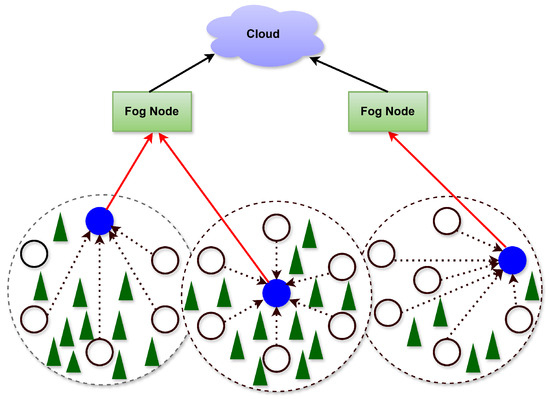
This study considered an Industry 4.0-compliant architecture comprising CR-IIoT devices, fog nodes, and cloud servers [20,23,24]. The cloud layer facilitates complex analytics and real-time data computations through distributed processing systems. The fog layer consists of interconnected CR-equipped fog nodes that coordinate the communication with cluster heads (CHs). The CR-IIoT layer includes heterogeneous CR-IIoT devices that are dynamically organized into clusters, as illustrated in Figure 1. The IIoT applications produce packets of heterogeneous sizes, typically smaller than those of PU transmissions, which lowers the bandwidth requirement. We considered a cognitive radio ad hoc network (CRAHN) [25,26] formed by ‘N’ CR-IIoT devices, represented as . The CR-IIoT network operates alongside ‘P’ PUs, denoted as . Licensed spectrum channels that can be accessed opportunistically are represented by the set .
Figure 1.
White circles: CR-IIoT devices; blue circles: cluster heads; green triangles: PUs. Brown dashed arrows: intra-cluster communication between CR-IIoT devices and their CH; red solid arrows: inter-cluster communication from CHs to fog nodes; black solid arrows: communication between fog nodes and the cloud.
A localized, cluster-based architecture was adopted (Figure 1), in which CR-IIoT devices are grouped into disjoint clusters for distributed coordination and spectrum access. The cluster formation is updated in each TDMA cycle to adapt to variations in channel availability and device mobility. Each cluster autonomously responds to local PU activity [19,25]. To prolong the network lifespan, a distributed probabilistic CH-selection policy was employed to achieve an even distribution of the energy load across the CR-IIoT devices. Devices with a critically low residual energy were excluded from CH contention to minimize the communication disruptions caused by premature energy depletion. The clustering is defined as follows:
where denotes the set of all clusters, represents the ℓ-th cluster, is the total number of clusters, and is the set of all nodes.
Each cluster contains one CH () and a set of non-CH members (). All members, , communicate with their respective CHs for both control and data transmission. Each cluster independently manages spectrum access using distinct direct sequence spread spectrum (DSSS) codes to support concurrent, interference-free transmissions [19].
Each CR-IIoT device performs local spectrum sensing to detect PU activity within its interference protection range (IPR) [19]. An energy detection (ED)-sensing technique was adopted due to its low computational overhead and compatibility with resource-constrained devices [27,28]. Interweave CR communication was governed by an ON/OFF PU-sensing model, which was adopted to minimize the interference with PUs while maintaining a low computational overhead [29]. The devices were synchronized using the technique described in [30]. However, this approach relies on a dedicated synchronized phase, which results in a larger signaling overhead. We addressed this issue by embedding a timestamp into the cluster-formation messages.
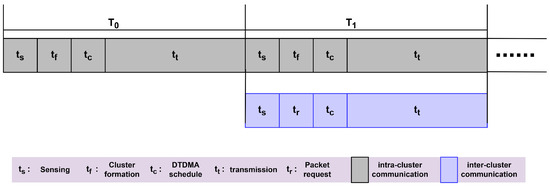
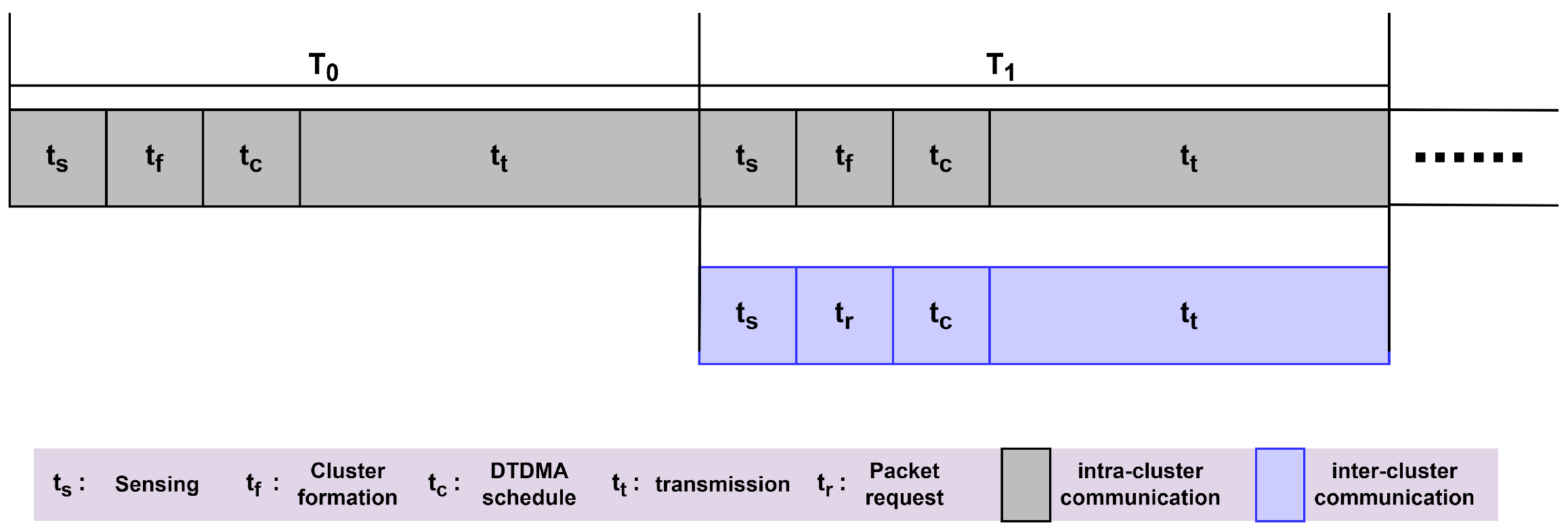
A time-slotted communication structure was employed, encompassing both control and data transmission phases, as illustrated in Figure 2. The control phase includes spectrum-sensing (), cluster-formation ()/packet request exchange (), and schedule preparation () phases. In LDCRM, the scheduling activities are distributed across two parallel rounds: (i) intra-cluster and (ii) inter-cluster.
Figure 2.
LDCRM organizes communication into a superframe with dedicated Control and Data phases to support synchronized, conflict-free communication. TDMA cycle demonstrates concurrent intra-cluster and inter-cluster communication. Ellipses indicate continuation of TDMA cycles beyond .
The CR-IIoT device-specific assumptions considered in the proposed work were as follows:
- Each CR-IIoT device is assigned a 16-bit unique identifier by the fog node upon joining the network [31].
- The CR-IIoT devices are battery-powered and operate under energy constraints.
- Each device operates with a single transceiver to maintain low interference and cost-effectiveness [29].
- The residual energy is estimated using the Coulomb counting method [32].
- The devices are capable of direct transmission to the fog layer and support power control and signal processing [33].
- To meet the PU protection requirements, a dedicated channel from the industrial, scientific, and medical (ISM) frequency band is designated as the common control channel (CCC) to exchange control messages such as CH_Announcement and Join_Request [29].
3.1. PU-Sensing Model
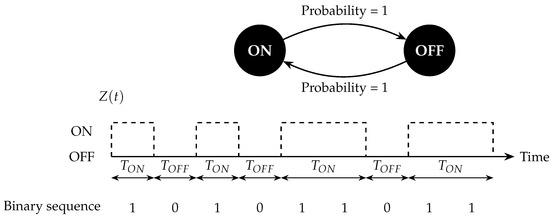
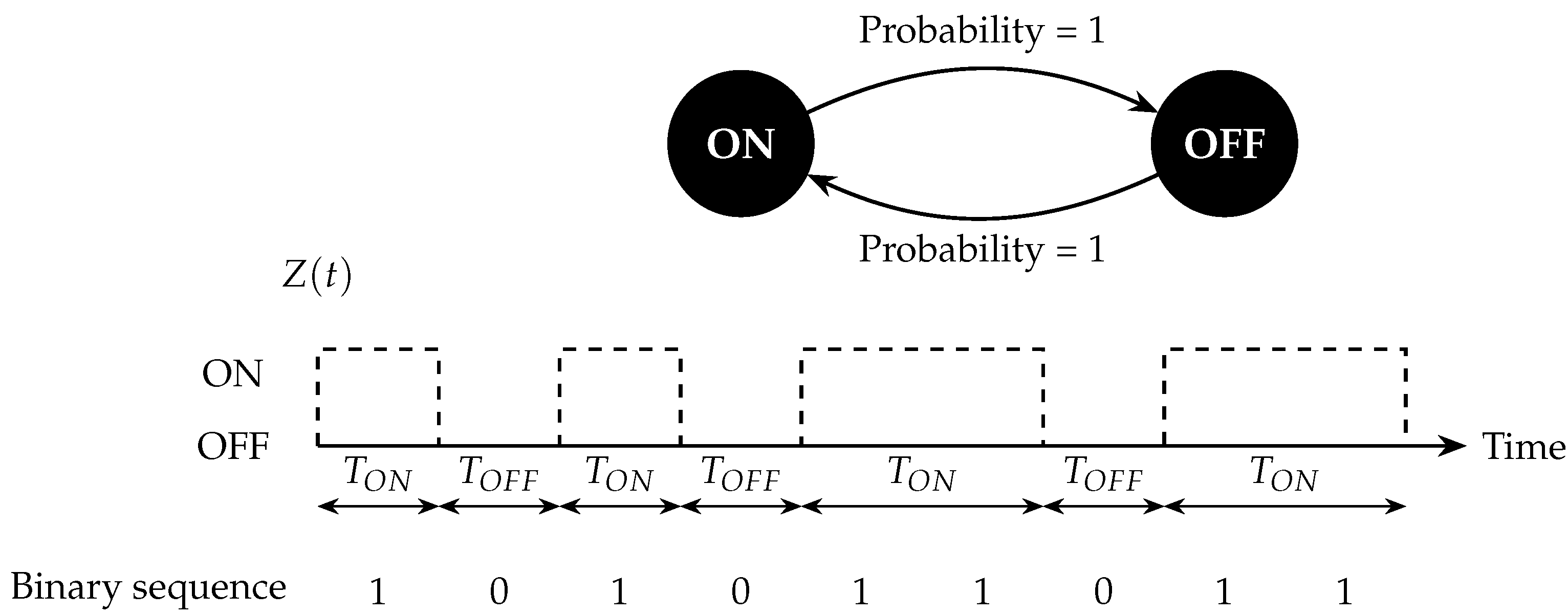
The spectrum-sensing framework followed a continuous-time ON/OFF Markov renewal process (MRP) [29,34] to ensure a lightweight design and analytical tractability while capturing the temporal correlation in PU activity. In this model, the ON state (represented by 1) corresponds to the PU occupying the channel, while the OFF state (represented by 0) denotes channel inactivity, as illustrated in Figure 3.
Figure 3.
MRP Model illustrating spectrum usage patterns through ON/OFF state transitions probabilities and active () and idle () periods.
The duration of the ON and OFF states is given by Equations (1) and (2) [35]:
where and refer to the ON and OFF periods of channel C. The ON/OFF state transitions of channel C are represented by exponential distributions parameterized by and . The respective state durations, and , are derived using Equations (3) and (4) [29,34]:
where and , and and represent the mean of the exponential distributions for the ON and OFF durations, respectively.
The probabilities of channel C being in the ON or OFF state at time t, denoted by and , respectively, are given by Equations (5) and (6) [29]:
At any given time t, the renewal period () for channel C is the sum of the consecutive probabilities of the ON and OFF periods, derived as (using Equations (5) and (6)) [29]. The CR-IIoT devices will compute to capture the idle durations of a channel and gather historical samples of the channel state transitions [36].
3.2. Dynamic Channel-Selection Policy
In ad hoc CR-IIoT networks, the stochastic PU activity necessitates an adaptive and interference-aware channel-selection strategy. To achieve this, a lightweight lexicographic ranking framework was proposed, considering interference toward PUs (), the expected idle duration (), and the signal quality ().
Let be the set of idle channels detected by device . Each channel is characterized by the tuple , where is obtained via energy detection [37], is derived from the PU-sensing model using Equation (4), and is estimated using the method from [38]. The proposed lexicographic ranking orders channels according to three sequential criteria: (i) protecting PU transmissions, (ii) maximizing transmission opportunities and minimizing the switching overhead, and (iii) the signal quality, which is given lowest priority, as its impact can be mitigated through link-adaptation techniques [39]. Formally, for any ,
Each device i constructs a channel priority list (CPL), , where the ordering is determined according to Equation (7) by sorting channels using the key . For intra-cluster communication, CHs select the top-ranked channel from their CPL, whereas non-CH members utilize their CPL to determine the cluster association.
3.3. Energy- and Spectrum-Aware Distributed CH Selection
In ad hoc CR-IIoT networks, the frequent exchange of neighbor states for cluster formation can lead to excessive signaling overhead and scalability issues. To address this, LDCRM leverages the historical data of neighbor residual energy () and the spectrum availability (), reducing the signaling overhead while maintaining accuracy in decision making. However, static averages can be inaccurate under stochastic spectrum conditions. Therefore, we adopted the Robbins–Monro stochastic approximation method [40] to update these estimates incrementally. This approach ensures convergence under bounded and ergodic dynamics while maintaining minimal computational overhead.
LDCRM forms clusters through a fully distributed mechanism that jointly considers spectrum availability and residual energy. Inspired by [19], local decision-making is implemented through a distributed approach by exploiting historical data on neighbor energy and spectrum occupancy. CH selection is performed in two tightly integrated phases: an estimation phase, in which each device computes its CH probability based on historical estimates of local and neighbor states, and an update phase, in which these estimates are refined using actual values exchanged during cycle (t) to prepare for the next cycle (). The probability that device i assumes the CH role at time t is given by Equation (8):
where is the target CH count per round, represents the residual energy of device i, and denotes the number of idle channels detected by device i during the current TDMA cycle. This value is obtained from the CPL constructed in Section 3.2. The term serves as a normalization factor approximating the network-wide average of the channel–energy product, computed locally using Equation (9):
where denotes the neighbors of device. For each neighbor j, refers to the historical estimate of idle channel availability and corresponds to its residual energy.
By applying the Robbins–Monro approximation, the historical estimates are updated using Equation (10):
where with ensures asymptotic convergence [40].
The channel availability process is modeled as a bounded and ergodic MRP (Section 3.1), while the residual energy remains bounded within a fixed interval , determined by hardware limitations. These properties guarantee the reliable estimation of over time, which enables lightweight and adaptive CH selection.
4. LDCRM Scheduling Framework
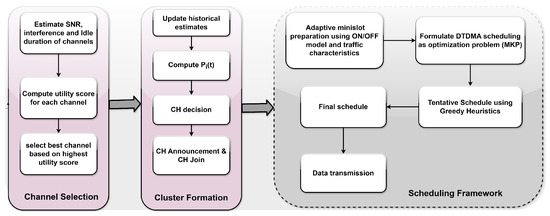
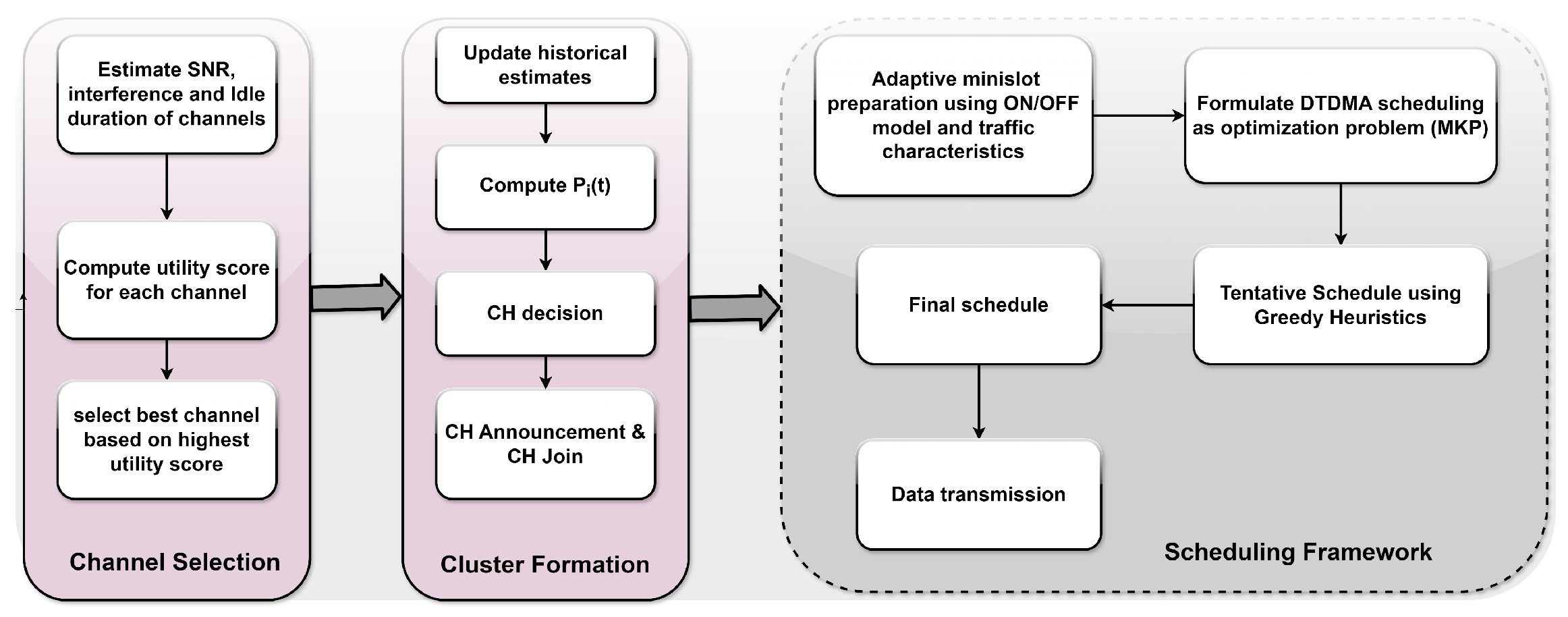
To enable efficient and adaptive spectrum access in CR-IIoT networks, the proposed LDCRM scheme incorporates a multi-stage scheduling framework that jointly considers the bandwidth fragmentation, PU activity patterns, delay sensitivity, and residual energy of the devices. The framework is composed of three tightly coupled components: adaptive minislot preparation, DTDMA slot scheduling problem formulation, and greedy scheduling heuristics. An overview of the scheduling workflow is illustrated in Figure 4.
Figure 4.
Block diagram of the LDCRM scheduling framework illustrating the flow from channel and CH selection to adaptive minislot allocation and DTDMA scheduling using lightweight greedy heuristics.
4.1. Adaptive Minislot Preparation
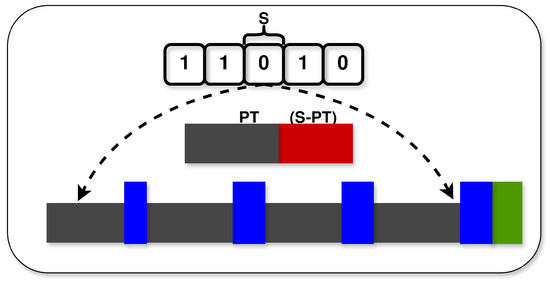
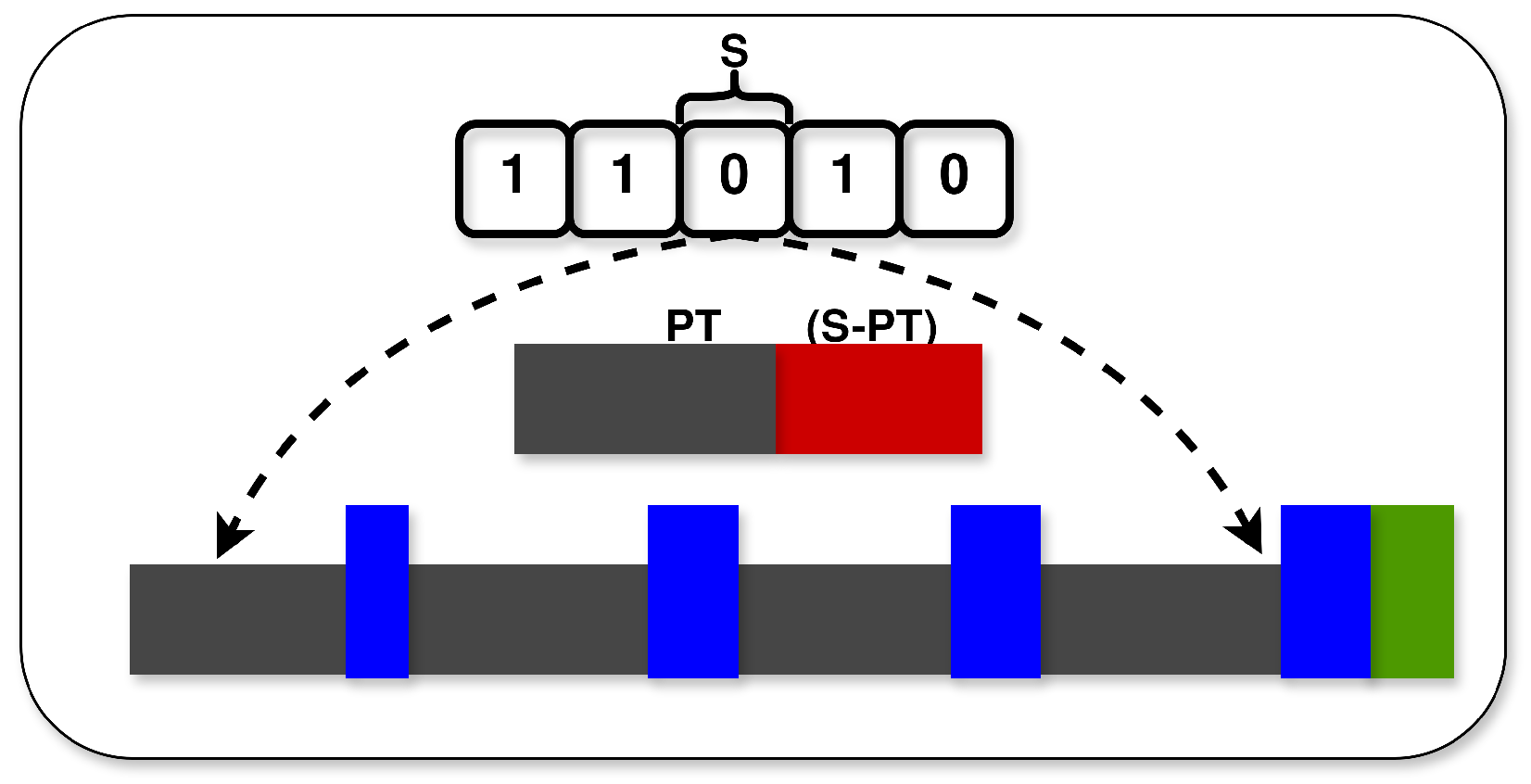
In this section, an adaptive minislot preparation scheme is introduced to mitigate bandwidth fragmentation. Bandwidth fragmentation is a situation where the idle slots in a licensed channel have a duration greater than the required length by IIoT packets as shown in Figure 5. Therefore, a slot is further subdivided into minislots, allowing for more IIoT packets within the OFF duration. The scheme dynamically adjusts the minislot duration based on the channel availability and the transmission duration required by heterogeneous IIoT applications. The bandwidth demand from the IIoT applications is fulfilled by assigning one or more minislots. To deal with the fragmentation, the minislot duration is chosen in such a way that the total wastage (TW) of time within the OFF duration is minimized. The scenario of bandwidth wastage (BW) due to fragmentation can be caused due to the following two reasons:
Figure 5.
Illustration of minislot-based slot preparation over spectrum holes. Each PU slot of duration S is partially utilized for IIoT packet transmission (), leaving BW as shown in red. Therefore, the spectrum holes are subdivided into adaptive minislots (grey: transmission, blue: , green: ) to minimize bandwidth fragmentation.
1. Internal Wastage (): This occurs when the allocated minislot duration exceeds the packet’s actual transmission time (PT). is computed using Equation (11):
where represents the queue length at device i, indicates the minislot requirement for the packet, and represents the minislot duration.
2. External Wastage (): This represents the unused bandwidth due to the lengths of the spectrum holes being not exactly divisible by the minislot duration, and it can be computed using Equation (12):
where K is the total number of spectrum holes.
Illustrative Example: Consider a scenario with three spectrum holes of lengths and three packets with transmission times . Let the candidate minislot duration . Then, .
Using Equation (11), .
Using Equation (12), .
Thus, the total bandwidth wastage is .
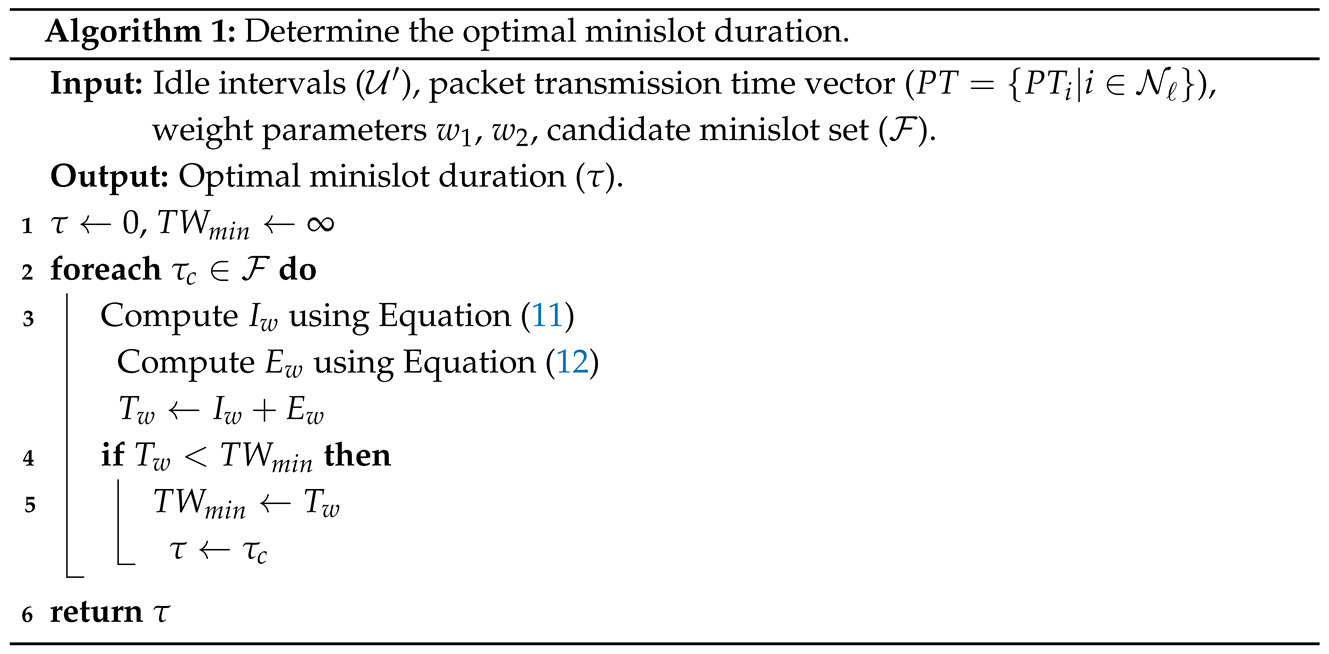
To identify the optimal minislot duration that minimizes , an exhaustive search is computationally intensive and infeasible for resource-constrained ad hoc CR-IIoT settings. The optimization function involves modulo arithmetic, making it non-differentiable and ill-suited for gradient-based techniques. To address this, a random search approach was employed that optimizes the computational complexity and exploration of a large solution space. Each non-CH member proposes a candidate , forming a collective candidate set . The final is selected from as the one that yields the minimum BW. The dynamic minislot adjustment strategy optimizes spectrum utilization by minimizing bandwidth fragmentation and preserving the collision-free property of DTDMA. It also forms the backbone for the lightweight design of the CR-IIoT MAC scheme by enabling MKP-based optimization under CR-IIoT constraints. Algorithm 1 identifies the optimal that minimizes .
4.2. Problem Formulation
LDCRM is formulated as a constrained optimization framework designed to minimize the queuing delay and maximize channel utilization through dynamic minislot allocation. The model operates under CR-IIoT constraints, including the stochastic channel availability, network density, queueing dynamics, and residual energy limitation. To carry out LDCRM scheduling problem formulation, we introduce the following key definitions:
Definition 1.
The total minislots () in the k-th spectrum hole represents the number of times that the duration can be subdivided into minislots. This is computed using Equation (13):
where is the duration of the k-th spectrum hole.
Definition 2.
The total number of minislots (V) within one TDMA cycle is computed as the aggregate of minislots across all spectrum holes, given by Equation (14):
where K is the total number of spectrum holes within one TDMA cycle.
Definition 3.
The minislot requirement for transmitting packet j, denoted by , represents the number of minislots needed to satisfy its transmission requirement. is calculated using Equation (15):
where r indicates an extra minislot if is not divisible by τ; it is derived as follows:
and represents the packet transmission duration, which is derived as follows [41]:
where refers to the channel capacity in terms of the data transmitted per time unit.
Definition 4.
The queuing delay of the j-th packet in the queue of the i-th device is approximated using Equation (17) [42]:
where and λ is the packet arrival rate.
Definition 5.
The duration to the m-th minislot in the spectrum hole is the time gap between the start time of the first TDMA slot and the start time of the m-th, which is derived by Equation (18):
The utility of scheduling a packet within an idle period is derived using normalized values of Equations (17) and (18) and the remaining energy of device (), given by Equation (19):
where represents the min–max-normalized value of and is added to prioritize the devices that have a remaining energy lesser than a user-defined threshold (), given by Equation (20):
represents the min–max-normalized value of , which ensures that slots closer to the cycle’s beginning are prioritized for transmission.
Each cluster autonomously performs scheduling based on locally exchanged control information. For a given cluster with non-CH members, the scheduling process is initiated by broadcasting Join_Request messages over the CCC. By overhearing these broadcasts, each non-CH member constructs a local view of the cluster state. The scheduling problem for cluster () is then formulated as a utility-driven maximization problem, with the goal of optimizing the aggregate utility by prioritizing packets with a higher utility (U). The formal optimization model for scheduling in cluster is presented as follows:
where is the total utility obtained by allocating the packets into minislots, is the utility obtained from the packet of the non-CH in the spectrum hole, and is a binary decision variable. The value of is 1 if the packet j of non-CH i is assigned to minislot k; otherwise, it is 0. Similarly, the value of binary variable is 1 if packet j is allocated in minislot in the spectrum hole; otherwise, it is 0. The objective function, given in Equation (21), aims to optimize the aggregate utility derived from the scheduling of the packets in all available minislots and targets to minimize the queueing delay of the packets.
The constraint in Equation (22) specifies that the total transmission time of the scheduled packets must not exceed the spectrum hole length. The constraint in Equation (23) ensures that each packet is assigned within a single spectrum hole, whereas the constraint in Equation (24) enforces that only one packet can be assigned to a minislot. The constraint given by Equation (25) mandates that each packet j must be fit in at least one of the spectrum holes. The constraint in Equation (26) ensures that any spectrum holes that cannot accommodate any packets are excluded. The constraint in Equation (27) refers to the decision variables. Equation (22) enforces that the scheduled transmissions fit within each spectrum hole, thereby avoiding interference with PU communication. Equations (23) and (24) refer to the constraints that prevent collisions among the devices by ensuring that each packet is assigned to a distinct minislot and each minislot is assigned to a unique packet.
4.3. Proposed Heuristic Algorithm
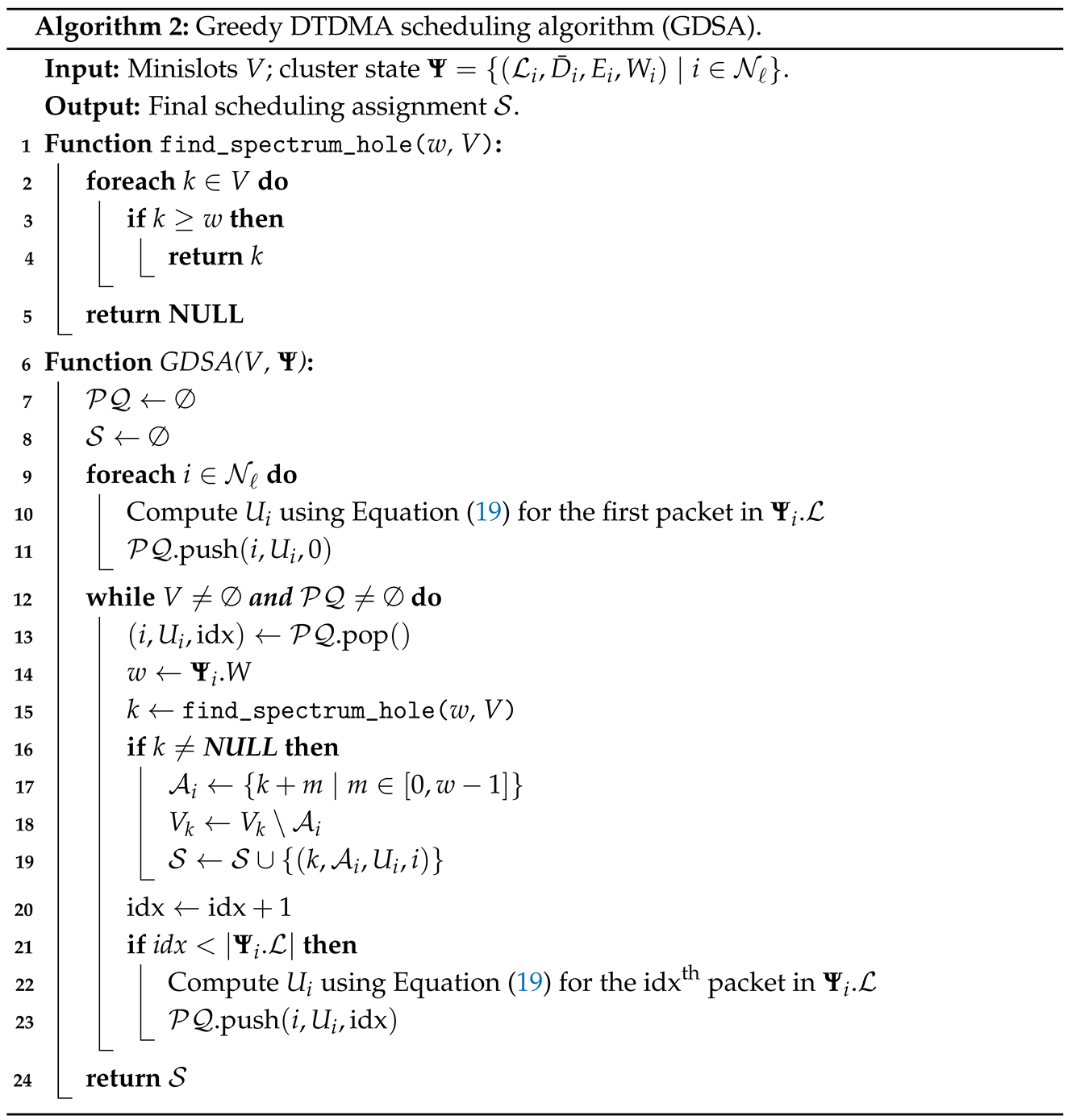
This subsection presents a lightweight greedy heuristic DTDMA scheduling algorithm (GDSA) to obtain a sub-optimal solution for the formulated problem within polynomial time. The proposed algorithm computes the DTDMA schedule by considering the residual energy and minislot availability for a device while achieving the utility of the scheduled packets in terms of the queuing delay. During the initialization phase, GDSA computes U for the first packet of each device using Equation (19) and inserts a tuple containing {device information, U, and packet_index} into the PriorityQueue. This PriorityQueue is organized in descending order of U, ensuring that the packet with the highest U is always selected first for scheduling. In each iteration, the algorithm removes the first entry from the PriorityQueue and attempts to schedule the corresponding device into suitable minislots. Upon successful allocation, the number of available minislots is decreased by . If the device has additional unscheduled packets, GDSA computes U for the next packet and inserts the updated device information into the PriorityQueue, incrementing the packet index accordingly. This process continues until either all of the minislots are exhausted or all of the packets are scheduled, i.e., the PriorityQueue is empty. The working steps of the proposed greedy algorithm are presented in Algorithm 2:
4.4. Asymptotic Analysis
For GDSA, the initialization phase involves inserting the first packet from each device into a priority queue, which requires a time complexity of . In subsequent iterations, pop and push operations on the priority queue incur per operation. The process of identifying the optimal spectrum hole has a complexity of . The main loop that handles all packets executes in time. Considering that the cluster size is much smaller than the total number of packets, the overall complexity of LDCRM becomes . The memory requirement is , primarily due to the priority queue. In contrast, the DPPST algorithm exhibits a time complexity of for sorting and crossover operations [20], while its space complexity is [20].
4.5. Construction of DTDMA Schedule
This section presents the distributed construction of the minislot schedule, designed to minimize the queuing delay and maximize minislot utilization within each cluster. A lightweight, leader-assisted approach was adopted, wherein non-CH members compute tentative schedules locally, while the CH consolidates and resolves conflicts to produce the final schedule as outlined in (Algorithm 3).
| Algorithm 3: DTDMA schedule-construction procedure. |
| Input: Idle periods , cluster state . Output: Final conflict-free DTDMA schedule.
|
During the cluster-formation phase, each non-CH device transmits a Join_Request message over the CCC. Using this received information, each non-CH member computes the minislot duration () using the method described in Section 4.1. For each cluster (), each non-CH () formulates the MKP and applies the GDSA algorithm (Algorithm 2) to compute a tentative schedule and its corresponding utility score U. The tentative schedules are then transmitted to the CH. The CH resolves scheduling conflicts using a hierarchical policy: the devices are ranked by utility, residual energy is considered next, and the device ID is used as the final tie-breaking policy. The CH broadcasts the final schedule to its members. Each non-CH member maintains a local minislot schedule vector (MSV) that stores the complete allocation for the cluster. Mathematically, the MSV maintained by device is as follows:
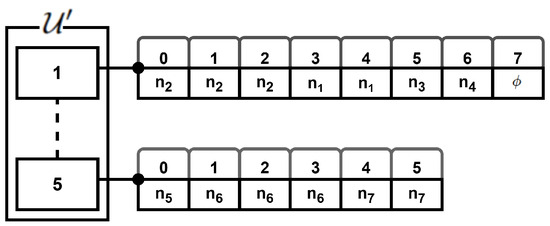
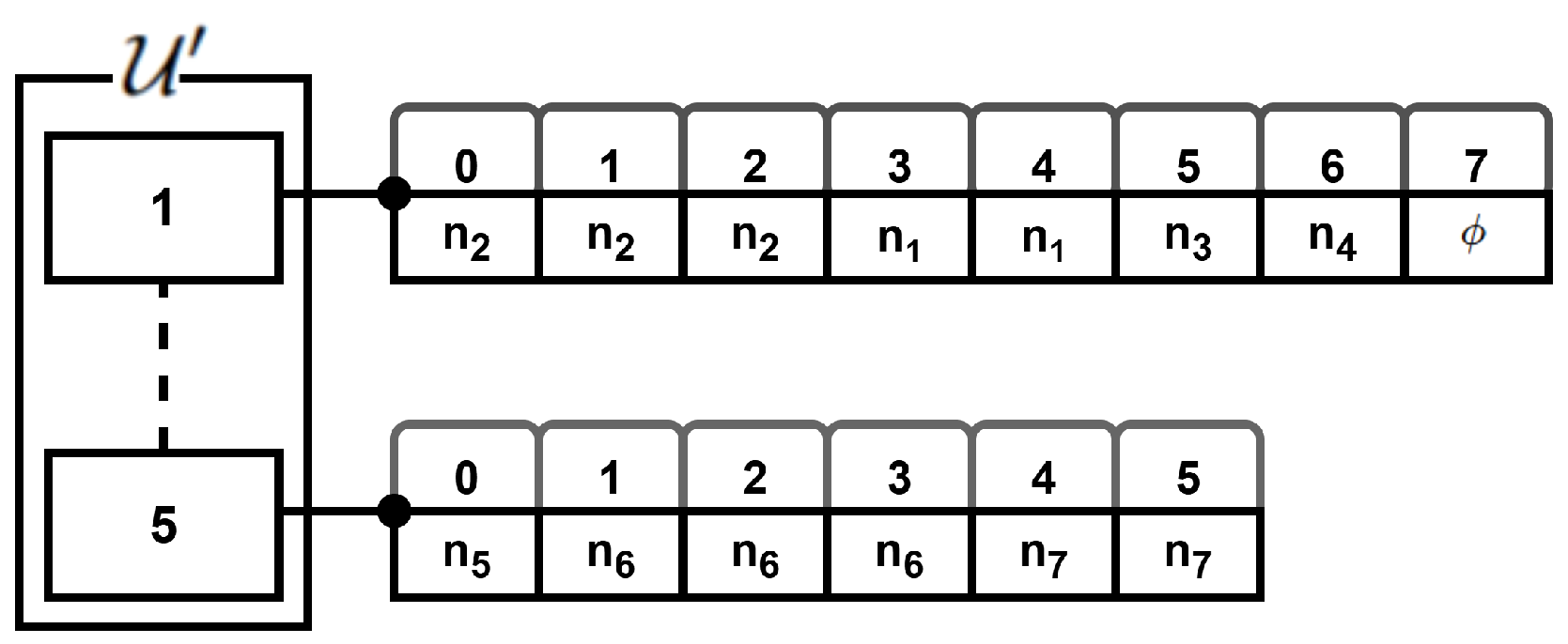
Here, m denotes the minislot index and represents the ID of the scheduled device. Figure 6 illustrates an example MSV, where denotes an unassigned minislot.
Figure 6.
Example MSV maintained by non-CH members. The rounded boxes denote minislot indices; the rectangular boxes below indicate the assigned member. Consecutive allocations reflect successive slot reservations. represents unassigned minislots.
Upon receiving the final schedule, each device updates its MSV and discards temporary scheduling structures, enabling conflict-free, concurrent transmissions within the cluster.
5. Proposed MAC Scheme
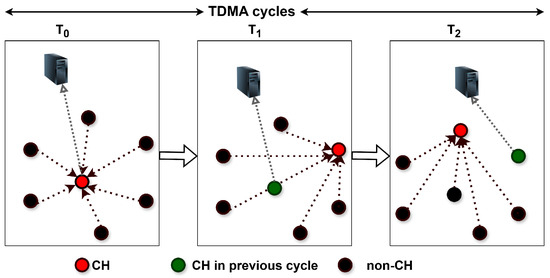
This section implements the LDCRM scheduling framework introduced in Section 4. While the framework defines the abstract stages of channel selection, CH selection, and scheduling optimization, the proposed MAC scheme realizes them through two concurrent communication rounds within each TDMA cycle: intra-cluster and inter-cluster. These rounds operationalize the framework’s utility-driven decisions using distributed and centralized scheduling strategies, respectively. The TDMA round design explicitly avoids scheduling conflicts by assigning non-overlapping roles to CHs across successive cycles, ensuring that intra- and inter-cluster rounds can coexist within the same temporal window. As illustrated in Figure 7, this concurrent dual-round scheduling eliminates idle periods, enhances the bandwidth efficiency, and reduces the queuing latency without cross-round interference.
Figure 7.
Illustration of the staggered intra- and inter-cluster communication rounds across three successive TDMA cycles in LDCRM. In each cycle, a newly selected CH (in red) coordinates intra-cluster transmission within its cluster, while the CH selected in the previous cycle (in green) concurrently performs inter-cluster data transmission with the fog node. Solid arrows represent intra-cluster communication between CH and non-CH nodes, while dashed arrows indicate inter-cluster communication between the CH and the fog node.
5.1. Intra-Cluster Communication Round
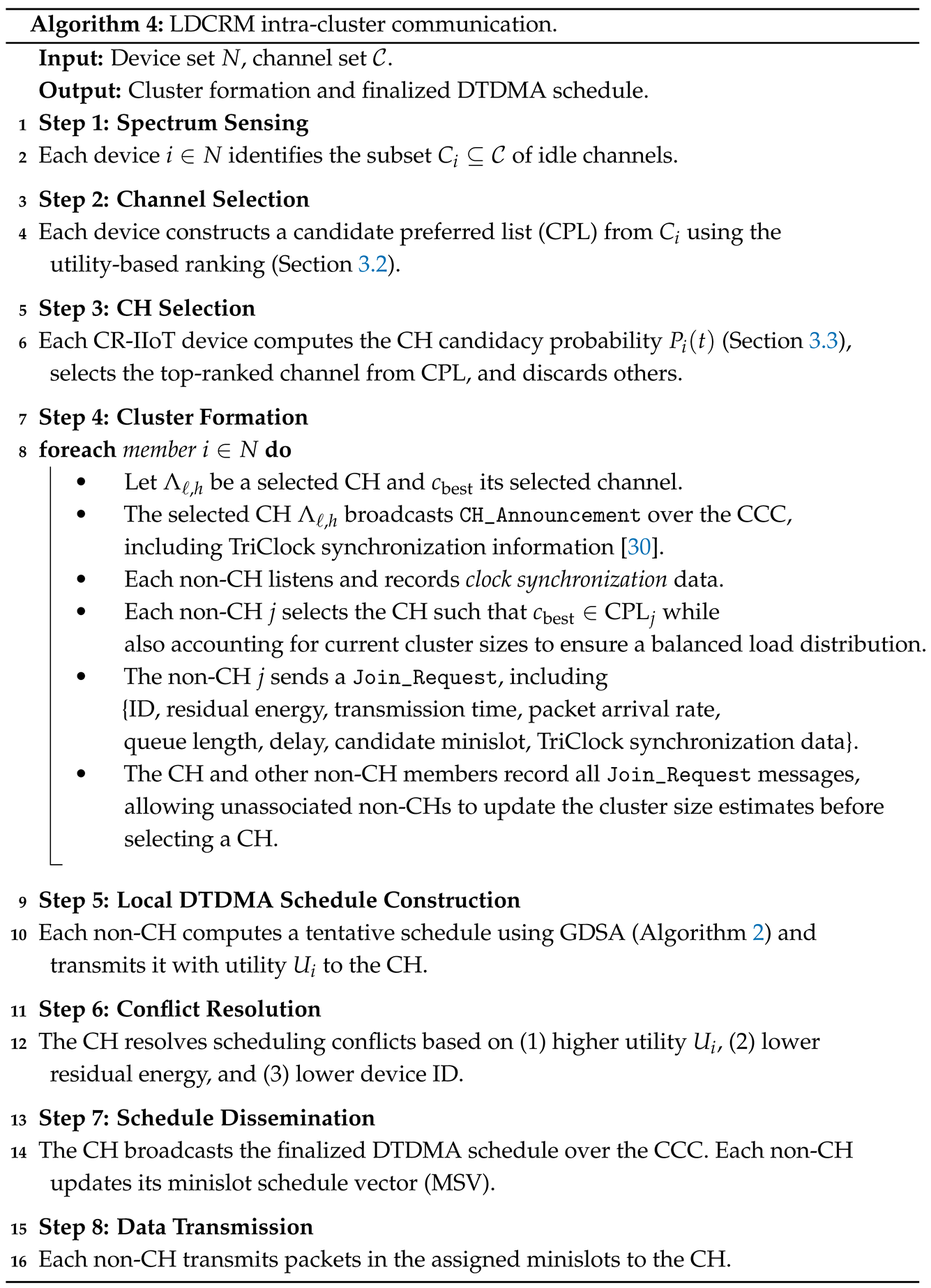
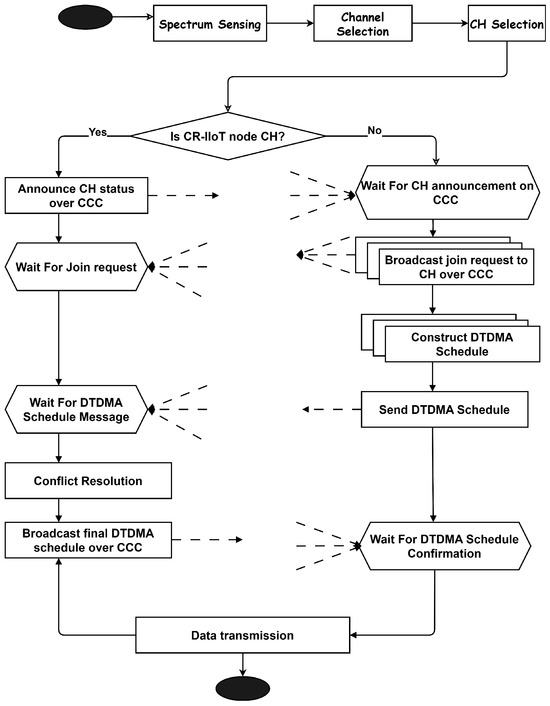
In this phase, non-CH members transmit their queued packets to the CH in their assigned minislots prepared by the DTDMA schedule. The overall process includes spectrum sensing, channel selection, CH selection, cluster formation, DTDMA schedule construction, and conflict resolution. The entire workflow is visualized in Figure 8 and described in Algorithm 4.
Figure 8.
Intra-cluster communication workflow of LDCRM. Each CR-IIoT device performs spectrum sensing, selects the best idle channel, and decides the CH candidacy. Cluster members locally construct tentative DTDMA schedules, which are resolved and finalized by the CH for synchronized data transmission.
5.2. Inter-Cluster Communication Round
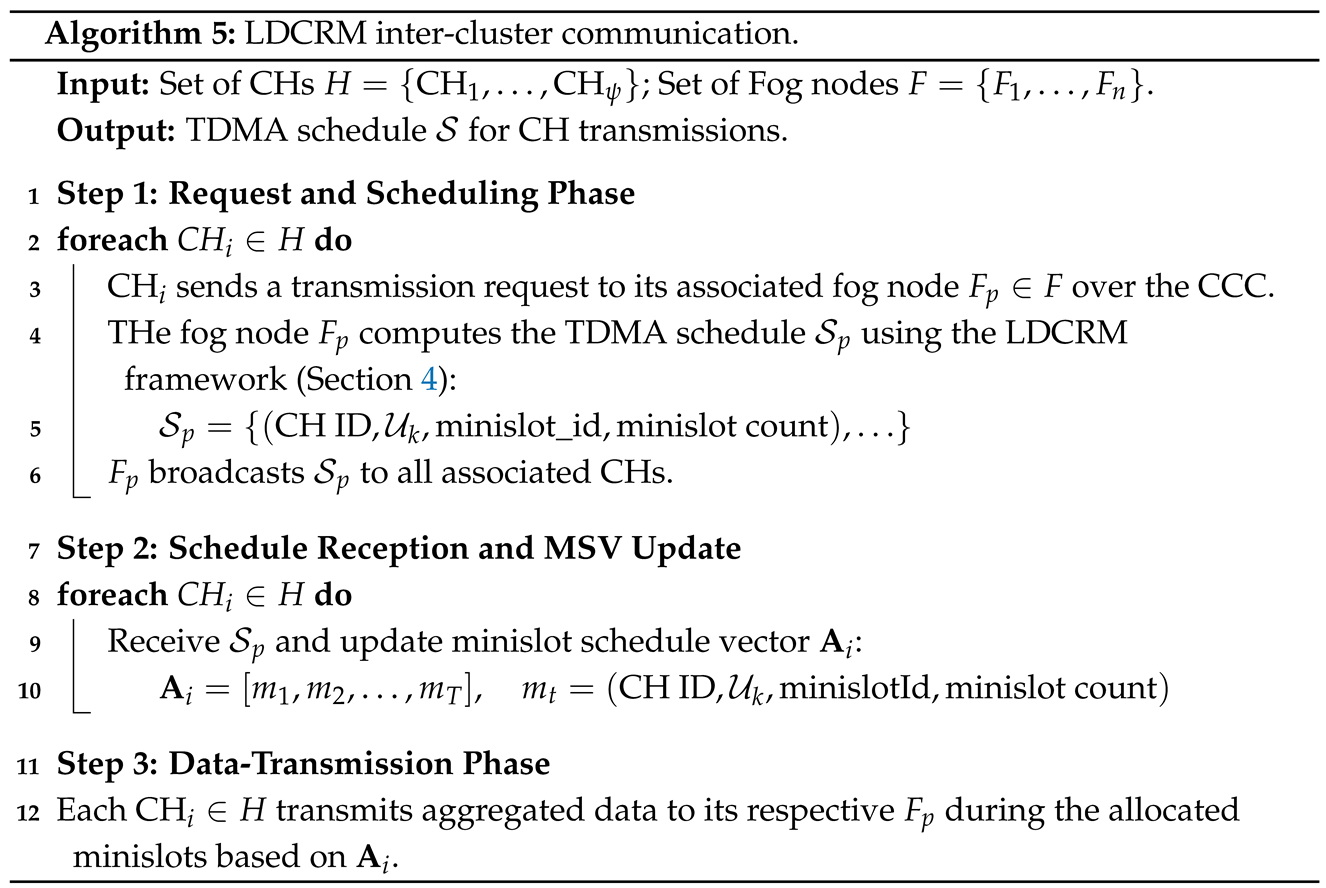
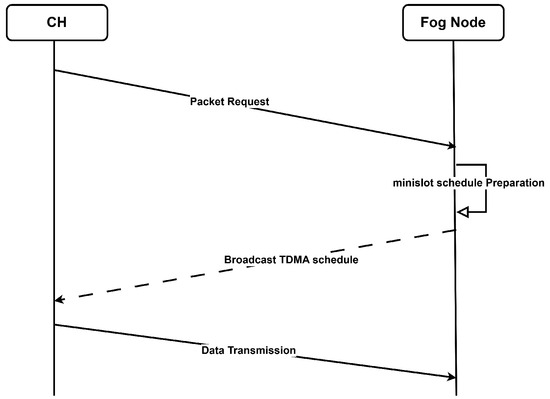
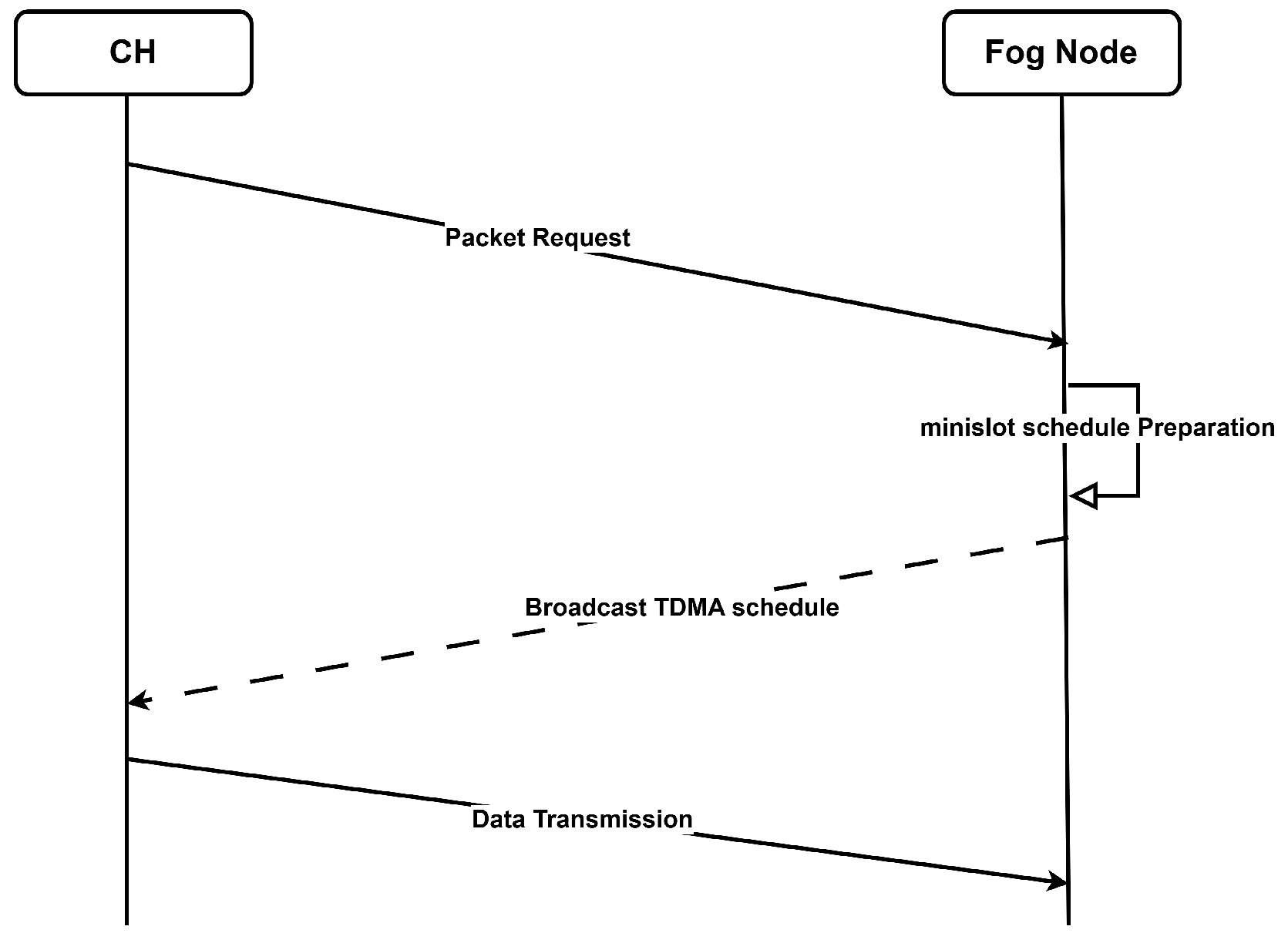
This phase facilitates the centralized scheduling mechanism coordinated by the fog nodes in the LDCRM scheme. Upon receiving transmission requests from CHs, the fog nodes compute an optimal TDMA schedule based on the LDCRM scheduling framework described in Section 4. The complete sequence of message exchanges and scheduling coordination is illustrated in Figure 9, highlighting the interaction between CHs and fog nodes. The corresponding procedure for scheduling and transmission is formally presented in Algorithm 5.
Figure 9.
Intra-cluster communication workflow in LDCRM. Each CR-IIoT device performs spectrum sensing, selects the best idle channel, and decides CH candidacy. Cluster members construct tentative DTDMA schedules, which the CH resolves and finalizes for synchronized data transmission.
6. Experiments and Discussion
This section presents a simulation-based performance evaluation of the proposed LDCRM scheme. The simulations were implemented in Python 3.11 and executed on a system running Ubuntu 22.04.1 with 64 GB RAM. For benchmarking, two related approaches were considered—(i) a DP-PSO-based DTDMA packet-scheduling protocol [20] and (ii) a CogLEACH protocol [19]. The optimal packet-to-slot mapping in the DP-PSO-based DTDMA scheme was determined by a combinatorial optimization technique to minimize the queueing delay in CR-IoT networks. CogLEACH is a spectrum-aware extension of the LEACH protocol that shares similarities with LDCRM in cluster formation. For fairness and consistency in the performance evaluation, the original schemes in [19,20] were extended by incorporating the minislot strategy. These extensions are referred to as DPPST and E-CogLEACH, respectively. The simulation results include confidence intervals exceeding , achieved through multiple iterations of each simulation, and these intervals are explicitly shown in the figures as error bars to illustrate the variability.
6.1. Performance Benchmarking
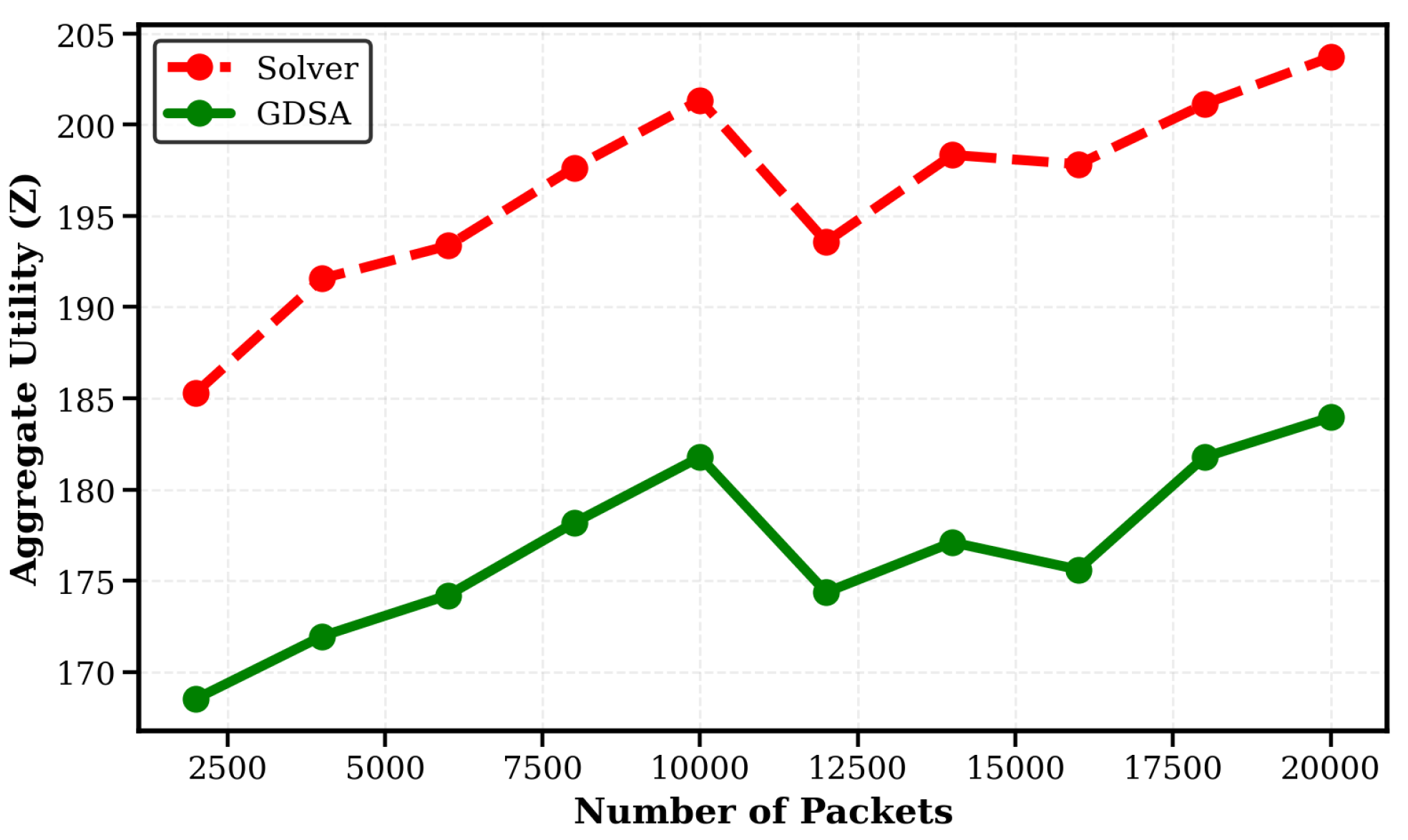
This section details a simulation-based experiment that benchmarks the proposed GDSA algorithm against an optimization-based solver based on to demonstrate the trade-off between the computational complexity and the real-time adpatibility in CR-IIoT deployments. The experiment was carried out across packet loads defined as . The generated packet sizes followed a uniform random distribution over [11, 222] bytes [43,44]. The OFF state duration lengths were computed using the ON/OFF model (Section 3.1) with randomly chosen rate parameters: and [35]. The minislot duration was computed using Algorithm 1 and the packet transmission time () was obtained using Equation (16). These values ( and ) were then used to compute (Equations (15) and (19)), which formed the input to the GDSA and solver. The aggregated utility for GDSA and the solver was computed as the mean value over 1000 TDMA cycles for each configuration.
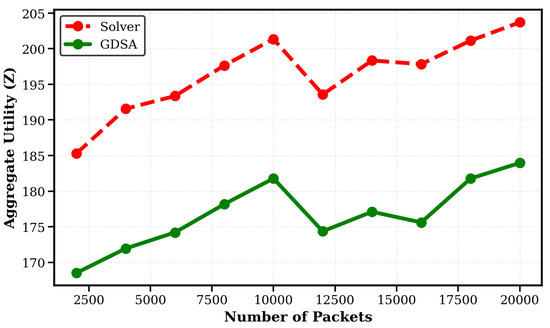
Figure 10 illustrates that both the GDSA and the optimization-based solver followed similar trends in . The solver comparatively performed better, with a maximum deviation of occurring at , because of its exhaustive search approach during packets to minislot assignments. However, the lightweight greedy heuristics design of the GDSA provides near-optimal scheduling while meeting the stringent timing requirements of IIoT applications.
Figure 10.
Benchmarking aggregate utility () across varying packet sizes for the GDSA and the optimal solver. The solver achieved a consistently higher utility, while the GDSA showed larger fluctuations at higher packet volumes.
6.2. Experimental Setup
A single-hop CRAHN with a transmission range of 250 m was randomly deployed in a flat square grid area of size , and the IPR radius was . This work adopted a state-based energy consumption model [45], which includes Transmit (TX), Receive (RX), Idle, Sleep and Spectrum Sensing states, along with channel-switching overhead. The power parameters were derived from IEEE 802.15.4-class radios [31] and vendor datasheets (e.g., TI CC2420) [46], which are widely used in industrial IoT deployments. The initial energy per device was 0.5 J [19]. The optimal CH count () was derived by following [47] and adjusted dynamically based on the number of active devices in each round. The PU activity followed an ON/OFF model with transition rates and adopted from [35]. The simulations were run for 1000 TDMA cycles, and each cycle had a duration of 5 s and each time slot had a duration of s. The parameter values used in the simulation are presented in Table 1:
Table 1.
Simulation parameters.
6.3. Experimental Analysis of Cluster Stability and Fairness
This experiment was conducted for 100 devices to evaluate the impact of cluster-formation strategies on the network lifespan and load distribution in ad hoc CR-IIoT networks. Stable and fair cluster formation is critical for an extended network lifespan because energy dissipation depends on the clustering strategy. To evaluate the fairness in cluster member association, Jain’s fairness index (JFI) [48] was adopted as a quantitative metric. JFI provides a normalized, scale-independent measure of the load balance across clusters, where and values closer to 1 indicate a uniform distribution.
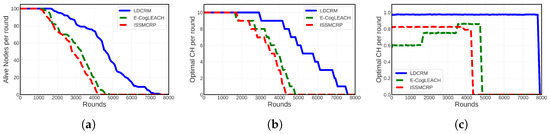
Figure 11a illustrates the evolution of active devices per round for LDCRM, E-CogLEACH, and ISSMCRP. The number of active devices in LDCRM was significantly higher than that of E-CogLEACH and ISSMCRP (≈7500 rounds vs. ≈4800 and ≈4229 rounds), representing a improvement over E-CogLEACH. Similarly, the LDCRM retained active devices until ≈5000 rounds as compared to ≈3000 and ≈2750 rounds for E-CogLEACH and ISSMCRP, demonstrating a better energy efficiency. This improvement can be primarily attributed to the efficiency in energy consumption, which is due to reduced signaling overhead during cluster formation and an even distribution of non-CH members across clusters.
Figure 11.
LDCRM vs. E-CogLEACH: (a) alive devices per round, (b) optimized CH count per round, and (c) Jain’s fairness index per round.
Figure 11b compares the number of CHs per round for LDCRM, E-CogLEACH, and ISSMCRP. While all three protocols started at the target of 10 CHs, E-CogLEACH showed a faster decrease in CHs beginning around 1600 rounds, and all the devices became non-operational by 4700–4800 rounds, exhausting their residual energy. ISSMCRP followed a similar trend, with complete node exhaustion occurring by 4200–4300 rounds. In contrast, LDCRM maintained the target CHs until 3100 rounds. It showed the regular and single-step decline of CHs approximately every 400–600 rounds. All devices under LDCRM became inactive after operating until 7500 rounds. LDCRM thus extended the time to exhaustion by ≈2800 rounds and demonstrated a smoother, slower decline in active devices. This indicates a more balanced load distribution and uniform energy consumption across clusters.
Figure 11c illustrates the fairness trends across clusters in each round. LDCRM achieved an optimal JFI (–) throughout the network lifetime, while E-CogLEACH fluctuated between and initially, improving marginally before collapsing as the network died. ISSMCRP maintained a moderate fairness (0.70–0.85), outperforming E-CogLEACH due to its inter-cluster routing, adaptive cluster radius, and consideration of imperfect spectrum sensing. The improved performance of LDCRM can be attributed to its load-aware cluster association strategy [Algorithm 4]. The minor variation in LDCRM was seen primarily due to fluctuations in the number of active devices throughout the experiment. LDCRM’s high LFI value indicates adaptive cluster formation and uniform member allocation with growth in the network size. This balanced distribution of devices across clusters optimizes the network lifespan and spectrum utilization.
6.4. Experimental Result Analysis
This section evaluates the performance of LDCRM in comparison to E-CogLEACH and DPPST across multiple scenarios, including the network size, traffic load, and residual energy thresholds.
6.4.1. Performance Evaluation Metrics
The performance of LDCRM was assessed using four key metrics to analyze the scheduling efficiency, reliability, and latency within ad hoc CR-IIoT scenarios. To mitigate transient fluctuations, the average values of the corresponding metric obtained by running ’T’ cycles were used as the data points. The four metrics are defined as follows:
- The average queuing delay () was computed using Little’s Law [42]:where is the arrival rate of the device.
- Bandwidth utilization (, %) measures the efficiency in spectrum utilization, computed by Equation (30):
- The packet delivery ratio (, %) indicates the reliability of packet transmission, defined by Equation (31):where and are packets delivered and transmitted in cycle t.
- Slot utilization (, %) demonstrates the minislot allocation efficiency, given by Equation (32):where and denote the used and total minislots in cycle t.
6.4.2. Scalability Analysis by Increasing Network Size
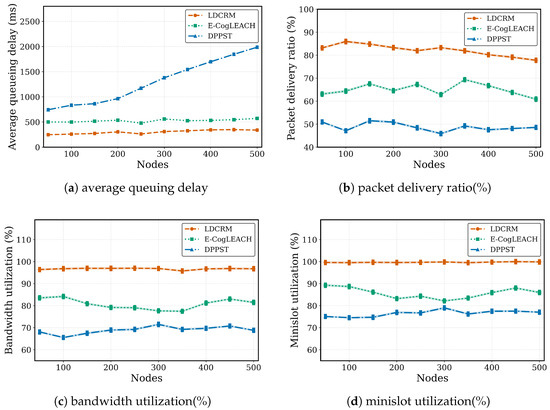
The performance of the LDCRM, E-CogLEACH, and DPPST schemes was evaluated by increasing the network size from 50 to 500. The packet arrival rate was set to 100 packets per ms throughout the experiment. Figure 12a–d illustrate that LDCRM consistently outperformed E-CogLEACH and DPPST across all the evaluated metrics. LDCRM achieved the lowest in the range of – ms, a higher of –, and near-optimal resource utilization with an and of – and –, respectively. Comparatively, E-CogLEACH demonstrated a moderate performance, characterized by a higher – ms, a lower (–) and declining resource utilization (: –, : –). DPPST depicted the lowest performance among the three, with a escalating from (534.97–2178.5) ms, a consistently below , and an inefficient (–) and (–). LDCRM showed an improvement of up to 43.34% in the and the maximum of , as compared to and for E-CogLEACH and DPPST, respectively.
Figure 12.
Effect of network size on performance metrics: (a) , (b) , (c) , and (d) .
The optimal performance of LDCRM can be attributed to its load-aware clustering mechanism and MKP-based scheduling approach. By employing lightweight greedy heuristics that consider the queuing delay and residual energy, LDCRM effectively minimizes the while optimizing the , , and . Conversely, E-CogLEACH is affected by uneven cluster formation and the use of randomized scheduling that is not delay-aware, resulting in performance degradation as the network size increases. DPPST’s exhaustive search-based scheduling becomes computationally intensive as the network size grows, resulting in excessive queuing delays and higher packet drop rates. LDCRM maintained a consistent performance across varying network sizes due to its clustering strategy. By evenly distributing nodes among clusters, it minimizes intra-cluster contention and facilitates efficient concurrent communication, thereby optimizing the overall network performance.
6.4.3. Impact Analysis of Packet Arrival Rate on Performance
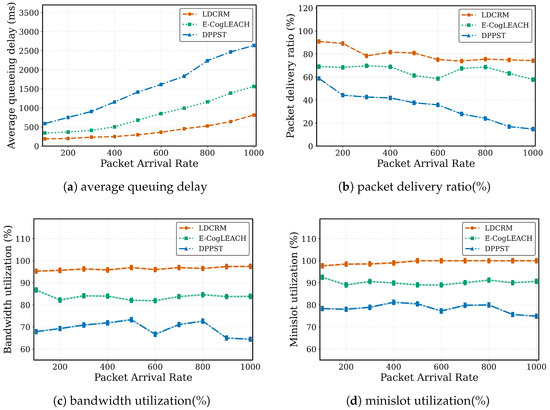
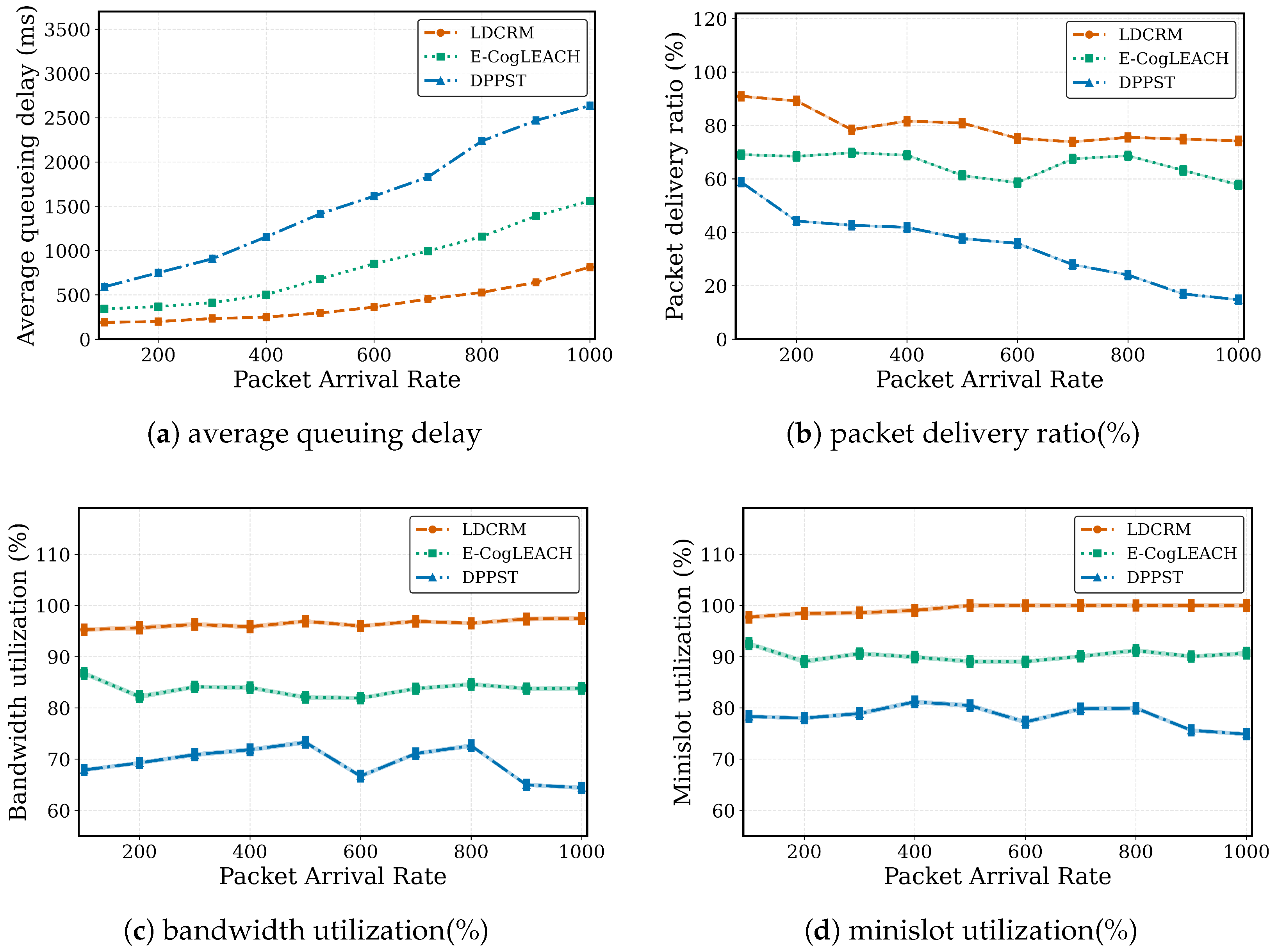
Figure 13 illustrates the performance impact on LDCRM, E-CogLEACH, and DPPST under increasing packet arrival rates, from to , while keeping the network size constant at 100 devices. Figure 13a demonstrates that LDCRM maintained the lowest (189.28–813.64 ms), while E-CogLEACH and DPPST experienced significant growth, reaching up to ms and ms, respectively, at 1000 packets/ms. Figure 13b reveals that the for LDCRM remained consistently high (–89.23%), whereas E-CogLEACH exhibited a moderate performance (57.79–69.79%) and DPPST suffered a sharp decline from 44.23% to 14.76%. , as shown in Figure 13c, and remained stable for LDCRM (95.29–97.45%) across all arrival rates, outperforming E-CogLEACH (81.92–84.61%) and DPPST (64.42–73.28%). Similarly, in Figure 13d demonstrates LDCRM’s near-optimal minislot usage (97.72–100%), whereas E-CogLEACH and DPPST exhibited a lower utilization (89.04–91.21% and 74.87–81.18%) due to inefficient scheduling. However, the showed an increasing and the demonstrated a decreasing trend across all protocols with increasing packet arrival rate. This was primarily due to higher network congestion caused by an increase in the packet arrival rate, which resulted in more packets in the queue and a higher demand for minislots. Since the available bandwidth remained relatively constant, there was not enough capacity to satisfy the rising minislot demand. This is evident from the optimized and value achieved by LDCRM. LDCRM maintained the lowest total wastage (), ranging between (2.6 and 4%), while for E-CogLEACH and DPPST, the value ranged between (5.78 and 7.12%) and between (7.17 and 10.65%), respectively. LDCRM dynamically selected the minislot durations to minimize bandwidth fragmentation and reduce by employing spectrum-aware scheduling (GDSA) to assign minislots within the optimal spectrum hole.
Figure 13.
Impact of increasing packet arrival rate on performance metrics: (a) , (b) , (c) , and (d) .
6.4.4. Impact Analysis of Residual Energy Threshold Variations on Performance
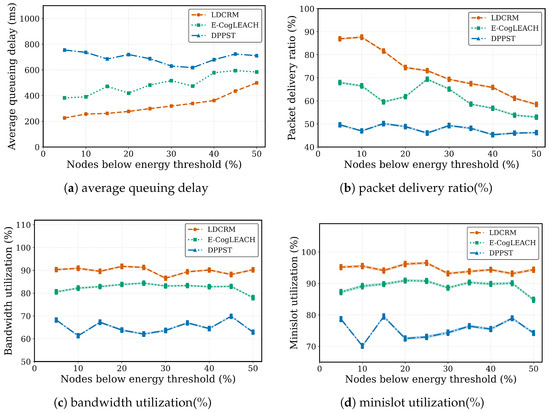
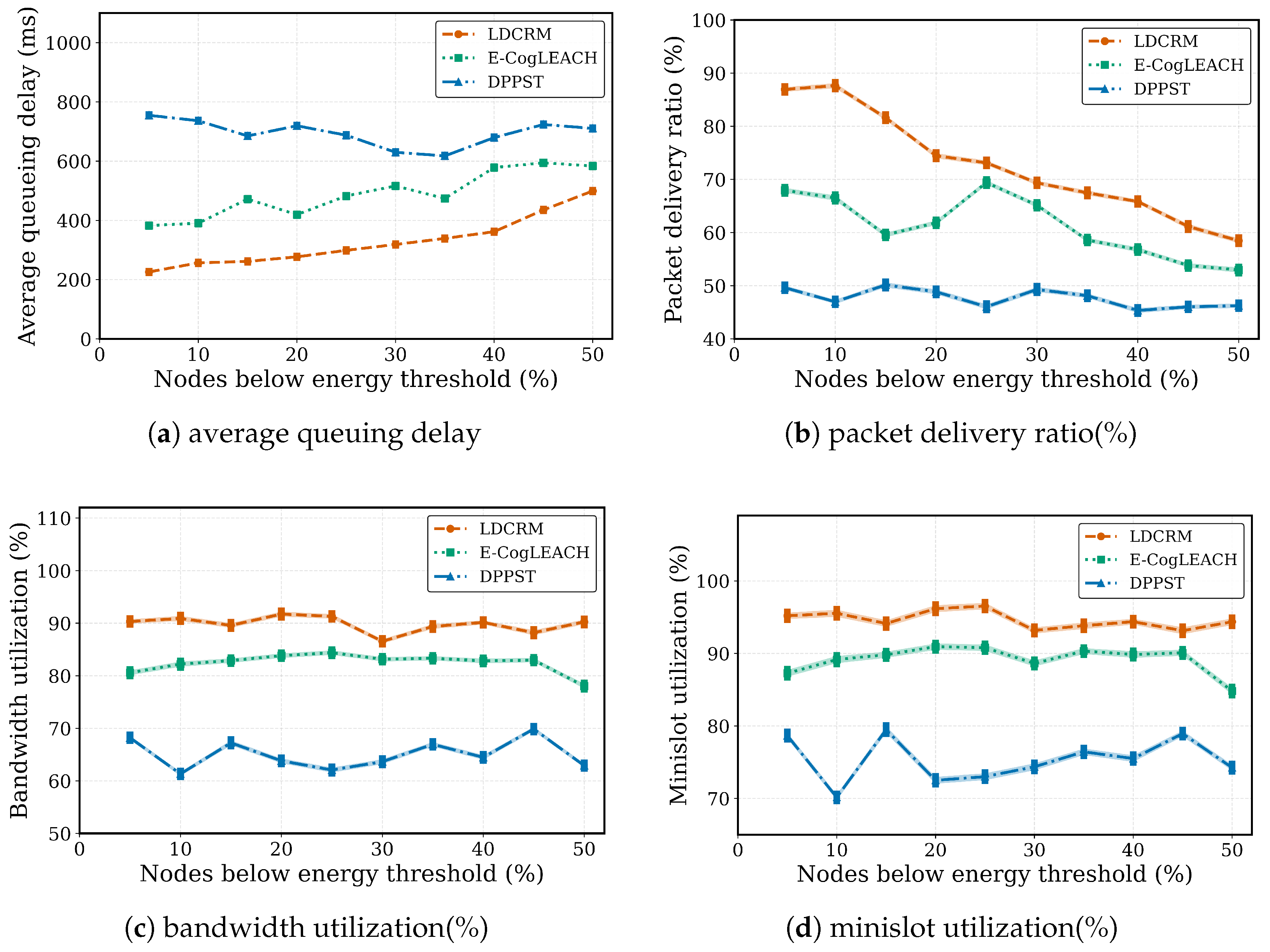
A comparative assessment of LDCRM, E-CogLEACH, and DPPST under varying percentages of devices below the energy threshold (5–50% devices below threshold) demonstrated significant variations across the performance metrics, as shown in Figure 14. Figure 14c indicates that LDCRM consistently achieved the superior (86.55–91.73%), outperforming E-CogLEACH (78.03–84.39%) and DPPST (61.32–69.87%). Similarly, Figure 14b shows that LDCRM maintained a higher , starting at 87.64% and reducing to 58.47% while E-CogLEACH and DPPST exhibited a lower . In terms of (Figure 14a), LDCRM recorded the lowest (225.93–499.26 ms), while E-CogLEACH and DPPST experienced higher ((382.36–594.23) ms and (617.5–736.29) ms, respectively). Figure 14d shows minislot utilization, confirming LDCRM’s efficiency, achieving (93.13–96.53%) utilization compared to E-CogLEACH (84.81–90.93%) and DPPST (70.15–79.49%). However, as observed from the experimental results, with an increase in the percentage of devices below the energy threshold, , and for LDCRM exhibited a gradual decline, while the showed an upward trend. This behavior is primarily due to LDCRM’s design principle of prioritizing packets originating from devices with a low residual energy (Equation (21)). Such prioritization guarantees data delivery from energy-critical devices prior to depletion, reducing packet loss and preserving reliability. In contrast, E-CogLEACH and DPPST remained largely indifferent to residual energy levels during scheduling. As a result, their performance metrics remained relatively stable across different energy-depletion scenarios, with minor fluctuations caused by random scheduling and variations in the OFF duration lengths. While these protocols maintained a stable , they did so at the cost of communication reliability, as devices with critically low energy may fail to transmit their packets, leading to potential data loss. These results demonstrate that LDCRM achieves a trade-off between throughput efficiency and reliability, prioritizing guaranteed delivery from energy-constrained devices over marginal improvements in delay and bandwidth utilization.
Figure 14.
Impact of increasing percentage of devices below residual energy threshold on performance metrics: (a) , (b) , (c) , and (d) . Results compare LDCRM, E-CogLEACH, and DPPST, highlighting LDCRM’s adaptive scheduling strategy that prioritizes energy-critical devices, ensuring reliability at the cost of marginal delay and utilization trade-offs.
7. Conclusions
This study addressed the challenges of opportunistic spectrum access, bandwidth fragmentation, and energy constraints in ad hoc CR-IIoT networks, which limits the scalability and reliability of IIoT applications. We proposed LDCRM, a lightweight DTDMA-assisted MAC scheme that combines lexicographic channel ranking, adaptive minislot allocation, and distributed cluster formation, considering the spectrum and energy limitations in ad hoc CR-IIoT environments. LDCRM achieved efficient spectrum utilization and reliability without imposing a high computational overhead. The proposed greedy heuristics for DTDMA scheduling delivered a near-optimal performance while significantly reducing the computational complexity compared to optimization-based solvers.
The comparative results from cluster stability and fairness experiments indicated an improvement of approximately 56.25% in the network lifespan under LDCRM. Similarly, the simulation results across three scenarios—(i) network scalability, (ii) increasing traffic loads, and (iii) residual energy variations—demonstrated that LDCRM consistently outperformed E-CogLEACH and DPPST, achieving an up to 89.96% reduction in the queuing delay, a higher packet delivery ratio (between 58.47 and 92.48%), and a near-optimal bandwidth and minislot utilization. These improvements validate LDCRM’s suitability for large-scale, real-time IIoT deployments.
However, the current evaluation is limited to static topologies and ON/OFF channel models, and the results are influenced by the randomly chosen rate parameters (, ). Future work will extend LDCRM to mobility-aware scenarios and incorporate predictive spectrum access using machine learning techniques to enhance the adaptability, scalability, and energy efficiency in real-world deployments.
Author Contributions
B.M. and S.K.D. put forward the idea of this paper. B.M. and S.K.D. finished the design of the study and the algorithms. B.M. contributed to the experimental work and the result analysis. B.M. made the figures and tables. B.M. and S.K.D. drafted the manuscript. All authors have read and agreed to the published version of the manuscript.
Funding
This research received no external funding.
Data Availability Statement
All data underlying the results are available as part of the article and no additional source data are required.
Conflicts of Interest
The authors declare no conflicts of interest.
References
- Haykin, S. Cognitive radio: Brain-empowered wireless communications. IEEE J. Sel. Areas Commun. 2005, 23, 201–220. [Google Scholar] [CrossRef] [Scilit]
- Federal Communications Commission. Spectrum Policy Task Force Report; Report ET Docket No. 02-135; Federal Communications Commission: Washington, DC, USA, 2002. [Google Scholar]
- Mitola, J.; Maguire, G.Q. Cognitive radio: Making software radios more personal. IEEE Pers. Commun. 1999, 6, 13–18. [Google Scholar] [CrossRef] [Scilit]
- Khisa, S.; Moh, S. Priority-Aware fast MAC protocol for UAV-assisted industrial IoT systems. IEEE Access 2021, 9, 57089–57106. [Google Scholar] [CrossRef] [Scilit]
- Cao, X.; Song, Z.; Yang, B.; ElMossallamy, M.A.; Qian, L.; Han, Z. A distributed ambient backscatter MAC protocol for Internet-of-Things networks. IEEE Internet Things J. 2019, 7, 1488–1501. [Google Scholar] [CrossRef]
- Batta, M.S.; Harous, S.; Louail, L.; Aliouat, Z. A distributed tdma scheduling algorithm for latency minimization in internet of things. In Proceedings of the 2019 IEEE International Conference on Electro Information Technology (EIT); IEEE: New York, NY, USA, 2019; pp. 108–113. [Google Scholar]
- Li, Y.; Zhang, X.; Zeng, J.; Wan, Y.; Ma, F. A distributed TDMA scheduling algorithm based on energy-topology factor in Internet of Things. IEEE Access 2017, 5, 10757–10768. [Google Scholar] [CrossRef] [Scilit]
- Derakhshani, M.; Khan, Y.; Nguyen, D.T.; Parsaeefard, S.; Shoaei, A.D.; Le-Ngoc, T. Self-organizing TDMA: A distributed contention-resolution MAC protocol. IEEE Access 2019, 7, 144845–144860. [Google Scholar] [CrossRef] [Scilit]
- Joshi, N.; Kumar, A.; Minenkov, D.; Kaplun, D.; Sharma, S. Optimized MAC Protocol Using Fuzzy-Based Framework for Cognitive Radio AdHoc Networks. IEEE Access 2023, 11, 27506–27518. [Google Scholar] [CrossRef] [Scilit]
- Salh, A.; Audah, L.; Alhartomi, M.A.; Kim, K.S.; Alsamhi, S.H.; Almalki, F.A.; Abdullah, Q.; Saif, A.; Algethami, H. Smart packet transmission scheduling in cognitive IoT systems: DDQN based approach. IEEE Access 2022, 10, 50023–50036. [Google Scholar] [CrossRef] [Scilit]
- Wu, C.M.; Kao, Y.C.; Chang, K.F.; Tsai, C.T.; Hou, C.C. A q-learning-based adaptive mac protocol for internet of things networks. IEEE Access 2021, 9, 128905–128918. [Google Scholar] [CrossRef] [Scilit]
- Benrebbouh, C.; Louail, L.; Cherbal, S. Distributed TDMA for IoT Using a Dynamic Slot Assignment. In Proceedings of the International Conference on Advances in Computing Research; Springer: Berlin/Heidelberg, Germany, 2023; pp. 469–480. [Google Scholar]
- Dhurandher, S.K.; Gupta, N.; Nicopolitidis, P. Contract theory based medium access contention resolution in TDMA cognitive radio networks. IEEE Trans. Veh. Technol. 2019, 68, 8026–8035. [Google Scholar] [CrossRef] [Scilit]
- Batta, M.S.; Aliouat, Z.; Harous, S. A distributed weight-based tdma scheduling algorithm for latency improvement in iot. In Proceedings of the 2019 IEEE 10th Annual Ubiquitous Computing, Electronics & Mobile Communication Conference (UEMCON); IEEE: New York, NY, USA, 2019; pp. 768–774. [Google Scholar]
- Touati, H.; Chriki, A.; Snoussi, H.; Kamoun, F. Cognitive Radio and Dynamic TDMA for efficient UAVs swarm communications. Comput. Netw. 2021, 196, 108264. [Google Scholar] [CrossRef] [Scilit]
- Tiwari, J.; Prakash, A.; Tripathi, R. A novel cooperative MAC protocol for safety applications in cognitive radio enabled vehicular ad-hoc networks. Veh. Commun. 2021, 29, 100336. [Google Scholar] [CrossRef] [Scilit]
- Singh, R.P.; Sangwan, A.; Godara, K. Modified-PRMA MAC protocol for cognitive radio networks. Wirel. Pers. Commun. 2019, 107, 869–885. [Google Scholar] [CrossRef] [Scilit]
- Nguyen, T.T.; Kim, T.; Kim, T. A distributed TDMA scheduling algorithm using topological ordering for wireless sensor networks. IEEE Access 2020, 8, 145316–145331. [Google Scholar] [CrossRef] [Scilit]
- Eletreby, R.M.; Elsayed, H.M.; Khairy, M.M. CogLEACH: A spectrum aware clustering protocol for cognitive radio sensor networks. In Proceedings of the 2014 9th International Conference on Cognitive Radio Oriented Wireless Networks and Communications (CROWNCOM); IEEE: New York, NY, USA, 2014; pp. 179–184. [Google Scholar]
- Tarek, D.; Benslimane, A.; Darwish, M.; Kotb, A.M. Distributed Packets Scheduling Technique for Cognitive Radio Internet of Things Based on Discrete Permutation Particle Swarm Optimization. In Proceedings of the 2020 International Conferences on Internet of Things (iThings) and IEEE Green Computing and Communications (GreenCom) and IEEE Cyber, Physical and Social Computing (CPSCom) and IEEE Smart Data (SmartData) and IEEE Congress on Cybermatics (Cybermatics); IEEE: New York, NY, USA, 2020; pp. 142–151. [Google Scholar]
- Sarvghadi, M.A.; Wan, T.C. Distributed and Efficient Slot Assignment–Alignment Protocol for Resource-Constrained Wireless IoT Devices. IEEE Internet Things J. 2022, 10, 8754–8772. [Google Scholar] [CrossRef] [Scilit]
- Agrawal, N.K.; Kumar, S.; Bisht, G.S.; Srivastav, A.; Bansla, V.; Jain, A. RECRIoT-MAC: A Reliable and Energy Efficient Resource Management for Internet of Things Based Cognitive Radio Multi-Channel MAC Protocol. In Proceedings of the 2024 International Conference on Communication, Computer Sciences and Engineering (IC3SE); IEEE: New York, NY, USA, 2024; pp. 1–6. [Google Scholar]
- Oñate, W.; Sanz, R. Analysis of architectures implemented for IIoT. Heliyon 2023, 9, e12868. [Google Scholar] [CrossRef] [Scilit]
- Sengupta, J.; Ruj, S.; Bit, S.D. A secure fog-based architecture for industrial Internet of Things and industry 4.0. IEEE Trans. Ind. Inform. 2020, 17, 2316–2324. [Google Scholar] [CrossRef] [Scilit]
- Akyildiz, I.F.; Lee, W.Y.; Chowdhury, K.R. CRAHNs: Cognitive radio ad hoc networks. Ad Hoc Netw. 2009, 7, 810–836. [Google Scholar] [CrossRef] [Scilit]
- Cordeiro, C.; Challapali, K. C-MAC: A cognitive MAC protocol for multi-channel wireless networks. In Proceedings of the 2007 2nd IEEE International Symposium on New Frontiers in Dynamic Spectrum Access Networks; IEEE: New York, NY, USA, 2007; pp. 147–157. [Google Scholar]
- Yucek, T.; Arslan, H. A survey of spectrum sensing algorithms for cognitive radio applications. IEEE Commun. Surv. Tutor. 2009, 11, 116–130. [Google Scholar] [CrossRef] [Scilit]
- Akyildiz, I.F.; Lo, B.F.; Balakrishnan, R. Cooperative spectrum sensing in cognitive radio networks: A survey. Phys. Commun. 2011, 4, 40–62. [Google Scholar] [CrossRef] [Scilit]
- Yarnagula, H.K.; Deka, S.K.; Sarma, N. Distributed TDMA based MAC protocol for data dissemination in ad-hoc Cognitive Radio networks. In Proceedings of the 2013 IEEE International Conference on Advanced Networks and Telecommunications Systems (ANTS); IEEE: New York, NY, USA, 2013; pp. 1–6. [Google Scholar]
- Leugner, S.; Constapel, M.; Hellbrueck, H. Triclock-clock synchronization compensating drift, offset and propagation delay. In Proceedings of the 2018 IEEE International Conference on Communications (ICC); IEEE: New York, NY, USA, 2018; pp. 1–6. [Google Scholar]
- IEEE Std 802.15.4-2020; IEEE Standard for Low-Rate Wireless Networks. IEEE: New York, NY, USA, 2020. Available online: https://ieeexplore.ieee.org/document/9144691 (accessed on 22 December 2025).
- Mohammadi, F. Lithium-ion battery State-of-Charge estimation based on an improved Coulomb-Counting algorithm and uncertainty evaluation. J. Energy Storage 2022, 48, 104061. [Google Scholar] [CrossRef] [Scilit]
- Heinzelman, W.B.; Chandrakasan, A.P.; Balakrishnan, H. An application-specific protocol architecture for wireless microsensor networks. IEEE Trans. Wirel. Commun. 2002, 1, 660–670. [Google Scholar] [CrossRef] [Scilit]
- Rehmani, M.H.; Viana, A.C.; Khalife, H.; Fdida, S. Surf: A distributed channel selection strategy for data dissemination in multi-hop cognitive radio networks. Comput. Commun. 2013, 36, 1172–1185. [Google Scholar] [CrossRef] [Scilit]
- Rehmani, M.H.; Viana, A.C.; Khalife, H.; Fdida, S. Activity pattern impact of primary radio nodes on channel selection strategies. In Proceedings of the 4th International Conference on Cognitive Radio and Advanced Spectrum Management, Tenerife, Spain, 26–29 October 2011; pp. 1–5. [Google Scholar]
- Kim, H.; Shin, K.G. Efficient discovery of spectrum opportunities with MAC-layer sensing in cognitive radio networks. IEEE Trans. Mob. Comput. 2008, 7, 533–545. [Google Scholar] [CrossRef] [Scilit]
- Quan, Z.; Cui, S.; Poor, H.V.; Sayed, A.H. Collaborative wideband sensing for cognitive radios. IEEE Signal Process. Mag. 2008, 25, 60–73. [Google Scholar] [CrossRef] [Scilit]
- Hussain, A.S.; Deka, S.K.; Chauhan, P.; Karmakar, A. Throughput optimization for interference aware underlay CRN. Wirel. Pers. Commun. 2019, 107, 325–340. [Google Scholar] [CrossRef] [Scilit]
- Goldsmith, A. Wireless Communications; Cambridge University Press: Cambridge, UK, 2005. [Google Scholar]
- Robbins, H.; Monro, S. A stochastic approximation method. Ann. Math. Stat. 1951, 22, 400–407. [Google Scholar] [CrossRef] [Scilit]
- Kurose, J.F. Computer Networking: A Top-Down Approach Featuring the Internet, 3/E; Pearson Education India: New Delhi, India, 2005. [Google Scholar]
- Little, J.D.; Graves, S.C. Little’s law. In Building Intuition: Insights from Basic Operations Management Models and Principles; Pearson Education India: New Delhi, India, 2008; pp. 81–100. [Google Scholar]
- LoRa Alliance. LoRaWAN® L2 1.0.4 Specification; Defines LoRaWAN Layer 2 protocol including MAC frame formats and payload size constraints; Technical Report; LoRa Alliance: Fremont, CA, USA, 2020. [Google Scholar]
- LoRa Alliance. LoRaWAN® Regional Parameters RP002-1.0.4; Specifies maximum payload sizes per region and data rate for LoRaWAN; Technical Report; LoRa Alliance: Fremont, CA, USA, 2020. [Google Scholar]
- Wang, J.; Liu, C. An imperfect spectrum sensing-based multi-hop clustering routing protocol for cognitive radio sensor networks. Sci. Rep. 2023, 13, 4853. [Google Scholar] [CrossRef] [Scilit]
- Texas Instruments. CC2420 2.4 GHz IEEE 802.15.4/ZigBee-Ready RF Transceiver Technical Reference Manual. 2020. Available online: https://www.ti.com/lit/ds/symlink/cc2420.pdf (accessed on 22 December 2025).
- Smaragdakis, G.; Matta, I.; Bestavros, A. SEP: A Stable Election Protocol for Clustered Heterogeneous Wireless Sensor Networks; Technical Report; Boston University Computer Science Department: Boston, CA, USA, 2004. [Google Scholar]
- Jain, R.K.; Chiu, D.M.W.; Hawe, W.R. A Quantitative Measure of Fairness and Discrimination; Eastern Research Laboratory, Digital Equipment Corporation: Hudson, MA, USA, 1984; Volume 21, pp. 2022–2023. [Google Scholar]

Disclaimer/Publisher’s Note: The statements, opinions and data contained in all publications are solely those of the individual author(s) and contributor(s) and not of MDPI and/or the editor(s). MDPI and/or the editor(s) disclaim responsibility for any injury to people or property resulting from any ideas, methods, instructions or products referred to in the content. |
© 2025 by the authors. Licensee MDPI, Basel, Switzerland. This article is an open access article distributed under the terms and conditions of the Creative Commons Attribution (CC BY) license.