Article

Color-to-Grayscale Image Conversion Based on the Entropy and the Local Contrast

School of Computer Science and Artificial Intelligence, Lanzhou University of Technology, No. 36 Pengjiaping Road, Qilihe District, Lanzhou 730050, China
*
Author to whom correspondence should be addressed.
Electronics 2026, 15(1), 114; https://doi.org/10.3390/electronics15010114
Submission received: 27 November 2025 / Revised: 22 December 2025 / Accepted: 24 December 2025 / Published: 25 December 2025
(This article belongs to the Section Computer Science & Engineering)

Abstract

Color-to-grayscale conversion is a fundamental preprocessing task with widespread applications in digital printing, electronic ink displays, medical imaging, and artistic photo stylization. A primary challenge in this domain is to simultaneously preserve global luminance distribution and local contrast. To address this, we propose an adaptive conversion method centered on a novel objective function that integrates information entropy with Edge Content (EC), a metric for local gradient information. The key advantage of our approach is its ability to generate grayscale results that maintain both rich overall contrast and fine-grained local details. Compared with previous adaptive linear methods, our approach demonstrates superior qualitative and quantitative performance. Furthermore, by eliminating the need for computationally expensive edge detection, the proposed algorithm provides an effective solution to the color-to-grayscale conversion.

1. Introduction

Color images are vital for information-rich applications in digital media, computer vision, and industrial inspection. However, the convertion to a grayscale image, known as color-to-grayscale conversion, is often necessary for tasks like document printing, artistic creation, medical imaging, or reducing computational and storage overhead. The goal is to map 3D color data (e.g., RGB channels) into a 1D grayscale space, producing a single-channel luminance image. An effective conversion algorithm must preserve original luminance while maximizing the retention of visual contrast, texture, and structure. This ensures that the resulting grayscale image is visually natural, clear, and retains all critical information [1].
Traditional color-to-grayscale conversion methods, such as the average method, the maximum value method, and the ITU-R BT.601 standard (i.e., the weighted average method [2]: G r a y = 0.299 R + 0.587 G + 0.114 B ) widely adopted by black-and-white printers, are computationally simple and highly efficient. Consequently, they have been integrated into various image processing software and hardware systems [3]. These methods rely on fixed linear combinations of color channels. However, their “one-size-fits-all” nature renders them incapable of adapting to the diversity of image content. This often fails to preserve critical details, as objects with similar luminance but different colors can become indistinguishable, degrading perceptual quality [4].
To overcome the limitations of these traditional approaches, researchers have developed a variety of advanced color-to-grayscale conversion algorithms [5,6,7,8,9,10,11,12,13,14,15,16,17,18,19,20,21,22,23,24,25,26,27,28,29,30,31,32,33,34,35,36]. Current mainstream color-to-grayscale conversion methods are typically categorized into two classes: traditional approaches [5,6,7,8,9,10,11,12,13,14,15,16,20,23,24,25,26,27,28,29,30,31,32,33,34,35,36], and data-driven (deep learning-based) methods [17,18,19,21,22].
Among traditional methods, Wang et al. [16] introduced a two-stage framework that integrates global linear mapping with local structure transfer filtering. This approach preserves color contrast by determining chromatic directions via a differentiable cost function. Experiments show it significantly outperforms competing methods on objective metrics like C2G-SSIM [37] and CCPR [5]. The rise of deep learning has revolutionized color-to-grayscale conversion. CNN-based methods [17,19,21,22], in particular, have achieved substantial progress [38] by learning mappings from large-scale datasets to generate perceptually faithful, high-quality grayscale images. Despite their success, these methods face significant challenges: they typically require extensive training data and computational resources, involve complex architectures, and possess an inherent “black-box” nature that hinders interpretability and deployment on resource-constrained devices. These limitations have prompted a recent resurgence of traditional approaches [30,31,32,33,34,35,36], which are favored for their efficiency and practicality.
Inspired by Zhang and Wan [30], who leveraged image entropy and edge information, this paper introduces an adaptive method fusing global information entropy with local color contrast. Our core innovation lies in using the local contrast EC [39] metric to replace traditional edge information, which captures local contrast information efficiently. Specifically, we employ image entropy to quantify overall content complexity for macro-level mapping guidance, while local contrast EC calculations capture critical details such as edges and textures. This adaptive fusion enables the dynamic generation of a linear grayscale mapping weight tailored to each image.
Our main contributions are threefold:
A novel and simplified local contrast preservation mechanism that directly integrates Edge Content (EC) [39] values-computed via Sobel operators-into the objective function, thereby reducing computational complexity over Canny-based methods.
Rigorous quantitative and qualitative evaluations that validate the superior performance of our method against state-of-the-art techniques on three benchmark datasets.
We demonstrate the efficacy of a discrete search strategy with a step of size 0.1 granularity, which significantly enhances computational efficiency without sacrificing precision.
This paper proceeds as follows. Section 2 surveys the related literature. Section 3 elaborates on our proposed methodology. Section 4 presents the experimental setup and comparative analysis. Finally, Section 5 provides the conclusion.

2. Related Work

In recent years, discrete searching strategies have emerged as a prominent paradigm in color-to-grayscale conversion, valued for their simplicity and efficiency in facilitating near real-time processing. A substantial body of work [11,13,14,20,23,30] has adopted this approach, with empirical evidence consistently validating its efficacy in producing high-quality color-to-grayscale conversion results.
The discrete searching methodology operates by systematically exploring candidate grayscale solutions guided by an objective function that identifies the optimal selection. Typically implemented in the RGB color space, this approach generates 66 candidate grayscale values for each pixel. The grayscale value g is computed as a linear combination of RGB channel intensities:
g = ω R I R + ω G I G + ω B I B
where ω R , ω G , and ω B denote the weighting coefficients. Employing a step size of 0.1 for weight discretization yields a solution space of (1 + 11)*11/2 = 66 distinct combinations, a strategy established in prior works [11,13,14,20,23,30].
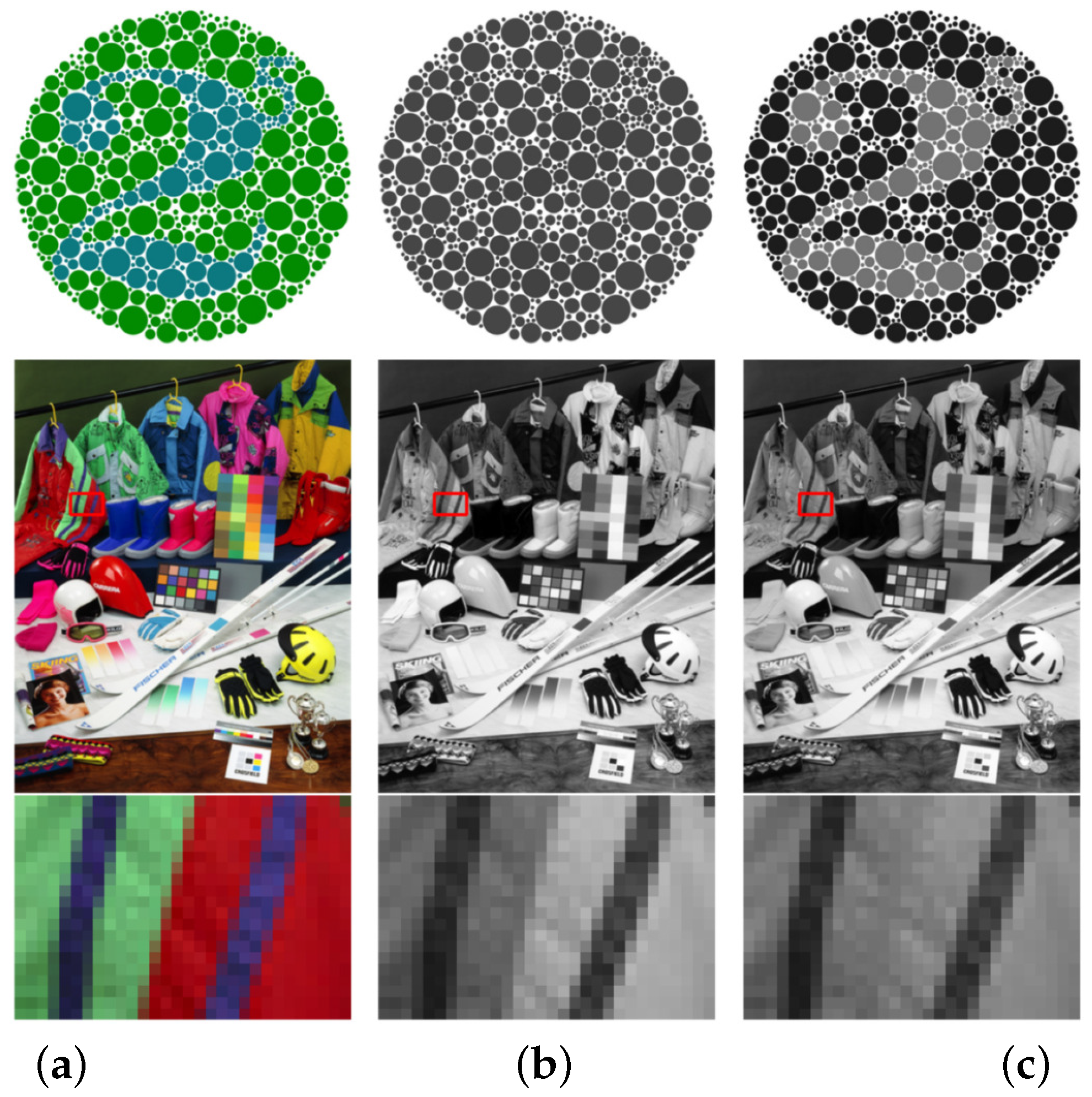
Drawing inspiration from the methods in [13,20], Zhang and Wan [30] proposed a color-to-grayscale conversion method that outperforms other discrete searching approaches. As illustrated in Figure 1, the grayscale result from the method in [20], shown in the first row and second column, fails to effectively preserve the overall contrast between distinct regions. However, the results in the last two rows of the same figure demonstrate that local contrast, encompassing neighborhood and edge information, is well-maintained. In contrast, the method proposed by Wan et al. [13], which employs image entropy [40] as its objective function, successfully maintains the overall contrast in the first row. This observation highlights that image entropy is a key factor in preserving global contrast.
Accordingly, the method proposed by Zhang and Wan [30] constructs an objective function that integrates image entropy [40] with local edge information (Canny edge ratio), aiming to preserve both global and local contrast. However, the reliance on the Canny edge ratio introduces significant computational overhead. For instance, to obtain the optimal grayscale result for a single color image, their method requires the additional computation of Canny edges for each of the three color channels (R, G, B). Subsequently, the Canny edges of the candidate grayscale image must be compared against the union of these color-channel edges to compute the Canny edge preservation ratio. To overcome this challenge, we propose replacing the Canny edge ratio with Edge Content (EC) [39]. This metric offers a more straightforward alternative while still effectively preserving local contrast in grayscale images. Our resulting objective function combines image entropy with EC to generate the final grayscale image, achieving a balance between performance and computational cost. The detailed algorithm is presented in Section 3.

3. Methodology

The proposed method consists of two primary stages. First, in Section 3.1, we detail the calculation of image entropy and EC values. Subsequently, Section 3.2 presents an algorithm to determine the optimal grayscale image from the linear combination model using a discrete searching strategy.

3.1. Calculation of Image Entropy and EC Values

The entropy [40] of an image is defined based on its grayscale representation. For a grayscale image G, the entropy E ( G ) is computed as:
E ( G ) = k = 0 L 1 p ( k ) log 2 ( p ( k ) ) ,
where L is the total number of gray levels (typically L = 256 ), k denotes a specific gray value, and p ( k ) is the probability of its occurrence. This entropy metric has been employed to categorize images; for instance, Ma et al. [37] used the entropy of the luminance channel of a color image to classify images in the Cadik dataset. In their work, an image is classified as synthetic if its entropy E ( G ) 4 , and photographic otherwise.
We discretize the weights ω R , ω G , and ω B within [ 0 ,   1 ] with a step size of 0.1, subject to the constraint c { R , G , B } ω c = 1 . This process yields 66 distinct weight combinations, denoted as ω i = ( ω R , i , ω G , i , ω B , i ) for i = 1 , 2 , , 66 . The corresponding grayscale images G i are then computed as:
G i = c { R , G , B } ω c , i I c ,
where I R , I G , and I B represent the red, green, and blue channels of original colorimage I, respectively. These 66 grayscale images G i constitute the set of candidate grayscale representations for I. This weight discretization strategy is consistent with the initial step of the methods proposed in [9,11,13,14,30].
The Edge Content (EC) [39] is a no-reference metric designed to quantify the strength of local contrast in grayscale images. Derived from local luminance gradients, it serves as an objective measure of perceived image sharpness and contrast enhancement. The EC value for an image I of size m × n is computed as:
EC = 1 m × n i = 1 m j = 1 n | I ( i , j ) | ,
where m and n denote the spatial dimensions of image I, and | I ( i , j ) | represents the gradient magnitude at pixel location ( i , j ) . The gradient magnitude is calculated as:
| I ( i , j ) | = G X 2 + G Y 2 ,
where G X and G Y are the horizontal and vertical gradients of I, respectively, which are computed using the Sobel operator [42] as follows:
G X = 1 0 + 1 2 0 + 2 1 0 + 1 I ,
G Y = 1 2 1 0 0 0 + 1 + 2 + 1 I .
We then compute the EC value for each of the 66 candidate grayscale images. Notably, a significant scale disparity exists between the average entropy and EC metrics. For instance, within Cadik’s dataset, the average entropy values for synthetic and photographic images are 2.77 and 5.24, respectively, whereas their corresponding average EC values are 85.28 and 85.94. To reconcile these disparate scales, we normalize the EC values. The normalization factors were chosen based on the average EC-to-entropy ratio for each image category. Specifically, we divide the EC values by 40 for synthetic images (ratio ≈ 30.8) and by 20 for photographic images (ratio ≈ 16.4) for simplicity.

3.2. Determining the Optimal Grayscale Image

The optimal grayscale image is identified by simultaneously maximizing local contrast (as measured by EC) and preserving information content (quantified by entropy). Accordingly, we define an objective function F as a weighted combination of these two metrics:
F = λ E ( G i ) + ( 1 λ ) EC i ,
where i = 1 , 2 , , 66 , EC i is computed via Equation (4), E ( G i ) denotes the entropy of grayscale image G i , and λ is a balancing parameter. The balancing parameter λ is empirically set to 0.95. This value was determined through a systematic grid search on the Cadik dataset, where λ was varied from 0 to 1 with a step size of 0.05. The results showed that λ 0 = 0.95 yielded the best trade-off between preserving entropy and enhancing edge contrast. We apply Equation (8) to the 66 candidate grayscale images to compute the corresponding objective function values F i for i = 1 , , 66 . The optimal grayscale image, G k , is then identified as the one that maximizes this function, yielding the maximum value F k . The complete Algorithm 1 encompassing these steps is summarized as follows:
Algorithm 1 Color-to-Grayscale Conversion Algorithm
  •  Input: A color image I
  •  Output: A grayscale image G k
1:
Discretize the weights ω R , ω G , and ω B within [ 0 ,   1 ] at intervals of 0.1 , subject to c { R , G , B } ω c = 1 , to generate 66 distinct weight triplets ω i = ( ω R , i , ω G , i , ω B , i ) for i = 1 , 2 , , 66 ;
2:
Generate the set of candidate grayscale images { G i } i = 1 66 using Equation (3) with each corresponding ω i ;
3:
Compute the entropy E ( G i ) and the edge content E C i for each candidate using Equation (2) and Equation (4), respectively;
4:
Select the optimal grayscale image G k that maximizes the objective function F k from Equation (8).
The resulting grayscale image G k constitutes our primary grayscale conversion result, which we refer to as Our1 (original grayscale) in the experimental section. As observed in prior work [30], the pixel values of G k may not always utilize the full grayscale intensity range of [ 0 ,   255 ] . To enhance contrast, it is beneficial to redistribute these values across the entire available range. Accordingly, we apply a linear stretching technique to G k , following the methodologies in [13,20,30]. For any pixel value g in G k , its stretched counterpart g is computed as:
g = g Min Max Min · ( L 1 ) ,
where L = 256 denotes the total number of gray levels, and Min and Max represent the minimum and maximum pixel intensities within the grayscale image G k , respectively. This contrast-enhanced version, denoted as Our2 (stretched grayscale), is also included in our experimental evaluation for comparative analysis.

4. Experimental Results

To validate the efficacy of our proposed method, we conduct a comprehensive comparative against five state-of-the-art approaches [15,17,20,23,30]. Our evaluation is performed on three widely adopted benchmark datasets for color-to-grayscale conversion: (1) Cadik’s dataset [41], a standard benchmark containing 24 images; (2) the COLOR250 dataset [9], a larger collection of 250 images encompassing both photographic and synthetic content; and (3) the CSDD dataset [8], which comprises 22 images characterized by rich color distributions and intricate texture. All images across these datasets are stored in the PNG format and utilize the standard RGB color space.

4.1. Qualitative Evaluation

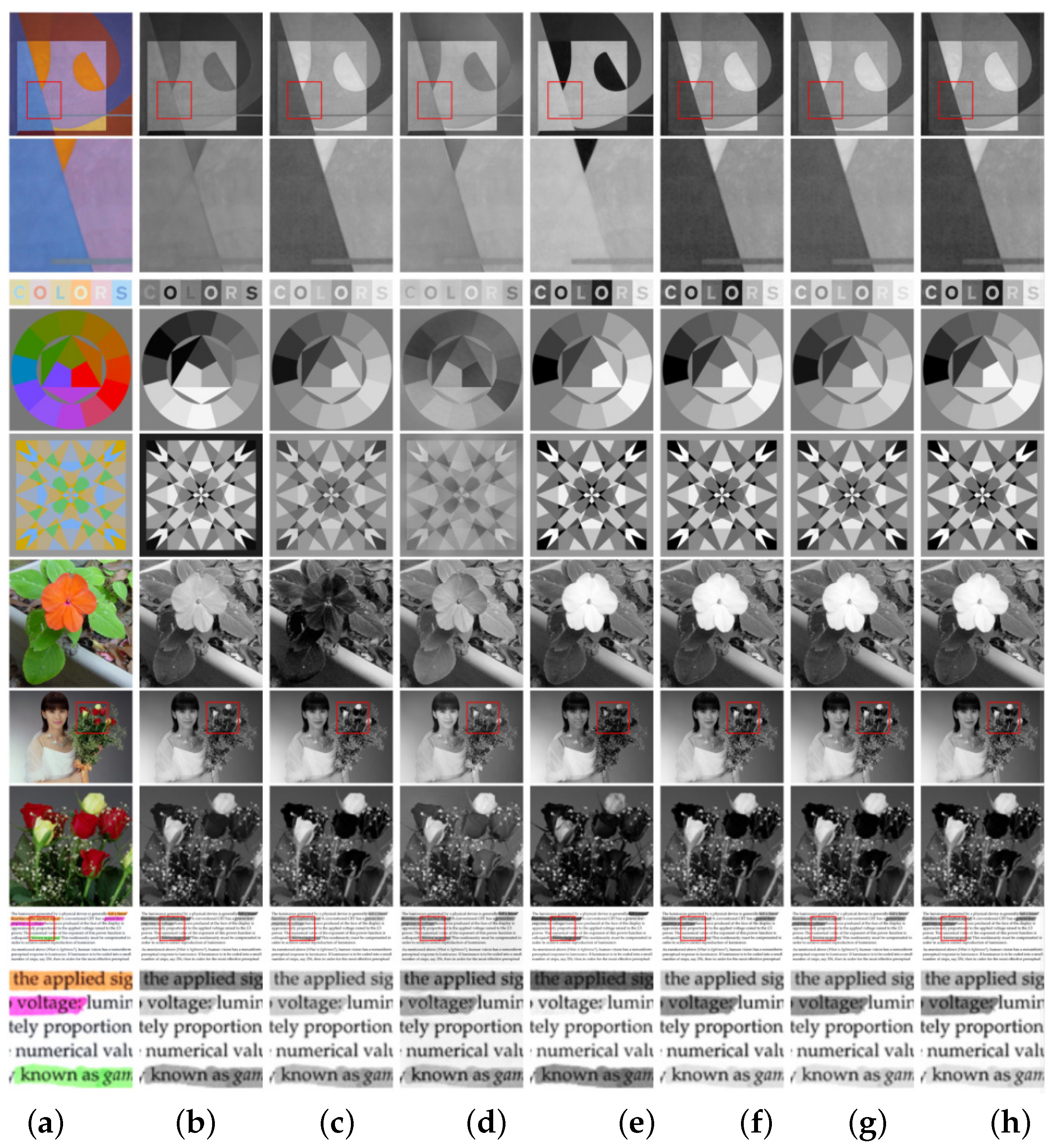
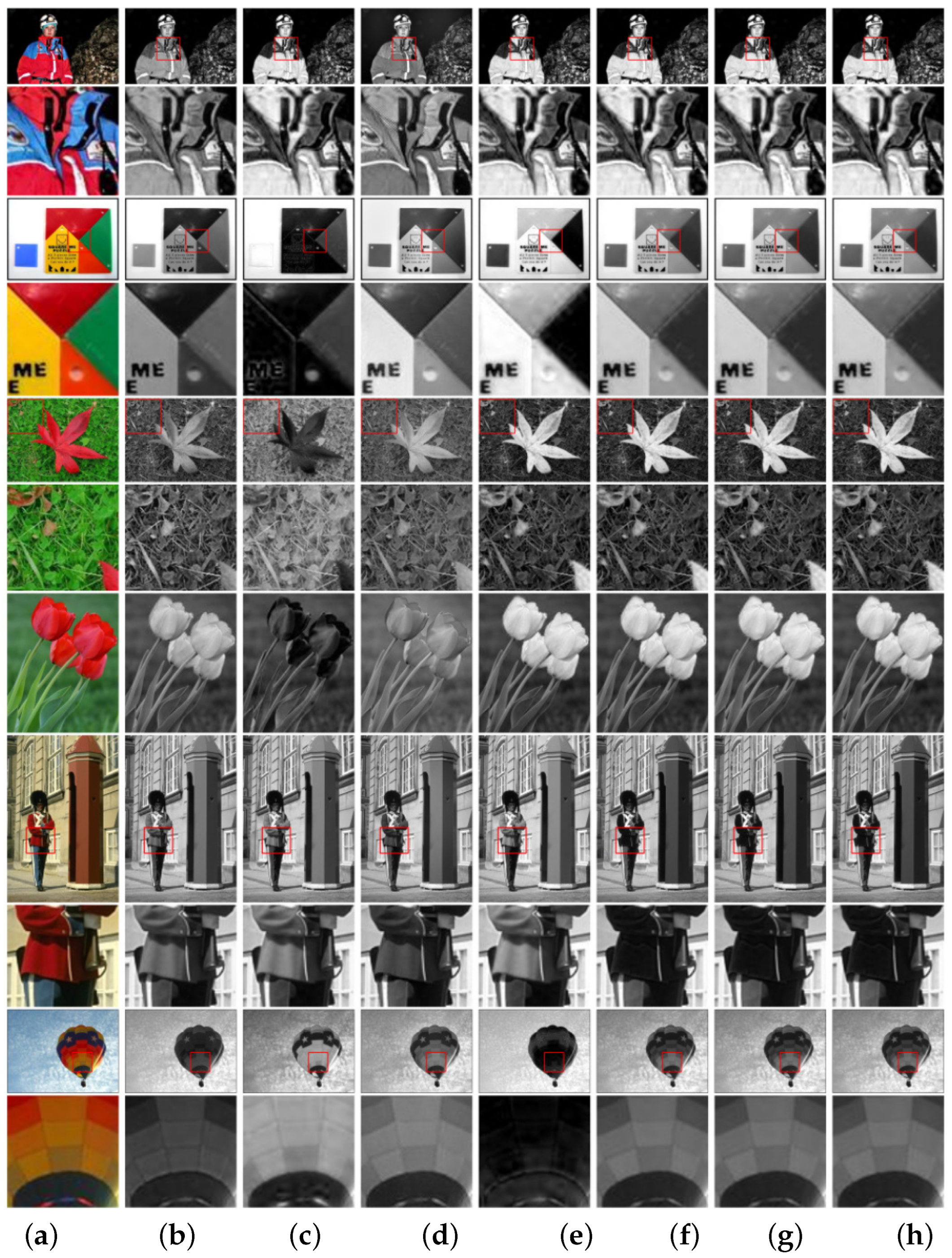
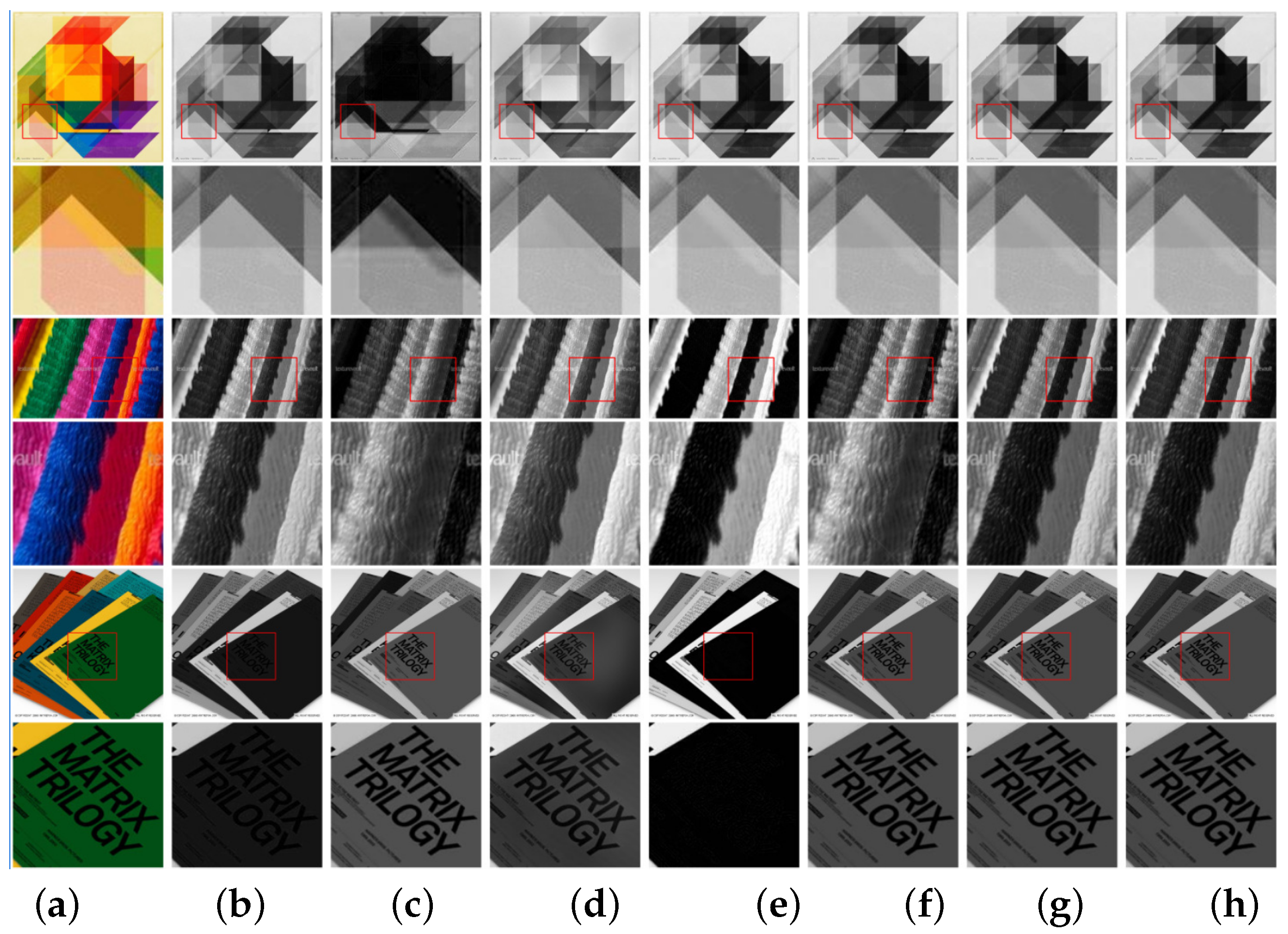
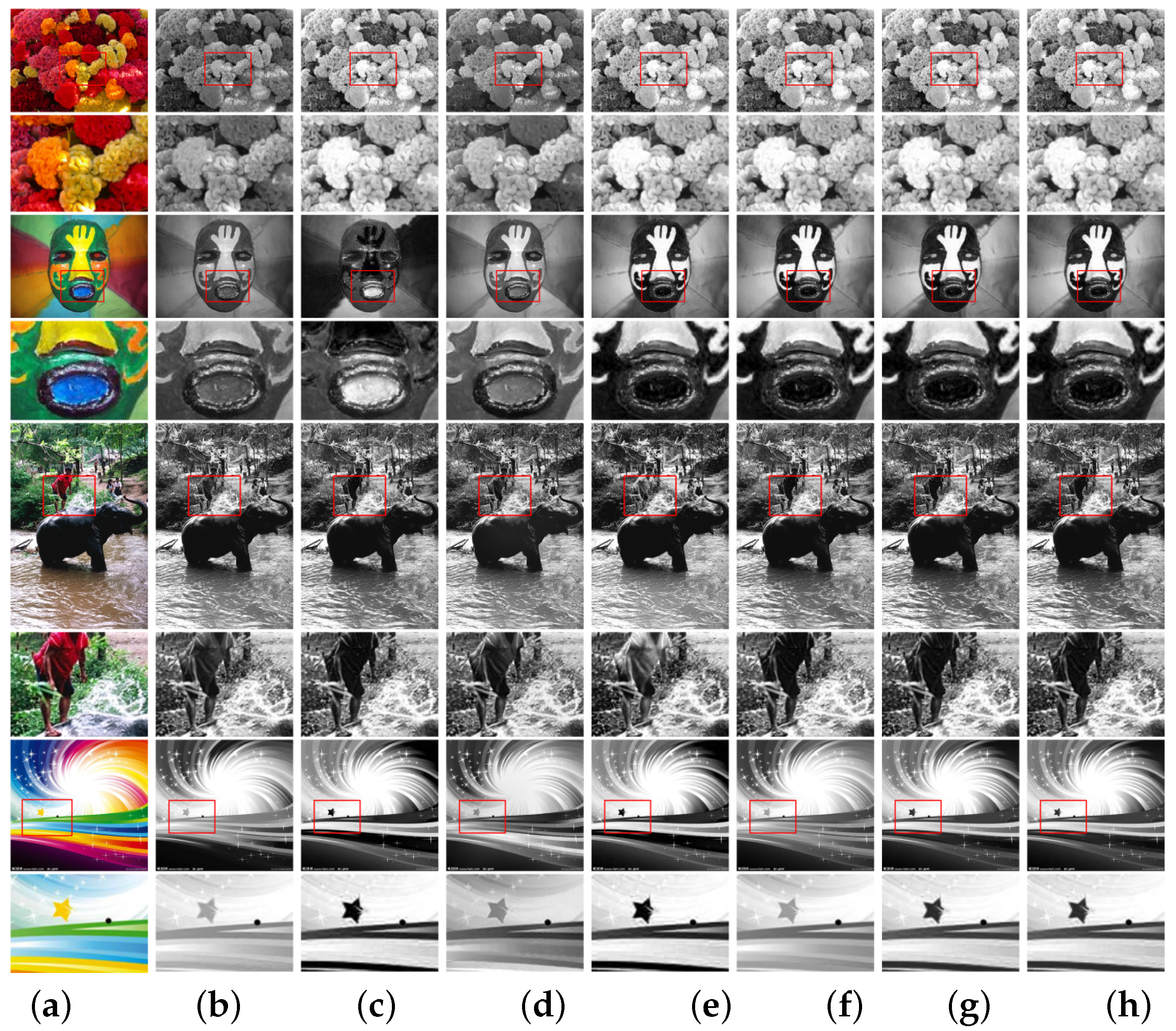
We qualitatively compare our proposed method against five state-of-the-art approaches: four traditional methods [15,20,23,30] and one deep learning-based method [17]. This comparison is conducted on three benchmark datasets [8,9,41], with visual results presented in Figure 2, Figure 3 and Figure 4.
As shown in the first two rows of Figure 2, the method by Nafchi et al. [15] yields grayscale images with insufficient contrast between distinct regions, rendering fine details barely perceptible. In contrast, the text “COLORS” remains clearly legible in the outputs from Liu et al. [23], Zhang and Wan [30], and our enhanced method (Our2), showcasing superior contrast preservation. Furthermore, the outputs from Cai et al. [17] (rows 4 and 5) exhibit noticeable blurring artifacts, indicating a loss of fine details. In terms of color-to-gray mapping, our method, alongside those of Liu et al. [23] and Zhang and Wan [30], effectively preserves the relative brightness of the orange flower against its leaves (row 6). Conversely, the methods by Li et al. [20] and Liu et al. [23] show poor distinguishability between different regions in the final four rows, leading to a significant loss of critical information from the original color image.
As shown in the first two rows of Figure 3, the methods by Nafchi et al. [15] and Cai et al. [17] inadequately preserve the critical contrast between the blue and red regions of the coat. Similarly, the result from Li et al. [20] shows diminished contrast between the yellow and red blocks. Conversely, in the fifth row, the methods by Liu et al. [23], Zhang and Wan [30], and our proposed approach effectively distinguish the red maple leaves from the background. A similar effectiveness in distinguishing foreground elements is observed for the flowers in the seventh row. For the final four rows, the methods by Cai et al. [17], Zhang and Wan [30], and our approach demonstrate robust contrast preservation, effectively differentiating not only red and blue regions but also other color-coded areas.
As illustrated in the first two rows of Figure 4, the method by Li et al. [20] fails to maintain adequate contrast between distinct color regions. This deficiency is further evident in the fourth row, where the results from both Li et al. [20] and Zhang and Wan [30] show a significant loss of contrast between the blue and red areas. Moreover, in the grayscale images produced by Nafchi et al. [15] and Liu et al. [23], the text on the green book lacks sufficient contrast with its background, severely compromising its legibility.
To further illustrate the limitations, we present additional examples from the three datasets [8,9,41], which feature challenging conditions such as backlit, brightly lit, specular and multi-object overlapping images (see Figure 5). As observed in the second (brightly lit), fourth (specular), sixth (multi-object overlapping) and last (backlit) rows, for instance, most methods, including ours, struggle to preserve the chromatic distinction between adjacent regions (e.g., orange, green, and red), leading to suboptimal grayscale results. These failures can be attributed to two inherent limitations of our approach. Firstly, the Edge Content (EC) metric, while effective for general contrast, can be disproportionately influenced by intense specular highlights. It may assign an excessively high weight to preserving these bright edges, which in turn compromises the global contrast and leads to a washed-out appearance in other regions. Secondly, the discrete search for optimal parameters, by its nature, has a coarse granularity. It may fail to pinpoint the true optimum, especially for complex scenes where the ideal weighting between entropy and EC is subtle and lies between the discrete steps we test. Collectively, these factors contribute to the performance degradation observed in these difficult cases.

4.2. Quantitative Evaluation

We evaluate the quality of the generated grayscale images using three quantitative metrics proposed by Lu et al. [9]: the Color Contrast Preserving Ratio (CCPR), the Color Contrast Fidelity Ratio (CCFR), and their joint measure, the E-score. In our quantitative evaluation, we compare both versions of our method (original grayscale (Our1) and stretched grayscale (Our2)) against five competing approaches. These include four traditional methods [15,20,23,30] and one deep learning-based method [17].

4.2.1. CCPR

The Color Contrast Preserving Ratio (CCPR) measures the extent to which the color contrast of the original image is preserved after conversion. It is defined as:
CCPR = # { ( x , y ) | ( x , y ) ϵ Ω , | g x g y | τ } Ω ,
where τ is a predefined threshold for distinguishing visible differences. The set Ω comprises all pixel pairs ( x , y ) from the original color image whose Euclidean distance in the color space, δ x , y , is greater than or equal to τ . The denominator, Ω , represents the total number of such pairs. The numerator counts the number of these pairs that remain distinguishable after color-to-grayscale conversion, i.e., the number of pairs ( x , y ) Ω for which the absolute difference in their grayscale values, | g x g y | , is also greater than or equal to τ . A higher CCPR value indicates superior preservation of the original color contrast in the resulting grayscale image.
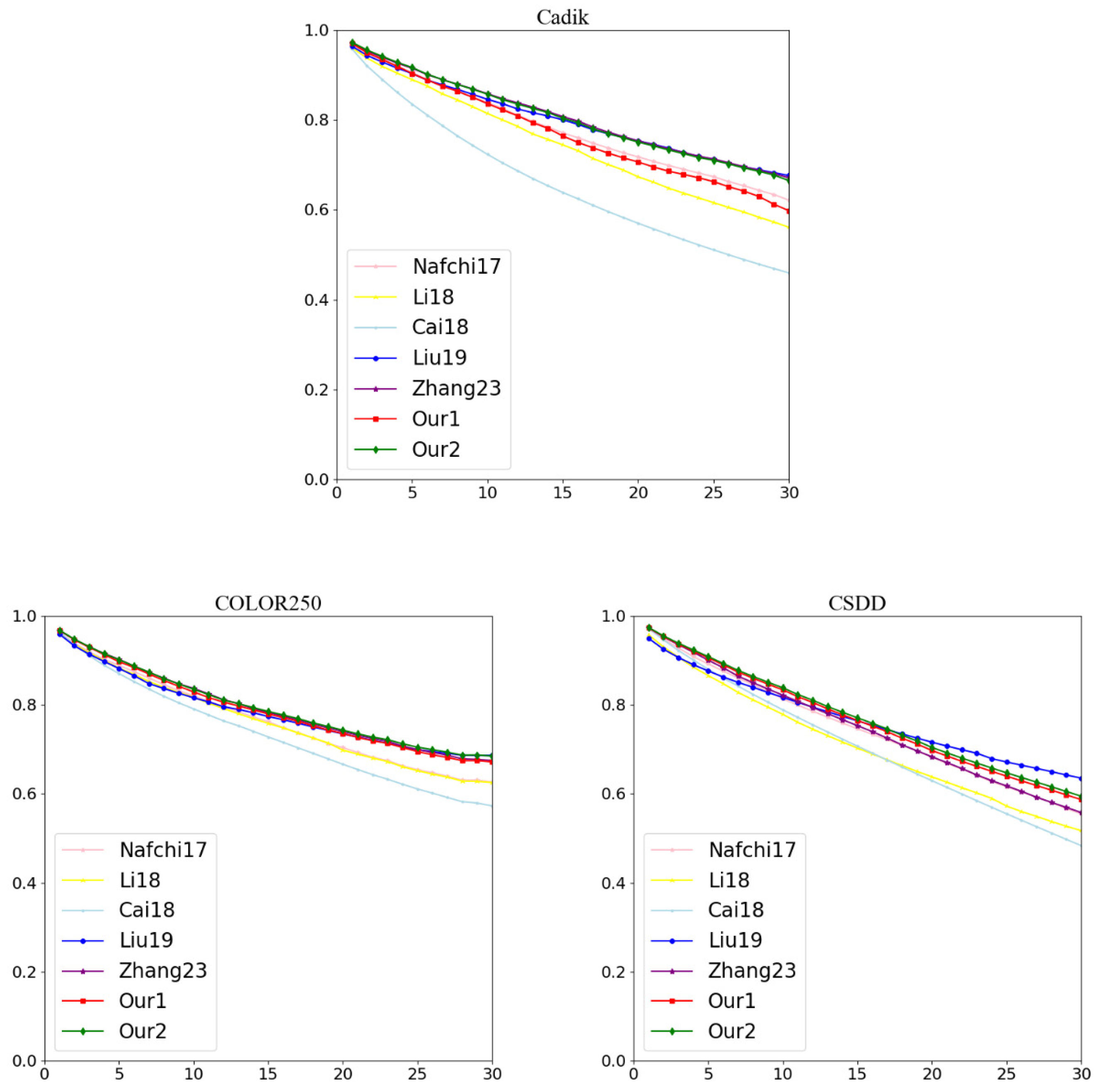
As shown in Figure 6, our stretched grayscale method (Our2) achieves the highest average CCPR values on both the Cadik’s and COLOR250 datasets. On the CSDD dataset, Our2 also outperforms all other methods for thresholds τ < 15 . However, for τ > 15 , it is hloutperformed by the method from Liu et al. [23]. Overall, these results validate the effectiveness of our method in preserving the original color contrast.

4.2.2. CCFR

The Color Contrast Fidelity Ratio (CCFR) measures the structural fidelity between the original color image and its grayscale version. It is defined as:
CCFR = 1 # ( x , y ) ( x , y ) Θ , δ x , y τ Θ ,
where Θ is the set of pixel pairs that are distinguishable in the resulting grayscale image, i.e., those with | g x g y |   >   τ . The denominator, Θ , is the total number of such pairs. The numerator counts the subset of these pairs that were originally indistinguishable in the color image (i.e., δ x , y τ ). This fraction therefore represents the proportion of artifactual edges introduced during conversion. Consequently, a higher CCFR value indicates better preservation of structural fidelity and fewer artifacts.
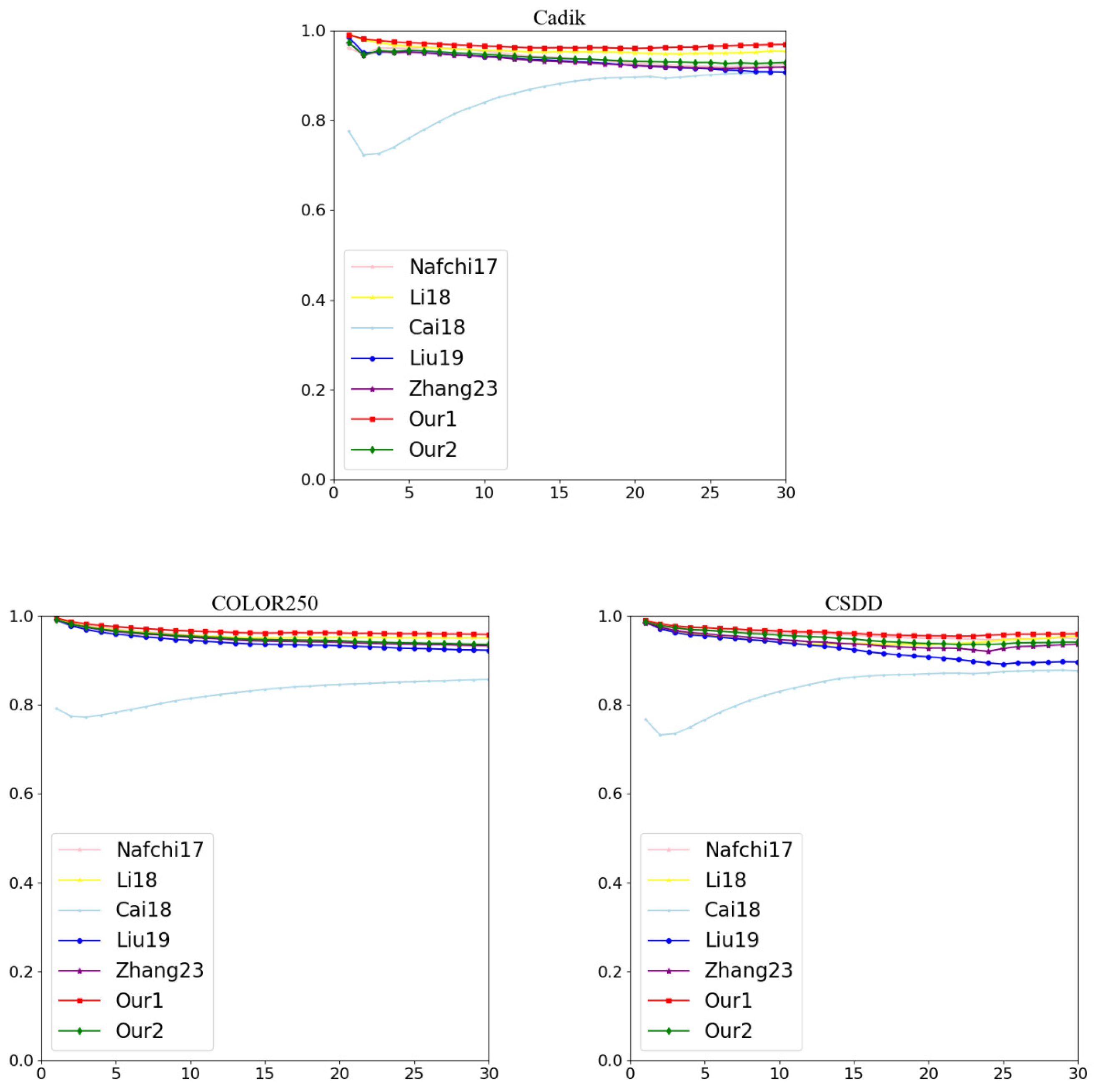
As shown in Figure 7, our original grayscale method (Our1) achieves the highest CCFR score among all competing methods. This indicates that our proposed method excels at preserving the structural fidelity of the original color images.

4.2.3. E-Score Evaluation

The E-score, a metric designed to align with human visual perception [9], combines the Color Contrast Preservation Ratio (CCPR) and the Color Contrast Fidelity Ratio (CCFR) using their harmonic mean. It is calculated as:
E-score = 2 · CCPR · CCFR CCPR + CCFR .
A higher E-score indicates a better balance between preserving the original color contrast and minimizing the introduction of spurious edges in the grayscale output.
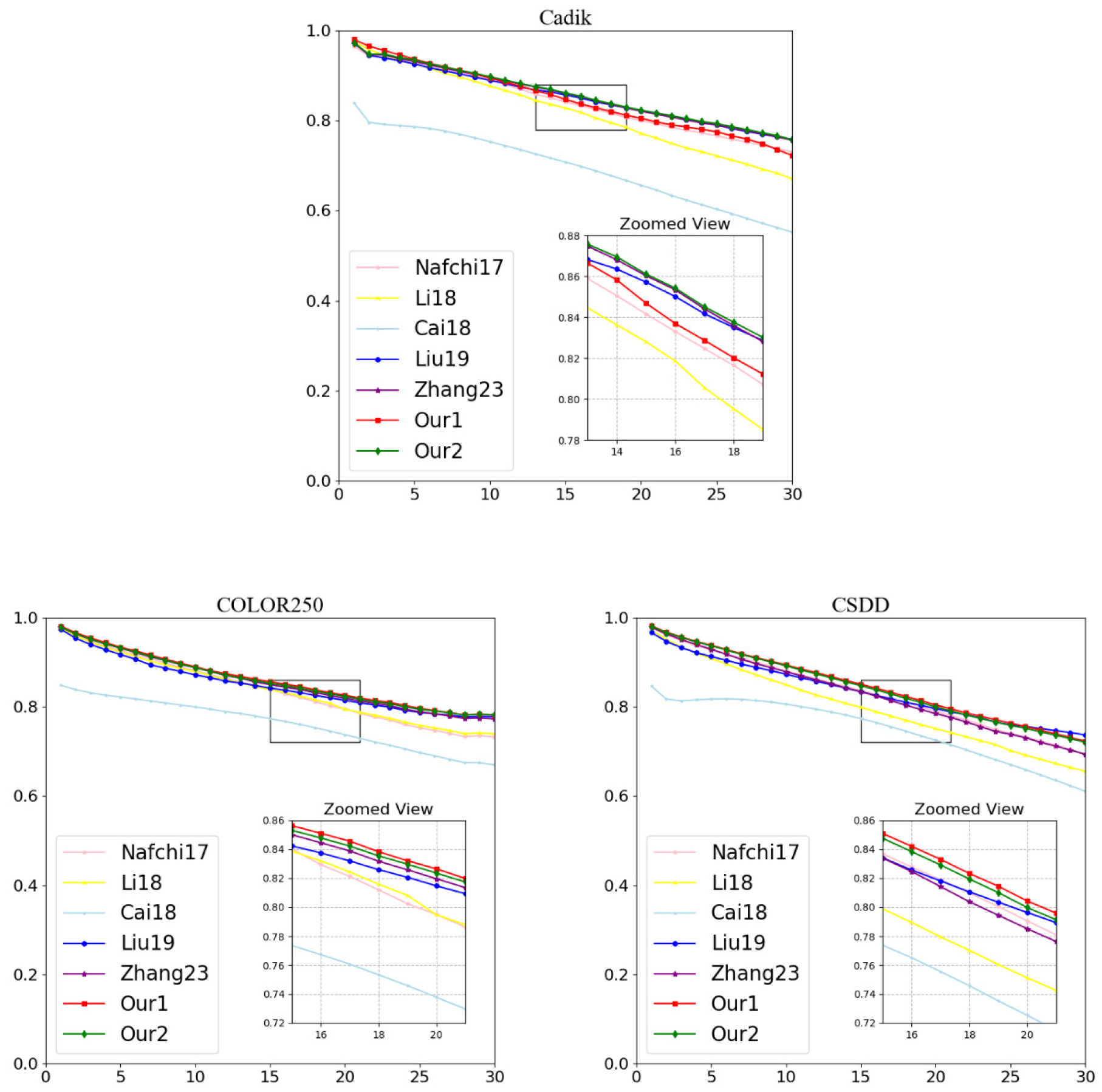
As shown in Figure 8, the E-score curves for our methods, (Our1 (original grayscale) and Our2 (streched grayscale)), consistently surpass those of all competing methods across the evaluated datasets. This superior performance can be attributed to two primary strengths. First, our methods effectively preserve intrinsic color contrast, ensuring that semantically meaningful regions remain distinct in the grayscale output. Second, they suppress artifacts in smooth regions, preventing spurious edges from compromising the structural integrity of the image. Notably, Our1 (original grayscale) achieves the highest E-score values for most of the τ range on the COLOR250 [9] and CSDD [8] datasets. This confirms that our framework, by integrating contrast enhancement, yields a more balanced performance between contrast preservation and artifact reduction-attributes that are highly consistent with human visual assessment of grayscale image quality.

4.3. Validation of the Optimal Step Size for Channel Weights

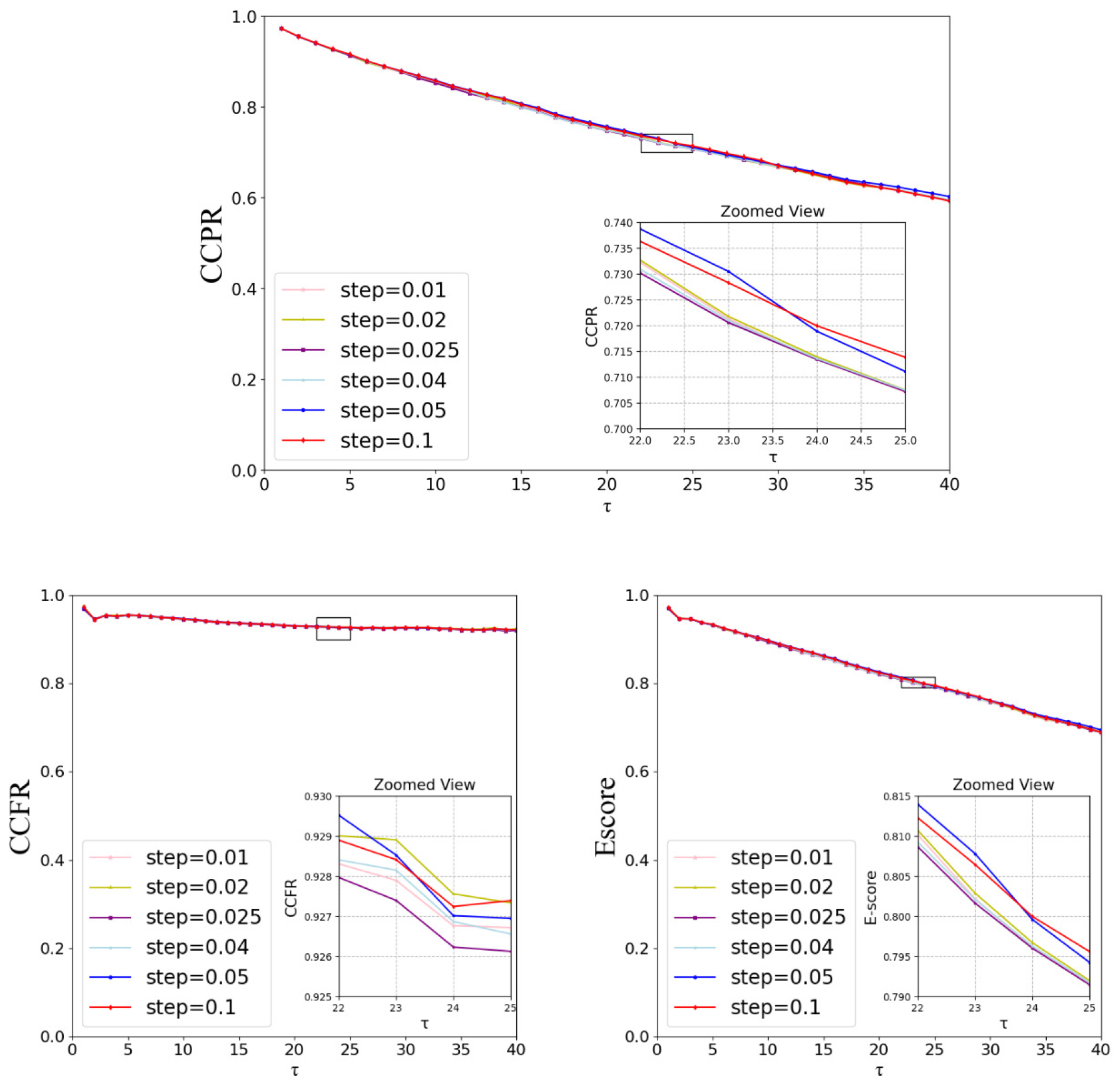
To determine the optimal step size for channel weights, a critical hyperparameter in our framework, we conducted experiments on Cadik’s dataset [41]. We evaluated six step sizes: 0.1, 0.05, 0.04, 0.025, 0.02, and 0.01. For each step size, we generated grayscale results for all 24 images and computed the average CCPR, CCFR, and E-score. These metrics quantify contrast preservation, structural fidelity, and overall perceptual quality, respectively. The results are presented in Figure 9.
As illustrated in Figure 9, step sizes of 0.1 and 0.05 yield comparable performance in CCPR and E-score, with no statistically significant difference in their average values. However, a key trade-off concerning computational efficiency emerges. The channel weights are constrained to the range [ 0 ,   1 ] ; reducing the step size from 0.1 to 0.05 expands the search space for optimal weights from 66 to 256 candidate combinations. This expansion results in an approximate fourfold increase in the computational time required to identify the optimal grayscale output.
This performance-efficiency trade-off aligns with prior work [11,13,14,20,23,30], where most studies adopt a step size of 0.1 to balance feasibility and performance. For smaller step sizes (e.g., 0.04, 0.025, 0.02, 0.01), our experiments reveal only marginal improvements in CCFR (less than 2% on average) at the cost of an exponential increase in runtime. Such minor gains do not justify the substantial computational overhead for practical applications.
Based on these findings, we adopt a step size of 0.1 for our framework. This choice achieves performance on par with smaller step sizes in terms of CCPR and E-score, while maintaining high computational efficiency. This makes it suitable for both academic evaluation and practical deployment.

5. Conclusions

This paper proposes an adaptive linear weighting method for color-to-grayscale conversion. Our approach integrates image entropy and edge content (EC) into an objective function, which is maximized via a discrete search to derive the optimal grayscale image. Before fusion with entropy, EC is normalized using two distinct thresholds tailored for synthetic and photographic images. Experiments on three datasets (Cadik’s [41], COLOR250 [9], CSDD [8]) using subjective and objective metrics (CCPR, CCFR, E-score) demonstrate that our method outperforms five state-of-the-art approaches. Despite its effectiveness, the method has certain limitations. The discrete search reduces computational efficiency, and it may cause global contrast imbalance in complex images (e.g., backlit scenes, multi-object overlapping images). In our future work, we will leverage advanced parameter search methods used in [43,44] to enhance our parameter selection. Additionally, we will explore more effective metrics to better guide the color-to-grayscale conversion process.
It is important to acknowledge a limitation of our current evaluation: the analysis is based on average metric values across the datasets. While this provides a clear indication of overall performance, it does not include statistical measures such as confidence intervals or significance tests. Therefore, a critical direction for our future work will be to conduct a comprehensive statistical analysis to more robustly validate the performance improvements and credibility of our proposed method.

Author Contributions

Conceptualization, L.Z.; methodology, L.Z.; software, L.Z. and J.Y.; validation, L.Z.; formal analysis, L.Z.; investigation, L.Z.; resources, L.Z.; data curation, L.Z.; writing—original draft preparation, L.Z.; writing—review and editing, L.Z. and J.Y.; visualization, L.Z.; supervision, Y.X.; project administration, L.Z.; funding acquisition, L.Z. All authors have read and agreed to the published version of the manuscript.

Funding

This work was supported by the Scientific Research Start-up Foundation from Lanzhou University of Technology, China, (grant number 14-062511).

Data Availability Statement

Data generated in this study (summary figures) are presented within the article; all raw data were obtained from previously published literature cited in the references.

Conflicts of Interest

The authors declare no conflict of interest.

References

  1. Sharma, G.; Trussell, H.J. Digital color imaging. IEEE Trans. Image Process. 1997, 6, 901–932. [Google Scholar] [CrossRef]
  2. MathWorks. rgb2gray Documentation. 2023. Available online: https://www.mathworks.com/help/matlab/ref/rgb2gray.html (accessed on 1 October 2023).
  3. ITU-R Recommendation BT.601-7; Studio Encoding Parameters of Digital Television for Standard 4:3 and Wide-Screen 16:9 Aspect Ratios. Recommendation, International Telecommunication Union: Geneva, Switzerland, 2011.
  4. Smith, K.; Egelhaaf, P.A.M. A contrast-based algorithm for the decolorization of complex scenes. In Proceedings of the 18th IEEE International Conference on Image Processing (ICIP), Brussels, Belgium, 11–14 September 2011; pp. 2677–2680. [Google Scholar]
  5. Lu, C.; Xu, L.; Jia, J. Contrast preserving decolorization. In Proceedings of the IEEE International Conference on Computational Photography (ICCP), Seattle, WA, USA, 28–29 April 2012; pp. 1–7. [Google Scholar]
  6. Seo, J.W.; Kim, S.D. Novel PCA-based color-to-gray image conversion. In Proceedings of the IEEE International Conference on Image Processing, Melbourne, Australia, 15–18 September 2013; pp. 2279–2283. [Google Scholar]
  7. Zhu, W.; Hu, R.; Liu, L. Grey conversion via perceived-contrast. Vis. Comput. 2014, 30, 299–309. [Google Scholar] [CrossRef]
  8. Du, H.; He, S.; Sheng, B.; Ma, L.; Lau, R.W.H. Saliency-Guided Color-to-Gray Conversion Using Region-Based Optimization. IEEE Trans. Image Process. 2014, 24, 434–443. [Google Scholar] [CrossRef] [PubMed]
  9. Lu, C.; Li, X.; Jia, J. Contrast Preserving Decolorization with Perception-Based Quality Metrics. Int. J. Comput. Vis. 2014, 110, 222–239. [Google Scholar] [CrossRef]
  10. Wu, Z.; Robinson, J. Edge-preserving colour-to-greyscale conversion. Iet Image Process. 2014, 8, 252–260. [Google Scholar] [CrossRef]
  11. Liu, Q.; Liu, P.X.; Xie, W.; Wang, Y.; Liang, D. GcsDecolor: Gradient Correlation Similarity for Efficient Contrast Preserving Decolorization. IEEE Trans. Image Process. 2015, 24, 2889–2904. [Google Scholar] [CrossRef]
  12. Chen, J.; Li, X.; Zhu, X.; Wang, J. Visual perception preserving decolorization method. Int. J. Signal Image Process. Pattern Recognit. 2016, 9, 65–78. [Google Scholar] [CrossRef]
  13. Wan, Y.; Xie, Q. A Novel Framework for Optimal RGB to Grayscale Image Conversion. In Proceedings of the International Conference on Intelligent Human-Machine Systems and Cybernetics (IHMSC), Hangzhou, China, 27–28 August 2016; Volume 2, pp. 345–348. [Google Scholar]
  14. Liu, Q.; Shao, G.; Wang, Y.; Gao, J.; Leung, H. Log-Euclidean Metrics for Contrast Preserving Decolorization. IEEE Trans. Image Process. 2017, 26, 5772–5783. [Google Scholar] [CrossRef]
  15. Nafchi, H.Z.; Shahkolaei, A.; Hedjam, R.; Cheriet, M. CorrC2G: Color to Gray Conversion by Correlation. IEEE Signal Process. Lett. 2017, 24, 1651–1655. [Google Scholar] [CrossRef]
  16. Wang, W.; Li, Z.G.; Wu, S.Q. Color Contrast-Preserving Decolorization. IEEE Trans. Image Process. 2018, 27, 5464–5474. [Google Scholar] [CrossRef]
  17. Cai, B.; Xu, X.; Xing, X. Perception Preserving Decolorization. In Proceedings of the IEEE International Conference on Image Processing (ICIP), Athens, Greece, 7–10 October 2018; pp. 2810–2814. [Google Scholar]
  18. Hou, X.; Gong, Y.; Liu, B.; Sun, K.; Liu, J.; Xu, B.; Duan, J.; Qiu, G. Learning based Image Transformation using Convolutional Neural Networks. IEEE Access 2018, 6, 49779–49792. [Google Scholar] [CrossRef]
  19. Zhang, X.; Liu, S. Contrast preserving image decolorization combining global features band local semantic features. Vis. Comput. 2018, 34, 1099–1108. [Google Scholar] [CrossRef]
  20. Li, X.; Zhang, L.; Wan, Y. A New Color-to-Gray Conversion Method Based on Edge Detection. In Proceedings of the International Conference on Communications, Circuits, and Systems (ICCCAS), Chengdu, China, 22–24 December 2018. [Google Scholar]
  21. Liu, Q.; Henry, L. Variable augmented neural network for decolorization and multi-exposure fusion. Inf. Fusion 2019, 46, 114–127. [Google Scholar] [CrossRef]
  22. Liu, S.; Zhang, X. Image decolorization combining local features and exposure features. IEEE Trans. Multimed. 2019, 21, 2461–2472. [Google Scholar] [CrossRef]
  23. Liu, Q.; Li, S.; Xiong, J.; Qin, B. WpmDecolor: Weighted projection maximum solver for contrast-preserving decolorization. Vis. Comput. 2019, 35, 205–221. [Google Scholar] [CrossRef]
  24. Chen, H.; Fang, F. Bregman-Tanimoto Based Method for Contrast Preserving Decolorization. In Proceedings of the 2019 IEEE International Conference on Multimedia and Expo (ICME), Shanghai, China, 8–12 July 2019; pp. 1240–1245. [Google Scholar]
  25. Ambalathankandy, P.; Ou, Y.; Ikebe, M. Warm-cool color-based high-speed decolorization: An empirical approach for tone mapping applications. J. Electron. Imaging 2021, 30, 043026–043035. [Google Scholar] [CrossRef]
  26. Isumi, R.; Yamamoto, K.; Noma, T. Color2Hatch: Conversion of color to hatching for low-cost printing. Vis. Comput. 2021, 37, 3103–3113. [Google Scholar] [CrossRef]
  27. Li, F.; Zhu, Y. Smoothing and Clustering Guided Image Decolorization. Image Anal. Stereol. 2021, 40, 17–27. [Google Scholar] [CrossRef]
  28. Yu, N.; Li, J.; Hua, Z. Detail enhancement decolorization algorithm based on rolling guided filtering. Multimed. Tools Appl. 2022, 81, 2711–2731. [Google Scholar] [CrossRef]
  29. Yu, N.; Li, J.; Hua, Z. Decolorization algorithm based on contrast pyramid transform fusion. Multimed. Tools Appl. 2022, 81, 15017–15039. [Google Scholar] [CrossRef]
  30. Zhang, L.; Wan, Y. Decolorization based on the weighted combination of image entropy and canny edge retention ratio. J. Electron. Imaging 2023, 32, 013024. [Google Scholar] [CrossRef]
  31. Khudhair, Z.N.; Khdiar, A.N.; El Abbadi, N.K.; Mohamed, F.; Saba, T.; Alamri, F.S.; Rehman, A. Color to Grayscale Image Conversion Based on Singular Value Decomposition. IEEE Access 2023, 11, 54629–54638. [Google Scholar] [CrossRef]
  32. Zhang, L.; Wan, Y. Color-to-gray image conversion using salient colors and radial basis functions. J. Electron. Imaging 2024, 33, 013047. [Google Scholar] [CrossRef]
  33. Śluzek, A. Incremental Image Decolorization with Randomizing Factors. In Proceedings of the 32nd European Signal Processing Conference (EUSIPCO), Lyon, France, 26–30 August 2024; pp. 591–595. [Google Scholar]
  34. Ceylan, A.; Özay, E.K.; Tunga, B. Contrast and content preserving HDMR-based color-to-gray conversion. Comput. Graph. 2024, 125, 104110. [Google Scholar] [CrossRef]
  35. Wu, T.; Eising, C.; Glavin, M.; Jones, E. An Efficient and Effective Image Decolorization Algorithm Based on Cumulative Distribution Function. J. Imaging 2024, 10, 51. [Google Scholar] [CrossRef]
  36. Sanchez-Cesteros, O.; Rincon, M. Decolorization with Warmth–Coolness Adjustment in an Opponent and Complementary Color System. J. Imaging 2025, 11, 199. [Google Scholar] [CrossRef] [PubMed]
  37. Ma, K.; Zhao, T.; Zeng, K.; Wang, Z. Objective Quality Assessment for Color-to-Gray Image Conversion. IEEE Trans. Image Process. 2015, 24, 4673–4685. [Google Scholar] [CrossRef]
  38. Cheng, Z.; Yang, Q.; Sheng, B. Deep color-to-gray: An adaptive approach. In Proceedings of the IEEE/CVF Conference on Computer Vision and Pattern Recognition (CVPR), Long Beach, CA, USA, 16–20 June 2019; pp. 1237–1246. [Google Scholar]
  39. Turiel, A. The multifractal structure of contrast changes in natural images: From sharp edges to textures. Neural Comput. 2000, 12, 763–793. [Google Scholar] [CrossRef] [PubMed]
  40. Cover, T.M.; Thomas, J.A. Elements of Information Theory; Wiley-Interscience: Hoboken, NJ, USA, 2006. [Google Scholar]
  41. Čadík, M. Perceptual evaluation of color-to-grayscale image conversions. Comput. Graph. Forum 2008, 27, 1745–1754. [Google Scholar] [CrossRef]
  42. Duda, R.; Hart, P. Pattern Classification and Scene Analysis; Wiley: Hoboken, NJ, USA, 1973. [Google Scholar]
  43. Wang, S. A hybrid SMOTE and Trans-CWGAN for data imbalance in real operational AHU AFDD: A case study of an auditorium building. Energy Build. 2025, 348, 116447. [Google Scholar] [CrossRef]
  44. Wang, S. Evaluating cross-building transferability of attention-based automated fault detection and diagnosis for air handling units: Auditorium and hospital case study. Build. Environ. 2026, 287, 113889. [Google Scholar] [CrossRef]
Figure 1. Two color images and the enlarged regions marked by red box in one image, with their grayscale results by the methods [13,20]. (a) Original images 2.png and 19.png from Cadik’s datasets [41], (b) the grayscale result of (a) by the method [20], (c) the grayscale result of (a) by the method [13].
Electronics 15 00114 g001
Figure 2. Visual comparisons on some images (6.png, 7.png, 8.png, 11.png, 13.png, 16.png and 21.png) from Cadik’s dataset [41]; the red boxes indicate the enlarged regions. From left to right: (a) original color images; grayscale results generated by (b) Nafchi et al. [15], (c) Li et al. [20], (d) Cai et al. [17], (e) Liu et al. [23], (f) Zhang and Wan [30], (g) Our1 (our original grayscale), and (h) Our2 (our stretched grayscale).
Electronics 15 00114 g002
Figure 3. Visual comparisons on some images (6.png, 8.png, 10.png, 26.png, 100.png and 194.png) from the COLOR250 dataset [9]; the red boxes indicate the enlarged regions. From left to right: (a) original color images; grayscale results generated by (b) Nafchi et al. [15], (c) Li et al. [20], (d) Cai et al. [17], (e) Liu et al. [23], (f) Zhang and Wan [30], (g) Our1 (our original grayscale), and (h) Our2 (our stretched grayscale).
Electronics 15 00114 g003
Figure 4. Visual comparisons on some images (10.png, 13.png and 14.png) from the CSDD dataset [8]; the red boxes indicate the enlarged regions. From left to right: (a) original color images; grayscale results generated by (b) Nafchi et al. [15], (c) Li et al. [20], (d) Cai et al. [17], (e) Liu et al. [23], (f) Zhang and Wan [30], (g) Our1 (our original grayscale), and (h) Our2 (our stretched grayscale).
Electronics 15 00114 g004
Figure 5. Visual comparisons on some images (9.png from Cadik’s dataset [41], 27.png and 34.png from the COLOR250 datasets [9] and 19.png from the CSDD dataset [8]; the red boxes indicate the enlarged regions. From left to right: (a) original color images; grayscale results generated by (b) Nafchi et al. [15], (c) Li et al. [20], (d) Cai et al. [17], (e) Liu et al. [23], (f) Zhang and Wan [30], (gOur1 (our original grayscale), and (h) Our2 (our stretched grayscale).
Electronics 15 00114 g005
Figure 6. Comparison of average CCPR values on three datasets: Cadik [41] (24 images), COLOR250 [9] (250 images), and CSDD [8] (22 images). The methods are labeled as Nafchi17 [15], Li18 [20], Cai18 [17], Liu19 [23], Zhang23 [30], Our1 (our original grayscale), and Our2 (our stretched grayscale). The x-axis represents the threshold τ , and the y-axis shows the corresponding CCPR value.
Electronics 15 00114 g006
Figure 7. Comparison of average CCFR values on three datasets: Cadik [41] (24 images), COLOR250 [9] (250 images), and CSDD [8] (22 images). The methods are labeled as Nafchi17 [15], Li18 [20], Cai18 [17], Liu19 [23], Zhang23 [30], Our1 (our original grayscale), and Our2 (our stretched grayscale). The x-axis represents the threshold τ , and the y-axis shows the corresponding CCFR value.
Electronics 15 00114 g007
Figure 8. Comparison of average E-score values on three datasets: Cadik [41] (24 images), COLOR250 [9] (250 images), and CSDD [8] (22 images); the black boxes indicate the enlarged regions. The methods are labeled as Nafchi17 [15], Li18 [20], Cai18 [17], Liu19 [23], Zhang23 [30], Our1 (our original grayscale), and Our2 (our stretched grayscale). The x-axis represents the threshold τ , and the y-axis shows the corresponding E-score value.
Electronics 15 00114 g008
Figure 9. Comparison of the impact of channel weight step size on average CCPR, CCFR, and E-score for Cadik’s dataset [41]; the black boxes indicate the enlarged regions.
Electronics 15 00114 g009
Disclaimer/Publisher’s Note: The statements, opinions and data contained in all publications are solely those of the individual author(s) and contributor(s) and not of MDPI and/or the editor(s). MDPI and/or the editor(s) disclaim responsibility for any injury to people or property resulting from any ideas, methods, instructions or products referred to in the content.