Abstract
An adaptive line-of-sight (ALOS) guidance law with drift angle compensation is proposed to achieve the path following of unmanned surface vehicles (USVs) under the influence of ocean currents. The ALOS guidance law can calculate the desired heading of USV accurately. Compact Form Dynamic Linearization—Model-Free Adaptive Control (CFDL-MFAC) is used to control the heading. Firstly, the relationship between the path tracking error and the USV model is established. The look-ahead distance is designed as a function related to the tracking error and the speed. The sideslip angle is estimated online and compensated by using the reduced-order state observer. Finally, the heading is controlled using CFDL-MFAC, which is calculated by the ALOS guidance law. The simulation results demonstrate that satisfactory performance has been achieved of the ALOS by comparing the mean absolute error (MAE) and root mean square error (RMSE).
1. Introduction
Unmanned surface vehicles (USVs) have gained much importance in oceanographic research. USVs have been increasingly applied to unmanned tasks such as marine surveying, meteorological monitoring, and environmental monitoring [1,2,3]. One of the key aspects of this technology is ensuring the path is followed [4,5]. However, disturbance from ocean currents make this more challenging. Guidance methods typically include line-of-sight (LOS), pure tracking, and constant heading guidance [6,7]. Among these, LOS is widely used as an effective strategy for path tracking [8,9,10].
The USV path-following problem was initially solved using the Serret–Frenet coordinate system as a control strategy. Simulations confirm the approach’s effectiveness [11]. The controller was developed by combining the backstepping and parameter projection methods to address the path-following control problem under ocean current disturbance conditions [12]. A switching LOS guidance law was developed to ensure that the USV follows the desired path with an optimal LOS circle radius, eliminating the limitation on the initial position [13,14]. A robust adaptive path-following control scheme based on a fuzzy unknown observer was proposed [15]. A guidance law known as surge-guided line of sight (SGLOS) has been introduced with the objective of improving the performance of unmanned surface vehicles. This approach has been specifically designed to address path tracking challenges by minimizing errors in tracking and achieving greater accuracy. Through simulation experiments, it has been demonstrated that this strategy effectively enhances the ability of USVs to maintain their desired trajectory while reducing deviations caused by environmental factors. A control method for path following based on the virtual transition LOS guidance law is introduced, and a robust adaptive S-plane controller is developed to control both heading and speed. The method improved the convergence velocity of the USV and reduced steering overshoot [16]. Although LOS guidance has been extensively explored in USV path tracking, dynamic disturbances such as ocean currents in the marine environment still pose significant challenges to USV path tracking. Traditional LOS guidance methods typically assume static or slowly changing disturbances, which may not be feasible in the real world. The latest advances in reduced order models (ROMs) and data assimilation (DA) techniques provide powerful tools for addressing similar challenges in dynamical systems. For example, ROMs can already be effectively combined with machine learning to improve the adaptability and accuracy of models under uncertain and dynamic conditions. Similarly, the ROM based framework-enhanced variational data assimilation method has shown great potential in improving interference estimation and compensation [17,18]. These advances lay the foundation for developing robust guidance strategies for unmanned underwater vehicles in complex and dynamic marine environments. In addition, in recent years, research has further combined neural network technology to optimize reduced order models and data assimilation methods. In reference [19], the author proposed a potential spatial data assimilation method based on multi-domain encoder–decoder neural networks. This approach not only significantly improves the computational efficiency of data assimilation, but also demonstrates higher accuracy in dynamic interference estimation. This provides new ideas for path tracking and disturbance compensation in complex dynamic environments. In recent years, sustainable navigation and control strategies have received widespread attention in the field of autonomous ship navigation. Zhang et al. proposed a wind-assisted navigation and control strategy that can effectively utilize environmental resources to optimize ship energy consumption and path tracking performance. This method integrates environmental dynamics into autonomous ship control, providing a new approach [20]. In addition, Zhang et al. proposed a structurally synchronized dynamic event triggered control scheme and applied it to autonomous marine vehicles in marine ranch scenarios. This method combines a multi-task guidance law with robust control technology, improving the accuracy of path tracking and enhancing the compensation of dynamic disturbances [21].
However, in addition to dynamic disturbances in the marine environment, USVs also face another significant issue of sideslip angle. Sideslip angle generation is influenced by external factors, including ocean currents, winds, and waves, which can trigger the sideslip motion of USVs, further increasing the complexity of path tracking. Especially for USVs that rely solely on tail thrusters for navigation, their structural characteristics make them more susceptible to external disturbances due to the lack of lateral thrust. The sideslip angle causes a mismatch between the expected and actual heading, thereby reducing the accuracy of path tracking. Dynamic interference not only affects the accuracy of path tracking, but also leads to the generation of sideslip angles, further reducing the performance of USVs. Therefore, the compensation of sideslip angle is an important aspect to improve the accuracy of path following. An ILOS guidance method based on direct adaptation and indirect adaptation was proposed, which weakened the influence of unknown time-varying ocean currents [10]. A novel nonlinear adaptive path-following controller is proposed to reduce sideslip angle [22]. The simulation confirms the method’s ability to track the desired path despite ocean currents. An LOS guidance law employs a filtered extended state observer (FESO) to estimate wind-induced sideslip angle, waves, and currents. Adaptive fuzzy control and sliding mode control methods were used for path tracking, which greatly improves the tracking accuracy of the USV [23]. A sustainable navigation and control method was proposed for wind-assisted navigation of ships. It provides an important reference for our research, especially when considering the impact of dynamic environmental factors such as wind force on path tracking control [20]. A dynamic event-triggered control method based on multi-task switching guidance was proposed for marine ranch automation systems. This control strategy optimizes system performance by dynamically adjusting the timing of event triggering, especially in dynamic environments [21].
An adaptive LOS guidance law based on reinforcement learning is applied for a dynamic, data-driven, autonomous underwater vehicle. RL is applied for the deterministic strategy gradient (DSG), which is designed to optimize the forward-looking distance of continuous variation [24]. The path-following controller for USVs is enhanced by trajectory linearization. The ALOS algorithm is applied in the navigation strategy, effectively solving the sideslip angle problem and optimizing convergence speed [25]. In the dynamic tracking process of USVs, a broken line path tracking algorithm in an uncertain environment is proposed by calculating the virtual targets of the straight line [26]. An internal model control-based observer was proposed to estimate the sideslip angle, offering fast response and minimal steady error [27].
The heading control of USVs primarily includes methods such as PID control [28], sliding mode control [29], intelligent control [30], and model predictive control [31]. Among these, PID control is the most widely used. However, simulations and field tests show that USVs are significantly affected by model perturbations and environmental disturbances, making it challenging for PID control to maintain stable performance without frequent parameter adjustments to stabilize the system.
Therefore, USVs require a robust and adaptive control method, and CFDL-MFAC is well-suited to meet these needs. While it has been successfully applied in industries such as transportation, oil refining, and chemicals [32,33,34], research on its application in motion control for robots and ships remains limited.
This study’s main contributions are outlined as follows:
- The look-ahead distance varies with USV speed and tracking error;
- The sideslip angle was estimated online and compensated by the reduced-order state observer;
- CFDL-MFAC was designed as a heading controller.
The remainder of this paper is organized into four sections. Section 2 is dedicate to the modeling of a USV with three degrees of freedom (3 DOFs). In Section 3, the design of the ALOS guidance law and CFDL-MFAC is described, and the stability is proved. Section 4 provides simulation results to illustrate the effectiveness of the method. The conclusions are summarized in Section 5.
2. Kinematics and Dynamic USV Model
2.1. The Coordinate System Setup
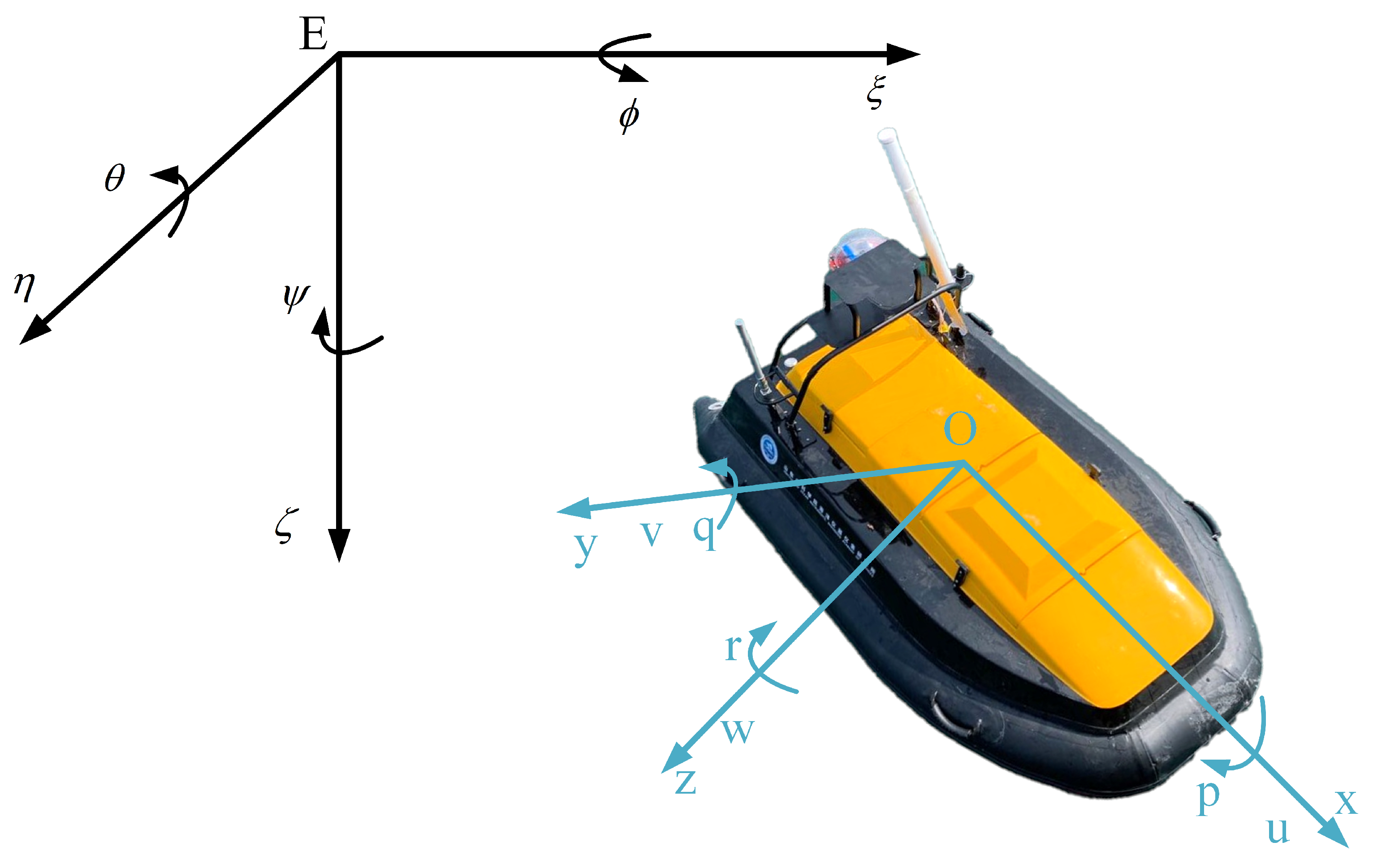
The nonlinear dynamic model of the USV is crucial for path tracking studies. This paper uses the coordinate system from International Towing Tank Conference to describe motion parameters at any given time [35]. It consists of two main coordinate systems: the geodetic coordinate system I: (), with the origin E on Earth, and the ship’s coordinate system B: (), where O is the moving origin on the USV (see Figure 1).
Figure 1.
Coordinate system of USV.
The USV has six degrees of freedom: surge (u), sway (v), heave (w), roll (p), pitch (q), and yaw (r). The linear and angular velocity in the body-fixed coordinate system is represented by . The relevant symbol definitions are listed in Table 1. Since the USV operates at low speed, Earth’s motion can be neglected, and a fixed point on the Earth’s surface is used as the reference for the Earth’s coordinate system.
Table 1.
Notations used for USV [36].
2.2. 3-DOF Model of the USV
An underactuated vessel moves at speed U, with forward velocity u and lateral velocity v as defined in Equation (1). In the Earth-fixed frame I, its position and orientation are described by Equation (2). Longitudinal, lateral, and angular velocities in the body-fixed frame B are specified in Equation (3). The 3-DOF kinematics and dynamic model of the USV, which is not fully symmetric in the horizontal plane, are represented in vector form by Equation (4).
where are the thrust and moment vectors, the matrix is the rotation of the USV from coordinate system to , M is the inertia matrix, is the Coriolis force and centripetal force matrix, and is the damping force matrix. They are defined as Equation (5).
Assume the USV’s position in the Earth-fixed frame is , with its 3-DOF kinematic equations defined in Equation (6) [37].
3. Adaptive LOS Guidance Design and Analysis
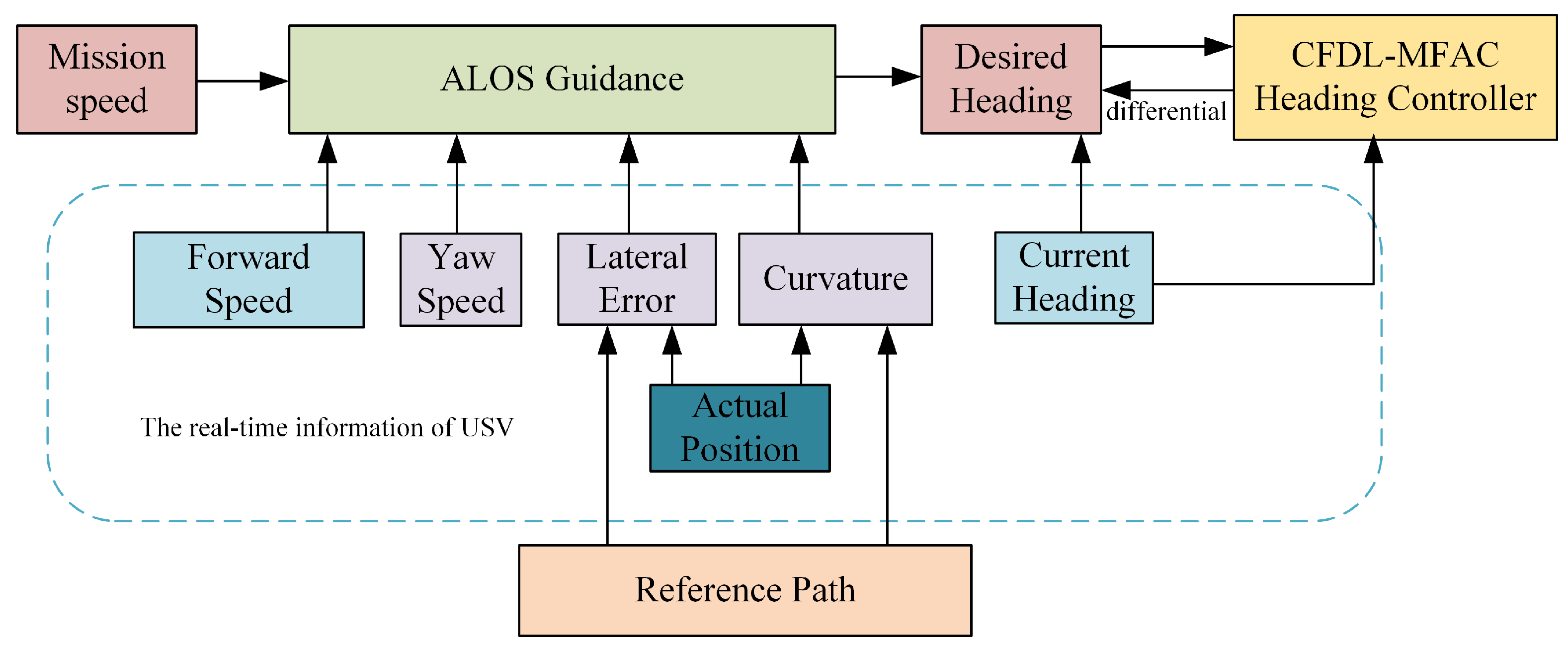
Figure 2 illustrates the block diagram of the path-following system. The path-following system is divided into two modules: path following and motion control. The input is the task information set by the user, and the output acts on the propeller. The USV sails along the desired path at the desired speed and reaches the desired position. In order to achieve this goal, the cascade system theory was adopted in this study, and the path-following control was divided into guidance and control parts. The main task of the path-following module is to obtain the desired attitude of the USV through the task requirements and calculate the expected heading through the guidance law.
Figure 2.
The structure of the path-following system.
3.1. Path Error Design
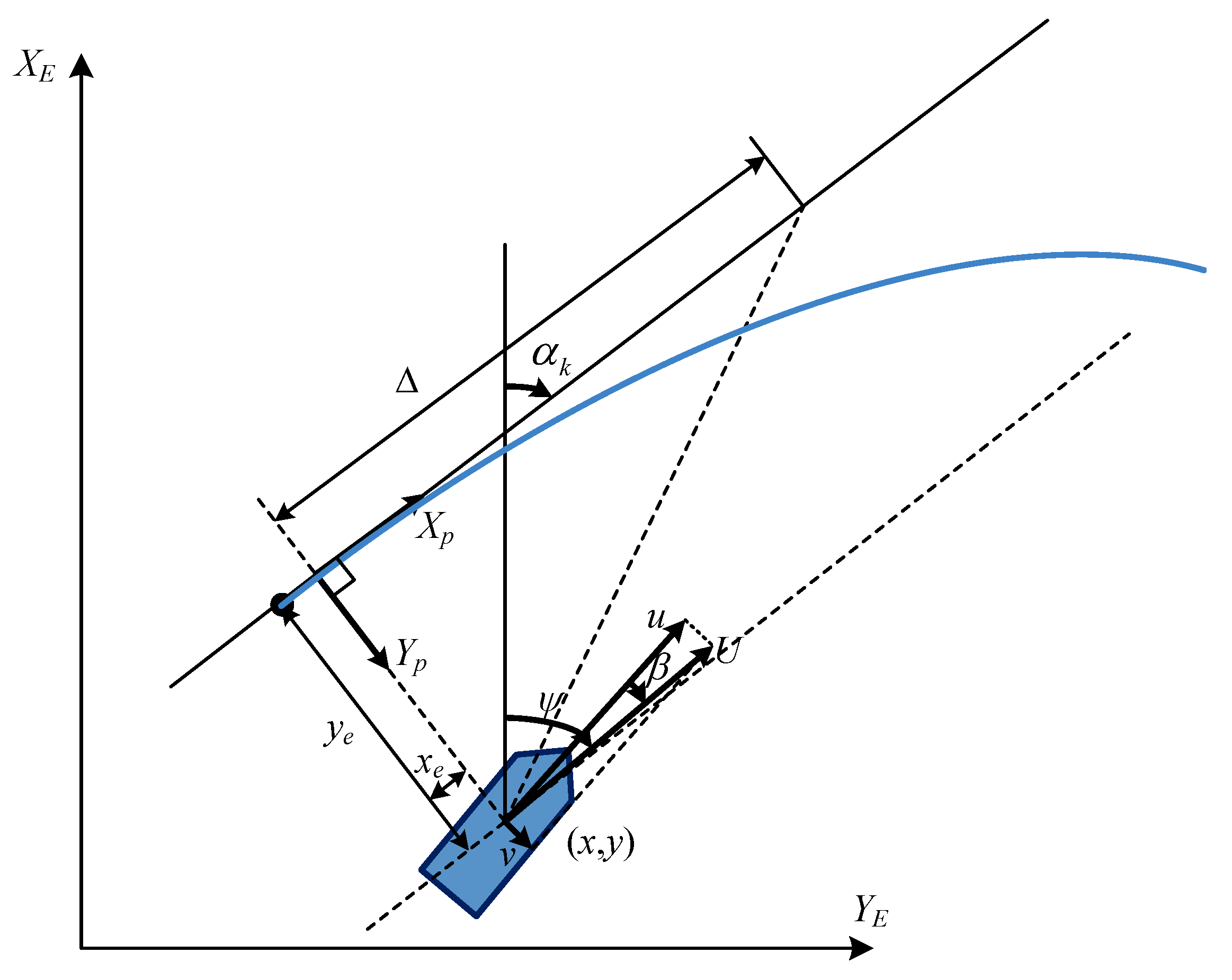
The USV path tracking model guided by the LOS guidance law is illustrated in Figure 3. The position of the USV, , projects onto the reference path at , where is the forward path variable and the reference path is an open path. The angle represents the clockwise rotation of the path-tangential reference frame at relative to the Earth-fixed frame, and is expressed as , with and .
Figure 3.
Geometrical illustration of LOS guidance.
The along-track error and cross-track error for the USV at position are given by Equation (7):
Taking the time derivative of , we have Equation (8).
After simplification, we have Equation (9):
where , where represents the USV speed, and is the sideslip angle (refer to Figure 3). The virtual reference point speed, denoted as , is expressed by Equation (10).
Taking the time derivative of results in Equation (11).
Finally, the derivatives of the cross-track and along-track errors are given in Equation (13).
where is the sideslip angle and is the course angle.
3.2. The Calculation of Look-Ahead Distance
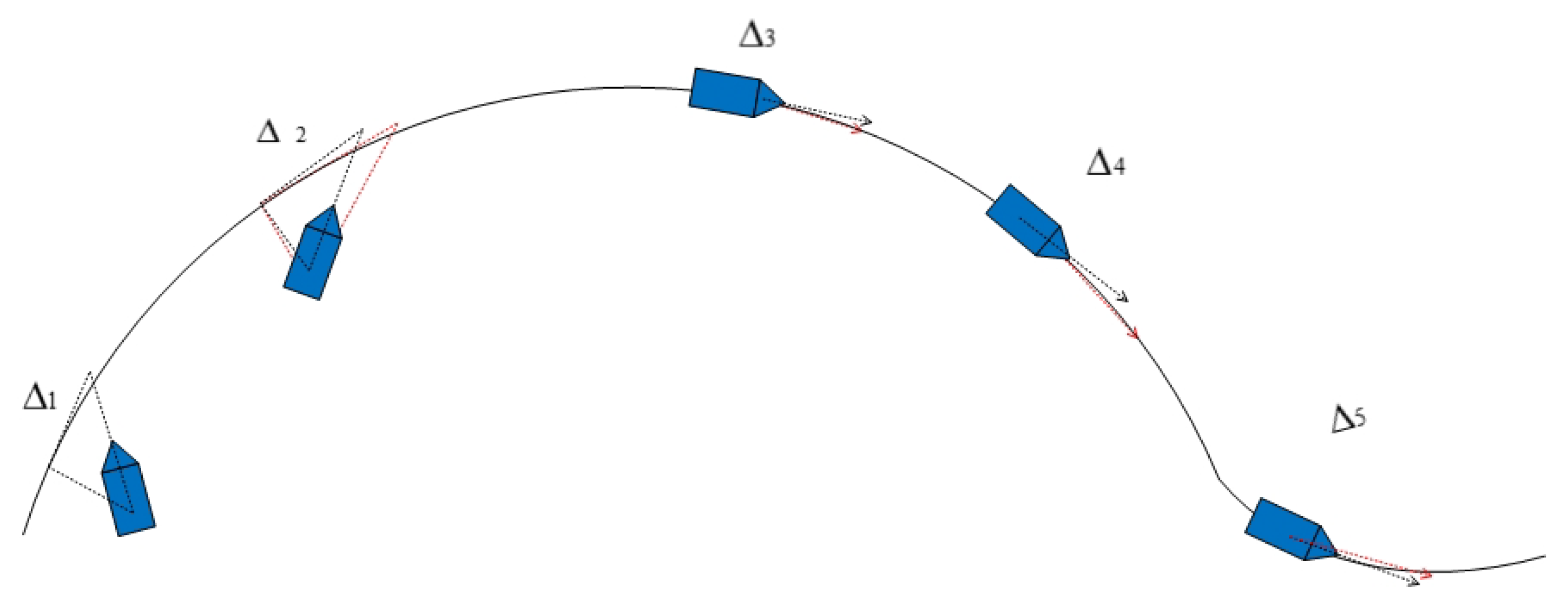
The forward distance is critical in LOS guidance, as it directly impacts path tracking convergence. A larger forward distance slows tracking, whereas a smaller one heightens overshoot. Assuming the reference path is a curved path with different curvatures. As shown in Figure 4, the figure simultaneously displays two scenarios: (1) fixed forward distance: for large curvature paths, fixed forward distance (represented by black dashed lines) can lead to significant lateral tracking errors; (2) adaptive forward distance: as the lateral tracking error decreases, the adaptive forward distance (represented by the red dashed line) can be dynamically adjusted to improve the accuracy of path tracking.
Figure 4.
The curve tracking with variable curvature.
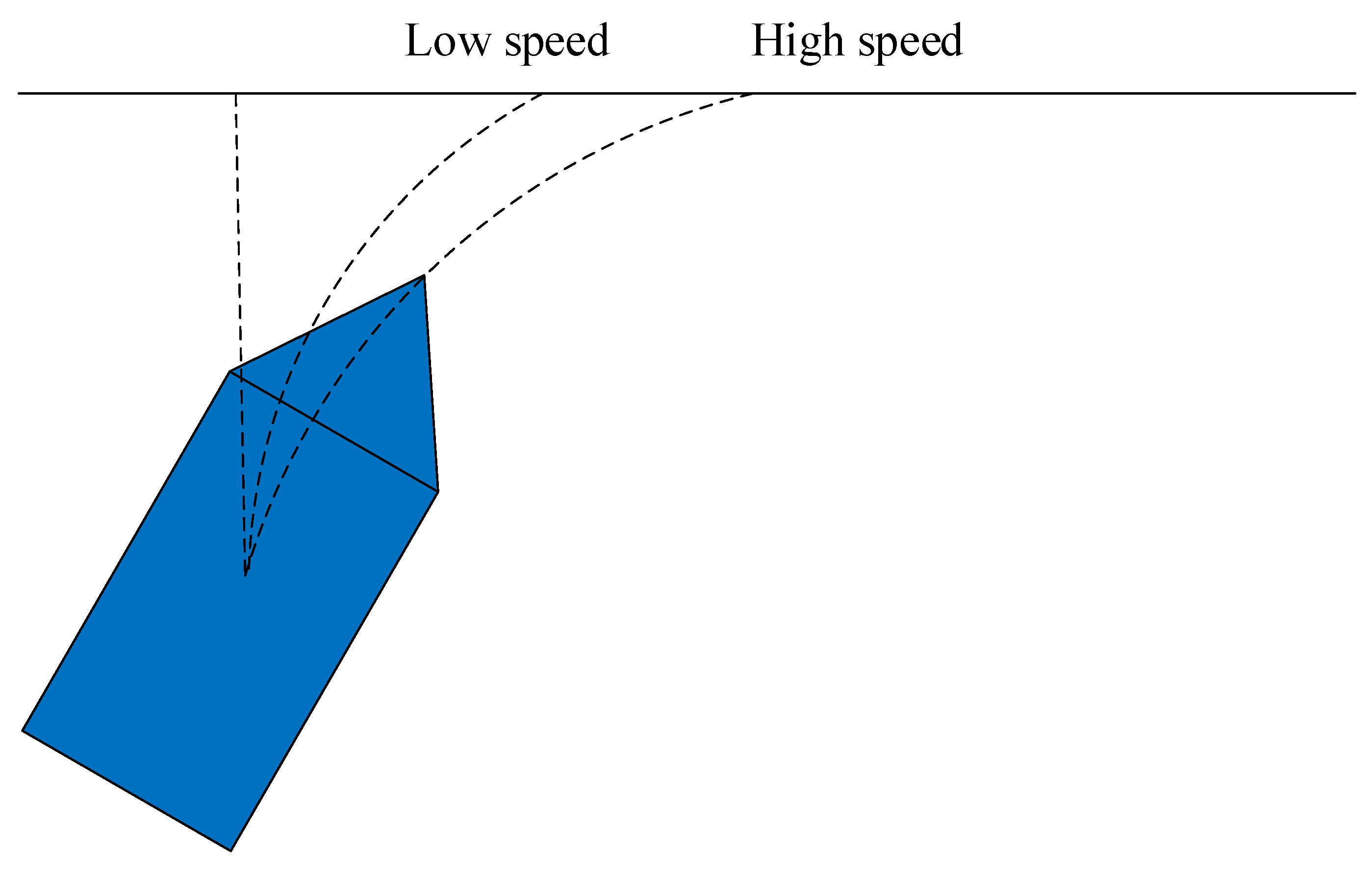
If the USV sails at a higher forward speed, the forward distance should increase rapidly. If the USV sails at a lower forward speed, the forward distance should increase slowly, as shown in Figure 5. Following these principles, Equation (16) defines the look-ahead distance.
where and are controller parameters that satisfy and , represents the smallest look-ahead distance without considering speed. Let , and .
Figure 5.
The convergence performance with different speeds.
The formula of dynamic look-ahead distance offers more adaptability than a fixed one. When the USV deviates significantly from the path, a reduced distance accelerates its return. As it approaches the path, an increased look-ahead distance minimizes overshooting.
3.3. Reduced-Order State Observer Design
Ocean currents cause the sideslip angle to fluctuate over time, complicating accurate measurement. This angle heavily influences path tracking precision and may undermine the system’s reliability. Thus, compensation is essential to keep the USV on its intended path.
The reduced-order observer features simplicity and estimates internal states based on system inputs and outputs.This section introduces a reduced-order observer for estimating the sideslip angle in real time, under the assumption of a small upper bound with .
Assume that the intermediate variable be
And there exists a positive constant that satisfies , then Equation (15) can be rewritten as Equation (18).
The cruising speed U and heading angle are recorded, while is derived from . Using this, a reduced-order observer determines the intermediate variable via Equation (18), enabling the calculation of sideslip angle through Equation (19).
where and are estimations of and , respectively.
Expanding on the method in [27], a modified observer for estimating the sideslip angle is formulated in Equation (20).
where p is the auxiliary state of the observer, is the gain of the observer. Assume that the initial values of the observer be and .
Consider the Lyapunov function candidate . If , then . The differentiation of in combination with Equation (21) yields
where , and if , then
Assume that class functions , and the continuous positive definite function .
Theorem 1.
According to Theorem 1 [38], subsystem (21) of the reduced-order state observer is ISS with .
There exist the class function and class function that satisfy.
where .
3.4. Guidance Law Design
The expected heading of a USV is calculated based on lateral error and preview distance, as shown in Equation (28) using traditional guidance methods. The angle of the LOS guidance method will guide the object’s motion until . However, USVs are subject to external disturbances that generate drift forces during path tracking, resulting in drift angles due to offset. In order to cope with the interference of ocean currents or other environments, a modified guidance method with additional proportional terms is proposed, as shown in Equation (29). The expected heading angle is defined by both Equations (28) and (29).
where the angle is calculated as , and the measurable cross-track error and the estimated are provided by the state observer. Equations (30) and (31) can be inferred by Equation (29).
Consider another Lyapunov function candidate . If , then . And
. According to Equation (16), if the cruising speed U is positive and bounded, i.e., , the look-ahead distance is bounded, i.e., , is bounded and its upper bound is . Equation (33) can be rewritten as Equation (34).
Defining
Equation (34) can be expressed as , which means that the equilibrium point of the guiding system is asymptotically stable. However, due to the assumption that the lateral error in Equation (13) is linearized with a small sideslip angle, it is impossible to achieve globally consistent asymptotic stability of the guidance system.
3.5. Controller Design
The design of the USV heading nonlinear control system is central to the USV control framework. The USV’s heading output spans to , and an increase in thrust does not necessarily result in a higher heading angle. This paper addresses the control challenges under uncertain conditions using the CFDL-MFAC method. A general single-input, single-output (SISO) discrete-time nonlinear system is represented in Equation (36).
Here, and denote the system’s input and output at time k. The integers and are unknown but positive. The function is an unspecified nonlinear mapping.
When in Equation (36), there must be a time-varying parameter , so that Equation (36) can be transformed into the following CFDL-MFAC data model in Equation (37).
The scalar parameter remains bounded for all k. CFDL-MFAC transforms discrete-time nonlinear systems into linear time-varying models using . The method is applicable when , where is a small positive value.
The scheme of CFDL-MFAC is depicted in Equations (39) and (40).
is the desired output signal, . If or , , is the initial value of .
Combining the requirements of CFDL-MFAC for the controlled system, Equation (38) can be written as Equation (41).
Taking the heading angle and the yaw angular velocity r as the output signal of the system, as the yaw angular velocity gain, is a constant. Then, the control problem of the heading subsystem of the USV can be rewritten as Equation (42).
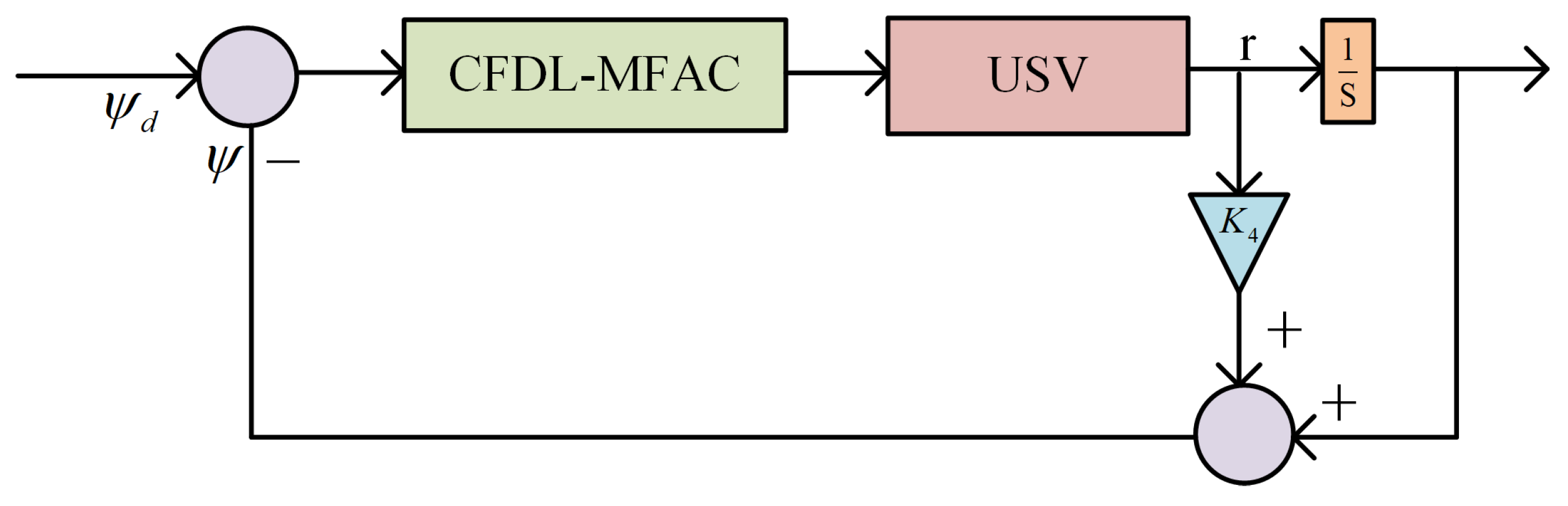
When the control input increases, increases to offset the decreasing value of the heading and ensure that the controlled output continues increase. The block diagram of the heading control system based on CFDL-MFAC is shown in Figure 6.
Figure 6.
Block diagram of heading control system based on CFDL-MFAC.
Items 3 and 6 in Equation (6) constitute the heading control subsystem, which can be rewritten in the discrete form:
where represents the sampling time, is the heading angle output of the system at time k, is the longitudinal linear velocity output at time k, is the lateral linear velocity output at time k, and is the yaw angular velocity output at time k. Additionally, represents the yaw moment input of the system at time k.
In the case of , we have Equation (46).
Consider an extreme case where the heading angle reaches and then changes to , resulting in . Equation (46) is then rewritten as Equation (47).
That is Equation (48):
The USV heading control has relatively fixed dynamic characteristics, and the variation in the angular velocity within a sampling period satisfies , is the maximum forward angular velocity per unit time. , , so Equation (48) satisfies:
where has a minimum value . So that for any time k when is satisfied, .
4. Simulation
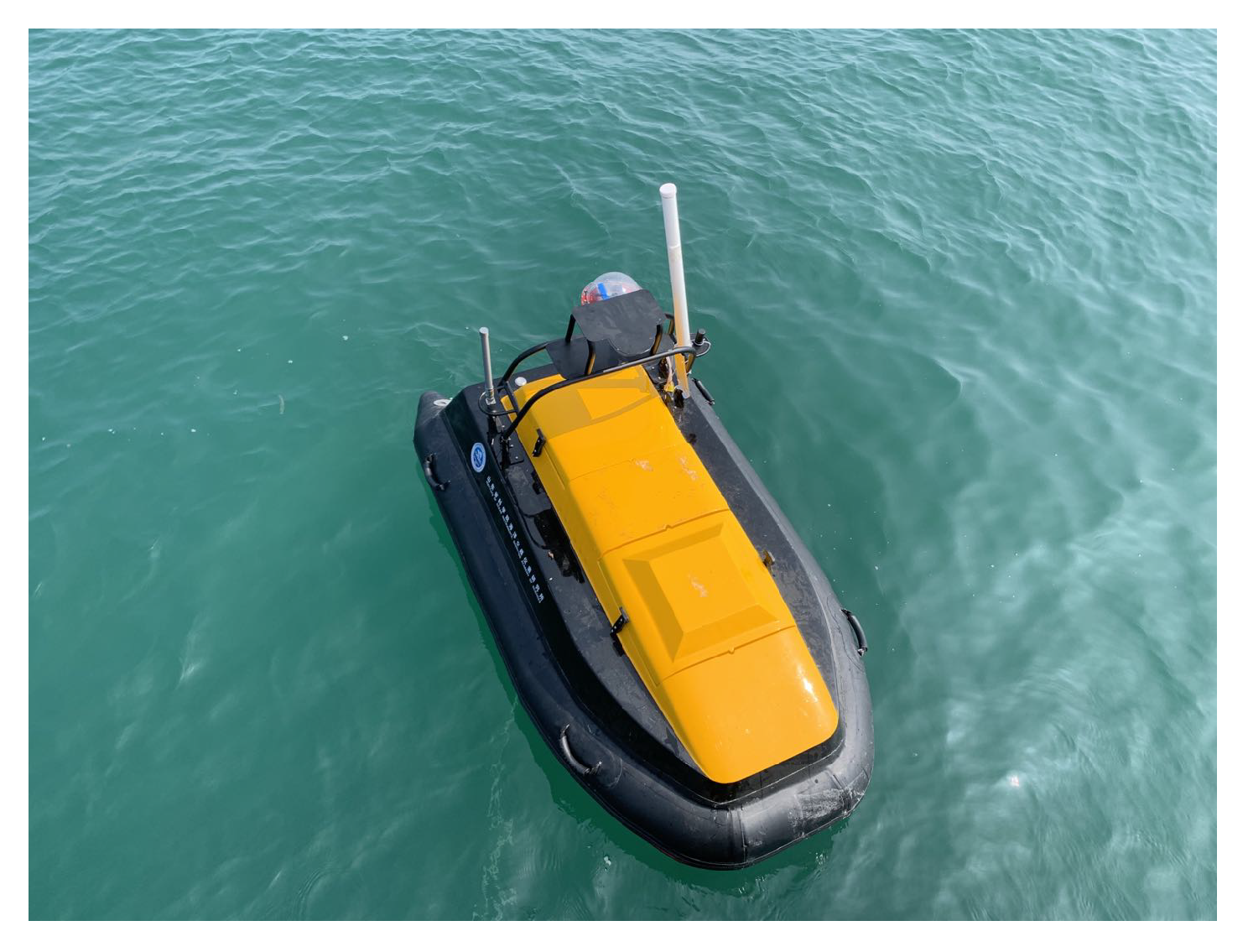
USV heading control was analyzed through computer simulations comparing the PID controller and CFDL-MFAC in both non-disturbed and disturbed environments. The improved ALOS was then integrated with the controller, and a simulation experiment was conducted on the USV path using the experimental parameters developed by Shandong Academy of Sciences as the simulation model. The USV and its specifications are shown in Figure 7 and Table 2, respectively.
Figure 7.
USV in sea trials.
Table 2.
Specifications of the USV.
4.1. Heading Control Comparisons
The desired heading angle is . The initial motion state of the system , the parameters of CFDL-MFAC are, respectively, 0.5, 1, 0.1, 1, 8, 0.0000001. The parameters of the PID controller are .
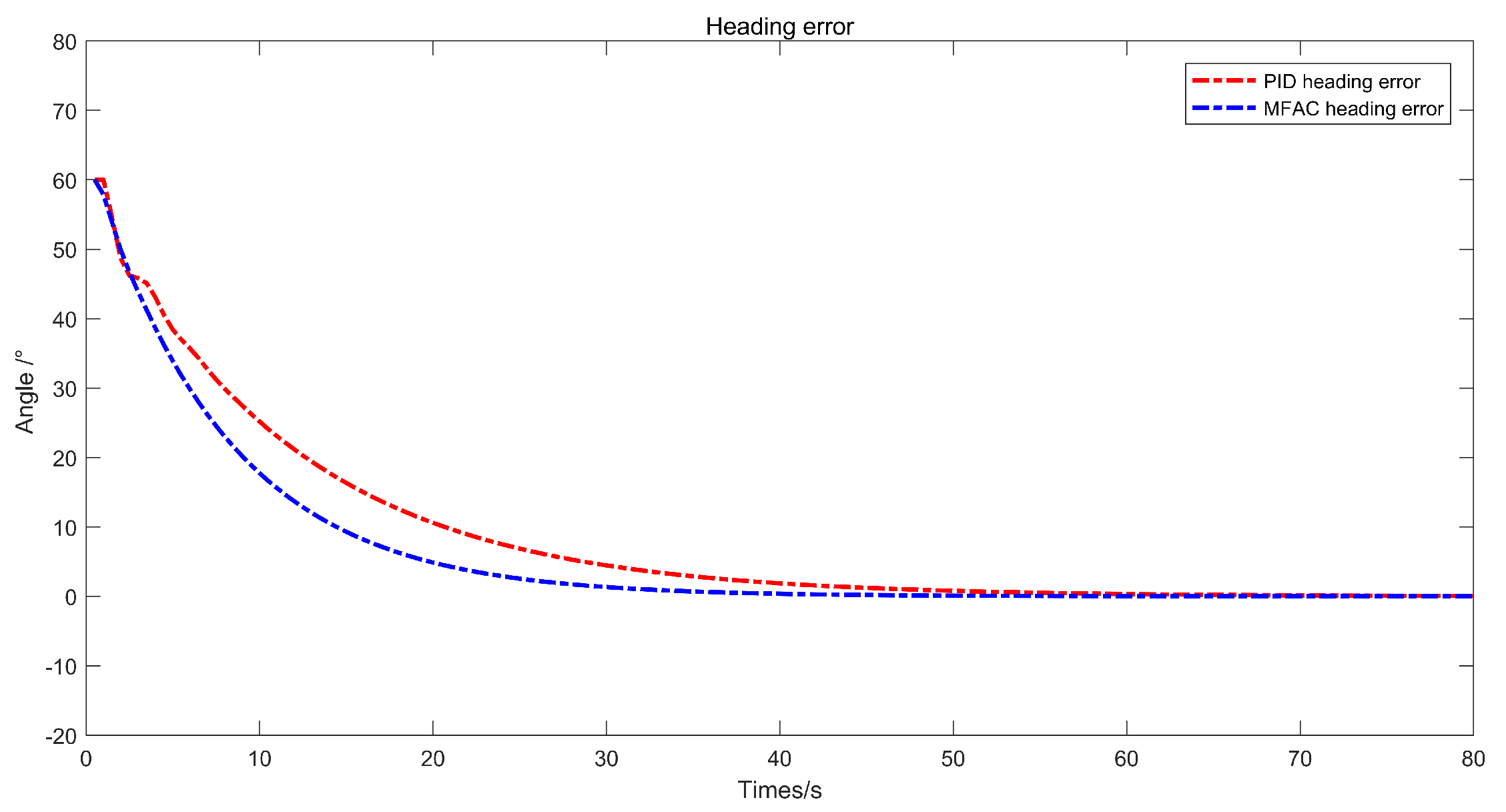
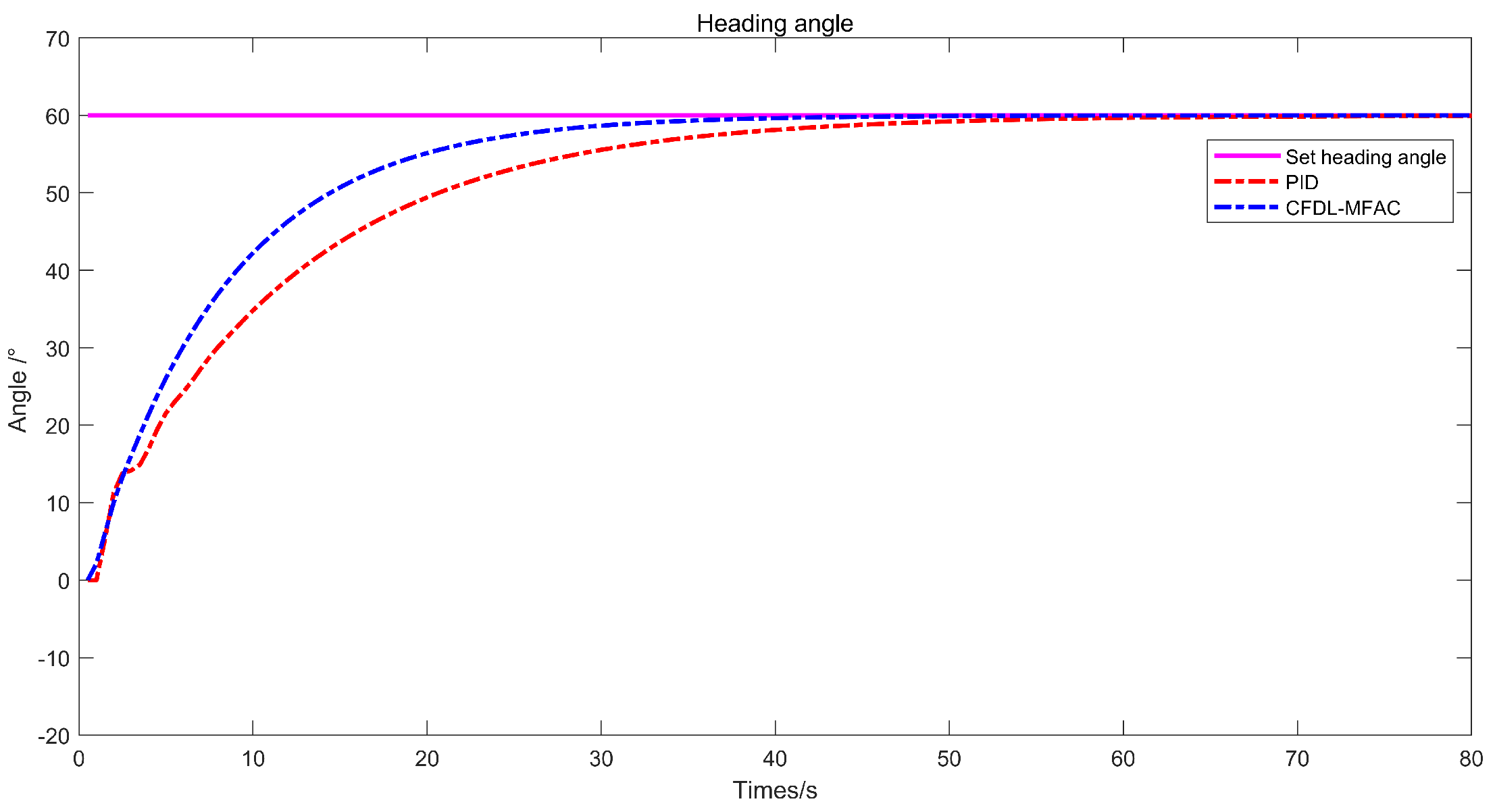
It was assumed that the USV sailed without disturbance. The simulation results of the two control methods are shown in Figure 8 and Figure 9. Both the PID control and CFDL-MFAC can achieve the desired heading angle. The course stabilization time of the USV under the PID control is about 50 s, and the course stabilization time of CFDL-MFAC is about 30 s. The heading errors of the two controllers are essentially the same. The comparative experiments show that under the condition of using the unified model and without disturbance, the PID control and CFDL-MFAC have consistent control results, and the response speed of CFDL-MFAC is faster than that of the PID control. The curve of CFDL-MFAC is also smoother than that of the PID control.
Figure 8.
Heading error without disturbance.
Figure 9.
USV heading angle without disturbance.
To further test whether the initial state, control parameters, expected value, and target heading of the control system are consistent with the previous section under the influence of environmental disturbance, the simulation experiment was set up with ocean current disturbance.
4.2. Tracking Straight-Line Paths in Dynamic Ocean Currents
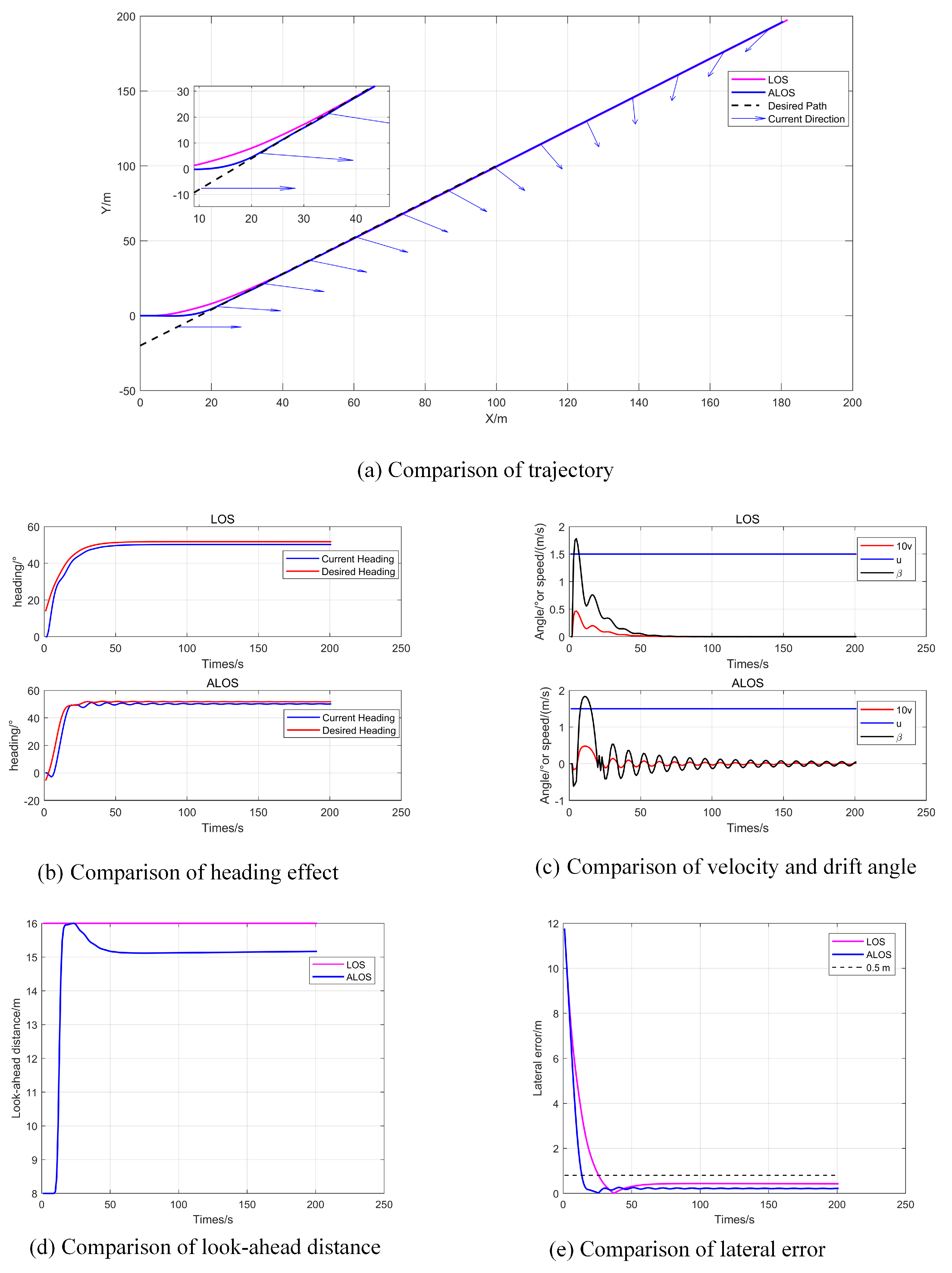
The desired path connects and , starting from as the initial USV position. The vessel cruises at 1.5 m/s, while a constant current of 0.5 m/s is simulated with its direction reducing by per minute from an initial angle of . The results are illustrated in Figure 10 and Table 3.
Figure 10.
Straight-line tracking under time-varying ocean current conditions ( m/s).
Table 3.
Performance metric of straight-line tracking under time-varying ocean current conditions ( m/s).
Figure 10a illustrates the USV motion, with the ALOS trajectory in blue and the reference path in black dashed lines. The blue arrow represents ocean currents. Both LOS and ALOS successfully converge to and follow the path during the guidance stage. However, LOS is slower to reach the reference path, demonstrating ALOS’s advantage in handling lateral errors. ALOS performs better in tracking under ocean current conditions than LOS.
Figure 10b illustrates heading control performance. The red line indicates the target heading, while the blue line reflects the current heading for both methods. Since both rely on the same CFDL-MFAC controller, tracking accuracy primarily depends on the guidance law.
Figure 10c shows the velocity and drift angle over time. The forward and sway speeds are depicted by red and blue lines, while the black line illustrates the drift angle. A comparison between Figure 10a,c highlights the effectiveness of ALOS in reducing the influence of drift angles, ensuring the USV remains aligned with the reference trajectory despite variations.
Figure 10d shows the time evolution of the look-ahead distance. LOS (represented by the pink line) uses a constant 16m, while ALOS (the blue line) adjusts its look-ahead distance during the convergence stage.
Figure 10e depicts the lateral error for both methods. LOS (the pink line) exhibits larger errors compared to ALOS (the blue line), highlighting the importance of considering drift angle effects. ALOS reduces the lateral error to a stable value more effectively due to its adaptive look-ahead distance.
Table 3 shows that ALOS yields the lowest MAE (0.5760 m) and RMSE (1.7397), indicating smoother and more accurate position data. Additionally, ALOS lowers the MAE by and the RMSE by relative to traditional LOS.
4.3. Folded Line Path Following Under Time-Varying Ocean Current Conditions
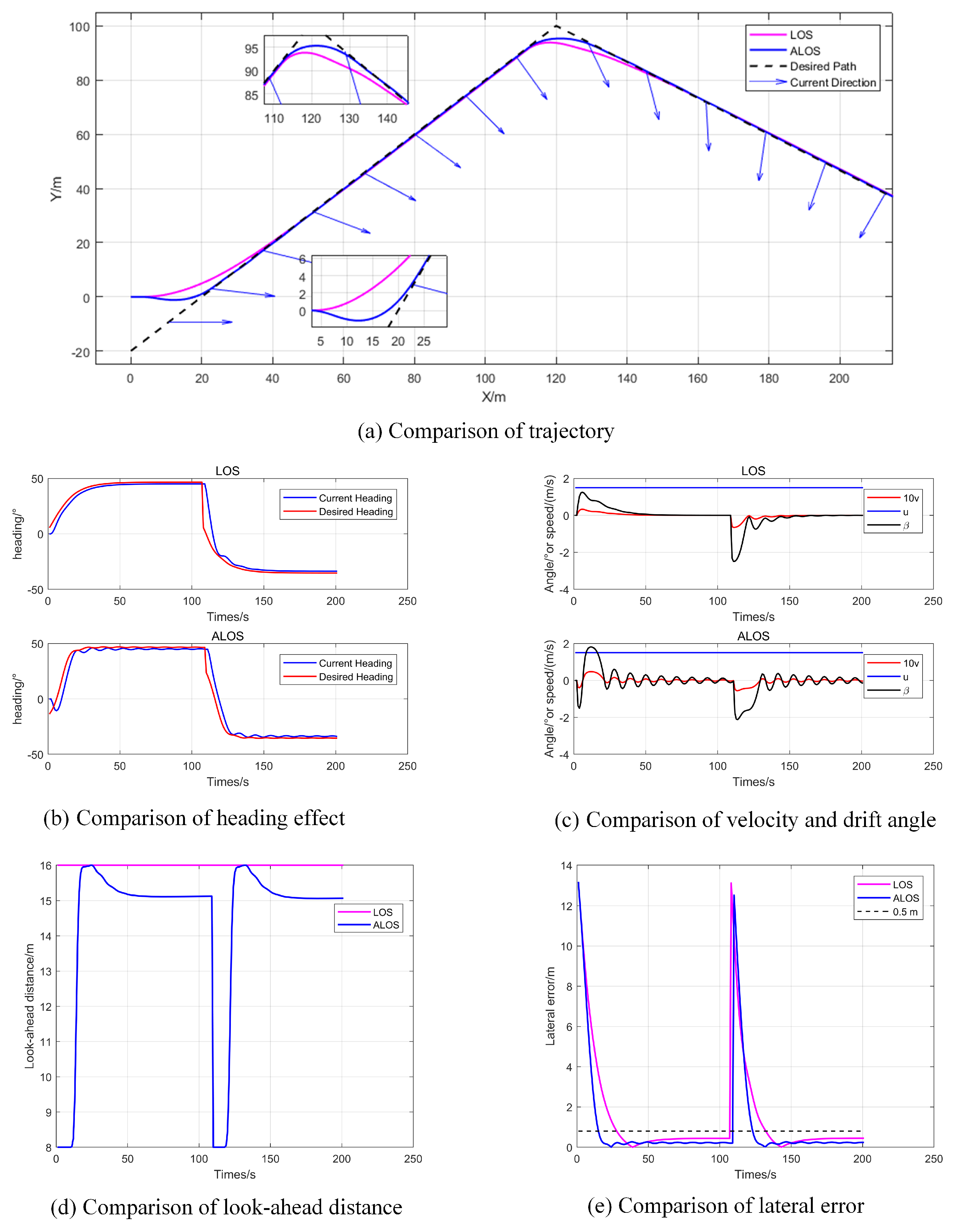
This case study examines a reference path formed by two non-collinear straight segments, , with and . Ocean currents are modeled with a fixed speed of 0.5 m/s and an initial direction shifting from , reducing by per minute. The forward speed is specified as m/s. The results are illustrated in Figure 11 and Table 4.
Figure 11.
Zig-zag tracking under time-varying ocean current conditions ( m/s).
Table 4.
Performance metric of zig-zag tracking under time-varying ocean current conditions ( m/s).
In Figure 11a, the USV’s motion is illustrated. The pink line depicts the LOS trajectory, the blue line corresponds to the ALOS trajectory, and the black dashed line represents the reference path. The ocean current velocity is indicated by the blue arrow. During the convergence stage, ALOS achieves better alignment by effectively addressing lateral errors. Although LOS aligns with the reference path, it diverges during the guidance phase. Under the influence of ocean currents, ALOS demonstrates superior tracking compared to LOS.
Figure 11b illustrates the heading control, with both methods relying on the same controller. Consequently, path-following effectiveness is largely determined by the guidance law.
Figure 11c presents the time evolution of sway velocity, forward velocity, and drift angle. The red line shows that sway velocity stabilizes at 0 m/s for both methods. The blue and black lines represent the forward velocity and drift angle, respectively.
Figure 11d shows the time evolution of the look-ahead distance. LOS (pink line) maintains a constant look-ahead distance of 16m, while ALOS (blue line) adapts the look-ahead distance during the convergence. When combined with Figure 11a, it is clear that ALOS takes lateral error into account in the guidance stage, demonstrating the advantage of its adaptive look-ahead distance.
Figure 11e shows that ALOS achieves the fastest convergence time and the smallest lateral error at the turning point, maintaining good tracking along the reference path.
From Table 4, it is evident that ALOS enhances convergence speed compared to LOS. ALOS also achieves the smallest MAE of 1.0420m, indicating a more concentrated and continuous trajectory that is closer to the expected position. The lowest RMSE for ALOS is 2.7146 m. Although the RMSE values for both methods are relatively high due to larger initial position errors, ALOS reduces the MAE by approximately and the RMSE by compared to the traditional LOS.
4.4. Sinusoidal Path Following Under Time-Varying Ocean Current Conditions
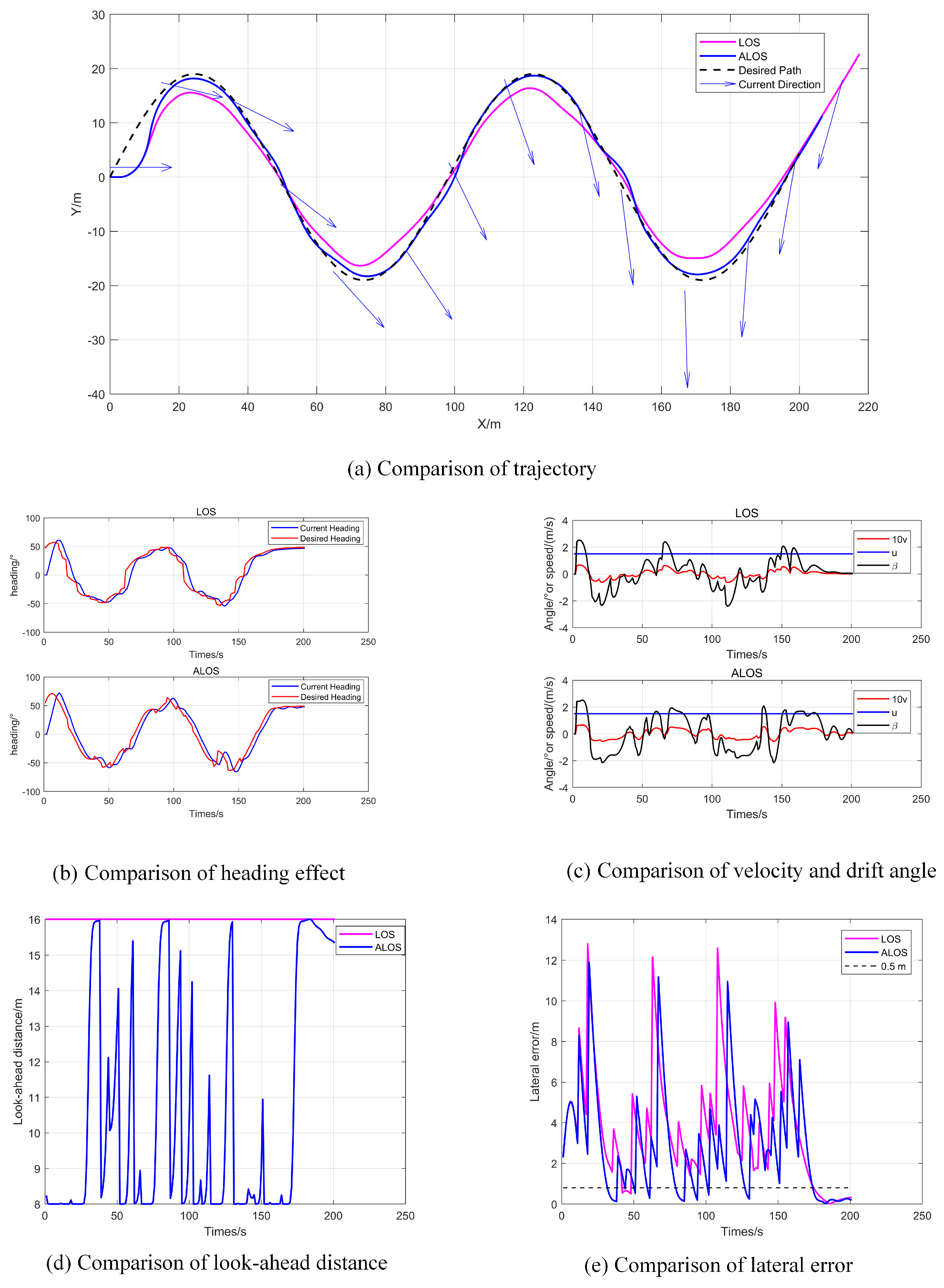
To simulate path following along a time-varying curved path, a set of sine curves was used under the influence of constant ocean currents. The curve is defined by Equation . The initial position of the USV is at , and it cruises at a speed of . The ocean current velocity is constant at , and the initial current direction is from west to east (), decreasing by per minute. The results of the simulation are presented in Figure 12 and Table 5.
Figure 12.
Tracking sinusoidal paths in dynamic ocean currents ( m/s).
Table 5.
Performance metric of sinusoidal tracking under time-varying ocean current conditions ( m/s).
Figure 12a depicts the USV’s motion for two methods. The pink line indicates the LOS trajectory, the blue line corresponds to the ALOS trajectory, and the black dashed line marks the reference path. Ocean current direction is represented by the blue arrow. The plot demonstrates that ALOS outperforms LOS, particularly when path curvature varies significantly, showcasing its adaptive capability. Additionally, ALOS exhibits stronger resistance to constant ocean currents than LOS.
Figure 12b shows the heading control performance. In both plots, the blue line represents the current heading, and the red line represents the desired heading. The final tracking performance for both methods is similar, as both rely on the guidance law design.
Figure 12c illustrates velocity and drift angle dynamics. Red and blue lines indicate the USV’s forward and sway speeds, while the black line depicts the drift angle. This angle changes with sway speed and is affected by the heading. Compared to Figure 12a, ALOS mitigates drift angle variations, enabling the USV to follow the reference path.
Figure 12d depicts the look-ahead distance over time. The pink line indicates LOS with a fixed value of 16 m, whereas the blue line shows ALOS dynamically adjusting during convergence.
Figure 12e demonstrates that the lateral error for LOS (pink line) is larger than that of ALOS (blue line), highlighting the importance of the adaptive method, which accounts for curvature. ALOS also reduces the lateral error compared to LOS, reflecting the significant role of the proportional method that considers drift angles.
Table 5 reports that ALOS achieves the lowest MAE (2.8647 m) and RMSE (3.8550 m), reflecting its improved alignment with the reference path. Compared to LOS, ALOS enhances tracking by lowering MAE and RMSE by and , respectively, showcasing greater adaptability.
5. Conclusions
The ALOS method was adopted in this study for guidance and CFDL-MFAC for control. In ALOS, the look-ahead distance adapts to the USV’s speed and tracking error, with a reduced-order observer estimating and compensating for the sideslip angle in real time. Time-varying rules for the look-ahead distance with 3 DOFs were formulated, enhancing the traditional LOS framework for efficient path following. For curved paths, a shorter look-ahead distance ensures better convergence, while longer distances are used for straight segments. Proximity to the reference path increases the look-ahead distance, and higher speeds reduce its adjustment range. CFDL-MFAC enhances resistance to external disturbances. Simulations validate the method’s efficiency and resilience.
Future sea trials will be conducted, with automatic adjustments to algorithm parameters to enhance its performance.
Author Contributions
Conceptualization, Y.L., X.W. and J.W.; methodology, J.W. and Z.Y.; software, H.L. and Z.Y.; validation, J.W., Z.S., H.L. and L.K.; writing—original draft preparation, L.K. and J.L.; writing—review and editing, Y.Y. and J.L. All authors have read and agreed to the published version of the manuscript.
Funding
This research was funded by the Natural Science Foundation of Shandong (No. ZR2021MD070 and ZR2023QF036), the National Natural Science Foundation of China (No. 62406156) and Research on air-sea collaborative sensing and self-escape networking (LYY-2022-08).
Institutional Review Board Statement
The study did not involve humans or animals.
Informed Consent Statement
The study did not involve humans.
Data Availability Statement
Data is contained within the article.
Conflicts of Interest
The authors declare no conflict of interest.
References
- Liu, Z.; Zhang, Y.; Yu, X.; Yuan, C. Unmanned surface vehicles: An overview of developments and challenges. Annu. Rev. Control 2016, 41, 71–93. [Google Scholar] [CrossRef]
- Shi, B.; Su, Y.; Wang, C.; Wan, L.; Luo, Y. Study on intelligent collision avoidance and recovery path planning system for the waterjet-propelled unmanned surface vehicle. Ocean Eng. 2019, 182, 489–498. [Google Scholar] [CrossRef]
- Wan, L.; Su, Y.; Zhang, H.; Tang, Y.; Shi, B. Global fast terminal sliding mode control based on radial basis function neural network for course keeping of unmanned surface vehicle. Int. J. Adv. Robot. Syst. 2019, 16, 1729881419829961. [Google Scholar] [CrossRef]
- Zhang, G.; Deng, Y.; Zhang, W.; Huang, C. Novel DVS guidance and path-following control for underactuated ships in presence of multiple static and moving obstacles. Ocean Eng. 2018, 170, 100–110. [Google Scholar] [CrossRef]
- Zhang, G.; Deng, Y.; Zhang, W. Robust neural path-following control for underactuated ships with the DVS obstacles avoidance guidance. Ocean Eng. 2017, 143, 198–208. [Google Scholar] [CrossRef]
- Breivik, M.; Fossen, T.I. Guidance Laws for Autonomous Underwater Vehicles; InTech: Takasago, Japan, 2009. [Google Scholar]
- Fossen, T.I. Marine Control System: Guidance, Navigation and Control of Ship, Rigs and Underwater Vehicles. Tapir Trykkeri Trondheim Norway 2002, ch. II, 143–169. [Google Scholar]
- Xiang, X.; Liu, C.; Lapierre, L.; Jouvencel, B. Synchronized Path Following Control of Multiple Homogeneous Underactuated AUVs. J. Syst. Sci. Complex. 2012, 25, 71–89. [Google Scholar] [CrossRef]
- Børhaug, E.; Pavlov, A.; Pettersen, K.Y. Integral LOS control for path following of underactuated marine surface vessels in the presence of constant ocean currents. In Proceedings of the 47th IEEE Conference on Decision and Control, Cancun, Mexico, 9–11 December 2008; pp. 4984–4991. [Google Scholar]
- Fossen, T.I.; Lekkas, A.M. Direct and indirect adaptive integral line-of-sight path-following controllers for marine craft exposed to ocean currents. Int. J. Adapt. Control. Signal Process. 2017, 31, 445–463. [Google Scholar] [CrossRef]
- Encamacao, P.; Pacoal, A.; Arcak, M. Path following for autonomous marine craft. In Proceedings of the 5th IFAC Conference on Manoeuvring and Control of Marine Caraft, Aalborg, Denmark, 23–25 August 2000; pp. 117–122. [Google Scholar]
- Do, K.D.; Jiang, Z.P.; Pan, J. Robust adaptive path following of underactuated ships. Automatica 2004, 40, 929–944. [Google Scholar] [CrossRef]
- Zeng, J.F.; Wan, L.; Li, Y.M.; Zhang, Y.H.; Zhang, Z.Y.; Chen, G.F. Switching-line-of-sight-guidance-based Robust Adaptive Path-following Control for Underactuated Unmanned Surface Vehicles. Acta Armamentarii 2018, 39, 2427–2437. [Google Scholar]
- Zhou, W.; Chang, X.; Zhou, P.; Wang, Y.; Duan, D. Path following control for an under-actuated autonomous airship in constant wind field. In Proceedings of the 2017 29th Chinese Control And Decision Conference (CCDC), Chongqing, China, 28–30 May 2017; pp. 382–387. [Google Scholar]
- Wang, N.; Sun, Z.; Yin, J.; Zou, Z.; Su, S.F. Fuzzy unknown observer-based robust adaptive path following control of underactuated surface vehicles subject to multiple unknowns. Ocean Eng. 2019, 176, 57–64. [Google Scholar] [CrossRef]
- Niu, G.; Wan, L. Model-free Path Following Control of Unmanned Surface Vehicle Based on Adaptive Line-of-sight Guidance. In IOP Conference Series: Earth and Environmental Science; IOP Publishing: Bristol, UK, 2021; Volume 632, p. 032046. [Google Scholar]
- Cheng, S.; Quilodrán-Casas, C.; Ouala, S.; Farchi, A.; Liu, C.; Tandeo, P.; Fablet, R.; Lucor, D.; Iooss, B.; Brajard, J.; et al. Machine learning with data assimilation and uncertainty quantification for dynamical systems: A review. J. Comput. Phys. 2021, 426, 109935. [Google Scholar] [CrossRef]
- Bos, J.T.O.; Dijkstra, H.A.; van Leeuwen, P.J. Model-reduced variational data assimilation. Mon. Weather. Rev. 2008, 136, 3657–3677. [Google Scholar]
- Cheng, S.; Zhuang, Y.; Kahouadji, L.; Liu, C.; Chen, J.; Matar, O.K.; Arcucci, R. Multi-domain encoder-decoder neural networks for latent data assimilation in dynamical systems. Phys. Fluids 2022, 34, 056606. [Google Scholar] [CrossRef]
- Zhang, G.; Li, J.; Chang, T.; Zhang, W.; Song, L. Autonomous navigation and control for a sustainable vessel: A wind-assisted strategy. Sustain. Horizons 2025, 2, 10–20. [Google Scholar] [CrossRef]
- Zhang, G.; Yin, S.; Huang, C.; Zhang, W.; Li, J. Structure Synchronized Dynamic Event-Triggered Control for Marine Ranching AMVs via the Multi-Task Switching Guidance. IEEE Trans. Intell. Transp. Syst. 2024, 25, 1234–1246. [Google Scholar] [CrossRef]
- Wang, Y.; Tong, H.; Fu, M. Line-of-sight guidance law for path following of amphibious hovercrafts with big and time-varying sideslip compensation. Ocean Eng. 2019, 172, 531–540. [Google Scholar] [CrossRef]
- Li, M.; Guo, C.; Yu, H. Filtered Extended State Observer based Line-of-Sight Guidance for Path Following of Unmanned Surface Vehicles with Unknown Dynamics and Disturbances. IEEE Access 2019, 7, 178401–178412. [Google Scholar] [CrossRef]
- Wang, D.; He, B.; Shen, Y.; Li, G.; Chen, G. A Modified ALOS Method of Path Tracking for AUVs with Reinforcement Learning Accelerated by Dynamic Data-Driven AUV Model. J. Intell. Robot. Syst. 2022, 103, 49. [Google Scholar] [CrossRef]
- Mu, D.; Wang, G.; Fan, Y. Path Following Control Strategy for Underactuated Unmanned Surface Vehicle Subject to Multiple Constraints. IEEJ Trans. Electr. Electron. Eng. 2022, 17, 229–241. [Google Scholar] [CrossRef]
- Zhao, Y.; Qi, X.; Incecik, A.; Ma, Y.; Li, Z. Broken lines path following algorithm for a water-jet propulsion USV with disturbance uncertainties. Ocean Eng. 2020, 201, 107118. [Google Scholar] [CrossRef]
- Huang, Y.; Shi, X.; Huang, W.; Chen, S. Internal Model Control-Based Observer for the Sideslip Angle of an Unmanned Surface Vehicle. J. Mar. Sci. Eng. 2022, 10, 470. [Google Scholar] [CrossRef]
- Mobarez, E.N.; Mobariz, K.N.; Ashry, M.M. Marine Control System Design Based on Different PID Approaches. In Proceedings of the 2021 Tenth International Conference on Intelligent Computing and Information Systems (ICICIS), Cairo, Egypt, 5–7 December 2021; pp. 254–257. [Google Scholar]
- Gonzalez-Garcia, A.; Castañeda, H. Guidance and Control Based on Adaptive Sliding Mode Strategy for a USV Subject to Uncertainties. IEEE J. Ocean. Eng. 2021, 46, 1144–1154. [Google Scholar] [CrossRef]
- Liu, L.; Li, Z.; Chen, Y.; Wang, R. Disturbance Observer-Based Adaptive Intelligent Control of Marine Vessel With Position and Heading Constraint Condition Related to Desired Output. IEEE Trans. Neural Networks Learn. Syst. 2024, 35, 5870–5879. [Google Scholar] [CrossRef]
- Liu, Z.; Xiang, Q.; Ye, X.; Yu, L. Unmanned Surface Vehicle Heading and Speed Control Method Based on Model Predictive Control. In Proceedings of the 2022 IEEE 5th International Conference on Electronics Technology (ICET), Chengdu, China, 13–16 May 2022; pp. 612–616. [Google Scholar]
- Hou, Z.; Huang, W. The model-free learning adaptive control of a class of nonlinear discrete-time systems. IFAC Proc. Vol. 1998, 15, 893–899. [Google Scholar] [CrossRef]
- Hou, Z. Model Free Adaptive Control: Theory and Applications; Springer: Berlin/Heidelberg, Germany, 2013. [Google Scholar]
- Hou, Z.; Liu, S.; Tian, T. Lazy-Learning-Based Data-Driven Model-Free Adaptive Predictive Control for a Class of Discrete-Time Nonlinear Systems. IEEE Trans. Neural Networks Learn. Syst. 2017, 28, 1914–1928. [Google Scholar] [CrossRef]
- Liu, F.; Shen, Y.; He, B.; Wan, J.; Wang, D.; Yin, Q.; Qin, P. 3DOF Adaptive Line-Of-Sight Based Proportional Guidance Law for Path Following of AUV in the Presence of Ocean Currents. Appl. Sci. 2019, 9, 3518. [Google Scholar] [CrossRef]
- Liu, F.; Shen, Y.; He, B.; Wang, D.; Wan, J.; Sha, Q.; Qin, P. Drift angle compensation-based adaptive line-of-sight path following for autonomous underwater vehicle. Appl. Ocean. Res. 2019, 93, 101943. [Google Scholar] [CrossRef]
- Fossen, T.I. Handbook of Marine Craft Hydrodynamics and Motion Control; John Willy & Sons Ltd.: Hoboken, NJ, USA, 2011. [Google Scholar]
- Khalil, H.K. Nonlinear Systems. Automatica 2002, 38, 1091–1093. [Google Scholar] [CrossRef]
Disclaimer/Publisher’s Note: The statements, opinions and data contained in all publications are solely those of the individual author(s) and contributor(s) and not of MDPI and/or the editor(s). MDPI and/or the editor(s) disclaim responsibility for any injury to people or property resulting from any ideas, methods, instructions or products referred to in the content. |
© 2025 by the authors. Licensee MDPI, Basel, Switzerland. This article is an open access article distributed under the terms and conditions of the Creative Commons Attribution (CC BY) license (https://creativecommons.org/licenses/by/4.0/).