



Compression of High-Component Gaussian Mixture Model (GMM) Based on Multi-Scale Mixture Compression Model †

Abstract
1. Introduction
- Overfitting problem: High-component GMM is prone to overfitting on training data, especially when the data itself is not that complex. Excessive components can cause the model to model noise or random features in the data, thereby losing its true reflection of the underlying structure of the data [16,17];
- Redundant component problem: GMM with a high number of components may exhibit redundant Gaussian components, i.e., some Gaussian components do not make a significant contribution, or multiple Gaussian components overlap in the same region. These redundant components make the model more complex without contributing to the expression of the data features [16,18];
- Computational complexity issue: The total number of parameters in a GMM depends on both the feature space dimensionality D and the number of components M. Specifically, each Gaussian component contains one weight parameter, D mean parameters, and unique covariance parameters (due to symmetry of the covariance matrix). Thus, the total number of parameters for a GMM iswhere the additional term accounts for the constraint that component weights sum to 1. As M or D increases, the total number of parameters grows faster than linear, leading to high computational complexity for high-component or high-dimensional GMMs [6,19]. For example, in the subsequent UAV state estimation application scenario (Section 5), the number of GMM components evolves exponentially with time steps (Equation (21)), which directly leads to explosive growth in computational complexity.
2. Problems Formulation
2.1. Notation and Preliminaries
2.2. Existing Challenges in GMM Compression
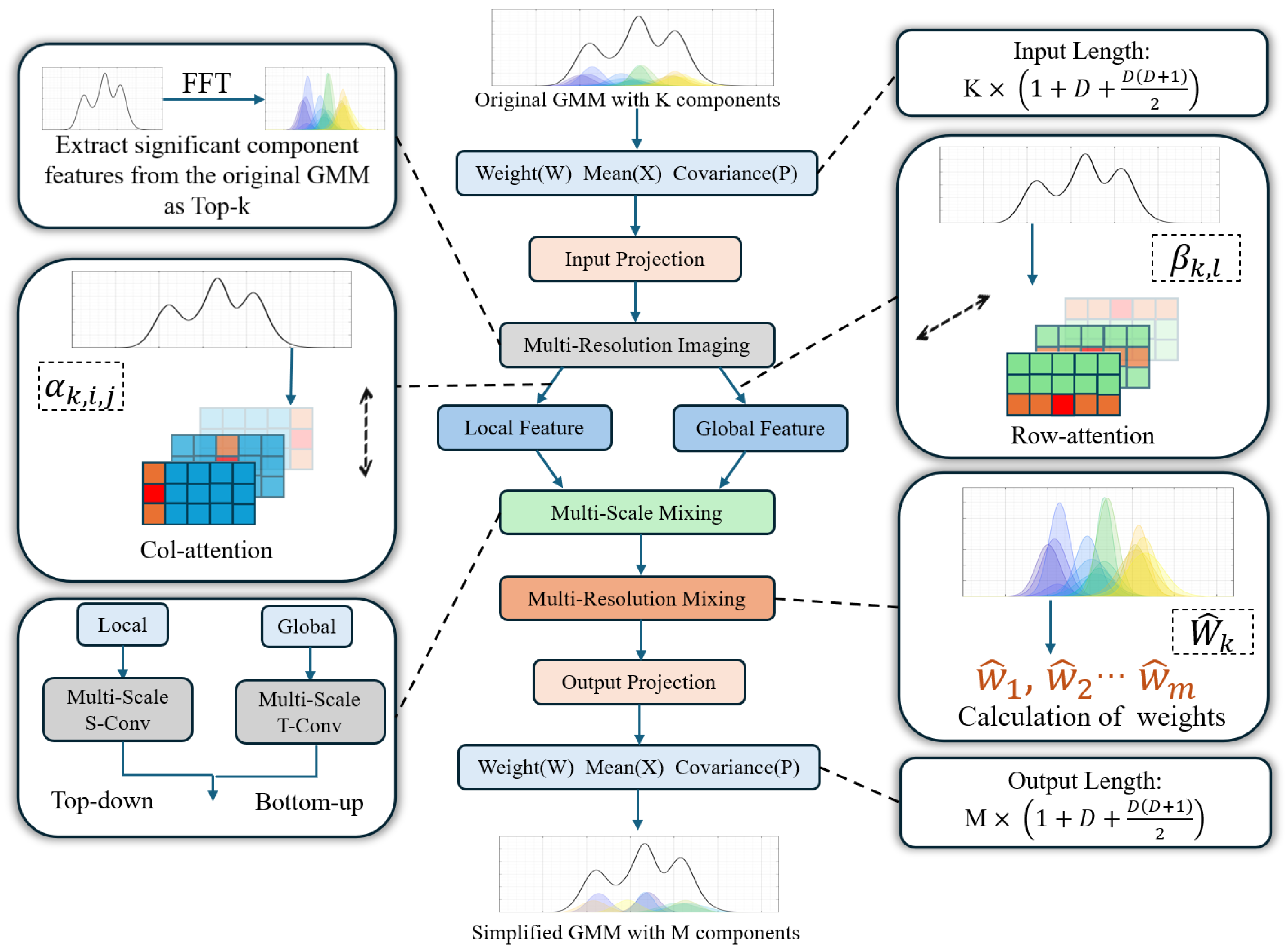
2.3. Overview of the Proposed Method
3. Simplification of Complex GMM Based on the GMMultiMixer Model
3.1. Overview of the TimeMixer++ Model
- The input time series data is first down-sampled to convert the original time series into a sequence of () scales;
- The input projection then captures the interaction information between variables in the time series data through channel mixing and embedding operations;
- The MixerBlock then extracts features from the time series from the perspectives of seasonal and trend characteristics through modules such as Multi-Resolution Time Imaging (MRTI), Time Image Decomposition (TID), Multi-Scale Mixing (MCM), and Multi-Resolution Mixing (MRM);
- The output projection makes predictions based on features at different scales and weights the integrated results of predictions at various scales to enhance the robustness of the model’s predictions.
3.2. Principles and Improvements of GMMultiMixer
3.2.1. Multi-Resolution Time Imaging
3.2.2. Time Image Decomposition
3.2.3. Multi-Scale Mixing
3.2.4. Multi-Resolution Mixing
3.2.5. Parameter Parsing and Model Reconstruction of the Simplified GMM
3.2.6. Integration Mechanism of GMMultiMixer and Kalman Filter
- Forward Prediction and Update: At time step k, based on the posterior GMM at the previous time step, the posterior GMM at the current time step is computed through the prediction and update equations of the Kalman filter, taking into account all possible data packet loss scenarios. This process leads to a sharp increase in the number of components K of the GMM compared with that at time step ; for detailed formulas, refer to Equations (21) and (22) in the subsequent sections.
- Component Number Monitoring and Compression Triggering: The system continuously monitors the number of components K of the current posterior GMM in real time. Once K exceeds the preset real-time computing capacity threshold , the GMMultiMixer compression module is triggered. This design ensures that the system’s computational load remains controllable at all times.
- Global Compression: The parameters (weights , means , and covariances ) of the high-component GMM to be compressed are fed as inputs to the GMMultiMixer model. After the multi-scale feature extraction and fusion process as described earlier, the model directly outputs all parameters of the compressed low-component GMM , where . This step replaces the computationally intensive iterative merging or truncation strategies in traditional methods.
- Prior Transmission: The compressed GMM serves as the prior distribution for the recursive computation of the Kalman filter at the next time step (). Since the number of components has been reduced from K to M, the computational complexity of the prediction and update in the next round is significantly reduced.
- Cyclic Execution: The aforementioned process is executed cyclically at each estimation time step, thus continuously stabilizing the number of GMM components around the controllable range M in long-term time series estimation and avoiding the exponential growth of computational complexity.
3.3. Implementation of a Simplified Model Based on GMMultiMixer
3.4. The Pseudocode Algorithm
| Algorithm 1 High-Component GMM Compression Algorithm |
| Require: Original GMM parameters: for ; Target component count: M (); Data dimension: D; Ensure: Compressed GMM parameters: for ;
|
4. Comparative Verification Experiments and Expansion
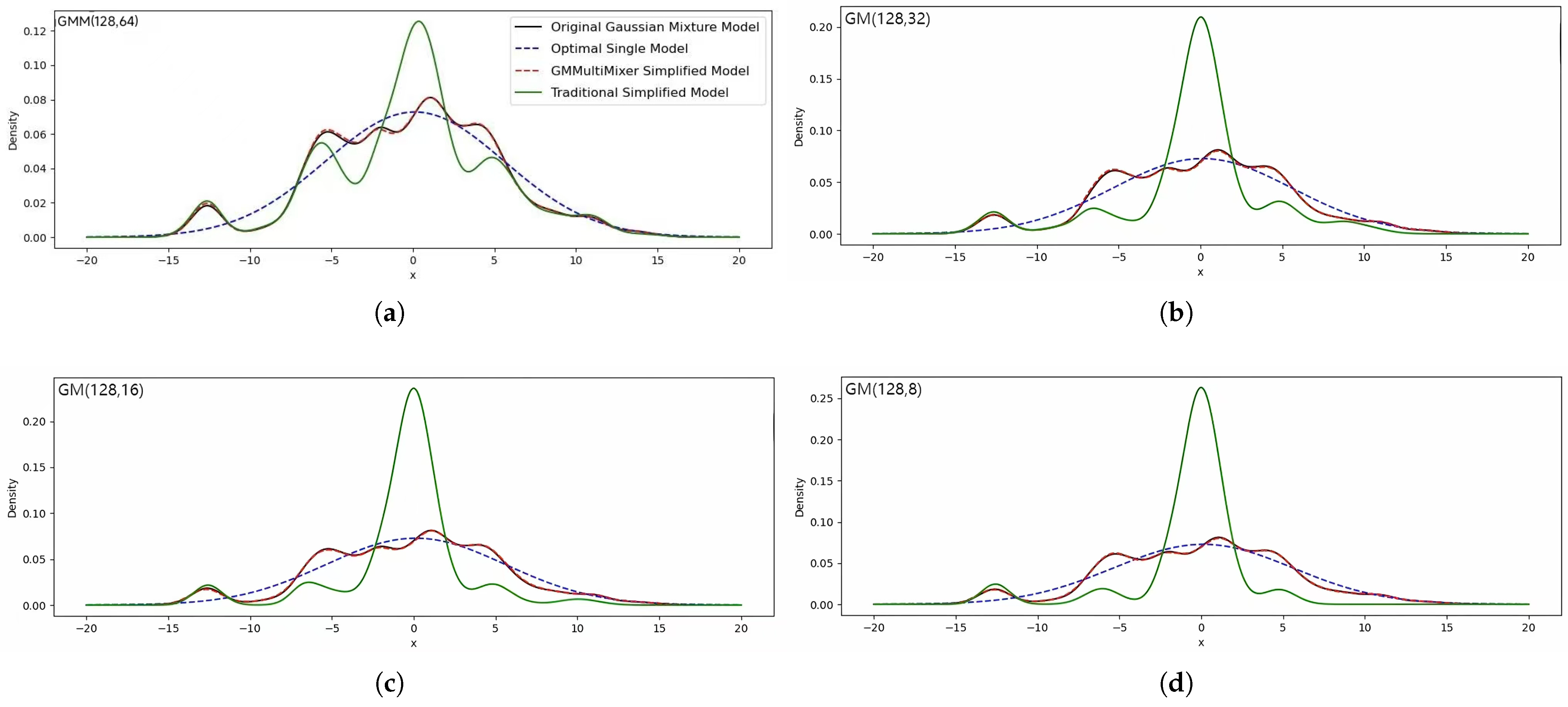
4.1. Experiment 1: Comparative Verification of Simplification Effects for One-Dimensional GMM
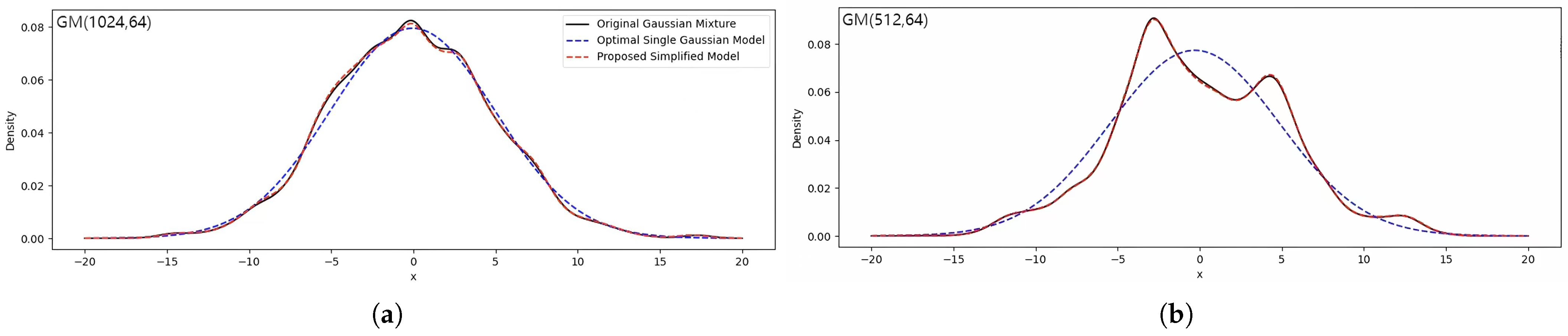
4.2. Experiment 2: Verification of Extreme Simplification Capability for One-Dimensional High-Component GMM
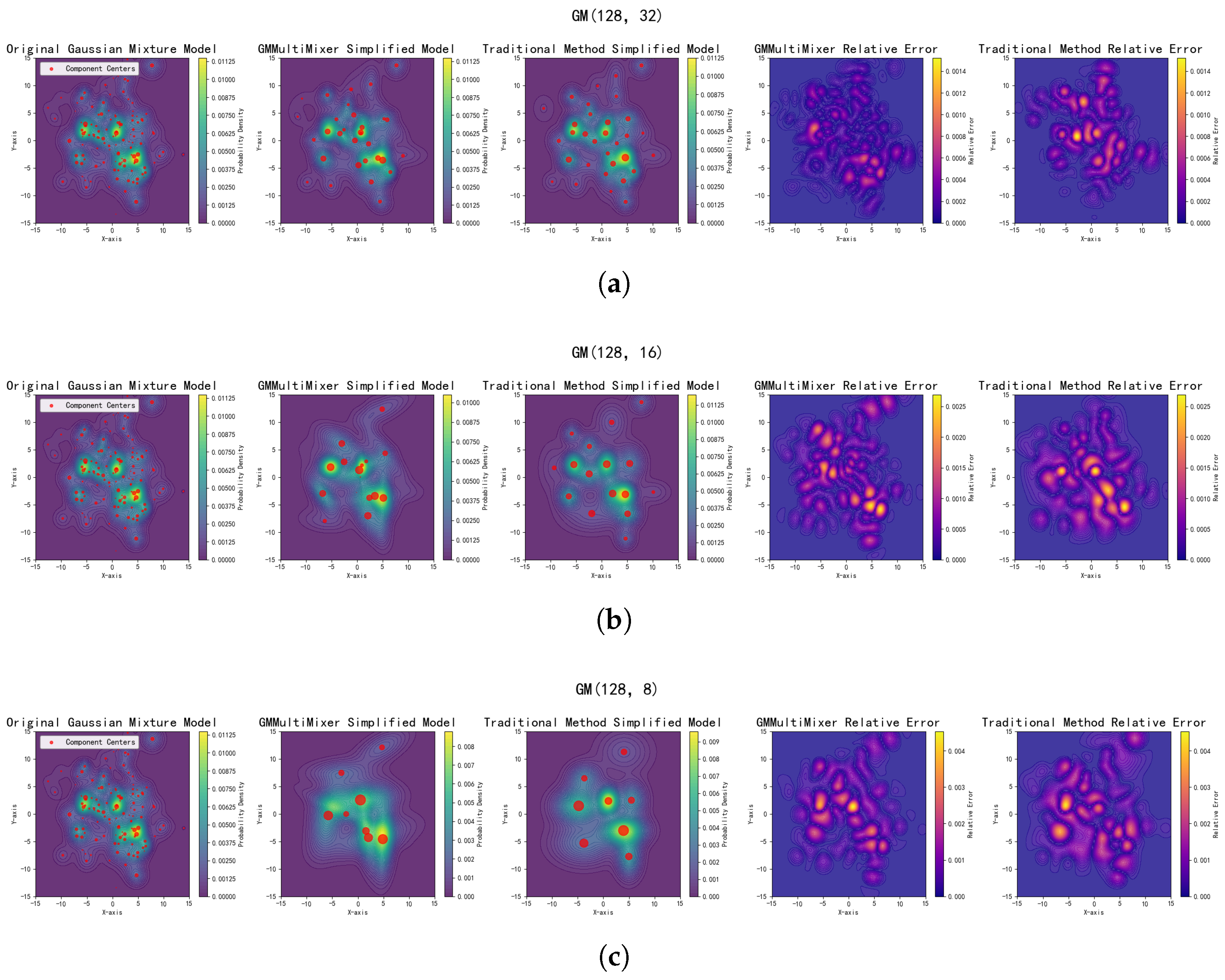
4.3. Experiment 3: Verification of Simplification Effects for Two-Dimensional GMM
4.4. Analysis of the Significance of Experimental Results
5. Application of the GMMultiMixer Model in Unmanned Aerial Vehicle (UAV) State Estimation
5.1. System Setup and Problem Description
5.2. Experimental Results and Analysis
5.2.1. System Model and Initial Conditions
5.2.2. Network and Detection Settings
5.2.3. Experimental Environment and Cruising Route
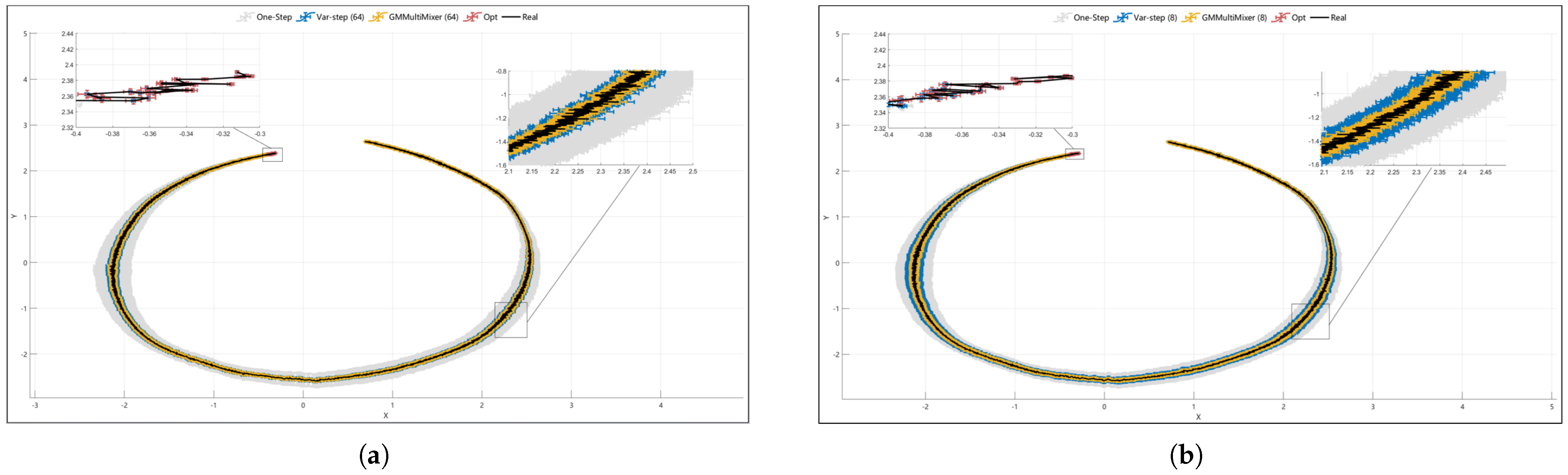
5.2.4. Comparison and Analysis of Results
6. Conclusions
Author Contributions
Funding
Institutional Review Board Statement
Informed Consent Statement
Data Availability Statement
Acknowledgments
Conflicts of Interest
References
- Baltrušaitis, T.; Ahuja, C.; Morency, L.P. Multimodal machine learning: A survey and taxonomy. IEEE Trans. Pattern Anal. Mach. Intell. 2018, 41, 423–443. [Google Scholar] [CrossRef] [PubMed]
- Ramachandram, D.; Taylor, G.W. Deep multimodal learning: A survey on recent advances and trends. IEEE Signal Process. Mag. 2017, 34, 96–108. [Google Scholar] [CrossRef]
- Bishop, C.M. Pattern Recognition and Machine Learning; Springer: Berlin/Heidelberg, Germany, 2006. [Google Scholar] [CrossRef]
- Murphy, K.P. Machine Learning: A Probabilistic Perspective; MIT Press: Cambridge, MA, USA, 2012. [Google Scholar]
- Guo, C.; Zhou, J.; Chen, H.; Ying, N.; Zhang, J.; Zhou, D. Variational autoencoder with optimizing Gaussian mixture model priors. IEEE Access 2020, 8, 43992–44005. [Google Scholar] [CrossRef]
- Liang, S.; Cai, C.; Xia, M.; Lin, H. Variable step-size estimation over UDP-based wireless networks with application to a hydrogen-powered UAV. IET Control Theory Appl. 2024, 18, 865–876. [Google Scholar] [CrossRef]
- Liang, S.; Lin, H.; Lu, S.; Su, H. Single target tracking with unknown detection status: Filter design and stability analysis. IEEE Trans. Ind. Electron. 2023, 71, 11316–11325. [Google Scholar] [CrossRef]
- Wang, Q.; Zhang, L.; Liu, J. Image Denoising Using Asymmetric Gaussian Mixture Models in Wavelet Domain. Electronics 2021, 10, 345. [Google Scholar] [CrossRef]
- Roweis, S.T.; Ghahramani, Z. A unifying review of linear Gaussian models. Neural Comput. 1999, 11, 305–345. [Google Scholar] [CrossRef] [PubMed]
- Tipping, M.E.; Bishop, C.M. Mixtures of probabilistic principal component analyzers. Neural Comput. 1999, 11, 443–482. [Google Scholar] [CrossRef] [PubMed]
- Zhang, H.; Wu, X.; Chen, Y. GMM-Based Voice Conversion with Spectral Smoothing for Low-Resource Languages. Electronics 2022, 11, 789. [Google Scholar] [CrossRef]
- Julier, S.J.; Uhlmann, J.K. A new extension of the Kalman filter to nonlinear systems. In Proceedings of the 1997 American Control Conference, Albuquerque, NM, USA, 6 June 1997; IEEE: New York, NY, USA, 1997; Volume 1, pp. 477–481. [Google Scholar] [CrossRef]
- Wan, E.A.; Van Der Merwe, R. The unscented Kalman filter for nonlinear estimation. In Proceedings of the 2000 IEEE Adaptive Systems for Signal Processing, Communications, and Control Symposium, Lake Louise, AB, Canada, 4 October 2000; IEEE: New York, NY, USA, 2000; pp. 153–158. [Google Scholar] [CrossRef]
- Duda, R.O.; Hart, P.E.; Stork, D.G. Pattern Classification, 2nd ed.; John Wiley & Sons: Hoboken, NJ, USA, 2000. [Google Scholar] [CrossRef]
- Webb, A.R. Statistical Pattern Recognition, 3rd ed.; John Wiley & Sons: Hoboken, NJ, USA, 2011. [Google Scholar] [CrossRef]
- McLachlan, G.J.; Rathnayake, S. On the number of components in a Gaussian mixture model. Wiley Interdiscip. Rev. Data Min. Knowl. Discov. 2014, 4, 341–355. [Google Scholar] [CrossRef]
- Hastie, T.; Tibshirani, R.; Friedman, J.H. The Elements of Statistical Learning: Data Mining, Inference, and Prediction, 2nd ed.; Springer: Berlin/Heidelberg, Germany, 2009. [Google Scholar] [CrossRef]
- Figueiredo, M.A.T.; Jain, A.K. Unsupervised learning of finite mixture models. IEEE Trans. Pattern Anal. Mach. Intell. 2002, 24, 381–396. [Google Scholar] [CrossRef]
- McLachlan, G.J.; Peel, D. Finite Mixture Models; John Wiley & Sons: Hoboken, NJ, USA, 2004. [Google Scholar] [CrossRef]
- Jordan, M.I.; Ghahramani, Z.; Jaakkola, T.S.; Saul, L.K. An introduction to variational methods for graphical models. Mach. Learn. 1999, 37, 183–233. [Google Scholar] [CrossRef]
- Blei, D.M.; Ng, A.Y.; Jordan, M.I. Latent Dirichlet allocation. J. Mach. Learn. Res. 2003, 3, 993–1022. [Google Scholar] [CrossRef]
- Chen, L.; Wang, H.; Zhang, X. Efficient Compression of Gaussian Mixture Models via KL Divergence Minimization. Electronics 2023, 12, 1876. [Google Scholar] [CrossRef]
- Ueda, N.; Nakano, R. Deterministic annealing EM algorithm. Neural Netw. 1998, 11, 271–282. [Google Scholar] [CrossRef] [PubMed]
- Liu, Y.; Zhao, P.; Li, W. Challenges of Traditional Gaussian Mixture Model Optimization in High-Dimensional Spaces. Electronics 2020, 9, 1890. [Google Scholar] [CrossRef]
- Yang, M.S.; Sinaga, K.P. Federated Multi-View K-Means Clustering. IEEE Trans. Pattern Anal. Mach. Intell. 2024, 46, 2446–2459. [Google Scholar] [CrossRef] [PubMed]
- Ioannou, I.; Gregoriades, A.; Christophorou, C.; Raspopoulos, M.; Vassiliou, V. Implementing a Cell-Free 6G Distributed AI Network with the Use of Deep ML Under a Traditional Multi-Cell Mobile Network. In Proceedings of the 2025 5th IEEE Middle East and North Africa Communications Conference (MENACOMM), Byblos, Lebanon, 20–22 February 2025; IEEE: New York, NY, USA, 2025; pp. 1–8. [Google Scholar] [CrossRef]
- LeCun, Y.; Bengio, Y.; Hinton, G. Deep learning. Nature 2015, 521, 436–444. [Google Scholar] [CrossRef] [PubMed]
- Wang, S.; Li, J.; Shi, X.; Ye, Z.; Mo, B.; Lin, W.; Ju, S.; Chu, Z.; Jin, M. Timemixer++: A general time series pattern machine for universal predictive analysis. arXiv 2024, arXiv:2410.16032. [Google Scholar]



| M = 64 | M = 32 | M = 16 | M = 8 | M = 1 | |
|---|---|---|---|---|---|
| Traditional Model | 0.051326 | 0.4198759 | 0.619011 | 0.8678492 | None |
| GMMultiMixer | 0.000035 | 0.000026 | 0.000091 | 0.000110 | None |
| Analytical Solution | None | None | None | None | 0.045774 |
| M = 32 | M = 16 | M = 8 | M = 1 | |
|---|---|---|---|---|
| Traditional Model | 0.009894 | 0.048143 | 0.137103 | None |
| GMMultiMixer | 0.006537 | 0.025016 | 0.076115 | None |
| Analytical Solution | None | None | None | 0.277146 |
Disclaimer/Publisher’s Note: The statements, opinions and data contained in all publications are solely those of the individual author(s) and contributor(s) and not of MDPI and/or the editor(s). MDPI and/or the editor(s) disclaim responsibility for any injury to people or property resulting from any ideas, methods, instructions or products referred to in the content. |
© 2025 by the authors. Licensee MDPI, Basel, Switzerland. This article is an open access article distributed under the terms and conditions of the Creative Commons Attribution (CC BY) license (https://creativecommons.org/licenses/by/4.0/).
Share and Cite
Zhang, L.; Zhang, J.; Tan, M.; Liang, S. Compression of High-Component Gaussian Mixture Model (GMM) Based on Multi-Scale Mixture Compression Model. Electronics 2025, 14, 4858. https://doi.org/10.3390/electronics14244858
Zhang L, Zhang J, Tan M, Liang S. Compression of High-Component Gaussian Mixture Model (GMM) Based on Multi-Scale Mixture Compression Model. Electronics. 2025; 14(24):4858. https://doi.org/10.3390/electronics14244858
Chicago/Turabian StyleZhang, Linwei, Jin Zhang, Mingye Tan, and Shi Liang. 2025. "Compression of High-Component Gaussian Mixture Model (GMM) Based on Multi-Scale Mixture Compression Model" Electronics 14, no. 24: 4858. https://doi.org/10.3390/electronics14244858
APA StyleZhang, L., Zhang, J., Tan, M., & Liang, S. (2025). Compression of High-Component Gaussian Mixture Model (GMM) Based on Multi-Scale Mixture Compression Model. Electronics, 14(24), 4858. https://doi.org/10.3390/electronics14244858