
An Improved TOPSIS Method Using Fermatean Fuzzy Sets for Techno-Economic Evaluation of Multi-Type Power Sources

Abstract
1. Introduction
2. Evaluation Index System Based on DEMATEL
2.1. Initial Evaluation Indicator System
- (1)
- Unit Electricity Cost. This indicator reflects the total cost incurred for generating one kilowatt-hour of electricity over the entire life cycle of a power source. It is typically measured by the LCOE; for energy storage systems, the cycle-based cost per kilowatt-hour can be used instead. As the core metric for evaluating the economic competitiveness of power sources, the unit electricity cost directly determines their bidding capability in the electricity market and serves as the fundamental benchmark for economic comparison among different power types.
- (2)
- Unit Capacity Investment Cost. This indicator represents the initial investment required to construct each kilowatt of installed capacity. It reflects the project’s financial threshold and investment pressure, thus serving as an important reference for investors and decision-makers when assessing project feasibility.
- (3)
- Operation and Maintenance (O&M) Cost Ratio. This refers to the proportion of annual O&M costs to the total annual generation revenue or overall cost. It indicates the operational stability and long-term economic performance of a power source. A high O&M cost ratio often implies a heavy operational burden and greater sensitivity of profitability to fluctuations in fuel prices or market electricity prices.
- (4)
- Capacity Factor. Defined as the ratio of actual electricity generation to the theoretical maximum generation under full-load operation, this indicator measures the “productivity” and utilization level of a power source. It reflects the combined effects of technological reliability and local resource conditions, thereby providing a comprehensive view of the power source’s operational performance.
- (5)
- Start-Up and Regulation Characteristics. This composite performance indicator can be decomposed into two aspects—start-up time and ramp rate—and can also be evaluated systematically using Fermatean fuzzy numbers to quantify flexibility. In power systems with a high penetration of renewable energy, the rapid response and regulation capability of power sources play a crucial role in maintaining system stability and mitigating output fluctuations.
- (6)
- Energy Conversion Efficiency. This indicator represents the ratio of output energy to input energy. For power generation units, it corresponds to generation efficiency, while for energy storage systems, it reflects round-trip efficiency. It directly illustrates the technological advancement and energy utilization level of a system, where low efficiency typically indicates higher energy losses and hidden costs.
- (7)
- Carbon Emission Intensity. Carbon emission intensity measures the amount of CO2-equivalent emissions produced per kilowatt-hour of electricity generated. Under the dual-carbon (carbon peaking and carbon neutrality) objectives, this indicator has become a key parameter for assessing the environmental friendliness of power sources. It directly affects their social acceptability, environmental costs, and long-term development prospects.
2.2. Dimensionality Reduction of the Evaluation Indicators Using DEMATEL
- (1)
- Construct the initial direct influence matrix . According to the correspondence between linguistic variables and fuzzy numbers in Table 1, the initial direct influence matrix provided by the k-th expert is obtained.
- (2)
- Calculate the normalized triangular fuzzy numbers . Normalize the triangular fuzzy numbers in the initial direct influence matrix based on Equations (1)–(3).
- (3)
- Calculate the comprehensive standardized value . First, calculate the left and right standard values and according to Equations (4) and (5). Then, calculate the comprehensive standardized value based on Equation (6).
- (4)
- Obtain the quantitative influence value determined by the k-th expert for factor i on factor j.
- (5)
- Calculate the direct influence matrix B.
- (6)
- Calculate the comprehensive influence matrix T by first standardizing the data in B according to Equation (10), and then obtaining the comprehensive influence matrix T based on Equation (11).
- (7)
- Calculate the causality degree and centrality. Aggregate the elements in T separately by rows and columns, and calculate the influence degree and the affected degree of each evaluation indicator according to Equations (12) and (13). The causality degree and centrality can be calculated according to Equations (14) and (15).
3. Combined Weighting Based on the Improved FAHP-EWM
3.1. Calculation of Subjective Weights Based on FAHP
3.1.1. Construction of the Fuzzy Judgment Matrix
3.1.2. Calculation of Weights at This Hierarchical Level
3.2. Calculation of Objective Weights Based on EWM
3.2.1. Determination of System Entropy
3.2.2. Calculation of Weights
4. Comprehensive Techno-Economic Evaluation Model for Multiple Power Generation Technologies Based on FFHWD-TOPSIS
4.1. Overview of the Traditional TOPSIS Method
- (1)
- Transform the original decision matrix X into the normalized decision matrix Y = (yij)m*n using the following formula. Normalizing the original decision matrix eliminates the influence of differing dimensions among indicators and resolves the issue of incomparability between them.
- (2)
- Construct the weighted normalized decision matrix Z.
- (3)
- Determine the positive ideal solution S+ and the negative ideal solution S−. The positive ideal solution represents the scenario in which all evaluation indicators achieve their optimal values, while the negative ideal solution represents the scenario in which all indicators reach their worst values.
- (4)
- Calculate the Euclidean distances of each alternative from the positive and negative ideal solutions:
- (5)
- Calculate the relative closeness Ci of each evaluation object using the following formula. A larger Ci value indicates that the evaluation object is closer to the ideal solution, whereas a smaller Ci value indicates closer proximity to the negative ideal solution. The evaluation objects are then ranked according to the magnitude of their relative closeness values.
4.2. Fermatean Fuzzy Hybrid Weighted Distance
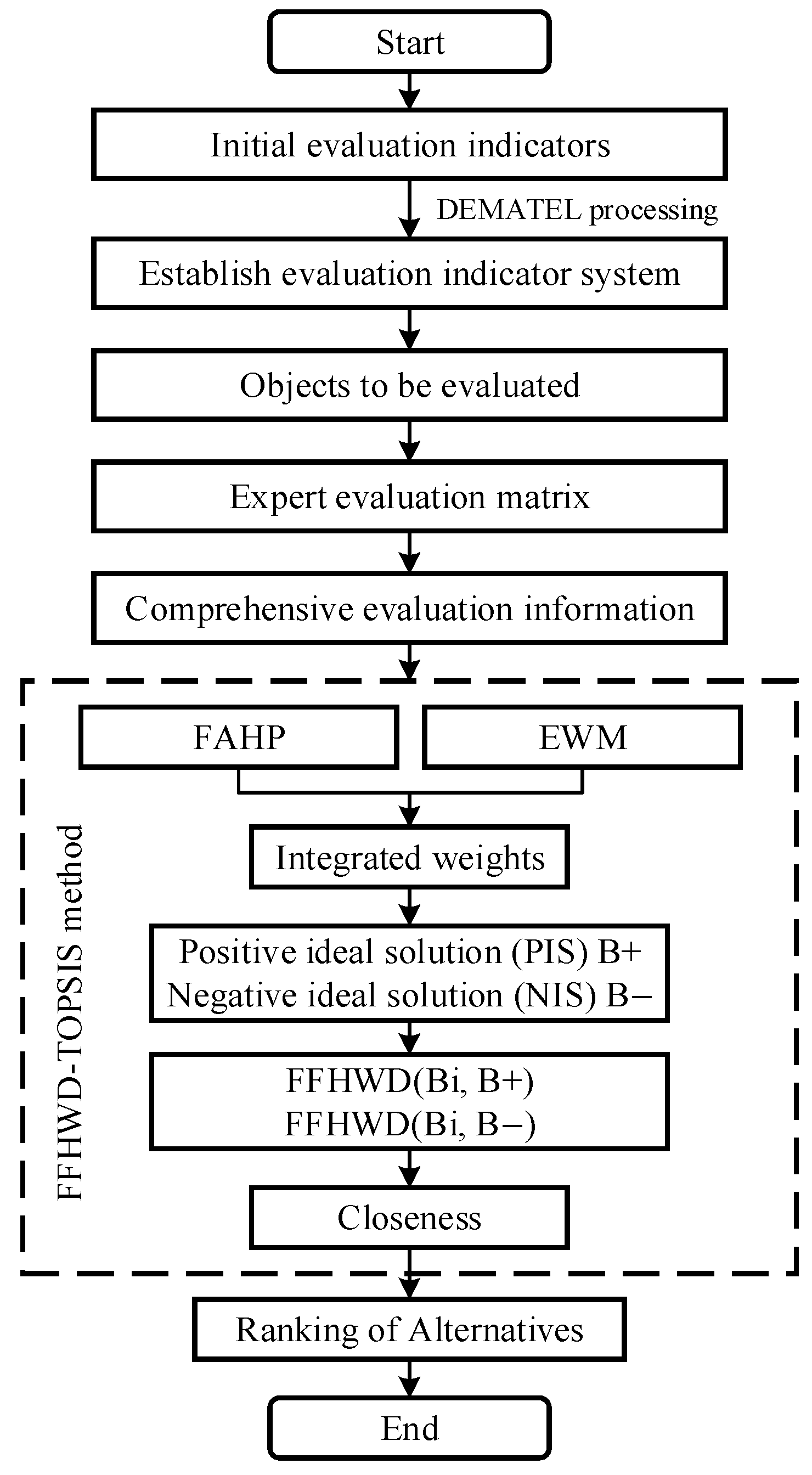
4.3. Comprehensive Evaluation Framework Based on FFHWD-TOPSIS
- (1)
- Construct the Fermat-type decision matrix. Expert evaluates the criterion under the evaluation object in the form of FFN, denoted as . Therefore, the fuzzy soft decision matrix of the k-th expert can be obtained:
- (2)
- Normalize the individual decision matrices of experts. Let the normalized criterion value be .
- (3)
- Apply the FFWA operator, combined with the weight of each expert denoted as εk, to aggregate the decision matrices of all experts, thereby obtaining the overall fuzzy soft decision matrix :
- (4)
- Apply the combined weighting method presented in Section 3 to determine the comprehensive weights of each indicator.
- (5)
- Calculate the Fermatean fuzzy PIS B+ and Fermatean fuzzy NIS B− as follows:
- (6)
- Calculate the deviations between each alternative Bi and the FF PIS B+ and NIS B−, denoted as and, respectively.
- (7)
- Calculate the closeness value for each alternative solution .
- (8)
- Sort all alternative schemes in descending order based on the closeness degree calculated in the previous step, and determine the optimal scheme.
5. Case Studies
5.1. Selection of Evaluation Indicators
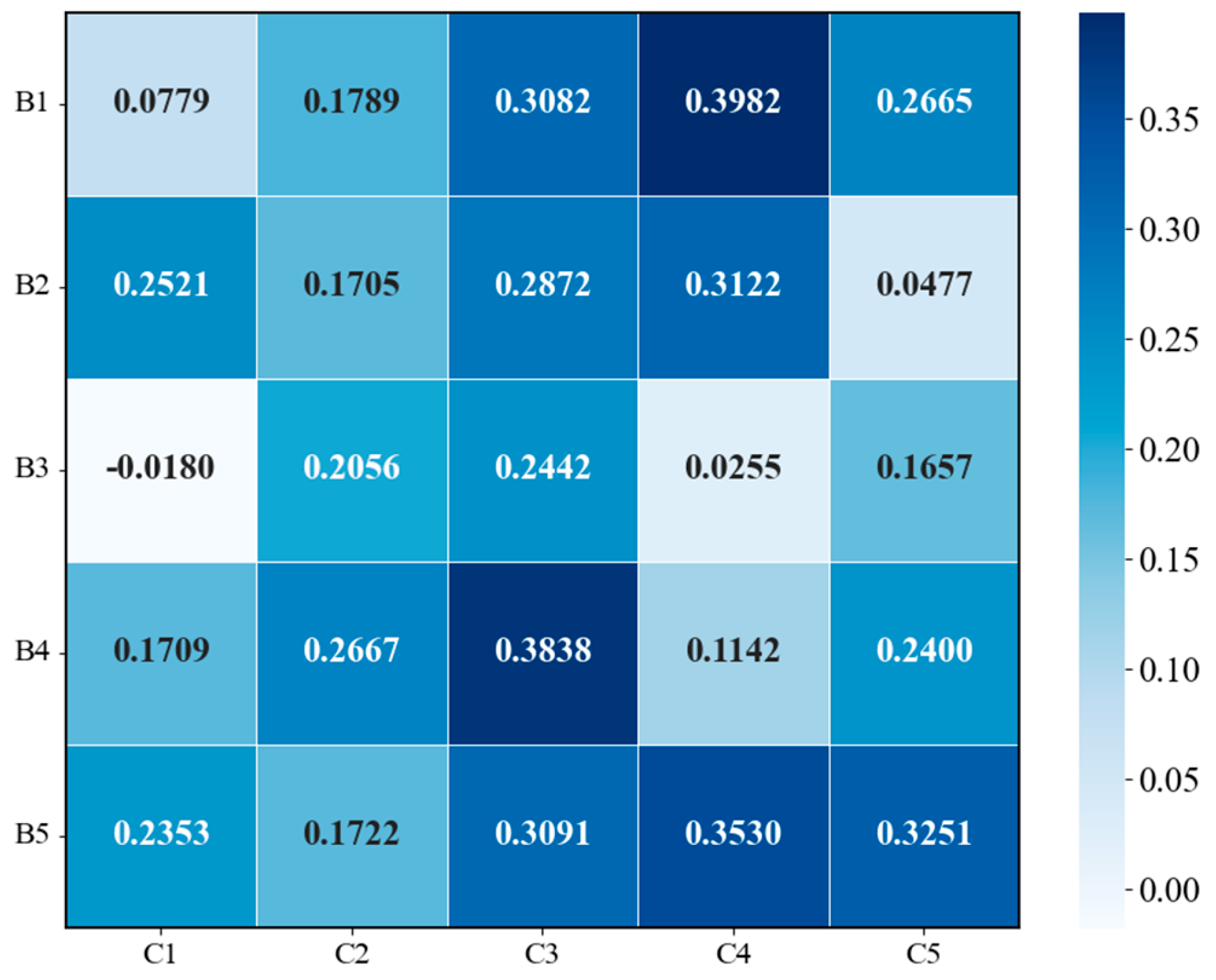
5.2. Model Application and Analysis
5.3. Comparative Analysis for Model Validation
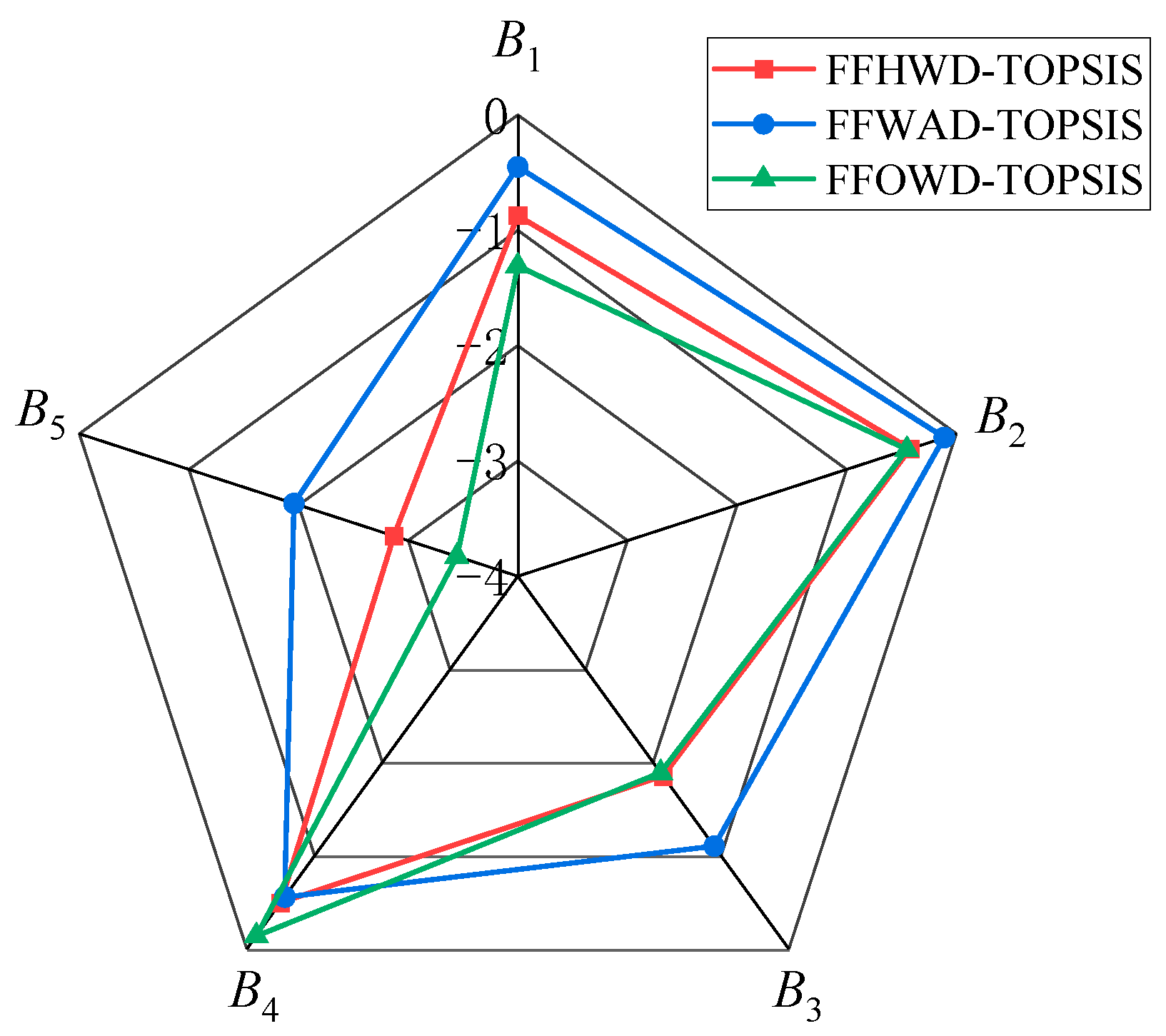
5.3.1. Comparison of Different Distance Measurement Methods
5.3.2. Comparison of Different Evaluation Methods
- (1)
- Enhanced higher-order uncertainty handling capability. While the MARCOS method relies on standardized deterministic numerical inputs, FFHWD-TOPSIS explicitly incorporates Fermatean fuzzy membership degrees, non-membership degrees, and hesitation margins, enabling a more expressive representation of fuzzy expert knowledge.
- (2)
- Integrated hybrid weighting mechanism combining subjective and objective elements. The FFHWD measure simultaneously considers both inherent criterion importance and positional risk preferences, overcoming the purely data-driven limitations of MARCOS and effectively mitigating weight conflict sensitivity issues.
- (3)
- Superior ranking stability under parameter and data perturbations. As demonstrated in the sensitivity analysis, our approach maintains ranking robustness across variations in mixed weight proportions, whereas the MARCOS method lacks this flexible robustness modeling capability.
6. Conclusions
- (1)
- Performance ranking: The FFHWD-TOPSIS model was applied to five representative power sources (thermal, hydropower, wind, photovoltaic, and energy storage) using expert evaluations. The computed closeness coefficients rank hydropower (B2) highest in overall performance (best techno-economic score), with photovoltaic (B4) and thermal power (B1) in second and third place, respectively. In contrast, wind power (B3) and energy storage (B5) have much lower closeness values and thus appear less competitive under the current evaluation framework.
- (2)
- Comparative analysis: Compared to existing Fermatean-fuzzy TOPSIS variants using FWAD or FOWD distance measures, the proposed FFHWD-TOPSIS yields more balanced and stable rankings. By effectively blending objective and subjective weighting information, the method enhances the rationality and consistency of the final ranking.
Author Contributions
Funding
Data Availability Statement
Conflicts of Interest
References
- Srettiwat, N.; Safari, M.; Olcay, H.; Malina, R. A techno-economic evaluation of solar-powered green hydrogen production for sustainable energy consumption in Belgium. Int. J. Hydrogen Energy 2023, 48, 39731–39746. [Google Scholar] [CrossRef]
- Brumana, G.; Franchini, G.; Ghirardi, E.; Perdichizzi, A. Techno-economic optimization of hybrid power generation systems: A renewables community case study. Energy 2022, 246, 123427. [Google Scholar] [CrossRef]
- Shakeel, M.R.; Mokheimer, E.M. A techno-economic evaluation of utility scale solar power generation. Energy 2022, 261, 125170. [Google Scholar] [CrossRef]
- Liu, T.; Yang, J.; Yang, Z.; Duan, Y. Techno-economic feasibility of solar power plants considering PV/CSP with electrical/thermal energy storage system. Energy Convers. Manag. 2022, 255, 115308. [Google Scholar] [CrossRef]
- Meng, F.; Chen, X.; Zhang, Y. Consistency-based linear programming models for generating the priority vector from interval fuzzy preference relations. Appl. Soft Comput. 2016, 41, 247–264. [Google Scholar] [CrossRef]
- Tan, C.; Chen, X. Generalized archimedean intuitionistic fuzzy averaging aggregation operators and their application to multicriteria decision-making. Int. J. Inf. Technol. Decis. Mak. 2016, 15, 311–352. [Google Scholar] [CrossRef]
- Younis, M.; Ashraf, S.; Abdullah, S.; Shahid, T.; KC, G. Strategic MARCOS model for optimizing renewable energy investments under Pythagorean hesitant fuzzy assessments. Adv. Fuzzy Syst. 2025, 1, 6193403. [Google Scholar] [CrossRef]
- Chen, H.; Sun, W.; Zou, X.; Hu, D.; Yu, T.; Shao, W. Evaluation method of power source reaching service term based on fuzzy analytical Hierar-chy process and the entropy weight method. J. Power Supply 2025, 23, 290–297. [Google Scholar]
- Li, N.; Zhao, H. Performance evaluation of eco-industrial thermal power plants by using fuzzy GRA-VIKOR and combination weighting techniques. J. Clean. Prod. 2016, 135, 169–183. [Google Scholar] [CrossRef]
- Senapati, T.; Yager, R.R. Fermatean fuzzy weighted averaging/geometric operators and its application in multi-criteria decision-making methods. Eng. Appl. Artif. Intell. 2019, 85, 112–121. [Google Scholar] [CrossRef]
- Büyüközkan, G.; Uztürk, D.; Ilıcak, Ö. Fermatean fuzzy sets and its extensions: A systematic literature review. Artif. Intell. Rev. 2024, 57, 138. [Google Scholar] [CrossRef]
- Deng, Z.; Wang, J. New distance measure for Fermatean fuzzy sets and its application. Int. J. Intell. Syst. 2022, 37, 1903–1930. [Google Scholar] [CrossRef]
- Gul, M.; Lo, H.W.; Yucesan, M. Fermatean fuzzy TOPSIS-based approach for occupational risk assessment in manufacturing. Complex Intell. Syst. 2021, 7, 2635–2653. [Google Scholar] [CrossRef]
- Yang, S.; Pan, Y.; Zeng, S. Decision making framework based Fermatean fuzzy integrated weighted distance and TOPSIS for green low-carbon port evaluation. Eng. Appl. Artif. Intell. 2022, 114, 105048. [Google Scholar] [CrossRef]
- Zeng, S.; Gu, J.; Peng, X. Low-carbon cities comprehensive evaluation method based on Fermatean fuzzy hybrid distance measure and TOPSIS. Artif. Intell. Rev. 2023, 56, 8591–8607. [Google Scholar] [CrossRef]
- Liu, D.; Liu, Y.; Chen, X. The new similarity measure and distance measure of a hesitant fuzzy linguistic term set based on a linguistic scale function. Symmetry 2018, 10, 367. [Google Scholar] [CrossRef]
- Li, X.; Pan, L.; Zhang, J. Development status evaluation and path analysis of regional clean energy power generation in China. Energy Strategy Rev. 2023, 49, 101139. [Google Scholar] [CrossRef]
- Qi, L.; Dou, W.; Hu, C.; Zhou, Y.; Yu, J. A context-aware service evaluation approach over big data for cloud applications. IEEE Trans. Cloud Comput. 2015, 8, 338–348. [Google Scholar] [CrossRef]
- Yang, Y.; Yang, F.; Chen, J.; Zeng, Y.; Liu, L. Pythagorean fuzzy Bonferroni mean with weighted interaction operator and its application in fusion of online multidimensional ratings. Int. J. Comput. Intell. Syst. 2022, 15, 94. [Google Scholar] [CrossRef]
- Liu, L.; Bin, Z.; Shi, B.; Cao, W. Sustainable supplier selection based on regret theory and QUALIFLEX method. Int. J. Comput. Intell. Syst. 2020, 13, 1120–1133. [Google Scholar] [CrossRef]
- Liu, J.; Chen, H.; Zhao, S.; Pan, P.; Wu, L.; Xu, G. Evaluation and improvements on the flexibility and economic performance of a thermal power plant while applying carbon capture, utilization & storage. Energy Convers. Manag. 2023, 290, 117219. [Google Scholar] [CrossRef]
- Xu, X.; Pan, B.; Yang, Y. Large-group risk dynamic emergency decision method based on the dual influence of preference transfer and risk preference. Soft Comput. 2018, 22, 7479–7490. [Google Scholar] [CrossRef]
- Wang, Y.; Lee, S.; Li, C.; Umair, M.; Yakhyaeva, I. Techno-economic evaluation of solar photovoltaic power production in China for sustainable development and the environment. Environ. Dev. Sustain. 2024, 1–30. [Google Scholar] [CrossRef]
- Braga, I.F.; Ferreira, F.A.; Ferreira, J.J.; Correia, R.J.; Pereira, L.F.; Falcão, P.F. A DEMATEL analysis of smart city determinants. Technol. Soc. 2021, 66, 101687. [Google Scholar] [CrossRef]
- Gedam, V.V.; Raut, R.D.; Priyadarshinee, P.; Chirra, S.; Pathak, P.D. Analysing the adoption barriers for sustainability in the Indian power sector by DEMATEL approach. Int. J. Sustain. Eng. 2021, 14, 471–486. [Google Scholar] [CrossRef]
- Zhang, J.; Li, J.; You, J. Research on influencing factors of cost control of centralized photovoltaic power generation project based on DEMATEL-ISM. Sustainability 2024, 16, 5289. [Google Scholar] [CrossRef]
- Kara, E.; Onat, M.R.; Demir, M.E.; Kinaci, O.K. Techno-economic analysis of offshore renewable energy farms in Western Spain using fuzzy AHP & TOPSIS methodology. Renew. Energy 2025, 242, 122361. [Google Scholar] [CrossRef]
- Heo, E.; Kim, J.; Boo, K.J. Analysis of the assessment factors for renewable energy dissemination program evaluation using fuzzy AHP. Renew. Sustain. Energy Rev. 2010, 14, 2214–2220. [Google Scholar] [CrossRef]
- Li, X.; Chen, X. D-intuitionistic hesitant fuzzy sets and their application in multiple attribute decision making. Cogn. Comput. 2018, 10, 496–505. [Google Scholar] [CrossRef]
- Meng, F.; Tang, J.; Wang, P.; Chen, X. A programming-based algorithm for interval-valued intuitionistic fuzzy group decision making. Knowl. -Based Syst. 2018, 144, 122–143. [Google Scholar] [CrossRef]
- Li, X.; Chen, X. Value determination method based on multiple reference points under a trapezoidal intuitionistic fuzzy environment. Appl. Soft Comput. 2018, 63, 39–49. [Google Scholar] [CrossRef]
- Ma, X.; Zhao, Z. Investment efficiency evaluation of electric power substation projects by stages using the EWM-DEA model. Int. J. Ind. Syst. Eng. 2024, 46, 34–57. [Google Scholar] [CrossRef]
- Chen, Z.S.; Yang, Y.; Wang, X.J.; Chin, K.S.; Tsui, K.L. Fostering linguistic decision-making under uncertainty: A proportional interval type-2 hesitant fuzzy TOPSIS approach based on Hamacher aggregation operators and andness optimization models. Inf. Sci. 2019, 500, 229–258. [Google Scholar] [CrossRef]
- Afrane, S.; Ampah, J.D.; Jin, C.; Liu, H.; Aboagye, E.M. Techno-economic feasibility of waste-to-energy technologies for investment in Ghana: A multicriteria assessment based on fuzzy TOPSIS approach. J. Clean. Prod. 2021, 318, 128515. [Google Scholar] [CrossRef]
- Göçer, F. A novel extension of Fermatean fuzzy sets into group decision making: A study for prioritization of renewable energy technologies. Arab. J. Sci. Eng. 2024, 49, 4209–4228. [Google Scholar] [CrossRef]
- Bouraima, M.B.; Ayyildiz, E.; Qian, S.; Aydin, N. A robust three-dimensional Fermatean fuzzy approach for comprehensive strategy selection for photovoltaic energy development. Environ. Dev. Sustain. 2025, 1–40. [Google Scholar] [CrossRef]
- Yang, Y.; Chen, Z.S.; Chen, Y.H.; Chin, K.S. Interval-valued Pythagorean fuzzy Frank power aggregation operators based on an isomorphic Frank dual triple. Int. J. Comput. Intell. Syst. 2018, 11, 1091–1110. [Google Scholar] [CrossRef]
- Ren, J.; Hu, C.H.; Yu, S.Q.; Cheng, P.F. An extended EDAS method under four-branch fuzzy environments and its application in credit evaluation for micro and small entrepreneurs. Soft Comput.-A Fusion Found. Methodol. Appl. 2021, 25, 2777–2792. [Google Scholar] [CrossRef]
- Liu, D.; Chen, X.; Peng, D. Cosine distance measure between neutrosophic hesitant fuzzy linguistic sets and its application in multiple criteria decision making. Symmetry 2018, 10, 602. [Google Scholar] [CrossRef]
- Xu, Z.; Xia, M. Distance and similarity measures for hesitant fuzzy sets. Inf. Sci. 2011, 181, 2128–2138. [Google Scholar] [CrossRef]
- Donghai, L.; Yuanyuan, L.; Xiaohong, C. The new similarity measure and distance measure between hesitant fuzzy linguistic term sets and their application in multi-criteria decision making. J. Intell. Fuzzy Syst. 2019, 37, 995–1006. [Google Scholar] [CrossRef]
- Meng, F.; Chen, X. The symmetrical interval intuitionistic uncertain linguistic operators and their application to decision making. Comput. Ind. Eng. 2016, 98, 531–542. [Google Scholar] [CrossRef]



| Scale | Degree of Influence | Triangular Fuzzy Number (lij, mij, uij) |
|---|---|---|
| NO | No impact | (0, 0.1, 0.3) |
| VL | Slight impact | (0.1, 0.3, 0.5) |
| L | Minor impact | (0.3, 0.5, 0.7) |
| H | Significant impact | (0.5, 0.7, 0.9) |
| VH | Major impact | (0.7, 0.9, 1.0) |
| Evaluation Indicator | C1 | C2 | C3 | C4 | C5 | C6 | C7 |
|---|---|---|---|---|---|---|---|
| C1 | NO | L | VH | H | VH | VH | H |
| C2 | H | NO | VH | H | H | L | VH |
| C3 | VH | H | NO | VH | VH | VH | H |
| C4 | L | VH | VH | NO | H | H | VH |
| C5 | VH | H | VH | L | NO | VH | H |
| C6 | VL | VL | L | H | VL | NO | L |
| C7 | L | VL | L | VL | VL | L | NO |
| Evaluation Indicator | Nfluence Degree fi | Affected Degree ei | Causality Degree ni | Centrality mi | Normalized Centrality |
|---|---|---|---|---|---|
| C1 | 1.1108 | 0.7000 | 0.4108 | 1.8108 | 0.349 |
| C2 | 1.0730 | 0.9644 | 0.1086 | 2.0374 | 0.733 |
| C3 | 1.1276 | 1.0674 | 0.0602 | 2.1950 | 1.000 |
| C4 | 1.1071 | 0.9194 | 0.1877 | 2.0265 | 0.715 |
| C5 | 0.9156 | 0.8789 | 0.0367 | 1.7945 | 0.321 |
| C6 | 0.6203 | 1.0601 | −0.4398 | 1.6804 | 0.128 |
| C7 | 0.6203 | 0.9845 | −0.3642 | 1.6048 | 0.000 |
| Expert | Alternative | C1 | C2 | C3 | C4 | C5 |
|---|---|---|---|---|---|---|
| E1 | B1 | (0.61, 0.61) | (0.69, 0.34) | (0.66, 0.32) | (0.78, 0.16) | (0.62, 0.36) |
| B2 | (0.60, 0.41) | (0.65, 0.41) | (0.81, 0.51) | (0.57, 0.26) | (0.86, 0.82) | |
| B3 | (0.47, 0.70) | (0.73, 0.56) | (0.71, 0.43) | (0.44, 0.24) | (0.66, 0.55) | |
| B4 | (0.39, 0.47) | (0.72, 0.35) | (0.83, 0.32) | (0.65, 0.54) | (0.84, 0.66) | |
| B5 | (0.78, 0.53) | (0.57, 0.67) | (0.75, 0.23) | (0.90, 0.72) | (0.55, 0.58) | |
| E2 | B1 | (0.55, 0.90) | (0.71, 0.48) | (0.77, 0.07) | (0.78, 0.35) | (0.65, 0.33) |
| B2 | (0.63, 0.36) | (0.49, 0.82) | (0.67, 0.58) | (0.81, 0.23) | (0.39, 0.26) | |
| B3 | (0.66, 0.55) | (0.58, 0.73) | (0.74, 0.64) | (0.76, 0.75) | (0.57, 0.52) | |
| B4 | (0.84, 0.24) | (0.76, 0.64) | (0.87, 0.51) | (0.82, 0.64) | (0.67, 0.42) | |
| B5 | (0.65, 0.37) | (0.60, 0.42) | (0.67, 0.23) | (0.81, 0.68) | (0.79, 0.33) | |
| E3 | B1 | (0.64, 0.33) | (0.76, 0.42) | (0.66, 0.53) | (0.88, 0.37) | (0.70, 0.23) |
| B2 | (0.82, 0.21) | (0.86, 0.43) | (0.64, 0.23) | (0.79, 0.41) | (0.47, 0.77) | |
| B3 | (0.67, 0.48) | (0.81, 0.47) | (0.59, 0.45) | (0.78, 0.44) | (0.39, 0.14) | |
| B4 | (0.51, 0.20) | (0.66, 0.41) | (0.81, 0.54) | (0.60, 0.27) | (0.68, 0.55) | |
| B5 | (0.71, 0.21) | (0.82, 0.43) | (0.77, 0.54) | (0.84, 0.32) | (0.84, 0.45) | |
| E4 | B1 | (0.54, 0.22) | (0.46, 0.65) | (0.78, 0.53) | (0.58, 0.43) | (0.73, 0.43) |
| B2 | (0.57, 0.21) | (0.62, 0.40) | (0.85, 0.74) | (0.73, 0.57) | (0.64, 0.31) | |
| B3 | (0.58, 0.65) | (0.69, 0.41) | (0.74, 0.31) | (0.38, 0.86) | (0.81, 0.38) | |
| B4 | (0.80, 0.60) | (0.60, 0.15) | (0.57, 0.31) | (0.50, 0.65) | (0.70, 0.45) | |
| B5 | (0.47, 0.34) | (0.58, 0.23) | (0.65, 0.52) | (0.67, 0.52) | (0.83, 0.32) |
| C1 | C2 | C3 | C4 | C5 | |
|---|---|---|---|---|---|
| B1 | (0.5880, 0.5005) | (0.6540, 0.4655) | (0.7120, 0.3750) | (0.7550, 0.3180) | (0.6735, 0.3390) |
| B2 | (0.6535, 0.3000) | (0.6630, 0.4945) | (0.7495, 0.5115) | (0.7130, 0.3690) | (0.6135, 0.5680) |
| B3 | (0.5855, 0.6025) | (0.7100, 0.5340) | (0.6935, 0.4470) | (0.5740, 0.5470) | (0.6120, 0.3990) |
| B4 | (0.6125, 0.3890) | (0.6830, 0.3730) | (0.7680, 0.4105) | (0.6340, 0.5200) | (0.7310, 0.5320) |
| B5 | (0.6590, 0.3705) | (0.6410, 0.4500) | (0.7140, 0.3800) | (0.8095, 0.5620) | (0.7405, 0.4325) |
| C1 | C2 | C3 | C4 | C5 | |
|---|---|---|---|---|---|
| B+ | (0.6535, 0.3000) | (0.6830, 0.3730) | (0.7680, 0.4105) | (0.7550, 0.3180) | (0.7405, 0.4325) |
| B− | (0.5855, 0.6025) | (0.6630, 0.4945) | (0.6935, 0.4470) | (0.5740, 0.5470) | (0.6135, 0.5680) |
| C1 | C2 | C3 | C4 | C5 | |
|---|---|---|---|---|---|
| FAHP | 0.102 | 0.191 | 0.223 | 0.273 | 0.211 |
| EWM | 0.072 | 0.130 | 0.261 | 0.356 | 0.181 |
| Integrated weights | 0.087 | 0.1605 | 0.242 | 0.3145 | 0.196 |
| FFHWD(Bi, B+) | FFHWD(Bi, B−) | Ranking | ||
|---|---|---|---|---|
| B1 | 0.0921 | 0.0979 | −0.8736 | 3 |
| B2 | 0.0864 | 0.1521 | −0.4198 | 1 |
| B3 | 0.1448 | 0.0829 | −1.8562 | 4 |
| B4 | 0.0608 | 0.0767 | −0.5003 | 2 |
| B5 | 0.2056 | 0.0827 | −2.8704 | 5 |
| Ranking Order | ||||||
|---|---|---|---|---|---|---|
| −0.7504 | −0.4042 | −1.7762 | −0.5211 | −2.7086 | B2 > B4 > B1 > B3 > B5 | |
| −0.8078 | −0.4148 | −1.8304 | −0.5176 | −2.7853 | B2 > B4 > B1 > B3 > B5 | |
| −0.8736 | −0.4198 | −1.8562 | −0.5003 | −2.8704 | B2 > B4 > B1 > B3 > B5 | |
| −0.9386 | −0.4257 | −1.8869 | −0.4762 | −2.9437 | B2 > B4 > B1 > B3 > B5 | |
| −1.0113 | −0.4319 | −1.9101 | −0.4537 | −3.0216 | B2 > B4 > B1 > B3 > B5 |
| B1 | B2 | B3 | B4 | B5 | |
|---|---|---|---|---|---|
| −0.4502 | −0.1094 | −1.1026 | −0.5584 | −1.9577 | |
| −1.3088 | −0.4489 | −1.8914 | −0.1387 | −3.4457 |
| Evaluation Method | Ranking Result |
|---|---|
| VIKOR | B2 > B1 > B4 > B3 > B5 |
| MARCOS | B2 > B4 > B1 > B3 > B5 |
| AHP | B2 > B1 > B3 > B4 > B5 |
| FFHWD-TOPSIS | B2 > B4 > B1 > B3 > B5 |
Disclaimer/Publisher’s Note: The statements, opinions and data contained in all publications are solely those of the individual author(s) and contributor(s) and not of MDPI and/or the editor(s). MDPI and/or the editor(s) disclaim responsibility for any injury to people or property resulting from any ideas, methods, instructions or products referred to in the content. |
© 2025 by the authors. Licensee MDPI, Basel, Switzerland. This article is an open access article distributed under the terms and conditions of the Creative Commons Attribution (CC BY) license (https://creativecommons.org/licenses/by/4.0/).
Share and Cite
Ye, L.; Li, J.; Yang, S.; Jiang, L.; Liao, J.; Xu, B. An Improved TOPSIS Method Using Fermatean Fuzzy Sets for Techno-Economic Evaluation of Multi-Type Power Sources. Electronics 2025, 14, 4770. https://doi.org/10.3390/electronics14234770
Ye L, Li J, Yang S, Jiang L, Liao J, Xu B. An Improved TOPSIS Method Using Fermatean Fuzzy Sets for Techno-Economic Evaluation of Multi-Type Power Sources. Electronics. 2025; 14(23):4770. https://doi.org/10.3390/electronics14234770
Chicago/Turabian StyleYe, Lun, Jichuan Li, Shengjie Yang, Lei Jiang, Jing Liao, and Binkun Xu. 2025. "An Improved TOPSIS Method Using Fermatean Fuzzy Sets for Techno-Economic Evaluation of Multi-Type Power Sources" Electronics 14, no. 23: 4770. https://doi.org/10.3390/electronics14234770
APA StyleYe, L., Li, J., Yang, S., Jiang, L., Liao, J., & Xu, B. (2025). An Improved TOPSIS Method Using Fermatean Fuzzy Sets for Techno-Economic Evaluation of Multi-Type Power Sources. Electronics, 14(23), 4770. https://doi.org/10.3390/electronics14234770