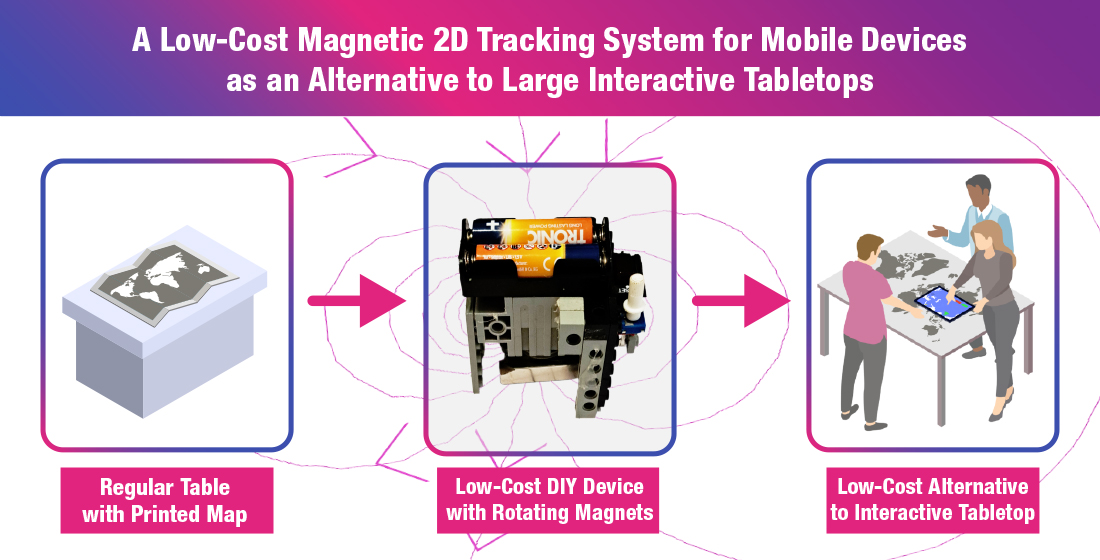
A Low-Cost Magnetic 2D Tracking System for Mobile Devices as an Alternative to Large Interactive Tabletops


Abstract
1. Introduction
2. Previous Work and SPART Prototypes
- 1.
- Accuracy: To maintain the illusion of virtual elements in physical space, the mean Euclidean distance between real and calculated position should not exceed 1 cm.
- 2.
- Fluidity: When moved across the underlying surface, an update rate of 10 Hz or better should be achieved.
- 3.
- Minimum operating range: The A3 format is a standard size for printed media in Europe (29.7 × 42 cm). The technology should thus operate across such a surface.
- 4.
- Mobility: To support either meetings or situated learning in a variety of settings, the technology should be compact and portable, with a weight of less than 500 g and dimensions not exceeding those of a notebook (A4).
- 5.
- Affordability: For successful deployment in educational settings, the device cost should not exceed €50 per unit.
- 6.
- Do-It-Yourself (DIY) & Reparability: The production and assembly of a prototype should be possible for students or educators. Components should be easily available.
- 7.
- Multi-device support: Multiple devices can be located simultaneously (minimum two).
3. SPART-MAR Prototype Design
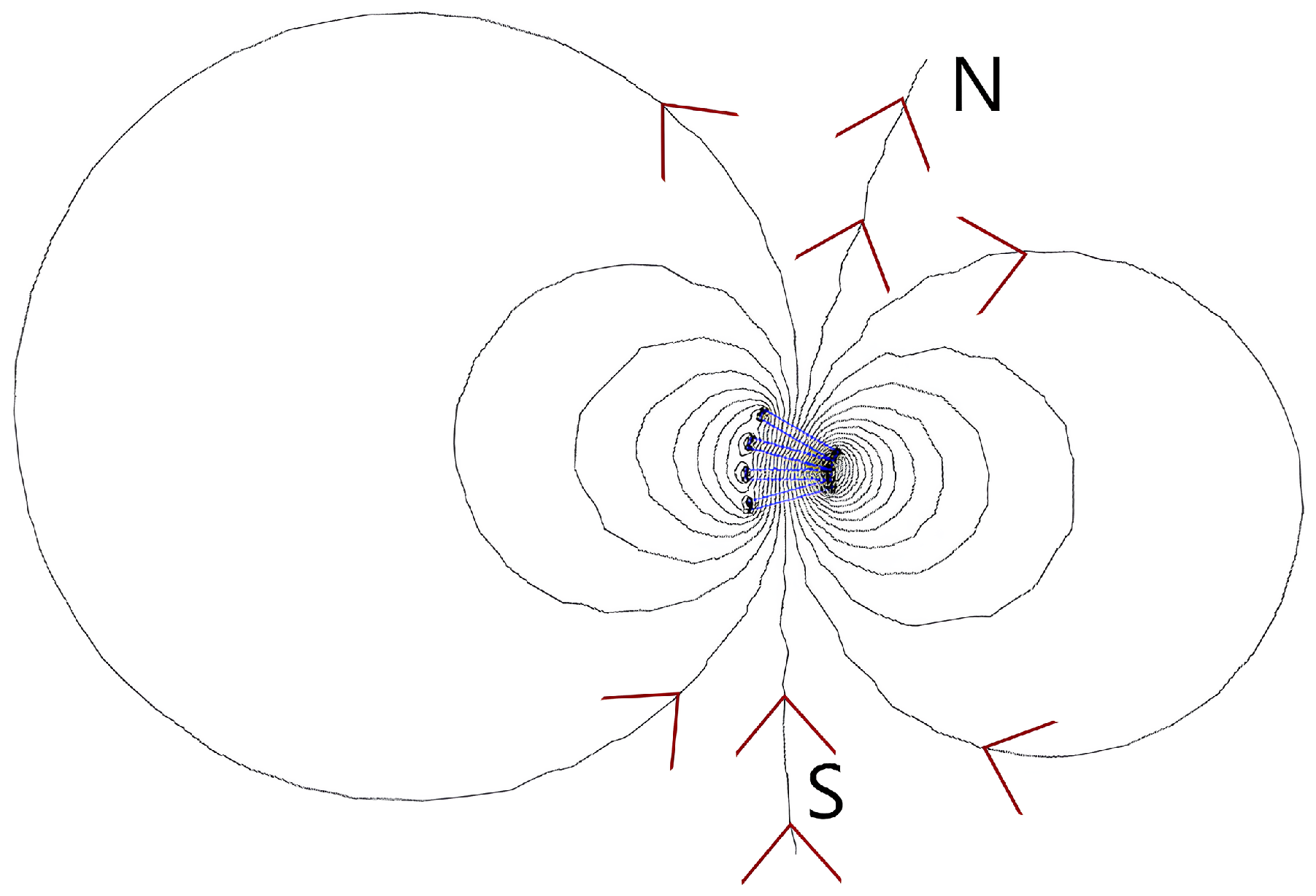
3.1. Localization Technique and Technology
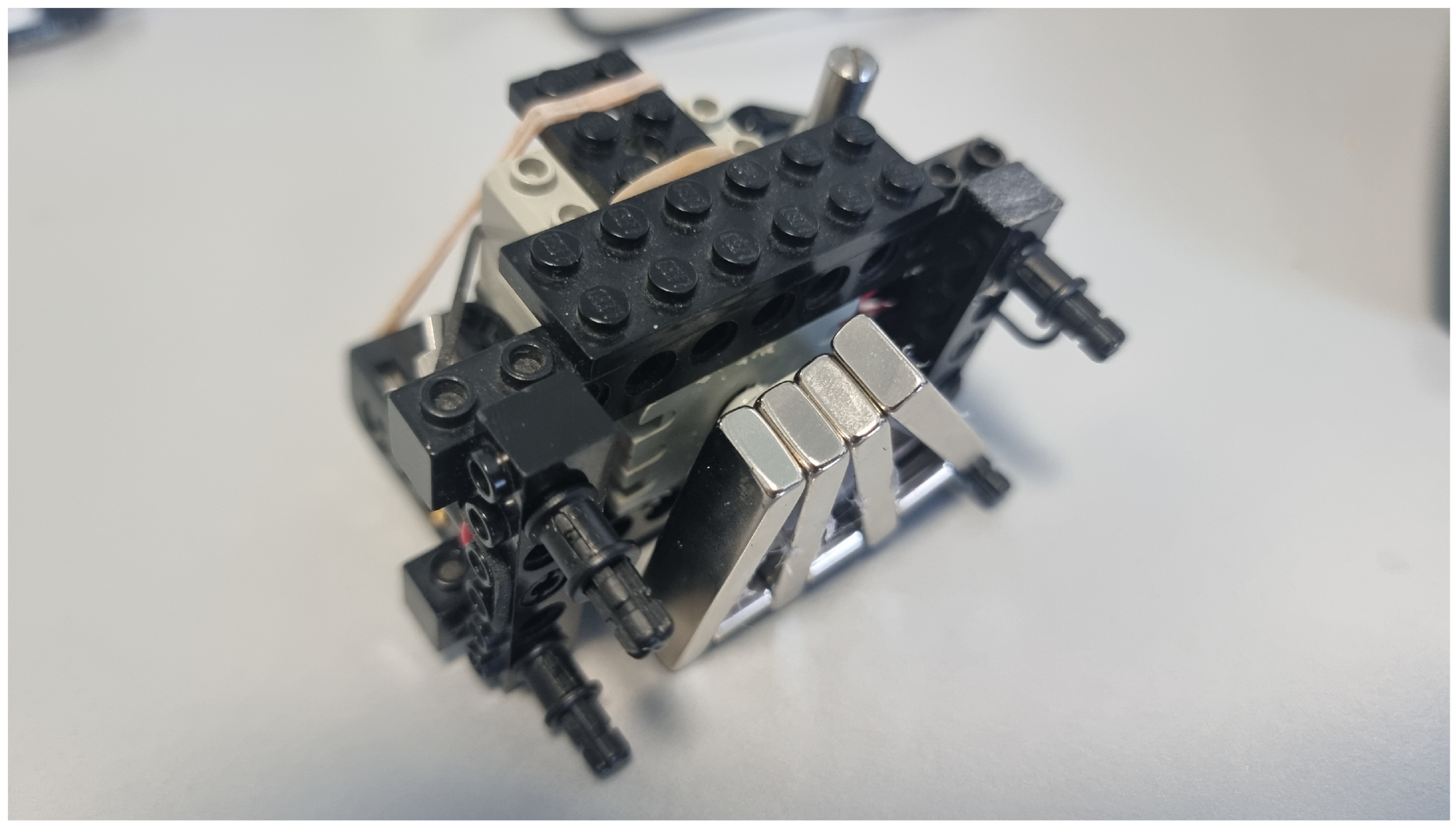
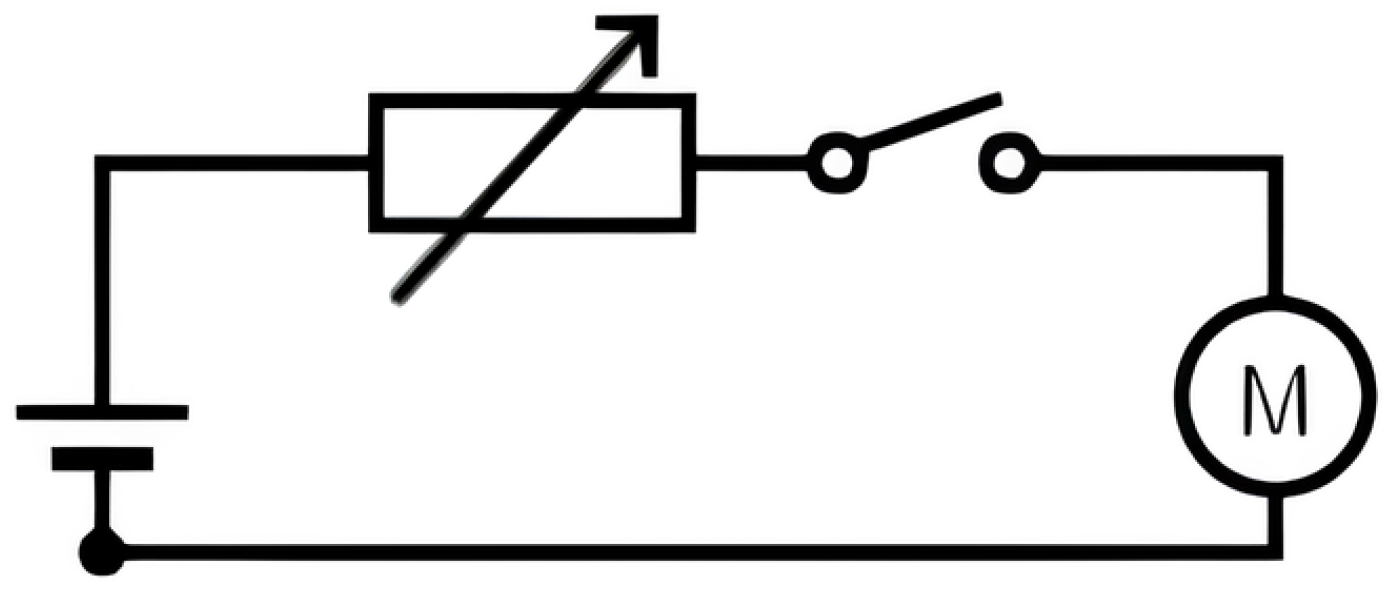
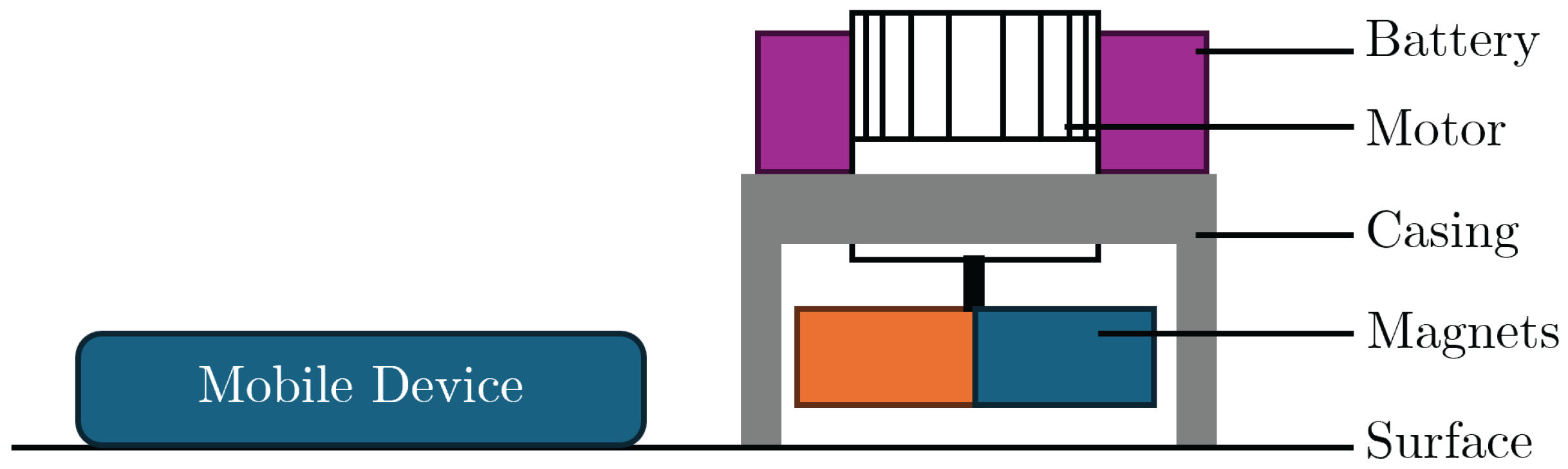
3.2. Circuit and Prototype Design
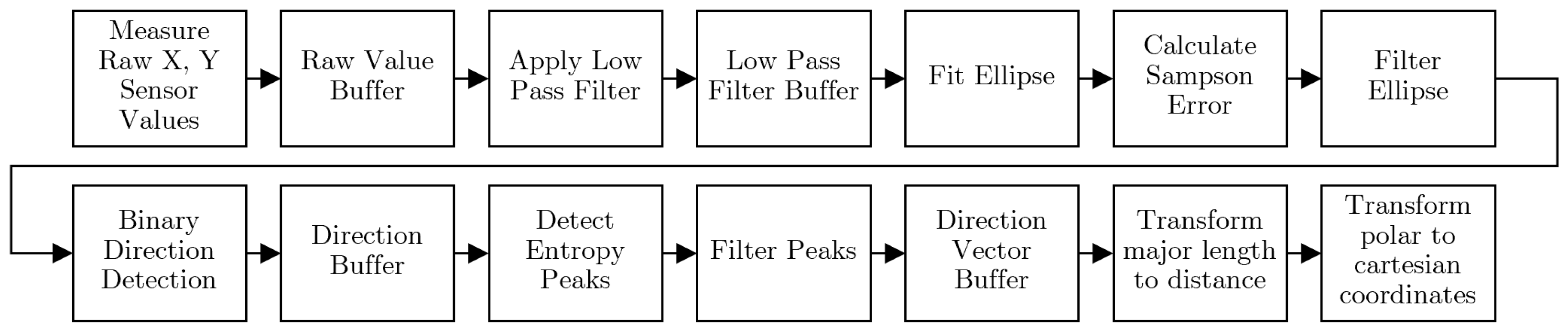
3.3. Algorithm
- 1.
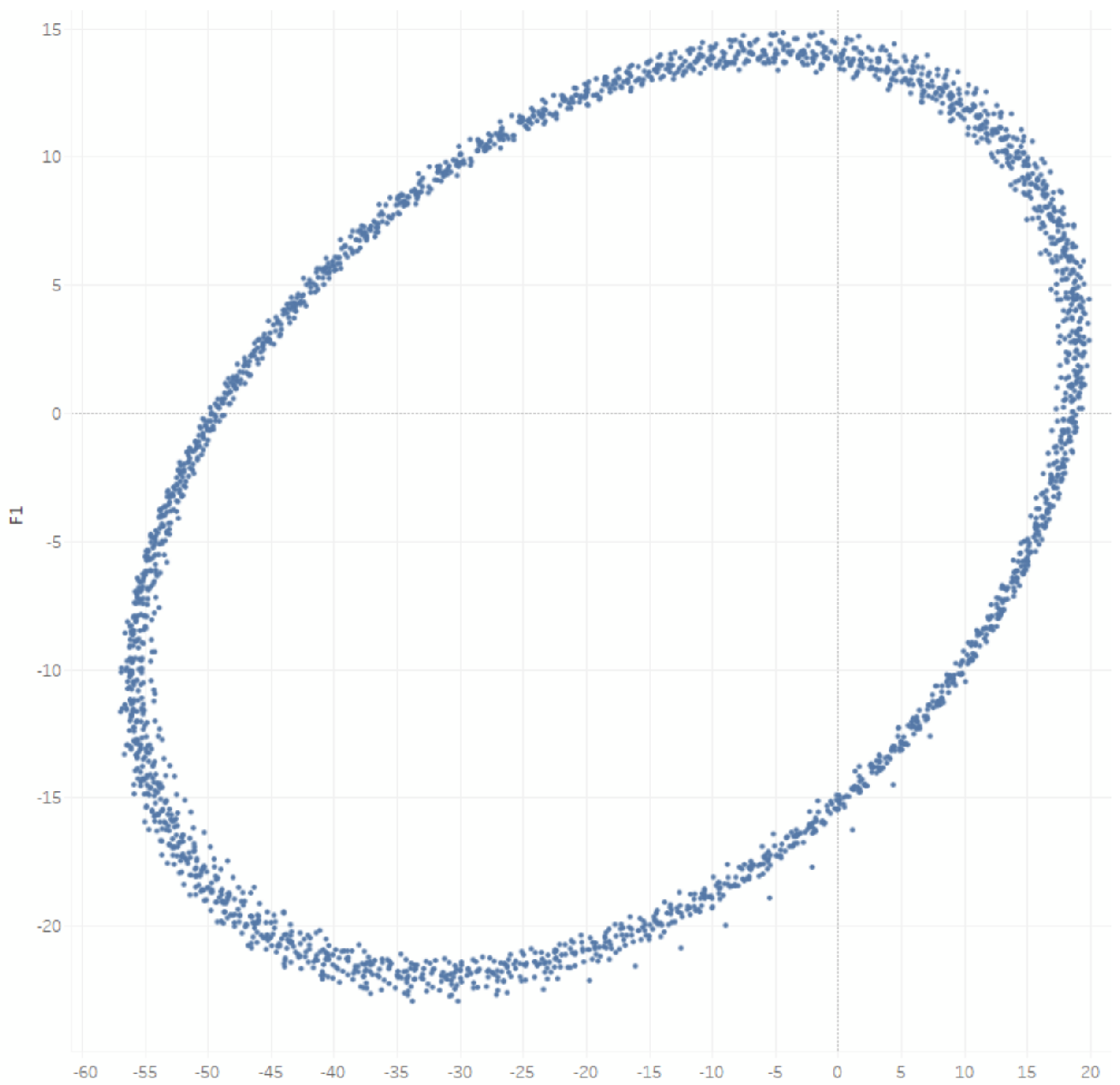
- Calibration: Establish a function to map the ellipse major length to the distance.
- 2.
- Ellipse detection: Establishes whether the device is in range of SPART-MAR.
- 3.
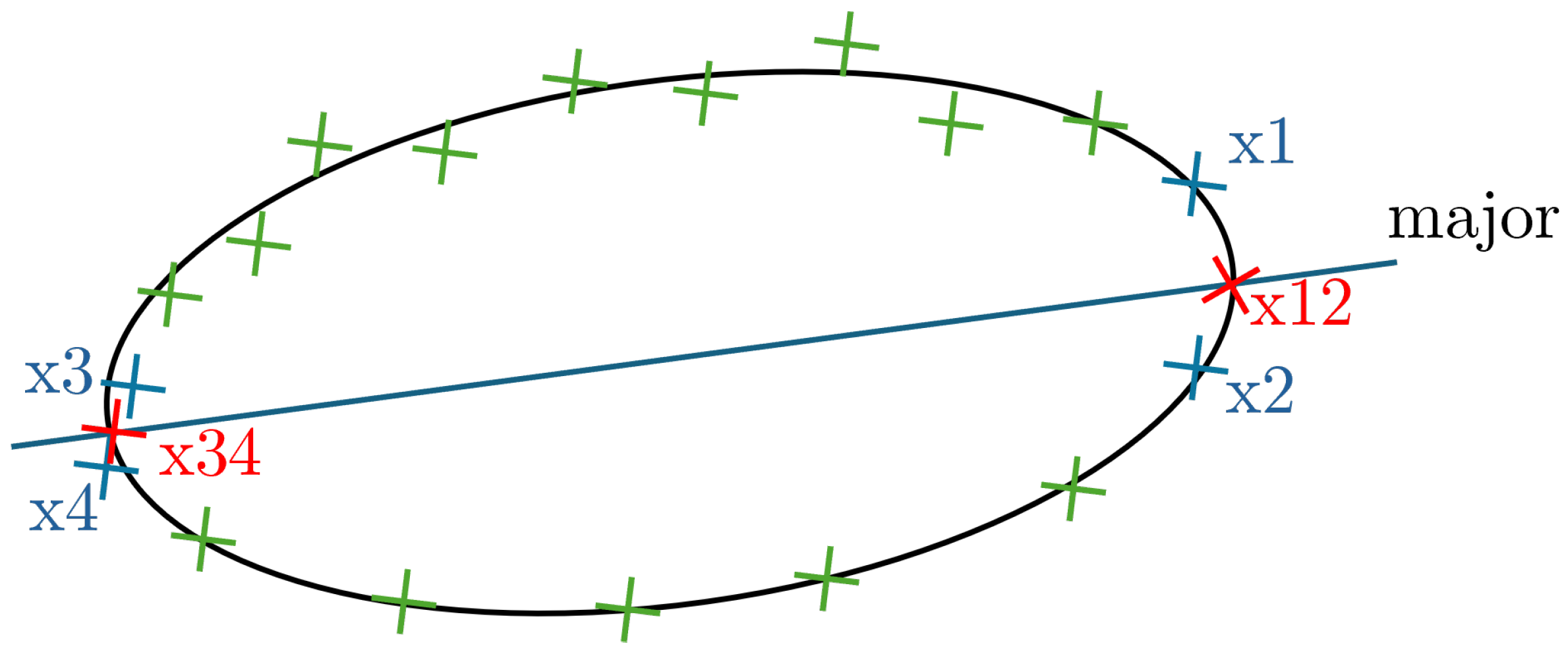
- Ellipse fitting: Given the data of one rotation, determine the best-fitting ellipse’s major angle and length.
- 4.
- Direction detection: Convert the ellipse major in a vector by determining in which of the two possible directions the prototype is located.
3.3.1. Calibration
3.3.2. Ellipse Detection
3.3.3. Ellipse Fitting
3.3.4. Ellipse Major Direction
- 1.
- Distance-based: for each complete ellipse, we calculate the sequence of data points with the maximum average distance.
- 2.
- Time-based: each sensor value is timestamped and we calculate the time difference between two semi-rotations.
4. Evaluation Methods
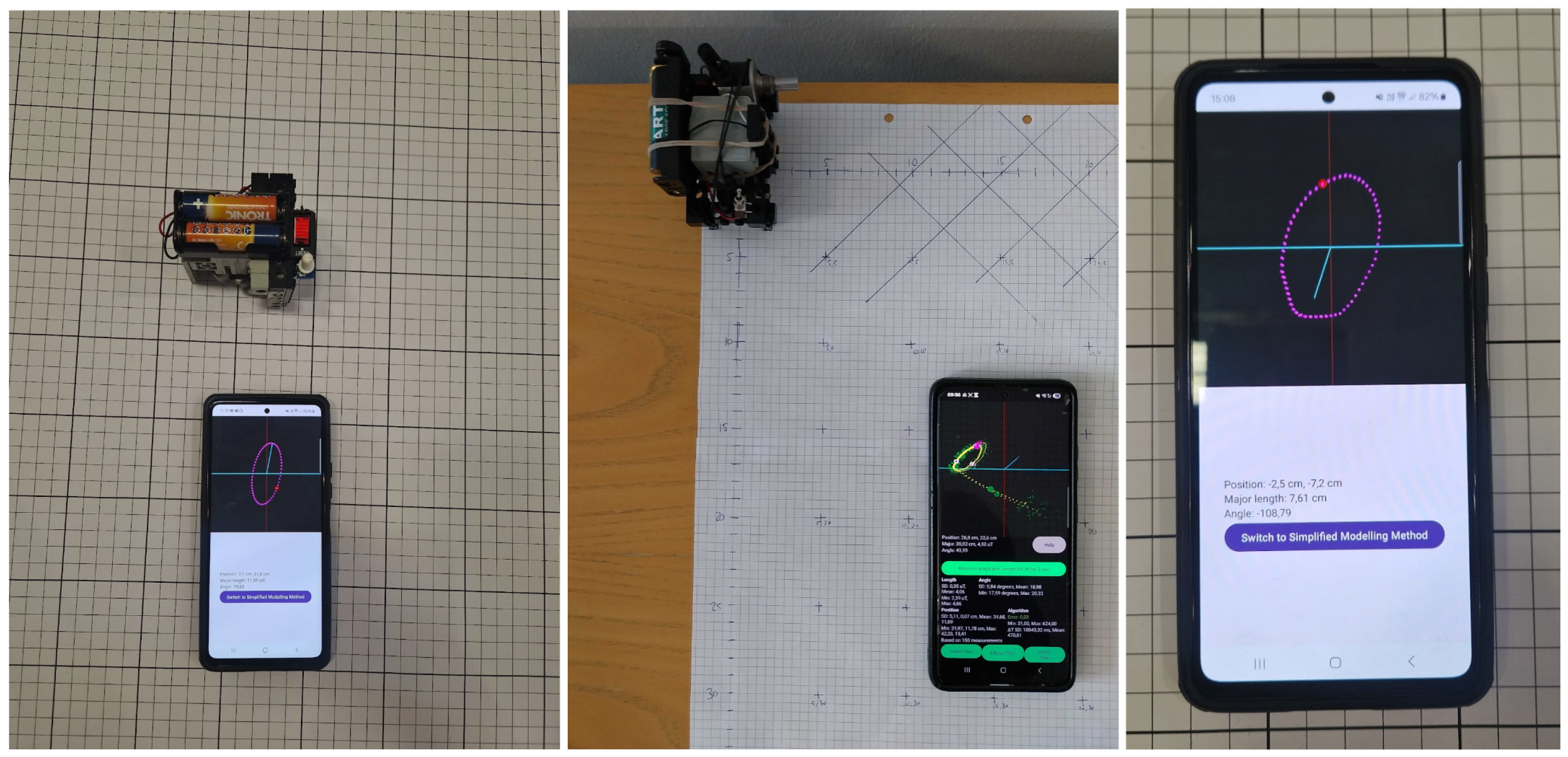
4.1. Prototype and Experimental Setup
- Samsung S21 Ultra running Android 15, dimensions 165.1 × 75.6 × 8.9 mm.
- Samsung A53 running Android 14 smartphone, dimensions 159.6 × 8.1 × 74.8 mm.
4.2. Experimental Procedures and Data Collection
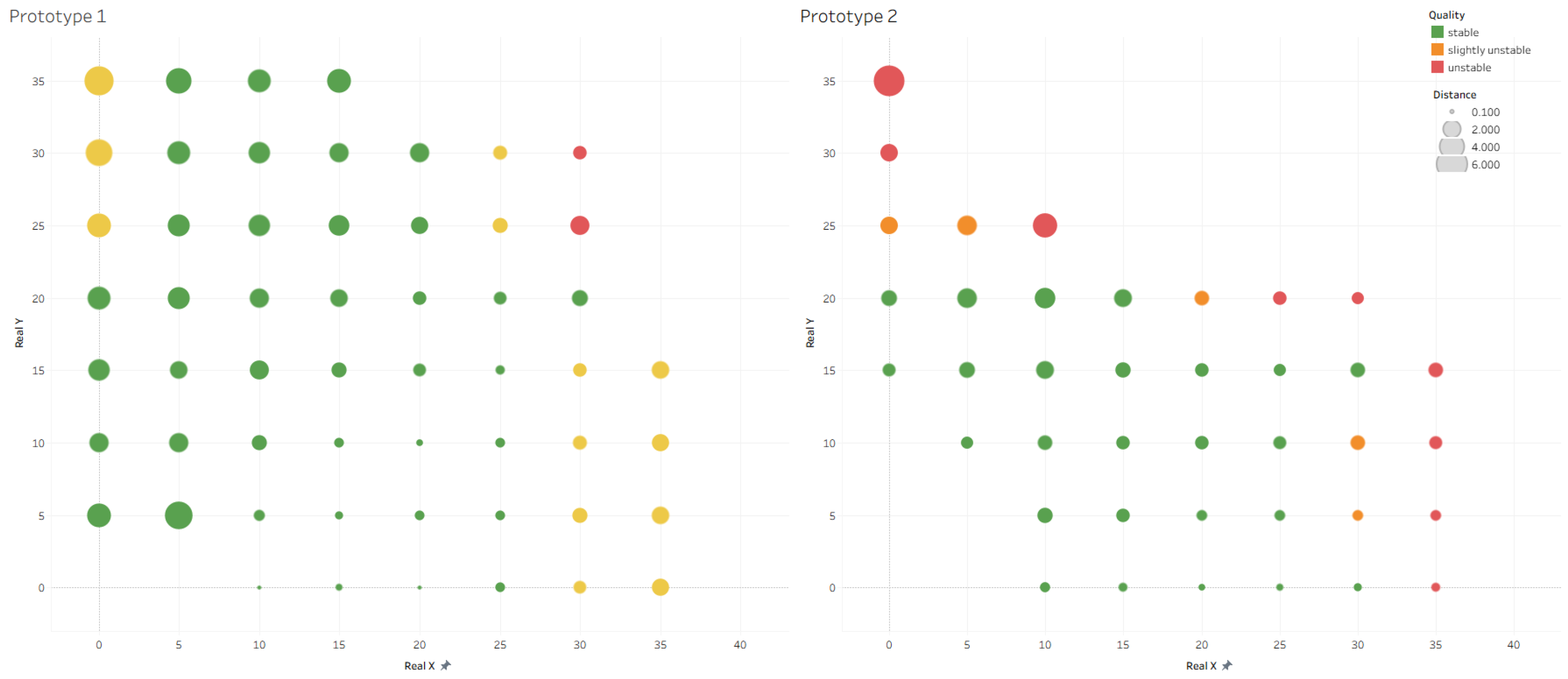
- Positioning accuracy testing: comparing the ground-truth distances recorded on the measurement grid with the corresponding values estimated by the application (evaluating criteria 1—Accuracy).
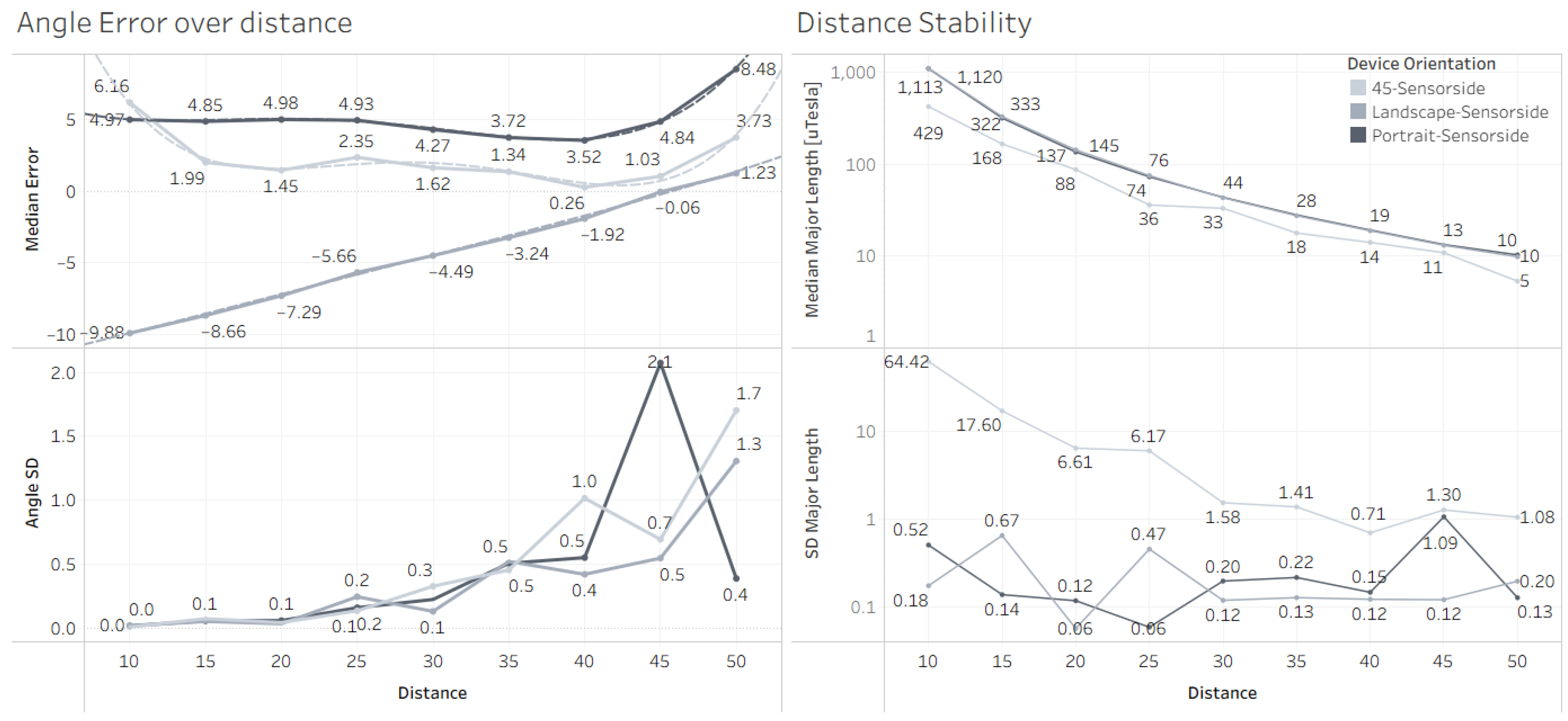
- Distance testing: assessing the maximum operational range of the prototype relative to the device (criteria 3—Minimum operating range).
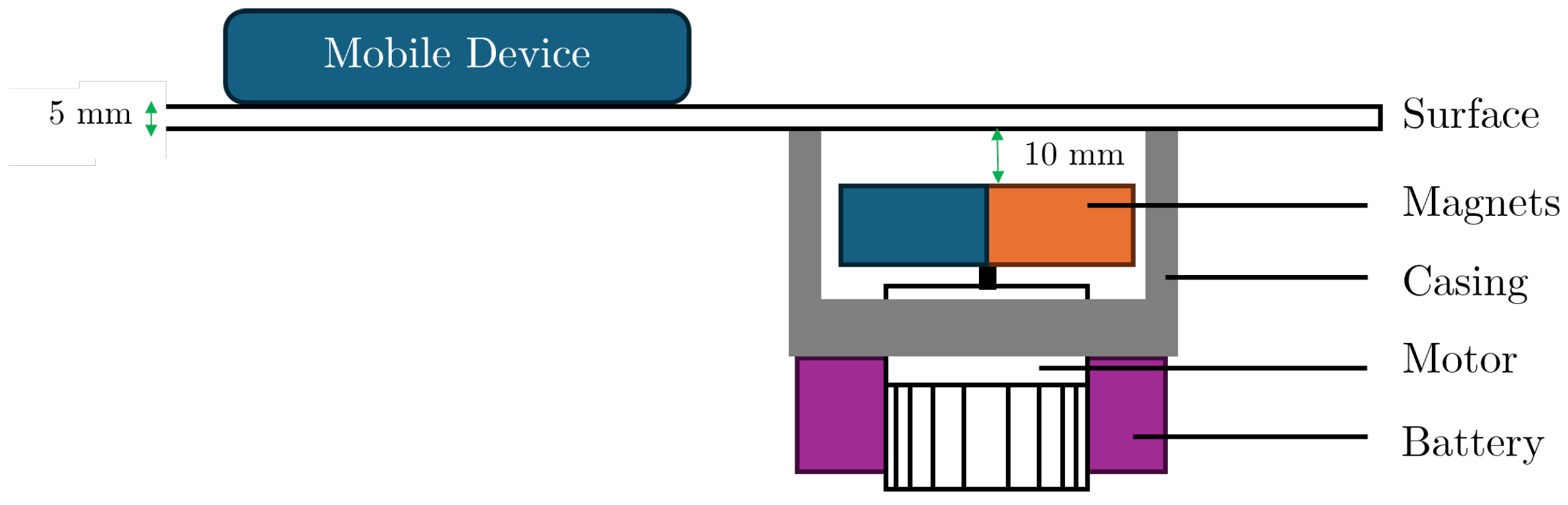
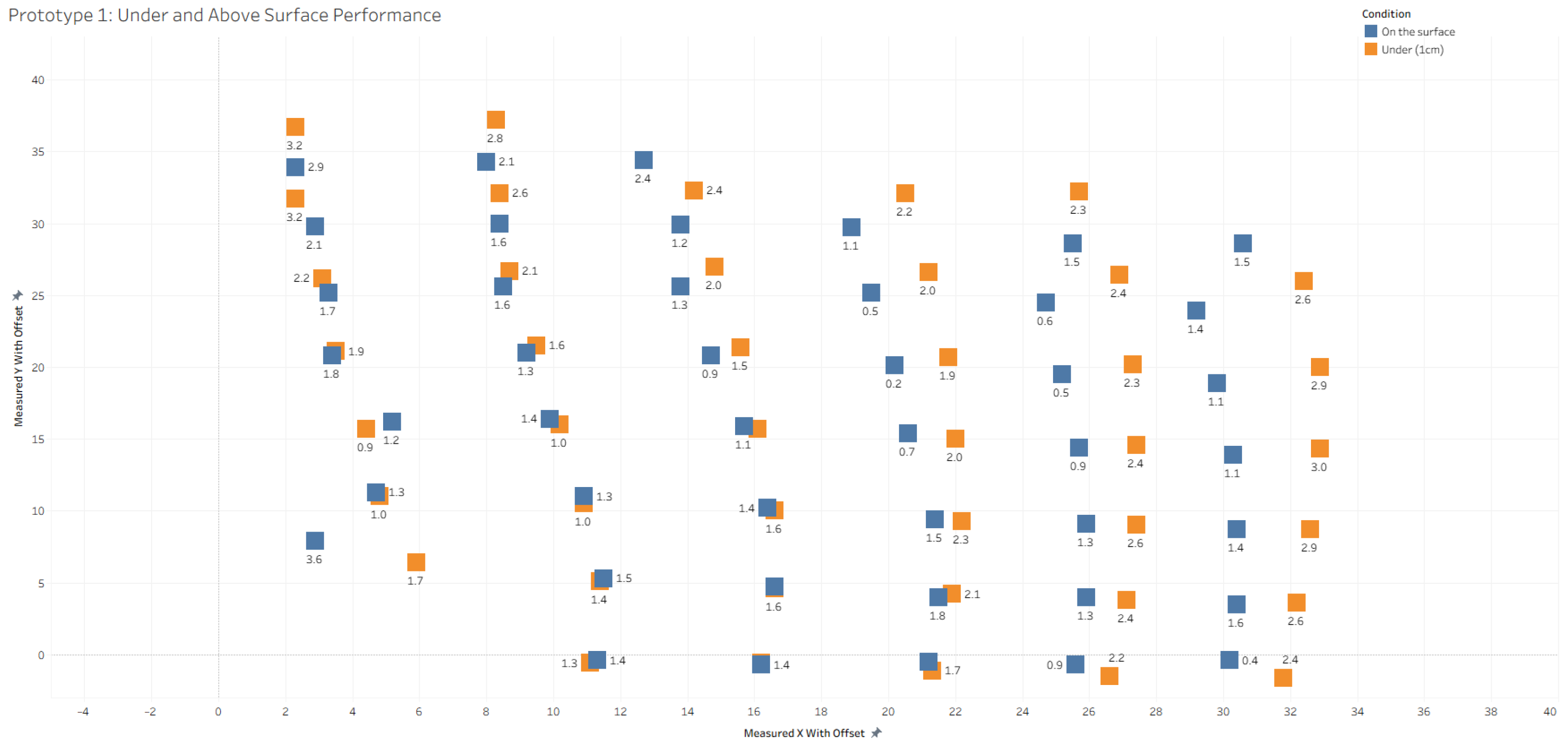
- Obstruction testing: placing the prototype beneath a 5 mm KAPA®fix board.
5. Data Analysis
5.1. Accuracy
5.2. Stability and Range
5.3. Additional Experiments
5.3.1. Non-Obstructive Performance
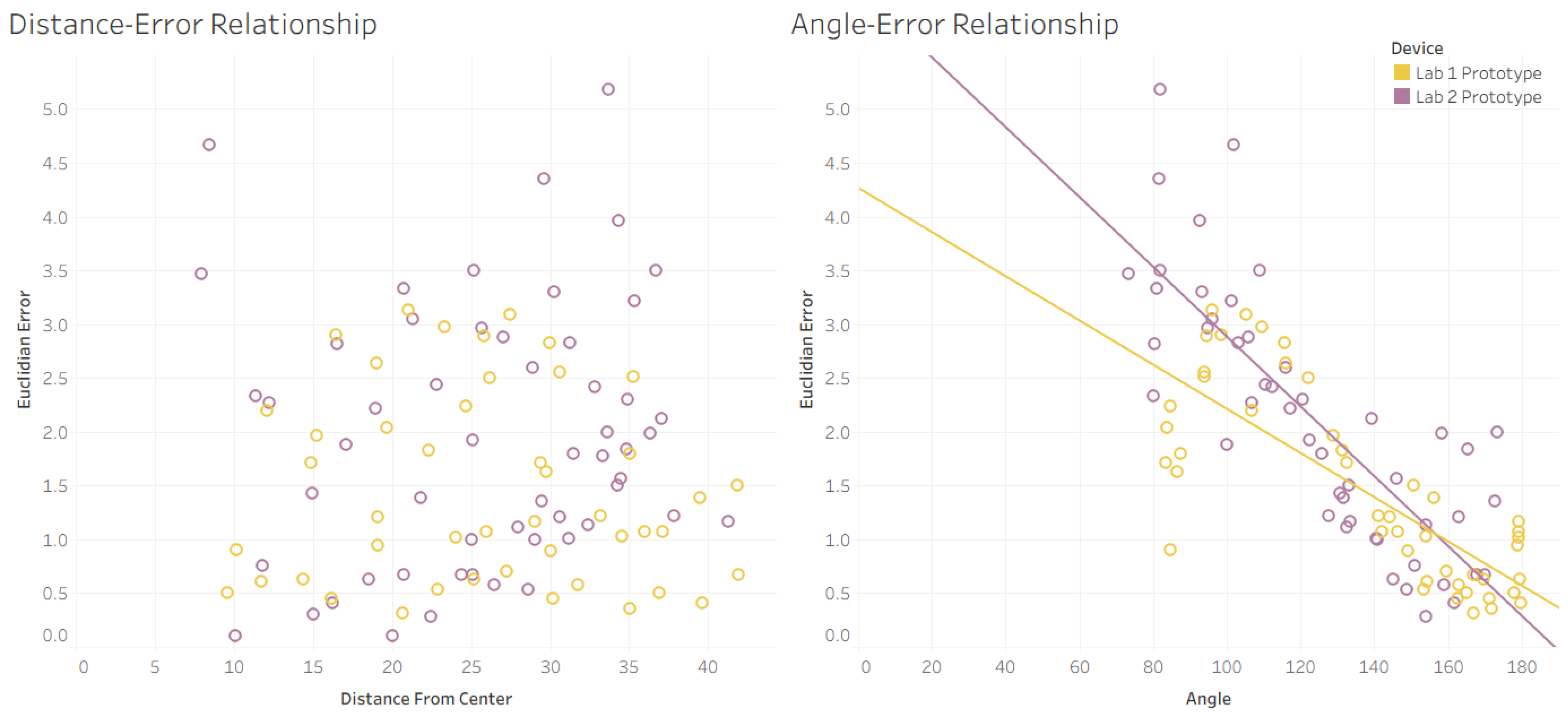
5.3.2. Angle and Length Errors
5.3.3. Investigations into Direction Stability
5.3.4. Alternative Magnetic Position Indicators
6. Discussion
7. Conclusions and Future Work
Author Contributions
Funding
Institutional Review Board Statement
Informed Consent Statement
Data Availability Statement
Acknowledgments
Conflicts of Interest
References
- Thornhill-Miller, B.; Camarda, A.; Mercier, M.; Burkhardt, J.M.; Morisseau, T.; Bourgeois-Bougrine, S.; Vinchon, F.; El Hayek, S.; Augereau-Landais, M.; Mourey, F.; et al. Creativity, Critical Thinking, Communication, and Collaboration: Assessment, Certification, and Promotion of 21st Century Skills for the Future of Work and Education. J. Intell. 2023, 11, 54. [Google Scholar] [CrossRef]
- Kivunja, C. Exploring the Pedagogical Meaning and Implications of the 4Cs “Super Skills” for the 21st Century through Bruner’s 5E Lenses of Knowledge Construction to Improve Pedagogies of the New Learning Paradigm. Creat. Educ. 2015, 6, 224–239. [Google Scholar] [CrossRef]
- Johnson-Lenz, P.; Johnson-Lenz, T. Post-mechanistic groupware primitives: Rhythms, boundaries and containers. Int. J. Man-Mach. Stud. 1991, 34, 395–417. [Google Scholar] [CrossRef]
- Sugimoto, M.; Hosoi, K.; Hashizume, H. Caretta: A System for Supporting Face-to-Face Collaboration by Integrating Personal and Shared Spaces. In Proceedings of the SIGCHI Conference on Human Factors in Computing Systems, Vienna, Austria, 24–29 April 2004; CHI’04. pp. 41–48. [Google Scholar] [CrossRef]
- Dietz, P.; Leigh, D. DiamondTouch: A multi-user touch technology. In Proceedings of the 14th Annual ACM Symposium on User Interface Software and Technology, Orlando, FL, USA, 11–14 November 2001; UIST ’01. pp. 219–226. [Google Scholar] [CrossRef]
- Samsung. Écran Numérique Interactif Samsung Flip|Samsung Professionnels FR. 2024. Available online: https://www.samsung.com/fr/business/smart-signage/samsung-flip/ (accessed on 11 April 2025).
- Ahsanullah; Sulaiman, S.; Mahmood, A.K.B.; Khan, M.; Madni, M. Applications of Multi-Touch Tabletop Displays and Their Challenging Issues: An Overview. Int. J. Smart Sens. Intell. Syst. 2015, 8, 966–991. [Google Scholar] [CrossRef]
- European Comission. Survey on Using Mobile Phones in Schools—Results| European School Education Platform. 2025. Available online: https://school-education.ec.europa.eu/en/discover/surveys/mobile-phones-schools (accessed on 2 July 2025).
- Riaz, S. Developers Losing Interest in Windows Phone Platform. Available online: https://www.mobileworldlive.com/news-apps/developers-losing-interest-windows-phone-platform-says-study/ (accessed on 20 September 2025).
- Cardoza, C. Developers Losing Interest in Google Glass, Report Finds. Available online: https://sdtimes.com/google/developers-losing-interest-google-glass-report-finds/ (accessed on 20 September 2025).
- Makransky, G.; Mayer, R.E. Benefits of Taking a Virtual Field Trip in Immersive Virtual Reality: Evidence for the Immersion Principle in Multimedia Learning. Educ. Psychol. Rev. 2022, 34, 1771–1798. [Google Scholar] [CrossRef]
- Kumar, K.; Pande, B.P. Rise of Online Teaching and Learning Processes During COVID-19 Pandemic. In Predictive and Preventive Measures for COVID-19 Pandemic; Khosla, P.K., Mittal, M., Sharma, D., Goyal, L.M., Eds.; Springer: Singapore, 2021; pp. 251–271. [Google Scholar] [CrossRef]
- Dillenbourg, P.; Evans, M. Interactive tabletops in education. Int. J. Comput.-Support. Collab. Learn. 2011, 6, 491–514. [Google Scholar] [CrossRef]
- Afkari, H.; Maquil, V.; Arend, B.; Heuser, S.; Sunnen, P. Designing different features of an interactive tabletop application to support collaborative problem-solving. In Proceedings of the AVI ’20: International Conference on Advanced Visual Interfaces, Salerno, Italy, 28 September–2 October 2020. [Google Scholar] [CrossRef]
- Sung, Y.T.; Yang, J.M.; Lee, H.Y. The Effects of Mobile-Computer-Supported Collaborative Learning: Meta-Analysis and Critical Synthesis. Rev. Educ. Res. 2017, 87, 768–805. [Google Scholar] [CrossRef] [PubMed]
- Stewart, J.; Bederson, B.B.; Druin, A. Single display groupware: A model for co-present collaboration. In Proceedings of the SIGCHI Conference on Human Factors in Computing Systems, Pittsburgh, PA, USA, 15–20 May 1999; CHI ’99. pp. 286–293. [Google Scholar] [CrossRef]
- Infante, C.; Weitz, J.; Reyes, T.; Nussbaum, M.; Gómez, F.; Radovic, D. Co-located collaborative learning video game with single display groupware. Interact. Learn. Environ. 2010, 18, 177–195. [Google Scholar] [CrossRef]
- Caballero, D.; van Riesen, S.A.N.; Álvarez, S.; Nussbaum, M.; de Jong, T.; Alario-Hoyos, C. The effects of whole-class interactive instruction with Single Display Groupware for Triangles. Comput. Educ. 2014, 70, 203–211. [Google Scholar] [CrossRef]
- Čarapina, M.; Pap, K. Exploring Colocated Synchronous Use of Tablets Based on Split Screen Feature. IEEE Access 2023, 11, 123418–123432. [Google Scholar] [CrossRef]
- Simon, S.; Marfisi-Schottmann, I.; George, S. Spart—An Affordable Mobile Augmented Reality Alternative to Interactive Tabletops in Education. In Proceedings of the Mobile Learning Proceedings, Porto, Portugal, 9–11 March 2024. [Google Scholar]
- Fleck, R.; Vasalou, A.; Stasinou, K. Tablet for two: How do children collaborate around single player tablet games? Int. J. Hum.-Comput. Stud. 2021, 145, 102539. [Google Scholar] [CrossRef]
- Melero, J.; Hernández-Leo, D.; Manatunga, K. Group-based mobile learning: Do group size and sharing mobile devices matter? Comput. Hum. Behav. 2015, 44, 377–385. [Google Scholar] [CrossRef]
- Spindler, M.; Büschel, W.; Winkler, C.; Dachselt, R. Tangible displays for the masses: Spatial interaction with handheld displays by using consumer depth cameras. Pers. Ubiquitous Comput. 2014, 18, 1213–1225. [Google Scholar] [CrossRef]
- Babic, T.; Reiterer, H.; Haller, M. Understanding and Creating Spatial Interactions with Distant Displays Enabled by Unmodified Off-The-Shelf Smartphones. Multimodal Technol. Interact. 2022, 6, 94. [Google Scholar] [CrossRef]
- Wieland, J. Designing and Evaluating Interactions for Handheld AR. In Proceedings of the Companion Proceedings of the 2023 Conference on Interactive Surfaces and Spaces, Pittsburgh, PA, USA, 5–8 November 2023; ISS Companion ’23. pp. 100–103. [Google Scholar] [CrossRef]
- Platinsky, L.; Szabados, M.; Hlasek, F.; Hemsley, R.; Pero, L.D.; Pancik, A.; Baum, B.; Grimmett, H.; Ondruska, P. Collaborative Augmented Reality on Smartphones via Life-long City-scale Maps. In Proceedings of the 2020 IEEE International Symposium on Mixed and Augmented Reality (ISMAR), Virtual, 9–13 November 2020; pp. 533–541. [Google Scholar] [CrossRef]
- Ma, X.; Liu, J.; Liang, J.; Fan, C. An empirical study on the effect of group awareness in CSCL environments. Interact. Learn. Environ. 2023, 31, 38–53. [Google Scholar] [CrossRef]
- Pereira, A.; Miller, T.; Huang, Y.M.; Odell, D.; Rempel, D. Holding a tablet computer with one hand: Effect of tablet design features on biomechanics and subjective usability among users with small hands. Ergonomics 2013, 56, 1363–1375. [Google Scholar] [CrossRef]
- Rädle, R.; Jetter, H.C.; Marquardt, N.; Reiterer, H.; Rogers, Y. HuddleLamp: Spatially-Aware Mobile Displays for Ad-hoc Around-the-Table Collaboration. In Proceedings of the Ninth ACM International Conference on Interactive Tabletops and Surfaces, New Dresden, Germany, 16–19 November 2014; ITS ’14. pp. 45–54. [Google Scholar] [CrossRef]
- Mehra, S.; Werkhoven, P.; Worring, M. Navigating on handheld displays: Dynamic versus static peephole navigation. ACM Trans.-Comput.-Hum. Interact. 2006, 13, 448–457. [Google Scholar] [CrossRef]
- Kang, B.; Kim, J.; Yun, T.R.; Bae, H.; Kim, C.E. Identifying Features that Shape Perceived Consciousness in Large Language Model-based AI: A Quantitative Study of Human Responses. arXiv 2025, arXiv:2502.15365. [Google Scholar] [CrossRef]
- Sekimori, D.; Miyazaki, F. Precise Dead-Reckoning for Mobile Robots using Multiple Optical Mouse Sensors. In Informatics in Control, Automation and Robotics II; Filipe, J., Ferrier, J.L., Cetto, J.A., Carvalho, M., Eds.; Springer: Dordrecht, The Netherlands, 2007; pp. 145–151. [Google Scholar] [CrossRef]
- Nandakumar, R.; Iyer, V.; Tan, D.; Gollakota, S. FingerIO: Using Active Sonar for Fine-Grained Finger Tracking. In Proceedings of the 2016 CHI Conference on Human Factors in Computing Systems, San Jose, CA, USA, 7–12 May 2016; pp. 1515–1525. [Google Scholar] [CrossRef]
- Wang, S.; Yang, P.; Sun, H. Fingerprinting Acoustic Localization Indoor Based on Cluster Analysis and Iterative Interpolation. Appl. Sci. 2018, 8, 1862. [Google Scholar] [CrossRef]
- Chen, C.; Chen, Y.; Lai, H.Q.; Han, Y.; Liu, K.R. High accuracy indoor localization: A WiFi-based approach. In Proceedings of the 2016 IEEE International Conference on Acoustics, Speech and Signal Processing (ICASSP), Shanghai, China, 20–25 March 2016; pp. 6245–6249. [Google Scholar] [CrossRef]
- Syed, T.A.; Siddiqui, M.S.; Abdullah, H.B.; Jan, S.; Namoun, A.; Alzahrani, A.; Nadeem, A.; Alkhodre, A.B. In-Depth Review of Augmented Reality: Tracking Technologies, Development Tools, AR Displays, Collaborative AR, and Security Concerns. Sensors 2023, 23, 146. [Google Scholar] [CrossRef]
- Simon, S. Collaborative Learning in Mobile Settings: Conceptual Framework and Design of an Innovative Device to Augment Flat Visual Representations. Ph.D. Thesis, Le Mans University, Le Mans, France, 2024. [Google Scholar]
- Halíř, R.; Flusser, J.; Halíř, R.; Flusser, J. Numerically stable direct least squares fitting of ellipses. In Proceedings of the 6th International Conference in Central Europe on Computer Graphics and Visualization, WSCG ’98, Plzen, Czech Republic, 9–13 February 1998. [Google Scholar]
- Fitzgibbon, A.; Pilu, M.; Fisher, R. Direct least square fitting of ellipses. IEEE Trans. Pattern Anal. Mach. Intell. 1999, 21, 476–480. [Google Scholar] [CrossRef]
- Hemsi, K.T. Robust Computational Intelligence Techniques for Visual Information Processing. Ph.D. Thesis, Universidad de Málaga, Malaga, Spain, 2021. Available online: https://riuma.uma.es/xmlui/handle/10630/21791 (accessed on 30 June 2025).





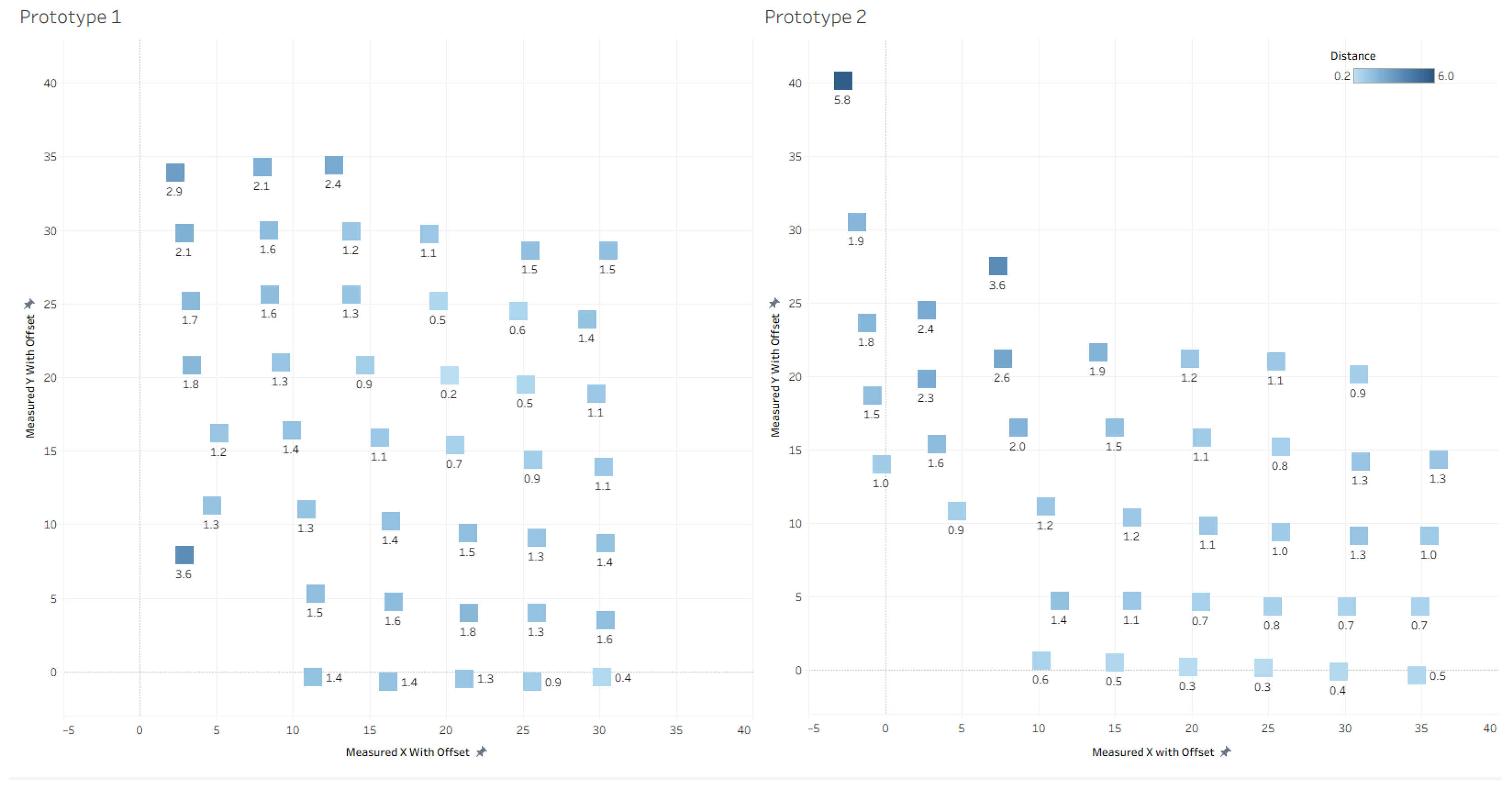
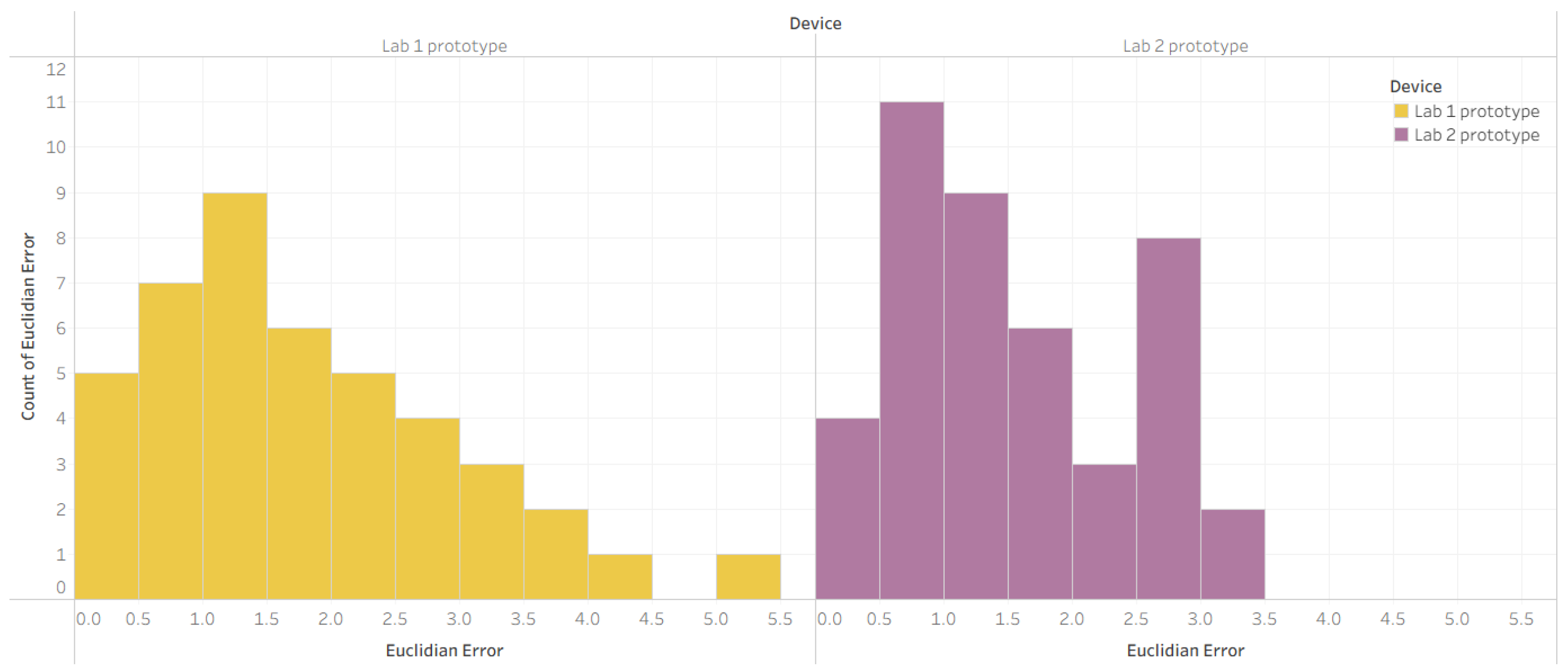



| Accuracy | The current error is situated between 1.3–1.6 cm across two different prototypes and smartphones, and thus does not fulfill the threshold of 1 cm. |
| Fluidity | The current update rate, only at rest, is below 1 Hz and thus not sufficient. |
| Minimum operating range | The current prototype operates reliably in a radius of 25 cm, of which the inner ring of 5 cm is not accessible due to sensor saturation and obstruction, leaving an operational area of 1885 cm2. The required surface of an A3 is 1247 cm2. Although the covered surface is larger, it is not rectangular. The requirement is thus partly met. |
| Mobility | The prototype is mobile (weight is around 500 g), and the requirement is thus met. |
| Affordability | Components can be ordered for less than €10. |
| DIY & Reparability | The prototype can be built nearly entirely with LEGO components. Soldering can thus be avoided entirely. |
| Multi-device support | Multiple devices can be located simultaneously. |
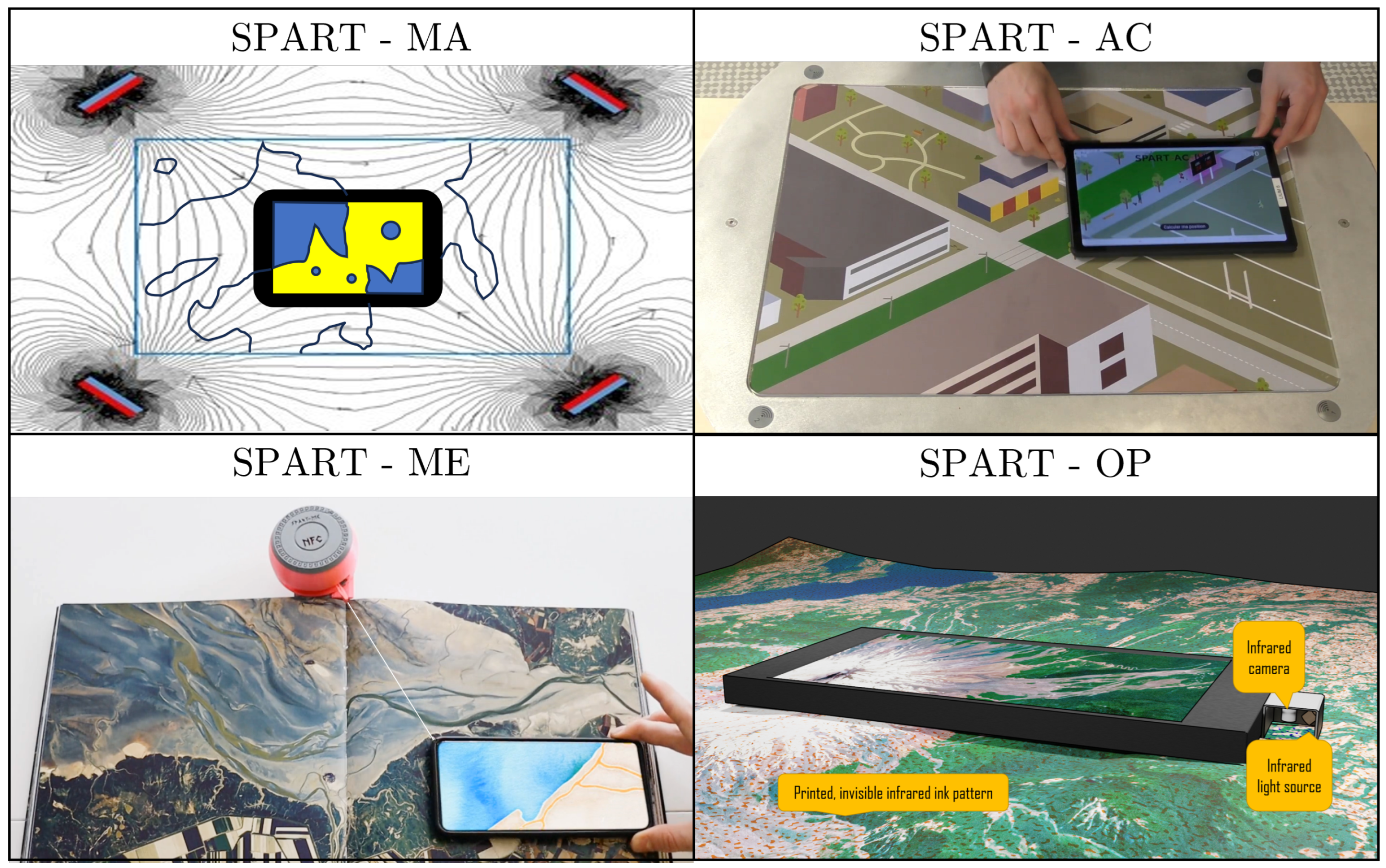
| Criterion/System | SPART-MAR (This Work) | SPART-ME (Mechanical) | SPART-AC (Acoustic) |
|---|---|---|---|
| Accuracy | 1–3 % (on axis) | ≤0.5 cm | Highly variable |
| Fluidity / Update rate | ∼1 Hz (device at rest) | Smooth, real-time | None, updates only at rest) |
| Operating range | 25–30 cm radius | Full A3 surface | Full A3 surface |
| Mobility | High (compact; <500 g) | Moderate (rigid support required) | None (20 kg) |
| DIY / Reproducibility | Very high (BLE/OVD print; <10, minimal electronics) | Moderate (complex assembly and calibration) | Low (microphone array and circuit cost €100) |
| Multi-device support | Yes | Limited (one thread per device) | No (single device) |
| Dependence on external hardware | None (uses magnetometer only) | External Bluetooth chipset | Microphone array, sound processing on external, Bluetooth enabled hardware |
| Overall contribution | First wireless SPART implementation; low-cost and portable | High accuracy and fluidity | Conceptual proof-of-concept, not yet practical |
Disclaimer/Publisher’s Note: The statements, opinions and data contained in all publications are solely those of the individual author(s) and contributor(s) and not of MDPI and/or the editor(s). MDPI and/or the editor(s) disclaim responsibility for any injury to people or property resulting from any ideas, methods, instructions or products referred to in the content. |
© 2025 by the authors. Licensee MDPI, Basel, Switzerland. This article is an open access article distributed under the terms and conditions of the Creative Commons Attribution (CC BY) license (https://creativecommons.org/licenses/by/4.0/).
Share and Cite
Simon, S.; Čarapina, M.; Plehati, S.; Marfisi, I. A Low-Cost Magnetic 2D Tracking System for Mobile Devices as an Alternative to Large Interactive Tabletops. Electronics 2025, 14, 4586. https://doi.org/10.3390/electronics14234586
Simon S, Čarapina M, Plehati S, Marfisi I. A Low-Cost Magnetic 2D Tracking System for Mobile Devices as an Alternative to Large Interactive Tabletops. Electronics. 2025; 14(23):4586. https://doi.org/10.3390/electronics14234586
Chicago/Turabian StyleSimon, Sebastian, Mia Čarapina, Silvio Plehati, and Iza Marfisi. 2025. "A Low-Cost Magnetic 2D Tracking System for Mobile Devices as an Alternative to Large Interactive Tabletops" Electronics 14, no. 23: 4586. https://doi.org/10.3390/electronics14234586
APA StyleSimon, S., Čarapina, M., Plehati, S., & Marfisi, I. (2025). A Low-Cost Magnetic 2D Tracking System for Mobile Devices as an Alternative to Large Interactive Tabletops. Electronics, 14(23), 4586. https://doi.org/10.3390/electronics14234586